 Location :
Orlando, FL, USA
Location :
Orlando, FL, USA +1 (407) 714-1616
 info@biz4group.com

- AI avatars vs traditional chatbots in healthcare comes down to interaction depth. AI avatars deliver human like patient interaction, while chatbots focus on basic automation.
- Why AI avatars are better than chatbots in healthcare shows in engagement and trust. Avatars improve healthcare customer experience using voice, visuals, and context.
- Traditional chatbots in healthcare still work for FAQs and scheduling but struggle with personalization and complex conversations.
- AI avatar vs chatbot implementation cost differs over time. Chatbots cost less upfront, while AI avatars provide stronger long term ROI.
- When choosing between AI avatars and chatbots for healthcare services, many teams partner with Biz4Group LLC to build scalable, future ready conversational AI.
Have you ever noticed how patients stop engaging once a chatbot gives a few generic replies?
Speed helps, but in healthcare, speed without empathy feels incomplete. Patients want clarity, reassurance, and guidance that feels personal. That is why the discussion around AI avatars vs traditional chatbots is becoming more relevant for healthcare leaders in 2026.
Healthcare organizations are no longer asking whether AI should be used. They are asking a more important question. Is our conversational experience built just to answer questions, or to build trust?
This shift is pushing many teams to rethink AI avatars vs traditional chatbots in healthcare, especially for patient facing workflows. More providers are now working with an experienced AI development company to design conversations that feel natural, supportive, and easier for patients to engage with.
The momentum is backed by data.
In 2025, 85 percent of healthcare organizations report moderate to high ROI from AI adoption, largely driven by improved patient engagement and operational efficiency.
At the same time, nearly 80 percent of hospitals are already using AI to improve patient care and internal workflows, showing how deeply AI is shaping everyday healthcare operations.
So, the real question becomes simple - When patients interact with your digital systems, do they feel guided or just processed?
Understanding why AI avatars are better than chatbots in healthcare starts with that answer. When human like interaction is done right, it becomes a core part of scalable and compliant enterprise AI solutions.
Let us now look at what AI avatars actually are and why healthcare leaders are paying attention.
Are your patients still dropping off after the first chat?
In 2025, over 85 percent of healthcare organizations report ROI from AI driven engagement, yet many still lose trust at the conversation layer. Human like interaction fixes that gap.
Talk to an AI ExpertWhat Are AI Avatars and Why Healthcare Is Paying Attention
AI avatars are intelligent digital characters designed to interact with patients in a way that feels conversational, guided, and human. In healthcare, that distinction matters more than ever. Patients are not just looking for answers. They are looking for clarity, reassurance, and confidence at every touchpoint.
This is why the discussion around AI avatars vs traditional chatbots in healthcare is gaining serious attention among healthcare leaders who care about experience, trust, and long-term engagement.
Let us break this down properly.
Types of AI Avatars Used in Healthcare
1. Informational AI Avatars
These avatars focus on delivering clear and structured information. Common uses include treatment explanations, service overviews, insurance guidance, and pre visit education. They work best when accuracy and consistency matter more than personalization. Many healthcare organizations start here by deploying an AI avatar for business reducing repetitive patient questions without increasing staff load.
2. Conversational AI Avatars
Conversational avatars are designed for open-ended dialogue. They respond to follow up questions, clarify patient concerns, and adapt responses in real time. This category directly supports AI avatars for human like patient interaction, where tone, pacing, and flow make conversations feel natural rather than scripted.
3. Task Oriented AI Avatars
These avatars are built to complete actions, not just respond. They can schedule appointments, assist with intake, route requests, and trigger workflows. A common example is the AI receptionist avatar, which helps manage front desk operations while maintaining a welcoming patient experience.
4. Personalized Care Support Avatars
Personalized avatars adapt based on patient history, preferences, and behavior. They are often used for follow ups, reminders, and continuity of care. These experiences are especially valuable in long term engagement scenarios where patients benefit from familiarity and consistency.
5. Emotionally Aware and Supportive Avatars
These avatars are designed to handle sensitive conversations. They adjust language, tone, and response timing to provide emotional support. This approach is central to mental health AI avatar development, where empathy and trust directly influence patient participation and outcomes.
How AI Avatars Work Behind the Scenes?
Understanding how AI avatars function explains how AI avatars are different from traditional chatbots in real healthcare environments.
1. Multimodal Input Processing
AI avatars can process text, voice, and sometimes visual cues at the same time. This allows patients to interact in the way that feels most comfortable to them.
2. Intent Recognition and Context Tracking
Instead of reacting to keywords, the system identifies patient intent and tracks context across the conversation. This decision making is handled by an AI agent that determines what should happen next.
3. Reasoning and Decision Making
With agentic AI development, avatars can evaluate options, plan responses, and adapt behavior based on patient inputs and prior interactions. This prevents repetitive or irrelevant replies.
4. Action Execution Through Integrations
AI avatars must do more than talk. They connect with scheduling systems, records, and internal tools to complete real actions that patients actually need.
5. Response Generation and Delivery
Responses are generated using the best AI model for your use case, balancing accuracy, explainability, and conversational quality. Output can be delivered through voice, visuals, or text.
6. Continuous Learning and Optimization
Over time, avatars improve through feedback and usage patterns while staying within healthcare compliance boundaries.
Advantages of AI Avatars Over Chatbots in Healthcare
AI avatars bring clear benefits when compared to traditional chatbots:
- Stronger patient engagement through voice and visual presence
- More natural conversations that build trust
- Higher adoption across patient demographics
- Consistent experience even at scale
This is why many healthcare organizations choose to work with an experienced AI avatar development company instead of extending legacy chatbot systems.
Limitations and Realistic Expectations of AI Avatars
AI avatars require thoughtful planning and execution.
- The cost to develop a custom AI avatar is typically higher than deploying a basic chatbot, especially when healthcare compliance and system integrations are involved.
- To manage this, many organizations begin with MVP development. This approach allows teams to validate patient response, refine interactions, and scale confidently without overcommitting
- When implemented strategically, AI avatars become a long-term engagement asset. When rushed, they can feel shallow. The difference comes down to planning, not potential.
Traditional Chatbots in Healthcare: Familiar Tools That Are Starting to Show Their Limits
You have probably interacted with a healthcare chatbot before. It answered a quick question, guided you to a form, or helped schedule an appointment. For years, this approach worked well enough.
Traditional chatbots are still widely used today. They are simple to deploy, cost effective, and useful for predictable workflows. But as patient expectations rise, their limitations become more visible. This is where the discussion around AI avatars vs traditional chatbots in healthcare becomes important for decision makers.
To understand AI avatars vs chatbots which is better for healthcare, let us look closely at how traditional chatbots function and where they struggle.
Types of Traditional Chatbots Used in Healthcare

1. Rule Based Chatbots
Rule based chatbots follow predefined decision trees and scripted flows. They respond based on exact keywords or fixed menu options. Many healthcare organizations still rely on a legacy chatbot for FAQs, basic patient navigation, and simple triage. While dependable, these systems struggle with flexibility and cannot support human like patient interaction.
2. NLP Based Chatbots
NLP based chatbots use natural language processing to identify intent instead of exact keywords. They represent a step forward from rule-based bots but still operate within strict boundaries. In comparison to AI avatars and chatbots for healthcare businesses, these bots often fall short when conversations become emotional or complex.
3. Visual Chatbots
A visual chatbot relies on buttons, menus, and guided paths instead of free form conversation. This works well for structured processes like form completion or appointment booking. However, visual chatbots limit personalization and reduce engagement, especially when compared to AI avatars for human like patient interaction.
How Traditional Chatbots Work in Healthcare Settings
Understanding how traditional chatbots operate makes it easier to see how AI avatars are different from traditional chatbots, especially in real world healthcare environments.
1. Intent Detection Through Predefined Logic
Traditional chatbots start by identifying keywords or basic intent from patient input. This logic is defined upfront during AI chatbot development. If the input matches a known pattern, the chatbot proceeds. If not, it often fails to respond meaningfully.
2. Scripted Response Mapping
Once intent is detected, the chatbot pulls a predefined response from a fixed script or decision tree. This approach works for predictable healthcare questions like clinic hours or appointment availability, but it limits flexibility when patients ask follow up or clarifying questions.
3. Rule Based Decision Paths
Most traditional chatbots follow rigid rules. Each answer determines the next available path. In longer conversations, this makes interactions feel repetitive and mechanical, which directly impacts healthcare customer experience.
4. Limited Context Retention
Traditional chatbots struggle to remember past inputs within the same conversation. Patients may need to repeat symptoms, preferences, or concerns, which creates frustration and reduces trust.
5. Escalation to Human Support
When a chatbot reaches the end of its scripted flow, it either loops responses or escalates the conversation to a human agent. While escalation is necessary, frequent handoffs increase operational load and expose the limits of traditional chatbot systems in healthcare services.
Advantages of Traditional Chatbots in Healthcare Services
Despite their limitations, traditional chatbots still serve a purpose.
They are effective for repetitive administrative tasks and predictable interactions. Many healthcare teams continue to rely on proven use cases of AI chatbots such as appointment scheduling, insurance queries, and intake form assistance.
For organizations focused purely on efficiency, chatbots can still deliver short term value.
Limitations That Affect Healthcare Customer Experience
- This is where traditional chatbots begin to struggle.
- They lack emotional intelligence and cannot adjust tone or pacing based on patient stress. Conversations often feel transactional, which reduces trust and long-term engagement.
- They also fail to maintain context across longer interactions. Patients are forced to repeat information, leading to frustration and abandonment.
While AI chatbot integration in various industries has improved, healthcare environments demand deeper alignment with compliance, data security, and clinical workflows. This gap becomes more apparent when comparing AI avatars vs chatbots for healthcare customer experience.
Why Healthcare Leaders Are Rethinking Chatbots
- Traditional chatbots are not obsolete, but they are increasingly limited.
- When healthcare leaders evaluate AI avatars vs traditional chatbots, the deciding factor often comes down to engagement and trust. Chatbots handle transactions well. They struggle with reassurance, education, and continuity of care.
- This is why many organizations are now exploring alternatives that better support patient relationships and long-term digital health strategies.
Next, we will dive into a detailed, side by side breakdown of AI avatars vs traditional chatbots in healthcare, covering functionality, experience, cost, and business impact.
AI Avatars vs Traditional Chatbots in Healthcare: A Side-by-Side Reality Check
Healthcare leaders evaluating conversational AI want to understand how these technologies perform in real patient interactions, not just in demos. This section breaks down AI avatars vs traditional chatbots in healthcare across experience, operations, and long-term business impact.
| Aspect | AI Avatars in Healthcare | Traditional Chatbots in Healthcare |
|---|---|---|
|
Interaction Style |
Use voice, visuals, and conversational flow to guide patients naturally through interactions |
Rely mainly on text responses and predefined conversational paths |
|
Patient Engagement |
Keep patients engaged longer by responding dynamically and adjusting based on patient input |
Engagement often drops when responses feel repetitive or scripted |
|
Emotional Awareness |
Adapt tone and pacing to patient emotions, especially in sensitive care situations |
Do not recognize emotional signals or adjust responses |
|
Trust and Comfort |
Build patient confidence through consistent and reassuring communication |
Limited ability to establish trust due to mechanical responses |
|
Personalization Level |
Tailor conversations using patient history, preferences, and prior interactions |
Offer minimal personalization beyond basic intent matching |
|
Context Retention |
Maintain conversation context across multiple interactions |
Often lose context, forcing patients to repeat information |
|
Handling Complex Queries |
Can manage layered questions and follow ups without breaking flow |
Struggle when questions fall outside predefined logic |
|
Patient Education |
Explain medical information using guided visuals, voice, and step by step conversation |
Present static text that may overwhelm or confuse patients |
|
Accessibility Support |
Support voice-based interaction and visual cues for diverse patient needs |
Primarily text focused, limiting accessibility |
|
Operational Efficiency |
Reduce staff workload while maintaining high quality interactions using intelligent workflows and AI automation services |
Reduce workload but increase handoffs to human agents |
|
Workflow Integration |
Seamlessly connect with scheduling, intake, and care systems through AI integration services |
Limited integration beyond basic triggers |
|
Scalability Impact |
Scale across departments without degrading experience quality |
Scale increases often reduce conversation quality |
|
Implementation Complexity |
Require structured planning, design, and testing |
Faster to deploy with minimal setup |
|
Cost and Investment |
Higher upfront cost with stronger long-term ROI |
Lower initial cost with limited long-term value |
|
Healthcare Customer Experience |
Designed to improve satisfaction, trust, and adoption |
Focused on speed rather than experience |
|
Future Readiness |
Built to support evolving digital health strategies |
Reach functional limits as expectations grow |
What This Comparison Means for Healthcare Businesses
If your primary goal is handling large volumes of simple requests, traditional chatbots can still serve that purpose. But when evaluating AI avatars vs chatbots which is better for healthcare, the difference becomes clear once patient trust, experience quality, and scalability are part of the equation.
This comparison of AI avatars and chatbots for healthcare businesses shows why organizations focused on long term outcomes and patient centric care increasingly favor AI avatars for critical touchpoints.
Next, we will move into why AI avatars are better than chatbots in healthcare, focusing on benefits that directly impact patient engagement, adoption, and operational efficiency.
Does your chatbot answer questions or actually guide patients?
If your comparison showed gaps in engagement, empathy, or continuity, it may be time to rethink your conversational strategy for healthcare.
Compare the Right SolutionWhy AI Avatars Are Better Than Chatbots in Healthcare Experiences That Matter

If you are deciding between AI avatars and chatbots, the real question is not about technology. It is about outcomes that affect patients and your business.
Healthcare conversations are rarely simple. Patients hesitate. They ask follow up questions. They need reassurance before they act. This is where the difference between AI avatars vs traditional chatbots in healthcare becomes clear, and why leaders increasingly ask why AI avatars are better than chatbots in healthcare.
Let us break this down in practical terms.
1. They Build Trust, Not Just Responses
Healthcare runs on trust. AI avatars create a sense of presence through voice, visuals, and guided conversation. Patients feel supported rather than pushed through a flow.
Chatbots focus on answers. AI avatars focus on understanding.
This is why healthcare organizations that care about experience often work with an experienced AI avatar development company instead of extending basic chatbot systems. Trust directly impacts adoption, satisfaction, and follow through.
2. They Enable Human Like Patient Interaction at Scale
One of the biggest advantages of AI avatars is their ability to deliver AI avatars for human like patient interaction even when volume increases.
- They pause when patients hesitate.
- They clarify when confusion shows up.
- They explain complex topics in simpler language.
Chatbots can handle scale, but they struggle to maintain quality. This gap becomes obvious when evaluating AI avatars vs chatbots for healthcare customer experience.
3. They Handle Sensitive and Complex Healthcare Conversations Better
Healthcare interactions often involve anxiety, uncertainty, and emotion.
AI avatars adapt tone, pacing, and language to match the situation. Chatbots respond the same way regardless of context.
This difference matters in areas like patient education, follow ups, and behavioral care, where empathy and clarity directly influence outcomes. It is also a key reason behind the growing benefits of AI avatars over chatbots in healthcare.
4. They Improve Adoption and Reduce Drop Off
Many healthcare teams notice that chatbots lose engagement quickly. Patients interact once, then stop.
- AI avatars change that pattern.
- Patients stay engaged longer.
- They complete more steps.
- They are more likely to follow guidance.
This is why organizations comparing AI avatars vs chatbots which is better for healthcare often see stronger adoption metrics with avatars, not just better experiences.
5. They Align Better with Long Term Healthcare Business Goals
Healthcare leaders are thinking beyond short term automation. They want systems that support continuity, scalability, and patient centric care.
AI avatars integrate more naturally into broader platforms and workflows. They evolve as care models change.
This is why many organizations partner with an experienced AI product development company to design avatar driven solution that supports long term growth, not just quick wins.
Why This Matters for Healthcare Decision Makers
When evaluating comparison of AI avatars and chatbots for healthcare businesses, the choice becomes clear once patient trust and experience are part of the equation.
- Chatbots are useful for efficiency.
- AI avatars are built for engagement, understanding, and long-term value.
Use Cases of AI Avatars in Healthcare That Drive Real Outcomes
AI avatars create the most value when they are applied to the right healthcare touchpoints. Below are the most practical and high impact use cases where healthcare organizations clearly see the difference when comparing AI avatars vs traditional chatbots in healthcare.
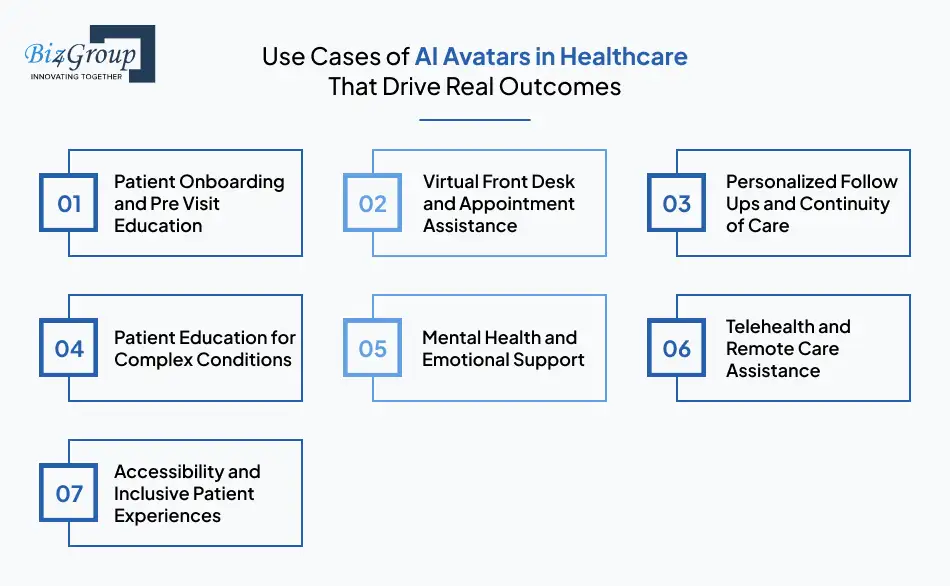
1. Patient Onboarding and Pre Visit Education
Patient onboarding is often rushed, confusing, and inconsistent. AI avatars guide patients through pre visit instructions, consent steps, and preparation details in a calm and conversational way. Instead of dumping information, the avatar explains what matters, answers follow up questions and confirms understanding before moving forward.
For example, before a diagnostic test, an avatar can explain dietary restrictions, arrival timing, and next steps. This reduces last minute cancellations and improves preparedness, highlighting why AI avatars for human like patient interaction perform better than static chatbot flows.
2. Virtual Front Desk and Appointment Assistance
Front desk teams spend hours answering the same questions every day. AI avatars reduce this load by handling appointment scheduling, rescheduling, insurance basics, and location guidance through natural conversation. Patients can ask questions the way they normally would and receive immediate, clear responses.
For instance, a patient booking an appointment can confirm availability, ask about preparation, and receive reminders in one interaction. This improves efficiency and strengthens AI avatars vs chatbots for healthcare customer experience.
3. Personalized Follow Ups and Continuity of Care
Follow up care is critical, yet difficult to scale. AI avatars support ongoing engagement by checking in after visits, reminding patients about medications, and answering common recovery questions. Conversations feel familiar because the avatar remembers prior interactions and adjusts responses accordingly.
This is where a personal avatar chatbot becomes especially effective. For example, a post-surgery patient can receive daily guidance that adapts based on pain levels or reported symptoms, demonstrating clear benefits of AI avatars over chatbots in healthcare.
4. Patient Education for Complex Conditions
Healthcare information is often overwhelming when delivered through text alone. AI avatars break down complex medical topics into simple explanations, supported by visuals and paced conversation. Patients can stop, ask questions, and revisit information without feeling rushed.
For example, an avatar can explain a chronic condition management plan step by step, adjusting explanations based on patient understanding. This improves comprehension and reduces repeated support calls, strengthening the case for AI avatars vs traditional chatbots in healthcare.
5. Mental Health and Emotional Support
Mental health conversations require empathy, consistency, and a nonjudgmental tone. AI avatars are well suited for this because they adjust pacing and language based on patient responses, creating a safe and supportive interaction environment.
For example, an avatar can guide users through daily check-ins or relaxation exercises, encouraging next steps when needed. This use case clearly shows why AI avatars are better than chatbots in healthcare, especially when emotional sensitivity matters.
6. Telehealth and Remote Care Assistance
AI avatars enhance telehealth by supporting patients before and after virtual visits. They can collect symptoms in advance, explain what to expect during the consultation, and guide patients through post visit instructions.
These experiences are often built with the help of an experienced AI app development company to ensure smooth integration across patient portals and mobile apps. The result is better clarity, fewer follow up questions, and improved care continuity.
7. Accessibility and Inclusive Patient Experiences
Not every patient is comfortable with text-based systems. AI avatars improve accessibility by supporting voice interaction and visual guidance, making healthcare services easier to use for elderly patients or those with limited digital literacy.
Thoughtful UI/UX design ensures these avatars feel intuitive rather than overwhelming. For example, voice guided navigation helps patients complete tasks independently, improving adoption and satisfaction across diverse patient groups.
Across all these scenarios, the value of AI avatars comes from removing friction without removing humanity. When healthcare leaders evaluate comparison of AI avatars and chatbots for healthcare businesses, these use cases clearly show where avatars deliver stronger engagement, better outcomes, and long-term value.
AI Avatars vs Traditional Chatbots: ROI and Business Impact Comparison
When healthcare leaders evaluate AI avatars vs traditional chatbots in healthcare, ROI is not just about upfront cost. It is about patient engagement, operational efficiency, scalability, and long term business value.
This table breaks down how each option performs against real healthcare business goals.
| Business Factor | AI Avatars | Traditional Chatbots |
|---|---|---|
|
Upfront Investment |
Higher initial investment due to design complexity, intelligence, and interaction quality |
Lower upfront cost and faster initial deployment |
|
Long Term ROI |
Strong long term returns driven by higher adoption, better engagement, and improved outcomes |
ROI often plateaus as experience limitations reduce usage |
|
Operational Efficiency |
Resolve more interactions end to end, reducing staff dependency without sacrificing experience |
Automate simple tasks but escalate complex interactions |
|
Patient Engagement |
Sustain engagement through human like interaction and adaptive conversations |
Engagement declines once responses feel repetitive |
|
Scalability |
Scale across departments while maintaining experience quality |
Experience quality degrades as usage grows |
|
Time to Market |
Requires thoughtful planning and validation |
Faster launch for basic use cases |
|
Flexibility and Growth |
Easily evolve with changing care models and patient needs |
Limited flexibility beyond predefined workflows |
|
Risk Management |
Often deployed in phases to validate value before full rollout |
Lower initial risk but limited upside |
|
Execution Complexity |
Requires stronger alignment between product, design, and data teams |
Simpler to implement with minimal customization |
|
Strategic Alignment |
Supports long term digital health and patient experience strategies |
Best suited for short term efficiency gains |
What This Means for Healthcare Decision Makers
If your priority is cost control and quick deployment, traditional chatbots may still fit. If your priority includes engagement, trust, scalability, and future readiness, AI avatars deliver stronger ROI over time.
This distinction becomes especially important when deciding AI avatars vs chatbots which is better for healthcare organizations planning beyond short term automation.
Is lower upfront cost quietly hurting your long term ROI?
Healthcare leaders investing in patient engagement and retention are seeing stronger returns over time with avatar led experiences.
Calculate My Healthcare AI ROIChallenges and Solutions When Choosing Between AI Avatars and Traditional Chatbots in Healthcare
No conversational technology is perfect out of the box. Whether you are evaluating AI avatars vs traditional chatbots in healthcare, understanding the challenges early helps you avoid poor adoption, wasted spend, and stalled digital initiatives.
Challenges and Solutions for AI Avatars in Healthcare
AI avatars deliver strong engagement and human like patient interaction, but they also introduce complexity. These challenges are manageable when addressed with the right strategy and execution approach.
| Challenge | How It Is Solved |
|---|---|
|
Higher upfront investment |
Organizations start with a focused pilot tied to a specific patient journey. This helps validate value before scaling across departments. |
|
Conversation and experience design complexity |
Teams invest early in patient journey mapping and conversational design to ensure clarity, empathy, and compliance. |
|
Healthcare compliance and data sensitivity |
Avatars are built with strict data access controls and security practices aligned with healthcare regulations. |
|
System integration challenges |
Planning integrations upfront ensures avatars can connect smoothly with scheduling, intake, and care platforms. |
|
Patient adoption uncertainty |
Many organizations introduce avatars in low-risk areas like onboarding or education before expanding to care critical workflows. |
|
Selecting the right implementation partner |
Risk is reduced by evaluating experience and healthcare focus when choosing from the top AI avatar development companies in USA. |
Challenges and Solutions for Traditional Chatbots in Healthcare
Traditional chatbots are easier to deploy, but their limitations become visible as patient expectations grow. These challenges directly affect healthcare customer experience and long term scalability.
| Challenge | How It Is Solved |
|---|---|
|
Limited conversational depth |
Chatbots are restricted to predictable workflows such as FAQs, scheduling, and basic intake. |
|
Low patient engagement over time |
Flows are redesigned to be short and task focused rather than conversational. |
|
Loss of context in longer interactions |
Chatbots are used only where multi step context is not critical to patient success. |
|
High escalation rates to staff |
Clear handoff points are defined so patients are not stuck in repetitive loops. |
|
Difficulty handling complex questions |
Human support or more advanced conversational layers are introduced where needed. |
|
Customization and integration limits |
Healthcare teams work with an experienced AI chatbot development company to improve intent handling and system integration. |
Chatbots work best when efficiency is the primary goal. However, when organizations compare AI avatars vs chatbots which is better for healthcare, chatbot limitations often appear in patient trust, engagement, and continuity of care.
How Healthcare Leaders Should Use This Comparison
When choosing between AI avatars and chatbots for healthcare services, the right approach is rarely one size fits all.
- Chatbots are effective for speed, cost control, and predictable tasks
- AI avatars are better suited for education, reassurance, and long-term patient engagement
Understanding these challenges upfront allows healthcare organizations to invest confidently, align technology with business goals, and avoid rework later.
Why Choose Biz4Group LLC for AI Avatars That Transform Healthcare Engagement?
When you’re comparing AI avatars vs traditional chatbots in healthcare, technology alone is not enough. You want real results, seamless implementation, and long-term impact on patient engagement and operational efficiency. That is where Biz4Group LLC, a seasoned AI development company shines. Let’s look at three real projects that show how we boost interaction, personalize experiences, and drive measurable outcomes with human like AI avatars.
1. NextLPC: AI-Powered Learning and Interaction Platform
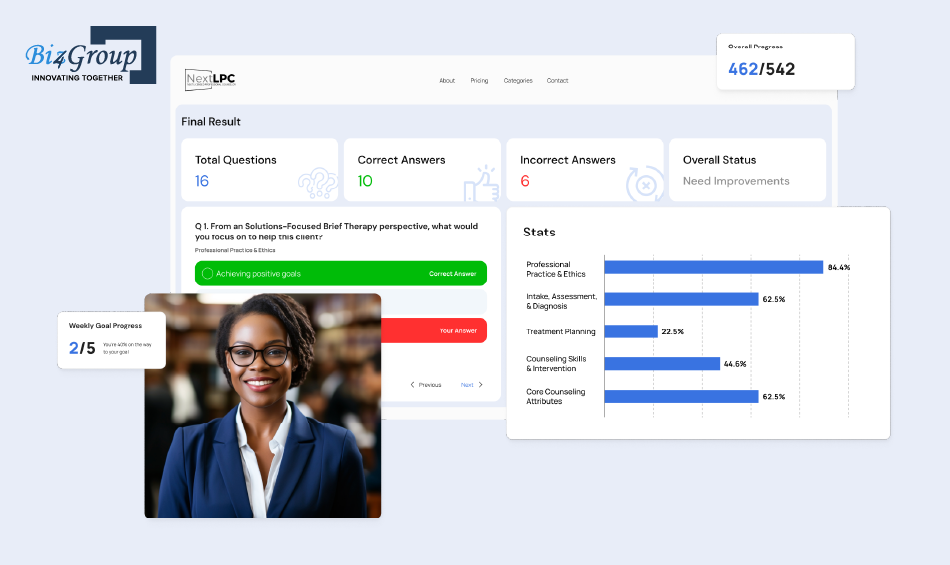
NextLPC is an AI-powered eLearning platform built to support psychotherapy students with lifelike virtual tutors. These avatars behave like real therapists, guiding users through therapy case studies while responding in natural, human-centered ways. This not only improves comprehension but also mimics real-world interaction and empathy.
Key Highlights
- AI avatars communicate with students like human tutors, improving engagement and retention.
- Personalized learning based on user progress and performance.
- Voice assistance helps learners in multiple languages and reading levels.
By delivering AI avatars for human like patient interaction, this project shows how immersive avatars improve learning outcomes and user satisfaction far beyond the static responses of a legacy chatbot. It demonstrates how visual and conversational AI can elevate care-oriented education and support service excellence.
2. AI Wizard: Interactive Companion With Human Feel
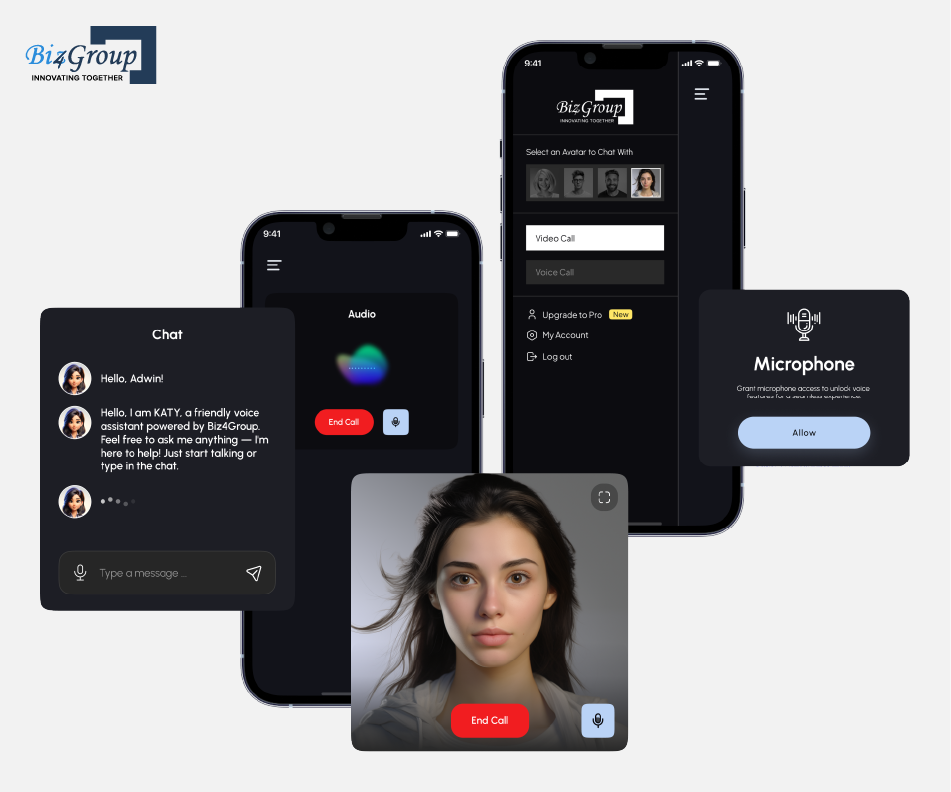
AI Wizard is an avatar-based AI companion designed by Biz4Group. It acts like a supportive digital ally that users can talk with through voice and video. The avatar combines conversational intelligence with natural demeanor to comfort, inform, and interact just like a human would.
Key Highlights
- Voice and video interaction makes engagement feel natural and personal.
- Uses advanced language understanding to respond contextually.
- Delivers compassionate support that feels human, not robotic.
This project illustrates why AI avatars are better than chatbots in healthcare environments where empathy, real-time responsiveness, and emotional nuance are critical to patient experience and trust.
3. Truman: AI-Enabled Wellness and Decision Support Avatar
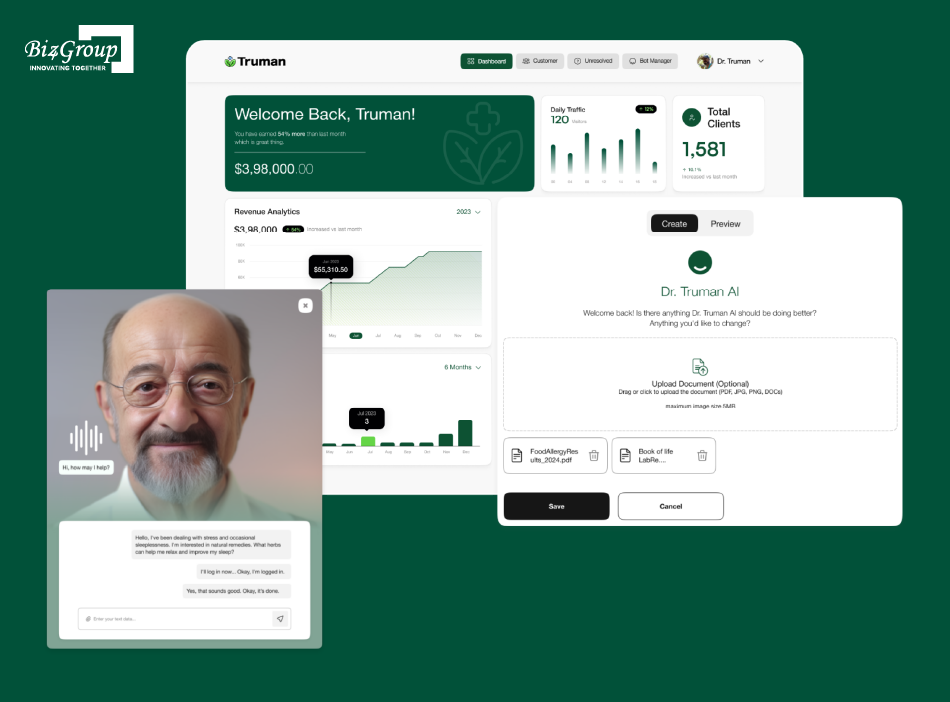
For Truman, we created an AI-enabled health companion that offers personalized wellness guidance and health support solutions. The avatar serves as an always-available point of contact for users seeking tailored health advice, symptom insights, and contextual recommendations.
Key Highlights
- Personalized health assistance that adapts based on user needs.
- Seamless interaction that feels human and trustworthy.
- Supports wellness engagement without overwhelming users with technical language.
By crafting AI avatars vs chatbots which is better for healthcare decision support, this solution shows how next-gen avatars can handle complex, sensitive health topics more effectively than rule-based chat systems.
Each of these deployments reflects what today’s health organizations are after:
- Higher patient engagement and trust by creating AI avatars for human-like patient interaction rather than robotic exchanges.
- Scalable digital care solutions that support education, wellness, and ongoing patient communication.
- Actionable insights and personalization rather than one-size-fits-all replies that legacy systems produce.
When you work with Biz4Group, you are not just building a tool. You are implementing enterprise AI solutions that elevate the quality of interaction, strengthen patient experience, and drive real strategic outcomes across your care channels.
Ready to build what patients actually trust and use?
Biz4Group LLC has delivered real AI avatar platforms that move beyond demos into measurable healthcare impact.
Contact UsWhat This Really Adds Up To!
Healthcare conversations are changing. Patients expect speed, but they also expect clarity, empathy, and guidance they can trust. That is why the discussion around AI avatars vs traditional chatbots is no longer theoretical. It is a practical decision that shapes patient experience, adoption, and long term ROI.
Traditional chatbots still have a place for simple, transactional tasks. But when engagement, education, and trust matter, the gap becomes obvious. Across onboarding, follow-ups, telehealth, and emotional support, AI avatars vs traditional chatbots in healthcare consistently show that human like interaction leads to better outcomes. Higher engagement. Fewer drop offs. Stronger patient relationships.
The real takeaway is this. Technology should not just respond. It should support.
This is where execution matters as much as vision. Biz4Group brings deep experience in building AI avatar solutions that go beyond demos and actually work in production environments. Our work across multiple AI avatar projects shows how thoughtful design, strong AI foundations, and healthcare ready implementation turn conversational AI into a business asset, not an experiment.
- If you are evaluating choosing between AI avatars and chatbots for healthcare services, the answer comes down to your goals.
- If you want efficiency alone, chatbots may be enough.
- If you want engagement, trust, scalability, and future readiness, AI avatars are the clear next step.
And with the right partner, that step does not have to be risky. It can be strategic, measurable, and built to last.
FAQ
1. What exactly are AI avatars vs traditional chatbots in healthcare?
AI avatars vs traditional chatbots in healthcare differ mainly in how they interact with patients. AI avatars use voice, visuals, and contextual intelligence to create human like patient interaction, while traditional chatbots rely on text based and rule driven responses. This difference affects trust, engagement, and overall healthcare customer experience.
2. Can AI avatars really improve patient engagement more than chatbots?
Yes, AI avatars consistently improve engagement because they feel more conversational and supportive. When comparing AI avatars vs chatbots for healthcare customer experience, avatars keep patients involved longer, reduce confusion, and encourage follow through. This is one of the key reasons healthcare leaders explore why AI avatars are better than chatbots in healthcare.
3. How do AI avatars and chatbots succeed or fall short in healthcare use cases?
AI avatars succeed in scenarios that require empathy, personalization, and complex communication. Traditional chatbots succeed in predictable and repetitive workflows. This contrast explains how AI avatars are different from traditional chatbots and why the comparison of AI avatars and chatbots for healthcare businesses depends on the use case.
4. Are there specific healthcare situations where traditional chatbots still make sense?
Yes, traditional chatbots are effective for appointment scheduling, FAQs, reminders, and basic intake tasks. In these situations, AI avatars vs chatbots which is better for healthcare often depends on whether speed or depth of interaction is the priority.
5. Do AI avatars reduce operational costs compared to traditional chatbots?
AI avatars can reduce operational costs over time by improving engagement and lowering repeat interactions. Although AI avatar vs chatbot implementation cost is higher initially, the long term ROI improves through better adoption and fewer escalations, which highlights the benefits of AI avatars over chatbots in healthcare.
6. Can AI avatars or chatbots integrate with existing healthcare systems like EHR and CRM?
Yes, both AI avatars and chatbots can integrate with healthcare systems when implemented correctly. Integration quality plays a major role when choosing between AI avatars and chatbots for healthcare services, especially in environments that require compliance and data security.
7. Are there risks with using AI avatars or chatbots in patient care?
There are risks such as data privacy concerns, accuracy limitations, and over reliance on automation. Understanding these risks helps healthcare leaders make informed decisions when evaluating AI avatars vs traditional chatbots in healthcare and planning long term digital health strategies.
