Location :
Orlando, FL, USA
Location :
Orlando, FL, USA +1 (407) 714-1616
 info@biz4group.com


















Imagine a digital system that doesn’t wait for instructions but instead, understands your business goals, learns from real-time feedback, and takes independent actions to get the job done.
Read More

The healthcare market is moving quickly. Many founders feel this pressure, especially when they see new products launching every month.
Do you know the fastest way to stay ahead? It is to build a minimum viable product (MVP) for AI healthcare software that proves your concept in real clinical settings before resources stretch thin.
This urgency is backed by numbers. The healthcare AI market is expected to reach 148.4 billion dollars by 2029. Growth at this scale reminds founders that waiting for a perfect product rarely leads to real traction. Teams that develop an MVP for AI healthcare software gain early insight into user behavior, clinical acceptance and technical feasibility.
Many leaders explore how to create an AI healthcare MVP platform that balances innovation with responsible development. Instead of building everything at once, they focus on the core outcomes that matter to clinicians, administrators and patients. This approach helps teams learn faster and course correct before the stakes grow higher.
If your goal is to make a healthcare AI MVP for clinical use that feels practical and trustworthy, you are in the right place. This guide walks you through the process with a tone that matches real challenges founders face and offers a clear path to validation.
So, let’s begin with the basics.
Our team helps founders refine ideas in minutes. You could be next.
Get Expert Input NowHealthcare leaders are searching for solutions that improve workflow efficiency, reduce burnout and deliver measurable patient outcomes. The pressure is real. One widely cited study in the Annals of Internal Medicine found that physicians spend nearly 49% of their workday on EHR and administrative tasks rather than face time with patients.
This reality creates demand for tools that streamline workloads and reduce repetitive tasks. Teams that develop custom MVP software place themselves in front of organizations that feel this pain every day. Early pilots reveal how your solution can reduce administrative strain and improve workflow flow.
Before diving into features and strategy, it helps to understand why providers look for new solutions. A focused MVP can address issues such as:
Each of these challenges creates an opening for teams that aim to create an AI healthcare MVP platform with real clinical value. By tackling the symptoms providers feel every day, your MVP earns attention faster.
Timing shapes validation. Clinical teams prefer to see working tools rather than theoretical roadmaps. An MVP becomes a bridge between concept and true adoption.
Here is a quick view of how early action helps.
|
Benefit |
What It Means for You |
Why It Matters |
|---|---|---|
|
Faster validation |
Real clinical feedback |
Shorter development cycles |
|
Clear data needs |
You learn what datasets work |
Stronger model performance later |
|
Pilot opportunities |
Hospitals prefer tested ideas |
Easier stakeholder buy in |
|
Cost control |
You avoid overbuilding |
Smarter use of budget |
|
Stronger product story |
Early proof points |
Better investor conversations |
These benefits often spark confidence for teams planning to make a healthcare AI MVP for clinical use because each step builds credibility.
Clinical environments move cautiously, yet they reward products with evidence. By choosing to focus on developing minimum viable product (MVP) for AI healthcare software instead of chasing a perfect build, you gather meaningful proof that your concept fits into actual care delivery.
The best part is that every insight from your MVP becomes the foundation for your future roadmap. It shapes your messaging, compliance planning, AI model requirements and integration strategy. When you begin early, you learn early and that clarity makes scaling far more manageable.
Now that the reasons are clear, the next step is understanding what features matter most. Let us move into that with a sharper lens so your MVP lands well in clinical settings.
A strong healthcare AI MVP starts with clarity. Instead of building everything at once, you focus on the features that offer clinical value fast. The list below highlights the capabilities most teams prioritize.
Every AI healthcare solution needs a reliable way to collect accurate input. This can be symptom data, patient history, workflow details or operational information from clinical staff. A simple yet thoughtful intake design helps ensure your model receives quality data and helps you test whether your AI output aligns with real expectations.
Your MVP should prove that the AI component provides meaningful insight, even if the first version is simple. Early models often include rule-based logic, decision support estimates or a basic predictive function. The goal is not sophistication. The goal is evidence that your solution helps someone make a faster or better decision.
A healthcare MVP succeeds when users understand it without friction. Your interface can be a basic dashboard, a clean chat experience or a simple workflow screen. What matters is usability. When clinicians or patients can interact with your product quickly, you gather honest feedback about usability, trust and clarity.
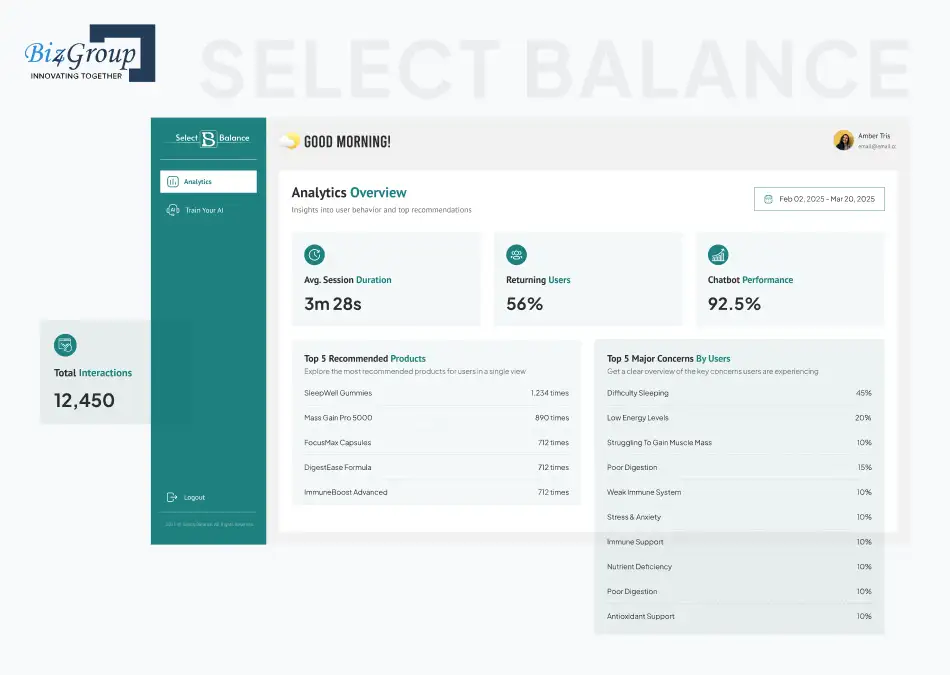
With our seasoned AI chatbot development skills, Biz4Group built an AI chatbot to help customers receive personalized supplement recommendations through an intuitive experience that blended quiz based input and natural conversation.
Key strengths:
This example shows how a well-designed frontend allows teams to test user behavior, retention and clarity from day one.
Also read: AI supplement recommendation chatbot development guide
Healthcare AI products rely on clean data movement. Your MVP needs a dependable path for collecting, storing and processing data while keeping everything compliant. A simple encrypted storage layer, structured database and minimal ETL process help you begin safely.
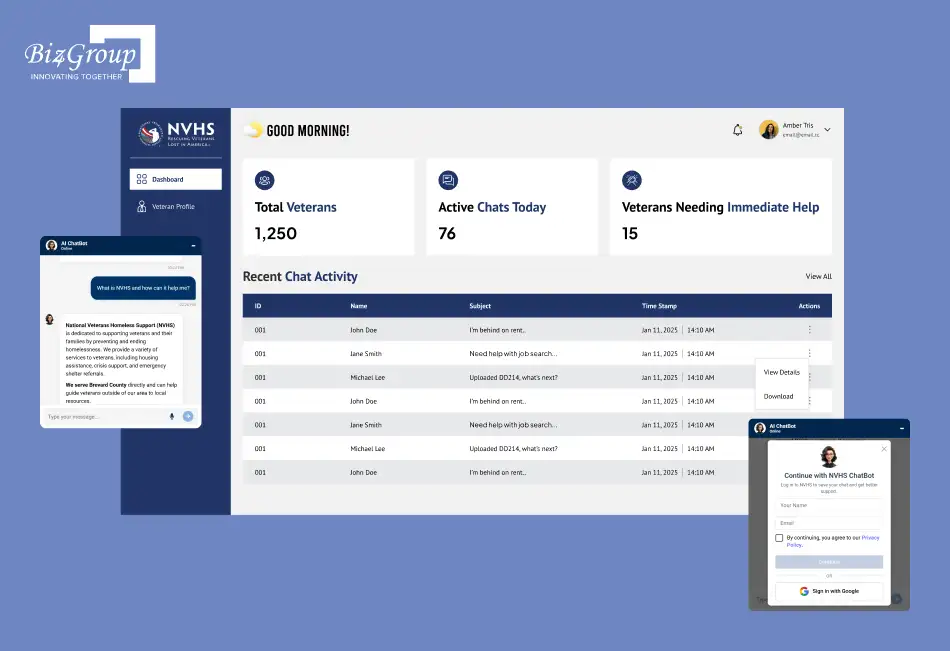
Although this chatbot supports homeless and at-risk veterans rather than a clinical workflow, it demonstrates the power of a strong data pipeline. The solution gathered, organized and matched information from thousands of unstructured pages to help veterans receive tailored guidance.
Key strengths:
This example mirrors the data demands of early healthcare MVPs where information must be accurate, protected and actionable.
Even at MVP stage, your product benefits from the ability to connect with clinical systems or external data sources. This may be a small FHIR endpoint, a CSV upload or a sandbox API integration. Early tests help determine how well your solution fits hospital environments and what your full integration roadmap needs to look like.
Healthcare decision makers expect security and compliance from the beginning. MVPs often include role-based access, encryption, audit logs and privacy notices. These controls build trust and prepare your product for real use in pilot settings.
With these features in place, your MVP communicates seriousness, readiness and a commitment to patient safety.
If these features already sparked ideas, imagine what a working prototype could do for your momentum.
Build with Biz4GroupA well-planned tech stack shapes how quickly your product moves from concept to pilot. When teams combine practical engineering choices with thoughtful full stack development, they create an AI healthcare MVP that is flexible, fast and ready for early testing. In this section, you will find a clear and simple table that breaks down each layer of your product and how it supports a smooth MVP build.
|
Tech Layer |
Purpose In MVP |
Common Choices |
Why It Supports Early Validation |
|---|---|---|---|
|
Front End Layer |
Delivers the user experience for patients, clinicians or admins |
React, Next.js, Vue |
Helps teams test usability and refine workflows with minimal engineering overhead |
|
Back End Layer |
Powers business logic and core functions |
Node.js, Python Flask, Django |
Offers flexibility for fast feature building and smooth integration with AI components |
|
Database Layer |
Stores structured or semi structured data safely |
PostgreSQL, MongoDB |
Creates a stable foundation for AI input storage and supports rapid schema adjustments |
|
AI And Model Layer |
Processes predictions, insights or recommendations |
Python, TensorFlow, PyTorch |
Enables lightweight models that prove value early while staying easy to iterate |
|
Data Processing Layer |
Cleans, transforms and prepares input data |
Pandas, Apache Airflow, custom scripts |
Ensures the MVP handles inputs consistently for accurate testing and early model feedback |
|
API Layer |
Connects front end, back end and external systems |
REST APIs, GraphQL |
Makes your MVP modular and easy to integrate into clinical sandbox environments |
|
Deployment Environment |
Hosts your application for pilots or internal testing |
AWS, Azure, GCP |
Provides stable cloud tools for scaling slowly as your MVP gains traction |
|
DevOps Setup |
Supports code releases and environment consistency |
Docker, GitHub Actions |
Reduces deployment friction and helps your team ship updates quickly |
Once you select the right tools for each layer, building and refining your MVP becomes far more predictable. These choices guide your development rhythm and give your team the agility needed in healthcare settings where requirements evolve fast.
Also read: How to build AI software for medical devices?
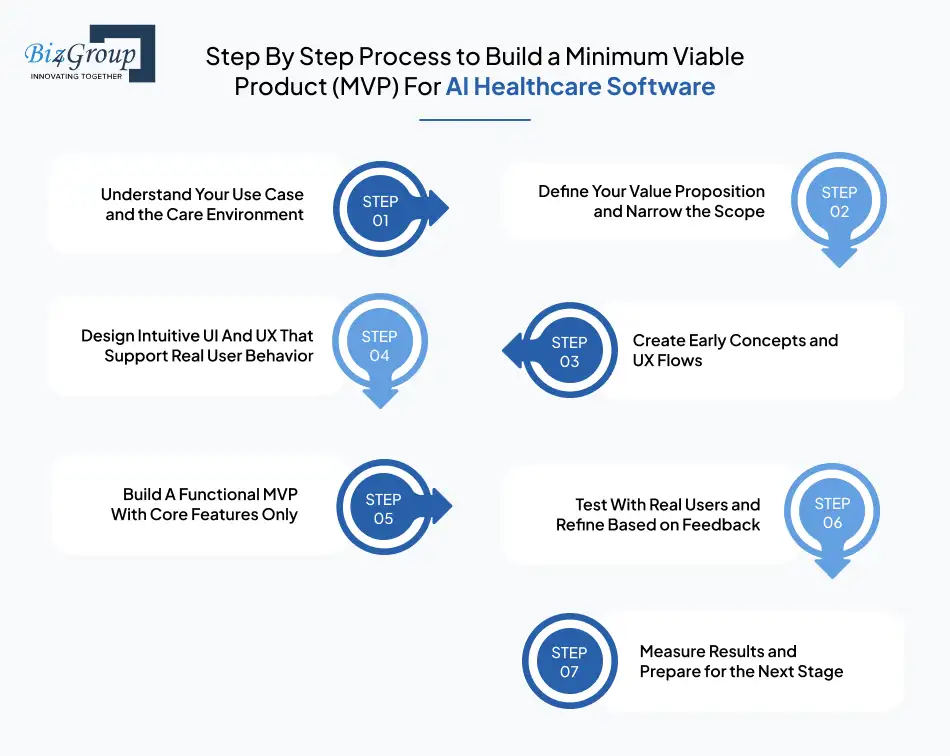
A strong healthcare MVP follows a simple truth. Clarity beats complexity. When you begin with focused steps, your idea moves from a rough vision to a working product that earns real feedback. The sequence below helps you shape an MVP that feels practical, testable and valuable to early users.
Every effective healthcare MVP starts with context. This means speaking with clinicians, patients or care coordinators to understand how your idea fits into daily routines. You uncover where their attention goes, what slows them down and what decisions require better support. This early discovery work shapes your entire build.
Once you understand the environment, the next step is to clarify the single outcome your MVP must prove. Instead of adding multiple goals, pick one. This keeps your early build focused and makes your product easier to test.
A narrow scope helps reduce confusion for testers and lets you collect cleaner data. The more focused your value proposition, the faster you can demonstrate traction.
A clear idea deserves a visual blueprint. This step turns your concept into simple sketches, user flows or clickable mockups. These visuals help everyone see how your product will work even before development begins.
This is also where you identify gaps, adjust navigation and refine the logic behind each interaction. When UX flows are clean, user conversations in pilots become more productive.
A healthcare MVP succeeds when users feel comfortable exploring it. Your UI shapes trust, clarity and adoption. This step involves choosing layouts, colors, content and interaction styles that match the needs of your audience. A skilled UI/UX design company ensures clinicians understand your tool quickly and helps patients move through tasks without confusion.
Also read: Top 15 UI/UX design companies in USA
Once the concept and design are in place, development can begin. Focus on the features necessary to prove your value proposition and nothing more. Developing an MVP keeps timelines short and helps you concentrate on what needs validation.
Early versions are simple by design. They aim to show functionality, not perfection. What matters most is that you create something real enough for users to try.
Also read: Top 12+ MVP development companies in USA
Testing brings your concept to life. Here you learn what resonates, what confuses and what needs refinement. Pilot testers might include clinicians, patients or administrative staff depending on your solution.
Gather both qualitative and quantitative insights. This feedback directs your next iteration and helps shape a product roadmap that supports adoption.
Before moving toward scaling, you need proof that your MVP can deliver value. Capture metrics tied to your use case, such as time saved, accuracy improvements or workflow enhancement.
This final step closes the loop from discovery to early validation. With the right data in hand, you can decide whether to expand, pivot or deepen your current approach.
Each of these steps forms the backbone of developing an MVP for AI healthcare software. When followed with intention, they create a smoother path to a reliable pilot and a stronger foundation for future growth.
Most founders delay for months, while the fast movers secure pilots. Which path feels better?
Secure Your Pilot Today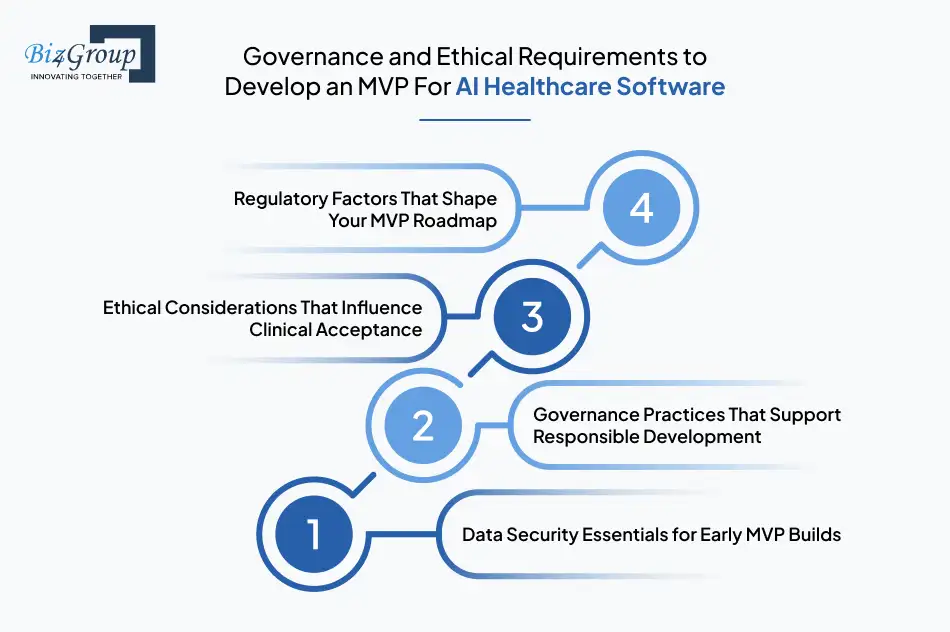
Healthcare products earn trust when they demonstrate responsibility from day one. Even when you focus on an MVP, the foundation must feel dependable and aligned with clinical expectations.
This section highlights the essential security, governance and regulatory considerations that shape early adoption.
Strong data protection helps create confidence among clinicians, patients and administrators. Your early build should reflect a thoughtful approach to how information is handled.
Key elements you want to include.
Governance provides structure for how your product evolves. Even in an MVP stage, teams benefit from having simple rules that guide decisions and keep quality consistent.
Helpful practices to introduce early.
AI in healthcare raises understandable concerns about fairness, balance and human judgment. Addressing ethics early helps you build a product that aligns with patient expectations and clinical comfort.
Ethical decisions to consider.
Healthcare is a regulated environment and your MVP should respect that reality. Even if you are not pursuing full certification yet, awareness of regulatory boundaries keeps your product safe to test and easy to expand later.
Key considerations to understand early.
Each area above plays a role in hiring AI health software developers that earn trust quickly and avoid avoidable revisions later. When these foundations are in place, your product becomes far easier to test, refine and introduce to real care environments.
Budget clarity helps founders and healthcare teams move forward without hesitation. When you understand where your resources go and why each element matters, planning becomes far less stressful. Most healthcare AI MVPs fall somewhere between $15,000-$100,000+ based on scope, AI complexity and the depth of user experience you want in the early release.
To help you get a clear picture, here is a quick comparison from MVP stage through enterprise level growth. This gives you a working sense of how your investment expands as features, integrations and model requirements grow.
|
Stage |
What You Receive |
Typical Characteristics |
|---|---|---|
|
MVP Build |
Core features only |
Narrow use case, simple model, streamlined UX |
|
Advanced Level |
Expanded capabilities |
Multiple workflows, improved AI accuracy, stronger UI |
|
Enterprise Scale |
Full ecosystem |
Deep integrations, large datasets, analytics, multi department usage |
Every MVP has variables that influence cost. The more clarity you have on these factors, the easier it becomes to estimate, prioritize and plan.
Each cost driver helps you understand the logic behind an MVP budget. When planned carefully, they support a healthy balance between speed and practicality.
Hidden costs do not always appear on first estimates, yet they influence long term planning. They deserve attention early so your roadmap feels stable rather than unpredictable.
Data Maintenance and Expansion
Your initial dataset helps you validate an early model, but real world pilots often reveal new inputs, conditions or edge cases. That means you will expand or refine your dataset to improve accuracy. Keeping data fresh ensures your MVP grows in the right direction.
Model Optimization and Ongoing Enhancements
AI models need tuning as usage increases. What works in early tests may evolve once real users interact with your product. You may need cycles of retraining, performance evaluation and threshold adjustments. These updates strengthen product reliability.
Cloud Hosting and Inference Costs
Cloud infrastructure supports both development and pilot environments. As usage grows, compute demands may rise. Understanding this early helps keep operations smooth.
Compliance Alignment and Documentation
While full certification may not be required at MVP stage, teams often invest time in documentation and clarity for future compliance planning. These habits reduce friction when your product grows into clinical ecosystems.
When these hidden costs appear in your planning, your budget becomes realistic and actionable. This clarity helps teams commit to the next stage without uncertainty.
In the next section, we explore challenges and risks that shape early development so you can make practical choices with fewer setbacks.
Also read: How Much Does It Cost to Build an MVP for AI Application?
Teams that know their numbers move 3x faster toward funding and pilot readiness. Do you?
Get a Custom Cost Plan-for-ai-healthcare-software.webp)
Every healthcare product faces obstacles, especially during early development. These challenges are not signs of failure. They simply reveal what needs attention before your solution reaches real users. This section breaks down common hurdles and gives practical solutions you can apply right away.
Healthcare ideas tend to expand quickly because the domain is complex and workflows vary. Teams often feel tempted to add features that do not serve immediate validation.
Solutions you can apply.
Your MVP needs data that reflects real world situations. The challenge is that healthcare environments use varied formats and quality levels that may not align with your early plans.
Solutions that help.
Clinicians and care teams manage intense workloads. If your design does not match their rhythm, they will overlook the product.
Solutions to improve adoption.
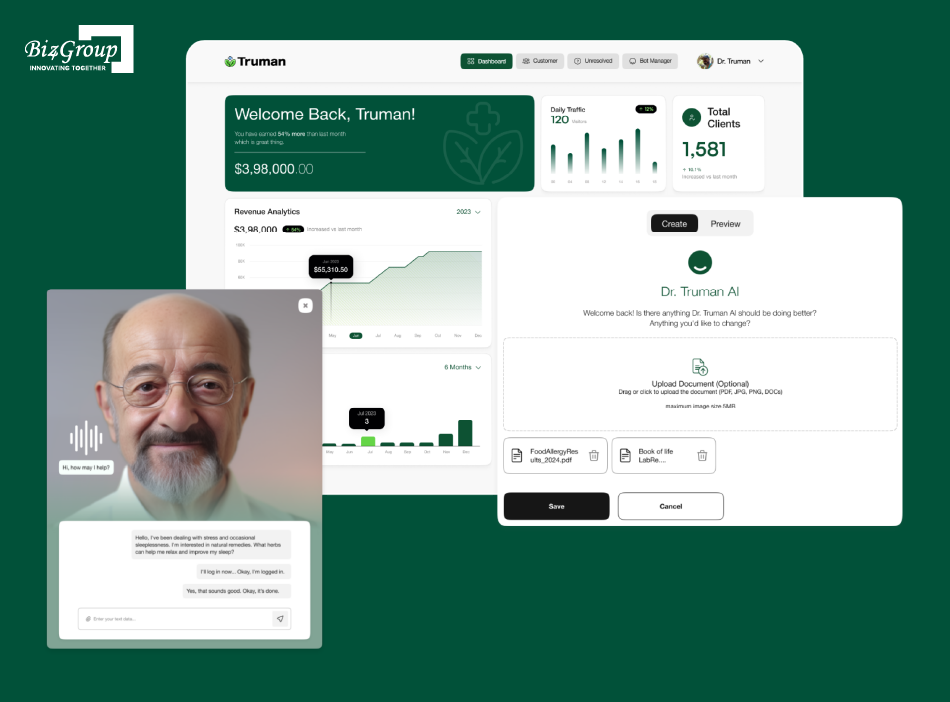
This AI avatar for personalized wellness offers a helpful perspective on designing experiences that feel natural for users seeking guidance. The solution used an AI avatar that delivered health insight in a friendly conversational style and paired it with a clean interface that guided users through recommendations and product discovery.
Key strengths:
This example shows how a thoughtful approach to presentation and interaction can help an MVP feel intuitive from the start, even before advanced features are introduced.
Also read: How to build an MVP for AI wellness platform?
Teams sometimes struggle to deliver early results without overbuilding their first version.
Solutions that keep this manageable.
Founders, clinicians, investors and technical teams often think about success in different ways. Misalignment can slow your progress.
Solutions that build clarity.
Each challenge in this section appears frequently across healthcare AI projects. When you address them thoughtfully, your MVP becomes easier to test, more appealing to users and more grounded in real clinical value.
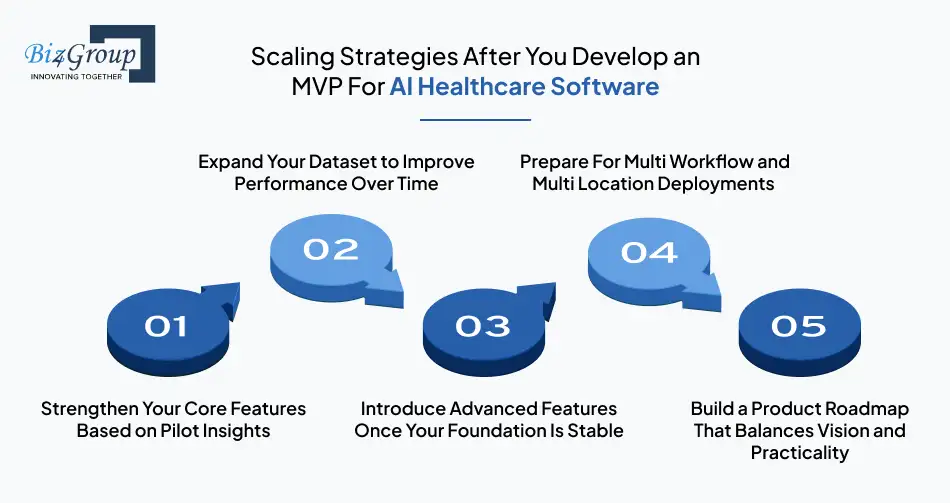
Scaling your MVP is where your idea starts to feel like a long-term solution. At this stage, real user insights guide your next moves and your AI product begins to evolve into something ready for broader adoption.
This section breaks down the strategic steps that help you transform early validation into a polished, reliable and expansive healthcare platform.
A strong pilot does more than validate your concept. It reveals gaps and opportunities that help shape your larger roadmap. Areas to refine as you grow:
This process keeps your product grounded in what users truly need.
As your user base grows, your dataset should grow with it. More diverse clinical scenarios create stronger model accuracy and better insights. Focus on these steps as you scale:
These steps help your model grow into a trustworthy decision support tool.
A refined MVP gives you the confidence to explore features that enhance user engagement and clinical relevance. Adding too much too early makes testing harder, so scale at a steady pace. Features that often appear after MVP success:
These additions strengthen the value of your product as adoption expands.
Once your solution works well in one environment, expanding into others becomes the next milestone. Each new department or clinic will have unique conditions, user roles or workflows. Key preparation steps:
This prepares your product for broader adoption and long term success.
Growth requires thoughtful planning. Your roadmap should reflect short-term adjustments and long-term ambitions. Focus areas that guide a strong roadmap:
A grounded roadmap helps you scale without drifting away from your core purpose.
Each of these steps supports the natural evolution of developing AI MVPs for telehealth and remote care solutions, clinical tools or operational improvement platforms. When you grow your product intentionally, you set the stage for long term adoption and stronger impact across care settings.
If real users are already paying attention, imagine what polished, scalable features could do.
Scale with Biz4Group NowHealthcare innovators across the USA look for partners who understand the challenges of early product development and the urgency behind proving value fast. Biz4Group LLC brings that clarity and experience to every engagement. As a US-based software development company, we help founders, healthcare organizations and digital health teams turn ambitious AI concepts into working MVPs that earn real traction.
Our strength comes from years of building AI healthcare solutions, wellness solutions and AI agents that support both patients and clinicians. Trust us, we understand how to shape an AI healthcare MVP so it feels practical, intuitive and aligned with real clinical needs.
Our team combines product thinking, design strategy and engineering excellence. This gives you a complete AI development experience instead of fragmented work done in isolation. Every step comes with clarity, communication and measurable progress. This approach is why growing healthcare innovators trust Biz4Group LLC when they need results, not speculation.
Organizations choose Biz4Group LLC because they want a development partner who treats their idea with the level of focus and precision it deserves. We have:
These strengths show why Biz4Group LLC stands out as a partner that supports founders and healthcare teams through each stage of growth.
As you move through the process of developing a minimum viable product, working with a team that keeps your goals central makes each decision easier. You gain peace of mind knowing your idea is guided by professionals who care about quality and long-term success.
We are that team. Share your ideas with us. Let’s talk.
Building a healthcare AI product begins with a focused and validated starting point. When you build a minimum viable product (MVP) for AI healthcare software, you move from ideas on paper to insights shaped by real users.
This early clarity helps you understand what matters to clinicians and patients, which features support real workflows and how your product can evolve into something truly valuable. An MVP gives you the agility to learn fast, refine quickly and avoid heavy investment in assumptions that have not been tested.
Biz4Group LLC supports healthcare innovators who want to move with confidence. As an AI app development partner with phenomenal AI automation services, we help founders and care teams shape ideas into validated MVPs that earn trust. Our work brings clarity, structure and real progress so your concept becomes something people are eager to try.
If you feel ready to transform your healthcare AI idea into a powerful MVP, reach out to Biz4Group LLC today and build something with us that your future users will talk about.
It helps to involve clinicians right after you outline your core idea. Early conversations reveal workflow challenges, terminology preferences and decision points that shape a practical product direction. These insights help you avoid misalignment and allow your team to design a solution that feels natural for real users.
Smaller, well-organized datasets are more effective for initial experiments than large, unstructured collections. Early sets should be clean, labeled and relevant to a focused use case. As you refine your model, you can introduce richer datasets that cover varied conditions and edge cases.
Yes, as long as they work with development teams that communicate clearly and simplify technical decisions. Founders contribute vision, user understanding and industry insight, which are key parts of a successful build. Technical teams handle the engineering responsibilities and guide decisions that impact functionality.
Pilot lengths vary, but many run for several weeks. This gives users enough time to explore the tool in their routine and provide meaningful feedback. Shorter pilots often miss important insights and longer ones can introduce unnecessary delay.
Yes, some founders offer pilot programs, paid trials or limited access versions to early adopters. If your MVP delivers noticeable value, organizations may be willing to join early access programs that support your growth while giving them a unique advantage.

with Biz4Group today!
Our website require some cookies to function properly. Read our privacy policy to know more.