Location :
Orlando, FL, USA
Location :
Orlando, FL, USA +1 (407) 714-1616
 info@biz4group.com
 AI Summary Powered by Biz4AI
- A mobile casino app combines engaging gameplay, secure transactions, and scalable technology to help businesses attract, retain, and monetize players across Android and iOS.
- Success in casino mobile app development depends on choosing the right features, integrating licensed games, ensuring regulatory compliance, and building a platform that can scale as your business grows.
- Building a mobile casino app typically costs $15,000-$300,000+, depending on the project's complexity, customization, integrations, and compliance requirements.
- Custom casino mobile app development offers greater flexibility, ownership, and long-term ROI than most white-label solutions, making it the preferred choice for businesses with long-term growth plans.
- Partnering with an experienced team like Biz4Group LLC helps you navigate strategy, development, compliance, and post-launch growth to build a secure, scalable, and future-ready mobile casino app.
What if the biggest reason players leave your platform has nothing to do with the games you offer?
Imagine a new player discovers your casino, downloads your mobile casino app, signs up, and is ready to play. Then the registration takes too long. Or the payment fails. Or the app feels outdated, and within minutes, they're gone. That's a lost player, a lost revenue opportunity, and a reminder that great games alone no longer define success.
Building a successful casino app starts long before development begins. It starts with asking the right questions like, "we're planning to launch a casino mobile app. How much will development cost?" Or which features matter most? Should you invest in custom casino mobile app development or choose a white label solution? Basically, how do you build a platform that is secure, scalable, and ready for future growth?
The timing couldn't be better to answer those questions. Grand View Research estimates that the global online casino market will grow from $23.9 billion in 2026 to $38 billion by 2030, driven by rising smartphone usage, faster internet connectivity, and increasing demand for mobile gaming experiences.
In the next few minutes, you'll learn what it takes to build a scalable mobile casino app, which features deliver the highest player engagement, how much development typically costs, which compliance requirements can delay a launch, and how to choose a development partner that fits your business goals.
Why Are Businesses Investing in a Mobile Casino App?
Businesses are investing in a mobile casino app because player behavior has shifted toward smartphones, digital payments, and on-demand gaming. A well-built app creates new revenue opportunities, increases player retention, and gives operators complete control over branding, user experience, and future product expansion.
The conversation has moved beyond simply having an online casino. Today's players expect the entire experience to fit in their pocket. They want to register within minutes, access hundreds of games instantly, receive personalized offers, and withdraw winnings without friction. Operators that meet these expectations are seeing stronger engagement and longer player lifecycles.
The numbers tell the same story.
- According to Grand View Research, the global online gambling market is expected to grow from $97.7 billion in 2026 to $202.8 billion by 2033, at an annual growth rate of 11%.
- Polaris Market Research shares that mobile devices already account for more than 74% of the online gambling market by device in 2025.
- In the United States, smartphones generated over 80% of online gambling revenue in 2025.
These trends explain why founders are asking questions like "We want to build a mobile casino app. Where do we start?" The opportunity is clear. The real challenge lies in building a product that players continue using long after they install it.
Benefits of Choosing Casino Mobile App Development
Every successful platform has its own business goals, but most investments revolve around a handful of measurable outcomes.
|
Business Goal |
Why It Matters |
|---|---|
|
Increase player lifetime value |
Personalized experiences and loyalty programs encourage repeat play. |
|
Expand into regulated markets |
Mobile platforms make it easier to launch region-specific experiences while meeting local requirements. |
|
Improve operational efficiency |
Automated onboarding, payments, and player management reduce manual effort. |
|
Build a recognizable brand |
A dedicated app creates a stronger identity than relying solely on third-party marketplaces. |
|
Prepare for future innovation |
Modern platforms can adopt new technologies and game formats without rebuilding the entire ecosystem. |
Operators are now looking beyond standalone apps and planning platforms that support multiple game providers, payment systems, analytics tools, and customer engagement solutions.
As investment grows, so do player expectations. The next step is understanding what happens behind the scenes of a mobile casino platform and how every component works together to deliver a smooth gaming experience.
How Does a Mobile Casino App Work?
A mobile casino app works by connecting players, game providers, payment systems, and operator controls through a single digital platform. Every action, from signing in and joining a game to depositing funds and withdrawing winnings, follows a secure workflow that happens within seconds.
If your team is asking, "How do I begin building a mobile casino app?", understanding this workflow is the best first step. It helps you identify which business functions are essential before deciding how the platform should be designed, integrated, and scaled.
Instead of thinking of a casino app as a collection of games, think of it as a network of connected systems working together in real time.
Here's What Happens When a Player Opens a Mobile Casino App
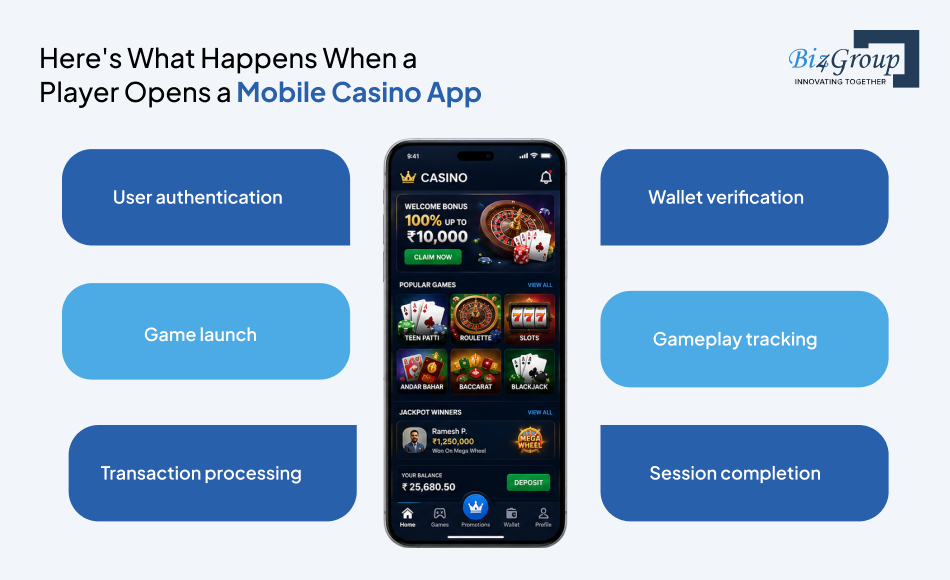
|
Step |
What Happens |
Why It Matters |
|---|---|---|
|
1. User authentication |
The player signs in or creates an account. Returning users are recognized instantly. |
Ensures every session starts securely and links activity to the correct player profile. |
|
2. Wallet verification |
The platform checks the player's balance, available bonuses, and account status before gameplay begins. |
Prevents transaction conflicts and keeps balances synchronized across all activities. |
|
3. Game launch |
The selected game loads and establishes a secure session with the game provider. |
Creates a smooth gameplay experience without noticeable delays. |
|
4. Gameplay tracking |
Every spin, card, or wager is recorded and validated in real time. |
Maintains accurate game history, payouts, and player records. |
|
5. Transaction processing |
Deposits, bets, winnings, and withdrawals are processed through the wallet system. |
Keeps financial records accurate while reducing disputes. |
|
6. Session completion |
Game results, updated balances, rewards, and player activity are stored before the session ends. |
Enables loyalty programs, reporting, and future player engagement. |
Each interaction may look simple to the player, but multiple services communicate simultaneously to keep gameplay uninterrupted.
Core Components of a Mobile Casino App
Every successful platform relies on a set of business components that manage different responsibilities throughout the player journey.
|
Component |
Primary Responsibility |
|---|---|
|
Player Account Center |
Stores player profiles, preferences, gaming history, and account settings. |
|
Digital Wallet |
Tracks deposits, withdrawals, bonuses, and available balances. |
|
Game Management Hub |
Organizes casino games, categories, providers, and player access. |
|
Reward Engine |
Manages promotions, loyalty points, VIP tiers, tournaments, and incentives. |
|
Transaction Ledger |
Records every financial activity for reporting and reconciliation. |
|
Operator Dashboard |
Gives administrators visibility into player activity, revenue, campaigns, and operational performance. |
|
Notification Center |
Delivers offers, account updates, tournament announcements, and transactional alerts. |
Each component performs a specific role, but their real value comes from working together as one connected ecosystem.
How Does Data Move Throughout the Platform?
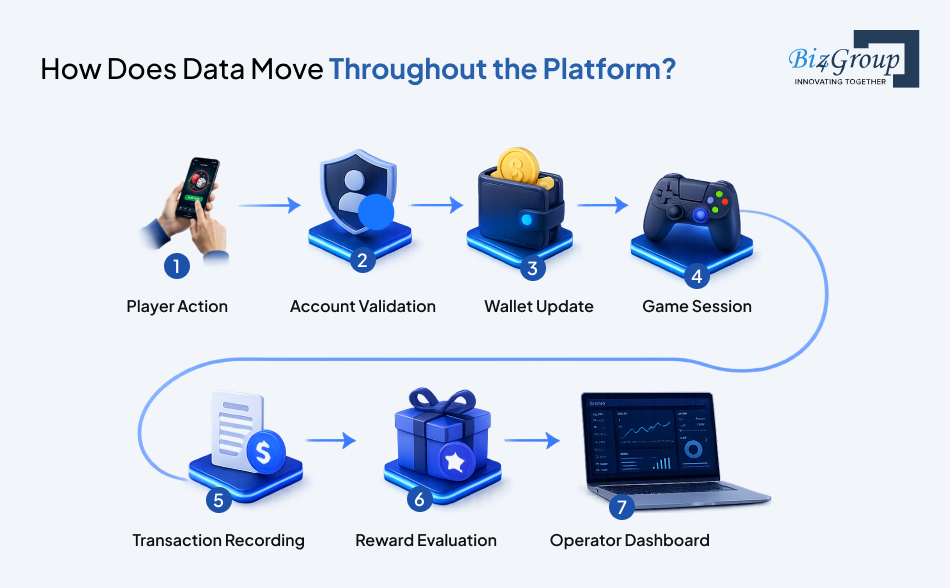
Every player action creates new information that keeps the platform running efficiently. A simplified workflow looks like this.
Player Action → Account Validation → Wallet Update → Game Session → Transaction Recording → Reward Evaluation → Operator Dashboard
This continuous flow allows operators to monitor platform activity, identify unusual behavior, measure engagement, and deliver a consistent player experience without interrupting gameplay.
One area where many businesses underestimate complexity is content management. Most successful operators don't rely on a single game studio. They connect multiple providers to expand their game library and keep players engaged with fresh titles throughout the year. Planning for casino game aggregator platform development early makes it much easier to introduce new content without rebuilding the platform every time a new provider is added.
Now, the next step is identifying which features create a seamless experience for both players and operators, and which ones deserve priority in your first release.
What Features Should a Mobile Casino App Include?
A successful mobile casino app should combine engaging gameplay, frictionless financial transactions, intuitive player management, and operational visibility for administrators. The best products focus on features that improve the player journey while helping operators manage growth efficiently.
If you're asking, "I need a custom casino mobile app for my gaming business. What features should I include?", start by prioritizing capabilities that directly support acquisition, engagement, retention, and platform management. Everything else can be introduced in future releases based on user demand.
Rather than viewing features as individual modules, think of them as experiences that solve a specific business or player need. For example...
What Features Help Players Start Playing Faster?
Players expect to create an account, fund it, and begin playing within minutes. Reducing friction during the first session often has a direct impact on activation and repeat visits.
The first experience should include:
- Quick account registration
- Secure sign in with multiple authentication options
- Digital wallet with balance visibility
- Simple deposit and withdrawal flow
- Favorite games and recently played history
- Multi-language and multi-currency support
- Personalized player profile
If you're wondering, "Can we add multiple payment methods?", the answer is yes. Most modern platforms support traditional cards, digital wallets, bank transfers, and cryptocurrencies based on regional regulations and business requirements.
Which Features Keep Players Coming Back?
Player retention grows when every session feels rewarding and personalized. The goal is to encourage repeat engagement without overwhelming users with unnecessary complexity.
|
Engagement Feature |
Business Value |
|---|---|
|
Loyalty programs |
Encourage repeat play and higher lifetime value |
|
VIP tiers |
Reward high-value players with exclusive benefits |
|
Daily rewards |
Increase return visits |
|
Achievement badges |
Motivate continued gameplay |
|
Referral programs |
Support organic player acquisition |
|
Push notifications |
Bring inactive users back at the right time |
|
Personalized promotions |
Improve offer relevance and redemption rates |
These features become even more effective when connected with intelligent player insights through AI integration services, allowing operators to deliver recommendations and offers based on player behavior instead of generic promotional campaigns.
What Features Help Operators Manage the Platform Efficiently?
Operators need complete visibility into platform performance without relying on multiple disconnected tools. Administrative capabilities are as important as player-facing experiences because they influence daily operations and business decisions.
Key operator features include:
- Centralized player management
- Campaign and bonus management
- Transaction monitoring
- Revenue reporting
- Customer support dashboard
- Content moderation
- Role-based administrator access
- Operational analytics
Having these capabilities within a single platform reduces manual effort and creates a more consistent operating environment as the business grows.
How Did Biz4Group Build These Features for an iGaming Platform?
Biz4Group partnered with Juicy Slots to build the platform from the ground up, delivering both the frontend and backend while creating an experience that connects players with leading gaming providers through one unified interface.
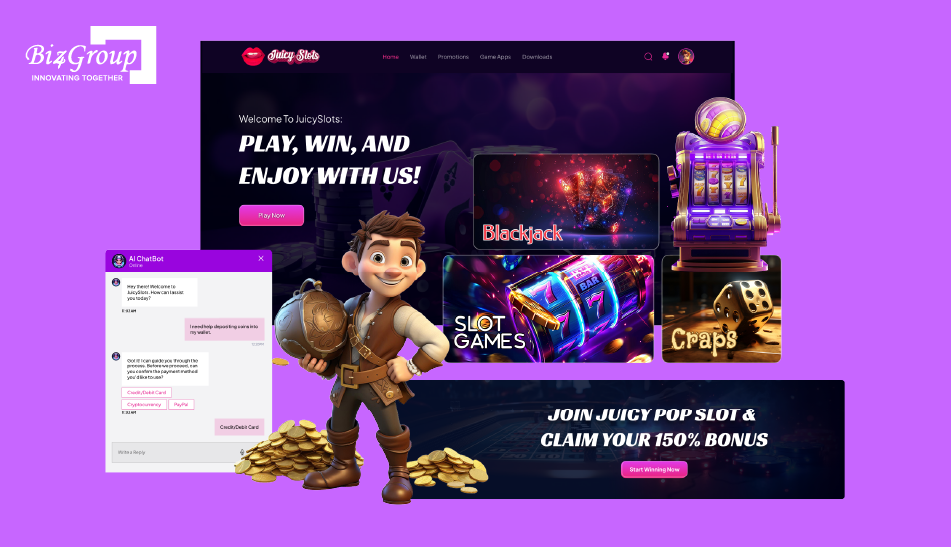
Highlights from the project include:
- Aggregated games from Game Vault, Juwa, Vegas Sweeps, Fire Kirin, Orion Stars, Ultra Panda, VB Link, and other popular providers
- Organized game discovery with search, filters, and category-based browsing
- Secure wallet management with coin purchases, fund redemption, and real-time balance updates
- Personalized player profiles with transaction history, preferences, and account settings
- Multiple payment options, including credit cards, PayPal, and cryptocurrency
One of the largest engineering challenges involved integrating multiple casino providers that each exposed different APIs and communication models.
To solve this, our team:
- Built a middleware layer that standardized data across providers
- Optimized WebSocket communication for real-time synchronization
- Designed a scalable backend capable of handling thousands of concurrent users
- Implemented load balancing to maintain platform performance during traffic spikes
The outcome reflected the impact of these architectural decisions.
|
Business Outcome |
Result |
|---|---|
|
Transaction success rate |
99.8% |
|
Reduction in user drop-offs |
40% |
Projects like JuicySlots reinforce why businesses planning long-term growth often evaluate AI product development services alongside platform engineering. Planning intelligent capabilities early makes future enhancements significantly easier as player expectations evolve.
What Features Can Differentiate Your Casino for Mobile?
The most successful casino platforms introduce capabilities that solve real player problems instead of adding features simply because competitors have them.
Consider including:
- Personalized game recommendations
- Smart search across large game libraries
- Cross-device session continuity
- Community tournaments
- Private gaming rooms
- Regional promotions
- Interactive onboarding
- In-app customer assistance
Each of these capabilities contributes to a more memorable player experience while supporting stronger engagement over time.
Once you've identified the experiences your platform should deliver, the next step is understanding the structured development process required to turn those ideas into a production-ready mobile casino app.
Also read: Telegram casino software development guide
Building More Features Doesn't Always Build a Better Casino App
Nearly 80% of app features see little usage. Let's identify the ones your players will actually value.
Let's Build SmarterHow Do You Build a Mobile Casino App Step-by-Step?
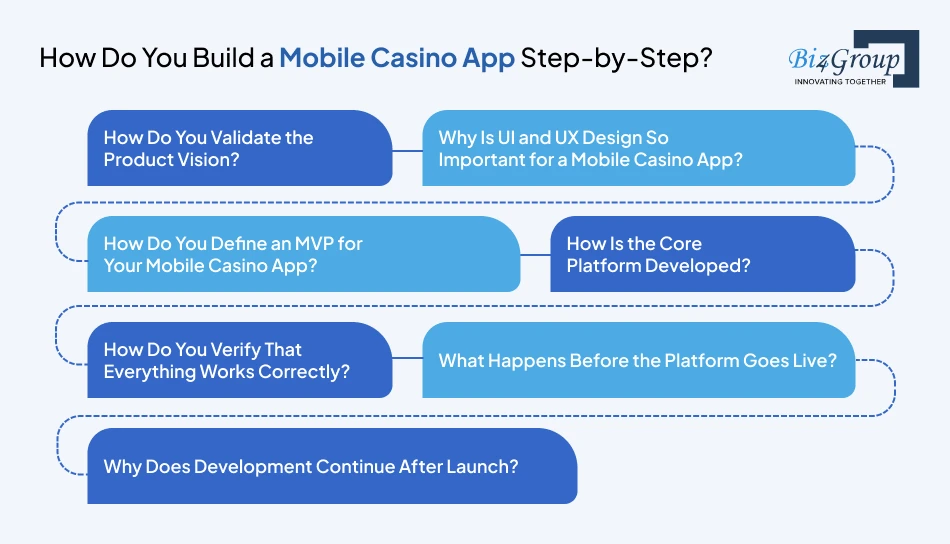
Building a mobile casino app starts with validating your business idea, followed by creating an intuitive user experience, designing an MVP, developing the platform, testing it thoroughly, and preparing it for launch. Breaking the project into structured phases reduces risk, improves development efficiency, and helps businesses make informed decisions at every stage.
Here's a proven seven-step framework followed by successful casino operators.
Step 1. How Do You Validate the Product Vision?
Every successful platform begins with a clearly defined business objective. Before writing code, identify who your players are, what markets you plan to serve, and how your product will generate revenue.
This stage typically focuses on:
- Defining business goals
- Understanding player expectations
- Identifying target regions
- Prioritizing product requirements
- Creating an initial feature roadmap
The outcome should be a product blueprint that aligns technical decisions with long-term business goals.
Step 2. Why Is UI and UX Design So Important for a Mobile Casino App?
A great gaming experience begins long before the first game starts. Clear navigation, intuitive layouts, and smooth player journeys influence how quickly users become comfortable with the platform.
Strong UI and UX design focuses on:
- Easy navigation
- Fast onboarding
- Consistent visual hierarchy
- Accessible game discovery
- Simple payment journeys
- Clear account management
Working with an experienced UI/UX design company helps transform business requirements into intuitive user journeys that support both player satisfaction and operational goals.
Also read: Top 15 UI/UX design companies in USA
Step 3. How Do You Define an MVP for Your Mobile Casino App?
An MVP helps businesses validate their concept with real users before investing in a full-scale platform. It reduces development risk while providing valuable product feedback early in the lifecycle.
A casino MVP usually includes:
|
MVP Component |
Purpose |
|---|---|
|
Account registration |
Player onboarding |
|
Wallet |
Basic financial transactions |
|
Selected game catalog |
Validate player interest |
|
Player profile |
Personalized experience |
|
Admin dashboard |
Platform management |
Businesses planning phased launches often begin with MVP development services to shorten time-to-market while building a strong foundation for future expansion.
Also read: Top 12+ MVP development companies in USA
Step 4. How Is the Core Platform Developed?
The core platform is developed by turning approved designs into a functioning product by building every player-facing and administrative workflow identified during planning.
Development activities include:
- Mobile application development
- Business logic implementation
- Wallet functionality
- Administrative capabilities
- Third-party service connections
- Internal workflow implementation
The objective is to create a stable product that reflects the approved user experience while remaining flexible for future enhancements.
Step 5. How Do You Verify That Everything Works Correctly?
Testing confirms that every user journey performs as expected before the application reaches real players. Catching issues early is significantly less expensive than fixing them after launch.
Quality assurance commonly includes:
- Functional testing
- User flow validation
- Performance testing
- Cross-device compatibility
- Security verification
- Regression testing
Each release should meet predefined quality benchmarks before moving to the next stage.
Step 6. What Happens Before the Platform Goes Live?
Launching a mobile casino app involves much more than publishing it to an app marketplace. Every operational process should be reviewed to ensure the platform is ready for real users.
The final preparation typically includes:
- Production deployment
- Final configuration checks
- User acceptance testing
- Operational readiness review
- Team training
- Launch planning
A structured rollout reduces disruption during the first weeks after launch.
Step 7. Why Does Development Continue After Launch?
The first release marks the beginning of product evolution, not the end of development. Continuous improvements help businesses respond to player feedback and changing market expectations.
Post-launch priorities often include:
- Feature enhancements
- User feedback analysis
- Platform optimization
- Performance monitoring
- Content expansion
- Product roadmap execution
This iterative approach allows operators to improve the platform while supporting sustainable business growth over time.
The next step is selecting the right technology stack and architecture that can support performance, scalability, and long-term product growth.
What Technology Stack and Architecture Are Best for Casino Mobile App Development?
The best technology stack for casino mobile app development combines high-performance mobile frameworks, scalable backend services, secure cloud infrastructure, and an architecture that supports real-time gameplay, payments, and future growth. The ideal stack depends on your business goals, expected traffic, and long-term product roadmap rather than a single programming language or framework.
One of the most common questions businesses ask is, "What technology stack is best for casino mobile app development?" The answer depends on what you're building. An MVP designed for one market has very different requirements than an enterprise platform serving millions of transactions each month.
Which Mobile Technologies Deliver the Best Player Experience?
The frontend should deliver fast loading times, responsive interactions, and a consistent experience across both Android and iOS devices.
Popular choices include:
|
Layer |
Recommended Technologies |
Why They Work |
|---|---|---|
|
Cross-platform |
Flutter, React Native |
Faster development across multiple platforms |
|
Native iOS |
Swift |
Optimized Apple ecosystem performance |
|
Native Android |
Kotlin |
Excellent Android compatibility |
|
Frontend Web |
Next.js |
Useful for connected web portals and promotional experiences |
The choice depends on launch strategy, budget, and long-term maintenance plans.
What Backend Technologies Support a Mobile Casino App?
The backend acts as the operational engine of the platform. It manages business rules, player activity, financial transactions, and communication between different services.
A typical backend stack includes:
|
Component |
Common Technologies |
|---|---|
|
Server Framework |
Node.js, .NET, Java Spring Boot |
|
Database |
PostgreSQL, MySQL, MongoDB |
|
Cache Layer |
Redis |
|
Authentication |
OAuth 2.0, JWT |
|
Storage |
Amazon S3 |
|
Background Processing |
RabbitMQ, Apache Kafka |
The right backend should remain responsive during heavy traffic without affecting player sessions.
Why Does Architecture Matter More Than Individual Technologies?
Architecture determines how well a platform performs as player traffic grows. Even the best programming languages cannot compensate for a poorly designed system.
A modern mobile casino platform typically consists of independent services working together.
|
Architectural Component |
Primary Responsibility |
|---|---|
|
API Gateway |
Routes requests to the correct services |
|
Authentication Service |
Manages player identity and secure access |
|
Wallet Service |
Processes balances and financial operations |
|
Game Service |
Connects players with gaming providers |
|
Notification Service |
Delivers transactional and promotional messages |
|
Reporting Service |
Generates operational and business insights |
This modular approach makes it easier to update individual services without disrupting the entire platform.
How Does Cloud Infrastructure Improve Platform Reliability?
Cloud infrastructure allows businesses to scale resources automatically as player activity increases while maintaining consistent platform availability.
Key cloud capabilities include:
- Automatic scaling during traffic spikes
- Load balancing across multiple servers
- Continuous backups
- Disaster recovery
- Global content delivery
- Infrastructure monitoring
These capabilities help operators maintain consistent performance during major sporting events, tournaments, or promotional campaigns that generate sudden increases in traffic.
How Do Integrations Expand Platform Capabilities?
A mobile casino app becomes significantly more valuable when it connects with external services instead of operating as an isolated platform.
Businesses commonly integrate:
- Payment providers
- Identity verification services
- Marketing platforms
- Customer communication systems
- Analytics platforms
- Game content providers
- CRM platforms
Planning integrations during the architecture phase reduces future implementation effort and creates a more flexible product ecosystem.
What Role Does AI Architecture Play in Modern Casino Platforms?
Artificial intelligence delivers the best results when it is designed as part of the platform architecture. This allows intelligent services to access player activity, operational data, and business workflows in real time.
Depending on business goals, AI components may include:
- Recommendation services
- Behavioral analytics
- Conversational assistants
- Operational automation
- Content generation support
- Business intelligence
Organizations investing in long-term innovation often combine their product roadmap with enterprise AI solutions so intelligent capabilities can evolve alongside the platform instead of requiring major architectural changes later.
Should You Build for Today's Requirements or Tomorrow's Growth?
The smartest architecture decisions prepare the platform for future expansion without making the initial product unnecessarily complex.
Ask these questions before finalizing your technical architecture:
- How many concurrent users should the platform support?
- Will multiple game providers be connected?
- Could the platform expand into sports betting?
- Will AI capabilities be introduced later?
- Should the platform support multiple geographic regions?
- Will future products share the same backend ecosystem?
Answering these questions early helps avoid expensive architectural changes as the business grows.
A strong technology stack creates the foundation for growth, but technology alone cannot protect a gaming platform. The next step is understanding the security controls and regulatory requirements that keep a mobile casino app trustworthy, compliant, and ready for launch.
How Do You Build a Secure and Compliant Mobile Casino App?
A secure and compliant mobile casino app protects player information, secures financial transactions, and follows the gambling regulations of every market where it operates. The best approach is to make security and compliance part of the product strategy from the beginning rather than treating them as final launch requirements.
Businesses often ask, "I want to build a secure casino mobile app that complies with gambling regulations. What do I need to know?" The answer starts with understanding the legal and operational responsibilities that govern online gambling. Planning for these requirements early helps reduce launch delays, protects your business, and builds player confidence.
Core Regulatory Requirements
Although licensing rules vary by country and state, most operators should prepare for the following compliance requirements before going live.
|
Requirement |
Why It Matters |
|---|---|
|
Gambling License |
Enables legal operation in approved jurisdictions. |
|
KYC and AML |
Verifies player identity and helps detect suspicious financial activity. |
|
Age Verification |
Prevents underage gambling and supports regulatory compliance. |
|
Payment Compliance |
Protects deposits, withdrawals, and financial records. |
|
Responsible Gaming |
Supports player well-being through safeguards and account controls. |
|
Data Privacy |
Ensures personal information is collected and managed responsibly. |
Meeting these requirements early helps avoid expensive changes later in the development lifecycle.
Security Practices That Protect Players
Player trust depends on how safely the platform handles every interaction. A secure casino platform should include:
- Strong user authentication
- Encrypted payment processing
- Continuous fraud monitoring
- Secure wallet management
- Role-based administrative access
- Activity logs for audits and investigations
- Regular security assessments
- Backup and disaster recovery planning
These practices work together to create a platform that players can trust while reducing operational risks for the business.
Stackr Case Study: Building Compliance Into the Platform
One example is Stackr, an AI-powered social casino platform developed by Biz4Group. While the platform delivers an engaging gaming experience with more than 800 games, the project also required careful planning around compliance, payment security, and player verification.
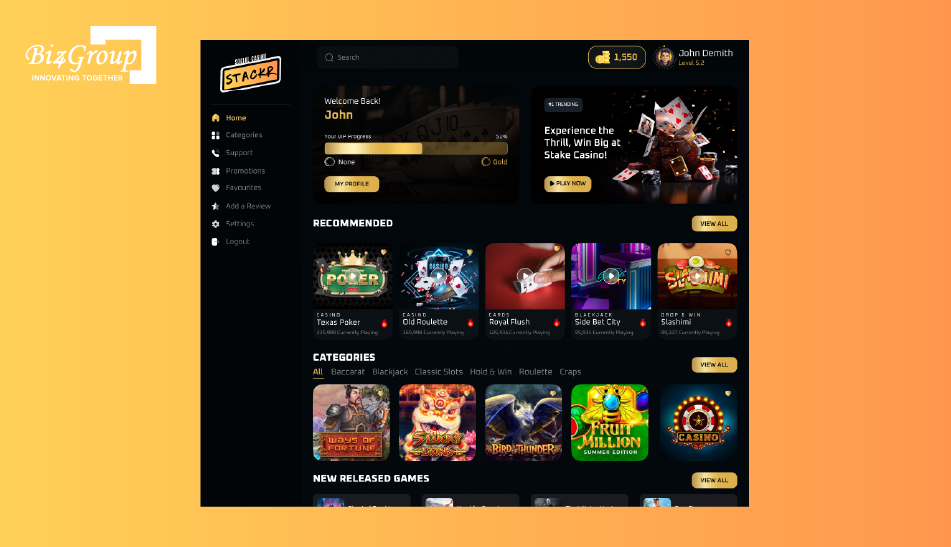
Some of the key capabilities included:
- AgeChecker integration for player age verification
- Dual wallet architecture for virtual and real currency management
- Secure payment processing through Authorize.Net
- Prizeout integration for gift card and voucher redemption
- Paynote integration for cash redemption
- Detailed records of gameplay, wallet activity, and transaction history
- State-aware access to support location-specific restrictions
The platform also connected leading game providers such as Betsoft, Pragmatic Play, EvoPlay, Habanero, and 3Oaks while maintaining a consistent player experience across the ecosystem.
Beyond compliance, Stackr introduced AI-powered game recommendations that personalized each player's experience based on their interests and gameplay history, helping improve long-term engagement without compromising platform security.
Also read: How to build an AI social casino platform like Stackr?
Why Early Compliance Planning Pays Off
Security and compliance influence much more than legal approvals. They affect player onboarding, payment workflows, wallet management, reporting, and long-term platform maintenance.
Businesses that define these requirements during product planning spend less time revisiting core workflows after development begins. The same approach applies when planning to create a fully compliant and scalable casino website, where regulatory readiness becomes part of the foundation instead of an afterthought.
Up next, we will discuss about everything related to cost.
Also read: How online casino developers build fully compliant iGaming platforms for the New Jersey market?
How Much Does It Cost to Build a Mobile Casino App?
Building a mobile casino app typically costs between $15,000-$300,000+, depending on the platform's complexity, feature set, third-party integrations, security requirements, and customization level. While an MVP can be launched with a modest investment, enterprise-grade platforms require significantly larger budgets to support scalability, compliance, and long-term growth.
If you're asking, "We're planning to launch a casino mobile app. How much will development cost?", the answer depends less on the number of games and more on the business you want to build over the next few years.
Here's a realistic breakdown.
|
Platform Type |
Estimated Cost |
Typical Timeline |
|---|---|---|
|
MVP |
$15,000-$40,000 |
2-3 months |
|
Advanced Platform |
$40,000-$120,000 |
4-6 months |
|
Enterprise Platform |
$120,000-$300,000+ |
7-12+ months |
Cost Breakdown by Development Area
Every stage contributes differently to the overall investment. Planning your budget around these components provides a much clearer picture than looking at a single project estimate.
|
Development Area |
Estimated Cost |
|---|---|
|
Product Discovery & Planning |
$3,000-$8,000 |
|
UI/UX Design |
$5,000-$15,000 |
|
Mobile Application Development |
$20,000-$80,000 |
|
Backend Development |
$15,000-$60,000 |
|
Third-Party Integrations |
$10,000-$40,000 |
|
Quality Assurance & Testing |
$5,000-$20,000 |
|
Deployment & Launch |
$2,000-$8,000 |
Combined, these factors account for approximately 70-85% of the total project investment.
Hidden Costs Businesses Often Overlook
Initial development is only one part of the overall investment. Several operational expenses appear after development begins or once the platform is live.
|
Hidden Cost |
Estimated Cost |
|---|---|
|
Cloud infrastructure |
$300-$3,000/month |
|
Third-party service subscriptions |
$500-$5,000/month |
|
Platform maintenance |
15-20% of annual development cost |
|
App store accounts and publishing |
$100-$500/year |
|
Feature enhancements |
$5,000-$30,000 per release cycle |
These recurring expenses typically represent 20-30% of the total cost of ownership over the first few years.
Also read: How much does it cost to start an online casino?
Cost Optimization Strategies
Reducing development costs should never come at the expense of product quality. The goal is to spend smarter by prioritizing features that create immediate business value.
A practical approach includes:
- Launch with an MVP before expanding the platform
- Prioritize high-impact features over nice-to-have functionality
- Use reusable design systems across mobile platforms
- Integrate only essential third-party services during the first release
- Plan AI capabilities early instead of rebuilding the platform later
- Choose an experienced AI app development company that can align technical decisions with long-term business goals
These strategies can reduce initial development expenses by 25-40% while preserving flexibility for future growth.
Also read: AI social casino platform development cost guide
Before You Finalize Your Budget, Check One More Number
The right architecture can reduce development costs by 25-40% without sacrificing quality or future scalability.
+1 (407) 714-1616Which Games Should You Include in a Casino for Mobile?
The best casino for mobile offers a balanced mix of high-demand classics and engaging modern games. Instead of launching hundreds of titles at once, focus on games that attract the widest audience and support long-term player retention.
If you're wondering, "Which casino games should we launch first?", begin with categories that consistently perform well across global iGaming markets.
|
Game Category |
Why Include It? |
|---|---|
|
Slots |
Highest player demand with a wide variety of themes and gameplay styles. |
|
Blackjack |
Appeals to players who enjoy strategy-based games. |
|
Roulette |
A timeless casino favorite with broad market appeal. |
|
Poker |
Builds player communities and encourages repeat engagement. |
|
Live Dealer Games |
Delivers an immersive casino experience through real-time interaction. |
|
Instant Win & Crash Games |
Popular among mobile-first players looking for quick gameplay sessions. |
Your game portfolio should grow with your audience. Launching with a curated selection allows you to validate player preferences before expanding into additional categories.
Many operators also ask, "Should we include live dealer games?" If your target audience values realism and longer play sessions, live dealer experiences can significantly increase engagement. However, they also require reliable streaming infrastructure and partnerships with licensed game providers.
The goal isn't to offer the largest game library on day one. It's to launch with the right mix of games that aligns with your audience, business model, and growth strategy.
Common Mistakes Should You Avoid When Building a Mobile Casino App
Many mobile casino apps struggle because businesses prioritize launching quickly over building a scalable, compliant, and player-friendly platform. Avoiding a few common mistakes early can save months of redevelopment and significantly reduce long-term costs.
If you're asking, "What are the biggest mistakes when building a mobile casino app?", the answer often comes down to planning, technology choices, and understanding player expectations rather than the games themselves.
|
Common Mistake |
Best Practice |
|---|---|
|
Building every feature before launch |
Start with an MVP and expand based on player feedback. |
|
Ignoring licensing and compliance requirements |
Plan regulatory compliance before development begins. |
|
Choosing the wrong technology partner |
Work with an experienced development team that understands iGaming regulations and scalability. |
|
Poor game selection |
Launch with a curated mix of high-demand games instead of an oversized library. |
|
Overlooking platform scalability |
Design the architecture to support future users, games, and integrations. |
|
Skipping analytics |
Track player behavior from day one to improve engagement and business decisions. |
Another common question is, "Can I build a casino mobile app without industry experience?" While it's possible, partnering with a sports betting app development company, like Biz4Group, reduces technical risks, shortens development time, and helps avoid costly mistakes around compliance and third-party integrations.
Quick note: Businesses targeting regulated U.S. markets should also review state-specific requirements before development begins, for example, understanding the landscape of online casino platform providers in Pennsylvania, or any other region you're targeting. This practice can provide useful insights into how regional regulations influence platform planning.
Along with building your product, the right development partner will help you avoid expensive mistakes before a single line of code is written. That's why the next decision is often just as important as the technology itself: Should you build a custom mobile casino app or buy a ready-made solution?
Should You Buy or Build a Mobile Casino App?
The right choice depends on your business goals. A white-label solution helps you launch faster with a lower upfront investment, while a custom mobile casino app gives you complete ownership, greater flexibility, and stronger long-term ROI. For businesses planning to grow, custom casino mobile app development often delivers the best value over time.
A lot of CEOs keep asking, "Should I build a casino mobile app from scratch or buy a ready-made solution?" There's no universal answer. The decision depends on your budget, timeline, customization needs, and long-term business strategy.
|
Factor |
Custom Development |
White-Label Solution |
|---|---|---|
|
Time to Launch |
Longer |
Faster |
|
Upfront Cost |
Higher |
Lower |
|
Branding |
Fully customizable |
Limited customization |
|
Features |
Built around your business |
Restricted by the provider |
|
Scalability |
High |
Depends on vendor capabilities |
|
Ownership |
Full ownership of the platform |
Vendor-controlled |
|
Long-Term ROI |
Higher |
Lower over time |
For a deeper comparison, explore our guide on custom casino platforms vs. white-label before making a development decision.
Why Custom Development Delivers Better ROI
While white-label platforms reduce the initial investment, they often introduce recurring licensing fees, limited customization, and dependency on third-party providers. As your business grows, these limitations can become expensive.
Custom development requires a larger upfront investment, but it gives you the freedom to:
- Build features around your players instead of vendor limitations.
- Integrate the payment providers, game studios, and business tools you actually need.
- Scale your platform without migrating to a different solution later.
- Own your source code, data, and intellectual property.
- Introduce new features and revenue streams on your own timeline.
This approach is especially valuable for businesses planning to build a differentiated casino for mobile instead of launching another platform that looks and functions like dozens of others.
A Practical Way to Decide
If you're still asking, "Is custom casino mobile app development worth it?", use the following guide.
|
Choose This Approach |
When It Makes Sense |
|---|---|
|
Buy a White-Label Platform |
You need to validate an idea quickly, have a limited budget, and can work with standardized features. |
|
Build a Custom Mobile Casino App |
You want complete ownership, unique functionality, better scalability, and stronger long-term ROI. |
|
Choose a Hybrid Approach |
You want to launch faster using selected third-party services while developing your own branded platform and expanding it over time. |
Many successful operators begin with a clear roadmap instead of trying to build everything at once. They prioritize the capabilities that create immediate business value, then expand the platform as their player base grows.
That's the approach followed by experienced development partners like Biz4Group LLC, where every engagement starts with understanding the client's business model, regulatory requirements, and long-term growth plans before recommending whether a custom, white-label, or hybrid solution is the best fit. The objective isn't to promote one approach over another. It's to build a platform that continues to deliver value well beyond launch.
In short:
- Buy when speed and budget are your top priorities.
- Build when long-term growth, ownership, and ROI matter most.
- Choose a hybrid approach when you want to balance faster market entry with the flexibility to evolve your platform over time.
Once you've decided on the right approach, the final step is selecting a development partner with the technical expertise and industry knowledge to turn your vision into a successful mobile casino app.
One Conversation Today Can Save Months of Rework Tomorrow
Every successful platform starts with the right roadmap, not the biggest budget or the longest feature list.
Get My Free Project AssessmentHow Do You Choose the Right Mobile Casino App Development Company?
To choose the right mobile casino app development company, evaluate the company's experience in iGaming, portfolio of similar projects, understanding of gambling regulations, technical capabilities, communication process, and long-term support. A reliable partner should help you make informed product decisions, not simply execute development tasks.
If you're asking, "How do I choose the best company to build a mobile casino app?", start by looking beyond pricing. A lower quote may reduce upfront costs, but experience, quality, and long-term support often determine the success of your product.
What to Look for in a Development Partner
Use the following checklist when evaluating companies for custom casino mobile app development.
|
Evaluation Criteria |
What to Look For |
Why It Matters |
|---|---|---|
|
Industry Experience |
Portfolio of casino or iGaming projects |
Reduces development risks and speeds up execution. |
|
Technical Expertise |
Mobile, backend, cloud, and third-party integration capabilities |
Supports a scalable and future-ready platform. |
|
Compliance Knowledge |
Experience with KYC, AML, payments, and responsible gaming |
Simplifies regulatory readiness. |
|
Development Process |
Clear discovery, design, development, testing, and launch phases |
Improves transparency and project planning. |
|
Communication |
Dedicated project manager and regular progress updates |
Keeps stakeholders aligned throughout development. |
|
Post-Launch Support |
Maintenance, feature enhancements, and performance monitoring |
Ensures long-term platform reliability. |
Red Flags You Shouldn't Ignore
Choosing the wrong partner can lead to delays, budget overruns, and unnecessary redevelopment. Be cautious if a company:
- Promises unrealistically low costs or aggressive timelines.
- Has no experience building casino or regulated gaming platforms.
- Cannot explain how it handles game provider and payment integrations.
- Doesn't discuss scalability or future product growth.
- Offers little or no post-launch maintenance and support.
- Doesn't clearly define ownership of the source code and intellectual property.
Another common question is, "Should I hire freelancers or a dedicated development company?" Freelancers can work well for small projects, but building a production-ready mobile casino app typically requires a multidisciplinary team that includes designers, developers, QA engineers, solution architects, and project managers working together.
Choosing a Partner That Supports Long-Term Growth
The best development companies don't begin with code. They begin by understanding your business model, target audience, compliance requirements, and long-term roadmap before recommending the right technical approach.
This consultative process is how experienced teams, including Biz4Group, a leading AI development company, approach casino mobile app development. Instead of applying the same solution to every project, they focus on aligning technology decisions with business objectives, helping clients avoid unnecessary complexity while building platforms that are easier to scale and maintain.
If you're comparing providers, reviewing the top 10+ AI casino app development companies in USA can help you understand how different teams approach custom development. Businesses planning intelligent gaming experiences can also hire AI developers to incorporate advanced capabilities as the platform evolves.
Ultimately, the right development partner isn't the one with the lowest quote. It's the one with the expertise, process, and vision to turn your idea into a successful mobile casino app that continues delivering value long after launch.
Final Thoughts
Building a successful mobile casino app requires careful planning, the right technology, and a clear understanding of what players expect. Every decision, including feature selection, compliance, development approach, and technology stack, plays a role in creating a platform that can attract users and support long-term business growth.
Many businesses eventually reach the same question: "What's the best way to build a mobile casino app?" The answer depends on your goals, budget, and timeline. An MVP is often the right starting point for validating an idea, while custom casino mobile app development offers the flexibility, scalability, and ownership needed to build a lasting brand.
Choosing the right development partner is just as important as choosing the right technology. Experienced teams bring more than technical expertise. They help validate ideas, anticipate challenges, simplify complex decisions, and create a roadmap that supports your business well beyond launch.
That's the philosophy behind every project at Biz4Group. Our team works closely with businesses to understand their vision before recommending the right strategy, ensuring every development decision supports measurable business outcomes instead of adding unnecessary complexity.
If you're planning your next casino mobile app development project or simply exploring what's possible, we'd be happy to discuss your idea, answer your questions, and help you identify the most practical path to launch. Get in touch today.
Frequently Asked Questions
1. Can I launch a mobile casino app without developing my own games?
Yes. Most businesses integrate games from licensed third-party providers instead of developing every game in-house. This approach speeds up development, reduces costs, and gives players access to proven titles from established studios while allowing operators to focus on branding and user experience.
2. Do I need separate licenses for every country or U.S. state?
In many cases, yes. Gambling regulations vary by jurisdiction, and each country or state may have its own licensing, compliance, and operational requirements. It's important to understand your target market's legal framework before launching your mobile casino app.
3. How long does it take to build a mobile casino app?
Most production-ready platforms take 3-9 months to design, develop, test, and launch, depending on the project's complexity. Biz4Group, however, can deliver a functional MVP in 2-4 weeks by leveraging reusable components and proven development frameworks that reduce both development time and overall project costs.
4. Can I monetize a casino app without using real-money gambling?
Yes. Many businesses generate revenue through social casino models using virtual currencies, in-app purchases, subscriptions, advertisements, sponsorships, and loyalty programs. This approach can also simplify market entry in regions where real-money gambling is restricted.
5. Can I add new games after my mobile casino app goes live?
Yes. A well-designed platform should allow operators to introduce new games, payment methods, promotions, and third-party integrations without rebuilding the application. Planning for future expansion during development makes ongoing updates faster and more cost-effective.
6. What is the biggest challenge in casino mobile app development?
The biggest challenge is balancing player experience with technical complexity. A successful platform must integrate games, payments, user management, analytics, and regulatory requirements while maintaining smooth performance and high reliability as the user base grows.