 Location :
Orlando, FL, USA
Location :
Orlando, FL, USA +1 (407) 714-1616
 info@biz4group.com

- Casino Game Aggregator Platform Development centralizes multi-provider integrations through a unified API, wallet synchronization, and compliance control layer, reducing operational friction.
- Businesses invest in aggregation to improve provider diversification, enable faster market entry, and support long term revenue scalability across regulated jurisdictions.
- Success depends on structured architecture, including routing stability, real-time reporting, fraud monitoring, and the ability to develop scalable casino game aggregator platforms without constant rework.
- The cost for the development typically ranges from $40,000 to $300,000+, depending on provider count, compliance scope, infrastructure depth, and whether you build an MVP or full multi-jurisdiction system.
- With hands-on experience in real multi-provider integrations, Biz4Group LLC delivers structured execution for casino game aggregator solutions focusing on integration control and scalable aggregation architecture.
What if the future of online gaming success no longer depended on single provider deals?
The rise of casino game aggregator platform development is reshaping how operators and startups build long-term value. Traditional integration chains are becoming too slow, costly, and complex. Today’s market demands platforms that bring multiple providers together under one roof.
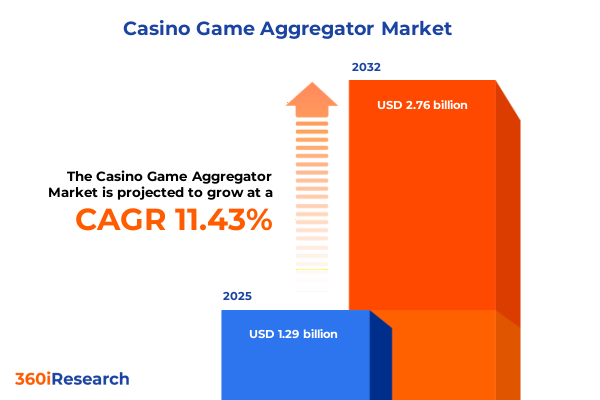
The casino game aggregator market size was estimated at USD 1.29 billion in 2025 and expected to reach USD 1.41 billion in 2026, at a CAGR of 11.43% to reach USD 2.76 billion by 2032.
At the same time, game aggregation solutions developed by a custom software development company are becoming the backbone of modern iGaming businesses. Operators deliver thousands of games through one streamlined connection when they build secure casino game aggregator platforms for global markets
Today’s smart operators are no longer choosing between content silos rather they want one system that connects:
- Diverse content from multiple game providers
- Faster market launches and simplified integrations
- Enhanced experiences for players everywhere
More players now join online casinos than ever before. Smartphones are now the primary device for nearly 80% of online gamblers, indicating mobile-first growth in iGaming.
This guide walks you through every key part to develop casino game aggregator platform. You’ll learn from strategy to execution and how to build cassino game aggregator platform that scales and delivers value. More importantly, you will see how casino game aggregator software supports long-term revenue growth and operational control.
What is Casino Game Aggregator Platform: How does the Platform Operates and Delivers Multi-Provider Connectivity
Casino game aggregator platform development focuses on building a centralized system that connects multiple game providers with online casino operators. Instead of managing separate integrations, operators use one structured connection layer. This platform routes game data, player sessions, and transaction flows through a unified engine. When businesses create casino game aggregation platform infrastructure correctly, they reduce operational friction and gain stronger control over content distribution.
How does the Platform Operates and Delivers Multi-Provider Connectivity
- Unified API connection layer: The platform connects operators with many providers using one standardized API. This approach simplifies integration workflows and reduces repeated technical development efforts.
- Central game distribution engine: A routing engine manages game requests between providers and operators. It ensures sessions load correctly while maintaining stable performance across content networks.
- Session and wallet synchronization: The system links provider game sessions with operator wallet systems. Players move across titles smoothly without balance conflicts or session interruptions.
- Standardized provider onboarding model: When you build online casino game aggregator system architecture, structured onboarding templates allow faster provider integrations without rebuilding backend logic repeatedly.
- Data intelligence and optimization layer: Performance metrics flow through centralized dashboards. Many platforms now embed analytics powered by AI model development to refine content placement and engagement.
- Scalable integration architecture: The platform is built on modular components with AI integration that support parallel provider connections. This allows consistent performance while new providers are added without disrupting existing integrations.
A casino game aggregator platform works best when its connectivity layer is engineered with clarity and discipline. Strong multi-provider architecture reduces integration friction and creates the foundation for scalable, long-term operational growth.
Why Businesses Should Invest in Casino Game Aggregator Platform Development for Long-Term Revenue Growth
The online gambling market is entering a revenue expansion phase. Capital is flowing into regulated markets with predictable growth. In this environment, casino game aggregator platform development becomes a direct lever for sustainable revenue scaling.
Let’s look at what the numbers actually show.
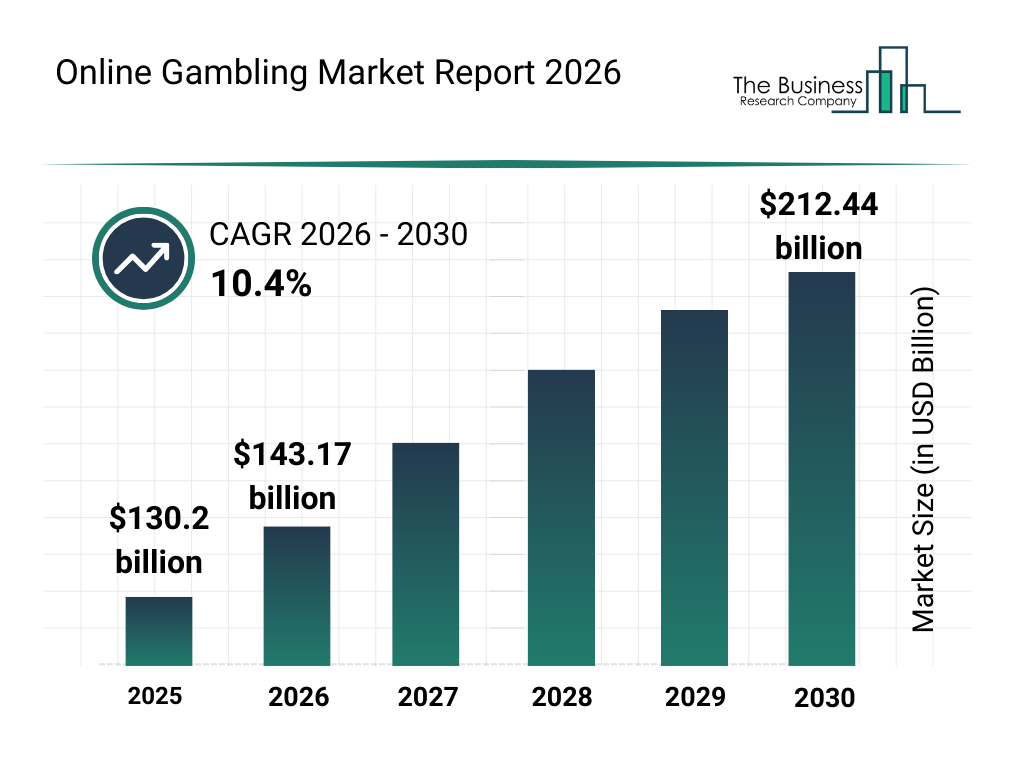
The global online gambling market reached $130.2 billion in 2025 and is projected to grow to $143.17 billion in 2026, reflecting a 10% annual growth rate. By 2030, the market is expected to exceed $212 billion, driven by expansion across digital casino and sports betting segments
This growth directly shapes how operators approach revenue expansion:
1. Higher Game Volume Drives Higher Betting Activity
Revenue in online casinos directly depends on active betting volume. More games create more engagement opportunities across player segments. Aggregator infrastructure expands content supply without fragmented integrations.
Businesses using casino game aggregator platform development services can increase wagering frequency through broader content availability.
- Larger libraries increase session duration
- More titles improve player retention
- Expanded categories attract diverse demographics
2. Faster Market Entry Captures Early Revenue Windows
Newly regulated regions create short revenue windows for early entrants. Operators entering first often secure higher acquisition rates.
When businesses build casino game aggregator software, they reduce integration delays and launch faster in regulated markets.
- Faster launches capture early player traffic
- Early compliance readiness reduces approval lag
- Quicker onboarding supports faster monetization
3. Multi-Provider Access Reduces Revenue Dependency Risk
Relying on a single provider concentrates revenue exposure. Aggregation distributes earnings across multiple studios and game types.
iGaming aggregator platform development allows operators to diversify content sources and stabilize revenue streams.
- Reduces provider concentration risk
- Maintains earnings if one supplier underperforms
- Supports consistent monthly revenue flow
4. Cross-Sell Opportunities Increase Player Lifetime Value
Player lifetime value grows when users explore multiple content categories. Aggregator systems enable seamless cross-title engagement within one session.
- Encourages movement between slots and live games
- Increases total betting per session
- Supports higher repeat visit rates
5. Data Visibility Improves Revenue Optimization Decisions
Revenue growth depends on accurate performance insights. Aggregator platforms centralize wagering and game-level reporting across providers.
Advanced analytics supported by enterprise AI solutions help operators detect profitable patterns faster and adjust content strategy based on measurable performance indicators.
- Identifies top revenue-generating providers
- Optimizes promotional budget allocation
- Improves forecasting accuracy
Casino game aggregator platform development supports steady revenue expansion across evolving global markets as market growth is real and measurable. Operators who invest early in the right infrastructure can capture consistent betting activity and long-term earnings.
Ready to Stop Leaving Revenue on the Table
Expansion only works when your backend can support it. Let's evaluate whether your aggregation model is built for long-term betting volume growth.
Discuss Your Revenue StrategyCasino Game Aggregator vs Direct Game Provider Integration: Which Model Scales Better?
Integration structure directly impacts expansion speed and operational control. Before investing in casino game aggregator platform development, operators must compare aggregation architecture with direct provider integrations to understand it better.
|
Differentiating Factor |
Casino Game Aggregator |
Direct Game Provider Integration |
|---|---|---|
|
Technical Expansion Effort |
One core integration supports multiple studios |
Each new studio requires separate technical deployment |
|
Compliance Management |
Central compliance logic applied across providers |
Repeated certification effort for every provider |
|
Commercial Flexibility |
Unified commercial negotiations layer |
Individual commercial agreements per studio |
|
Platform Upgrade Control |
Core updates applied once across ecosystem |
Updates coordinated separately with each provider |
|
Data Standardization |
Normalized data structure across games |
Provider specific data formats increase reconciliation work |
|
Market Entry Speed |
Structured onboarding enables faster regulated launches |
Launch timelines extend with every added integration |
As expansion pressures increase, the comparison clearly shows why casino game aggregator platform development scales better for operators targeting structured multi market growth without repeated technical overhead.
- Reduces cumulative technical debt as provider count increases
- Maintains operational stability during aggressive content expansion
- Supports custom casino game aggregator development with modular architecture
- Enables teams to develop casino game aggregation solutions for faster market entry
- Creates foundation to integrate AI driven reporting without structural redesign
Scaling is not only about adding games. It is about sustaining growth without multiplying operational friction. Aggregator infrastructure protects long term expansion efficiency while direct integrations increase structural strain over time.
Build, License, or Partner? A Strategic Framework for Casino Game Aggregator Platform Development
Every operator entering aggregation must decide how to structure ownership and control. The right model depends on capital strength, compliance goals, and long-term expansion strategy across regulated markets.
1. Build From Scratch
Building gives you full architectural control. You design workflows, provider routing logic, and reporting layers around your business model. When companies choose casino game aggregator platform development, they control roadmap priorities without external restrictions. This route works well when you plan to develop multi provider casino game platform capabilities with long term ownership in mind.
Best suited for:
- Operators targeting multiple jurisdictions
- Businesses seeking IP ownership
- Teams investing in scalable backend control
Key Considerations:
- Higher upfront development cost
- Longer initial launch cycle
- Strong technical leadership required
2. License a White Label Solution
Licensing reduces early technical burden. The infrastructure is prebuilt and ready for deployment. This approach fits businesses focused on quick market entry instead of backend ownership. Discussions around custom casino platforms and white-label solutions often come down to speed versus control. White label models limit backend customization. Expansion flexibility may depend on vendor capabilities.
Best suited for:
- Startups validating market demand
- Operators testing new regions
- Businesses with limited development teams
Key Considerations:
- Ongoing licensing fees
- Limited architectural control
- Dependency on vendor roadmap
3. Partner With an Aggregation Technology Provider
Partnership models balance ownership and speed. You collaborate with a technology firm while maintaining operational direction. Many operators use partnerships to create casino game aggregation platforms for iGaming operators without building internal engineering teams from scratch. This model also allows structured integration of AI automation services within reporting and compliance workflows.
Best suited for:
- Mid-scale operators expanding globally
- Businesses entering regulated markets
- Companies requiring guided technical execution
Key Considerations:
- Shared control over infrastructure
- Revenue sharing agreements
- Alignment on long term roadmap
The selection between build, license, or partner is not about trend preference. It is about matching growth ambition with operational capability. A clear framework protects expansion plans and prevents costly restructuring later.
Also Read: iGaming Platform Development: Build Custom or Choose White-Label?
Still Deciding Build vs. License?
The wrong model will cost you more later. Let's map your capital, compliance scope, and growth goals before you commit.
Get a Strategic Architecture ReviewCore Features Required to Build a Casino Game Aggregator Software Platform
Before starting casino aggregator software development, operators must define the structural features that support scale. Strong casino game aggregator platform development depends on backend stability, provider management logic, and controlled transaction processing layers.
|
Core Feature |
Why It Matters |
|---|---|
|
Unified API Gateway |
Connects multiple providers through one standardized integration layer |
|
Provider Management Console |
Controls onboarding status, contracts, and technical configuration |
|
Game Routing Engine |
Directs player requests to the correct provider in real time |
|
Wallet Synchronization System |
Maintains balance accuracy across operator and provider environments |
|
Session Management Layer |
Ensures stable gameplay without interruption or data conflict |
|
Centralized Reporting Dashboard |
Aggregates wagering, revenue, and provider level performance data |
|
Compliance Configuration Module |
Applies jurisdiction rules across integrated game libraries |
|
Game Catalog Management |
Organizes categories, tags, and localized content display |
|
Risk And Fraud Monitoring Controls |
Detects irregular betting patterns and transaction anomalies |
|
Performance Monitoring Tools |
Tracks uptime, latency, and integration stability metrics |
|
Multi-Currency Support |
Handles regional payment structures and player wallets |
|
Scalable Cloud Infrastructure |
Supports traffic growth without system degradation |
When businesses create casino content aggregation software, these features form the operational backbone. Each component reduces friction between providers and operators while supporting stable expansion. Without them, scaling becomes technically fragile and commercially risky.
Advanced Capabilities to Develop Scalable Casino Game Aggregator Platforms for Global Markets
Core features ensure operational stability, but advanced capabilities determine global competitiveness. Structured casino game aggregator platform development must support jurisdiction expansion, intelligent automation, and performance control across high volume regulated markets.
|
Advanced Capability |
Why It Matters |
|---|---|
|
Multi jurisdiction compliance engine |
Applies region specific gaming rules automatically across providers |
|
Dynamic content localization |
Adjusts language, currency, and lobby layout per market |
|
Real time revenue share automation |
Calculates provider payouts without manual reconciliation cycles |
|
Intelligent game recommendation engine powered by generative AI |
Optimizes content ranking based on player behavior patterns |
|
Modular AI analytics layer to build an AI app internally |
Gives operators direct control over predictive revenue modeling |
|
Scalable microservices architecture |
Enables independent scaling of traffic heavy system components |
|
Centralized bonus management framework |
Synchronizes promotional rules across all integrated studios |
|
Cross provider fraud detection system |
Flags abnormal wagering activity across content sources |
|
Automated regulatory audit logs |
Maintains structured compliance records for licensing reviews |
|
Elastic traffic load distribution |
Prevents downtime during peak betting activity |
|
Encrypted data exchange layer |
Secures financial and gameplay data across jurisdictions |
Operators that make casino game aggregator software for online casinos must move beyond basic connectivity. Intelligent automation reduces manual oversight while supporting operational scale. Businesses aiming to develop scalable casino game aggregator platforms succeed when advanced intelligence and compliance layers are built directly into system architecture.
Is Your Platform Built for Real Scale
If fraud detection, localization, and performance automation feel like afterthoughts, scaling will hurt. Let's stress-test your aggregation roadmap.
Validate Your Scaling PlanStep-by-Step Guide to Develop Casino Game Aggregation Software for Faster Market Entry
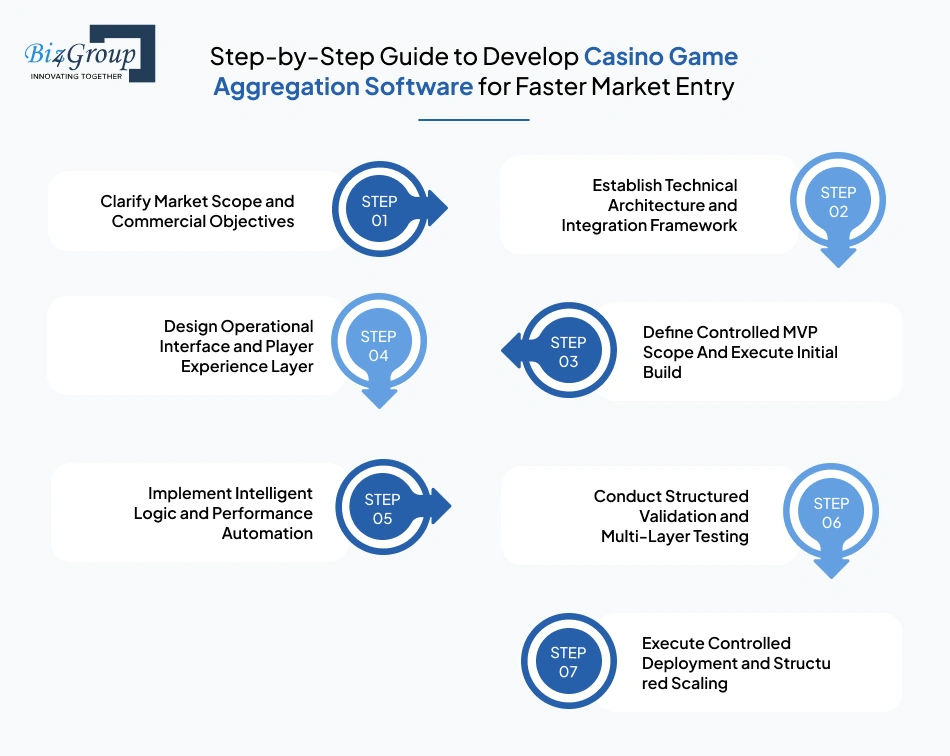
Developing casino aggregation software for faster launch requires disciplined sequencing. Each stage must reduce approval delays, integration friction, and provider onboarding time while keeping architecture stable for future multi market expansion.
Step 1: Clarify Market Scope and Commercial Objectives
Begin by identifying the jurisdictions you plan to enter as each market carries unique licensing rules and reporting obligations. Clearly define revenue expectations and provider mix early. This clarity helps teams build casino game aggregator systems with multiple providers without misalignment later. Focus on:
- Target countries and regulatory tiers
- Player demographics and device behavior
- Revenue share structure planning
- Local payment ecosystem compatibility
Clear objectives prevent technical drift making expansion intentional rather than reactive.
Step 2: Establish Technical Architecture and Integration Framework
Architecture decisions determine long-term scalability, so design a modular backend that separates routing, wallet logic, and reporting layers. Your integration planning should support both direct studios and the ability to create white label casino game aggregator platform structures when required. You should prioritize:
- Unified API development gateway structure
- Provider onboarding workflow
- Session and wallet synchronization logic
- Compliance configuration modules
A stable framework reduces redevelopment cycles as it prepares the platform for disciplined expansion across multiple regulated markets.
Step 3: Define Controlled MVP Scope And Execute Initial Build
Do not start with a full-scale release at once. Define a focused release version that validates routing logic, wallet synchronization, and provider onboarding workflows. Use MVP software development principles to reduce unnecessary build layers. This approach protects capital while validating core performance assumptions. Focus on:
- Limited provider integrations
- Core API gateway functionality
- Basic compliance configuration
- Essential reporting visibility
A disciplined MVP ensures architecture stability before full expansion. Many teams engage structured MVP development company to accelerate controlled delivery cycles.
A practical example of his structured MVP approach can be seen in one of Biz4Group LLC’s large scale social casino implementations: Stackr

Stackr is a social casino platform designed to deliver immersive slot gameplay with reward-driven engagement mechanics. We first launched a focused MVP covering core gameplay logic, wallet synchronization, and a limited game catalog. Once core flows proved stable with early users, the team expanded features and integrated additional game libraries. The platform was then scaled to support a larger game catalog, improved reward systems, and higher traffic capacity while maintaining performance stability.
Also Read: Top 12+ MVP Development Companies
Step 4: Design Operational Interface and Player Experience Layer
Backend strength alone does not guarantee adoption. Operators must prioritize structured UI/UX design across admin dashboards and content lobbies. Interfaces should simplify provider management and reporting workflows. Player facing layouts must support smooth navigation between integrated titles. Prioritize:
- Clear game categorization
- Responsive mobile layouts
- Real time session visibility
- Operator control dashboards
Operational clarity improves internal efficiency as a structured interface supports better engagement during early launch phases.
Also Read: Top UI/UX design companies in USA
Step 5: Implement Intelligent Logic and Performance Automation
Once MVP validation is complete, focus on strengthening the decision layer. It is important that data driven logic improve routing efficiency and revenue visibility across providers. At this stage, teams carefully integrate AI models into recommendation systems and fraud detection layers. These models enhance performance without overcomplicating architecture. Focus on:
- Behavior based game ranking logic
- Automated anomaly detection workflows
- Revenue trend forecasting controls
- Performance benchmarking dashboards
Controlled intelligence improves decision accuracy while protecting operational stability. For platforms delivering casino game aggregator solutions for startups and enterprises, it is important that AI automation must remain modular and scalable.
Step 6: Conduct Structured Validation and Multi-Layer Testing
Before full rollout, validate every integration layer as stability under peak traffic conditions is critical for regulated launches. Many operators often collaborate with experienced software testing companies to ensure compliance alignment and transaction reliability. Independent validation reduces launch risk therefore testing should cover:
- Wallet reconciliation accuracy
- Session continuity across providers
- Regulatory rule enforcement
- Load and stress performance benchmarks
Structured validation protects revenue flow. It ensures readiness before scaling into additional jurisdictions.
Step 7: Execute Controlled Deployment and Structured Scaling
Deployment should begin with phased regional rollout rather than activating all providers across every market at once. You should start with controlled traffic allocation and monitor system behavior closely as performance tracking during early days prevents larger operational setbacks later. Focus on:
- Gradual provider activation across jurisdictions
- Real time monitoring of transaction stability
- Revenue pattern validation post launch
- Infrastructure scaling based on actual traffic
Expansion must remain measured and data driven. Scaling decisions should follow proven performance benchmarks rather than assumptions.
A structured development sequence reduces launch delays and protects platform stability. When each stage follows disciplined execution, operators enter regulated markets with confidence and scale without triggering costly technical restructuring later.
Technology Stack to Create Casino Game Aggregation Platform Infrastructure in 2026
Infrastructure decisions directly impact performance and regulatory readiness. During casino game aggregator platform development, teams must align backend scalability with frontend control while planning long term full stack development across multi provider ecosystems.
|
Architecture Layer |
Technology Used |
Purpose |
|---|---|---|
|
Frontend Operator Dashboard |
React.js |
Responsive admin panels for provider control and reporting visibility are build with ReactJS development. |
|
Player Lobby Interface |
Next.js |
NextJS development delivers fast server-side rendering and SEO optimized game catalogs |
|
Backend API Layer |
Node.js |
NodeJS development manages provider routing, wallet synchronization, and session handling |
|
Data Processing Layer |
Python |
Analytics processing, fraud detection logic, and automation workflows are handled through python development |
|
Database Layer |
PostgreSQL |
Stores transactional data with structured relational integrity |
|
Caching Layer |
Redis |
Reduces latency for session data and high frequency requests |
|
Message Queue System |
Apache Kafka |
Enables real time event streaming between services |
|
Containerization |
Docker |
Ensures consistent deployment across staging and production |
|
Orchestration |
Kubernetes |
Manages scalable container deployment during traffic spikes |
|
Cloud Infrastructure |
AWS or Azure |
Provides elastic compute and secure regional hosting |
|
Monitoring Tools |
Prometheus and Grafana |
Tracks uptime, latency, and infrastructure performance metrics |
|
Security Layer |
OAuth 2.0 and JWT |
Secures authentication and token based access control |
Technology choices should support future scaling without major rebuilds. Teams offering custom casino game aggregator development services often select stacks that balance scalability with compliance flexibility. Strong engineering alignment between backend and frontend layers ensures stable operations across both operator dashboards and player environments delivered through modern mobile app development and web development services.
Is Your Tech Stack Holding You Back?
Outdated architecture quietly limits growth. Let's review your backend and infrastructure decisions before expansion begins.
Audit Your Aggregation StackSecurity and Compliance Framework for Custom Casino Game Aggregator Development Services
Security failures in aggregation environments create regulatory exposure quickly. Strong casino game aggregator platform development must address cross provider risk, transaction integrity, and audit defensibility before expanding into tightly regulated markets.
1. Multi Jurisdiction Regulatory Exposure
- License dependency across providers: Each integrated studio operates under specific certifications. Misaligned licenses can suspend operations when you develop multi provider casino game platform ecosystems.
- Rule conflict across regions: Different jurisdictions enforce varied RTP disclosures and reporting timelines. Aggregators must prevent rule overlap that creates compliance violations.
2. Financial Transaction Integrity
- Wallet synchronization accountability: Transaction mismatches between operator and provider wallets create audit red flags, and reconciliation gaps can trigger regulatory scrutiny quickly.
- Payment flow traceability: Every wager and payout must be fully traceable. Structured logging protects casino aggregator software development environments during audits.
3. Data Protection and Cross Border Governance
- Cross border data liability: Player identity and transaction data moves between different countries during processing. If this data is stored outside approved regulatory regions, it can violate local data protection and residency requirements.
- Access to governance accountability: Unauthorized administrative access increases breach liability. Regulators expect documented access logs and controlled privilege structures during compliance investigations.
4. Fraud Monitoring and Behavioral Oversight
- Cross studio abuse risk: Fraud rings often exploit gaps between integrated providers. Weak monitoring across studios increases exposure to coordinated wagering manipulation.
- Monitoring control reliability: Delayed anomaly detection can trigger regulatory penalties. Surveillance systems must be capable of providing defensible evidence during dispute or fraud investigations.
5. Audit Readiness and Operational Transparency
- Historical record preservation: Regulators require complete transaction histories and configuration records. Missing or inconsistent logs can raise immediate compliance concerns.
- Defensible reporting structure: Audit reviews demand structured, time stamped reporting visibility. Poor documentation weakens the operator’s ability to defend against regulatory examinations.
How to Scale Casino Game Aggregator Platform Architecture Across Multiple Jurisdictions
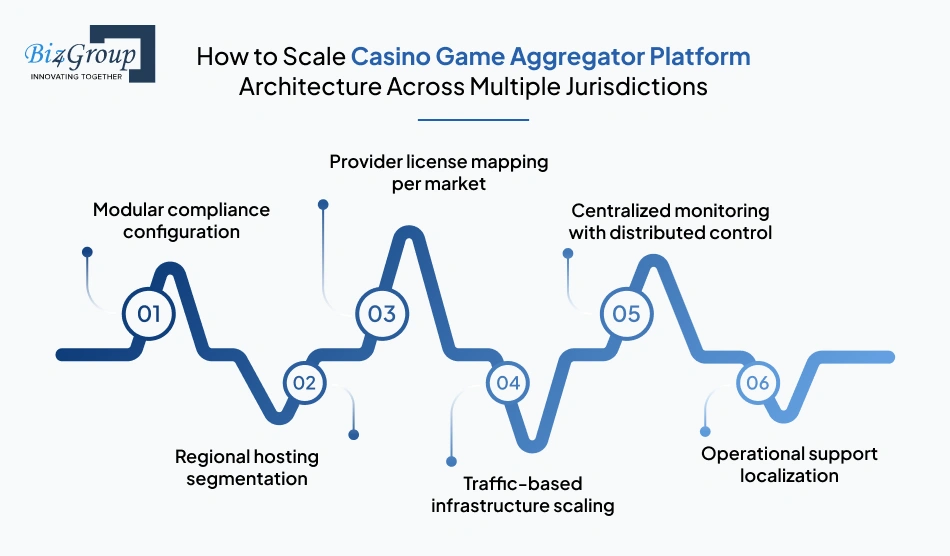
Scaling across regions requires architectural discipline, not rapid duplication. Strong casino game aggregator platform development must adapt to regulatory variation, infrastructure demand, and operational oversight without rebuilding core integration layers.
- Modular compliance configuration: Separate jurisdiction rules into configurable modules. This allows teams to develop casino game aggregator platform expansions without rewriting core transaction logic.
- Regional hosting segmentation: Deploy infrastructure within approved data residency zones. Local hosting improves regulatory alignment and reduces latency for market specific traffic.
- Provider license mapping per market: Activate studios only where certifications match jurisdiction rules. Structured validation prevents regulatory suspension during expansion phases.
- Traffic-based infrastructure scaling: Increase compute resources based on regional wagering patterns. Measured scaling prevents performance degradation during high volume periods.
- Centralized monitoring with distributed control: Maintain unified reporting while allowing regional oversight teams. Some operators rely on systems inspired by business app development using AI to monitor performance anomalies.
- Operational support localization: Establish localized compliance documentation and audit workflows. Regional control strengthens readiness during regulatory inspections.
Scaling across jurisdictions demands controlled expansion and structured oversight. Platforms supported by experienced casino game aggregator platform development services grow faster because architectural decisions anticipate regulatory variation instead of reacting to it.
Casino Game Aggregator Platform Development Cost Breakdown
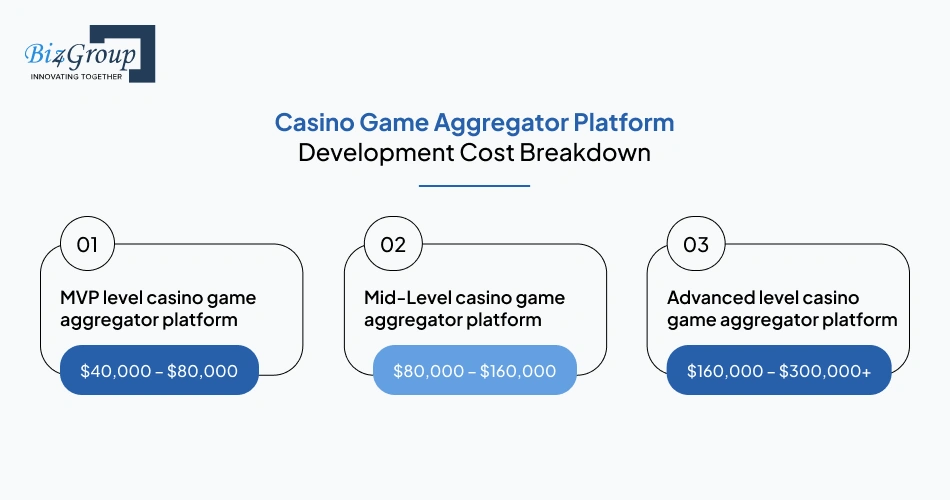
The investment required for the development of casino game aggregator platform development depends on scope, compliance depth, and provider scale. Most projects fall between $40,000 and $300,000+, based on architecture complexity and long-term expansion goals.
|
Development Level |
Estimated Cost Range |
What This Typically Covers |
|---|---|---|
|
MVP level casino game aggregator platform |
$40,000 – $80,000 |
Core API gateway, limited provider integrations, wallet sync, basic compliance configuration, foundational reporting dashboard |
|
Mid-Level casino game aggregator platform |
$80,000 – $160,000 |
Multiple provider onboarding, structured compliance modules, advanced reporting, bonus management, performance monitoring |
|
Advanced level casino game aggregator platform |
$160,000 – $300,000+ |
Multi jurisdiction architecture, scalable infrastructure, fraud detection systems, automation layers, full scale performance optimization |
Let’s look at what actually drives these numbers upward.
Also Read: AI Social Casino Platform Development Cost
Key Factors That Influence the Cost to build casino game aggregator software
- Provider count: Each additional studio increases integration time, certification handling, and testing scope. Multi provider environments require deeper routing logic and compliance verification across jurisdictions.
- Compliance scope: Expanding into regulated markets raises certification and audit preparation requirements. Jurisdiction specific configurations add development and documentation overhead.
- Infrastructure scale: High traffic expectations demand resilient hosting architecture. Load balancing, monitoring, and redundancy planning increase engineering effort and infrastructure expenses.
- Feature depth: Advanced reporting, bonus engines, payment fraud detection modules and AI integrations costs expand backend complexity. More operational control layers increase both build time and testing cycles.
- Customization level: Highly tailored operator dashboards and workflows require additional engineering effort. Custom logic increases long term maintenance responsibility.
Now let’s see how you can control these costs strategically.
How To Optimize the Cost to Develop scalable casino game aggregator platforms
- Start With MVP: Launch with limited providers and core routing stability. Controlled validation reduces early overspending and protects capital before scaling.
- Phased Expansion: Add providers and jurisdictions in stages. Gradual onboarding spreads certification and integration costs over time.
- Modular Architecture: Build independent system components that scale separately. Modular design prevents expensive rebuilds during expansion.
- Cloud Efficiency: Use elastic infrastructure based on real traffic patterns. Avoid overprovisioning resources during early market entry.
- Vendor Negotiation: Structure provider agreements with clear revenue share models. Balanced commercial terms reduce financial pressure during early operations.
Cost planning should align with long term platform goals, not short-term shortcuts. A structured investment approach protects scalability, compliance readiness, and operational stability while preventing unnecessary rebuild costs during future expansion phases.
Also Read: AI Software Development Cost
Spending Smart or Just Spending More
Cost overruns usually come from unclear scope. Let's define what you truly need before development begins.
Get a Cost Planning ConsultationKPIs That Define Success in Casino Game Aggregator Platform Development
Measuring growth requires more than counting integrated games. Strong casino game aggregator platform development depends on operational stability, revenue performance, compliance reliability, and provider efficiency across regulated markets.
1. Provider Activation Speed
Fast onboarding reflects AI integration maturity. Delays signal architectural gaps or compliance friction.
- Average time from contract signing to live deployment
- Certification approval cycle duration per jurisdiction
- Technical integration completion timeline
Efficient activation supports teams that build casino game aggregator systems with multiple providers without increasing operational strain.
2. Platform Stability and Uptime
Aggregation fails if sessions break or transactions drop. Stability shows whether the architecture can handle real wagering loads.
- Percentage uptime during peak wagering hours
- Failed game load attempts across providers
- Interrupted transaction rate per 10,000 wagers
Stable performance is essential for operators who aim to build fully compliant iGaming platforms under strict regulatory audits.
3. Revenue Per Provider
Game aggregation works well when multiple studios contribute revenue. Dependency on one provider weakens commercial resilience.
- Revenue share split across integrated studios
- Top three provider contribution ratio
- Growth rate of newly added providers
Balanced contribution confirms healthy multi provider performance.
4. Wallet Reconciliation Accuracy
Every wager must match between operator and provider records. Any mismatch creates regulatory exposure.
- Settlement match rate between systems
- Number of daily reconciliation discrepancies
- Resolution time for financial conflicts
Accurate reconciliation proves financial control discipline.
5. Player Session Continuity
Game aggregation success depends on smooth provider switching. Session drops reduce wagering and increase churn.
- Game switching failure percentage
- Session timeout frequency during peak load
- Drop rate during provider transitions
Low interruption rates confirm integration quality across studios.
Clear performance indicators reveal whether aggregation infrastructure truly scales. Consistent monitoring across integration speed, stability, and revenue distribution ensures long-term operational control and measurable growth across regulated markets.
Common Mistakes to Avoid When You Develop Casino Game Aggregator Platform Solutions
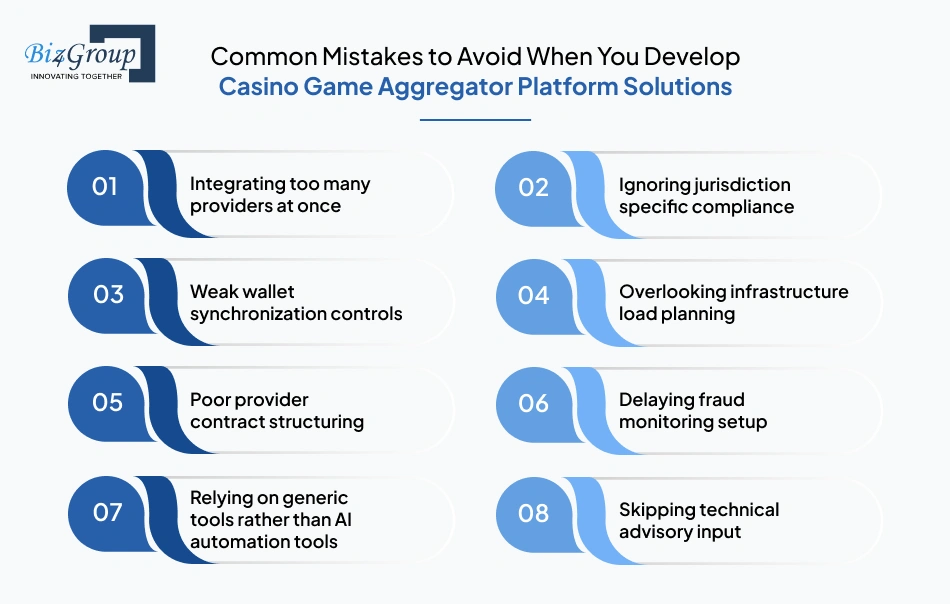
Many failures in casino game aggregator platform development do not come from technology limits. They happen due to planning gaps, compliance oversights, and rushed integration decisions that weaken long term scalability.
|
Mistakes |
How To Avoid |
|---|---|
|
Integrating too many providers at once |
Start with controlled onboarding phases. Validate routing stability and wallet reconciliation before expanding provider volume. |
|
Ignoring jurisdiction specific compliance |
Map license requirements early. Separate regulatory configurations per region to prevent approval delays. |
|
Weak wallet synchronization controls |
Implement strict reconciliation validation between operator and provider systems before launch. |
|
Overlooking infrastructure load planning |
Conduct peak traffic simulations. Scale hosting resources based on wagering projections. |
|
Poor provider contract structuring |
Define revenue share clarity and reporting accountability before technical integration begins. |
|
Delaying fraud monitoring setup |
Embed fraud detection logic during early architecture planning, not after launch. |
|
Relying on generic tools rather than AI automation tools |
When intelligent monitoring is required, hire AI developers with gaming domain knowledge. |
|
Skipping technical advisory input |
AI consulting services can prevent flawed architecture decisions during aggregation planning. |
Avoiding these mistakes protects capital and operational stability. Teams that create casino game aggregation platforms for iGaming operators succeed when iGaming aggregator platform development follows disciplined execution instead of rushed expansion strategies.
Why Biz4Group Is the Right Technology Partner for Casino Game Aggregator Platform Development?
Biz4Group LLC is listed among the top iGaming software development companies in USA with deep domain expertise in regulated gaming ecosystems and multi-provider integrations. This experience makes it a trusted choice for structured casino game aggregator platform development that aligns with compliance and growth goals.
Our work in aggregation focuses on building stable integration layers, controlled wallet synchronization, and jurisdiction-aware compliance mapping. These foundations reduce operational risk when multiple providers connect through one system. We collaborate closely during planning to prevent structural mistakes that become costly later.
Operating as a custom software development company in Florida, we work hands on with architecture, testing, and rollout phases. Our involvement stays practical and execution driven, especially when aggregation complexity increases across providers and regulated markets.
The following project delivered by us shows how this execution approach works in practice.
Portfolio Spotlight: JuicySlots

JuicySlots is an iGaming aggregation platform that provides users access to multiple popular online casinos through a single interface. The platform connects games from renowned providers allowing users to browse slot games, table games, and live casino titles within one structured environment.
Key Highlights:
- Aggregated multi-casino game catalog with category filters and search options
- Secure wallet management with coin purchases and fund redemption
- Real-time balance updates and protected transaction processing
- Personalized user profiles with transaction history visibility
We developed both frontend and backend systems to unify third-party casino integrations into one stable platform. The focus remained on structured game aggregation, wallet synchronization, real-time session handling, and scalable performance under concurrent user activity.
Why companies choose Biz4Group LLC:
- We structure development in phases to prevent rework during multi provider expansion and jurisdiction specific adjustments.
- Regulatory mapping is planned early, so compliance configurations do not disrupt integration timelines later.
- Our iGaming software solutions focus on stable routing, wallet accuracy, and measurable provider performance visibility.
- Architectural decisions are documented clearly to reduce dependency risk during future scaling phases.
Biz4Group LLC applies disciplined aggregation execution across planning, integration, and rollout phases. Unlike many casino game aggregator platform development companies, we stay focused on stable provider connections and wallet accuracy. Our on-demand application development solutions also support casino game aggregator solutions for startups and enterprises managing real operational scale.
Looking for Execution, Not Promises
If you value structured rollout and controlled scaling, let's talk through your aggregation requirements in detail.
Schedule a Technical DiscussionConclusion
Casino game aggregator platform development does not end when the first provider goes live. The real pressure begins with wallet reconciliation checks, jurisdiction audits, and unexpected traffic spikes. Teams that build secure casino game aggregator platforms for global markets quickly realize that routing stability and disciplined expansion matter more than adding games fast. Many work with top AI development companies in Florida once intelligent monitoring becomes necessary for tighter operational control.
Aggregation growth is usually steady, not dramatic. It comes from careful onboarding, controlled provider activation, and ongoing performance checks. Some teams create white label casino game aggregator platform models to move faster, while others choose deeper architectural ownership. The better choice is the one that matches your long-term operational capacity, not short-term urgency. Connect with us to review your current aggregation architecture before scaling further.
FAQ’s
1. What does casino game aggregator platform development typically include beyond basic integrations?
It includes unified API routing, wallet synchronization, provider onboarding logic, compliance configuration, centralized reporting, and scalable infrastructure planning. True aggregation development goes far beyond simply connecting multiple game studios.
2. How long does it take to develop casino game aggregator platform for regulated markets?
Timelines depend on provider count, jurisdiction scope, and compliance requirements. An MVP may take a few months, while a fully regulated multi-provider system can take significantly longer due to certification and testing cycles.
3. What is the difference between Casino game aggregator vs direct game provider integration?
Direct integration requires separate technical connections for each provider. Aggregator architecture centralizes integrations through one routing layer, simplifying expansion, compliance updates, and reporting across multiple studios.
4. How do you build secure casino game aggregator platforms for global markets?
Security requires encrypted transaction handling, jurisdiction-specific compliance mapping, wallet reconciliation accuracy, fraud monitoring controls, and structured audit logging. Stability under traffic spikes is equally important for global scalability.
5. Can startups use custom casino game aggregator development services, or is this only for large operators?
Startups can begin with controlled MVP models and limited providers. Custom casino game aggregator development services allow phased scaling without committing to full multi-jurisdiction infrastructure from day one.
6. What should businesses evaluate before choosing among casino game aggregator platform development companies?
They should assess real multi-provider experience, wallet synchronization accuracy, compliance handling capability, scalability architecture, and proven delivery of aggregation systems rather than general iGaming development claims.
