Location :
Orlando, FL, USA
 +1 (407) 714-1616
 info@biz4group.com


 AI Summary Powered by Biz4AI
- Prediction market platform development builds a venue where users trade contracts on event outcomes. It differs from a sportsbook in its counterparty, its revenue, and its regulator.
- Five regulatory paths run from a technology partnership to owning an exchange. KPMG puts their timelines at 1 to 3 months up to 24+ months.
- Core features, build steps, and architecture include a matching engine, pricing and liquidity tools, a wallet and ledger, settlement, and market surveillance. Your regulatory path sets how much of that you build.
- Compliance depends on your role and keeps changing. Identity checks, surveillance, clear contract rules, and flexible access controls come first.
- The cost of the platform build runs from $20,000 to $250,000+. Registration, legal work, capital, and liquidity come on top.
- Biz4Group LLC has guided 50+ sports betting solutions and helps teams scope the right build for their regulatory role.
Should you apply to run an exchange, or launch on someone else’s?
That choice shapes every part of prediction market platform development, from the matching engine you build to the registration you hold.
The market is moving fast. Kalshi and Polymarket together traded more than $40 billion in 2025, up from about $9 billion in 2024. In June 2026, DraftKings launched its own prediction exchange. Its launch release cited about $11.3 billion in annualized trading volume for the week ended June 21.
This guide explains how to build a prediction market platform. You will see how it differs from a sportsbook, which regulatory path fits, which features and architecture you need, and what the build costs.
Biz4Group LLC builds sports betting platforms for US-regulated markets, so we focus on sports event contracts and the technology behind them. Rules here change quickly, so the legal points are sourced and the key ones are dated.
How Does a Prediction Market Platform Differ from a Sportsbook?
A prediction market platform lets users buy and sell contracts on event outcomes, with prices that move like a stock and settle when the event resolves. A sportsbook sets odds and takes the other side of each bet. The operator usually matches buyers and sellers instead, which changes the regulator, the revenue model, and the build.
|
Dimension |
Sportsbook |
Prediction Market Platform |
|---|---|---|
|
Product |
Bets on outcomes at set odds |
Contracts that pay out if an event occurs |
|
Counterparty |
The sportsbook |
Other traders, often with market makers |
|
Revenue |
Margin built into the odds |
Fees on trades |
|
Regulator |
State gaming commissions |
The CFTC for registered event contracts, which states dispute in court |
|
Pricing engine |
Odds compilers and traders |
Order book and market makers |
|
Settlement |
Bet graded from an official result |
Contract resolved from a named source |
Revenue comes from trading fees. Kalshi earned $263.5 million in fees on $22.9 billion of volume in 2025, according to KPMG. A betting exchange under a state sportsbook license is a different product, which building a sports betting platform like BetDEX covers.
The legal status of sports event contracts is being decided in court, so this guide explains the models and does not give legal advice. The table shows what changes, so the next section covers the regulatory path you choose first.
Which Regulatory Path Should Your Prediction Market Platform Follow?
Pick your regulatory path before you design the platform, because the path decides what you build and when you launch. KPMG’s 2026 paper lists five entry models. They run from a technology partnership with an existing exchange to owning the exchange itself.
1. Technology Service Vendor (TSV)
A TSV is an app company that partners with an existing exchange to offer its contracts to the app’s users. KPMG calls this the fastest recent route but warns that the concept is new and untested with regulators. You build the customer-facing product and the integrations.
2. Introducing Broker (IB)
An IB is a CFTC-registered intermediary that takes orders but not customer funds, and routes them through a futures commission merchant.
3. Futures Commission Merchant (FCM)
An FCM holds customer funds in segregated accounts and executes, clears, and settles trades.
4. Designated Contract Market (DCM)
A DCM is the exchange itself, and it is the only role that designs and lists new contracts. It operates under 23 core principles. KPMG counts 17 new applications since early 2025, with seven approved.
5. Derivatives Clearing Organization (DCO)
A DCO is the clearinghouse that stands behind every trade.
|
Path |
Regulation |
Typical Timeline |
Capital |
How You Earn |
|---|---|---|---|---|
|
TSV |
Minimal |
1 to 3 months |
None required |
Set by your service contract |
|
IB |
Low to medium |
3 to 6 months |
$45,000 if not guaranteed by an FCM |
Commission on order flow, typically 0.5% to 2% of customer volume |
|
FCM |
High |
6 to 12 months |
$1 million and up |
Clearing fees, commissions of 1% to 3% of volume, and margin interest |
|
DCM |
Very high |
12 to 24+ months |
$5 million and up |
Full fee stack: trading, listing, market data, membership, and API fees |
|
DCO |
Very high |
12 to 24+ months |
$10 million and up |
Clearing and membership fees |
KPMG describes these timelines as approximate. ProphetX, for example, submitted its exchange application in January 2026 and relaunched as a prediction market in June. Biz4Group builds the platform technology, and the operator holds the registration.
How Did DraftKings, FanDuel, and Fanatics Enter?
Three major US sportsbook brands started with partners, and two have since moved up the stack. DraftKings registered as an introducing broker in December 2025, then launched its own exchange, DKeX, in June 2026 after buying Railbird. FanDuel launched FanDuel Predicts in five states in partnership with CME Group. Fanatics launched Fanatics Markets in December 2025 with Crypto.com supplying the pricing and market engine, and it has since acquired exchange infrastructure from BGC Group, GamblingNews reported.
Your role sets the scope, so the next section lists the features the platform needs.
Which Entry Path Gets You Live Fastest?
Talk to our team and leave with a clear recommendation on the path, partners, and scope that fit your launch.
Find My Entry PathWhat Features Does a Prediction Market Platform Need?
A prediction market platform needs market creation tools, an order book, pricing and liquidity controls, a trading interface, accounts with identity checks, settlement, surveillance, and admin tools. Each feature protects fairness, liquidity, or compliance. A missing one shows up quickly as a stalled market or a disputed payout.
- Market creation tools: Admins define the question, the rules, the expiry, and the source that will resolve the contract.
- Order book and matching: Buyers and sellers post bids and offers, and the engine matches them by price and time.
- Pricing and liquidity controls: Market makers are traders who post both sides of a market, and spread controls keep their prices tight so traders can enter and exit.
- Trading interface: Players see prices, depth, an order ticket, open positions, and a portfolio view.
- Accounts and funding: Traders verify identity, fund accounts, and withdraw through regulated payment providers.
- Settlement and resolution: The platform resolves each contract from its named source and pays the holders.
- Surveillance and risk tools: Position limits, unusual-trading alerts, and audit logs help staff spot manipulation.
- Real-time data and alerts: Price moves and event updates reach traders as they happen.
- Admin and reporting: Staff manage markets, accounts, and reports for partners and regulators.
Which Features Ship First?
Ship market creation, accounts, the order ticket, and settlement first, and add the rest once real trading starts.
|
Build Now |
Add Later |
Why |
|---|---|---|
|
One market category |
Many categories |
One category keeps rules and settlement simple |
|
Order ticket and open positions |
Rich charting |
Traders need to place and track orders first |
|
Accounts, identity checks, funding |
Loyalty and rewards |
Compliance tools cannot wait |
|
Settlement with an audit log |
Advanced analytics |
Payouts must be right from day one |
|
Basic surveillance alerts |
Public API access |
Integrity checks protect the first markets |
Those features need a build order, so the next section walks through the steps.
How Do You Build a Prediction Market Platform Step by Step?
To build a prediction market platform, work through seven steps. Choose your regulatory role, define your first markets, and design the trading flow. Then connect exchange, data and payments, build matching and settlement, test for integrity and load, and launch. Seven steps keep the work in order and the risk contained.
Step 1: Choose Your Regulatory Role
Decide which role you will hold before you design anything. Use the five paths above, and confirm the choice in writing with a lawyer who has CFTC and NFA experience. The test is a one-page memo naming your role, your partners, and who holds customer funds. Do not start the build without it.
Step 2: Define Your First Markets
Start with one category, such as sports, and write a rule sheet for each contract. Each sheet names the question, the expiry, and the source that resolves it. Test by resolving three past events on paper before any code exists. Gaps in the rules show up fast this way.
Step 3: Design the Trading Flow
Map sign-up, funding, browsing, the order ticket, open positions, and withdrawal. Keep the ticket simple, with price, quantity, and cost visible before confirmation. Test the flow with a handful of real traders. Watch where they hesitate, because that is where orders get abandoned.
Step 4: Connect Exchange, Data, and Payments
On a partner path, integrate the partner exchange’s APIs for markets, prices, and orders. On an exchange path, connect result feeds for settlement. Add identity checks and a payment provider, and test every call in a sandbox, as the prediction market API integration guide explains.
Step 5: Build Matching, Pricing, and Settlement
Build or integrate the order book, the pricing tools, and the settlement service. Settlement must be repeatable, so paying the same contract twice is impossible. Test with simulated order flow and with deliberately wrong results. Every payout should trace back to a logged resolution.
Step 6: Test for Integrity and Load
Test surveillance alerts, wash trading checks, and position limits. Wash trading means a trader on both sides of a trade to fake volume. Simulate event-day traffic and a data-feed failure. A halted market must stay halted until staff clear it.
Step 7: Launch and Expand
Launch with a small set of markets and watch spreads, volume, and disputes. Add categories one at a time. Review each new contract’s resolution source before it lists. Keep a regular review of resolutions after launch.
The steps show the order of work, and the next section covers the architecture behind them.
Can Your First Markets Launch This Season?
Share your markets, integrations, and launch window, and get a line-item estimate you can show your team and investors.
Get My Build EstimateWhich Architecture Fits a Prediction Market Platform?
A prediction market platform needs a matching engine, a pricing and liquidity layer, a wallet and ledger, a settlement service, and market surveillance, all fed by real-time data. An exchange builds every layer. A partner-based path builds the front end, accounts, and integrations around the partner’s engine.
|
Layer |
What It Does |
Exchange Path |
Partner Path |
|---|---|---|---|
|
Matching engine |
Pairs buyers and sellers by price and time |
You build it |
The partner provides it |
|
Pricing and liquidity |
Market-maker tools and spread controls |
You build the tools |
You display the partner’s prices |
|
Wallet and ledger |
Records balances and every trade |
You build it |
Funds sit with the regulated intermediary, and you show balances |
|
Settlement |
Resolves contracts and pays out |
You build it |
The partner settles, and you display results |
|
Surveillance |
Flags manipulation and unusual trading |
You build it |
You add your own alerts and reports |
|
Front end and APIs |
Order tickets, portfolios, notifications |
You build it |
You build it |
|
Real-time data |
Streams prices and results |
You build it |
You consume the partner’s feeds |
Order Book or On-Chain: Which Model Fits?
A central order book fits a US-regulated exchange or broker path, while an on-chain model settles through smart contracts. An order book matches bids and offers on the operator’s own engine, and regulated intermediaries hold customer funds.
An on-chain model runs on a blockchain, settles in a stablecoin, and uses an oracle, which is a data feed that reports results to the contract. Developer guides describe Polymarket as running on Polygon and settling in a dollar-pegged stablecoin.
A crypto prediction market platform adds wallets, token flows, and smart-contract audits. It also changes who holds the funds and how fast contracts settle. This guide covers order-book builds, which match the US-regulated paths above.
How Does Settlement Work?
Settlement resolves each contract from a named source and pays the holders. The rule sheet must name that source before trading opens, and the platform should log every resolution. Official data providers can serve as that source for sports. Genius Sports agreed in 2026 to let Kalshi and Polymarket use its data to settle sports contracts.
PredictEX: Real-Time Data Architecture in Practice
Event pricing needs the same fast data path as live betting, and PredictEX shows that path in a live build. Biz4Group built PredictEX on official Sportradar data for MLB, college football, and NFL games, delivered over real-time sockets. An eight-layer architecture and a C# admin panel keep data flowing and staff in control. The portfolio page reports 78% lower live data latency.
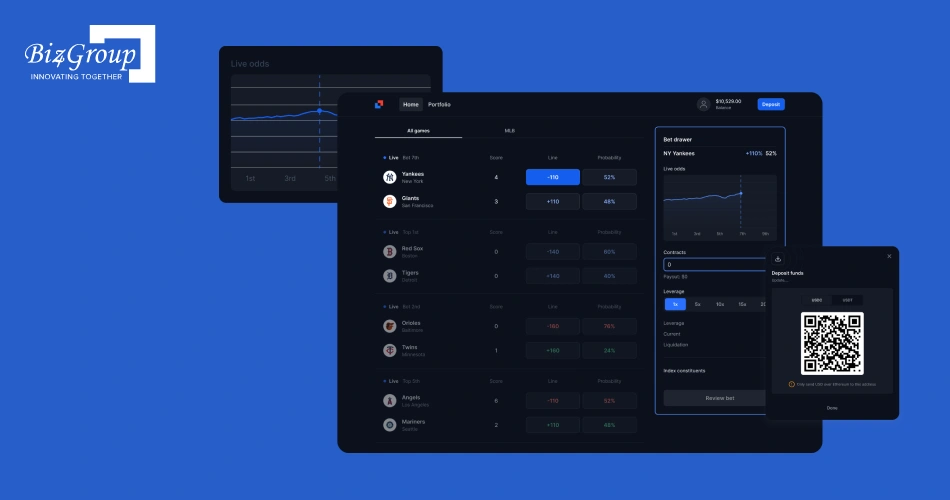
The architecture shows what you build, and compliance sets the limits, so the next section covers compliance.
What Compliance Does a Prediction Market Platform Need?
A prediction market platform needs compliance for its regulatory role, plus identity checks, market surveillance, and clear contract rules. The role you hold decides the exact duties. Legal status is changing, so confirm each point with a CFTC-experienced lawyer before launch.
- Registration for your role Each path carries its own CFTC or NFA registration, and KPMG warns that offering access without the right one can bring CFTC enforcement.
- Identity and AML checks Verify each trader before funding, and monitor deposits and withdrawals for suspicious activity.
- Market surveillance A DCM must list only contracts that are not readily susceptible to manipulation, and it must monitor trading.
- Clear contract rules Publish each contract’s question, expiry, and resolution source before trading opens.
- Location and access controls Geolocation tools let you apply rules by state, and those rules should be settings you can change.
What Should a Contract Rule Sheet Say?
A rule sheet should state the question, the expiry, the resolution source, how ties and cancelled events are handled, and how disputes are decided. Publish it before trading opens. Sports contracts also need a rule for postponed games.
Where Does the Legal Fight Stand?
The legal fight over sports event contracts is unsettled, so build access rules as settings you can change. KPMG notes that CFTC-regulated markets can be offered nationally under federal law, and that state regulators are challenging this in multiple courts. Foley’s litigation tracker, updated Nov 2, 2026, follows those cases in district courts and appeals courts. On Nov 6, 2026, CDC Gaming reported that the CFTC ordered contract markets to end geofencing restrictions that violate impartial access requirements within 30 days, or explain why. It also reported that Ohio and Massachusetts have threatened licenses.
This section is for planning and is not legal advice. Compliance sets the scope, and scope sets the price, so the next section covers cost.
Will Your Design Survive Regulator Scrutiny?
We review your identity, surveillance, and access-control design before launch, so technical gaps surface in a workshop, not an audit.
Review My DesignHow Much Does Prediction Market Platform Development Cost?
Prediction market platform development costs about $20,000 to $250,000+, depending on scope, integrations, and the regulatory role you hold. A front end on a partner’s exchange sits at the low end, and larger builds with their own engines sit higher. Registration, legal fees, and capital requirements come on top.
|
Tier |
What You Get |
Build Cost |
|---|---|---|
|
First Version |
One market category, a partner-exchange integration, accounts, an order ticket, and basic admin tools |
$20,000 to $45,000 |
|
Mid-Scale |
More categories, portfolios, notifications, and richer admin and reporting |
$45,000 to $90,000 |
|
Multi-Market |
Market-maker tools, partner APIs, surveillance alerts, and several data feeds |
$90,000 to $160,000 |
|
Enterprise |
Own matching and settlement engines, full surveillance, and high-load infrastructure, with exchange-grade scope able to exceed the top of this range |
$160,000 to $250,000+ |
Each added market category, data feed, or integration moves a build up a tier.
What Is Not in the Build Cost?
Five costs sit outside the build range, which covers the platform only and is a Biz4Group planning range, not a quote.
- Registration and legal fees depend on your role.
- The capital your role requires is shown in the path table.
- Market makers and early liquidity need their own budget.
- Data feed licenses, identity checks, and payment fees add to the build.
- Hosting, security testing, and ongoing support continue after launch.
The sports betting app development cost breakdown shows how the data, identity, payment, and security lines are priced for betting platforms. Price only matters if the company can deliver, so the last section covers how to choose one.
How Do You Choose a Prediction Market Platform Development Company?
Choose a development company that has shipped real-time trading or betting products, explains your regulatory role without promising approval, and lets you test a working demo. Ask who owns the code, who holds customer funds, and how settlement errors are corrected. A company that cannot answer those is not ready for this build.
What Should You Ask a Prediction Market Platform Development Company?
Ask for evidence from live builds.
- Which real-time trading or betting products can you show running?
- How do you settle a contract, and how do you correct a wrong resolution?
- Who holds customer funds in your design?
- How do you test surveillance alerts and event-day load?
- Who owns the source code and the trading data?
- Which of your past projects had the same regulatory role as mine?
Should You Build Custom or Start Turnkey?
Start turnkey when speed matters and your needs are standard, and build custom when your contracts, pricing, or workflow are your product. A turnkey prediction market software product is a ready platform you configure. A white-label prediction market platform is the same idea under your brand, so check which regulatory role the vendor’s product assumes. A guide to white-label sports betting platforms shows how that model works.
What Red Flags Should You Watch For?
Treat these as reasons to ask more questions.
- A company that promises regulatory approval is overselling, because the regulator decides.
- A quote with no line items hides data, security, and support costs.
- A promise of “any market in weeks” with no scope hides integration work.
- A team that cannot name the regulated entity in your design leaves a compliance gap.
- A company with no demo environment cannot show how it handles errors.
How Does Biz4Group LLC Approach Prediction Market Platform Development?
Biz4Group LLC builds real-time sports betting platforms for US-regulated markets, and our team has guided 50+ sports betting solutions. As an experienced sports betting app development company, we scope the build around your regulatory role, share line-item estimates, and leave registration with the operator.
To Summarize...
Prediction market platform development starts with a regulatory role, not a feature list. Pick one of five paths, build the layers that path requires, and treat access rules as settings you can change. Plan the build at $20,000 to $250,000+, and budget registration, legal work, capital, and liquidity separately.
Biz4Group helps teams scope that build and price it before they commit. We can turn your role and your first markets into a clear scope and a line-item estimate.
FAQs
1. Is a prediction market the same as an AI sports prediction app?
No. An AI prediction app forecasts outcomes for users, while a prediction market lets users trade contracts on those outcomes. If you only need forecasts, see AI sports betting predictions app development.
2. What happens if a contract resolves incorrectly?
The platform needs a correction process before launch. Keep an audit log of the source and the resolver for each contract, and test reversals in a sandbox. A platform that cannot reverse a payout cleanly is not ready.
3. Who provides liquidity on a new platform?
Market makers post bids and offers so traders can enter and exit. A new exchange needs a plan to attract them, and a partner path can use the partner’s depth. Thin books keep traders away, so plan this before launch.
4. Can a platform offer events beyond sports?
Yes. CasinoBeats reported that Fanatics Markets launched with sports and finance and economics contracts, and that it planned to add crypto, tech, culture, and climate.
5. Do I need a crypto wallet or token to build one?
Not for an order-book build on a regulated path, because customers fund accounts through regulated intermediaries. On-chain models use wallets, stablecoins, and smart contracts instead.
6. Can a sweepstakes sportsbook move to prediction markets?
Some are trying. Fliff and Onyx Odds each had an affiliate file for futures commission merchant registration on Aug 12, DeFi Rate reported. The move changes the regulator, the ledger, and the settlement rules, so it is a re-platform, not a re-skin.