Location :
Orlando, FL, USA
Location :
Orlando, FL, USA +1 (407) 714-1616
 info@biz4group.com

- Sports betting app development cost in 2026 typically ranges from $20,000 to $150,000+, depending on whether you build a white-label sportsbook, custom MVP, multi-state platform, or enterprise ecosystem.
- Hidden expenses often add another $15,000 to $80,000+, making sportsbook platform licensing and operational cost breakdown a critical part of financial planning.
- Monthly operating expenses for sportsbooks often range from $5K to $30K+ per month, meaning the cost of developing sports betting app products extends far beyond launch.
- Choosing the right development approach can reduce spending by 15% to 40%, potentially saving $10K to $60K+ across the project lifecycle.
- Biz4Group LLC helps businesses build sportsbook products with transparent budgeting and AI expertise across betting, prediction, analytics, and real-time sports platforms.
What if the biggest mistake in building a sportsbook happens before development even begins?
Founders often spend months comparing proposals only to realize later that the cheapest quote excluded the costs that actually matter.
The truth is simple. Sports betting app development cost in 2026 rarely stops at development. Most regulated sportsbooks launching in the US should realistically expect investments ranging between $20,000 and $150,000+ depending on scope, compliance requirements, and market ambitions.
Meanwhile, American Gaming Association through PR newswire shared that the US sports betting industry generated nearly $16.9 billion in revenue during 2025, showing how quickly competition continues to intensify.
“We are planning to launch a sports betting app and want to understand the full development cost including MVP, white-label, and enterprise sportsbook options in 2026.” If this sounds familiar, you are not alone.
Investors, startup founders, sports media companies, and casino operators are asking the same questions because development decisions made today directly affect profitability tomorrow.
So how much does it cost to build a sports betting app in 2026 with compliance and geofencing features? More importantly, why do two agencies sometimes quote the same project with a six-figure difference?
This guide breaks down sportsbook app development cost from the perspective most cost articles ignore. Launch cost, operational cost, licensing cost, compliance cost, and the hidden expenses that tend to appear after contracts are signed.
Let’s dive into the details now.
What Are the Factors That Affect the Development Budget of Sports Betting App
Why can two companies receive quotes for the same sportsbook product and still see a six-figure gap?
The answer usually comes down to scope.
Architecture decisions, market scope, infrastructure complexity, and technical requirements usually determine whether your budget stays near $20,000 or moves toward $150,000+.
“We are evaluating sportsbook business models and need clarity on how much it costs to build a regulated sports betting app with compliance and geofencing features.” This query comes up frequently because two sportsbooks with similar interfaces may have completely different technical requirements underneath.
The table below shows what actually moves the numbers.
|
Cost Driver |
Typical Cost Impact |
Budget Influence |
|---|---|---|
|
Platform scope |
Low to High |
$20K to $150K+ |
|
Real-time infrastructure |
Medium to High |
+10% to 25% |
|
Sports coverage |
Medium |
+$5K to $20K |
|
UI complexity |
Medium |
+$3K to $15K |
|
Compliance requirements |
High |
+15% to 30% |
|
Data integrations |
High |
+$5K to $25K |
|
Scalability requirements |
High |
+20% to 40% |
1. Platform Scope Decides Your Starting Budget
The first decision is simple.... What are you building?
A prediction app.
A white label sportsbook.
A betting marketplace.
A multi-state sportsbook.
Each option changes the sportsbook app development cost significantly.
|
Platform Type |
Typical Range |
|---|---|
|
Basic betting MVP |
$20K to $35K |
|
Mid-scale custom sportsbook |
$40K to $80K |
|
Advanced scalable platform |
$80K to $150K+ |
Teams exploring a scalable launch often begin with a smaller validation model like a sports betting app MVP before expanding functionality later. This reduces early capital exposure while improving product-market fit.
2. Real-Time Data Infrastructure Changes Everything
Sports betting products live or die by speed.
Odds update. Scores change. Users place bets simultaneously.
This means your backend architecture becomes expensive quickly.
Why does this matter financially?
Because real-time systems require:
- Persistent connections
- High availability architecture
- Synchronization logic
- Load balancing
- Performance optimization
Platforms struggling with latency often discover why most betting apps fail at real-time match accuracy when traffic spikes during large sporting events.
Estimated cost impact
|
Infrastructure Complexity |
Added Cost Range |
|---|---|
|
Basic polling architecture |
$2K to $5K |
|
WebSocket implementation |
$5K to $12K |
|
Large-scale real-time synchronization |
$15K to $35K |
3. Sports Coverage Directly Impacts Development Scope
Supporting one sport is easier. Supporting multiple leagues increases complexity rapidly.
Each league introduces:
- Different APIs
- Different betting markets
- Different data structures
- Different update frequencies
Example:
A sportsbook focused only on NHL may remain closer to the lower budget range.
A platform covering NFL, NBA, MLB, NCAA, and micro markets requires significantly larger infrastructure.
Teams exploring broader coverage often evaluate how top US betting apps rely on multiple sports data providers because relying on a single provider creates operational limitations.
4. User Experience Often Becomes an Unexpected Cost Driver
Poor interfaces create expensive problems.
Higher abandonment. Lower retention. More support requests.
The best sportsbooks prioritize:
- Fast navigation
- Low click count
- Simple bet placement
- Mobile-first interfaces
A strong user experience typically increases development budget upfront while reducing acquisition costs later. For many startups, collaborating with a UI/UX design company during early planning prevents costly redesign cycles.
|
UX Complexity |
Estimated Cost Impact |
|---|---|
|
Standard interface |
$2K to $5K |
|
Custom sportsbook workflows |
$5K to $12K |
|
Highly personalized experiences |
$12K to $20K |
Also read: Top 15 UI/UX design companies in USA
5. Integrations Often Cost More Than Founders Expect
Most sportsbooks connect multiple systems.
Examples include:
- Odds providers
- Payment gateways
- Authentication
- Analytics tools
- Notification systems
- CRM platforms
More integrations create:
- More dependencies
- More testing cycles
- More maintenance requirements
Teams frequently invest in AI integration services when building recommendation engines, personalization systems, or predictive workflows. Typical integration complexity affects the development cost of sports betting app projects substantially.
|
Integration Level |
Estimated Budget Impact |
|---|---|
|
Few integrations |
$2K to $5K |
|
Moderate integrations |
$5K to $15K |
|
Heavy integration ecosystem |
$15K to $30K |
6. Scalability Planning Changes Long-Term Economics
Many founders budget for launch. Few budget for growth.
That becomes expensive later.
Questions worth asking early:
- How many concurrent users are expected?
- Will traffic spike during live events?
- Are multiple states planned later?
- Will personalization or analytics expand?
Projects requiring enterprise AI solutions, recommendation engines, or predictive workflows generally require stronger backend planning from day one.
A simple rule applies... Building scalability later usually costs more than planning scalability earlier.
So before asking, "What is the sportsbook app development cost?"
Ask: "What exactly are we building?"
Because pricing rarely changes due to code alone. It changes because of architecture, scalability, integrations, and product decisions made long before development begins.
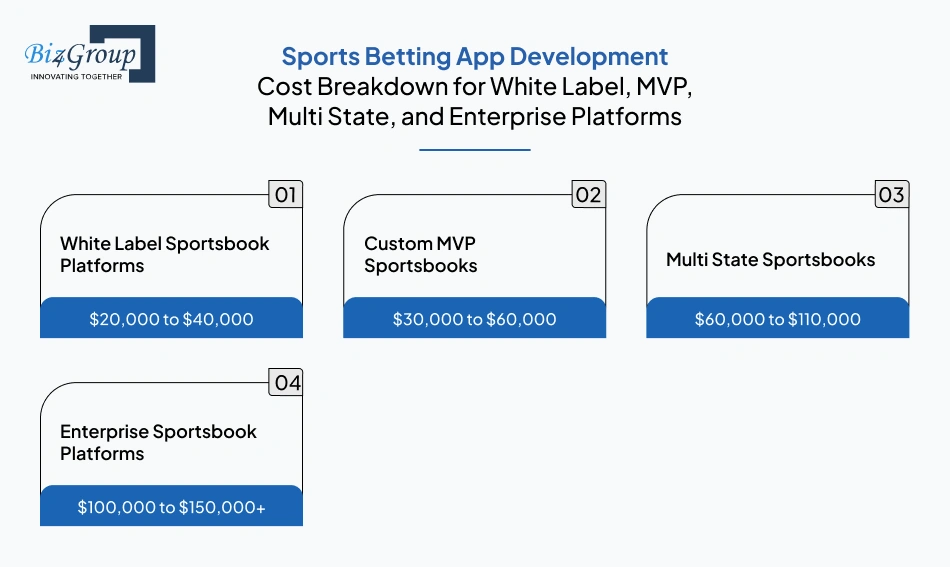
Sports Betting App Development Cost Breakdown for White Label, MVP, Multi State, and Enterprise Platforms
A little reality check.
When founders ask about sports betting app cost breakdown, they often expect one number.
There is no single number.
The cost changes depending on what type of sportsbook you are building.
Decision makers saying, “We are investors exploring the betting industry and want to compare build vs buy costs for sports betting app in the US market” make sense because the difference between platform categories can easily exceed six figures.
The table below gives a high-level view.
|
Platform Type |
Typical Budget Range |
Time to Market |
Scalability Potential |
|---|---|---|---|
|
White Label Platform |
$20K to $40K |
Fast |
Moderate |
|
Custom MVP |
$30K to $60K |
Moderate |
Good |
|
Multi State Sportsbook |
$60K to $110K |
Longer |
High |
|
Enterprise Sportsbook Platform |
$100K to $150K+ |
Longest |
Very High |
Let's break them down.
1. White Label Sportsbook Platforms
Estimated Budget: $20,000 to $40,000
White label products work best when speed matters more than customization. You are essentially purchasing pre-built infrastructure while customizing branding, interfaces, selected workflows, and limited functionality.
Common use cases:
- Affiliate businesses
- Prediction platforms
- Early market testing
- Rapid launches
A typical white-label sports betting platform can reduce launch timelines dramatically because much of the technical foundation already exists.
Example from All Chalk
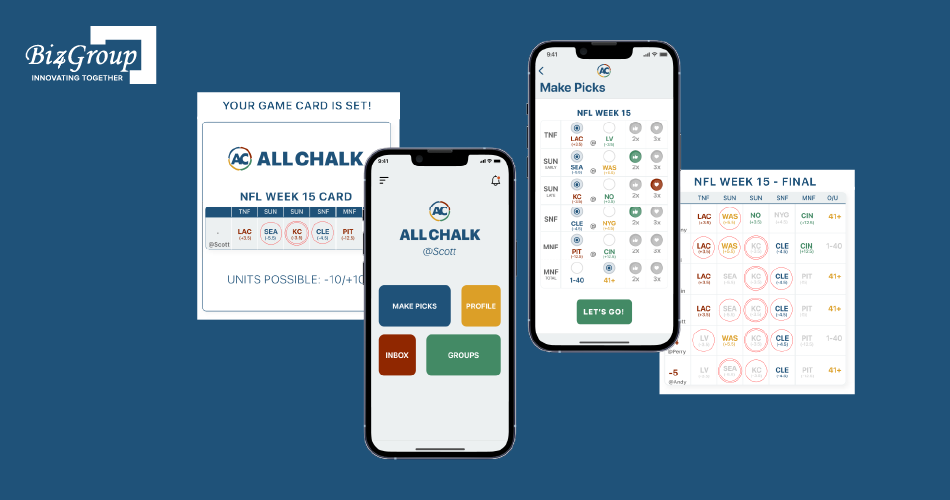
All Chalk demonstrates what happens when simplicity becomes a strength. The platform focused on:
- Prediction mechanics
- Leaderboard systems
- Multi-league support
- Game reminders
- Simplified user journeys
Because the scope remained focused, the team could prioritize faster delivery, easier onboarding, and smoother cross-platform experiences.
White label economics work well when:
- Speed matters
- Customization requirements remain limited
- Market validation comes first
Not every company needs a full sportsbook on day one.
2. Custom MVP Sportsbooks
Estimated Budget: $30,000 to $60,000
Custom MVPs sit in the middle.
You control the product.
You validate assumptions.
You avoid overspending early.
This approach works particularly well for:
- Startups
- Sports communities
- Niche betting products
- Emerging markets
Teams evaluating MVP development services usually choose this route because it creates flexibility without enterprise-level spending.
Example from Handshake
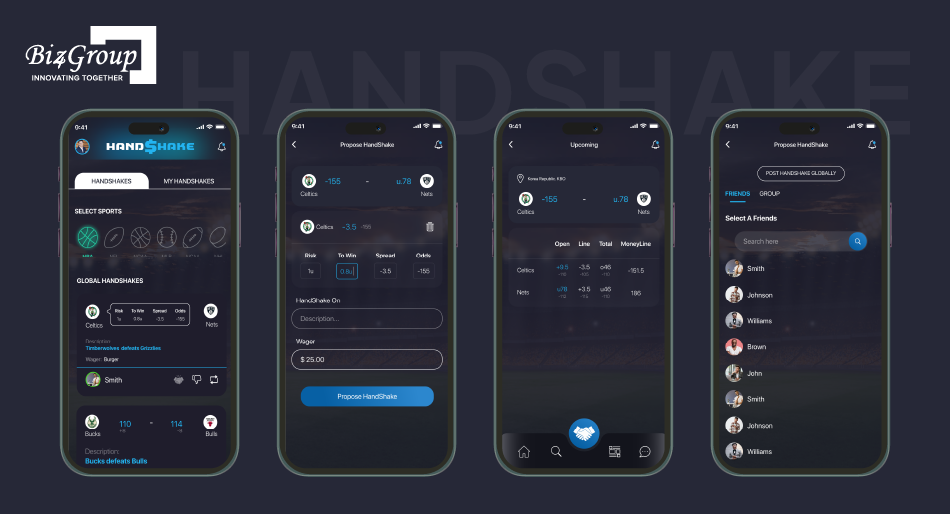
When Biz4Group built Handshake, the goal was different. Instead of replicating traditional sportsbooks, the focus shifted toward social betting experiences, community interactions, and recommendation-driven engagement.
The product introduced:
- Social betting
- One-on-one wagers
- Group betting experiences
- Chat systems
- Recommendation capabilities
- Multiple sports ecosystems
This created additional complexity. More workflows. More interactions. More edge cases.
Yet the MVP approach kept development focused around validation.
Custom MVP platforms make sense when:
- Product differentiation matters
- User behavior still needs validation
- Future expansion remains uncertain
Also read: Top 12+ MVP development companies in USA
3. Multi State Sportsbooks
Estimated Budget: $60,000 to $110,000
Multi-state platforms operate differently. The challenge moves from features toward scale.
Requirements typically include:
- Multiple jurisdictions
- Higher traffic loads
- Larger infrastructure
- More operational complexity
Teams considering multi-state expansion frequently spend considerable time studying sports betting regulations across US states because launch requirements vary substantially.
Example from SportsMEX
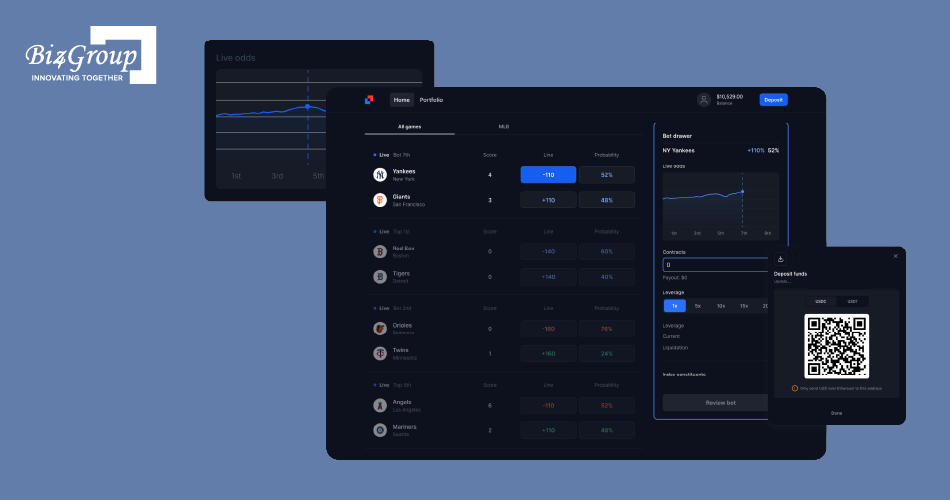
At Biz4Group, SportsMEX showed us firsthand why scalable sportsbooks become significantly more expensive as infrastructure complexity increases.
The platform required:
- Live game data across multiple leagues
- High-volume socket architecture
- Distributed backend services
- Synchronization mechanisms
- Large-scale real-time operations
Features included:
- MLB coverage
- NFL coverage
- CFB coverage
- Dynamic pricing systems
- Predictive analytics
The result?
Infrastructure requirements increased significantly compared to simpler sportsbooks.
Multi-state architecture becomes necessary when growth projections are aggressive, multiple markets are targeted, and scalability becomes a competitive advantage. Businesses evaluating how to build an AI sports betting app that passes state-by-state regulatory approval in USA frequently discover that architecture decisions made early determine future expansion costs.
4. Enterprise Sportsbook Platforms
Estimated Budget: $100,000 to $150,000+
Enterprise systems are different entirely. At this stage, companies are building ecosystems rather than applications.
Typical requirements include:
- Analytics layers
- Personalization engines
- Operational dashboards
- Extensive reporting
- High concurrency support
- Advanced automation
Example from Quick Start Bets
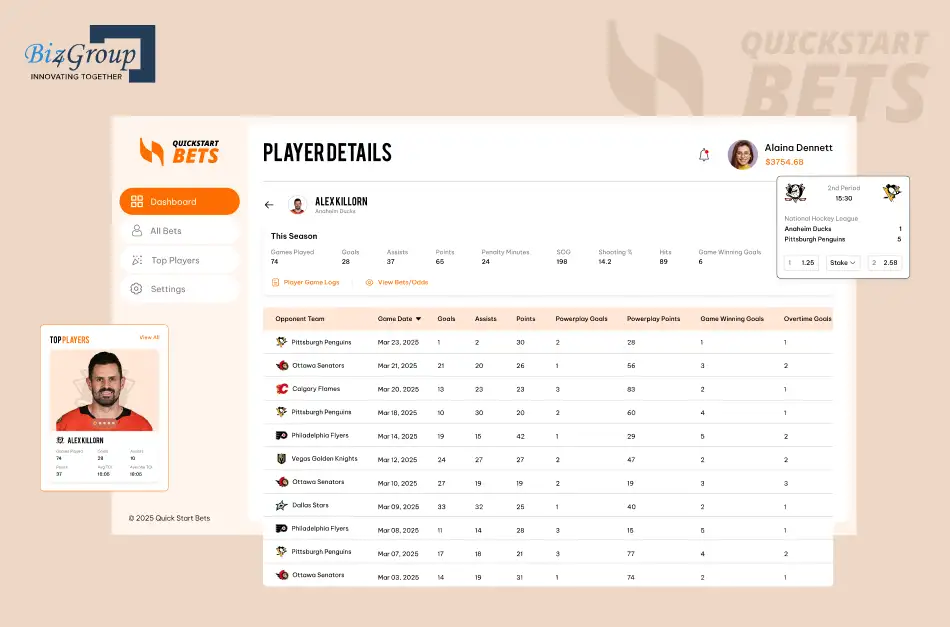
While building Quick Start Bets at Biz4Group, our team discovered that enterprise sportsbook complexity rarely comes from features alone. The challenge came from keeping analytics, odds, dashboards, and real-time systems synchronized continuously.
The platform combined:
- Real-time odds
- Detailed player analytics
- Historical statistics
- Centralized dashboards
- Tracking systems
- Low-latency infrastructure
The difficult part was not building features. The difficult part was making everything work together continuously.
This type of environment often introduces:
- Larger backend teams
- Stronger infrastructure requirements
- More testing cycles
- Higher operational overhead
Teams exploring enterprise environments frequently evaluate how to use AI for sports betting because predictive capabilities increasingly influence user engagement.
5. Hybrid Models Are Becoming More Common
Some companies now combine approaches.
Examples:
- MVP + white label backend
- Custom frontend + existing infrastructure
- Enterprise analytics layered on simpler betting engines
Hybrid approaches help reduce risk while maintaining flexibility.
Many organizations comparing white-label to custom sports betting software development discover that hybrid strategies often provide better capital efficiency.
Quick Decision Framework
|
If Your Goal Is |
Recommended Path |
|---|---|
|
Launch quickly |
White Label |
|
Validate product ideas |
Custom MVP |
|
Expand across markets |
Multi State |
|
Build long-term competitive advantage |
Enterprise |
|
Reduce risk while scaling |
Hybrid |
The biggest mistake founders make? Choosing architecture before choosing business objectives.
Platform category should always follow business strategy. Not the other way around.
So... Which Budget Bucket Are You Actually In?
Most sportsbook founders discover their real budget is 2x different from their first assumption. A five-minute estimate today can save months of wrong planning tomorrow.
Calculate My Sportsbook CostHidden Sports Betting App Development Cost That Most Founders Miss
Here is the uncomfortable truth. Most founders budget for development. Few budget for everything surrounding development.
Hidden expenses often add $15,000 to $80,000+ on top of initial build estimates depending on scale, target markets, and operational requirements.
Founders are often heard saying, “We are a startup team looking to develop a sports betting app and want to understand hidden costs like data feeds, licensing, and responsible gaming tools.” It matters because hidden costs are usually what create budget overruns.
The table below shows where unexpected spending appears.
|
Hidden Cost Category |
Typical Cost Range |
When It Appears |
|---|---|---|
|
Data feeds and odds providers |
$3K to $20K+ |
Before launch |
|
Geolocation tools |
$1K to $10K+ |
During implementation |
|
KYC and identity verification |
$2K to $10K+ |
Testing and launch |
|
Responsible gaming tools |
$2K to $15K+ |
Compliance stage |
|
Payment infrastructure setup |
$2K to $8K+ |
Pre-launch |
|
Fraud monitoring |
$2K to $10K+ |
Scaling stage |
|
Security and penetration testing |
$3K to $15K+ |
Before release |
1. Odds Feeds and Sports Data Costs Arrive Earlier Than Expected
A sportsbook without reliable data does not survive. Odds providers charge differently depending on:
- Sports coverage
- Update frequency
- API volume
- Market access
Many founders underestimate how expensive real-time information becomes.
|
Data Complexity |
Typical Cost Impact |
|---|---|
|
Single sport coverage |
$3K to $5K |
|
Multi league coverage |
$5K to $12K |
|
Premium real-time feeds |
$12K to $20K+ |
Teams evaluating a sports betting affiliate website often discover that content products and sportsbooks operate under very different infrastructure economics.
2. Geolocation Infrastructure Creates Hidden Spending
Location verification sounds simple. It rarely is.
Regulated sportsbooks need systems capable of:
- Location validation
- Fraud prevention
- VPN detection
- Session verification
These requirements increase online sportsbook app development pricing rapidly.
|
Geofencing Complexity |
Estimated Cost |
|---|---|
|
Basic location services |
$1K to $3K |
|
Multi-state geolocation setup |
$3K to $7K |
|
Advanced fraud prevention |
$7K to $10K+ |
Questions around geolocation frequently appear when companies study challenges in modern sports betting app development because location compliance affects both technical and operational planning.
3. KYC, Identity Verification, and User Validation
User registration creates hidden complexity. Regulated sportsbooks often require:
- Age verification
- Document validation
- Identity checks
- Risk scoring
These systems require additional integrations, more testing, and operational monitoring.
|
User Verification Scope |
Typical Cost |
|---|---|
|
Basic verification |
$2K to $4K |
|
Advanced KYC flows |
$4K to $8K |
|
Enterprise onboarding systems |
$8K to $10K+ |
These costs become more visible when companies compare cost to develop AI sports betting software because personalization and onboarding increasingly overlap.
4. Responsible Gaming Systems Add Another Layer
This category rarely appears in early proposals. It should.
Responsible gaming capabilities may include:
- Betting limits
- Self-exclusion tools
- Risk monitoring
- Behavioral alerts
- User restrictions
|
Responsible Gaming Features |
Estimated Range |
|---|---|
|
Basic controls |
$2K to $5K |
|
Advanced monitoring systems |
$5K to $10K |
|
Automated intervention workflows |
$10K to $15K+ |
Organizations increasingly invest in AI automation services when building behavioral monitoring systems because manual monitoring becomes difficult at scale.
5. Payment Infrastructure Costs More Than Most Teams Expect
Accepting payments creates more work than connecting a gateway. Additional requirements often include:
- Merchant setup
- Transaction monitoring
- Fraud detection
- Withdrawal management
- Dispute handling
|
Payment Setup Complexity |
Estimated Cost |
|---|---|
|
Standard setup |
$2K to $4K |
|
Advanced transaction flows |
$4K to $6K |
|
High volume infrastructure |
$6K to $8K+ |
Companies studying how AI sports betting apps like FanDuel make money usually discover that transaction infrastructure becomes a major operational consideration.
6. Security Spending Usually Appears Late
Security spending rarely creates excitement. Skipping it creates expensive problems.
Hidden costs often include:
- Penetration testing
- Infrastructure hardening
- Data protection workflows
- API protection
- Monitoring systems
Teams building AI-powered betting systems or advanced personalization engines frequently work with an AI app development company because security complexity increases alongside system complexity.
Typical security spending:
|
Security Layer |
Cost Range |
|---|---|
|
Basic protection |
$3K to $5K |
|
Moderate security testing |
$5K to $10K |
|
Enterprise-level protection |
$10K to $15K+ |
What Hidden Costs Usually Surprise Founders Most?
Short answer... Not development.
The hidden layers around development.
That is why pricing guide for building regulated sportsbook apps in US market discussions frequently fail to capture the real investment picture. Because development builds the platform. Hidden costs determine whether the platform survives launch.
What If the Most Expensive Part of Your Sportsbook Isn't Even in Your Budget Yet?
Hidden expenses alone can add $15K to $80K+ beyond development. A 15-minute conversation today may save you from six-figure surprises later.
Call Our Experts NowOngoing Expenses That Shape Sports Betting App Development Cost
Building the product is one expense. Running it every month is another.
CEOs often say, “We are considering launching a multi-state sportsbook app and need a complete breakdown of development cost and scalability requirements.” For many operators, monthly expenses become the difference between sustainable growth and shrinking margins.
Below is a simplified operational view.
|
Operational Area |
Monthly Range |
Why It Matters |
|---|---|---|
|
Cloud infrastructure and hosting |
$500 to $8,000+ |
Keeps systems available during traffic spikes |
|
Monitoring and uptime tools |
$200 to $2,000 |
Detects failures and performance issues |
|
Customer support operations |
$1,000 to $10,000+ |
Supports user retention and dispute handling |
|
Engineering maintenance |
$2,000 to $15,000+ |
Fixes bugs and supports updates |
|
Analytics and reporting tools |
$300 to $3,000 |
Tracks user behavior & platform performance |
|
Marketing and acquisition tools |
$1,000 to $20,000+ |
Supports growth and retention |
|
Operational staffing |
$2,000 to $25,000+ |
Supports scaling requirements |
Estimated Monthly Total
|
Platform Scale |
Estimated Monthly Operational Cost |
|---|---|
|
Small sportsbook operations |
$5K to $12K |
|
Growing sportsbook platforms |
$12K to $30K |
|
Large-scale sportsbook ecosystems |
$30K+ |
When founders calculate sportsbook app development cost, monthly operations are frequently overlooked. That becomes expensive later. Because development budget of sports betting app projects determines launch. Operational costs determine survival.
Sportsbook App Development Cost Changes Across Different States
A sportsbook built for one state rarely costs the same as a sportsbook built for another. Why?
Because regulations, market size, competition, and launch complexity vary dramatically.
Decision makers say, “I want to create a regulated sports betting app in the US but need cost estimation for multi-state compliance and geofencing features.” That query has no universal answer because launching in Colorado looks very different from launching in New York.
Below is a simplified view.
|
State |
Relative Complexity |
Estimated Build Budget Impact |
Typical Founder Profile |
|---|---|---|---|
|
Colorado |
Lower |
$20K to $40K |
Startups and MVP launches |
|
Arizona |
Moderate |
$25K to $50K |
Growth-stage operators |
|
Illinois |
Moderate to High |
$40K to $70K |
Regional sportsbooks |
|
New Jersey |
High |
$50K to $90K |
Competitive sportsbook entrants |
|
Pennsylvania |
Very High |
$60K to $110K |
Large funded operators |
|
New York |
Extremely High |
$80K to $150K+ |
Enterprise operators |
1. Lower Complexity Markets Create Faster Entry Opportunities
Some states create easier launch conditions. Colorado and Arizona often attract:
- Newer operators
- Early-stage products
- Regional launches
- Testing strategies
These markets typically work better when founders want faster deployment, lower initial exposure, and controlled scaling. Many startups exploring AI fantasy sports app development often enter simpler markets first before expanding.
2. Mid-Tier Markets Require Larger Capital Buffers
States such as Illinois create different planning requirements. These markets often involve:
- Larger customer bases
- Stronger competition
- Heavier operational planning
- Increased launch preparation
This is where sportsbook app development cost begins moving away from startup budgets and toward growth-stage investment planning. Organizations exploring cost to build an AI sports prediction website frequently encounter similar scaling questions because larger audiences create larger infrastructure requirements.
3. Highly Competitive Markets Create Enterprise Economics
Markets such as New Jersey, Pennsylvania, and New York typically require larger financial planning. Why?
Because competition changes expectations.
These markets often require:
- Stronger user experiences
- Larger marketing budgets
- More operational readiness
- Deeper infrastructure planning
Companies evaluating cost to develop an AI sports betting app like Rithmm frequently model enterprise-level assumptions because competition becomes significantly stronger.
4. Multi-State Expansion Rarely Scales Linearly
Many founders assume: Launch once. Expand everywhere.
Reality works differently.
Adding states frequently creates additional work because:
|
Expansion Variable |
Impact on Budget |
|---|---|
|
New market onboarding |
Moderate |
|
Additional infrastructure |
Moderate to High |
|
Expanded operations |
High |
|
Additional reporting requirements |
Moderate |
|
Larger customer support operations |
High |
This explains why many organizations exploring how to build an enterprise AI sports betting platform focus heavily on expansion architecture from the beginning.
Quick Market Selection Framework
|
Your Goal |
Recommended Approach |
|---|---|
|
Validate demand quickly |
Lower complexity states |
|
Expand regionally |
Mid-tier states |
|
Build large sportsbook brands |
High complexity states |
|
Scale nationally |
Multi-state architecture |
The biggest mistake founders make? Choosing markets based on market size alone.
The cost to make sportsbook app platforms successful depends heavily on choosing markets that match available capital, operational maturity, and long-term growth plans.
Launching In the Wrong State Could Cost More Than Building the App!
Choosing the right market can change first-year economics dramatically. A smarter expansion roadmap can reduce costs by 15% to 40% while improving long-term ROI.
Calculate My ROI PotentialThe Real Year 1 Sports Betting App Development Cost Model
If you’re wondering, “We are unsure how much capital is required to build a compliant sports betting app and want a full cost breakdown before investing”, we have your back.
For a realistic example, assume a startup launches a custom sportsbook in two US states with plans to scale after proving traction.
|
Cost Category |
Estimated Year 1 Cost |
|---|---|
|
Product development |
$45,000 |
|
Infrastructure and hosting |
$12,000 |
|
Operations and support |
$18,000 |
|
Marketing and user acquisition |
$25,000 |
|
Product improvements and updates |
$10,000 |
|
Contingency reserve |
$10,000 |
|
Estimated Year 1 Total |
$120,000 |
What Does This Tell Us?
The development budget of sports betting app projects is only one piece of the puzzle. A sportsbook that costs $45,000 to build may require nearly three times that amount to launch, operate, improve, and grow during its first year.
That is why founders should evaluate total ownership cost rather than focusing only on the initial development quote.
A realistic Year 1 budget for most growth-oriented sportsbooks typically falls between $80,000 and $150,000+, depending on market strategy, scale, and business goals.
How to Reduce Sportsbook App Development Cost Without Sacrificing Quality?
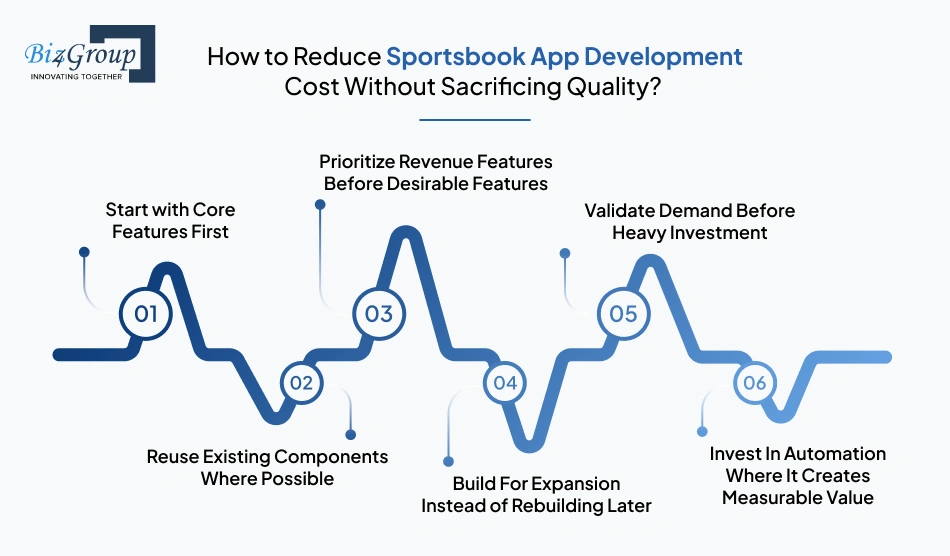
The good news? Reducing sports betting app development cost does not always require cutting features.
Founders who make the right planning decisions early can often save 15% to 40% of their total project budget, which translates to roughly $10,000 to $60,000+ depending on platform scope.
The following strategies typically deliver the highest savings.
1. Start with Core Features First
Many founders attempt to launch with every possible feature. That usually leads to longer timelines and larger budgets. Launching with essential functionality first can reduce development spending by $5,000 to $20,000.
Focus on:
- User onboarding
- Betting workflows
- Wallet functionality
- Basic reporting
Everything else can follow after validation.
2. Reuse Existing Components Where Possible
Not every feature needs to be built from scratch. Using proven modules for authentication, notifications, analytics, and reporting can save $3,000 to $15,000 in development effort.
This approach is especially valuable for startups working with limited capital.
3. Prioritize Revenue Features Before Desirable Features
A common mistake is investing heavily in features that do not contribute to engagement or revenue. Instead, prioritize capabilities that directly support user activity and retention. Potential savings range from $5,000 to $25,000 by avoiding unnecessary scope expansion.
Companies planning to develop a sports betting app like Stake often discover that disciplined feature prioritization creates faster returns than oversized launch plans.
4. Build For Expansion Instead of Rebuilding Later
Shortcuts frequently become expensive. Planning architecture for future growth may increase initial effort slightly, but it often prevents $10,000 to $30,000+ in redevelopment costs later.
This becomes particularly important when expansion is part of the roadmap.
5. Validate Demand Before Heavy Investment
Many successful sportsbooks begin by validating audience demand before committing to large budgets.
Examples include:
- Niche betting products
- Prediction platforms
- Focused sports communities
Early validation can reduce investment risk by $10,000 to $40,000+.
The same principle applies when launching a micro-betting AI app, where proving user engagement early often matters more than launching a fully mature platform.
6. Invest In Automation Where It Creates Measurable Value
Manual processes create recurring costs. Automation can reduce long-term operational effort across reporting, customer support workflows, user engagement systems, and performance monitoring.
Businesses investing in AI product development services frequently see operational savings of $2,000 to $10,000 annually, depending on scale.
The cost to build a sports betting app becomes far more manageable when decisions are driven by business goals rather than feature wish lists. Most successful sportsbooks do not start with maximum complexity. They start with the right complexity.
Red Flags Hidden Inside Sports Betting App Development Cost Proposals
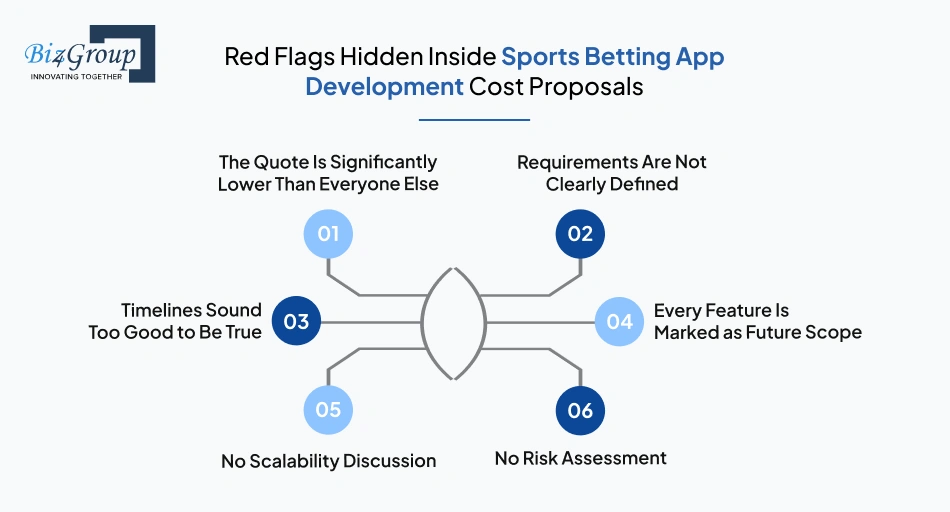
A low quote is not always a good quote. In many cases, the cheapest proposal becomes the most expensive project.
For professionals asking, “I am an investor researching sportsbook app and want to understand development cost structure and ROI potential”, hold on. Before signing any agreement, look for these warning signs.
1. The Quote Is Significantly Lower Than Everyone Else
If one proposal is $25,000 and the others are between $60,000 and $100,000, ask why.
A lower number often means something has been excluded.
Not optimized. Not planned. Or not understood.
2. Requirements Are Not Clearly Defined
A proposal should explain:
- What is included
- What is excluded
- Expected deliverables
- Development assumptions
If everything sounds vague, budget surprises usually follow.
3. Timelines Sound Too Good to Be True
Building a sportsbook requires planning, testing, integrations, and deployment. Promises like "Full sportsbook in four weeks" should trigger further investigation.
4. Every Feature Is Marked as Future Scope
This is one of the most common causes of budget expansion. A proposal may appear affordable initially because major functionality has been moved outside the current scope.
Always ask: “What will require additional spending after the contract starts?”
5. No Scalability Discussion
A proposal focused only on launch often ignores growth. Ask how the platform will handle:
- Traffic increases
- New markets
- Additional sports
- Future feature expansion
6. No Risk Assessment
Every software project contains risk. Experienced teams identify those risks early.
If a proposal presents development as completely straightforward, that is often a warning sign rather than a strength.
Quick Founder Checklist
Before accepting any sports betting app development pricing estimate, make sure you can clearly answer:
- What exactly am I paying for?
- What assumptions were used?
- What future expenses should I expect?
- What happens if scope changes?
- How will the platform scale?
The cost of building sports betting app platforms is rarely determined by the first number on a proposal. The real cost is usually hidden in everything that number leaves out.
Also read: How to develop a sports betting app like Stake?
Still Comparing Proposals That Look Completely Different?
If one agency quotes $25K and another quotes $100K+, someone is probably excluding something important. Get clarity before signing something expensive.
Get A Transparent EstimateQuestions to Ask Before Hiring a Sports Betting App Development Company
Hiring a development partner is a business decision before it becomes a technology decision.
If “I need a company that can build a scalable sports betting app with full compliance and cost breakdown consultation” sounds familiar, ask these questions before moving forward.
Q1. Have You Built Products Similar to Our Business Model?
A sportsbook for:
- prediction contests
- social betting
- micro betting
- enterprise sportsbooks
all require different expertise. Ask for relevant experience based on your specific goals.
Q2. How Do You Handle Product Discovery and Planning?
Strong teams ask questions before giving answers. Look for conversations around:
- Business objectives
- Target users
- Monetization strategy
- Technical constraints
This step often determines whether projects stay aligned with business goals.
Q3. What Type of Team Will Actually Build the Product?
Many buyers focus only on agencies. Focus on people instead.
Ask:
- Who leads architecture?
- Who manages delivery?
- Who owns quality?
- Who handles scaling decisions?
Companies planning advanced platforms often choose to hire AI developers when predictive systems, automation, or personalization become part of the roadmap.
Q4. How Will You Support Future Growth?
Growth creates different problems. Ask how the team approaches:
- New feature releases
- Performance optimization
- Product evolution
- Technical maintenance
Organizations evaluating how to choose top AI sports betting software development company often prioritize long-term partnership capability rather than launch capability alone.
Q5. How Do You Translate Business Goals into Technical Decisions?
The right partner should explain:
- tradeoffs
- priorities
- timelines
- technical recommendations
in business language. Not technical jargon.
Also read: Top 12 AI sports betting app development companies in USA
Final Question
Before signing anything, ask one final question: If our business doubles in size within 12 months, what changes?
The answer often reveals whether you are hiring developers... Or hiring long-term product partners.
Why Businesses Across USA Choose Biz4Group LLC for Sports Betting App Development
Building sportsbook products requires teams that understand betting ecosystems, user behavior, real-time systems, product economics, scalability, and growth.
That is where Biz4Group has built its reputation.
Biz4Group LLC a USA-based AI development company that helps entrepreneurs, startups, funded operators, and enterprises build modern sportsbook ecosystems designed for growth. From prediction platforms and social betting experiences to enterprise-grade sportsbooks and real-time analytics systems, our focus has always remained the same... Build products that excel at launch and scale successfully afterward.
As a sports betting app development company, our approach combines product strategy, architecture planning, scalable engineering, real-time infrastructure, and business-focused execution. Whether companies need sportsbook platforms, prediction engines, automation workflows, analytics systems, or AI-driven experiences, the objective remains simple.
Reduce risk. Accelerate growth. Build products that create measurable business value.
Modern sportsbooks rely heavily on infrastructure decisions. That is why our expertise extends beyond interfaces and workflows into backend architecture, scaling systems, and sports betting API integration services that keep platforms fast, reliable, and ready for growth.
Why Businesses Choose Biz4Group LLC
- Strong experience building sportsbook products across multiple categories and business models
- Product-first development approach focused on business outcomes rather than feature checklists
- Expertise across AI systems, analytics engines, automation workflows, and personalization
- Transparent planning processes that prioritize realistic budgeting and long-term scalability
- Teams capable of handling real-time systems, large user volumes, and high-performance infrastructure
- Experience supporting founders from early-stage validation through enterprise growth
- Clear communication around technical decisions, tradeoffs, and roadmap planning
Many companies exploring sportsbook opportunities eventually realize something important.
Building the software is only part of the challenge. Building the right software for the right business model is where real expertise matters.
If you are evaluating sportsbook app development cost, custom platform requirements, scalability planning, or long-term product strategy, the development partner you choose will often determine whether your budget becomes an investment or an expense.
If you want a realistic sportsbook roadmap, transparent cost estimates, and a team that understands how sportsbook products actually operate, let's start with a conversation.
To Summarize...
Sports betting app development cost in 2026 is no longer a simple question with a simple answer. The real investment depends on product type, scalability goals, market strategy, operational planning, and long-term growth objectives. A sportsbook built for quick validation will look very different from one designed for multiple markets and large user volumes.
Throughout this guide, one thing becomes clear. The cost to build a sports betting app should never be evaluated through development expenses alone. Launch costs, infrastructure decisions, expansion plans, operational spending, and business objectives all shape the final investment. We are evaluating sportsbook business models and need clarity on how much it costs to build a regulated sports betting app with compliance and geofencing features. If that question brought you here, the answer should feel much clearer now.
At Biz4Group, we approach sportsbook products differently. As a USA-based software development company, we help businesses move beyond vague estimates and generic proposals by building realistic product roadmaps, transparent cost models, scalable architectures, and growth-focused betting platforms designed around actual business goals.
The sportsbook market is growing quickly. Most businesses already know that. The question is simple. Will you enter the market with assumptions or with a strategy?
Let's build the version that scales. Let’s talk.
FAQs
1. Is it better to launch a sportsbook app for one sport or multiple sports initially?
For most startups, launching with one or two sports is usually more practical. Supporting multiple leagues increases testing requirements, operational complexity, and product management overhead. Starting with focused sports coverage often helps validate demand faster while reducing early investment risk.
2. Can sportsbooks generate revenue before reaching large user numbers?
Yes. Many sportsbooks focus on smaller but highly engaged user segments before expanding. Subscription models, premium analytics, affiliate partnerships, prediction contests, and community-driven experiences often create earlier monetization opportunities without requiring millions of users.
3. How long does it take to build a sports betting app?
Most platforms take anywhere between 2 to 6 months depending on complexity, product scope, and technical requirements. Biz4Group, however, can deliver a functional MVP in 2 to 4 weeks because we use reusable components that reduce both development time and cost while maintaining flexibility for future expansion.
4. Should startups focus on mobile apps first or web platforms first?
The answer depends on audience behavior and acquisition strategy. Mobile-first experiences generally perform better for user engagement, while web-first platforms may simplify validation and reduce early complexity. Many businesses eventually support both ecosystems for stronger growth.
5. How important is personalization in modern sportsbook platforms?
Personalization has become increasingly important because users expect tailored experiences. Features like customized recommendations, behavioral insights, and personalized dashboards can improve engagement and retention when implemented thoughtfully.
6. What business models work best for sportsbook startups entering competitive markets?
Different models work for different businesses. Some companies focus on subscription-based analytics. Others prioritize affiliate ecosystems, prediction contests, premium communities, or traditional wagering experiences. The best model usually depends on audience behavior rather than market trends.
7. What skills should a sportsbook development team ideally have?
Strong sportsbook teams usually combine multiple disciplines including product strategy, backend engineering, frontend development, infrastructure planning, real-time systems expertise, security knowledge, and experience building consumer-facing platforms. Product thinking often becomes equally important as technical execution.
8. How do investors evaluate sportsbook opportunities before investing?
Investors usually evaluate three things first. Market opportunity, operational sustainability, and scalability potential. Products with clear monetization strategies, realistic growth plans, and measurable differentiation often attract stronger investor confidence compared to products competing only on features.