Location :
Orlando, FL, USA
Location :
Orlando, FL, USA +1 (407) 714-1616
 info@biz4group.com

 AI Summary Powered by Biz4AI
- A responsible gambling monitoring platform helps US operators identify player risk, trigger timely alerts, manage interventions, and maintain auditable player protection records.
- Responsible gambling monitoring combines player activity data, configurable risk indicators, alerts, case management, intervention workflows, reporting, and data-quality controls.
- State-specific responsible gaming requirements make configurable rules, permissions, records, and review processes important for operators serving players across multiple US jurisdictions.
- AI and predictive analytics can support risk detection, player segmentation, anomaly identification, and prioritization, with human review remaining essential for high-impact decisions.
- Responsible gambling monitoring platform development typically costs $20,000-$250,000+, depending on integrations, risk scoring, intervention workflows, analytics, security, reporting, and scale.
- Biz4Group LLC can help operators plan and develop custom responsible gambling monitoring solutions by mapping their data sources, jurisdictions, workflows, integrations, and technical requirements into a scalable product roadmap.
What happens when a player’s gambling behavior starts raising concerns, but your team notices the warning signs too late?
For online casinos, sports betting operators, and iGaming businesses in the United States, that gap can have serious consequences. A responsible gambling monitoring platform helps operators identify potentially harmful behavior, assess player risk, manage interventions, and maintain records of their player protection activities.
The need is particularly relevant in the US, where gambling oversight varies by state. The American Gaming Association’s Responsible Gaming Regulations and Statutes Guide documents the regulatory landscape across states with commercial casinos, sports betting, or internet gaming. Some jurisdictions also require automated indicators or algorithmic triggers to support responsible gaming interventions.
For operators planning a custom solution, the challenge extends beyond identifying warning signs. The platform must connect player activity data, risk assessment, intervention workflows, and compliance records without creating gaps between them. Biz4Group’s experience building sports and iGaming platforms provides relevant engineering context for these decisions, particularly around data integration, user activity tracking, and scalable application architecture.
This guide explains how responsible gambling monitoring platforms work, which features matter most, how to approach compliance, and what operators should consider when developing a custom solution.
What Is a Responsible Gambling Monitoring Platform?
A responsible gambling monitoring platform is a digital system that helps gambling operators recognize signs of potentially harmful play and respond with appropriate player protection measures.
It brings together player activity data, risk assessment rules, alerts, intervention workflows, and compliance records. Depending on the implementation, it may also connect with identity verification services, payment systems, self-exclusion programs, and customer support tools.
The goal is to help operators identify concerns early, respond consistently, and document their actions.
How Does a Responsible Gambling Monitoring Platform Work?
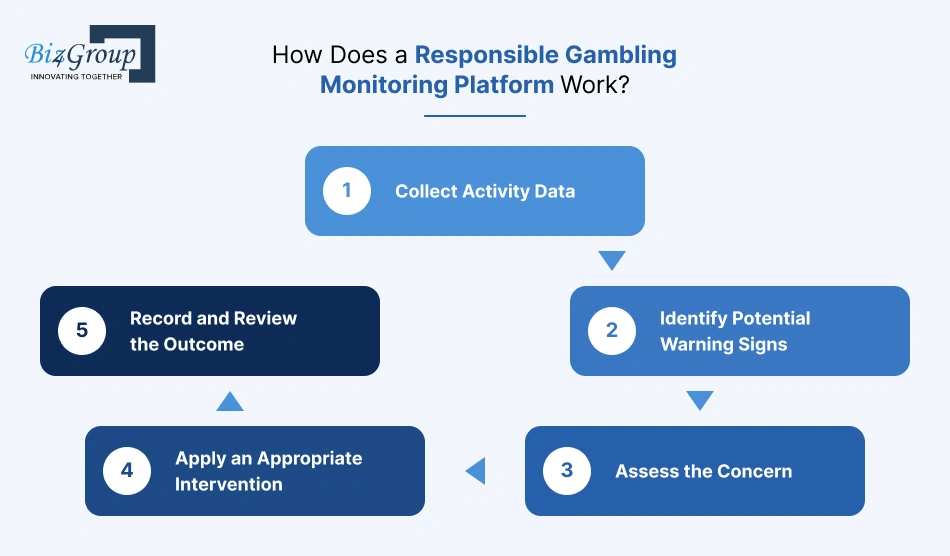
The platform collects relevant activity data, evaluates it against defined risk indicators, and flags accounts that may require attention. A trained employee can then review the available evidence and determine the appropriate response.
A typical workflow looks like this.
1. Collect Activity Data
Gather relevant deposits, wagers, session activity, limit changes, account history, and customer interactions.
2. Identify Potential Warning Signs
Apply rules, behavioral analytics, and risk models to detect patterns that may warrant attention.
3. Assess the Concern
Prioritize alerts and give trained staff the context needed to review a player's activity.
4. Apply an Appropriate Intervention
Support a player conversation, a limit reminder, a cooling-off period, or another action required by the operator's policy.
5. Record and Review the Outcome
Store the alert, decision, communication, follow-up, and outcome for ongoing oversight and audits.
The system should not automatically label someone as having a gambling problem. A risk indicator signals that further review may be appropriate. It is not a medical diagnosis.
What Are the Core Components?
Most responsible gambling monitoring systems combine several connected capabilities.
|
Component |
Purpose |
|---|---|
|
Data collection layer |
Captures relevant account, transaction, wagering, and session activity |
|
Risk assessment engine |
Applies configurable rules and analytical models to identify concerning patterns |
|
Alert management |
Prioritizes cases according to urgency and operator policy |
|
Intervention management |
Records and coordinates player communications and protective actions |
|
Player protection controls |
Supports limits, time-outs, account restrictions, and self-exclusion workflows |
|
Compliance records |
Maintains evidence of alerts, decisions, actions, and follow-ups |
|
Reporting dashboard |
Tracks trends, intervention outcomes, and responsible gambling KPIs |
|
Integration layer |
Connects the platform with the operator’s existing systems and relevant external services |
The right combination depends on the operator’s size, product mix, licensing jurisdictions, and existing technology.
A startup sportsbook may begin with rule-based monitoring and a structured case management workflow. A multi-state operator may require more advanced analytics, jurisdiction-specific rules, and integrations across several brands.
Quick Start Bets and Real-Time Activity Data
Quick Start Bets by Biz4Group brings together real-time NHL odds, player and team insights, and game-day information in one analytics platform.
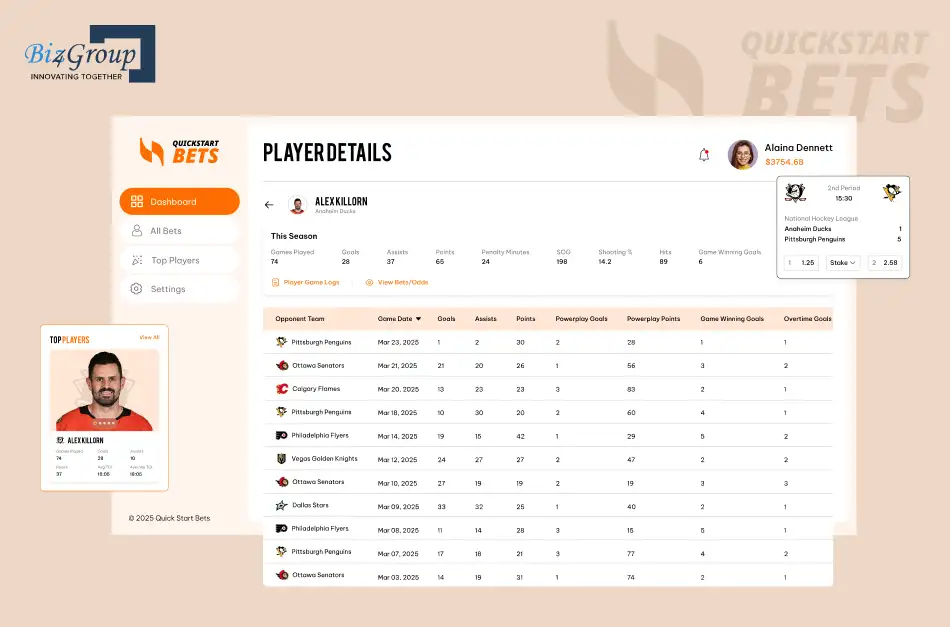
Its data-intensive functionality illustrates an important architectural consideration for responsible gambling monitoring. The system must receive relevant activity data, process updates reliably, and present useful information without unnecessary delays.
For a responsible gambling monitoring platform, that foundation would need additional capabilities for identifying potential markers of harm, prioritizing cases, and recording interventions. Those player protection requirements must be designed and validated separately.
Why Do Gambling Operators Need a Responsible Gambling Monitoring Platform?
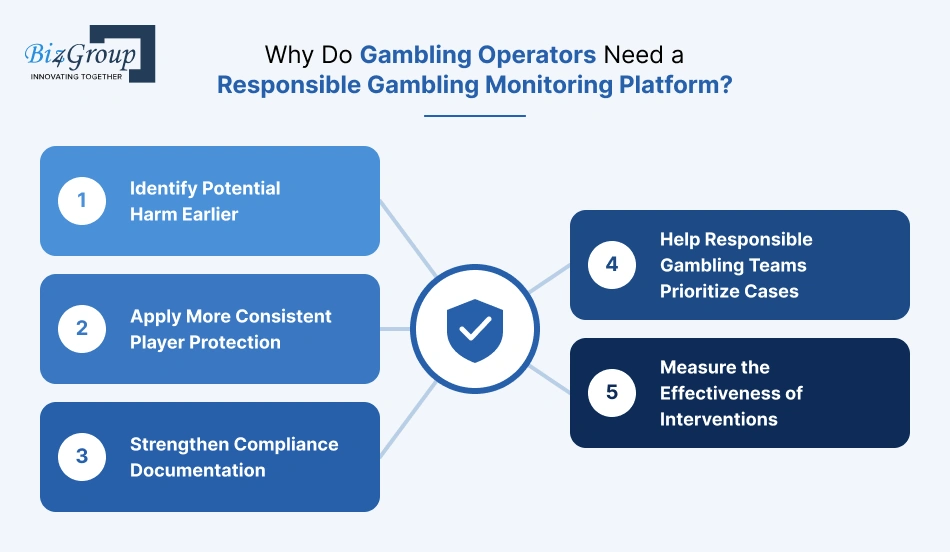
Operators need a reliable way to identify potential harm, respond consistently, and demonstrate how their player protection policies work in practice.
A responsible gambling monitoring platform supports that work by turning scattered activity records into actionable information.
1. Identify Potential Harm Earlier
A player’s behavior can change over time. A sudden increase in deposits, repeated attempts to recover losses, or frequent changes to spending limits may warrant a closer look.
Any single indicator can have an innocent explanation. Several indicators appearing together, particularly when they represent a change from a player’s usual activity, may deserve further assessment.
A monitoring platform helps staff recognize these patterns before concerns become harder to address.
2. Apply More Consistent Player Protection
Without a structured workflow, different employees may respond differently to similar situations.
One employee might follow up immediately. Another might overlook the alert or record an incomplete case note.
Responsible gambling monitoring platform, in the broad industry sense, can help standardize internal processes through shared risk criteria, escalation rules, review queues, and intervention templates.
3. Strengthen Compliance Documentation
US gambling regulation is not uniform across the country. Requirements can vary by state, license type, product, and regulator. A configurable platform helps operators document the policies they apply, the warning signs they review, and the actions they take.
It can also make internal reviews easier by keeping case records, timestamps, staff decisions, and intervention outcomes together.
4. Help Responsible Gambling Teams Prioritize Cases
Manual review becomes difficult as account volumes and activity levels increase.
A risk-based queue can help staff focus on cases that need attention first. Employees can see why an alert was generated, review the supporting data, and record their decisions in one place.
The system should make human review more informed, not remove accountability from the people responsible for player protection.
5. Measure the Effectiveness of Interventions
Sending a message does not automatically mean a concern has been addressed.
Operators need to understand whether interventions are completed on time, whether follow-ups occur, and whether the underlying behavior changes.
A platform can help measure these outcomes, highlight recurring patterns, and inform updates to internal policies.
Building a reliable monitoring workflow also requires careful product planning. Biz4Group approaches complex digital platform development by connecting business requirements with data flows, user roles, integration needs, and measurable system behavior. For operators, this means defining how a concern moves from detection to review, action, and documented resolution before development begins.
The National Council on Problem Gambling’s Internet Responsible Gambling Standards provides a useful framework for operators assessing their internet gambling protection practices. It covers areas such as player education, assistance, self-exclusion, and organizational policies.
Also read: How do social casinos make money?
Which Features Should a Responsible Gambling Monitoring Platform Include?
The most useful features help operators detect potential harm, review cases, take action, and evaluate results. A long feature list matters less than how well those capabilities work together.
Essential Monitoring and Risk Assessment Features
|
Feature |
What It Does |
Why It Matters |
|---|---|---|
|
Real-time player monitoring |
Evaluates incoming activity as it occurs or at defined intervals |
Helps teams identify emerging concerns |
|
Markers of harm |
Tracks indicators such as chasing losses, escalating deposits, or extended sessions |
Gives staff specific reasons to review an account |
|
Player risk scoring |
Groups cases by configured risk criteria |
Supports consistent prioritization |
|
Behavioral analytics |
Looks for changes and patterns across activity history |
Adds context beyond individual transactions |
|
Configurable alerts |
Triggers notifications when defined conditions are met |
Helps teams meet internal response targets |
|
Historical activity view |
Displays relevant account behavior over time |
Helps reviewers understand the wider context |
Stackr and Player Activity Records
Biz4group developed Stackr, a social casino platform with player profiles, gaming history, transaction records, and activity analytics.
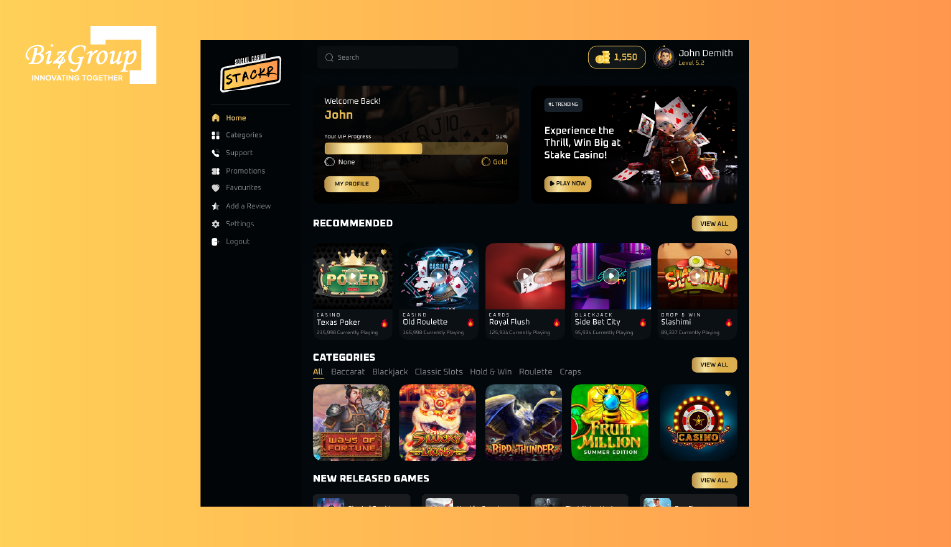
Building products with these account-level data requirements highlights why player activity must be organized, accessible to authorized teams, and recorded consistently.
In a responsible gambling monitoring platform, relevant records can help reviewers understand changes in player behavior. The monitoring layer must still apply its own validated risk indicators, intervention rules, and access controls. Player activity tracking by itself does not establish that a responsible gambling assessment has taken place.
Player Protection and Intervention Management
Detecting potential harm is only one part of the process. The platform also needs to support meaningful action.
Important capabilities include:
- Case management. Assign cases to staff, track ownership, and record progress.
- Intervention workflows. Guide employees through approved steps based on case type and urgency.
- Player communication records. Store messages, contact attempts, and outcomes.
- Limit management. Support deposit, wager, loss, and session limits where applicable.
- Time-outs and cooling-off periods. Record temporary breaks and enforce the relevant restrictions.
- Self-exclusion workflows. Support applicable operator and state-level exclusion processes.
- Escalation rules. Send unresolved or high-priority cases to the appropriate team.
- Follow-up scheduling. Help staff complete reviews and check whether further action is needed.
The platform should also make it easy for players to find protection tools. Those controls should be accessible, understandable, and consistent with the applicable regulatory requirements.
Compliance and Reporting Features
A useful responsible gambling monitoring platform should make oversight easier without creating a second administrative burden.
Look for these reporting capabilities.
- Configurable reports for each applicable jurisdiction.
- Audit trails covering alerts, decisions, communications, and account actions.
- Role-based access to sensitive player records.
- Reporting on case volumes, response times, and overdue reviews.
- Records of policy changes and rule configurations.
- Exportable evidence for authorized internal and regulatory reviews.
- Dashboards for identifying recurring risk patterns and operational gaps.
A practical selection tip: Ask vendors to demonstrate a complete case, starting with the activity that triggered an alert and ending with the recorded intervention outcome. A polished dashboard is not enough if the underlying workflow is difficult to audit.
Are Your Player Protection Gaps Hiding in Plain Sight?
The right alerts are only useful when the right data and intervention workflows sit behind them.
Audit My RequirementsWhat Technology Stack Should You Use?
A responsible gambling monitoring platform needs a secure, maintainable architecture that can process sensitive player information and support timely decisions.
The exact stack depends on transaction volumes, integration requirements, data residency obligations, and the operator’s existing infrastructure.
|
Technology Layer |
Suitable Options |
Main Consideration |
|---|---|---|
|
Frontend |
React, Next.js, Angular |
Accessible dashboards and efficient case review |
|
Backend |
Java, C#, Python, Node.js |
Reliable business rules, APIs, and workflow management |
|
Data storage |
PostgreSQL, Microsoft SQL Server |
Consistent records and structured reporting |
|
Event processing |
Apache Kafka, Amazon Kinesis, managed message queues |
Handling incoming activity at scale |
|
Analytics |
Python, SQL, analytical data stores |
Risk indicators, trends, and model evaluation |
|
Cloud infrastructure |
AWS, Microsoft Azure, Google Cloud |
Security, availability, monitoring, and deployment flexibility |
|
Identity and access |
Enterprise identity providers, multifactor authentication, role-based access controls |
Limiting access to sensitive records |
|
Observability |
Centralized logs, metrics, tracing, and alerting |
Detecting failures and monitoring service health |
These are possible choices, not a mandatory recipe. A platform built around an operator’s existing cloud and data infrastructure may be easier to maintain than one that introduces an entirely new stack.
PredictEX and Scalable Data Architecture
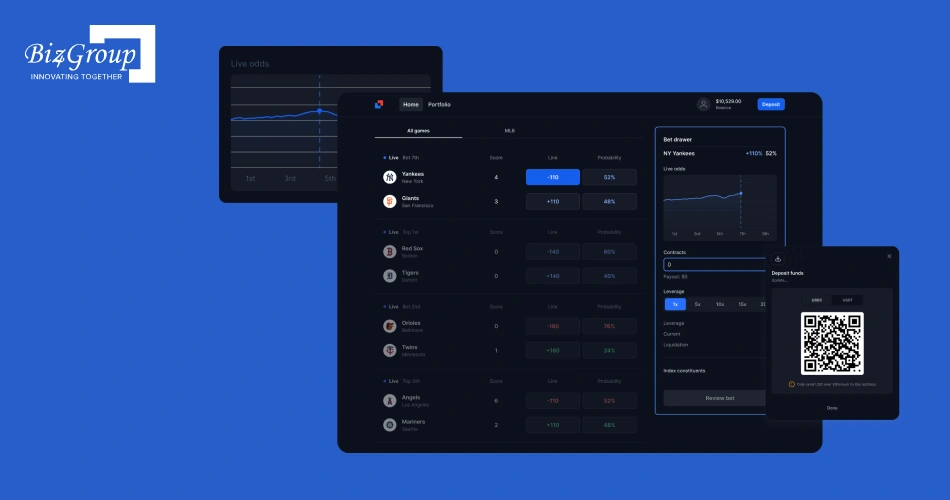
PredictEX by Biz4Group combines real-time sports data integrations with a multi-layer application architecture designed to support synchronized updates and consistent information across its platform. This provides a relevant example of the integration and data-consistency challenges that arise in real-time sports applications.
For responsible gambling monitoring, the same architectural questions matter.
- How quickly does relevant activity reach the monitoring layer?
- How are duplicate or delayed events handled?
- Can reviewers trace an alert back to the data that triggered it?
A custom platform needs explicit answers to these questions, alongside its player protection rules and audit requirements.
Also read: How to build a proprietary sportsbook platform?
Where Does AI Fit into Responsible Gambling Monitoring?
AI can help identify complex patterns that are difficult to capture through fixed rules alone.
For example, a model might flag a combination of increased deposit frequency, longer sessions, and repeated changes in betting behavior. It can then provide a risk signal for a trained employee to investigate.
Useful applications include:
- Anomaly detection across account activity.
- Pattern analysis over time.
- Prioritization of cases for review.
- Identification of recurring intervention patterns.
- Summarization of relevant activity for authorized staff.
However, AI responsible gambling capabilities need careful testing. A model can produce false positives, miss relevant cases, or perform differently across player groups.
Operators should document the indicators used, evaluate model performance, review potential bias, and retain meaningful human oversight. Sensitive decisions should not rely on an unexplained score alone.
Protecting Player Data
The platform may process identity information, payment activity, account history, and sensitive case notes. Security must therefore be part of the architecture from the beginning.
Consider encryption in transit and at rest, least-privilege access, secure API authentication, retention controls, audit logging, backup procedures, and incident response planning.
US operators should also assess applicable state privacy laws, contractual requirements, and any obligations relating to the handling of financial or personal information.
What Could Smarter Risk Detection Catch Earlier?
Learn where AI can support risk scoring, anomaly detection, and review prioritization without removing human oversight.
Explore AI OpportunitiesWhat US Compliance Requirements Should Operators Consider?
Responsible gambling compliance depends on the states and jurisdictions in which an operator is licensed, the products it offers, and the specific conditions attached to its licenses.
There is no single national checklist that replaces a jurisdiction-by-jurisdiction review.
The American Gaming Association’s Responsible Gaming Regulations and Statutes Guide is a useful starting point for understanding differences among US jurisdictions. It should be supplemented with current regulator guidance and advice from qualified gaming counsel.
Key Compliance Areas
|
Area |
What the Platform May Need to Support |
|---|---|
|
Player identification and age verification |
Integration with approved identity and age verification processes |
|
Responsible gaming disclosures |
Accessible information, help resources, and required notices |
|
Deposit and wager limits |
Configurable limits and accurate records of player selections |
|
Time-outs and cooling-off periods |
Correct application and tracking of temporary restrictions |
|
Self-exclusion |
Integration with applicable state programs and enforcement of exclusion status |
|
Customer interaction |
Documented review, outreach, escalation, and follow-up workflows |
|
Financial risk checks |
Applicable checks, thresholds, and review procedures where required |
|
Recordkeeping |
Retention of relevant case details and intervention evidence |
|
Reporting |
Reports that support the operator’s obligations in each jurisdiction |
The system should support the operator’s compliance program. It cannot guarantee compliance by itself.
State-Level Requirements Matter
A platform designed for a single jurisdiction may not cover every requirement needed by an operator expanding into additional states.
Before development, map requirements to the relevant licenses, product types, and regulator rules. Record the effective dates of requirements and assign responsibility for reviewing changes.
The platform should also make it possible to configure jurisdiction-specific rules without rebuilding the entire application each time a requirement changes.
Also read: Sports betting regulations across US states
Self-Exclusion and External Registries
Self-exclusion is a particularly important integration area. The available programs, processes, and scope of exclusion vary by jurisdiction.
For US deployments, determine which state-level exclusion programs apply and how account matching, exclusion enforcement, status updates, and evidence of enforcement should work.
Before choosing an integration, confirm that the service is available to the operator, supports the relevant jurisdiction, and provides the access method required for implementation.
How Do You Develop a Responsible Gambling Monitoring Platform?
Developing a responsible gambling monitoring platform requires a clear compliance scope, a reliable data foundation, practical workflows, and thorough testing.
A custom platform can be useful when an operator needs specific integrations, tailored risk rules, or control over its internal case management processes.
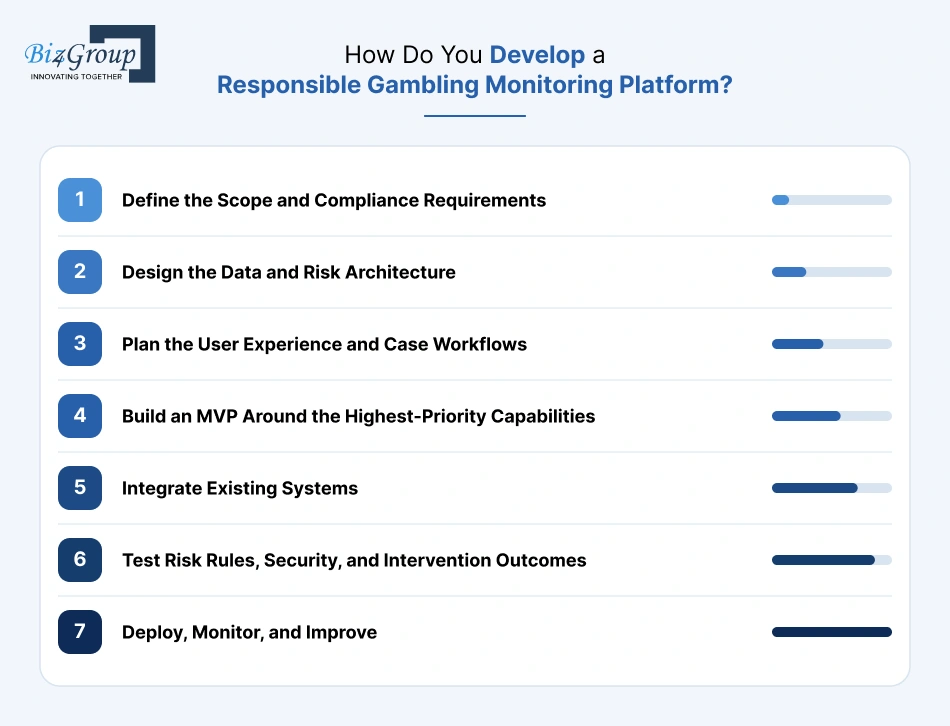
Here is a seven-step development process.
Step 1. Define the Scope and Compliance Requirements
Start by documenting the operator’s business model, licensed states, product categories, expected account volume, and existing player protection processes.
Identify the specific problems the platform needs to solve. These may include slow case reviews, fragmented records, limited reporting, or an inability to apply consistent risk criteria across multiple brands.
Create a requirements matrix that connects each applicable obligation to a platform capability, responsible team, and testable outcome.
Step 2. Design the Data and Risk Architecture
Determine which data sources are needed and how frequently their information must be processed.
Potential sources include account activity, deposits, wagers, session duration, limit changes, customer contacts, and self-exclusion status.
Define the initial markers of harm and establish how alerts will be generated, prioritized, reviewed, and resolved. Document data quality checks, access permissions, retention rules, and failure handling.
For organizations developing AI capabilities, AI integration services can help connect analytical functions with the existing application architecture. The actual design should reflect the operator’s data, compliance needs, and available evidence.
Step 3. Plan the User Experience and Case Workflows
Responsible gambling teams need interfaces that help them make careful decisions without forcing them to navigate multiple disconnected screens.
Design a clear case overview that displays the alert reason, relevant activity history, previous interventions, assigned reviewer, and required next steps. The interface should also make it easy to document decisions and identify overdue actions.
A specialist UI/UX design company can help map these workflows and test them with representative users before development begins.
Also read: Top 15 UI/UX design companies in USA
Step 4. Build an MVP Around the Highest-Priority Capabilities
An MVP should validate the core monitoring and intervention workflow before the team expands into more advanced analytics.
A practical first release may include:
- Data ingestion from one or two priority sources.
- A configurable rules engine.
- Basic risk indicators and alert queues.
- Case assignment and intervention records.
- Role-based access controls.
- Essential dashboards and audit trails.
The goal is to prove that the system can turn relevant activity into a documented, reviewable case.
Using MVP development services can help structure this first release around testable requirements and a realistic delivery plan.
Also read: Top 12+ MVP development companies in USA
Step 5. Integrate Existing Systems
The monitoring platform may need to connect with the operator’s player account system, payment infrastructure, identity verification service, customer relationship management tools, and applicable self-exclusion programs.
Build integrations with clear authentication, error handling, retries, data validation, and monitoring.
Each integration should have an owner and a documented fallback process. A failed data feed should not silently create the impression that monitoring is working normally.
JuicySlots and Multi-Provider Integration
JuicySlots brings casino content from multiple providers into one platform. Biz4Group developed a middleware layer to standardize incoming provider data, while real-time synchronization supports consistent game and transaction information.

This is relevant to the integration planning behind a responsible gambling monitoring platform. When data arrives from several systems, a consistent format helps downstream services interpret it reliably. The monitoring platform would still need separate validation rules, risk assessment logic, and controls for missing or delayed records.
Step 6. Test Risk Rules, Security, and Intervention Outcomes
Testing should cover more than whether the application loads and buttons work.
Create test cases for ordinary activity, potentially concerning patterns, incomplete records, duplicate events, delayed feeds, and conflicting account information.
Evaluate false positives and false negatives. Confirm that high-priority alerts reach the right team and that interventions are recorded correctly.
Security testing should cover permissions, API access, sensitive data exposure, and audit integrity. Compliance specialists should also review the workflows against the applicable requirements.
Step 7. Deploy, Monitor, and Improve
Launch in a controlled environment with staff training, operational support, and clear escalation procedures.
Track system availability, data freshness, alert volumes, review times, and intervention completion. Review model and rule performance regularly, using approved evaluation methods.
Updates should follow a controlled process that records what changed, why it changed, who approved it, and how its performance will be assessed.
A responsible gambling monitoring platform is an ongoing product. Its rules, integrations, and reporting should evolve as the operator’s needs and applicable requirements change.
How Much Does It Cost to Develop a Responsible Gambling Monitoring Platform?
Developing a responsible gambling monitoring platform can cost approximately $20,000-$250,000+, depending on the scope, data integrations, risk assessment requirements, reporting needs, and scale of the operation.
A focused MVP can cover core monitoring and case management. An advanced platform may add multiple data sources, configurable risk rules, and richer reporting. An enterprise implementation may need multi-brand architecture, higher data volumes, advanced analytics, and more extensive controls.
The table below gives US operators a practical starting point for budgeting.
|
Platform Level |
Estimated Development Cost |
Typical Scope |
|---|---|---|
|
MVP |
$20,000-$50,000 |
Core activity data, configurable rules, basic alerts, case records, essential reporting, and initial integrations |
|
Advanced Level |
$50,000-$120,000 |
Multiple integrations, more detailed risk indicators, intervention workflows, configurable dashboards, and expanded audit records |
|
Enterprise Level |
$120,000-$250,000+ |
Multi-brand architecture, high activity volumes, advanced analytics, extensive integrations, jurisdiction-specific workflows, and enterprise security controls |
These are illustrative estimates based on Biz4Group’s project-planning experience, not fixed quotations or published market averages. The final cost depends on the agreed scope, existing infrastructure, data quality, delivery team, and third-party requirements. The tiers are planning ranges, not prices that should be added together.
What Factors Influence the Development Cost?
The biggest cost differences usually come from how much data the platform needs to process, how complex its risk assessment and intervention workflows are, and how many external systems it must connect to.
The following table estimates the contribution of individual work areas.
|
Cost Driver |
Indicative Cost Impact |
What Changes the Estimate |
|---|---|---|
|
Discovery and requirements |
$3,000-$10,000 |
Number of jurisdictions, stakeholder workshops, process mapping, and requirements documentation |
|
UI/UX and workflow design |
$4,000-$12,000 |
Staff roles, case review screens, accessibility needs, and prototype testing |
|
Data ingestion and integrations |
$3,000-$15,000 per standard integration |
API availability, data formats, authentication, event volume, and error handling |
|
Complex or legacy integrations |
$10,000-$30,000+ per integration |
Limited documentation, custom connectors, inconsistent records, or additional reconciliation logic |
|
Rules engine and risk scoring |
$5,000-$20,000 |
Number of indicators, configurable thresholds, case prioritization, and rule versioning |
|
Advanced analytics or AI |
$15,000-$50,000+ |
Data preparation, model development, evaluation, explainability, monitoring, and retraining |
|
Case and intervention management |
$8,000-$25,000 |
Case assignment, escalations, approval steps, communication history, and follow-up workflows |
|
Reporting and audit trails |
$5,000-$20,000 |
Custom reports, exports, audit detail, permissions, and jurisdiction-specific views |
|
Security and access controls |
$5,000-$20,000 |
Identity management, access policies, encryption, logging, and security testing |
|
Testing and deployment |
$4,000-$15,000 |
Integration testing, performance checks, security validation, release preparation, and staff training support |
For example, an operator that already has clean activity data and reliable APIs may spend less on integrations than one working with several legacy systems. A team launching with configurable rules can also avoid the cost of building and validating advanced models before those capabilities are necessary.
These figures are indicative planning allowances. They overlap in some projects and should not be added mechanically to calculate a total.
Pro tip: The best way to control the budget is to define the initial requirements clearly, separate essential capabilities from later enhancements, and confirm which items are included in the development estimate.
What Hidden Costs Should Operators Budget For?
The initial build is only one part of the investment. Hosting, external services, maintenance, compliance reviews, and staff training can all affect the cost of operating the platform after launch.
Include these items in the budget before approving development.
1. Cloud Infrastructure and Monitoring
Hosting costs depend on event volume, data retention, availability requirements, and the amount of processing performed. A small deployment might budget approximately $500-$2,000 per month for its initial infrastructure and monitoring. Larger implementations may require $2,000-$10,000+ per month, with higher costs possible for demanding enterprise workloads.
These figures are planning allowances, not cloud-provider quotes. Request an estimate based on expected usage, storage, backup policies, and service-level requirements.
2. Third-Party Data and Service Fees
Identity checks, data providers, external registry connections, messaging services, and other integrations may involve setup fees or recurring charges. Allow approximately $500-$5,000+ per month for a modest set of external services, depending on usage and contract terms. Complex enterprise arrangements can exceed this range.
Confirm which fees are charged per transaction, per account, per request, or under a minimum monthly commitment. Also identify who pays for integration changes when an external provider updates its API.
3. Maintenance and Technical Updates
The platform will need security patches, dependency updates, bug fixes, compatibility work, and ongoing technical support. As an initial planning allowance, reserve approximately 15%-25% of the original development cost per year for maintenance and routine enhancements.
A larger system with extensive integrations or strict availability commitments may need a separate support arrangement. Confirm what is included in the maintenance plan and which changes will be billed as new development.
4. Risk Rule and Model Evaluation
An initial allowance of $3,000-$15,000 per review cycle may be reasonable for scoped rule or model evaluation work. More extensive model development or retraining can cost $15,000-$50,000+, depending on the data and testing requirements.
These costs should be tied to a defined evaluation plan. Operators should not pay for unnecessary model complexity when a transparent rules-based approach can meet the initial requirements.
5. Compliance and Legal Review
Set aside approximately $5,000-$20,000+ for a scoped compliance and legal review. The actual amount can be higher when several jurisdictions, products, or complex licensing arrangements are involved.
This is an indicative planning allowance, not a substitute for advice from qualified gaming counsel.
7. Security Testing and Independent Assessments
Security work can include penetration testing, access-control reviews, vulnerability assessment, and validation of audit logging. A focused assessment may require approximately $3,000-$10,000, while broader testing across multiple services and environments can exceed $10,000-$25,000+.
Confirm which tests are included in the development contract, which are performed by independent specialists, and how remediation work will be priced.
How Can Operators Assess ROI?
Responsible gambling monitoring should be evaluated through the quality and consistency of player protection processes, not through gambling activity or revenue alone.
Before launch, record a baseline for the measures that matter to the organization. Review the same measures after deployment to determine whether the platform is improving case handling and reporting.
Useful indicators include:
- Case review time: Track the time required to assess and document an alert. Use the baseline to determine whether the workflow is becoming easier to manage.
- Timely review rate: Measure the percentage of alerts reviewed within the operator’s required timeframe.
- Overdue interventions: Track unresolved cases and follow-ups that have passed their assigned deadlines.
- Record completeness: Check whether alerts, decisions, communications, and follow-up actions are documented consistently.
- Data reliability: Monitor missing records, delayed feeds, failed integrations, and alert processing delays.
- Reporting effort: Estimate the staff time required to prepare internal reports and gather evidence for reviews.
The value of the platform should be assessed alongside its full cost of ownership. A solution that reduces manual work but creates frequent data gaps may not deliver the intended result. Likewise, a larger investment in advanced analytics is difficult to justify without a clear evaluation plan.
Start with measurable operational requirements, agree on how success will be assessed, and expand the platform when evidence shows that additional capabilities are needed.
What Will Your ROI Look Like When Risk Reviews Scale?
A clearer workflow can reduce review bottlenecks, missed follow-ups, and manual reporting work. Let’s estimate the numbers.
Calculate My ROIHow Should Operators Evaluate Responsible Gambling Monitoring Platform Providers?
The best provider is the one that can demonstrate how its platform fits the operator’s requirements, supports the applicable compliance processes, and provides reliable evidence for review.
Operators should compare capabilities against documented needs instead of relying on feature lists or broad claims about AI.
Use This Provider Evaluation Checklist
|
Evaluation Criterion |
Questions to Ask |
|---|---|
|
US jurisdiction support |
Can the solution support the states and licenses relevant to our business? |
|
Data integration |
Which systems can it connect to, and what happens when a feed fails? |
|
Risk indicators |
Can we configure and explain the indicators used to generate alerts? |
|
Intervention workflows |
Can cases be assigned, escalated, documented, and followed up? |
|
Self-exclusion |
How are applicable state-level exclusion requirements supported? |
|
Auditability |
Can we reconstruct why an alert was generated and what happened afterward? |
|
Security |
What access controls, encryption, retention policies, and security assessments are available? |
|
Scalability |
Can the architecture handle expected activity volumes and future brands? |
|
Reporting |
Can authorized users generate the reports they need without manual data consolidation? |
|
Ownership and flexibility |
Can we configure rules, export records, and access our data if the relationship ends? |
|
Support and maintenance |
What are the response times, service commitments, and upgrade responsibilities? |
|
Total cost |
What is included in implementation, licensing, integrations, support, and ongoing maintenance? |
Questions to Include in an RFP
A responsible gambling RFP should ask vendors to demonstrate real workflows and explain their limitations.
Consider including these questions:
- How does the platform identify and prioritize potential markers of harm?
- Can the operator configure rules for different jurisdictions and products?
- How are false positives and missed alerts evaluated?
- What information is shown to staff when an alert is generated?
- How are intervention decisions and follow-ups documented?
- Which integrations are available, and which require custom development?
- How does the platform handle unavailable or delayed data?
- What security controls and audit records are included?
- What are the implementation timeline and ongoing support costs?
- Can the provider demonstrate the full lifecycle of a case using representative test data?
Ask for evidence of capabilities, not promises. A vendor should be able to show how its system behaves when an alert is wrong, a data feed fails, or a case requires escalation.
A proof of concept should test a representative workflow before the operator commits to a full implementation. Agree on the test cases and acceptance criteria in advance.
At minimum, verify that the platform can:
- Ingest a defined sample of player activity.
- Identify the expected indicators under the agreed test rules.
- Explain why each test alert was generated.
- Route cases to the correct reviewer.
- Record intervention decisions and follow-up actions.
- Flag incomplete data or failed integrations.
- Produce an auditable case history and the required sample report.
The proof of concept should also document known limitations. Passing a controlled test does not guarantee that every real-world case will be detected, so the production plan must include ongoing evaluation and human oversight.
When Does Custom Development Make Sense?
A custom platform may be appropriate when the operator needs control over risk rules, integration architecture, case management, or data governance.
It may also suit organizations whose requirements cannot be met by a configurable existing product. However, custom development brings responsibility for maintenance, validation, security, and ongoing compliance updates.
Biz4Group LLC, an experienced sports betting app development company, can help operators translate their requirements into a technical roadmap covering architecture, integrations, user experience, analytics, and deployment. The engagement should begin with a discovery discussion, a review of existing systems, and an agreed scope. That gives both sides a clearer basis for estimating cost, defining acceptance criteria, and deciding which capabilities belong in the first release.
Final Thoughts
A responsible gambling monitoring platform helps operators identify potential signs of harm, prioritize reviews, manage interventions, and maintain reliable compliance records. Its value depends on the quality of the data, the clarity of the risk indicators, and the effectiveness of the workflows built around them.
For US operators, the first step is to map the requirements of every relevant jurisdiction. The next is to choose an architecture that supports reliable monitoring, secure data handling, meaningful staff review, and measurable outcomes. A clear scope, carefully chosen integrations, and a staged delivery plan can help operators make informed investment decisions.
Biz4Group can support the planning and development of custom digital platforms, including architecture, integrations, analytics, and user experience. If your organization is evaluating a responsible gambling monitoring platform, start with a requirements discussion that identifies the capabilities you need, the systems you already have, and the compliance obligations your solution must support.
Let's build something worthwhile together. Let's talk.
FAQs
1. What is the difference between responsible gambling monitoring and player protection?
Responsible gambling monitoring focuses on identifying potential risk indicators and tracking relevant player activity. Player protection is broader. It includes monitoring, intervention policies, limits, self-exclusion, education, support resources, and the processes used to reduce potential harm.
2. Can a responsible gambling monitoring platform work across multiple US states?
Yes, provided the architecture supports the relevant state-specific requirements. Operators should be able to configure applicable rules, workflows, reports, and integrations for each jurisdiction. The platform does not remove the need for a legal review of each license and regulatory framework.
3. Does a player risk score prove that someone has a gambling problem?
No. A risk score is an indicator used to support further review. It does not establish a diagnosis or prove that a player is experiencing harm. Operators should consider the available evidence and follow their approved intervention policies.
4. Should operators build a custom platform or use an existing solution?
The answer depends on the operator’s requirements, available internal resources, integration needs, and budget. An existing solution may suit organizations with standard requirements and a short deployment window. Custom development may be preferable when operators need greater control over architecture, risk rules, workflows, or data governance.
5. Which metrics should operators track after deployment?
Useful measures include alert review time, overdue cases, intervention completion, record completeness, data-feed reliability, and reporting preparation time. Operators should also evaluate the quality of risk indicators and intervention outcomes, not rely on alert volume alone.
6. Can AI detect every instance of gambling harm?
No. AI can identify patterns that may be difficult to capture with fixed rules, but it cannot guarantee detection. Data gaps, false positives, changing behavior, and model limitations can affect results. AI should support trained staff, with regular testing and documented oversight.