 Location :
Orlando, FL, USA
Location :
Orlando, FL, USA +1 (407) 714-1616
 info@biz4group.com

 AI Summary Powered by Biz4AI
- Sports betting laws by state are set one jurisdiction at a time: as of October 2026, 31 states plus DC allow online betting statewide, 8 allow in-person betting only, and 11 have no legal sports betting.
- Sports betting tax rates by state run from 6.75% (Iowa, Nevada) to 51% (New Hampshire, New York, Oregon, Rhode Island). Promotions and per-bet fees such as Illinois’s change what operators actually pay.
- Federal law (PASPA’s end in Murphy v. NCAA, the Wire Act, UIGEA, IGRA) leaves licensing to the states, and there is no national sportsbook license.
- 2026 changes: Missouri went live in December 2025, Wisconsin authorized tribal mobile betting, Kentucky and Colorado tightened consumer protections, and Nebraska votes on online betting on November 3.
- Multi-state compliance rests on five checks (KYC, geolocation, AML, responsible gaming, tested technology), and state-specific rules should be configurable settings rather than hard-coded logic.
- Biz4Group LLC builds AI sports betting platforms that treat each state as a configuration on one shared platform, so operators can launch compliantly in one state and scale to more.
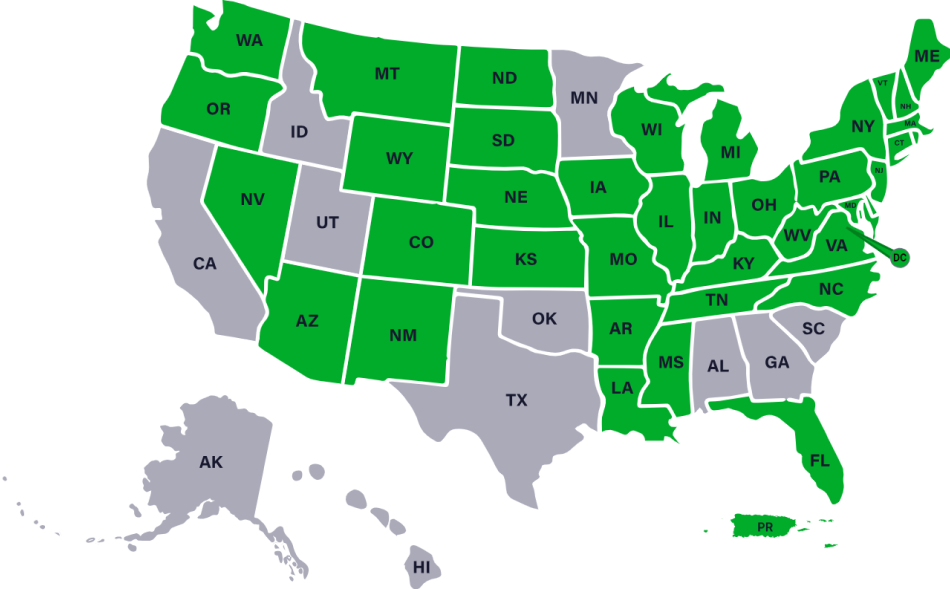
US sports betting laws by state are set one jurisdiction at a time, and as of October 2026, 31 states plus Washington, DC allow online betting statewide, eight more states allow it only in person for now, and 11 have no legal sports betting at all.
Key facts (last verified October 12, 2026)
- States with legal online sports betting: 31 states plus DC, per CBS Sports’ October 2026 state tracker and WSN. Some trackers report 32; this guide counts places where mobile betting is live statewide today.
- Any legal sports betting, including in person: 39 states plus DC.
- No legal sports betting: Alabama, Alaska, California, Georgia, Hawaii, Idaho, Minnesota, Oklahoma, South Carolina, Texas and Utah.
- Newest markets: Missouri went live on December 1, 2025, with a 10% tax. Wisconsin signed a law on April 9, 2026 that lets its tribes run mobile betting, but no app is live yet.
- Market size in 2025: the AGA’s tracker counted $166.94 billion in bets (handle) and $16.96 billion in sportsbook revenue, up 22.8%.
- Prediction markets: federal appeals courts disagree on who regulates sports contracts, and New Jersey has asked the US Supreme Court to step in, as per reports by Washington Times.
For an operator, a spot on the list of legal sports betting states doesn’t mean the door is open. Some states welcome new applicants. Others cap the number of licenses, require a casino partner, or hand the whole market to one company. Sports betting tax rates by state then run from 6.75% to 51%, and between them, those two things usually decide whether a market is worth entering.
Two things changed the picture in the past year. New markets opened or got approved: Missouri is live, and Wisconsin has a law but no app yet. And prediction markets that list sports contracts have pulled the CFTC, the federal derivatives regulator, into a fight with the states, which it has sued nine times over, according to a report by CNBC.
So which states are actually open to you, what does each one charge, and what should you check before building for more than one of them? And where do prediction markets fit in? The key facts above give the short answers. The sections after them give the detail, and we say where each number comes from.
Biz4Group builds AI sports betting platforms, so we read these laws the way a builder has to: what does a state let you launch, and what does it make you build?
This is a guide, not legal advice, and any real market-entry decision should go past a gaming lawyer.
Which States Have Legal Online Sports Betting in 2026?
As of October 2026, 31 states plus Washington, DC have legal online sports betting live statewide. Eight more states allow betting only in person, and 11 states have no legal sports betting at all, as per a report by WSN.
How many states allow online sports betting, and how does DC count?
Thirty-one states allow online sports betting statewide. Washington, DC does too, but DC is a federal district, not a state, so this guide counts it separately: 31 states plus DC.
The test we use is simple. A place counts only if people can bet from a phone anywhere inside its borders today. By that test, the 50 states split three ways:
- Online statewide (31): Arizona, Arkansas, Colorado, Connecticut, Delaware, Florida, Illinois, Indiana, Iowa, Kansas, Kentucky, Louisiana, Maine, Maryland, Massachusetts, Michigan, Missouri, Nevada, New Hampshire, New Jersey, New York, North Carolina, Ohio, Oregon, Pennsylvania, Rhode Island, Tennessee, Vermont, Virginia, West Virginia and Wyoming.
- In person only (8): Mississippi, Montana, Nebraska, New Mexico, North Dakota, South Dakota, Washington and Wisconsin. These are the retail-only and tribal-only markets, where bets happen at casinos, on tribal lands or at other approved locations.
- No legal sports betting (11): Alabama, Alaska, California, Georgia, Hawaii, Idaho, Minnesota, Oklahoma, South Carolina, Texas and Utah.
In September 2025 the count was one lower. The Tax Foundation counted 30 states plus DC then, and Missouri went live on December 1, 2025.
So is Wisconsin the 32nd? Not yet. Its governor signed a law on April 9, 2026 that lets the state’s tribes run mobile betting, but no app is live, so Wisconsin stays in the in-person group until one launches.
What about a state with only one app? It still counts. Florida’s only online sportsbook is Hard Rock Bet, and mobile betting works statewide. Montana does not count, because bets there must be placed on site.
How big is the legal US market?
Two terms come up constantly in the sports betting business:
- Handle is the total amount bet.
- Gross gaming revenue (GGR) is what sportsbooks keep after paying out winning bets, before their own costs.
Revenue grew about twice as fast as handle, which rose 11.0%. By our math, sportsbooks kept roughly 10 cents of every dollar bet in 2025 ($16.96 billion divided by $166.94 billion).
That revenue feeds state gaming tax revenue. The Tax Foundation counted more than $2.8 billion in online sports betting taxes across the states it tracks in 2024. New York alone paid more than $1 billion of that, about 37% of the total by our calculation from its table.
So the market is big, but it is lopsided. Why does that matter when you’re reading US sports betting laws by state? Because size alone doesn’t tell you whether a market is open to you. That depends on how each state lets operators in, which is the subject of the sections that follow.
Is Sports Betting Legal at the Federal Level, and Who Regulates It?
Federal law doesn’t ban state-authorized sports betting, and it doesn’t legalize it either. It leaves that choice to each state. States do the day-to-day regulating, with federal laws layered on top for interstate bets, payments, tribal land and money laundering. imgl
What did Murphy v. NCAA change?
It ended the federal ban on states allowing sports betting. On May 14, 2018, the Supreme Court ruled 6-3 in Murphy v. NCAA that the Professional and Amateur Sports Protection Act of 1992 (PASPA) was unconstitutional.
- Before: PASPA barred states from authorizing, licensing or running sports betting.
- After: states could write their own sports betting laws. New Jersey, which brought the case, saw its governor sign a law permitting betting at casinos and racetracks on June 11, 2018 (Britannica)
The Court’s reasoning rested on a rule called anti-commandeering: Congress can’t order states to keep a law on the books, any more than it can order them to pass a new one, as per CRS. The Court also noted that Congress can regulate sports betting directly. It just can’t do it by dictating to the states.
PASPA was never a criminal law: the Attorney General and the sports leagues could sue to stop violations, but betting itself wasn’t a federal crime.
Did that make sports betting legal everywhere? No. Murphy put the decision in the hands of the states, so each one has to pass its own law. That is the root of today’s patchwork of US sports betting laws by state.
Which federal laws still apply to sports betting?
Four federal laws shape most day-to-day decisions: the Wire Act, UIGEA, IGRA and the Bank Secrecy Act. None of them bans state-licensed betting, but each one sets edges that operators have to respect.
- The Wire Act (1961). It bars sending sports bets or betting information across state lines by phone line or internet. The Justice Department argued in 2018 that it covered every type of bet. In January 2021 the First Circuit disagreed and held that it applies only to sports wagering.
Doesn’t every app bet cross state lines? The law firm Cadwalader raised that point after the ruling. A bettor and a sportsbook can sit in the same state, but the internet moves data across state lines, which left sports betting more exposed to the Wire Act than online lotteries or casino-style games.
- UIGEA (2006). The Unlawful Internet Gambling Enforcement Act doesn’t ban betting itself. It bars banks and payment processors from knowingly handling payments for unlawful internet gambling. Bets made entirely inside one state are exempt when state law authorizes them and requires age and location checks, and the same goes for bets inside tribal lands under a compact. That is why licensed sportsbooks can use ordinary payment methods.
- IGRA (1988). The Indian Gaming Regulatory Act governs gaming on tribal land. Sports betting counts as Class III gaming, which needs a compact, a formal agreement between a tribe and the state. In Florida, statewide mobile betting runs as tribal gaming, as per imgllicentium.
- The Bank Secrecy Act. Enforced by FinCEN, the federal financial crimes agency, it requires covered casinos and card clubs to run anti-money-laundering programs based on risk. Whether a particular sportsbook counts as covered is a question for its lawyers according to International gaming laws.
Who regulates sports betting in the US?
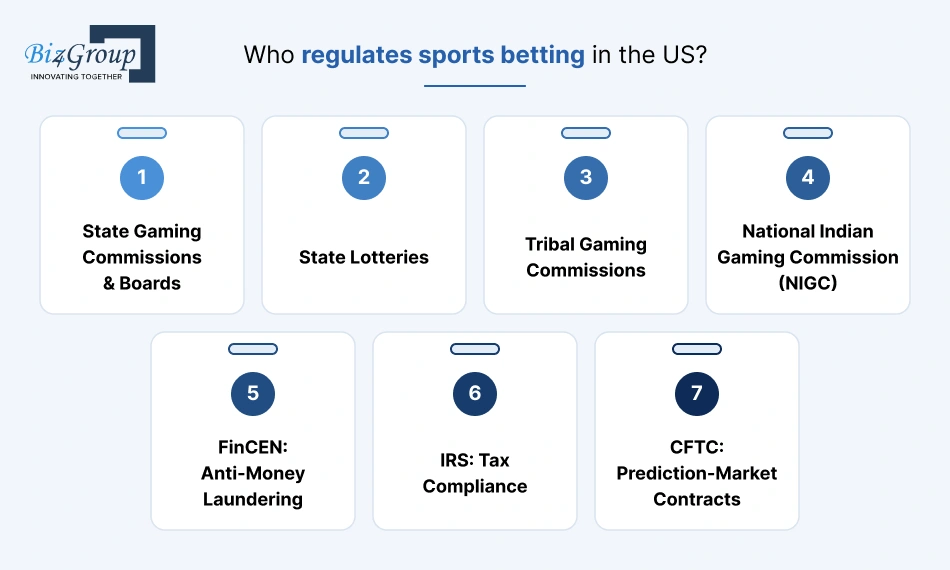
States do. In most states that means a gaming commission or gaming board, though a few markets run through a state lottery. Tribal gaming commissions oversee tribal betting, and federal agencies cover specific pieces.
- State gaming commissions and boards license operators and supervise them day to day.
- State lotteries run or contract the market in a few places. DC’s market is run by the DC Lottery.
- Tribal gaming commissions and the National Indian Gaming Commission handle tribal betting, which the tribe and the state co-regulate under the compact.
- Federal agencies cover pieces: FinCEN for money laundering, the IRS for tax, and the CFTC for prediction-market contracts.
So who actually hands out the license? The state regulator where you plan to take bets, and for a tribal market, the tribe under its compact. That is why sports betting regulations by state can look so different even when the game being bet on is the same.
Is there a national sportsbook license?
No. There is no federal sportsbook license. An operator needs approval from each state where it wants to take bets, and from tribal authorities and compacts for tribal markets.
In practice, operator licensing is a separate application in every state, with its own rules and review. Some states also limit who can apply: New Jersey requires a casino or racetrack partner, for instance, while a few states hand the whole market to one company. The access-models section later in this guide covers those differences.
The one open fight over a single federal approval reaching across states involves prediction markets and the CFTC. Appeals courts have split on whether states can regulate sports contracts sold on those platforms, and a later section covers the rulings.
Sports Betting Laws by State: All 50 States and Washington, DC
As of October 2026, 31 states plus DC run statewide online sports betting, eight states allow it only in person, and 11 states have no legal sports betting. The tables below put US sports betting laws by state side by side, with each jurisdiction’s tax rate, regulator and how open its market is to new operators.
How do you read the table?
Use it as a state-by-state sports betting legal tracker for 2026. Each row in the main table answers four questions: is online betting live, what does the state take in tax, who regulates it, and how hard is it to get in.
- Status follows the rule from the first section. A jurisdiction counts as online only if mobile betting is live statewide today. The rest are in-person only (eight states) or have no legal betting (11 states).
- Tax is the headline rate on online GGR, short for gross gaming revenue, meaning bets minus winnings paid out. A few states work differently: Tennessee taxes handle, Illinois adds a fee on every wager, and Florida’s figure is a revenue share under its tribal compact. Effective rates often land lower because states allow promotional deductions.
- Operator access is our own label, not an official one.
Why add a column the regulators don’t publish? Because “legal” tells a bettor where they can play, but it says little about operator licensing, meaning whether a new company can actually get in. We sort each market by who can apply:
- Partner required: a casino, racetrack, tribe, team or similar partner has to sponsor you.
- Partner or standalone: both routes exist.
- Standalone: you can apply without a local partner, though many states cap the number of licenses.
- Limited licenses: a fixed group of licensees and no open application window.
- Exclusive: the state or a tribal group has given the market to one company or a small set.
We built the labels from statutes, regulator pages and trade reporting. Treat them as a starting point for your lawyers, because rules and license holders change.
Legal status, tax rate, regulator, and operator access by jurisdiction
These 32 jurisdictions allow online betting statewide. Sports betting tax rates by state run from 6.75% in Nevada and Iowa to 51% in New Hampshire, New York, Oregon and Rhode Island, and in 15 of them you need a local partner to get in. taxfoundation
|
Jurisdiction |
Online tax rate |
Regulator |
Operator access (our label) |
|---|---|---|---|
|
Arizona |
10% |
Arizona Department of Gaming |
Partner required: 20 licenses split between tribes and pro sports venues |
|
Arkansas |
13% / 20% (tiered) |
Arkansas Racing Commission |
Partner required: casinos hold the mobile licenses |
|
Colorado |
10% |
Colorado Division of Gaming |
Partner required: casino-tied |
|
Connecticut |
13.75% |
Dept. of Consumer Protection, Gaming Division |
Partner required: tribes and the CT Lottery |
|
Delaware |
50% |
Delaware Lottery |
Exclusive: lottery contract with DraftKings |
|
District of Columbia |
20-30% by license type |
DC Office of Lottery and Gaming |
Partner required: stadium or team license types |
|
Florida |
13.75% revenue share |
Florida Gaming Control Commission |
Exclusive: Seminole Tribe (Hard Rock Bet) |
|
Illinois |
20-40% graduated, plus $0.25-$0.50 per online wager |
Illinois Gaming Board |
Partner or standalone: casino, track and venue licenses plus an online-only license |
|
Indiana |
9.5% |
Indiana Gaming Commission |
Partner required: casino-tied |
|
Iowa |
6.75% |
Iowa Racing and Gaming Commission |
Partner required: casinos and racetracks |
|
Kansas |
10% |
Kansas Racing and Gaming Commission |
Partner required: state casinos |
|
Kentucky |
14.25% |
Kentucky Horse Racing Commission |
Partner required: racetracks |
|
Louisiana |
21.5% |
Louisiana Gaming Control Board |
Partner required: parish-based, casino and track-tied |
|
Maine |
10% |
Maine Gambling Control Unit |
Exclusive: four tribes control online access |
|
Maryland |
20% |
Maryland Lottery and Gaming Control Agency |
Standalone: mobile licenses, up to 60 |
|
Massachusetts |
20% |
Partner or standalone: tethered and untethered categories |
|
|
Michigan |
8.4% |
Michigan Gaming Control Board |
Partner required: casinos and tribes |
|
Missouri |
10% |
Missouri Gaming Commission |
Partner or standalone: mostly tethered, plus two untethered licenses |
|
Nevada |
6.75% |
Nevada Gaming Control Board |
Partner required: casino-licensed only, no online-only license, and mobile accounts need in-person sign-up |
|
New Hampshire |
51% |
New Hampshire Lottery Commission |
Exclusive: DraftKings under a lottery contract |
|
New Jersey |
21% (includes a 1.25% add-on) |
NJ Division of Gaming Enforcement |
Partner required: casino or racetrack |
|
New York |
51% |
NY State Gaming Commission |
Limited licenses: nine operators, no open window (New York sports betting license guide) |
|
North Carolina |
18% |
NC State Lottery Commission |
Standalone: up to 12 mobile licenses |
|
Ohio |
20% |
Ohio Casino Control Commission |
Partner or standalone: a pro sports partnership is optional |
|
Oregon |
51% state share |
Oregon Lottery |
Exclusive: DraftKings through the lottery |
|
Pennsylvania |
36% |
PA Gaming Control Board |
Partner required: only casinos hold the certificates |
|
Rhode Island |
51% |
Rhode Island Lottery |
Exclusive: state-run |
|
Tennessee |
1.85% of handle |
TN Sports Wagering Council |
Standalone: no casino anchor needed |
|
Vermont |
20% minimum; 2024 winning bids 31-33% |
VT Dept. of Liquor and Lottery |
Standalone: up to six licenses, three issued at launch |
|
Virginia |
15% |
Virginia Lottery |
Standalone: up to 12 untethered mobile operators |
|
West Virginia |
10% |
West Virginia Lottery |
Partner required: casino partnership |
|
Wyoming |
10% |
Wyoming Gaming Commission |
Standalone: online-only |
Which states allow only retail or tribal-only betting?
Eight states allow betting only in person: Mississippi, Montana, Nebraska, New Mexico, North Dakota, South Dakota, Washington and Wisconsin. They are the retail-only and tribal-only sports betting markets.
Does in-person only mean no mobile betting at all? Not always. In Mississippi and Washington, apps work, but only while you stand on the casino or tribal-casino premises.
Mississippi. Casino sportsbooks, with mobile apps limited to casino premises. The Mississippi Gaming Commission regulates it, and retail bets carry a 12% tax.
Montana. The state lottery runs Sports Bet Montana at licensed locations. The state keeps the revenue, and sales agents get 3% of handle, as mentioned by Betting USA.
Nebraska. Racetrack casinos only, regulated by the Nebraska Racing and Gaming Commission, with a 20% retail tax.
New Mexico. Tribal casinos offer betting under their compacts with the state. There is no state sports betting law behind it.
North Dakota. Tribal casinos only, again through compacts.
South Dakota. Deadwood casinos and tribal casinos, overseen by the South Dakota Commission on Gaming, with a 9% retail tax.
Washington. Tribal casinos only, with geofenced apps working on site. The Washington State Gambling Commission and tribal agencies oversee it, as per legal regulations.
Wisconsin. Tribal casinos have run sportsbooks since 2021. A law signed on April 9, 2026 allows statewide mobile betting run exclusively by the state’s tribes, but launch timing depends on amended compacts.
Which states still have no legal sports betting?
Eleven states have no legal sports betting: Alabama, Alaska, California, Georgia, Hawaii, Idaho, Minnesota, Oklahoma, South Carolina, Texas and Utah. Each has its own roadblock, and the 2026 sessions moved none of them over the line.
- Alabama: a 2026 proposal died without a hearing, and a constitutional amendment needs a three-fifths vote.
- Alaska: HB 145 carried into 2026 without a committee vote.
- California: no bill this year, with tribes preparing a 2028 ballot initiative.
- Georgia: the House voted an amendment down 63-98 on March 6, 2026.
- Hawaii: a 2025 bill passed both chambers for the first time, then died in conference.
- Idaho: no sports betting bill introduced in 2025 or 2026.
- Minnesota: a tribal-led mobile bill got no vote before the May 18, 2026 adjournment.
- Oklahoma: the Senate rejected HB 1047, 27-21, on April 22, 2026.
- South Carolina: S.444 got its first Senate hearing in February 2026 but was not voted out.
- Texas: no 2026 session, since the legislature meets in odd years.
- Utah: no legal gambling of any kind, with 2026 action aimed at tightening, not opening.
Could any of these flip soon? Not quickly. Several would need a constitutional amendment or a public vote, and the next regular windows are 2027 sessions. The legalization-pending section later in this guide tracks the live efforts.
Sources and Notes:
- Tax rates come from BettingUSA’s state table, updated October 8, 2026, and the Tax Foundation’s online sports betting tax review.
- Regulators come from RG’s state regulator list
- Operator access labels draw on the Pennsylvania statute and AGA fact sheet, Maryland’s sports wagering outreach document, the Massachusetts Gaming Commission’s license categories, Vermont’s launch reporting, the Nevada Independent, and trade coverage for the other states.
- Status counts follow CBS Sports’ October 2026 state table. Last verified October 12, 2026.
Planning to Launch a Sportsbook?
Choosing the right technology stack and integrations early can save costly rework as your platform grows.
Build Your Sports Betting PlatformHow Do States Let Operators Into the Market? Five Access Models
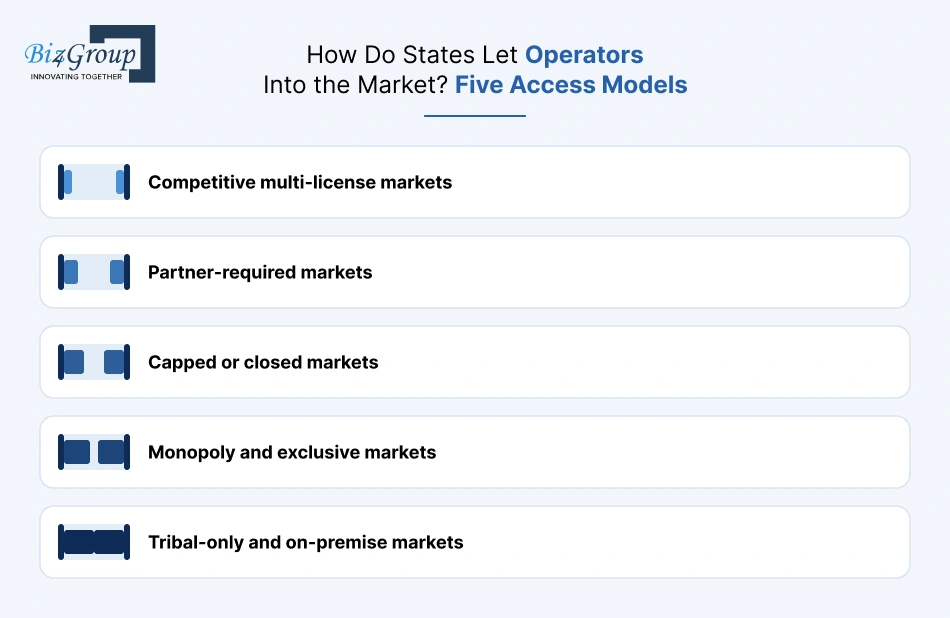
US sports betting markets follow five broad access models: competitive multi-license, partner-required, capped or closed, monopoly or exclusive, and tribal-only or on-premise. Each determines whether an operator can apply directly, needs an approved partner, must secure a limited license, or has no independent route into the market.
Competitive multi-license markets
These markets allow multiple operators to compete, sometimes without a casino or other local partner. However, license caps, application fees, and compliance requirements can still limit entry.
Partner-required markets
Operators must work with an approved casino, racetrack, tribe, team, or other authorized entity. The partnership determines how market access works, while commercial agreements influence the economics of launching.
Capped or closed markets
Some states limit the number of available licenses or accept applications only during designated periods. New York is a prominent example, where entering the market may depend on an existing license position or a future regulatory opportunity.
Monopoly and exclusive markets
In these jurisdictions, a state-authorized operator, lottery contractor, or tribal entity controls online sports betting. New entrants generally need to work with the existing market holder or wait for a new contracting opportunity.
Tribal-only and on-premise markets
These markets restrict betting to approved tribal operations or designated physical locations. Operators typically need an authorized tribal or venue partner rather than an independent statewide license.
What does this mean for sports betting operators?
Legalization does not automatically guarantee market access. Before entering a state, operators need to assess its licensing model, eligibility requirements, tax structure, partnership obligations, and regulatory conditions. The right entry strategy depends on both the state's rules and the operator's business model.
Which States Tax Sportsbooks the Most?
New Hampshire, New York, Oregon and Rhode Island tax online sportsbooks the most, at 51% of revenue, followed by Delaware at 50%. Illinois reaches 40% on its biggest operators plus a per-bet fee, and Pennsylvania charges 36%. The lowest rates are 6.75% in Iowa and Nevada.
Sports betting tax rates by state in 2026, ranked
Sports betting tax rates by state in 2026 run from 6.75% to 51% of online gross gaming revenue. The table ranks every online jurisdiction by headline rate, grouped into bands.
|
Band |
Headline rate |
Jurisdictions |
|---|---|---|
|
1 |
51% |
New Hampshire, New York, Oregon, Rhode Island |
|
2 |
50% |
Delaware |
|
3 |
20-40% graduated, plus a per-bet fee |
Illinois |
|
4 |
36% |
Pennsylvania |
|
5 |
31-33% (winning bids at launch, 20% minimum) |
Vermont |
|
6 |
20-30% by license type |
District of Columbia |
|
7 |
21-21.5% |
Louisiana (21.5%), New Jersey (21%) |
|
8 |
20% |
Maryland, Massachusetts, Ohio, Arkansas (13% / 20% tiered) |
|
9 |
18% |
North Carolina |
|
10 |
15% |
Virginia |
|
11 |
13.75-14.25% |
Kentucky (14.25%), Connecticut and Florida (13.75%) |
|
12 |
10% |
Arizona, Colorado, Kansas, Maine, Missouri, West Virginia, Wyoming |
|
13 |
9.5% and lower |
Indiana (9.5%), Michigan (8.4%), Iowa and Nevada (6.75%) |
|
n/a |
1.85% of handle |
Tennessee (a handle tax, so not directly comparable) |
New Jersey’s 21% includes a 1.25% add-on tax, and Oregon’s and Florida’s figures are state shares under lottery and tribal arrangements.
*These rates have been taken from BettingUSA and the Tax Foundation.
Which states tax handle or per-wager instead of revenue?
Two states do: Tennessee taxes handle, at 1.85% of every dollar bet, and Illinois adds a per-wager fee of $0.25 to $0.50 on top of its revenue tax.
Why would a state tax bets instead of revenue? A handle tax doesn’t care whether the sportsbook won or lost that month. Illinois’s fee started July 1, 2025, and the Tax Foundation puts the $0.50 tier at roughly 10% of revenue. As of spring 2026 reporting, Illinois is the only state with one, as reported by InGame.
Which states raised sports betting taxes in 2025, and what happened next?
At least four states raised or added sports betting taxes in 2025:
- Illinois added the per-wager fee on top of its 20-40% graduated rate as per igamingbusiness
- New Jersey went from 14.25% to 21%.
- Louisiana went from 15% to 21.5%.
- Maryland went from 15% to 20%.
Ohio and Michigan rejected hikes, and in 2026 Michigan’s legislature left Illinois-style per-bet fees out of its budget bills. Did the hikes pay off? In Illinois, the state collected more tax from fewer bets: 21.4 million bets in March 2026 against 29 million a year earlier, yet fiscal-year state gaming tax revenue from sports betting reached $506.8 million through April, up $163.4 million.
A bill to repeal the per-wager fee died in committee in March 2026, so whether Illinois came out ahead depends on whether you count the activity that left, as per thelines.
What do high-tax and low-tax markets mean for operator margins?
The headline rate is not what operators pay. On $100 million of taxable revenue, a 51% state leaves $49 million before costs, a 20% state leaves $80 million, and a 6.75% state leaves $93.25 million. That is our arithmetic, before promotions.
Promotions and extra fees change it. BettingUSA puts Pennsylvania’s effective rate at 24.6% against 36%, while Illinois’s biggest operators were paying about 44% in early 2026 because the per-wager fee sits on top of a 40% bracket. Our New York tax math shows what a 51% rate does per account.
Which states look most attractive for operators by tax rate and market size?

On a simple screen, six states look most attractive for launching a sportsbook in 2026: Ohio, Arizona, Massachusetts, Nevada, Virginia and North Carolina.
The screen asks for a tax rate of 20% or less, 2025 handle of at least $7 billion, and a route that isn’t closed or exclusive. That is our analysis, not an official ranking.
Is that a recommendation to launch there? No. It is a starting list, and moving the thresholds changes it.
|
State |
Online tax |
2025 handle |
2025 GGR |
Route (our label) |
|---|---|---|---|---|
|
Ohio |
20% |
$10.30B |
$1.04B |
Partner or standalone |
|
Arizona |
10% |
$9.13B |
$623M |
Partner required, 20 licenses |
|
Massachusetts |
20% |
$8.53B |
$843M |
Partner or standalone |
|
Nevada |
6.75% |
$8.07B |
$601M |
Partner required, casino-licensed |
|
Virginia |
15% |
$7.68B |
$787M |
Standalone, up to 12 |
|
North Carolina |
18% |
$7.27B |
$738M |
Standalone, up to 12 |
The biggest markets miss the screen: New York charges 51% and has no open window, Illinois layers a per-bet fee on a 40% top rate, New Jersey sits one point over at 21% all-in, and Pennsylvania charges 36%. Nevada passes on paper, but it is casino-licensed and its handle combines retail and online.
The screen ignores competition, partner revenue shares, promotion rules and customer acquisition costs, so treat handle as size, not profit. Figures come from RG’s ranking of the 10 largest markets of 2025.
What Changed in US Sports Betting in 2026?
Three things changed. Wisconsin became the only new state to authorize online sports betting, Missouri’s market went live in December 2025, and states like Colorado and Kentucky tightened consumer protections. Nebraska voters now decide on online betting on November 3.
Which states launched or authorized online betting?
Missouri launched and Wisconsin authorized. Missouri went live on December 1, 2025, after voters approved Amendment 2 in November 2024 by a narrow margin (50.05% to 49.95%). Wisconsin signed a law on April 9, 2026 that lets its tribes run mobile betting, and it was the only new state to legalize online sports betting in the 2026 legislative sessions. Its apps are not live yet, according to reports by Sports Betting Dime.
How long do new markets take to launch?
Recent markets took roughly 7 to 13 months from law or vote to first bets, and the regulator’s calendar set the pace.
- Vermont: signed June 14, 2023, launched January 11, 2024, about 7 months.
- North Carolina: signed June 14, 2023, launched March 11, 2024, about 9 months. Regulators said they would not be ready for the earliest date the law allowed, January 8, 2024.
- Missouri: voters approved the amendment on November 5, 2024, and betting launched December 1, 2025, about 13 months.
*Dates come from Sports Betting Dime’s legal timeline. Three markets don’t make a rule, so we don’t give a standard number.
Which states tightened consumer-protection and college-prop rules?
Kentucky and Colorado tightened consumer protections in 2026.
- Kentucky’s HB 904, passed over a governor’s veto, raises the betting age from 18 to 21, expands self-exclusion, requires responsible gaming messaging and bans prop bets on Kentucky college teams, as per igamingfuturecovers.
- Colorado’s SB 26-131 took effect August 12, 2026. It caps deposits at six per sportsbook every 24 hours, bans credit cards and buy-now-pay-later funding, bars push notifications urging deposits and bars marketing to anyone under 21. A proposed player-prop ban was dropped.
Are college player props banned everywhere? No.
Ohio, Maryland and Louisiana banned them in 2024, and Kentucky now bars them for its own teams. Sports betting laws for college and player prop bets vary by state, so check each one before you design a prop menu.
Which states have legalization pending in 2026?
Pending sports betting legalization in 2026 comes down to Nebraska. Ballot Measures 440 and 441 go to voters on November 3, 2026. If both pass, each licensed racetrack casino could run up to two online sportsbooks, the law would take effect January 1, 2027, and regulators must finalize rules by June 1, 2027, with no launch date set.
Could anything else flip soon? Wisconsin’s apps are the other thing to watch, since its launch awaits amended tribal compacts.
Expanding Into New Sports Betting Markets?
A flexible platform makes it easier to manage state-specific rules without rebuilding core systems for every launch.
Explore Multi-State Platform DevelopmentAre Prediction Market Sports Contracts Legal? Federal vs. State
It is not settled. The CFTC says sports event contracts on its registered exchanges are federal swaps that states can’t regulate, while states say they are sports bets that need a state license. Federal appeals courts have split, and the Supreme Court has been asked to decide, according to a report by Pymnts. This reflects the situation as of October 12, 2026.
What is the dispute between the CFTC and the states?
The CFTC claims exclusive jurisdiction under the Commodity Exchange Act, so it treats CFTC-regulated sports event contracts as swaps. States answer that a contract on a game is a sports bet, so their gambling laws apply. The CFTC has sued several states, including Arizona, Minnesota and New York.
So who is right? Courts disagree. On October 9 the CFTC issued an interim rule excluding state- and tribe-licensed sportsbook bets from the swap definition and proposed to define sports and other event contracts as swaps. Both are open for comment.
Which courts have ruled, and how?
Three federal appeals courts have ruled, and they split: the Third Circuit sided with Kalshi, and the Ninth and Sixth Circuits sided with the states.
|
Court |
State involved |
Decision |
|---|---|---|
|
Third Circuit |
New Jersey |
April 6, 2026: 2-1 for Kalshi |
|
Ninth Circuit |
Nevada |
August 28, 2026: 3-0 against Kalshi, rehearing petition pending |
|
Sixth Circuit |
Ohio and Tennessee |
September 25, 2026: unanimous against Kalshi |
|
Fourth Circuit |
Maryland |
Argued May 7, 2026, no ruling yet |
Court dates come from DeFi Rate’s litigation tracker. Until this is resolved, the same contract can be a regulated derivative in New Jersey and an unlicensed bet in Ohio.
What are Congress and the Supreme Court being asked to decide?
Both are being asked who regulates sports contracts. New Jersey petitioned the Supreme Court on September 2, and the Court has not yet agreed to hear the case. Ohio, 38 other states and DC, the NFL, former CFTC Chair Gary Gensler and the American Gaming Association filed briefs backing review.
In Congress, the Prediction Markets Are Gambling Act would bar sports contracts on CFTC-registered platforms. Senators Schiff, Curtis and Cortez Masto introduced it in March 2026, and a House companion followed in July. It is pending in the Senate Agriculture Committee, and its prospects are uncertain. Update on Prediction Markets +2
How much state tax revenue is at stake?
The American Gaming Association estimates states have lost more than $1 billion in tax revenue to prediction markets. For scale, sports betting generated $3.71 billion in state taxes in 2025. CNBCpredictionmarketdaily
The AGA is an industry group, and this is its estimate, not an audited figure. Its logic is simple: sportsbooks pay state gaming taxes, and prediction market platforms do not. Yahoo Finance
What does this mean for operators building in 2026-27?
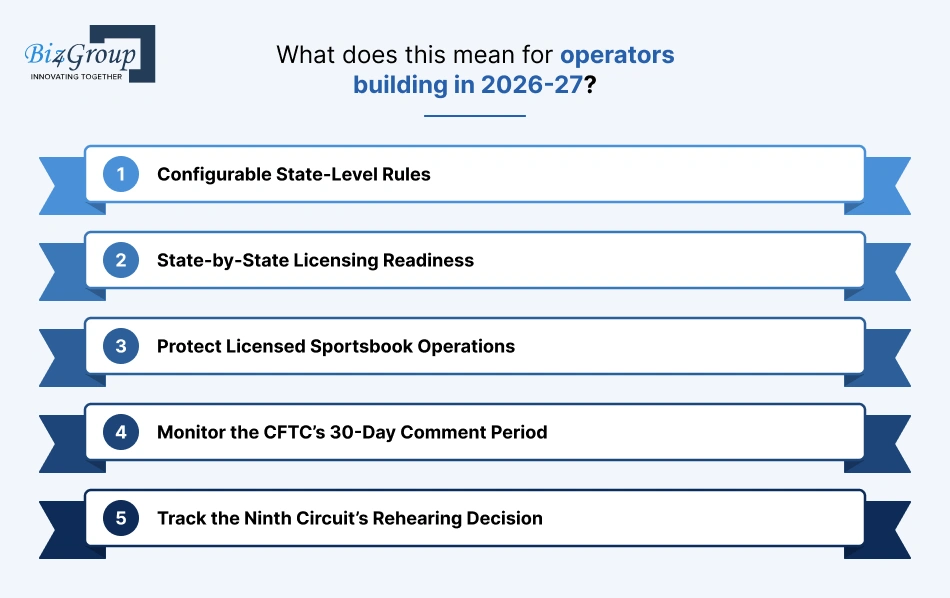
Plan for both outcomes. Should you wait for the Supreme Court? No.
- Keep state rules configurable. If sports contracts are treated as bets, the same product needs a license in each state where it operates.
- Licensed sportsbooks stay under state law. The October 9 interim rule says bets placed with state- or tribal-licensed sportsbooks are not swaps.
- Watch two things: the 30-day comment period after the CFTC rules are published, and the Ninth Circuit’s rehearing decision.
What Compliance Rules Apply in Every State?
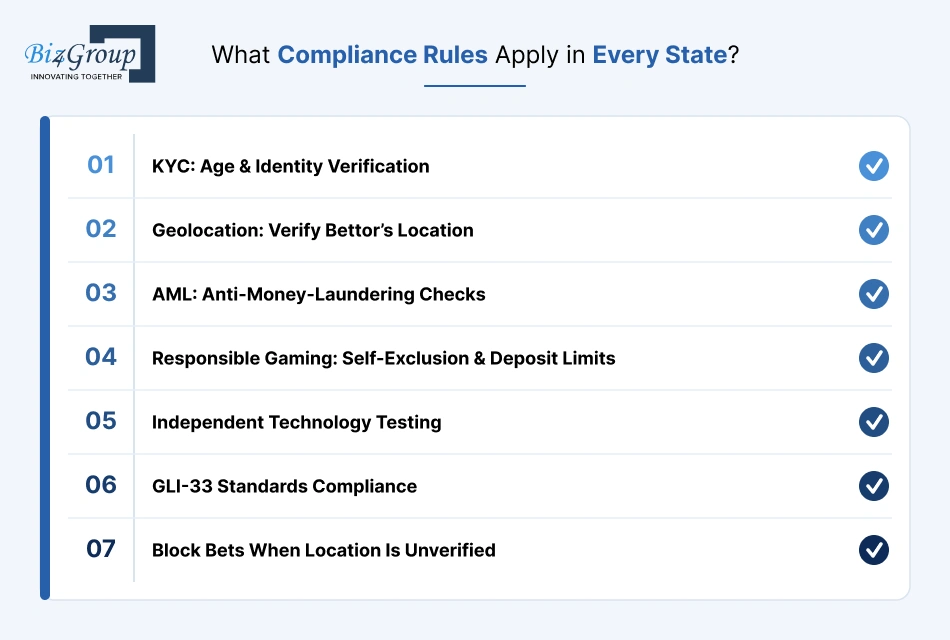
There’s no single national rulebook for sportsbook compliance. A handful of checks show up in nearly every state, and then each state adds its own twists.
What is the compliance baseline across states?
The compliance requirements for operating a sportsbook across multiple states boil down to five checks: age and identity, geolocation, anti-money-laundering, responsible gaming and tested technology. Here is what each one looks like:
- Who’s betting: you verify age and identity at sign-up, known as KYC (know your customer), usually with a government ID.
- Where they are: geolocation proves the bettor is physically inside the state when the bet goes in.
- Where the money comes from: anti-money-laundering checks, building on the federal rules we covered earlier.
- How you protect them: responsible gaming tools like self-exclusion and deposit limits.
- Whether your tech holds up: an independent lab tests it. Regulators often lean on GLI-33, a testing standard that covers accounts, geolocation and responsible gambling.
Isn’t verifying who the player is enough? No. Identity checks tell you who they are, and geolocation tells you where they are, so you need both. Under GLI-33, a system that can’t confirm location has to block the bet until it can.
In practice: Stackr, a social casino platform we built, needed age checks before coins could be bought or redeemed, and had to handle location restrictions across US states. It’s not a sportsbook, so it shows experience with these checks, not a state license. For the build side, see our guide to how to build an AI sports betting app following USA compliance.

Where do state rules diverge?
On the small print. States agree on the big checks, but the details differ, and the details are what you end up building.
|
Rule |
How states differ |
|---|---|
|
Minimum age |
21 in most states, 18 in DC, Montana, New Hampshire, Rhode Island and Wyoming (some sportsbooks there still require 21). Kentucky moved from 18 to 21 in 2026. |
|
Credit cards |
Banned for years in Massachusetts, Iowa, New Hampshire and Oregon. Colorado joined on August 12, 2026, and Maine banned them by law in 2026. DraftKings announced in August 2025 that it would stop accepting them nationwide. |
|
Deposits and nudges |
Colorado caps deposits at six per 24 hours and bars push notifications that solicit bets. |
|
Account limits |
Since June 1, 2026, Massachusetts requires operators to tell a bettor within 48 hours, with a reason, when they limit an account. |
|
Sign-up |
Nevada requires mobile accounts to be opened in person at a casino. |
Can one rule set cover every state? No. Treat each rule as a per-state setting, not hard-coded logic. And compliance is only one of several headaches, which we cover in our piece on challenges in modern sports betting app development.
How Do You Build a Sportsbook Platform for Multiple States?
Build one shared platform and treat each state as a set of settings, not a separate app. Then launch one state at a time, because licenses and testing, not code, usually set your go-live date.
What has to be configurable by state?
Anything a state’s rulebook touches should be a setting you can change per state without touching the core code. A sportsbook platform for multi-state compliance and licensing needs at least these:
- Tax and reporting logic, since rates run from 6.75% to 51% and Illinois adds a per-bet fee.
- The age gate, which is 21 in most states and 18 in a few.
- Funding options, such as credit cards where they’re banned.
- Deposit limits and notification rules, like Colorado’s.
- The market menu, including college and player props.
- Notices, like Massachusetts’s 48-hour message when a bettor is limited.
- Geolocation boundaries and the sign-up flow.
- Which brand runs under which license or partner, known as a skin.
Do you need a separate app for every state? No. One platform can hold many state profiles, much like the tenants in our guide to a multi-tenant AI sports betting platform, where each tenant gets its own branding, markets, payments, compliance rules and reporting on a shared betting engine and data feeds.
What are the stages of a multi-state launch, and what drives the timeline?
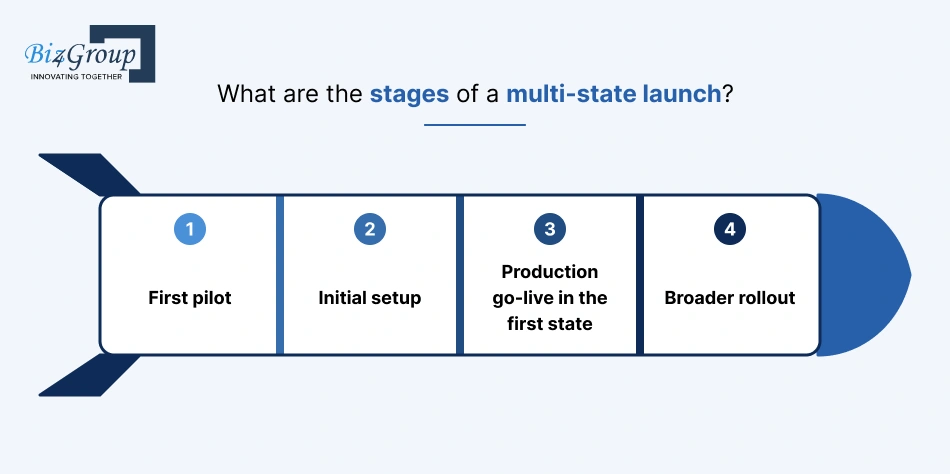
There are four stages, and the regulator’s calendar, not your code, usually sets the pace. A narrow pilot and a licensed launch are different jobs, so we don’t quote one number for all of them.
- First pilot: a small build, such as one league and one state profile in test mode, to prove the betting flow. Scope drives the time, and a sports betting app MVP is a common way in.
- Initial setup: connect data feeds, payments, ID checks and geolocation, and load the first state’s rules. The number of integrations and provider onboarding drive the time, and our sports betting API integration services cover the feeds.
- Production go-live in the first state: you need the license, the partner agreement if the state requires one, and passed testing. This runs on the regulator’s calendar. Recent US markets took roughly 7 to 13 months from law or vote to first bets, which shows how long regulators can take.
- Broader rollout: add states one at a time. The platform work gets lighter, but each state’s license and testing still run on their own calendar.
Can you build while you wait for a license? Yes. Build and test while the application runs, but you can’t take real-money bets in a state until it approves you.
Want to Make Sports Betting Safer?
AI-powered monitoring can flag unusual wagering patterns and help teams investigate suspicious activity faster.
Explore AI Sports Betting SolutionsHow does Biz4Group LLC approach multi-state builds?
We build one shared platform, treat each state as a configuration, and start with one state before adding more. That matches the tenant approach in our guides, and this is the experience behind it:
- PredictEX: real-time sports data for MLB, college football and the NFL, delivered over live connections.
- Quick Start Bets: live NHL odds and bet tracking on low-latency data pipelines.
- Handshake: peer-to-peer wagering where the stakes can be money, rewards or other agreed outcomes.
These show what we’ve engineered, not licenses. Getting licensed is the operator’s job, and we’re technology experts, not lawyers. If you want to talk through a build, start with our sports betting app development company page.
Final Words
US sports betting laws by state come down to one idea: legal doesn’t mean open. As of October 2026, 31 states plus DC run online betting, but how a market lets you in, what it taxes and which rules apply all change from one state to the next.
What to remember:
- Count carefully: 31 states plus DC online, 8 in person only, and 11 with no legal betting.
- Check access before tax. Some markets require a partner, cap licenses or belong to one company.
- Read tax rates, from 6.75% to 51%, as headline rates, since promotions and extra fees change what operators really pay.
- Treat prediction markets as unsettled. Appeals courts disagree, the Supreme Court has been asked to step in, and Nebraska votes on online betting on November 3.
- Build state rules as settings, not hard-coded logic, and launch one state at a time.
So where do you start? Pick the model you can actually enter, then compare tax and market size, and plan for both outcomes in the prediction-market fight. Rules and rulings keep moving, so check the date at the top and talk to a gaming lawyer before you commit.
Planning a multi-state build? Talk to our team.
Sources, and Last Verified
Last verified October 12, 2026. These are the main sources behind the numbers in this guide, with official documents marked. Other sources are linked where they appear, and the few figures we calculated ourselves are labeled as ours.
- Market size and tax: American Gaming Association, Tax Foundation, BettingUSA, RG’s 2025 market ranking and InGame on Illinois.
- State status and regulators: CBS Sports, WSN, RG’s regulator list, the Pennsylvania statute (official), Maryland’s outreach document (official), the Massachusetts Gaming Commission (official) and the Nevada Independent.
- Federal law: SCOTUSblog, Britannica, the Congressional Research Service on Murphy (official), the First Circuit’s Wire Act opinion (official), Cadwalader and GamingCompliance.
- 2026 changes: the Nebraska Secretary of State’s ballot certification (official), iGaming Future, SportsBettingDime, Gambling.com on Colorado, Covers on Kentucky and Legal Sports Betting on college props.
- Prediction markets: the CFTC’s interim rule release (official), the CFTC’s New York suit release (official), Supreme Court docket No. 26-299 (official), the Congressional Research Service on the CFTC proposal (official), Rep. Horsford’s release (official), CNBC, PYMNTS, DeFi Rate and Covers on the AGA estimate.
- Compliance: the North Carolina Gaming Commission’s GLI-33 copy (official), Gambling.com on age limits and BettingUSA on credit cards.
*This guide is for information, not legal advice. Talk to a gaming lawyer before any market-entry decision.
FAQs: Sports Betting Laws by State in 2026
1. Can an offshore sportsbook legally accept bets from US customers?
An offshore sportsbook cannot legally accept US bets simply because it operates outside the country. Its activities must comply with applicable federal and state gambling laws, and operating without the required authorization can expose it to enforcement action.
2. Can a sports betting operator use the same KYC provider across multiple states?
Yes. An operator can use one Know Your Customer (KYC) provider across multiple states if the provider supports each jurisdiction's identity verification, age verification, and compliance requirements. The operator remains responsible for ensuring that the checks meet local regulations.
3. Do sports betting operators need independent security audits?
Sports betting operators may need independent security assessments, technical testing, and system certifications to obtain or maintain regulatory approval. The specific requirements depend on the jurisdiction, the platform's components, and the systems handling wagers, payments, and customer information.
4. Can a sportsbook change its odds after a customer places a bet?
A sportsbook can update its odds for future wagers as market conditions change, but an already accepted wager is generally governed by its original terms. Whether a bet can be voided or adjusted depends on the operator's published rules and applicable state regulations.
5. Are cryptocurrency deposits allowed on US-licensed sportsbooks?
Cryptocurrency deposits are not universally permitted across US-regulated sportsbooks. Operators must confirm that their licenses, state regulations, payment-processing arrangements, and applicable financial compliance obligations allow the proposed cryptocurrency transactions before introducing them.
6. Can sports betting operators outsource platform development to third-party vendors?
Yes. Operators can outsource sportsbook development, data integrations, payment processing, and other technology functions to specialized vendors. However, they must ensure that vendors meet applicable technical and security standards, and outsourcing does not remove the operator's responsibility for regulatory compliance.
7. What happens if a sportsbook accepts bets from a restricted state?
Accepting wagers where an operator lacks the necessary authorization can trigger regulatory investigations, financial penalties, license suspension, or other legal consequences. Operators should use reliable geolocation controls to block prohibited wagers and maintain records demonstrating compliance with jurisdictional restrictions.
8. Can AI detect suspicious sports betting activity?
Yes. AI models can analyze betting patterns, transaction histories, account behavior, and unusual wagering activity to flag potential fraud or coordinated betting. These systems support risk monitoring and investigation, but their alerts should be reviewed against relevant evidence before an operator takes enforcement action.
9. How long must sportsbooks retain betting transaction records?
Record retention periods vary by jurisdiction and record type. Sportsbooks may need to preserve wagering transactions, customer verification records, payment histories, and compliance documentation for specified periods. Operators should configure retention policies around applicable regulatory requirements rather than applying one universal period.
10. Can a sportsbook operate multiple brands on one technology platform?
Yes. A sportsbook operator can potentially manage multiple brands through a shared technology platform, provided the arrangement complies with applicable licensing and ownership rules. Each brand may require separate approvals, branding controls, reporting configurations, or other safeguards, depending on the jurisdiction and its relationship with the licensed operator.
