 Location :
Orlando, FL, USA
Location :
Orlando, FL, USA +1 (407) 714-1616
 info@biz4group.com
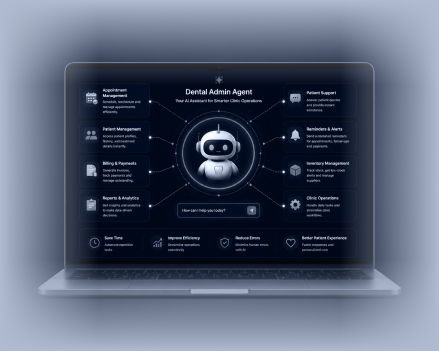
 AI Summary Powered by Biz4AI
- AI agent development for dental clinic admin tasks automates scheduling, billing, insurance verification, and staff coordination, helping clinics reduce administrative workload and improve efficiency.
- Modern dental clinic management AI agents streamline front-desk operations, patient communication, appointment management, and daily workflow execution.
- AI-powered administrative systems can minimize appointment overload, reduce billing errors, improve staff coordination, and support scalable practice growth.
- The cost of developing a dental practice management AI agent typically ranges from $30,000 to $750,000+, depending on AI capabilities, integrations, compliance requirements, and customization levels.
- Success often depends on choosing the right development approach, implementation strategy, and technology partner, such as Biz4Group, to ensure long-term scalability, security, and measurable ROI.
If dental clinics had a secret second waiting room, it would probably be filled with unanswered calls, pending insurance claims, rescheduling requests, insurance paperwork, and spreadsheets, that nobody wants to open. This is the increasing struggle faced by clinic admins because administrative work keeps multiplying faster than teams can handle it.
That's why AI agent development for dental clinic admin tasks is getting serious attention among clinics. These AI agents are capable of reducing workload, improving efficiency, and growing without continuously increasing staff headcounts.
Around 62% of dentists identified that staffing shortages, recruitment challenges, and retention issues are one of their biggest expected challenges, as per the American Dental Association's Health Policy Institute's report.
Recent industry data suggests that dental practice overhead commonly consumes a significant amount of collections, which is leading to reduction in inefficiencies caused by scheduling gaps, manual billing processes, or operational bottlenecks. Meanwhile, many practices continue to experience recruitment challenges for administrative and clinical roles, that is adding more pressure on already overloaded front desk teams.
This creates a difficult question, "how do you scale operations without continuously adding administrative complexity, higher labor costs, and more operational friction?"
And the answer is dental clinic AI agent development for administration.
AI powered dental clinic admin agent development is transforming how dental practices operate. AI agents can handle everything, from using AI voice assistant for scheduling appointment and insurance verification to billing workflows and staff coordination. Let's explore what AI agent development for dental clinic admin tasks is, and why clinics are investing in it.
What Is AI Agent Development for Dental Clinic Admin Tasks and How Are AI Agents Different from Traditional Dental Clinic Automation Systems?
When people hear the term "AI agent," many immediately imagine AI chatbots answering questions or robots replacing staff. In contrast, AI agents are much more practical and much less dramatic.
AI agent development for dental clinic admin tasks refers to building intelligent systems that are capable of understanding information, making decisions, and performing administrative actions with minimal human intervention. Instead of following fixed rules, these systems analyze context, interact with multiple systems, and execute workflows across scheduling, billing, communication, and operations.
This difference is important because traditional automation works well only when processes remain predictable.
Comparison Factor |
Traditional Dental Clinic Automation |
AI Agent Development for Dental Clinic Admin Tasks |
|---|---|---|
How decisions are made |
Operates using predefined rules and fixed workflows |
Makes context aware decisions based on inputs, patient requests, schedules, and operational conditions |
Handling appointment scheduling |
Requires staff intervention for exceptions like rescheduling, double bookings, or cancellations |
Automatically manages scheduling conflicts, rescheduling, cancellations, waitlists, and slot optimization |
Response to unexpected situations |
Breaks when workflows fall outside predefined conditions |
Adapts dynamically and escalates only when human intervention is required |
Sends static reminders and notifications |
Understands patient requests, responds conversationally, personalizes communication, and handles follow ups |
|
Workflow coverage |
Automates isolated tasks individually |
Connects and orchestrates complete workflows across scheduling, billing, insurance, and staff coordination |
System integration capabilities |
Usually limited to one software or workflow |
Coordinates across practice management systems, billing tools, communication platforms, calendars, and databases |
Billing and insurance processing |
Requires significant manual verification and corrections |
Detects anomalies, validates billing workflows, assists insurance verification, and reduces claim errors |
Learning and optimization ability |
Does not improve without manual reconfiguration |
Learns from workflows, identifies patterns, and continuously improves operational efficiency |
Scalability as clinic grows |
Requires additional staff and administrative overhead |
Handles increasing workload without proportional growth in administrative resources |
Role of administrative staff |
Staff performs most repetitive operational tasks |
Staff focuses on approvals, patient care, complex cases, and higher value work |
Implementation complexity |
Easier and faster to deploy but limited flexibility |
Higher initial complexity but greater long term operational impact |
Business outcome |
Improves task efficiency |
Improves operational efficiency, reduces revenue leakage, increases scalability, and enhances patient experience |
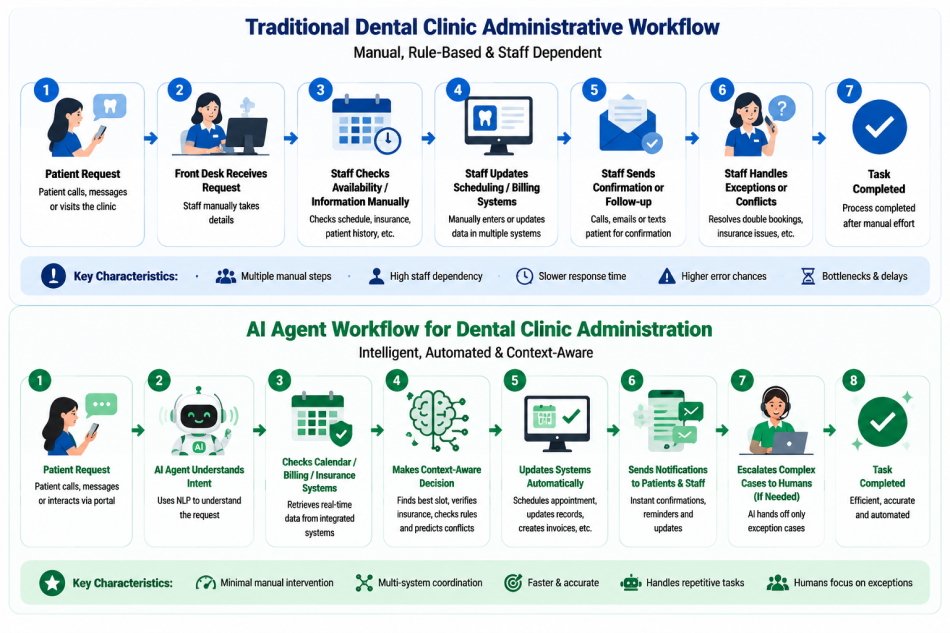
AI agent dental practice administration software are designed to remove repetitive administrative work, not replace staff, which leads to teams that focus on patient care and higher-value activities. For clinics trying to scale operations efficiently, that distinction is extremely important. Now, let's explore the types of intelligent dental clinic admin agent development.
What Type of AI Agent Dental Practice Administration Software Are There and Their Use Cases?
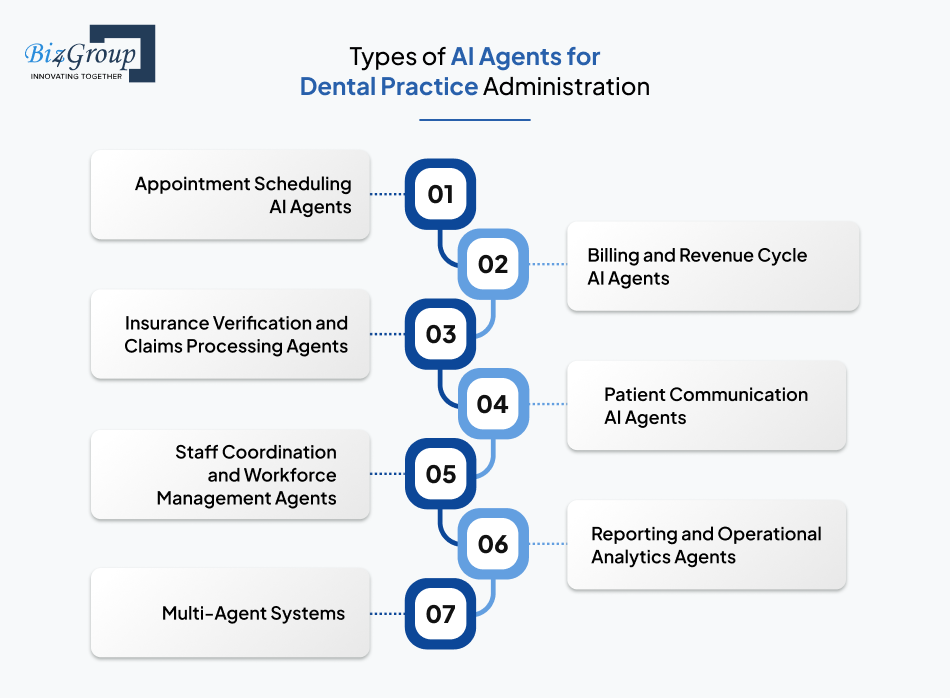
Dental office AI automation agent development not only focuses on solving the same level of problems, but some also focus on handling repetitive administrative tasks, while others are designed to coordinate workflows across multiple systems and departments. Understanding these different categories helps decision-makers identify which type of AI agent creates the highest operational impact.
1. Appointment Scheduling AI Agents
Appointment scheduling AI agents are designed to manage the entire scheduling lifecycle without requiring constant front desk involvement. These systems understand appointment requests, analyze availability, optimize schedules, and handle changes automatically.
Why they matter:
Scheduling inefficiencies directly affect revenue, chair utilization, and patient experience.
Use Cases:
- appointment booking
- rescheduling requests
- automated reminders
- waitlist management
- reducing no-shows
- calendar optimization
Here is a real-world example, Custom enterprise AI agent, developed by Biz4Group. Although built for enterprise use cases, this project demonstrates how AI agents can automate complex workflows, integrate with existing systems, and securely manage sensitive information, capabilities that are equally valuable in dental clinic administration.
Real World Projects by Biz4Group: Custom Enterprise AI Agent
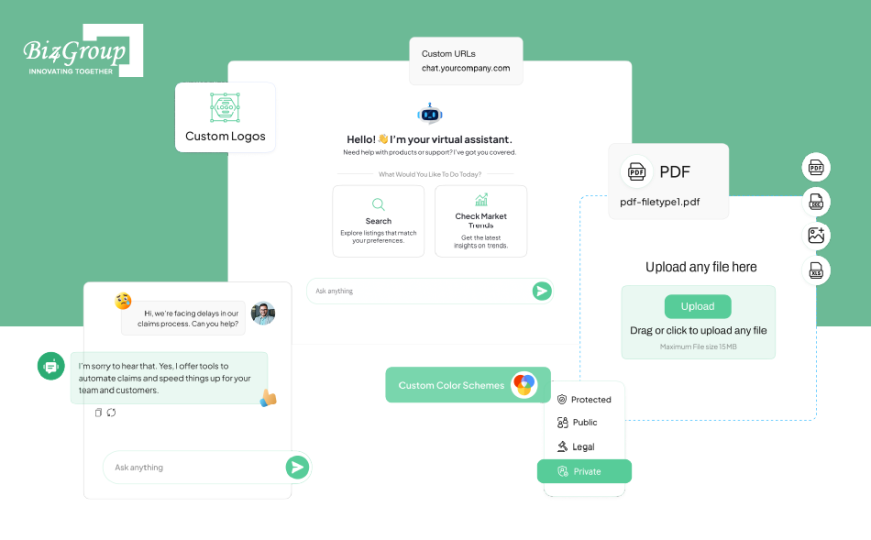
Custom enterprise AI agent, developed by Biz4Group. The solution was developed as a HIPAA and GDPR-compliant AI agent capable of supporting secure interactions, automating workflows, and integrating with enterprise ecosystems while handling sensitive information responsibly.
The platform included capabilities such as:
- Multi-language interactions and communication support
- Enterprise integrations with tools such as Salesforce and Slack
- Document analysis and information processing across multiple formats
- IVR assistants and conversational workflows
- Plug-and-play API integrations
- White-label deployment capabilities
- Industry-specific workflows and compliance-focused architecture
2. Billing and Revenue Cycle AI Agents
These agents automate administrative workflows associated with invoices, payments, billing validation, and financial processes. Rather than generating invoices, they analyze billing information, identify anomalies, and reduce revenue leakage.
Why they matter:
Manual billing mistakes and claim rejections create cash flow disruptions.
Use Cases:
- invoice generation
- payment reminders
- billing validation
- payment tracking
- revenue reporting
- identifying billing anomalies
3. Insurance Verification and Claims Processing Agents
Insurance verification and claim processing agents are specifically designed to reduce the operational burden created by insurance workflows. They retrieve eligibility information, validate documentation requirements, and assist with claims management.
Why they matter:
Insurance verification delays frequently create front desk bottlenecks.
Use Cases:
- insurance eligibility verification
- pre-authorization checks
- claim validation
- claims tracking
- documentation assistance
- rejection reduction
Another project developed by Biz4Group is Insurance AI. It shows how AI agent development can streamline complex operational processes, improve information accessibility, and reduce administrative burden through intelligent automation.
Real World Projects by Biz4Group: Insurance AI
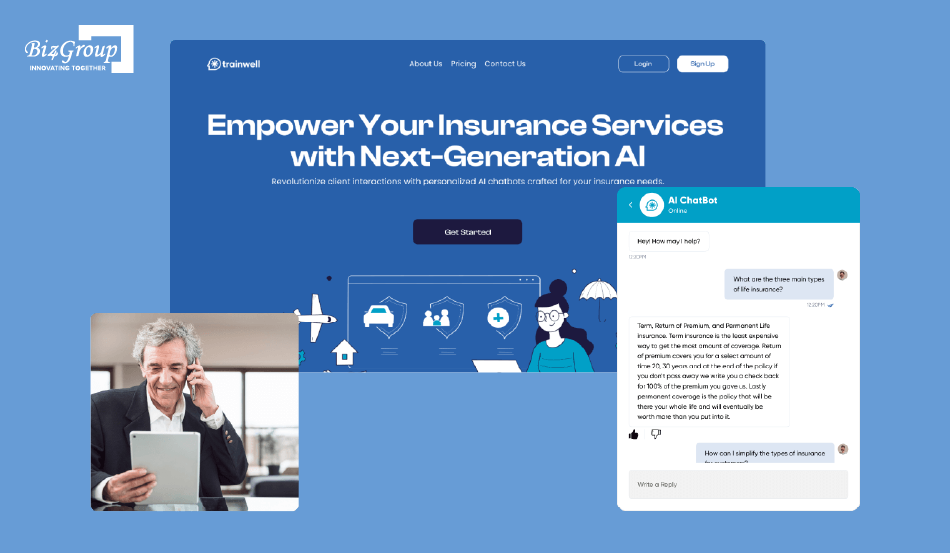
Insurance AI is a Generative AI-powered chatbot built to streamline training, knowledge sharing, and support operations within an insurance organization.
The solution was designed to help insurance agents access information instantly without relying on frequent training sessions, lengthy documentation, or repeated interactions with senior team members. The platform improves knowledge accessibility by providing accurate and contextual responses in real time, while reducing operational overhead.
The platform included capabilities such as:
- AI-powered responses trained on organization-specific knowledge
- Instant access to policies, procedures, and training materials
- Centralized knowledge management
- Admin-controlled document uploads and updates
- Conversation history and interaction tracking
- Feedback collection and response improvement mechanisms
- Ability to handle multiple user queries simultaneously
4. Patient Communication AI Agents
These agents focus on automating patient interactions across multiple communication channels. So, instead of requiring staff to manually manage repetitive conversations, these systems handle communication workflows automatically.
Why they matter:
Communication delays negatively affect patient experience and retention.
Use Cases:
- appointment reminders
- follow-up communication
- FAQ handling
- personalized messaging
- treatment reminders
- feedback collection
5. Staff Coordination and Workforce Management Agents
These agents optimize how staff schedules, resources, and workloads are managed. Rather than assigning shifts, they analyze operational requirements and coordinate resources dynamically.
Why they matter:
Poor staff coordination reduces operational efficiency.
Use Cases:
- staff scheduling
- workload balancing
- resource allocation
- shift coordination
- conflict detection
- provider availability management
6. Reporting and Operational Analytics Agents
These systems collect information from multiple operational systems and generate actionable insights automatically. They help leadership teams move from reactive decision-making to data-driven management.
Why they matter:
Operational visibility becomes difficult as clinics scale.
Use Cases:
- performance dashboards
- appointment analytics
- revenue analysis
- operational KPIs
- forecasting
- productivity monitoring
7. Multi-Agent Systems
When building multi-agent systems, it's important to know that they consist of multiple specialized AI agents working together instead of relying on a single system to manage every operational process. Each agent handles a specific responsibility while continuously communicating and coordinating actions with other agents.
Why They Matter:
As clinics grow, larger practices and multi-location organizations often require cross-functional automation across workflows, teams, and systems.
Use Cases:
- Cross-system coordination and workflow management
- Workforce and resource allocation optimization
- Compliance monitoring and document management
- Multi-location operational synchronization
- Real-time reporting and business intelligence generation
Implementing AI in healthcare environments requires more than automation alone. It requires handling sensitive information, managing user interactions, supporting appointment workflows, and creating experiences that work reliably in real-world environments. To have a better understanding, let's explore the core features behind modern dental AI systems.
Which AI agent survives the Monday morning rush?
Find the right automation fit for your clinic.
Connect With UsWhat Core Features Should an AI Agent for Dental Clinic Admin Automation Include?
An AI powered dental administration system is only as effective as the operational capabilities it supports. While advanced AI features help optimize workflows at scale, core features form the foundation required for reliable day-to-day clinic operations.
These capabilities helps in ensuring administrative efficiency, workflow consistency, and seamless coordination across dental practice management systems.
Core Feature |
What It Does |
Why It Matters for Dental Clinics |
|---|---|---|
Intelligent Appointment Scheduling |
Automates appointment booking, cancellations, and rescheduling workflows |
Reduces manual scheduling workload and improves chair utilization |
Automated Appointment Reminders |
Sends reminders through SMS, email, or messaging platforms |
Helps reduce no-shows and missed appointments |
Patient Registration Automation |
Digitizes patient intake forms and onboarding workflows |
Reduces front desk paperwork and administrative delays |
Insurance Eligibility Verification |
Verifies patient insurance coverage before appointments |
Minimizes verification delays and administrative bottlenecks |
Billing and Invoice Management |
Generates invoices, payment reminders, and payment tracking workflows |
Improves billing efficiency and reduces manual errors |
Claims Submission Assistance |
Supports claims documentation and submission workflows |
Accelerates reimbursement processes |
Multi-System Integration |
Connects with AI EHRs, CRMs, billing platforms, scheduling tools, and communication systems |
Eliminates disconnected administrative workflows |
Patient Communication Management |
Automates confirmations, follow-ups, notifications, and routine communication |
Improves patient engagement and operational responsiveness |
Calendar and Provider Coordination |
Synchronizes provider availability, room schedules, and appointment calendars |
Prevents scheduling conflicts and resource overlap |
Task and Workflow Automation |
Automates repetitive administrative processes across clinic operations |
Reduces operational overhead and staff workload |
Real-Time Notifications and Alerts |
Sends instant updates to patients and staff regarding appointments, billing, and workflow changes |
Improves operational coordination |
Role-Based Access Management |
Controls system access based on staff roles and responsibilities |
Supports operational security and workflow governance |
Audit Trails and Activity Logging |
Tracks actions, workflow history, and administrative changes |
Supports accountability and compliance monitoring |
Document and Record Management |
Organizes patient forms, billing records, insurance documents, and operational files |
Simplifies administrative record handling |
Reporting and Performance Dashboards |
Provides visibility into appointments, billing activity, workflow performance, and operational KPIs |
Helps leadership monitor operational health |
Protects patient information through encryption, access controls, and compliance safeguards |
Essential for regulatory compliance and patient trust |
|
Human Escalation Support |
Routes sensitive or exceptional cases to staff when manual review is required |
Maintains operational oversight and reduces risk |
Scalability and Multi-Location Support |
Supports workflow expansion across growing practices and multiple clinic locations |
Enables operational scalability without proportional staffing increases |
These core features that creates the operational backbone of AI agent dental practice administration software. Now, Let's discover the advanced features of AI driven dental clinic admin system development.
What Advanced Features Make Intelligent Dental Clinic Admin Agents More Effective?
Core automation features help clinics in streamlining repetitive administrative work. However, advanced AI capabilities take things a step further, as integrating advanced features helps in enabling prediction, autonomous decision-making, optimization, and continuous improvement across clinic operations.
These features transform dental office AI automation agent development from administrative assistants into intelligent operational systems.
Advanced Feature |
What It Does |
Business Impact |
|---|---|---|
Predictive No-Show Risk Scoring |
Analyzes patient behavior, attendance history, demographics, and scheduling patterns to identify appointments most likely to be missed |
Reduces revenue loss and improves chair utilization |
AI-Driven Schedule Optimization |
Automatically restructures schedules based on cancellations, treatment duration, provider availability, and patient preferences |
Maximizes appointment capacity and operational efficiency |
Autonomous Appointment Recovery |
Agentic AI detects cancellations and automatically fills vacant slots using waitlists, patient preferences, and scheduling priorities |
Minimizes unused chair time and lost revenue |
Intelligent Insurance Claim Risk Prediction |
Evaluates claims before submission and predicts rejection probability based on historical approval patterns |
Improves claim acceptance rates and accelerates reimbursements |
Revenue Leakage Detection Engine |
Identifies missed billing opportunities, incomplete claims, unbilled procedures, and payment gaps |
Protects revenue and improves financial performance |
AI-Powered Workforce Forecasting |
Predicts staffing requirements using historical demand, seasonal trends, provider schedules, and appointment volume |
Improves workforce planning and labor cost management |
Dynamic Resource Optimization |
Recommends optimal allocation of operatories, equipment, and providers based on real-time clinic demand |
Improves resource utilization across the practice |
Multi-Agent Collaboration Framework |
Enables scheduling, billing, insurance, communication, and workforce agents to work together toward shared operational goals |
Creates end-to-end autonomous workflow management |
Context-Aware Decision Intelligence |
Considers multiple operational variables before taking action instead of relying on predefined rules |
Enables smarter administrative decision-making |
Self-Learning Workflow Optimization |
Continuously learns from clinic operations, staff actions, patient behavior, and outcomes to improve future performance |
Increases automation accuracy over time |
Operational Bottleneck Prediction |
Detects workflow slowdowns before they impact scheduling, billing, or patient experience |
Enables proactive operational management |
Predictive Capacity Planning |
Forecasts future appointment demand, provider utilization, and operational workload |
Supports long-term growth planning and expansion strategies |
Executive Decision Support Intelligence |
Converts operational data into actionable recommendations for leadership teams |
Improves strategic planning and decision-making |
Conversational Voice AI for Front Desk Operations |
Conducts human-like phone conversations for scheduling, rescheduling, confirmations, and patient inquiries |
Reduces front desk workload while maintaining service quality |
These advanced capabilities represent the next evolution of dental clinic administration. They are helping practices to predict operational challenges, optimize resources, improve financial outcomes, and scale more efficiently. Let's understand what kind of tech stack is needed to develop dental practice management AI agent.
What if your automation could actually think ahead?
Explore smarter AI capabilities for dental operations.
Connect With UsWhat Kind of Tech Stack Is Used for Building Machine Learning Dental Clinic Management Agent?
Modern AI agents operate across multiple systems. They analyze operational data, make decisions, automate workflows, and communicate with patients and staff in real time.
To support these capabilities, organizations typically use a layered technology stack where each component serves a specific purpose within the overall ecosystem.
Technology Layer |
Common Technologies |
Purpose in Dental AI Agent Development |
|---|---|---|
Frontend Development |
React.js, Angular, Vue.js |
Creates utility dashboards for administrators, reception teams, and clinic managers to monitor workflows and interact with AI systems using React.js development |
Backend Development |
Node.js, Python, Java, .NET |
Node.js development and Python development power the backend layer, enabling workflow orchestration, business logic execution, API management, system integrations, and seamless communication between AI agents and operational platforms. |
AI & Machine Learning Frameworks |
TensorFlow, PyTorch, Scikit-learn |
Powers predictive analytics, decision-making, patient behavior analysis, and workflow optimization |
Large Language Models (LLMs) |
GPT, Claude, Llama, Gemini |
Enables natural language conversations, patient communication, appointment handling, and administrative assistance |
Agent Frameworks |
LangGraph, CrewAI, AutoGen, LangChain |
Allows multiple AI agents to collaborate across scheduling, billing, communication, and insurance workflows |
Database Systems |
PostgreSQL, MySQL, MongoDB |
Stores patient information, appointment records, billing data, workflow logs, and operational data |
Vector Databases |
Pinecone, Weaviate, ChromaDB |
Supports semantic search, contextual memory, document retrieval, and knowledge management |
Workflow Automation Engines |
Temporal, n8n, Apache Airflow |
Automates repetitive administrative processes and coordinates workflow execution |
API Integration Layer |
REST APIs, GraphQL, HL7, FHIR |
Connects AI agents with EHR systems, billing platforms, CRMs, insurance providers, and third-party tools |
Cloud Infrastructure |
AWS, Microsoft Azure, Google Cloud |
Provides scalability, security, computing resources, storage, and deployment environments |
Communication Services |
Twilio, SendGrid, WhatsApp APIs |
Enables appointment reminders, notifications, patient engagement, and communication automation |
Analytics & Monitoring |
Power BI, Tableau, Grafana |
Tracks operational KPIs, workflow performance, utilization metrics, and system health |
Security & Compliance |
OAuth 2.0, IAM, Encryption Services |
Protects sensitive patient information and supports HIPAA-compliant operations |
DevOps & Deployment |
Docker, Kubernetes, GitHub Actions |
Supports application deployment, updates, monitoring, and infrastructure management |
This combination of tech enables AI powered dental clinic admin agent development to automate complex administrative operations while maintaining accuracy, scalability, and compliance. Now, let's understand the step-by-step development of dental practice management AI agent.
How Can You Develop an AI Agent for Dental Practice Management: Step by Step Development Process
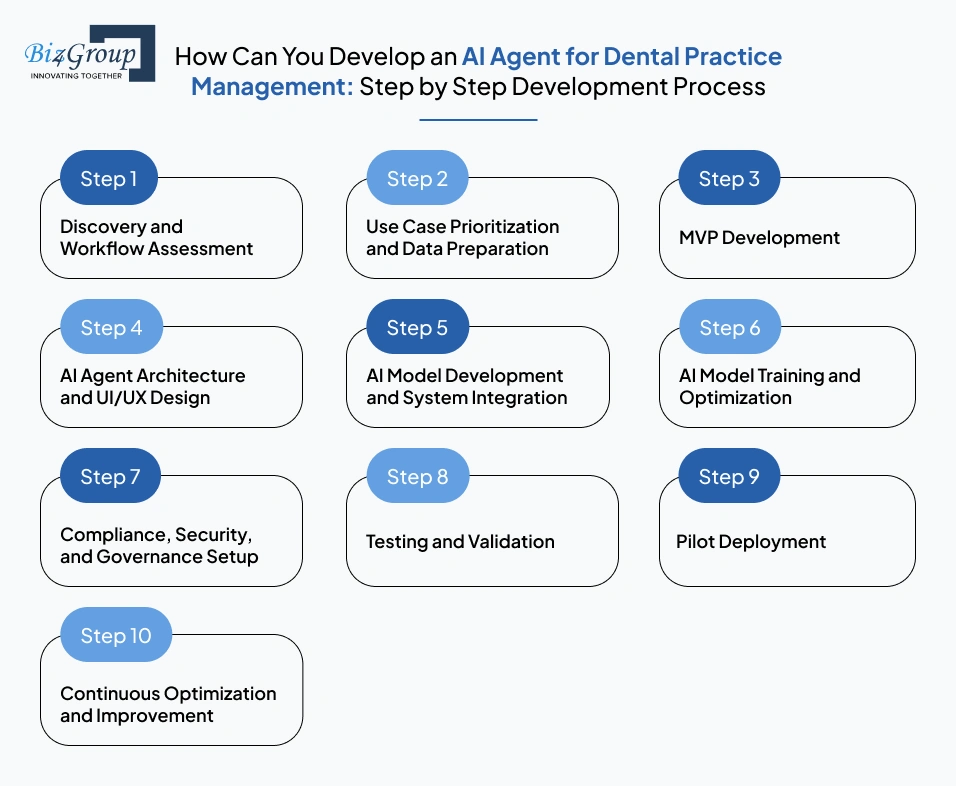
Building AI dental clinic management automation is not just about building an AI model. It involves understanding clinic workflows, identifying operational bottlenecks, integrating with existing systems, and creating intelligent automation that delivers measurable business outcomes.
Here is a typical end-to-end development process that is used to build production-ready dental administration of AI agents.
Step 1: Discovery and Workflow Assessment
Before any development begins, organizations must understand how their current administrative operations function, where inefficiencies exist, and which processes create the biggest operational challenges. This stage creates the foundation for the entire AI implementation.
What Happens?
- Analyze appointment scheduling workflows
- Review billing and insurance processes
- Assess staff coordination procedures
- Identify operational bottlenecks
- Define automation opportunities
- Gather stakeholder requirements
A clear roadmap of business challenges, automation opportunities, project goals, and expected outcomes.
Step 2: Use Case Prioritization and Data Preparation
Not every process should be automated immediately. This phase focuses on identifying high-impact automation opportunities while preparing the data required to support accurate AI decision-making. Since administrative information is often spread across multiple systems, organizations must determine where AI can create the greatest value and ensure the underlying data is ready for implementation.
What Happens?
- Prioritize high-value use cases based on business impact and ROI potential
- Define business objectives and success metrics
- Determine automation scope and implementation priorities
- Create a phased implementation roadmap
- Evaluate technical feasibility and integration requirements
- Collect scheduling, billing, insurance, and communication data
- Consolidate information from multiple systems and workflows
- Clean duplicate, incomplete, or inconsistent records
- Standardize datasets to improve accuracy and reliability
A prioritized implementation roadmap supported by a structured and reliable data foundation, enabling AI agents to deliver accurate insights, efficient automation, and measurable business value.
Step 3: MVP Development
Rather than building a fully featured AI ecosystem immediately, organizations typically begin with developing a minimum viable product (MVP) focused on high-impact workflows. This approach reduces implementation risks while validating business value early.
What Happens?
- Develop core AI capabilities for prioritized workflows
- Build essential integrations
- Implement high-impact automation use cases
- Validate workflows and user interactions
- Collect stakeholder feedback
- Identify improvements and expansion opportunities
A functional AI solution capable of delivering measurable business value while providing a foundation for future expansion and optimization.
Also Read: 12+ MVP Development Companies in USA to Launch Your Startup in 2026
Step 4: AI Agent Architecture and UI/UX Design
AI agent architecture focus on designing both the technical architecture and user experience of the AI system. The objective is to define how AI agents will operate, communicate, make decisions, and interact with users while ensuring the solution remains intuitive, secure, and efficient for daily clinic operations.
What Happens?
- Design agent workflows and automation processes
- Define decision-making logic and escalation rules
- Plan integrations with existing systems and platforms
- Establish security architecture and access controls
- Define communication channels between users and AI agents
- Design UI/UX for administrators, front-desk teams, and providers
- Create dashboards, portals, and workflow management interfaces
- Build prototypes and validate usability
- Optimize user journeys and workflows for efficiency and adoption
A complete technical and UI/UX blueprint that defines how the AI system functions, integrates, and delivers a seamless user experience across administrative workflows.
Also Read: Top 15 UI/UX Design Companies in USA (2026 Edition)
Step 5: AI Model Development and System Integration
This stage focuses on building the intelligence behind the AI agent and connecting it with existing clinic systems. The goal is to create an AI solution that can understand requests, make decisions, and seamlessly interact with operational workflows.
What Happens?
- Configure language models and machine learning frameworks
- Train AI models using administrative and operational data
- Develop workflow automation and decision-making capabilities
- Establish business rules and response logic
- Integrate EHRs, billing platforms, scheduling software, and CRM systems
- Connect communication tools and third-party applications through APIs
- Enable secure data exchange between systems and AI agents
An intelligent and connected AI system capable of understanding requests, accessing relevant information, automating workflows, and interacting seamlessly with existing clinic infrastructure.
Step 6: AI Model Training and Optimization
At this stage, the AI agent is trained to understand requests, interpret information, make decisions, and generate relevant responses. The goal is to ensure the system can perform administrative tasks accurately and consistently across different scenarios.
What Happens?
- Train AI models using administrative and operational datasets
- Configure language models for healthcare and dental-specific interactions
- Establish decision-making rules and response logic
- Train the system to understand patient, billing, and operational queries
- Optimize model accuracy through testing and feedback loops
- Validate responses across different administrative scenarios
- Fine-tune performance for reliability and consistency
An intelligent AI agent capable of understanding context, making informed decisions, and supporting administrative workflows with high accuracy.
Step 7: Compliance, Security, and Governance Setup
Healthcare systems require strong safeguards to protect patient information, maintain operational trust, and ensure regulatory compliance. This stage focuses on building the security, governance, and control mechanisms required before the AI system is deployed in real-world clinical environments.
What Happens?
- Implement access controls
- Configure encryption
- Establish audit trails
- Set user permissions
- Apply HIPAA compliance measures
- Create monitoring mechanisms
A secure and compliant AI environment ready for production deployment.
Step 8: Testing and Validation
Before deployment, the AI agent must be thoroughly tested to ensure reliability, accuracy, security, and operational readiness. Since administrative workflows directly affect patient experience, billing, and clinic operations, testing helps in identifying issues before they impact real-world processes.
What Happens?
- Test workflows
- Validate AI responses
- Verify integrations
- Perform security testing
- Conduct user acceptance testing
- Identify and resolve issues
With this step of developing dental practice management, a stable and production-ready AI agent is procured with validated performance.
Also Read: 15+ Software Testing Companies in USA in 2026
Step 9: Pilot Deployment
Rather than automating the entire clinic immediately, organizations typically begin with a controlled rollout. This phase allows teams to validate performance, reduce implementation risks, and identify operational improvements before expanding automation across the organization.
What Happens?
- Deploy to selected workflows
- Monitor user interactions
- Collect staff feedback
- Measure performance
- Identify optimization opportunities
- Refine configurations
Real-world validation with reduced implementation risk.
Step 10: Continuous Optimization and Improvement
AI agent development does not end after deployment. Continuous improvement ensures long-term performance, higher automation accuracy, and sustained business value as clinic operations, patient expectations, and administrative requirements evolve over time.
What Happens?
- Monitor KPIs
- Analyze user behavior
- Improve workflows
- Retrain models when required
- Add new capabilities
- Scale automation across locations
A continuously evolving AI system that becomes more effective, efficient, and valuable over time. Now, let's explore what option is best suitable for your clinic to build AI driven dental clinic admin system development system
Should Businesses Build, Buy, or Customize AI Agent Dental Practice Administration Software?
After identifying the need for AI-powered dental administration, the next important question that arise is that "should you build a solution from scratch, purchase an existing platform, or customize a solution with an experienced AI development partner?"
The answer depends on your budget, timeline, operational complexity, and long-term business goals.
Option 1: Buy an Off-the-Shelf AI Solution
Off-the-shelf solutions are pre-built software platforms that are designed to address common administrative challenges such as appointment scheduling, reminders, billing, and patient communication. These platforms offer a faster path to implementation because most features are already developed and tested.
Advantages
- Faster deployment
- Lower upfront investment
- Minimal development effort
- Vendor-managed maintenance
- Easier onboarding
Limitations
- Limited customization options
- Generic workflows
- Restricted integrations
- Scalability limitations
- Vendor dependency
Best For
Small clinics looking for basic automation without significant customization requirements.
Option 2: Build an AI Agent From Scratch
Building AI dental clinic management automation from scratch involves creating a completely custom AI system that is tailored specifically to your organization's workflows, infrastructure, and operational requirements. Every component, from agent architecture to integrations and workflows, is developed internally or through a dedicated engineering team.
Advantages
- Complete ownership
- Maximum flexibility
- Fully customized workflows
- Unlimited scalability potential
- Full control over data and infrastructure
Limitations
- Highest development costs
- Longer implementation timelines
- Significant technical complexity
- Ongoing maintenance responsibility
- Requires specialized AI expertise
Best For
Large dental organizations with substantial budgets, internal engineering resources, and highly specialized operational requirements.
Option 3: Customize an AI Solution with an Experienced Development Partner
Customization combines the flexibility of custom development with the speed and expertise of an established AI development team.
Instead of starting from zero, businesses leverage proven AI frameworks, development accelerators, and industry expertise to create solutions tailored to their unique workflows.
Advantages
- Faster implementation than building from scratch
- Lower risk compared to internal development
- Custom workflows and integrations
- Access to experienced AI specialists
- Scalable architecture
- Ongoing support and optimization
Limitations
- Higher investment than off-the-shelf software
- Requires collaboration during implementation
Best For
Custom AI agent development dental clinic management is a good option for growing dental practices, multi-location clinics, dental service organizations (DSOs), and enterprises that are seeking long-term operational advantages without building an internal AI engineering department.
For most dental organizations, custom AI agent development provides the best balance between flexibility, scalability, speed, and cost efficiency. Off-the-shelf tools may help solve immediate problems, while building everything from scratch can become expensive and complex. Custom solutions give clinics the advantage of using proven technologies while still creating workflows that fit their operations, compliance requirements, and long-term growth plans. Now, let's discover the cost of an intelligent dental clinic admin agent development.
Build it, buy it, or regret it later?
Choose the right AI approach for long-term growth.
Connect With UsHow much AI Agent Development for Dental Clinic Management Cost?
The cost of AI agent development for dental clinic management varies from $30,000 to $750,000+, depending on the complexity of the solution, the number of workflows being automated, integration requirements, and the level of customization involved.
A basic scheduling-focused AI agent requires significantly less investment than a fully integrated system capable of handling appointment management, billing, insurance verification, staff coordination, patient communication, and operational analytics.
Estimated Cost by Solution Complexity
Solution Type |
Estimated Development Cost |
|---|---|
Basic AI Administrative Agent |
$30,000 – $60,000 |
Standard Dental Clinic AI Agent |
$60,000 – $150,000 |
Advanced Multi-Agent Dental Management System |
$150,000 – $350,000+ |
Enterprise Dental AI Ecosystem |
$350,000 – $750,000+ |
Development Cost Breakdown
Development Component |
Estimated Cost Range |
|---|---|
Discovery & Planning |
$5,000 – $15,000 |
UI/UX Design |
$5,000 – $20,000 |
AI Agent Development |
$20,000 – $100,000+ |
Backend Development |
$15,000 – $50,000 |
System Integrations |
$10,000 – $40,000 |
Security & Compliance |
$5,000 – $25,000 |
Testing & Deployment |
$8,000 – $35,000 |
The final investment depends on the scope of automation, customization requirements, and the overall complexity of the dental practice management ecosystem being developed. Let's explore the hidden cost of dental clinic AI agent development for administration
What Hidden Costs Are Often Ignored During AI Driven Dental Clinic Admin System Development?
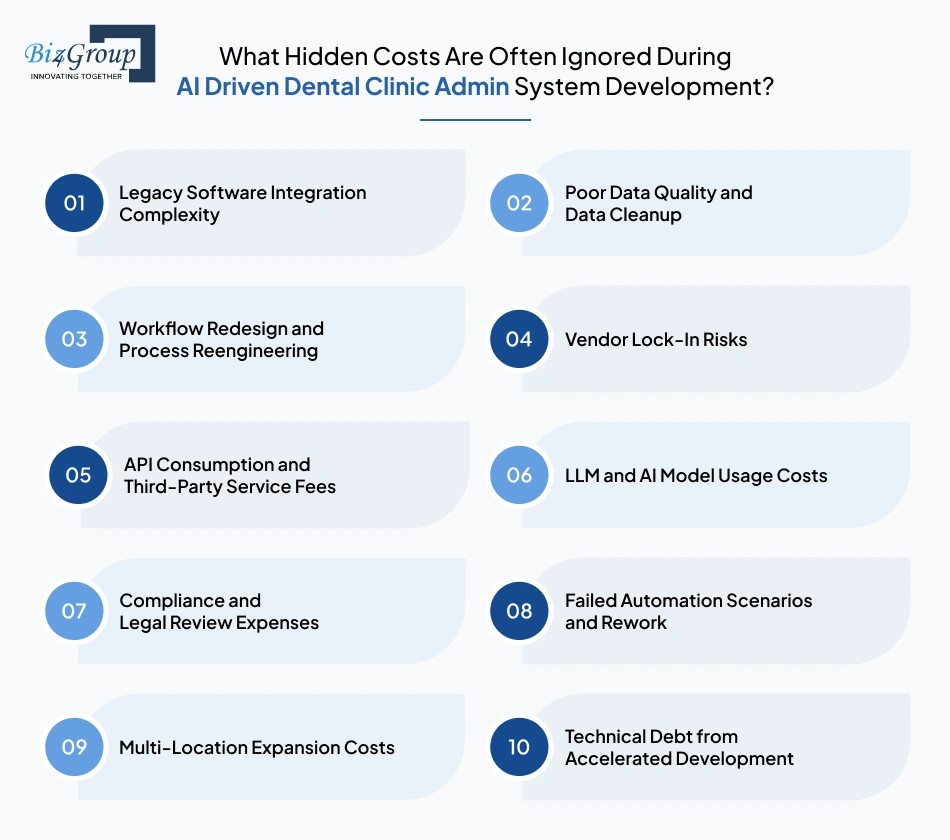
AI projects exceed their original budgets because of expenses that are rarely discussed during the planning phase. While most businesses only account for development, infrastructure, security, and deployment costs when budgeting, but hidden costs are always there.
These hidden costs typically emerge during implementation, integration, scaling, or long-term operation. They can collectively have a substantial impact on the total cost of ownership (TCO) of an AI-powered dental administration system.
Hidden Cost |
Why It's Often Missed |
|---|---|
Legacy Software Integration Complexity |
Existing dental practice management platforms, billing systems, and EHRs may have limited APIs, outdated architectures, or poor documentation, requiring additional development effort than originally estimated. |
Poor Data Quality and Data Cleanup |
Duplicate patient records, inconsistent billing information, incomplete appointment histories, and fragmented datasets often require extensive preparation before AI systems can function effectively. |
Workflow Redesign and Process Reengineering |
AI adoption frequently requires clinics to redesign existing administrative processes, approval chains, and operational workflows rather than automating current practices. |
Vendor Lock-In Risks |
Some AI platforms create long-term dependency through proprietary architectures, making future migrations, integrations, or platform changes expensive and complex. |
API Consumption and Third-Party Service Fees |
Messaging services, scheduling APIs, insurance verification systems, communication platforms, and other external services often introduce recurring usage-based charges that increase over time. |
LLM and AI Model Usage Costs |
Large language models typically operate on consumption-based pricing. As patient interactions, workflow volume, and automation usage grow, these costs can increase significantly. |
Compliance and Legal Review Expenses |
Healthcare AI solutions often require additional privacy assessments, legal reviews, security audits, and compliance validation that may not be included in initial project estimates. |
Failed Automation Scenarios and Rework |
Certain workflows may perform differently in production than expected, requiring additional development, retraining, optimization, or manual intervention after deployment. |
Multi-Location Expansion Costs |
Scaling an AI system from a single clinic to multiple locations often requires additional governance, workflow customization, permissions management, and operational configuration. |
Technical Debt from Accelerated Development |
Decisions made to speed up initial deployment can create future maintenance, optimization, and modernization expenses that were never part of the original budget. |
The most successful dental organizations evaluate AI investments based on total ownership costs rather than development expenses alone. Understanding these hidden costs helps decision-makers in building realistic budgets, reducing implementation surprises, and improving long-term project success.
How Can Clinics Optimize Costs While Building AI Dental Clinic Management Automation?
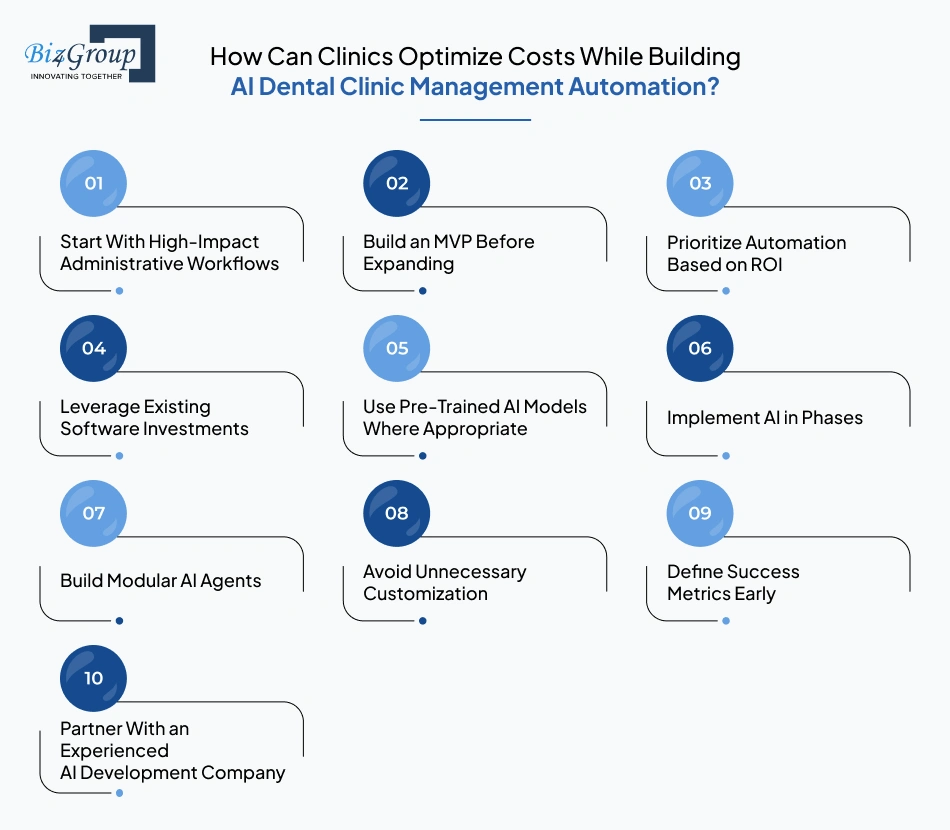
Building an AI dental clinic management automation system does not require a massive upfront investment. The most successful organizations focus on generating maximum business value while minimizing complexity, risk, and avoidable expenses.
Here are some practical ways clinics can optimize costs during AI agent development:
1. Start With High-Impact Administrative Workflows
Focus on processes that create the biggest operational burden first, such as:
- Appointment scheduling
- Appointment reminders
- Insurance verification
- Billing management
- Patient communication
It leads to generating faster ROI and lower initial investment.
2. Build an MVP Before Expanding
Instead of developing a fully featured AI ecosystem from day one:
- Launch core capabilities first
- Validate performance
- Gather user feedback
- Expand functionality gradually
As it helps in reducing development costs and lower project risk.
3. Prioritize Automation Based on ROI
Not every workflow delivers the same value.
Prioritize tasks that:
- Consume significant staff time
- Cause frequent errors
- Create operational bottlenecks
- Directly impact revenue
It helps in achieving higher returns from every dollar invested.
4. Leverage Existing Software Investments
Rather than replacing existing systems:
- Integrate with current EHR platforms
- Connect existing billing software
- Utilize current scheduling systems
- Extend existing communication tools
It helps in lowering implementation costs and faster deployment.
5. Use Pre-Trained AI Models Where Appropriate
Organizations can accelerate development by:
- Utilizing existing LLMs
- Leveraging pre-trained machine learning models
- Using proven AI frameworks
It reduces development effort and faster time-to-market.
6. Implement AI in Phases
A phased rollout allows organizations to:
- Minimize disruption
- Validate each implementation stage
- Address issues early
- Control spending over time
It helps to improve budget management and lower implementation risk.
7. Build Modular AI Agents
Instead of creating one large system:
- Develop scheduling agents first
- Add billing agents later
- Expand into insurance and staff coordination when needed
It leads to greater flexibility and controlled investment.
8. Avoid Unnecessary Customization
Customize only where it creates meaningful business value.
Standardize:
- Common workflows
- Administrative processes
- Routine automation tasks
Customize:
- Competitive differentiators
- Unique business requirements
- Specialized workflows
It helps reduce development and maintenance costs.
9. Define Success Metrics Early
Establish measurable goals before development begins:
- Reduced no-show rates
- Faster scheduling times
- Lower billing errors
- Administrative time savings
It prevents spending on features that do not contribute to business outcomes.
10. Partner With an Experienced AI Development Company
Working with an experienced development partner helps:
- Reduce implementation mistakes
- Accelerate project timelines
- Avoid costly rework
- Leverage proven frameworks and best practices
It helps in reducing total project costs and faster realization of business value.
The most effective cost optimization strategy is not spending less on AI development. It is investing in the right capabilities at the right time while ensuring every implementation phase delivers measurable operational value. Now, let's understand the monetization strategy.
Want smarter automation without scary invoices?
Optimize AI costs without sacrificing impact.
Connect With UsWhat ROI Metrics Should Decision Makers Track After AI Implementation?
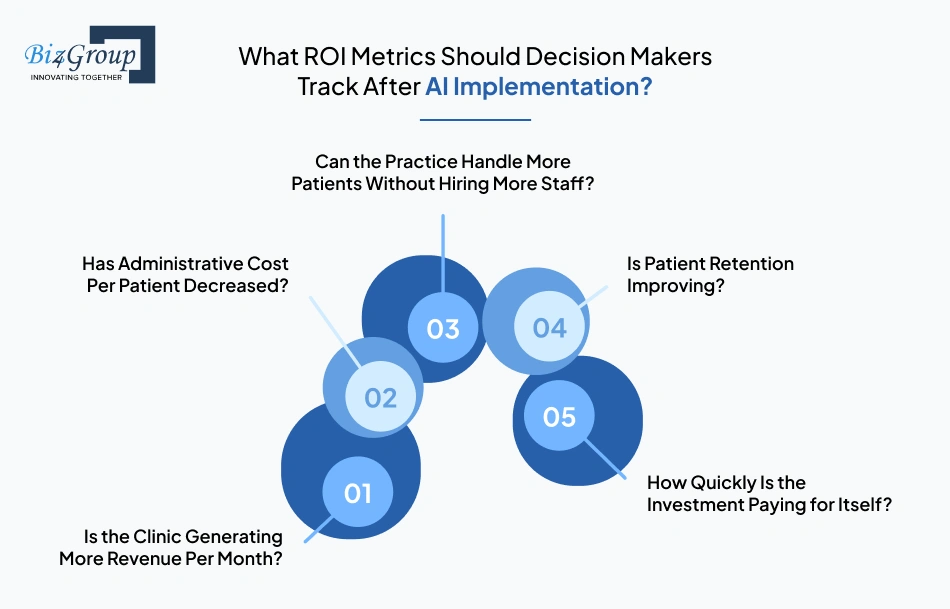
When investing in developing dental practice management for AI agent, the ultimate question is not whether the technology works. The real question is "how do dental service organizations calculate the ROI of investing in AI agent development for their administrative operations and what performance improvements in billing accuracy scheduling efficiency and staff productivity justify the development investment across a portfolio of dental clinics?"
For dental clinics, DSOs, and multi-location practices, ROI should be evaluated through five key business outcomes.
1. Is the Clinic Generating More Revenue Per Month?
One of the fastest ways to measure ROI is through revenue performance.
Track:
- Increase in monthly collections
- Revenue per chair
- Reduction in unfilled appointment slots
- Increase in completed appointments
- Reduction in revenue leakage
Why it matters: increase in appointment completion, and reduction in operational errors should directly contribute to higher revenue.
2. Has Administrative Cost Per Patient Decreased?
AI should reduce the amount of administrative effort required to serve each patient.
Track:
- Administrative cost per patient
- Administrative hours per week
- Cost of manual scheduling and billing activities
- Cost savings from workflow automation
Why it matters: It lowers operational costs to improve profitability without requiring additional patient volume.
3. Can the Practice Handle More Patients Without Hiring More Staff?
One of the biggest promises of AI is scalability.
Track:
- Patients managed per administrative employee
- Appointment volume growth
- Provider utilization rates
- Growth without proportional headcount increases
Why it matters: If patient volume increases while staffing costs remain relatively stable, it means that the AI investment is creating leverage.
4. Is Patient Retention Improving?
Acquiring new patients is expensive. Retaining existing ones is far more profitable.
Track:
- Patient retention rate
- Treatment completion rate
- Recall appointment compliance
- Follow-up appointment conversion rate
Why it matters: Better communication and administrative experiences often lead to stronger patient loyalty and lifetime value.
5. How Quickly Is the Investment Paying for Itself?
Every major technology investment should have a clear payback period.
Track:
- Total implementation cost
- Monthly operational savings
- Additional monthly revenue generated
- Payback period
- Overall return on investment (ROI)
Why it matters: Decision-makers need a clear understanding of when the investment becomes financially positive.
The AI investment delivers meaningful business value. Let's explore the future trends in AI agent development dental clinic management.
Are spreadsheets running your future clinic?
See where AI-driven dental operations are heading.
Connect With UsWhy Partnering with Biz4Group for AI Agent Development for Dental Clinic Admin Tasks Can Be Beneficial For You?
Building an AI dental clinic management automation for a dental clinic sounds straightforward until you realize it needs to understand patient requests, coordinate schedules, verify insurance, automate billing workflows, integrate with existing systems, and remain compliant while doing all of it. For that, experience matters.
Biz4Group LLC is a leading AI agent development company in USA, helps dental organizations move beyond basic automation by developing intelligent AI agents that solve real operational challenges. As we've seen, Biz4Group has experience in developing AI solutions across healthcare and enterprise environments. This includes Dr. Ara, an AI-powered healthcare platform that combines health analysis, consultation management, appointment workflows, and personalized user experiences, as well as a HIPAA and GDPR-compliant enterprise AI agent designed for secure workflow automation, document processing, multilingual interactions, and enterprise integrations. These projects demonstrate our ability to build secure, scalable, and intelligent AI systems capable of supporting complex operational and administrative workflows.
Ultimately, the goal is not to implement AI, but to create intelligent systems that improve efficiency, support growth, and deliver long-term business value. For dental practices looking to scale without scaling administrative complexity, Biz4Group LLC can help turn AI from an idea into a competitive advantage.
Final Thoughts
Running a successful dental practice today requires more than just delivering patient care. It also depends on managing a growing number of administrative tasks efficiently and consistently.
AI powered dental clinic admin agent development is providing a practical way to streamline operations like scheduling, billing, insurance verification, and staff coordination to reduce manual workload, and are creating capacity for growth without adding unnecessary overhead.
However, the difference lies in how the solution is built. Partnering with an experienced AI development company like Biz4Group LLC gives you access to the technical expertise, integration capabilities, and strategic guidance needed to build AI agents that deliver real business impact, not just automation.
If you're ready to explore how AI can transform your dental practice operations, now is the perfect time to start the conversation.
FAQs
1. What is an AI agent for dental clinic administration?
An AI agent is an intelligent software system that automates administrative tasks such as appointment scheduling, billing, insurance verification, patient communication, and staff coordination while minimizing manual effort.
2. How can AI agents improve dental practice management?
AI agents streamline repetitive workflows, reduce administrative workload, improve operational efficiency, minimize errors, and help staff focus more on patient care and high-value activities.
3. Can AI agents integrate with existing dental practice management software?
Yes. Modern AI agents can integrate with scheduling systems, EHRs, billing platforms, CRMs, communication tools, and other third-party applications through APIs and secure integrations.
4. How do AI agents help reduce appointment no-shows?
AI agents can automate appointment reminders, manage waitlists, send follow-up notifications, and intelligently reschedule appointments, helping clinics maximize chair utilization.
5. Can AI agents automate dental billing and insurance verification?
Yes. AI agents can assist with invoice generation, payment tracking, insurance eligibility checks, claims validation, and other billing-related workflows to improve accuracy and efficiency.
6. Are AI agents secure enough for handling patient information?
When developed correctly, AI agents can incorporate encryption, role-based access controls, audit trails, and compliance-focused security measures to protect sensitive patient data.
7. How long does it take to develop an AI agent for dental clinic management?
Development timelines vary based on complexity, integrations, and customization requirements. Most projects take anywhere from 6-8 weeks for enterprise-grade systems.
8. How much does AI agent development for dental clinic management cost?
The cost typically ranges from $30,000 to $750,000+, depending on the solution's complexity, automation scope, integrations, compliance requirements, and customization needs.
9. Can small and mid-sized dental practices benefit from AI agents?
Absolutely. Clinics of all sizes can use AI agents to automate administrative tasks, improve operational efficiency, and support growth without significantly increasing administrative headcount.
10. What is the biggest benefit of implementing AI agents in dental clinics?
The biggest benefit is the ability to reduce administrative complexity while improving efficiency, patient experience, and operational scalability, allowing teams to focus more on delivering quality care.
