Location :
Orlando, FL, USA
Location :
Orlando, FL, USA +1 (407) 714-1616
 info@biz4group.com

















Imagine a digital system that doesn’t wait for instructions but instead, understands your business goals, learns from real-time feedback, and takes independent actions to get the job done.
Read More

Healthcare systems often run on multiple disconnected tools. Patient data lives in different systems, formats, and workflows, which makes it hard to access or use in real time. When organizations integrate healthcare platforms with AI EHRs, the goal is to connect these systems so data can move reliably and support clinical and operational decisions without manual effort.
At a basic level, AI EHR integration with healthcare platforms means aligning data, workflows, and system communication. Data needs to be structured and consistent across systems. Workflows need to stay in sync when updates happen. Systems need stable ways to exchange information without errors or delays. If any of these break, integration becomes incomplete.
AI adds another layer of dependency. AI systems rely on clean and timely data. If the integration layer passes inconsistent or delayed data, the outputs from AI healthcare solutions become unreliable. This is why many teams that build AI software for healthcare focus on fixing integration first before scaling AI use cases.
Integration is also not a one-time setup. Systems change, new tools are added, and data formats evolve. Healthcare platform integration with AI EHR systems needs to support updates, scaling, and long-term system stability. This blog explains how to design and implement this integration using clear architecture patterns, API strategies, and practical decision frameworks that can be applied in real-world healthcare environments.
Most healthcare systems don’t talk to each other well. Data sits in different tools, updates don’t sync, and teams often rely on manual work to fill the gaps. When organizations integrate healthcare platforms with AI EHRs, they are solving this by making systems work together as one connected environment. Here’s what you’re doing when you integrate healthcare platforms with AI EHRs:
In simple terms, integration removes gaps between systems so data flows correctly and operations stay aligned. It creates a stable setup where systems remain in sync and decisions are based on complete, up-to-date information.
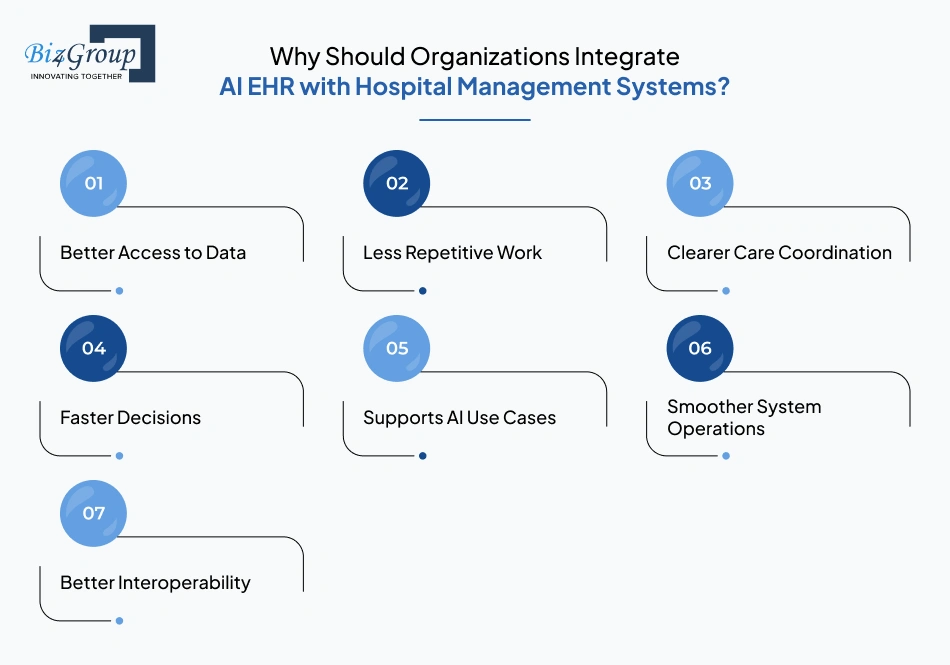
Healthcare teams often deal with scattered data, disconnected workflows, and systems that don’t update each other in time. This makes even simple tasks slower and increases the chances of errors. When organizations integrate healthcare platforms with AI EHRs, they create a setup where systems share data reliably and support day-to-day operations without constant manual effort.
When systems are connected, teams can access the information they need without switching between multiple tools. Data becomes available where it is needed, when it is needed. With AI EHR API integration for healthcare platforms, this access remains structured and consistent.
Manual data entry across systems takes time and often leads to errors. Integration reduces this by syncing data automatically between platforms. This helps teams avoid duplicate work and focus on more important tasks.
When patient data is shared across systems, care teams can work with the same information. This reduces confusion and improves coordination between departments. It also helps avoid gaps caused by missing updates.
Real-time or near real-time data makes it easier to act quickly. Teams don’t have to wait for updates or reports to make decisions. This improves response time in both clinical and administrative scenarios.
AI systems need reliable and consistent data to work properly. Integration ensures that data flows into these systems without major gaps. This is often supported through AI integration services that prepare and manage data for AI processing.
When systems are connected, workflows run more smoothly because data moves automatically. This reduces delays and makes system behavior more predictable. It also helps maintain stability as systems scale.
Different systems can work together more effectively when integration is in place. Through healthcare interoperability with AI EHR integration, data remains usable across platforms even if they were not originally built to connect.
These benefits are not limited to efficiency alone. Integration also makes systems easier to scale, simplifies how new tools are added, and helps organizations maintain consistency as their technology stack grows.
To integrate healthcare platforms with AI EHRs, systems need to be connected through a few clear layers. Each layer handles a specific part of how data moves, gets processed, and is used. When these components are set up properly, systems stay in sync and data remains usable across the entire setup.
|
Component |
What It Covers |
|---|---|
|
Data Sources |
This includes hospital systems, telehealth platforms, and 3rd-party tools where data is first created. These systems often store data in different formats, which is why defining source systems is important before you connect healthcare platforms with AI EHR systems. |
|
Integration Layer |
APIs and middleware sit here to move data between systems. This layer handles requests, responses, retries, and failures so systems can communicate reliably without breaking under load or mismatched formats. |
|
Data Transformation Layer |
Data coming from different systems is rarely consistent. This layer cleans, maps, and standardizes data so it can be understood across platforms and used without ambiguity. |
|
AI Processing Layer |
This layer runs AI models and manages data pipelines. It takes structured input and generates outputs that depend on stable pipelines, often built with AI model development. |
|
Storage Layer |
Data is stored here in databases or data systems, both structured and unstructured. This allows systems to access past records and current data without delays or loss. |
|
Output Layer |
This is where processed data is used, such as dashboards, alerts, or clinical systems. It ensures the right information reaches the right system in a usable format. |
Each of these components plays a role in keeping systems connected and data usable. When one layer is weak, the entire setup starts to break, either through delays, inconsistencies, or missing data. A well-defined structure helps avoid these issues and makes it easier to scale, update systems, and maintain consistency over time.
There is no single architecture that works for every setup. The right choice depends on how your systems handle data, how often they update, and how many systems are involved. When organizations integrate healthcare platforms with AI EHRs, the goal is to keep data flowing smoothly and avoid unnecessary complexity as systems grow.
|
Aspect |
Direct API Integration |
Middleware-Based Architecture |
|---|---|---|
|
Setup Effort |
Faster to start with minimal setup |
Requires planning, setup, and configuration |
|
System Connections |
Each system connects directly to others |
Systems connect through a central layer |
|
Scalability |
Becomes difficult as connections increase |
Scales more easily as systems grow |
|
Maintenance |
Changes need updates in multiple places |
Changes handled centrally |
|
Error Handling |
Managed by each system separately |
Managed in one place with better control |
When to use what: Use direct API integration when you have a small number of stable systems. Use middleware when systems increase or when coordination across systems becomes complex.
Where it fails: Direct APIs become hard to manage as integrations grow. Middleware can feel like over-engineering in very simple setups.
|
Aspect |
Request-Response |
Event-Driven |
|---|---|---|
|
Communication Style |
One system requests, another responds |
Systems publish events and others react |
|
Data Flow |
Happens only when requested |
Happens automatically on change |
|
Dependency |
Systems depend on each other |
Systems are loosely connected |
|
Performance |
Can slow down with frequent requests |
Handles frequent updates better |
|
Debugging |
Easier to trace requests |
Needs proper monitoring tools |
When to use what: Use request-response for fetching data when needed. Use event-driven when systems must stay updated continuously, especially when teams integrate AI EHR with telehealth platforms.
Where it fails: Too many requests can create delays. Event-driven systems can be harder to track without proper monitoring, which is why teams often hire AI developers for setup and maintenance.
|
Aspect |
Centralized Model |
Distributed Model |
|---|---|---|
|
Data Storage |
Stored in a single system |
Stored across multiple systems |
|
Control |
Easier to manage and govern |
Requires coordination between systems |
|
Scalability |
Limited by central system capacity |
Scales across systems independently |
|
Data Consistency |
Easier to enforce |
Needs conflict resolution rules |
|
Flexibility |
Less flexible for system changes |
More flexible for adding new systems |
When to use what: Use centralized when you need strong control and a single source of truth. Use distributed when systems need to scale or operate independently.
Where it fails: Centralized systems can become bottlenecks. Distributed systems can create inconsistencies if data rules are not clearly defined.
|
Aspect |
Real-Time Processing |
Batch Processing |
|---|---|---|
|
Processing Timing |
Immediate or near real-time |
Scheduled at intervals |
|
Data Freshness |
Always up to date |
May have delays |
|
Complexity |
Requires stable and continuous processing |
Easier to manage |
|
Resource Usage |
Continuous resource usage |
Controlled resource usage |
|
Use Cases |
Alerts, live updates, monitoring |
Reporting, analytics, historical analysis |
When to use what: Use real-time when decisions depend on current data. Use batch when delays are acceptable and data is used for analysis.
Where it fails: Real-time increases complexity if overused. Batch processing delays can affect time-sensitive workflows. This balance is important in systems built on enterprise AI solutions.
These choices usually work together in real systems. Instead of picking one approach everywhere, teams combine them based on what each workflow needs. Many organizations rely on AI EHR system integration services for healthcare to design architectures that stay stable and scalable over time.
Fix the gaps when you integrate healthcare platforms with AI EHRs and get your data flowing where it should.
Fix My System Gaps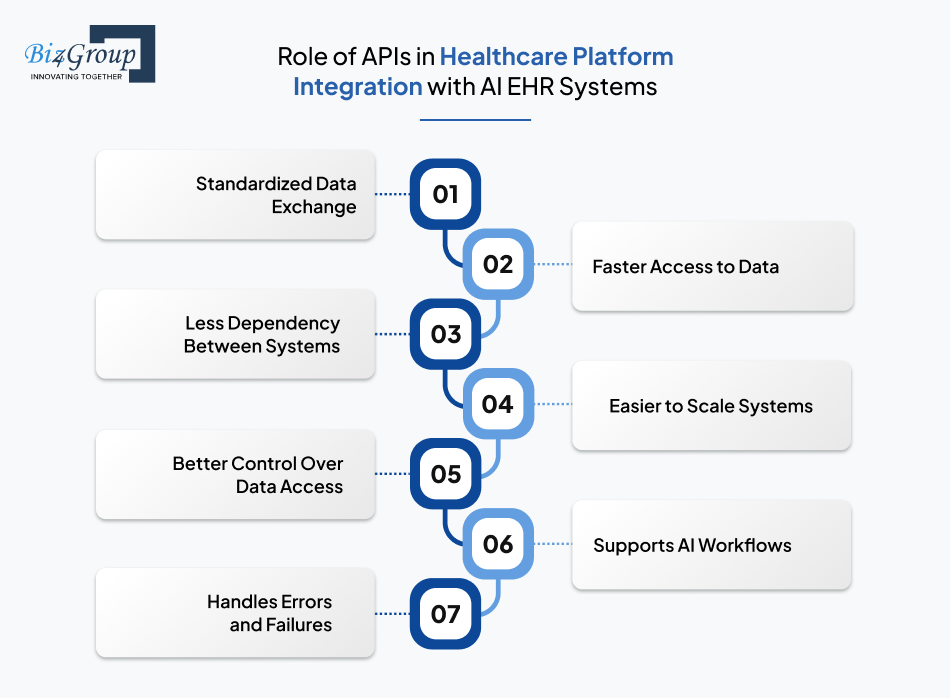
APIs are what allow different healthcare systems to talk to each other. Without them, systems stay disconnected and data cannot move easily. When organizations integrate healthcare platforms with AI EHRs, APIs make sure data can be shared, updated, and used across systems without manual effort.
APIs give systems a common way to share data, even if they are built differently. This avoids building custom connections every time a new system is added. In healthcare data integration with AI EHR, this helps keep data consistent across platforms.
APIs make it possible to get and update data quickly. Systems don’t have to wait for manual updates or scheduled processes. This helps teams work with the latest available information.
APIs act as a layer between systems, so they don’t need to depend directly on each other. This makes it easier to update or replace systems without affecting everything else. It also reduces the chances of system-wide failures.
When new tools are added, APIs make it easier to connect them without changing existing systems. This supports growth as more systems and workflows are introduced. Many teams use AI EMR EHR software development to expand these capabilities over time.
APIs allow organizations to control who can access what data. Permissions can be set based on roles and needs. This helps keep sensitive healthcare data protected.
APIs help send data to AI systems and bring results back into workflows. This is important for setups that depend on AI consulting services to manage data flow between systems and AI models.
APIs can be designed to manage errors, retries, and delays. This helps systems continue working even when something goes wrong. It improves overall reliability.
Overall, APIs make integration practical and manageable. They help systems stay connected, keep data flowing, and support everyday operations. This is why they are a key part of AI EHR integration for clinics and hospitals.
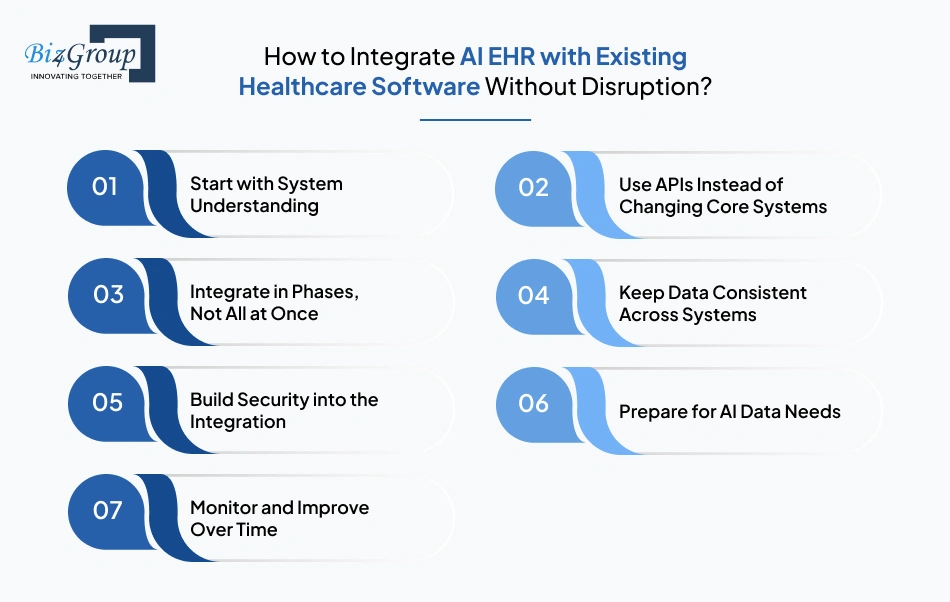
Most healthcare systems are already in use, so you can’t afford to break them while adding new capabilities. The goal is to connect systems step by step without affecting daily operations. When organizations integrate healthcare platforms with AI EHRs, they focus on keeping systems stable while gradually improving how data flows.
Before making changes, it helps to know how your current systems are connected and how data moves between them. This avoids surprises later and helps you decide where to start. A clear view of the setup makes integration more predictable.
Instead of modifying existing systems directly, APIs provide a safer way to connect them. This reduces the risk of breaking current workflows. Many teams follow how to use APIs to integrate healthcare platforms with AI EHRs to build these connections step by step.
Also Read: Software Testing Companies in USA
Connecting everything at once can create issues that are hard to track. A phased approach helps you test and adjust as you go. It also reduces the impact if something goes wrong.
Different systems often store data in different ways. Without proper handling, this leads to mismatched or duplicate records. Keeping data aligned is key to making integration work.
Security should be part of the setup from the beginning, not added later. This helps protect sensitive data and avoid compliance issues. It is essential for secure integration of healthcare platforms with AI EHR.
AI systems depend on clean and reliable data. Integration should make sure data is available in the right format and at the right time. This becomes important when teams integrate AI into an app or expand AI use cases.
Integration is not a one-time task. Systems need regular checks to make sure everything is working as expected. Small issues can grow if they are not tracked early.
A smooth integration comes from taking small, controlled steps instead of big changes. With the right architecture for integrating healthcare platforms with AI EHRs, systems can be connected without disruption while keeping data accurate and workflows stable.
Make AI EHR integration with healthcare platforms work the way your workflows actually need.
Make Systems TalkData flow is simply how data moves from one system to another. If this flow is not clear, systems may send incomplete, delayed, or incorrect data. When organizations integrate healthcare platforms with AI EHRs, getting this flow right is what keeps systems aligned and outputs reliable.
Data usually starts from systems like hospital software or telehealth platforms. It then moves through APIs or integration layers before reaching storage or AI systems. Each step needs to be clear so data does not get lost or delayed, which is why it is part of the architecture for integrating healthcare platforms with AI EHRs.
Data from different systems often looks different or has errors. It needs to be checked, cleaned, and converted into a standard format before it can be used. This step makes sure systems and AI models are working with usable data.
It is common to have duplicate records or missing information in healthcare systems. Systems need simple rules to decide which data to keep and how to fill gaps. Without this, different systems may show different versions of the same data. This becomes important when teams integrate AI into an app, where inconsistent data can affect outputs.
Once data is shared, it should stay the same across all systems. If one system updates a record, others should reflect that change as well. This is important for secure integration of healthcare platforms with AI EHR, where accuracy and reliability are critical. It also supports setups built through AI app development company efforts where consistent data flow is required.
|
Step |
What Happens |
Why It Matters |
|---|---|---|
|
Data Collection |
Data is generated from hospital systems, telehealth platforms, and other tools |
Defines the starting point of data flow |
|
Data Processing |
Data is validated, cleaned, and standardized |
Ensures data can be used across systems |
|
Data Transfer |
Data moves through APIs or integration layers |
Keeps systems connected and updated |
|
Data Storage |
Data is stored for real-time or future use |
Supports both current operations and analysis |
|
Data Usage |
Data is used by systems, dashboards, or AI models |
Turns data into actionable outputs |
In simple terms, good data flow keeps systems in sync and reduces confusion. It also supports setups that depend on consistent data across systems, including those guided by how to use APIs to integrate healthcare platforms with AI EHRs.
Interoperability means different healthcare systems can share and use data without confusion or loss. In practice, this is harder than it sounds because systems store data differently and follow different rules. When organizations integrate healthcare platforms with AI EHRs, interoperability depends on standards, data alignment, and clear handling of patient records.
For those wondering how to achieve interoperability using AI EHR integration, here’s everything that they need to know:
Most systems rely on common standards to exchange data. These standards define how data is structured and shared so different systems can understand it.
Why this matters:
Without standards, every integration becomes custom and hard to maintain.
Where teams struggle:
Even with standards, systems often store the same data in different ways. Mapping is required to align these differences so data remains usable across platforms.
|
Challenge |
What Happens |
What Helps |
|---|---|---|
|
Field mismatch |
Same data stored under different names |
Define clear mapping rules |
|
Format differences |
Dates, units, or codes vary |
Normalize before syncing |
|
Missing fields |
One system has more data than another |
Set fallback or default values |
Mapping is not a one-time task. It needs updates as systems evolve, especially when teams work on how to integrate AI EHR with existing healthcare software.
One of the biggest challenges is identifying the same patient across systems. Different systems may store slightly different details, leading to duplicate or mismatched records.
What needs to be handled:
Common approach:
This step becomes critical in workflows supported by AI in healthcare administration automation, where accurate patient identity affects every downstream process.
Here are some of the most frequent issues teams face when it comes to interoperability of AI EHRs that are integrated with healthcare platforms:
What this leads to:
What helps avoid this:
Interoperability is not achieved through a single tool or standard. It comes from aligning systems, data, and workflows over time. It works pretty much like AI chatbot integration, where systems depend on consistent and shared data across platforms.
Build smarter healthcare platform integration with AI EHR systems that don’t slow you down later.
Scale My IntegrationSecurity in healthcare is not optional. Systems deal with sensitive patient data, so even small gaps can create serious risks. When organizations integrate healthcare platforms with AI EHRs, they need to make sure data is protected at every step without slowing down how systems work.
Data should move only between systems that are allowed to communicate with each other. This reduces the chances of unauthorized access and keeps sensitive information protected during transfers. A controlled setup is important for secure integration of healthcare platforms with AI EHR, where data moves across multiple systems.
Every system and user should be verified before they can access data. Authentication checks identity, while authorization decides what actions are allowed. These controls are often part of the tools required to integrate healthcare platforms with AI EHRs and help limit unnecessary access.
Encryption keeps data safe by making it unreadable to unauthorized users. It is used when data is being sent between systems and when it is stored. This ensures that even if data is exposed, it cannot be easily used.
Systems should keep track of who accessed data and what changes were made. This helps teams spot unusual activity early and take action if needed. It is also useful for teams working on AI medical web development, where tracking system behavior is important.
Healthcare systems must follow rules that define how data is handled and protected. These rules apply to how data is stored, shared, and accessed across systems. This becomes important when teams evaluate compliance.
Security and compliance help keep systems reliable and trustworthy. They make sure data is protected while still allowing systems to work together smoothly, which is important for long-term system stability.
Set up the right architecture for integrating healthcare platforms with AI EHRs before complexity catches up.
Fix My Architecture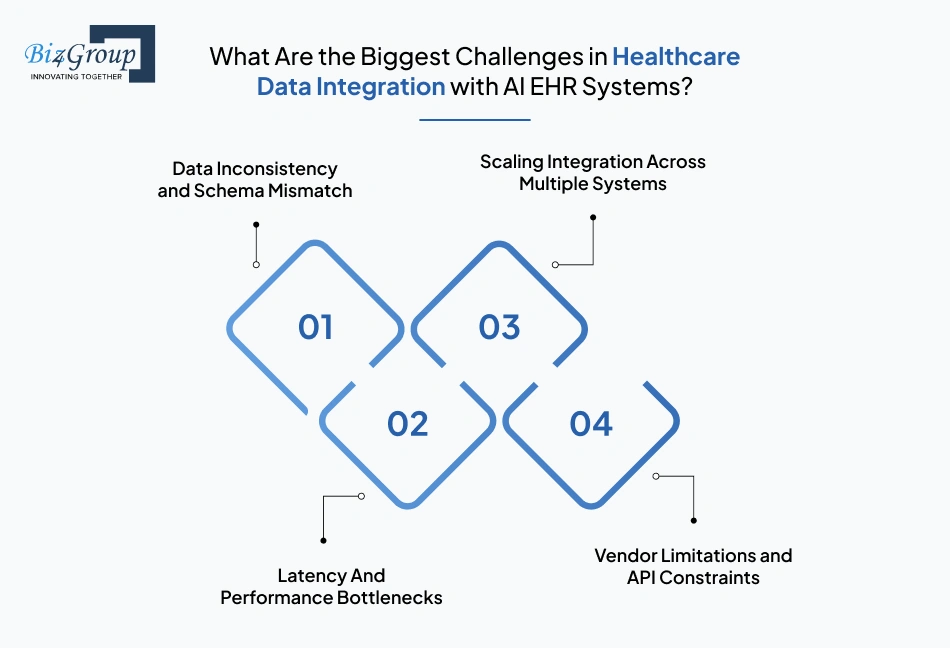
Healthcare systems are not built the same way, and that is where most integration problems start. Data comes in different formats, systems respond at different speeds, and not every platform is easy to connect. When organizations integrate healthcare platforms with AI EHRs, these challenges show up quickly and need to be handled early.
|
Challenge |
What It Means |
Why It Becomes a Problem |
|---|---|---|
|
Data Inconsistency and Schema Mismatch |
The same data can look different across systems, with different formats or missing fields. |
Systems may show conflicting information, which makes data hard to trust or use. |
|
Latency And Performance Bottlenecks |
Data does not always move instantly between systems and can get delayed. |
Delays can affect workflows that depend on up-to-date information. |
|
Scaling Integration Across Multiple Systems |
Adding more systems increases the number of connections and dependencies. |
The setup becomes harder to manage and maintain over time. |
|
Vendor Limitations and API Constraints |
Some systems have limited APIs or restrictions on how data can be accessed. |
This can slow down integration or require extra workarounds. |
These challenges are common and expected, not exceptions. The key is to plan for them early and build systems that can handle change over time. Many teams work with a custom software development company when figuring out who can help integrate AI EHR with our healthcare platform, so they can manage these issues without disrupting existing systems.
There are a few ways to connect healthcare systems, but the right choice depends on how your setup looks today and how it will grow over time. When organizations integrate healthcare platforms with AI EHRs, the goal is to pick an approach that works now without creating problems later.
Direct API integration works best when you have a small number of systems and things are fairly stable. It is quick to set up and does not require extra layers or tools. This makes it useful when you want to move fast without adding too much complexity.
Middleware becomes useful when more systems are involved and things start getting harder to manage. It sits in the middle and handles how systems talk to each other. This helps keep everything organized, especially in setups like chatbot development for healthcare industry.
Some teams choose to build their own integration, while others use existing tools or services. Building gives more control but takes time and effort. Buying is faster, but it may limit how much you can customize, which affects decisions like how to hire developers for AI EHR integration in healthcare.
Every option comes with trade-offs. Cheaper setups may become harder to manage later, while scalable setups may need more effort at the start. It is important to think about how the system will behave as more data and systems are added.
|
Factor |
Direct API Integration |
Middleware Approach |
Build |
Buy |
|---|---|---|---|---|
|
Setup Cost |
Lower at the start |
Higher upfront |
Higher |
Lower upfront |
|
Scalability |
Limited over time |
Easier to scale |
Flexible |
Depends on vendor |
|
Maintenance |
Gets harder as systems grow |
Managed in one place |
Handled internally |
Handled by vendor |
|
Control |
Limited |
More control |
Full control |
Limited control |
|
Time to Implement |
Faster |
Slower |
Longer |
Faster |
In the end, the right approach depends on how complex your system is and how much it will grow. Many teams explore which companies provide AI EHR integration services and work with a software development company in Florida to build setups that stay manageable over time.
Get secure integration of healthcare platforms with AI EHR without adding friction to your workflows.
Secure My SystemsIntegration works best when it feels simple to use and easy to maintain, even if the systems behind it are complex. Small design decisions early on can make a big difference later. When organizations integrate healthcare platforms with AI EHRs, a few practical habits can help avoid common problems and keep things running smoothly.
Here are the best practices to integrate AI EHR with healthcare platforms:
Things will fail at some point, systems go down, APIs slow down, or data gets delayed. The goal is to make sure one issue does not break everything else. A setup that can recover quickly and keep running is easier to manage over time, especially in environments using AI automation services.
If the data is messy, the system will be messy. Keeping data clean and consistent across systems helps avoid confusion and errors. This is a key part of AI EHR integration with healthcare platforms, where multiple systems depend on the same data.
Systems will change, new tools will be added, and old ones may be replaced. Integration should make these changes easier, not harder. A setup that is easy to update saves time and effort in the long run, which is important for products like an AI conversation app.
Technology should fit into how teams already work, not the other way around. If systems don’t match real workflows, people will find workarounds. Keeping integration aligned with daily processes makes it more useful and easier to adopt.
These practices help keep integration simple, stable, and easier to manage as systems grow.
Choosing the right people to handle integration is just as important as choosing the right architecture. The outcome depends heavily on who is building and managing the system. When organizations integrate healthcare platforms with AI EHRs, they usually decide between using their internal team, external partners, or a mix of both.
|
Aspect |
Internal Team |
External Integration Services |
|---|---|---|
|
Control |
Full control over systems and decisions |
Shared control with defined scope |
|
Speed |
Slower if team is small or inexperienced |
Faster due to existing expertise |
|
Expertise |
Depends on in-house experience |
Specialized knowledge across systems |
|
Cost |
Fixed internal cost |
Project-based or ongoing cost |
|
Scalability |
Limited by team size |
Easier to scale with resources |
How to decide:
If your team already understands your systems well and has integration experience, internal works fine. If not, external partners can help move faster and reduce risk. Many teams evaluating who can help integrate AI EHR with our healthcare platform end up using a mix of both.
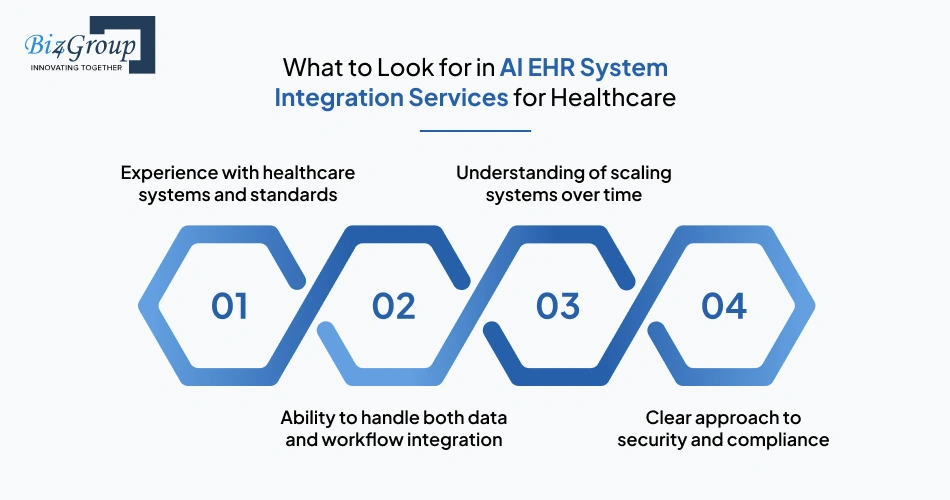
Not all service providers are the same, so it helps to know what actually matters.
Teams working on business app development using AI often prefer partners who can support long-term system changes, not just initial setup.
Hiring for integration is more about practical experience than general development skills. Look for developers who can:
This becomes important when planning how to hire developers for AI EHR integration in healthcare, especially for projects that involve the use of generative AI or require support from top AI development companies in Florida.
The right support model depends on your systems, timelines, and internal capabilities. Some teams build everything in-house, while others rely on external partners. The goal is to choose an approach that keeps systems stable and supports future growth.
It’s time to connect healthcare platforms with AI EHR systems and make everything work as one.
Connect My PlatformsMost integration projects don’t fail because of technology, they fail because systems become too complex to manage over time. As an AI development company, Biz4Group LLC focuses on keeping things simple, stable, and easy to scale. When organizations integrate healthcare platforms with AI EHRs, the goal is to make systems work together without creating new problems.
What this means in practice:
How this approach helps:
Biz4Group LLC has a simple approach: build systems that keep working as things change, not just systems that work once.
Conclusion
Bringing systems together in healthcare sounds simple, until you actually try doing it. Different data formats, legacy systems, and constant updates make it a moving target. That is why when organizations integrate healthcare platforms with AI EHRs, the focus is not just on connecting systems, but on making sure they keep working together over time.
The key takeaway is this: integration works best when it is planned as a system, not a shortcut. Clear architecture, clean data flow, and the right integration approach make a big difference. Add AI into the mix, and the need for reliable data becomes even more important.
If done right, integration does not just reduce manual work, it makes systems easier to scale, improves decision-making, and sets the base for future AI use cases. And if done wrong, well, you end up spending more time fixing than building.
As an AI product development company, our goal is simple, build integrations that do not fall apart the moment things start to grow.
Looking to connect your healthcare platforms with AI EHRs? Let’s map out the right approach.
The timeline depends on system complexity, number of integrations, and data quality. Simple integrations can take a few weeks, while larger, multi-system setups may take several months. Planning, testing, and compliance checks often add to the timeline.
Costs vary based on the number of systems, integration method, data complexity, and security requirements. Custom development, middleware usage, and ongoing maintenance also impact the total cost. Projects involving legacy systems usually require more effort and budget.
Yes, but it requires additional effort. Legacy systems may not support modern APIs, so integration often involves middleware or custom connectors. Data format differences and limited documentation can also increase complexity.
Common risks include data inconsistencies, system downtime during integration, and security vulnerabilities if not handled properly. Poor integration design can also lead to unreliable AI outputs. Careful planning and testing help reduce these risks.
Testing usually involves validating data flow, checking API responses, and ensuring systems stay in sync. Teams also test edge cases like missing or incorrect data. A staged rollout or sandbox testing environment is often used before full deployment.
Maintenance includes monitoring system performance, updating APIs, and handling changes in data formats or workflows. Regular checks help ensure data consistency and system reliability. Integration is an ongoing process rather than a one-time setup.

with Biz4Group today!
Our website require some cookies to function properly. Read our privacy policy to know more.