Location :
Orlando, FL, USA
Location :
Orlando, FL, USA +1 (407) 714-1616
 info@biz4group.com

















Imagine a digital system that doesn’t wait for instructions but instead, understands your business goals, learns from real-time feedback, and takes independent actions to get the job done.
Read More

Have you ever wondered why a patient’s cry for help still gets lost in the shuffle despite all the technology in hospitals today? Or why do nurses sometimes feel overwhelmed by alerts that don’t help them prioritize care? You are not alone. In 2025, 80% of hospitals are actively using AI to improve patient care and operational efficiency, a figure that shows how much healthcare is leaning into smarter systems to solve real problems. Yet traditional communication between patients and nursing teams remains a pain point hospital are still trying to fix.
And it is not just talk. Analysts project that the nurse call systems market will be worth over USD 2.32 billion in 2025 as hospitals seek faster, richer communication with patients and staff.
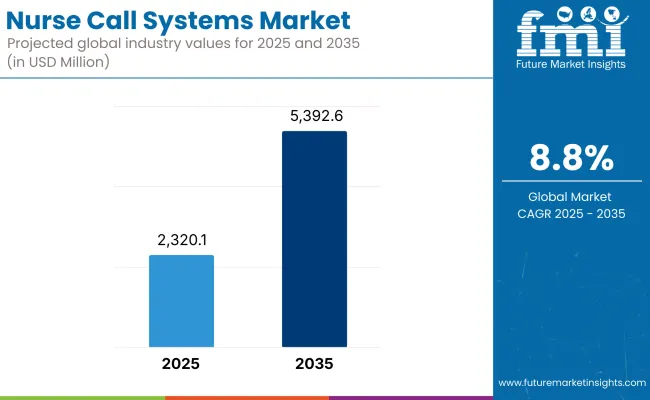
That tells you two things. One, hospitals know they must modernize the way patients and caregivers connect. Two, there is still a big opportunity for systems that go beyond buttons and buzzers. That is where building an AI enabled patient to nurse communication system becomes a real strategic move, not just a technology upgrade.
Before we dive deeper, let us ask you this.
This is exactly what AI patient to nurse communication system development is designed to solve.
In this guide, we will walk you through what these systems are, why they are critical for modern care delivery, and how you can approach AI patient to nurse communication software development in a way that actually works on the hospital floor. We will keep the focus on real workflows, real constraints, and real outcomes.
Along the way, we will also touch on how platforms built with AI automation services help hospitals streamline alerts, reduce manual coordination, and support nursing teams without adding more tools to manage.
If you are looking to build AI powered patient nurse communication platforms that improve response times, lower staff burden, and raise patient satisfaction, you are in the right place. Let us break it down together, step by step, and show you how to do it right.
If patient communication feels reactive and noisy, it is time for a system that actually understands urgency and supports your nurses in real time.
Talk to an AI Healthcare ExpertLet us ground this with a clear definition before we go further.
An AI enabled patient to nurse communication system is an intelligent healthcare communication platform that allows patients to request assistance through voice, text, or digital interfaces, while AI analyzes each request in real time to understand intent, assess urgency, and route it to the right nurse or care team. Unlike traditional nurse call systems, it does not treat every alert the same. It prioritizes, escalates, and adapts based on clinical context, workload, and patient needs.
In simple terms, this is AI patient to nurse communication system development focused on making communication smarter, not louder.
Here is what sets it apart from legacy systems:
This is where AI patient to nurse communication software development becomes a strategic investment rather than an IT upgrade.
Now let us talk about why hospitals need this today, not later.
Healthcare facilities are under pressure from multiple directions at once. Staffing shortages. Higher patient acuity. Growing expectations for faster and more personalized care. Traditional communication tools were not built for this reality.
Hospitals are moving toward AI-driven systems because:
To solve this, many organizations are choosing to develop smart hospital communication systems that integrate seamlessly with clinical workflows and existing platforms. This often includes connecting communication tools with broader systems such as AI hospital management software and AI-powered patient management software so patient requests, care delivery, and operational data stay aligned.
When you develop AI enabled nurse call system solutions with this approach, you are not just improving response times. You are creating a foundation for scalable, intelligent care delivery.
With this understanding in place, let us move on to the benefits hospitals actually see once these systems are implemented in real clinical environments.
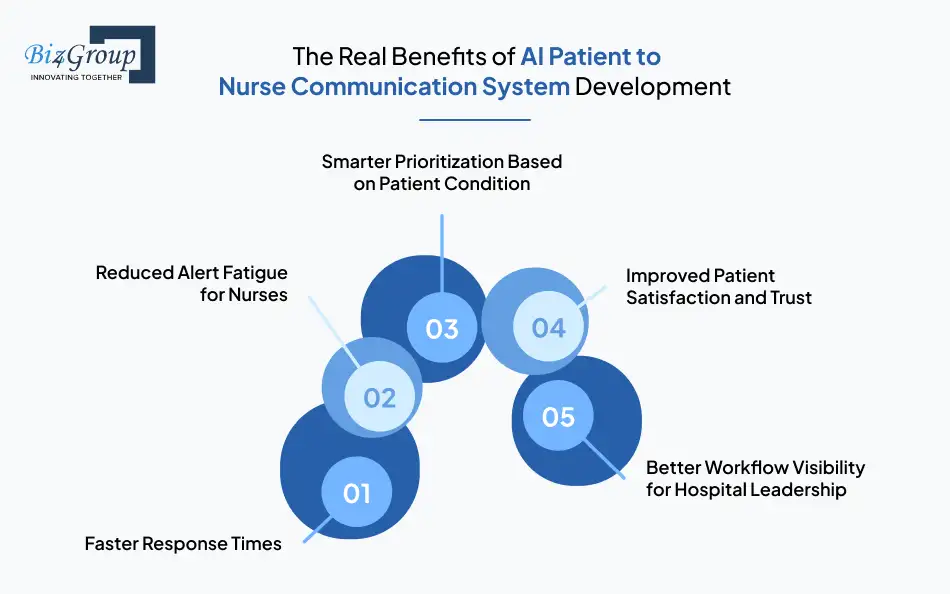
When you invest in AI patient to nurse communication system development, the impact shows up where it matters most, on the hospital floor. Not as buzzwords or dashboards alone, but as smoother workflows, faster care delivery, and patients who feel supported. Below are the core benefits hospitals see when they build AI enabled patient to nurse communication system solutions with purpose.
AI continuously evaluates incoming patient requests and assigns priority based on urgency and context. Critical alerts are escalated instantly, while routine needs are queued intelligently. This allows hospitals to build AI nurse call and alert systems that improve response times without adding pressure on nursing staff.
One of the biggest challenges in care delivery is constant interruptions. With AI patient to nurse communication software development, non-critical alerts are filtered automatically. Nurses receive fewer but more relevant notifications, helping them focus on patient care instead of managing noise.
AI understands that not all requests carry the same risk. By analyzing patient condition, history, and real-time inputs, hospitals can develop AI enabled nurse call system solutions that route urgent cases faster and reduce delays in critical care situations.
Patients feel reassured when their requests are acknowledged and handled appropriately. Intelligent routing and timely responses improve the overall care experience. This is where AI patient communication solutions for smart hospitals and health systems directly influence satisfaction scores and patient trust.
AI-powered systems generate insights into response times, bottlenecks, and workload distribution. These insights support better staffing and operational decisions. Many hospitals enhance this further by combining communication workflows with healthcare conversational AI to enable more natural, responsive interactions between patients and care teams.
Together, these benefits show why healthcare leaders are moving beyond traditional tools and choosing to build AI powered patient nurse communication platforms that scale with modern hospital demands.
Next, let us explore the core features smart hospitals now expect from AI-driven communication systems.
When hospitals decide to build an AI enabled patient to nurse communication system, they expect it to work across people, devices, and workflows. These are the core features that modern healthcare facilities consider non-negotiable.
AI evaluates every patient request in real time using urgency, patient condition, and nurse availability. Alerts are routed dynamically instead of following static rules. This is critical for hospitals that want to build AI nurse call and alert systems that reduce response delays and missed critical events.
Patients communicate differently. Some prefer voice. Others rely on bedside tablets or mobile apps. A robust system supports voice, text, and touch inputs, making AI patient to nurse communication software development inclusive and accessible across patient demographics.
AI does not just log requests. It interprets intent using clinical context and historical data. This allows hospitals to create intelligent patient to nurse communication software that understands whether a patient needs immediate care, assistance, or reassurance.
If a request is not acknowledged within defined timeframes, the system escalates it automatically. This prevents silent failures and ensures accountability, which is essential when hospitals develop AI enabled nurse call system solutions for high-acuity environments.
Communication tools must connect seamlessly with EHRs, staff scheduling, patient monitoring, and analytics platforms. Hospitals rely on AI integration services to ensure data flows without disrupting existing workflows.
AI monitors nurse assignments and redistributes requests to avoid overload. This feature supports fair workload distribution and helps hospitals develop smart hospital communication systems that protect staff well-being.
Leadership needs visibility. Dashboards provide insights into response times, bottlenecks, frequent patient requests, and staffing pressure points. These insights are foundational for AI healthcare communication software development that supports data-driven decisions.
Patients receive immediate confirmation that their request has been received and is being handled. This reduces anxiety and repeat calls, improving satisfaction and trust in creating AI enabled hospital communication systems for patient care.
End-to-end encryption, access controls, audit logs, and compliance readiness are built in from day one. This is non-negotiable for hospitals investing in custom AI patient communication software development.
Together, these features define the baseline for hospitals that want to build AI powered patient nurse communication platforms capable of operating at scale, under pressure, and without compromising care quality.
Once the core foundation is in place, this is where hospitals truly differentiate. Advanced AI features go beyond communication and actively support clinical decisions, staffing efficiency, and proactive care. These capabilities are what elevate AI patient to nurse communication system development from helpful to mission-critical.
Below is a clear table outlining the advanced AI features smart hospitals prioritize today, along with how each one creates real operational value.
|
Advanced AI Feature |
What It Does in Real Hospital Settings |
Why It Matters to You |
|
Natural Language Processing (NLP) |
Understands patient voice or text requests in plain language, even with accents or incomplete sentences |
Enables more human, intuitive communication without forcing patients to use rigid commands |
|
AI-Based Urgency Scoring |
Assigns urgency levels using symptoms, patient history, and real-time inputs |
Helps you build AI enabled patient to nurse communication system that prioritizes care accurately |
|
Predictive Alert Escalation |
Anticipates when a request may become critical and escalates before delays occur |
Prevents adverse events and reduces liability risks |
|
AI-Powered Workload Forecasting |
Predicts nurse workload trends based on time, unit activity, and patient behavior |
Supports smarter staffing and operational planning |
|
Clinical Decision Support Signals |
Flags potential risks using patterns from previous interactions and patient data |
Adds an extra safety layer without replacing clinical judgment |
|
Voice-Enabled Hands-Free Interaction |
Allows nurses to receive and respond to alerts without stopping care activities |
Improves efficiency in high-acuity and sterile environments |
|
Adaptive Learning Models |
Continuously improves prioritization and routing based on outcomes and feedback |
Ensures your AI patient to nurse communication software development improves over time |
|
Identifies emotional distress or anxiety in patient communication |
Helps staff intervene earlier and improve patient experience |
|
|
Smart Routing Based on Skills and Availability |
Routes requests to nurses with the right skills and current availability |
Improves care quality while balancing workloads |
|
Operational Analytics and Insights Engine |
Analyzes communication data to uncover delays, bottlenecks, and trends |
Enables data-driven decisions across departments |
These advanced capabilities allow hospitals to build AI powered patient nurse communication platforms that are proactive, adaptive, and resilient under pressure. They also prepare your organization for future smart hospital initiatives without needing to rebuild systems later.
Smart features only matter when they fit real workflows. Let us help you design communication that works on the hospital floor, not just on paper.
Design My AI Communication System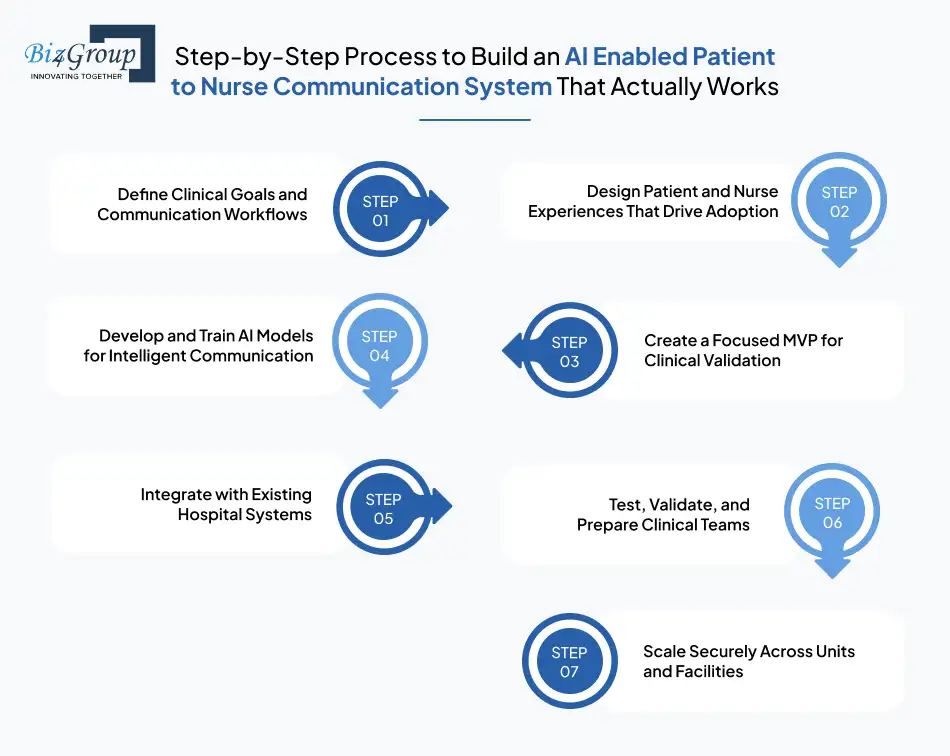
To build an AI enabled patient to nurse communication system that succeeds in real hospital environments, each step needs clear intent, clinical alignment, and technical discipline. Below, every step is explained in 3 to 4 focused lines, with keywords placed naturally and meaningfully.
Every successful AI patient to nurse communication system development starts with understanding how communication actually happens on the floor. You need clarity on where delays occur, which requests are most frequent, and how nurses currently respond. This step ensures AI solves real problems, not assumed ones.
Key actions:
Usability determines success. When hospitals build AI powered patient nurse communication platforms, both patients and nurses must find the system intuitive under pressure. Clean, accessible design reduces friction and improves adoption from day one.
Key actions:
Before scaling, hospitals should test assumptions in a controlled setting. A pilot MVP allows teams to validate alert logic, workflows, and response times without operational risk. This approach is central to AI patient to nurse communication software development done right.
Key actions:
This is where intelligence enters the system. AI models interpret patient intent, assess urgency, and assist with routing decisions. When hospitals create intelligent patient to nurse communication software, AI must reflect clinical reality, not generic datasets.
Key actions:
Context matters in care delivery. AI systems must connect with EHRs, nurse schedules, and monitoring tools to function accurately. This step enables hospitals to develop smart hospital communication systems that work as part of a larger ecosystem.
Key actions:
Also Read: How to Develop AI Remote Patient Monitoring Software?
Healthcare systems cannot fail silently. Testing ensures alerts trigger correctly, escalations work, and staff trust the system. This phase is critical for hospitals aiming to develop AI enabled nurse call system solutions that nurses rely on.
Key actions:
Once proven, the system can expand confidently. Continuous learning and monitoring help hospitals develop AI powered patient nurse communication for smart hospitals that adapt as care demands grow.
Key actions:
This structured process ensures you can create AI driven patient nurse interaction platforms that are safe, scalable, and aligned with how hospitals actually operate.
When you build an AI enabled patient to nurse communication system, the technology stack matters as much as the AI logic itself. Hospitals need systems that are fast, secure, interoperable, and easy to scale. Below is a practical tech stack used in AI patient to nurse communication system development, explained layer by layer.
|
System Layer |
Tools and Technologies |
How This Layer Supports the System |
|
Frontend Layer |
React.js, Vue.js, Flutter |
Powers patient and nurse interfaces. Enables responsive dashboards, bedside tablets, and mobile apps that support real-time communication and quick actions. |
|
Backend Layer |
Handles business logic, request routing, alert prioritization, and integration. This layer is critical for AI patient to nurse communication software development at scale. |
|
|
AI and ML Layer |
Python, TensorFlow, PyTorch, spaCy |
Processes patient inputs, performs intent detection, urgency scoring, and continuous learning. This layer enables hospitals to create intelligent patient to nurse communication software. |
|
Natural Language Processing Layer |
OpenAI models, Google Dialogflow, custom NLP models |
Understand patient voice and text requests in plain language. Supports conversational workflows and reduces manual triage. |
|
Real-Time Communication Layer |
WebSockets, Socket.IO, Twilio, Firebase |
Enables instant alert delivery, two-way messaging, and voice communication between patients and nurses without delays. |
|
Data and Integration Layer |
HL7, FHIR APIs, REST APIs |
Connects the system with EHRs, patient monitoring devices, and scheduling tools. Essential to develop smart hospital communication systems that work in real environments. |
|
Database Layer |
PostgreSQL, MongoDB, Redis |
Stores patient requests, logs, response times, and analytics data while supporting fast read and write operations. |
|
Security and Compliance Layer |
OAuth 2.0, JWT, AES encryption |
Ensure secure access, encrypted data handling, and audit readiness for AI healthcare communication software development. |
|
Cloud and Infrastructure Layer |
AWS, Azure, Google Cloud |
Supports scalability, high availability, disaster recovery, and compliance requirements for hospital-grade systems. |
|
Monitoring and Analytics Layer |
Prometheus, Grafana, ELK Stack |
Tracks system health, response times, alert patterns, and usage trends to optimize performance and outcomes. |
This stack gives hospitals the flexibility to build AI powered patient nurse communication platforms that integrate smoothly with existing systems while remaining secure and future-ready.
Also Read: Next JS Development Company
If you are planning to build an AI enabled patient to nurse communication system, cost is one of the first questions that comes up. In most real-world scenarios, the AI patient nurse communication system development cost estimate falls between $25,000 to $150,000+. The final number depends heavily on scope, AI depth, integrations, and compliance needs.
There is no fixed price because every hospital’s workflows, scale, and technical maturity are different. A pilot system for one unit looks very different from a full-scale deployment across multiple facilities.
Let us break this down clearly so you know where the budget goes and how to plan it smartly.
|
Feature Area |
Estimated Cost Range |
What Drives the Cost |
|
Patient and Nurse Interfaces |
$4,000 to $10,000 |
Frontend design, accessibility support, bedside and mobile interfaces, usability testing |
|
Backend and Workflow Logic |
$6,000 to $15,000 |
Request routing, escalation rules, nurse availability logic, system orchestration |
|
AI and NLP Capabilities |
$8,000 to $25,000 |
Intent detection, urgency scoring, model training, tuning for clinical accuracy |
|
System Integrations |
$5,000 to $20,000 |
EHR, scheduling systems, monitoring devices, API development |
|
Security and Compliance Setup |
$4,000 to $12,000 |
Authentication, encryption, audit logs, compliance alignment |
|
Admin Dashboards and Analytics |
$3,000 to $8,000 |
Operational dashboards, response time tracking, reporting |
|
Testing and Validation |
$3,000 to $10,000 |
Clinical scenario testing, performance validation, fail-safe testing |
Together, these components define the real cost of AI patient to nurse communication system development when built for production use.
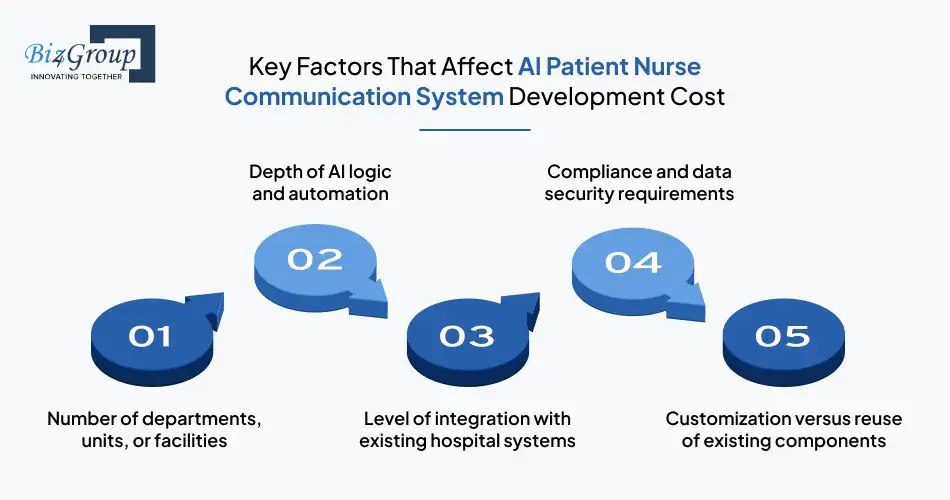
Several variables influence how close you land to the lower or higher end of the range when you develop AI powered patient nurse communication for smart hospitals.
Hospitals often work with an experienced AI development company to assess these factors early and avoid scope creep later.
This is where budgets quietly slip if planning is rushed.
When you create AI enabled hospital communication systems for patient care, watch out for these commonly overlooked costs:
Ignoring these does not make them disappear. It only delays the expense.
Cost optimization is not about cutting corners. It is about building smart.
Hospitals that control budgets effectively often:
This approach keeps custom AI patient communication software development predictable and scalable.
If you are budgeting for AI patient communication solutions for smart hospitals and health systems, the right question is not just “How much does it cost?” It is “What level of intelligence, safety, and scalability do we need today and tomorrow?”
That clarity is what keeps your investment aligned with clinical outcomes instead of turning into another underused system.
Get a clear cost roadmap for your hospital’s AI patient nurse communication system development, without hidden surprises or overengineering.
Get My Cost Estimate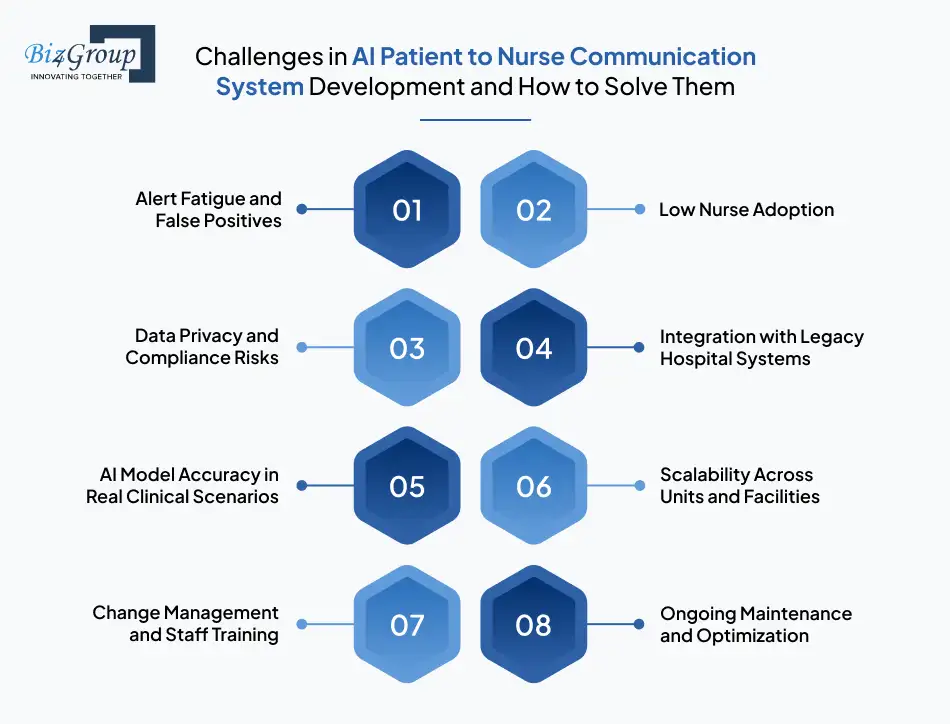
When hospitals move to build an AI enabled patient to nurse communication system, challenges are inevitable. The difference between success and frustration comes down to anticipating these issues early and designing around them. Below is a clear, practical view of the most common challenges in AI patient to nurse communication system development, along with proven ways smart hospitals address them.
|
Challenge |
Why It Happens in Healthcare Environments |
How Smart Hospitals Solve It |
|
Alert Fatigue and False Positives |
Poorly trained AI models treat too many requests as urgent, overwhelming nurses |
Use clinical rules, continuous model tuning, and staged escalation to develop AI enabled nurse call system solutions that prioritize accurately |
|
Low Nurse Adoption |
Systems disrupt workflows or add extra steps during busy shifts |
Involve nurses early, design around real workflows, and invest in intuitive interfaces through UI/UX design |
|
Data Privacy and Compliance Risks |
Patient communication involves sensitive health data |
Build security from day one and follow best practices outlined in HIPAA compliant AI app development for healthcare providers |
|
Integration with Legacy Hospital Systems |
Many hospitals run on fragmented or outdated platforms |
Rely on phased rollouts and robust APIs to develop smart hospital communication systems without disrupting operations |
|
AI Model Accuracy in Real Clinical Scenarios |
Models trained on generic data fail in hospital-specific contexts |
Train models using real clinical workflows and refine them continuously to create intelligent patient to nurse communication software |
|
Scalability Across Units and Facilities |
What works in one ward may fail at scale |
Use modular architectures and cloud infrastructure to build AI powered patient nurse communication platforms that grow with demand |
|
Change Management and Staff Training |
New systems require behavioral change, not just software |
Provide hands-on training and clear value demonstration aligned with daily nursing tasks |
|
Ongoing Maintenance and Optimization |
AI systems evolve and require monitoring |
Addressing these challenges proactively allows hospitals to develop AI patient nurse communication solutions for smart healthcare facilities that are trusted, scalable, and safe.
When you plan to build an AI enabled patient to nurse communication system, you are not just investing in technology. You are investing in patient safety, nursing efficiency, and long-term smart hospital scalability. That is why choosing the right development partner is critical.
Biz4Group LLC brings hands-on expertise in AI patient to nurse communication system development backed by deep experience in healthcare-grade platforms. We understand that hospitals operate in high-pressure environments where systems must perform reliably, securely, and without disruption.
Our teams specialize in AI patient to nurse communication software development that aligns with real clinical workflows. We focus on building platforms that nurses actually use and patients easily understand. From intelligent alert routing to real-time communication and analytics, every solution is designed to support care teams rather than overwhelm them.
What sets Biz4Group apart is our ability to engineer systems that scale. Whether you want to develop AI enabled nurse call system solutions for a single unit or develop smart hospital communication systems across multiple facilities, we design architectures that grow with your operational needs.
A few core strengths that matter for healthcare leaders include:
As a trusted AI app development company, we help healthcare organizations move from idea to execution without unnecessary risk. Our experience delivering enterprise AI solutions ensures your communication platform integrates seamlessly into broader hospital systems and long-term digital transformation plans.
If your objective is to create AI driven patient nurse interaction platforms that improve response times, reduce staff workload, and elevate patient satisfaction, partnering with a team that understands both AI engineering and healthcare realities makes all the difference.
Biz4Group is built to deliver exactly that. So, Let’s connect with our experts.
Partner with a team that understands healthcare workflows, AI engineering, and enterprise delivery from day one.
Build with Biz4GroupHospitals today are under constant pressure to improve response times, support nursing teams, and deliver better patient experiences, all without increasing operational costs. That is exactly why more healthcare leaders are choosing to build an AI enabled patient to nurse communication system instead of relying on outdated nurse call tools.
When done right, AI patient to nurse communication system development transforms communication from reactive to intelligent. It helps nurses focus on what truly matters, ensures patients feel heard, and gives hospital leadership the visibility needed to scale smart care initiatives with confidence.
The key is execution.
Building these platforms requires deep understanding of clinical workflows, strong AI engineering, and experience delivering secure, enterprise-grade healthcare systems. This is where Biz4Group LLC brings lasting value. Our teams have a proven track record in AI patient to nurse communication software development, delivering scalable solutions that align with real hospital operations and regulatory expectations.
From strategy and architecture to deployment and optimization, Biz4Group approaches every engagement as a long-term partnership. We help healthcare organizations develop AI powered patient nurse communication platforms that are reliable today and ready for tomorrow’s smart hospital demands.
If your goal is to modernize patient–nurse communication without adding complexity, risk, or unnecessary cost, working with an experienced AI partner makes all the difference. Biz4Group is ready to help you take that next step with clarity and confidence.
An AI enabled patient to nurse communication system uses artificial intelligence to understand patient requests, prioritize urgency, and route alerts intelligently. Unlike traditional nurse call systems that treat every alert the same, AI-driven systems add context, reduce alert fatigue, and support faster, safer responses.
Hospitals face staff shortages, rising patient expectations, and increasing operational pressure. AI patient to nurse communication system development helps reduce nurse workload, improve response times, and scale care delivery without increasing headcount, making it a practical solution for modern healthcare challenges.
Timelines vary based on scope and integrations. A focused MVP can be built in 8 to 12 weeks, while full-scale AI patient to nurse communication software development for smart hospitals may take several months, especially when multiple systems and compliance requirements are involved.
Smart hospitals should prioritize intelligent alert prioritization, two-way communication, system integrations, automated escalation, and real-time dashboards. These features ensure hospitals can build AI powered patient nurse communication platforms that support nurses and improve patient experience.
Security is a core requirement. When built correctly, AI healthcare communication software development includes encryption, role-based access, audit logs, and compliance-ready architectures to protect sensitive patient communication data and meet regulatory standards.
The AI patient nurse communication system development cost estimate typically ranges from $25,000 to $150,000+, depending on AI complexity, integrations, security needs, and scale. Costs vary based on whether the system is built for a single unit or across multiple facilities.
Hospitals should look for proven healthcare experience, strong AI engineering capabilities, understanding of clinical workflows, and a track record of delivering secure, scalable platforms. Choosing the best AI company to develop AI patient nurse communication systems ensures smoother adoption and long-term success.

with Biz4Group today!
Our website require some cookies to function properly. Read our privacy policy to know more.