 Location :
Orlando, FL, USA
Location :
Orlando, FL, USA +1 (407) 714-1616
 info@biz4group.com

- AI casino website development cost typically starts at $40,000 and can exceed $300,000+, depending on platform depth, AI scope, and compliance needs.
- The cost to develop AI casino website rises faster with retention workflows, wallet logic, fraud controls, and multi-provider scalability requirements.
- Hidden budget leaks usually come from licensing, certifications, vendor contracts, and soft-launch reserves, not from the visible feature quote.
- Smarter rollout choices, phased personalization, and reusable provider frameworks help reduce the price to create AI casino gaming website without limiting growth.
- Team model, jurisdiction goals, and player scale directly influence long-term ownership spend more than the first delivery estimate suggests.
- Biz4Group LLC helps keep budget to develop AI casino website lower through reusable iGaming frameworks, phased rollout logic, and roadmap decisions built for scalable profitability.
What does it really cost to launch an AI casino platform that keeps players engaged, protects revenue, and stays ready for scale in a market that contributes $328.65 billion annually to the U.S. economy? That question becomes urgent when every delay in planning can inflate the AI casino website development cost through fragmented features, rushed compliance, and poorly scoped AI workflows.
For casino business owners and gaming startup founders aiming to create a casino website with smarter retention, fraud monitoring, and personalized game journeys, the budget planning stage needs clear cost visibility from the start. The realistic AI casino website development cost usually ranges between $40,000-$300,000+, depending on platform depth and rollout goals.
The challenge is rarely the idea. It is understanding the cost of developing an AI casino website in a way that connects business value with actual build scope. When an industry supports 1.75 million jobs, even small improvements in player lifetime value, support automation, or risk control can directly influence revenue planning. That is why casino website development cost integrating AI must be approached as a structured investment, not a rough quote.
Before moving into the detailed breakdown, answering what is the cost of developing an AI casino website here are the biggest cost-shaping realities leaders usually need clarity on:
- AI-driven personalization, fraud checks, and support workflows increase development depth early in the roadmap.
- Data pipelines, payment security, and player analytics need stronger foundations when building AI website experiences for scale.
- With casinos generating $52.71 billion in tax revenue, compliance-ready architecture often becomes a major budget layer.
And that’s exactly what the rest of this blog will help you plan with confidence.
AI Casino Website Development Cost Estimator – Get a Quick Quote for Your Platform
Once the budget conversation starts, founders usually need a faster way to translate feature ideas into a working number. That is where an estimator becomes useful. Instead of waiting for a full discovery cycle, it gives you a practical way to understand the AI casino website development cost based on platform type, AI depth, integrations, and rollout goals.
For gaming startup founders wondering how to estimate the cost of creating an AI casino website, the most reliable starting point is to map the quote around platform scope, AI feature depth, integrations, and rollout scale.
AI Casino Website Development Cost Estimator Formula
Estimated Cost = Base Platform Cost + (AI Feature Cost × Complexity Multiplier) + Integration Cost + UI/UX + Data & Hosting
What Each Cost Variable Includes:
- Base Platform Cost = player accounts, lobby, wallet, admin controls, game management
- AI Feature Cost = payment fraud monitoring, smart recommendations, retention journeys, support automation
- Complexity Multiplier = 1x–2x based on scale, number of jurisdictions, and real-time data workflows
- Integration Cost = payment gateways, KYC, CRM, bonus systems, game providers
- UI/UX = player dashboard, VIP journeys, promotions, mobile-responsive gaming flows
- Data & Hosting = cloud hosting, analytics, AI processing, storage, log retention
Illustrative Example for a Mid-Scale AI Casino Platform
- Base platform: $60,000
- AI modules: $25,000
- Complexity multiplier: 5x
- Integrations: $18,000
- UI/UX: $15,000
- Data & hosting: $10,000
- Estimated Cost = $60,000 + ($25,000 × 1.5) + $18,000 + $15,000 + $10,000 = $140,500
Why This Quick Quote Estimator Helps Early Budget Planning
A structured estimator adds value before the discovery phase by helping teams:
- visualize how feature depth changes budget
- set realistic scope expectations
- improve internal approval discussions
- prepare for better vendor conversations
- reduce rough quote uncertainty
This quick quote framework is especially useful when early budget discussions involve deciding between a custom casino platform or white label rollout, because the scope difference can significantly change the AI casino website development cost.
Is Your Estimated Budget Actually Accurate?
Validate your projected platform cost before hidden scope starts inflating the final quote
Get Cost ValidationAI Casino Website Development Cost Breakdown by Platform Level
The most practical way to understand AI casino website development cost is to map it against the level of platform maturity you plan to launch. As startup validating player demand does not need the same budget depth as an operator building a multi-jurisdiction revenue engine.
Let us walk through the platform level cost breakdown and understand why AI casino website development cost varies so much.
1. MVP Level AI Casino Website Development
Estimated Cost Range: $40,000-$80,000
This level is built for fast market entry and early validation. The focus stays on the minimum platform capabilities required to launch, test engagement, and gather real player behavior data.
What is typically covered:
- player registration and login
- basic wallet and payment flow
- game lobby with limited providers
- simple AI game recommendations
- basic fraud flagging rules
- admin dashboard
- responsive UI
- standard cloud hosting
How it differs: At this stage, AI stays lightweight and rule driven. The goal is to validate retention workflows and transaction stability before investing in deeper personalization or advanced fraud systems.
2. Mid-Level AI Casino Website Development
Estimated Cost Range: $80,000-$160,000
Once the MVP proves retention and revenue potential, the next investment layer focuses on stronger personalization, smoother operations, and better risk visibility.
What is typically covered:
- advanced wallet logic
- bonus and loyalty engine
- multi-provider game integrations
- smarter AI recommendations
- chatbot-based player support
- stronger fraud detection
- player analytics dashboards
- AI CRM and marketing integrations
How It Differs from MVP: This level expands beyond validation into growth. Compared to the MVP layer, the cost increases with AI integration as it now supports real-time player journeys, better fraud responses, and stronger monetization loops.
3. Advanced Level AI Casino Website Development
Estimated Cost Range: $160,000-$300,000+
This level supports brands scaling into multiple markets with deeper intelligence and stronger operational control. At this stage, the platform usually expands beyond a fixed game portfolio and starts supporting a casino game aggregator platform with multiple content providers, broader category coverage, and dynamic game distribution.
The higher budget here reflects the need for AI systems that can actively support revenue growth, risk reduction, and market expansion.
What is typically covered:
- multi-region deployment
- advanced fraud intelligence
- player lifetime value scoring
- VIP journey automation
- real-time retention campaigns
- responsible gaming alerts
- multi-currency and geo controls
- deeper reporting and executive dashboards
- high-availability infrastructure
How It Differs from Mid-Level: This level introduces operational intelligence supporting broader enterprise AI integrations. AI becomes a direct part of revenue protection, fraud prevention, VIP retention, compliance workflows, and expansion readiness.
Quick Summary Table:
|
Development Level |
Estimated Cost Range |
Scope |
Ideal For |
|---|---|---|---|
|
MVP Level AI Casino Website Development |
$40,000–$80,000 |
core launch platform with essential AI support |
startups validating demand and early player retention |
|
Mid-Level AI Casino Website Development |
$80,000–$160,000 |
growth-ready platform with retention and monetization workflows |
growing casino brands improving monetization and support |
|
Advanced Level AI Casino Website Development |
$160,000–$300,000+ |
enterprise-scale platform with deeper intelligence and operational control |
enterprise operators scaling across markets and larger player volumes |
The real value of this level-wise view is that it turns pricing into a business decision instead of a rough guess. Once your platform goals are mapped to MVP, growth, or enterprise scale, the cost breakdown to create AI casino gaming website becomes easier to justify and plan with confidence.
Why Does AI Casino Website Development Costs More Than Standard Casino Platforms?
The budget starts rising when casino operations begin responding to live player actions instead of running on fixed gameplay flows. This is exactly where pricing to develop AI casino website with features starts increasing, because every added intelligence layer directly with:
- Real-time recommendation logic increases budget allocation across player journey mapping, reward triggers, and retention workflows.
- Fraud prevention workflows add cost through wallet monitoring, gameplay risk checks, and dispute handling systems.
- Personalized retention journeys require deeper event tracking across bonuses, loyalty actions, and reactivation campaigns.
- AI-powered support workflows raise the budget by automating payment issues, reward queries, and VIP routing.
- Responsible gaming alerts add player-risk signals, limit triggers, and audit-ready workflows.
- Live analytics and reporting increase the cost of storage, dashboards, and continuous data processing.
- Multi-role reporting, fraud oversight, and automated decision layers raise costs further when the platform begins supporting AI solutions for enterprise use cases across teams.
The budget gap becomes clearer when cost layers are viewed side by side. Here take a look:
|
Cost Aspect |
Standard Casino Platform |
AI Casino Platform |
|---|---|---|
|
Budget Logic |
feature-led fixed scope |
intelligence-led expanding scope |
|
Player Journeys |
manual promotions |
adaptive engagement workflows |
|
Fraud Operations |
manual review process |
automated risk monitoring |
|
Support Handling |
support team dependency |
workflow-driven ticket automation |
|
Data Cost |
basic reporting logs |
real-time behavior processing |
|
Retention Spend |
campaign-led effort |
lifecycle automation cost |
|
Scale Economics |
expansion through new modules |
intelligence-driven operational scaling |
Once the investment is viewed through retention, fraud control, and workflow automation, the higher budget becomes much easier to justify. That is why the cost to build AI casino website usually rises in direct proportion to how much live decision-making, risk handling, and player engagement the platform is expected to manage on its own.
AI Casino Website Development Pricing by Architecture Choice
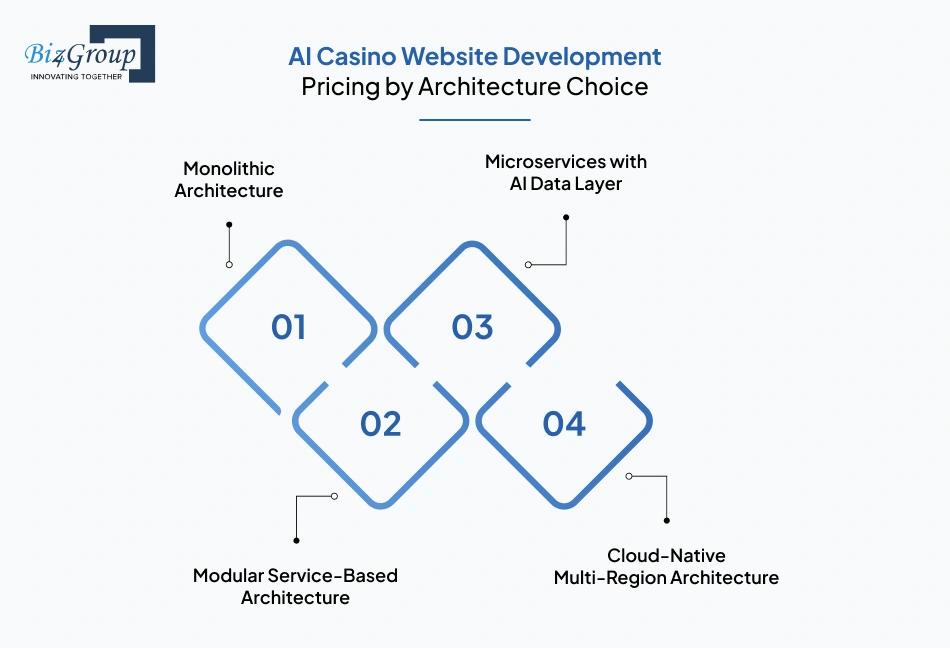
Architecture pricing becomes meaningful only when it helps you decide which setup best fits your growth plans, traffic expectations, and future AI depth. This is where the cost to develop scalable AI casino website architecture needs to be viewed as a business choice, because the right structure can either control long-term spend or create expensive rebuilds later.
1. Monolithic Architecture:
A monolithic architecture keeps the full casino platform inside one connected system, where wallet flows, player accounts, game lobby, admin controls, and AI workflows all run together.
Cost you can expect: $60,000-$100,000
Best fit when you need:
- MVP and early growth rollout
- limited game providers
- single-region player base
- lighter traffic expectations
The AI casino website development cost stays more controlled here because updates, testing, and issue fixes happen inside one unified system.
2. Modular Service-Based Architecture
A modular service-based architecture separates major business functions into connected blocks such as wallet, loyalty, fraud workflows, and player support. This option works well when different business areas need flexibility without rebuilding the entire platform.
Cost you can expect: $100,000-$180,000
Best fit when you need:
- stronger loyalty systems
- multiple payment integrations
- expanding game ecosystems
- isolated fraud workflows
- mid-scale traffic flexibility
The higher budget comes from managing separate service blocks, each with its own deployment, validation, and monitoring needs.
3. Microservices with AI Data Layer
This option runs each major function independently while a dedicated AI data layer continuously processes gameplay, wallet, fraud, and retention signals. It is ideal for businesses that want real-time decision-making across multiple player touchpoints.
Cost you can expect: $180,000-$260,000
Best fit when you need:
- advanced personalization
- live fraud intelligence
- VIP automation
- real-time analytics
- multi-game ecosystems
The cost to create AI casino website rises because live AI workflows depend on constant data exchange across independent services.
4. Cloud-Native Multi-Region Architecture
This option distributes the casino platform across multiple cloud regions to support geo expansion, failover protection, and stronger uptime. It is best for brands that expect global traffic and strict availability requirements.
Cost you can expect: $260,000-$300,000+
Best fit when you need:
- global player base
- multi-currency support
- geo compliance controls
- large tournament spikes
- high uptime guarantees
This carries the highest budget because cross-region recovery, live duplication, and data consistency all require deeper infrastructure investment.
Therefore, instead of looking at architecture as a technical layer, think of it as a budget decision tied to business scale.
Architecture Choice Comparison for Better Budget Decisions
|
Architecture Choice |
Best Business Situation |
Cost Range |
Decision Impact |
|---|---|---|---|
|
Monolithic |
validating demand, single market launch, faster MVP |
$60,000-$100,000 |
lower upfront spend, easier early control |
|
Modular Service-Based |
growth-stage casino brands adding loyalty, fraud, and support workflows |
$100,000-$180,000 |
balanced scale with controlled upgrade costs |
|
Microservices + AI Data Layer |
real-time personalization, advanced fraud control, VIP journeys |
$180,000-$260,000 |
higher investment but stronger AI-led retention |
|
Cloud-Native Multi-Region |
global operators, multi-currency traffic, high uptime expectations |
$260,000-$300,000+ |
highest budget, strongest long-term scale readiness |
How to Decide Which Architecture Fits Your Budget
These architecture choices are not meant to be followed as a fixed progression path. Here’s are you can decide architecture for your AI casino website development:
- If your immediate goal is faster market validation, the lower cost of a monolithic structure usually makes better financial sense. It helps control early spend without stretching the roadmap for AI casino website development.
- When the platform roadmap includes deeper retention, payment expansion, and AI-driven fraud workflows, the budget usually shifts toward a modular or microservices setup because these choices reduce future rework.
- For operators planning large traffic spikes, geo expansion, and executive-level reporting, the cost to create AI casino website on a cloud-native multi-region model is often justified by uptime stability and stronger operational continuity.
Quick Decision Lens for Business Owners
A simple way to decide is to align the architecture with your next 18–24 months of business growth, not just launch needs:
- Need validation fast? → Monolithic
- Scaling rewards and fraud workflows? → Modular
- Want AI-led retention at scale? → Microservices
- Planning multi-market expansion? → Cloud-native multi-region
The right decision here is rarely about what is technically stronger. It is about which architecture protects your budget from expensive rebuilds as player volume and AI dependency grow.
Architecture Mistakes Inflating Your Cost Faster
Align your platform foundation with the right long-term budget before scale increases spend
Validate Architecture CostAI Casino Website Development Cost: Complete Timeline and Phase-Wise Breakdown
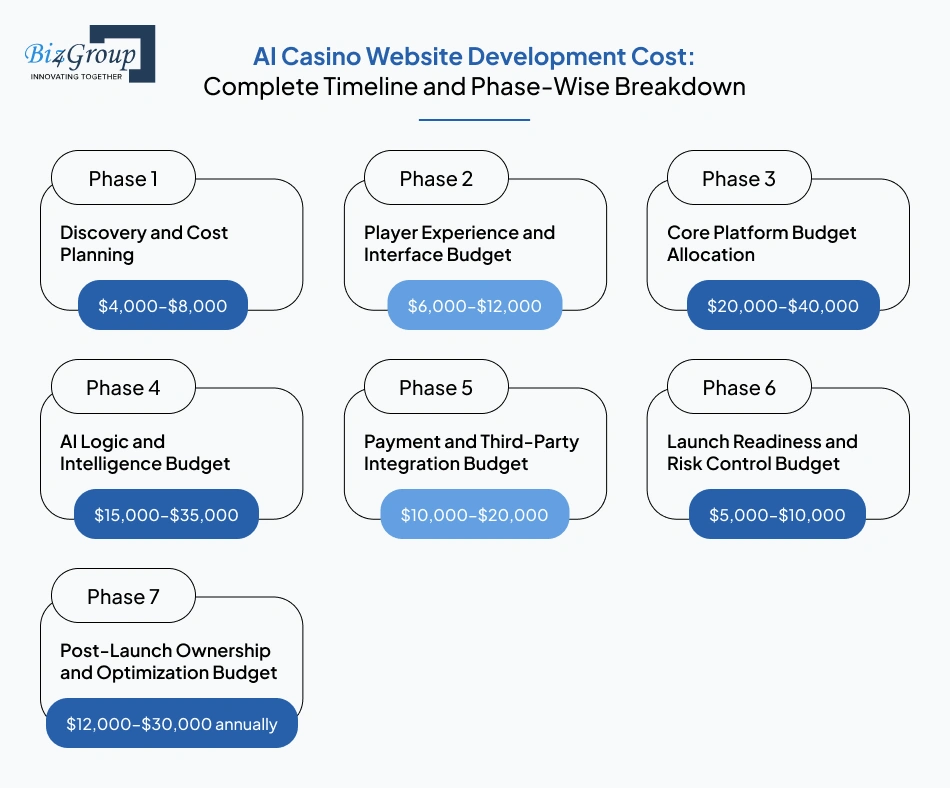
The total quote starts making sense when you can see how the budget moves across 7 financial phases instead of one bulk estimate. This phase-wise view makes detailed cost to build AI casino website for startups easier to plan, because each phase carries a different budget weight.
Phase 1: Discovery and Cost Planning
Estimated Timeline: 1–2 weeks
Estimated Cost: $4,000–$8,000
This phase covers the first layer of budget allocation where your business goals, player retention priorities, fraud objectives, and compliance scope are translated into a financial roadmap. A realistic estimate at this stage protects the project from unnecessary budget expansion later.
Phase 2: Player Experience and Interface Budget
Estimated Timeline: 2–3 weeks
Estimated Cost: $6,000–$12,000
This cost phase focuses on the player-facing journey, including onboarding, wallet visibility, lobby navigation, and reward discovery. Many operators invest more here because poor usability often creates redesign expenses later in the roadmap.
Working with an experienced UI/UX design company helps keep these budget decisions aligned with player behavior and conversion goals. This phase is less about visuals and more about protecting future redesign spendings.
Also Read: Top UI/UX Design Companies in USA
Phase 3: Core Platform Budget Allocation
Estimated Timeline: 4–6 weeks
Estimated Cost: $20,000–$40,000
This is usually the largest fixed budget block because it funds the actual business foundation of the casino platform. Wallet systems, game lobby logic, admin controls, player dashboards, and account workflows all start consuming meaningful budget here.
Many gaming startup founders intentionally work with MVP development service providers, so the cost of creating AI casino website remains controlled during validation. The financial goal here is to cover revenue-critical workflows before scaling deeper AI layers.
Also Read: Top MVP Development Companies in USA
Phase 4: AI Logic and Intelligence Budget
Estimated Timeline: 3–5 weeks
Estimated Cost: $15,000–$35,000
This phase introduces the budget dedicated to fraud detection, smart recommendations, retention triggers, and support automation. The spend grows based on how much real-time decision-making the platform is expected to handle.
As AI model training becomes part of the roadmap, the cost quickly expands. This is often where casino business owners begin seeing the difference between standard casino spend and AI-led investment.
integration of AI m
Phase 5: Payment and Third-Party Integration Budget
Estimated Timeline: 2–3 weeks
Estimated Cost: $10,000–$20,000
This budget phase covers payment systems, KYC workflows, CRM connections, game provider APIs, integration of AI models, and affiliate tracking tools. Costs can increase here depending on how many external systems need to work together without friction.
For many gaming operators, this phase becomes financially important because payment stability directly affects player trust and retention. A well-planned integration budget also reduces future vendor-switching costs.
Phase 6: Launch Readiness and Risk Control Budget
Estimated Timeline: 1–2 weeks
Estimated Cost: $5,000–$10,000
This phase is reserved for the spend required to make launch financially safe. The focus stays on testing wallet stability, gameplay reliability, fraud scenario checks, and traffic readiness before the platform goes live.
Budgeting properly here protects the business from downtime costs and first-launch reputation issues. Even a short launch phase can become expensive if risk checks are skipped.
Also Read: Software Testing Companies in USA
Phase 7: Post-Launch Ownership and Optimization Budget
Estimated Timeline: Ongoing
Estimated Cost: $12,000–$30,000 annually
The final phase covers the ongoing financial commitment after launch, which many gaming startup founders underestimate in the initial quote. This includes fraud tuning, infrastructure scaling, AI performance updates, and player behavior optimization.
Since live player data keeps changing, the platform requires recurring budget attention to stay efficient and profitable. This long-term ownership layer plays a major role in the full AI casino website development cost.
Phase Wise Cost Breakdown at a Glance
|
Phase |
Timeline |
Cost Range |
|---|---|---|
|
Discovery & Planning |
1–2 weeks |
$4,000–$8,000 |
|
Player Experience |
2–3 weeks |
$6,000–$12,000 |
|
Core Platform |
4–6 weeks |
$20,000–$40,000 |
|
AI Logic |
3–5 weeks |
$15,000–$35,000 |
|
Integrations |
2–3 weeks |
$10,000–$20,000 |
|
Launch Readiness |
1–2 weeks |
$5,000–$10,000 |
|
Post-Launch |
Ongoing |
$12,000–$30,000 yearly |
When the budget is viewed this way, the AI casino website development cost feels less like a large upfront quote and more like a phased financial roadmap, making investment approvals and milestone planning far easier for founders and operators.
How Data Pipelines and Infrastructure Shape AI Casino Website Development Cost?
The development budget of AI casino website often shifts the most when player data movement, storage readiness, and live processing requirements are defined. Even when feature scope stays the same, the total spend can change significantly based on how fast data needs to move between gameplay, wallets, fraud checks, and retention workflows.
1) Real-Time Player Event Streaming
Every spin, wallet action, deposit, bonus claim, and session drop creates live player signals that must move instantly across the platform. The cost here usually comes from setting up fast event flow, validation, and monitoring.
Typical Cost Impact: $8,000–$20,000
Budget Effect: 10%–15% of total project spend
The more real-time personalization and fraud logic you want, the higher this budget block becomes.
2) Payment, Wallet, and Risk Data Sync
Casino platforms constantly move transaction data between wallets, payment gateways, fraud systems, and reporting dashboards. This synchronization layer adds cost because transaction mismatches directly affect revenue trust.
Typical Cost Impact: $10,000–$25,000
Teams often rely on AI integration services here to reduce reconciliation errors and keep budget overruns under control.
3) Player Behavior Data Cleaning and Segmentation
Before player behavior can be used for retention logic, VIP scoring, or churn prevention, the data must be cleaned and grouped into usable patterns.
- organized data: $5,000–$10,000
- partially inconsistent data: $10,000–$25,000
- fragmented multi-source data: $25,000–$45,000
This stage alone can consume 15%–25% of the total budget.
4) Infrastructure Setup for AI Workloads
The infrastructure budget covers cloud hosting, player analytics storage, AI processing, and scaling readiness for traffic spikes.
Typical Cost Impact: $12,000–$40,000
This is often where enterprise decision makers get the clearest answer to the total budget required to create AI casino website, because infrastructure scale directly influences long-term cost ownership.
5) Legacy Casino System Compatibility
If the AI casino website needs to connect with older wallet systems, game engines, or reporting tools, extra budget is required to make data flow safely between systems.
Typical Cost Impact: $8,000–$30,000
This is where experienced AI developers help reduce expensive rework caused by legacy system mismatches.
Also Read: Cost to Hire an AI Software Developer
6) Data Storage Retention and Compliance Logs
Casino platforms often need long-term retention for gameplay history, wallet trails, fraud actions, and player disputes, which creates an ongoing infrastructure budget layer.
Typical Cost Impact: $6,000–$18,000
Retention-heavy jurisdictions usually increase this cost block significantly.
Summary of Data and Infrastructure Cost Impact
|
Cost Component |
Typical Cost Impact |
Effect on Total Budget |
|---|---|---|
|
Real-Time Event Streaming |
$8,000–$20,000 |
10%–15% |
|
Wallet & Risk Sync |
$10,000–$25,000 |
grows with transaction volume |
|
Data Cleaning |
$5,000–$45,000 |
15%–25% |
|
AI Infrastructure |
$12,000–$40,000 |
depends on scale and traffic |
|
Legacy Compatibility |
$8,000–$30,000 |
higher with old systems |
|
Log Retention |
$6,000–$18,000 |
compliance-driven |
Once these cost layers are mapped early, infrastructure spending becomes far easier to forecast because data speed, storage depth, and uptime readiness often influence the final quote more than visible feature scope.
Your Infrastructure Can Quietly Raise Cost
Map data and processing spend early before scale multiplies infrastructure ownership budgets
Talk to UsWhat Key Factors Influence AI Casino Website Development Cost
The final quote often changes long before coding begins because several visible business decisions directly reshape the budget. Failure to understand these cost drivers often leaves founders wondering why AI casino website development is costly.
So now let us understand the 8 factors that directly influence upfront pricing of AI casino website development.
1) AI Feature Depth
The depth of intelligence you expect from the platform has one of the biggest impacts on the quote. Smarter fraud workflows, retention triggers, player recommendations, and automated support all increase AI casino website development pricing because each decision layer adds more logic and validation.
Typical Cost Impact: $15,000–$50,000
This factor usually expands budget through:
- real-time fraud actions
- player segmentation depth
- support automation flows
- reward trigger intelligence
2) Game Provider Integrations
The number of external game aggregators and content providers directly affects the cost to develop AI casino website. Every additional provider increases integration validation, reporting alignment, and long-term maintenance effort.
Typical Cost Impact: $8,000–$30,000
Budget movement is commonly driven by:
- slot and live casino providers
- sportsbook extensions
- jackpot feeds
- reporting synchronization
3) Payment and Wallet Complexity
Wallet depth has a direct effect on project pricing because it touches revenue movement and player trust. The budget rises when deposits, withdrawals, multi-wallet logic, and bonus balances need stronger financial controls. More transaction paths naturally mean more quote-stage effort.
Typical Cost Impact: $10,000–$35,000
This factor often increases with:
- multi-currency handling
- bonus wallet layers
- payout routes
- transaction reconciliation logic
4) Compliance and Regional Controls
Legal coverage across markets directly reshapes the quote because every additional region adds policy workflows and player restrictions. This factor becomes critical for multi-market rollout plans.
Typical Cost Impact: $12,000–$40,000
This usually adds spend through:
- KYC workflows
- geo restrictions
- audit trails readiness
- responsible gaming controls
5) Player Experience Personalization
The more tailored the player’s journey becomes, the more quotes expand through journey logic and engagement layers. The spend here is closely tied to player retention goals and VIP experience.
Typical Cost Impact: $8,000–$25,000
This factor is shaped by:
- onboarding flows
- VIP journey depth
- promotion logic
- reward visibility and path variations
6) Reporting and Live Dashboards
Business visibility requirements can significantly change the quote even when the platform's scope stays the same, and gaming startup founders seemingly underestimate this budget block early.
Typical Cost Impact: $6,000–$20,000
This factor often includes:
- revenue dashboards and summaries
- fraud reporting dashboards
- retention reports
- player lifetime views
7) Delivery Team Expertise
The level of casino domain experience behind the project also changes the quote. A team with stronger AI and gaming workflow knowledge usually gives faster budget accuracy and fewer rework risks.
Typical Cost Impact: $10,000–$45,000
The cost difference usually reflects:
- domain expertise
- fraud workflow understanding
- faster delivery precision
- lower correction effort
8) Scalability and Traffic Readiness
Traffic expectations influence cost long before launching because higher concurrency requires stronger readiness planning. This factor becomes essential for brands expecting fast user growth.
Typical Cost Impact: $12,000–$35,000
This factor usually grows through:
- high traffic expectations
- peak event readiness
- live reward triggers
- fraud spike monitoring
Summary Table of Key Cost Factors
|
Cost Factor |
Budget Impact |
Why It Changes Pricing |
|---|---|---|
|
AI feature depth |
high |
more decision workflows |
|
game integrations |
medium-high |
more provider sync |
|
payment complexity |
high |
wallet logic depth |
|
compliance |
high |
region controls |
|
personalization |
medium |
more journey paths |
|
dashboards |
medium |
live business visibility |
|
team expertise |
medium |
speed + accuracy |
|
scalability |
high |
traffic readiness |
When these visible cost drivers are mapped early, the AI casino website development cost becomes far easier to justify because every major spend now ties directly to player retention, wallet complexity, compliance scope, and long-term scale readiness.
Hidden Expenses in AI Casino Website Development You Must Plan for
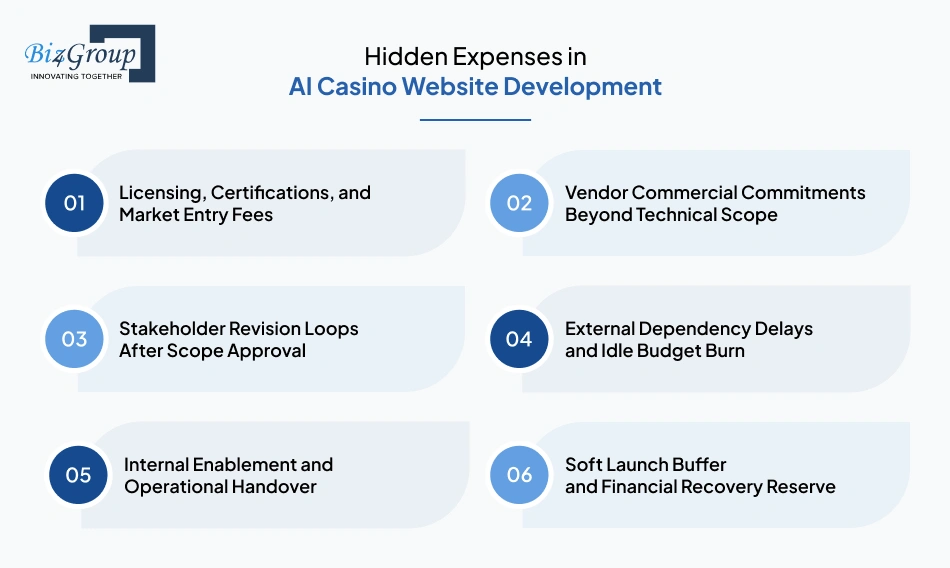
The approved quote usually feels complete until delayed financial obligations begin surfacing after legal reviews, vendor contracts, or internal sign-offs. These delayed budget leaks rarely appear in the first estimate, which is why early financial planning can still drift even after scope approval.
So, what are the hidden costs in AI casino website development?
The 6 delayed budget leak points below answer that through the expenses most first quotes fail to capture.
1) Licensing, Certifications, and Market Entry Fees
These expenses stay outside the initial product estimate because they surface closer to launch readiness. Once jurisdiction approvals, fairness validation, and compliance filings begin, they become unavoidable financial commitments that were never part of the visible build quote.
- Jurisdiction Approval: Multi-market launch paperwork usually appears after scope lock and can consume $5,000–$20,000, especially when legal reviews run parallel across regulated regions.
- Fairness Certification: RNG, payout logic, and platform security validation are external financial obligations that can require $4,000–$12,000 before market approval is granted.
2) Vendor Commercial Commitments Beyond Technical Scope
The delivery estimate may include integration effort, but commercial contracts with payment partners, analytics vendors, or fraud providers hide financial minimums outside the engineering quote. These costs only become visible when business agreements move forward.
- Minimum Billing Clauses: Even below projected traffic, payment or fraud vendors can lock monthly commitments that consume $3,000–$10,000 beyond the approved technical budget.
- Annual Contract Floors: Long-term vendor commitments tied to API connection access, fraud usage, or reporting services can consume $5,000–$18,000 outside product delivery cost.
Also Read: A Complete Guide to OpenAI API Integration for AI Applications
3) Stakeholder Revision Loops After Scope Approval
A hidden budget leak begins when internal teams revisit workflows after the financial estimate is approved. VIP journeys, withdrawal rules, dashboard views, or reward conditions can reopen redesign and retesting cycles.
- Reward Logic Revision: Reworking bonus conditions after sign-off can consume $4,000–$15,000, because approved journeys must be redesigned, revalidated, and financially retested.
- Dashboard Approval Loops: Repeated leadership feedback on reports or admin visibility can absorb $3,000–$8,000 through additional delivery bandwidth and testing rounds.
4) External Dependency Delays and Idle Budget Burn
Not every hidden expense comes from scope expansion. Delays from third-party providers, banking partners, or legal reviewers keep delivery teams allocated, which quietly consumes approved budget without visible product progress.
- Provider Response Delays: Slow banking or game-provider confirmations can consume $3,000–$9,000 because allocated resources remain billable while milestones stay blocked.
- Sandbox Access Delays: Missing credentials or delayed testing environments can quietly burn $2,000–$6,000 before the next financial checkpoint is reached.
5) Internal Enablement and Operational Handover
Post-delivery handover costs are usually missed during the initial quote because the platform is technically complete, yet internal teams still need process readiness before smooth financial operations begin.
- Operations Team Training: Fraud, support, and finance teams may require onboarding that consumes $2,000–$7,000, especially when admin workflows directly affect revenue control.
- Process Documentation: SOPs, dispute workflows, and finance handover manuals can require $1,500–$5,000 outside the approved implementation budget.
6) Soft Launch Buffer and Financial Recovery Reserve
The budget plan may assume one clean release, but real-world launches usually need controlled rollouts, rollback support, and a first-week issue reserve. These costs surface only when launch risk becomes financially visible.
- Controlled Rollout Reserve: Limited-region release monitoring can consume $3,000–$8,000 before full launch confidence is established across revenue-critical workflows.
- First-Week Recovery Buffer: Hotfix coverage and rollback protection usually hold back $2,000–$6,000 as a financial safeguard against early production issues.
These delayed financial leak points are usually what push the AI casino website development cost beyond the approved estimate. Identifying them early gives founders stronger budget protection, cleaner approval planning, and far better financial predictability before the platform moves toward launch.
Hidden Costs Break Approved Budgets First
Identify delayed budget leaks before they push the project beyond financial approvals
Uncover Hidden CostsAI Casino Website Development Cost by Team Model: In-House vs Outsourcing vs Dedicated Partner
The same product scope can carry very different budgets depending on who owns execution, roadmap continuity, and delivery accountability. For many founders, “can I outsource AI casino website development to save cost” becomes the key budget question when deciding between fixed salaries, external delivery fees, and long-term ownership overhead.
Before comparing the numbers, let's understand what each delivery model means from a cost perspective.
- In-house teams mean your company hires developers, designers, QA, and project managers as full-time employees, giving stronger internal control but creating the highest fixed budget through salaries, tools, and retention overhead.
- Outsourcing means assigning the project to an external agency on a fixed-scope or milestone basis, which reduces hiring overhead and helps control upfront delivery cost for startups and fast launches.
- A dedicated development partner works like an extended product team that stays aligned with roadmap evolution, offering better continuity than outsourcing while avoiding the fixed salary burden of an internal team.
Now the table below maps how these three delivery models reshape the same platform budget through different cost structures:
|
Team Model |
Typical Cost Range |
Best Fit |
Budget Reality |
Hidden Cost Risk |
|---|---|---|---|---|
|
In-House Team |
$180,000–$350,000+ yearly |
enterprises with long product roadmap |
highest fixed salaries, hiring, tools, retention cost |
hiring delays, bench cost, team attrition |
|
Outsourcing Agency |
$80,000–$180,000 |
startups and mid-scale operators |
controlled project-based pricing with faster execution |
scope creep, communication gaps |
|
Dedicated AI Development Partner |
$120,000–$220,000 |
scaling brands needing long-term ownership support |
balanced cost with strategic planning continuity |
lower hidden risk due to roadmap alignment |
The hiring decision changes far more than vendor pricing alone. It directly affects delivery speed, roadmap continuity, and financial predictability, which is why the AI casino website development cost can shift significantly even when the product scope remains exactly the same.
Cost Optimization Strategies That Actually Reduce Budget Risk of AI Casino Website Development
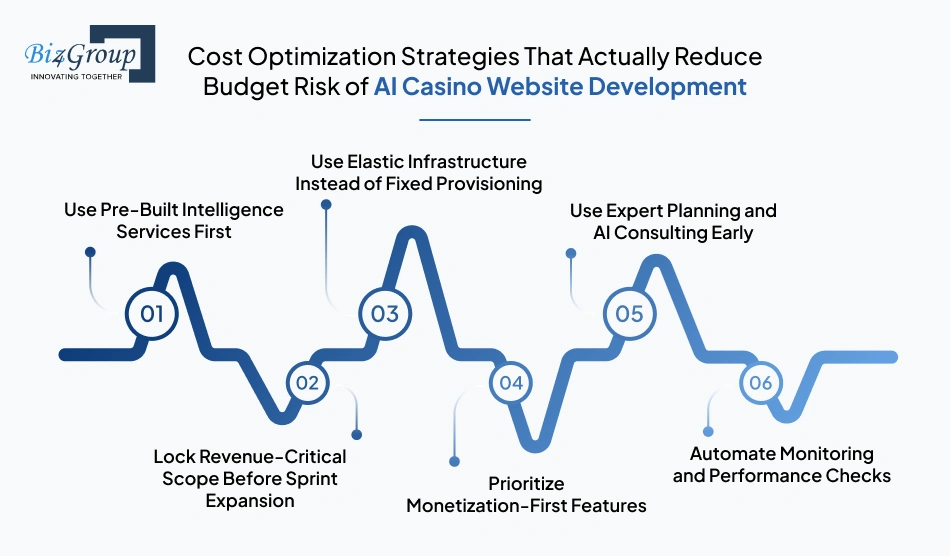
With everything on the table now comes the most practical question: How to reduce cost when building AI casino website?
Well, budget optimization works best when savings come from smarter delivery decisions instead of feature compromise. The most reliable answer is to focus on execution choices that lower rework, shorten validation cycles, and improve long-term financial predictability. Have a look:
1) Use Pre-Built Intelligence Services First
Not every retention or fraud workflow needs custom intelligence in phase one. Using proven third-party services reduces the cost of developing AI models from scratch and helps teams launch faster with lower validation spend.
This optimization works best through:
- using pre-trained fraud or support models for early launch workflows
- delaying custom recommendation engines until player behavior data matures
- reducing model validation and retraining effort in the first roadmap cycle
This single decision can reduce spend by 15%–25% (around $15,000–$25,000 on a $100K project).
2) Lock Revenue-Critical Scope Before Sprint Expansion
A major cost leak begins when wallet rules, VIP logic, or retention workflows keep moving after estimation. Freezing the monetization-critical scope early protects the budget from redesign and repeated approval cycles.
This optimization protects budget through:
- fixing withdrawal and reward logic before execution begins
- limiting dashboard revisions during delivery
- preventing retesting caused by late business changes
This discipline can reduce spend by 10%–15% (about $10,000–$15,000 on a $100K project).
3) Use Elastic Infrastructure Instead of Fixed Provisioning
Casino traffic changes around jackpots, events, and promotions, so fixed capacity planning inflates early cost. Elastic cloud allocation keeps spending closer to real user demand and reduces idle infrastructure waste.
The savings usually come from:
- scaling only during traffic spikes
- reducing unused compute reserve costs
- avoiding early overinvestment in backup capacity
This strategy can reduce spend by 20%–30% (roughly $20,000–$30,000 on a $100K project).
4) Prioritize Monetization-First Features
The fastest way to optimize budget is to release features that influence deposits, withdrawals, retention, and VIP value first. Lower-priority reporting and expansion workflows can follow once ROI proves demand.
This improves budget efficiency by:
- validating revenue flows before secondary layers
- delaying low-impact visibility features
- funding expansion from proven user behavior signals
This roadmap choice can reduce spend by 15%–20% (approximately $15,000–$20,000 on a $100K project).
5) Use Expert Planning and AI Consulting Early
A large share of budget loss comes from preventable scope mistakes in compliance, fraud workflows, and wallet logic. Strong AI consulting at the planning stage reduces expensive rebuild cycles later.
This optimization saves cost through:
- better scope accuracy before approvals
- fewer compliance workflow mistakes
- stronger fraud rule planning before delivery
This strategy can reduce spend by 10%–20% (around $10,000–$20,000 on a $100K project).
6) Automate Monitoring and Performance Checks
Manual fraud review, reward misuse checks, and uptime validation consume recurring support budgets. Automating these workflows reduces operational cost leakage after launch and keeps the ownership budget healthier.
The long-term savings come from:
- automated fraud alert reviews
- proactive uptime anomaly detection
- lower manual support dependency
This can reduce yearly spend by 5%–10% annually (about $1,000–$2,000 on $20K yearly maintenance).
These optimization moves make the AI casino website development cost far more predictable because the savings come from better sequencing, lower rework, and disciplined budget release instead of sacrificing critical platform value.
Reduce Cost Without Cutting Growth
Lower rollout spend through smarter execution decisions before rework starts draining budget
Optimize My BudgetHow Biz4Group LLC Reduces AI Casino Website Development Cost Without Compromising Scalability
For casino business owners and gaming startup founders, evaluating which company can build AI casino website at affordable cost, Biz4Group LLC stands out as a practical answer.
As an AI development company with proven experience in scalable iGaming software solutions, we focus on reducing unnecessary rework, shortening rollout cycles, and protecting monetization-first priorities.
Here are two portfolio-backed examples that show how our team optimizes budget through smart product decisions instead of feature compromise:
1) Stackr – AI-Led Retention Optimization Through Smarter Rollout
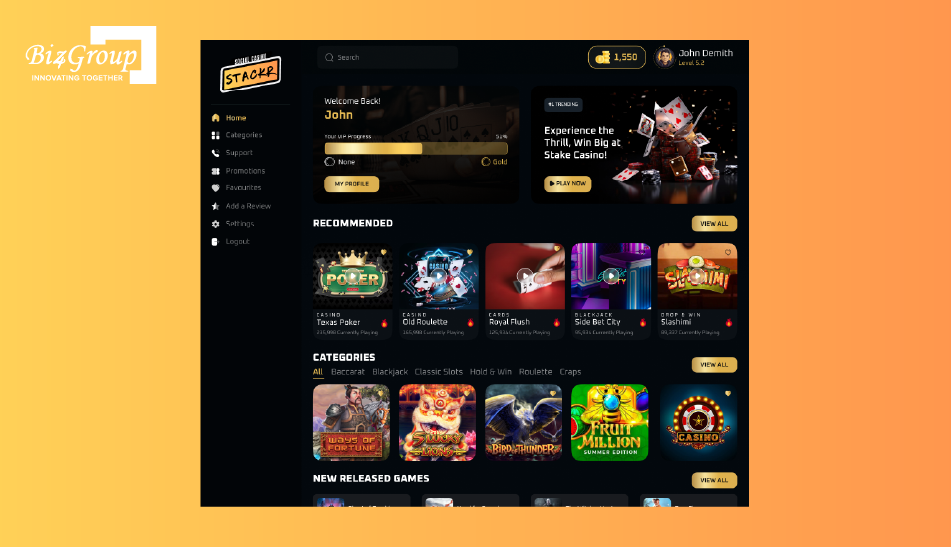
Stackr is an AI-powered social casino platform built around 800+ games, virtual currency, loyalty rewards, leaderboards, and personalized game recommendations. The product is designed to keep players engaged longer through habit-forming reward loops and smarter content discovery, which naturally makes retention systems one of the most expensive layers of the platform.
To keep this cost under control, we did not push every engagement layer into the first rollout. Our team first prioritized monetization-critical journeys like virtual currency usage, wallet continuity, and core loyalty triggers. Personalized recommendation depth and secondary engagement mechanics were expanded after real player behavior started shaping better product decisions.
This cost optimization was achieved through:
- phased release of recommendation intelligence
- reuse of loyalty and wallet frameworks
- validating retention journeys before expansion
- reducing redesign cost through real usage insights
This rollout strategy kept advanced retention spend aligned with real player ROI instead of front-loading unnecessary budget.
2) JuicySlots – Integration-Led Budget Efficiency for Faster Scale

JuicySlots is a multi-provider casino access platform that gives players seamless entry into multiple gaming environments through one smooth experience. The product depends heavily on provider onboarding, wallet continuity, gameplay routing, and cross-device consistency. This becomes financially heavy every time a new content source is introduced.
To prevent expansion costs from increasing with every provider, we established reusable provider onboarding flows, shared wallet continuity logic, and standardized routing layers early in the product foundation. This allowed the platform to extend into additional gaming ecosystems without repeatedly funding the same delivery work.
This cost optimization was achieved through:
- reusable provider onboarding frameworks
- standardized wallet continuity logic
- shared gameplay routing structures
- minimizing repeated UI adaptation effort
This rollout strategy kept expansion-stage spend financially lighter while preserving a scalable path for future provider growth.
These portfolio outcomes show why the AI casino website development cost stays more predictable with Biz4Group LLC’s delivery model. Our focus remains on reusable gaming frameworks, phased monetization logic, and scalable roadmap decisions that protect both launch budget and long-term profitability.
Conclusion
A successful casino platform is never defined only by features. Its long-term success depends on how wisely you plan the development cost around retention, fraud control, compliance, and scalable growth. The price to create AI casino gaming website becomes practical when your budget decisions stay connected to business goals instead of short-term delivery pressure. This is where the right AI product development company help you move forward with more financial confidence.
With the right roadmap, your platform can launch lean, scale faster, and stay profitable as player demand grows. Biz4Group LLC helps transform that vision into a cost-efficient and scalable product foundation built for long-term iGaming success. If you are ready to move from estimation to execution with clarity, connect with us and turn your idea into a platform that is financially sustainable from day one.
FAQ’s
1) How long does it take to recover the AI casino website development cost through player retention gains?
The recovery timeline usually depends on player lifetime value, retention workflow quality, VIP monetization, and reward-loop performance. For platforms with strong engagement logic, founders typically start seeing budget recovery within 6–12 months, while AI-led personalization can shorten this window further.
2) Does licensing jurisdiction affect the cost to build AI casino website for multi-market rollout?
Yes, jurisdiction strategy can significantly reshape the total quote. Launching across multiple regulated markets increases legal validation, certification, geo-restriction workflows, and dispute readiness costs, which directly affects rollout-stage financial planning even when the core platform remains unchanged.
3) How does player volume forecasting change AI casino website development pricing?
Projected traffic directly affects concurrency planning, wallet transaction volume, fraud monitoring depth, and uptime readiness. A platform planned for 50,000 active users will require a very different financial roadmap than one targeting 500,000+, especially around scaling safeguards and real-time gameplay continuity.
4) Should startups validate one casino game category first before scaling the full platform?
Yes, many gaming startups reduce financial risk by validating one monetization-heavy category first, such as slots, live dealer, or social casino loops. This helps test retention economics early before larger spend moves into broader game-provider expansion.
5) How does white-label migration impact the future cost of creating AI casino website?
Migrating later from a white-label platform to a fully owned AI ecosystem usually increases wallet migration, player-history transfer, loyalty rework, and provider remapping costs. Founders planning long-term ownership should account for this transition budget early.
6) What KPIs should founders track to justify AI casino website development pricing after launch?
The most decision-relevant KPIs include player retention rate, churn recovery, average wallet reloads, VIP conversion, fraud loss reduction, and session duration growth. These numbers help founders validate whether the AI Casino Website Development Cost is translating into measurable platform profitability.
