 Location :
Orlando, FL, USA
Location :
Orlando, FL, USA +1 (407) 714-1616
 info@biz4group.com

- AI in CRM shifts systems from passive data storage to active decision support, helping teams prioritize actions and reduce guesswork in daily workflows.
- Modern AI-powered CRM platforms embed intelligence directly into sales, support, and marketing processes, improving clarity without forcing teams to change how they work.
- Industry use cases show AI in CRM delivers value when aligned to real operational pressures such as patient follow-ups in healthcare, churn signals in banking, or buyer intent in real estate.
- Platform-based AI works well for standard workflows, while custom AI CRM development becomes necessary when business rules, scale, or integrations exceed configurable limits.
- Successful AI CRM adoption depends on disciplined rollout, clean decision signals, workflow-level validation, and long-term governance, not model complexity.
- Biz4Group LLC supports both AI integration into existing CRM platforms and custom AI-based CRM development, ensuring execution clarity, workflow alignment, and long-term system stability.
Most CRM systems today know everything about customers yet still leave teams guessing what to do next.
- Sales reps chase the wrong leads.
- Support teams react instead of anticipating.
- Marketing teams work with data, but not with direction.
That gap is where artificial intelligence in CRM is quietly changing how businesses operate.
Before going further, let’s ground this. A CRM is the system businesses use to store customer data, manage sales pipelines, track interactions, and coordinate marketing and support activities across teams all in one centralized platform.
What’s different now is not a trend shift, but an evolution. Customer relationship management with AI integration is turning software from static databases into systems that help teams decide, prioritize, and act with more confidence. The market numbers reflect that shift. The Global AI In CRM Market size is expected to be worth around USD 48.4 Billion By 2033, growing at a CAGR of 28%.
This blog is written for teams trying to make sense of that change without hype. As you read, you’ll gain clarity on:
- Where AI genuinely fits inside everyday CRM workflows
- How CRM software with artificial intelligence is being used across industries
- What to look for in platforms versus custom implementations
- How businesses approach adoption without disrupting existing operations
The goal here is simple: help you understand how AI fits into CRM in practical, workable ways and how to approach it with clarity, not confusion while working with an experienced AI product development company.
Understanding the Role of Artificial Intelligence in Modern CRM Systems
CRM systems are no longer judged by how much data they store. They’re judged by how well they help teams respond, prioritize, and move conversations forward when customer expectations and volumes continue to rise.
What are AI powered modern CRM systems?
AI powered CRM solutions represent a shift in how CRM systems behave in day-to-day operations. Instead of acting like static systems that wait for inputs, modern CRM platforms observe patterns, learn from outcomes, and support decisions as work happens.
With artificial intelligence in CRM, systems start recognizing
- which leads deserve attention
- which customers need follow-up
- which interactions carry risk or opportunity
This intelligence doesn’t sit separately. It works inside sales pipelines, support queues, and marketing workflows, making CRM systems feel more responsive and less manual.
As CRM software evolves, many businesses now expect AI in CRM systems to adapt over time. That adaptability often comes from ongoing AI model development, where systems refine how they score, prioritize, and suggest actions based on real usage and outcomes rather than fixed rules.
Key AI driven features in modern CRM systems
Modern AI driven CRM platforms introduce intelligence through practical capabilities that support everyday work.
- Predictive analytics helps teams anticipate outcomes instead of reacting late. CRM systems analyze past customer behavior to highlight likely conversions, deal risks, and future demand. This allows sales and marketing teams to plan with more confidence.
- Personalization becomes more natural when CRM systems learn from real interactions. Messages, follow-ups, and recommendations adjust based on how customers actually behave, not just on predefined segments.
- AI Automation reduces routine workload without removing human judgment. Tasks like lead assignments, data updates, and follow-up reminders happen automatically, keeping teams focused on meaningful conversations.
- AI chatbot integration with CRM improves responsiveness across customer touchpoints. AI Chatbot handles common questions, captures intent, and passes context to human agents when needed, ensuring conversations continue smoothly without starting over.
- CRM systems apply sentiment analysis using NLP to understand the tone and intent behind customer messages across emails, chats, and social interactions. This helps teams respond with the right priority and context, not just faster replies.
- Insights and reporting improve as CRM systems learn continuously. Over time, AI in CRM helps summarize interactions, surface trends, and present information in ways teams can act on faster.
Together, these features allow CRM systems to support decisions in real time instead of functioning as passive records.
Also Read: A Complete Guide to AI Chatbot Development
Benefits of AI enhanced CRM systems
When AI is applied thoughtfully, CRM systems start delivering value beyond efficiency.
- Customer interactions feel more relevant and timely because teams understand context before responding.
- Sales teams spend less time qualifying leads and more time closing the right opportunities.
- Support teams resolve issues faster while maintaining consistency across channels.
- Retention improves as CRM systems surface early warning signs from engagement and sentiment.
- Operations become leaner as repetitive tasks fade into the background.
These benefits grow stronger as systems mature, and AI capabilities evolve alongside business processes.
The real role of artificial intelligence in CRM is not complexity, but clarity. It helps CRM systems guide teams toward better actions, better timing, and better customer experiences without changing how people naturally work.
Bring Clarity into Your CRM
See how AI-driven CRM decisions reduce guesswork, improve prioritization, and support teams without disrupting existing workflows.
Explore AI in CRMWhy Should Companies Adopt Artificial Intelligence in CRM?
As businesses grow, CRM systems often remain operational but lose strategic value. They store activity but stop guiding decisions, which creates uncertainty for teams that depend on clarity to manage customers at scale.
Market Snapshot:
To understand the business pressure behind adoption, here’s how companies are already benefiting from intelligent CRM capabilities across performance and cost metrics.
- AI-driven CRM solutions are projected to generate over $1.1 trillion in revenue globally, reflecting broad enterprise uptake.
- Firms using AI in CRM report 91% reduction in customer acquisition costs
- Companies incorporating generative AI are 83% more likely to exceed sales goals, showing real operational value.
Market impact explains why AI adoption in CRM is accelerating. The real drivers appear inside daily CRM operations. As workload increases, gaps emerge in decision quality, risk visibility, and operational stability. Below we have mentioned some of the reasons as why businesses are adopting AI in CRM:
1. Growing CRM Data Weakens Decision Quality
As customer data expands, teams struggle to separate what matters from what does not.
- Sales leaders see pipelines filled with activity but lack confidence in priorities.
- Support managers respond to issues after impact.
- Marketing teams track engagement without understanding intent.
This is why artificial intelligence in CRM has become important. It helps businesses move away from guesswork and regain confidence in daily decisions when human review alone cannot keep up with volume and complexity. Many organizations reach out for enterprise AI solutions, to restore clarity when decision-making starts breaking under scale.
2. Manual CRM Processes Increase Operational Risk
Manual CRM processes work well at smaller scales. As organizations expand, they introduce delays that quietly affect outcomes.
- Deal risks surface only after revenue is already affected
- Customer dissatisfaction becomes visible after escalation
- Teams rely on individual judgment instead of shared direction
These gaps explain the need for CRM automation using artificial intelligence. Automation reduces dependency on individual awareness and creates consistency across teams without adding process overhead. To apply it correctly, some businesses rely on AI consulting services to align automation with existing CRM workflows instead of creating fragmented processes.
3. AI Adoption for Operational Stability
Companies adopt artificial intelligence in CRM because decision-making becomes harder as customer operations scale. Growing data volumes reduce clarity and increase the risk of delayed responses.
- Customer activity outpaces manual review
- Priorities blur as every account appears urgent
- Teams react after impact instead of acting early
AI brings structure back to CRM decisions, helping teams maintain consistency, reduce uncertainty, and stay aligned as complexity grows.
Industry-Specific Use Cases of AI Powered CRM Solutions
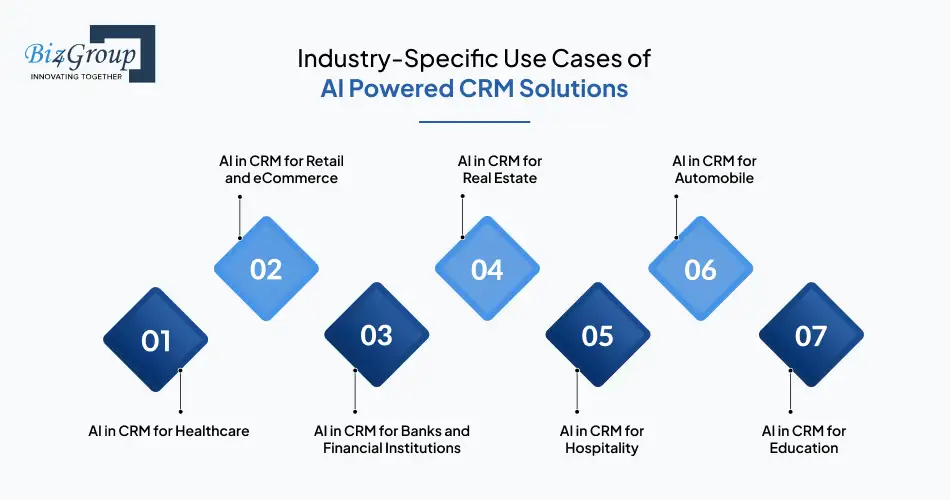
The impact of artificial intelligence in CRM looks very different across industries. Customer expectations, relationship lifecycles, and operational pressures vary widely, which means CRM systems must support decisions in ways that fit each industry’s reality.
We have listed top 7 industries that use CRM for their business operations and workflows:
1. AI in CRM for Healthcare
Healthcare organizations manage long-term relationships where timing, follow-ups, and continuity matter more than speed. Missed communication does not just affect experience. It can affect outcomes. Traditional CRM systems often struggle to keep pace with growing patient volumes and fragmented interactions.
The healthcare AI CRM software supports awareness and coordination rather than automation for its own sake.
- Care teams gain better visibility into patient engagement patterns across appointments, messages, and follow-ups
- Administrative staff can identify patients who may need attention without manually reviewing every interaction
- Communication stays consistent across departments, even when patients interact through multiple channels
- Relationship history remains clear, helping teams respond with proper context rather than assumptions
For healthcare organizations, the value lies in reducing gaps, improving follow-through, and maintaining trust at scale. AI in CRM supports better coordination while allowing care teams to focus on what matters most: patient relationships and outcomes.
This approach helps healthcare providers stay proactive without overwhelming staff. Working with an experienced AI healthcare software development company can help providers integrate AI in CRM systems that support continuity of care instead of acting as passive records.
Also Read: Cost of Implementing AI in Healthcare
2. AI in CRM for Retail and eCommerce
AI adoption within retail CRM systems is accelerating as customer journeys become more fragmented. Market forecasts show that it is growing at CAGR of 21.9% and is expected to USD 7,372.7 million by 2030 driven by retailers prioritizing relationship intelligence.
Retail and eCommerce businesses depend on timing, relevance, and continuity. Customers browse, compare, abandon carts, return later, and expect brands to remember them across every interaction.
Artificial Intelligence in CRM supports relationship awareness across fast-moving customer journeys.
- CRM systems with AI recognize repeat buying patterns and changes in shopping behavior
- Teams gain early visibility into customers who may disengage or stop purchasing
- Interactions from websites, apps, stores, and support channels stay connected
- Many retailers now aim to create intelligent CRM solutions for businesses that adapt to shopper behavior instead of relying on static rules
For retail teams, this means less guesswork and more confidence when planning engagement, offers, and follow-ups. AI CRM systems begin reflecting how customers actually move between channels, not how businesses expect them to.
Also Read: How To Build AI Virtual Assistant for Ecommerce
3. AI in CRM for Banks and Financial Institutions
Banks and financial institutions use CRM systems to manage customer profiles, relationship histories, service requests, and product interactions. As customer bases grow, reviewing this information manually becomes slow and inconsistent.
AI in CRM is applied for decision accuracy and timing matter most.
- Customer records are continuously reviewed to flag accounts showing reduced engagement, frequent service issues, or unusual interaction patterns that may signal churn risk.
- Relationship managers receive prioritization cues inside CRM to focus on customers who are most likely to need follow-ups or guidance.
- CRM systems surface patterns from past product usage to support more relevant cross-sell and retention conversations.
- Service teams see customer context immediately when handling requests, reducing repeated explanations and missing details.
These use cases keep CRM systems focused on relationship quality rather than data volume. For banks, AI in CRM supports better customer handling without increasing manual checks or operational load.
Also Read: AI Financial Forecasting Platform Development Guide
4. AI in CRM for Real Estate
Real estate CRM systems manage large volumes of inquiries, property interactions, and long decision cycles. AI in CRM is used where human tracking becomes unreliable due to timing, volume, and changing buyer intent.
- CRM systems apply real estate AI predictive analytics to evaluate buyer interaction data such as listing views, inquiry timing, and response behavior to identify prospects most likely to proceed.
- Lead priority inside the CRM adjusts dynamically as buyer interest rises or declines across multiple properties.
- AI identifies stalled deals by detecting inactivity patterns and missed engagement signals within the CRM pipeline.
- Property recommendations inside CRM update automatically based on evolving buyer behavior rather than static preferences.
- AI in CRM systems surface early churn signals when buyers disengage after site visits or negotiations.
These use cases show how AI stays tightly connected to CRM decision points in real estate. For organizations working with a real estate AI software development company, this focus ensures CRM intelligence supports deal movement, timing, and follow-through without adding operational noise.
Also Read: AI in Real Estate Investment: Trends, Tools, and Tactics
5. AI in CRM for Hospitality
Hospitality businesses manage frequent and time-sensitive customer interactions across reservations, stays, and follow-ups. CRM systems in this sector must support quick decisions while keeping guest information consistent across properties and service teams.
AI in CRM is used to support relationship handling during active service periods.
- CRM systems with AI flag guests who may need immediate attention based on recent requests, unresolved issues, or service delays
- Front desk and service teams see relevant guest history during interactions, reducing repeated questions and missed context
- Loyalty engagement improves when AI in CRM systems recognize repeat stays, booking frequency, and visit patterns
- Guest communication remains aligned across locations and shifts, even when multiple teams interact with the same guest
Many hospitality brands choose to develop AI powered CRM software for businesses when standard systems cannot support multi-property coordination or high guest turnover during peak seasons.
As hospitality operations scale, AI based hospitality software development often strengthens CRM intelligence, so teams maintain service consistency and relationship continuity without increasing operational pressure.
Also Read: How to Build an AI Receptionist Avatar for Hospitality
6. AI in CRM for Automobile
Automobile businesses use CRM systems to manage leads, test drive requests, financing conversations, and service interactions. As lead sources and customer touchpoints increase, teams struggle to track intent and maintain timely follow-ups. AI automotive dealership management software play a central role in coordinating sales, service, and customer engagement activities.
AI in CRM helps automobile teams prioritize actions across the customer lifecycle.
- CRM systems with AI identify prospects showing high purchase intent based on inquiry patterns and recent interactions
- Sales teams receive clearer signals on when to follow up after test drives or pricing discussions
- Service teams detect gaps in post-sale engagement that may affect retention
- Customer records stay aligned across sales, service, and support without manual coordination
Many dealerships and manufacturers develop CRM systems with artificial intelligence capabilities to ensure these signals are built directly into their existing sales and service workflows instead of relying on disconnected tools.
For organizations using AI automotive CRM software, the value lies in timing and consistency. Teams act on CRM-driven signals rather than memory or delayed reports, improving lead conversion and strengthening after-sales relationships across locations.
Also Read: Top 10 AI Automotive Software Development Companies in USA
7. AI in CRM for Education
Educational institutions use CRM systems to manage inquiries, enrollments, and ongoing student engagement. As volumes increase, teams struggle to prioritize follow-ups, identify disengaged students, and maintain consistency across departments.
AI in CRM supports education teams by improving visibility and timing across the student lifecycle.
- Admissions teams can focus on applicants who show strong intent instead of treating every inquiry the same
- AI in CRM systems surface early signs of disengagement so support teams can intervene before outcomes are affected
- Communication across admissions, academics, and administration stays aligned around a single student record
- Engagement efforts adjust based on student responses rather than fixed outreach schedules
In education, the value of AI in CRM is not personalized for its own sake. It lies in helping institutions act earlier, coordinate better, and reduce drop-offs across long and complex student journeys. Many institutions work with an AI educational software development company to ensure these CRM capabilities align with existing academic systems and enrollment processes rather than operating as disconnected tools.
This approach allows teams to manage scale while keeping enrollment, retention, and student support efforts consistent and measurable.
Also Read: Development Cost of AI Solutions in the Educational Sector
Apply AI Where It Matters
See how AI-driven CRM decisions align with your industry workflows, timing pressures, and customer relationship lifecycles.
View your Industry UsePopular CRM Platforms with AI Functionality
AI in CRM is no longer experimental. Many popular CRM platforms already apply AI within daily workflows, helping teams manage customers, support requests, and follow-ups more effectively without changing how CRM systems are used.
1. Salesforce
Salesforce applies AI directly within daily CRM workflows, helping teams manage customers more effectively without changing how they already work.
- AI supports lead prioritization, case handling, and account follow-ups inside the CRM
- Sales teams get guidance on which opportunities need attention instead of scanning long pipelines
- Support teams handle customer issues faster, enabling practical use of AI in CRM for customer support automation
- Customer interactions stay consistent across channels as volumes increase
- Often chosen by businesses looking to build AI enabled CRM systems for businesses at scale
2. Microsoft Dynamics 365
Microsoft Dynamics 365 uses AI within CRM to support structured decision-making across sales, service, and account management teams.
- AI helps teams track customer signals across ongoing interactions and relationship histories
- Sales managers gain better visibility into deal progress and follow-up timing
- Service teams maintain consistent responses across customer touchpoints
- CRM insights support coordination across departments using shared customer data
3. HubSpot
HubSpot applies AI in CRM to simplify customer engagement for growing teams and fast-moving businesses.
- AI supports follow-ups, engagement tracking, and contact prioritization within the CRM
- Sales and marketing teams stay aligned around shared customer activity
- Support teams manage requests without losing conversation context
- CRM usage remains simple while scaling customer interactions
- Commonly used by startups and mid-sized businesses focused on growth
4. SAP Customer Experience
SAP Customer Experience applies AI in CRM to help large organizations manage complex customer relationships reliably.
- AI in CRM supports consistent handling of customer interactions across long lifecycles
- Teams gain clearer visibility into engagement across sales and service operations
- CRM insights help reduce gaps between customer-facing teams
- Works well in environments with high volumes and structured processes
- Often used by enterprises managing large customer bases across regions
5. Odoo
Odoo uses AI within CRM to support flexible and customizable customer management workflows.
- AI helps teams track customer interactions and follow-ups within modular CRM setups
- Businesses can adapt CRM behavior as operations evolve
- Customer information stays connected across sales and service activities
- CRM usage remains lightweight while supporting growth
These platforms show that AI in CRM is already delivering real value. The right choice depends on business scale, workflow complexity, and how naturally AI supports everyday customer management without adding unnecessary operational burden.
Artificial Intelligence in CRM Implementation: A Practical Roadmap
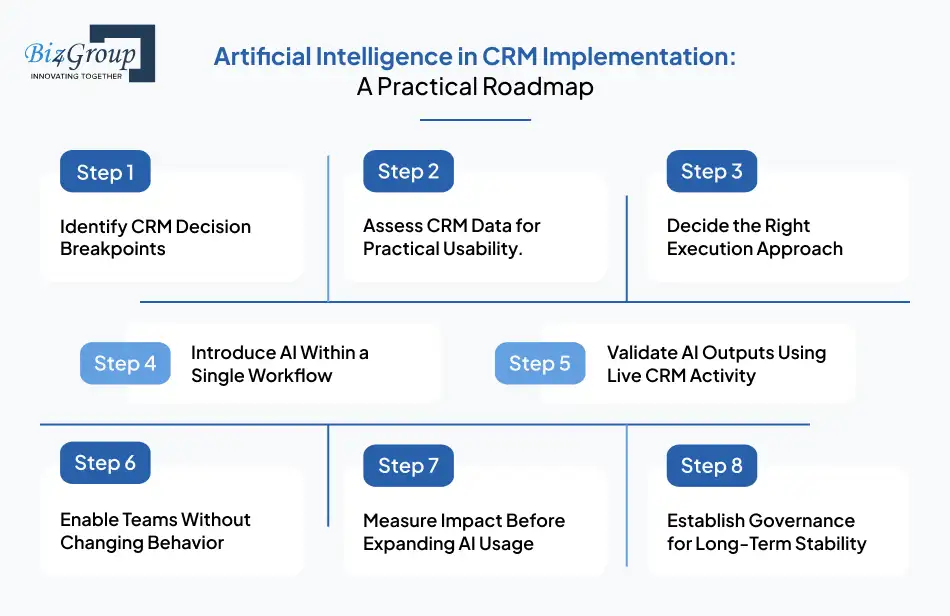
Artificial intelligence in CRM implementation works best when introduced through clear operational steps. This roadmap explains how organizations add AI to CRM workflows gradually, improving decision-making and consistency without disrupting existing sales, service, or marketing processes.
Step 1: Identify CRM Decision Breakpoints
Before defining how to implement AI in CRM systems, teams must understand where CRM workflows stop guiding action and start creating confusion for day-to-day decision-making.
- Decision delays: Identify CRM situations where teams hesitate, delay follow-ups, or depend on personal judgment because priorities are unclear, or useful signals arrive too late.
- Priority conflicts: Review pipelines or queues where all tasks appear urgent, causing teams to spend time on low-impact actions instead of focusing on critical customer decisions.
- Outcome clarity: Clearly define what better decisions look like, such as earlier risk awareness, improved follow-up timing, or clearer ownership across CRM workflows.
Step 2: Assess CRM Data for Practical Usability.
AI CRM implementation services often start by confirming whether CRM data reflects real customer behavior consistently enough to guide prioritization and next actions.
- Data consistency: Review how interactions, outcomes, and status updates are recorded across teams to ensure CRM data reflects actual work, not individual reporting habits.
- Signal relevance: Identify which data points directly influence urgency or next steps instead of treating all CRM fields as equally useful.
- Targeted fixes: Improve only the data elements needed for the chosen workflow, avoiding large cleanup efforts that slow progress without improving decisions.
Step 3: Decide the Right Execution Approach
Organizations must decide whether to extend existing systems or hire AI developers for focused enhancements that support real operational needs.
- Platform capability review: Evaluate whether current CRM features already support prioritization, routing, or scoring required for identified decision gaps.
- Customization necessity: Identify where industry-specific rules or integrations are missing and cannot be addressed through configuration alone.
- Sustainability balance: Choose an approach that meets current needs without increasing long-term complexity or maintenance effort.
Step 4: Introduce AI Within a Single Workflow
Working with an AI development company is most effective when intelligence is added to one workflow where decision quality directly affects outcomes.
- Workflow selection: Choose processes like lead prioritization, follow-up scheduling, or case routing where better timing or focus improves results.
- Native placement: Ensure AI insights appear directly inside existing CRM screens so teams can act without switching tools or managing separate systems.
- Controlled scope: Keep implementation limited at first to observe usability, trust, and impact before expanding to other workflows.
Step 5: Validate AI Outputs Using Live CRM Activity
When organizations build AI software, validation must happen during active CRM usage, not only through historical analysis.
- Decision comparison: Compare AI recommendations with experienced team decisions to confirm they match real operational judgment.
- Sensitivity adjustment: Adjust thresholds to avoid excessive alerts or signals that distract teams from higher-value actions.
- Signal removal: Remove insights that do not affect decisions, helping teams trust AI outputs that remain.
Step 6: Enable Teams Without Changing Behavior
This step focuses on ensuring AI fits naturally into existing CRM usage, so teams gain decision support or change how they already manage customer interactions.
- Action-oriented guidance: Train AI models to respond to signals within existing workflows instead of explaining technical details.
- Human accountability: Reinforce that AI supports decisions, while final responsibility remains with CRM users.
- Feedback capture: Collect regular input from users to improve relevance based on real usage and operational experience.
Step 7: Measure Impact Before Expanding AI Usage
Attention shifts to evaluating whether AI is actually improving CRM decisions, using clear operational signals to determine when expansion is justified and when restraint is needed.
- Impact tracking: Measure improvements in response time, prioritization accuracy, and consistency rather than activity volume.
- Pattern replication: Expand AI only when early results show repeatable value across similar workflows.
- Expansion restraint: Avoid adding intelligence that increases complexity without improving decision clarity.
Step 8: Establish Governance for Long-Term Stability
Long-term stability depends on putting guardrails in place, so AI-driven CRM decisions remain transparent, controlled, and trustworthy as usage grows across teams.
- Data boundaries: Define clear rules for how customer data is used within AI-supported CRM workflows.
- Decision transparency: Ensure teams understand why recommendations appear to avoid blind reliance on AI signals.
- Periodic review: Review AI behavior regularly to keep it aligned with changing CRM processes and business priorities.
A practical CRM AI roadmap focuses on clarity, trust, and steady adoption. When implemented step by step, AI improves CRM decision-making without disruption, helping organizations manage customer operations with greater confidence and consistency.
Implement AI in CRM Without Disruption
Follow a structured CRM AI roadmap that improves decision quality, builds trust, and scales intelligence without changing workflows.
View Implementation StepsCommon Challenges in AI CRM Implementation and How to Avoid Them
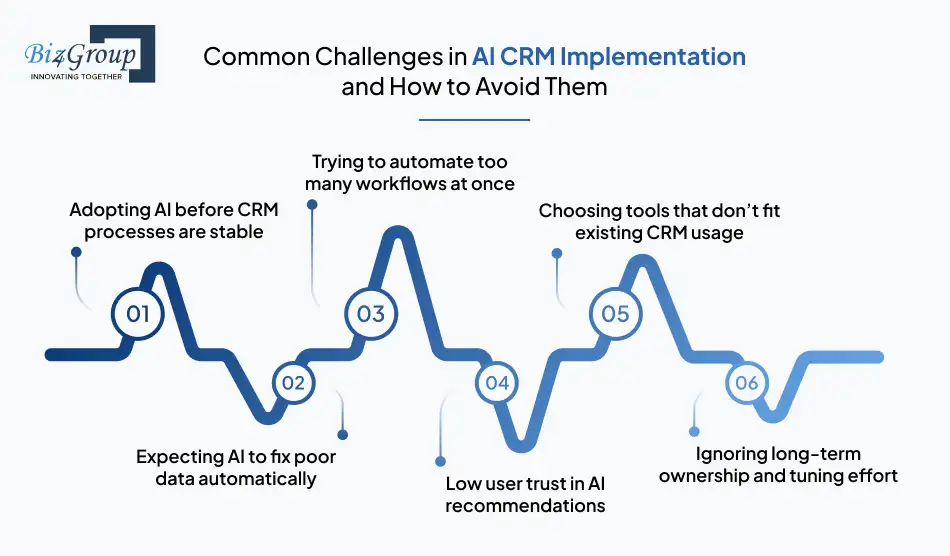
AI in CRM often struggles not because of technology, but because of timing, expectations, and execution gaps. Understanding common challenges helps teams decide when should companies adopt AI in CRM and how to avoid costly missteps.
|
Challenge |
How to Avoid It |
|---|---|
|
Adopting AI before CRM processes are stable |
Companies should adopt AI in CRM only after core sales, support, or marketing processes operate consistently. |
|
Expecting AI to fix poor data automatically |
Focus first on making critical fields usable, then apply AI to support decisions rather than correct foundational issues. |
|
Trying to automate too many workflows at once |
Start with one clear use case. Successful AI CRM solutions for enterprises and startups scale gradually after proving value in a single workflow. |
|
Low user trust in AI recommendations |
Keep AI advisory, not authoritative. Teams adopt AI faster when insights support judgment instead of overriding human decisions. |
|
Choosing tools that don’t fit existing CRM usage |
AI should live inside current CRM screens. Avoid tools that require users to leave their daily workflow to see value. |
|
Ignoring long-term ownership and tuning effort |
AI needs ongoing adjustment. Plan for refinement early, whether using internal teams or external support. |
AI CRM initiatives succeed when adopted at the right time and applied with restraint. Clear expectations, focused use cases, and practical execution help businesses avoid friction while gaining real value from intelligent CRM systems.
Why Businesses Should Choose Biz4Group LLC for Implementing AI in CRM?
AI initiatives inside CRM rarely fail because models underperform. They fail when intelligence is added without aligning data flows, ownership, and daily workflows. Execution gaps create noise, slow adoption, and distrust. Fixing those gaps determines whether Artificial Intelligence in CRM delivers clarity or confusion.
That reality shapes how Biz4Group LLC approaches modernization inside systems teams already rely on.
Modernizing legacy CRM systems with AI integration
Most enterprises already operate CRM systems that support active revenue and support operations. These systems cannot absorb experimentation. Biz4Group integrates Artificial Intelligence in CRM by working directly inside production environments with minimal tolerance for disruption.
- Execution starts by mapping how CRM data actually moves through pipelines, queues, and ownership handoffs.
- Audit live CRM workflows to identify decision delays and prioritization gaps
- Trace CRM data pipelines to confirm which fields drive real operational outcomes
- Integrate AI models directly into existing CRM screens and pipeline stages
- Validate prioritization signals against live user behavior before expanding scope
AI runs within the same CRM interfaces teams already use. Security policies, access controls, and system performance remain unchanged. This same execution discipline also applies when existing platforms are no longer enough.
Supporting custom AI-based CRM development
Some organizations reach limits where configurable CRM platforms no longer reflect how their business operates. We support these cases by designing AI-based CRM systems from the ground up with execution control built in.
As a custom software development company, we structure CRM platforms around real operational rules rather than assumed best practices.
- Define CRM data models using actual interaction patterns and outcome history
- Build AI decision layers that support scoring, prioritization, and risk detection
- Design explainable outputs so users understand why actions are suggested
- Implement governance controls that regulate how AI models evolve over time
- Maintain model performance through ongoing tuning as workflows change
AI behavior is tested against real usage scenarios, not theoretical accuracy. This depth of delivery is why enterprises evaluating top AI development companies in Florida often rely on Biz4Group LLC for long-term AI CRM execution.
Execute AI Inside Real CRMs
Work with a team that integrates AI into live CRM systems or builds custom platforms without disrupting ownership, workflows, or performance.
Discuss CRM ExecutionConclusion
Artificial Intelligence in CRM is no longer about adding intelligence for its own sake. It is about restoring clarity in systems that teams already depend on every day. Across industries, platforms, and implementation paths, the pattern stays consistent. AI delivers value when it improves prioritization, timing, and follow-through without disrupting how people work.
Across industries, the pattern is consistent. AI works when it fits naturally into CRM operations, respects data reality, and supports decisions without adding noise. Whether organizations modernize existing systems or invest in custom CRM platforms, success depends on disciplined rollout, data realism, and long-term governance.
That is why many enterprises work with a software development company that understands both CRM operations and AI execution depth. When applied with restraint and intent, Artificial Intelligence in CRM becomes a decision support layer teams trust. In the end, the best company to implement AI in CRM systems is the one that delivers clarity where teams actually work. Why wait? Connect with us today and start your journey!
Frequently Asked Questions (FAQ’s)
1. What does Artificial Intelligence in CRM improve in daily operations?
Artificial Intelligence in CRM helps teams prioritize leads, follow up at the right time, and respond with context. It turns CRM systems from static records into decision-support tools without changing existing workflows.
2. When should companies adopt AI in CRM systems?
Companies should adopt AI in CRM systems when data volume increases and manual review starts affecting response time, prioritization, or consistency across sales, support, or account management teams.
3. How is customer relationship management with AI different from rule-based automation?
Customer relationship management with AI adapts based on outcomes and behavior. Unlike fixed automation rules, AI powered CRM solutions adjust prioritization and recommendations as real usage patterns change.
4. Can AI be added to existing CRM software without replacement?
Yes. AI CRM implementation services allow businesses to integrate intelligence into current CRM software with artificial intelligence features, without replacing platforms or disrupting active workflows.
5. How is AI used in CRM for customer support automation?
Using AI in CRM for customer support automation helps prioritize tickets, detect sentiment, and route requests efficiently. AI supports agents with context while keeping decision control with humans.
6. What should businesses evaluate before building AI-enabled CRM systems?
Before they build AI enabled CRM systems for businesses, teams should assess data quality, workflow maturity, and governance readiness. Artificial intelligence in CRM implementation depends on execution discipline, not model complexity.
7. How do companies select the best company to implement AI in CRM systems?
The best company to implement AI in CRM systems demonstrates experience integrating AI into live CRM environments, with a focus on workflows, explainability, and long-term system stability.
