 Location :
Orlando, FL, USA
Location :
Orlando, FL, USA +1 (407) 714-1616
 info@biz4group.com

 AI Summary Powered by Biz4AI
- AI entertainment app development is transforming streaming, gaming, music, and interactive storytelling through intelligent personalization, automation, and Generative AI.
- A successful app combines the right AI strategy, scalable architecture, engaging features, and continuous optimization, not just advanced AI models.
- Development costs typically range from $40,000 to $500,000+, depending on app complexity, AI capabilities, supported platforms, and custom development requirements.
- Starting with an MVP, selecting the right AI technologies, and optimizing infrastructure can significantly reduce both development and operational costs.
- Biz4Group helps startups and enterprises build secure, scalable, and future-ready AI entertainment apps, guiding businesses from product strategy to deployment and long-term growth.
Let's begin with an uncomfortable truth. Users usually don't give second chances to entertainment apps. The first minute or two often determine whether they'll keep exploring or abandon your app altogether. If they can't quickly find something worth watching, playing, or listening to, they're already looking elsewhere.
Yet many entertainment platforms are still designed like it's 2015. Static content libraries, generic homepages, and search bars are expected to do all the work. Meanwhile, the industry's biggest players rely on AI to deliver deeply personalized experiences.
Netflix, for example, attributes the vast majority of content discovery to its recommendation engine rather than manual searches. AI-driven personalization has also been shown to significantly improve engagement and retention. According to PwC's Global Entertainment & Media Outlook 2025-2029, the global entertainment and media industry is projected to reach $3.5 trillion by 2029, with AI-powered advertising and hyper-personalization emerging as major growth drivers.
At Biz4Group, we've seen the same shift firsthand while helping businesses build intelligent AI products. The biggest difference between an app users forget and one they keep coming back to isn't just having AI. It's knowing how to use AI to make every interaction feel personal, timely, and effortless.
That shift changes how you think about building an entertainment product altogether.
Whether you're exploring AI entertainment app development for a streaming platform, experimenting with a generative AI entertainment app, shaping a conversational AI entertainment app, or pushing the boundaries with an AI-powered esports app, the real challenge isn't just adding intelligence. It's designing an experience where discovery feels effortless, interactions feel intuitive, and users keep coming back without thinking twice.
If you're wondering how to build an AI entertainment app that users actually want to return to, you're in the right place. Let's begin by understanding what it is.
What Is an AI Entertainment App, and Why Are Businesses Investing in One?
Let's clear up a common misconception first. An AI entertainment app isn't just an entertainment app with an AI chatbot or a recommendation feature added to it. It's an application that uses artificial intelligence to improve how users discover, consume, create, or interact with entertainment content.
Depending on the use case, AI can power personalized recommendations, AI-generated music or videos, AI virtual assistants, adaptive gameplay, real-time subtitles, intelligent search, and much more. In other words, AI isn't there just to automate tasks. It helps deliver experiences that feel more relevant, engaging, and tailored to every user.
Think about the last time a streaming platform recommended a show you ended up binge-watching, or when a game adjusted its difficulty to match your skill level. Those aren't coincidences. They're examples of AI analyzing user behavior, learning preferences, and making intelligent decisions in real time.
Unlike traditional entertainment apps that offer the same experience to every user, an AI-powered entertainment app continuously evolves. It learns from interactions such as watch history, searches, likes, skips, playtime, purchases, and engagement patterns to personalize content, recommendations, and even the overall user experience.
Behind these intelligent experiences are several AI technologies working together:
- Machine Learning (ML): Learns from user behavior to predict preferences and improve recommendations over time.
- Natural Language Processing (NLP): Enables conversational search, AI assistants, voice commands, and sentiment analysis.
- Generative AI: Creates original content such as stories, music, images, game assets, summaries, or virtual characters.
- AI Computer Vision Development: Supports visual search, scene recognition, facial analysis, and content moderation.
- Recommendation Engines: Analyze user behavior and content similarities to surface the most relevant content at the right moment.
This ability to continuously learn and personalize experiences is exactly why businesses are investing in AI entertainment app development. Whether it's a streaming platform, a generative AI entertainment app, a conversational AI entertainment app, or an AI-powered gaming app, AI helps increase engagement, improve retention, and create experiences that keep users coming back.
Basically, great content attracts users. AI helps them discover more of what they'll love, making every session feel uniquely personalized. Now that we've defined the concept, let's look at the use cases of AI entertainment app development.
What Are the Most Popular AI Entertainment App Use Cases?
The term AI entertainment app covers a much broader range of products than streaming platforms alone. Today, businesses are using AI to reshape how people watch, play, listen, create, and interact with digital entertainment.
Here are some of the most promising use cases driving AI entertainment app development.
1. AI-Powered Streaming Platforms
Streaming services use AI to simplify content discovery across massive libraries. Instead of making users scroll endlessly, AI recommends movies, TV shows, or videos based on viewing history, watch duration, language preferences, and similar audience behavior.
This approach is especially valuable for niche OTT platforms focused on genres like anime, regional content, sports, fitness, or educational entertainment, where helping users quickly find relevant content can become a major competitive advantage.
Leading platforms like Netflix, YouTube, and Disney+ use AI to personalize recommendations, optimize content discovery, and improve viewer engagement.
2. AI-Powered Gaming Apps
Today's AI-powered gaming apps create experiences that evolve as players progress. Generative AI enables dynamic NPC conversations, procedurally generated quests, adaptive game worlds, and difficulty levels that respond to a player's skill. Rather than following fixed scripts, games can introduce fresh challenges and storylines, making each playthrough feel unique.
Games such as AI Dungeon and AI-powered NPC experiences from NVIDIA demonstrate how AI is creating more dynamic gameplay, adaptive characters, and personalized gaming experiences.
3. Music and Podcast Platforms
AI helps music and podcast platforms move beyond simple genre-based recommendations.
By analyzing listening habits, skipped tracks, favorite creators, session length, and contextual signals like time of day, AI can build playlists, surface new artists, recommend podcast episodes, and even summarize lengthy content for listeners who want quick insights. Services like Spotify and Audible leverage AI for music recommendations, podcast discovery, and personalized listening experiences.
To see these concepts in action, let's look at a real-world entertainment platform developed by Biz4Group and how it delivers engaging digital experiences at scale.
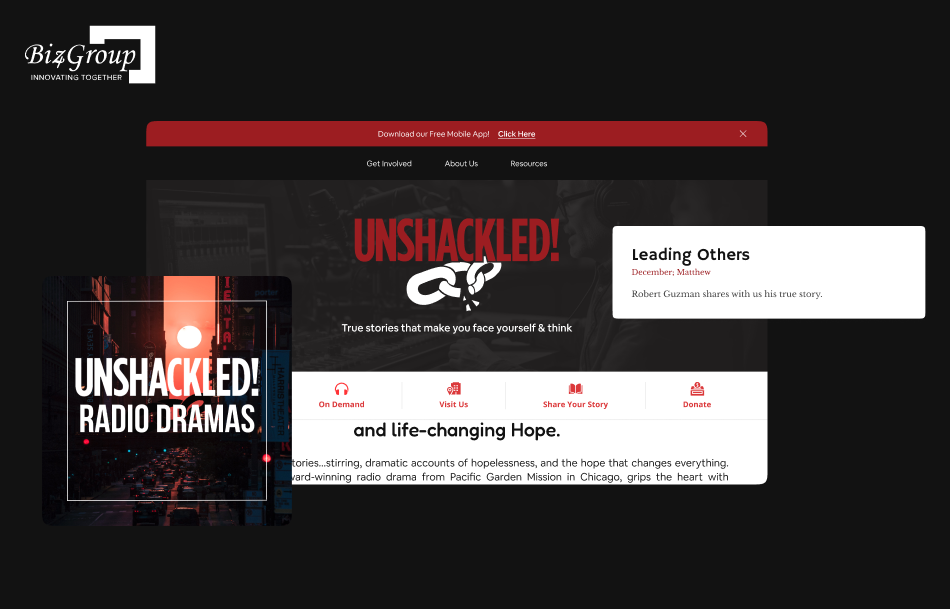
Unshackled is a great example of scalable entertainment app development. It is a WordPress-based podcast and media platform developed by us for a long-running non-profit ministry.
Originally launched in 1950, Unshackled needed a modern digital platform that could make its Bible-based audio and video content more accessible while delivering an engaging user experience.
Key Features Delivered
- Live Radio Streaming with scheduled programming
- On-Demand Audio Library featuring Audio Dramas, Daily Devotionals, and real-life testimonies
- Share Your Testimony to encourage community participation
- History's Greatest Sermons content library
- Library for the Blind to improve accessibility
- Integrated Donations through GiveButter to support the ministry
While Unshackled isn't a generative AI entertainment platform, it showcases the building blocks of modern AI entertainment app development, including scalable architecture, rich media experiences, seamless content delivery, and strong user engagement.
4. Interactive Storytelling Apps
Interactive storytelling takes entertainment from passive consumption to active participation.
A generative AI entertainment app can create branching narratives, generate dialogue in real time, and adapt storylines based on user choices. Instead of reading the same story as everyone else, users become part of an experience that unfolds differently with every decision. Platforms such as AI Dungeon and NovelAI showcase how AI can generate branching narratives and interactive storytelling experiences.
5. Conversational AI Companion Apps
A conversational AI entertainment app allows users to interact with AI characters through natural conversations.
These applications can power virtual friends, fictional characters, role-playing companions, or celebrity-inspired experiences that remember previous conversations, maintain consistent personalities, and respond intelligently to changing contexts. The result is a form of entertainment built around ongoing interaction rather than one-time content consumption. Apps like Replika and Character.AI use conversational AI to create engaging, personalized virtual companions.
As AI-powered virtual characters become more advanced, businesses are creating immersive entertainment experiences with lifelike digital avatars. AI Wizard showcases Biz4Group's expertise in building interactive, AI-driven companion platforms.
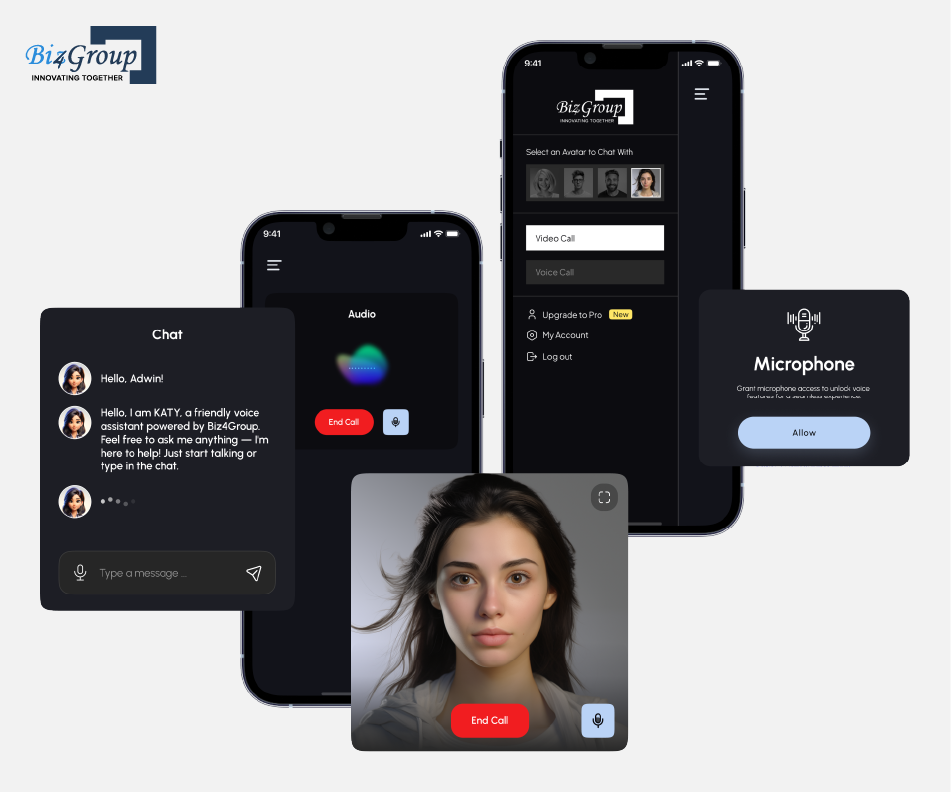
We developed AI Wizard, an avatar-based AI companion that enables natural voice, video, and chat interactions. Powered by D-ID, ChatGPT, and Whisper AI, the platform delivers realistic, real-time conversations while optimizing development costs through strategic AI integrations.
Key Features Delivered
- AI-Powered Video Calls with real-time facial expressions and avatar animations
- AI Voice Conversations powered by speech recognition and conversational AI
- Custom Avatar Creation using user-uploaded photographs
- Text-Based AI Chat for seamless multi-channel interactions
- Social Platform Integrations with Reddit, Discord, and Facebook
- End-to-End Encryption for secure communications
- Cross-Platform Compatibility for a consistent experience across devices
This project showcases how to combine conversational AI, voice technology, and realistic digital humans to create engaging and interactive entertainment experiences.
6. AI-Powered Social Entertainment Platforms
Social entertainment platforms rely on AI to match users with content they're most likely to enjoy.
Instead of showing posts in chronological order, AI evaluates viewing behavior, interactions, content preferences, and emerging trends to curate highly relevant feeds. It can also connect users with creators, communities, and live content aligned with their interests. Platforms such as Snapchat, Instagram, and TikTok incorporate AI to personalize feeds, recommend content, and enhance social interactions.
AI is reshaping social experiences through intelligent automation, making planning and coordination faster and more intuitive. Hey Benson showcases Biz4Group's expertise in building conversational AI platforms for seamless social engagement.
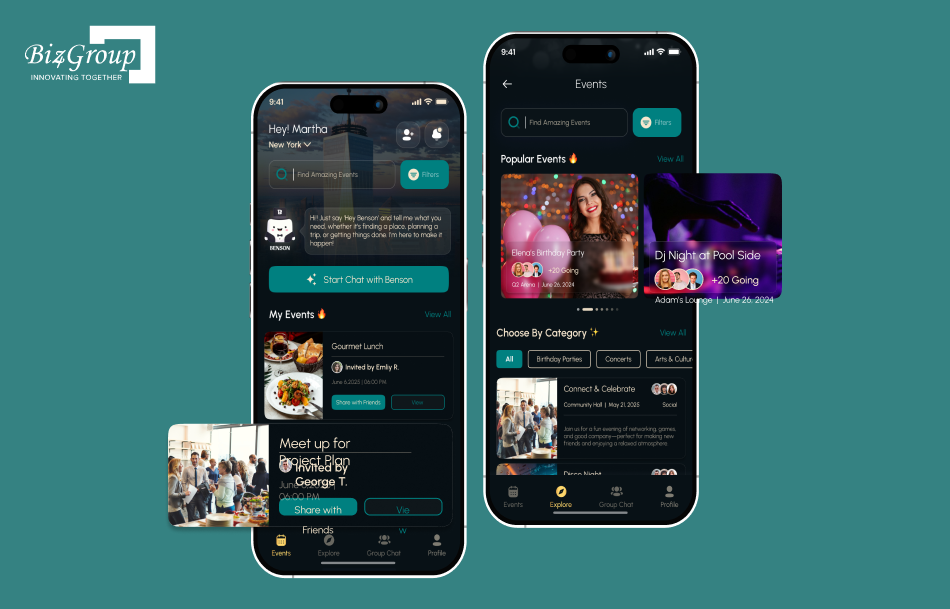
We developed Hey Benson, an AI-powered event planning app that lets users create events, invite participants, and manage plans through natural language conversations. By automating coordination across SMS, email, and in-app notifications, the platform eliminates the hassle of traditional group planning.
Key Features Delivered
- AI-Driven Event Workflow Engine for end-to-end event planning through natural language
- Contact-Based Invitations via SMS, email, and in-app notifications without requiring friend requests
- AI-Generated Event Posters to increase email invitation engagement
- Embedded AI Assistant within event group chats for real-time coordination and decision support
- Automated Event Updates with multi-channel notification delivery and fallback logic
- Dedicated Event-Based Group Chats for seamless collaboration
- Cross-Platform Support across iOS, Android, and web
This project demonstrates Biz4Group's ability to combine conversational AI, workflow automation, and scalable application architecture to build intelligent social platforms that enhance user engagement and simplify real-world interactions.
7. Live Events and Virtual Experiences
AI is enhancing digital concerts, sports broadcasts, and virtual events by making them more interactive and accessible.
Applications include real-time language translation, automated captions, AI-generated highlights, personalized camera angles, and intelligent moderation for live chats. These capabilities help businesses deliver richer viewing experiences to global audiences.
Platforms like Zoom, Roblox, and Fortnite have expanded live virtual experiences through AI-powered moderation, event management, and audience engagement.
8. AI Content Creation Platforms
Not every entertainment app is built for consumers, many focus on empowering creators.
A custom AI entertainment app can generate scripts, music, videos, voiceovers, subtitles, animations, thumbnails, and visual effects with minimal manual effort. This enables creators and production teams to experiment with ideas faster and scale content production more efficiently. Tools such as Runway, Canva, Adobe Firefly, and Luma AI enable creators to generate images, videos, and other media with AI.
Whether you're building an AI-powered content creation platform or a next-generation social entertainment app, real-world execution matters. One example is Biz4Group's AI-powered social media platform, designed to help users generate, personalize, and share AI-created content with ease.
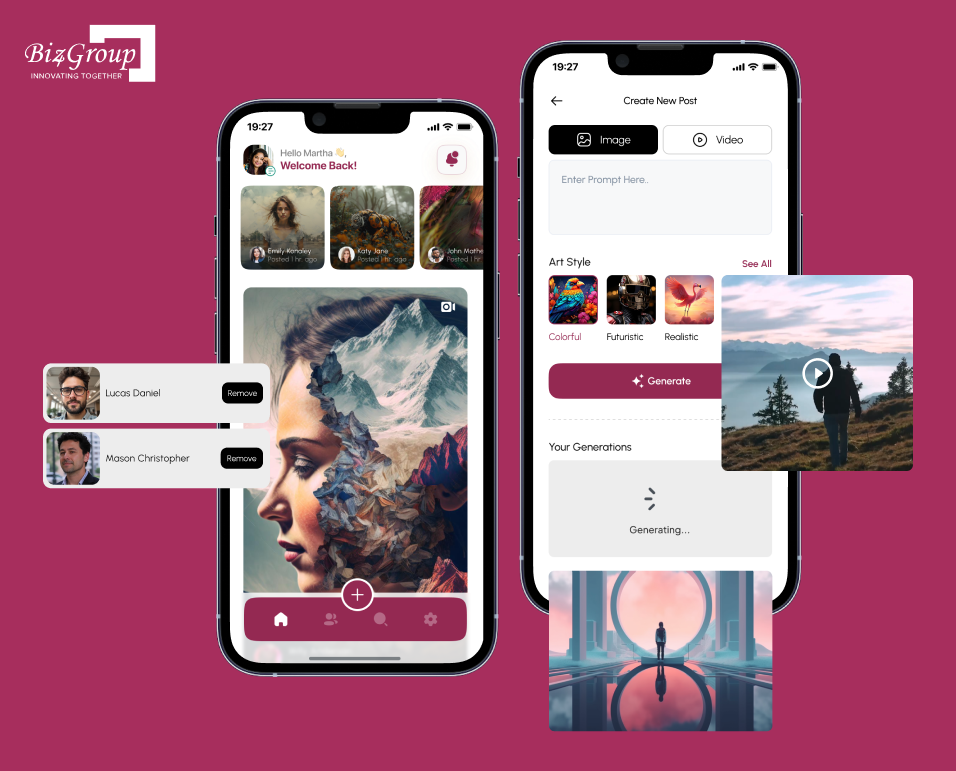
We developed an AI-powered social media application that enables users to generate original images and videos using text prompts and instantly share them with their network. By integrating advanced AI models with a scalable backend, the platform delivers a seamless content creation experience while optimizing infrastructure costs through intelligent media management.
Key Features Delivered
- AI-Powered Image & Video Generation using Vertex AI (Imagine 3) and Luma AI
- Content Optimization Engine that stores and reuses previously generated media to reduce AI inference costs
- Social Content Sharing for publishing AI-generated images and videos
- Media Customization to personalize AI-generated content based on user preferences
- Multiple Authentication Options including Google, Apple, email, and guest login
- Privacy Controls for secure user account management
- Cross-Platform Experience built with Ionic + React, supported by a Node.js backend and PostgreSQL database for scalability
The project highlights how strategic AI implementation can enhance user creativity while optimizing long-term operational costs.
9. AR and VR Entertainment Apps
Artificial intelligence is playing an increasingly important role in immersive experiences. In augmented and virtual reality applications, AI powers intelligent avatars, gesture recognition, object tracking, voice interaction, and adaptive virtual environments. These technologies make immersive entertainment feel more responsive and lifelike.
Platforms like Pokémon GO, Meta Horizon Worlds, and Beat Saber demonstrate how AI enhances immersive AR and VR entertainment experiences.
10. AI Karaoke and Virtual Performance Apps
AI is also transforming music-based entertainment. Modern karaoke and performance apps use AI to analyze vocal accuracy, provide real-time singing feedback, recommend songs based on vocal range, generate harmonies, and create virtual duet experiences. These features make practice sessions and performances more engaging for casual users and aspiring artists alike.
Applications such as Smule and virtual concert experiences on Fortnite showcase how AI is enhancing singing, voice processing, and interactive digital performances.
AI-powered features such as personalized recommendations, intelligent search, voice interactions, and content automation can significantly enhance user engagement. The overall AI entertainment app development cost depends on the features, AI capabilities, and technologies you choose to implement.
Regardless of the use case, every successful AI entertainment app relies on a strong set of core features. Let's explore the essential capabilities your platform should include.
What is the Core Features Every AI Entertainment App Should Have?
The success of an AI entertainment app depends on the features it offers. While the exact feature set varies by use case, there are a few core capabilities that form the foundation of most AI-powered entertainment platforms. Let's explore them.
|
Feature |
What It Does |
Business Impact |
|---|---|---|
|
Hybrid Recommendation Engine |
Combines user behavior and content attributes to recommend relevant content |
Improves content discovery and watch time |
|
AI-Powered Semantic Search |
Understands user intent instead of matching exact keywords |
Makes content easier to discover |
|
Personalized Home Feed |
Dynamically ranks content for each user |
Reduces browsing time and increases engagement |
|
Conversational AI Assistant |
Enables natural language or voice-based content discovery |
Simplifies navigation |
|
Behavioral Intelligence Engine |
Captures user interactions to improve AI models |
Powers smarter recommendations over time |
|
AI Content Moderation |
Detects harmful, spammy, or inappropriate content |
Protects platform quality |
|
Smart Notification Engine |
Sends personalized notifications at optimal times |
Improves re-engagement |
|
Cross-Device Synchronization |
Syncs activity and preferences across devices |
Creates a seamless user experience |
|
AI Content Summaries |
Generates quick summaries of videos, podcasts, or articles |
Helps users make faster decisions |
|
Identifies user trends and churn risks |
Supports better product decisions |
These features significantly improve the overall user experience and help transform a standard product into a custom AI entertainment app that users enjoy returning to. Now that we've explored the core features, let's look at the advanced AI capabilities that can make your AI entertainment app stand out in a competitive market.
What Are the Advanced AI Features That Enhance User Engagement?
Core features lay the foundation, but advanced AI capabilities are what take an entertainment app to the next level. From generating content in real time to enabling natural conversations and hyper-personalized experiences, these features help create more engaging and intelligent entertainment platforms.
|
Advanced AI Feature |
What It Does |
Best Suited For |
|---|---|---|
|
Generative AI Content Creation |
Creates stories, dialogue, music, videos, quests, or game assets in real time |
Gaming, storytelling, creator platforms |
|
AI-Personalized Thumbnails & Artwork |
Displays different thumbnails or posters based on individual viewing preferences |
OTT and video streaming apps |
|
Adaptive Storytelling Engine |
Changes narratives, characters, and outcomes based on user decisions |
Interactive fiction and RPGs |
|
Multimodal Search & Discovery |
Lets users discover content using text, voice, and images together |
Streaming and social entertainment |
|
AI Highlight & Trailer Generation |
Automatically creates highlights, trailers, or short clips from long-form content |
Sports, podcasts, creator platforms |
|
AI Dubbing & Voice Localization |
Generates natural multilingual voiceovers without traditional dubbing workflows |
Video streaming and educational platforms |
|
Digital AI Avatars & Virtual Hosts |
Creates AI presenters, influencers, DJs, or virtual companions for interactive experiences |
Gaming, live events, virtual entertainment |
|
AI Co-Creation Tools |
Enables users to create music, videos, artwork, or stories alongside AI |
Creator economy and entertainment apps |
|
Context-Aware Experience Engine |
Adapts content presentation based on factors like device type, time of day, or user activity |
Cross-platform entertainment platforms |
|
Emotion-Aware Personalization (Emerging) |
Adjusts content experiences using explicit user feedback and interaction patterns |
Premium entertainment experiences |
As AI entertainment app development continues to evolve, advanced capabilities like these are shifting entertainment from passive consumption toward highly interactive and AI-assisted experiences. Businesses that adopt them thoughtfully can create products that stand out in an increasingly competitive market. Once you've identified the features your product needs, the next step is selecting the technologies that can support them efficiently and scale as your platform grows.
Your Audience Is Waiting. Is Your App?
Let's build an entertainment experience they'll keep coming back to.
Connect With UsWhich Technologies Power AI Entertainment App Development?
Building a successful AI entertainment app requires more than choosing an AI model. A scalable platform combines modern frontend frameworks, cloud infrastructure, AI services, databases, analytics, and streaming technologies that work together seamlessly.
While the exact stack depends on your business goals and scale, the following technologies are widely used in modern AI entertainment app development.
|
Technology Layer |
Recommended Technologies |
Purpose |
|---|---|---|
|
Frontend |
React, Next.js, React Native, Flutter, Swift, Kotlin |
Next.js development and more build responsive web and mobile applications |
|
Backend |
Node.js, Python (FastAPI/Django), Java Spring Boot |
Python development, Node.js development more manage APIs, business logic, authentication, and AI integrations |
|
AI & LLMs |
OpenAI GPT-4.1/GPT-4o, Anthropic Claude, Meta Llama, Mistral |
Power conversational AI, content generation, summaries, and intelligent assistants |
|
Recommendation Engine |
AWS Personalize, TensorFlow Recommenders, PyTorch |
Deliver personalized content recommendations |
|
Vector Database |
Pinecone, Weaviate, Qdrant, Milvus |
Enable semantic search and Retrieval-Augmented Generation (RAG) |
|
Databases |
PostgreSQL, MongoDB, Redis |
Store user profiles, content metadata, and cache frequently accessed data |
|
Cloud Platform |
AWS, Microsoft Azure, Google Cloud |
Host applications, AI workloads, storage, and media services |
|
Media Processing |
AWS Elemental Media Services, Mux, FFmpeg |
Encode, stream, and optimize video and audio content |
|
Real-Time Communication |
WebRTC, Agora |
Support live streaming, voice chat, and interactive experiences |
|
AI Image & Video Generation |
OpenAI Images, Stability AI, Runway, Replicate |
Generate artwork, thumbnails, trailers, and creative assets |
|
Analytics |
Amplitude, Mixpanel, Google Analytics |
Track user behavior, engagement, and product performance |
|
ML Observability |
Arize AI, Evidently AI |
Monitor model accuracy, drift, and recommendation quality |
|
Authentication |
Auth0, Firebase Authentication, Amazon Cognito |
Secure user authentication and identity management |
|
Payments |
Stripe, RevenueCat |
Handle subscriptions, in-app purchases, and recurring billing |
|
DevOps & Deployment |
Docker, Kubernetes, GitHub Actions |
Automate deployment and scale applications efficiently |
No single technology stack fits every project. The key is choosing technologies that align with your product roadmap, expected user base, and long-term scalability rather than just adopting the latest AI tools. With the technology stack in place, it's time to understand how these components come together throughout the development lifecycle.
How to Build an AI Entertainment App: Step-by-Step Development Process?
Successful AI entertainment app development is much more than integrating AI into an existing application. It requires careful planning, the right technology choices, quality data, and continuous optimization after launch.
Here's a practical roadmap followed by experienced AI product teams.
Step 1: Define Your Product Vision & Validate the Idea
Every successful product begins with solving a real user problem.
Start by identifying your target audience, entertainment category, business goals, and the unique value your application offers. Simultaneously, validate your idea by speaking with potential users, reviewing competitors, and confirming there is genuine market demand before investing in development.
Key activities
- Define your target audience
- Identify your niche
- Validate the problem you're solving
- Set measurable business goals
Step 2: Conduct Market & Competitor Research
Understanding the market helps you build a product users actually want.
Study competing entertainment platforms to identify feature gaps, monetization strategies, AI capabilities, user complaints, and emerging opportunities. This research helps you differentiate your application instead of recreating what's already available.
Key activities
- Competitor analysis
- User interviews
- Market sizing
- Gap analysis
- Keyword and trend research
Step 3: Define AI Use Cases & Plan Your MVP
Not every feature needs AI. Identify where AI genuinely improves the user experience and prioritize those capabilities for your first release. Rather than building every feature at once, focus on an MVP development services that deliver your product's core value while leaving room for future iterations.
Key activities
- Define AI use cases
- Prioritize features
- Create an MVP roadmap
- Estimate development phases
Step 4: Design the User Experience
AI should simplify the user journey, not complicate it. Design intuitive navigation, seamless onboarding, and personalized user flows that make content easy to discover. Consider accessibility, explainable AI, and preference management from the beginning to build trust and improve usability.
Key activities
- Wireframes
- User journeys
- UI/UX design
- Interactive prototypes
Step 5: Choose the Right Technology Stack
The technologies you choose determine your application's scalability and long-term maintainability.
Select frontend frameworks, backend technologies, cloud infrastructure, databases, AI models, vector databases, streaming services, analytics tools, and development frameworks that match your product goals and expected user growth.
Key activities
- Frontend & backend architecture
- Cloud platform selection
- Database design
- AI infrastructure planning
Step 6: Develop the Core Application
Once planning is complete, begin building the application's core functionality.
Develop the frontend, backend, APIs, authentication, payment systems, content management, and media delivery infrastructure. A modular architecture makes future AI enhancements easier to implement and maintain.
Key activities
- Frontend development
- Backend APIs
- Authentication
- Content management
- Payment integration
Step 7: Prepare Data & Train AI Models
AI is only as effective as the data behind it.
Collect, clean, organize, and structure the data your AI model will rely on. Depending on your use case, this may involve preparing content metadata, user interaction data, embeddings, or labeled datasets. You can then fine-tune open-source models, train recommendation systems, or optimize prompts for foundation models.
For applications using Retrieval-Augmented Generation (RAG), this is also the stage where documents are embedded into a vector database so AI can retrieve relevant information during inference.
Key activities
- Data collection
- Data preprocessing
- Embedding generation
- AI Model selection
- Fine-tuning or prompt optimization
- Recommendation AI model training
- RAG implementation (if required)
Step 8: Integrate AI Models & Third-Party Services
With the core application ready, integrate the AI capabilities and external services that power your product.
This includes connecting language models, image generation services, recommendation systems, analytics platforms, payment gateways, authentication providers, notification services, and media streaming infrastructure.
The focus should be on creating reliable workflows while monitoring response quality, latency, and cost.
Key activities
- AI model integration
- API integration
- Streaming services
- Analytics
- Payments
- Authentication
Step 9: Implement Security, Privacy & Compliance
Security should be embedded throughout development rather than added before launch.
Protect user data using encryption, secure authentication, access controls, and API security. Ensure compliance with regulations such as GDPR, CCPA, and COPPA where applicable, and establish clear policies for AI governance and content moderation.
Key activities
- Data encryption
- Secure authentication
- API security
- Privacy AI compliance
- AI governance
- Content moderation
Step 10: Test, Deploy & Continuously Optimize
Before launch, test every aspect of the application, including functionality, AI performance, scalability, security, and user experience.
After deployment, continuously monitor user behavior, AI outputs, infrastructure performance, and business metrics. Regular updates, A/B testing, model improvements, and user feedback help keep your application competitive as user expectations evolve.
Key activities
- Functional testing
- AI evaluation
- Performance testing
- Deployment
- Monitoring
- A/B testing
- Continuous optimization
Following the right development process lays a solid foundation. However, experienced AI teams also follow a set of best practices that improve performance, scalability, and long-term success.
What are the Best Practices for Building a High-Performing AI Entertainment App?
A successful AI entertainment app isn't defined by the number of AI features it offers. It's defined by how intelligently those features improve the overall user experience. The following best practices can help you build a product that's scalable, trustworthy, and designed for long-term success.
|
Best Practice |
Why It Matters |
|---|---|
|
Design AI to assist, not replace, user decisions |
Keeps users in control while making AI feel helpful instead of intrusive. |
|
Balance personalization with content discovery |
Prevents filter bubbles and encourages users to explore new content. |
|
Keep humans involved in sensitive AI decisions |
Improves accuracy for moderation, copyright, and AI-generated content review. |
|
Build model-agnostic AI architecture |
Makes it easier to adopt newer or more cost-effective AI models in the future. |
|
Optimize AI cost alongside performance |
Prevents infrastructure costs from growing faster than user adoption. |
|
Measure AI success with dedicated KPIs |
Tracks whether AI features actually improve user experience and business outcomes. |
|
Continuously evaluate AI outputs |
Detects model drift, hallucinations, and declining response quality over time. |
|
Design for accessibility and inclusivity |
Makes entertainment experiences usable for a wider audience. |
|
Prioritize responsible AI practices |
Reduces bias, protects user rights, and improves trust. |
|
Experiment continuously |
Small improvements through A/B testing often outperform major redesigns. |
Even with careful planning and execution, every AI project faces technical and operational challenges. Knowing what to expect can help you avoid costly mistakes and accelerate development.
Why Stream Ideas When You Can Launch Them?
Let's build an AI entertainment app that's worth the binge.
Connect With UsWhat are the Biggest Challenges in AI Entertainment App Development and How to Overcome Them?
Building an AI entertainment app comes with challenges that traditional software projects rarely face. Beyond writing code, teams must manage evolving AI models, changing user behavior, infrastructure costs, and data quality.
The good news? Most of these challenges are predictable and can be addressed with the right planning.
|
Challenge |
Why It Happens |
How to Overcome It |
|---|---|---|
|
Cold-Start Problem |
New users have little or no behavioral data, making personalization difficult. |
Combine onboarding preferences, trending content, and editorial recommendations until enough user data is collected. |
|
Poor Data Quality |
Incomplete, inconsistent, or outdated data reduces AI accuracy. |
Establish reliable data collection, validation, and preprocessing pipelines from the start. |
|
Model Drift |
User preferences, content libraries, and trends change over time, reducing model accuracy. |
Continuously monitor AI performance and retrain models using fresh data. |
|
Balancing AI Cost and Performance |
Advanced AI models can significantly increase operational costs. |
Match the AI model to the task, optimize inference, and regularly review infrastructure costs. |
|
Infrastructure Scalability |
AI inference, streaming, and user traffic grow at different rates. |
Use cloud-native, modular architectures that allow services to scale independently. |
|
Content Rights & Copyright |
AI-generated or recommended content must respect licensing agreements and intellectual property rights. |
Integrate AI with content management and rights enforcement systems. |
|
AI may repeatedly favor certain creators, genres, or content categories. |
Audit recommendation results regularly and introduce diversity into recommendation strategies. |
|
|
Privacy & Regulatory Compliance |
Entertainment platforms often process sensitive behavioral data. |
Implement privacy-by-design principles and comply with regulations such as GDPR, CCPA, and COPPA. |
By recognizing these challenges early, businesses can make informed technical and product decisions that improve the long-term success of their AI entertainment app development initiatives instead of solving avoidable problems after launch. Once you understand the development challenges, the next logical question is the investment required to build and maintain an AI-powered entertainment platform.
How Much Does AI Entertainment App Development Cost?
The cost of AI entertainment app development typically ranges from $30,000 to $250,000+, depending on the project's scope, AI complexity, supported platforms, and custom development requirements.
Here's a general cost estimate.
|
Project Scope |
Estimated Cost |
Development Timeline |
|---|---|---|
|
MVP |
$30,000-$80,000 |
2-4 Weeks |
|
Mid-Scale AI Entertainment App |
$80,000-$180,000 |
4-6 Weeks |
|
Enterprise AI Entertainment Platform |
$180,000-$250,000+ |
6-8 Weeks |
Several factors influence the final development cost.
|
Cost Factor |
Impact |
|---|---|
|
Application Complexity |
Streaming, gaming, creator platforms, and companion apps require different levels of engineering effort. |
|
AI Capabilities |
Generative AI, multimodal interactions, and custom AI models increase development costs. |
|
Supported Platforms |
Building for iOS, Android, web, smart TVs, or multiple platforms requires additional development effort. |
|
Content Infrastructure |
Video streaming, live broadcasting, and media processing require additional cloud infrastructure. |
|
Third-Party Integrations |
Payment gateways, streaming APIs, authentication, and analytics add implementation effort. |
|
Development Team |
Project cost varies based on the team's experience, location, and engagement model. |
In addition to development, businesses should also budget for recurring operational expenses such as cloud hosting, AI inference, content delivery, maintenance, monitoring, and ongoing product updates. While AI Entertainment App Development Cost are easier to estimate, there are several additional expenses that businesses often overlook during project planning.
Plot Twist: Your Next Hit Could Be an App.
Let's build an AI entertainment experience your users will keep coming back to.
Connect With UsWhat are the Monetization Strategies for AI Entertainment Apps?
Building an AI entertainment app is only part of the equation. Choosing the right AI app monetization strategy is equally important for generating sustainable revenue and maximizing ROI. Many successful platforms combine multiple revenue streams to diversify income while enhancing the user experience.
|
Monetization Model |
How It Works |
Best For |
|---|---|---|
|
Subscription Plans |
Users pay a recurring monthly or annual fee to access premium content, AI features, or an ad-free experience. |
Streaming platforms, AI content creation apps, premium communities |
|
Freemium Model |
Offer basic features for free while charging for advanced AI capabilities, exclusive content, or higher usage limits. |
AI video, music, and image generation apps |
|
In-App Purchases |
Users buy virtual goods, digital assets, premium filters, AI credits, or exclusive content on demand. |
Gaming, creator platforms, virtual entertainment apps |
|
Advertising |
Generate revenue through display ads, rewarded videos, sponsored content, or branded experiences. |
Free entertainment and streaming platforms with large user bases |
|
Pay-Per-Use AI Credits |
Charge users based on AI usage, such as image generation, video creation, or chatbot interactions. |
Generative AI entertainment and creator apps |
|
Creator Revenue Sharing |
Allow creators to monetize their content while earning a commission on subscriptions, tips, or digital sales. |
Creator economy, social entertainment, and video-sharing platforms |
|
Brand Partnerships & Sponsorships |
Collaborate with brands to feature sponsored content, live events, or promotional campaigns. |
Social media, streaming, and influencer-driven entertainment apps |
|
Affiliate & Merchandise Sales |
Earn commissions by promoting products or selling branded merchandise directly within the app. |
Fan communities, podcasts, and creator-focused platforms |
Rather than relying on a single revenue stream, most successful AI entertainment apps combine multiple monetization models to maximize user lifetime value while creating a sustainable business model. Now let's see what future holds for AI entertainment apps.
What Does the Future Hold for AI Entertainment Apps?
AI is moving beyond recommending content or generating media. The next generation of AI entertainment apps will deliver adaptive, immersive, and highly personalized experiences that evolve with each user in real time. Here are the trends most likely to shape the future of AI entertainment app development.
|
Future Trend |
Potential Impact |
|---|---|
|
Agentic AI Experiences |
AI agents will proactively organize, personalize, and manage entertainment experiences instead of simply responding to user requests. |
|
Real-Time Interactive World Generation |
AI will create dynamic game worlds, stories, and environments that evolve based on player actions rather than relying on pre-designed content. |
|
Spatial Computing & Mixed Reality |
Entertainment will extend into immersive 3D environments powered by AI-aware AR and mixed reality experiences. |
|
AI-powered characters will remember past interactions, develop unique personalities, and maintain long-term relationships with users across sessions. |
|
|
Synthetic Media Production |
AI will increasingly assist creators by generating video, music, animation, voiceovers, and visual effects, significantly reducing production time while keeping human creativity at the center. |
|
Personal AI Entertainment Agents |
Instead of browsing multiple apps, users may rely on AI assistants that understand their preferences and curate entertainment across platforms. |
|
Responsible & Transparent AI |
Explainable recommendations, content authenticity, copyright protection, and AI governance will become competitive advantages rather than compliance requirements. |
The biggest opportunity lies in building AI entertainment platforms with scalable, flexible architectures that can evolve alongside advances in AI. Prioritizing modular development, high-quality data, and responsible AI practices makes it easier to integrate new capabilities without major redevelopment.
Success ultimately depends on combining the right technology with experienced development expertise to build AI entertainment applications that are scalable, secure, and ready for future growth. Next, we will explore how Biz4Group can be a great partner for anyone who is interested in building an AI entertainment app.
Why Choose Biz4Group for AI Entertainment App Development?
Building a successful AI entertainment app requires more than writing code. It takes the right blend of AI expertise, product strategy, scalable engineering, and industry experience to turn an idea into a market-ready solution.
Biz4Group, a leading AI entertainment software development company in USA, helps businesses build intelligent entertainment platforms that are secure, scalable, and designed for long-term growth. Our expertise is reflected in projects like Unshackled, AI Wizard, Hey Benson, and an AI-powered Social Media App, showcasing our ability to build scalable, AI-driven entertainment platforms across streaming, virtual companions, social experiences, and AI content creation.
Here's what sets us apart
- 20+ Years of Industry Experience delivering innovative software solutions across multiple domains.
- 1,000+ Successful Projects Delivered for startups, SMBs, and enterprise organizations.
- 500+ Global Clients who trust us as their long-term technology partner.
- End-to-End AI Entertainment App Development, from product discovery and UI/UX design to development, deployment, and ongoing support.
- Expertise in Generative AI, LLMs, Machine Learning, Computer Vision, and Conversational AI to build intelligent, future-ready applications.
- Custom AI Solutions tailored to your business model, audience, and growth objectives instead of one-size-fits-all products.
- Scalable Cloud-Native Architecture designed to support growing user bases, increasing content libraries, and evolving AI workloads.
- Agile Development Process with transparent communication, faster iterations, and continuous collaboration throughout the project.
Whether you're building a generative AI entertainment app, a conversational AI entertainment app, an AI-powered gaming app, or a fully custom AI entertainment app, our team can help you transform your vision into a high-performing digital product that delivers exceptional user experiences and measurable business results.
Final Thoughts
The entertainment industry is entering a new era where AI is not just an enhancement anymore. It's becoming the technology that powers personalized experiences, interactive storytelling, intelligent content discovery, and next-generation gaming.
However, building a successful AI entertainment app isn't about adding as many AI features as possible. It's about solving real user problems, choosing the right technologies, and creating experiences that keep users engaged long after the first download.
Whether you're developing a generative AI entertainment app, an AI-powered gaming app, or a fully custom AI entertainment app, success depends on combining a clear product vision with the right development strategy.
If you're ready to bring your idea to life, Biz4Group LLC can help. With decades of experience building innovative AI-powered solutions for startups and enterprises, our team can guide you through every stage of AI entertainment app development, from strategy and design to development, deployment, and long-term growth.
Have an AI entertainment app idea in mind? Let's discuss your vision, explore the right AI strategy, and build a scalable solution tailored to your business goals. Get in touch with our experts today for a free consultation and take the first step toward launching your next AI-powered entertainment platform.
FAQ’s
1. Do I need a custom AI model to build an AI entertainment app?
Not necessarily. Many businesses launch using pre-trained AI models or managed AI services and transition to custom models only when they need greater control, lower inference costs, or domain-specific performance.
2. Can AI entertainment apps work without large amounts of user data?
Yes. New applications can use onboarding preferences, curated content, popularity trends, and contextual signals until enough behavioral data is collected to support advanced personalization.
3. Which monetization model works best for an AI entertainment app?
The ideal monetization strategy depends on your audience and content. Common options include subscriptions, freemium plans, in-app purchases, advertising, pay-per-view, and creator revenue-sharing models. Many platforms combine multiple revenue streams.
4. Is Generative AI suitable for every entertainment app?
No. Generative AI is most valuable when users create, customize, or interact with content. For many applications, traditional machine learning or recommendation systems may provide better value with lower infrastructure costs.
5. How can businesses protect user privacy in AI entertainment apps?
Businesses should encrypt sensitive data, obtain user consent, comply with privacy regulations, minimize unnecessary data collection, and be transparent about how AI uses personal information.
6. Can an AI entertainment app support multiple languages?
Yes. Modern AI models support multilingual conversations, real-time translation, AI dubbing, subtitle generation, and localized recommendations, making it easier to reach global audiences.
7. What KPIs should businesses track after launching an AI entertainment app?
Beyond downloads and active users, businesses should monitor user retention, session duration, content completion rate, recommendation acceptance rate, engagement, customer lifetime value (CLV), and AI response quality to measure long-term success.
8. Can AI entertainment apps integrate with existing streaming or content management platforms?
Yes. Most modern AI applications can integrate with existing CMS platforms, media libraries, streaming services, payment gateways, analytics tools, and cloud infrastructure through APIs.
9. How often should AI models be updated in an entertainment app?
There isn't a fixed schedule. AI models should be reviewed and updated whenever user behavior, content libraries, or business requirements change significantly, or when performance metrics indicate declining accuracy.
10. What should businesses look for before hiring an AI entertainment app development company?
Evaluate the company's experience with AI technologies, entertainment platforms, cloud architecture, scalability, security, post-launch support, and its ability to build custom solutions aligned with your business objectives rather than offering generic templates.
