 Location :
Orlando, FL, USA
Location :
Orlando, FL, USA +1 (407) 714-1616
 info@biz4group.com
 AI Summary Powered by Biz4AI
- AI financial reporting can create accurate client-facing reports, but the output is only as reliable as the information AI works with.
- A polished report can still contain wrong numbers, missing context, or unsupported information, so it should not be trusted at first glance.
- AI-generated financial reports for financial advisors should be checked against original sources, especially for important figures, calculations, and claims.
- Client context still matters. Accurate financial data alone may not produce a report that is right for that particular client.
- Clear review, approval, and error-correction processes help advisory firms use AI without handing over final responsibility.
- While developing WorthOne Plan, Biz4Group LLC worked through a key practical challenge: making AI useful for report preparation without treating AI output as the final answer.
AI can create a financial report in minutes. But if that report is going to a client, "Was it generated?" is probably not the most important question. AI financial reporting needs to answer a much tougher one: "Can I actually trust what I'm about to send?"
To make it precise, you may also be wondering:
I am running an RIA and want to improve our client reporting without replacing the advisor's role. Can you suggest how AI can automate report preparation while keeping human oversight and an audit trail?
Yes. AI can take on more of the repetitive work involved in organizing information and preparing report drafts, while advisors continue to review and approve the final output. Human oversight should be built into the workflow rather than added as an afterthought, and important changes or approvals should be recorded where an audit trail is needed.
Because a report can look polished and still be wrong. AI may miss an important piece of client context, misunderstand the information it has, or confidently include something that was never actually provided.
Biz4Group LLC ran into these questions firsthand while developing WorthOne Plan. Getting AI to produce a report was one thing. The bigger challenge was figuring out how to work with the available financial information without simply letting the AI fill every gap on its own - and where advisors needed to step in before anything became client-facing.
That experience makes the trust question a lot less theoretical. So, can AI-generated financial reports really be trusted? The answer depends on what the AI is working with, what it is allowed to do, and what happens before the report reaches the client.
How Accurate Is AI Financial Reporting?
AI financial reporting can be accurate, but that accuracy depends on more than the AI model itself. The quality of the financial information, the context available to the system, and the way the final output is checked all matter. A strong model can still produce a wrong report if it starts with incomplete information or fills an unclear gap incorrectly.
The Quality of the Financial Information AI Works With
With financial reporting with AI, the quality of the output starts with the quality of the information going in. If the available data is incomplete, outdated, inconsistent, or missing context, AI may carry those problems into the report.
A few common issues include:
- Incomplete information: AI cannot reliably account for details it was never given.
- Conflicting information: Different sources may contain figures or details that do not match.
- Outdated information: Old data can produce a report that looks correct but no longer reflects the current situation.
- Missing context: A number may be accurate on its own but misleading without the right client or portfolio context.
Good prompts can help, but they cannot fix unreliable source information. For AI financial reporting, accuracy starts before the report is generated.
The Difference Between a Well-Written Report and a Correct Report
A major risk in AI-generated financial reports is confusing good writing with correct information. AI can produce polished, professional language, which can make an output feel trustworthy before anyone has checked whether the underlying information is actually right.
|
A Well-Written Report |
A Correct Report |
|---|---|
|
Sounds clear and professional |
Matches the source information |
|
Has a logical structure |
Uses the right numbers and facts |
|
Explains information smoothly |
Keeps important context intact |
|
Looks ready to share |
Holds up during review |
This is where financial report accuracy and validation become important. A report needs more than clear language and a professional layout. The information behind it needs to be checked too.
Why AI Can Sound Confident and Still Be Wrong
AI does not always stop and say, "I don't have enough information to answer this." When something is missing or unclear, it may still generate an answer that sounds complete. And honestly, that is exactly what can make an error difficult to spot.
Common situations include:
- AI making a link between two pieces of information that is not actually supported.
- An assumption being presented as a fact.
- Correct information being placed in the wrong context.
- A polished explanation being built around an incorrect figure.
|
What You See in the Report |
What Could Be Happening |
|---|---|
|
Confident, detailed language |
The information may be incomplete |
|
A clear explanation |
An unsupported assumption may be included |
|
A professional-looking report |
A factual error may be easy to miss |
|
What appears to be a complete answer |
Important client context may be absent |
The point is not that AI is always unreliable. It is that confidence is not evidence of accuracy, especially when a report is going to a client.
What Are the Risks of Using AI to Generate Financial Reports for Clients?
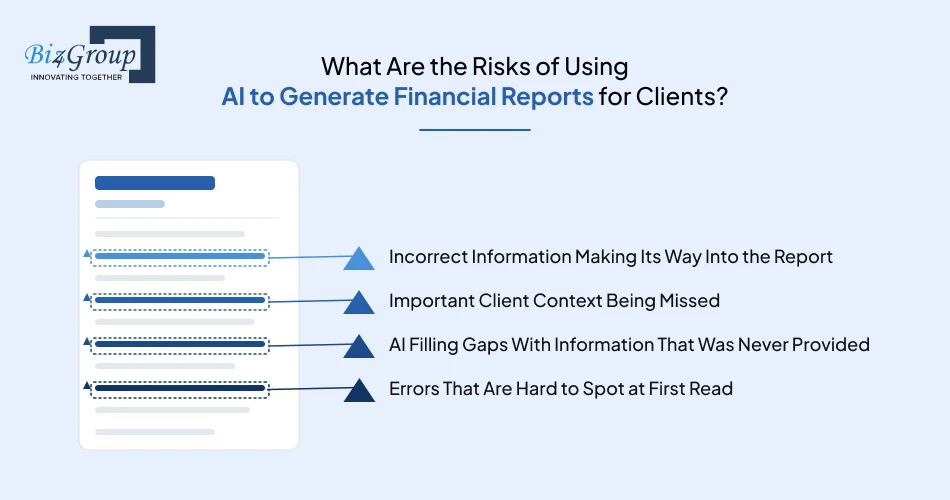
The main risk is not simply that AI can make mistakes. It is that those mistakes can make their way into a polished, client-facing report without being obvious. AI financial reporting can work quickly with large amounts of information, but wrong details, missing context, and unsupported statements can still end up in the final output.
Incorrect Information Making Its Way Into the Report
An incorrect number, date, figure, or statement can enter the report in several ways. The original information may be wrong, different sources may not match, or AI may misunderstand what the information means.
And what happens if just one important detail is wrong? It can change how the client understands the rest of the report, even if everything else looks perfectly fine.
Important Client Context Being Missed
Financial information does not always explain the full picture. Two clients may have similar numbers but very different goals, circumstances, or reasons behind those numbers.
Can AI know context it was never given? NO. If important client information is missing, the report may be factually correct but still miss what actually matters to that client.
AI Filling Gaps With Information That Was Never Provided
Sometimes the available information does not clearly answer a question. Instead of leaving that gap alone, AI may generate something that sounds reasonable and complete.
That is where AI-generated financial reports need extra attention. A statement can sound perfectly believable without having a clear basis in the information used to create the report.
Errors That Are Hard to Spot at First Read
The easiest errors to catch are the obvious ones. The harder ones are hidden inside a report that reads well, follows a logical structure, and looks professionally prepared. A quick read may tell you that the report sounds good. It does not always tell you whether every important detail is right.
AI can still be useful for client reporting. The key is making sure the workflow does not treat a polished output as proof that the report is ready to send.
Can Financial Advisors Use AI to Create Accurate Client-Facing Financial Reports?
Yes, but only if AI is used as part of a controlled reporting process. AI financial reporting for financial advisors can help turn available information into a structured report, but it cannot guarantee that the final output is accurate simply because the report was generated by AI.
AI Can Help Build the Report
AI can help organize information from the available sources and turn it into a readable first version. For AI client reporting for financial advisors, that can mean spending less time assembling the report and more time looking at what the report is actually saying.
- For example: Available portfolio details, investment performance data, and client information can be brought together to create an initial client-facing report instead of building every section manually. This happens to be one of the ways AI can support financial reporting.
Accuracy Still Depends on the Information Behind It
AI does not automatically fix bad or incomplete information. If the data behind the report is outdated, inconsistent, or missing something important, those issues can carry into the output. This is an important part of understanding how AI can improve financial reporting accuracy: AI can process information faster, but the information still needs to be reliable.
- For example: If two sources show different portfolio values, the difference needs to be resolved before either figure is used in the final report.
Advisor Review Remains Part of the Process
This is where AI-generated financial reports for financial advisors still need human judgment. The advisor has to look beyond whether the report reads well and decide whether it makes sense for that specific client.
- For example: AI may accurately summarize investment performance, but the advisor may know that a recent change in the client's goals needs to change how that information is presented.
AI can help build a client-facing report, but it should not become the last person to "sign off" on it. The advisor still owns the decision to send it.
How Can Advisory Firms Verify AI-Generated Financial Reports Before Sending Them to Clients?
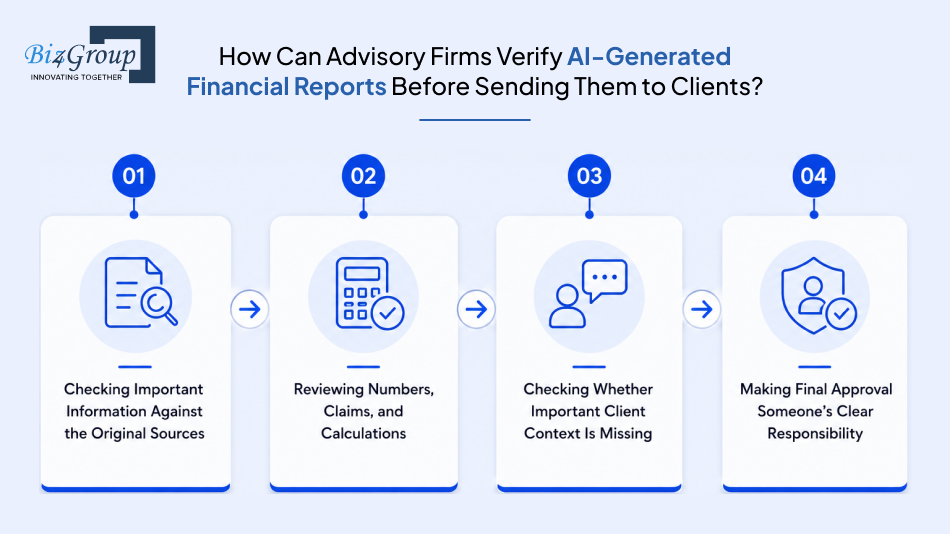
For AI financial reporting for advisory firms, verification should be part of the workflow, not something done only when a report looks suspicious. Important information should be checked against the original sources, key numbers and claims should be reviewed, missing client context should be considered, and one person should clearly own the final approval.
For an RIA handling reports across many clients, the concern is mostly about how errors can be caught before the client sees them. Questions like these often pop up:
We are an RIA managing reports for many clients, and I am worried that an AI-generated report could contain inaccurate financial information. How can we verify AI reports before they reach our clients?
Start by checking important information against the original sources. Key numbers, calculations, and client-specific claims should also be reviewed before delivery. A clear approval step then makes sure someone is responsible for deciding that the report is ready to send.
Checking Important Information Against the Original Sources
Start by tracing important details back to where they came from. AI can bring information together into one smooth report, but that does not remove the need to check whether the most important details match the original information.
- For example: If the report shows a client's current portfolio value, compare it with the latest figure in the original source before approving the report.
Reviewing Numbers, Claims, and Calculations
What if the numbers in the report look perfectly reasonable? They can still be wrong. The same goes for claims built around those numbers. This is where financial report accuracy and validation becomes a practical part of the review, rather than just a final proofread.
- For example: If a report says an investment outperformed its benchmark, check the underlying performance figures and the calculation behind the difference.
Checking Whether Important Client Context Is Missing
A report can be factually correct and still miss something that changes how the client should understand the information. Is there anything the advisor knows about the client that the underlying data does not show? That is often where a closer review becomes important.
- For example: A recent change in the client's investment goals may not appear in portfolio data but could affect how the report should be presented.
Making Final Approval Someone's Clear Responsibility
For anyone asking, "How can businesses review AI-generated financial reports?", one simple answer is to make sure the final decision clearly belongs to someone. Who is actually responsible for saying, "Yes, this is ready to send"? That should never be unclear.
- For example: An advisory firm can require the responsible advisor or a designated reviewer to approve each client report before it is sent.
|
What to Verify |
What the Reviewer Should Check |
|---|---|
|
Source information |
Do the important details match the original sources? |
|
Numbers and calculations |
Are key figures and calculations correct? |
|
Client context |
Has anything important about the client's situation been missed? |
|
Claims and conclusions |
Is every important statement supported by the available information? |
|
Final approval |
Is it clear who is responsible for sending the report? |
Verification does not have to mean turning every report into an audit. It simply means having a clear way to check what matters before AI-generated content becomes client-facing.
Don't Let a Polished Report Be the Final Check
Build AI-generated financial reports around source information, review steps, and clear human approval.
Explore Your AI Reporting OptionsWhat Controls Should an RIA Have When Using AI for Financial Reporting?
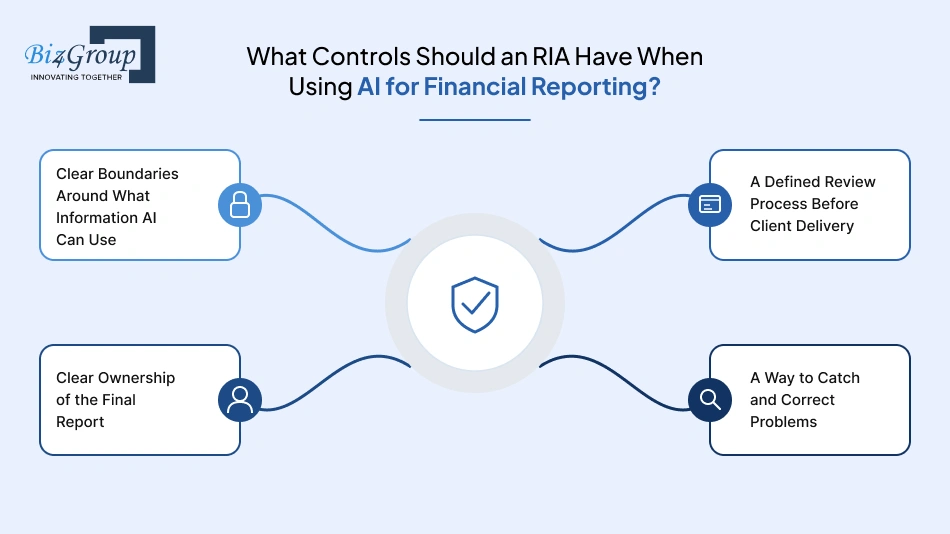
An RIA needs clear controls around what AI can use, how the report is reviewed, who gives the final approval, and what happens when something goes wrong. AI financial reporting for RIAs does not need a complicated chain of checks, but there should be no confusion about how AI-generated content gets from available information to a client-facing report.
For those asking:
I am a financial advisor and want to use AI to generate personalized client reports, but I need to maintain accuracy, compliance, and control over the final output. What should I look for in an AI reporting platform?
Look for clear controls around the information AI can use, along with a defined review and approval process. The platform should also make it possible to adapt reports to individual clients without letting personalization turn into unsupported assumptions. Most importantly, AI should not become the final decision-maker.
Clear Boundaries Around What Information AI Can Use
AI should work with information that is relevant to the reporting task. That means deciding what sources, files, or data the system can use instead of assuming everything available should automatically go into the report.
What if AI is given outdated or unrelated information? It may still use it if the workflow does not make those boundaries clear.
A Defined Review Process Before Client Delivery
Every report should have a clear point where someone checks it before it reaches the client. The level of review can vary depending on the report, but simply generating and exporting the output should not be the entire process.
For AI client reporting for RIAs, the question should be simple: What needs to be checked before this particular report is ready to send? The answer can then shape the review process.
Clear Ownership of the Final Report
Someone needs to be responsible for the final call. If an issue reaches the client, it should be clear who was expected to review the report before it was sent.
Who is actually responsible for saying, "This is ready"? For AI financial reporting for registered investment advisors, that responsibility should remain with a clearly identified person, not disappear somewhere between AI generation and client delivery.
A Way to Catch and Correct Problems
Problems will occasionally happen, even with good controls. What matters is whether the team has a clear way to fix the issue and prevent the same thing from happening again.
If AI misunderstands a particular type of financial information, for example, correcting that one report may not be enough. The team should also look at why it happened and whether the reporting workflow needs to change.
Good controls should not make AI financial reporting automation feel like extra work layered on top of an existing process. They should give the team enough structure to use AI confidently without losing sight of who is responsible for the final report.
How Does WorthOne Plan Make AI-Generated Reports Easier to Trust?
Trust does not come from AI creating the report. It comes from what information the AI works with, how easily the output can be checked, and who controls the final version. Those were practical questions Biz4Group LLC had to work through while developing WorthOne Plan for client-facing financial reporting.
Concern such as the one that's given below comes up when advisory teams want the time-saving side of AI without turning report delivery into a black box.
I run a financial advisory firm and we spend too much time preparing client-facing financial reports manually. Can AI automate the process while allowing our advisors to review everything before delivery?
Yes. AI can handle much of the report-building work while keeping the generated output open for advisor review. The key is to treat AI as the system that prepares the draft, not the one that gives final approval. Advisors should still be able to review the report, make changes where needed, and decide when it is ready to share.
Using the Information Already Available Instead of Letting AI Guess
One trust issue with generative AI in financial reporting is what happens when information is missing or unclear. Our platform that automates financial reporting with AI is built to work with the financial data already available for the report instead of simply letting AI fill every gap with an assumed answer.
That matters because an advisor can only properly review information when there is a clear basis for what appears in the report.
Making It Easy to Check the Report Before It Is Shared
A polished draft should still be easy to review. If checking an AI-generated report takes almost as much effort as building one from scratch, the workflow is not doing much to help.
Biz4Group's AI financial report generator keeps the drafted report open for review, allowing advisors to inspect the output, make changes, and catch anything that does not look right before sharing it.
Treating AI Output as a Starting Point, Not the Final Answer
This is an important boundary in AI client reporting for financial advisors. AI can help turn available financial information into a usable draft, but it should not quietly become the final decision.
WorthOne Plan keeps the advisor involved before the report is shared. AI helps build the report, while the advisor remains responsible for deciding whether it is ready for the client.
AI Can Build the Draft. Your Team Should Own the Decision.
Use AI for financial reporting while keeping advisors in control of review, edits, and final approval.
Plan Your AI Reporting SolutionWhen Can AI Financial Reporting Be Trusted With Client-Facing Reports?
AI financial reporting can be trusted when the information behind the report can be checked, the output has been reviewed in the right client context, and a person remains responsible for the final decision. For anyone asking, can AI be trusted for financial reporting?, the answer is yes, but trust has to come from the process around the AI, not from the generated output alone.
When the Information Behind the Report Can Be Checked
Important numbers, statements, and conclusions should be traceable to the financial information they came from. If something looks questionable, the advisor should be able to check it rather than assume the AI got it right.
That ability to trace and review the information is a key part of financial report accuracy and validation.
When the Output Has Been Reviewed in Context
Accurate numbers do not always mean the report tells the right story. Has anything recently changed for the client? Is important context missing? Does the way the information is presented still make sense?
For AI client reporting for financial advisors, reviewing the output in context can catch problems that a simple data check may miss.
When AI Is Not Making the Final Decision
AI can help build and organize the report, but it should not decide that the report is ready to send. Someone who understands the client and the information in the report still needs to make that call.
The simplest test is this: if the report cannot be explained, checked, and approved by the person sending it, it is probably not ready to be trusted with a client.
Conclusion
If you're asking "how can AI improve financial reporting?" The answer is that AI can play a useful role in financial reporting, but a polished report is not automatically a trustworthy one. The information behind it needs to be reliable, important details need to be checked, and the final output needs to make sense for the client receiving it.
One lesson from developing WorthOne Plan was that generating a report is only the visible part of the challenge. The harder part is designing the workflow around it so the AI knows what it can work with, where its output needs checking, and where it should stop rather than make its own final call.
That is where AI financial reporting becomes genuinely useful. AI can do more of the report-building work, while the advisor remains accountable for what the client ultimately receives.
FAQ’s
1. If AI creates a client report, how do I know it has not made up any financial information?
AI should not be trusted just because the report sounds complete. Important numbers, statements, and conclusions should be checked against the original financial information before the report is sent.
2. Can I use AI to draft client portfolio reports without letting it make investment decisions?
Yes. AI can help organize available information and create a report draft without being given responsibility for the final advice, interpretation, or decision.
3. What should my RIA check before sending an AI-generated financial report to a client?
Check the important numbers, claims, calculations, and client-specific context. Someone should also be clearly responsible for approving the final report.
4. Can an AI-generated report be factually correct but still be wrong for the client?
Yes. The numbers may be accurate while important client context, recent changes, or relevant circumstances are missing from the report.
5. What happens if the financial information given to the AI is incomplete or conflicting?
AI may carry those problems into the report or make an unsupported assumption to fill the gap. Conflicting or missing information should ideally be resolved before the final report is approved.
6. Do financial advisors still need to review reports created with AI?
Yes. AI can help build the report, but the advisor still needs to decide whether the information is correct, complete, and appropriate for that particular client.
7. Is it safe to send an AI-generated financial report directly to a client?
Not without a review process. The report should be checked before delivery, especially when it contains important financial information or client-specific conclusions.
8. How do we make AI-generated client reporting easier to trust without reviewing every line from scratch?
The goal is to build checks around the information that matters most. A good workflow should make important details traceable, highlight what needs attention, and leave the final approval with a responsible person.
