 Location :
Orlando, FL, USA
Location :
Orlando, FL, USA +1 (407) 714-1616
 info@biz4group.com
- The AI app development cost in 2026 typically ranges between $20,000 and $150,000+, and estimating this cost accurately depends on key variables like app complexity, AI model type, platform choice, and the scale of deployment being targeted.
- Accurately estimating the cost of building an AI app requires evaluating critical factors such as data readiness, UI/UX design complexity, AI model training requirements, technology stack selection, third party integrations, and industry specific compliance needs.
- Optimizing the development budget of an AI app is achievable by leveraging pre- trained AI models and APIs, adopting cloud-based infrastructure, and following agile methodologies that cut unnecessary spending and accelerate time to market.
- The building cost of an AI mobile app can be significantly controlled by starting with a lean MVP, validating core features with real users, and scaling the product gradually rather than investing the full AI app development budget into an untested product from day one.
- AI app pricing does not end at launch, as post release expenses including model retraining, API usage fees, infrastructure scaling, security audits, and ongoing maintenance typically add 15 to 30 percent annually to the overall cost of AI app development.
- The total AI application development cost varies significantly by industry, with healthcare, fintech, and legal sectors demanding higher investment due to strict data privacy laws, security architecture, and compliance certifications that directly impact the final AI app development budget.
- Teams seeking a transparent and cost-efficient AI app pricing structure can partner with Biz4Group, a trusted AI app development company known for delivering scalable AI solutions through rapid prototyping, modern AI frameworks, and end to end project execution across healthcare, fintech, ecommerce, and enterprise automation.
If you're a startup at the ideation stage planning to build an AI-powered application, one of the first questions you’ll likely ask is: “How much will it cost to develop a basic AI MVP without overspending our budget?”
The average AI app development cost typically ranges from $20,000 to $150,000+, depending on the app’s complexity, AI capabilities, integrations, scalability requirements, and data infrastructure. However, early-stage startups building a lean MVP AI app can often launch with a much smaller investment by focusing only on core features and using pre-trained AI models or APIs.
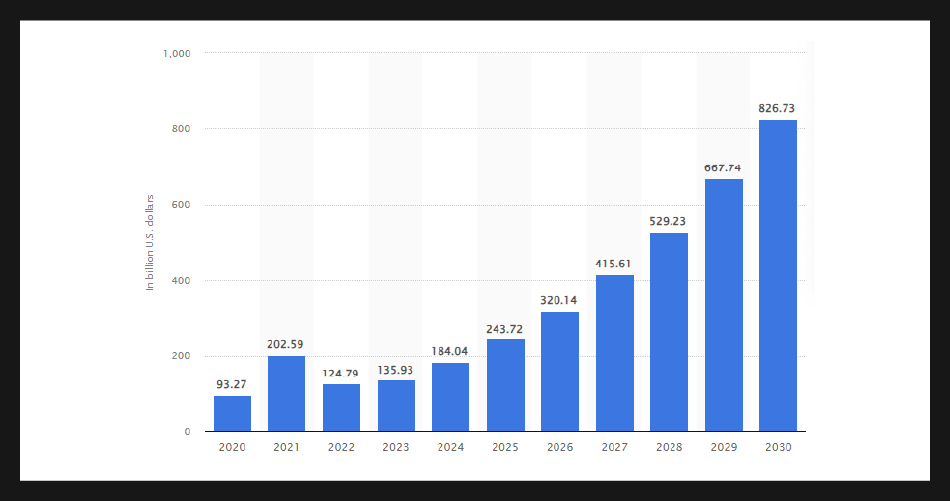
Today, AI-powered applications are transforming industries such as healthcare, fintech, eCommerce, education, customer support, and enterprise automation. According to industry reports, the global artificial intelligence market is projected to reach nearly $1.84 trillion by 2030, growing at a CAGR of approximately 32.9%. This rapid growth is pushing startups and businesses to invest in AI solutions faster than ever before.
As an AI app development company, Biz4Group specializes in building custom AI app solutions including AI chatbots, intelligent SaaS platforms, recommendation engines, automation systems, and AI-powered mobile applications. One of the most common concerns founders have during the early planning stage is understanding the custom AI app development cost and finding a realistic AI app estimation before starting development.
In this guide, we’ll break down:
- AI app development cost estimates for startups and enterprises
- Cost of building a basic AI MVP vs advanced AI applications
- Key factors affecting AI app estimation
- Hidden development and infrastructure costs
- Smart ways to reduce AI development expenses without compromising scalability
Let’s explore how much it really costs to build an AI app in USA and how startups can launch efficiently within budget.
What Exactly Is AI App Development and Why Does It Cost More Than Regular Apps
AI app development is the process of building applications that can simulate human intelligence using technologies like machine learning, natural language processing, computer vision, and predictive analytics. Unlike traditional software, AI-powered apps can learn from data, recognize patterns, automate decisions, and continuously improve their performance over time.
Examples of AI applications include:
- AI chatbots and virtual assistants
- Recommendation engines like Netflix or Amazon suggestions
- Predictive analytics platforms
- Generative AI apps powered by LLMs
- Computer vision and image recognition apps
While traditional mobile or web applications mainly follow fixed rules and predefined workflows, AI applications require additional layers of intelligence, data processing, and model training. This is one of the biggest reasons why AI app development cost is usually higher than regular app development cost.
A standard app typically involves front-end design, backend development, APIs, and database management. In contrast, AI-powered applications require:
- Large-scale data collection and processing
- AI model training and optimization
- GPU/cloud infrastructure for inference
- Continuous learning and model improvement
- Integration with AI APIs or custom machine learning models
- Specialized AI engineers, data scientists, and ML experts
For example, a basic mobile app may only process user inputs, but an AI app must analyze data, generate predictions, understand language, or create intelligent outputs in real time. These additional computational and engineering requirements significantly impact the custom AI app development cost.
Another major cost driver is AI infrastructure. Features like generative AI responses, image recognition, or predictive recommendations require cloud GPUs, vector databases, model hosting, and ongoing AI inference costs, which increase operational expenses over time.
This is why businesses looking for accurate AI app estimation must evaluate not only the app features, but also the complexity of AI models, data requirements, scalability needs, and long-term maintenance costs before starting development.
Why Do You Need to Consider Cost while Developing an AI App?
Understanding the AI app development cost is essential for businesses planning to build intelligent applications. Proper cost estimation helps companies allocate resources effectively, prioritize features, and ensure the project delivers strong return on investment.
Careful financial planning also reduces the risk of project failure, which is common in artificial intelligence initiatives. Industry reports suggest that only about 53% of AI projects successfully move from prototype to full production, highlighting the importance of structured development and cost planning.
Below are some key reasons why businesses must evaluate the cost to build an AI app before starting development.
1. Better Budget Planning
Estimating the cost of AI app development allows organizations to create a realistic development budget. This helps decision makers determine whether the project requires external funding, phased investment, or gradual feature rollout.
2. Clear Development Roadmap
Understanding costs helps teams divide the project into manageable stages. A phased approach ensures that businesses build essential features first while minimizing unnecessary spending.
3. Higher Return on Investment (ROI)
Strategic cost planning ensures resources are invested in features that deliver real business value, such as automation, data insights, or improved customer experience.
4. Reduced Risk of AI Project Failure
Many AI initiatives fail because companies attempt to build complex solutions all at once. Developing an AI application in structured phases increases the chances of success and allows teams to validate the product early.
A typical AI app development lifecycle includes the following stages:
- Wireframing: defining user flows and application structure
• Prototyping: building a visual model of the AI solution
• Minimum Viable Product (MVP): launching the first functional version with core features
• User Acceptance Testing (UAT): validating the AI app with real users
• Minimum Marketable Product (MMP): releasing a refined version ready for the market
• Feature Expansion: continuously adding advanced AI capabilities based on feedback
Following this phased development strategy helps businesses control the overall cost of AI app development while gradually improving the product.
Also Read: How to Integrate Chatbot in Website?
Why Now is the Perfect Time to Invest in AI Apps: Insights into the Booming Intelligent App Market
With artificial intelligence rapidly transforming industries, now is the ideal time to invest in AI app development. Businesses across the globe are shifting toward AI-enabled solutions to gain a competitive edge, streamline operations, and personalize user experiences at scale.
According to market research, the global
AI apps market reached nearly $2.94 billion in 2024 and is projected to grow to $5.13
billion by 2025, with an impressive CAGR of 38.7% through 2030.
This exponential
growth reflects not just rising demand but also the increasing return on investment of intelligent
applications, making the cost of AI apps more of a strategic investment than a simple expense.
Startups and enterprises alike are actively seeking reliable AI app development cost estimates to better plan budgets, manage risk, and launch impactful applications in high-opportunity sectors like healthcare, eCommerce, fintech, and customer support.
Whether you're a tech entrepreneur or a CTO, investing in AI app development now could position your business ahead of the curve, especially while cloud infrastructure and pre-trained AI models are making the cost of intelligent app development more accessible than ever before.
What is the Cost of Building an AI App?
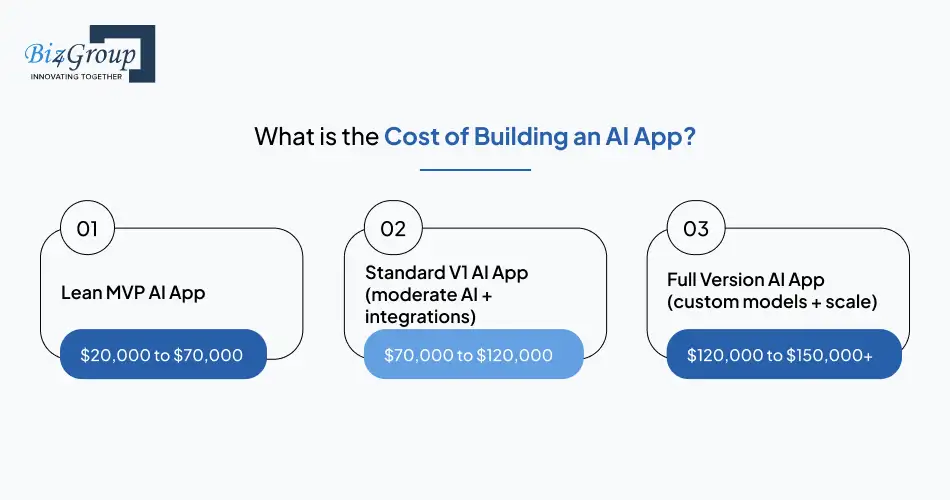
Before diving into detailed estimators, it is important to understand the core pricing tiers that influence the development cost of an AI app. The figures below will help you estimate an average cost to build an AI app based on complexity, AI depth, and the number of integrations your project requires.
|
Type of AI App |
Estimated Cost |
Best For |
What You Get |
|---|---|---|---|
|
Lean MVP AI App |
$20,000 to $70,000+ |
Early stage startups testing market demand |
Basic AI features powered by APIs, essential mobile app screens, lightweight backend, simple user flows |
|
Standard V1 AI App (moderate AI + integrations) |
$70,000 to $120,000+ |
Growing businesses that need stronger AI automation and integrations |
Moderate AI capabilities, analytics, third-party integrations, polished user experience, scalable architecture |
|
Full Version AI App (custom models + scale) |
$120,000 to $150,000+ |
Businesses aiming for advanced AI models and high performance at scale |
Custom AI models, training pipelines, large data processing, multi-platform app, enterprise-grade security and infrastructure |
These ranges give a clear picture of the cost of creating an AI app and help answer the common question: how much does it cost to make an app with AI.
AI App Development Cost Estimator – Get a Quick Quote
When businesses plan for an AI app, one of their first questions is: “How much will it cost?” On average, AI app development costs range between $20,000- $150,000+, depending on multiple variables like the type of app, feature set, data needs, and integration complexity.
To make early decision-making easier, embedding an AI app development cost estimator helps users get a rough quote instantly based on selected inputs.
AI App Development Cost Estimator Formula:
Estimated Cost = Base App Type Cost + (AI Feature Costs × Complexity Factor) + Integration Cost + UI/UX Design + Data Management Cost
Where:
- Base App Type Cost = Starting cost for a specific app type (e.g., chatbot, image detection)
- AI Feature Costs = NLP, ML models, sentiment analysis, etc.
- Complexity Factor = 1x to 2x multiplier based on the scope of work
- Integration Cost = CRM, ERP, third-party API connections
- UI/UX Design = Visual design and front-end interactivity
- Data Management = Collection, labeling, and model training support
Example Breakdown:
Let’s say a company wants to build an AI chatbot with CRM integration and sentiment analysis:
- Base App Type (AI Chatbot): $20,000
- AI Features (Sentiment Analysis + NLP): $15,000
- Complexity Factor:2×
- CRM Integration: $10,000
- UI/UX Design: $10,000
- Data Management: $5,000
Estimated Cost = ($20,000 + $15,000) × 1.2 + $10,000 + $10,000 + $5,000 = $67,000
Why Add This Estimator?
Including a "Get Instant Estimate" tool or calculator on your website:
- Boosts lead generation by engaging curious users
- Provides transparency on the cost of intelligent app development
- Helps users visualize how AI app development cost estimates vary
- Increases conversion rates by offering instant value
The tool can be as simple as dropdowns or sliders where users select options like:
- Type of AI app
- AI capabilities (e.g., NLP, computer vision)
- Required integrations
- Hosting preference (cloud/on-premise)
With the rising demand and inquiries around AI app cost, offering a dynamic estimate tool gives your business a competitive edge.
Get a custom cost estimate and take the first step toward building your intelligent AI app with confidence.
Also Read: How to Build an AI App?
AI App Development Cost – Factors that Influence
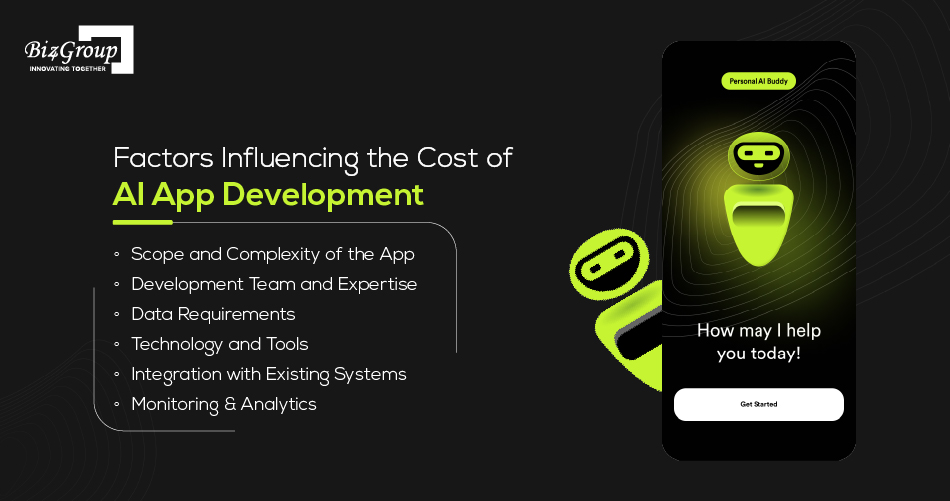
Several factors influence the cost of AI app development, including the complexity of the application, the expertise of the development team, data requirements, technology stack, system integrations, and post deployment monitoring. Understanding these elements helps businesses estimate the cost to build an AI app more accurately and plan their development budget effectively.
Below are the most important factors that impact AI app development cost.
1. Scope and Complexity of the App
The scope and complexity of features play a major role in determining AI development costs. Applications with basic functionality, such as simple AI chatbots or recommendation systems, generally require lower investment.
However, AI apps that include advanced capabilities like image recognition, natural language processing (NLP), predictive analytics, or automation workflows require more development time, advanced algorithms, and extensive testing.
More complex AI systems often require:
- custom machine learning models
- large data processing pipelines
- advanced model training
- continuous performance optimization
For example:
- AI travel planner apps typically cost between $20,000 and $80,000
- AI image detection systems may cost $50,000 to $200,000
2. Development Team and Expertise
The experience and size of the development team significantly influence the cost of AI app development.
Less experienced teams may offer lower development rates, but they often lack exposure to advanced AI frameworks, which can lead to longer development cycles, frequent errors, and costly rework.
Highly skilled AI engineers, data scientists, and ML specialists usually charge higher rates. However, their expertise helps ensure:
- faster development timelines
- better model accuracy
- fewer technical issues
- scalable system architecture
Working with experienced AI developers can ultimately reduce long term project risks and costs.
3. Data Requirements
High quality data is the foundation of any successful AI application. AI models require large volumes of clean, structured, and labeled data to generate accurate predictions and insights.
The data preparation process includes several stages, each contributing to the overall AI application development cost.
Typical data related costs include:
- Data collection from multiple sources: $5,000 to $20,000
- Data cleaning and preprocessing: $10,000 to $30,000
- Data labeling for supervised learning: $15,000 to $50,000
- Secure data storage infrastructure: $5,000 to $20,000 annually
- Data updates and maintenance: $10,000 to $40,000 annually
- Legal and compliance requirements: $5,000 to $15,000
Proper data management is essential to ensure reliable AI model performance.
4. Technology and Tools
AI applications require specialized technologies such as programming languages, machine learning frameworks, cloud platforms, and DevOps tools.
Common technologies used in AI development include:
- programming languages such as Python and R
- ML libraries like TensorFlow, Pandas, and PyTorch
- cloud platforms including AWS, Google Cloud, and Azure
- containerization and DevOps tools for deployment
The cost of implementing these technologies can range between $10,000 and $50,000, depending on the complexity of the project and infrastructure requirements.
5. Integration with Existing Systems
Many businesses build AI capabilities that must integrate with their existing digital infrastructure, such as CRM systems, ERP platforms, HR software, or internal databases. These integrations allow companies to enhance their current platforms with intelligent automation rather than building an entirely new system.
Integrating AI systems typically requires:
- custom API development
- secure data pipelines
- compatibility and performance testing
- modifications to the existing system architecture
For example, a company may add AI powered resume parsing to its existing HRMS platform to automate recruitment process using AI. This allows the system to automatically screen resumes, extract candidate data, and shortlist applicants based on predefined criteria. However, integrating AI into an existing HR platform requires careful customization to ensure secure and accurate data exchange between systems.
Because of the technical complexity involved, AI integration costs typically range between $20,000 and $100,000, depending on the number of systems involved, API requirements, and the complexity of the existing infrastructure.
6. Monitoring & Analytics
AI applications require continuous monitoring and performance optimization after deployment. Monitoring tools help track model accuracy, system performance, and user engagement metrics.
Post launch AI maintenance may include:
- performance monitoring
- AI model retraining
- bug fixes and updates
- analytics dashboards
- security improvements
These ongoing operational costs usually range between $5,000 and $20,000 annually.
Also Read: Success Stories of most Innovative AI Case Studies
Use-Case Wise Cost of AI App Development
The cost of AI app development varies widely based on the type of application, AI complexity, infrastructure requirements, integrations, and the amount of data processing involved. Some AI applications rely on lightweight APIs and basic automation, while others require advanced machine learning models, real-time analytics, computer vision, or large-scale cloud infrastructure.
This is why the cost to build an AI app can differ significantly from one use case to another. For example, a simple AI chatbot MVP may cost under $30,000, while enterprise healthcare AI platforms or computer vision systems may require much larger investments due to compliance, model training, and infrastructure complexity.
If your startup is trying to estimate AI app development pricing, understanding how different AI use cases impact development cost can help you plan features, budget, and scalability more effectively.
|
AI App Type |
Estimated Development Cost |
Major AI Features |
Common Business Use Case |
|---|---|---|---|
|
AI Chatbots |
$20,000 – $80,000+ |
NLP, conversational AI, sentiment analysis, automation |
AI customer support and virtual assistants |
|
Resume Parsing Software |
$40,000 – $120,000+ |
Resume extraction, keyword matching, candidate scoring |
AI recruitment and HR automation |
|
Predictive Analytics Tools |
$30,000 – $100,000+ |
Forecasting models, data analysis, pattern recognition |
Sales and demand forecasting |
|
Healthcare AI Apps |
$80,000 – $150,000+ |
Medical diagnostics, predictive insights, patient monitoring |
AI-assisted healthcare platforms |
|
AI-Powered CRM Systems |
$70,000 – $150,000+ |
Lead scoring, customer intelligence, behavior analysis |
Intelligent sales and CRM platforms |
|
AI Image Detection Systems |
$50,000 – $150,000+ |
Computer vision, object detection, real-time image processing |
Fitness, security, and retail AI apps |
|
Generative AI Applications |
$40,000 – $150,000+ |
LLM integration, AI content generation, prompt workflows |
AI writing tools and content platforms |
|
AI Recommendation Engines |
$30,000 – $90,000+ |
Personalization algorithms, user behavior tracking |
eCommerce and streaming platforms |
|
AI Voice Assistants |
$50,000 – $140,000+ |
Speech recognition, voice processing, conversational AI |
Smart assistants and voice automation |
|
AI SaaS Platforms |
$60,000 – $150,000+ |
Multi-user AI workflows, analytics dashboards, automation |
Enterprise productivity and workflow tools |
Why AI App Development Costs Vary by Use Case
The biggest reason AI application development cost changes across industries is the level of AI sophistication involved. Applications using basic NLP APIs or automation workflows usually cost less because they rely on existing AI services.
However, apps involving:
- custom machine learning models
- healthcare compliance
- computer vision systems
- real-time AI inference
- large-scale analytics
- generative AI infrastructure
typically require higher development budgets due to engineering complexity and infrastructure demands.
For startups and businesses building an AI MVP, the smartest approach is usually to begin with core AI functionality first, validate the product in the market, and expand advanced features gradually. This helps reduce upfront AI app development cost while maintaining scalability for future growth.
Cost to Build an AI App: Complete Timeline and Phase-Wise Breakdown
The cost to create an AI app is typically distributed across several development phases, including planning, design, MVP development, AI model training, testing, and deployment. Each stage contributes to the overall AI mobile app development cost and ensures that the final product is scalable, reliable, and ready for real-world use.
Understanding how the budget is allocated across the AI development lifecycle helps businesses manage investments more effectively and avoid unexpected expenses.
Below is a phase-wise breakdown of the AI app development cost structure and the key activities involved in each stage.
1. Planning & Discovery – $5,000 to $10,000+
This phase involves understanding your business goals, defining the app’s purpose, target users, required AI features, and outlining the project scope.
Key Activities:
- Market research & competitor analysis
- AI feasibility assessment
- Project requirement gathering
- Rough timeline and budget planning
This step sets the foundation and ensures clarity before major investments begin.
2. UI/UX Design – $8,000 to $15,000+
User interface and experience design ensure that the app is intuitive and user-friendly, while also making room for AI-driven interactions.
Key Activities:
- Wireframing and user flow
- High-fidelity design mockups
- Design of AI interaction points (chat windows, visual outputs, etc.)
Great design reduces friction and enhances user trust in AI functionality.
3. MVP Development – $15,000 to $35,000+
MVP development is a crucial phase in the AI app journey. The Minimum Viable Product (MVP) is your app’s first functional version. It includes essential features, without full AI sophistication, and allows early testing.
Key Activities:
- Core front-end and back-end development
- Basic integration (APIs, databases)
- Initial deployment on staging
This version helps validate the product concept before scaling AI capabilities.
4. AI Model Development & Training – $20,000 to $50,000+
This is the most intensive and critical phase for AI-based applications. The cost depends on whether you're training custom models or using pre-trained APIs.
Key Activities:
- Data collection and preprocessing
- AI model selection or creation
- Model training, testing, and optimization
- Integration of AI logic into the app
For apps requiring natural language processing, image detection, or recommendation engines, this phase drives major development costs.
5. Testing & QA – $5,000 to $15,000+
Ensures your AI app performs accurately, reliably, and securely before going live. This includes both functional testing and AI performance validation.
Key Activities:
- Unit testing, integration testing
- UAT (User Acceptance Testing)
- AI model performance evaluation
- Bug fixing and optimization
Especially critical for AI apps, as models must be validated for real-world accuracy.
6. Deployment & Post-Launch Support – $7,000 to $25,000+
The final stage includes launching the app in the production environment and providing ongoing support, updates, and model re-training if needed.
Key Activities:
- Final deployment (App Store, cloud, internal systems)
- Monitoring and analytics integration
- Maintenance and model updates
- Post-launch user feedback integration
Ongoing support is essential to keep your AI models relevant and high-performing.
By distributing your budget wisely across these AI app development cost phases, you can ensure optimal use of resources, higher success probability, and measurable ROI.
Table Overview of AI App Development Cost on the Basis of Phases
|
Development Phase |
Estimated Cost Range |
|---|---|
|
Planning & Discovery |
$5,000 - $10,000+ |
|
UI/UX Design |
$8,000 - $15,000+ |
|
MVP Development |
$15,000 - $35,000+ |
|
AI Model Development & Training |
$20,000 - $50,000+ |
|
Testing & QA |
$5,000 - $15,000+ |
|
Deployment & Post-Launch Support |
$7,000 - $25,000+ |
This phase-wise breakdown is essential for business owners and tech leads to plan the development process effectively, avoid cost overruns, and align their strategy with technical realities.
Cost of Developing an AI App by Industry / Sector (2026 Estimates)
The cost of developing an AI app varies significantly by industry, as each sector requires different AI capabilities, regulatory compliance, integrations, and data processing requirements. For example, healthcare AI apps often require strict data security and regulatory compliance, while social media AI platforms focus more on recommendation algorithms and content moderation.
The table below shows the estimated AI app development cost by industry in 2026, helping businesses compare budgets and identify the investment required for different types of AI applications.
AI Application Development Cost by Industry (2026 Estimates)
|
App Type |
Cost |
Best For |
Examples |
|---|---|---|---|
|
$60,000 – $150,000+ |
Clinics, hospitals, diagnostics platforms |
Symptom checkers, AI triage, medical imaging assistants |
|
|
$50,000 – $140,000+ |
Relationship apps, matchmaking startups |
AI matchmaking, smart chat, profile scoring |
|
|
$70,000 – $150,000+ |
Community platforms, social networking apps |
AI feeds, content moderation, recommendation engines |
|
|
$40,000 – $120,000+ |
Property rental/sale platforms, agents |
AI property recommendations, virtual assistants |
|
|
$45,000 – $130,000+ |
eLearning platforms, tutoring apps |
AI tutors, personalized learning paths |
|
|
$50,000 – $140,000+ |
Insurance agencies, fintech startups |
AI underwriting, claim automation |
|
|
$30,000 – $150,000+ |
Creators, influencers, entertainment |
AI avatars, image-to-avatar transformation |
|
|
$40,000 – $130,000+ |
Recruiting agencies, HR tech |
AI resume screening, job-matching engines |
|
|
$40,000 – $120,000+ |
Wellness companies, therapy platforms |
AI mood tracking, chat-based guidance |
|
|
$60,000 – $150,000+ |
Law firms, compliance startups |
AI document review, case analysis |
|
|
$50,000 – $150,000+ |
Streaming, creator ecosystems |
AI content creation, recommendation systems |
|
|
$40,000 – $125,000+ |
Booking apps, travel planners |
AI itinerary planning, smart trip suggestions |
|
|
$35,000 – $110,000+ |
Agri-tech startups, farms |
Crop prediction, soil analysis, yield forecasting |
|
|
$60,000 – $150,000+ |
Fintech, investment platforms |
AI trading bots, market prediction tools |
|
|
$50,000 – $140,000+ |
Betting platforms, gaming startups |
AI odds prediction, risk engines |
These estimates help you quickly compare AI application development cost by industry so you can plan the right features, budget, and strategy before starting your AI app project.
Hidden AI App Development Costs That Can Blow Your Budget in 2026
When startups estimate the cost to build an AI app, they usually focus only on design, development, and AI model integration. However, many hidden expenses appear after development begins or once the product goes live. These overlooked costs are often the reason AI projects exceed their original budget.
If your team wants to reduce AI app development costs without sacrificing quality, understanding these hidden expenses early can help you plan smarter, prioritize better, and avoid expensive surprises later.
For most businesses, the total AI app development cost ranges from $20,000 to $150,000+, but hidden operational and scaling costs can easily increase the budget by another 20% to 40% over time.
1. AI Model Retraining and Fine Tuning Costs
AI models are not “set and forget” systems. Over time, user behavior, market trends, and data patterns change, causing model accuracy to decline. This is known as model drift.
To maintain performance, most AI applications require retraining or fine tuning every 3 to 6 months.
Typical retraining expenses include:
- Data collection and cleaning
- Model optimization
- GPU/cloud compute costs
- Testing and deployment
Estimated Cost: $5,000 to $30,000 per retraining cycle
Many startups reduce these costs by starting with pre-trained models instead of building custom AI systems from scratch. This is one of the most practical strategies companies use to optimize custom AI app development cost while maintaining quality.
2. Inference and API Usage Costs Post Launch
One of the biggest hidden expenses in AI app development is inference cost, meaning the cost of running AI models in production after launch.
Unlike traditional apps, AI systems continuously consume computing resources every time users interact with them. If your app uses GPT APIs, image generation models, or recommendation engines, you are charged based on usage.
For example:
- AI chatbots are often billed per token processed
- Image generation apps are billed per generated image
- Voice AI systems charge per audio minute processed
A startup may launch with low infrastructure expenses, but as usage grows, monthly AI API costs can rise rapidly.
Estimated Cost: $500 to $20,000+ per month depending on traffic and AI usage volume
To reduce AI app estimation risks, many companies implement response caching, lightweight models, and hybrid AI architectures to lower inference costs without compromising user experience.
3. Monitoring and Observability Costs
AI systems require constant monitoring to ensure outputs remain accurate, safe, and reliable. Unlike traditional software bugs, AI failures can be unpredictable and difficult to detect manually.
This is why companies use AI observability platforms such as:
- LangSmith
- Helicone
- Arize AI
These tools help teams monitor:
- hallucinations and AI errors
- latency and response quality
- token consumption
- user interactions
- model performance drift
Estimated Cost: $500 to $5,000+ per month depending on scale
Monitoring tools are especially important for generative AI apps, customer-facing chatbots, and enterprise AI systems handling sensitive workflows.
4. Employee Training and Change Management
Many businesses underestimate the internal cost of adopting AI tools inside their organization. Even the best AI application can fail if employees are not properly trained to use it.
AI adoption often requires:
- onboarding sessions
- workflow redesign
- operational documentation
- employee training programs
- internal process adjustments
For enterprise AI deployments, change management alone can add significant overhead to the project budget.
Estimated Impact: 10% to 20% of total AI app development cost
Companies that successfully control AI implementation costs usually launch AI features gradually instead of transforming entire workflows at once.
5. Third Party Integrations and API Licensing
Most AI applications need integrations with external platforms such as:
- CRM systems
- ERP software
- payment gateways
- analytics platforms
- cloud storage services
Each integration requires API development, authentication handling, testing, and ongoing maintenance.
Estimated Cost: $2,000 to $15,000+ per integration
For startups trying to build an AI MVP on a tight budget, prioritizing only mission-critical integrations can significantly reduce early-stage AI app development expenses.
6. Security Audits and Penetration Testing
Security is one of the most overlooked AI app development costs, especially for startups rushing toward launch. However, insecure AI systems can expose sensitive data, create compliance issues, and damage customer trust.
AI applications often require:
- penetration testing
- API security validation
- encryption audits
- vulnerability assessments
- compliance reviews
Estimated Cost: $3,000 to $25,000+ depending on app complexity and compliance requirements
Many companies regret skipping this stage because fixing security vulnerabilities after launch is usually far more expensive than preventing them during development.
Understanding these hidden AI app development costs early helps startups create a more accurate AI app estimation, avoid budget overruns, and build scalable AI products without compromising quality or long-term growth.
Some Famous AI Business Applications' Development Costs
One of the best ways to understand AI app development cost is by analyzing the estimated budgets behind popular AI-powered business platforms already dominating the market. These applications combine technologies like natural language processing, predictive analytics, recommendation engines, automation workflows, and generative AI, making them strong benchmarks for startups planning similar products.
The actual custom AI app development cost depends on factors such as AI model complexity, integrations, scalability, user traffic, security requirements, and ongoing infrastructure expenses. While some AI MVPs can be launched affordably using APIs and pre-trained models, enterprise-grade AI platforms often require significantly larger investments.
Below are estimated development costs for different categories of AI business applications and the major cost-driving features behind them.
|
AI Business Application |
Estimated Development Cost |
Major AI Features Driving Cost |
|---|---|---|
|
Virtual AI Customer Agents like Drift |
$50,000 – $100,000+ |
NLP chatbot, conversational AI, CRM integration, workflow automation |
|
Resume Parsing Software like Zoho Recruit |
$40,000 – $120,000+ |
Resume extraction, candidate matching, AI screening algorithms |
|
AI-Powered Writing Assistant like Textio |
$50,000 – $110,000+ |
Generative AI, tone analysis, NLP optimization |
|
Sales Analytics Platforms like Gong.io |
$60,000 – $130,000+ |
Predictive analytics, speech analysis, AI sales insights |
|
AI Grammar Checker like Grammarly |
$80,000 – $200,000+ |
Advanced NLP, contextual corrections, generative AI suggestions |
|
AI Financial Assistant like Cleo |
$70,000 – $150,000+ |
Financial forecasting, behavioral AI, personalized recommendations |
|
AI CRM Software like InsightSquared |
$70,000 – $150,000+ |
Customer analytics, lead scoring, predictive sales intelligence |
|
Predictive Analytics Tools like Looker |
$30,000 – $100,000+ |
Data visualization, forecasting models, business intelligence |
|
AI Inventory Management like TradeGecko |
$60,000 – $140,000+ |
Demand forecasting, stock prediction, automation workflows |
|
AI Customer Support Platforms like Freshdesk |
$40,000 – $90,000+ |
AI ticket routing, chatbot automation, sentiment analysis |
What Startups Can Learn from These AI App Cost Estimates
Most successful AI startups do not launch with every advanced feature from day one. Instead, they begin with a lean AI MVP focused on solving one high-value business problem, then gradually expand functionality based on user adoption and revenue growth.
For example:
- AI chatbot startups often begin with GPT-based APIs instead of training custom language models
- AI analytics platforms initially use third-party cloud AI services to reduce infrastructure costs
- Generative AI apps frequently launch with limited workflows before scaling GPU resources
This phased development strategy helps businesses reduce AI app estimation risks while maintaining product quality and scalability.
If your startup is evaluating the cost to develop an AI app, these examples provide a realistic benchmark for understanding how AI features directly impact development budgets, infrastructure costs, and long-term operational expenses.
Should You Build a Custom AI App, Buy a Ready Made Solution, or Use a No Code Builder in 2026?
One of the biggest questions businesses ask before starting AI development is:
“Should we build a custom AI app from scratch, integrate existing AI APIs, or use a no-code AI platform to save our development costs?”
The answer depends on your budget, business goals, scalability requirements, data privacy needs, and technical expertise. Choosing the wrong approach can lead to unnecessary AI app development costs, delayed launches, or expensive rebuilds later.
In 2026, companies have four major options for building AI-powered applications.
|
Approach |
Estimated Cost Range |
Best For |
Limitations |
|---|---|---|---|
|
No Code AI Builder |
$15 to $500/month |
Solopreneurs, MVP validation, internal tools |
Limited customization and scalability |
|
API Integration (GPT, Claude, Gemini) |
$5,000 to $50,000+ |
Startups, SaaS apps, AI MVPs |
Ongoing API and inference costs |
|
Custom AI Development |
$50,000 to $500,000+ |
Enterprises, advanced AI products |
High upfront investment |
|
Open Source Models (Self Hosted) |
$20,000 to $150,000+ |
Privacy-focused businesses, long-term cost optimization |
Requires ML expertise and infrastructure management |
Option 1: No Code AI Builders
No-code AI platforms allow businesses to launch simple AI applications without writing complex code. These tools are ideal for startups validating an idea quickly or building internal automation systems on a limited budget.
Popular use cases include:
- AI chatbots
- workflow automation
- lead generation tools
- lightweight AI assistants
The biggest advantage is low upfront cost and rapid deployment. However, customization, scalability, and ownership remain limited.
Best For:
- founders validating an MVP
- non-technical teams
- early-stage startups testing market demand
Option 2: AI API Integrations
Many startups reduce custom AI app development cost by integrating APIs from providers like OpenAI, Anthropic Claude, or Google Gemini instead of training AI models from scratch.
This approach significantly lowers development time while still enabling advanced AI capabilities like:
- conversational AI
- content generation
- recommendation engines
- summarization
- sentiment analysis
However, businesses must account for long-term inference and token usage costs as user traffic grows.
Best For:
- SaaS startups
- AI MVP development
- businesses launching quickly with limited budgets
Option 3: Custom AI App Development
Custom AI app development involves building proprietary AI app tailored specifically to your business workflows and data. This provides maximum flexibility, scalability, and competitive advantage.
Custom development may include:
- proprietary machine learning models
- private AI infrastructure
- enterprise integrations
- advanced predictive analytics
- industry-specific AI automation
While this approach delivers the highest level of control, it also comes with the highest AI app development cost due to engineering complexity, infrastructure requirements, and ongoing maintenance.
Best For:
- enterprise AI products
- highly specialized use cases
- companies seeking long-term differentiation
Option 4: Open Source AI Models (Self Hosted)
Many businesses are now using open-source AI models to reduce dependency on expensive commercial APIs. Self-hosted AI allows companies to control infrastructure costs, improve data privacy, and customize models deeply.
This approach is becoming increasingly popular for:
- healthcare AI applications
- fintech platforms
- enterprise AI systems handling sensitive data
However, managing open-source AI models requires machine learning expertise, GPU infrastructure, monitoring systems, and DevOps support.
Best For:
- privacy-focused organizations
- companies with internal AI teams
- businesses optimizing long-term AI operational costs
How to Decide Which AI Development Approach Is Right for You
Before choosing an AI development strategy, your team should answer these questions:
- Are you building an MVP or a long-term scalable product?
- How important is customization and ownership?
- What is your realistic AI app estimation and budget range?
- Will your app process sensitive or regulated data?
- Can your team manage AI infrastructure internally?
- Are ongoing API costs sustainable at scale?
- How quickly do you need to launch?
Practical Decision Framework for Startups
Choose a No-Code AI Builder if:
- you want to validate an idea quickly
- your budget is extremely limited
- your AI workflows are simple
Choose AI APIs if:
- you need fast AI integration
- you want advanced AI capabilities without massive infrastructure costs
- you are building a startup MVP
Choose Custom AI App Development if:
- AI is your core product differentiator
- you need full scalability and customization
- long-term competitive advantage matters most
Choose Open Source AI Models if:
- privacy and data ownership are critical
- you want to reduce dependency on third-party APIs
- your business can support ML operations internally
Which Option Is the Most Cost Effective?
For most startups in 2026, integrating AI APIs into an MVP is usually the most cost-efficient approach because it balances speed, scalability, and lower upfront investment.
As the product grows, companies often transition toward hybrid or custom AI infrastructure to reduce long-term operational expenses and gain more control over their AI ecosystem.
Understanding these options early helps businesses optimize AI mobile app development costs while selecting a strategy that aligns with their growth goals, technical capabilities, and budget limitations.
In House Team vs Freelancers vs AI App Development Agency-What Will Actually Cost You Less?
One of the biggest decisions companies face while estimating the cost to build an AI app is whether to hire an internal team, work with freelancers, or partner with an AI app development agency.
Many businesses ask:
“Our company is deciding between hiring an AI app development agency or building an in-house team and we are looking for a detailed cost comparison to help us make the right call.”
The answer depends on your project complexity, launch timeline, internal technical expertise, scalability goals, and long-term AI strategy. Each approach affects your AI app building pricing differently in terms of upfront investment, operational overhead, and long-term maintenance costs.
Building an In-House AI App Team
Building an internal AI team gives businesses complete control over product development, infrastructure, and intellectual property. However, it is usually the most expensive option during the early stages.
A typical AI product team may include:
- AI/ML engineers
- backend developers
- frontend developers
- DevOps specialists
- QA engineers
- UI/UX designers
- product managers
In 2026, experienced AI engineers in the United States earn approximately $120,000 to $200,000+ per year, excluding recruitment costs, employee benefits, cloud infrastructure, and operational overhead.
Another major challenge is hiring time. Building a fully functional AI team often takes 3 to 6 months or longer, which can delay product launch significantly.
Best For:
- enterprises building multiple long-term AI products
- companies requiring full ownership of AI systems
- businesses investing heavily in proprietary AI technology
Hiring Freelance AI App Developers
Freelancers can help reduce initial artificial intelligence app development cost, especially for startups building lightweight MVPs or testing AI concepts quickly.
Average freelance AI app developer rates in 2026:
|
Region |
Average Hourly Rate |
|---|---|
|
United States & Canada |
$100 – $250/hour |
|
Western Europe |
$80 – $180/hour |
|
Eastern Europe |
$40 – $100/hour |
|
India & Southeast Asia |
$25 – $80/hour |
Freelancers are commonly hired for:
- chatbot integrations
- AI automation features
- proof-of-concept development
- small AI MVP projects
However, freelance hiring also involves risks related to:
- inconsistent availability
- communication delays
- scalability limitations
- project continuity issues
- intellectual property protection
Best For:
- projects under $30,000
- startups validating early AI ideas
- businesses with internal technical management
Hiring an AI App Development Agency
An AI app development agency provides end-to-end AI product development, helping companies launch faster while reducing operational complexity.
Most agencies offer:
- AI consulting and strategy
- UI/UX design
- full-stack development
- AI model integration
- cloud deployment
- testing and maintenance
Average AI application development cost through agencies typically ranges from $40,000 to $150,000+, depending on app complexity, AI capabilities, infrastructure, and scalability needs.
Although agency pricing may seem higher initially, many businesses reduce long-term expenses through:
- faster time-to-market
- reduced hiring overhead
- access to specialized AI expertise
- structured project management
- lower risk of technical failures
Best For:
- startups building scalable AI MVPs
- enterprises launching production-ready AI systems
- companies without dedicated AI expertise internally
Offshore vs Onshore AI App Development Cost Comparison
Many businesses lower AI app development cost by outsourcing development offshore. In 2026, offshore AI development can reduce total project expenses by approximately 30% to 50% compared to fully onshore teams.
|
Development Model |
Cost Impact |
|---|---|
|
Onshore Development (US/Western Europe) |
Higher cost, easier collaboration |
|
Offshore Development (India, Eastern Europe, Southeast Asia) |
Lower cost, broader talent access |
|
Hybrid Model |
Balanced cost and communication |
However, offshore development may involve tradeoffs related to timezone differences, communication speed, and project coordination.
Which Option Is Most Cost Effective?
For most startups and mid-sized businesses, partnering with an experienced AI app development agency is often the most practical option because it combines technical expertise, predictable delivery, and lower operational complexity.
Meanwhile, enterprises with continuous AI initiatives may benefit more from investing in long-term internal AI teams.
Understanding these tradeoffs helps businesses create a realistic AI application development cost breakdown for startups and enterprises while balancing budget, scalability, speed, and product quality.
How to Optimize AI App Development Cost
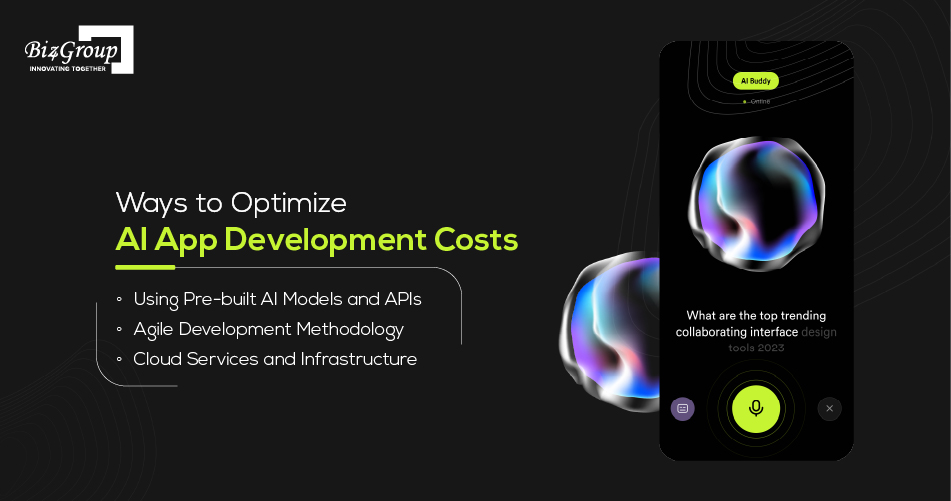
Now, the point is, as a businessperson how you can optimize AI app development cost for your business. Here are some insights on how you can optimize the cost of AI app development:
1. Using Pre-built AI Models and APIs
You can simply leverage pre-built AI models and API solutions. This eliminates the need for bearing cost for developing AI models from scratch.
Additionally, pre-built models are created and refined by industry experts, which enhances the probability of high accuracy and reliability.
For example, an AI chatbot development company use OpenAI's GPT API or Google's Dialogflow API instead of building an AI model from scratch. This way, you can easily integrate natural language processing capabilities, high accuracy, and reliability, while saving time and resources on development and training.
2. Agile Development Methodology
In agile development methodology, projects are divided into small units – named “sprints”. Each sprint is meant to deliver a specific set of features. Sprints also lead to early detection of issues.
Moreover, iterative testing is an integral part of agile methodology. Such testing ensures a continuous feedback loop, wherein errors can be identified and rectified on time. Thus, this methodology leads to less costly rework, when it comes to developing AI apps.
Most importantly, an iterative development approach can support your phase-wise development process.
3. Cloud Services and Infrastructure
Leveraging cloud services for AI development leads to reducing huge upfront costs of purchasing and maintaining physical hardware. Cloud services fall under pay-as-you-go model wherein fluctuating workload can be managed on and off. Additionally, cloud services also provide access to advanced AI tools so that there is less dependency on in-house expertise.
Further costs can be reduced as cloud providers also handle infrastructure maintenance, security, and updates.
However, some of our enterprise clients wanted on-premises data hosting due to data security. This means apps that handle sensitive data (i.e. patient health data) might require on-premises or private hosting on the cloud.
How Biz4Group LLC Optimize Your AI App Development Cost?
One of the most common questions business leaders ask before investing in AI app is:
“Our board wants to know if building an AI app is worth the cost for a business our size and we are looking for real examples of companies that have done it and what results they achieved.”
At Biz4Group, we help startups, SMBs, and enterprises answer that question with practical AI strategies, realistic budgeting, and measurable business outcomes. As one of the leading AI app development companies in USA, our approach focuses on building scalable AI applications while optimizing development costs, infrastructure expenses, and long-term operational efficiency.
Instead of pushing businesses toward unnecessary complexity, we help clients identify the most cost-effective path based on their goals, industry, user scale, and AI requirements. This includes selecting the right AI models, cloud architecture, integrations, and deployment strategy from the very beginning.
Our AI app development methodology focuses heavily on reducing unnecessary spending through:
- agile and modular development workflows
- reusable AI components and code libraries
- pre-trained AI models instead of costly custom training
- scalable cloud-native infrastructure
- efficient API and compute optimization
- phased MVP-first development strategies
This allows businesses to reduce overall AI app development cost without compromising scalability, security, or performance.
Real Projects Where Biz4Group Optimized AI App Development Cost
Biz4Group LLC has successfully delivered numerous AI-powered applications across industries, consistently helping clients control expenses, accelerate launch timelines, and maintain product excellence.
1. AI-Powered Personal Fitness App – Built Smart, Delivered Within Budget
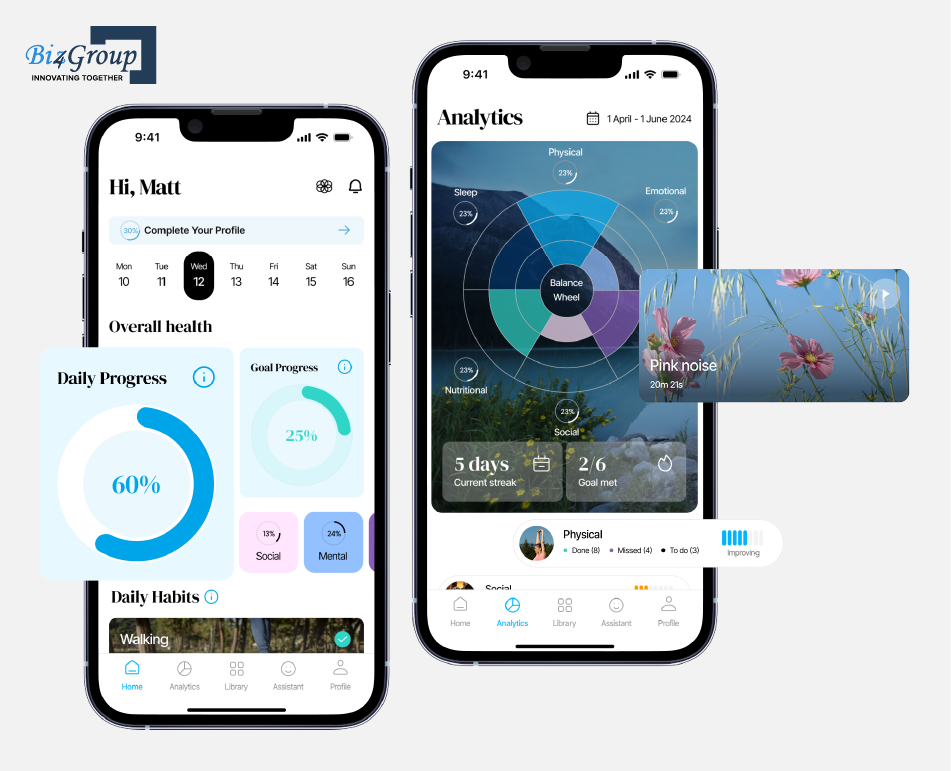
View Project: AI Personal Fitness App
Biz4Group developed a wellness-focused AI application designed to improve physical fitness, nutrition, sleep, and behavioral health.
To optimize development costs, our team:
- used pre-trained LLMs for personalized recommendations
- reused scalable UI components across modules
- implemented cloud-native infrastructure for flexible scaling
As a result, the client launched an advanced AI-powered wellness platform while staying within their planned budget and reducing future infrastructure costs.
2. AI Mental Health App for Dementia Support – Human-Centered, Budget-Optimized
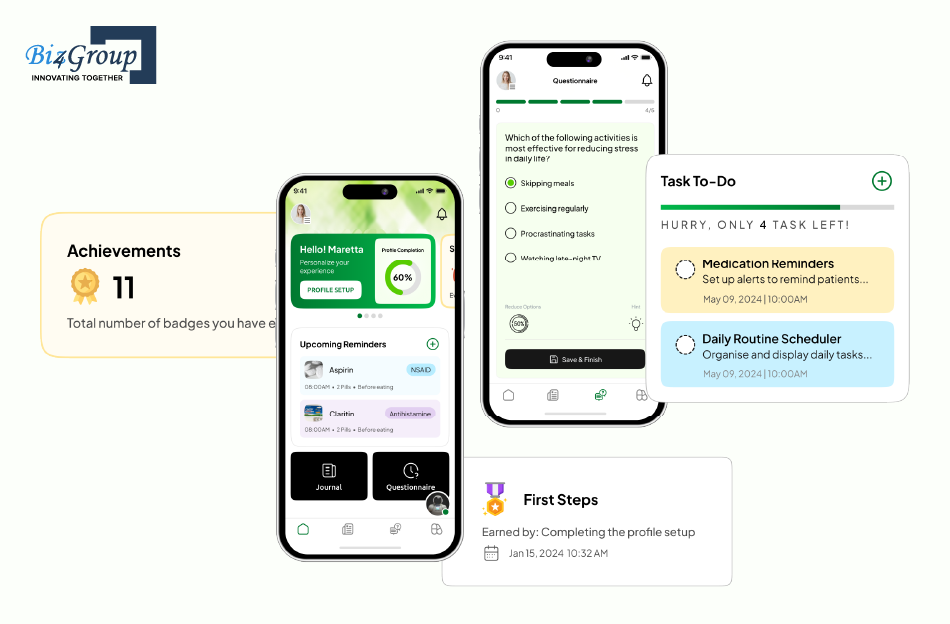
View Project: AI Mental Health App for Dementia patients
For a healthcare client focused on dementia support, Biz4Group built an AI-powered cognitive assistance platform designed to help patients manage social and daily activities.
To control AI application development costs, we implemented:
- lightweight AI models for faster performance
- optimized data pipelines to reduce storage expenses
- modular architecture for future feature expansion
This allowed the client to launch a scalable healthcare AI app solution without the massive costs often associated with enterprise healthcare systems.
3. AI Custom Workout App – Advanced VLMs Without High AI Costs
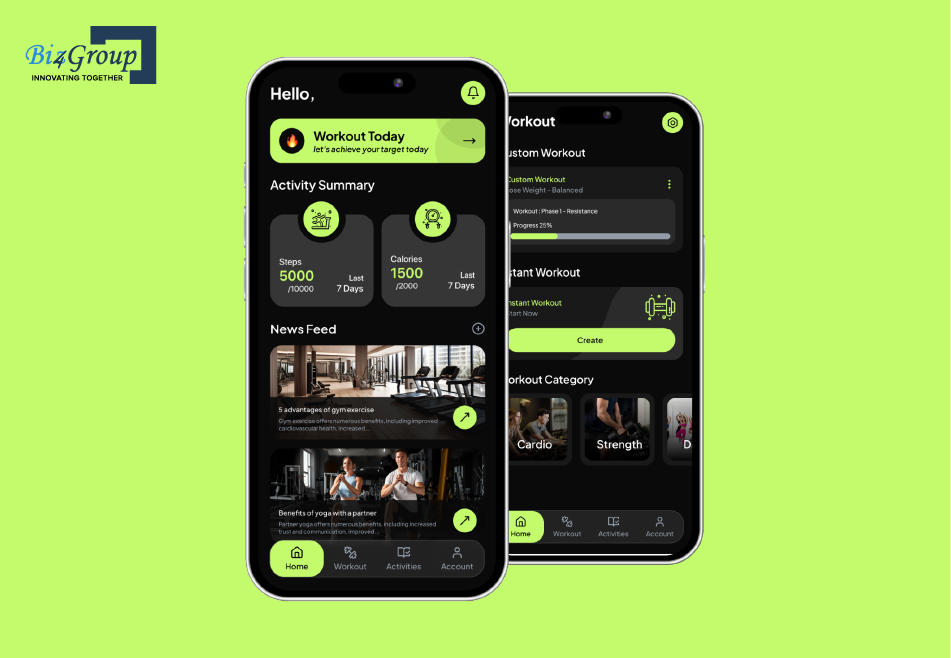
View Project: AI Workout App
This AI-powered fitness platform used Vision-Language Models (VLMs) to analyze body composition, posture, and muscle tracking.
Our cost optimization strategies included:
- quantized AI models to reduce GPU usage
- serverless cloud pipelines for compute efficiency
- reusable AI fitness algorithms from previous projects
These decisions significantly reduced cloud infrastructure costs while maintaining high AI performance and scalability.
4. AI-Powered Social Media App – High-Performance AI on a Startup Budget
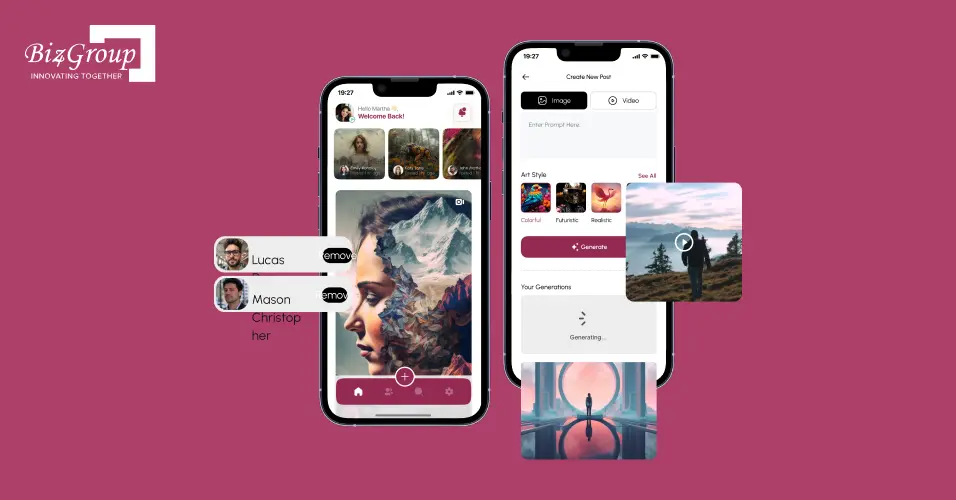
View Project: AI Social Media App
Biz4Group also developed a next-generation AI social platform that enabled users to create AI-generated images and videos.
To help the startup control development expenses, we used:
- pre-trained generative AI integrations
- on-demand GPU infrastructure
- optimized media delivery pipelines
This enabled the client to launch an innovative AI platform on a startup-friendly budget while remaining scalable for future user growth.
Why Businesses Trust Biz4Group for Cost-Optimized AI Development?
Businesses partner with Biz4Group because we focus not only on building AI products, but also on maximizing ROI from every development dollar invested.
Our clients benefit from:
- transparent and realistic AI cost planning
- scalable AI architectures built for future growth
- optimized cloud infrastructure and AI operations
- faster development cycles using modular frameworks
- long-term support, monitoring, and AI model optimization
Whether you are building a fitness app, healthcare platform, social media solution, enterprise automation tool, or generative AI application, Biz4Group helps businesses develop AI apps efficiently while maintaining scalability, security, and long-term business value.
Conclusion
The cost of AI app development in 2026 generally ranges between $20,000 and $150,000+, depending on the app’s complexity, AI capabilities, integrations, infrastructure, and scalability requirements. While simple AI MVPs and chatbot applications can be developed within a limited budget, advanced AI platforms involving custom models, predictive analytics, or computer vision require higher investment.
The key to controlling AI app development cost is choosing the right strategy from the beginning, whether that means starting with a lean MVP, leveraging pre-trained AI models, or selecting the right development partner. Businesses that plan carefully can reduce unnecessary expenses while building scalable and future-ready AI solutions.
At Biz4Group, we help startups and enterprises build cost-efficient AI applications tailored to their goals, budget, and growth plans.
Ready to turn your AI app idea into reality?
Book an appointment with our AI experts
today and get a customized AI app development cost estimate for your project.
Frequently Asked Questions
1. How much does it cost to build an AI app in 2026?
The average AI app development cost in 2026 typically ranges between $20,000 and $150,000+, depending on factors such as app complexity, AI features, integrations, infrastructure, scalability, and data requirements. Basic AI MVPs or chatbot applications usually cost less, while enterprise-grade AI platforms using custom machine learning models, generative AI, or computer vision require significantly higher investment.
2. What factors affect the cost of AI app development the most?
The biggest factors influencing AI app development cost include the complexity of AI models, feature requirements, integrations with third-party systems, data collection and training needs, cloud infrastructure, security requirements, and ongoing maintenance. Apps using advanced AI capabilities like predictive analytics, recommendation engines, or generative AI usually require more development time and computational resources.
3. How much does it cost to maintain an AI app after it is launched?
AI app maintenance costs generally range from 15% to 25% of the initial development cost annually. Ongoing expenses may include AI model retraining, cloud hosting, API usage, security updates, monitoring tools, bug fixes, feature enhancements, and infrastructure scaling as user traffic grows over time.
4. Is it cheaper to build an AI app using APIs like ChatGPT or Claude versus building a custom model from scratch?
Yes, using APIs like OpenAI GPT or Anthropic Claude is usually far more cost-effective for startups and MVPs because it eliminates the need for expensive AI model training and infrastructure setup. API-based AI apps can often be developed within $5,000 to $50,000, while building custom AI models from scratch may increase development costs substantially due to data preparation, GPU infrastructure, and machine learning engineering requirements.
5. What are the hidden costs of AI app development that most businesses overlook?
Many businesses underestimate hidden AI costs such as model retraining, inference and API usage fees, monitoring tools, cloud GPU infrastructure, security audits, compliance requirements, and employee training. These operational expenses can significantly increase the long-term cost of running an AI-powered application if they are not planned properly during the early stages of development.
6. How long does it take to develop an AI app and how does the timeline affect the total cost?
The AI app development timeline directly impacts the overall project budget because longer development cycles require more engineering hours, infrastructure usage, and testing efforts. A basic AI MVP usually takes around 2 to 4 weeks, while advanced AI applications with custom features, integrations, and scalable infrastructure can take approximately 5 to 12 weeks or longer depending on complexity.
7. How do I choose the right AI app development company without overpaying in 2026?
To choose the right AI app development company, businesses should evaluate real AI project experience, technical expertise, scalability capabilities, transparent pricing, communication processes, and post-launch support services. Instead of selecting the cheapest option, companies should focus on finding a development partner that can balance quality, scalability, delivery speed, and realistic AI app cost estimation without unnecessary upselling.
