 Location :
Orlando, FL, USA
Location :
Orlando, FL, USA +1 (407) 714-1616
 info@biz4group.com

 AI Summary Powered by Biz4AI
- AI real estate insurance risk scoring platforms turn property, claims, hazard, inspection, imagery, and geospatial data into explainable risk intelligence for insurance teams.
- The strongest platforms move beyond static scores by supporting new business, renewals, inspections, claims, loss prevention, and portfolio risk management with human review and traceable outputs.
- Successful development depends on reliable property data, purpose-built risk models, explainability, enterprise integrations, MLOps, security, and insurance governance, not the AI model alone.
- Development typically costs $60,000-$100,000 for an MVP, $100,000-$200,000 for a mid-market platform, and $200,000-$350,000+ for an enterprise-grade system, based on scope and complexity.
- A capable development partner such as Biz4Group can help connect product strategy, real-estate AI experience, integrations, deployment, and post-launch support into one development path.
Could a property that looks low-risk in a static database actually be carrying very different exposure today? A wildfire, hailstorm, inspection finding, or occupancy change can quickly shift the risk picture. That is where AI real estate insurance & risk scoring platform development starts to prove its value.
The idea is to bring property details, hazard exposure, imagery, inspections, claims, and other approved data together in one place. Then, instead of leaving underwriters to piece everything together themselves, turn those signals into a clear property risk profile they can actually review, understand, and act on.
And there's a good reason this kind of visibility is getting more attention. Swiss Re reported in March 2026 that North America recorded more than $90 billion in insured natural catastrophe losses in 2025, with wildfires and severe convective storms accounting for most of those losses.
The global numbers are just as striking. Secondary perils, including wildfires and severe convective storms, made up a record 92% of insured natural catastrophe losses, reaching $107 billion in 2025. In a market where property risk can change quickly, having a clearer, more up-to-date view isn't just helpful, it can make the difference between reacting to risk and actually staying ahead of it.
That changes the game for what an AI insurance platform really needs to deliver. It's not enough to simply spit out a risk score and call it a day. A useful system should explain what's driving that score, flag meaningful changes, keep humans in the loop when judgment matters, and seamlessly bring risk intelligence into underwriting, claims, and portfolio workflows.
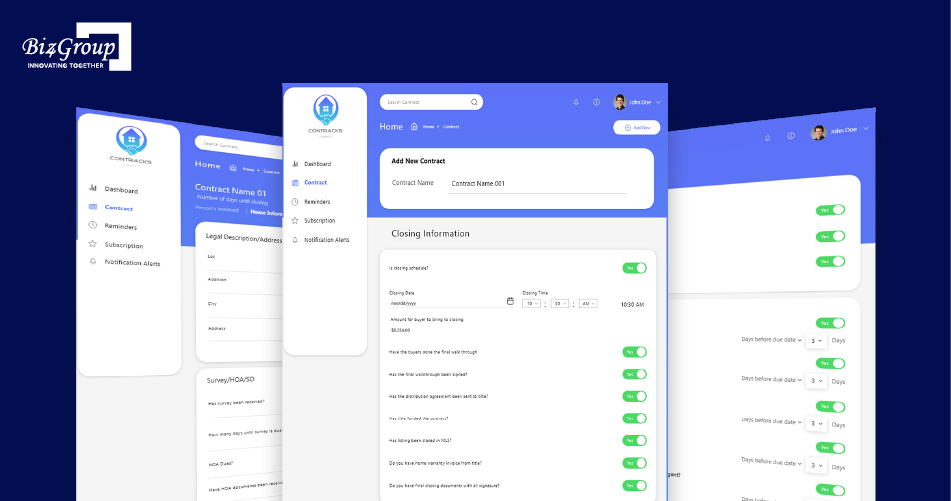
While building Contracks for real-estate professionals, Biz4Group learned an important lesson, property-related work gets messy when information, inspections, documents, alerts, and decisions are scattered across different processes. By bringing everything into one connected workflow, and letting AI take care of the document-heavy work, we saw just how powerful it can be when intelligence is built right into the work itself.
So, what does an AI real estate insurance and risk scoring platform actually do, and how does it turn property data into decisions? Let's understand.
What Does an AI Real Estate Insurance & Risk Scoring Platform Do?
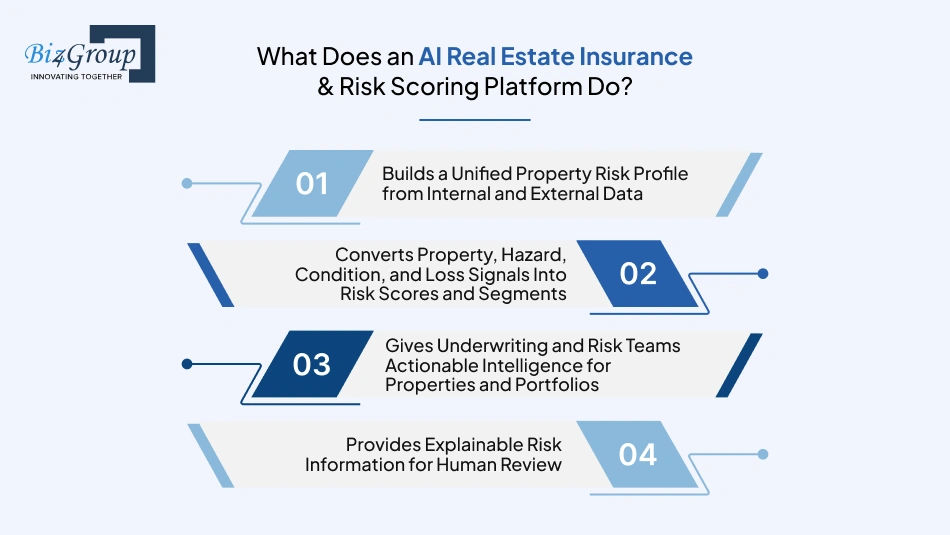
An AI real estate insurance and risk scoring platform combines property, hazard, condition, claims, and other approved data to create risk profiles, generate explainable scores, and deliver decision support to underwriting and risk teams. It supports insurance decisions but does not automatically replace underwriting judgment.
1. Builds a Unified Property Risk Profile from Internal and External Data
A strong AI property risk assessment starts by creating one reliable view of a property across multiple data sources.
What Data Goes into the Property Profile?
Depending on the use case, the platform can connect:
- Building age, construction, occupancy, square footage, and roof characteristics
- Policy, claims, and inspection records
- Flood, wildfire, wind, hail, earthquake, and other hazard exposure
- Parcel and geospatial data
- Aerial, satellite, or street-level imagery
- Permits, property records, and other approved external data
The platform must also resolve differences between sources. An address may identify a property in one system, while a parcel ID or internal risk ID identifies it in another. Entity resolution and data validation are therefore part of the risk architecture, not optional cleanup.
2. Converts Property, Hazard, Condition, and Loss Signals Into Risk Scores and Segments
The platform turns raw signals into measurable indicators that align with a defined insurance outcome. These can include property risk scoring, hazard-specific scores, risk segments, predicted loss measures, or inspection priorities.
A score needs a clear definition. "Risk" is too broad on its own.
For example, the model could estimate relative wildfire exposure, likelihood of loss, inspection priority, or another approved target. Each objective requires different training data, features, validation methods, and thresholds.
The output might then group properties into segments such as standard review, additional review, or further assessment. These segments support workflow decisions rather than acting as automatic approval or decline decisions.
3. Gives Underwriting and Risk Teams Actionable Intelligence for Properties and Portfolios
Risk scores become useful when teams can act on them.
At the property level, an underwriter may use the platform to identify missing information, review changing hazard exposure, or prioritize an inspection. At the portfolio level, risk teams can identify concentration, accumulation, and shifts in exposure across regions, hazards, or property types.
A practical AI risk assessment platform should let users move between the two views.
For example, a portfolio dashboard might show increased wildfire exposure in a region, while the underlying records reveal which properties contributed to the change and what factors drove their individual scores.
4. Provides Explainable Risk Information for Human Review
An insurer should be able to answer a basic question quickly: "Why did this property receive this score?"
The platform should show the factors that materially influenced the output, relevant source data, recent changes, model version, and appropriate confidence or uncertainty information.
Instead of presenting only, "Property Risk Score: 78"
The platform could provide:
- Primary factors: high wildfire exposure, older roof characteristics, prior loss activity
- Recent change: updated hazard data increased the wildfire exposure classification
- Evidence: linked inspection, property, or geospatial records
- Model information: model version and scoring date
This gives underwriters context to review, challenge, or escalate a result. It also creates a stronger basis for auditability and model governance.
Risk scoring should therefore be treated as decision support. AI insurance underwriting may use these outputs to prioritize and inform decisions, while applicable underwriting controls and human review remain in place.
How Does an AI Property Risk Scoring Platform Work?
An AI-powered insurance risk scoring platform works as a data-to-decision pipeline. It collects property and insurance data, checks and enriches it, converts it into risk features, applies specialized AI models, combines the outputs into risk scores, explains the results, and sends the final intelligence into underwriting and other insurance workflows.
1. Ingests Property, Insurance, Claims, Geospatial, Hazard, Imagery, and Document Data
The first step is creating a reliable data foundation for each property. The platform pulls information from internal insurance systems and approved external sources, then links those records to the correct property.
What Data Is Ingested?
A typical AI property insurance risk assessment platform may ingest:
- Property characteristics such as construction type, year built, square footage, occupancy, roof type, and building condition
- Policy information, coverage details, prior underwriting decisions, and claims history
- Inspection records, photographs, repair observations, and loss-prevention reports
- Parcel boundaries, location coordinates, elevation, surrounding structures, and other geospatial attributes
- Hazard data for wildfire, flood, wind, hail, earthquake, storm, and other exposures
- Aerial, satellite, or street-level imagery
- Permits, property records, and other approved public or commercial datasets
- Unstructured documents such as inspection reports, appraisals, and property descriptions
The platform should retain the source, timestamp, property identifier, and other provenance information for each important data element. That becomes important later when a user needs to understand where a score came from.
2. Validates, Normalizes, Enriches, and Converts Data Into Risk Features
Collected data cannot be sent directly into a risk model. It first needs to be checked for completeness, consistency, accuracy, and relevance.
How Is Raw Data Prepared?
The platform can perform address normalization, duplicate detection, missing-value checks, unit conversion, geospatial matching, and entity resolution.
For example, one system may identify a property through an address while another uses a parcel ID. The platform needs to determine that both records refer to the same insured location before combining them.
It can then enrich the property record with derived information. A property coordinate, for example, can be matched against wildfire zones, flood maps, wind exposure layers, or nearby environmental conditions.
The final result is a structured feature set that represents the property's measurable risk characteristics.
What Is a Risk Feature?
A risk feature is a model-ready representation of an observed property or exposure characteristic.
|
Source Signal |
Example Risk Feature |
|---|---|
|
Year built |
Building age |
|
Claims history |
Loss frequency or recent loss activity |
|
Roof inspection |
Roof condition indicator |
|
Property coordinates |
Hazard exposure score |
|
Elevation data |
Flood-related exposure feature |
|
Aerial imagery |
Observable roof or site characteristics |
|
Occupancy records |
Occupancy risk category |
|
Permit history |
Recent structural modification indicator |
This feature layer is one of the most important parts of property risk scoring. Poorly defined or inconsistent features can reduce model reliability even when the underlying machine-learning method is technically strong.
3. Uses Machine Learning and Other AI Models to Estimate Relevant Risk Factors
The platform then applies AI models to identify relationships between property characteristics, exposure conditions, and historical insurance outcomes.
Why Use Multiple Models?
Different risk signals require different analytical methods. A single model is rarely the best way to process structured claims data, property imagery, inspection documents, and geographic exposure.
For example:
- Machine learning can analyze structured property and claims data to estimate loss-related outcomes.
- AI Computer vision can analyze property imagery for observable characteristics such as roof or exterior conditions.
- NLP can extract relevant information from inspection reports and other documents.
- Geospatial AI can evaluate the relationship between a property and surrounding hazards, infrastructure, terrain, or other spatial variables.
- Predictive analytics can estimate how specific risk indicators may change over a defined period.
The platform can then combine these model outputs rather than forcing every risk signal into one generalized model.
4. Combines Model Outputs Into Risk Scores, Segments, Predictions, and Confidence Measures
Once the individual models produce their outputs, the scoring layer converts those outputs into a consistent risk representation that matches the insurance use case.
How Is Property Risk Scored?
The scoring engine can combine model predictions, validated features, actuarial inputs, business rules, and approved weighting logic to calculate the final risk output.
For example, a property risk model could consider:
40% hazard exposure + 25% property condition + 20% loss history + 15% building characteristics
Those percentages are illustrative. Production weighting should come from the defined modeling methodology and validation process rather than being chosen simply because it seems reasonable.
The platform may then produce:
- A property risk score
- Hazard-specific scores
- Risk segments
- Predicted loss indicators
- Inspection priority
- Risk-change indicators
- Confidence or uncertainty measures
The score should always have a defined meaning. A score for wildfire exposure is not interchangeable with a score predicting overall property loss.
Why Include Confidence or Uncertainty?
Two properties can receive similar scores while having very different levels of supporting evidence.
One property may have recent inspections, complete claims history, current imagery, and well-maintained property records. Another may have missing inspection data and outdated imagery.
A confidence indicator can help an underwriter recognize when a score is supported by strong evidence and when additional information may be appropriate.
5. Applies Explainability to Identify the Main Drivers of Each Score
A risk score should not appear as a black box. The explainability layer shows which inputs materially influenced the result and provides the context needed for human review.
What Makes a Risk Score Explainable?
Depending on the model, the platform can provide:
- Primary factors influencing the score
- Feature contribution or importance information
- Human-readable reason codes
- Changes from a previous score
- Source records supporting key inputs
- Model version and scoring date
- Confidence or uncertainty information
- Relevant business rules applied to the result
Main Drivers
- High wildfire exposure
- Older roof characteristics
- Recent roof-condition concerns
- Prior loss activity
Change Since Previous Assessment
- Updated hazard data increased wildfire exposure
This gives the underwriter something concrete to review. They can verify the underlying evidence, challenge an incorrect input, request an inspection, or continue with the existing workflow.
Explainability also supports AI governance, because the organization can document how a particular model version produced an output rather than retaining only the final score.
6. Delivers Risk Intelligence to Underwriters, Analysts, and Connected Insurance Systems
The last stage turns model output into an operational decision-support tool. Risk intelligence can be shown directly in underwriting interfaces or passed through APIs into existing insurance systems.
Where Are the Outputs Used?
Depending on the implementation, scores and explanations can support:
- New-business underwriting
- Renewal review
- Inspection prioritization
- Claims investigation
- Loss-prevention programs
- Portfolio monitoring
- Risk concentration analysis
- Property-level review
For example, an underwriter reviewing a submission could see the property score, major risk drivers, supporting evidence, and recommended follow-up actions without manually gathering that information from several systems.
Why Integration Matters?
The value of an AI insurance platform depends partly on what happens after the model generates a score. APIs can connect the scoring engine with policy administration, claims, rating, CRM, data warehouses, and other enterprise systems.
This creates a closed workflow:
Data Sources → Property Profile → Risk Features → AI Models → Risk Score → Explanation → Human Review → Insurance System
That workflow also creates a foundation for continuous reassessment. When new claims, inspections, imagery, property changes, or hazard data arrive, the platform can determine whether the property's risk profile needs to be updated rather than waiting for the next manual review.
Also Read: A Guide to AI Insurance App Development
Got the Data. Now Make It Work.
Turn your property data into scores your underwriting team can actually use.
Talk to a Biz4Group ExpertWhere Can AI Risk Scoring Improve Property Insurance Workflows?
AI property risk assessment can improve property insurance workflows by helping teams prioritize work, identify material changes, allocate inspection capacity, monitor portfolio exposure, target mitigation, and investigate claims with better property context.
1. New-Business Workflows Can Enrich Submissions and Prioritize Underwriting Review
For new business, an AI insurance platform can enrich a submission before underwriting review by pulling together relevant property, hazard, claims, and geospatial information. It can also flag missing data and route submissions that need closer review.
For example, a submission may contain the property address, building details, occupancy, and requested coverage. The platform can add approved external data and identify factors such as elevated wildfire exposure, prior losses, or incomplete property information.
The workflow can then separate routine submissions from those requiring additional documentation, inspection, or senior underwriting review. The risk score supports that prioritization rather than automatically determining whether the policy should be accepted.
2. Renewal Workflows Can Reassess Changing Property Conditions and Hazard Exposure
At renewal, the main value is identifying what has changed since the previous assessment. An AI risk assessment platform can compare current and historical property data to flag material changes in condition, occupancy, claims, or hazard exposure.
For example, new imagery may indicate a roof change, an inspection may report deterioration, or updated hazard data may increase exposure for the property.
The workflow can surface only the properties with meaningful changes for review, instead of requiring underwriters to manually recheck the same information across the entire book.
3. Inspection Workflows Can Prioritize Properties That Warrant Further Assessment
Property risk scoring can help inspection teams allocate limited field and remote inspection resources based on defined risk indicators.
A property may receive a higher inspection priority because of unresolved inspection findings, recent claims, changing hazard exposure, visible condition changes, or incomplete property data.
The platform should connect that priority to a specific action, such as requesting documents, ordering an inspection, or assigning specialist review. This makes the score operational rather than just informational.
4. Portfolio Workflows Can Identify Concentration, Accumulation, and Emerging Risks
Portfolio analysis looks beyond individual properties to understand how exposures interact across the book. Property risk analytics can reveal geographic concentration, hazard accumulation, clusters of similar property characteristics, and changes in exposure over time.
For example, several properties may have acceptable individual risk scores while sharing significant exposure to the same wildfire zone. A property-level view can miss that concentration.
Portfolio teams can use these insights to examine:
- Geographic and hazard concentration
- High-value exposure clusters
- Accumulation within specific regions or property types
- Increasing risk across defined segments
- Emerging changes in portfolio exposure
This makes the platform useful for accumulation management, portfolio oversight, and reinsurance analysis.
5. Risk-Mitigation Workflows Can Prioritize Properties for Loss-Prevention Actions
An AI property risk assessment platform can help insurers connect identified risks with appropriate loss-prevention actions.
A property with elevated wildfire exposure may require vegetation management, while a property with roof-condition concerns may require maintenance or repair. The workflow can prioritize properties based on risk severity, potential impact, available evidence, and the relevance of a mitigation action.
A useful implementation can then track:
Risk identified → Mitigation assigned → Action completed → Risk reassessed
That feedback allows the insurer to determine whether the property's risk indicators changed after mitigation rather than treating the recommendation as the final step.
6. Claims Workflows Can Provide Property Intelligence for Investigation and Risk Analysis
Claims teams can use existing property intelligence to understand the location before and after a loss. Relevant property records, prior inspections, imagery, hazard exposure, and claims history can be surfaced within the claims workflow.
An adjuster may need to determine what the property looked like before the event, whether a condition was previously documented, or whether the location had known exposure to the reported hazard.
Computer vision can help analyze available imagery, while NLP can extract relevant facts from inspection and other documents. These capabilities provide evidence and context for investigation without turning the AI output into an automatic claim decision.
Across all six workflows, the role of insurance risk assessment AI is to help teams decide where to look, what changed, and what action may be appropriate. The human decision remains connected to the underlying evidence, workflow rules, and applicable insurance controls.
What Are the Core Features of an AI Insurance Risk Scoring Platform?
An AI insurance platform needs more than a risk model. A production platform connects property data, scoring, underwriting workflows, monitoring, explainability, security, and APIs so teams can use risk intelligence within existing insurance processes.
|
Core Feature |
What It Does |
Why It Matters |
|---|---|---|
|
Property Intelligence and 360-Degree Risk Profiles |
Combines property, claims, inspection, hazard, imagery, geospatial, occupancy, and condition data into one property record. |
Gives teams a consistent view of property exposure and condition. |
|
Automated Data Ingestion, Validation, and Enrichment |
Ingests internal and third-party data, validates records, resolves property identities, detects gaps, and adds relevant risk attributes. |
Improves input quality before data reaches models and reduces manual preparation. |
|
Configurable Risk Scoring and Risk Segmentation |
Converts validated features and model outputs into risk scores, segments, hazard indicators, and other defined outputs. |
Supports different products, portfolios, regions, and underwriting rules. |
|
Underwriting Dashboards and Decision-Support Interfaces |
Displays scores, risk drivers, source evidence, score changes, data gaps, and review actions. |
Helps underwriters understand and act on the output. |
|
Risk Alerts, Thresholds, and Portfolio Monitoring |
Flags defined score changes, threshold breaches, concentration, accumulation, and emerging exposure. |
Helps risk teams focus on material changes instead of reviewing every property manually. |
|
Explainable Scores, Reason Codes, and Audit Trails |
Records score drivers, model versions, inputs, timestamps, review actions, and other relevant events. |
Supports human review, governance, reproducibility, and auditability. |
|
Role-Based Access and API-Based Data Delivery |
Controls access by role and sends risk outputs to underwriting, policy, claims, rating, and other enterprise systems through APIs. |
Protects sensitive data and embeds risk intelligence into existing workflows. |
What Advanced AI Features Can Be Added to a Property Risk Scoring Platform?
Advanced AI capabilities can extend a property risk scoring platform from static assessment into prediction, spatial analysis, image-based inspection, continuous reassessment, simulation, and workflow automation. These capabilities are most useful when the core data, scoring, and governance layers are already reliable.
|
Advanced AI Feature |
What It Does |
Why It Matters |
|---|---|---|
|
Predictive Loss Modeling and Forward-Looking Risk Forecasts |
Uses historical losses, property characteristics, hazard exposure, and other approved signals to estimate defined future insurance outcomes. |
Helps underwriting and portfolio teams evaluate potential future loss rather than relying only on current risk conditions. |
|
Geospatial and Catastrophe-Risk Intelligence |
Analyzes property location, terrain, hazard zones, surrounding exposures, and spatial relationships. |
Reveals location-specific and accumulation risks that may not be visible in property records alone. |
|
Computer Vision for Property-Condition and Inspection Analysis |
Analyzes property and inspection imagery for observable characteristics such as roof or exterior-condition indicators. |
Reduces manual image review and helps identify properties that warrant closer inspection. |
|
Dynamic Risk Scoring Based on Changing Property and Exposure Data |
Reassesses risk when material changes occur in property condition, claims, occupancy, imagery, or hazard exposure. |
Keeps risk assessments aligned with current conditions instead of relying on stale point-in-time evaluations. |
|
Scenario Analysis and Portfolio Risk Simulation |
Models how portfolio exposure could change under defined hazard, property, geographic, or business scenarios. |
Helps risk teams evaluate concentration, accumulation, and potential portfolio impact before taking action. |
|
AI Agents for Automated Data Retrieval, Analysis, and Workflow Coordination |
Performs defined research and analysis tasks across approved data sources, summarizes findings, identifies gaps, and coordinates workflow steps. |
Reduces repetitive analyst work while keeping defined approvals and human review for consequential decisions. |
|
Continuous Model Monitoring and Adaptive Risk Intelligence |
Monitors model performance, data drift, calibration, feature changes, and output stability after deployment. |
Helps identify when models or data are becoming less reliable and need investigation, recalibration, or retraining. |
Adaptive intelligence should not mean uncontrolled self-updating. Model changes should move through documented review, testing, validation, versioning, and approval before affecting production insurance workflows.
What Technology Stack Supports an AI Property Risk Scoring Platform?
An AI property risk scoring platform typically uses a layered architecture across data engineering, AI/ML, APIs, MLOps, and security. The right stack depends on data volume, model types, existing insurance systems, deployment requirements, and governance needs. The architecture should make each layer independently scalable and replaceable rather than tying the entire platform to one technology.
|
Technology Layer |
Typical Technologies |
What It Does |
|---|---|---|
|
Data Engineering and Storage |
Python, Apache Spark, Kafka, Airflow, PostgreSQL, Snowflake, Databricks, object storage |
Collects, validates, transforms, and stores property, insurance, claims, imagery, geospatial, and third-party data. |
|
AI and Machine Learning |
Python, scikit-learn, XGBoost, PyTorch, TensorFlow, Hugging Face |
Processes structured and unstructured risk signals and generates predictions or extracted insights. |
|
Geospatial Processing |
PostGIS, GeoPandas, GDAL, raster processing tools |
Connects properties with hazard layers, parcel boundaries, terrain, geographic exposures, and other spatial data. |
|
API and Integration Layer |
FastAPI, REST, GraphQL, API gateways, event-driven services |
Delivers risk data and model outputs to underwriting, policy, claims, rating, and enterprise systems. |
|
MLOps and Model Operations |
MLflow, Kubeflow, Docker, Kubernetes, cloud ML platforms |
Manages model versions, experiments, deployments, monitoring, retraining, and rollback. |
|
Security and Identity |
OAuth 2.0, OpenID Connect, IAM, KMS, encryption, secrets management |
Protects sensitive property and insurance information and controls who can access it. |
|
Audit and Observability |
OpenTelemetry, centralized logging, SIEM platforms, audit logs |
Records data changes, model activity, API events, user actions, and system health. |
How Do You Develop an AI Real Estate Insurance Risk Scoring Platform?
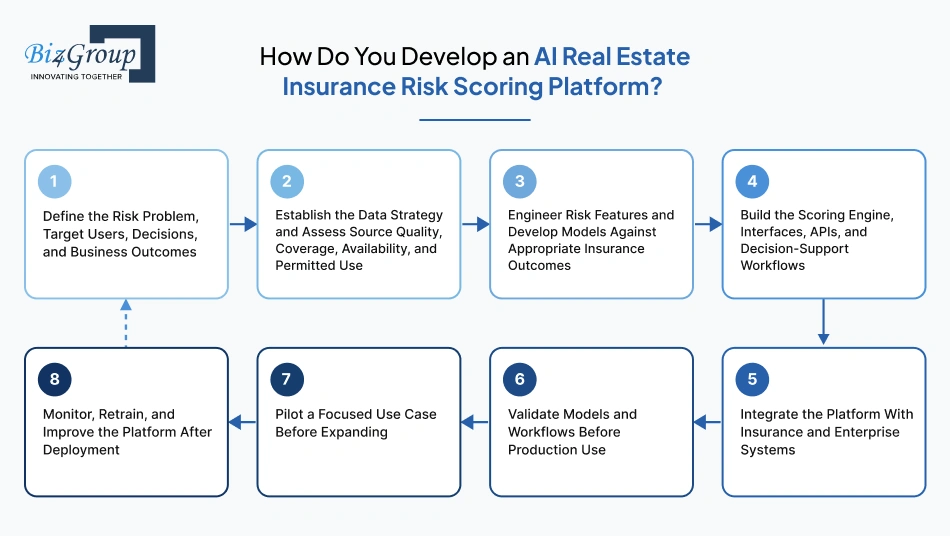
When you are building an AI real estate risk scoring platform, start with the insurance decision you want to improve, then move through data preparation, model development, platform engineering, integrations, validation, and deployment in defined stages.
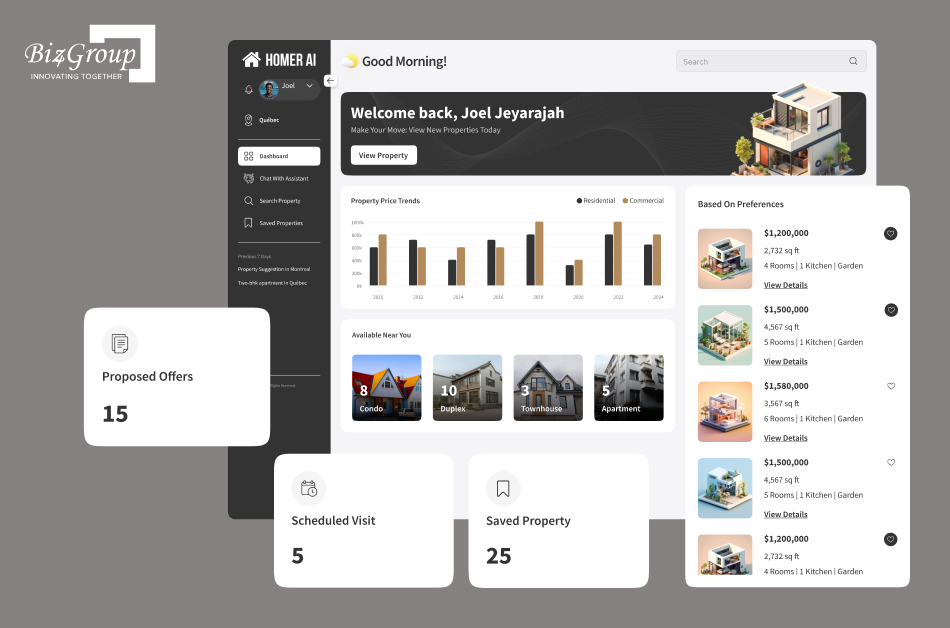
Our experience with Homer AI, an AI-based real-estate platform that helps buyers and sellers connect through property search, conversational recommendations, property details, and visit scheduling, reinforced the value of this approach. The product involved multiple AI, property-data, API, and user-workflow components, so breaking development into clear stages helped keep each dependency aligned before moving forward.
The same approach applies to AI property risk assessment. Define measurable acceptance criteria at each stage so data, model, integration, and workflow issues are caught before they become production problems.
1. Define the Risk Problem, Target Users, Decisions, and Business Outcomes
Start with the decision the platform must improve. "Assess property risk" is too broad to determine the right data, model, workflow, or success metric.
Define:
- Users: underwriters, actuaries, risk managers, claims teams, inspectors, or portfolio managers
- Decision: new-business review, renewal review, inspection priority, loss prevention, or portfolio analysis
- Outcome: claim frequency, loss severity, hazard exposure, inspection priority, or another defined target
- Time horizon: the period over which the outcome will be measured
- Business metric: review time, referral quality, loss outcomes, decision consistency, or another measurable result
For example, a project could focus on identifying commercial properties that require additional underwriting review. That creates a defined population, target outcome, and workflow.
2. Establish the Data Strategy and Assess Source Quality, Coverage, Availability, and Permitted Use
The data strategy determines whether the selected risk problem can be modeled reliably.
Assess:
- Policy and claims records
- Property and parcel data
- Inspection findings and imagery
- Hazard and catastrophe data
- Property condition information
- Aerial, satellite, or street-level imagery
- Public and commercial property sources
For every source, evaluate completeness, freshness, geographic coverage, historical depth, accuracy, licensing, privacy, and permitted use.
Property identity resolution is also essential. Policy, claims, parcel, inspection, and external records may use different identifiers. The platform must reliably map those records to the same property before they are used for AI property risk assessment.
A common mistake is choosing the model first and discovering later that the historical data does not support the target outcome.
Also Read: AI Property Management System Development
3. Engineer Risk Features and Develop Models Against Appropriate Insurance Outcomes
Raw property and insurance records need to become consistent model inputs.
Possible features include:
- Building age and construction type
- Occupancy characteristics
- Claims frequency and recent loss activity
- Hazard exposure
- Roof and exterior condition indicators
- Property or insured value
- Geographic relationships to defined hazards
- Changes in property condition over time
The modeling method should match the signal. Structured claims data may use supervised machine learning, imagery may use computer vision, documents may use NLP, and location-based exposure may use geospatial methods.
Models should be developed against a clearly defined insurance outcome with appropriate training, test, calibration, and validation methods. A complex model is not useful when its added complexity does not improve the target result or makes validation harder.
4. Build the Scoring Engine, Interfaces, APIs, and Decision-Support Workflows
The platform layer turns model outputs into usable underwriting and risk workflows.
The scoring engine should define how predictions become scores, segments, thresholds, or other outputs. Each result should retain the relevant model version, scoring date, inputs, and explanation data.
The interface should show more than the score. An underwriter may need to see:
Risk score → Main drivers → Supporting evidence → Data gaps → Recommended review
APIs should expose the same outputs to connected insurance systems rather than forcing teams to recreate scoring logic across separate applications.
5. Integrate the Platform With Insurance and Enterprise Systems
The platform must exchange data with the systems already used by the organization.
Common connections include:
|
System |
Data or Function |
|---|---|
|
Policy administration |
Policy, coverage, and property records |
|
Claims |
Loss history and new claim events |
|
Inspection |
Findings, images, and inspection status |
|
Underwriting |
Risk scores, explanations, and review actions |
|
Data platforms |
Portfolio analytics and reporting |
|
Identity services |
Authentication and access control |
Integration design should define API contracts, data ownership, event triggers, latency requirements, error handling, and retry behavior.
For example, a new claim or inspection result could trigger a reassessment event rather than waiting for the next scheduled review.
6. Validate Models and Workflows Before Production Use
Model validation should test predictive performance, calibration, stability, error rates, data quality, and performance across relevant property and risk segments.
Workflow validation asks whether the output is usable and reviewable.
Test cases should include:
- Missing or stale property data
- Conflicting source records
- Low-confidence model outputs
- Failed API calls
- Incorrect property matches
- Changes in model version
- Reproduction of historical scores
The organization should also verify that users can understand why a score was generated and identify the evidence supporting it.
Production decisions should be gated by documented validation criteria rather than a single accuracy metric.
7. Pilot a Focused Use Case Before Expanding
Start with one measurable use case, such as new-business triage, renewal change detection, or inspection prioritization.
The pilot should define:
- Target property population
- Required data sources
- Risk outcome
- Baseline performance
- Model acceptance criteria
- Workflow owner
- Governance requirements
Measure both model performance and operational impact. For example, an AI insurance risk scoring platform may produce accurate predictions but still fail to improve review efficiency if underwriters cannot access or interpret the results.
Once the pilot meets its technical and business criteria, the platform can expand to additional hazards, property types, regions, and workflows.
8. Monitor, Retrain, and Improve the Platform After Deployment
Production conditions change. Claims patterns, property characteristics, hazard exposure, data quality, and portfolio composition can all shift.
Monitor:
- Predictive performance and calibration
- Data and feature drift
- Missing-data rates
- Output distribution
- Segment-level performance
- API reliability
- User overrides and review outcomes
Retraining should follow defined triggers and a controlled validation process. A candidate model should be compared with the current production model, tested against acceptance criteria, validated, versioned, and approved before release.
The operating cycle is:
Production data → Monitoring → Issue detection → Model or data update → Validation → Approved deployment
This approach keeps an AI property risk scoring platform reliable as its data, models, and insurance use cases evolve.
How Should AI Risk Models Be Governed for Insurance Use?
AI risk models used in insurance need governance across data, development, validation, deployment, monitoring, and retirement. The framework should define accountability, testing standards, explainability, data controls, fairness review, third-party oversight, and applicable regulatory requirements. The NAIC's AI guidance emphasizes governance, risk management, transparency, accuracy, fairness, and compliance with applicable insurance laws.
|
Governance Area |
What It Covers |
Why It Matters |
|---|---|---|
|
Model Governance and Accountability |
Ownership, approved use, validation, deployment, monitoring, changes, and retirement. |
Defines who is responsible for the model throughout its lifecycle. |
|
Model Validation |
Performance, calibration, stability, limitations, data quality, and segment-level testing. |
Shows whether the model works as intended and where its outputs may be unreliable. |
|
Explainability and Documentation |
Model purpose, inputs, methods, score drivers, reason codes, versions, and limitations. |
Makes outputs understandable, reviewable, and auditable. |
|
Data Governance |
Provenance, quality, freshness, privacy, access, licensing, retention, and permitted use. |
Prevents poor or improperly used data from undermining the model. |
|
Fairness and Bias Testing |
Outcome differences, proxy variables, data imbalance, and segment-level performance. |
Helps identify inappropriate or potentially discriminatory outcomes. |
|
Third-Party Data and Model Governance |
Vendor documentation, validation evidence, limitations, audit rights, and contractual controls. |
Keeps external dependencies visible and accountable. |
|
State Requirements and NAIC Guidance |
Applicable state laws, unfair discrimination requirements, regulatory expectations, and internal controls. |
Ensures governance matches the jurisdictions where the model is used. |
For an AI insurance underwriting platform, the practical approach for AI governance is to map each model and workflow to applicable requirements, document the controls that address them, and retain evidence that those controls operate as designed.
How Much Does It Cost and How Long Does It Take to Develop an AI Risk Scoring Platform?
Developing an AI insurance risk scoring platform typically costs $60,000 to $350,000+, depending on the scope of the risk model, data integrations, platform features, AI capabilities, and governance requirements. The ranges below are practical project-planning estimates for this type of platform.
|
Development Scope |
Estimated Cost |
Estimated Timeline |
What's Included |
|---|---|---|---|
|
$60,000-$100,000 |
2-4 weeks |
Core property data ingestion, data enrichment, one primary risk model, scoring engine, explainable risk outputs, basic underwriting dashboard, API integration, and initial testing. |
|
|
Mid-Market Platform |
$100,000-$200,000 |
4-6 weeks |
Multiple data sources, configurable scoring, risk segmentation, underwriting workflows, alerts, portfolio views, explainability, MLOps, security controls, and several integrations. |
|
Enterprise-Grade System |
$200,000-$350,000+ |
6-8 weeks |
Multiple risk models, geospatial intelligence, computer vision, portfolio analytics, advanced integrations, claims and renewal workflows, extensive governance, monitoring, and scalable architecture. |
Also Read: 12+ MVP Development Companies in USA
What Factors Influence the Development Cost?
For an AI property risk assessment platform, cost depends on the data volume, AI complexity, integrations, and production controls required. The following ranges show where the budget typically goes.
|
Cost Factor |
Typical Cost |
What It Covers |
|---|---|---|
|
Property & Insurance Data Integration |
$10,000-$40,000 |
Policy, claims, property, inspection, parcel, and third-party data connections |
|
Risk Model Development |
$20,000-$60,000 |
Feature engineering, model training, calibration, testing, and documentation |
|
Computer Vision |
$20,000-$60,000 |
Image processing, annotation, condition detection, model development, and validation |
|
Geospatial Intelligence |
$15,000-$50,000 |
Parcel matching, hazard layers, spatial analysis, and geographic risk processing |
|
Enterprise Integrations |
$10,000-$50,000+ per integration group |
Underwriting, policy, claims, rating, identity, and data-platform integrations |
|
Governance & Validation |
$10,000-$50,000 |
Explainability, model validation, fairness testing, auditability, and approval controls |
|
Security & Production Infrastructure |
$10,000-$40,000 |
IAM, encryption, logging, monitoring, deployment hardening, and security testing |
|
AI Agent Capabilities |
$15,000-$50,000 |
Data retrieval, document analysis, workflow orchestration, permissions, and agent evaluation |
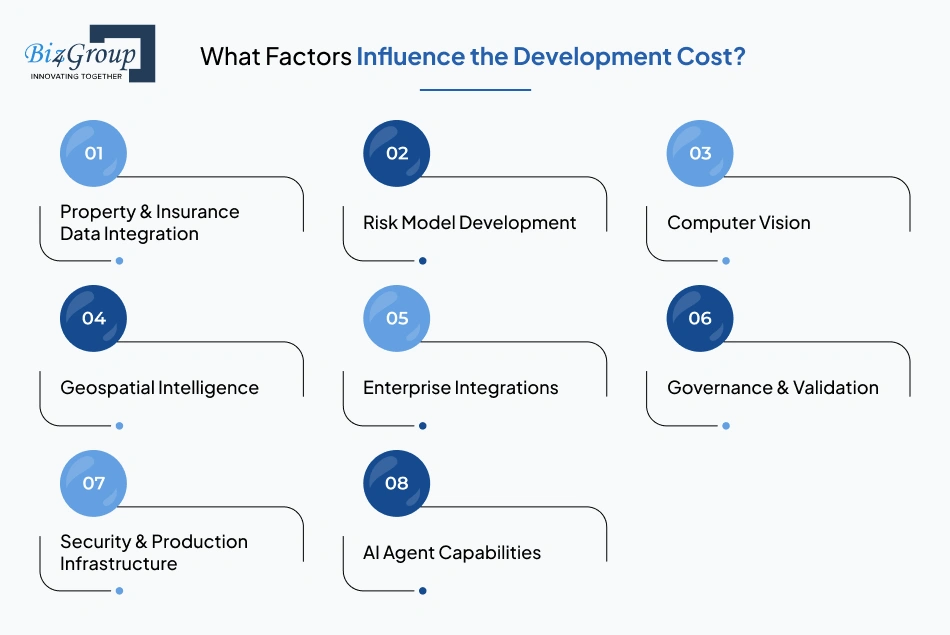
These are planning ranges within the total project budget, so they should not be added together. The actual AI insurance platform development cost depends on which capabilities are required for the chosen MVP, mid-market, or enterprise scope.
What Hidden Costs Should You Budget For?
Development is only one part of the total investment. An AI property risk scoring platform can also incur recurring costs for data, cloud infrastructure, model monitoring, AI usage, and integration maintenance.
|
Ongoing Cost |
Typical Planning Budget |
What Drives It |
|---|---|---|
|
Property and Hazard Data |
$5,000-$50,000+/year |
Property databases, hazard feeds, imagery, parcel data, and commercial datasets |
|
Cloud Infrastructure |
$500-$5,000+/month for early production |
Compute, storage, databases, networking, logging, and inference |
|
Model Monitoring and Revalidation |
$10,000-$40,000/year |
Drift analysis, calibration, performance review, and validation |
|
Security Maintenance |
$10,000-$30,000/year |
Penetration testing, vulnerability management, access reviews, and monitoring |
|
Integration Maintenance |
$10,000-$40,000/year |
API changes, schema changes, source-system changes, and support |
|
Image and Document Processing |
$5,000-$50,000+/year |
Image analysis, document extraction, labeling, processing, and storage |
|
Generative AI Usage |
Usage-based |
Document analysis, summarization, retrieval, and AI-agent workflows |
These recurring figures are planning allowances because commercial data licensing and enterprise infrastructure vary significantly by provider and workload.
How Can You Optimize AI Risk Scoring Platform Costs?
A lower development budget should come from controlling scope and workload, not removing the controls needed for reliable insurance decisions.
- Start with one risk outcome. Keep the first release within the $60K-$100K MVP range instead of building every workflow at once.
- Reuse existing data integrations. If policy or claims APIs already exist, avoid rebuilding the same pipelines.
- Delay computer vision until it solves a measurable problem. Adding it can introduce $20K-$60K+ in model, labeling, and infrastructure work.
- Use batch inference where real-time results are unnecessary. AWS supports batch and asynchronous inference, including configurations that can scale down when there is no work to process.
- Filter before expensive AI processing. Run detailed image or document analysis only on properties that meet defined rules or thresholds.
- Choose model complexity based on measurable improvement. A more complex model should justify its additional development and validation cost.
- Phase enterprise integrations. Connect the systems required by the first workflow before expanding to every downstream platform.
- Track cloud usage during the MVP. Actual inference volume and storage requirements provide a better basis for the production budget than assumptions.
- Use caching and batch processing for eligible AI workloads. Current OpenAI pricing provides lower cached-input rates and a 50% Batch API discount for eligible models.
- Build explainability and auditability into the first release. Retrofitting them after production can require additional engineering and validation.
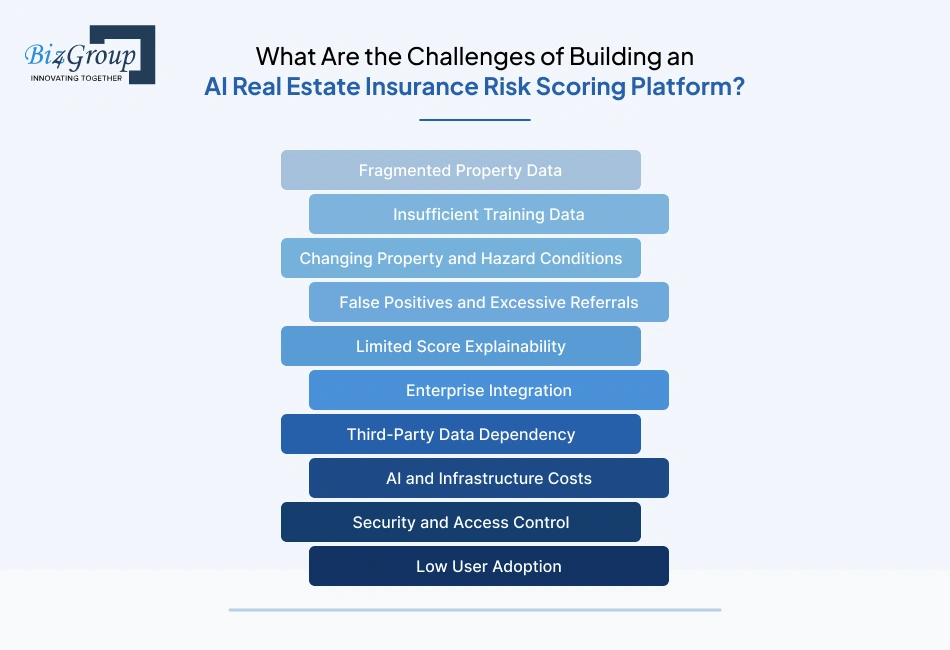
What Are the Challenges of Building an AI Real Estate Insurance Risk Scoring Platform?
The main challenges in AI real estate risk scoring platform development are reliable data, trustworthy models, changing property conditions, seamless system integration, and clear explainability. For insurers, the platform must produce risk scores that underwriters can understand, validate, and use confidently within existing workflows.
Biz4Group faced similar real-estate workflow challenges while developing Facilitor, including remote property-visit safety, buyer-seller communication gaps, and financial verification. Instead of handling each issue separately, the platform brought them into defined workflows supported by GPS and MLS data, real-time communication, and facilitator-assisted property visits.
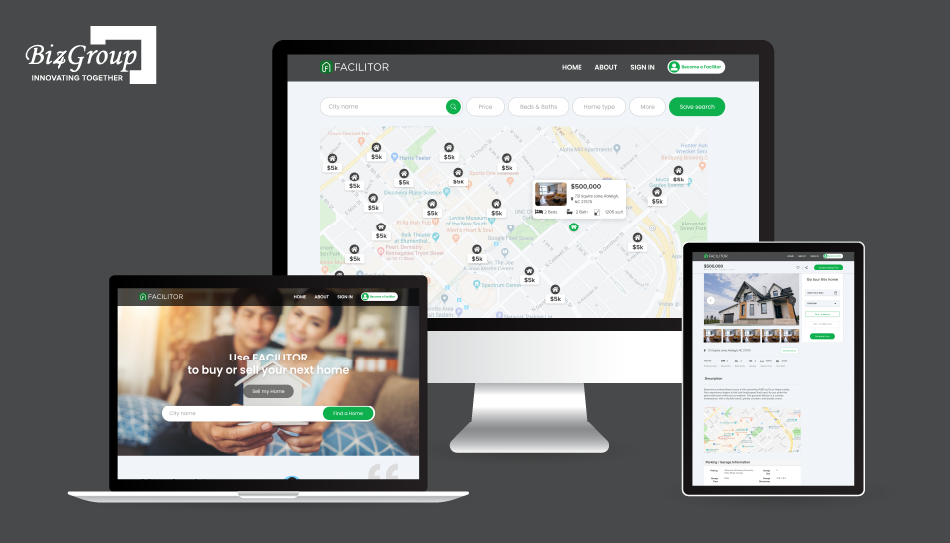
The same principle applies to AI property risk assessment, identify failure points early and build data, AI, integrations, and workflows around them. Validate data before scoring, show evidence behind outputs, provide fallbacks for missing data, and keep decisions traceable.
The goal isn't just to produce a risk score. It's to make that score understandable, defensible, and useful in the actual insurance workflow.
|
Challenge |
Why It Happens |
How to Address It |
|---|---|---|
|
Fragmented Property Data |
Property, claims, inspection, parcel, imagery, and policy systems often use different identifiers and formats. |
Create a property identity layer, normalize records, and retain source and timestamp data. |
|
Insufficient Training Data |
Claims may be sparse, outdated, inconsistent, or poorly matched to the intended insurance outcome. |
Define the target outcome first, test data coverage, and validate whether the available history supports the model. |
|
Changing Property and Hazard Conditions |
Occupancy, property condition, claims, and hazard exposure can change after the original assessment. |
Use time-aware features, freshness rules, change detection, and controlled reassessment. |
|
False Positives and Excessive Referrals |
Aggressive thresholds can send too many properties to underwriters or inspectors. |
Tune thresholds using workflow metrics such as referral volume, precision, and reviewer outcomes. |
|
Limited Score Explainability |
A score without its drivers does not tell reviewers why the risk changed. |
Show reason codes, major contributing factors, supporting evidence, model version, and score history. |
|
Enterprise Integration |
Policy, claims, underwriting, rating, and data systems may use different APIs, schemas, and workflows. |
Define API contracts, ownership, event triggers, error handling, and integration priorities before development. |
|
Third-Party Data Dependency |
External property, hazard, and imagery providers can change coverage, schemas, pricing, or update frequency. |
Track provider dependencies, validate incoming data, and keep external connectors replaceable. |
|
AI and Infrastructure Costs |
Computer vision, geospatial processing, large-scale inference, and AI agents can increase processing costs. |
Use AI where it adds measurable value, apply batch processing when possible, and monitor compute and API usage. |
|
Security and Access Control |
Different users may require different access to property, policy, claims, and inspection information. |
Apply role-based access, encryption, least-privilege permissions, API security, and audit logging. |
|
Low User Adoption |
Underwriters may reject scores they cannot verify or use within their existing workflow. |
Put risk drivers and source evidence beside the score and make the next review action clear. |
For an AI insurance risk scoring platform, the highest-risk failures usually occur when teams treat these as separate technical issues. Data quality affects model performance, model design affects explainability, and integration affects whether users act on the output. The platform needs all three to work together for property insurance risk assessment to be useful in production.
Should You Build, Buy, or Partner an AI Insurance Risk Scoring Platform?
The choice depends on how proprietary the risk logic is, what data the insurer already owns, how much customization is required, and how quickly the platform must reach production. Build gives the insurer the most control, buy provides existing capabilities faster, and partner supports custom development without requiring the insurer to build the entire technology stack internally.
|
Approach |
Best Fit |
Advantages |
Trade-Offs |
|---|---|---|---|
|
Build In-House |
Proprietary models, workflows, and strong internal engineering teams |
Maximum control over models, data, architecture, and roadmap |
Higher internal effort and long-term ownership |
|
Buy Existing Capabilities |
Standard property, hazard, or risk data needs |
Faster access to established capabilities |
Less control over models, customization, and vendor roadmap |
|
Partner for Custom Development |
Custom platform needs without a full internal delivery team |
Combines tailored development with specialized AI and engineering expertise |
Requires strong vendor governance and knowledge transfer |
Partner for End-to-End Development When You Need Customization and Delivery Support
If your team already knows the insurance problem you want to solve but does not want to assemble separate teams for AI, data, integrations, and deployment, a development partner can take the platform from AI property risk assessment strategy to production. You get one delivery team working across the risk model, property data, underwriting workflows, enterprise integrations, security, and post-launch improvements.
Biz4Group brings relevant real-estate product experience through Homer AI, Facilitor, and Contracks. That experience can help when your platform needs to connect property data with AI capabilities, third-party systems, and operational workflows. Our AI integration services can also help connect the risk platform with the systems your underwriting and risk teams already use.
For your team, the practical benefit is fewer handoffs during development and a clearer path from product requirements to a working AI insurance platform. The engagement can cover architecture, data pipelines, AI risk models, integrations, cloud deployment, MLOps, security, testing, and post-launch improvements.
Keep ownership clear from day one. You should retain ownership or contractual access to the source code, models, data pipelines, configurations, documentation, and production data so your team can maintain the platform and extend it as new risks, products, and workflows are added.
What Is the Future of AI-Powered Property Risk Assessment?
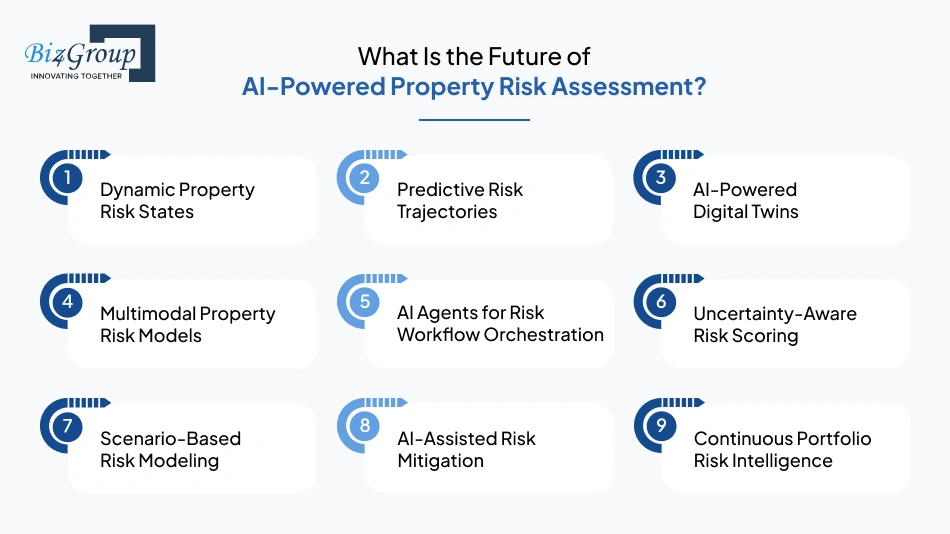
The future of AI-powered property risk assessment will focus on continuously updated risk intelligence rather than one-time scores. The main shift is toward systems that can track change, predict future exposure, model scenarios, and support risk mitigation.
1. Dynamic Property Risk States
Future platforms can update a property's risk state when claims, inspections, imagery, occupancy, or hazard exposure materially changes. This moves assessment from periodic rescoring toward event-driven reassessment.
2. Predictive Risk Trajectories
An AI real estate risk scoring platform could estimate how property risk may change over 6, 12, or 24 months by combining property condition, environmental trends, hazard exposure, and historical patterns.
3. AI-Powered Digital Twins
Digital property representations could combine building characteristics, condition, claims, inspections, hazards, imagery, and sensor data. New information could then update the property's risk state and support scenario analysis.
4. Multimodal Property Risk Models
Future models could connect images, documents, claims, geospatial data, weather, and sensor information within a common risk framework. Each additional data source would still need to demonstrate measurable value and reliability.
5. AI Agents for Risk Workflow Orchestration
AI agents could retrieve approved property data, analyze documents and imagery, identify missing information, and prepare risk assessments. A future workflow could move from data collection → analysis → assessment → exception routing, with human approval for material decisions.
6. Uncertainty-Aware Risk Scoring
Future systems could show confidence, missing evidence, model disagreement, and key risk drivers alongside the score. This would give reviewers better context when evidence is incomplete or predictions are uncertain.
7. Scenario-Based Risk Modeling
Insurers could test how property and portfolio exposure might change under defined wildfire, flood, storm, or mitigation scenarios. The output would show projected exposure and losses under each stated assumption.
8. AI-Assisted Risk Mitigation
Future platforms could evaluate how defined mitigation actions may affect projected exposure. The workflow could become detect → explain → simulate → mitigate → reassess.
9. Continuous Portfolio Risk Intelligence
Property-level changes could feed portfolio-level concentration and accumulation analysis. A future property intelligence platform could connect individual property exposure with geography, insured values, catastrophe risk, and scenario results.
Final Thoughts
An AI real estate insurance & risk scoring platform brings property, claims, hazard, inspection, imagery, and geospatial data together to give your team a clearer view of risk. But the real value goes beyond generating a score. You get explanations, forecasts, and actionable insights that can support underwriting, renewals, inspections, claims, loss prevention, and portfolio management.
If you're planning AI real estate risk scoring platform development, start with the outcomes you want to achieve. From there, focus on reliable property data, explainable AI models, seamless integration with your existing insurance systems, thorough model validation, and continuous performance monitoring.
With experience across real-estate products Biz4Group LLC can help you move from an initial idea to a production-ready platform. That includes product consultation, architecture, AI development, integrations, deployment, and post-launch improvements.
Ready to build your AI insurance risk-scoring platform? Talk to us for a roadmap tailored to your data, workflows, integrations, and goals.
Frequently Asked Questions
1. What Data Quality Issues Can Affect AI Property Risk Assessment?
Incomplete addresses, conflicting property attributes, outdated inspections, missing claims history, inconsistent property identifiers, and stale hazard data can reduce the reliability of AI property risk assessment. A production platform should validate source data, preserve provenance, flag missing values, and avoid generating high-impact outputs when critical inputs are unreliable.
2. How Does Computer Vision Improve Property Insurance Risk Assessment?
Computer vision can analyze property imagery for observable characteristics such as roof condition, exterior deterioration, vegetation, and other predefined indicators. In AI property insurance risk assessment, the output should include confidence information and remain subject to human verification when image quality is poor or the finding could materially affect an insurance decision.
3. What Makes an Insurance Risk Score Explainable?
An explainable insurance risk scoring platform connects the score to its main contributing factors, source evidence, scoring date, model version, and relevant changes in the property record. Reason codes can present these drivers in language that underwriters can review instead of showing only a numerical score.
4. Can an AI Risk Model Use Multiple Data Providers?
Yes. An AI risk assessment platform can combine property, claims, hazard, geospatial, imagery, and other approved datasets from multiple providers. Each source should have defined ownership, permitted use, update frequency, quality checks, and a replacement strategy so one vendor does not become an uncontrolled dependency.
5. How Often Should an AI Property Risk Score Be Updated?
There is no universal update interval. A better approach is event-driven scoring, where material changes such as a new claim, inspection result, property modification, or significant hazard update trigger reassessment. Stable properties can remain on a scheduled review cycle, reducing unnecessary model runs and underwriting referrals.
6. What Insurance Systems Should an AI Risk Scoring Platform Integrate With?
A production AI insurance platform commonly integrates with policy administration, claims, underwriting, rating, inspection, identity, data warehouse, and portfolio analytics systems. APIs and event-driven integrations can pass scores, reason codes, property attributes, and score changes into existing workflows without duplicating the scoring logic.
7. How Much Does It Cost to Maintain an AI Risk Scoring Platform After Launch?
Ongoing costs usually include data licensing, cloud infrastructure, model monitoring, validation, security, integration maintenance, and AI processing. For planning, an early production platform may require roughly $500 to $5,000+ per month for cloud infrastructure, while data and specialized AI services can add $5,000 to $50,000+ per year, depending on usage and providers.
8. Is It Better to Build an AI Risk Scoring Platform In-House or With a Development Partner?
A partner can be more practical when the insurer has the insurance expertise and business requirements but needs additional capacity for AI, data engineering, integrations, cloud deployment, and MLOps. The important criteria are ownership, technical transparency, domain understanding, integration experience, and the partner's ability to support the platform after launch.
9. What Should You Look for in a Partner for AI Insurance Risk Scoring Platform Development?
Look for a partner with experience across real-estate AI development, property data, third-party integrations, machine learning, and production deployment. For an AI property risk assessment platform, the right team should be able to support consultation, architecture, development, integration, launch, and post-launch improvements while maintaining clear ownership, documentation, and access to the technology delivered.
10. Can AI Risk Scoring Support Loss Prevention, Not Just Underwriting?
Yes. Property risk analytics can identify properties where specific mitigation actions may be relevant, such as addressing documented roof or exterior-condition concerns. A more advanced platform can track the workflow from risk detection → mitigation action → reassessment, allowing teams to evaluate whether the property's risk indicators changed after the intervention.
