Location :
Orlando, FL, USA
Location :
Orlando, FL, USA +1 (407) 714-1616
 info@biz4group.com


















Imagine a digital system that doesn’t wait for instructions but instead, understands your business goals, learns from real-time feedback, and takes independent actions to get the job done.
Read More

 AI Summary Powered by Biz4AI
Client reporting is one of those jobs where AI can save RIAs a lot of time. Teams still have to pull together portfolio data, prepare personalized reports, check the details, and make sure everything is handled properly. Add sensitive client information, compliance requirements, and advisor review, and a simple AI writing tool can quickly fall short.
Biz4Group LLC came across these same challenges while developing WorthOne Plan with Worth Advisors. The team had to work through how financial information reaches the AI, how the generated content fits into the reporting process, and where advisors need to review or change the report before it goes to the client.
That is why an AI Reporting Platform for RIAs needs to fit the way an advisory firm actually works. It should support privacy, compliance, audit trails, personalization, and advisor oversight alongside its AI capabilities. Those details are especially important for RIAs evaluating platforms in 2026.
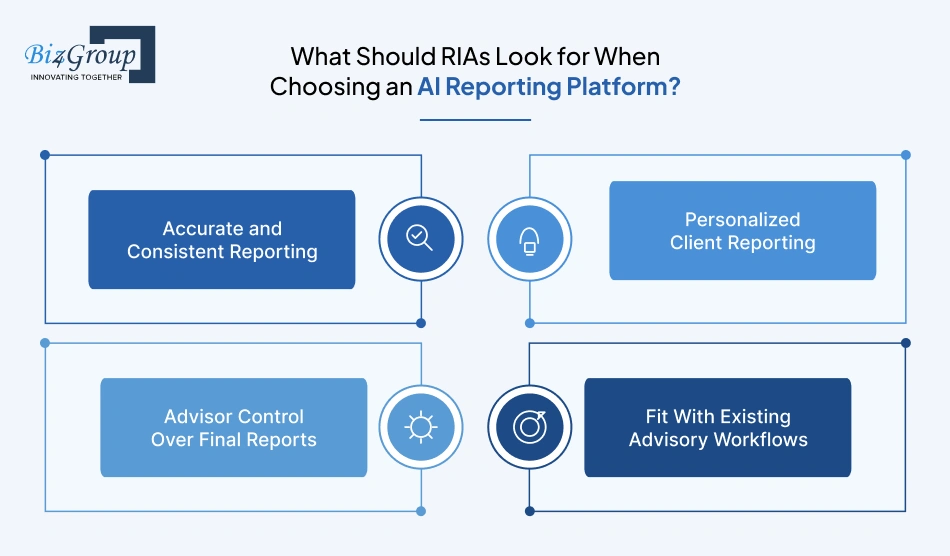
Start with four things: accurate reporting, personalization, advisor control, and a good fit with the firm's existing workflow. These areas have the biggest impact on whether an AI Reporting Platform for RIAs actually works for an RIA's day-to-day reporting needs.
AI-generated reports need to stay grounded in the right financial information and produce consistent results. Look for ways to validate source data, catch missing details, and flag problems before a report is sent to a client. This becomes especially important when AI-assisted investment reporting is used across a large client base.
Clients have different goals, portfolios, and communication preferences. An AI client reporting platform for advisory firms should give advisors enough flexibility to tailor reports instead of producing the same format for everyone.
How comfortable would you be sending an AI-generated report to a client without reviewing it first? Most firms will want advisors to check the content, make changes, and approve the final version before delivery.
The platform should work with the systems and processes your team already uses. Good workflow fit can reduce manual steps and make adoption easier across the firm.
The best platform should fit naturally into how your team already prepares and reviews client reports.
The platform should fit into the RIA's existing compliance process and give the firm enough control over how reports are created, reviewed, stored, and shared. For 2026, that means paying attention to applicable Advisers Act requirements, recordkeeping, marketing communications where relevant, and the firm's own written policies and procedures. A compliant AI reporting platform for RIAs should make these requirements easier to manage within the reporting workflow.
|
Area |
What to Look For |
|---|---|
|
RIA and SEC Requirements |
Support for the rules and compliance processes that apply to the firm. |
|
Controls for AI-Generated Content |
Review and validation steps before AI-generated content reaches clients. |
|
Recordkeeping and Retention |
Easy access to required reports, versions, and related records. |
|
RIA vs. Provider Responsibilities |
Clear understanding of what the platform handles and what remains with the advisory firm. |
The key is to make compliance part of the workflow. Look for financial reporting compliance controls that give your team clear checkpoints instead of leaving compliance work to separate manual processes.
An RIA's reporting platform may handle client names, account details, portfolio holdings, performance data, and financial documents. That data should stay protected as it moves into the platform, while it is being processed, and when reports are stored.
Access should also depend on what each person actually needs to do. A secure AI reporting platform for RIAs should make these controls part of the reporting workflow.
Look for a platform that protects financial information both in storage and when it moves between the platform and connected systems. The provider should also be able to explain how API keys, login credentials, and other connection points are secured. An AI reporting platform with data privacy controls should make those protections clear.
While developing WorthOne Plan with Worth Advisors, Biz4Group had to account for the financial information used in advisor reports and the systems that supplied it. Protecting that information as it moved through the reporting workflow was part of the development work.
An advisor may need to view and edit a client's report, while an operations user may only need to prepare it. Compliance staff may need access to records and approvals without having access to every editing function. The platform should let the firm set those permissions by role.
For example: an operations team member could prepare a report, an advisor could edit and approve it, and a compliance user could review the approval history.
Each client's information should stay within the right account, household, and reporting workflow. This matters even more when the platform is processing many reports at once.
For example: Client A's portfolio holdings should never be pulled into Client B's report because the two records happen to use similar account names or identifiers.
An RIA should know what the platform does with its data after it enters the system. Ask what information the AI can access, how long it is stored, who can access it, and whether the provider can use it for model training or other purposes.
A useful question to ask a provider is: Can our client and portfolio data be used for anything beyond generating and managing our reports? The answer should be clear and documented.
For an RIA, good data handling should be easy to understand: what data is used, where it goes, who can see it, and how long it stays there.
An RIA reporting platform should make it easy to see what changed, who changed it, who reviewed the report, and which version was approved. These records support RIA compliance reporting and give the firm a clear trail when a report needs to be reviewed later.
|
Area |
What to Look For |
|---|---|
|
Activity and Change History |
A record of important actions, including edits, approvals, rejected reports, and user activity. |
|
Advisor Review and Approval |
A clear step where an advisor can review, edit, and approve a report before client delivery. |
|
Report Version Control |
Access to previous versions so the team can see what changed between drafts and the final report. |
|
Exception Handling |
Alerts or review steps for missing data, unusual values, failed checks, or AI-generated content that needs attention. |
When evaluating an AI reporting platform with audit trails, check how quickly your team can answer a simple question: what happened to this report, and who approved it? Those records should be easy to find without digging through emails or separate systems.
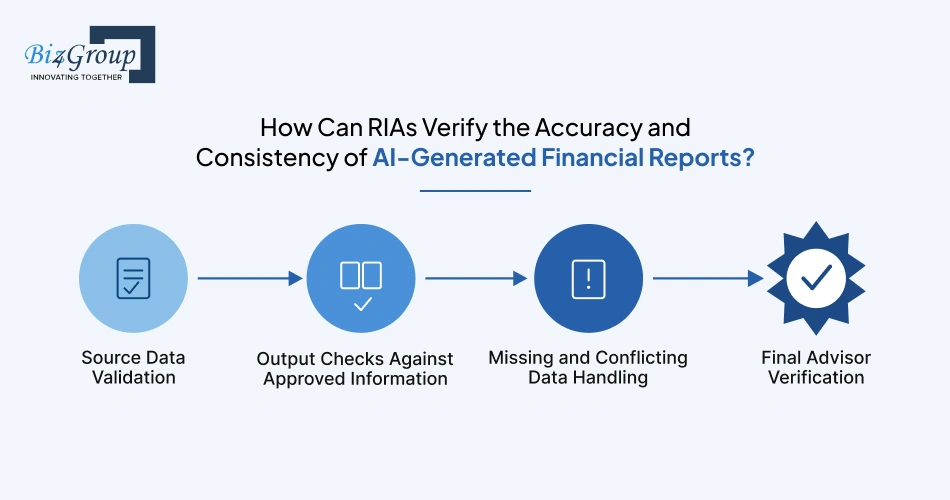
RIAs should check the data going into a report, compare AI-generated content with approved information, flag gaps or mismatches, and give an advisor the final say. A reliable AI financial reporting platform for RIAs should make those checks part of the reporting workflow rather than leaving the team to catch every issue manually.
Before AI starts generating a report, the platform should check whether the portfolio and client information needed for that report is actually available. A missing transaction, incomplete record, or unavailable figure should be flagged instead of leaving the AI to fill the gap.
While developing WorthOne Plan, Biz4Group and Worth Advisors had to account for situations where the available financial information did not fully support what a report needed to say. The workflow therefore had to distinguish between information the system could use and cases where an advisor needed to review the underlying data.
Important parts of the report should be checked against the firm's approved data. Portfolio values, performance figures, dates, and client details should have a clear source behind them.
For example, an AI-generated performance summary should tie back to the portfolio data used for that report rather than relying on the model to produce a plausible explanation. This kind of check is especially useful when firms are using secure portfolio reporting automation across many client accounts.
What happens when two connected systems show different information? The platform should flag the mismatch and hold that part of the report for review.
A CRM might contain one household name while the portfolio system uses another, or two sources might show different values for the same account. Those differences should be surfaced rather than silently resolved by the AI.
An advisor should be able to review the completed report, make changes, and approve it before it reaches the client. This final step also gives the advisor a chance to check whether the report makes sense for that particular client.
Would the advisor be able to see what the AI produced, edit it, and approve the final version in the same workflow? That is worth confirming before choosing a platform.
For an RIA, a useful accuracy check should answer three things clearly: where the information came from, what the AI generated, and what the advisor approved.
Not sure which features and controls your advisory firm actually needs? Biz4Group can help you assess the technical and reporting requirements behind your idea.
Talk to Our TeamCompare platforms based on how well they fit your firm's actual reporting process. Look at security, customization, scalability, implementation, and ongoing support. A strong AI reporting solution for registered investment advisors should fit the firm's workflow without creating extra work for advisors or operations teams.
|
Integration Area |
What to Look For |
|---|---|
|
Portfolio and Accounting Systems |
Connections for holdings, transactions, performance, valuations, and account data. |
|
CRM and Client Data |
Client profiles, household details, goals, contact information, and other advisor-managed data. |
|
Custodial and Financial Data Sources |
Secure access to account and investment information held with custodians and other financial providers. |
|
APIs and Other Data Connections |
Reliable APIs, file imports, and other connection methods for systems that don't offer the same integration options. |
The bigger question is how well these connections work together. A platform should bring the right information into the reporting workflow without forcing the team to keep moving data between systems manually.
Compare platforms based on how well they handle your firm's actual reporting process. Pay attention to how client data is protected, how much control you have over reports, what happens as your client base grows, how data is moved into the platform, and who handles problems after launch.
Look at the controls around client and portfolio data, user access, report approvals, and activity records. The provider should be able to show you how these controls work instead of giving you a broad security statement.
Your firm may have its own report layouts, branding, client segments, and wording preferences. The platform should let you make those changes without turning every update into a development project.
Think about where the platform needs to be a few years from now, not just on day one. It should be able to handle more households, more data, and more reports without creating delays for the team.
Good AI reporting platform implementation for advisory firms should cover more than connecting the software. Ask how the provider will map existing data, connect your systems, test the migrated information, and prepare your team for launch.
A reporting platform can run into issues after launch when an API changes, a data feed fails, or your team needs a new report format. Find out who handles those problems and how quickly your team can get help.
|
Area |
Quick Check |
|---|---|
|
Security |
Data protection, access controls, auditability |
|
Customization |
Flexible reports, branding, client-specific formats |
|
Scalability |
More clients, data, and reporting volume |
|
Implementation |
Data migration, integrations, testing |
|
Support |
Maintenance, fixes, updates, future changes |
When comparing providers, use the same real reporting scenarios with each one. You'll get a much clearer idea of how each platform would actually work for your firm.
General-purpose AI tools can help with drafting summaries and turning information into readable content. An RIA-specific platform goes further by fitting those capabilities into financial reporting workflows, data connections, advisor review, and the controls needed around client reports.
AI reporting tools for advisory firms can be useful for drafting summaries, rewriting content, or turning existing information into a readable report. They usually need extra systems or manual steps when the job involves portfolio data, client-specific details, approval workflows, or recordkeeping.
Where does the advisor fit when the AI produces something that needs to be checked or changed?
|
General-Purpose AI Tools |
Typical Gap for RIAs |
|---|---|
|
Draft summaries |
May need separate financial data sources |
|
Generate report content |
Limited advisory workflow support |
|
Rewrite or personalize text |
May rely heavily on manual input |
|
Handle broad reporting tasks |
Compliance and audit controls may sit elsewhere |
An AI reporting platform for wealth management firms is built around the reporting process itself. It can bring together portfolio information, client data, personalized content, and advisor review in a way that matches how the firm already prepares reports.
|
RIA-Specific Capability |
What It Supports |
|---|---|
|
Financial data connections |
Brings portfolio and account information into reporting |
|
Client personalization |
Adapts reports to individual client needs |
|
Advisor review |
Lets advisors edit and approve reports |
|
Reporting history |
Keeps track of report changes and approved versions |
This is where an AI reporting platform evaluation should go beyond the AI demo. Check whether the product can show where report information came from, what was changed, who approved it, and how the final version is handled.
Can your team trace a client report back to the information, changes, and approval that produced it?
|
Area |
What an RIA Should Be Able to Do |
|---|---|
|
Data traceability |
Identify the information used in a report |
|
Auditability |
See important edits and user actions |
|
Approval workflow |
Review and approve reports before delivery |
|
Compliance support |
Keep required controls within the reporting process |
For an advisory firm, the difference comes down to workflow fit. A general AI tool may help create content, while an RIA-focused platform can support the process that gets that content from financial data to an approved client report.
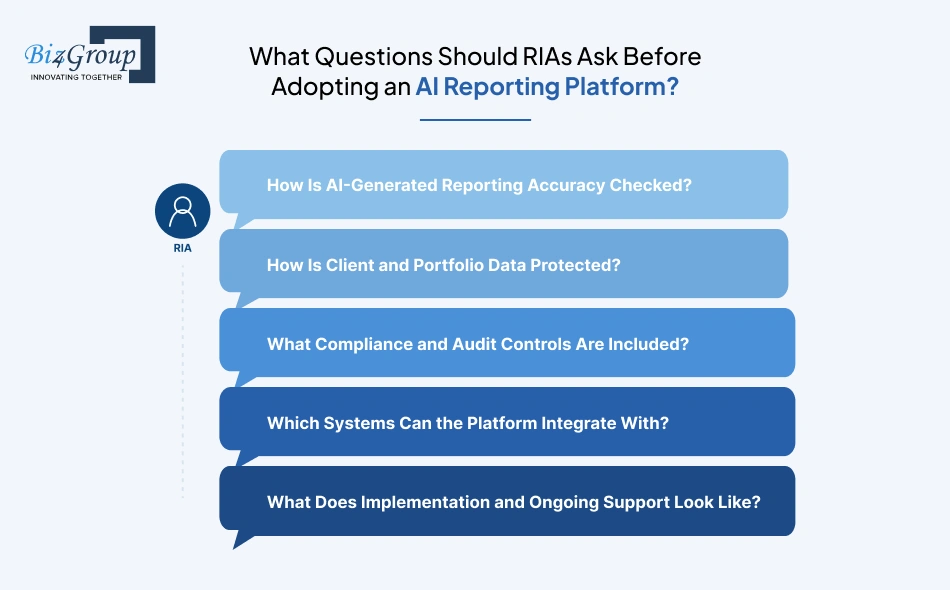
The right questions should help you understand how the platform handles accuracy, client data, compliance, integrations, and implementation. They also make AI reporting platform evaluation more practical because you can compare providers using the same criteria.
Ask how the platform checks AI-generated content against the financial information it uses. Find out how it handles incorrect figures, unsupported statements, missing data, and other issues before a report is approved.
Ask where client and portfolio data is stored, how it moves between connected systems, who can access it, and whether the data is used for anything outside your reporting workflow. The provider should be able to explain its data practices in plain terms.
Find out what the platform records and what your team can review later. Ask about report history, user actions, approvals, retention, and controls around AI-generated content.
What would your compliance team need to see six months after a report was sent to a client? That answer can help you judge whether the platform provides enough history and visibility.
Ask whether it can connect with the portfolio, accounting, CRM, custodial, and other financial systems your firm already uses. Also check how the provider handles systems that rely on APIs, files, or custom data connections.
Ask who handles data mapping, migration, testing, user setup, training, and launch support. Then clarify what happens when an integration changes, a workflow needs updating, or your team needs help after launch.
|
Area |
What to Ask |
|---|---|
|
Accuracy |
How is AI output checked? |
|
Data Security |
How is client and portfolio data protected? |
|
Compliance |
What records, approvals, and controls are built in? |
|
Integrations |
Which portfolio, CRM, custodial, and financial systems are supported? |
|
Implementation |
Who handles migration, setup, testing, and training? |
|
Support |
What help is available after launch? |
For a firm still working out how to choose an AI reporting platform for RIAs, these answers can make vendor comparisons much easier.
Share your reporting workflow, data sources, and client communication needs with Biz4Group to explore a solution that fits your firm.
Explore Your OptionsThe biggest risks for an RIA are wrong or unsupported information, exposed client data, too much automation, and weak review controls. Each one can affect what an advisor sends to a client and how the firm manages its reporting process.
AI can produce a report that sounds polished while using an outdated portfolio value, missing a transaction, or making a statement the source data doesn't support. An AI reporting platform for SEC-registered investment advisors should have checks that help catch those issues before the report moves forward.
What happens when a required figure is missing from the source data? The system should stop and surface the gap rather than let the AI work around it.
RIA reports can contain account numbers, holdings, performance data, financial documents, and personal client details. Risks can come from weak access controls, poorly secured integrations, or unclear rules around which AI services can receive that information.
A provider should be able to tell you exactly where client and portfolio data goes during report generation and which people or systems can access it.
Some reporting steps can be automated, while others depend on an advisor's knowledge of the client. A platform that removes those decision points can produce reports that are technically complete but miss important client-specific context.
For example: an advisor may know that a recent portfolio change needs explanation even though the underlying performance data is correct. The platform should leave room for that input.
If the platform doesn't record important edits, approvals, and exceptions, it becomes harder to understand how a report reached its final version. That can make internal reviews more difficult and leave the firm with less visibility into its own reporting process.
Can your team see who changed a report, what changed, and who approved it? Those details should be easy to find without reconstructing the process manually.
The risks are easier to manage when the platform is designed around the actual reporting workflow an RIA follows every day.
The real test of an AI Reporting Platform for RIAs comes when it has to work with actual portfolio data, client-specific reporting needs, connected systems, and an advisor who wants to review or change the report before it reaches the client. Those details show whether the platform can fit into an RIA's day-to-day reporting process.
Have a platform you're evaluating or an idea you're planning to build? Biz4Group can help you work through the reporting workflow, AI requirements, integrations, and development approach for your use case.
Look for report approvals, audit trails, version history, access controls, recordkeeping support, and controls for reviewing AI-generated content.
An RIA should define where advisor review is required. The platform should let advisors check, edit, and approve reports before client delivery.
Ask where client and portfolio data is stored, how it moves between systems, who can access it, and whether the provider uses it for model training or other purposes.
Check how the platform validates source data, handles missing or conflicting information, and checks AI-generated figures and statements against approved data.
The platform should connect with the firm's portfolio management, accounting, CRM, custodial, and other financial data systems through APIs or supported file-based connections.
Compare their data controls, compliance features, accuracy checks, advisor workflows, integrations, customization, implementation process, and ongoing support.
Yes. The provider can supply tools and controls, but the RIA remains responsible for its own compliance obligations and how the platform is used.
Ask who handles data migration, field mapping, integrations, testing, user setup, training, and launch support, and how future system changes will be handled.

Our website require some cookies to function properly. Read our privacy policy to know more.