 Location :
Orlando, FL, USA
 +1 (407) 714-1616
 info@biz4group.com


 AI Summary Powered by Biz4AI
- A new AI residential property marketplace rarely wins on listing volume. It wins with a narrow buyer group or region and by helping those buyers decide.
- Large portals have already launched conversational and natural-language search, so a chat box on its own is not a differentiator.
- Neighborhood and lifestyle-fit scores need explainable inputs and fair housing review, because recommending places can turn into steering.
- Google says AI Overviews need no special optimization: a page has to be indexed and eligible to appear with a snippet.
- Measure the AI against a pre-launch baseline, one change at a time, using search success, saves, tour requests and cost per qualified lead.
An AI residential property marketplace is a home-search platform that uses AI to match buyers with homes, and a new one rarely wins by being bigger. The large portals already have the listings, the traffic and AI search of their own. What a newcomer can offer is a sharper answer for one group of buyers, which is a different job from copying the biggest site's feature list.
Most AI residential property marketplace development advice starts with features. This blog starts a step earlier, with why a buyer would pick a new site at all, and then covers how to choose a niche, build neighborhood fit scores that stay fair, get found in AI-generated answers and tell whether the AI is helping.
Which of these ideas apply also depends on whether the product is a search portal, a two-sided marketplace or a brokerage app, so settle that first if it is still open.
How can a new AI residential property marketplace compete with the large portals?
A new AI residential property marketplace competes by narrowing its audience and improving how those buyers decide, since it cannot match the large portals on listing volume. It cannot count on search alone either, because one large portal's November 2025 release describes conversational home search built into its main search bar, where shoppers describe what they want in their own words and refine it in follow-up messages.
That portal is not alone. Real Estate News reported that two more portals had added AI-powered or natural-language search. A chat box is now table stakes, not a reason to switch.
The same release reports early-test figures in the portal's own words: users viewed nearly twice as many listings and were 47% more likely to request tours or other services. Those are vendor claims from early testing, not independent results, but they show where the large portals are aiming. That leaves three things a new marketplace can still own:
- A narrow audience, such as one region or one kind of buyer.
- Answers that help that audience decide, not only lists of homes.
- Explanations buyers can check, so a recommendation comes with its reasons.
Search, assistants and valuation estimates are the usual AI real estate marketplace features, and any new product can add them. What sets one product apart is who they are pointed at and how well they explain themselves.
Conversational search in particular is now a standard interface, built the same way as any AI conversation app, which is one more reason it works as a starting point and not as the whole pitch.
Visual extras such as 3D tours and AI virtual staging can make listings more attractive, but they are a separate build with their own page, and they do not answer who the marketplace is for.
Which niche should a custom AI residential property marketplace start with?
Start with a niche where you can fill both sides and where buyers have a need the standard search does not meet. Three kinds work as starting points:
- A region. Local knowledge is hard for a national site to match, and a small market needs fewer listings to feel complete.
- A buyer group. First-time buyers, relocating households or buyers who need to know what they can afford before they look.
- A workflow. One step that standard search handles poorly, such as affordability-first search or comparing neighborhoods side by side.
Take the first-time buyer. Facilitor, a platform Biz4Group built for home buyers, pairs budget- and location-based search with AI-powered recommendations and a buyer financial verification step the platform uses to show suitable properties. Buyers can then visit by video call or in person with a facilitator and chat in real time.
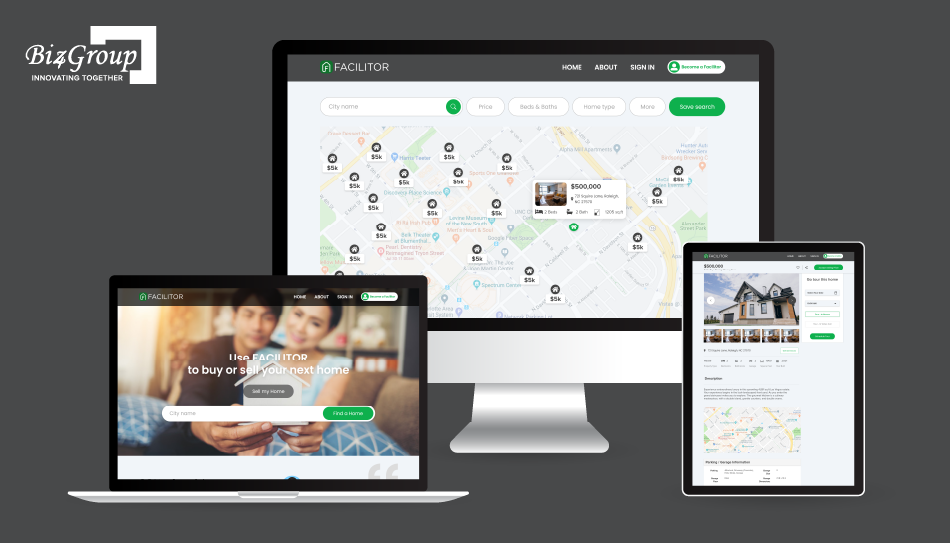
A niche also shrinks the empty-room problem, because a two-sided marketplace has to fill both sides and a narrow market needs fewer listings and buyers to feel alive.
How does neighborhood and lifestyle-fit scoring work in an AI-powered residential property marketplace?
Neighborhood fit scoring compares what a buyer says about their routine with location data for each area, then shows how well the two match and why. The "why" is what separates a useful score from a black box. Four habits keep it honest:
- Start from the buyer's routine, such as commute destinations, must-have amenities, transit and noise tolerance, not from a demographic profile.
- Match it to location data for each area, such as travel times, nearby amenities and transit stops.
- Show the parts, not only a number. Several factor scores the buyer can weight, each with its data source and date, are easier to trust than one overall grade.
- Show the gaps. Where data is missing or old, say so instead of guessing.
A buyer who commutes to a hospital and wants a walkable street, for example, should see travel time and walkability as separate lines they can reweight. How a model learns from clicks and saves to rank homes is a separate recommendation build, and the score above should work without it.
When does neighborhood fit scoring in a residential marketplace turn into steering?
It turns into steering when a score or recommendation nudges buyers toward or away from areas because of a protected characteristic, directly or through a stand-in for one. HUD's rule on prohibited sales and rental conduct covers restricting or discouraging a person's choices in a community or neighborhood by words or conduct, which is the behavior usually called steering.
The Fair Housing Act applies when AI and algorithms handle tenant screening and housing advertising, and that practices with an unjustified discriminatory effect are covered even without intent. Neighborhood scoring is neither of those two tasks, so applying the guidance to it is an inference, which is one more reason to have counsel review the design.
Researchers at the National Fair Housing Alliance's Responsible AI Lab tested the risk on language models in a 2026 conference paper. They asked seven models to recommend five zip codes for a homebuyer in Chicago, Houston, New York City or Los Angeles, changing only the buyer's stated race. In every baseline group, at least one model steered buyers toward zip codes with a high share of their own racial group, and adding lifestyle preferences generally raised the number of models that did. The authors note that the models were earlier versions, the analysis was at zip-code level and only explicit racial cues were tested, so the results do not describe any one marketplace. They do show that a model asked to match lifestyle can steer without being told to. Habits that follow:
- Take preferences from the buyer. Do not infer protected traits from names, photos or browsing.
- Keep demographic data out of the score, then test whether the remaining inputs act as stand-ins for it.
- Let buyers see and change the weights, so the buyer steers and the model does not.
- Check outcomes, such as which areas different groups of buyers are shown, and keep records of what you tested and fixed. How to test for that lawfully is a question for counsel.
Disclaimer: This section is information, not legal advice.
How can an AI marketplace for residential real estate get found in AI-generated answers?
By doing ordinary search work well, because Google says there are no additional requirements to appear in its AI Overviews or AI Mode and no special optimizations, markup or AI text files are needed. A page only has to be indexed and eligible to show with a snippet. That page covers Google's own AI features, and other assistants may follow different rules, so no one can promise a citation. What helps is the same work any new marketplace should do:
- Crawlable listing and neighborhood pages, with text a crawler can read, not only a map or a widget.
- Local content that stays current, such as a page per neighborhood answering what a buyer asks about it.
- Consistent details about the business across the site and its profiles.
- Tracking, meaning referral traffic from AI assistants and, where tools allow, mentions and citations.
Find the Niche Your Marketplace Can Own.
Biz4Group helps you choose the buyer group and region, then builds the search and scoring around them.
Plan My NicheHow do you measure whether AI is improving the buyer experience in a residential marketplace?
Compare a few numbers against a baseline taken before launch, and change one thing at a time. Five cover most of it:
Metric |
What it shows |
Compare against |
|---|---|---|
Search success rate |
Share of searches that end in a save, a contact or a tour request |
The same searches before the AI feature |
Refinements per search |
How often a buyer rewrites or adjusts a search |
The baseline, where fewer only counts if success holds |
Saves and return visits |
Whether buyers find homes worth keeping and come back |
A baseline group of buyers |
Tour and agent requests |
Qualified leads coming out of search |
A baseline group of buyers |
Cost per qualified lead |
AI and hosting cost divided by qualified leads |
The cost of the same leads before |
A controlled test keeps the comparison honest: show half of buyers the new feature and half the old one, so a change in the numbers traces back to the feature. The last row matters because AI work is quoted as its own line in the cost breakdown, and a feature that lifts engagement but costs more per qualified lead has not paid off yet.
Want Neighborhood Scores Buyers Can Trust?
Get explainable fit scores with fair housing review built into the design.
Talk to Our TeamWhat a new marketplace has to prove
A new residential marketplace earns its place by knowing one group of buyers better than the large portals do, and then showing it in the numbers. The AI helps when it explains its scores, stays fair and moves the metrics that matter. A chat box alone shows none of that. If you want a partner for the niche, the scoring and the measurement, reach out to Biz4Group and the team will design it, build it and set up the tests.
Frequently asked questions
1. How narrow should a first niche be?
Narrow enough that you can recruit both sides by name, and broad enough that a buyer finds a few good matches in a first search. If a typical search comes back empty, the niche is too thin.
2. Can school or crime data go into a neighborhood fit score?
They are common inputs, and they can also stand in for protected characteristics, so handle them with care. Let buyers choose whether to see them, show the source and date, and have counsel review how they enter any ranking before launch.
3. Should a neighborhood score be one number or several?
Several. A single grade hides the trade-offs and is hard to explain or correct. Separate factor scores that the buyer can weight let a person see why an area fits.
4. What happens if a score is wrong or out of date?
Show the source and date of each input, give buyers a way to flag a correction and fix the data at its source. A score shown without a date can mislead a buyer more than no score at all.
5. How long before you can tell whether the AI is working?
Long enough for both groups in a controlled test to run a large number of searches, so a gap is not just chance. A small marketplace has fewer searches and needs longer, so judge by search volume, not by calendar days.
6. Does the same approach work for rentals?
Mostly, with different data. Renters care about availability, lease terms and fees, and fair housing rules cover rentals too, so the steering safeguards apply. The logic of choosing a niche and measuring against a baseline stays the same.
CTA 1. Headline:
CTA 2. Headline:
CTA 3. Headline: Not Sure the AI Is Paying Off? Pitch: Set up a baseline and a controlled test so you know what each feature changes. Button: Set Up My Tests
