 Location :
Orlando, FL, USA
 +1 (407) 714-1616
 info@biz4group.com


 AI Summary Powered by Biz4AI
- Real estate portal and marketplace development covers three different products: a search portal, a two-sided marketplace and a brokerage app. Each has a different business, data need and risk.
- A portal wins on search and listing data. A marketplace wins on matching two sides and getting both to show up. An app wins on speed and agent workflow.
- All three depend on listing data. In the US that usually means MLS data under IDX rules, delivered through standards like the RESO Web API.
- AI helps most in search, recommendations, lead handling and operations, and least in replacing the data itself.
- Published estimates run from about $20K for a basic listing site to $300K+ for a full platform. Build-vs-buy and each build type have their own pages.
Real estate portal and marketplace development gets pitched as one thing, and it is at least three. A founder says "we want to build a Zillow," the agency nods, and six months later the team is arguing about whether the product is a search engine, a matchmaking service or a brokerage's app. Those are different businesses with different data needs, different costs and different ways to fail.
This blog sorts them out in easy terms. The short version: decide which of the three you are before anything else, because every later choice follows from it.
What is the difference between a portal, a marketplace and an app?
A portal shows listings and helps people search them. A marketplace connects two sides, such as buyers and agents or renters and landlords, and earns when they transact. An app is the mobile front of a business that already operates, usually a brokerage. They overlap, but the money and the hard part are different.
|
Aspect |
Search portal |
Two-sided marketplace |
Brokerage-operated app |
|---|---|---|---|
|
What it is |
A place to find and compare listings |
A place where two groups meet and deal |
A mobile tool for a firm's own clients and agents |
|
Who pays |
Agents and advertisers |
Either side, or a fee per transaction |
The firm, through the deals it closes |
|
The hard part |
Fresh, accurate listing data and fast search |
Getting both sides to show up |
Fitting how agents and clients really work |
|
Where it fails |
Stale or duplicated listings |
An empty room: buyers without sellers, or the reverse |
Features nobody uses on a phone |
|
First big decision |
Where listing data comes from |
Which side to recruit first |
Which agent tasks go on a phone |
A search portal lives or dies on listing data and search speed, so most of the work goes into clean feeds and a Zillow-style map search that never stalls.
A marketplace has the opposite problem: the features are the easy part and the empty room is the hard part, which is why a two-sided marketplace is judged on who pays and how both sides fill up, not on its feature list.
An app is mostly about the people already using it: a brokerage's agents and clients want scheduling, alerts and quick answers on a phone, which is what a Redfin-style brokerage app is built around.
Should you build a portal, a marketplace or an app first?
The one that matches what you already have. A short test:
- Do you have listing data and no audience yet? A portal is the natural start, because your edge is search.
- Do you have an audience on one side and need the other? A marketplace, but plan how you will fill the empty side before you plan the features.
- Do you already run a brokerage or team? An app, since you already own the clients and the workflow.
- Do you already have a portal that feels old? Look at modernizing before you rebuild.
Choosing between building from scratch, buying a platform or going white-label is a separate decision with its own trade-offs. And if the portal already exists, upgrading is often a smaller job than rebuilding, because modernizing an existing portal keeps your listings, users and search history in place while the engine underneath changes.
What do real estate portals, marketplaces, and apps have in common?
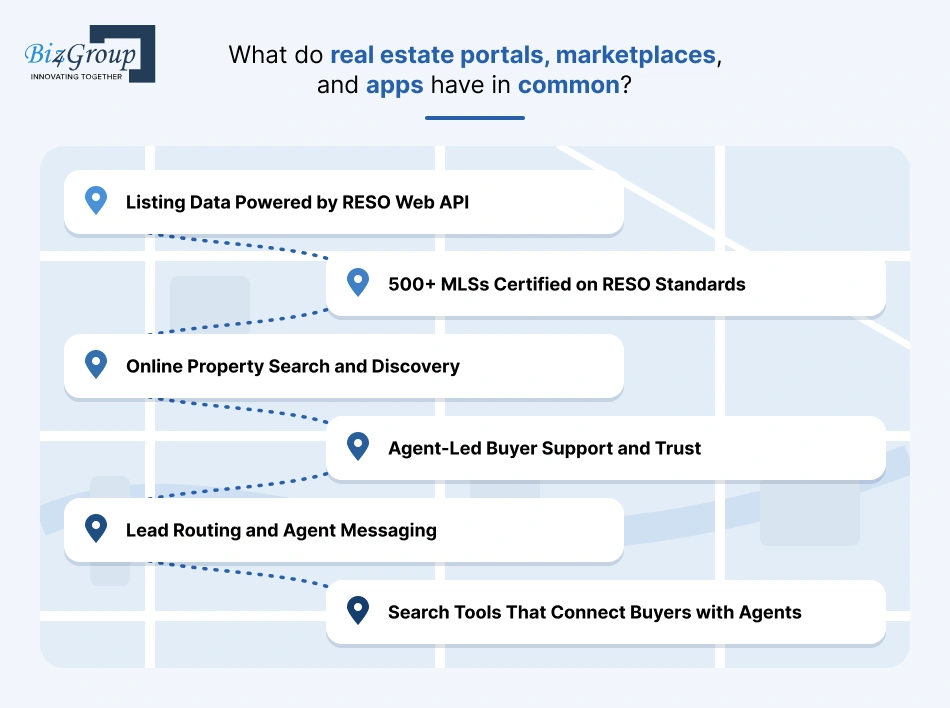
Listing data, trust and search. Without listings nobody comes. Without trust nobody contacts an agent. Without good search nobody finds the listing they came for.
On the data side, the standard in the US is the RESO Web API, which carries MLS data in a common format. RESO describes itself as a not-for-profit and says over 500 MLSs have been certified on its standards, though it gives no date for that figure (RESO fact sheet).
On the trust side, agents still matter. NAR's Profile of Home Buyers and Sellers, as summarized by a state Realtor association, reports that 88% of buyers bought through an agent or broker and 85% of recent buyers ranked agents the most useful information source, while most home searches began online (Virginia Realtors summary). In short, people search on their own and still want a person at the end of it, which is why agent tools, lead routing and messaging show up in every build.
Not sure which one you are building?
Biz4Group helps you pick the right build before a line of code is written.
Pick My BuildWhere does AI actually help in a real estate portal or marketplace?
In four places, and none of them replace the listing data. AI improves how people search, how they are matched, how leads are handled, and how the platform runs behind the scenes.
|
Where |
What AI does |
Example |
|---|---|---|
|
Search |
Understands plain-language requests, not only filters |
"Three beds near a good school, under a budget" |
|
Matching |
Learns what a buyer or renter actually clicks |
Recommendations that improve with use |
|
Leads |
Qualifies and routes inquiries, answers questions after hours |
An agent gets a summary, not a raw form |
|
Operations |
Checks listings, flags duplicates, supports users |
A queue that shrinks without extra staff |
Search and recommendations are usually where AI pays off first, because buyers notice smarter search and recommendations straight away.
The quieter win is operations: a small team can run a busy platform when multi-agent AI systems handle matching, moderation and support.
One warning that applies everywhere: anything that ranks, scores or steers people toward certain homes needs fair housing review. That is a legal question for your attorney, and it shapes the design from the start, as it does with most AI applications for real estate.
What does real estate portal and marketplace development cost?
Published estimates run from about $20,000 for a basic listing site to $300,000 or more for a full platform, with most mid-size marketplaces in between. These come from three agency write-ups published in mid-2026, and all three are vendor estimates, not quotes.
|
Published estimate |
Basic listing site or MVP |
Mid-size marketplace |
Full platform |
|---|---|---|---|
|
$40K to $70K |
$70K to $130K |
$100K to $160K+ |
|
|
$20K to $50K |
$50K to $120K |
$120K to $300K+ |
|
|
$5K to $50K (prototype) |
$50K to $120K |
$120K to $300K+ |
|
|
Span used here |
About $20K to $70K |
About $50K to $130K |
About $100K to $300K+ |
Most of the spread comes from scope and team rates. One of the estimates puts North American rates at $100 to $180 an hour against $25 to $45 in South Asia, and search that has to handle MLS data is a bigger job than a basic filter. The third estimate's lowest tier is a prototype, so the basic span above starts at the other two floors.
Remember to treat these figure as a ballpark. The ranges cover the build only; hosting, maintenance and data access come on top, and what the full cost looks like depends on how many of those you carry.
What has Biz4Group LLC built in this space?
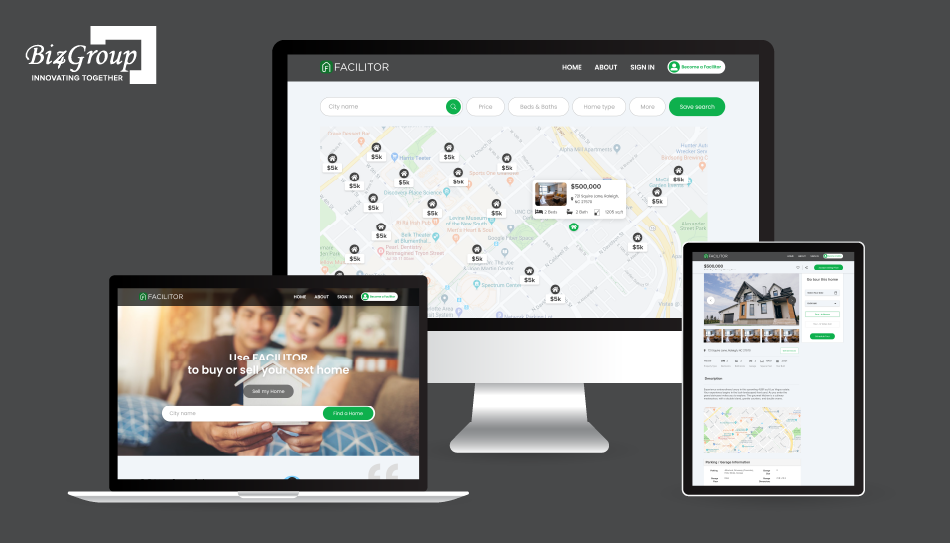
Two projects are relevant, and both are described by features only, because their portfolio pages do not state results. Facilitor lets buyers and homeowners communicate and complete transactions, with property search by budget and location, AI-powered recommendations, video and in-person visits, buyer financial verification, real-time chat, and GPS and MLS integration.
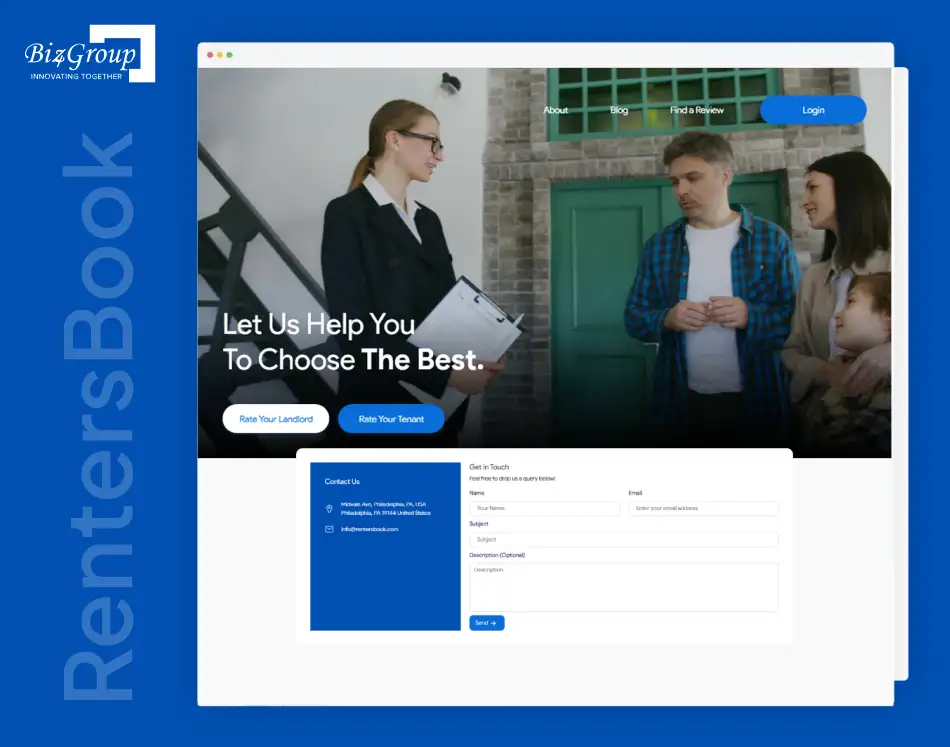
Renters Book is a review and ratings platform built by Biz4Group LLC for a US real estate company, where landlords and tenants post feedback tied to a property and search reviews by tenant, landlord or property.
Know what you are building?
Biz4Group designs and builds the platform, from the listing feed to launch.
Build It With Biz4Group LLCSo, which of the three are you?
Think of a restaurant. A portal is the menu, a marketplace is the dining room that needs diners and a kitchen at once, and an app is the delivery bag. Know which one you are before you hire the chef. Biz4Group LLC, an AI product development company based in USA, builds real estate platforms from the listing feed to launch day, and it will tell you straight which of the three yours is, which tends to save the most money of anything on this page.
Still not sure which of the three you are? Reach out to Biz4Group and the team will match your idea to the right build, then build it, from the listing feed to launch day.
FAQs
1. Do we need MLS access to launch?
Not always. Some products start with listings they collect directly, or in a niche such as rentals or new construction. MLS data gives broad coverage but comes with display rules, so confirm what you may show with the MLS you plan to use.
2. Can one product be a portal, a marketplace and an app?
Eventually, yes. Start with one, because each has a different hard problem, and the second is easier once the first has users.
3. How is a marketplace different from a lead-generation site?
A lead-generation site collects inquiries and hands them on. A marketplace sits in the middle of the deal, with both sides using it to find, talk and transact.
4. Is it too late to build one with the big names around?
Broad coverage is hard to match, but narrow is not: a region, a rental type, a buyer group or a workflow that the large sites handle badly. Pick the narrow thing first.
5. Who owns the data your users create?
You should, and the contract should say so, along with what happens to it if you change builders.
