Location :
Orlando, FL, USA
Location :
Orlando, FL, USA +1 (407) 714-1616
 info@biz4group.com
















Imagine a digital system that doesn’t wait for instructions but instead, understands your business goals, learns from real-time feedback, and takes independent actions to get the job done.
Read More

Transform Every Listing Into a Showstopper with AI Virtual Staging
Picture this. A buyer clicks on a property listing and sees an empty, echoing room that feels cold and uninviting. Now picture that same space instantly transformed into a warm, stylish, fully furnished interior created by a virtual staging AI app for real estate. The difference is not subtle. It is the difference between a quick scroll-past and a scheduled showing.
This is exactly why AI virtual staging app development has become one of the fastest-growing innovations in proptech. Modern buyers form an opinion within seconds, and realtors cannot afford lackluster visuals. By choosing to develop a virtual staging AI app, real estate brands can replace expensive physical staging with automated, photorealistic interiors that match current design trends and buyer preferences. These capabilities are now integral to AI for real estate agents, helping them market properties faster and more effectively.
Whether you are a real estate marketplace looking to scale, a brokerage aiming to boost listing performance, or a founder planning to build an AI virtual staging solution, the opportunity is massive. The ability to create virtual staging AI apps for real estate unlocks faster conversions, higher engagement, and a stronger competitive edge.
In this guide, you will learn how to develop a virtual staging AI app from the ground up, what features matter most, how the technology works, and what it takes to build a real estate virtual staging AI app that stands out in 2026 and beyond.
An AI virtual staging app is a digital tool that uses artificial intelligence to transform empty or outdated property photos into fully furnished, visually appealing interiors. In the world of AI virtual staging real estate, these solutions help agents, brokers, and marketplaces showcase homes in their best possible light without the cost of physical staging.
A virtual staging app with AI analyzes room structure, lighting, and layout, then intelligently places furniture, decor, and design elements that match popular styles and buyer expectations. Unlike manual editing, virtual staging real estate AI delivers faster, more consistent, and highly realistic results.
By applying AI in real estate, property images become more engaging, helping buyers visualize the potential of a space. This results in quicker listing conversions, improved online impressions, and a more efficient marketing process for modern real estate teams.
Investing in custom Virtual Staging AI App Development gives real estate businesses a powerful way to enhance property listings and attract more qualified buyers. Here are the top advantages of developing Virtual Staging AI App solutions that deliver long-term value to agents, agencies, and proptech platforms.
With AI Virtual Staging App Development for real estate, empty or outdated rooms can be transformed within seconds into beautifully designed interiors. This dramatically reduces the time between property photography and listing publication. Faster staging means faster market readiness, helping agents stay ahead in competitive markets. Modern buyers are more likely to interact with visually rich listings, which makes your property stand out immediately.
Traditional staging involves costly furniture rentals, transportation teams, and interior designers. When you choose to create Virtual Staging AI Application solutions, these expenses disappear completely. Instead of staging each room physically, AI algorithms generate multiple design versions at no additional cost. Over time, this results in substantial savings for agencies and independent realtors, especially those handling large inventories.
Staged properties attract more views, stronger engagement, and more showing requests. AI-enhanced visuals help potential buyers better visualize how they would live in the space. This emotional connection leads to higher conversion rates and quicker sales. Well-staged rooms also reduce buyer hesitation, as they clearly showcase layout potential, functionality, and aesthetics.
A custom Virtual Staging AI App Development project allows users to experiment with endless design themes. Whether the property suits modern, luxury, bohemian, or minimalist aesthetics, the app can generate multiple variations instantly. This flexibility empowers realtors to target specific buyer demographics, test what resonates most, and adjust visuals without needing new photos or physical restaging.
Large real estate agencies, listing platforms, and marketplaces benefit immensely from AI-driven scalability. Instead of relying on manual editing teams or interior designers, automated staging enables rapid processing of hundreds of listings simultaneously. This ensures consistent quality, quicker turnaround, and the ability to stage entire portfolios within days, not months.
Maintaining visual consistency is challenging when different designers or teams handle staging. With AI-driven staging, every property follows the same color palette, design approach, and presentation style. This uniformity strengthens brand credibility, enhances the professional appeal of your listings, and creates a recognizable visual identity across all marketing platforms.
These are the benefits that make Virtual Staging AI App Development a powerful investment for real estate businesses aiming to elevate their listings and outperform competitors.
Let’s design a custom AI solution for your real estate goals
Schedule a Free ConsultationTo build a standout virtual staging AI app, it's not just about photorealism — it's about creating an intuitive experience that realtors, photographers, and even homeowners can use without a tech manual.
Here’s a breakdown of the essential features every AI virtual staging for real estate solution must include:
| Feature | Purpose | Why It Matters |
|---|---|---|
|
AI-Powered Furniture Rendering |
Automatically generates virtual interiors based on room type |
Saves time and eliminates manual design |
|
Room Type Detection |
Recognizes kitchens, bedrooms, living spaces, etc. |
Enables smart staging decisions |
|
Drag-and-Drop UI |
Add/remove decor elements with ease |
Increases usability for non-tech users |
|
Style Presets (Modern, Farmhouse, Scandinavian, etc.) |
Users can apply entire staging styles in one click |
Personalization = higher buyer engagement |
|
Before/After Toggle View |
See the transformation instantly |
Helps showcase added value to clients |
|
Download & Share Options |
Easy exports for MLS listings or client proposals |
Supports marketing and collaboration |
|
MLS Compliance Check |
Flags any virtual edits that violate listing guidelines |
Keeps users compliant with real estate regulations |
|
Cloud Storage & Project History |
Save past renderings and projects |
Supports collaboration and long-term reuse |
|
Integrated APIs |
Enables staging directly from listing platforms |
Perfect for AI Integration Services across CRMs, real estate apps, and SaaS tools |
If your app misses any of these, it’s likely to lose ground to more sophisticated tools — both in user satisfaction and market share.
Next, let’s explore the advanced features that can set your AI staging platform apart from cookie-cutter solutions.
Once you’ve covered the basics, it’s time to step up your game. Modern users — especially realtors and real estate startups — expect more than just a couch and a rug in a room. What they need is intelligent, adaptive, and aesthetically on-point rendering.
Here’s how premium AI virtual staging software and AI virtual staging tools deliver on that front:
| Advanced Feature | What It Does | Why It’s a Game-Changer | Estimated Cost Impact |
|---|---|---|---|
|
AI-Based Interior Style Recognition |
Detects existing architectural elements and suggests staging that fits |
Makes staging feel native to the space, not imposed |
$1,500–$3,000 |
|
Auto-Staging Based on Buyer Persona |
Personalizes decor based on user segments (e.g., family vs. luxury buyer) |
Increases buyer engagement with hyper-targeted staging |
$2,000–$4,000 |
|
Real-Time 3D Rendering Engine |
Allows users to rotate, zoom, and adjust angles interactively |
Enhances user control and visual appeal |
$3,000–$5,000 |
|
AI Feedback Loops |
Learns from user preferences and staging history to improve future suggestions |
Builds a smarter, adaptive tool over time |
$2,500–$4,500 |
|
Style-Matching Across Rooms |
Applies cohesive staging styles across multiple rooms in one flow |
Increases design consistency across listings |
$1,200–$2,000 |
|
AR Preview Integration |
Enables users to visualize the staging in real-world environments via smartphone |
Merges virtual and physical real estate experiences |
$5,000+ |
|
API Layer for Marketplace or SaaS Integration |
Allows plug-and-play with MLS, CRM, or real estate SaaS tools |
Makes your app platform-ready (SaaS scalability) |
$2,000–$3,500 |
All these features play a pivotal role in how your platform performs — not just functionally, but also in the eyes of investors, customers, and enterprise partners.
Want to incorporate these seamlessly? That’s where expert AI Product Development Services can accelerate your roadmap without compromising scalability or stability.
We’ll help you prioritize features that align with your users and your budget.
Customize My Feature ListThere’s no shortage of AI virtual staging tools out there — but which one’s right for your real estate business, marketplace platform, or proptech startup?
Below is a side-by-side breakdown of top players making waves in 2026:
| Tool | Best For | Pros | Cons |
|---|---|---|---|
|
REimagineHome |
Real estate agencies & interior designers |
Offers design suggestions; intuitive interface |
Limited control over decor placement |
|
VisualStager |
Individual realtors on a budget |
Easy drag-and-drop interface; quick turnaround |
Looks less photorealistic; lacks AI adaptability |
|
BoxBrownie AI |
Professional photographers & MLS integration |
Realistic results; supports multiple staging styles |
Requires manual input for some adjustments |
|
VirtualStagingAI |
Startups & SaaS marketplaces |
Fully automated AI-based staging |
Customization options are limited |
|
3D Vista Staging |
Premium real estate platforms |
Supports 360° and VR staging |
Expensive; learning curve |
|
Designify AI |
DIY landlords and rental owners |
Great for small budgets; quick image enhancements |
Not a full-fledged staging tool |
Whether you're looking for speed, photorealism, or deep customization, there's a tool that fits. If you're building your own white-label version, these can serve as great benchmarking references.
Looking for deeper insights on tool selection and platform strategy? We’ve already compiled a breakdown of real estate AI tools that streamline operations and amplify sales across the board.
Next up, let’s walk you through the actual development process of building a custom AI virtual staging app from scratch.
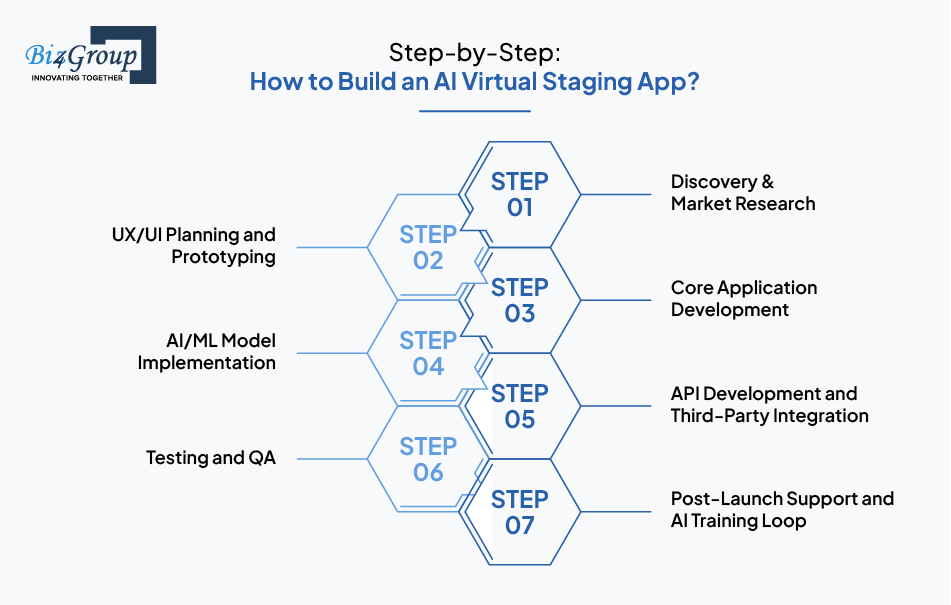
So, you've got the vision: an AI-powered tool that stages homes faster than a professional stager, looks amazing on any screen, and saves your clients both time and budget.
Let’s break down how that vision turns into a real product.
This is the groundwork. You're not just brainstorming features — you’re figuring out what actually matters to users.
At this stage:
Output: User personas, feature set, competitive edge.
Design isn’t just about good looks — it’s about clarity, intuitiveness, and conversion. The more intuitive your UI, the more repeat users you'll have.
This step involves:
A proven UI/UX design company ensures your product feels as smart as it looks.
This is where your developers take over. The focus here is architecture, scalability, and a responsive front end.
Your tech stack might include:
Working with an experienced AI App Development Company can cut the learning curve and help you avoid the usual integration headaches.
This is the brain of your virtual staging app.
What’s involved:
If you're going next-gen, consider generative AI to build custom staging layouts based on buyer personas.
For real-world utility, your app should integrate easily with external tools like MLS platforms, CRMs, or brokerage websites.
Scalability here is key — you don’t just want an app; you want an ecosystem.
Your QA phase must test for both performance and visual accuracy.
This phase also includes user testing to identify friction points before you go live.
Once live, the work isn’t done.
Think of this as the “learn and optimize” phase — a key to long-term retention.
With this full-cycle approach to AI virtual staging app development, you're not just building a tool. You're delivering a real estate advantage that scales.
We’ve delivered MVPs in weeks — let’s plan your roadmap
Book Your Project SprintBuilding an AI-powered virtual staging app isn’t just about “picking the right framework.” It’s about aligning your tech choices with your app’s goals — fast rendering, intelligent staging, seamless API usage, and platform scalability.
If you're planning to integrate or expose your own AI virtual staging API, your stack decisions will directly impact performance, accuracy, and adoption potential.
Let’s break it down by component.
| Component | Tech Options | Purpose |
|---|---|---|
|
Backend |
Core logic, user auth, session handling |
|
|
Frontend |
React.js, React Native, Vue.js |
User interface, drag-and-drop, staging canvas |
|
AI/ML Frameworks |
TensorFlow, PyTorch, OpenCV |
Room detection, object placement, rendering precision |
|
Rendering Engine |
Three.js, Babylon.js, Unity WebGL |
3D/AR visualization for furniture & decor placement |
|
Storage |
AWS S3, Google Cloud Storage |
High-resolution image uploads and project versioning |
|
Database |
MongoDB, PostgreSQL |
Storing user data, session state, app configurations |
|
CDN |
Cloudflare, AWS CloudFront |
Fast delivery of images and app assets globally |
|
AI API Hosting |
Google Vertex AI, AWS SageMaker, or custom dockerized ML pipelines |
Hosting your proprietary AI virtual staging API |
| Category | Open Source Option | Paid/Enterprise Tool | Best For |
|---|---|---|---|
|
ML Framework |
TensorFlow, PyTorch |
Google AutoML, Amazon SageMaker |
Startups vs large-scale AI ops |
|
Image Processing |
OpenCV |
Adobe Firefly AI API |
Real-time filters vs design fidelity |
|
UI Builder |
Figma + React.js |
OutSystems, Webflow (low-code) |
Custom design vs rapid prototyping |
|
Rendering Engine |
Three.js |
Unity WebGL, Babylon Pro |
Lightweight vs immersive experiences |
Choosing the right stack also depends on whether you're building for single-agent realtors or enterprise-level property platforms. If you're planning to scale or integrate with other tools (like CRMs, MLS, or mobile apps), working with an experienced AI Agent Development Company ensures your infrastructure is battle-tested from the get-go.
Don’t reinvent the wheel. Seamlessly add AI staging to your current real estate platform.
Let’s Integrate AIWhen planning your product roadmap, one of the most important questions is what is the cost of developing an AI Virtual Staging App. The budget can vary widely based on your feature set, AI model complexity, rendering engine, platform support, and integration needs. In most cases, the total AI Virtual Staging App Development Cost falls between $20,000 to $200,000 or more, depending on whether you choose a simple MVP or a fully advanced enterprise solution.
To make the budgeting process easier, here is a clear breakdown of the cost of building Virtual Staging AI App Development across three development tiers.
| App Type | What It Includes | Estimated Cost | Estimated Timeline |
|---|---|---|---|
|
Basic AI Virtual Staging App (MVP) |
Core image upload, basic room detection, preset staging styles, simple AI placement, export options |
$20,000 to $50,000 |
4 to 8 weeks |
|
Medium AI Virtual Staging App |
Multiple style libraries, enhanced staging accuracy, user accounts, dashboards, third party integrations, improved rendering |
$50,000 to 120,000 |
8 to 14 weeks |
|
Advanced AI Virtual Staging App |
Generative AI staging, 3D and AR previews, large style catalogs, real time rendering, MLS compliance, cloud infrastructure, full API ecosystem |
$120,000 to $200,000 or more |
14 to 24 weeks |
These cost ranges provide a realistic foundation for choosing the right development level that matches your feature goals, scalability needs, and target audience for your virtual staging AI app.
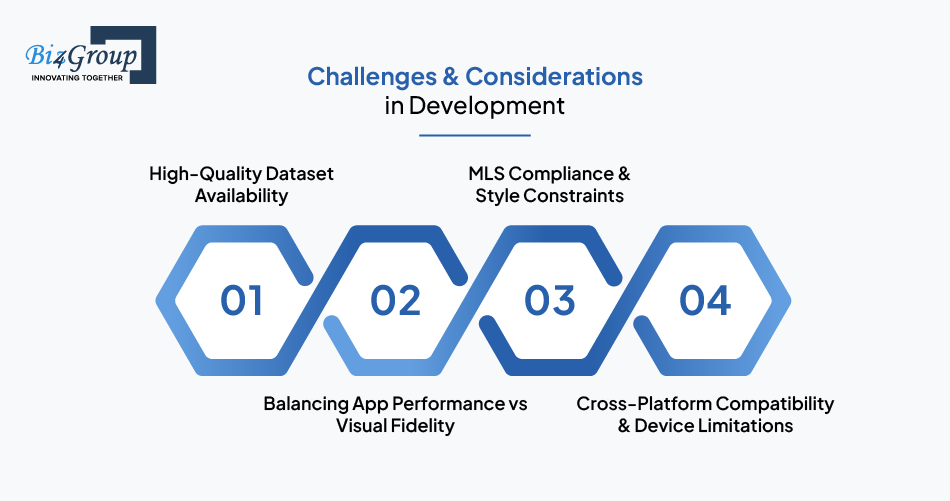
Developing an AI virtual staging app isn’t all polished renderings and snappy results. Behind the scenes, there are a few hard truths teams should be ready to tackle.
Let’s talk shop — these are the most common challenges teams run into:
Training your AI model to accurately recognize room layouts, furniture types, lighting angles, and textures? That takes thousands of labeled interior photos — and those aren’t easy (or cheap) to come by.
Getting datasets that reflect MLS standards and common staging styles adds another layer of complexity.
Sure, you want crisp, photorealistic staging. But can your app process that on a mid-tier phone without frying the battery?
Finding that balance between rendering quality and app responsiveness is where most dev teams lose steam — especially if you're targeting mobile and web platforms.
You can’t just make the room look pretty — it also has to meet MLS photo standards, which often ban watermarks, excessive edits, or unrealistic enhancements.
AI must walk a fine line between stylish and compliant.
AI staging apps must be equally performant across:
That means your rendering engine, CDN configuration, and AI model deployment strategy all need fine-tuning.
This is exactly where experienced partners shine. With the right AI consulting services, you don’t have to reinvent the wheel — just fine-tune the engine.
AI has already changed how realtors dress up empty rooms — but where is this all heading?
If you think virtual staging AI real estate tools are just about static images with mid-century modern sofas dropped in, think again. The next evolution is fast, immersive, and surprisingly predictive.
Here’s a look at what’s coming next in AI for virtual staging:
Picture this: a buyer opens your listing and walks around the empty room with their phone — but sees it furnished through AR.
Augmented Reality + real-time AI staging is the next big leap.
Smart staging models will soon recommend layouts based on buyer demographics, past listing performance, or even regional design trends.
Basically, AI won’t just stage the room — it’ll optimize it for conversion.
“Show me this room as a minimalist office.”
AI + voice interfaces will allow on-the-fly staging adjustments, perfect for agents or buyers exploring listings live.
With each user interaction, staging tools will adapt — improving placement, object selection, and even lighting preferences over time.
Smart agencies and startups are already laying the groundwork to create AI real estate assistant platforms that combine virtual staging with chat, search, and buyer profiling. If you're building for the future, now's the time to integrate these capabilities from the start.
Make your property stand out with cutting-edge virtual staging tools
Let’s Build ItDeveloping a next generation AI virtual staging app requires more than technical coding. It demands intelligent AI workflows, realistic rendering capabilities, strong real estate domain knowledge, and a user focused design approach. Biz4Group delivers all of these through a proven track record, making us a trusted AI app development company for vision driven real estate products.
At Biz4Group, we bring deep experience, strategic thinking, and future ready engineering to help you build a scalable, impactful staging solution that performs exceptionally in the real estate market.
Below are our featured real estate projects, presented separately so you can easily add portfolio images for each.
A smart property intelligence system that evaluates homes and provides improvement insights based on AI driven analysis. This showcases our capability to design platforms that use structured data, predictive logic, and intuitive UX for property decision making.
A complete facility and asset management platform built for multi property operations. It highlights our strength as a real estate web development company, with expertise in building powerful backend systems, automation workflows, and scalable infrastructures for large teams.
A secure contract automation and compliance management system. This project reflects our proficiency in creating structured, audit ready platforms ideal for real estate firms that handle sensitive information and rely on streamlined operations.
A rental marketplace application that connects property owners and renters through a smooth, mobile friendly experience. It demonstrates our ability to develop consumer centric platforms with strong usability, scalability, and modern real estate features.
We understand the challenges, workflows, and expectations of real estate agents, property managers, and proptech founders.
Our team combines model training, room detection, and generative staging technology to deliver highly accurate outputs.
We build fast, yet ensure your product is engineered for long term performance, growth, and stability.
Through our Enterprise AI Solutions, we help you select the right tech stack, rendering engine, AI logic, and product flow from the very beginning.
Our involvement continues beyond deployment with performance enhancements, QA cycles, new features, and roadmap support.
If you are ready to create a high performing AI virtual staging platform, Biz4Group offers the expertise, industry understanding, and collaborative partnership needed to build a solution that truly leads the market.
Let’s face it — today’s homebuyers judge a property in seconds, and plain empty rooms just don’t cut it anymore.
An intelligent, scalable AI virtual staging app isn’t a luxury add-on. It’s a conversion machine. It helps realtors create stunning, personalized interiors without the cost or delay of traditional staging. It turns photo galleries into powerful sales tools. And it does it faster, smarter, and at a fraction of the cost.
Yes, AI virtual staging app development comes with an upfront investment — but one that pays dividends in higher engagement, faster deal closures, and brand authority.
The next move? Find the right team that understands both AI and real estate.
Biz4Group brings proven experience, the full-stack expertise, and the creative edge to help you launch a product that sells homes before buyers even visit.
If you're ready to lead the future of real estate presentation, it’s time to Hire AI Developers who’ve done it before — and are ready to build your vision next.
Don’t settle for templates. Get a tailor-made AI staging solution that fits your brand and market.
Book Strategy CallThe cost typically ranges from $15,000 to $90,000+, depending on features like real-time rendering, cloud infrastructure, and model training. An MVP version costs less, while a full-scale solution with advanced automation and analytics will cost more.
Core technologies include Python for backend, TensorFlow or PyTorch for AI, and rendering engines like Three.js or Unity. Cloud platforms (AWS, GCP), CDN services, and UI libraries like React or Flutter are also common.
Some top tools include REimagineHome, VisualStager, and BoxBrownie AI. The best tool depends on your use case — whether you're a realtor, startup, or agency with custom design needs.
Absolutely. Many companies opt for custom chatbot development or staging features integrated into larger real estate platforms. Integration APIs and modular AI components make it easy to plug staging features into your existing product.
Yes — but only if implemented properly. MLS boards often restrict over-editing, so AI-generated rooms must be realistic, with clear disclaimers and no manipulations that alter property dimensions.
AI staging delivers 10x scalability at a fraction of the cost. It reduces time-to-market, allows for A/B testing of designs, and personalizes listings for different buyer personas — which can significantly boost engagement and conversions.
Yes. Firms experienced in real estate mobile app development can build and optimize AI staging apps that run efficiently on Android and iOS platforms without sacrificing visual fidelity.
The development team must use responsive UI frameworks, lightweight AI models, and CDN-backed delivery to ensure performance across devices — even on slower networks.
Yes. Many real estate app development companies offer modular AI integrations that let you embed staging engines within current systems.
Development typically takes 10 to 16 weeks, depending on features, integrations, and dataset availability. This includes discovery, design, AI training, rendering setup, QA, and deployment.

with Biz4Group today!
Our website require some cookies to function properly. Read our privacy policy to know more.