 Location :
Orlando, FL, USA
Location :
Orlando, FL, USA +1 (407) 714-1616
 info@biz4group.com
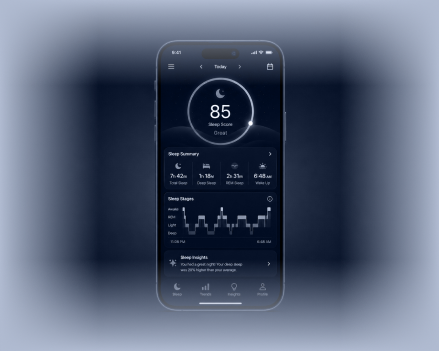
 AI Summary Powered by Biz4AI
- AI sleep tracking app development is evolving from basic monitoring to intelligent, predictive, and personalized health experiences.
- Businesses aiming to develop AI sleep tracking apps benefit from growing wearable adoption, preventive healthcare demand, and digital wellness trends.
- Successful AI sleep analysis app development combines AI, wearable integrations, cloud infrastructure, compliance, and scalability.
- Development costs range from roughly $40,000 for MVPs to $350,000+ for enterprise-grade platforms depending on features and AI complexity.
- Companies like Biz4Group help turn ideas into scalable AI-powered sleep monitoring solutions with end-to-end HealthTech expertise.
What if the next billion-dollar HealthTech opportunity isn’t about helping people stay awake, but helping them sleep better? AI sleep tracking app development is rapidly evolving from a niche wellness trend into a serious business opportunity. The companies are moving from basic monitoring tools to building intelligent health platforms. The idea is to deliver personalized recovery insights, behavioral recommendations, and predictive wellness experiences.
Now, users don’t just want to know how many hours they have slept. They want to understand why, how to recover better, and what changes can improve their health. That’s why smart sleep tracking app development is evolving from simply monitoring sleep to smart sleep pattern analysis app development using AI. As it offers recovery insights, behavioral guidance, predictive wellness experiences and many more.
The numbers reflect this momentum. The global sleep tech market was valued at nearly $29.3 billion in 2025 and is projected to be valued at US$1.4 billion in 2026, the sector will be growing aggressively in the coming decade as AI-powered wellness solutions, wearable adoption, and connected health ecosystems continue to expand. Wearables alone accounted for more than 75% of the sleep tech market share in 2025 which highlights the growing demand for data-driven sleep experiences.ng
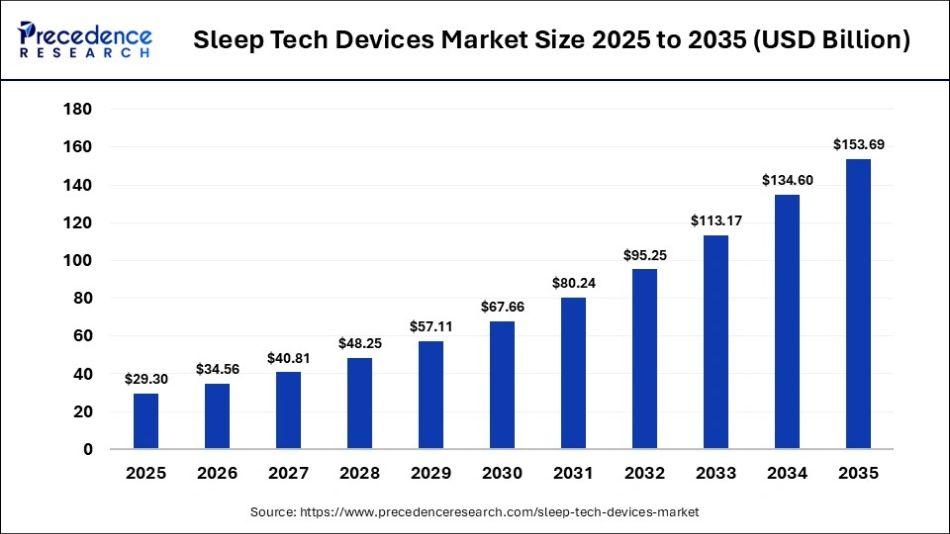
This creates a much larger opportunity for AI HealthTech startups, wellness platforms, healthcare providers, and enterprise innovators.
AI sleep analysis app development is becoming less about tracking sleep and more about building smarter health experiences as sleep is directly connected with recovery, productivity, chronic disease prevention, and mental wellness.
If you’re asking yourself, "How do we build an AI sleep monitoring app with wearable integration and real-time sleep analysis?", here’s a detailed look at AI sleep analysis app development, key features, and trends shaping the space.
What is the Market Demand for AI Sleep Tracking Apps in 2026?
Sleep is not viewed as a wellness issue anymore. It has become an essential pillar of health. As sleep disorders are rising, healthcare costs are increasing, and consumers are becoming more proactive about managing their health. It has become a growing business opportunity. Businesses are increasingly exploring to develop AI sleep tracking apps as a way to address one of the most important yet overlooked aspects of overall well-being.
Several market shifts are driving this momentum.
1. Rising Global Sleep Health Concerns
According to sleep health research, nearly one-third of adults globally experience inadequate sleep, which is contributing to rising concerns around productivity, chronic health conditions, and overall quality of life. Poor sleep is increasingly associated with burnout, reduced workplace performance, and higher healthcare spending.
2. Rapid Growth of the Digital Wellness Industry
The expansion of digital health is creating favorable conditions for AI-powered sleep solutions. The global digital health market is valued at approximately $347 billion in 2025, it is projected to grow at over 23% CAGR in the coming years. It is supported by increasing investment in connected healthcare technologies and preventive care solutions.
3. Increasing Adoption of Wearable Health Devices
Wearable devices continue generating larger volumes of health data than ever before. Industry projections estimate the wearable technology market will exceed $96 billion in 2026, it is driven by strong adoption of smartwatches, fitness trackers, smart rings, and connected health devices.
4. Expanding Market Opportunities Across Industries
Organizations across multiple sectors are exploring sleep monitoring as part of broader digital health strategies.
|
Industry |
Primary Growth Driver |
|---|---|
|
Healthtech Startups |
Preventive care solutions |
|
Healthcare Providers |
Patient monitoring initiatives |
|
Fitness & Wellness |
Recovery-focused experiences |
|
Corporate Wellness |
Workforce health programs |
|
Insurance |
Risk reduction initiatives |
The market demand in 2026 is driven by the growing need to transform health data into meaningful user outcomes. With evolving health ecosystems, strategic investment in the sector can create intelligent health solutions with long-term growth potential.
Now, let's address what AI sleep tracking app development is and why traditional ways of developing AI sleep tracking apps are not enough.
What Is AI Sleep Tracking App Development, and How Is It Different from Traditional Sleep Tracking App Development?
AI sleep tracking app development focuses on using advanced algorithms and machine learning to monitor, analyze, and interpret sleep patterns in a personalized way. These apps don’t just record hours slept, they provide actionable insights, detect patterns, and adapt recommendations based on individual behavior, lifestyle, and health data.
However, traditional sleep tracking apps development mostly were based on basic metrics like sleep duration, bedtime consistency, and daily sleep scores. They helped users to be more aware of their habits, but they often lack context, personalization, and predictive intelligence.
To better understand the evolution from simple tracking to intelligent sleep optimization, the table below compares traditional sleep tracking apps with AI-powered solutions side by side.
|
Aspects |
Traditional Sleep Tracking |
AI-Powered Sleep Tracker |
|---|---|---|
|
Core Purpose |
Tracks sleep duration and basic metrics like bedtime and wake time |
Analyzes sleep patterns and delivers personalized, actionable sleep intelligence |
|
Type of Insights Provided |
Generic reports such as total sleep hours and basic sleep scores |
Context-aware insights explaining sleep quality, recovery status, and influencing factors |
|
Personalization Level |
Same recommendations for all users regardless of behavior or lifestyle |
Fully personalized recommendations based on user habits, health data, and sleep history |
|
Understanding Sleep Quality |
Limited understanding of why sleep quality is poor |
Identifies root causes like stress, activity, or irregular routines affecting sleep |
|
Adaptability to User Changes |
Static rules that do not evolve with user behavior |
Continuously adapts using AI models as user behavior and lifestyle change |
|
Engagement Over Time |
Engagement drops due to repetitive and predictable insights |
Sustained engagement through evolving insights, alerts, and adaptive recommendations |
|
Predictive Capabilities |
No prediction; only shows historical sleep data |
Predicts potential sleep issues, recovery trends, and wellness risks |
|
Wearable & Ecosystem Integration
|
Basic or limited integration with devices |
Deep integration with wearables, health apps, and real-time biometric data |
|
Data Interpretation |
Users must interpret charts and raw data themselves |
AI converts complex sleep data into clear, actionable health insights |
|
Final User Outcome |
Awareness of sleep patterns only |
Improved sleep quality, recovery, and long-term wellness optimization |
For businesses investing in AI sleep analysis app development, the goal is not just to simply monitor sleep anymore. It is creating intelligent systems capable of delivering personalized health experiences on a scale. Let's discover the AI capabilities of smart sleep tracking app development.
Brains Behind the Snooze?
Let’s create the features that make your app smarter than the rest.
ConnectWhat Are the AI Capabilities Behind Sleep Tracking App Development?
Modern AI sleep tracking apps rely on multiple AI capabilities that works together to process health signals, analyze behavior, generate predictions, and continuously improve user experiences.
Rather than depending on a single AI model, intelligent sleep monitoring systems combine multiple technologies to deliver more accurate and personalized sleep insights.
|
AI Technology |
Purpose in Sleep Tracking Applications |
|---|---|
|
Large Language Models (LLM) |
Analyzes historical sleep behavior, activity patterns, and health signals to provide personalized insights, track trends, and enhance recommendations over time using machine learning for sleep analysis. |
|
Deep Learning for Pattern Recognition |
Analyzes complex biometric and sensor data to identify sleep stages, movement patterns, and subtle behavioral trends. |
|
Time-Series Forecasting Models |
Uses sequential data (sleep sessions, activity, heart rate trends) to predict future sleep quality, detect sleep deprivation, and anticipate recovery needs. |
|
Anomaly Detection for Sleep Health Risks |
Identifies irregular sleep behaviors, abnormal signals, or potential health risks early, enabling proactive alerts and behavioral interventions. |
|
Generative AI Model |
Powers conversational wellness assistants and interactive sleep coaching, providing explanations, personalized guidance, and behavioral recommendations in natural language. |
Well-chosen AI capabilities are essential for successful AI sleep analysis app development as it continuously helps with evolving user experiences. Now, let's take a look at the compliance and security requirements crucial for AI sleep health app development.
What are the Compliance and Security Requirements While Developing AI Sleep Monitoring App?
AI sleep tracking apps collect highly sensitive information that ranges from sleep behavior and biometric signals to health records and behavioral patterns. Therefore, security and compliance are not optional requirements. They are foundational components of building trustworthy health applications.
The exact requirements vary depending on geography, target users, and business models, but most AI sleep monitoring solutions should address the following areas.
|
Compliance Area |
Why It Matters |
|---|---|
|
Health Data Privacy (HIPAA, GDPR) |
Applications handling health information must comply with regional privacy requirements, such as HIPAA and GDPR, to ensure secure data collection, processing, and storage practices |
|
User Consent and Data Transparency |
Users should clearly understand what information is collected, how it is used, and how long it is retained |
|
Data Encryption and Secure Storage |
Sensitive health information should remain protected during data transmission, storage, and processing workflows |
|
Authentication and Access Control |
Strong authentication mechanisms help prevent unauthorized access to sensitive health data and user accounts |
|
Third-Party Integration Security |
Wearables, health platforms, APIs, and external services introduce additional security risks that require proper validation and monitoring |
|
AI Governance and Model Reliability |
Businesses should establish processes for monitoring model performance, reducing bias, validating outputs, and maintaining consistent system reliability |
Common Compliance Frameworks Businesses Often Consider
- HIPAA compliance for healthcare-related applications
- GDPR requirements for users located in regulated regions
- Data residency and localization requirements
- Industry-specific healthcare security standards
Strong compliance practices don't just reduce regulatory risks. They help create user trust, support enterprise adoption, and improve long-term product sustainability.
Now, let’s explore the core features used in the development of a smart sleep tracking app.
What Is the Core AI-Powered Features of Modern Sleep Tracking App Development?
Modern AI sleep tracking apps are no longer limited to recording sleep duration or displaying basic reports. Successful products combine data collection, behavioral analysis, predictive intelligence, and personalized guidance to create more meaningful user experiences.
The following features are increasingly becoming essential for businesses investing in AI sleep tracking app development.
|
Feature Category |
Key Capabilities |
|---|---|
|
Sleep Monitoring & Multi-Source Data Collection |
Tracks sleep duration, cycles, interruptions, and integrates data from wearables, smartphones, movement patterns, heart rate, and environmental factors like noise, temperature, and light exposure |
|
AI-Powered Sleep Pattern Analysis |
Identifies sleep stages (REM, deep, light), evaluates sleep quality, analyzes behavior patterns, and detects long-term trends |
|
Sleep Disorder Risk Detection |
Detects irregular sleep patterns, insomnia, sleep apnea, fatigue signals, and other potential recovery issues |
|
Predictive Sleep Quality Forecasting |
Forecasts future sleep quality, identifies sleep debt, and predicts the impact of lifestyle changes on recovery |
|
Personalized Sleep Coaching & Recommendations |
Provides customized sleep plans, habit improvement suggestions, behavioral guidance, and recovery tips |
|
Recovery & Readiness Scoring |
Generates recovery scores, wellness metrics, and energy readiness indicators based on multiple physiological and behavioral signals |
|
Smart Alerts & Behavioral Interventions |
Sends bedtime reminders, risk notifications, schedule optimization alerts, and personalized coaching prompts |
|
Data Visualization & Analytics Dashboard |
Displays sleep trends, comparisons, and progress in intuitive charts and graphs |
|
Integration with Health & Fitness Platforms |
Syncs with other health apps and wearables to consolidate wellness data and enable holistic insights |
|
User Engagement Features |
Daily tips, challenges, motivational messages, and gamification to increase adherence and retention |
The shift is already visible in platforms like QuantumFit, developed by Biz4Group, where AI helps users build healthier habits and wellness routines that naturally support improved sleep and recovery.
Quantum Fit – AI-Powered Personal Development
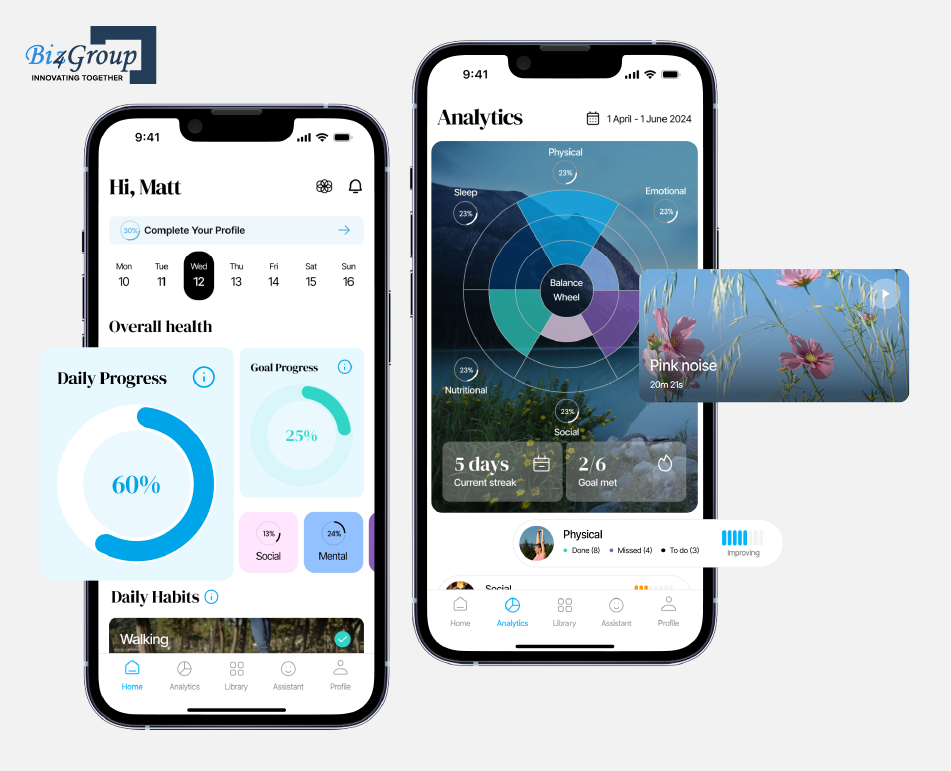
QuantumFit is an AI-driven personal development app that helps users optimize key areas of life including physical health, mental well-being, nutrition, social connection, and spiritual growth. While it does not track sleep directly, supporting these wellness habits naturally contributes to healthier routines and better recovery cycles.
Key Highlights:
- AI-Powered Habit Tracking: Monitors daily routines across multiple wellness area
- Personalized Insights: Offers actionable recommendations for stress management, activity, and nutrition
- Progress Analytics: Tracks improvements in overall well-being
- Multi-Platform Access: Seamless experience across devices
- Holistic Wellness Support: Encourages healthier lifestyle patterns that eventually help maintain a good sleep cycle
QuantumFit demonstrates how AI can improve wellness through behavioral guidance and provide the foundation for sleep intelligence. The next level of innovation lies in advanced AI capabilities. Let's explore the advanced features of AI sleep analysis app development.
What Are the Advanced Features of AI Sleep Tracking App Development?
The core features provide the essential features like tracking sleep, analyzing patterns, and offering basic recommendations. The next-generation of AI sleep tracking apps steps up the whole game to another level. Here’s a closer look at what sets premium AI sleep trackers apart:
|
Advanced Feature Category |
Key Capabilities |
|---|---|
|
AI Sleep Digital Twin |
Simulates a user’s sleep behavior to predict effects of lifestyle, travel, or environmental changes. |
|
Chronotype Intelligence & Lifestyle Optimization |
Identifies individual chronotypes and recommends optimal sleep, work, and recovery schedules. |
|
Multimodal Health Intelligence |
Combines sleep, activity, nutrition, stress, and HRV to deliver holistic wellness insights. |
|
Emotion & Stress Impact Analysis |
Detects how stress and emotional states influence sleep quality using wearable biomarkers. |
|
Smart Home & IoT Sleep Automation |
Integrates with smart lights, thermostats, sound systems, and devices to automatically optimize sleep conditions. |
|
AI-Powered Conversational Sleep Coach |
Provides contextual guidance through natural language, answering user questions and coaching habits. |
|
Predictive Health Risk Modeling |
Detects long-term trends signaling elevated risks of sleep disorders, burnout, or chronic fatigue. |
|
Workplace Performance & Recovery Intelligence |
Links sleep quality to productivity, focus, and cognitive performance for employee wellness insights. |
|
Family & Household Sleep Intelligence |
Monitors sleep patterns across multiple users to identify environmental or behavioral factors affecting household sleep quality. |
|
Personalized Sleep Experimentation Engine |
Tests different routines, sleep habits, and environmental adjustments to identify the most effective interventions. |
|
Privacy-Preserving AI & Federated Learning |
Improves AI models using decentralized learning while keeping health data private and secure. |
Businesses that are implementing these features can differentiate their product in a crowded healthtech market and deliver a truly personalized user experience. Now, let’s have a look at the tech stack used in the development of AI sleep tracking app.
Technology Stack Required for AI Sleep Tracking App Development?
Building AI-powered sleep tracking applications requires multiple technology layers working together to support mobile experiences, health data processing, AI capabilities, scalability, integrations, and security.
While the exact stack depends on business requirements, modern sleep tracking solutions typically include the following components:
|
Technology Layer |
Common Technologies |
Purpose |
|---|---|---|
|
Frontend Development Technologies |
Flutter, React Native, Swift, Kotlin |
Build mobile applications, dashboards, sleep monitoring interfaces, health visualizations, and personalized user experiences |
|
Backend Development Technologies |
Node.js, Python, Java, Go |
Manage APIs, business logic, authentication, user management, and server-side health data processing, with Node.js development enabling scalable and real-time backend performance for handling continuous sleep and health data streams. |
|
API and Integration Technologies |
REST APIs, GraphQL, SDK integrations |
Enable communication between applications, wearables, health platforms, and third-party services |
|
Database Technologies |
PostgreSQL, MongoDB, Firebase |
Store structured user profiles, sleep sessions, behavioral and health signals, and analytics data. PostgreSQL ensures high data integrity, scalability, and secure handling of sensitive health information, enabling AI models to generate accurate, personalized sleep insights. |
|
AI and Machine Learning Frameworks |
TensorFlow, PyTorch, Scikit-learn |
Train AI models, process behavioral data, generate predictions, and support sleep analysis systems |
|
Cloud Infrastructure Technologies |
AWS, Google Cloud Platform, Microsoft Azure |
Support scalable computing resources, storage infrastructure, deployment environments, and large-scale data processing |
|
Real-Time Data Processing Technologies |
Apache Kafka, Redis, WebSockets |
Process continuous health signals, support live synchronization, and enable real-time monitoring experiences |
|
Security and Data Protection Technologies |
OAuth, JWT, encryption services, secure authentication protocols |
Protect sensitive health information, manage secure access controls, and support regulatory requirements |
After building a tech stack, the real challenge lies in using that foundation to create personalized, engaging, and scalable wellness experiences that users consistently return to. A strong example of this approach is Cultiv8, a platform developed by Biz4group. Let’s have a look at how it is creating an impact on the wellness sector.
Cultiv8: AI-Powered Spiritual Wellness Platform by Biz4Group
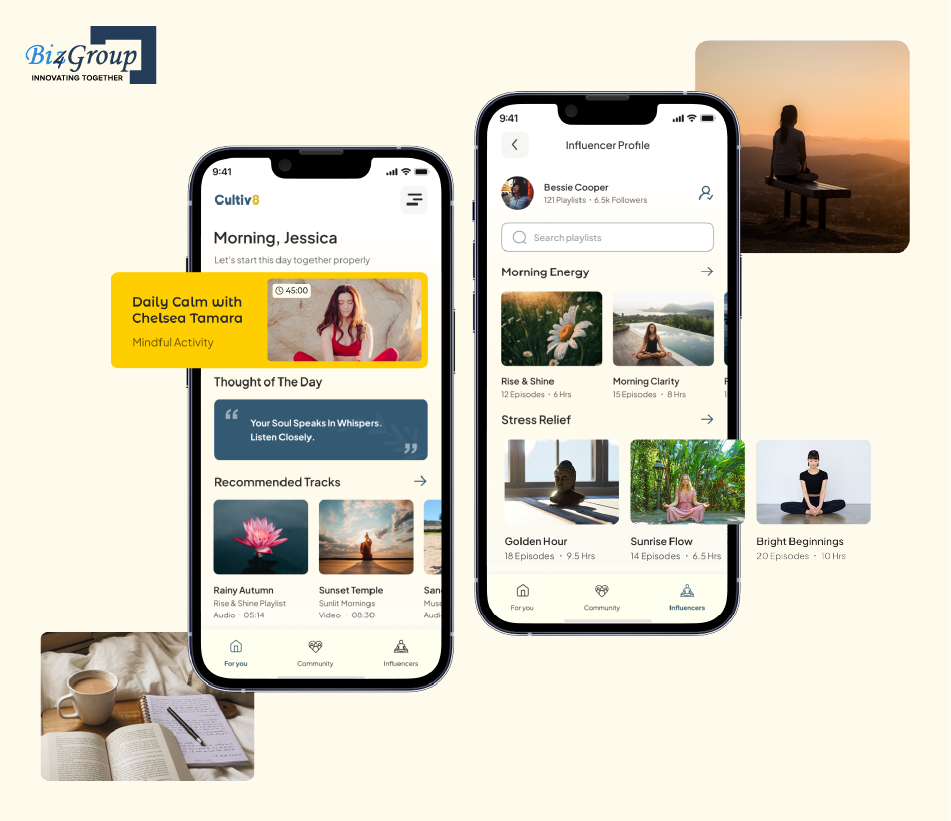
Cultiv8 is a digital wellness platform built to help users explore mindfulness, spirituality, and personal growth through personalized content and guided experiences. While the platform is not focused on sleep tracking, it demonstrates how AI-powered personalization and habit-building mechanisms can improve user engagement across wellness applications.
Key Capabilities:
- Personalized content recommendations based on user preferences and activity
- Guided meditation and mindfulness experiences
- Daily wellness content and engagement prompts
- Community-driven discussions and interactions
- Smart notifications and routine-building reminders
- Scalable content management and delivery system
Cultiv8 showcases how AI, personalization, content delivery systems, and user engagement mechanisms can be combined to create a scalable wellness platform. The project highlights the importance of building solutions that not only leverage intelligent technologies but also keep users engaged through tailored experiences and continuous value delivery. Next, let’s understand the stepwise development process of the AI sleep tracking app.
Also Read: Next JS Development Company
How to Develop AI Sleep Tracking App Development: A Step-by-Step Process
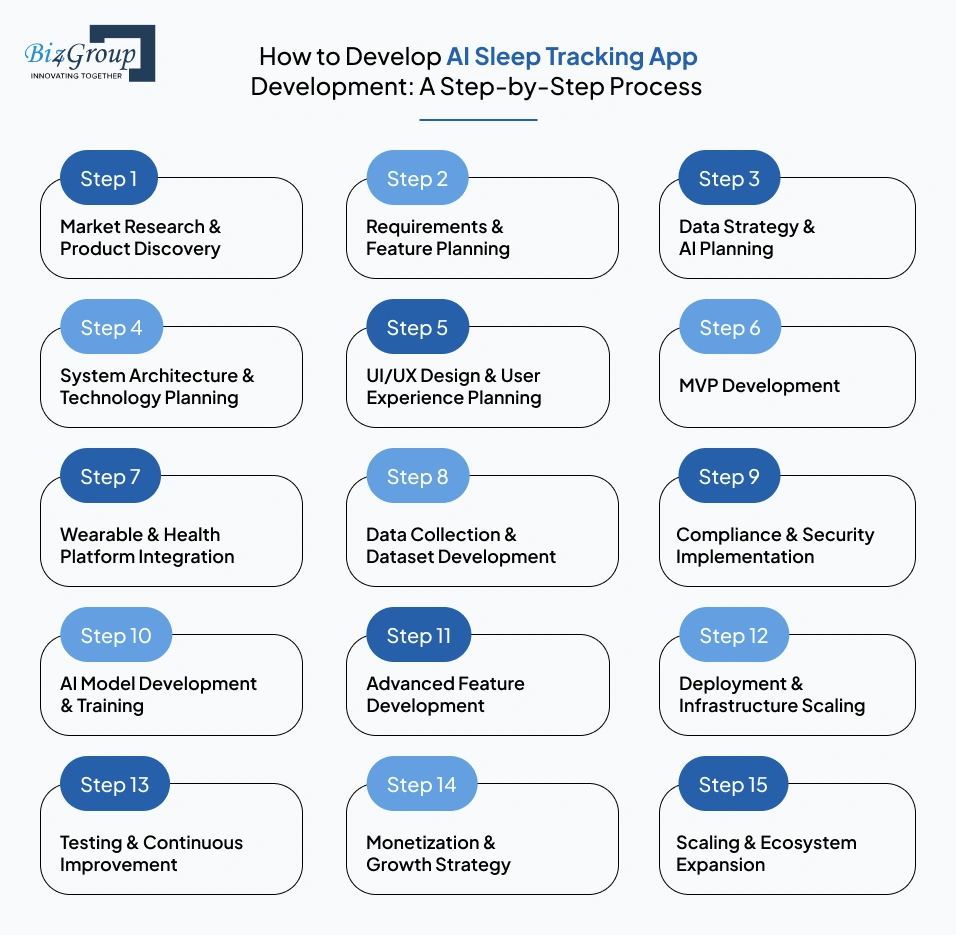
Building an AI sleep tracking app involves much more than creating a mobile interface that records sleep duration. Modern sleep applications require health data collection, AI systems, wearable connectivity, scalable infrastructure, and continuous optimization to deliver meaningful user experiences.
While development approaches vary depending on business goals and target users, most successful AI sleep tracking app development projects follow a structured process.
Step 1: Market Research & Product Discovery
Market research and product discovery are the first and most crucial steps of developing any app. Businesses need to understand who the target audience is, what problems they are solving, and whether there is genuine market demand. This phase creates clarity around product direction and business opportunities.
How This Step Works
- Analyze competitors and existing sleep solutions.
- Identify target users and their pain points.
- Validate demand through research and interviews.
- Define product positioning and differentiation.
- Establish business goals and success metrics.
By the end of this phase, businesses figure out if they have verified product vision, a clear target audience, and stronger confidence in market opportunities.
Step 2: Requirements & Feature Planning
Once the opportunity is validated, the next step is to decide what the product should actually include. The focus here is to identify features that deliver value without overcomplicating the first release.
How This Step Works
- Define essential sleep tracking features.
- Prioritize MVP functionality versus future features.
- Create user flows and feature requirements.
- Define technical and business objectives.
This phase creates a focused roadmap that aligns product decisions with business goals and development priorities.
Step 3: Data Strategy & AI Planning
AI performance depends entirely on data quality. Before building intelligent systems, businesses must determine what data is needed, where it comes from, and how it supports personalization.
How This Step Works
- Identify sleep, activity, behavioral, and biometric data sources.
- Define AI use cases and personalization goals.
- Establish data collection and storage strategies.
- Determine how AI models will generate insights.
This stage establishes the foundation required for accurate AI models and meaningful user experiences.
Step 4: System Architecture & Technology Planning
AI sleep applications process large volumes of health data and often support multiple devices and platforms. Building the right architecture early prevents scalability issues later.
How This Step Works
- Select mobile, backend, and cloud technologies.
- Design APIs and infrastructure architecture.
- Plan for scalability and performance.
- Establish integration requirements.
Businesses gain a technical foundation capable of supporting future growth, integrations, and expanding user bases.
Step 5: UI/UX Design & User Experience Planning
Even the most advanced AI system fails if users find the experience confusing. This stage focuses on creating simple and engaging experiences that encourage long-term usage.
How This Step Works
- Design onboarding and user journeys.
- Create dashboards and sleep visualization experiences.
- Build prototypes and test usability.
- Optimize accessibility and navigation.
Designing UI/UX and user experience planning creates intuitive user experiences that improve engagement, retention, and product adoption.
Step 6: MVP Development
The goal here is not to build the final product. Instead, businesses create an initial version that delivers core functionality while allowing faster validation.
How This Step Works
- Build sleep tracking capabilities.
- Develop dashboards and reporting features.
- Implement user accounts and authentication.
- Create basic recommendation systems.
- Establish backend services.
MVP development services helps in delivering a working product that enables businesses to validate assumptions and gather real-world feedback.
Step 7: Wearable & Health Platform Integration
AI sleep applications become significantly more valuable when they can collect information from multiple health ecosystems and wearable devices.
How This Step Works
- Integrate smartwatches and wearable devices.
- Connect health platforms and APIs.
- Synchronize multi-source health data.
- Build real-time data pipelines.
This phase improves tracking accuracy and creates richer datasets for AI-driven insights.
Step 8: Data Collection & Dataset Development
Once integrations are active, businesses must collect and organize high-quality datasets that AI systems can learn from.
How This Step Works
- Collect sleep and behavioral data.
- Clean and standardize datasets.
- Remove incomplete or inconsistent information.
- Establish ongoing data pipelines.
This stage creates reliable datasets that improve AI performance and personalization capabilities.
Step 9: Compliance & Security Implementation
Sleep applications process highly sensitive health information, which makes privacy and security essential. It is crucial to establish strong user data compliance to ensure security and build trust for a sustainable business
How This Step Works
- Implementing regulatory requirements.
- Encrypt sensitive information.
- Establish access controls and authentication systems.
- Conduct security testing and audits.
Compliance and security implementation reduce regulatory risk while strengthening user trust and platform security.
Step 10: AI Model Development & Training
AI model development and training involves collecting data to generate intelligent insights. AI models learn patterns and generate personalized recommendations.
How This Step Works
- Train sleep detection models.
- Develop prediction systems.
- Build recommendation engines.
- Fine tune AI coaching experiences.
- Evaluate model performance continuously.
Businesses gain intelligent capabilities that differentiate their products from traditional sleep tracking applications.
Step 11: Advanced Feature Development
Once the core platform is stable, businesses can introduce advanced experiences that increase personalization and user engagement.
How This Step Works
- Build AI coaching experiences.
- Enable behavioral interventions.
- Introduce stress and mood analysis.
- Integrate smart home ecosystems.
- Create adaptive optimization experiences.
This stage creates stronger differentiation and increases long-term user engagement.
Step 12: Deployment & Infrastructure Scaling
As adoption grows, infrastructure must support increasing users, larger datasets, and expand AI workloads.
How This Step Works
- Deploy scalable cloud infrastructure.
- Configure monitoring systems.
- Optimize database performance.
- Establish reliability and backup systems.
This phase ensures the platform can grow without sacrificing performance or reliability.
Step 13: Testing & Continuous Improvement
AI products improve through continuous testing, optimization, and learning from real-world usage.
How This Step Works
- Test application performance and reliability.
- Evaluate AI accuracy.
- Conduct user testing.
- Refine algorithms and experiences.
This stage improves product quality while ensuring that the platform evolves with user behavior.
Step 14: Monetization & Growth Strategy
Commercial success requires more than technical excellence. Businesses must define how value translates into revenue.
How This Step Works
- Develop subscription strategies.
- Introduce premium capabilities.
- Explore partnerships and enterprise offerings.
- Define growth and expansion plans.
This phase transforms the product into a sustainable business capable of long-term growth.
Step 15: Scaling & Ecosystem Expansion
Over time, sleep applications often evolve into broader wellness ecosystems that support larger user bases and additional health experiences.
How This Step Works
- Expand into new wellness categories.
- Introduce predictive health capabilities.
- Enable enterprise deployments.
- Build broader analytics and personalization systems.
This final stage positions the platform for long-term scalability, broader market opportunities, and sustained competitive advantage.
Each developmental step is crucial to build a smart sleep analysis app that can be monetized strategically. Next, let’s understand the monetization strategies.
Build It, Don’t Snore!
If you’re serious about making an AI sleep app, we’ve got you covered.
ConnectTop Monetization Strategies for AI Sleep Tracking Apps
Building an AI sleep tracking app is not only a technology investment. It also requires a sustainable monetization strategy capable of supporting long-term growth.
The right monetization approach depends on target users, product positioning, and business goals. Let’s take a look at the monetization models that could work best for your AI sleep tracking app development business.
|
Monetization Model |
How It Works |
Best Suited For |
|---|---|---|
|
Freemium Offerings |
Core sleep tracking functionality remains free while advanced capabilities, personalized insights, and premium experiences are unlocked through paid upgrades that encourage continued engagement with deeper sleep intelligence |
Products focused on user acquisition and market expansion |
|
Subscription-Based Revenue Models |
Users pay recurring monthly or annual fees to access premium tracking capabilities, advanced sleep insights, AI-powered recommendations, recovery metrics, and additional analytics features that reinforce consistent usage and long-term sleep improvement journeys |
Consumer wellness applications and healthtech startups |
|
Premium Sleep Coaching Services |
Users purchase personalized coaching experiences, guided sleep plans, behavioral recommendations, recovery programs, or AI-powered wellness assistance designed to build long-term healthy sleep habits through continuous guidance |
Sleep optimization and personalized wellness platforms |
|
Organizations provide sleep monitoring solutions to employees as part of workforce health, productivity improvement, and wellness initiatives that support sustained focus, performance, and reduced burnout |
Enterprise wellness and workforce health platforms |
|
|
Healthcare and Insurance Partnerships |
Sleep solutions integrate with healthcare providers, clinics, insurers, preventive care programs, and remote monitoring initiatives to support patient outcomes and health management long-term health monitoring strategies |
Healthcare ecosystems and preventive care solutions |
|
B2B Licensing and White-Label Solutions |
Businesses license sleep tracking technology or deploy white-label solutions for healthcare providers, wellness brands, fitness app development companies, and digital health platforms enabling scalable long-term user engagement systems |
Companies targeting enterprise and partner-driven growth models |
Factors That Influence Monetization Strategy
Businesses selecting monetization strategies typically consider:
- Target audience and primary use cases
- Consumer versus enterprise positioning
- User retention potential
- Product differentiation strategy
- Regulatory and compliance requirements
Many successful AI sleep tracking products combine multiple monetization models rather than depending on a single revenue stream.
Now let’s understand what it costs to build healthtech sleep tracking app development solutions.
What is the Cost of AI Sleep Tracking App Development in 2026?
The cost of AI sleep tracking app development depends on the product's feature depth, AI capabilities, integration requirements, compliance needs, and scalability goals, ranging from $40,000K to $350,000K. While no two projects are identical, most solutions fall into one of three categories.
|
Development Scope |
Estimated Cost |
Best Suited For |
|---|---|---|
|
MVP Sleep Tracking App |
$40,000 – $80,000 |
Startups validating a sleep tracking concept or entering the market quickly |
|
Advanced AI-Powered Solution |
$180,000 – $350,000+ |
Businesses seeking personalized insights, predictive analytics, recovery scoring, and AI-driven recommendations |
|
Enterprise-Grade Platform |
$350,000+ |
Healthcare providers, insurers, corporate wellness platforms, and large-scale healthtech companies |
What Drives the Investment?
As solutions move from MVPs to enterprise-grade platforms, development costs typically increase due to:
- More advanced AI capabilities and predictive analytics
- Wearable and health ecosystem integrations
- Real-time data processing requirements
- Compliance and security implementation
- Large-scale cloud infrastructure and scalability needs
- Enterprise reporting and administration features
The most successful businesses align their investment with long-term product goals rather than focusing solely on initial development costs. However, many companies begin with an MVP to validate demand and user engagement before investing in advanced AI capabilities and enterprise-scale infrastructure, as budget is an essential consideration.
What are the Factors Affecting AI Sleep Tracking App Development Cost?
No two AI sleep tracking applications are built the same. AI development service costs can vary significantly depending on product requirements, technical complexity, integration needs, and long-term scalability goals.
The following factors have the greatest impact on overall development of investment.
|
Cost Factor |
Impact on Development Cost |
|---|---|
|
Feature Complexity |
Applications with predictive analytics, recovery scoring, sleep disorder detection, personalized coaching, and advanced dashboards require more development effort than basic monitoring solutions |
|
AI Complexity and Model Development |
More advanced AI capabilities require additional work for data preparation, AI model training, validation, optimization, testing, and continuous improvement |
|
Wearable Device Integrations |
Integrating with smartwatches, fitness trackers, smart rings, health platforms, and IoT devices increases implementation and testing complexity |
|
Data Collection and Processing Requirements |
Applications processing large volumes of biometric, behavioral, and environmental data require stronger infrastructure and analytics capabilities |
|
Regulatory Compliance Requirements |
Supporting healthcare regulations, privacy standards, audit requirements, and compliance frameworks introduces additional development effort and operational costs |
|
Security and Data Protection Needs |
Encryption, secure authentication, access controls, monitoring systems, and sensitive health data protection mechanisms increase development scope |
|
Scalability and Cloud Infrastructure |
Supporting growing user bases, real-time processing, storage requirements, and large-scale deployments increases infrastructure complexity |
|
Cross-Platform Development and Third-Party Integrations |
Supporting multiple platforms, devices, APIs, AI healthcare development systems, and external services expands development and maintenance efforts |
Businesses can optimize development costs by focusing on core features in the initial release and introducing advanced capabilities in later phases. Now let’s discover what are the challenges that can occur while developing AI sleep tracking apps.
Challenges in AI Sleep Tracking App Development (and How to Overcome Them)
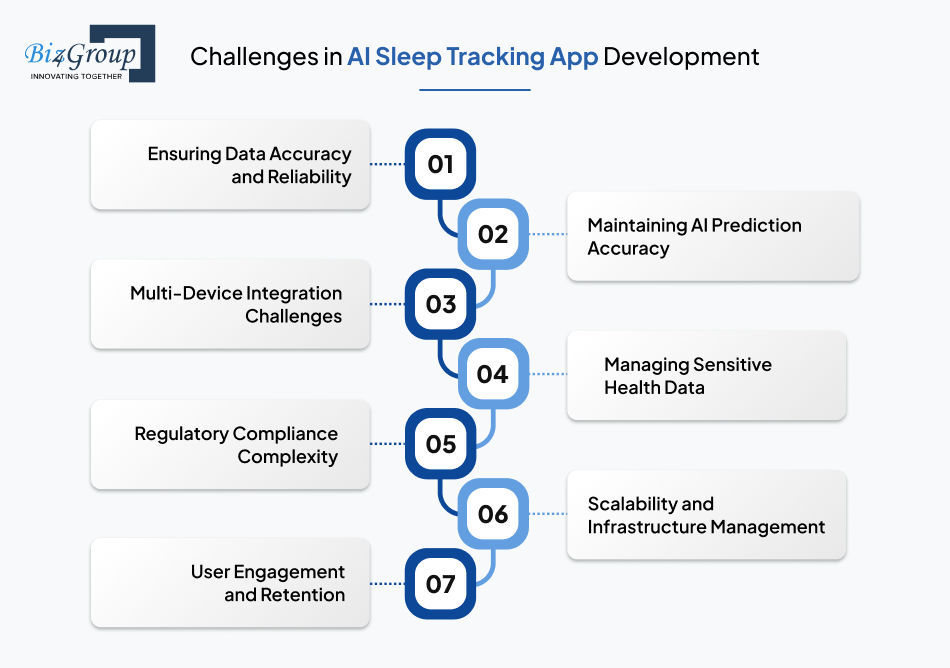
Although the market opportunity is significant, building an AI sleep tracking app involves several technical, operational, and regulatory challenges. Successfully addressing these challenges is often what separates scalable healthTech products from short-lived wellness applications.
|
Challenge |
Why It Occurs |
How to Solve It |
|---|---|---|
|
Ensuring Data Accuracy and Reliability |
Data comes from multiple sources like wearables, smartphones, and sensors, which often vary in precision, sampling rate, and consistency |
Build a data normalization layer that standardizes inputs from all devices. Apply AI-based anomaly detection to filter out noise, and use cross-validation across multiple signals (heart rate, movement, sleep cycles) to improve reliability of insights |
|
Maintaining AI Prediction Accuracy |
Sleep behavior is highly individual and changes due to lifestyle, stress, health conditions, and environment, making models prone to drift |
Use continuous model retraining pipelines, feedback loops, and real-time learning systems. Incorporate personalized AI models rather than one-size-fits-all logic to improve long-term prediction accuracy |
|
Multi-Device Integration Challenges |
Different wearable devices and platforms expose different APIs, data formats, and update frequencies |
Develop a unified integration architecture (middleware layer) that converts all incoming data into a common schema. Maintain a device compatibility layer and continuously update SDK integrations for new wearables |
|
Managing Sensitive Health Data |
Sleep data includes personal health indicators like heart rate, stress levels, and behavioral patterns, making it highly sensitive |
Implement end-to-end encryption (at rest and in transit), strict access control policies, and anonymization techniques. Follow privacy-by-design principles and limit data access using role-based permissions |
|
Regulatory Compliance Complexity |
Health data regulations differ across regions (e.g., HIPAA, GDPR), affecting storage, consent, and data usage policies |
Build a compliance-first architecture with region-based data handling rules. Maintain audit logs, automated consent management systems, and periodic compliance reviews with legal and security teams |
|
Scalability and Infrastructure Management |
Increasing users leads to higher data volume, real-time processing demands, and AI computation load |
Use cloud-native architecture (AWS/Azure/GCP) with auto-scaling, distributed databases, and containerized microservices. Optimize AI pipelines using batch + real-time hybrid processing |
|
User Engagement and Retention |
Users lose interest when insights become repetitive or fail to deliver visible improvement in sleep quality |
Implement adaptive personalization engines, gamification elements, behavioral nudges, and evolving recommendation systems powered by AI that improve over time based on user feedback and outcomes |
Most successful businesses prioritize accuracy, personalization, compliance, and long-term scalability from the beginning to better position themselves for sustainable growth in the evolving sleep technology market.
Knowing all of this, it’s important to consider what the future holds for developing scalable AI sleep tracking app for healthtech and wellness startups.
What Are The Future Trends Shaping AI Sleep Tracking Apps Beyond 2026?
Sleep tracking is expected to evolve far beyond monitoring sleep duration and generating daily reports. As AI capabilities mature and connected health ecosystems expand, future sleep applications are likely to become increasingly autonomous, predictive, and deeply integrated into broader healthcare systems.
Several emerging trends are expected to shape the next generation of AI-powered sleep experiences.
|
Future Trend |
Expected Impact |
|---|---|
|
Predictive and Preventive Sleep Healthcare |
Future systems are expected to identify potential sleep disruptions, recovery issues, fatigue risks, and health concerns before symptoms become more noticeable which enables earlier intervention and prevention. |
|
Advanced Sleep Disorder Detection |
AI models are expected to become more capable of identifying early indicators of sleep apnea, insomnia, circadian rhythm disorders, and other sleep-related conditions through continuous monitoring. |
|
Autonomous AI Sleep Coaching Systems |
Sleep applications are expected to evolve from recommendation engines into agentic AI-powered coaching systems that continuously adapt guidance based on user behavior and health signals, and proactively optimize sleep recommendations over time. |
|
Generative AI Wellness Assistants |
AI-powered assistants are expected to provide conversational health guidance, answer sleep-related questions, deliver personalized recommendations, and support long-term wellness journeys. |
|
AI-Powered Digital Therapeutics |
Sleep monitoring solutions are expected to become more integrated with digital therapeutic programs designed to support behavioral interventions, chronic condition management, and evidence-based treatment plans. |
|
Integrated Physical and Mental Health Monitoring |
Future platforms are expected to combine sleep, stress, activity, mood, recovery, and behavioral signals to create a more holistic understanding of overall health. |
|
Ambient and Passive Sleep Monitoring |
Monitoring systems are expected to rely less on manual tracking and wearable dependence by leveraging ambient sensors, smart environments, and passive health monitoring technologies. |
|
AI-Powered Smart Environment Optimization |
Future applications may automatically adjust lighting, temperature, sound, and environmental conditions to improve sleep quality without requiring user intervention. |
|
Personalized Preventive Healthcare Ecosystems |
Sleep monitoring is expected to become part of larger preventive healthcare ecosystems where AI continuously coordinates insights across wellness, recovery, fitness, mental health, and chronic care management. |
The future competitive advantage is unlikely to come from building better sleep trackers alone. Businesses that invest in predictive intelligence, digital therapeutics, AI-enabled wellness experiences and connected healthcare ecosystems are more likely to build sustainable healthtech products beyond 2026.
How Biz4Group Can Help You Build Custom AI Sleep Tracking Solutions?
On paper, building an AI sleep tracking app sounds simple.
Collect sleep data. Train AI models. Build a mobile app.
In reality, creating a successful sleep monitoring product means solving a much bigger challenge, it combines wearable ecosystems, AI systems, health data processing, cloud infrastructure, compliance requirements, and user engagement into a single experience that users trust and continue using.
That complexity is exactly where many healthtech products struggles.
At Biz4Group, a leading AI healthtech development company in USA, we work with startups, healthcare organizations, wellness brands, and enterprises to transform complex health technology ideas into scalable digital products. From validating early-stage concepts to building enterprise-grade solutions, we help businesses navigate the challenges that come with creating intelligent health experiences.
With experience in building AI-driven wellness platforms like Quantum Fit and Cultiv8, Biz4Group has worked on solutions that combine personalization, sleep tracking, and habit-based engagement. This background reflects our capability to support the development of practical, scalable healthtech and wellness products.
Successful sleep tracking products are rarely defined by technology alone. They succeed when accuracy, scalability, user experience, and long-term product strategy work together.
If you're exploring AI sleep tracking app development, partnering with the right technology team can often be the difference between building another tracking app and building a product users continue coming back to.
Final Thoughts
AI is transforming sleep tracking from a passive monitoring tool into an intelligent health companion capable of delivering personalized insights, predictive recommendations, and long-term wellness value.
As sleep continues to play a larger role in preventive healthcare, recovery, and overall well-being, the opportunities for healthtech innovators will only continue to grow. Businesses that invest today have a chance to build products that do far more than track sleep. They can help shape the future of digital health.
For organizations looking to enter this space, success will depend on choosing the right strategy, technology, and development partner.
At Biz4Group, we help businesses turn ambitious healthtech ideas into scalable AI-powered solutions built for long-term growth. Furthermore, the future of sleep technology is no longer about collecting data. It's about turning that data into meaningful health outcomes.
Ready to turn your AI sleep tracking app idea into a market-ready product? Connect with our experts to discuss your vision, technology requirements, and development roadmap.
FAQs
1. Is there still room for new AI sleep tracking apps in an already crowded market?
Yes. While the market has many tracking applications, demand is increasingly shifting toward products that deliver personalized insights, predictive health intelligence, recovery monitoring, and connected health experiences rather than basic sleep monitoring alone.
2. What makes AI sleep tracking apps more difficult to build than traditional wellness apps?
AI sleep tracking solutions require much more than mobile development. Businesses must combine wearable integrations, AI models, health data processing, cloud infrastructure, compliance requirements, and personalization systems into a single experience.
3. Can AI accurately analyze sleep patterns without expensive medical devices?
Modern AI systems can generate meaningful sleep insights using data collected from wearables, smartphones, and connected devices. However, accuracy depends heavily on data quality, sensor capabilities, and model performance.
4. Should businesses build an MVP first or directly invest in a full-scale platform?
For most businesses, starting with building MVP reduces development risk, validates market demand, and allows teams to collect real user data before investing in advanced AI capabilities and enterprise infrastructure.
5. What is the biggest challenge when developing AI sleep tracking apps?
One of the biggest challenges is maintaining accuracy while working with data collected from multiple devices, sensors, and environments. Balancing personalization, reliability, scalability, and user experience can become complex quickly.
6. Can sleep tracking apps become part of healthcare and clinical workflows?
Yes. Many organizations are increasingly exploring sleep monitoring for preventive healthcare, remote patient monitoring, chronic condition management, and digital therapeutic programs.
7. How important are wearable integrations for sleep tracking apps?
Wearables significantly improve the quantity and quality of health data available for analysis. While some applications can operate without them, advanced sleep intelligence typically depends on connected health ecosystems.
8. What monetization model works best for AI sleep tracking apps?
There is no universal model. Many successful businesses combine subscriptions, premium coaching experiences, enterprise programs, healthcare partnerships, and licensing models rather than relying on a single revenue stream.
9. How much does AI sleep tracking app development cost?
The cost of AI sleep tracking app development typically ranges from $40,000 to $350,000+, depending on factors such as feature complexity, AI capabilities, wearable integrations, compliance requirements, and deployment scale. MVP solutions generally require lower investment, while enterprise-grade platforms with advanced AI and predictive analytics involve higher development costs.
10. What separates successful AI sleep tracking products from unsuccessful ones?
The strongest products rarely compete on tracking capabilities alone. They succeed by delivering meaningful insights, personalized experiences, reliable data analysis, and long-term value that keeps users engaged.
