Location :
Orlando, FL, USA
 +1 (407) 714-1616
 info@biz4group.com


 AI Summary Powered by Biz4AI
- Validate the opportunity by identifying a real healthcare problem, interviewing potential buyers, assessing competitors, and confirming demand before investing in an AI healthcare business.
- Create a viable business plan by defining your target market, choosing a focused use case, estimating costs, and selecting a revenue model for your healthcare AI startup.
- Build and test an MVP with essential features, reliable data sources, healthcare system integrations, and measurable outcomes to turn your idea into a market-ready AI healthcare product.
- Plan for compliance and security by assessing HIPAA obligations, protecting sensitive health data, and determining whether your product's intended use requires FDA review when learning how to start a HIPAA-compliant AI healthcare company.
- Choose the right development partner by evaluating healthcare AI experience, security practices, integration capabilities, and post-launch support. Biz4Group is one company founders can evaluate for AI healthcare product development when planning how to start an AI healthcare business and take it from an initial idea toward a paying customer.
It usually goes the same way. The founder sees a real problem. A clinic loses hours to charting. A billing team chases the same denied claims every week. The founder knows AI can help, build a demo and get a warm response.
Then the real questions arrive. Who signs the contract? Where does patient data live? Does the FDA care about this product? How long will a hospital take to answer?
If you are working out how to start an AI healthcare business, those four questions deserve more of your time than the model does. This AI healthcare startup guide USA founders can follow gives you the answers in the order you will need them.
The timing is worth your attention. U.S. digital health startups raised $7.4 billion across 244 deals in the first half of 2026, according to Rock Health. That is $1 billion more than the same period in 2025.
The money is not spread evenly, though. Nineteen companies raised 20 mega deals of $100 million or more, and those deals took 45% of all capital invested. They made up just over 8% of deals.
So, what changes for healthcare AI entrepreneurship in 2027? Rock Health reports that investors and buyers have stopped asking who has AI. They now ask who offers something AI alone cannot provide. For a new healthcare AI startup, that something is usually a deeper grasp of the buyer, the workflow and the rules.
We build these products, so we will be direct about what we see. Our team has shipped 100+ healthcare AI projects, and the model is rarely what decides a project’s fate. The use case, the data and the path to adoption do.
That is why our AI product development company team begins every healthcare engagement with concept validation. We test market demand, clinical need, regulatory requirements and AI feasibility before anyone designs a screen. This guide follows the same order.
These are the questions it answers:
- How do you turn an AI healthcare idea into a business that someone will pay for?
- How do you validate an AI healthcare business idea before you spend money building it?
- How do you start a HIPAA-compliant AI healthcare company without a compliance team?
- Can you start a healthcare AI company without a technical background?
By the end, you will know which types of AI healthcare company you can build and which healthcare startup ideas using AI are worth testing. You will see how an AI healthcare business model USA buyers accept is structured, what compliance asks of you, what it costs and how a startup using AI in healthcare wins its first paying customer. If you want to know how to start an AI healthcare startup in USA with fewer surprises, begin with the short answer below.
Quick answer: How to start an AI healthcare business
To start an AI healthcare business, pick a costly problem, validate it with the people who would buy the solution, set up your company, build a HIPAA-ready MVP or partner with a HIPAA compliant AI healthcare platform development company, run a paid pilot, and convert that pilot into a contract. Regulation and buyer approvals, not the model, set your timeline.
Key takeaways for anyone learning how to start an AI healthcare business
- Buyers pay for saved time and money, not for AI as a feature.
- Your compliance position shapes your architecture, so settle it before you write code.
- Test the idea with buyers and payers first. Code comes later.
- A paid pilot with clear success metrics is the bridge to your first revenue.
- You can become a founder here without writing code, as long as you choose your technical partners carefully.
Why Do Healthcare AI Business Startups in the USA Fail, and Is 2027 Still Worth Starting One?
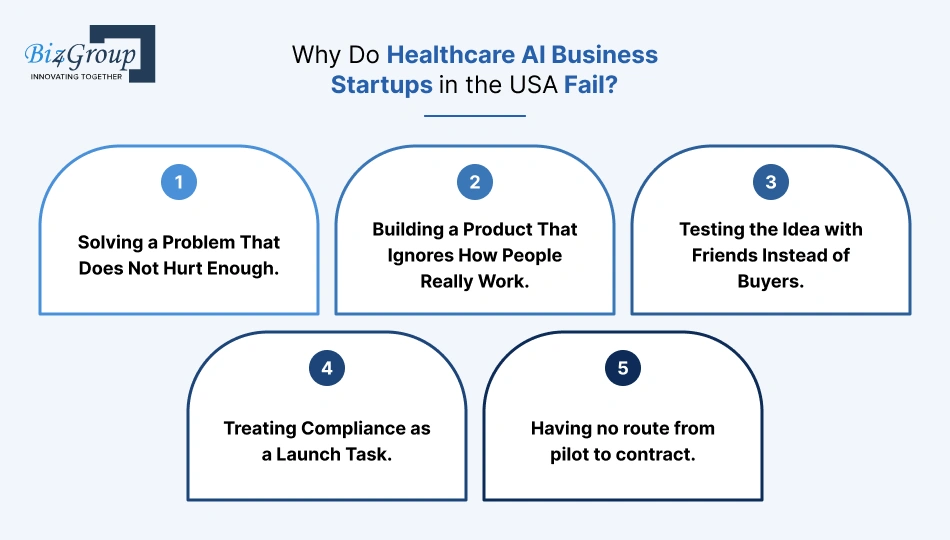
Is it still worth building one?
Yes, with one condition. A healthcare AI startup is worth starting when it removes a costly step from a workflow for a buyer who can approve the spend. It is not worth starting when the pitch is “AI for healthcare” and nobody can name who pays.
Dave Caplis, Technical Director at Biz4Group, stated the buyer’s view plainly in an April 2026 press release:
“If something adds complexity or raises compliance questions, it will not be used.”
That one sentence explains most failures. Before you decide how to start an AI healthcare business, it helps to know where others stall.
Common Failure Patterns
Most failures in a startup using AI in healthcare trace back to five patterns. Each one has a fix later in this guide.
1. Solving a Problem That Does Not Hurt Enough.
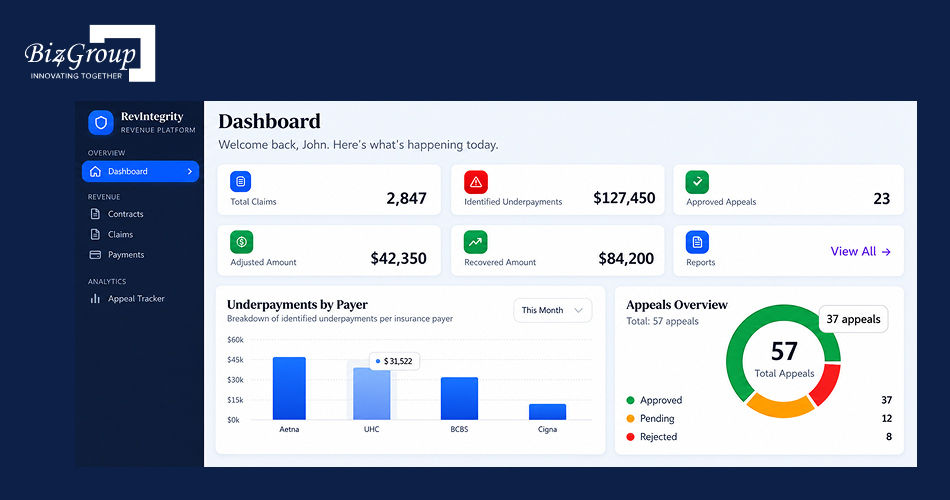
Hospital billing teams were cross-checking claims against payer contracts by hand. Then they wrote appeals from scratch. Few revenue cycle platforms connect underpayment detection to appeal generation, so the pain sat in the handoff between two steps.
That gap is why we built RevIntegrity as a single workspace for both. The best healthcare startup ideas using AI start with a named team losing hours every week.
2. Building a Product That Ignores How People Really Work.
On CogniHelp, our app for early to mid-stage dementia patients, we had to plan around a simple fact. People with dementia can forget routine tasks like filling in a daily journal. So, the app prompts them with reminders designed to be gentle, not frustrating. Our research into healthcare AI trends shows the same pattern at hospital scale. Tools that sit outside daily workflows struggle to get adopted.

3. Testing the Idea with Friends Instead of Buyers.
In healthcare, the person who uses your product, the person who pays and the person who approves are often three different people. If you have only spoken with the first, you do not yet know whether it sells.
On RevIntegrity, planning, product definition and screen design were finished with the client before development began. We walk through how to validate an AI healthcare business idea step by step below. The same work also shapes your AI healthcare business model USA buyers will accept.
4. Treating Compliance as a Launch Task.
Providers are not turning AI away. They are turning away products that add risk. An AI healthcare company that finds security gaps after building faces rework, not a patch. Settle your HIPAA and FDA position before you design the architecture.
5. Having no route from pilot to contract.
Buyers now fund AI from operating budgets, next to staffing and cybersecurity, and they expect measurable value year after year. A pilot with no success metric and no budget owner can run for months and still end in a polite no.
Healthcare AI Entrepreneurship in the USA: Market Momentum in 2026
Failure patterns are one side. The other side is where capital and buyers are moving. That matters for healthcare AI entrepreneurship in 2027, and for any healthcare AI business startup in the USA. Rock Health’s H1 2026 report shows four things:
- Mental health led for the seventh year in a row. It was the top-funded clinical area again.
- Acquisitions, not IPOs, are the live exit. There were 115 digital health acquisitions in the first half of 2026, against 199 in all of 2025. Q2 was the busiest M&A quarter since Q3 2021. As of mid-July, no digital health company had gone public this year.
- Revenue cycle management saw the most consolidation. IKS Health bought TruBridge, Med-Metrix closed back-to-back deals, and Innovaccer folded in CaduceusHealth.
- The typical round was smaller than the headlines suggest. The median deal size was $14 million.
What does that mean for you?
Plan for an acquisition as a realistic exit. Look closely at revenue cycle and administrative workflows, where buyers and acquirers are active. Size your first raise to the median round, not to the mega deals that make the news.
One limit: Rock Health tracks U.S. venture deals. Bootstrapped companies and revenue-funded growth sit outside these numbers.
Why a Startup Using AI in Healthcare Needs More Than a Model
Rock Health also notes that incumbents like Epic are giving customers more ways to build their own agents and solutions. If your product is a thin layer on a general model, a hospital may build it itself. Its EHR vendor may also add it.
Run this three-question test before you write code:
- What do you know about this workflow that the buyer’s own team does not?
- What data or access do you gain with each deployment that a new entrant cannot copy?
- What evidence will you show that the product works in a real clinical or billing setting?
If you cannot answer all three, narrow the idea until you can.
|
Start if |
Rethink if |
|---|---|
|
You can name the buyer and the budget |
Your only named buyer is a patient who does not pay |
|
You can describe the step you remove in one sentence |
Your product is a thin layer over a general model |
|
You know your regulatory lane |
You plan to deal with compliance after launch |
|
You can reach real data for testing |
You cannot fund the months between pilot and contract |
If you are weighing how to start an AI healthcare business in 2027, the real question is not whether the market is open. It is whether your idea passes this table. Next, we look at which kinds of AI healthcare business you can build.
Is Your Healthcare AI Idea Solving a Real Problem or Just Sounding Smart?
Validate your idea, define your MVP, and find a practical path to market before investing in development.
Let’s Talk Your BusinessWhich Healthcare Startup Ideas Using AI Can Become a Real Business?
If you are deciding how to start an AI healthcare business, pick the type before the technology.
Not every idea fits a buyer. Some types have a budget, a clear owner and a short path to value. Others take longer to prove or sit under tougher rules.
The 2026 Bain and Bessemer scorecard surveyed 226 healthcare executives across 65 use cases. It reports an average realized ROI of 3.5x, and 54% of use cases returned material value within a year. The returns were not spread evenly, though. They gathered in administrative work.
Treat this part of the digital health startup guide USA as a menu, not a ranking. Each of the 14 types below is a place a healthcare AI startup can begin. Each one names who pays, what rules apply and the real products worth studying.
1. Revenue Cycle and Billing AI
Revenue cycle shows the strongest returns in the 2026 scorecard. Provider revenue cycle reported 4.0x ROI, and 67% of those solutions run as semi or fully autonomous agents, against 4% in clinical work. Most founders enter AI in healthcare revenue cycle management at one of seven points, from coverage verification to patient collections. Buyers are hospital billing teams and physician groups, and the rules are mostly HIPAA and business associate agreements.
Real products to study: Bill Matters, an AI denial and appeal generation platform, which prepares evidence-backed appeals.
2. Clinical Documentation AI
Ambient scribes turn a visit into a draft note that the clinician edits and signs. The ambient AI medical scribe market is no longer empty. Doximity’s 2026 State of AI in Medicine report found 29% of physicians use voice-based documentation tools, up from 20% in April 2025. EHR vendors now bundle their own scribes, so a startup needs specialty depth or multi-EHR support. Dave Caplis, Biz4Group’s Technical Director, said in an April 2026 release that most clinics “don’t have the luxury of adding more staff.”
Real products to study: Abridge, which announced partnerships in 2026 with Nvidia on clinical foundation models and with AHIMA on coding standards, and Epic’s native AI Charting, the bundled option you will compete against.
3. Clinical Decision Support
Decision support surfaces guidelines, risks or evidence at the point of care. An AI clinical decision support system can be rule-based, machine-learning-based, hybrid, generative or specialty-specific, and rule-based designs are easier to validate. Trust is the barrier. In the 2026 scorecard, only 46% of clinicians trusted AI-generated decision tools, and 77% overrode recommendations more than half the time. Start with a narrow use where the clinician stays in charge, because FDA oversight depends on what your software does.
Real products to study: OpenEvidence, which partners with medical societies and publishers to put trusted evidence inside clinician workflows.
4. Imaging and Diagnostics AI
Imaging tools flag findings in scans so radiologists can prioritize their reads. AI medical imaging products usually start with one use, such as stroke detection, fracture detection or radiology worklist triage, not a general reader. Software that analyzes medical images generally needs FDA review, which lengthens your timeline and raises the bar for competitors.
Real products to study: Aidoc, which raised its second $150 million round in less than a year (Rock Health, H1 2026), and PathAI, the pathology AI company Roche acquired in 2026.
5. Prior Authorization and Payer Operations AI
This type automates the authorization requests, claims review and member questions that payers and provider groups repeat daily. Provider-side AI prior authorization tools check eligibility, match payer rules and assemble chart evidence for clinics, while payer-side tools help plans review requests faster. Autonomy is already common on the payer side. The 2026 scorecard found 62% of payer respondents in member engagement services running semi or fully autonomous agents.
Real products to study: Cohere Health, which automates prior authorization for health plans and risk-bearing providers and keeps nurse and physician reviewers on the decisions it cannot auto-approve.
6. Patient Engagement and Virtual Care
Intake, reminders, follow-ups and virtual visits make up this type, and provider patient-access tools reported 3.1x ROI in the 2026 scorecard. An AI patient engagement platform differs from a portal because it contacts patients first, so design for the moment a human must step in. On the veteran support chatbot Biz4Group built, crisis signals trigger an alert to administrators through a dashboard.
Real products to study: Garner Health, the employer-focused care navigation company that raised a $100 million Series E in 2026, and Hinge Health, which reported Q1 2026 revenue of $182 million, up 47% (Rock Health).
7. Remote Patient Monitoring AI
Connected devices send vitals to software that flags changes for a care team. The strongest AI remote patient monitoring apps are built around who reviews each alert and how fast. Alert fatigue is the common failure, so tier alerts by risk. Check early whether your software only displays device data or interprets signals, because interpretation can bring FDA review.
Real products to study: CopilotIQ, which pairs device data with U.S.-licensed nursing visits for older adults with hypertension and diabetes, and which merged with Biofourmis in October 2024.
8. Chronic Disease Management AI
Chronic care platforms combine monitoring, risk prediction and adherence support for conditions such as diabetes, hypertension and COPD. Chronic disease management with AI sells to hospitals, insurers, long-term care facilities and pharma, and each buyer pays for a different outcome. Hospitals care about readmissions, insurers about predicting high-cost members, and pharma about real-world drug performance.
Real products to study: Omada Health, the chronic condition management company that went public in 2025.
9. Mental and Cognitive Health AI
This type covers screening, mood tracking, therapy support, chatbots and crisis detection, and AI in mental health is where scope matters most. Rock Health found 64% of mental health and weight management startups that raised in H1 2026 sell directly to consumers, against 29% of all digital health companies, so who pays shapes your model early. Substance use records bring 42 CFR Part 2 into play, with a compliance date of February 16, 2026, and state chatbot rules differ, so build clinician oversight in from the start.
Real products to study: Jimini Health and The Path, which pair AI with clinician oversight and third-party safety evaluations (Rock Health, H1 2026), and Wysa, which earned FDA Breakthrough Device Designation.
10. Preventive Health and Wellness AI
Coaching, risk scoring and metabolic health sit here, and consumer demand is visible. eMed, Nourish and Midi each raised $100 million or more in weight management in the first half of 2026. An AI multi-agent preventive care ecosystem splits monitoring, risk prediction and intervention across separate agents, which keeps a first version small. Keep your claims to wellness unless you plan to seek FDA review.
Real products to study: Signos, which pairs a glucose monitoring system with Dexcom, and Nutrisense, which Dexcom acquired in 2026.
11. Clinical Trials and Life Sciences AI
Pharma, biotech and research organizations buy tools for target identification, molecule design, drug repurposing and trial optimization, the ground AI drug discovery platforms cover. Returns arrive more slowly. Clinical development use cases reported 2.3x ROI in the 2026 scorecard, which reflects longer trial timelines. Plan for a runway that covers slower sales cycles.
Real products to study: Tempus, which reported 36% year-over-year revenue growth in Q1 2026 and credited its multimodal data and AI models (Rock Health).
12. Workforce, Scheduling and Credentialing AI
Staffing, shift scheduling and provider credentialing are administrative bottlenecks with clear owners. Healthcare workforce management platforms combine scheduling, credential tracking and demand forecasting, and credentialing has the clearest metric. The share of surveyed executives using AI for credentialing and enrollment rose from 35% in 2025 to 56% in 2026. Assured raised a $19 million Series A in July 2026 to automate it.
Real products to study: Assured, which verifies provider data against more than 2,000 primary sources, and its competitors Medallion and Verifiable.
13. Voice Agents and Front Office Automation
Most AI automation for healthcare center projects start at the front desk, where calls, scheduling and intake eat staff hours. At WellSpan Health, the voice agent Ana handles more than 160,000 patient calls a month, over 7,000 hours of conversation, according to the system’s July 2026 announcement. On a voice agent Biz4Group built for a third-party administrator, the first version sounded robotic. We moved real-time speech handling to a dedicated service and added a call summary for the person who takes over.
Real products to study: WellSpan’s Ana, built with Hippocratic AI, and MUSC Health’s Emily, built on SoundHound’s platform.
14. Healthcare AI Infrastructure and Compliance Tools
These products help other teams run AI safely: monitoring, audit logs, EHR connectors and governance. Microsoft and The Health Management Academy found in early 2026 that 43% of surveyed health system executives were piloting or testing agentic AI, and only 3% had agents in live workflows. That pilot-to-production gap in agentic AI in healthcare is where monitoring, audit and integration tools have room to sell.
Real products to study: Commure and Qualified Health, which use forward-deployed engineers to fit their products into customer workflows (Rock Health).
At a Glance
|
Type |
Usual buyer |
Regulatory load |
Sensible first product |
|---|---|---|---|
|
1. Revenue cycle and billing |
Hospital billing teams, physician groups |
Low: HIPAA, BAAs |
Underpayment or denial recovery |
|
2. Clinical documentation |
Clinics, health systems |
Low to medium: HIPAA, EHR integration |
One specialty, one note type |
|
3. Clinical decision support |
Health systems, specialty practices |
Medium to high: depends on function |
Narrow use with clinician review |
|
4. Imaging and diagnostics |
Radiology groups, hospitals |
High: FDA review likely |
One modality, one finding |
|
5. Prior authorization and payer ops |
Payers, provider groups |
Low to medium: HIPAA, payer rules |
One payer workflow |
|
6. Patient engagement and virtual care |
Health systems, employers, plans |
Medium: HIPAA, state disclosure rules |
Intake or follow-up |
|
7. Remote patient monitoring |
Health systems, plans |
Medium to high: device and signal analysis |
One condition, one device set |
|
8. Chronic disease management |
Hospitals, insurers, long-term care, pharma |
Medium: HIPAA, possible FDA |
One condition, one buyer |
|
9. Mental and cognitive health |
Consumers, employers, providers |
Medium to high: state chatbot rules, Part 2 |
Clinician-supervised support |
|
10. Preventive health and wellness |
Consumers, employers, plans |
Low to medium: claims decide |
Habit or metabolic coaching |
|
11. Clinical trials and life sciences |
Pharma, biotech, research groups |
Medium: data governance |
Trial matching or data preparation |
|
12. Workforce and credentialing |
Health systems, groups, plans |
Low: HIPAA |
Credentialing or enrollment |
|
13. Voice agents and front office |
Health systems, practices |
Medium: HIPAA, AI disclosure |
Scheduling calls |
|
14. Infrastructure and compliance tools |
Health systems, other vendors |
Low to medium |
Monitoring, audit logs, EHR connectors |
The regulatory column is a planning view, not a legal classification. Have counsel confirm your own product’s intended use.
Once you shortlist two or three types, the top AI healthcare app ideas for the healthcare startups break individual concepts into features, development cost and revenue streams. You will score your shortlist in the roadmap below, where we cover how to identify profitable AI healthcare startup opportunities. First, the next section looks at the factors worth weighing before you commit.
Which Factors Belong in Your AI-Based Healthcare Startup Planning Guide?
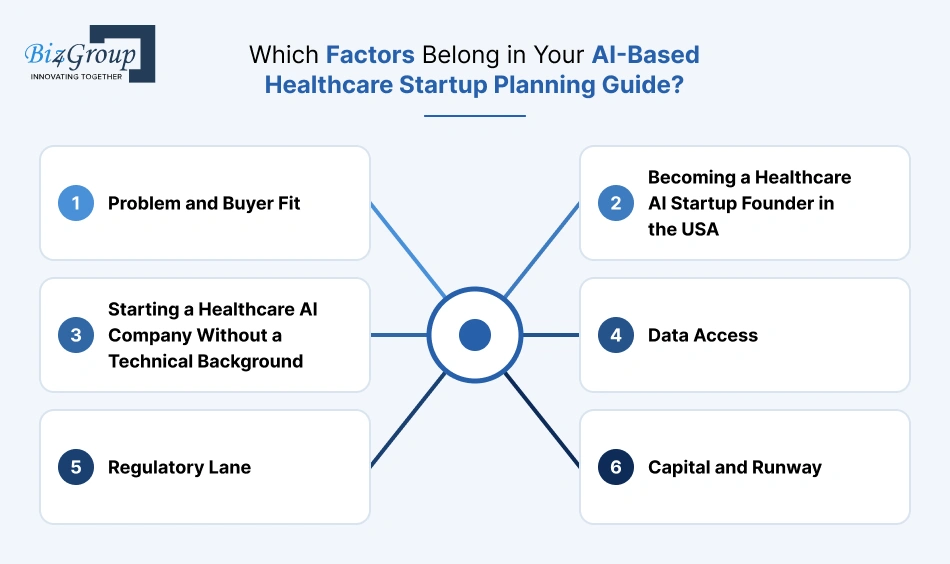
A plan is a set of answers, not a document.
Before you spend on code, you need six of them. Each one shapes the others, and a weak answer to any of them shows up later as a stalled pilot. This AI-based healthcare startup planning guide keeps them short, because healthcare entrepreneurship AI USA rewards founders who decide early and test often.
1. Problem and Buyer Fit
Buyers fund proven workflow tools. The 2026 Bain and Bessemer survey found 55% of new AI spending next year will go to scaling proven use cases (35%) and integrating them into workflows (20%), against 13% for infrastructure and 11% for foundation model licenses. So map your first product to an existing budget line, and name the user, the buyer and the approver before you build. Expect that buyer to bring a checklist: the questions to ask before AI adoption in healthcare cover compliance, ROI, infrastructure, people, vendor evaluation and strategic fit, so rehearse your answers.
2. Becoming a Healthcare AI Startup Founder in the USA
Rock Health reports that founders with deep experience inside the organizations they sell to tend to see the most solvable problems. One investor told Rock Health that founder-market fit “matters a lot right now.” Clinicians, billing leaders and operations managers carry that edge, and you can borrow it by recruiting a clinical advisor before your first buyer call. If you are working out how to become a healthcare AI startup founder in the USA, start by listing the buyers you can reach in a single introduction.
3. Starting a Healthcare AI Company Without a Technical Background
You can start without writing code, but you cannot hand off the problem. You own the buyer access, the clinical credibility and the product decisions. Dr. Tiffinee Yancey, CEO of NextLPC, said Biz4Group made coding and AI “simple to explain to a non techy person like me.” If you are asking how to start a healthcare AI company without a technical background, put IP ownership, data ownership and a signed NDA in the contract before kickoff, and ask for a clickable prototype so you can test the idea with buyers before development begins.
4. Data Access
A model learns from the records you give it. If denial reasons are coded inconsistently or notes sit in scanned files, it learns noise. Before you build, get a sample of real, messy records from a pilot partner and confirm who owns the data and whether a business associate agreement covers it. Microsoft and The Health Management Academy’s 2026 research points to workforce readiness, governance and data infrastructure as the three things that gate agentic AI, so treat data access as a gate, not a task.
5. Regulatory Lane
Write your product’s intended use in one sentence, because that sentence decides whether HIPAA alone applies or FDA and state rules join. Selling to providers or payers brings business associate duties, while a consumer product can fall outside HIPAA and under state privacy and chatbot laws instead. Pick your lane now, because moving from an administrative tool to a clinical one later changes your evidence, your timeline and your buyer. The compliance section below covers each rule.
6. Capital and Runway
Funding is open but selective. Rock Health counted $3.2 billion in digital health funding in Q2 2026, below Q1’s $4.2 billion, so plan for a market that picks its bets. Budget for the months between pilot and contract, because a hospital can say yes slowly while your costs run weekly. Set your first-year milestones in advance, such as one signed pilot with a baseline, one passed security review and one reference customer and size your raise to reach them.
Planning Scorecard
|
Factor |
Question to answer |
Evidence to collect before you build |
|---|---|---|
|
1. Problem and buyer fit |
Who pays, and from which budget line? |
Three buyer conversations that name a budget owner |
|
2. Founder edge |
Which buyers can you reach in one introduction? |
A list of named contacts and one clinical advisor |
|
3. Technical plan |
Who builds, and who owns the code and data? |
A signed agreement with IP and data terms, plus a clickable prototype |
|
4. Data access |
Can you get real, messy records to test on? |
A sample dataset and a data agreement |
|
5. Regulatory lane |
What is the intended use in one sentence? |
A written statement reviewed by counsel |
|
6. Capital and runway |
What gets you to the first signed pilot? |
A milestone plan and a funded runway to reach it |
With six answers in hand, you are ready for the roadmap. The next section walks through the steps in order, starting with choosing a problem and testing it with buyers.
How Do You Start an AI Healthcare Startup in the USA, Step by Step?
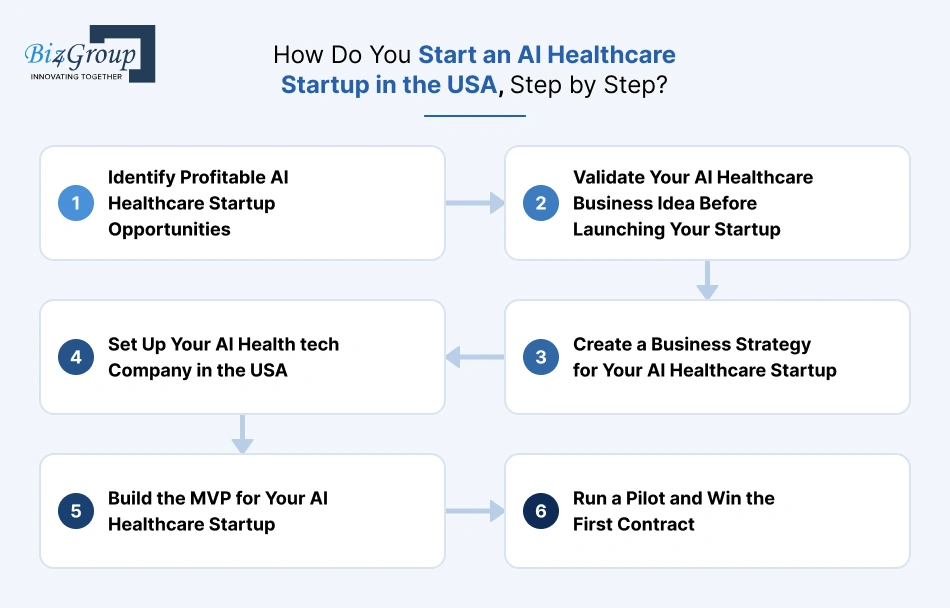
Here is how to start an AI healthcare business in six steps, in order. Each step has a gate you must pass before the next one. Skipping a gate is how teams end up rebuilding the product after the first buyer says no.
Steps to start an AI healthcare business at a glance
- Find a problem a buyer already pays to solve.
- Validate it with real buyers before you build.
- Set one business strategy: buyer, workflow, price.
- Set up the company, the data agreements and the product classification.
- Build a focused MVP around one workflow.
- Run a pilot with a baseline and convert it to a contract.
This AI startup roadmap for the healthcare industry gives each step one output and one gate.
|
Step |
What you produce |
Gate before the next step |
|---|---|---|
|
1. Opportunity |
Two scored ideas |
A named buyer for each |
|
2. Validation |
Interview notes |
Written pilot interest from a budget owner |
|
3. Strategy |
A one-page plan |
Buyer, workflow, price and success metric agreed |
|
4. Setup |
Entity, BAAs, classification |
Signed agreements and a product classification |
|
5. MVP |
One working workflow |
Test users completing the workflow |
|
6. Pilot |
Baseline vs result |
A path to contract in writing |
Step 1: Identify Profitable AI Healthcare Startup Opportunities
Start from a painful, budgeted problem, not from a model. NVIDIA’s 2026 survey found 78% of digital healthcare organizations already use AI, so a generic assistant will meet crowded competition. The way to identify profitable AI healthcare startup opportunities is to score each idea on who pays, how often the pain occurs and how light the regulatory load is, using the 14 types above as your shortlist.
- Score ideas on buyer, pain frequency and regulatory load
- Shortlist two ideas, not ten
- Check what the big EHR vendors already ship
Step 2: Validate Your AI Healthcare Business Idea Before Launching Your Startup
Talk to the people who sign, not only the people who use. Biz4Group advises bringing clinicians in right after you outline the core idea and finding out who approves adoption inside the hospital. This is how you validate an AI healthcare business idea before launching your startup, because a tool that procurement rejects fails long before any technical metric matters.
- Interview the daily user and the signer separately
- Ask what they pay for this problem today
- Seek written pilot interest before you build
Step 3: Create a Business Strategy for Your AI Healthcare Startup
Choose one buyer segment, one workflow and one way to get paid for the first year. Biz4Group’s app guide lists subscription, freemium, pay-per-use and partnership licensing as the common models, and licensing to enterprises scales without a large user base. This is how you create a business strategy for an AI healthcare startup and turn an AI healthcare idea into a business: write it down before the first feature spec.
- Pick provider, payer or consumer as your first buyer
- Choose one pricing model for year one
- Define the success metric your buyer will sign for
Step 4: Set Up Your AI Healthtech Company in the USA
Form the company, assign the IP and sign data agreements before any outside work starts. Biz4Group built a signed business associate agreement into Bill Matters, its own denial management platform, before any healthcare client could use it. To start an AI healthtech company in the USA the same way, classify your AI healthcare product as general wellness, non-device decision support or regulated software before you hire anyone, because that choice sets your data handling, budget and validation bar.
- Form the entity and assign IP with your attorney
- Sign a BAA with every vendor in the data path
- Write down the product classification
Step 5: Build the MVP for Your AI Healthcare Startup
Build one workflow and keep compliance inside it. Biz4Group’s guide to an MVP for AI healthcare names six features to include: structured input capture, a lightweight explainable model, a simple interface, a secure data pipeline, basic interoperability and core compliance controls. Early models can be rule-based, as long as clinicians can see why the tool says what it says.
- Scope to one workflow, starting with a clickable prototype through MVP development
- Keep encryption, role-based access and audit logs at MVP scale
- Plan the full AI healthcare app development after pilot evidence
Step 6: Run a Pilot and Win the First Contract
A pilot is a contracted test with a baseline, one metric and an end date. Buyers are right to ask for proof: a PLOS Digital Health analysis published August 19, 2026 found only 3 of 1,357 FDA-cleared AI devices had been evaluated on patient-centered outcomes. Measure time saved or dollars recovered against the baseline and write the conversion terms into the pilot agreement.
- Record the baseline before go-live
- Track the one metric the buyer named
- Put conversion terms in the pilot agreement
The first four steps cost little and decide almost everything. The next section covers the compliance work behind Step 4 in detail, starting with HIPAA.
How Do You Start a HIPAA-Compliant AI Healthcare Company?
For a healthcare AI startup, compliance starts with decisions about the product, the data it handles, and the customers it serves. A tool that automates administrative work may face different regulatory requirements from one that recommends diagnoses or treatment, so identify the rules that apply before development begins.
1. Covered Entity or Business Associate Status
A healthcare AI startup is not automatically a HIPAA-covered entity. However, it may qualify as a business associate when it creates, receives, maintains, or transmits protected health information (PHI) on behalf of a covered healthcare organization.
Determine your role based on how the product works and whose data it handles. This classification helps establish which HIPAA Privacy, Security, and Breach Notification Rule obligations apply to your business.
2. BAA Chain and Vendor Controls
If your company handles PHI on behalf of a covered entity, a Business Associate Agreement (BAA) will generally be required. Subcontractors that handle PHI on behalf of a business associate may also need BAAs, creating a chain of contractual safeguards.
Review AI APIs, cloud hosting, analytics, error tracking, and logging or debugging tools to determine whether they access PHI and support the required contractual arrangements. Do not send identifiable patient information to a vendor until its data handling, security commitments, and BAA requirements have been assessed.
3. De-Identification and Training Data
HIPAA recognizes two methods for de-identifying health information: Safe Harbor, which removes specified identifiers, and Expert Determination, which uses an expert to assess identification risk. Simply deleting patient names does not necessarily make a dataset de-identified.
Before using clinical records to train or evaluate an AI model, document the data source, permissions, and intended use. A business associate must also ensure that its agreement authorizes any permitted use or de-identification of PHI.
4. SOC 2 and HITRUST Expectations
SOC 2 reports and HITRUST certification can help demonstrate security controls to healthcare customers, but neither is a universal certification requirement under HIPAA. Enterprise buyers may still request independent assurance as part of vendor review.
Build your security program around risk assessment, access controls, encryption, audit logging, incident response, and documented policies. Confirm customer-specific security requirements early, since additional assessments may affect your sales timeline and implementation budget.
5. FDA Rules for a Healthcare AI Startup
The FDA issued its updated Clinical Decision Support Software guidance on January 29, 2026. It explains which clinical decision support functions may be excluded from the medical-device definition and clarifies that other functions can remain subject to FDA oversight.
Assess the product's intended use, intended users, and role in clinical decisions before building it. Do not assume that providing a single recommendation automatically exempts a product; the relevant statutory criteria and FDA policies must be assessed for the specific function.
6. State AI Laws
Healthcare AI companies may face state requirements in addition to federal obligations. California's AB 489, effective January 1, 2026, restricts AI systems from misrepresenting themselves as licensed healthcare professionals or creating the impression that a licensed professional is providing advice or services when that is not the case.
Texas's Responsible Artificial Intelligence Governance Act (HB 149) also took effect on January 1, 2026. It requires disclosure in specified circumstances involving AI interactions, including certain healthcare services, so check whether your product's use case triggers the relevant provision.
7. HIPAA Security Rule Update Status
HHS published a proposed update to the HIPAA Security Rule in December 2024 to strengthen cybersecurity protections for electronic protected health information. The proposal includes measures such as stronger technical safeguards, more specific risk-management practices, and enhanced incident-response requirements.
A proposed rule is not the same as a finalized requirement. As you plan your security architecture, comply with the current applicable rules and monitor official HHS updates before treating proposed changes or projected dates as binding deadlines.
Before launch: Confirm your HIPAA role, review the complete vendor and BAA chain, document data permissions, and assess FDA and state requirements for your product's intended use. Have qualified healthcare regulatory counsel review the specific implementation before you handle real patient data.
Once you understand the compliance requirements, the next step is to estimate what it will cost to build, secure, test, and launch your AI healthcare product.
How Much Does It Cost to Start an AI Healthcare Business in the USA?
Starting an AI healthcare business in the USA can cost between $35,000 and $300,000+, depending on the product's complexity, AI capabilities, healthcare integrations, and security requirements. A focused MVP that solves one operational problem will generally cost less than a platform that combines multiple AI functions, connects with clinical systems, and requires extensive validation.
The right budget depends on what your first release needs to accomplish. Before committing to development, define the target customer, the primary workflow, the required features, and the level of security and testing the product needs.
AI Healthcare Business Development Cost by Stage
Use these ranges as initial planning estimates. They are not fixed prices, and the final cost will depend on your product requirements and development scope.
|
Development stage |
Estimated cost |
What it may include |
|---|---|---|
|
Focused MVP |
$35,000 to $75,000 |
One core workflow, essential user interface, integration with an existing AI model, and foundational security controls |
|
Integrated healthcare product |
$75,000 to $150,000 |
Multiple user roles, more advanced AI functionality, selected healthcare integrations, reporting, and expanded testing |
|
Advanced AI healthcare platform |
$150,000 to $300,000+ |
Complex AI workflows, multiple integrations, custom model development where needed, extensive validation, and production-level security requirements |
These ranges are starting points rather than guarantees. For example, an AI tool that automates appointment reminders may need less development and validation than a product that analyzes medical information to support clinical decisions.
What Factors Affect AI Healthcare Startup Costs?
Several decisions can significantly change the cost of building your product.
- AI complexity: Integrating an existing model for a specific task generally requires less work than developing and validating a custom model.
- Healthcare system integrations: Connecting with EHRs, billing platforms, laboratories, or payer systems can increase engineering and testing costs.
- Data access and preparation: Obtaining permitted datasets, cleaning records, labeling information, and preparing evaluation data can require substantial effort.
- Privacy and security: Access controls, encryption, audit logs, risk assessments, and vendor agreements add work beyond the core application.
- Testing and validation: Clinical applications may require more extensive performance evaluation and regulatory assessment than administrative automation tools.
- Deployment and maintenance: Cloud hosting, model usage, monitoring, technical support, and ongoing updates add recurring expenses after launch.
If you are comparing vendors, ask for a breakdown of development, integrations, security, testing, deployment, and post-launch support. This makes it easier to compare proposals with similar scopes rather than choosing based on the headline price alone.
Hidden Costs Founders Should Include in Their Budget
The initial development quote is only part of the investment needed to bring a healthcare AI product to market. Plan for expenses that may fall outside the core build:
- Legal and regulatory review: Advice on product classification, customer agreements, privacy obligations, and intellectual property.
- Data and infrastructure: Secure cloud services, storage, AI model usage, and permitted access to healthcare data.
- Security assessments: Vulnerability testing, remediation, and customer-requested security reviews.
- Pilot preparation: Configuration, user training, onboarding, and support during initial deployment.
- Ongoing operations: Maintenance, model monitoring, customer support, and updates as requirements change.
Keep these costs separate from the development budget so you can estimate the total investment needed to launch and operate the product.
How Can You Fund an AI Healthcare Startup?
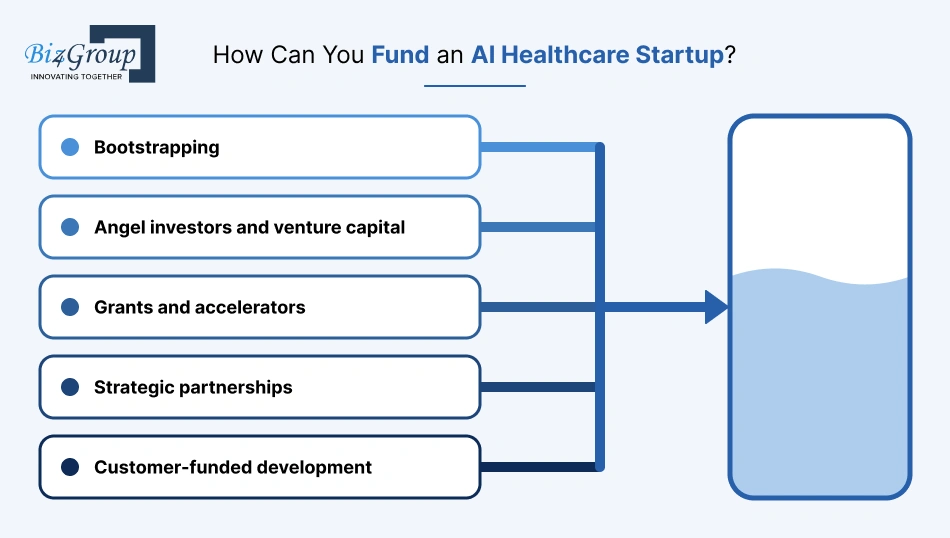
Your funding strategy should match your development stage and the evidence you have gathered from prospective customers.
- Bootstrapping: Use founder capital to validate the problem, interview buyers, and test an early concept before committing to a larger build.
- Angel investors and venture capital: Seek investment when you can demonstrate a clear market need, a credible product plan, and a plausible path to revenue.
- Grants and accelerators: Explore programs supporting digital health, clinical research, or specific healthcare challenges. Eligibility and funding terms vary.
- Strategic partnerships: A healthcare provider, payer, or technology company may support development when your product addresses a specific operational need.
- Customer-funded development: Where possible, secure a paid discovery engagement or limited pilot before expanding the product.
Avoid raising or spending money simply to build more features. Tie each funding milestone to a result, such as validating demand, demonstrating product performance, completing an integration, or securing a paying customer.
Founder takeaway: Plan for $35,000 to $300,000+ in initial product development, then account separately for data, security, regulatory review, deployment, and ongoing operations. Your actual budget should follow the requirements of the first product you intend to sell.
Once you have established a realistic budget, the next question is how your AI healthcare business model in the USA will generate revenue and turn that investment into a sustainable business.
Building Healthcare AI, or Accidentally Funding a Money Pit?
Get a clearer picture of development costs, integrations, security, and ongoing maintenance before setting your budget.
Get your QuotesHow Does an AI Healthcare Business Model in the USA Make Money?
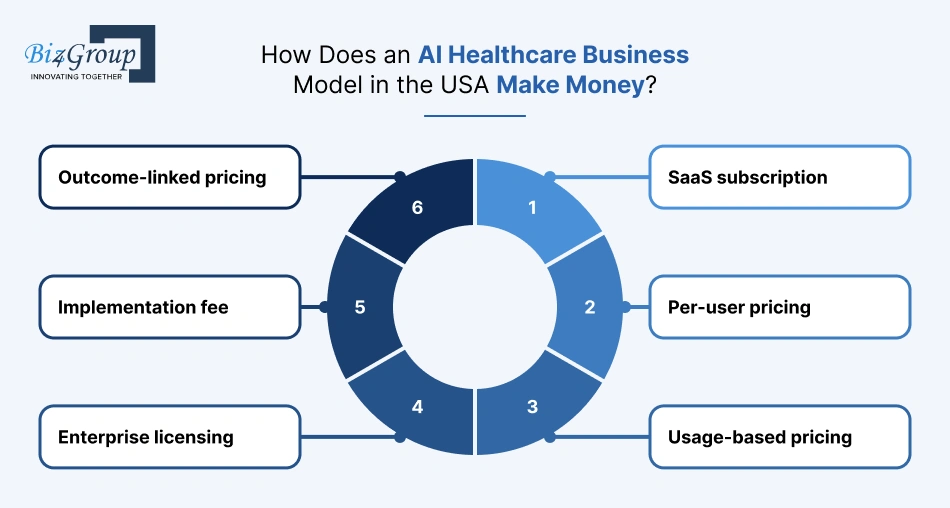
A healthcare AI business needs a clear answer to one question: who pays for the product, and what measurable value do they receive? A clinic may pay to reduce administrative workload, a hospital may invest in better operational efficiency, and a payer may purchase AI tools that help process claims or manage prior authorizations.
The right AI healthcare business model depends on the buyer, the problem being solved, and how easily the product's impact can be measured. Choose a revenue model that aligns with the customer's budget and purchasing process, rather than relying on the technology alone to justify its price.
Choose a Revenue Model That Fits Your Product
Different healthcare AI products lend themselves to different pricing structures. Match the model to how customers use the product and receive value.
|
Revenue model |
How it works |
Best suited for |
|---|---|---|
|
SaaS subscription |
Customers pay monthly or annually for access |
Patient engagement, documentation, and workflow tools |
|
Per-user pricing |
Fees depend on the number of clinicians, staff members, or other users |
Clinical productivity and workforce applications |
|
Usage-based pricing |
Customers pay based on transactions, documents, calls, or AI processing volume |
Voice agents, claims automation, and document processing |
|
Enterprise licensing |
A healthcare organization pays for broader access, support, and agreed functionality |
Hospital-wide platforms and multi-department solutions |
|
Implementation fee |
A one-time fee covers configuration, integration, and deployment |
Products that require connections to existing healthcare systems |
|
Outcome-linked pricing |
Part of the fee depends on agreed and measurable results |
Selected revenue cycle and operational efficiency tools |
You can combine models when the pricing reflects distinct services. For example, an AI documentation product might charge an implementation fee followed by a subscription based on clinician usage.
How Should You Price an AI Healthcare Product?
Start with the value your product creates, then compare that value with the customer's alternatives and budget. If an AI tool reduces manual work, estimate the time saved, the cost of that work, and the proportion of savings the customer can reasonably attribute to the product.
For an early healthcare AI startup, pricing can begin with a defined package rather than a complex pricing structure. Set clear limits for users, usage, integrations, support, and implementation so customers understand what they are buying.
Before finalizing prices, assess:
- Cost to serve: Include hosting, AI model usage, support, maintenance, and third-party services.
- Customer value: Estimate measurable time savings, reduced rework, faster processing, or improved capacity.
- Procurement requirements: Account for security reviews, integration work, contracting, and ongoing support.
- Expansion potential: Consider whether customers may add users, departments, or workflows over time.
Avoid promising savings or clinical outcomes you have not demonstrated. Use pilot data and customer evidence to refine your pricing as the product matures.
Can Healthcare AI Startups Earn Revenue Through Reimbursement?
Some healthcare AI products may fit into existing reimbursement pathways, but reimbursement is not automatic simply because a product uses AI. Payment depends on the service being delivered, who provides it, applicable billing rules, payer policies, and the product's regulatory status.
For example, an AI tool that supports a clinician's workflow may be sold directly to a healthcare organization, while a product associated with a reimbursable clinical service may require a separate assessment of coding, documentation, coverage, and billing requirements. Founders should distinguish between revenue earned by selling software and reimbursement received for clinical care.
Before making reimbursement part of your business plan, verify the relevant requirements with qualified billing, regulatory, and healthcare reimbursement specialists. Build your initial financial projections around a clearly identified paying customer instead of assuming that insurers will cover the product.
How Can You Build a Sustainable Revenue Strategy?
A sustainable model connects a specific buyer to a measurable business result. Start with one customer segment, one high-value workflow, and a pricing structure that is simple enough to explain and test.
As you gain customers, monitor recurring revenue, customer acquisition costs, renewal rates, implementation expenses, and gross margins. These figures help you identify whether growth is creating a sustainable business or simply increasing delivery costs.
Choose your revenue model based on who receives the value, who controls the budget, and how the product will be purchased. Validate willingness to pay before expanding your feature set and treat reimbursement as a separate pathway that requires evidence and verification.
With your business model defined, the next challenge is taking your product to market, building buyer trust, and securing your first paying healthcare customer.
How Do You Choose the Right AI Healthcare Development Company, and How Can Biz4Group Help?
Choosing an AI healthcare development company in the USA means finding a partner that understands both healthcare operations and the technical requirements of building AI products. A promising prototype is only the starting point. The product also needs to fit real workflows, handle sensitive information appropriately, integrate with existing systems, and solve a problem customers are willing to pay to fix.
For founders planning a healthcare AI startup, the right partner should help turn an initial idea into a product with a defined scope, a practical development plan, and a clear path to market. This is an important part of healthcare AI entrepreneurship, particularly for founders learning how to launch an AI healthcare company in a regulated market.
What Should You Look for in an AI Healthcare Development Partner?
1. Healthcare AI Experience Beyond the Demo
Ask prospective partners about their experience with healthcare workflows, patient-facing applications, clinical data, and administrative automation. Relevant project examples should explain the problem addressed, the solution developed, and the partner's actual contribution rather than simply listing AI technologies. This helps you assess whether the team has the experience required to build an AI healthcare product for real-world use.
2. Security and Compliance Built into Development
Your partner should understand how data flows through the application, which vendors process it, and what safeguards the intended use requires. For a product handling protected health information, discuss HIPAA obligations, access controls, audit logging, vendor agreements, and the need for specialist regulatory advice. These considerations are essential when planning how to start a HIPAA-compliant AI healthcare company.
3. Healthcare System Integration Capabilities
An AI product may need to work with electronic health records, scheduling platforms, billing systems, or patient portals. Ask how the team approaches interoperability standards such as FHIR and HL7, handles integration testing, and plans for differences between customer environments. These capabilities can help an AI healthcare company connect its product to existing healthcare infrastructure.
4. Clear Scope, Ownership, and Delivery Terms
Before signing, establish what the MVP includes, how milestones are measured, who owns the custom-developed intellectual property, and what happens when requirements change. A credible AI healthcare startup consulting company in the USA should explain technical trade-offs and delivery risks instead of promising results without understanding your requirements.
5. A Practical Plan for Moving Beyond the MVP
The first release should prove a specific assumption about your customer or product. Look for a partner that can distinguish essential features from later enhancements and explain how testing, customer feedback, maintenance, and future integrations will fit into the development plan. This approach helps founders manage the cost and risk of AI healthcare innovation while preparing for future growth.
Why Does Real-World Healthcare Experience Matter?
Healthcare AI development involves more than connecting an application to a language model. Data quality, clinical workflows, privacy requirements, and the consequences of incorrect outputs can all affect whether a product is suitable for real-world use. For a startup using AI in healthcare, practical implementation experience matters as much as technical capability.
Biz4Group Technical Director Dave Caplis emphasized the importance of practical implementation:
“What they actually need is a partner who understands HIPAA architecture, EHR data models, and how care is delivered on the ground. Not a vendor with a polished demo. A team that has built this before and can build it again.”
That perspective offers a useful test for founders: ask how a development team would address your actual workflow, data, integration, and operational constraints. The answer should be specific to your product, not a generic presentation about AI capabilities.
How Can Biz4Group Help You Build an AI Healthcare Business?
Biz4Group works on AI-enabled healthcare solutions spanning patient engagement, cognitive support, health-related applications, and operational automation. Its published work includes solutions for dementia care, patient support, and AI-powered healthcare interactions.
For a founder exploring how to turn an AI healthcare idea into a business, the engagement can begin with defining the target buyer, the problem worth solving, the data the product needs, and the features required for the first release. From there, the development scope can cover application architecture, AI integration, testing, deployment planning, and the safeguards appropriate to the product's intended use.
Depending on your requirements, relevant capabilities may include AI integration services for connecting AI with existing systems and AI automation services for reducing repetitive operational work. The appropriate approach depends on the workflow you want to improve, not on how many AI features can be added.
How to Start Working with the Right Development Partner
Before requesting a proposal, prepare a short brief covering:
- The problem: What specific healthcare workflow or user need are you addressing?
- The buyer: Who will use the product, who will approve it, and who will pay?
- The data: What information is available, and what permissions or safeguards are required?
- The MVP: Which essential features will demonstrate the product's value?
- The budget and goals: What can you invest, and what evidence do you need from the first release?
Use this brief to compare partners on their understanding of your business, proposed scope, relevant experience, and ability to explain risks clearly. This is one of the most practical steps to start an AI healthcare business with a clearer development strategy.
Ready to Turn Your Healthcare AI Idea into Something More Than a Pitch Deck?
Talk with Biz4Group about your product goals, technical requirements, and the next steps toward building your healthcare AI solution.
Contact UsFinal Thoughts!
Learning how to start an AI healthcare business begins with identifying a genuine healthcare problem, validating demand, and building a product that delivers measurable value. A successful healthcare AI startup also needs a viable business model, a realistic development budget, appropriate data safeguards, and a clear plan for reaching its first paying customer.
You do not need to build an entire healthcare platform from day one. Start with one well-defined use case, speak with potential buyers, and test whether your solution improves a specific workflow. Use those findings to guide product decisions and future investment rather than adding features based on assumptions.
As you plan your AI healthcare business, account for the requirements that apply to your product's intended use. If it handles protected health information, consider HIPAA obligations, access controls, vendor agreements, and security risks during the architecture and development stages. Working with a team experienced in HIPAA-compliant AI healthcare platform development can help address these technical requirements early, although compliance ultimately depends on your product, data flows, safeguards, and legal responsibilities.
Biz4Group has reported experience across 100+ healthcare AI projects, spanning areas such as patient engagement, cognitive support, and healthcare workflow automation. That experience provides relevant context for founders assessing the technical scope of an AI healthcare product. The right development approach still depends on the problem you are solving, your available data, your target customers, and the outcomes your business needs to demonstrate.
Ultimately, the best way to turn an AI healthcare idea into a business is to make the next decision based on evidence. Define the problem, identify who will pay to solve it, establish the essential features of your first release, and determine how you will measure success. A focused starting point gives your AI healthcare company a clearer path from concept to a product that customers can evaluate and adopt.
Contact Us
FAQ
1. How much does it cost to start an AI healthcare business in the USA?
Starting an AI healthcare business in the USA can cost between $35,000 and $300,000+, depending on product complexity, AI capabilities, healthcare integrations, security requirements, and testing. A focused MVP typically requires less investment than a multi-workflow healthcare platform. Budget separately for data access, regulatory advice, deployment, and ongoing maintenance when estimating your AI healthcare startup costs.
2. How do I validate an AI healthcare business idea before investing in development?
To validate an AI healthcare business idea, interview potential users and purchasing decision-makers, such as clinic owners, hospital administrators, or healthcare technology leaders. Identify a recurring problem, examine existing alternatives, and test whether buyers would pay for your proposed solution. Validate demand, workflow fit, and willingness to pay before investing in a full MVP.
3. Does an AI healthcare startup need to be HIPAA-compliant?
Not every AI healthcare company is automatically subject to HIPAA. However, a startup that qualifies as a covered entity or handles protected health information on behalf of a covered entity may have HIPAA obligations. Determine your company's role, review vendor agreements, and establish appropriate security controls before processing sensitive patient data.
4. Does an AI healthcare product need FDA approval?
Whether an AI healthcare product needs FDA clearance or authorization depends on its intended use and functionality. Some healthcare software functions may fall outside medical-device oversight, while others may be regulated. Products that analyze medical images or inform diagnosis and treatment may require closer assessment. Review the applicable FDA guidance and seek regulatory advice before deciding whether clearance or authorization is necessary.
5. Which AI healthcare business ideas have the strongest commercial potential?
Potential AI healthcare startup ideas include clinical documentation, revenue cycle automation, prior authorization, patient engagement, remote monitoring, and healthcare workforce management. The strongest opportunity depends on buyer demand, data access, competition, implementation complexity, and the ability to demonstrate measurable value. When deciding how to launch an AI healthcare company, prioritize a focused workflow with a clearly identified paying customer.
6. How can an AI healthcare startup make money?
An AI healthcare business model can include SaaS subscriptions, per-user pricing, usage-based fees, enterprise licensing, and implementation charges. The right model depends on who buys the product and how they receive value. Some products may support reimbursable clinical services, but reimbursement is not automatic. Validate willingness to pay and confirm applicable billing requirements before building your financial projections.
7. How do I choose an AI healthcare development company in the USA?
When choosing an AI healthcare development company in the USA, look for healthcare AI experience, secure development practices, healthcare system integration capabilities, clear intellectual property terms, and a realistic MVP plan. Ask how the team will address your workflow, data requirements, testing needs, and regulatory risks. Biz4Group is one option founders can evaluate for AI healthcare product development, particularly when they need support translating a healthcare use case into a defined product scope. Compare its proposal with other qualified providers based on relevant experience, deliverables, security practices, and ownership terms.