 Location :
Orlando, FL, USA
Location :
Orlando, FL, USA +1 (407) 714-1616
 info@biz4group.com
- To build an AI therapeutic app, start with a clear therapeutic goal, define your AI strategy and choose frameworks like CBT, ACT or mindfulness for structured guidance.
- AI therapeutic apps work through mood detection, sentiment analysis and personalized journeys, supporting users with real time emotional insights and guided interventions.
- Use cases range from mental health clinics, corporate wellness, senior care, behavior change, to digital companionship, with real examples like Cultiv8, Stratum 9 and CogniHelp.
- Development costs for AI therapeutic app development range from $20,000 to $150,000+, influenced by AI complexity, features, HIPAA compliance and integrations.
- Biz4Group is a strong partner for AI therapeutic app development services, offering expertise in AI, secure architecture, emotional UX, and full cycle development from MVP to enterprise scale.
If you are planning to build an AI therapeutic app, you might be wondering where to start. You may already know that people are looking for faster, more accessible support for mental health and wellness, but what does it take to turn that need into a reliable product? And how do you make sure your solution actually helps users instead of blending into a crowded market?
You are not alone if you feel that uncertainty. Many founders and tech leaders want to develop an AI therapeutic app, yet the steps, costs and technical decisions often feel overwhelming. Have you ever looked at another company’s product and thought, “How did they build all of this so quickly?” This guide will help you find those answers.
The market is moving quickly. The mental health app industry is expected to reach 8.54 billion dollars in 2025.
Digital therapeutics for mental health are projected to grow at 19.6 percent CAGR through 2033
If you plan to invest in AI therapeutic app development, this is the best time to build something meaningful.
In this guide, we will walk through everything you need to know. You will see how to shape the foundation of your product, how to design features that actually support users and how to overcome common blockers that slow teams down. You will also see where solutions like an AI mental health app fit into the larger digital care ecosystem.
By the end, you will have a step by step understanding of how to move from idea to execution using the right principles, especially if your goal is to create AI CBT based therapeutic application, offer therapeutic mobile app development, or build any form of personalized therapeutic app using AI. Our goal is to help you move confidently from uncertainty to clarity.
Ready to begin? Let's understand what these apps actually are and why they matter.
What Exactly Is an AI Therapeutic App and Why Building an AI Therapeutic App Matters More Than Ever
If you have been exploring ways to build an AI therapeutic app, you may be asking yourself what truly separates a therapeutic platform from a standard health app. It often starts with a simple idea. People want support that feels personal, timely and clinically grounded. You want to create something that delivers that level of care consistently.
An AI therapeutic app uses intelligent guidance to help users manage emotions, learn coping techniques, and make steady progress. Instead of offering static tips, it responds to the user’s mood, patterns, and actions. This is a major reason so many product teams want to develop an AI therapeutic app that feels meaningful rather than surface level.
So, what makes these apps valuable today? A few essentials stand out:
- Dynamic responses instead of one size fits all advice
- Personalized interventions based on mood, behavior or goals
- Structured therapeutic techniques, often inspired by CBT or similar frameworks
- Progress tracking that helps users understand patterns and improvements
- Real time support, especially during stressful or uncertain moments
You might be wondering whether these apps only focus on mental health. Most begin there, but they often branch into related areas such as emotional wellness, stress management, behavioral change and even chronic condition support. This flexibility is one of the strengths of AI therapeutic app development.
More organizations are turning to intelligent tools to reduce manual effort and enhance user outcomes. Some also implement advanced automation early in their roadmap. For example, teams working to optimize behind the scenes processes often benefit from structured AI automation services that help streamline data workflows and decision logic.
If your goal is to create AI CBT based therapeutic application features or build a personalized therapeutic app using AI, you do not need to complete everything at once. Most successful teams start with a simple foundation. They test it with real users. They refine based on insights, not assumptions.
To make those choices confidently, it helps to understand how these apps work internally and what powers their intelligence. That is exactly what we will explore next.
Ready to Turn Your AI Therapeutic App Idea Into Something Real
Your users need support. Your vision needs momentum. Let’s move it from concept to creation with clarity and confidence.
Contact UsHow AI Driven Therapeutic Apps Work Inside the AI, Data and Clinical Intelligence?
If you want to build an AI therapeutic app, understanding what happens underneath the surface will help you shape a product that feels reliable and supportive. Users see a simple chat or a guided exercise, but the internal process is structured, secure and clinically informed. You might even be asking yourself how these apps decide what to say or how they guide the user at the right moment. Let’s break it down step by step.
1. The User Shares Input
The journey starts when the user types a message, records a voice note or logs a mood. When you develop an AI therapeutic app, your system needs to capture this information in a safe and consistent way. This is the first layer of AI therapeutic app development services because everything that follows depends on accurate user input.
2. The System Interprets the Input
The app uses natural language understanding, emotional detection, and pattern recognition to interpret what the user is expressing. If you want strong conversational accuracy, you may benefit from intelligent systems built with agentic AI development. This helps your app understand context, tone, and intent rather than reacting only to keywords.
3. The Therapeutic Engine Decides What Happens Next
Once the input is understood, the therapeutic logic determines the next step. This logic is based on frameworks such as CBT, mindfulness, or behavioral activation. It shapes how the app responds, whether with calming guidance, reframing questions, or structured exercises. This is a core part of therapeutic app development integrating AI, because your clinical logic and AI models work together to support the user.
4. The App Delivers a Personalized Response
This is where personalization becomes important. The app delivers a response based on the user’s emotional state, previous entries, and overall progress. If you want to create AI CBT based therapeutic application features or build a personalized therapeutic app using AI, this layer determines how natural and relevant the experience feels.
5. The System Tracks Progress Continuously
As users interact over time, the app studies patterns in mood, behavior, and engagement. This helps the system adjust future recommendations and interventions. Strong tracking is essential for teams focused on therapeutic mobile app development and long term therapeutic outcomes.
6. Safety Checks Protect the User
Therapeutic apps often include automated rules that detect distress or phrases that signal emotional risk. When needed, the system can adjust the conversation, redirect the user, or notify a clinician depending on your model. If your goal is to develop a HIPAA compliant AI therapeutic application for remote care, these safety layers are mandatory.
7. The Backend Manages Everything Securely
A reliable backend ensures encrypted storage, protected sessions and stable data flow. This is the foundation behind every interaction. Many teams strengthen this part of their architecture using expert AI integration services so the entire system works smoothly. This part also aligns with a strong end to end development guide for AI based therapeutic applications, because backend design impacts compliance, speed, and scalability.
When all of these parts work together, the user experiences a simple and supportive interaction. Behind the scenes, your therapeutic app development using AI is powered by a coordinated system that interprets, analyzes and guides each step with care.
Next, let’s look at the real world use cases where this technology creates meaningful impact.
Use Cases That Prove the Value of AI Therapeutic App Development
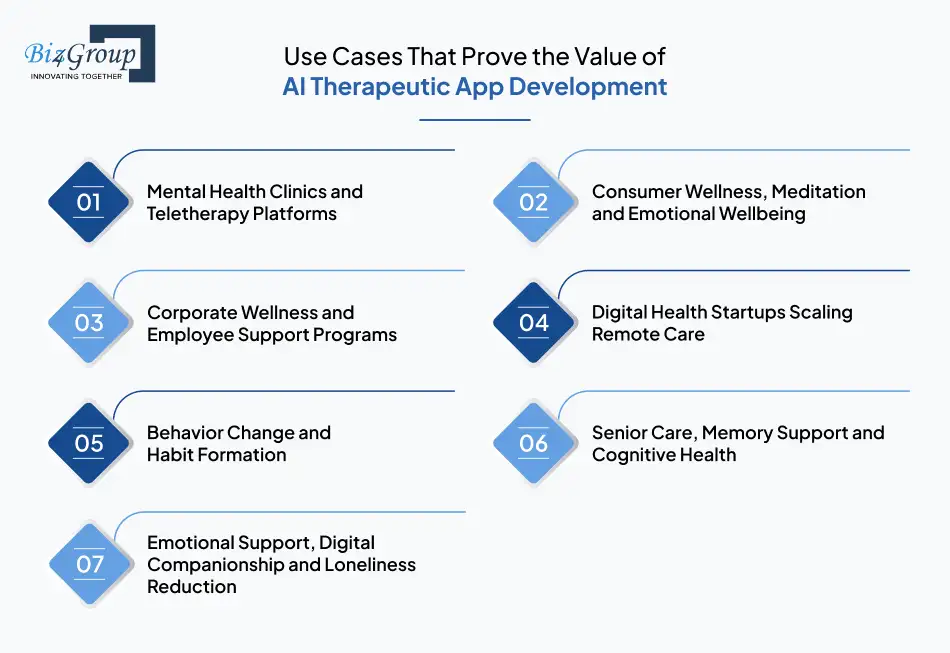
When you choose to build an AI therapeutic app, it helps to see where these platforms create a real impact in everyday environments. Different organizations use AI-guided therapeutic tools for different needs. Some focus on emotional wellbeing, others on workplace mental health, cognitive support, or behavior change.
Below are the strongest, real world use cases, each paired with a Biz4Group project that demonstrates how similar solutions have been built successfully.
1. Mental Health Clinics and Teletherapy Platforms
Clinics and therapy networks often need support tools that help clients between sessions. AI guided therapeutic apps can reduce drop offs, offer coping prompts and strengthen session effectiveness.
How this use case works:
- Users receive personalized guidance during stressful moments
- AI identifies mood patterns and emotional triggers
- Clinicians access weekly summaries without manual effort
- Sessions become more structured and productive
2. Consumer Wellness, Meditation and Emotional Wellbeing
Individuals often look for tools that help them manage stress, build emotional stability and create mindful routines. AI enhances these experiences through personalization and emotional context.
How Biz4Group has solved something similar
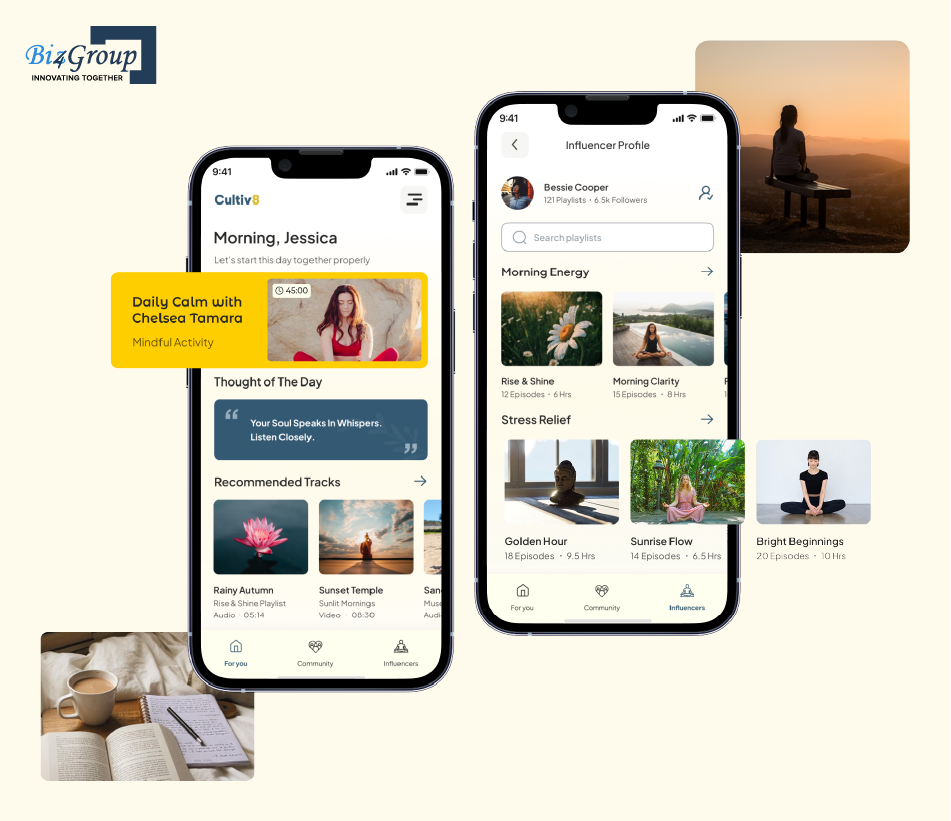
The Cultiv8 is a spiritual and emotional wellness platform offering guided meditations, reflective practices and personalized calming sessions. It helps users build emotional balance through daily habits.
Key highlights:
- Personalized meditation journeys
- AI curated spiritual practices
- Support for emotional grounding
- Tools for long term habit building
This aligns naturally with AI therapeutic app development for emotional wellbeing.
3. Corporate Wellness and Employee Support Programs
Workplace stress continues to rise. Companies adopt AI guided tools to help employees manage burnout, improve resilience and build healthier habits throughout the workday.
A real example from our portfolio
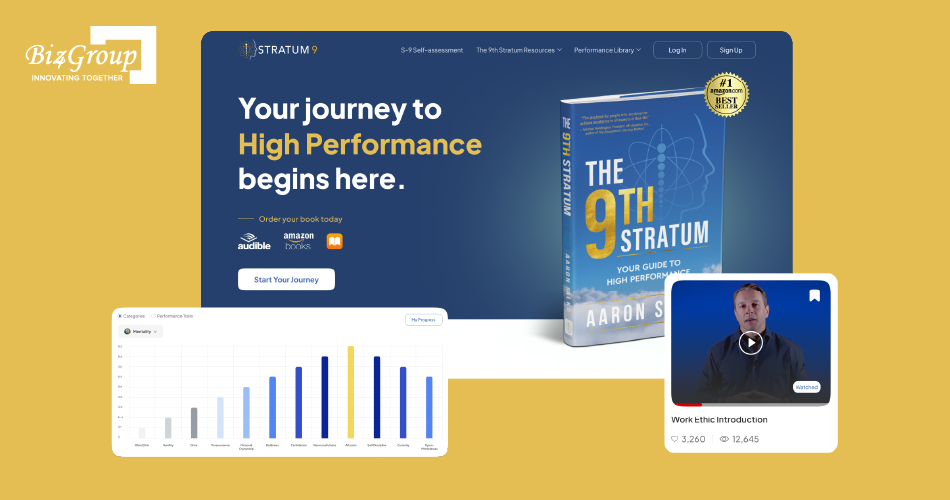
We developed Stratum 9, a behavior change and skill development platform that turns a personal growth book into an interactive experience. It helps employees strengthen resilience, build positive routines and enhance performance.
Key highlights:
- Structured behavior change modules
- Daily habit building prompts
- Performance improvement insights
- Programs designed to strengthen emotional resilience
This showcases how companies can create personalized therapeutic app using AI for workforce wellbeing.
4. Digital Health Startups Scaling Remote Care
Startups offering remote health services need scalable support systems. AI helps automate mood check ins, triage emotional concerns and deliver personalized routines at scale.
Here is something similar we created
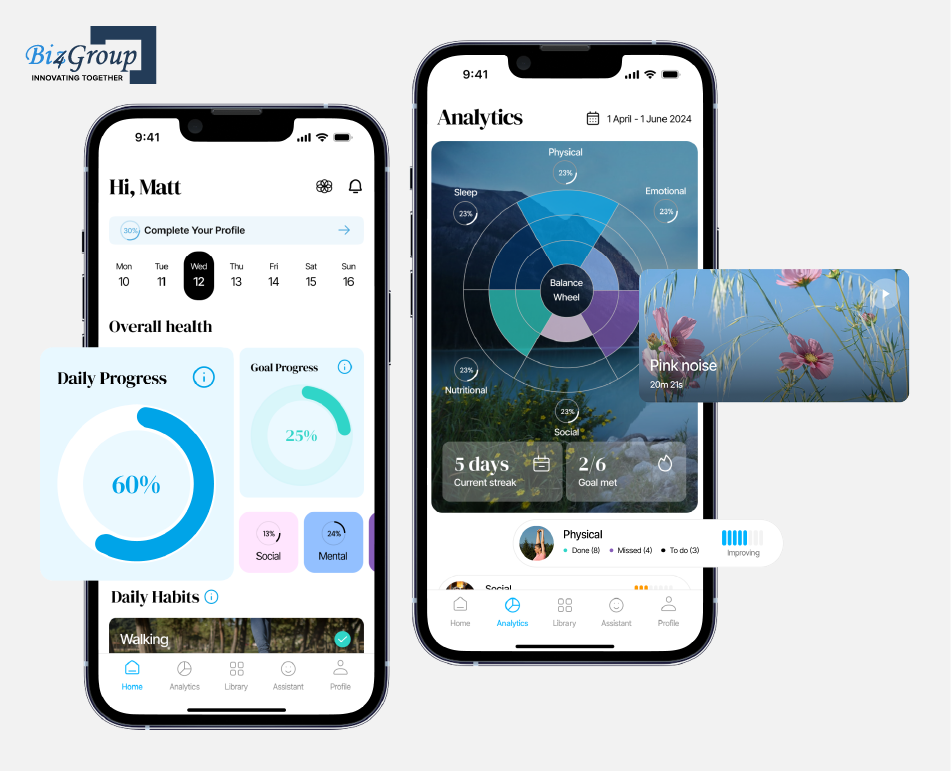
Our team-built Quantum Fit, a personal development app that blends mental, physical and lifestyle wellness. It provides intelligent recommendations and multi-dimensional insights that keep users engaged daily.
Key highlights:
- Personalized wellness routines
- Goal oriented guidance
- Multi-dimensional health tracking
- Support for long term engagement
This directly supports therapeutic mobile app development goals for remote care and continuous support.
5. Behavior Change and Habit Formation
Therapeutic apps often rely on behavior activation, daily routines, and guided habit formation. AI personalizes these routines for better adherence and outcomes.
A practical project that reflects this use case
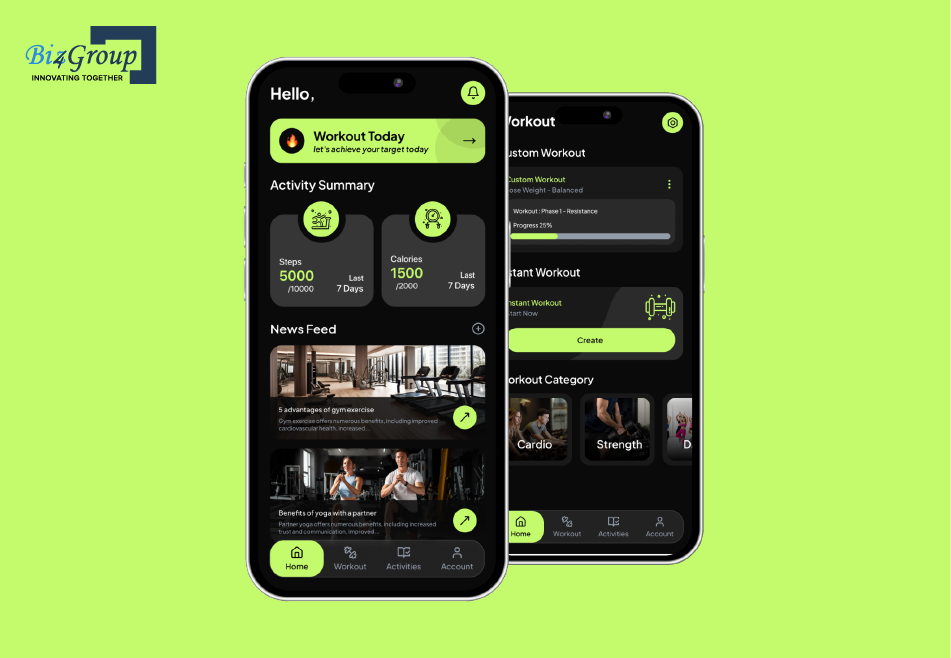
We developed an AI Workout App that analyzes user images and provides personalized workout routines. While fitness focused, it demonstrates how AI can guide habit creation with adaptive recommendations.
Key highlights:
- Computer vision-based analysis
- Tailored workout recommendations
- Adaptive difficulty levels
- Strong alignment with behavior changes models
This mirrors the structure used in therapeutic app development integrating AI for habit building.
6. Senior Care, Memory Support and Cognitive Health
Seniors often need gentle support for memory, routine building and cognitive exercises. AI can deliver simple, structured assistance throughout the day.
We have also built solutions for cognitive support
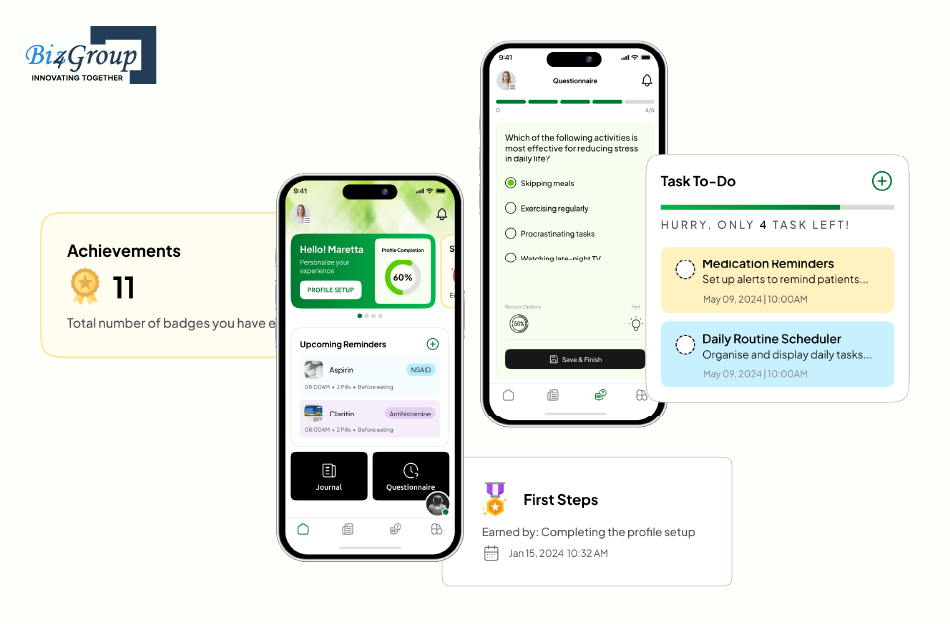
One example is CogniHelp, a companion app designed for dementia patients in their early and mid-stages. It provides memory prompts, cognitive stimulation, and caregiver communication tools.
Key highlights:
- Tailored cognitive exercises
- Daily memory support
- Simple interface for seniors
- Caregiver linked tracking
This fits the goal of developing a HIPAA compliant AI therapeutic application for remote care.
7. Emotional Support, Digital Companionship and Loneliness Reduction
AI companions can support users dealing with loneliness, anxiety, or emotional stress by offering consistent check-ins and empathetic conversations.
We have created something similar in the companionship space
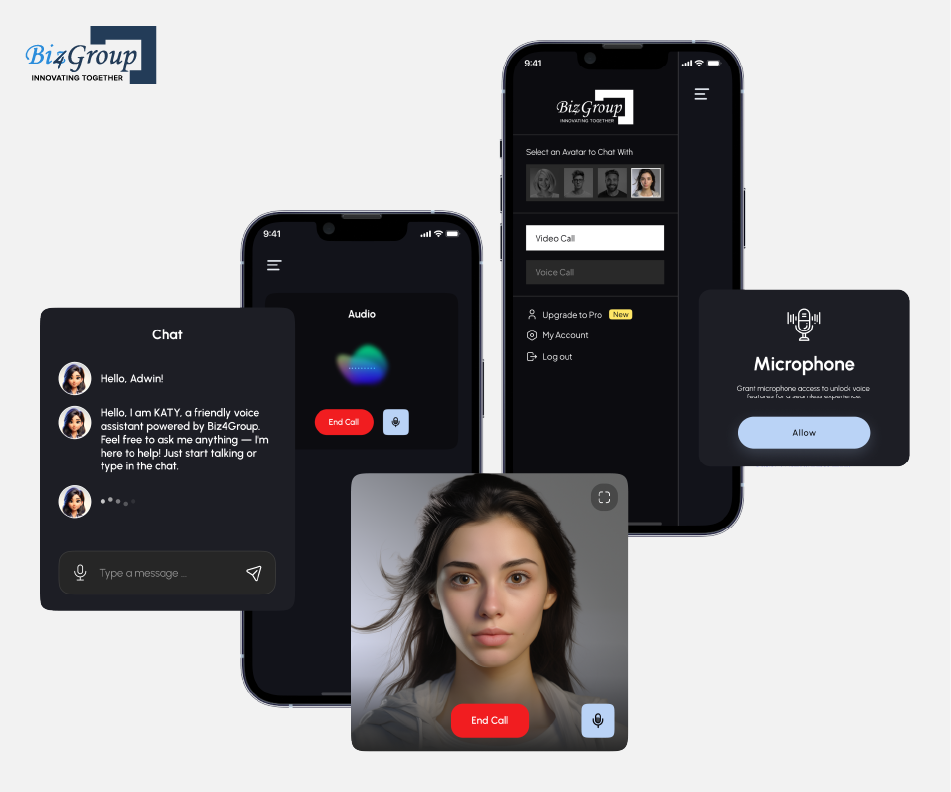
The AI Wizard project features an avatar-based companion that communicates through voice and video. It provides emotional presence, guided interactions, and comforting daily engagement.
Key highlights:
- Human like emotional interaction
- Voice and video-based communication
- Daily check ins for ongoing support
- Personalized conversation patterns
This reflects rising demand for therapeutic app development using AI for emotional connection.
Monetization Strategies for AI Therapeutic Apps: Turning Innovation into Revenue
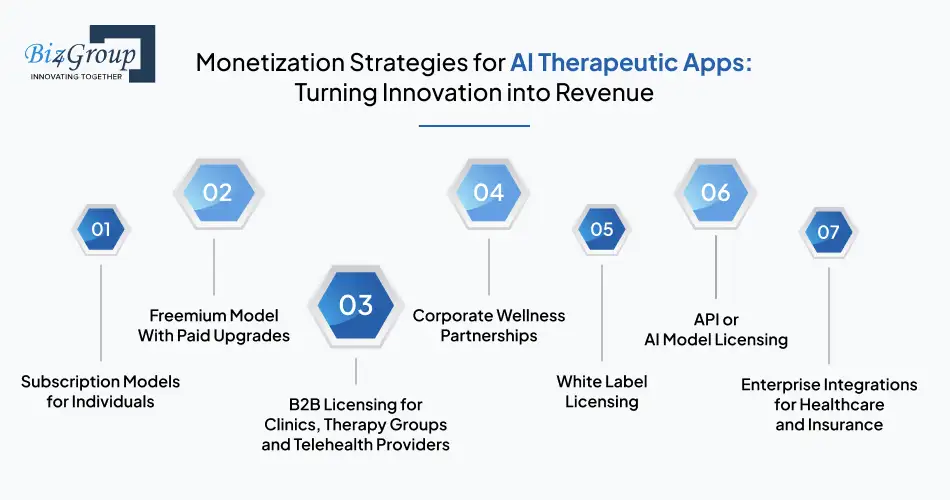
Once you decide to build an AI therapeutic app, the next question is simple. How do you turn it into a profitable, sustainable product? Monetization matters as much as technology. Whether you want to develop an AI therapeutic app for consumers, clinics or enterprises, the right revenue model can determine long-term success.
Let’s walk through the strongest models for AI therapeutic app development and how they fit different business goals.
1. Subscription Models for Individuals
Subscription based pricing is popular for emotional wellness, CBT based support and daily therapeutic routines.
Why it works:
- Predictable recurring revenue
- Works well with mood tracking and guided interventions
- Great fit for apps that offer ongoing therapeutic routines
If your goal is to create AI CBT based therapeutic application features or offer daily coaching, this model supports long term engagement.
2. Freemium Model With Paid Upgrades
If you want rapid adoption, this model helps you attract users first and convert them into paid members later.
Users may unlock premium features such as:
- AI energized journaling
- Advanced therapeutic modules
- Personalized progress reports
- Deeper emotional analytics
This approach is common for teams offering therapeutic mobile app development or therapeutic app development using AI for general wellness.
3. B2B Licensing for Clinics, Therapy Groups and Telehealth Providers
Clinics and teletherapy platforms want readymade digital therapeutics they can integrate into their care programs. Licensing gives them full functionality without building it from scratch.
This model works best when your app offers:
- Clinician dashboards
- Mood and symptom trends
- Progress insights
- HIPAA aligned security
If you plan to develop a HIPAA compliant AI therapeutic application for remote care, this model allows rapid scaling across multiple providers.
4. Corporate Wellness Partnerships
Companies continue investing in mental wellbeing tools. Your app can become a core part of their stress management and emotional resilience programs.
You can monetize through:
- Per employee access
- Corporate subscription bundles
- Custom therapeutic modules
- Behavioral insights for HR teams
This fits perfectly with AI digital therapeutics app development targeted toward workplace mental health and employee support.
5. White Label Licensing
Some brands want their own version of your app. White labeling lets them rebrand your product while you maintain the technology.
Best suited for:
- Hospitals
- Therapy groups
- Wellness brands
- Insurance programs
White labeling is a strong strategy when offering AI therapeutic app development services, especially if your system is modular.
6. API or AI Model Licensing
If your therapeutic intelligence is strong, you can license it as a standalone component.
You might offer:
- Mood detection APIs
- Sentiment analysis engines
- Personalized therapeutic journey mappers
- CBT logic modules for chat systems
This is a strategic option for businesses building multiple apps or wanting to create personalized therapeutic app using AI features across platforms.
7. Enterprise Integrations for Healthcare and Insurance
Insurance companies and healthcare systems want digital therapeutics that reduce long-term clinical costs. This usually requires structured therapeutic flows and measurable outcomes.
Revenue may come from:
- Reimbursement partnerships
- Outcome based pricing
- Enterprise level licensing
This model aligns well with end-to-end development guide for AI based therapeutic applications, especially when the app includes data driven therapeutic progress tracking
Must Have Features When You Build an AI Therapeutic App from Scratch
When you decide to build an AI therapeutic app, the features you include determine how effective, secure and engaging the final product becomes. You want to balance clinical value, user experience, and AI personalization without overwhelming users.
To help you plan your roadmap, here is a complete list of essential features for AI therapeutic app development, presented in a clean table for quick reference.
These features support mental health, behavior change, chronic condition management, and therapeutic skill building, while giving your team a strong foundation for long term scalability.
| Feature Category | Must Have Features | Why It Matters |
|---|---|---|
|
AI Capabilities |
- Personalized therapeutic recommendations - Adaptive CBT guidance - Human like conversational flow powered by an AI agent |
Delivers support that feels personal, timely and clinically aligned. Essential for therapeutic app development integrating AI. |
|
Therapeutic Tools |
- CBT, ACT or DBT based modules - Guided breathing and grounding exercises - Journaling prompts - Emotional reframing tools - Thought restructuring workflows |
Helps users practice real therapeutic skills. Important when you create AI CBT based therapeutic application features. |
|
User Engagement |
- Streaks and habit tracking - Smart reminders - Daily mood check ins - Personalized challenges - Progress streaks |
Keeps users consistent and improves outcomes. Critical for personalized therapeutic app using AI. |
|
Safety & Compliance |
- Secure authentication - Encrypted messaging - Crisis detection and escalation rules - Clinician override controls |
Required for organizations wanting to develop a HIPAA compliant AI therapeutic application for remote care. |
|
Clinician & Admin Tools |
- Therapist dashboard - Goal tracking - Progress summaries - Risk flag alerts - Session prep insights |
Supports blended care models, improves treatment quality and helps clinicians manage more patients safely. |
|
Data & Tracking |
- Mood trend visualization - Behavior pattern analytics - Symptom tracking - Automated reports - Insights for personalized journeys |
Enables smarter, evidence backed recommendations. A must for AI therapeutic app development services. |
|
User Experience |
- Clean and emotional safe UI - Accessibility friendly design - Multi device sync - Offline support - Calm, guided micro interactions |
Reduces friction and builds trust. A strong UI/UX design foundation impacts retention. |
|
Integrations |
- Wearables (Apple Health, Google Fit) - Calendar and notification sync |
Adds depth to your solution. Important when building an end to end development guide for AI based therapeutic applications. |
|
Content Library |
- Therapist approved content - Audio and video lessons - Evidence based frameworks - Micro learning for skill building |
Keeps your app rich, reliable and helpful for diverse user groups. |
|
Scalability & Performance |
- Cloud backend - Microservices - Real time AI processing - Secure storage - Auto scaling |
Ensures your app grows smoothly as users increase. Important for develop an AI therapeutic app that remains stable. |
How to Use This Table in Your Development Plan
- If your goal is to create AI CBT based therapeutic application features, start with AI personalization and therapeutic modules.
- If you want to support clinics, prioritize clinician dashboards and HIPAA workflows.
- If you want strong user retention, focus on habit systems, progress tracking and emotional safety.
- This list forms a solid foundation whether you are building an MVP or a full scale therapeutic solution.
Want These Features Built the Right Way
Great features only shine when the engineering behind them is rock solid. We make sure everything works, blends and scales smoothly.
Let's TalkStep by Step Process to AI Therapeutic App Development
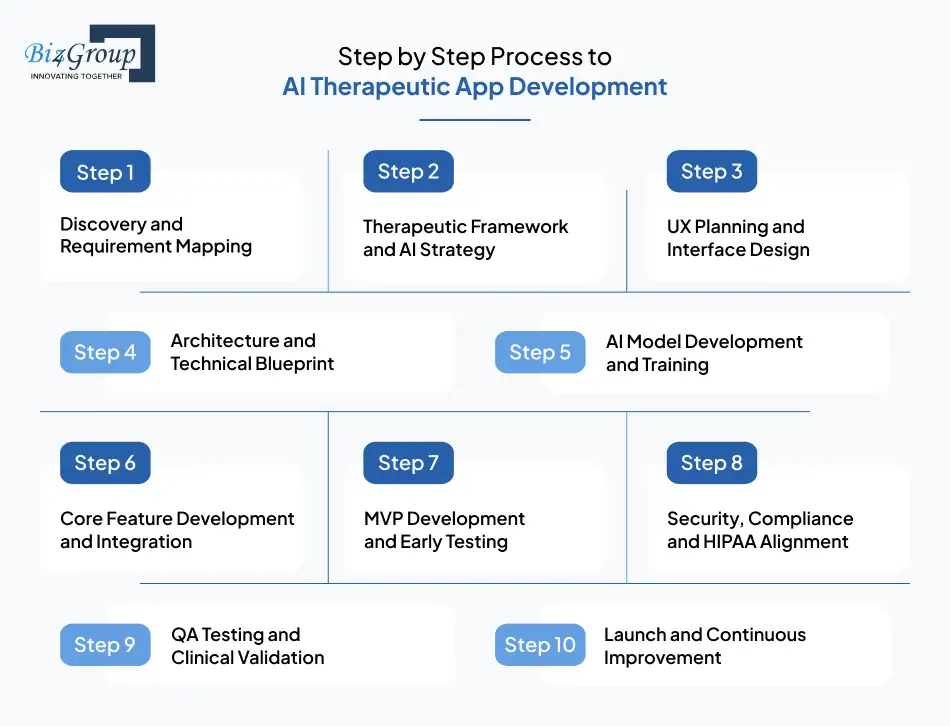
If you plan to build an AI therapeutic app, you need a clear development process that blends therapeutic principles with intelligent technology. This roadmap helps you avoid confusion, reduce delays, and create a product that supports real users effectively. Below is a step-by-step guide that fits every stage of AI therapeutic app development, from idea to launch.
1. Discovery and Requirement Mapping
This is where you clarify your product vision and the specific therapeutic goals you want your app to support. You identify your target audience, their challenges, and what outcomes you want to deliver through therapeutic mobile app development.
Key activities:
- Define your user personas and problem areas
- Outline emotional, behavioral or clinical goals
- List features aligned with therapeutic app development integrating AI
2. Therapeutic Framework and AI Strategy
Your therapeutic structure guides how users will learn, grow, and improve. This stage defines clinical models such as CBT or ACT and pairs them with the right AI techniques for personalization, prediction, and sentiment understanding.
Key activities:
- Select models for create AI CBT based therapeutic application paths
- Choose AI logic for mood detection and guided interventions
- Design an adaptive response strategy for each user journey
3. UX Planning and Interface Design
A calm, intuitive design builds trust. This stage focuses on emotional safety, ease of use, and supportive navigation. Many teams choose a specialist UI/UX design partner to shape the full experience.
Key activities:
- Create wireframes and therapeutic-friendly layouts
- Design screens that support personalized therapeutic app using AI flows
- Build prototypes for guided exercises and mood tracking
4. Architecture and Technical Blueprint
This step defines the entire engineering foundation. You outline HIPAA aligned backend systems, AI pipelines and data storage that keep your app secure and scalable.
Key activities:
- Plan backend and cloud architecture
- Map out AI and data pipelines for AI therapeutic app development services
- Define encryption, access control and secure APIs
5. AI Model Development and Training
Your AI becomes the engine of your therapeutic experience. It learns to understand user inputs, detect emotions, and deliver relevant suggestions. This is essential for apps that want to create digital therapeutics platforms using AI for anxiety and stress management.
Key activities:
- Develop NLP models for tone and sentiment
- Train AI model on therapeutic conversation patterns
- Build logic for guided interventions and mood routing
6. Core Feature Development and Integration
Your main features come alive at this stage. You develop CBT modules, guided tools, journaling flows, mood logs, progress dashboards, and all AI assisted interactions.
Key activities:
- Build modules to develop an AI therapeutic app around core needs
- Integrate AI for personalization and emotional guidance
- Connect analytics, dashboards and user tracking
7. MVP Development and Early Testing
Instead of building everything at once, you launch a focused version of your app. This MVP validates your assumptions and helps you refine your roadmap. Using structured MVP development helps you gather real user insights early.
Key activities:
- Build a simplified core feature set
- Test your end to end development guide for AI based therapeutic applications
- Collect usability and therapeutic feedback
8. Security, Compliance and HIPAA Alignment
Therapeutic apps deal with sensitive emotional and health data. This stage ensures your platform meets all privacy regulations and keeps user information safe.
Key activities:
- Encrypt communication and store data securely
- Set up HIPAA compliant workflows for remote care
- Validate architecture for develop a HIPAA compliant AI therapeutic application for remote care
9. QA Testing and Clinical Validation
Your app must be tested thoroughly for safety, accuracy and reliability. Clinical experts may review your conversational logic and therapeutic steps to ensure they align with best practices.
Key activities:
- Perform functional, emotional and stress testing
- Review all therapeutic content with clinicians
- Fine tune features for therapeutic app development using AI
10. Launch and Continuous Improvement
Your app goes live and begins helping real users. From here, you analyze behavior patterns, refine AI responses and introduce new modules based on user needs.
Key activities:
- Monitor analytics and engagement
- Release new modules for AI digital therapeutics app development
- Strengthen AI logic using real world usage data
Recommended Tech Stack for AI Therapeutic App Development
Choosing the right tech stack is one of the most important decisions when you build an AI therapeutic app. Your technology choices determine how secure, scalable and adaptive your solution becomes. A strong stack supports advanced personalization, smooth performance and HIPAA aligned workflows that are essential for AI therapeutic app development at any scale.
Here is a complete, easy to review table covering the ideal tech stack for therapeutic app development integrating AI.
| Layer | Recommended Technologies | Why It Matters |
|---|---|---|
|
Frontend (Mobile / Web) |
- React Native - Flutter - Swift (iOS) - Kotlin (Android) - ReactJS (Web) |
Delivers a smooth, responsive interface for users completing therapeutic tasks, guided interventions or CBT exercises. |
|
Backend Development |
- Node.js - Python (FastAPI, Django) - Java (Spring Boot) - .NET Core |
Essential for creating secure APIs, managing therapeutic workflows and supporting AI therapeutic app development services. |
|
AI & Machine Learning |
- Python ML stack (TensorFlow, PyTorch, Scikit-learn) - NLP frameworks (spaCy, HuggingFace, NLTK) - Sentiment analysis models - Recommendation engines |
Powers mood detection, personalized journeys and intelligent guidance for apps that want to develop an AI therapeutic app with adaptive support. |
|
Cloud Infrastructure |
- AWS (preferred for HIPAA readiness) - Google Cloud - Azure - Kubernetes & Docker for deployment |
Supports scalability, real time processing and secure data handling required for develop a HIPAA compliant AI therapeutic application for remote care. |
|
Databases |
- PostgreSQL - MongoDB - Firebase- Redis (caching) |
Stores user mood logs, therapeutic sessions, journaling data and AI insights securely and efficiently. |
|
HIPAA Compliance & Security |
- AWS HIPAA compliant services - Encrypted S3 storage - OAuth 2.0 - JWT authentication - SSL/TLS encryption |
Ensures data safety, privacy and trust for clinical and wellness users. A must for AI digital therapeutics app development. |
|
Real Time Features |
- WebSockets - Firebase Realtime DB - Twilio (chat, voice, video) |
Enables live chat, guided support, urgent check ins and therapist communication if required. |
|
Third Party Integrations |
- Apple Health - Google Fit - Stripe/PayPal - EHR/EMR connectors - Telehealth APIs |
Strengthens your app’s capabilities, especially when creating personalized therapeutic app using AI with holistic health data. |
|
DevOps & Monitoring |
- Jenkins - GitHub Actions - Terraform - Datadog - New Relic - AWS CloudWatch |
Ensures smooth updates, stable deployments and continuous improvement for long term therapeutic support. |
|
Testing Tools |
- XCTest - Jest - Selenium - Postman - JMeter |
Guarantees reliability and emotional safety in therapeutic app development using AI. |
How This Stack Supports Your AI Therapeutic App
A well planned tech stack ensures your product can:
- Personalize interventions for every user
- Process emotions, thoughts and mood inputs safely
- Deliver CBT and therapeutic tools instantly
- Scale across thousands of users
- Maintain HIPAA aligned data flows
- Adapt and grow with new features over time
Whether you want to create a digital therapeutics platform using AI for anxiety and stress management or build a multi purpose emotional wellbeing solution, this tech stack gives you all the essential engineering power.
Cost Breakdown to Build an AI Therapeutic App in 2026
If you want to build an AI therapeutic app, understanding the cost early helps you plan better, prioritize features, and avoid budget surprises. On average, creating a therapeutic platform with AI driven personalization can range from $20,000 to $150,000+, depending on the complexity, compliance needs and the type of AI feature you want to include. Your final investment may differ based on your development partner, AI sophistication, and long-term roadmap.
To help you make informed decisions, here is a complete breakdown of the cost of AI therapeutic app development, including feature costs, influencing factors, hidden expenses, and ways to optimize your budget.
Feature Wise Cost Breakdown for AI Therapeutic App Development
| Feature Category | Details Included | Estimated Cost Range |
|---|---|---|
|
Feature Category |
Details Included |
Estimated Cost Range |
|
Core App Structure (Frontend + Backend) |
App screens, navigation, basic backend setup, user onboarding |
$6,000 – $25,000 |
|
AI & Machine Learning Layer |
Mood detection, NLP, personalization engine, recommendations |
$8,000 – $40,000 |
|
Therapeutic Modules (CBT, ACT, DBT) |
Guided exercises, journaling flows, thought analysis, emotional reframing |
$4,000 – $20,000 |
|
Mood Tracking & Analytics |
Daily check ins, progress charts, emotional trends |
$3,500 – $15,000 |
|
Chat or AI Guided Interaction |
AI conversational flow, sentiment detection, emotional support logic |
$7,000 – $30,000 |
|
Clinician Dashboard (Optional) |
Progress summaries, client history, alerts, insights |
$10,000 – $35,000 |
|
Security & HIPAA Compliance |
Encryption, secure APIs, compliant data workflows |
$5,000 – $25,000 |
|
Wearable Integrations (Apple Health, Google Fit) |
Steps, sleep, heart rate syncing |
$2,500 – $10,000 |
|
Gamification & Habit Building Tools |
Challenges, streaks, rewards |
$2,000 – $8,000 |
|
Admin Panel |
User management, analytics, content updates |
$4,000 – $18,000 |
|
Testing & QA |
Functional, security, usability testing |
$2,500 – $10,000 |
|
Deployment & Cloud Setup |
App Store/Play Store deployment and cloud integration |
$1,500 – $6,000 |
This breakdown applies whether you want to develop an AI therapeutic app, create a personalized therapeutic app using AI, or build a full AI digital therapeutics app development platform.
Factors That Influence the Cost of AI Therapeutic App Development
These variables can significantly raise or reduce the cost when you create a digital therapeutics platform using AI for anxiety and stress management or targeted mental health support.
| Cost Factor | How It Impacts Total Cost |
|---|---|
|
AI Complexity |
More advanced NLP, emotional modeling or personalization increases development time and cost. |
|
Therapeutic Framework Depth |
Apps that include CBT, ACT and DBT modules cost more than single method apps. |
|
HIPAA Compliance Level |
Secure servers, encrypted data and audit logs add cost for apps offering remote care. |
|
Number of Features |
More screens, flows and tools create higher development hours. |
|
Third Party Integrations |
EHR systems, telehealth APIs and wearable connections add complexity. |
|
Platform Choice |
Building for Android + iOS together increases cost compared to a single OS. |
|
Design Quality |
High end emotional safe design created by a skilled UI/UX design partner increases upfront cost but boosts engagement. |
Hidden Costs Most Teams Don’t Anticipate
When you develop a HIPAA compliant AI therapeutic application for remote care, some hidden costs appear during or after development. Here is what to watch for:
| Hidden Cost | Why It Matters |
|---|---|
|
AI Model Retraining |
Your AI will need periodic updates to stay accurate with new user behavior. |
|
Cloud Usage & Storage Fees |
AI processing, logs and media files increase monthly cloud bills. |
|
Content Expansion |
Adding new CBT modules, lessons or coping tools requires ongoing investment. |
|
Compliance Audits |
Essential for insurance and clinical partnerships but adds extra cost. |
|
User Support & Maintenance |
Every therapeutic app needs continuous upgrades and bug fixes. |
To stay ahead of these costs, some companies choose to hire AI developers or rely on partners offering long term AI optimization services.
Cost Optimization Tips for AI Therapeutic App Development
If you want to stay within budget while still delivering high value features, here are smart ways to optimize costs when you build an AI therapeutic app.
| Optimization Strategy | Savings Benefit |
|---|---|
|
Start with an MVP first using structured custom MVP development |
Reduces upfront cost and validates your idea before scaling. |
|
Prioritize AI features that impact outcomes |
Avoid building unnecessary AI logic in the first release. |
|
Use modular architecture |
Allows you to expand features over time without rewriting the system. |
|
Outsource specialized AI tasks to an experienced AI app development company |
Cheaper than hiring full time AI engineers early on. |
|
Choose cross platform development (React Native / Flutter) |
Cuts development cost by 30 to 40 percent. |
|
Automate where possible using AI automation services |
Reduces manual effort and long term cost. |
Need a Custom Cost Estimate?
If you want clarity on exactly what it would cost to develop an AI therapeutic app with your specific features, I can prepare a personalized cost model based on:
- Your target audience
- Therapeutic goals
- Required AI sophistication
- Compliance needs
- Launch timeline
Challenges in AI Therapeutic App Development and How to Solve Them
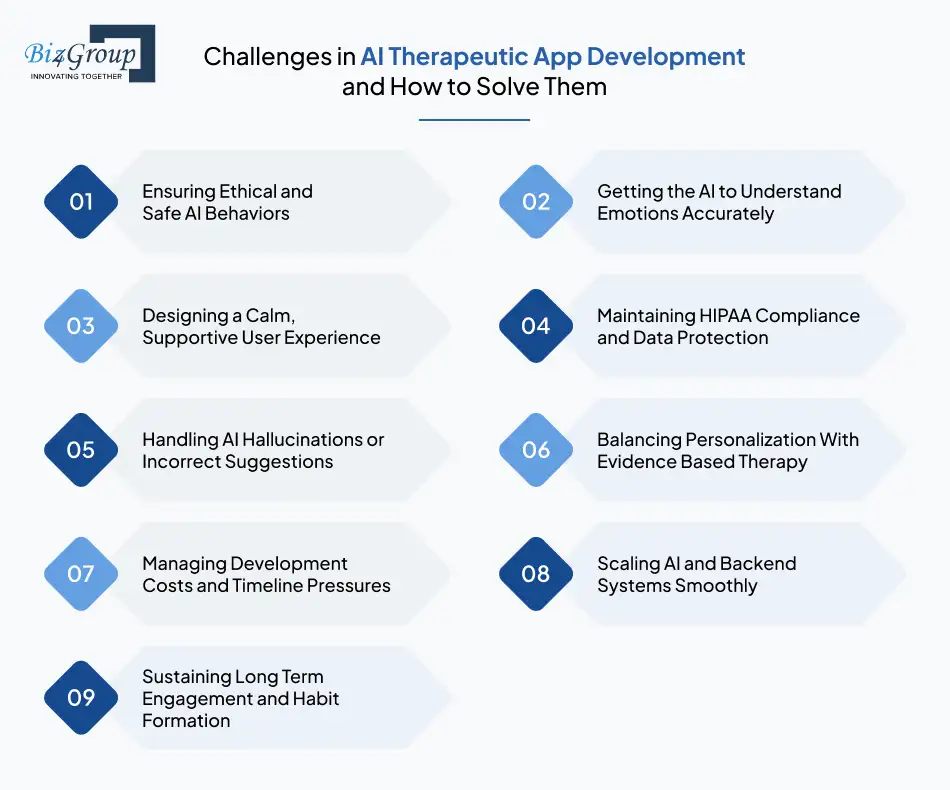
Every time you build an AI therapeutic app, you’ll face challenges that blend emotional safety, technology, and compliance. These hurdles are normal, especially when you're working in AI therapeutic app development that involves real user emotions, clinical logic and sensitive data. What matters is knowing how to solve these issues early so you can move forward confidently.
Below are the most common challenges and how teams building personalized therapeutic app using AI or therapeutic app development integrating AI can overcome them without slowing down the process.
1. Ensuring Ethical and Safe AI Behaviors
Therapeutic AI must respond safely and respectfully during stressful user moments. When you develop an AI therapeutic app, it becomes critical to prevent harmful or misleading responses.
How to solve it:
- Work with licensed therapists to review content and flows
- Add crisis detection, safety triggers and escalation messages
- Use human oversight for high risk cases
- Test emotional edge cases for accuracy and tone
2. Getting the AI to Understand Emotions Accurately
Emotional understanding is the heart of AI therapeutic app development services. But users express emotions differently based on age, culture, stress levels and communication style.
How to solve it:
- Train AI with diverse emotional datasets
- Combine NLP with behavioral signals like mood logs
- Apply continuous retraining for real world accuracy
- Use explainable AI to reduce misinterpretations
3. Designing a Calm, Supportive User Experience
Users seeking emotional help need an interface that feels comforting. When you create AI CBT based therapeutic application flows, a rushed or clinical UI can push users away.
How to solve it:
- Keep screens simple and emotionally safe
- Conduct user testing with people seeking support
- Use easy navigation for guided interventions
- Work with wellness focused UX experts or utilize AI integration services
4. Maintaining HIPAA Compliance and Data Protection
HIPAA rules can be overwhelming when you develop a HIPAA compliant AI therapeutic application for remote care. Therapy related data is extremely sensitive and must be handled with strict care.
How to solve it:
- Encrypt all stored and transmitted data
- Use HIPAA ready cloud infrastructure
- Implement secure authentication and audit logs
- Limit internal access to user health patterns
5. Handling AI Hallucinations or Incorrect Suggestions
AI can sometimes produce inaccurate or misleading suggestions. This is risky when you're creating AI digital therapeutics app development solutions.
How to solve it:
- Use rule based restrictions for all therapeutic content
- Restrict AI from offering medical diagnoses
- Add fallback responses for uncertain moments
- Continuously monitor AI behavior with real users
6. Balancing Personalization With Evidence Based Therapy
When teams create personalized therapeutic app using AI, they often struggle to blend tailored experiences with structured therapeutic frameworks like CBT or ACT.
How to solve it:
- Build personalization within clinical boundaries
- Partner with therapists for alignment
- Validate adaptive journeys for safety
- Use AI reinforcement learning responsibly
7. Managing Development Costs and Timeline Pressures
Building advanced features, AI models and compliance layers can increase costs. This challenge is common in end to end development guide for AI based therapeutic applications.
How to solve it:
- Start with a focused MVP
- Prioritize features supporting therapeutic outcomes
- Use modular architecture to scale gradually
- Outsource AI components to a reliable AI app development company
8. Scaling AI and Backend Systems Smoothly
As more users join your platform, the system must handle heavier workloads, real time AI requests and emotional data patterns.
How to solve it:
- Use cloud auto scaling and load balancing
- Optimize AI pipelines for faster response
- Break backend into microservices
- Implement caching for common requests
9. Sustaining Long Term Engagement and Habit Formation
Users may start strong but slowly lose momentum. This affects both therapeutic app development using AI and long term emotional wellness apps.
How to solve it:
- Add adaptive reminders and progress loops
- Offer personalized challenges and streaks
- Provide micro interactions that reward progress
- Deliver insights showing emotional improvement
Why Is Biz4Group the Best Partner to Build an AI Therapeutic App?
Selecting the right partner can make or break your journey to build an AI therapeutic app. You need a team that understands therapy, AI engineering, compliance, user behavior and long-term product success. Biz4Group brings all of that together with a level of expertise most development teams cannot match.
As a trusted AI development company, we combine deep technical skills with a genuine understanding of therapeutic workflows, emotional safety and user experience. That balance allows us to deliver products that feel supportive, reliable, and clinically aligned.
Here’s why Biz4Group is the partner team chosen for AI therapeutic app development.
1. Proven Experience Across AI Wellness, Mental Health and Behavior Change
We have delivered multiple successful therapeutic and wellness solutions across meditation, cognitive support, skill development, habit building, and digital companionship. Our portfolio includes:
- Cultiv8: Meditation App
- Stratum 9: Skill-Development Platform
- Quantum Fit: Personal Development App
- AI Workout App
- CogniHelp: Dementia Support App
- AI Wizard: Avatar Companion
Each project shows our ability to handle complexity while delivering emotional safety, personalization, and strong user engagement.
2. Expertise in Building AI Guided Therapeutic Intelligence
Biz4Group specializes in developing:
- AI powered mood detection
- Sentiment and tone analysis
- CBT aligned guidance flows
- Personalized therapeutic journeys
- Adaptive emotional responses
- Real time behavioral insights
This level of intelligence is essential for any team wanting to develop an AI therapeutic app or build a personalized therapeutic app using AI that adapts to users naturally.
3. Strong Focus on HIPAA, Privacy and Secure Architecture
If your goal is to develop a HIPAA compliant AI therapeutic application for remote care, you need more than engineering. You need airtight compliance, encrypted workflows and secure data handling.
We build:
- HIPAA ready cloud architecture
- Encrypted communication and storage
- Audit trails and secure authentication
- AI pipelines that protect sensitive emotional data
This gives you the trust foundation required for healthcare and enterprise adoption.
4. Emotion-Safe UI/UX Designed Specifically for Therapeutic Users
Therapeutic products require UI that feels approachable, calming and supportive. Our team specializes in emotional design and guided user experiences that reduce friction and increase retention.
This expertise helps us build interfaces for:
- CBT and mindfulness flows
- Mood tracking
- Guided self-reflection
- Safe and supportive interactions
This is a major advantage when creating therapeutic app development integrating AI features.
5. Complete End-to-End Development Support
Whether you want an MVP or a fully scaled digital therapeutics ecosystem, we support every step of the journey. As a full-service AI app development company, we handle:
- Product strategy
- AI architecture
- Feature development
- Model training
- Cloud deployment
- Long term product maintenance
This ensures your product keeps improving with user feedback, new research and ongoing AI advancements.
6. Future-Ready AI Product Expertise
Biz4Group is not just a development shop. We are also a forward-looking AI product development company focused on building long lasting, scalable and evolving therapeutic products.
We help your app grow through:
- Modular expansions
- Advanced AI upgrades
- Behavior analytics
- Clinical model integrations
- Wellness ecosystem features
This future-proof approach gives your therapeutic platform the longevity it needs to stay competitive.
7. A Partner Who Understands Digital Therapeutics at Every Level
From emotional design to secure architecture, from behavior science to personalization engines, Biz4Group brings the well-rounded expertise required to build something meaningful.
When you work with us, you get:
- Strategic clarity
- Technical accuracy
- AI excellence
- Compliance readiness
- Human-centered design
- Long term scalability
Biz4Group is more than a development team. We are a partner committed to helping you bring responsible, adaptive and impactful therapeutic technology to life.
Ready to Build With a Partner Who Gets It
Therapeutic tech is delicate, smart and deeply human. Biz4Group knows how to build it well and build it safely.
Schedule a Free CallConclusion: Building an AI Therapeutic App That Makes a Real Impact
When you decide to build an AI therapeutic app, you’re not just creating another wellness tool. You’re building a product that can influence emotional health, behavior change, daily resilience, and long-term wellbeing. The combination of therapeutic intelligence and adaptive AI has the power to make support more accessible than ever, especially for people who need guidance at the exact moment they feel stuck.
Success comes from choosing the right strategy, the right features and the right technology. But most importantly, it comes from choosing the right partner. Biz4Group brings deep experience in AI therapeutic app development, human centered design, HIPAA aligned engineering and long-term product scalability. Our portfolio in meditation, behavior change, cognitive support and AI companionship proves our ability to turn therapeutic ideas into real market-ready solutions.
Whether you want to develop an AI therapeutic app, create a fully personalized therapeutic app using AI, or build a complete AI digital therapeutics app development ecosystem, Biz4Group is equipped to guide you from strategy to launch long term growth.
Your vision deserves a partner who understands therapy, technology and people. Biz4Group is ready to help you build a solution that truly transforms lives.
Start building your AI powered therapeutic product with Biz4Group today.
FAQ
1. What does it take to build an AI therapeutic app from scratch?
To build an AI therapeutic app, you need a clear therapeutic goal, a strong AI strategy, HIPAA aligned workflows, structured user journeys and a development team that understands emotional safety. Planning your architecture, data model, AI logic and compliance early helps your AI therapeutic app development stay on track.
2. Which features are essential when you develop an AI therapeutic app?
Core features include AI driven mood detection, CBT and ACT modules, journaling, progress analytics, adaptive recommendations and secure data storage. These are must haves if you plan to develop an AI therapeutic app, create personalized therapeutic app using AI, or offer advanced AI therapeutic app development services.
3. How much does it cost to develop an AI therapeutic app in 2026?
Costs for AI digital therapeutics app development start around 20,000 dollars and can go beyond 150,000 dollars depending on the AI sophistication, number of features, therapeutic framework and compliance needs. Apps with deeper personalization and mood intelligence cost more than simple wellness trackers.
4. What is the timeline to build and launch an AI therapeutic app?
If you want to test fast, you can build an MVP for your AI therapeutic app in about 2 to 3 weeks. A full product with CBT modules, AI models, dashboards and HIPAA security typically takes 2 to 3 months. Timelines depend on the complexity of your therapeutic mobile app development and the depth of your AI features.
5. How do we ensure compliance and safety in therapeutic app development using AI?
Safety comes from encryption, secure authentication, limiting data access and reviewing all therapeutic content with clinicians. When you develop a HIPAA compliant AI therapeutic application for remote care, you must use HIPAA ready cloud infrastructure, audit trails and structured AI guardrails that prevent unsafe responses.
6. What monetization models work well for AI therapeutic apps?
Subscription plans, corporate wellness licensing, clinic partnerships, white label versions and API licensing are all effective. The right model depends on your goals, audience and the type of therapeutic app development integrating AI you want to offer. Apps with deeper AI and clinical alignment often perform best in B2B and enterprise channels.
7. How do I choose the right development partner for my AI therapeutic app?
Look for a team that understands AI, mental health workflows, HIPAA, user behavior and long term scalability. Biz4Group is trusted for AI therapeutic app development, create AI CBT based therapeutic application capabilities, compliance ready architecture and real world project experience. Choosing Biz4Group ensures your product grows with expert engineering and ongoing AI innovation.
