Location :
Orlando, FL, USA
Location :
Orlando, FL, USA +1 (407) 714-1616
 info@biz4group.com


















Imagine a digital system that doesn’t wait for instructions but instead, understands your business goals, learns from real-time feedback, and takes independent actions to get the job done.
Read More

 AI Summary Powered by Biz4AI
Ever had a title file stall because someone is chasing a missing document, re-entering the same details, or waiting for a status update? What if your team could automate those routine steps without handing important decisions over to a black box?
That's the practical promise of AI title insurance & escrow automation system development. A well-designed system can help organize transaction documents, extract and validate information, flag potential title issues for review, coordinate tasks, and keep file statuses up to date. The goal is to reduce repetitive work while keeping professionals in control of exceptions and consequential decisions.
The real value comes from connecting those capabilities to the systems your team already uses. That means thinking beyond the AI model to document data, title production system, task routing, approvals, and clear human handoffs.
The need for dependable workflows is measurable. ALTA's 2026 study of 449 title professionals across 47 states found that more than 80% of purchase transactions involved reviewing at least 11 documents, while nearly 60% required clearing three to five title issues. CertifID's 2026 survey also found that 22% of homebuyers received fraudulent communications during closing. Together, these findings highlight why title and escrow automation should streamline document handling and coordination while preserving human review and strong fraud controls.
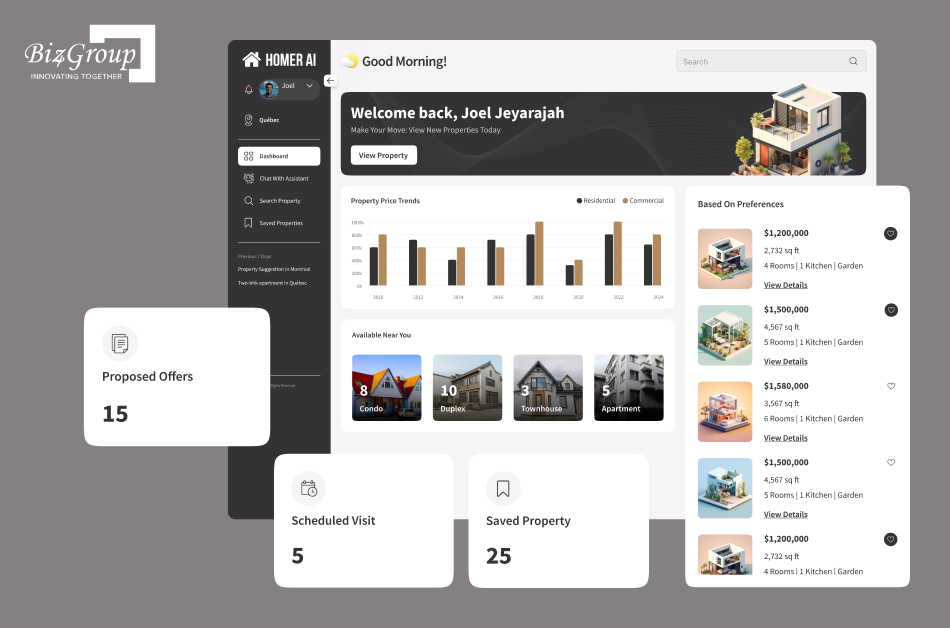
At Biz4Group, our work on real estate AI gave us a useful lesson in how conversational AI can support real tasks. With Homer AI, buyers can describe what they want, explore matching properties, and schedule visits. That experience showed us that AI becomes more useful when it's connected to relevant property data and actions people can actually take. The same idea applies to title and escrow automation, AI should do more than answer questions. It should help move work forward within the workflow, while keeping people involved in decisions that need their judgment.
So, how do you build it well? Let's learn.
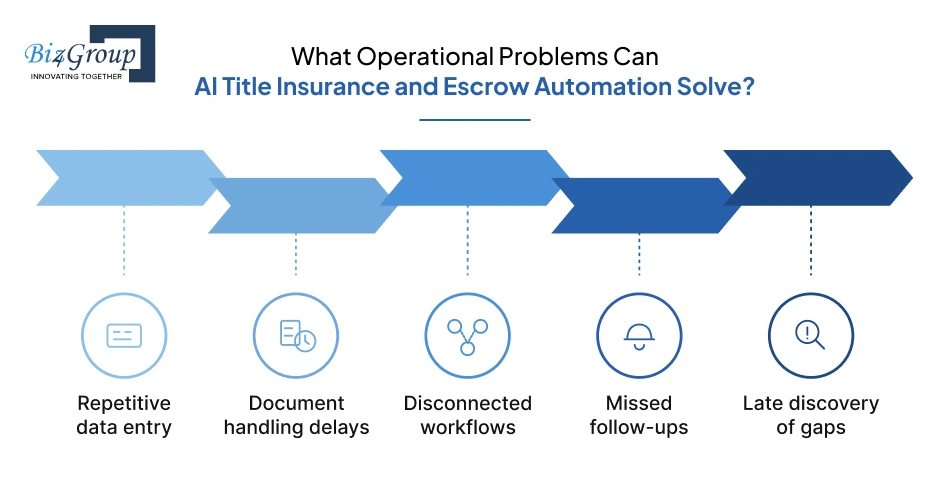
AI title insurance and escrow automation uses artificial intelligence to process transaction documents, extract information, and support routine title and escrow workflows. It helps reduce manual work, connect disconnected steps, and identify missing information earlier.
It can help agencies address problems such as:
AI supports the process, while qualified staff remain responsible for title judgments, approvals, and exceptions.
The key is to automate repeatable steps, not professional accountability. AI can prepare information, organize work, and surface potential issues. People still need to verify important details, resolve complex exceptions, and make decisions that require title, escrow, or underwriting expertise.
Start with high-volume, repetitive tasks that follow clear rules and are easy to verify. For example, AI automates contract creation and escrow management by supporting routine document preparation, task tracking, and coordination. These workflows are generally easier to test and measure than tasks involving legal judgment, title exceptions, coverage decisions, or fund transfers.
Rather than automating an entire file at once, choose one specific task, define what a correct result looks like, and keep human review wherever errors could create significant risk.
Automatically sort incoming documents, identify document types, and extract details such as names, property addresses, dates, and reference numbers. Staff can verify the extracted information before it is used in the file.
Use automation to create draft file records, populate routine fields, and check whether expected documents or information are missing. Route incomplete files to staff rather than treating them as ready to proceed.
Assign routine work based on file type, role, status, or predefined rules. Escalate overdue tasks and unusual cases to the appropriate team member.
Send approved reminders about outstanding documents, upcoming milestones, and routine file updates. Keep messages within approved templates and route sensitive questions to staff.
Generate summaries of documents and highlight possible inconsistencies or items that need attention. Treat these as review aids, not as final title determinations or authorization to close.
Some tasks may benefit from AI assistance but should not be handed over to automation without safeguards. These include:
For these tasks, AI can gather relevant information, summarize the issue, and route it for review. The authorized professional remains responsible for the decision.
Use four factors to compare candidate tasks. A task does not need to score highly on everything, but the assessment should make trade-offs visible.
|
Factor |
What to ask |
|---|---|
|
Value |
How much staff time, delay, rework, or avoidable effort could this remove? |
|
Risk |
What could happen if the system gets it wrong, and how easily can a person catch the error? |
|
Complexity |
Are the inputs, rules, and expected outputs clear? How difficult will integration be? |
|
Readiness |
Is the required data accessible and usable? Are there clear owners, review steps, and success measures? |
A practical starting point is document classification, routine data extraction, or reminders when the agency has reliable inputs and a way for staff to verify the results. More sensitive tasks can follow once the team has tested the system and established suitable controls.
Automate the predictable work first, measure whether it actually helps, and expand only when the process is reliable enough for the level of risk involved.
Start with one workflow, find the bottlenecks, and see where automation can give your team some breathing room.
Let's Talk AutomationAI can help title professionals process public records, extract key details, connect related documents, and flag potential title issues for review. It can speed up information gathering and make files easier to examine, but it should not be treated as a substitute for a complete title search, legal judgment, or an underwriter's decision.
AI can ingest digital records and scanned documents, identify their types, and organize them into a searchable transaction file. This gives examiners a more structured starting point than manually opening and sorting every document.
Typical steps include:
The system should retain links to the original records so an examiner can check the source rather than relying only on an AI-generated summary.
Take Contracks developed by Biz4group for example. It's a real estate contract management platform that uses AI to summarize documents, pull out key details, and track deadlines. Similar capabilities can help title examiners organize and search property records faster, while keeping original documents available for verification.
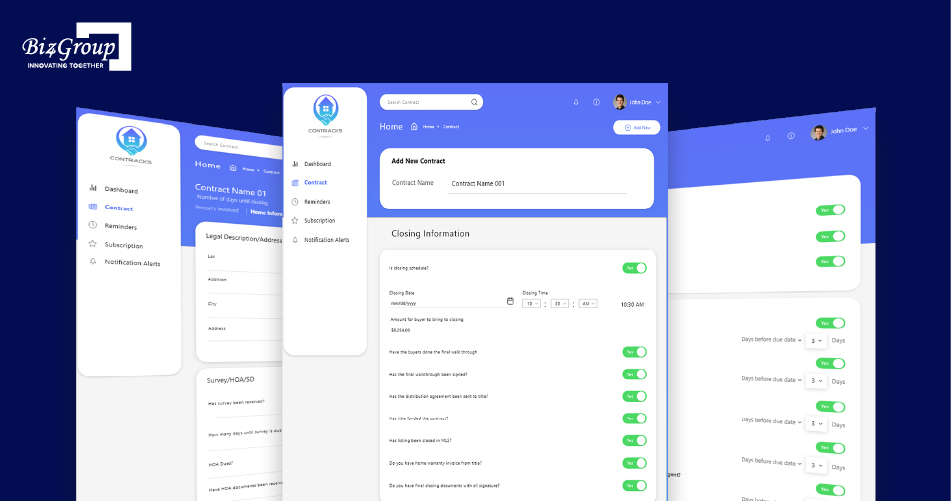
AI document processing can identify and capture details that examiners repeatedly need, including:
Extracted information can then be checked against other records and the transaction file. For example, if a deed lists a different owner name from a later mortgage, the system can flag the mismatch for review.
Extraction is not verification. A field can be read correctly but still be incomplete, outdated, or misunderstood without the surrounding document and property context.
AI can compare details across records and surface relationships or inconsistencies that may deserve an examiner's attention. It can help identify possible gaps, conflicting names, unreleased liens, or references to documents that may need to be located.
For example, a mortgage appears in the records, but no release is found.
This flags an issue to investigate, not a conclusion about enforceability or insurability. AI can also summarize flagged items and link supporting documents, depending on record availability and search scope.
AI can support commitment preparation by organizing extracted information, drafting summaries, and mapping potential exceptions to items that require review. It may also help compare file details with approved templates or agency rules.
A practical workflow could look like this:
The system should clearly distinguish between AI-suggested content, verified information, and approved commitment language. It should not silently convert a possible issue into a final exception or remove an exception simply because a model did not detect it.
Bring in a qualified professional when records are missing or conflicting. The same applies when ownership or legal descriptions don't match. Potential title exceptions and changes to commitment language may also need expert review. AI can flag these issues, but final title clearance and insurability decisions should stay with authorized professionals.
AI can organize title search and examination, process documents, and flag potential defects. Professionals must verify findings and make final title clearance and coverage decisions.
AI can make escrow processing more organized by helping open files, extract transaction details, track deadlines, coordinate communications, and prepare settlement information for review. To protect funds and closing accuracy, AI escrow automation should support payment checks, not independently approve wire changes or release money. Identity verification, independent confirmation, approval controls, and a clear audit trail remain essential.
AI-powered escrow automation can reduce manual setup by extracting transaction details from intake forms and supporting documents, then using that information to create or update a draft file.
It can help with:
For example, if the purchase agreement and intake form show different closing dates, the system can flag the mismatch rather than choosing one without confirmation.
AI workflow automation can track milestones, identify outstanding items, send routine reminders, and route tasks to the appropriate team member. This helps keep the transaction moving without requiring staff to manually check every file for the next action.
A system may:
Automated messages should use verified file information and approved templates. Sensitive questions, disputed details, and requests to change payment instructions should be escalated rather than handled as routine updates.
AI can help prepare settlement information by extracting figures from transaction documents, organizing charges and credits, and flagging discrepancies for review. It can also assist with comparing entries across approved records and identifying items that do not appear to match.
For example, it may flag:
These features can support settlement statement preparation and escrow reconciliation, but they should not silently change financial entries or treat a mismatch as resolved. Staff should verify the underlying documents, confirm the figures, and approve the final statement.
AI can help flag unusual payment-related activity, such as a late change to wire instructions, unexpected edits to recipient details, or a message that differs from the established transaction history. These alerts can help staff focus on requests that need additional scrutiny.
Useful controls include:
AI detection is only one layer of protection. A message can look legitimate and still be fraudulent, while a legitimate change may look unusual. The system should therefore raise alerts for investigation, not decide by itself that payment instructions are safe.
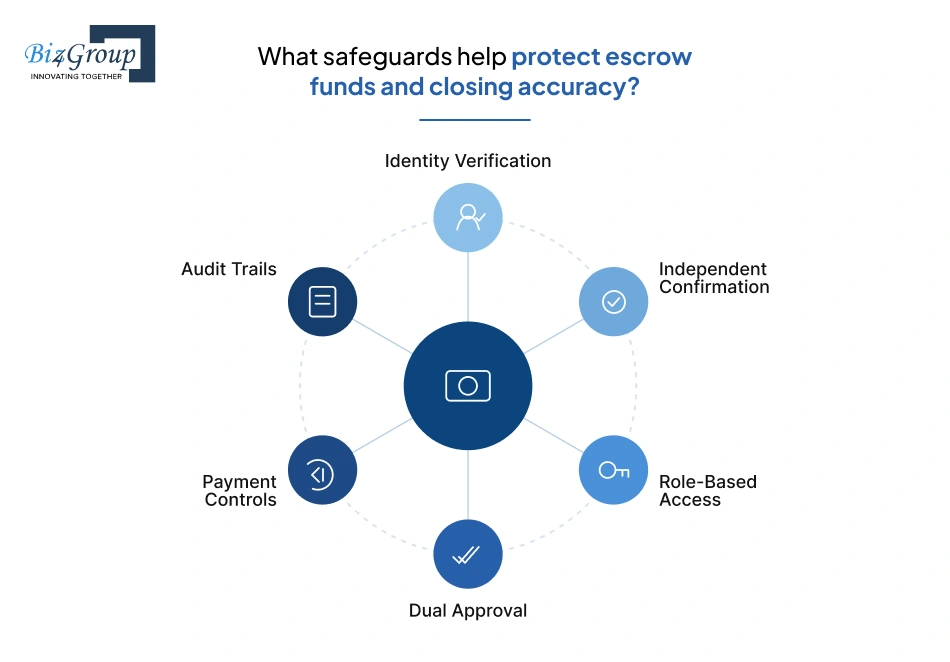
A secure escrow automation system combines AI alerts with independent verification, role-based permissions, required approvals, and traceable records. No single AI check should be treated as proof that a person or payment request is legitimate.
|
Safeguard |
How it helps |
|---|---|
|
Identity verification |
Checks identity using approved procedures and trusted information sources. |
|
Independent confirmation |
Verifies wire instructions or changes through a previously established, trusted contact method, not contact details supplied in the change request. |
|
Role-based access |
Limits who can view, edit, approve, or release payment information. |
|
Dual approval |
Requires a second authorized person to approve defined high-risk actions. |
|
Payment controls |
Keeps payment authorization and fund disbursement within approved escrow procedures. |
|
Audit trails |
Records changes, alerts, approvals, reviewer actions, and relevant timestamps. |
AI can flag wire changes, preserve original instructions, and route them for independent verification. It should never change payment details or authorize disbursements on its own.
For escrow automation, fund protection still requires verified instructions, controlled access, human approval, and audit trails.
An effective platform should combine document intelligence, title workflow support, escrow coordination, integrations, and built-in controls. The features should help staff process routine work faster, spot issues that need attention, and keep important decisions traceable.
Here's a practical feature checklist, organized by what each capability does and why it matters.
|
Feature |
What it should do |
Why it matters |
|---|---|---|
|
AI document intake and classification |
Import documents, identify document types, and organize them by transaction file. |
Reduces manual sorting and helps staff find records faster. |
|
OCR and data extraction |
Capture names, property details, dates, recording references, and financial fields from documents. |
Cuts down repetitive data entry while giving staff information to verify. |
|
Title search and examination support |
Organize public records, connect related documents, and surface possible gaps or inconsistencies. |
Helps examiners investigate potential title issues without treating AI findings as final conclusions. |
|
Title commitment assistance |
Prepare draft summaries and suggested requirements or exceptions using approved templates. |
Gives examiners a starting point while preserving professional review and approval. |
|
Escrow file management |
Track transaction details, documents, milestones, and outstanding requirements in one file view. |
Makes it easier to understand what is complete and what still needs attention. |
|
Workflow automation and task routing |
Assign tasks, trigger next steps, send reminders, and escalate overdue or unusual cases. |
Reduces manual coordination and makes responsibility clearer. |
|
Settlement statement support |
Organize charges and credits, compare figures, and flag missing or inconsistent entries. |
Helps staff review settlement information and catch discrepancies before finalization. |
|
Wire fraud and payment-change alerts |
Flag unusual wire-instruction changes, suspicious messages, or unexpected payment details. |
Adds a layer of detection while keeping independent verification and payment approval in place. |
|
Human review and exception queues |
Route uncertain, conflicting, or high-risk cases to authorized staff with supporting records. |
Prevents the system from guessing when a decision needs professional judgment. |
|
CRM and title-system integrations |
Exchange approved information with title production, escrow accounting, CRM, document management, and closing tools. |
Avoids isolated workflows and reduces duplicate data entry. |
|
Role-based access and approvals |
Control who can view, edit, approve, or perform sensitive actions. |
Helps protect confidential information and restricts consequential actions to authorized users. |
|
Audit trails and reporting |
Record document changes, AI suggestions, alerts, reviewer actions, approvals, and workflow status. |
Supports accountability, troubleshooting, and operational oversight. |
|
AI monitoring and quality evaluation |
Track extraction errors, missed issues, false alerts, and reviewer corrections over time. |
Helps teams identify weaknesses and improve performance before expanding automation. |
Start with a focused MVP development, add title defect analysis and payment-risk alerts after testing. Keep AI actions, evidence, uncertainty, and approvals traceable.
Also Read: 12+ MVP Development Companies in USA
A reliable architecture separates AI assistance from core transaction records, business rules, and sensitive actions. The AI should process and organize information, while controlled workflow services manage approvals, updates, and handoffs. This makes the system easier to test, monitor, and audit.
|
Architecture layer |
What it includes |
Role in the system |
|---|---|---|
|
User interface |
Staff dashboards, file views, review queues, and admin tools |
Lets users manage files, review AI results, and handle exceptions. |
|
Workflow and business rules |
Task routing, deadlines, approval steps, and escalation rules |
Controls how transactions move through title and escrow processes. |
|
AI services |
OCR, document classification, data extraction, language models, and search |
Reads documents, organizes information, and generates summaries or suggestions. |
|
Data and document layer |
Transaction database, document storage, metadata, and source references |
Keeps records organized and connects AI outputs to supporting documents. |
|
Integration layer |
APIs, webhooks, and controlled file exchanges with title, escrow, accounting, and closing systems |
Moves approved data between the platform and existing systems. |
|
Security and access control |
Authentication, role-based permissions, encryption, and access logs |
Protects sensitive transaction data and limits access to authorized users. |
|
Monitoring and audit |
AI quality checks, error tracking, activity logs, and performance reporting |
Helps teams investigate errors, monitor reliability, and track decisions. |
Let AI assist with the work, while controlled systems and authorized people manage records, approvals, and critical decisions.
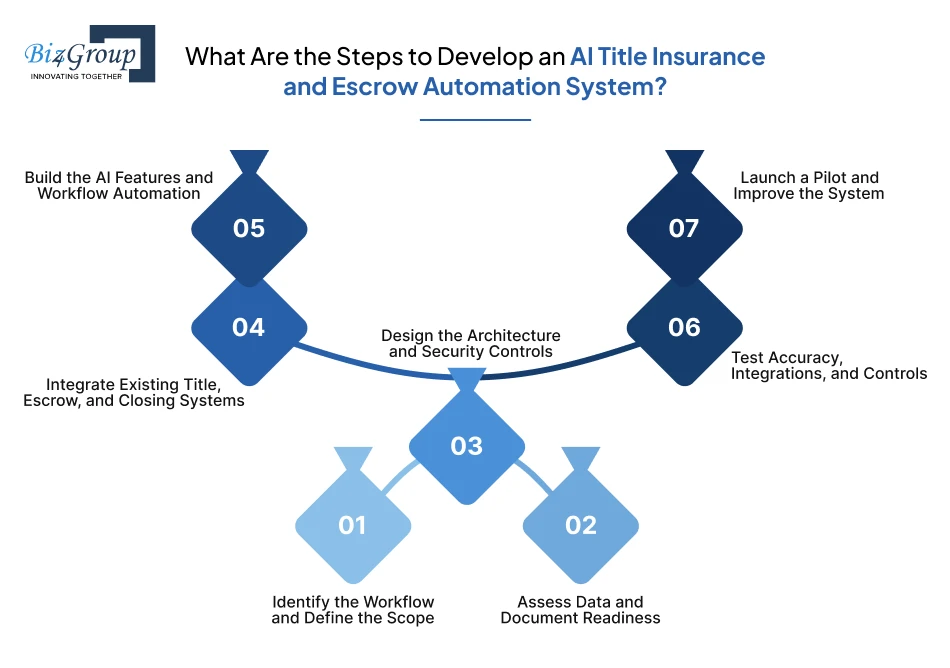
Developing the system involves defining workflows, preparing data, designing the architecture, integrating existing systems, building and testing AI features, and rolling out the platform with human oversight.
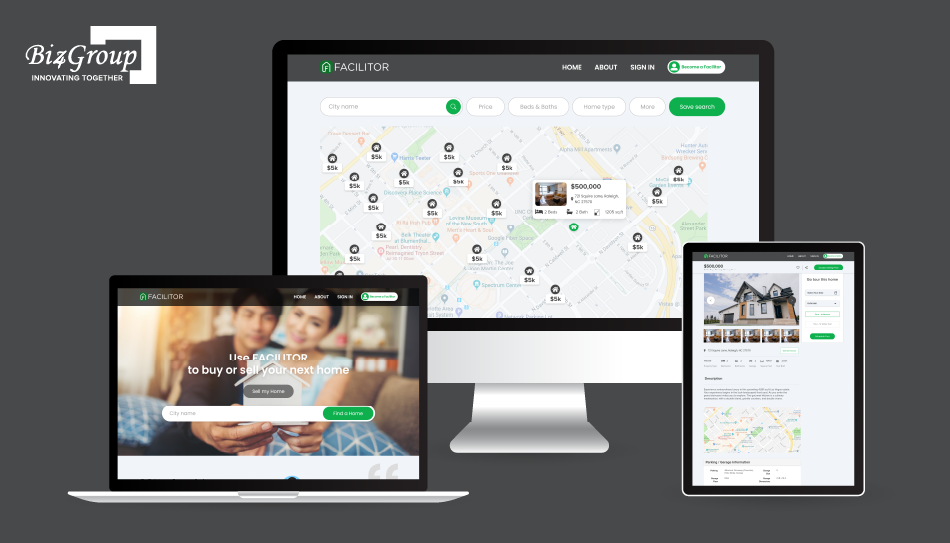
For example, Biz4Group's Facilitor addresses property-related processes by helping users navigate tasks and information within a real estate platform. An important lesson from projects like this is that development needs to happen in a planned sequence. Each stage should build on the previous one, from understanding user needs and mapping workflows to connecting system components and testing the complete experience. For title and escrow software, this approach helps identify missing requirements and integration issues before they affect live operations.
Choose a specific process to improve, such as document intake, file setup, or escrow task tracking.
Review the records the system will need to process.
Plan how the platform's AI, data, workflows, and user interfaces will work together.
Connect the platform to the system and services the team already relies on.
Develop the selected capabilities and connect them to the operational process.
Test the platform with representative transaction files before using it in live operations.
Start with a limited group, workflow, or transaction type.
The key is to build and validate the workflow as a whole. AI features, existing systems, data ownership, and human approvals need to work together for automation to be dependable.
Manage AI accuracy and compliance through risk-based reviews, mandatory approvals, secure data handling, regular testing, and audit trails. Keep authorized staff responsible for title clearance, legal and underwriting decisions, and fund transfers.
|
Area |
Potential risk |
Required controls |
|---|---|---|
|
AI accuracy |
Missed exceptions, false clears, extraction errors, or excessive alerts. |
Test against source documents, measure errors, and route uncertain or conflicting results for review. |
|
Review thresholds |
High-risk results receive insufficient scrutiny. |
Set risk-based thresholds and require qualified review for high-impact findings. |
|
Human approvals |
AI suggestions are treated as verified decisions. |
Require authorized approval for title clearance, commitment changes, legal or underwriting decisions, and fund disbursements. |
|
Privacy and data handling |
Sensitive transaction or financial information is exposed or retained improperly. |
Apply access controls, encryption, data minimization, retention rules, and vendor security reviews. |
|
Compliance |
Workflows conflict with applicable requirements or underwriter procedures. |
Map relevant state and federal requirements, contractual obligations, underwriter guidance, and industry standards. |
|
Performance changes across document types, jurisdictions, or workflow updates. |
Test before launch and after major changes. Monitor errors, missed exceptions, corrections, and system failures. |
|
|
Auditability |
Decisions and changes cannot be traced. |
Log source documents, AI outputs, corrections, approvals, user actions, and relevant system changes. |
|
Incident response and governance |
Errors or security incidents are not escalated promptly. |
Assign control owners, define escalation procedures, document incidents, and provide a way to pause affected automation. |
AI can process information and flag potential issues. Authorized people must verify the evidence and approve consequential decisions.
For budgeting, a focused AI title and escrow automation MVP may cost around $25,000–$60,000, a mid-sized custom platform around $60,000–$150,000, and a more advanced integrated platform around $150,000–$350,000 or more. These are preliminary development estimates, not confirmed quotes for a specific project. Your actual cost will depend on the workflows, AI integrations, AI capabilities, security controls, and testing required.
|
Development level |
Estimated cost (USD) |
Estimated timeline |
Typical scope |
|---|---|---|---|
|
Focused MVP |
$25,000-$60,000 |
2-4 weeks |
One or two workflows, document intake, basic data extraction, task tracking, and staff review. |
|
Mid-sized custom platform |
$60,000-$150,000 |
4-6 weeks |
Multiple workflows, AI-assisted title and escrow tasks, dashboards, and several integrations. |
|
Advanced integrated platform |
$150,000-$350,000+ |
6-8 weeks |
Complex title and escrow operations, extensive integrations, advanced controls, and reporting. |
The cost mainly depends on the number of workflows, AI capabilities, integrations, security requirements, testing needs, and data migration complexity.
|
Cost factor |
What affects the price |
Indicative budget impact |
|---|---|---|
|
Workflow scope and modules |
Number of processes, user roles, approval paths, and exceptions. |
10-25% for each major workflow added to a focused build. |
|
AI capabilities |
OCR, classification, extraction, search, defect flagging, and AI evaluation. |
15-30% more than a comparable rules-based application. |
|
System integrations |
Connections to title production, escrow accounting, closing platforms, and data providers. |
5-15% per moderate integration. |
|
Security and compliance |
Access controls, encryption, audit logs, retention policies, and security reviews. |
10-20% for significant additional controls. |
|
Testing and quality assurance |
Document variations, exception testing, integration checks, and user acceptance testing. |
10-20% of the build budget. |
|
Data migration and cleanup |
Moving files, mapping fields, resolving duplicates, and validating legacy records. |
Depends on data volume, quality, and migration complexity. |
These percentages are indicative planning estimates, not fixed industry rates. They may overlap and should not be added together directly.
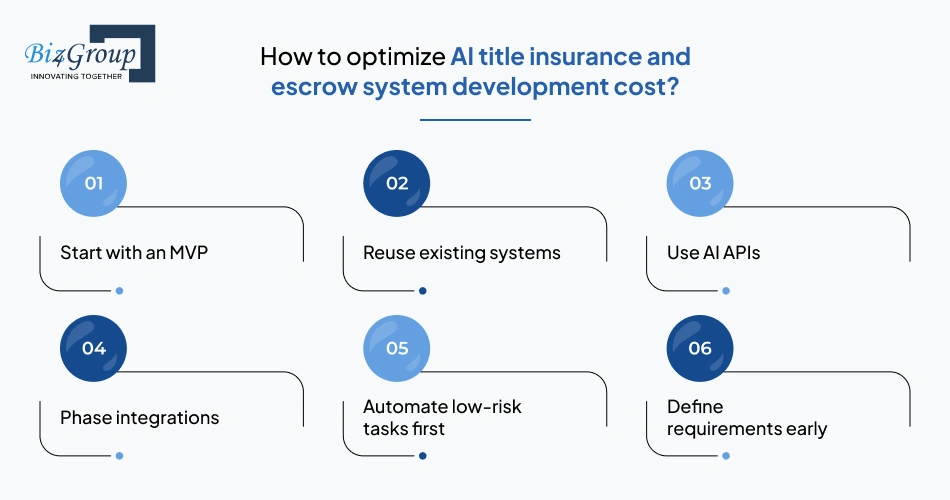
Choose based on workflow fit, customization needs, budget, implementation time, and internal technical capacity. Buying can suit standard needs, custom development can support specialized workflows, and a hybrid approach can extend existing system with tailored AI features.
|
Approach |
When it fits |
Main trade-offs |
|---|---|---|
|
Build custom |
You need specialized workflows, unique integrations, or greater control over features and data. |
More flexibility, but higher development effort, maintenance responsibility, and upfront investment. |
|
Buy a platform |
An existing product already meets most of your operational requirements. |
Potentially faster deployment, but customization and vendor capabilities may be limited. |
|
Combine both |
You want to keep core systems while adding custom AI automation or integrations. |
Reuses existing system, but requires careful integration, data ownership, and ongoing coordination. |
If you're considering a custom build, Biz4Group can be a great development partner to explore. As shared earlier in the blog, our experience includes AI product development, including Homer AI, Facilitor, Contracks, and more. Focus on where automation can reduce manual work, then assess each option against your existing systems, workflows, and operational needs.
With experience in real estate AI development, Biz4Group can support your project from initial consultation and planning through design, development, integration, testing, and deployment. Our team has worked on real estate products which gave us practical experience in building technology around real-world property needs. We can bring that experience to your AI title insurance and escrow automation project, helping shape a platform that fits your workflows, business goals, and operational requirements.
From your first AI feature to system integrations, Biz4Group can help you explore what it takes to bring your title and escrow automation idea to life.
Connect with Biz4Group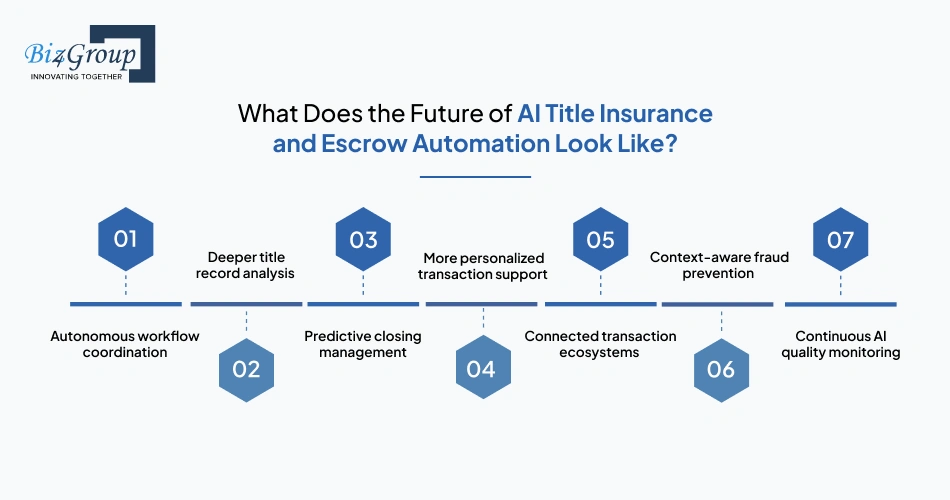
The future of AI title insurance and escrow automation is likely to move toward systems that coordinate more of the closing process, understand complex property records, anticipate workflow delays, and support faster decisions with traceable evidence. The focus will be on reducing manual coordination while keeping title professionals in control of high-impact decisions.
|
Future development |
What it could mean for title and escrow teams |
|---|---|
|
Autonomous workflow coordination |
Agentic AI could coordinate document requests, assign tasks, track deadlines, follow up on outstanding items, and escalate exceptions across a transaction. |
|
Deeper title record analysis |
AI could compare information across larger sets of property records, identify relationships between documents, and surface complex issues for examiner review. |
|
Predictive closing management |
Systems could use transaction history and file status to forecast likely delays, identify missing requirements earlier, and help teams prioritize work. |
|
More personalized transaction support |
AI assistants could provide buyers, sellers, lenders, and agents with role-specific updates, document guidance, and answers based on approved transaction information. |
|
Connected transaction ecosystems |
Title, escrow, lender, and closing platforms could exchange information more consistently, reducing repeated data entry and disconnected handoffs. |
|
Context-aware fraud prevention |
AI could evaluate patterns across communications, transaction changes, and payment instructions to identify suspicious activity and prompt additional verification. |
|
Continuous AI quality monitoring |
Systems could track extraction errors, reviewer corrections, and workflow outcomes to help teams identify performance issues and improve controls over time. |
These developments will depend on data quality, system interoperability, security, applicable regulations, and the reliability of AI models. Human review will remain important for legal interpretation, underwriting decisions, title clearance, and authorization of funds.
The long-term direction is toward AI-supported closing operations that can coordinate more work, identify risks earlier, and give professionals clearer information for decisions, rather than systems that remove professional accountability.
A title or escrow file can involve dozens of documents, deadlines, approvals, and people. When information is scattered across systems or routine tasks depend on manual follow-ups, even a small mistake or delay can slow down a closing. AI can help reduce that friction by organizing documents, extracting transaction details, tracking tasks, and bringing missing information or potential issues to the team's attention.
But successful automation is about more than adding AI to an existing process. It starts with understanding where your team spends time, which tasks are suitable for automation, and where human judgment must remain central. A practical approach is to begin with one clearly defined workflow, test it using real transaction scenarios, and measure whether it improves processing time, accuracy, and visibility. Once the results are reliable, you can gradually extend automation to other parts of title and escrow operations.
If you're considering a custom AI title insurance and escrow automation system, Biz4Group LLC can help you turn your operational requirements into a development plan. With experience in AI and real estate system development, our team can work with you to explore the right features, integrations, architecture, and safeguards for your business.
Have a title or escrow workflow you'd like to improve? Let's talk
Yes. A custom platform can connect with existing title production, escrow accounting, and closing system through APIs, webhooks, or secure file exchange, depending on what each system supports. The integration should preserve data ownership, prevent duplicate records, and provide a fallback when a connection fails.
Start with a limited pilot, such as document intake or file-completeness checks. Test it alongside the existing process, train staff, and review its output before expanding. Keep a manual fallback available so active transactions can continue if the automation needs attention.
AI can flag missing documents, conflicting details, and possible exceptions for review. It should not treat incomplete information as proof that title is clear. A qualified title professional should examine unusual records and make the required decisions.
Data ownership, access rights, and permitted uses should be defined in contracts and system requirements. Confirm who controls transaction records, whether vendors can use data to train models, how information can be exported, and what happens when a service agreement ends.
Track results against a baseline. Useful measures include processing time per file, manual data-entry hours, extraction error rates, missed tasks, rework, and staff adoption. Include quality and risk measures, not just speed.
It may. Recording practices, property records, transaction requirements, and applicable rules can vary by jurisdiction. Design the platform to support configurable workflows and jurisdiction-specific review rather than assuming one process fits every location.
Ask about supported workflows, integration capabilities, data ownership, security controls, model evaluation, human review, audit logs, pricing, support, and data portability. Request a demonstration using representative documents and clarify what happens when the AI produces an incorrect or uncertain result.
Focus on one repetitive, measurable workflow and avoid replacing existing systems unless necessary. A small pilot can help establish whether the time saved and quality improvements justify expanding the project.
A preliminary custom-development budget may range from $25,000–$60,000 for a focused MVP to $150,000–$350,000+ for an advanced integrated platform. The estimate depends on scope, AI capabilities, integrations, security, and testing. Hosting, maintenance, AI usage, licenses, and training should be budgeted separately.
Look for a partner with experience in AI development, custom system, system integrations, data security, and workflow automation. Biz4Group can help businesses explore their requirements, plan a suitable architecture, and develop a platform around their operational needs. You can contact Biz4Group to discuss your project scope and development goals.

Our website require some cookies to function properly. Read our privacy policy to know more.