Location :
Orlando, FL, USA
Location :
Orlando, FL, USA +1 (407) 714-1616
 info@biz4group.com


















Imagine a digital system that doesn’t wait for instructions but instead, understands your business goals, learns from real-time feedback, and takes independent actions to get the job done.
Read More

 AI Summary Powered by Biz4AI
Your real estate project is ready for its next payment. But legal is still reviewing the contract, finance is checking escrow conditions, and someone is hunting through emails for one missing document. Sound familiar?
This is where AI automation for contract creation and escrow management can help. AI can draft contracts, extract obligations, track milestones, and flag missing requirements, while leaving critical legal and financial decisions to your team.
The momentum is real: the global AI in real estate market is projected to grow from $404.9 billion in 2026 to $1.3 trillion by 2030, at a 33.9% CAGR. The market also includes AI applications such as NLP-based document analysis.
While building Contracks, an AI-powered real estate contract management platform, Biz4Group found that contract data, approvals, financial terms, and deadlines can quickly become scattered across different workflows.
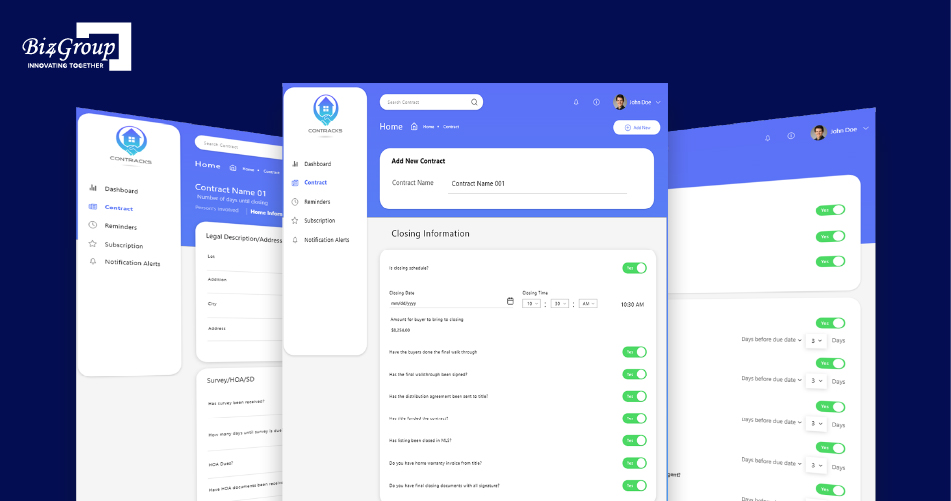
The takeaway? Good automation isn’t about letting AI make every decision. It’s about connecting the right data, workflows, and people.
So, how far can AI take real estate teams, from contract creation to escrow monitoring, without losing accountability? Let’s find out.
Real estate contract and escrow workflows still depend heavily on manual data entry, document review, approvals, and milestone tracking.
This creates a clear use case for AI automation for contract creation and escrow management, automate repetitive contract processing, document analysis, workflow tracking, and escrow-condition monitoring across real estate transactions.
AI automation for contract creation and escrow management connects contract data, transaction conditions, documents, approvals, and payment milestones in one workflow. It can support contract drafting and review while continuously tracking the conditions that affect escrow processing and closing.
AI-powered real estate contracts use transaction data and predefined clauses to generate drafts, extract key terms, identify obligations, and track changes.
Intelligent contract management can:
This connects AI real estate document management with automated escrow management, rather than treating contracts and escrow as separate processes.
The key difference is what these tools can actually do with contract information. Templates bring consistency to document creation, e-signature platforms make signing easier, whereas AI automation goes a step further by understanding documents and helping manage workflows.
|
Traditional tools |
AI automation |
|---|---|
|
Populate predefined fields |
Generate drafts from transaction data |
|
Store documents |
Extract and organize contract information |
|
Send documents for signature |
Identify the appropriate workflow |
|
Track signature status |
Track clauses, obligations, and deadlines |
|
Rules-based workflows |
Interpret unstructured documents and flag exceptions |
This is the practical difference between basic tools and AI contract automation for real estate, AI can interpret transaction information and use it to drive downstream workflows.
An AI-powered system typically combines four layers:
Together, these technologies support AI for real estate contract and escrow management, covering contract generation, processing, milestone tracking, escrow monitoring, and closing coordination.
Also Read: How to Develop an AI Contract Writing Tool for Real Estate Agents?
AI connects the key steps in a real estate transaction. It uses deal data to draft contracts, reviews clauses, routes approvals, and tracks escrow milestones. It can also flag missing documents and upcoming actions. Here’s how the workflow works in practice.
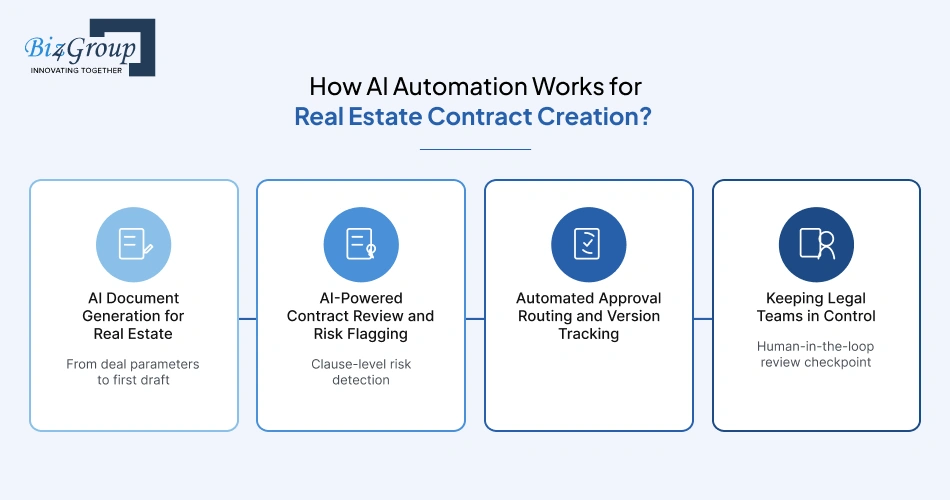
AI can convert deal data, property, parties, price, financing, dates, and contingencies, into a contract draft using approved templates and clauses.
Example: A developer enters buyer details, property value, closing date, and financing terms. AI generates the initial purchase agreement instead of requiring the team to populate every field manually.
AI can identify missing clauses, conflicting terms, unusual language, and deviations from approved contract standards.
Example: A lease includes a renewal term that differs from the company’s standard clause. AI flags the provision for legal review.
AI-powered workflows can route contracts to legal, finance, and management, while maintaining version history and approval status.
Example: After a buyer requests an amendment, the system creates a new version, sends it to the right approvers, and records the approval trail.
AI handles first-pass drafting and analysis while exceptions and non-standard terms are routed to legal teams.
Example: A standard purchase agreement moves through automated checks, while a customized indemnity clause is automatically escalated for legal review.
Also Read: AI Contract Management Software Development
AI can extract escrow conditions and connect them to milestones such as inspections, financing approval, title clearance, or construction completion.
Example: A construction agreement requires an inspection certificate before a milestone payment. AI checks for the required document and flags the transaction if it is missing.
AI can compare payment requirements with contract terms and supporting documents, then route eligible transactions for the next approval stage.
Example: Before a $250,000 construction draw, the system verifies the relevant milestone documentation and identifies discrepancies.
Instead of manually checking spreadsheets, AI can continuously monitor:
AI can flag whether escrow conditions appear satisfied, while rules-based controls, permissions, approval thresholds, and audit logs govern actual fund release.
Example: AI detects that an inspection report is missing and automatically blocks the payment workflow until the required approval is recorded.
Let AI do the chasing for you. We’ll help you turn repetitive real estate workflows into smarter, connected processes.
Let’s Automate It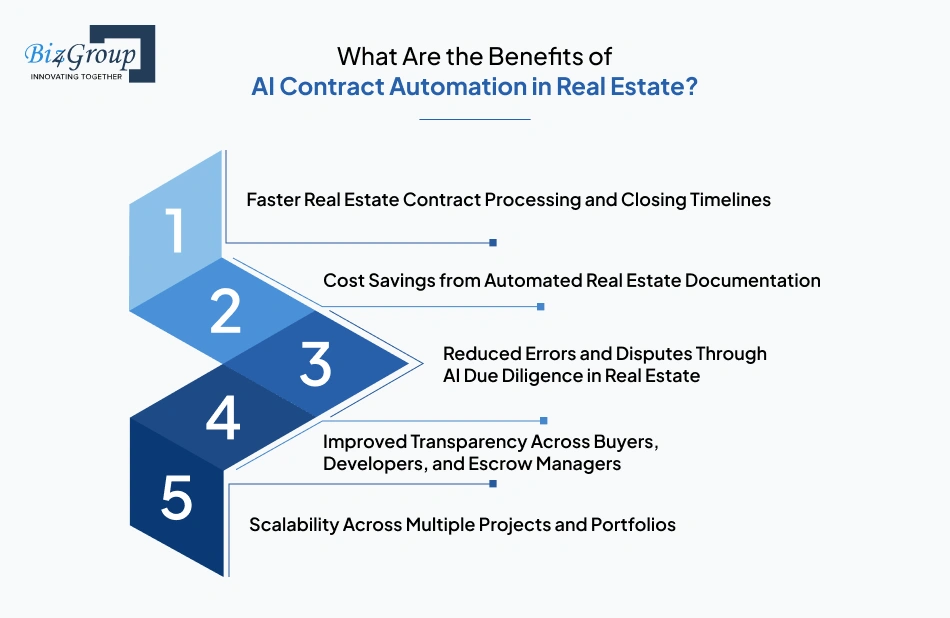
The benefits of AI contract automation in real estate extend beyond faster document creation. AI can reduce repetitive work, improve transaction visibility, and connect contract processing with escrow and closing workflows.
AI can accelerate drafting, clause comparison, document extraction, and escrow-condition checks.
Example: Instead of manually reviewing 100 agreements for missing closing dates, AI can extract and flag them in bulk.
Automated real estate documentation reduces repetitive data entry, first-pass review, document classification, and rework.
The savings become more significant for developers processing large volumes of standardized agreements.
AI can cross-check contract terms, identify inconsistencies, and flag missing documents or obligations.
Example: If an escrow release requires an inspection certificate and it is missing, AI can flag the transaction before the payment workflow advances.
AI real estate document management provides a centralized view of contract status, amendments, obligations, deadlines, and escrow milestones.
Teams spend less time searching through emails, spreadsheets, and individual files for transaction updates.
Real estate workflow automation allows developers to apply consistent contract and escrow processes across projects without increasing manual tracking at the same rate as transaction volume.
Example: A developer managing hundreds of agreements can monitor pending approvals, upcoming deadlines, amendments, and escrow milestones from one portfolio-level view.
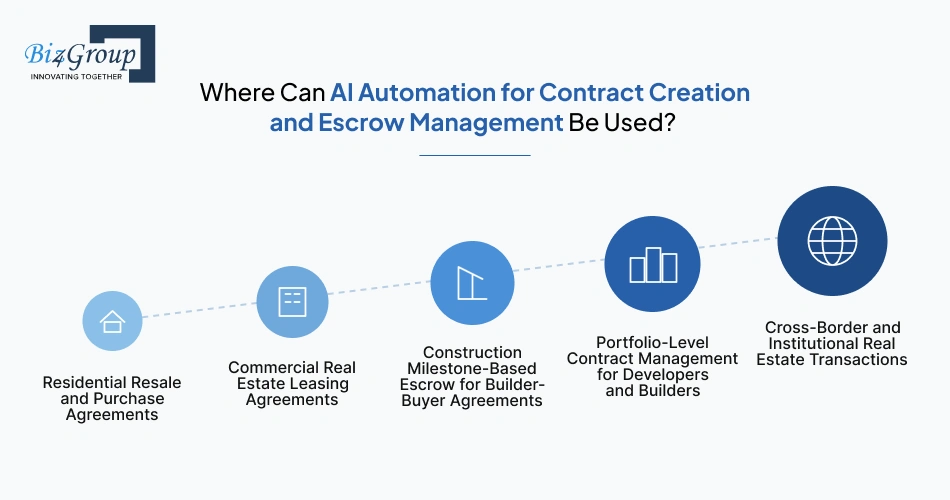
AI in real estate transactions can support different workflows depending on the property type, transaction volume, and contractual complexity. The strongest use cases are where teams handle large document volumes, recurring agreements, milestone-based payments, or multiple jurisdictions.
For residential transactions, AI can handle repetitive agreement preparation, extract buyer and seller obligations, compare negotiated terms, and connect contingencies with closing workflows. This is particularly useful for high-volume brokerages, builders, and transaction teams processing similar agreements.
Commercial leases contain more variables than standard purchase agreements, including rent escalations, CAM charges, renewal options, tenant improvements, exclusivity clauses, and termination provisions. AI can extract these terms into structured records and help teams manage obligations across multiple properties and tenants.
Construction transactions are well suited to AI escrow management because payments can depend on measurable project milestones. AI can connect contractual payment conditions with inspection reports, completion certificates, invoices, and other project documentation.
When hundreds of contracts span multiple projects, manually tracking amendments, obligations, renewals, approvals, and deadlines becomes difficult. AI real estate document management can turn these documents into searchable portfolio data and surface items requiring attention.
Institutional and cross-border transactions introduce additional complexity through multiple entities, jurisdictions, currencies, regulatory requirements, and large document sets. AI can classify documents, extract jurisdiction-specific terms, compare requirements, and support AI compliance in real estate workflows.
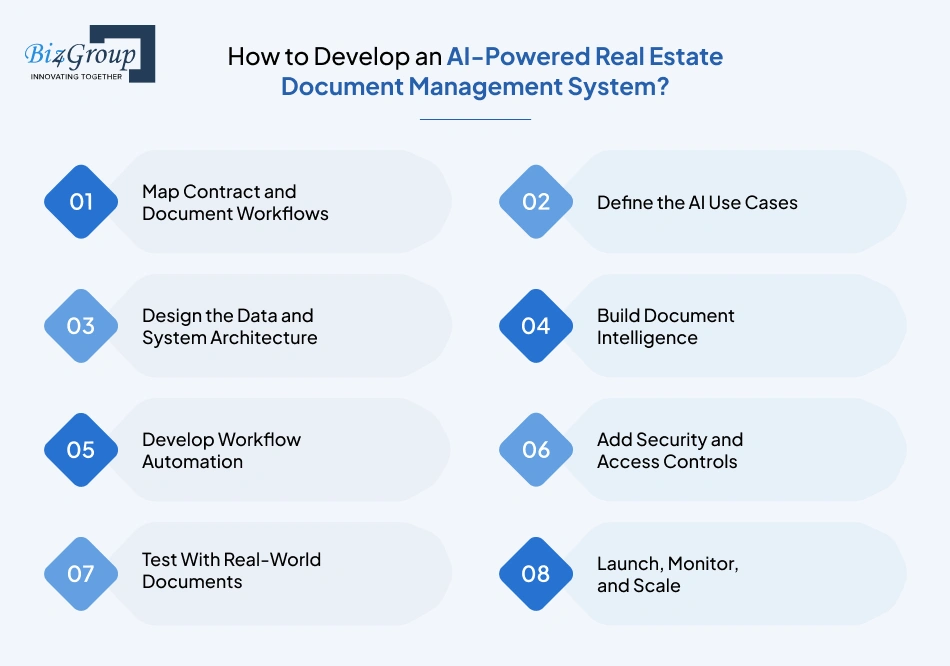
Developing an AI-powered real estate document management system involves more than adding AI to a document repository. The process should connect document intelligence with contract workflows, transaction data, approvals, and existing business systems.
Understand how documents move through the business before deciding what to automate.
Select the specific document and contract tasks where AI can deliver measurable value.
Establish how documents, transaction data, AI services, and business systems will work together.
Give the system the ability to read, classify, extract, and understand real estate documents.
Turn extracted contract information into actionable business workflows.
Protect sensitive contractual, financial, and property information throughout the system.
Validate the system against the document complexity and exceptions it will encounter in production.
Deploy gradually, measure performance, and expand automation as the system proves reliable.
Also Read: AI Contract Generator Platform Development for Legal Departments
Before implementing AI for real estate contract and escrow management, companies need to evaluate data security, regulatory requirements, AI accuracy, and integration with existing systems. The goal is to automate useful work without creating another disconnected technology layer.
Contracts and escrow records may contain financial information, banking details, identification data, property records, and confidential commercial terms.
A production AI escrow management system should include:
For example, a finance user may need access to escrow milestones but not confidential legal negotiations.
Real estate laws, disclosure requirements, recording practices, and escrow rules vary by jurisdiction. An AI compliance system should therefore use jurisdiction-specific rules rather than applying a single compliance model across every transaction.
These rules may cover:
AI can identify potential issues, while defined review processes address situations requiring legal interpretation.
AI can produce inaccurate results when contracts contain ambiguous language, poor-quality scans, handwritten changes, conflicting amendments, or unusual clauses. This naturally raises an important implementation question: "How much of the real estate contract and escrow lifecycle can AI automate, and where is human oversight still essential?"
A practical division is:
For example, if AI identifies a $500,000 escrow release condition, the system should show the contract clause and supporting documents behind that finding so the responsible person can verify it before action is taken.
AI should connect with existing systems rather than create another isolated repository.
Typical integrations include:
The result is a connected real estate transaction automation layer where AI processes information and coordinates workflows while existing financial and transaction platforms remain the systems of record.
The potential savings depend on contract volume, review complexity, labor costs, and how much of the workflow is automated. Studies show that AI-driven agreement workflows can reduce both the time teams spend on contracts and the cost of managing them.
AI can reduce manual work involved in:
Deloitte and DocuSign reported 29% average cost savings from reduced labor and outside counsel spend among surveyed organizations.
For real estate companies, the savings can extend across legal, finance, operations, and escrow teams.
A practical ROI calculation should use the company’s actual contract workload:
Example: If automation eliminates 600 hours of work annually at a fully loaded cost of $60/hour, the direct labor value is $36,000 per year.
Track hours per contract, turnaround time, cost per contract, exception rates, and contracts processed per employee before and after implementation to determine the actual return.
Building an AI-powered document management system requires more than adding an LLM to an existing document repository. The system must connect document processing, structured data, business workflows, and existing real estate platforms.
Biz4Group’s work on Contracks, an AI-driven real estate contract management platform, and Facilitor, an AI-powered real estate buying platform, highlights two practical considerations: AI should connect to existing workflows, and the architecture should support structured property and transaction data. Contracks combines document summarization, contract tracking, reminders, financial mapping, and inspection scheduling, while Facilitor integrates property search, AI recommendations, and buyer-verification tools.
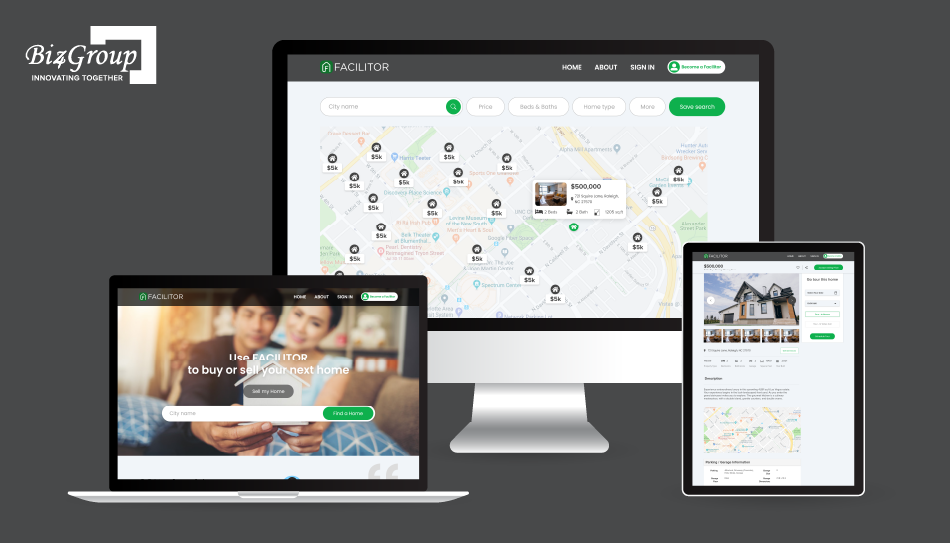
While developing Contracks, the focus was not limited to extracting information from contracts. The platform connected AI-powered document processing with contract tracking, financial mapping, reminders, and inspection scheduling. This illustrates an important implementation principle, AI document intelligence delivers greater operational value when it is connected to the workflows that follow document analysis.
|
Technology |
Application in Real Estate |
Implementation Consideration |
|---|---|---|
|
Document AI and OCR |
Extract text and structured data from contracts, scanned documents, and supporting records. |
Support different document formats, scan quality, and handwritten or amended content where possible. |
|
NLP and LLMs |
Summarize agreements, identify clauses, extract obligations, and answer document-based questions. |
Use source references and confidence indicators to support verification. |
|
Workflow automation |
Route documents for approval, trigger deadline reminders, and connect contract conditions to operational tasks. |
Map extracted information to specific business processes instead of leaving it in an isolated AI interface. |
|
APIs and integrations |
Connect CRMs, ERPs, accounting platforms, property-management systems, and escrow tools. |
Define data ownership, synchronization rules, and failure-handling procedures. |
|
Rules engines |
Check required fields, approval thresholds, milestone conditions, and disbursement controls. |
Keep critical financial and compliance rules deterministic rather than relying only on LLM outputs. |
|
Smart contracts |
Automate predefined actions through blockchain-based logic where appropriate. |
Evaluate legal enforceability, integration requirements, and jurisdiction-specific restrictions before implementation. |
Begin with the documents and processes that create the most manual work. Then connect AI extraction to searchable records, alerts, approval workflows, and existing business systems. Facilitor also demonstrates how AI features can be integrated with property data and transaction-related workflows rather than operating independently.
The right approach depends on the company’s existing systems, workflow complexity, contract volume, and integration requirements.
|
Approach |
Suitable For |
Key Considerations |
|---|---|---|
|
Buy an existing platform |
Standard contract storage, e-signatures, document search, and basic workflow management. |
Faster deployment, but customization and integration options may be limited. |
|
Customize an existing solution |
Companies that need industry-specific fields, approval processes, integrations, or selected AI features. |
Balances faster implementation with greater workflow flexibility. |
|
Build a custom system |
Complex escrow conditions, multi-project operations, proprietary processes, and deep internal-system integration. |
Requires greater investment in architecture, security, maintenance, and ongoing AI evaluation. |
Before selecting an approach, assess:
If your company plans to build a customized AI-powered real estate document management system, Biz4Group’s experience in developing AI-driven real estate solutions can help turn that plan into a practical, scalable implementation. From defining the technology architecture and integrating existing business systems to developing document intelligence and workflow automation, an experienced AI development team can help align the solution with your operational requirements and long-term growth.
Let’s build an AI solution around the way your real estate business actually works.
Talk to Our AI Experts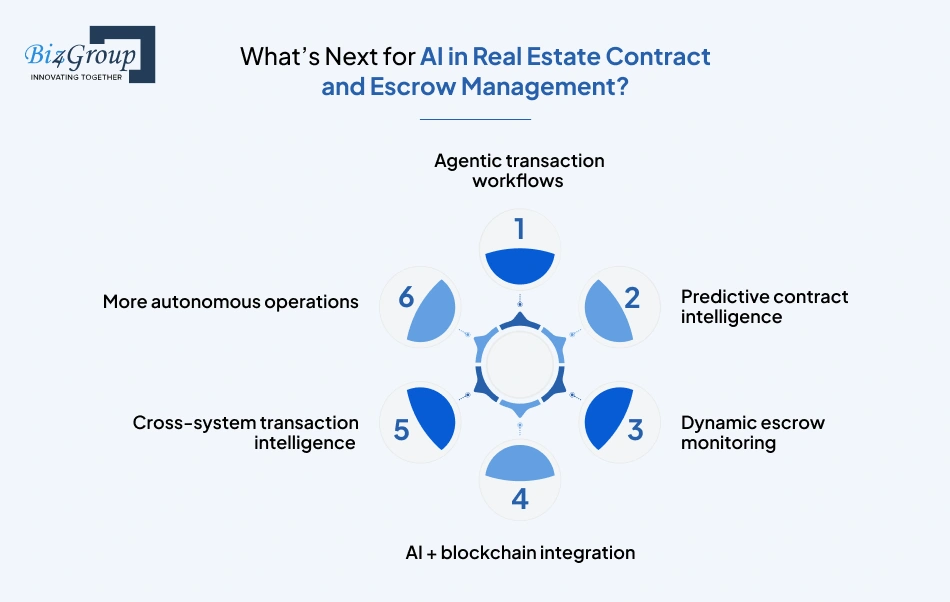
The next phase of AI in real estate will focus on making transaction workflows more connected, predictive, and autonomous.
AI can take a lot of the manual work out of real estate contract and escrow management, from processing documents and reviewing contracts to tracking obligations and monitoring escrow conditions. Its impact becomes even greater when it connects with the legal, finance, accounting, and project-management systems teams already use.
But AI shouldn’t handle every decision. Legal interpretation, disputed terms, exceptions, and significant financial decisions still need human oversight. The practical approach is simple, automate the repeatable work, while keeping people in control of decisions that carry legal or financial consequences.
Biz4Group LLC has applied this approach while developing AI-powered real estate solutions such as Contracks and Facilitor. These projects reflect our experience connecting AI capabilities with real estate workflows, structured data, and practical business requirements.
If you are looking to automate your contract or escrow workflows? Talk to our experts, we can help turn your requirements into a practical AI solution.
AI can compare contract versions, identify changed clauses, track amendments, and maintain a clear history of approvals. This helps teams quickly understand what changed and which version is currently active.
AI can review large volumes of agreements and supporting documents to identify missing information, unusual clauses, conflicting terms, obligations, and potential compliance issues that may require further review.
Typical inputs include property details, buyer and seller information, transaction values, financing terms, closing dates, contingencies, approved clauses, and relevant supporting documents. The quality and structure of this data directly affect automation accuracy.
AI can extract payment conditions from contracts and connect them with project milestones, inspections, approvals, and supporting documents. The system can then flag whether required conditions are complete before a payment workflow proceeds.
A production system should include role-based access, encryption, audit logs, document-level permissions, secure integrations, data retention policies, and controls around sensitive financial and contractual information.
Yes. AI can help classify documents, extract jurisdiction-specific terms, compare contractual requirements, and organize compliance information across transactions. Legal and regulatory requirements still need to be validated for each jurisdiction.
AI may struggle with ambiguous language, poor-quality scans, handwritten changes, unusual clauses, or conflicting amendments. These cases require additional validation rather than relying solely on automated interpretation.
AI focuses on understanding documents, extracting information, generating content, and managing workflows. Smart contracts use predefined blockchain logic to execute specific actions when programmed conditions are met. They address different parts of the transaction lifecycle.
AI can turn contracts into structured, searchable data and help teams monitor obligations, amendments, deadlines, approvals, and document requirements across multiple projects and properties.
Useful metrics include contract processing time, review hours, cost per contract, approval turnaround, exception rates, document-processing accuracy, and the number of contracts managed per employee.

Our website require some cookies to function properly. Read our privacy policy to know more.