 Location :
Orlando, FL, USA
Location :
Orlando, FL, USA +1 (407) 714-1616
 info@biz4group.com

 AI Summary Powered by Biz4AI
- Automated client reporting can help advisory firms handle more financial and portfolio reports without making every report look the same.
- Keep client-specific elements flexible, including performance metrics, portfolio details, report structure, and advisor commentary.
- Build common reporting differences into the workflow instead of creating separate processes or manually editing each report.
- Keep advisors involved in reviewing, adding context, and approving financial client reports before delivery.
- WorthOne Plan is designed to bring these capabilities together, helping firms scale personalized financial reporting without adding the same amount of manual work.
Preparing one financial client report is usually not the problem. Things get harder when you are preparing reports for dozens or hundreds of clients.
One client wants a detailed portfolio breakdown. Another only wants to see investment performance. Someone else needs different financial information, a different format, or a bit of advisor commentary. This is where automated client reporting can help, but there is a catch. Make every report follow the same template, and they can start feeling generic. Customize everything manually, and the reporting workload quickly comes back.
Biz4Group LLC ran into this while developing WorthOne Plan, an AI financial report generator platform. The interesting part was realizing that the workflow behind financial client reports can stay largely the same even when the reports themselves need to change. The real challenge is handling differences in portfolios, reporting needs, and client preferences without creating a separate process for every client.
That is the balance advisory firms need to get right if they want to scale reporting without losing the personal side of it.
Why Does Client Reporting Get Harder as Advisory Firms Grow?
Financial client reporting gets harder as an advisory firm grows because more clients bring more portfolios, data points, and reporting needs. How do you keep reports relevant without creating more manual work? That is where the challenge starts.
More Clients Mean More Reporting Differences
One client may want a detailed portfolio breakdown, while another focuses on investment performance or asset allocation. As the client base grows, these differences become harder to manage through one reporting process.
Custom Requests Bring Manual Work Back
An extra metric, a different portfolio view, or advisor commentary may seem like a small change. But what happens when those requests come from dozens of clients? Manual work quickly starts adding up.
Standard Templates Can Only Go So Far
Templates create consistency, but one format cannot fit every portfolio and client relationship. Teams often end up manually changing reports to make them more relevant.
Too Many Exceptions Slow Everything Down
Creating a separate process for every variation is not scalable either. Multiple report versions and workarounds can make automated client reporting harder to manage.
The goal is to handle client differences without letting them slow down the entire reporting process.
How can Financial Advisors Automate Client Reporting without Losing Personalization?
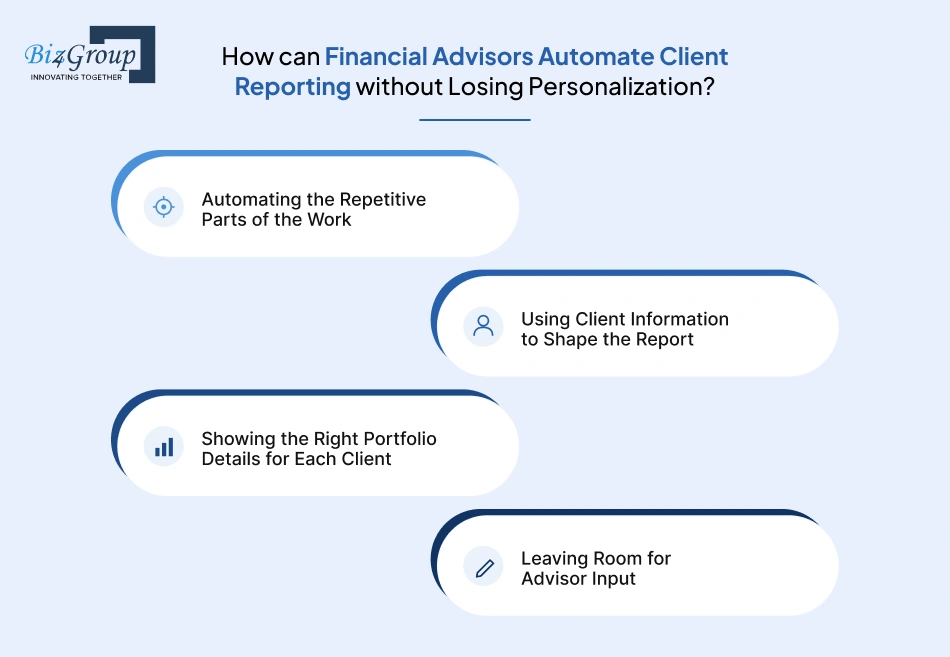
Financial advisors can automate the parts of client reporting that repeat while still changing the report based on each client's needs. The goal is not to make every financial report look the same. It is to reduce the repetitive work without losing what makes a report relevant to the client.
|
What Can Be Automated |
What Can Still Be Personalized |
|---|---|
|
Automating the Repetitive Parts of the Work Pulling together financial data, calculations, and report creation can follow the same process each time. |
Using Client Information to Shape the Report Client goals, preferences, and other relevant information can influence what goes into the report. |
|
Showing the Right Portfolio Details for Each Client Different clients can see the performance metrics, holdings, or portfolio information that matter to them. |
Leaving Room for Advisor Input Advisors can review the report and add their own context before it is shared with the client. |
With the right automated client reporting setup, the process can stay consistent without making the reports feel identical.
What Parts of Automated Client Reporting Should Be Standardized?
Not every part of a financial client report needs to be handled differently. The work that repeats every reporting cycle can follow the same process. Why spend time doing the same things again for every client? The idea is to standardize the backend work while keeping the actual report flexible.
Bringing Information Together
Portfolio data, account information, holdings, and performance data may come from different places. Bringing them into one reporting workflow can save the team from gathering the same information again and again.
- Example: Instead of pulling portfolio values and holdings separately for each client, the data is made available in one place before report preparation starts.
The Basic Steps Behind Every Report
The reports may be different, but the basic process behind them often is not. Why build a separate workflow when every reporting cycle follows roughly the same steps?
- Example: Portfolio data is prepared, the report is generated, an advisor reviews it, and the approved version is then sent to the client.
Information Every Report Needs to Include
Some things should appear in every financial client report, no matter who the client is. Setting these requirements upfront makes it easier to avoid missing important information.
- Example: Every report includes the reporting period, portfolio value, performance information, and required disclosures.
Generating and Sending Reports
Once a report has been reviewed and approved, creating the final version and getting it ready for delivery should not add more manual work. This is one area where automated client reporting for financial advisors can save time.
- Example: An approved portfolio report is automatically generated in the required format and prepared for secure client delivery.
The simple rule is to standardize what repeats and keep the parts that need to change open to customization.
What Should Still Change From One Client Report to Another?
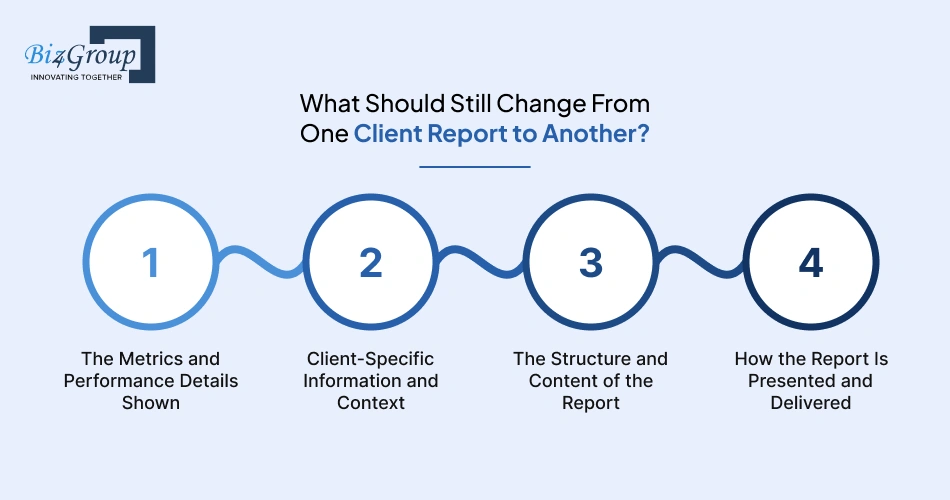
The process behind financial reporting can be standardized, but the actual report should still change based on the client's portfolio, investments, financial goals, and reporting preferences. Should two clients with different portfolios automatically receive the same financial report? Probably not.
The Metrics and Performance Details Shown
Different clients may need different views of their portfolio performance. One may focus on investment returns and asset allocation, while another may want to track specific holdings, account performance, or progress toward a financial goal. The report should bring forward the financial information that matters most to that client.
Client-Specific Information and Context
Portfolio numbers do not always explain why something happened or what changed. An advisor may need to add context around a recent investment decision, a change in portfolio strategy, or something affecting a client's financial plan. This helps connect the numbers to the client's specific situation.
The Structure and Content of the Report
Some clients prefer a short portfolio summary, while others want a detailed breakdown of holdings, investment performance, and financial progress. Why make both clients work through the same report structure? The level of detail and content can change without changing the entire reporting workflow.
How the Report Is Presented and Delivered
The final financial report may also change based on how the client prefers to review it. One client may receive a detailed portfolio report as a PDF, while another may need a shorter summary to discuss with their advisor.
While developing WorthOne Plan, Biz4Group LLC found that personalization often comes from a few well-defined changes rather than a completely different report. The metrics shown, the context added, and the amount of detail can all change based on the client. When these variations are built into the reporting workflow, the team does not have to recreate the report manually each time.
A scalable reporting process should handle these differences without turning them into separate tasks.
How does Automated Client Reporting Handle Different Client Portfolios and Reporting Requirements?
Automated client reporting can handle different portfolios without creating a separate reporting process for every client. The basic workflow can stay the same, while the portfolio data, financial details, and report format change based on what each client needs. Does a different portfolio always need a completely different workflow? No.
Working With Different Types of Client Information
Clients can have different accounts, holdings, asset classes, and investment strategies. The reporting process needs to pull in the right financial and portfolio information for each client.
- Example: One report may cover equities and fixed-income investments, while another also includes retirement accounts and alternative investments.
Supporting More Than One Report Structure
Not every client needs the same level of detail. One may only need a straightforward portfolio performance report, while another may want a broader view of multiple accounts and investments.
- Example: A client with one managed portfolio receives a short performance report, while a household with several accounts receives a more detailed financial report.
Mixing Standard Content With Client-Specific Details
Some parts of a financial client report can stay the same, while others should change. Why customize everything when only certain details need to be different? Required disclosures and basic reporting information can be standardized, while portfolio metrics and advisor commentary can remain client-specific.
- Example: Every report includes the reporting period and disclosures, but the highlighted holdings, performance metrics, and advisor notes change for each client.
Turning Common Variations Into Repeatable Rules
When the same reporting differences keep coming up, they can be handled through predefined rules instead of manual changes. This makes automated client reporting for advisory firms easier to manage as the number of clients grows.
- Example: Clients with multiple managed accounts automatically receive an account-level breakdown, while clients with a single portfolio receive a simpler performance summary.
The goal is to handle portfolio differences without making every financial client report a separate job.
Scale Your Client Reporting Without Making It Generic
Automate the repetitive work behind financial reporting while keeping each portfolio report relevant to the client receiving it.
Explore WorthOne PlanWhat Should an Automated Client Reporting Platform Offer Financial Advisory Firms?
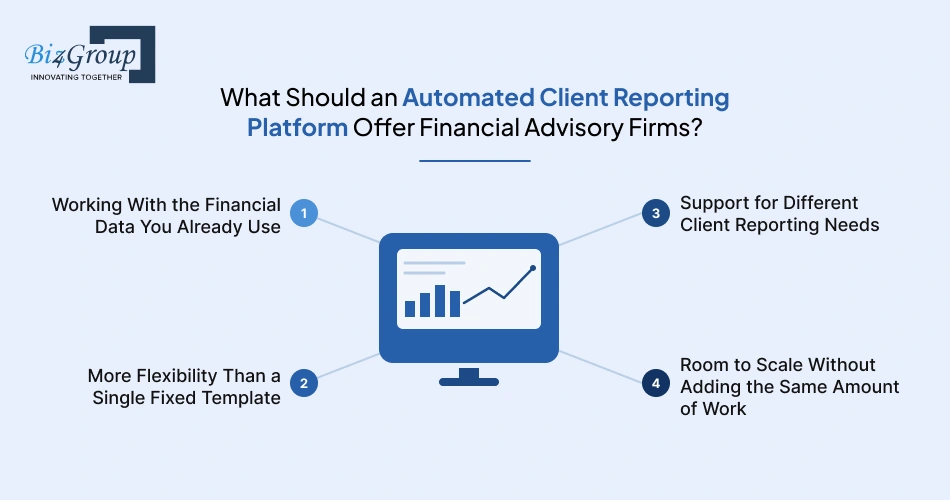
An automated client reporting platform should make financial reporting easier to manage as a firm grows. It should work with the portfolio and investment data the firm already uses, support different financial client reports, and reduce the amount of manual work needed every reporting cycle.
|
What Financial Advisory Firms Need |
What the Platform Should Offer |
|---|---|
|
Working With the Financial Data You Already Use |
It should work with portfolio, account, holdings, and investment performance data that already goes into financial client reports. |
|
More Flexibility Than a Single Fixed Template |
It should allow different report structures instead of forcing clients with different portfolios into one fixed format. |
|
Support for Different Client Reporting Needs |
Advisors should be able to change portfolio metrics, performance details, financial summaries, and commentary based on the client. |
|
Room to Scale Without Adding the Same Amount of Work |
As the client base grows, the firm should be able to prepare more financial and portfolio reports without adding manual work at the same pace. |
The right automated client reporting platform should make financial reporting easier to scale without making every client report look the same.
How Can Advisory Firms Scale Client Reporting Without Adding More Complexity?
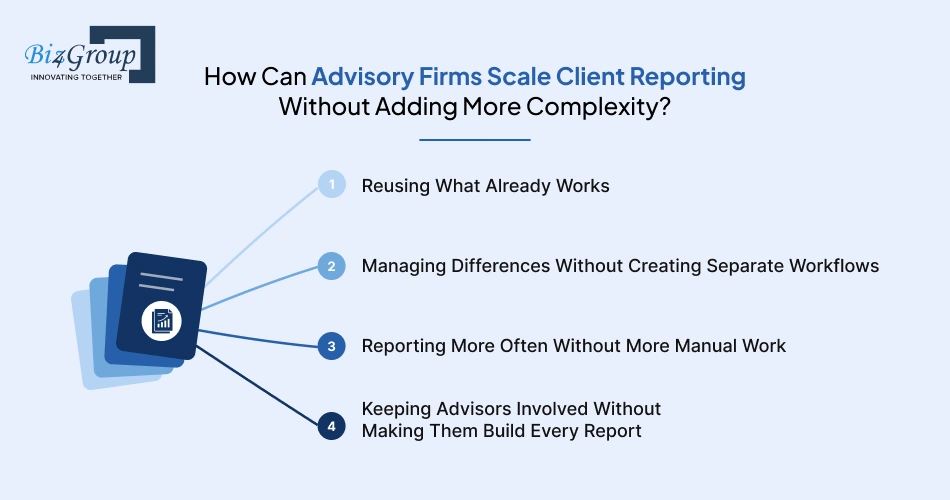
Advisory firms can scale financial client reporting by keeping the repeatable parts of portfolio reporting consistent and making it easier to handle common differences. More clients should not mean more reporting processes to manage.
Reusing What Already Works
The same process for bringing together portfolio data, calculating investment performance, generating reports, and reviewing them can be used for more clients. There is no need to rebuild the reporting process every time the firm grows.
Managing Differences Without Creating Separate Workflows
Clients will have different portfolios, accounts, and reporting needs. But does every difference need a separate workflow? Usually, no. Common variations can be handled within the same financial reporting process.
Reporting More Often Without More Manual Work
More frequent portfolio reporting can mean more work when teams are still pulling investment data, updating reports, and formatting them manually. Automating these repeatable steps makes it easier to increase reporting frequency without increasing the workload in the same way.
Keeping Advisors Involved Without Making Them Build Every Report
Advisors can still review financial client reports, add context around portfolio performance, and approve the final version. They just do not need to spend time gathering the data and putting every report together from scratch.
As the client base grows, the reporting process should be able to grow with it without becoming harder for the team to manage.
Keep Your Financial Reports Personal. Make the Process Scalable.
Handle different portfolios, reporting needs, and client preferences without creating a separate workflow for every variation.
See WorthOne Plan in ActionHow Does WorthOne Plan Support Personalized Client Reporting at Scale?
WorthOne Plan is built for advisory firms that are stuck between two difficult choices: spend hours manually preparing personalized financial reports or standardize everything until the reports start looking the same. It helps automate the repetitive work behind portfolio reporting while keeping the financial details, structure, and advisor input flexible for each client.
Supporting Different Types of Client Reports
Your clients do not all have the same portfolios, investments, or reporting expectations, so they should not all receive the same financial report. WorthOne Plan supports different types of portfolio and financial client reports without requiring the team to build each one from scratch.
- Example: One client receives a detailed portfolio performance report, while another receives a shorter financial summary built around the information most relevant to them.
Working With Different Financial Information and Requirements
Different clients can have different account types, holdings, asset classes, portfolio structures, and reporting requirements. Do you really need a separate manual process every time the financial information looks different? WorthOne Plan is designed to work with those differences as part of the reporting workflow.
- Example: A household with multiple investment accounts can receive an account-level view, while another client receives a report focused on a single managed portfolio.
Creating Reports Without Forcing Every Client Into One Format
A repeatable process should not result in identical portfolio reports. WorthOne Plan makes it possible to keep the work behind report generation consistent while changing the metrics, sections, level of detail, and advisor commentary based on the client.
- Example: Two reports can be generated through the same workflow, but one focuses on investment returns and asset allocation while another highlights holdings and progress toward financial goals.
Keeping the Process Repeatable as Client Needs Grow
What happens when you add more clients but do not want to add the same amount of reporting work? WorthOne Plan is designed to help firms handle growing numbers of financial client reports without turning every new requirement into another manual task or separate workflow.
- Example: A reporting variation that applies to a group of clients can be built into the existing process instead of asking the team to remember and apply it manually every reporting cycle.
WorthOne Plan brings together the two things growing advisory firms usually need most: a reporting process that can scale and financial client reports that can still feel relevant to each client.
Where Scalable Reporting Meets Personalization
Growing an advisory firm should not mean spending more and more time preparing financial client reports. But giving every client the same standard report is not the answer either.
The challenge is finding a way to handle more portfolios, accounts, reporting preferences, and client requests without creating more manual work. This is where WorthOne Plan can help. It is built to automate the repeatable parts of financial reporting while still leaving room for each client's portfolio, performance details, and advisor input.
While developing WorthOne Plan, Biz4Group LLC has worked through the practical problem behind this process: financial reports may follow a similar workflow, but the details that make them useful can vary from client to client. A platform needs to handle those differences without turning every one of them into another manual task.
For advisory firms, the goal is simple: produce more personalized financial client reports, without needing more people or more complicated reporting processes to do it.
FAQ’s
1. How do I automate portfolio reports when different clients want different metrics and performance views?
Automated portfolio reporting for advisors can use different metrics, performance views, and portfolio details based on each client's reporting requirements.
2. We already use report templates. How do we stop advisors from manually customizing every financial report?
Use personalized client reporting automation that applies predefined client-specific requirements instead of requiring manual edits every time. WorthOne Plan can make this easier by supporting different report requirements within a repeatable reporting workflow.
3. Can automated client reporting for RIAs handle clients with multiple accounts and different investments?
Yes. Automated client reporting for RIAs can work with different accounts, holdings, asset classes, and portfolio structures within the same reporting workflow.
4. How can we increase the frequency of portfolio reporting without hiring more operations staff?
Automated client reporting for financial advisors can automate repeated tasks such as gathering portfolio data, preparing reports, and generating final documents. WorthOne Plan is designed to help firms handle more frequent reporting without increasing manual work at the same pace.
5. Can advisors still review and personalize automated financial client reports before they are sent?
Yes. Automated client report generation can prepare the report first, after which the advisor can review it, add client-specific context, and approve the final version.
6. How do I automate portfolio reports for clients without making every report look the same?
Use an automated client reporting platform that keeps the workflow consistent while allowing portfolio data, metrics, report structure, and advisor input to vary by client. WorthOne Plan is built around this balance, helping firms keep reporting repeatable without forcing every financial client report into one format.
