Location :
Orlando, FL, USA
Location :
Orlando, FL, USA +1 (407) 714-1616
 info@biz4group.com


















Imagine a digital system that doesn’t wait for instructions but instead, understands your business goals, learns from real-time feedback, and takes independent actions to get the job done.
Read More

 AI Summary Powered by Biz4AI
What does a missed leasing inquiry really cost a multifamily operator? It can be the prospect who books a tour with a competing property because no one answered after hours.
That is one reason AI is moving from experimentation into leasing operations. AppFolio's 2026 benchmark found that 55% of property managers consider elevated vacancy their top business threat, while Zillow's 2026 data found that renters who engaged with its AI Assist were 19% more likely to book a tour and 24% more likely to sign a lease.
And multifamily AI is already moving beyond the chatbot. As SurfaceAI CEO Jason Wallis puts it, "I see everybody moving beyond the chatbot and actually applying AI in their operations in other ways." That shift is especially relevant to leasing, where AI can move from answering property questions to qualifying prospects, checking live inventory, scheduling tours, and managing follow-ups.
But putting that shift into practice comes with its own challenges. We experienced this firsthand while developing Homer AI, Biz4Group's AI-powered property management application.
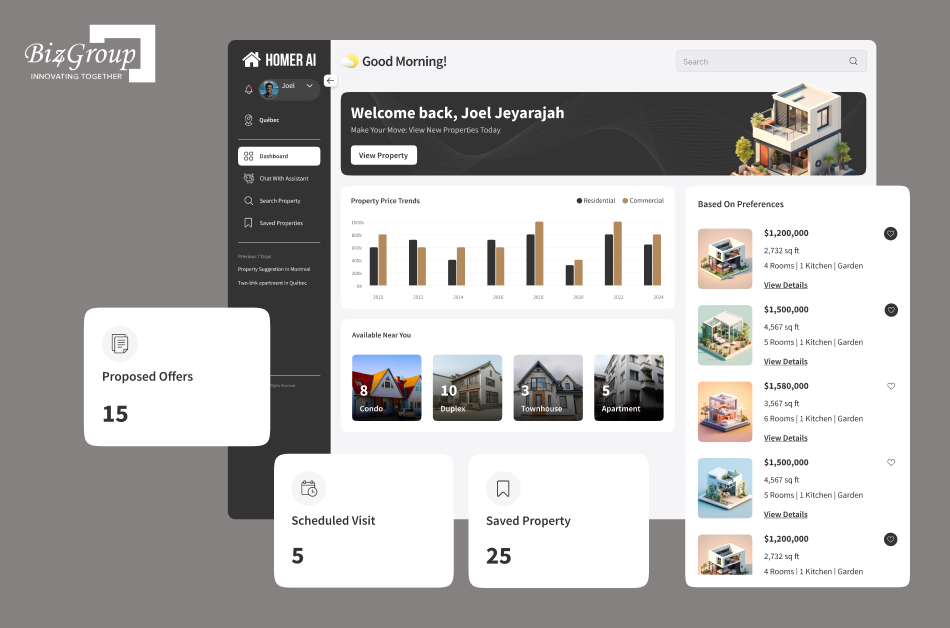
One of the key challenges was rethinking property search, not as a series of endless filters, but as a natural conversation where renters could describe what they wanted and get relevant results.
The goal was simple, help buyers and sellers connect through conversational AI while seamlessly handling property preferences, detailed listings, property filtering, and visit scheduling in the background.
It may sound straightforward, but it wasn't. Making it work required well-structured property data, accurate preference matching, and reliable APIs to ensure the right property information and plans reached the application at the right time. That's where the real engineering challenge, and some thoughtful problem-solving, came into play.
Those lessons carry directly into AI leasing platform development: ground the AI in trusted data, keep live information connected to authoritative systems, and control what the agent can actually do.
Let's walk through what goes on behind the scenes, from the core features and AI architecture to integrations, development, security, and production.
An AI leasing agent for multifamily properties is a system that handles leasing conversations, retrieves property information, qualifies prospects, recommends available units, schedules tours, follows up with leads, and hands complex cases to human leasing teams.
Think of it as a leasing operations layer that can talk, search, decide within defined rules, and take action across the systems your team already uses.
A modern AI leasing agent does more than answer questions like, "Do you allow pets?"
It can understand a prospect saying: "I need a two-bedroom under $2,500, I'm moving in next month, and I have a large dog."
The system can interpret those requirements, check eligible units, retrieve current pricing and availability, ask a useful follow-up question, and offer available tour times.
That combination of conversation + data retrieval + actions is what separates an AI leasing agent from a basic apartment chatbot.
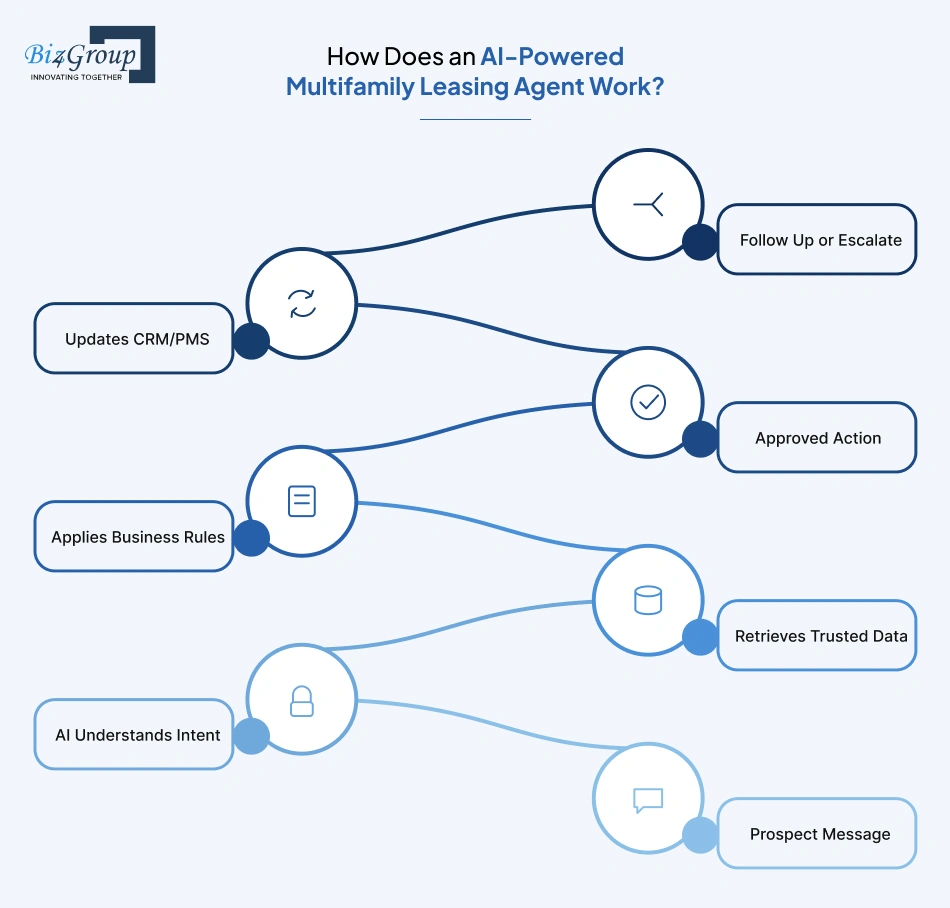
The basic flow looks like this:
Prospect message → AI understands intent → retrieves trusted data → applies business rules → takes an approved action → updates CRM/PMS → follows up or escalates
The LLM handles language and reasoning. Your property systems remain the source of truth for things such as unit availability, pricing, lease terms, and tour slots.
That distinction matters. You do not want the model "remembering" that Apartment 304 is available when the PMS says it was leased this morning.
The strongest benefits show up where leasing teams lose time or leads:
The goal is not to make leasing completely human-free. It is to make the routine parts automated and reserve human attention for the conversations where it adds the most value.
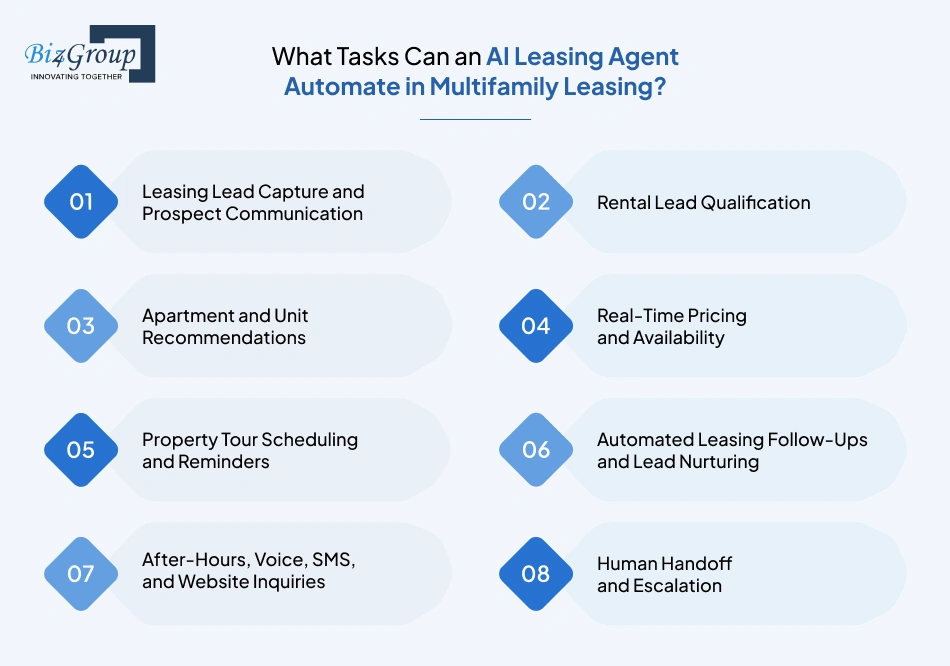
An AI leasing agent can automate much of the repetitive work between the first prospect inquiry and a completed tour or application. The useful distinction is not "what can AI technically do?" but which leasing tasks are repetitive, data-driven, and safe to automate without slowing the team down.
The first priority is responding while the prospect is still interested.
An AI leasing agent can capture inquiries from a website, chat widget, SMS, email, voice, and other connected channels, then maintain a consistent conversation across them.
For example: "Do you have any one-bedrooms available next month?"
Instead of sending a generic availability page, the agent can check the prospect's move-in date, preferred price range, unit type, and other requirements before showing relevant options.
This is particularly useful for after-hours inquiries and high-volume leasing periods when human response capacity is limited.
Qualification should feel like a conversation, not a form disguised as a chatbot.
The agent can collect information such as:
It can then update the CRM with structured lead information and route high-intent prospects to the appropriate leasing workflow.
The important implementation detail is to separate qualifications from prohibited or high-risk decision-making. The agent can gather relevant leasing preferences, but decisions with regulatory or discrimination implications should remain tightly controlled.
This is where an AI leasing agent becomes more useful than a standard property search widget.
A prospect might say: "I want a quiet two-bedroom, under $2,800, with parking, and I need to move in around the 15th."
The AI recommendation system can convert that request into structured criteria, search matching inventory, and return a small set of relevant units.
A good recommendation workflow should consider more than keyword matching. It should combine prospect preferences with actual unit attributes, community policies, current availability, and pricing.
And the recommendations should come from trusted property data, not whatever information happens to be sitting inside the model's context window.
Live leasing data should come from live systems.
The agent can call PMS or property APIs to retrieve:
This matters because leasing data changes constantly. A unit available at 10 a.m. may be gone by lunch.
For production systems, the architecture should therefore treat the PMS or connected property system as the source of truth and use the LLM to interpret and communicate that information.
Once a prospect is interested, the agent can move directly from conversation to action.
It can:
That removes one of the most common points of friction in leasing: making the prospect repeat their details while moving between systems.
Not every prospect is ready to tour today. Some are comparing properties, waiting for a move date, or simply stopped responding.
An AI leasing agent can trigger follow-ups based on events such as:
The useful part is context. Instead of sending the same "Just checking in" message to everyone, the system can continue from the actual conversation and use previously captured preferences.
It should also have clear stop conditions. Good automation knows when to stop messaging, not just when to send the next message.
A leasing agent does not have to live in a website chat box.
With the right communication layer, the same leasing workflow can support:
The key is keeping the underlying prospect context unified. Otherwise, you end up with several "AI agents" that do not know what the others already discussed.
A good AI leasing agent should know when not to continue.
Human handoff makes sense when a prospect:
The handoff should include the conversation history, prospect information, requested unit, and actions already taken.
That way, the leasing agent receives a qualified conversation instead of a cold transfer.
The best automation is not the one that handles most conversations. It is the one that automates the right conversations and makes human conversations better.
Let AI handle the repetitive stuff while your team focuses on the prospects that actually need a human.
Talk to an AI ExpertThe right feature set for an AI leasing agent starts with one goal, move a prospect through the leasing journey without forcing your team to manually manage every interaction. The core features should cover conversation, trusted property information, lead handling, scheduling, integrations, and controlled human escalation.
|
Core feature |
What it does |
Why it matters |
|---|---|---|
|
Natural language conversation |
Understands questions, intent, preferences, and follow-up requests |
Makes the interaction feel conversational rather than form-driven |
|
Property knowledge base |
Stores property details, amenities, policies, floor plans, fees, and FAQs |
Gives the agent reliable answers to common leasing questions |
|
RAG-based retrieval |
Retrieves relevant property information before generating a response |
Reduces hallucinations and keeps answers grounded in approved content |
|
Real-time availability |
Retrieves current unit availability, pricing, move-in dates, and concessions through APIs |
Prevents the agent from presenting outdated inventory |
|
Lead qualification |
Captures unit type, budget, move-in date, preferences, and tour intent |
Helps leasing teams prioritize higher-intent prospects |
|
Apartment recommendations |
Matches prospect requirements against available inventory |
Turns a simple Q&A interaction into guided apartment discovery |
|
Tour scheduling |
Checks availability, books tours, sends confirmations, and handles rescheduling |
Removes scheduling friction and reduces manual coordination |
|
Conversation memory |
Retains relevant information throughout the prospect journey |
Prevents repetitive questions and supports more personalized conversations |
|
CRM and PMS integration |
Syncs leads, activities, property data, appointments, and status updates |
Keeps the AI workflow connected to existing leasing operations |
|
Automated follow-up |
Sends contextual messages based on lead activity and workflow triggers |
Prevents leads from being lost after the first interaction |
|
Human handoff |
Escalates complex, sensitive, or unsupported conversations to leasing staff |
Keeps automation controlled without creating dead ends |
|
Conversation and activity history |
Records interactions, actions, and lead context |
Gives leasing teams visibility into what happened before handoff |
|
Analytics and reporting |
Tracks conversations, qualification, tours, handoffs, and conversions |
Provides the data needed to evaluate system performance and leasing impact |
The feature set should follow the leasing workflow, not an AI checklist. These features must work together reliably. One prospect request may involve retrieval, an API call, a recommendation, a CRM update, and a booking action, so the agent needs controlled tools, clear permissions, and reliable workflows.
Once the core leasing workflow is reliable, advanced features can expand the agent from a reactive leasing assistant into a more proactive and intelligent system. These capabilities are most useful for larger portfolios, higher lead volumes, and teams looking to automate more of the leasing journey.
|
Advanced feature |
What it does |
Primary value |
|---|---|---|
|
Voice AI |
Handles inbound and outbound leasing calls |
Expands phone-based lead coverage |
|
Multilingual AI |
Supports leasing conversations in multiple languages |
Expands prospect reach |
|
Predictive lead scoring |
Scores prospects using intent and engagement signals |
Helps teams prioritize high-value leads |
|
Cross-session memory |
Retains relevant prospect context across conversations |
Enables personalized follow-up |
|
Autonomous lead nurturing |
Adjusts follow-up timing and messaging based on behavior |
Recovers and nurtures warm leads |
|
Self-guided tour integration |
Connects AI with self-tour workflows |
Automates the path from inquiry to property visit |
|
Portfolio-wide search |
Searches inventory across multiple communities |
Supports centralized leasing operations |
|
Conversation intelligence |
Detects objections, intent, and recurring conversation patterns |
Improves leasing performance and training |
|
Proactive engagement |
Initiates outreach based on events such as missed tours or incomplete applications |
Recovers lost opportunities |
|
Multi-agent workflows |
Uses specialized agents for tasks such as recommendations, qualification, and follow-up |
Supports complex leasing operations |
These are best treated as second-stage capabilities, added after the core leasing workflow is stable and measurable.
An AI leasing agent needs more than an LLM to handle the job effectively. Its PMS, CRM, property APIs, retrieval layer, scheduling system, and communication channels all play a role in turning a conversation into a completed leasing workflow.
For example, answering "Do you allow pets?" may only require RAG. Answering "What two-bedrooms can I move into next month for under $2,500, and can I tour one Saturday?" requires live inventory, pricing, filtering logic, calendar availability, and a booking workflow.
That difference should drive your technology choices.
|
Layer |
Common technology choices |
What to evaluate |
|---|---|---|
|
LLM |
OpenAI, Anthropic, Google |
Accuracy, tool calling, latency, cost, context handling |
|
Backend |
Python, Node.js, Java |
Integration support, scalability, team expertise |
|
Agent orchestration |
LangGraph, custom orchestration, similar agent frameworks |
Workflow control, state management, debugging |
|
Database |
PostgreSQL, MySQL |
Structured property, lead, and workflow data |
|
Vector search |
pgvector, Pinecone, Weaviate |
Retrieval quality, scale, operational complexity |
|
RAG pipeline |
Custom RAG, LangChain, LlamaIndex |
Ingestion, retrieval, metadata filtering, evaluation |
|
PMS/CRM integration |
Yardi, RealPage, AppFolio, Entrata, custom APIs |
API access, data freshness, webhooks, rate limits |
|
Communication |
Twilio, email APIs, web chat, voice platforms |
Channel coverage, reliability, pricing |
|
Scheduling |
Calendar APIs, booking platforms |
Availability sync, booking, cancellation, time zones |
|
Cloud |
AWS, Azure, Google Cloud |
Security, scalability, compliance, observability |
|
Monitoring |
Application monitoring + LLM tracing/evaluation tools |
Latency, failures, token usage, tool-call errors |
Start with one orchestration layer and a focused set of leasing tools. Move to more complex multi-agent architecture only when different workflows genuinely require separate reasoning, permissions, or scaling patterns.
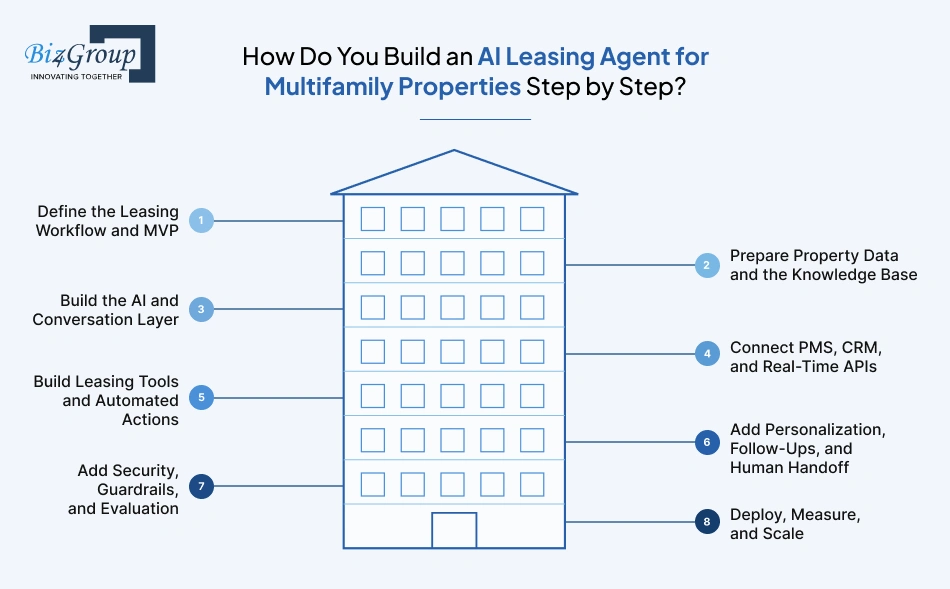
To build an AI leasing agent that can actually handle leasing workflows, start by mapping the prospect journey, then connect the AI to trusted property data, live PMS/CRM systems, and controlled leasing actions. The build should move from workflow and data → AI and integrations → actions and automation → testing and production.
Biz4Group took a similar approach while building Facilitor, an AI-powered real estate platform. Instead of treating each capability as a standalone feature, we brought budget- and location-based property search, AI recommendations, real-time chat, GPS and MLS integration, financial verification, and property-visit workflows into one connected experience.
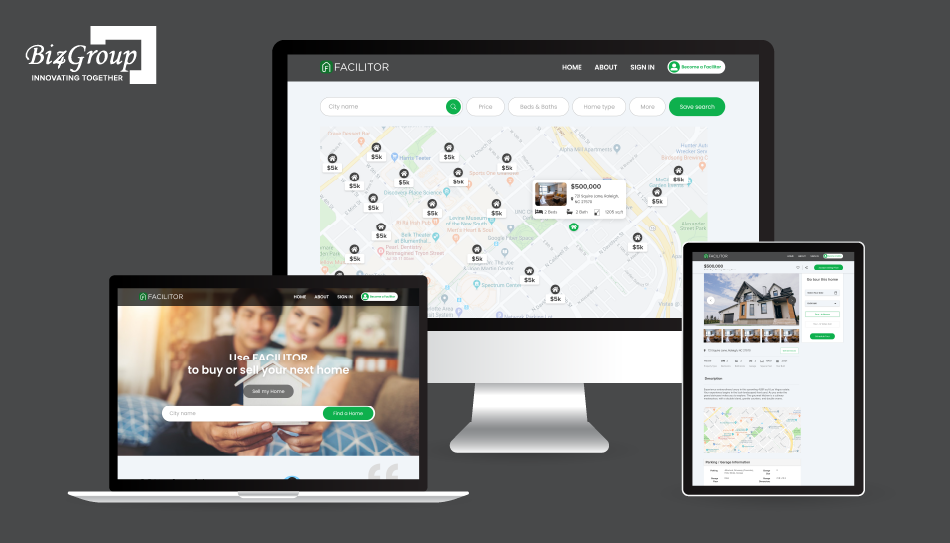
The interesting part was seeing how much more useful the AI became when recommendations, structured data, integrations, and real-world actions were designed to work together.
Here are the key steps that take you through the development process from start to finish.
Start with the highest-value leasing tasks rather than trying to automate everything.
A strong MVP can cover:
Lead inquiry → qualification → unit recommendation → availability check → tour booking → CRM update → follow-up
Define the inputs, decisions, actions, and human handoffs for each stage.
Structure the data the agent will need to answer questions and make recommendations.
This includes:
Use a searchable knowledge base and RAG for relatively stable information, while keeping live inventory and pricing outside the static knowledge layer.
Connect the LLM to the knowledge base and define how it understands leasing intent.
For example: "I need a two-bedroom under $2,500 and I'm moving in July."
The system should extract the requirements, maintain conversation context, retrieve relevant information, and decide which tool or workflow to use next.
This is where the agent becomes operational.
Connect:
For live information, query the source system rather than relying on cached AI knowledge.
Give the agent controlled tools for the actions it needs to perform.
Examples:
search_units() get_availability() get_pricing() recommend_units() schedule_tour() update_lead() send_followup() handoff_to_human()
Each tool should include validation, permissions, error handling, and logging.
Use conversation history and CRM data to maintain prospect context across interactions.
For example, after a prospect tours a property, the agent can follow up based on the units discussed rather than sending a generic message.
Define clear escalation rules for complex, sensitive, or unsupported requests so the leasing team can step in with full context.
Before production, control what the AI can access and execute.
Test:
Log important AI actions so failures can be traced and corrected.
Launch with a controlled property or workflow first.
Track both technical and leasing metrics such as:
response time → qualified leads → tours booked → applications → leases
Once the core workflow is reliable, expand into voice, multilingual conversations, portfolio-wide search, autonomous nurturing, and other advanced capabilities.
This staged approach also reflects what we learned from building Facilitor, getting the core search, recommendation, communication, data, and integration workflows working together creates the foundation for more sophisticated AI capabilities later.
The blueprint is sorted. Now let's turn it into a leasing agent that can actually talk, think, and take action.
Connect With Biz4Group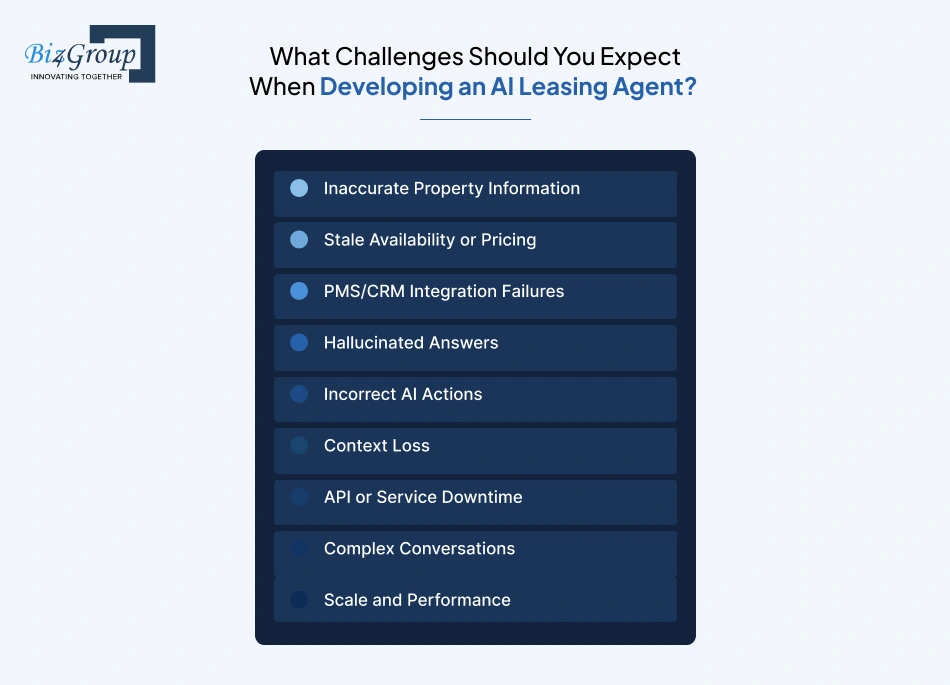
An AI leasing agent can handle a conversation well and still fail as a product. The difficult parts usually show up when the agent has to work with changing data, external systems, real leasing actions, and unexpected user behavior.
That pattern comes up repeatedly in real estate software development. While building Contracks, Biz4Group worked on an AI-powered contract management platform that brought contract creation, document handling, summaries, deadlines, notifications, inspections, and payments into one workflow.
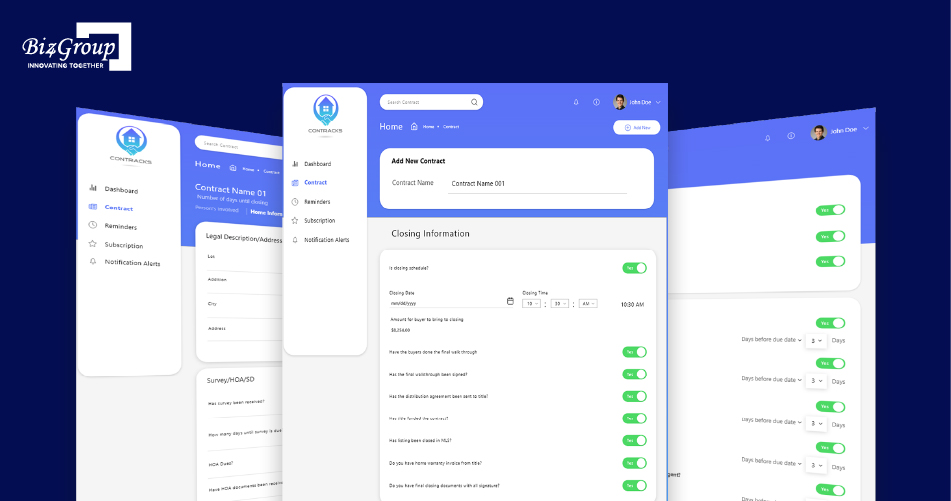
The project showed how much reliability depends on connecting AI with structured data, business workflows, and dependable system actions, not just getting the AI response right.
For an AI leasing agent, those same engineering principles apply in a different workflow. The table below maps the common challenges to the practical controls that help keep the agent reliable.
|
Development challenge |
What can go wrong |
How to solve it |
|---|---|---|
|
Inaccurate property information |
AI gives outdated amenities, fees, or policies |
Use approved knowledge sources, metadata, retrieval validation, and content refresh workflows |
|
Stale availability or pricing |
Agent recommends a unit that is no longer available |
Pull live inventory and pricing from PMS/property APIs |
|
PMS/CRM integration failures |
Leads, bookings, or updates fail to sync |
Use an integration layer with retries, webhooks, validation, and error logging |
|
Hallucinated answers |
Hallucinated AI invents information when it cannot find an answer |
Ground responses in retrieved data and define fallback behavior |
|
Incorrect AI actions |
Agent books the wrong tour or updates the wrong record |
Use structured tools, input validation, permissions, and confirmation rules |
|
Context loss |
Prospect has to repeat preferences across conversations |
Maintain session and prospect-level conversation state |
|
API or service downtime |
Agent cannot access availability or scheduling systems |
Add timeouts, retries, graceful fallbacks, and human escalation |
|
Complex conversations |
Prospect asks for exceptions or questions outside the workflow |
Define escalation triggers and transfer full context to a leasing team |
|
Scale and performance |
Response times and infrastructure costs increase with lead volume |
Use caching, model routing, asynchronous workflows, rate limits, and monitoring |
AI becomes much more useful when it is tied to the workflows users actually depend on. For leasing, that means connecting conversation, property data, integrations, actions, and escalation into one dependable flow rather than treating the LLM as the product.
For multifamily AI leasing, security and compliance need to follow the entire journey, from a prospect's first message to the AI's response, data access, recommendation, and any automated action. The goal is to keep sensitive information protected, keep the agent within clear limits, and reduce the risk of creating housing or consumer-protection issues along the way.
|
Aspect |
What the System Should Support |
Why It Matters |
|---|---|---|
|
Identity & Access |
SSO, MFA, RBAC, service accounts, property-level permissions |
Prevents unauthorized users or AI services from accessing sensitive systems |
|
Data Protection |
Encryption, secrets management, PII controls, retention and deletion policies |
Protects prospect, resident, and operational data |
|
AI Guardrails |
Approved topics, restricted responses, refusal rules, confidence thresholds |
Reduces unsupported or inappropriate AI responses |
|
Tool & Action Controls |
Permissioned tools, input validation, action limits, confirmation checks |
Prevents unauthorized bookings, CRM updates, or other actions |
|
Auditability |
Logs for conversations, tool calls, data access, overrides, and escalations |
Creates traceability for investigating errors and incidents |
|
Human Oversight |
Escalation rules, manual review, human override |
Keeps complex or sensitive decisions under appropriate human control |
|
Fair Housing |
Testing for discriminatory responses, steering, and inconsistent treatment |
Helps reduce Fair Housing risk in automated leasing interactions |
|
Tenant Screening |
Separate screening workflows, accuracy controls, dispute handling, authorized data use |
Screening can trigger FCRA obligations; the FTC's July 2026 RentGrow action highlights the importance of accuracy in tenant-screening reports |
|
Documented use cases, approved data sources, model ownership, review processes, incident procedures |
Defines who is responsible for AI behavior and changes |
|
|
Regulatory Monitoring |
Ongoing review of federal and state AI and housing requirements |
Requirements can change; Colorado's 2026 law, for example, adds requirements for certain AI-driven consequential decisions beginning January 1, 2027 |
Housing-related AI requirements can also vary by state and use case, so the compliance design should be reviewed as the system expands.
The cost to build an AI leasing agent depends mainly on how much of the leasing workflow you want to automate and how deeply it must connect with PMS, CRM, calendar, and communication systems. For budgeting, a practical range is $25,000-$60,000 for an MVP with real integrations, $60,000-$150,000 for a business-process agent, and $100,000-$300,000+ for an enterprise multi-agent system.
|
Development level |
Typical scope |
Estimated cost |
|---|---|---|
|
MVP with real integrations |
AI conversation, lead capture, basic qualification, property knowledge, selected PMS/CRM integrations |
$25K-$60K |
|
Business-process agent |
Lead qualification, recommendations, live availability, tour scheduling, follow-ups, CRM/PMS workflows |
$60K-$150K |
|
Enterprise multi-agent system |
Omnichannel/voice, advanced workflows, portfolio support, multi-agent orchestration, enterprise controls |
$100K-$300K+ |
These are planning ranges based on project scope, not fixed industry prices. Actual quotes can move significantly with integration depth, data readiness, security requirements, and channel complexity.
|
Cost factor |
Typical budget impact |
Effect on total cost |
|---|---|---|
|
AI and orchestration |
$5K-$30K+ |
Increases cost as workflows require more complex reasoning, memory, tool calling, and agent orchestration |
|
PMS/CRM integrations |
$10K-$50K+ per complex integration |
Can significantly increase development effort because of API differences, data mapping, authentication, and maintenance |
|
RAG and data engineering |
$5K-$25K+ |
Cost rises with the number of data sources, document volume, data cleanup, retrieval logic, and update frequency |
|
Web/chat interface |
$3K-$15K+ |
Increases with custom UX, multiple user roles, dashboards, and channel-specific interfaces |
|
SMS and email workflows |
$3K-$15K+ |
Grows with automation rules, templates, personalization, delivery tracking, and multi-channel coordination |
|
Voice AI |
$15K-$50K+ |
Adds speech processing, call routing, real-time latency management, telephony integration, and usage costs |
|
Tour scheduling and workflow automation |
$5K-$20K+ |
Cost increases with calendar integrations, rescheduling, reminders, business rules, and error handling |
|
Security, testing and observability |
$5K-$30K+ |
Higher investment is required for enterprise access controls, audit logs, AI evaluation, monitoring, and compliance testing |
|
Multi-property/enterprise architecture |
$20K-$75K+ |
Adds tenant/property isolation, reusable configurations, centralized administration, scalability, and portfolio-level reporting |
These figures are scoping ranges, not universal rate cards. Integration complexity can outweigh model selection as the system moves from a prototype to a production leasing platform.
The development quote is not the full budget. A reasonable starting point is to reserve 15%-25% of the initial build budget for integration surprises, data cleanup, testing, deployment changes, and early optimization.
For example, on a $100K build, keeping $15K-$25K aside gives the team room for issues that only appear once real property data and APIs are connected.
Ongoing costs can also include:
The easiest savings usually come from architecture and usage decisions, not cutting essential features.
|
Optimization |
Potential impact |
|---|---|
|
Use smaller models for routing and extraction |
Can reduce model spend by 20%-50% for those workloads |
|
Cache repeat property queries |
Can reduce repeated retrieval/model calls by 10%-30% |
|
Limit unnecessary agent/tool loops |
Can reduce per-conversation AI usage by 10%-30% |
|
Start with one PMS and core channels |
Can avoid $20K-$75K+ of early integration scope |
|
Reuse workflows across properties |
Reduces marginal cost when adding communities |
|
Track cost per qualified lead/tour/lease |
Shows where additional AI spending actually creates value |
The goal is to avoid paying enterprise-level engineering costs for workflows you have not yet proven you need.
AI leasing agents are moving toward systems that can predict, coordinate, and optimize leasing outcomes, not just respond to prospects. The future will be less about adding another AI feature and more about giving AI controlled responsibility across the leasing and property lifecycle.
AI will analyze prospect behavior, engagement, preferences, and market signals to predict the next likely action and prioritize the leads that need attention.
Agents will manage more of the journey from inquiry to signed lease, choosing the next approved action, executing it, and adapting as prospect behavior changes.
AI will work more closely with pricing and inventory systems to determine which units to promote, which prospects to prioritize, and when approved pricing or concession strategies should be applied.
Specialized AI agent development for leasing, pricing, maintenance, finance, marketing, and resident services will coordinate through shared workflows.
Instead of storing only conversation history, AI will build dynamic prospect profiles covering intent, preferences, timing, objections, engagement, and previous interactions.
Operators will be able to simulate changes to pricing, concessions, inventory allocation, and follow-up strategies before applying them to live leasing operations.
AI will analyze defined exceptions, identify relevant policies, and recommend actions for human approval instead of simply escalating every unusual case.
Agents will learn from tours, applications, conversions, and drop-offs to identify workflow changes that could improve leasing performance.
AI will operate across communities while respecting property-specific inventory, pricing, policies, permissions, and workflows.
The longer-term direction is an AI layer that moves beyond leasing to coordinate property performance, execute approved actions, monitor outcomes, and involve humans when judgment is required.
The strongest AI leasing agents will not be the ones with the longest feature lists. They will be the ones that connect accurate property data, AI reasoning, live systems, leasing workflows, and human oversight into one reliable experience.
For multifamily operators, that means starting with high-value workflows such as lead response, qualification, unit matching, tour scheduling, and follow-up, then expanding into voice, prediction, and greater autonomy once the foundation is working.
The shift is already moving beyond basic conversations. RentEngine's Q1 2026 data found that 36.1% of applications from AI-enabled teams came from prospects who never required a team member to step in, highlighting how AI can increasingly support actual leasing actions.
As this guide has shown, building an AI leasing agent requires more than choosing an LLM. It takes the right architecture, trusted data, integrations, tools, guardrails, and leasing workflows.
That is where practical real estate AI experience matters. Biz4Group LLC can help bring these pieces together, from defining the right MVP and architecture to developing, integrating, and scaling a production-ready AI leasing platform.
Planning to build an AI leasing agent for multifamily properties? Let's talk.
An AI leasing agent can respond instantly, qualify prospects consistently, recommend relevant units, and follow up automatically. This helps reduce lead drop-off between inquiry, tour, application, and lease.
Yes. A properly designed AI leasing agent platform can support multiple properties through property-level data, permissions, availability feeds, pricing rules, and centralized leasing workflows.
Use APIs or approved integration methods to connect the agent with PMS and CRM platforms. The AI should retrieve live operational data from these systems rather than relying on outdated information stored in its knowledge base.
Common integrations include PMS and CRM APIs, property inventory APIs, calendar and scheduling APIs, SMS and email services, voice APIs, payment or application systems, and authentication services.
The agent can combine RAG, structured property data, business rules, and live API calls to answer questions. When a request falls outside its permissions or confidence level, it should escalate to a human leasing professional.
The practical approach is to build around the existing technology stack instead of replacing it. The AI layer can connect with current PMS, CRM, calendar, communication, and property-data systems through supported APIs.
The cost to develop an AI leasing agent depends on integration complexity, number of properties, communication channels, voice capabilities, AI workflows, security requirements, data readiness, and the level of automation required. Development can range from roughly $25,000 to $300,000+ depending on scope.
The decision depends on workflow complexity, integration requirements, customization needs, data ownership, and long-term product strategy. Building can provide greater control and customization, while an existing platform may reduce initial development effort.
Look for experience with conversational AI, real estate workflows, PMS/CRM integrations, RAG, API-driven automation, security, and production AI systems. A development partner should also understand how leasing workflows operate beyond the chatbot interface.
Yes. Biz4Group can support AI leasing agent development from product discovery and architecture through AI development, integrations, automation, testing, and deployment, with the solution tailored to the operator's leasing workflows and technology environment.

Our website require some cookies to function properly. Read our privacy policy to know more.