 Location :
Orlando, FL, USA
Location :
Orlando, FL, USA +1 (407) 714-1616
 info@biz4group.com
 AI Summary Powered by Biz4AI
- RAG development services help businesses build AI applications that retrieve information from enterprise knowledge sources, improving response accuracy, security, and reliability.
- A production-ready RAG solution requires the right architecture, tech stack, retrieval strategy, and continuous optimization to deliver consistent business value.
- Enterprise use cases span customer support, internal knowledge management, healthcare, finance, legal, and other data-intensive workflows.
- The cost of a RAG implementation typically ranges from $20,000 for a PoC to $300,000+ for enterprise-grade deployments, depending on scope, integrations, security, and infrastructure.
- Biz4Group delivers end-to-end RAG development services, helping businesses design, develop, deploy, and scale secure, enterprise-ready AI solutions tailored to their unique requirements.
"We're using GPT-4, so why is our AI still giving inaccurate answers from our own documents?"
For enterprise teams asking these questions, the answer usually isn't a language model. It's how that model retrieves, verifies, and grounds information before generating a response. That's where RAG development services come into the picture. Instead of expecting an LLM to rely solely on its training data, Retrieval-Augmented Generation connects it with your organization's live knowledge, making responses more accurate, traceable, and relevant.
According to McKinsey's 2025 State of AI report, 78% of organizations now use AI in at least one business function, yet scaling AI successfully remains a challenge for many enterprises because reliability and business integration often lag behind adoption.
At Biz4Group, we've collaborated with organizations developing AI-powered knowledge assistants, enterprise search platforms, and domain-specific AI applications. Across these engagements, one lesson has consistently stood out, a successful RAG implementation depends far less on selecting the latest LLM and far more on building a retrieval architecture that continues to deliver accurate answers as data, users, and business requirements evolve.
If you've been exploring custom RAG development services using LLMs and vector databases for your business, the answers begin with understanding what RAG development services actually involve, how they fit into an enterprise AI strategy, and what separates a proof of concept from a system people can trust every day.
What Are RAG Development Services, and Why Do Businesses Need Them?
RAG development services are end-to-end AI development services focused on building Retrieval-Augmented Generation (RAG) applications that retrieve relevant information from enterprise data sources, combine it with the reasoning capabilities of large language models (LLMs), and generate accurate, context-aware responses for business users.
Businesses need RAG because standalone LLMs cannot continuously access proprietary data or retrieve the latest business information. They also cannot enforce enterprise permissions or integrate with multiple business systems on their own.
Uploading a few documents into ChatGPT may work for a one-off conversation. However, it does not create a centralized AI system. It cannot keep information updated, apply enterprise security, or support large numbers of users.
A typical RAG development services engagement includes:
- Requirement discovery to define business goals, data sources, user roles, and success metrics.
- Knowledge source integration with platforms such as SharePoint, Confluence, Salesforce, Google Drive, SQL databases, CRMs, and internal APIs.
- Data preprocessing to clean, organize, and prepare documents for retrieval.
- Retrieval pipeline development using embeddings, vector databases, metadata filtering, and optimized retrieval strategies.
- LLM integration with commercial or open source models that meet security, compliance, and performance requirements.
- Security and governance through role-based access, encryption, audit logs, and permission-aware retrieval.
- Performance optimization to improve response quality, reduce latency, and manage infrastructure costs.
- Testing, deployment, and ongoing support to keep the system accurate as business data changes.
Production AI systems have higher expectations than proof-of-concept chatbots. They must retrieve current information, enforce user permissions, connect with enterprise applications, provide source citations, and scale as data and users grow.
If you are building an internal knowledge assistant, AI-powered enterprise search, or customer support automation, custom RAG development services provide the foundation for a secure, scalable, and production-ready AI solution.
Let's explore the production of RAG architecture next.
What Does a Production RAG Architecture Look Like?
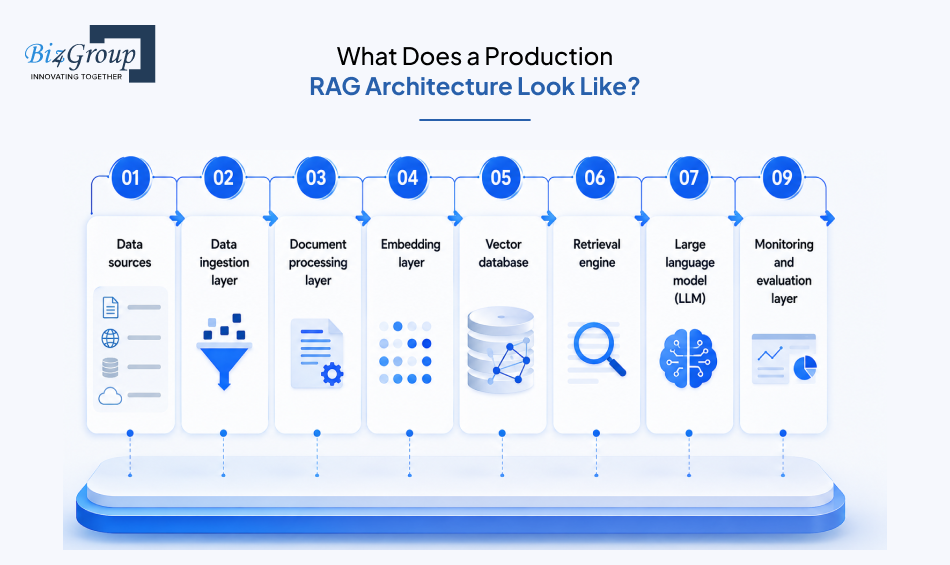
A production RAG architecture consists of interconnected components. They work together to ingest enterprise data, retrieve the most relevant information, generate context-aware responses, and continuously monitor system performance. Unlike a proof of concept, a production architecture is designed to support scalability, security, enterprise integrations, and reliable retrieval across large volumes of business data.
If this sounds familiar, "I built a RAG demo in a weekend using a tutorial, but I have no idea what a real production version is supposed to look like. What am I missing?", then you are in the right place.
A proof of concept demonstrates that RAG works. A production system expands that foundation with secure data pipelines, retrieval optimization, access controls, monitoring, and infrastructure capable of supporting real business workloads.
A typical production architecture includes the following building blocks:
- Data sources: Enterprise knowledge stored in SharePoint, Confluence, Google Drive, CRM platforms, databases, APIs, cloud storage, PDFs, websites, and other internal systems.
- Data ingestion layer: Connects with these sources, imports content, detects updates, and keeps the knowledge base synchronized.
- Document processing layer: Cleans, structures, and prepares raw content for retrieval by handling formatting, metadata, OCR, and content normalization.
- Embedding layer: Converts processed content into vector representations that preserve semantic meaning rather than exact keyword matches.
- Vector database: Stores embeddings and enables fast semantic retrieval across millions of documents.
- Retrieval engine: Identifies the most relevant content based on the user's query and prepares contextual information for the language model.
- Large language model (LLM): Uses the retrieved context to generate responses that are grounded in enterprise knowledge instead of relying solely on pre-trained information.
- Monitoring and evaluation layer: Tracks response quality, latency, retrieval performance, system health, and user feedback to support continuous improvements.
Although these components appear straightforward, each one directly affects the system's accuracy, scalability, security, and operational cost. A weak retrieval strategy, incomplete document processing, or poor metadata design can reduce answer quality, even when using a state-of-the-art language model.
Now, let's look at how documents are chunked before they ever reach the vector database.
So... Is RAG Actually the Right Fit for Your Business?
Let's map your use case before you commit time, budget, or engineering resources.
Let's Figure It OutHow Does a RAG System Work?
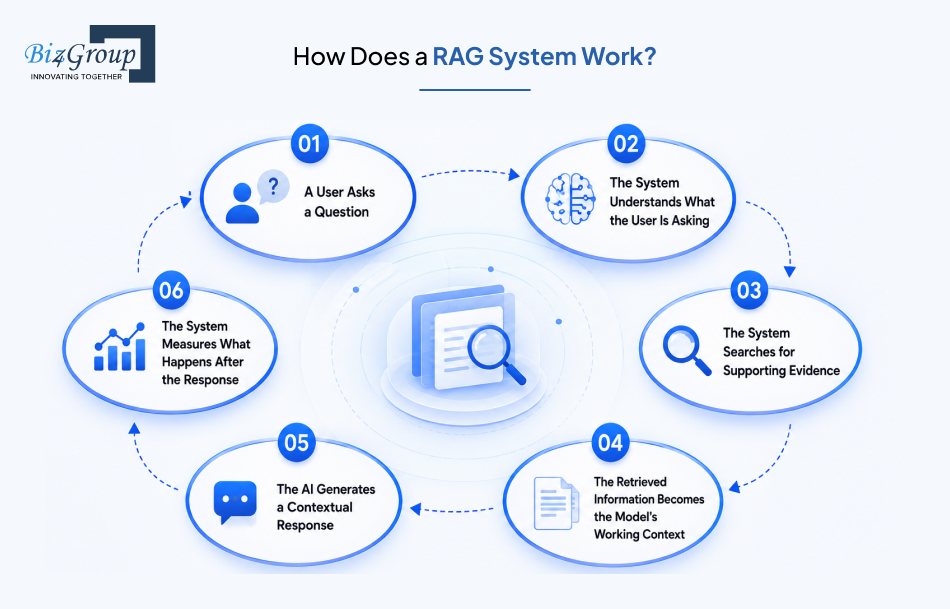
A RAG system works by retrieving the most relevant information from an organization's knowledge base before sending that information to a large language model (LLM) to generate a response. Instead of relying only on pre-trained knowledge, the AI grounds its answers in real-time, organization-specific data, making responses more accurate, contextual, and verifiable.
"Can you walk me through exactly what happens between when a user types a question and when they get an answer in a RAG system?" The easiest way to understand it is this... a RAG system searches first and writes second.
From the user's perspective, the interaction feels almost identical to chatting with any AI assistant. Behind the scenes, however, every question follows a structured workflow.
1. A User Asks a Question
Every interaction starts with a natural language query.
"What's our enterprise refund policy?"
"Which version of the API supports OAuth 2.0?"
At this stage, the system doesn't attempt to answer immediately. It first determines whether the question requires information from the organization's knowledge sources.
2. The System Understands What the User Is Asking
Before searching through documents, the query is analyzed to understand its intent. Depending on the implementation, the system may:
- Identify the main topic or entities.
- Detect the user's role or permissions.
- Recognize product names, departments, or business terms.
- Rewrite ambiguous queries to improve search accuracy.
Think of this as refining the question before looking for an answer. A clearer query usually leads to better retrieval results.
3. The System Searches for Supporting Evidence
This is the defining stage of a RAG workflow. Instead of relying on the LLM's memory, the system searches connected business knowledge for information related to the user's request.
That information could come from:
- Internal documentation
- Product manuals
- SharePoint libraries
- CRM platforms
- Knowledge bases
- Cloud storage
- Enterprise databases
- Customer support documentation
Imagine asking a librarian where a specific clause appears in a legal handbook. The librarian doesn't memorize every page. They locate the relevant section first, then use that information to answer your question. A RAG system follows the same principle. It retrieves evidence before generating a response.
4. The Retrieved Information Becomes the Model's Working Context
The retrieved content is then provided to the language model as reference material. Instead of generating an answer from general knowledge alone, the model now has access to business-specific information that's relevant to the current query.
This approach helps:
- Improve factual accuracy.
- Reflect recent business updates.
- Reduce responses based on outdated information.
- Ground answers in trusted enterprise content.
The model is still responsible for writing the response, but the retrieved context significantly influences what it says.
5. The AI Generates a Contextual Response
With the relevant information available, the language model generates a response that's tailored to the user's question. Many production systems also include:
- Source citations.
- Links to original documents.
- Confidence indicators.
- Follow-up recommendations.
These additions help users verify the information instead of accepting every response at face value.
6. The System Measures What Happens After the Response
Generating an answer isn't the end of the process. Production deployments continuously monitor how the system performs by tracking:
- Retrieval accuracy.
- Response quality.
- User feedback.
- Failed searches.
- Response latency.
- Frequently asked questions.
These insights help teams identify weak retrieval patterns, outdated knowledge sources, and opportunities to improve future responses.
A RAG system doesn't make an LLM smarter. It makes the LLM better informed by supplying relevant business knowledge before it generates an answer. That's why two applications using the same language model can produce completely different results. The quality of the retrieval process often has a greater impact than the choice of LLM itself.
Now let's explore how industries optimize a production-ready RAG application.
Which Business Use Cases Benefit Most from RAG?
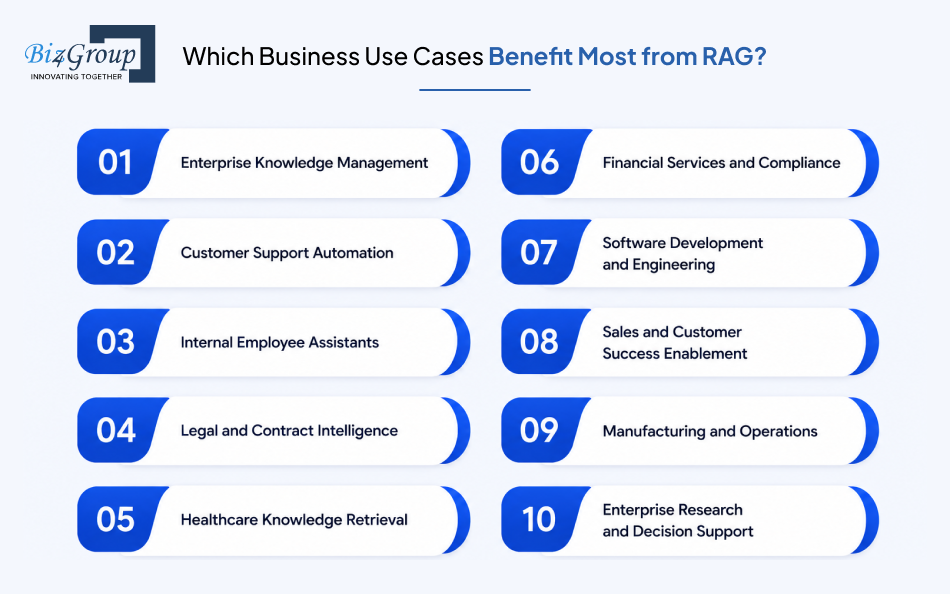
RAG delivers the greatest value in business scenarios where users need fast, accurate access to large volumes of frequently changing, organization-specific information. It's particularly effective for applications that rely on internal documents, knowledge bases, support content, policies, technical documentation, or enterprise systems that traditional keyword search and standalone LLMs struggle to handle reliably.
If this occurs to you often, "We have thousands of support tickets and product documents scattered across different systems. Is this actually a good fit for RAG, or are we chasing another AI trend?", then the answer in most cases is yes.
A simple rule of thumb is this... if your business knowledge changes regularly, lives in multiple systems, and needs to be retrieved accurately, RAG is likely a better fit than a standalone LLM or traditional keyword search.
Here are some of the most impactful use cases.
1. Enterprise Knowledge Management
Large organizations often store information across SharePoint, Confluence, Google Drive, Notion, internal wikis, emails, and document repositories. Finding the right document can take longer than solving the actual problem.
How RAG works in this scenario:
- Connects with multiple enterprise repositories.
- Retrieves only the most relevant documents for each query.
- Combines information from different sources into a single response.
- Links back to the original documents for verification.
Example: Instead of searching five different platforms for the latest travel reimbursement policy, an employee simply asks: "What's our international travel reimbursement policy for directors?"
The assistant retrieves the latest policy, summarizes the relevant section, and provides a link to the source document.
Biz4Group has also developed a custom enterprise AI agent that helps employees retrieve business knowledge from internal systems through natural language conversations.
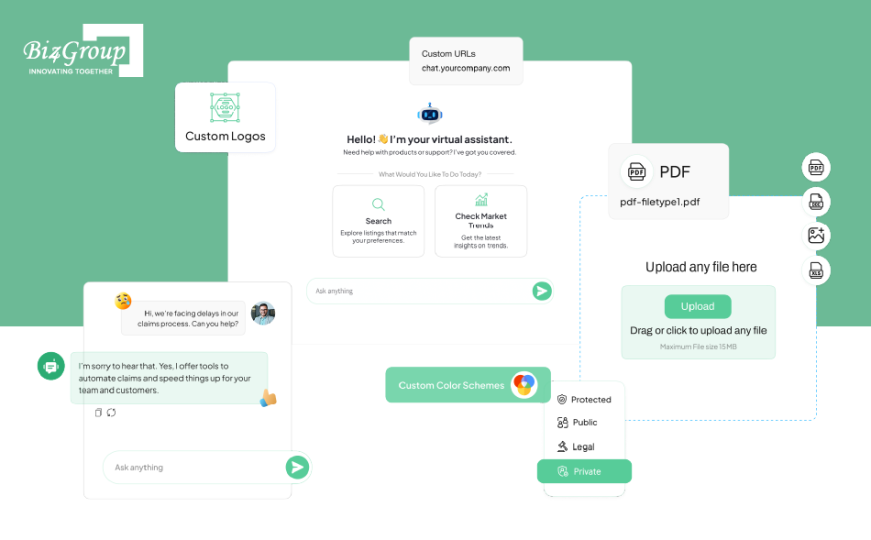
Custom enterprise AI agent securely connects with enterprise knowledge repositories and business applications, allowing employees to access policies, operational documents, HR resources, legal information, and internal documentation without manually searching across multiple platforms.
Key highlights:
- AI-powered enterprise knowledge assistant.
- Secure retrieval from internal business systems and knowledge bases.
- Integration with enterprise applications and third-party platforms.
- Role-based access control for secure information access.
- Enterprise-grade architecture designed for scalable deployments.
- Workflow automation to improve employee productivity.
This implementation demonstrates how organizations can centralize enterprise knowledge, reduce information silos, and provide employees with faster access to trusted business information.
2. Customer Support Automation
Support teams deal with product manuals, troubleshooting guides, FAQs, release notes, and previous support cases. Without retrieval, AI often provides generic troubleshooting advice.
How RAG works in this scenario:
- Retrieves the latest product documentation.
- References recently released features.
- Uses verified troubleshooting steps.
- Includes links to support articles when needed.
Example:
A customer asks: "Why is Single Sign-On failing after upgrading to Version 4.2?"
The assistant retrieves documentation specific to Version 4.2 instead of generating a generic authentication response.
Biz4Group developed Insurance AI, a custom AI solution designed to modernize insurance operations through intelligent automation and enterprise AI capabilities.
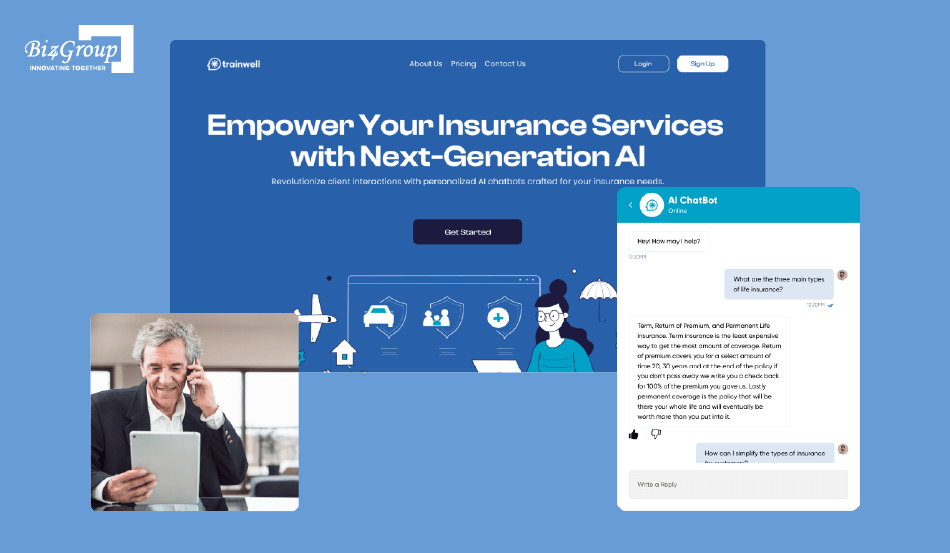
With the help of Insurance AI, agents and support teams can instantly retrieve policy information and internal documentation through conversational AI. It eliminates the need to manually search for lengthy policy documents while improving response accuracy and customer service.
Key highlights:
- AI-powered conversational assistant for insurance operations.
- Instant retrieval of policy documents and internal knowledge.
- Context-aware responses using enterprise data.
- Reduced manual document searches for support teams.
- Secure architecture built for enterprise environments.
- Improved agent productivity and faster customer response times.
This project highlights how RAG-powered AI can enhance customer support by delivering faster, more accurate answers from trusted enterprise knowledge sources.
3. Internal Employee Assistants
Employees ask repetitive questions every day about HR policies, IT procedures, procurement, compliance, and company operations.
How RAG works in this scenario:
- Searches internal policy documents.
- Applies department-based permissions.
- Retrieves the latest approved procedures.
- Delivers conversational answers instead of document links.
Example: If a business owner asks, "Can contractors access our VPN from personal devices?"
The assistant retrieves the latest IT security policy and explains the approved process.
4. Legal and Contract Intelligence
Legal teams review thousands of contracts, NDAs, vendor agreements, and regulatory documents. Manual searching is time-consuming and increases the risk of overlooking important clauses.
How RAG works in this scenario:
- Retrieves relevant contract clauses.
- Compares similar agreements.
- Surfaces regulatory references.
- Identifies supporting documents for legal review.
Example: When a RAG gets asked "Show termination clauses in vendor contracts signed during the last three years."
Instead of reviewing hundreds of agreements manually, legal teams receive the most relevant clauses within seconds.
5. Healthcare Knowledge Retrieval
Healthcare organizations continuously update clinical guidelines, operational procedures, and medical documentation. Using outdated information can have serious consequences.
How RAG works in this scenario:
- Retrieves the latest approved clinical guidance.
- Searches hospital knowledge repositories.
- References updated treatment protocols.
- Limits access based on user roles.
Example:
A clinician asks about the latest protocol for post-operative infection prevention and receives information from the hospital's most recent approved documentation rather than outdated reference material.
Biz4Group developed the National Veteran Homeless Support (NVHS) AI Assistant, an enterprise AI solution designed to simplify access to essential veteran support services through conversational AI.
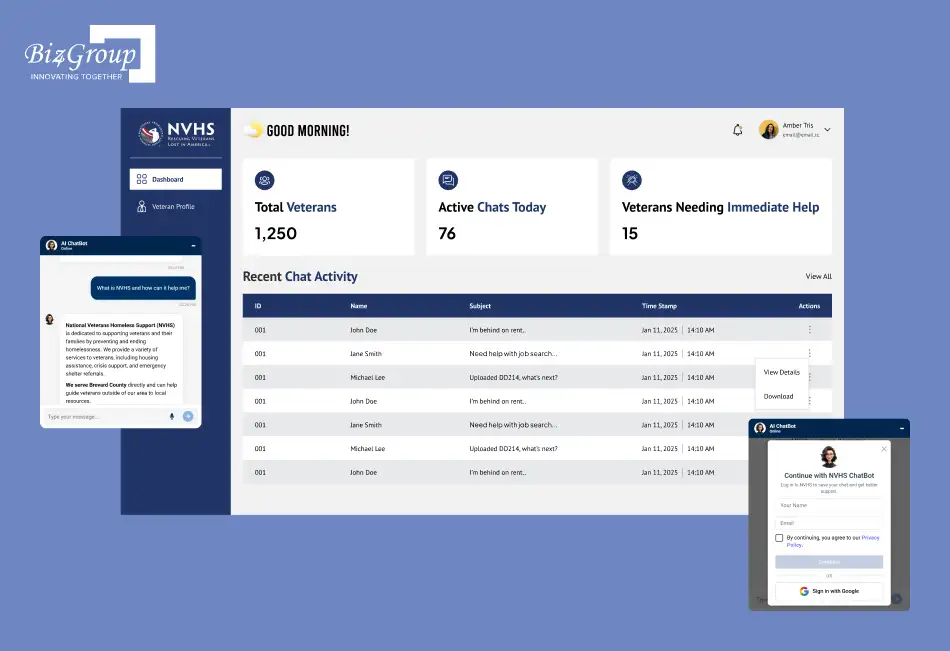
With the help of the NVHS AI Assistant, veterans can access housing assistance, healthcare services, legal aid, employment resources, and crisis intervention programs using natural language queries instead of navigating multiple government websites or support organizations. The platform retrieves trusted, up-to-date information and delivers personalized recommendations based on individual needs.
Key highlights:
- AI-powered conversational assistant for veterans.
- Intelligent retrieval of healthcare, housing, legal, and community resources.
- Personalized recommendations based on user needs and location.
- Voice and text interactions for greater accessibility.
- Secure case management and resource navigation.
- Scalable platform designed for public service organizations.
This implementation demonstrates how RAG-powered AI can improve access to essential public services by connecting users with accurate, up-to-date information when they need it most.
6. Financial Services and Compliance
Banks and insurance providers manage regulatory updates, internal policies, customer documentation, and compliance procedures.
How RAG works in this scenario:
- Retrieves current compliance policies.
- References applicable regulations.
- Searches internal operational manuals.
- Maintains permission-aware access to sensitive information.
Example:
A compliance officer asks: "Which AML verification steps changed after our latest policy update?"
The assistant summarizes the revised policy and highlights the specific sections that changed.
7. Software Development and Engineering
Engineering teams maintain API documentation, architecture decisions, coding standards, release notes, and incident reports. Developers lose valuable time searching for technical information.
How RAG works in this scenario:
- Searches engineering documentation.
- Retrieves architecture decisions.
- References API specifications.
- Combines related technical documents into one response.
Example: When a RAG get asked, "Which authentication method should new microservices use?"
The assistant retrieves the latest engineering standards and links to the implementation guide.
8. Sales and Customer Success Enablement
Sales teams need instant access to pricing documents, product updates, competitive intelligence, and proposal templates.
How RAG works in this scenario:
- Retrieves approved pricing information.
- Searches sales playbooks.
- References the latest product releases.
- Surfaces customer success documentation.
Example: Before a customer meeting, a sales representative asks: "Which healthcare case studies match a 500-bed hospital?"
The assistant retrieves relevant case studies, implementation summaries, and approved sales collateral.
9. Manufacturing and Operations
Manufacturers manage equipment manuals, maintenance procedures, quality standards, and safety documentation across multiple facilities.
How RAG works in this scenario:
- Retrieves equipment-specific manuals.
- References maintenance schedules.
- Searches quality control procedures.
- Surfaces safety guidelines for technicians.
Example: A maintenance engineer asks: "What's the recommended inspection sequence for CNC Machine A-104 after 5,000 operating hours?"
The assistant retrieves the exact maintenance procedure and supporting documentation instead of requiring manual searches through hundreds of pages.
10. Enterprise Research and Decision Support
Executives and analysts often need answers that combine information from reports, presentations, market research, and internal business documents.
How RAG works in this scenario:
- Retrieves information from multiple knowledge sources.
- Combines related findings into a single response.
- References original reports for validation.
- Highlights conflicting information when necessary.
Example: An executive asks: "What were the top three customer complaints across North America during the last two quarters, and what actions were recommended?"
Instead of opening multiple dashboards and reports, the assistant retrieves the relevant findings, summarizes recurring issues, and links to the supporting documents.
The strongest RAG use cases are defined by the need to retrieve accurate, up-to-date, and organization-specific knowledge from multiple sources. If your users spend more time searching for information than acting on it, a well-designed RAG solution can significantly improve productivity, decision-making, and customer experiences.
Don't Build Another AI Demo. Build Something People Will Actually Use.
We'll help you turn your proof of concept into a production-ready RAG solution.
Start the ConversationWhat Core Features Should Every RAG Solution Include?
Every production-ready RAG solution should include features that enable accurate knowledge retrieval, secure access to enterprise data, seamless integration with existing systems, and continuous performance monitoring. These capabilities form the foundation of a reliable RAG application, it ensures accurate deliver, context-aware responses while meeting enterprise requirements for scalability, security, and long-term maintainability.
If you are wondering, "Before we approve this project, what are the non-negotiable features our RAG system needs to have to actually be safe to use with customers?" That's the right question to ask because a production-ready solution isn't defined by the LLM it uses or the framework behind it.
It's defined by the capabilities that keep the system accurate, secure, and dependable as your business grows. If these foundational features are missing, the application may work during a demo, but it will struggle to meet the demands of real-world enterprise environments.
The easiest way to evaluate a RAG solution is to look at three areas:
- User experience: Can people find accurate information naturally?
- Enterprise readiness: Can the system protect business data while connecting with existing tools?
- Operational reliability: Can it continue performing as documents, users, and workloads increase?
Here the table explores core features every production RAG Solution should include:
|
Core Feature |
What It Does |
Why It Matters |
|---|---|---|
|
Natural Language Query Processing |
Understands conversational questions and user intent instead of relying on exact keyword matches. |
Makes the system intuitive to use and improves search accuracy for both technical and non-technical users. |
|
Semantic Search |
Retrieves information based on meaning, context, and relationships between concepts. |
Helps users find the right information even when their wording differs from the source documents. |
|
Context-Aware Response Generation |
Combines the user's query with retrieved business knowledge to generate relevant, grounded responses. |
Produces answers that are specific to the organization's data instead of relying only on the LLM's training. |
|
Source Citations |
Displays the documents or knowledge sources used to generate each response. |
Builds trust, supports compliance, and allows users to verify the information. |
|
Conversation Context Retention |
Maintains context across follow-up questions within the same conversation. |
Creates a natural chat experience without requiring users to repeat previous queries. |
|
Multi-Source Data Integration |
Connects with knowledge stored across document repositories, databases, cloud storage, APIs, CRM, ERP, and business applications. |
Eliminates information silos and enables AI to retrieve knowledge from across the organization. |
|
Multi-Format Document Support |
Processes structured and unstructured content such as PDFs, Word files, spreadsheets, presentations, emails, HTML pages, and databases. |
Expands the amount of enterprise knowledge available for retrieval without extensive manual conversion. |
|
Role-Based Access Control (RBAC) |
Applies existing user permissions before retrieving or displaying information. |
Prevents unauthorized access to confidential business data and supports enterprise governance. |
|
Metadata-Based Filtering |
Filters retrieved content using attributes like department, product, document type, location, version, or date. |
Improves retrieval precision and helps users receive information relevant to their specific context. |
|
Real-Time Knowledge Synchronization |
Detects additions, updates, and deletions in connected knowledge sources and keeps the index current. |
Ensures users always receive answers based on the latest approved business information. |
|
API & Enterprise System Integration |
Integrates the RAG solution with enterprise software, workflows, and business applications through APIs. |
Embeds AI into existing business processes instead of creating another standalone application. |
|
Security & Compliance Controls |
Supports authentication, encryption, audit logging, data governance, and AI compliance policies. |
Enables organizations to deploy AI securely in regulated and security-sensitive environments. |
|
Performance Monitoring & Analytics |
Measures retrieval accuracy, response quality, latency, user activity, and system health. |
Helps teams identify bottlenecks, optimize performance, and maintain a reliable user experience. |
|
User Feedback & Continuous Improvement |
Captures user ratings, corrections, and feedback to improve retrieval quality over time. |
Provides measurable insights that help refine prompts, data quality, and retrieval strategies. |
|
Scalability |
Handles growing volumes of documents, users, and concurrent requests without compromising performance. |
Allows the solution to support enterprise growth without requiring major architectural changes. |
Every production-ready RAG solution should provide a seamless user experience, enterprise-grade security, and reliable operational performance. These capabilities form the foundation of a trustworthy system. Once they're in place, organizations can begin evaluating advanced capabilities that improve retrieval accuracy, reasoning, and automation without adding unnecessary complexity too early.
Next, let's dive into the advanced features that enhance your RAG implementation.
Which Advanced RAG Features Are Worth Implementing?
Advanced RAG features should be implemented only when they address a defined business requirement. Capabilities such as Agentic RAG, GraphRAG, multimodal retrieval, and AI agent development can significantly improve automation, reasoning, and retrieval quality. However, they also increase development complexity, infrastructure costs, and maintenance requirements.
If this question has crossed your mind, "Our engineering team wants to build Agentic RAG from day one. Is that overkill for a company our size?", then you would like to know that in many cases, the answer is yes.
A production-ready RAG system should first establish accurate retrieval, secure data access, and reliable performance. Advanced capabilities deliver the most value after the core system has been validated and there's a clear business case for expanding its functionality.
The following advanced features are worth considering as your RAG solution evolves.
|
Feature |
What It Does |
Best For |
|---|---|---|
|
Hybrid Search |
Combines semantic search with traditional keyword search for better retrieval accuracy. |
Large enterprise knowledge bases, compliance documents, technical documentation |
|
Re-ranking |
Reorders retrieved results to prioritize the most relevant content before sending it to the LLM. |
Customer support, legal research, enterprise search |
|
GraphRAG |
Connects relationships between entities to answer complex, multi-hop questions. |
Healthcare, legal, financial services, research |
|
Agentic RAG |
Allows AI agents to plan, reason, and execute multiple retrieval steps before responding. |
Workflow automation, research assistants, enterprise AI copilots |
|
Multimodal RAG |
Retrieves information from images, diagrams, videos, scanned documents, and other non-text sources. |
Manufacturing, healthcare, engineering, field operations |
|
Query Expansion |
Reformulates user queries to improve retrieval accuracy without requiring users to rephrase questions. |
Large document collections with inconsistent terminology |
|
Tailors responses based on user roles, preferences, location, or previous interactions. |
Enterprise assistants, employee portals, customer support |
|
|
Multi-Language Retrieval |
Retrieves and generates responses across multiple languages while preserving context. |
Global organizations serving multilingual users |
Advanced features should be introduced only after the core RAG system is stable and production-ready. Once the foundation is in place, organizations can expand their capabilities based on evolving business requirements and technical needs.
Let's look at the technology stack that powers a production-ready RAG application.
How Do You Choose the Right RAG Tech Stack?
A production-ready RAG tech stack combines frameworks, embedding models, vector databases, large language models, and supporting infrastructure. Together, these components retrieve, process, and generate accurate, context-aware responses. The right technology stack should align with your business requirements, deployment model, scalability goals, and internal technical expertise.
If this question has occurred to you as well, "We're deciding between LangChain and LlamaIndex for our project, and I can't tell which one actually fits our situation. I also don't have a DevOps team, so what vector database should I choose?", let's explore the answer.
It depends on your use case, team expertise, deployment preferences, and operational requirements. Organizations with limited DevOps resources often prefer managed services, while those requiring greater control may opt for self-hosted solutions.
A production-ready RAG solution typically consists of multiple technology layers, each responsible for a specific function within the retrieval pipeline. The table below outlines the technologies commonly used across enterprise RAG implementations.
|
Layer |
Popular Technologies |
Purpose |
|---|---|---|
|
Data Sources |
SharePoint, Confluence, Google Drive, Salesforce, SQL Databases, Amazon S3, REST APIs |
Acts as the foundation of the RAG system by supplying the enterprise knowledge that the AI retrieves. The quality, freshness, and organization of these sources directly influence response accuracy. |
|
Data Processing & Parsing |
Unstructured.io, Apache Tika, Azure AI Document Intelligence, Amazon Textract |
Extracts, cleans, and structures content from different file formats so it can be indexed efficiently. It also handles OCR, removes unnecessary formatting, and preserves document structure where possible. |
|
Embedding Models |
OpenAI, Voyage AI, Cohere, BAAI BGE, Jina AI |
Converts text into numerical vector representations that capture semantic meaning. This enables the system to retrieve information based on context instead of exact keyword matches. |
|
Vector Database |
Pinecone, Weaviate, Qdrant, Milvus, pgvector |
Stores embeddings and performs high-speed similarity searches across large knowledge bases. It's optimized for retrieving relevant information within milliseconds, even when millions of documents are indexed. |
|
Retrieval Layer |
BM25, Hybrid Search, Metadata Filtering |
Identifies and filters the most relevant information before it reaches the language model. A well-designed retrieval layer improves accuracy while reducing irrelevant context and unnecessary token usage. |
|
Reranking Models |
Cohere Rerank, BGE Reranker, Jina AI Reranker |
Evaluates the initially retrieved results and rearranges them so the most relevant information is passed to the LLM. This improves answer quality, especially in large document collections. |
|
Orchestration Framework |
LangChain, LlamaIndex, Haystack, DSPy |
Coordinates the entire RAG workflow by managing retrieval, prompt construction, tool execution, memory, and interactions between different services. |
|
Large Language Models |
GPT-4.1, Claude 4, Gemini 2.5, Llama 4, Mistral Large |
Generates the final response by combining the retrieved business context with the user's query. It transforms retrieved information into natural, conversational answers rather than performing the retrieval itself. |
|
Evaluation & Observability |
LangSmith, Langfuse, Arize Phoenix, TruLens |
Monitors retrieval quality, response accuracy, latency, hallucinations, and user feedback. These tools help teams evaluate system performance and continuously optimize production deployments. |
|
Deployment Infrastructure |
AWS, Microsoft Azure, Google Cloud, Kubernetes, Docker |
Hosts, secures, and scales the RAG application while managing compute resources, networking, storage, and availability for enterprise workloads. |
With the technology stack in place, the next step is understanding how a RAG solution is planned, developed, tested, and deployed.
How Do You Build a Production-Ready RAG System Step-by-Step?
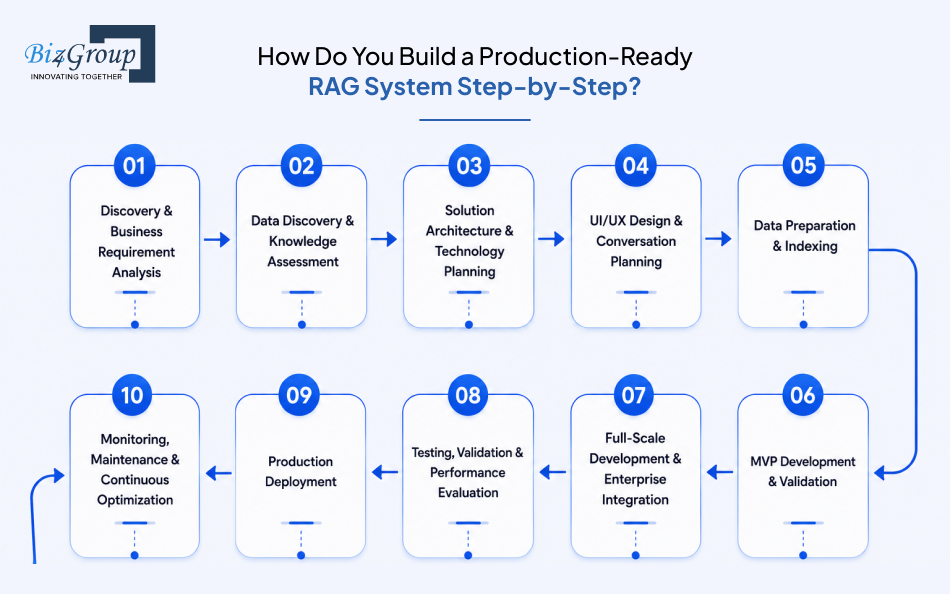
Building a production-ready RAG system follows a structured implementation process. It takes the solution from business requirements and architecture to deployment, monitoring, and continuous optimization. While timelines vary based on project scope and complexity, the core development phases remain largely the same.
If this question has crossed your mind, "If we started today, what would the actual timeline look like to get a RAG system live? I need a realistic project plan, not just someone telling me it'll take a few months" then here us out.
Every production-ready RAG development project moves through a series of implementation phases, with each phase preparing the foundation for the next.
The following roadmap outlines the typical development lifecycle of an enterprise RAG solution.
1. Discovery & Business Requirement Analysis
This phase focuses on understanding the business objectives, identifying the problem the AI solution will solve, and defining the overall project scope before development begins.
What happens during this phase?
- Identify business goals and AI use cases.
- Define target users and business workflows.
- Gather functional and technical requirements.
- Establish project scope and success metrics.
- Identify compliance and security requirements.
- Prepare the project roadmap.
2. Data Discovery & Knowledge Assessment
This phase evaluates the quality, structure, and availability of enterprise knowledge to determine what information the RAG system will retrieve.
What happens during this phase?
- Audit enterprise documents and repositories.
- Identify structured and unstructured data sources.
- Remove duplicate or outdated content.
- Identify knowledge gaps.
- Prioritize business-critical information.
- Review document ownership and update frequency.
3. Solution Architecture & Technology Planning
This phase defines the technical architecture of the RAG solution, including the technologies, infrastructure, security model, and integrations required for production deployment.
What happens during this phase?
- Design the system architecture.
- Select the LLM and embedding model.
- Choose the vector database.
- Finalize orchestration frameworks.
- Design the security architecture.
- Plan cloud or on-premises deployment.
- Define integration requirements.
4. UI/UX Design & Conversation Planning
This phase focuses on the UI/UX design of the RAG application, ensuring users can interact with the system through intuitive interfaces, seamless navigation, and well-structured conversation flows.
What happens during this phase?
- Design user journeys.
- Create wireframes and interactive prototypes.
- Design chat interfaces and dashboards.
- Define conversation flows.
- Plan citations and feedback mechanisms.
- Validate designs with stakeholders.
Also Read: Top 15 UI/UX Design Companies in USA
5. Data Preparation & Indexing
This phase prepares enterprise knowledge for retrieval by converting raw content into a structured, searchable format that the RAG system can understand.
What happens during this phase?
- Extract content from enterprise documents.
- Clean and standardize data.
- Generate metadata.
- Split documents into meaningful chunks.
- Generate vector embeddings.
- Index data in the vector database.
6. MVP Development & Validation
This phase focuses on MVP development by building the first functional version of the RAG application with essential features to validate the solution before moving to full-scale enterprise development.
What happens during this phase?
- Develop the core RAG workflow.
- Connect high-priority knowledge sources.
- Integrate the selected LLM and vector database.
- Build the core user interface.
- Validate retrieval quality and response accuracy.
- Conduct pilot testing with selected users.
- Collect stakeholder feedback.
- Prioritize features for the production release.
Also Read: 12+ MVP Development Companies in USA
7. Full-Scale Development & Enterprise Integration
After validating the MVP, this phase expands the solution into a production-ready application by adding enterprise integrations, advanced capabilities, and complete business workflows.
What happens during this phase?
- Build production-ready features.
- Integrate enterprise applications and APIs.
- Configure authentication and role-based access.
- Implement workflow automation.
- Develop administrative dashboards.
- Optimize application performance.
- Prepare the solution for enterprise-scale usage.
8. Testing, Validation & Performance Evaluation
This phase verifies that the RAG solution performs reliably, securely, and accurately before it is released into production.
What happens during this phase?
- Test retrieval accuracy.
- Validate response quality.
- Measure response latency.
- Perform security and penetration testing.
- Conduct load and scalability testing.
- Complete User Acceptance Testing (UAT).
- Resolve defects and optimize performance.
9. Production Deployment
This phase deploys the application into the production environment and prepares it for organization-wide use.
What happens during this phase?
- Deploy production infrastructure.
- Configure monitoring and logging.
- Enable backup and disaster recovery.
- Configure scaling policies.
- Perform final production validation.
- Launch the application.
10. Monitoring, Maintenance & Continuous Optimization
This ongoing phase ensures the RAG solution remains accurate, secure, and aligned with changing business requirements after deployment.
What happens during this phase?
- Monitor retrieval and application performance.
- Update and synchronize knowledge sources.
- Refresh embeddings when required.
- Optimize prompts and retrieval strategies.
- Analyze user feedback and usage patterns.
- Improve system performance.
- Introduce new integrations and features as business needs evolve.
Building a production-ready RAG solution is an iterative process rather than a one-time development effort. From business discovery and data preparation to deployment, monitoring, and governance, each phase contributes to a system that delivers accurate, secure, and scalable AI experiences. Skipping or rushing any phase often creates challenges that are far more expensive to fix after the solution goes live.
Next, let's look at the mistakes that can hinder effective RAG development.
Great AI Doesn't Guess. It Retrieves.
Let's build an enterprise RAG solution your teams can actually trust.
Build With Biz4GroupWhat Are the Most Common RAG Development Mistakes to Avoid?
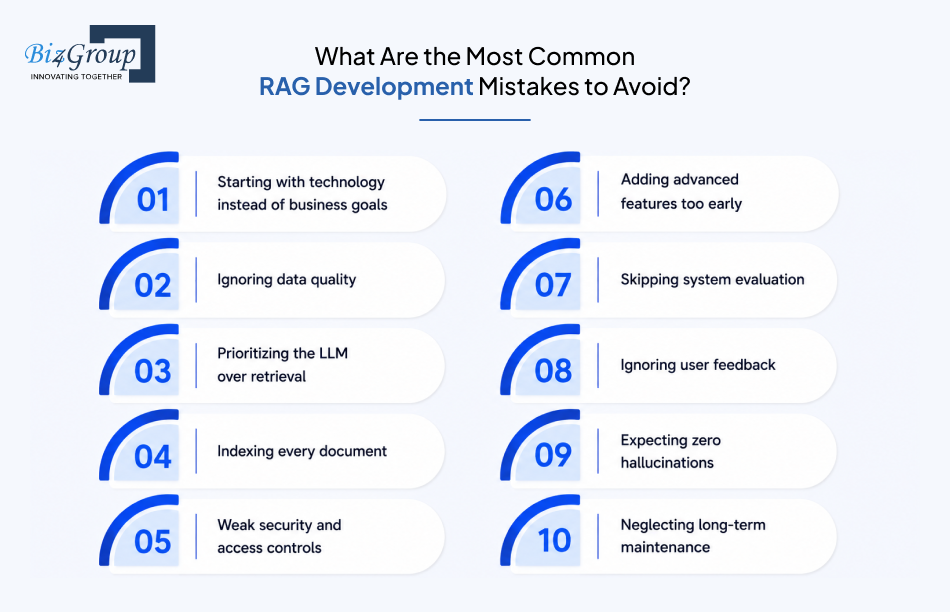
The most common RAG development mistakes include poor data quality, weak retrieval strategies, inadequate security, insufficient testing, and the lack of a long-term maintenance plan. Identifying these issues early helps improve implementation quality and reduce costly rework.
If this question has occurred to you as well, "We're about to start our first RAG project, and I want to know what mistakes other companies made so we don't repeat them", then the answer you're looking for is here.
Most implementation issues stem from decisions made during planning, data preparation, architecture, and deployment rather than the language model itself.
The table below outlines the most common RAG development mistakes, their impact, and how to avoid them.
|
Mistake |
Why It Happens |
Potential Impact |
How to Avoid It |
|---|---|---|---|
|
Starting with technology instead of business goals |
Business objectives aren't defined first. |
Low adoption and unclear ROI. |
Define business goals and success metrics first. |
|
Ignoring data quality |
Enterprise data isn't cleaned or validated. |
Inaccurate retrieval and responses. |
Audit, clean, and organize data before indexing. |
|
Prioritizing the LLM over retrieval |
Focus stays on model selection. |
Poor response quality despite a powerful LLM. |
Optimize retrieval, metadata, and document structure. |
|
Indexing every document |
All content is indexed without prioritization. |
Irrelevant results and retrieval noise. |
Index only relevant, trusted content. |
|
Weak security and access controls |
Permissions aren't planned early. |
Unauthorized access to sensitive data. |
Implement RBAC, encryption, and audit logs. |
|
Adding advanced features too early |
Teams overengineer the first release. |
Higher costs and longer development. |
Start with core RAG capabilities and iterate. |
|
Skipping system evaluation |
Demo results are treated as production-ready. |
Inconsistent accuracy after deployment. |
Validate with real-world test cases and metrics. |
|
Ignoring user feedback |
No process for post-launch improvements. |
Declining performance over time. |
Continuously monitor feedback and usage patterns. |
|
Expecting zero hallucinations |
Retrieval is expected to solve every error. |
Reduced user trust. |
Combine retrieval with citations and human review. |
|
Neglecting long-term maintenance |
Ongoing optimization isn't planned. |
Performance degrades as data evolves. |
Regularly update data, embeddings, and retrieval. |
Most RAG projects struggle because teams overlook foundational practices such as data quality, retrieval of optimization, security, evaluation, and ongoing maintenance. Addressing these areas early reduces implementation risks and creates a stronger foundation for a scalable, enterprise-ready solution.
Is Your AI Ready for Real Users... or Just Great Demos?
Let's design a RAG solution that performs beyond the prototype.
Let's Build It RightWhat Challenges Can You Expect During RAG Development?
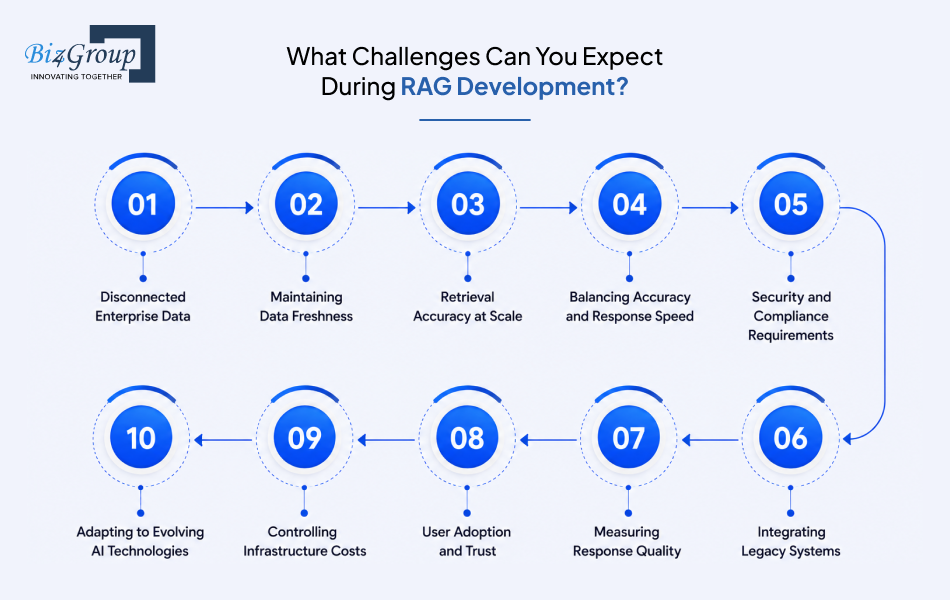
RAG development comes with both technical and operational challenges. These include fragmented enterprise data, maintaining retrieval accuracy, integrating legacy systems, meeting security requirements, and managing infrastructure at scale. These challenges are common in enterprise implementations and should be considered during project planning.
If this thought crosses your mind often, "Our data is spread across a dozen different systems. Even if we build everything correctly, what challenges should we expect during a RAG implementation? Then here is the answer for it.
Disconnected data, evolving business information, integration complexity, and performance at scale are challenges that most organizations encounter, regardless of their industry or technology stack.
The table below outlines the most common challenges in RAG development, their impact, and practical ways to address them.
|
Challenge |
Why It Happens |
How to Address It |
|---|---|---|
|
Disconnected Enterprise Data |
Business knowledge is distributed across multiple platforms and repositories. |
Build reliable integrations and establish a centralized retrieval strategy. |
|
Maintaining Data Freshness |
Documents, policies, and product information change frequently. |
Implement automated synchronization, scheduled indexing, and content governance. |
|
Retrieval Accuracy at Scale |
Growing document volumes make identifying the most relevant information more difficult. |
Continuously optimize retrieval logic, metadata, and indexing strategies. |
|
Balancing Accuracy and Response Speed |
Retrieving, processing, and generating responses all consume time. |
Optimize retrieval pipelines, caching, and infrastructure performance. |
|
Security and Compliance Requirements |
Sensitive business information requires strict governance and controlled access. |
Enforce authentication, role-based access, encryption, and audit logging. |
|
Integrating Legacy Systems |
Older enterprise applications often lack modern APIs or standardized data structures. |
Use middleware, custom connectors, or phased integration strategies. |
|
Measuring Response Quality |
AI-generated answers don't always have a simple right-or-wrong outcome. |
Define evaluation metrics and monitor retrieval quality continuously. |
|
User Adoption and Trust |
Employees may hesitate to rely on AI-generated responses. |
Provide source citations, gather user feedback, and educate users on how the system works. |
|
Controlling Infrastructure Costs |
Storage, inference, retrieval, and indexing costs increase as usage grows. |
Monitor usage patterns, optimize retrieval, and scale infrastructure strategically. |
|
Adapting to Evolving AI Technologies |
Models, frameworks, and best practices continue to evolve rapidly. |
Build modular architectures that allow components to be upgraded independently. |
Understanding these challenges helps organizations plan more effectively and build RAG solutions that remain reliable as business needs evolve.
The next step is applying the best practices that improve retrieval accuracy, system performance, and enterprise security.
Which Best Practices Improve Accuracy, Performance, and Security?
Building a production-ready RAG solution requires strong practices across the entire lifecycle. This includes maintaining quality data sources, optimizing retrieval, securing the system, monitoring performance, and keeping enterprise data current. Together, these practices help improve response accuracy, system reliability, and long-term scalability.
If you're curious about this as well, "Our RAG system is giving inconsistent answers, and we handle sensitive customer data. What practices actually improve accuracy without compromising security?", here us out.
The answer lies in strengthening the retrieval pipeline, securing access to enterprise data, and continuously monitoring system performance rather than relying solely on the language model.
The table below outlines the best practices that help build accurate, secure, and scalable RAG development solutions.
|
Best Practice |
Why It Matters |
Business Benefit |
|---|---|---|
|
Start With High-Quality Knowledge |
AI can only retrieve information that's available and trustworthy. |
Improves retrieval accuracy and user confidence. |
|
Define Clear Retrieval Strategies |
Different use cases require different retrieval approaches. |
Delivers more relevant responses while reducing unnecessary context. |
|
Apply Metadata Consistently |
Well-structured metadata improves document filtering and search precision. |
Faster and more accurate retrieval across large knowledge bases. |
|
Enforce Role-Based Access Control |
Sensitive information should only be accessible to authorized users. |
Strengthens security and supports compliance requirements. |
|
Continuously Evaluate Response Quality |
Production performance changes as data and user behavior evolve. |
Detects retrieval issues before they affect end users. |
|
Keep Knowledge Sources Updated |
Outdated content reduces response reliability. |
Ensures AI reflects the latest business information. |
|
Monitor System Performance |
Infrastructure and retrieval performance affect user experience. |
Maintains consistent response times and operational stability. |
|
Collect User Feedback |
End users often identify knowledge gaps before monitoring tools do. |
Supports continuous improvement and higher adoption. |
|
Optimize Infrastructure Costs |
AI workloads grow as adoption increases. |
Controls operational expenses without sacrificing performance. |
|
Design for Scalability |
Business knowledge, users, and workloads continue to expand. |
Reduces future migration effort and supports long-term growth. |
Applying these best practices helps organizations build RAG solutions that perform consistently in production and adapt as business requirements evolve.
After defining the implementation approach, it's time to estimate the cost of building a production-ready RAG solution.
How Much Does RAG Development Cost?
The cost of building a production-ready RAG solution typically ranges from $20,000 for a proof of concept (PoC) to over $300,000 for a large-scale enterprise implementation. The final investment depends on several factors. These include project scope, data complexity, enterprise integrations, deployment infrastructure, security requirements, and long-term maintenance.
If you've been looking for clarity on this, "We received a quote for $120,000 to build a RAG chatbot, but we have no idea whether that's reasonable. What actually drives the cost?"
Then you should know that in many cases, it can be. Two RAG projects using the same LLM can have significantly different budgets because implementation complexity, data readiness, integrations, and compliance requirements vary from one organization to another.
The following cost breakdown explains the typical investment required, the factors that influence pricing, hidden costs to plan for, and practical ways to optimize your budget.
|
Project Type |
Estimated Cost (USD) |
Best Suited For |
|---|---|---|
|
Proof of Concept (PoC) |
$20,000 to $50,000 |
Validating a single business use case before a larger investment. |
|
Minimum Viable Product (MVP) |
$50,000 to $100,000 |
Launching an internal assistant or customer-facing pilot with limited integrations. |
|
Enterprise Production Solution |
$100,000 to $300,000+ |
Organizations requiring enterprise integrations, compliance, scalability, and ongoing support. |
These are indicative estimates. The final investment varies based on project complexity, deployment model, and business requirements.
What Factors Influence RAG Development Cost?
The overall budget of RAG development depends on several technical and business decisions. Some increase one-time development costs, while others affect the total cost of ownership over the lifetime of the application.
|
Cost Factor |
Typical Cost Impact (USD) |
How It Impacts Cost |
|---|---|---|
|
Project Scope |
+$15,000 to $100,000+ |
Additional features, workflows, business units, and user roles require more development effort. |
|
Data Volume & Quality |
+$5,000 to $40,000 |
Cleaning, OCR, metadata creation, and document preparation increase implementation effort. |
|
Enterprise Integrations |
+$3,000 to $15,000 per integration |
Connecting CRMs, ERPs, APIs, databases, and enterprise applications adds development and testing time. |
|
Technology Stack |
+$5,000 to $50,000 |
Commercial models, managed services, premium embeddings, and enterprise tooling affect licensing and infrastructure costs. |
|
Security & Compliance |
+$10,000 to $60,000 |
Identity management, encryption, audit logging, and regulatory compliance require additional engineering. |
|
Application Development |
+$10,000 to $80,000 |
Custom portals, dashboards, APIs, workflow automation, and mobile applications increase development effort. |
|
Testing & Quality Assurance |
+$5,000 to $25,000 |
Retrieval validation, security testing, performance testing, and UAT extend implementation timelines. |
|
Infrastructure & Deployment |
+$3,000 to $20,000 |
Cloud provisioning, monitoring, storage, networking, and production deployment contribute to implementation costs. |
|
Post-Launch Maintenance |
15% to 25% of the initial project cost annually |
Covers monitoring, knowledge updates, optimization, infrastructure management, and security improvements. |
What Hidden Costs Should You Budget For?
Development is only one part of the investment. Once the system goes live, several recurring expenses become part of the total cost of ownership.
|
Hidden Cost |
Typical Ongoing Cost |
Why It Matters |
|---|---|---|
|
LLM API Usage |
$500 to $15,000+/month |
Costs increase with higher traffic, larger prompts, and premium language models. |
|
Embedding Generation |
$200 to $5,000 per indexing cycle |
New and updated documents require fresh embeddings before retrieval. |
|
Vector Database Storage |
$100 to $3,000+/month |
Larger knowledge bases require additional storage and indexing capacity. |
|
Cloud Infrastructure |
$500 to $10,000+/month |
Compute, storage, networking, backups, and autoscaling create recurring expenses. |
|
Knowledge Base Maintenance |
$2,000 to $15,000/month |
Documents need regular updates, reviews, metadata management, and synchronization. |
|
Monitoring & Observability |
$100 to $2,500+/month |
Monitoring platforms, logging, alerts, and evaluation tools often require paid subscriptions. |
|
Security Audits & Compliance |
$5,000 to $30,000/year |
Penetration testing, governance reviews, and compliance audits are recurring operational expenses. |
|
Performance Optimization |
$2,000 to $20,000/year |
Retrieval tuning, prompt optimization, and infrastructure improvements maintain response quality. |
|
Model Upgrades & Validation |
$3,000 to $25,000 per upgrade |
New models should be tested before replacing production deployments. |
How Can You Optimize RAG Development Costs?
Reducing costs doesn't always mean selecting the cheapest technology. It often comes down to controlling project scope, minimizing unnecessary infrastructure, and expanding the solution only after it demonstrates measurable business value.
- Start with a proof of concept before committing to enterprise deployment. This can avoid investing $50,000 to $250,000+ in a full-scale implementation before validating technical feasibility and business ROI.
- Launch an MVP before expanding across departments. A phased rollout can reduce initial development costs by 20% to 40%, allowing organizations to spread investment over multiple releases.
- Focus on high-value knowledge sources first. Prioritizing business-critical documentation can reduce data preparation costs by $5,000 to $30,000, depending on the size and condition of the knowledge base.
- Reuse existing cloud infrastructure whenever possible. Leveraging current cloud environments instead of building new infrastructure can lower deployment costs by 10% to 30%.
- Choose managed services if you have a small engineering team. Managed vector databases and hosted AI services can eliminate $20,000 to $80,000 per year in DevOps and infrastructure management costs.
- Monitor LLM token usage and API consumption. Optimizing prompts, limiting unnecessary context, and selecting the right model can reduce monthly inference costs by 10% to 35%.
- Introduce advanced capabilities in phases. Delaying features such as GraphRAG or agentic workflows until they're needed can postpone $15,000 to $75,000 in additional development costs.
- Continuously optimize retrieval performance. Improving retrieval quality often reduces unnecessary LLM calls, lowering monthly AI operating costs by 15% to 30% while improving response accuracy.
A well-planned budget helps prevent unexpected costs throughout the project lifecycle.
Now, let's compare your implementation options.
Still Thinking About That $120K Quote?
Let's break down what you're actually paying for and whether it fits your business.
Talk to an ExpertShould You Build In-House, Buy a Platform, or Partner with a RAG Development Company?
The right approach depends on your team's AI expertise, implementation timeline, and business goals. Here's a quick comparison to help you decide.
|
Option |
Best Suited For |
Key Advantages |
|---|---|---|
|
Build In-House |
Organizations with experienced AI and engineering teams |
Complete ownership, maximum customization, and full architectural control |
|
Buy a Platform |
Businesses looking for a quick, standardized solution |
Faster deployment, lower upfront investment, and vendor-managed infrastructure |
|
Partner with a RAG Development Company |
Enterprises requiring custom AI solutions and complex integrations |
Faster implementation, expert guidance, scalable architecture, and ongoing support |
Why Partner with Biz4Group for RAG Development Services?
With extensive experience of more than two decades, Biz4Group LLC, a leading AI development company in USA, helps organizations move from idea to production with scalable, secure, and business-focused RAG implementations. Our expertise extends beyond prototypes to enterprise-grade AI applications. We've developed solutions like the NVHS AI Assistant for public service organizations, Insurance AI for intelligent policy and knowledge retrieval, and a Custom Enterprise AI Agent for secure conversational access to organizational knowledge. Each project has addressed different business and technical challenges while following the same production-focused RAG principles.
Why businesses choose us:
- Custom RAG development services tailored to your business workflows.
- Expertise across LLMs, vector databases, enterprise integrations, and cloud platforms.
- End-to-end delivery, from consulting and architecture to deployment and optimization.
- Security-first development with enterprise-grade compliance and access controls.
- Proven experience building scalable enterprise RAG solutions across industries.
- Agile development process with transparent communication and faster time to market.
- Dedicated post-launch support, monitoring, and continuous optimization.
Whether you're validating an idea or scaling an enterprise AI initiative, Biz4Group can help you design, develop, and deploy a production-ready RAG solution that aligns with your business goals.
Get in touch with our AI experts today to discuss your requirements and receive a tailored RAG development roadmap.
What Does the Future of RAG Development Look Like?
The future of RAG development is focused on making enterprise AI more accurate, scalable, and deeply connected to business knowledge.
If you've had the same question, "Is RAG going to become obsolete once AI models have million-token context windows?" Then the answer is no.
Larger context windows improve model capacity, but they don't replace the need for retrieving current enterprise data, enforcing permissions, or maintaining compliance.
Here are the key trends shaping the future of RAG development.
|
Future Direction |
What It Means |
Business Impact |
|---|---|---|
|
Agentic RAG |
Agentic AI decides what information it needs and performs multiple searches before answering. |
More accurate and autonomous AI assistants. |
|
Multimodal RAG |
AI retrieves text, images, PDFs, diagrams, videos, and audio. |
Better support for technical, healthcare, and manufacturing industries. |
|
GraphRAG |
AI understands relationships between people, products, projects, and documents. |
Better business intelligence and analytics. |
|
Real-time RAG |
AI retrieves live data from databases and APIs. |
Always-current answers without retraining. |
|
Personalized RAG |
AI retrieves different information based on the user's role and permissions. |
Secure and personalized AI assistants. |
|
Hybrid RAG |
Combines keyword search with semantic search. |
More reliable search results. |
|
Self-improving RAG |
The retrieval system learns from feedback and improves over time. |
Better user experience with less manual tuning. |
|
Enterprise-wide RAG |
AI connects to all company systems. |
A single AI assistant for the whole organization. |
|
AI Agent + RAG |
RAG becomes one capability inside an AI agent that can also take actions. |
AI moves from answering questions to completing tasks. |
Building a flexible RAG architecture today makes it easier to adopt future AI advancements without redesigning the entire solution.
Final Thoughts
A year ago, the conversation was about whether businesses should adopt AI. Today, the question has shifted to if AI can reliably work with enterprise knowledge. That's where RAG continues to prove its value. It doesn't replace language models. It makes them useful in real business environments by grounding every response in the information your organization actually trusts.
The one takeaway you can have from this guide is this... a successful RAG implementation isn't defined by the LLM you choose. It's defined by the quality of your data, the strength of your retrieval pipeline, and the decisions you make long before the first prompt is ever written. Organizations that invest in these foundations are far more likely to build AI systems employees use confidently and customers can rely on.
If you're validating your first proof of concept or planning an enterprise-wide AI initiative, the goal shouldn't be to build the most advanced RAG application. It should be to build one that delivers measurable business value today while remaining flexible enough to evolve tomorrow.
For anyone who is looking for a technology partner that understands both the business and technical side of RAG development services, Biz4Group LLC can help you design, develop, and scale a solution tailored to your enterprise needs.
Have a RAG project in mind? Let's discuss your business goals, evaluate your requirements, and build a solution that delivers measurable results.
FAQs
1. Can a RAG system work with private documents that aren't connected to the internet?
Yes. A RAG system can retrieve information from private documents stored in internal databases, cloud storage, on-premises servers, SharePoint, Confluence, or other enterprise repositories. Since the retrieval process is based on your organization's knowledge sources, internet access isn't required unless your implementation specifically connects to external data.
2. How often should a RAG knowledge base be updated?
The update frequency depends on how often your business information changes. Organizations with rapidly changing documentation may update their knowledge base daily or in real time, while others may schedule updates weekly or monthly. Automating document synchronization helps keep responses accurate without manual intervention.
3. Can a RAG solution support multiple languages?
Yes. Modern RAG systems can retrieve and generate responses in multiple languages by using multilingual embedding models and LLMs. This makes them suitable for global organizations that serve multilingual employees or customers.
4. Can a RAG application integrate with Microsoft 365, Salesforce, or SharePoint?
Yes. Most enterprise RAG applications can integrate with platforms such as Microsoft 365, SharePoint, Salesforce, Google Drive, Slack, Confluence, and other business systems through APIs or native connectors. These integrations allow the AI to retrieve information from existing enterprise knowledge sources.
5. How many documents can a production RAG system handle?
There's no fixed limit. The number of supported documents depends on the vector database, infrastructure, indexing strategy, and retrieval architecture. Enterprise RAG systems can scale from a few thousand documents to millions of indexed records while maintaining efficient retrieval performance.
6. Do RAG systems require internet access to answer user questions?
Not necessarily. If the required information exists within the organization's internal knowledge base, the system can retrieve and generate responses without accessing the public internet. Many enterprise deployments operate entirely within private cloud or on-premises environments.
7. Can a RAG solution be integrated into an existing application?
Yes. Most RAG application development services include API-based integrations that allow AI capabilities to be added to existing web applications, mobile apps, customer portals, employee platforms, and enterprise software without rebuilding the entire application.
8. How do you measure the success of a RAG implementation?
The success of retrieval augmented generation development services is typically measured using metrics such as retrieval accuracy, response quality, user adoption, response time, task completion rate, customer satisfaction, and reductions in manual search effort or support ticket volume.
9. What ongoing costs should businesses expect after launching a RAG solution?
Beyond the initial development investment, organizations should budget for cloud infrastructure, LLM API usage, vector database hosting, monitoring tools, knowledge base updates, security maintenance, and periodic model or infrastructure upgrades. These operational costs vary based on usage, deployment model, and data volume.
10. Can a small business afford custom RAG development services?
Yes. Many providers offer custom RAG development services that begin with a proof of concept or MVP before expanding into a full-scale deployment. Depending on the scope and complexity, pilot projects typically start at $20,000 to $50,000, making custom retrieval augmented generation development services for enterprises accessible to businesses that want to validate ROI before scaling.
