 Location :
Orlando, FL, USA
Location :
Orlando, FL, USA +1 (407) 714-1616
 info@biz4group.com

 AI Summary Powered by Biz4AI
- Connect approved underwriting, source documents, IC memos, reviewer comments, and final decisions in one workflow.
- Use AI for financial spreading, NOI normalization, credit metrics, exception flags, and first-draft IC memos.
- Keep every key IC figure traceable to its underwriting input and original source document.
- Route deals by size, leverage, risk, strategy, and exceptions, with clear reviewers and approval steps.
- Custom underwriting-to-IC platforms can cost $40,000–$300,000, with focused pilots possible in 16–40 developer hours.
- Biz4Group builds AI workflows around business rules, documents, integrations, and human decisions, which fits CRE underwriting and IC approval needs.
Once a CRE deal is fully underwritten, the team still has to move that work into investment committee review. A CRE acquisitions workflow platform for underwriting and IC approval keeps the approved underwriting, IC memo, reviewer comments, and final decision connected to the same deal record.
That matters as AI becomes part of everyday CRE work. A May 2026 study from First American Data & Analytics and DealGround found that 66% of surveyed CRE professionals use AI weekly or daily, while only 5% trust it enough to inform real deal decisions. Another 53% use AI for support while keeping it out of final decision-making.
For acquisitions teams, the practical questions are straightforward.
- Can the platform separate source data from analyst adjustments?
- Can it lock the version submitted to IC while analysts continue working on new scenarios?
- Can it flag a changed assumption before an outdated figure reaches the memo?
- When a committee member questions a number, can the team trace it back to the rent roll, T-12, or another source?
The same standard applies to AI-powered investment committee memo generation software. The memo needs to stay tied to approved underwriting, supporting documents, assumptions, and reviewer decisions.
At Biz4Group LLC, when we build AI products around approval workflows, the memo itself is rarely where things go wrong. The version is. An analyst revises the exit cap rate after a reviewer comment, the model updates, and the memo still shows the old return. That is why we tie every memo figure to a locked underwriting version, so any change is visible, traceable, and reflected before the committee meets.
The committee shouldn't have to wonder which version of the deal it's voting on.
Why Do Underwriting and IC Memo Preparation Stay Disconnected in Most Acquisitions Teams?
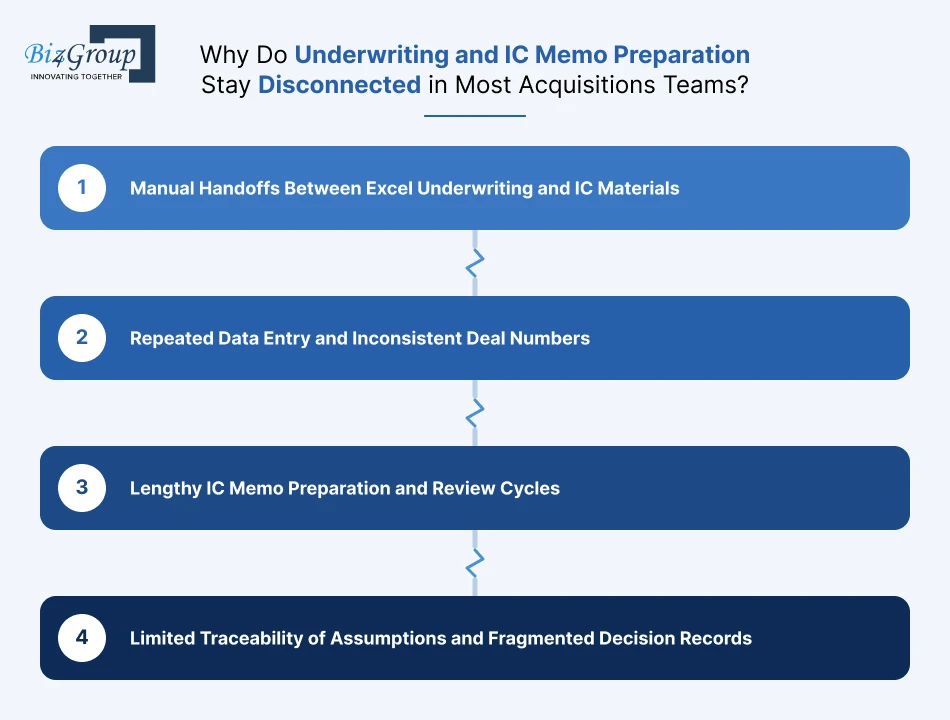
They stay disconnected because the work usually happens in different tools and at different stages. The analyst works in Excel, the IC memo gets built in another file, and approvals often happen through email or a deal system. There is no single workflow carrying the numbers, assumptions, supporting documents, and decisions from underwriting to IC.
Manual Handoffs Between Excel Underwriting and IC Materials
The analyst finishes the Excel model, then someone else copies the key figures into the IC memo and presentation. Purchase price, NOI, debt, returns, assumptions, and risks all have to be moved across manually.
If the model changes later, the memo needs to be checked and updated again. That is an easy place for an old number to slip through.
Repeated Data Entry and Inconsistent Deal Numbers
The same figures can show up in the model, memo, presentation, CRM, and email threads.
Typical examples include:
- Purchase price and cap rate
- Normalized NOI
- Debt amount, LTV, DSCR, and debt yield
- Exit assumptions and projected returns
Change one assumption and different files can quickly end up showing different numbers.
Lengthy IC Memo Preparation and Review Cycles
An IC memo brings together financial results, the investment thesis, risks, assumptions, and supporting information. Pulling all of that together manually takes time.
AI can create a first draft from approved underwriting data, giving the analyst a starting point for review and editing.
A common question from acquisitions teams is how much of the IC memo process AI can actually take off an analyst's plate. One version of that question comes up like this:
“Our investment committee memos take days to prepare because an analyst has to pull numbers from the model, write the narrative, and format everything by hand, and I want to understand how AI can generate a first draft of this automatically.”
AI can generate a first IC memo draft from approved underwriting data, including financial sections, assumptions, risks, and the investment narrative. The analyst then reviews and edits the draft before it goes to IC.
Limited Traceability of Assumptions and Fragmented Decision Records
When an IC member asks, “Where did this number come from?”, the answer should be easy to find. The figure should connect back to its source document and any adjustment made during underwriting.
The same goes for the final decision. Reviewer comments, approval conditions, and the IC decision should stay with the deal instead of being spread across emails and meeting notes.
What Does the Underwriting-to-IC Approval Workflow Look Like?
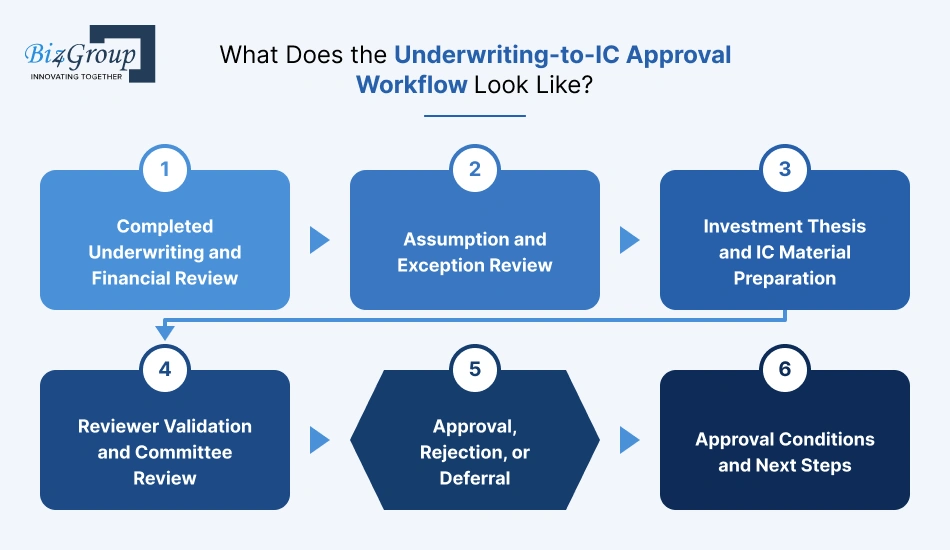
The workflow moves a deal through six connected stages: finalize the underwriting, review assumptions and exceptions, prepare the IC case, validate it, record the committee decision, and track any conditions. The same approved deal data should carry through each stage.
Completed Underwriting and Financial Review
The team starts with a completed underwriting case covering property performance, normalized NOI, financing, leverage, returns, and exit assumptions.
Before IC preparation, the platform should identify the approved version and inputs that will be used throughout the review. Analysts can continue running scenarios without changing the version submitted to IC.
Assumption and Exception Review
The team checks assumptions that could materially change the deal, such as rent growth, vacancy, expenses, exit assumptions, and leverage.
The platform can flag missing data, conflicting figures, unusual assumptions, or differences between source documents and the model. Analysts then resolve or explain those items.
Investment Thesis and IC Material Preparation
The approved underwriting becomes the basis for the IC package. It typically combines financial results with the investment thesis, key risks, assumptions, SWOT analysis, and supporting evidence.
AI can create a first draft from the approved data while the acquisitions team remains responsible for the investment narrative.
Reviewer Validation and Committee Review
The package moves through the firm's review structure based on deal size, risk, and reviewer roles. Reviewers can check numbers, assumptions, risks, and supporting documents while keeping their comments against the deal.
If someone asks, "Where did this number come from?", the workflow should make the source easy to find.
Approval, Rejection, or Deferral
The IC records one of three outcomes:
- Approve: Move the acquisition forward.
- Reject: Stop pursuing the deal.
- Defer: Complete additional work before deciding.
The decision record should include the submitted deal version, date, reviewers, and relevant comments.
Approval Conditions and Next Steps
An approval may include conditions such as revised pricing, additional diligence, or changes to financing.
Each condition should become a tracked action with an owner and deadline, keeping the IC decision connected to the work that follows.
|
Stage |
Main Focus |
Typical Output |
|---|---|---|
|
1. Underwriting Review |
Validate financials and approved inputs |
Final underwriting version |
|
2. Assumption & Exception Review |
Check risks, conflicts, and key assumptions |
Resolved or documented exceptions |
|
3. IC Preparation |
Turn approved data into the investment case |
IC memo and supporting materials |
|
4. Reviewer Validation |
Review numbers, risks, and evidence |
Reviewer comments and cleared issues |
|
5. IC Decision |
Approve, reject, or defer the deal |
Recorded IC decision |
|
6. Follow-Through |
Track approval conditions and actions |
Owners, deadlines, and next steps |
How to Build a CRE Underwriting-to-IC Platform: Build Sequence and Architecture
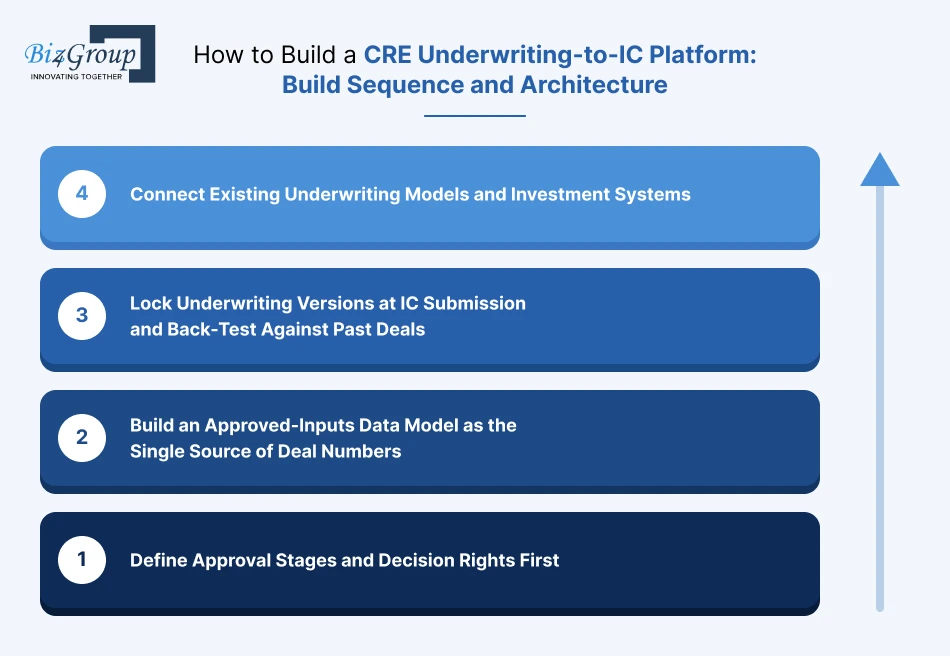
Build the platform in the same order the decision system needs to work: define decision rights, establish trusted deal data, control underwriting versions, then connect the systems already used by the acquisitions team.
1. Define Approval Stages and Decision Rights First
Before building screens or integrations, define who can review, approve, change, defer, or reject each part of the deal.
A simple decision map might look like:
Acquisitions Analyst → Acquisitions Lead → IC Reviewer → Investment Committee
For each stage, define:
- Who owns the review
- What information must be complete
- What the reviewer can change
- What requires escalation
- What event moves the deal to the next stage
This gives the workflow clear rules instead of leaving approval logic inside email threads or individual processes.
2. Build an Approved-Inputs Data Model as the Single Source of Deal Numbers
The platform needs one controlled record for the numbers that flow into IC materials. That record should distinguish between source data, analyst adjustments, and approved inputs.
Core fields can include:
|
Data group |
Examples |
|---|---|
|
Property |
Purchase price, units, occupancy, property type |
|
Operations |
Revenue, expenses, normalized NOI |
|
Financing |
Loan amount, LTV, DSCR, debt yield |
|
Returns |
IRR, equity multiple, cash-on-cash |
|
Assumptions |
Rent growth, vacancy, exit cap, financing terms |
|
Review status |
Approved, flagged, changed, unresolved |
The key architectural rule is simple: once a figure is approved for IC, downstream documents should pull from that approved value rather than from another copy of the model.
3. Lock Underwriting Versions at IC Submission and Back-Test Against Past Deals
When a deal enters IC review, create a locked underwriting version containing the exact inputs, assumptions, calculations, and outputs submitted to the committee.
Analysts can still run scenarios after submission, but those scenarios should create new versions rather than silently changing the IC record.
Back-testing adds another useful control. Run historical deals through the same workflow and compare the platform's outputs with the actual underwriting and final decisions. This can expose calculation errors, weak exception rules, missing inputs, or assumptions that need additional review before the system handles live deals.
4. Connect Existing Underwriting Models and Investment Systems
The final step is connecting the workflow layer to the tools the team already depends on, which is where AI integration services can help connect Excel models, CRM systems, document repositories, and other decision-critical tools without rebuilding the whole stack.
Start with the systems that contain decision-critical information:
- Excel underwriting models for detailed financial analysis
- CRM or deal systems for deal records and status
- Document repositories for source files and diligence materials
- Market and property data systems for supporting inputs
- Identity and permissions systems for reviewer access
The goal is to make these systems part of one controlled workflow without forcing the acquisitions team to replace every existing tool at once.
How Does AI Improve CRE Underwriting Before Investment Committee Review?
For firms looking to implement generative AI in real estate, underwriting is a practical place to start: use it for repetitive analysis, source comparison, draft explanations, and exception review while keeping investment judgment with the team.
Automating Financial Spreading and NOI Normalization
AI can turn financial information from rent rolls, T-12s, operating statements, and other approved source files into a structured underwriting dataset. From there, it can map revenue and expense lines into the firm's standard chart of accounts and identify items that need normalization.
For NOI normalization, the important part is showing why a number changed. A platform might flag a one-time repair expense, unusual management fee, owner-specific cost, or missing expense line for analyst review rather than silently adjusting the NOI.
A useful workflow is:
Source figure → AI classification → proposed adjustment → analyst review → approved NOI
That keeps automation focused on the mechanical work while making the adjustment visible to the person responsible for the underwriting.
Calculating DSCR, LTV, and Debt Yield From Approved Inputs
Once the platform has approved NOI, debt terms, and property value or purchase price, it can calculate the core financing metrics consistently.
- DSCR: NOI relative to required debt service
- LTV: Loan amount relative to property value
- Debt yield: NOI relative to loan amount
The calculations themselves are straightforward. The value comes from making sure they use the same approved inputs as the rest of the underwriting.
If an analyst changes the loan amount or normalized NOI, the platform should recalculate the affected metrics and identify which IC figures or assumptions have changed. That gives the team a clearer view of the downstream impact before the deal reaches committee.
Reconciling Conflicting Figures and Prioritizing Risks for Analyst Review
CRE deals often contain multiple versions of the same number. The rent roll may show one occupancy figure, the T-12 may imply another, and the underwriting model may use a third.
AI can compare these sources and flag discrepancies for review. It can also rank exceptions based on their potential effect on the deal rather than producing a long list of every minor inconsistency.
What should the analyst see first? A useful system should surface the discrepancies most likely to affect valuation, financing, or projected returns, along with the source documents behind them.
For example, a difference in a small operating expense may need little attention. A mismatch in current rent, occupancy, purchase price, or debt terms could materially change returns and should move higher in the review queue.
The platform should show the conflicting figures, their sources, the current underwriting value, and the potential impact. The analyst can then decide which figure is appropriate and document the reason.
Where Automated Analysis Hands Off to Investment Judgment
AI should stop where the question becomes investment judgment.
It can identify that normalized NOI depends on an unusual expense adjustment. It can calculate how that adjustment changes DSCR and returns. It can flag that the resulting margin is outside the team's usual range.
The acquisitions team still needs to decide whether the adjustment is reasonable and whether the risk is acceptable.
That boundary matters. The platform is supporting the underwriting decision, while the analyst and investment committee remain responsible for deciding what the numbers mean for the deal.
The review record should show what AI flagged, what evidence supported it, what the analyst changed, and what was ultimately accepted or rejected. That level of visibility also matters during AI model development, because the team needs to see where model output helps and where it needs tighter rules or human review.
Still Chasing Numbers Before IC?
If analysts are spending hours reconciling models, updating memos, and tracking approvals, an AI-powered CRE workflow can connect the pieces and keep every decision tied to the right data.
See What Your CRE Workflow Could AutomateHow Can AI Generate Investment Committee Memos With Source Citations?
AI can generate an IC memo from the approved underwriting record, then connect key figures and statements back to the documents and assumptions behind them. The useful part is the traceability: reviewers should be able to move from a memo figure to its approved input, source document, and any analyst adjustment without rebuilding the analysis manually.
Generating Standard IC Sections From Approved Underwriting Data
Start with a fixed IC template rather than asking AI to create a different memo structure for every deal. The platform can populate recurring sections from approved underwriting data, such as:
- Property and transaction overview
- Purchase price and capitalization
- Operating performance and normalized NOI
- Financing and leverage
- Return projections
- Key assumptions
- Risks and mitigants
- Investment recommendation
The figures should come from the approved underwriting record. AI's job is to organize and explain those inputs, not create new financial assumptions to fill gaps.
Drafting Investment Narratives and the SWOT Analysis
The narrative is where generative AI can save more time than simple data population, turning approved financial and property information into a first-pass explanation of the investment case.
It can turn approved financial and property information into a first-pass explanation of the investment case, including strengths, weaknesses, opportunities, and threats.
For example, if the underwriting shows strong in-place occupancy but significant rollover within the forecast period, the SWOT section can surface both points rather than presenting a generic risk list.
The analyst should still be able to edit the narrative and decide which factors actually belong in the investment thesis.
Documenting Assumptions and Risks
An IC memo should make material assumptions visible instead of burying them inside the model.
AI can pull approved assumptions into the memo and explain their relevance. That might include rent growth, vacancy, expense growth, exit cap rate, hold period, financing terms, or other deal-specific inputs.
A useful approach is to separate:
Assumption → Underwriting impact → Supporting evidence → Risk if assumption changes
This gives the committee a clearer way to challenge the case. If someone asks, “What happens if this assumption changes?”, the underlying model and source evidence are already connected.
Linking Memo Figures to Source Documents
Every important figure in the memo should have a traceable path back to its source.
Once AI starts generating the memo, the next concerns usually sound like:
“I need every number in our investment committee memo to be traceable back to the original rent roll or T-12, because our committee does not trust a memo if they cannot verify where the figures came from.”
The platform should link each material memo figure to its approved underwriting input and original source document, including the relevant extraction or analyst adjustment where applicable.
For example:
Memo: $18.2M purchase price
↓
Approved underwriting input
↓
Purchase agreement / source document
↓
Relevant page or extracted value
The same approach can apply to revenue, expenses, occupancy, debt terms, and other material figures. This creates the source-cited audit trail that IC reviewers need when they want to verify a number.
Keeping the Memo in Sync When Underwriting Changes After Drafting
Underwriting rarely stays frozen while the memo is being reviewed. A financing term may change, an expense may be reclassified, or an analyst may update an assumption after receiving new diligence.
The platform should detect when an approved underwriting value used in the draft has changed and identify the affected memo sections.
For example, if the debt amount changes, the system should flag the financing section and any dependent metrics such as LTV, DSCR, debt yield, returns, and related narrative. The analyst can then review the proposed updates before they reach the committee.
This is safer than regenerating the entire memo every time one number changes.
Keeping Investment Recommendations Subject to Human Review
AI can draft the recommendation, explain the supporting numbers, and surface relevant risks. It should not independently decide whether the firm should acquire the property.
The final recommendation should remain an explicit human decision, with the system recording who reviewed it, what version of the underwriting supported it, and whether the recommendation was changed before IC submission.
That distinction becomes especially important when the model identifies a risk that the investment team sees differently. Who gets the final say? The investment team does, with the AI output and supporting evidence available for review rather than treated as the decision itself.
How Should a CRE Platform Route Deals Through Investment Committee Approval?
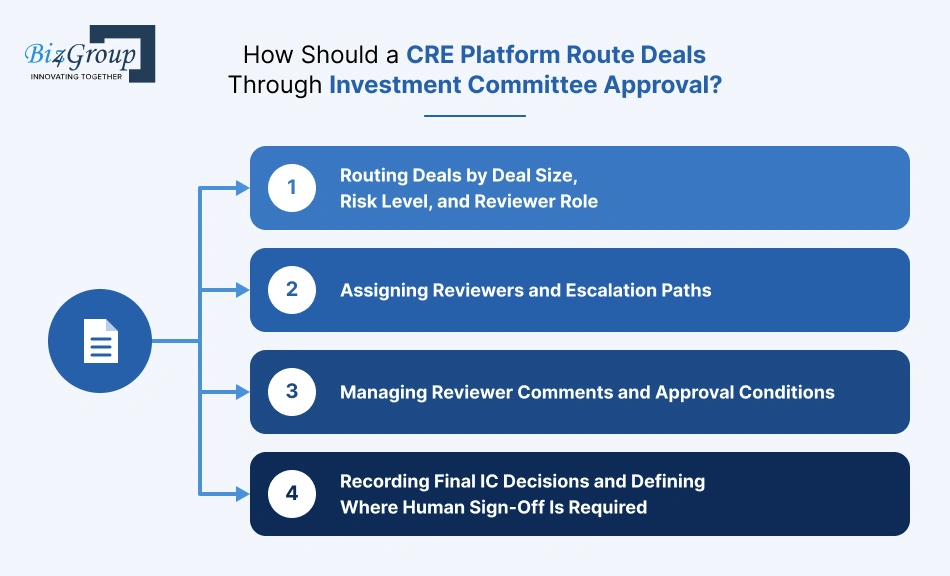
A good CRE approval workflow should route a deal according to the firm's actual decision rules, not simply send the same checklist to everyone. Deal size, leverage, asset risk, investment strategy, and unresolved underwriting issues can determine who needs to review the deal and when it needs to move beyond the standard approval path.
Routing Deals by Deal Size, Risk Level, and Reviewer Role
Routing should reflect how the investment team already thinks about risk. A $20 million acquisition with straightforward financing may need a different review path from a highly leveraged transaction with significant lease rollover, even if both follow the same basic IC process.
A common question from teams trying to formalize the process is:
“We have no consistent process for routing a deal through the right reviewers before it reaches the investment committee, and I want to build a platform that handles approval routing automatically based on deal size or risk level.”
The platform can route deals using defined rules such as deal size, leverage, asset risk, investment strategy, and underwriting exceptions, then assign the required reviewers and escalate deals that cross specific thresholds.
The platform can use rules such as:
- Deal size or equity requirement
- LTV, DSCR, or debt yield thresholds
- Tenant concentration or lease rollover
- Asset and market risk
- Investment strategy or fund mandate
- Material underwriting exceptions
- Required reviewer role
The important design choice is deciding which rules actually change the approval path. A system that flags every small variance as an escalation quickly becomes noise. The routing logic should focus on issues that change who needs to look at the deal or what level of approval it requires.
Assigning Reviewers and Escalation Paths
Once the route is determined, the platform should assign named reviewers rather than simply showing that a review is "pending." Each reviewer should know what they are responsible for and what happens if they raise an issue.
For example, an acquisitions lead might clear the underwriting for IC submission, while a finance reviewer checks debt assumptions and a senior investment professional handles a policy exception. If the exception crosses a defined threshold, the deal can move automatically to the appropriate decision-maker.
This is where workflow design gets more nuanced. What happens when two reviewers disagree about an underwriting assumption? The platform should preserve both views and route the disagreement to the person with authority to resolve it. It should not quietly overwrite one review with another.
Managing Reviewer Comments and Approval Conditions
Comments should remain connected to the item being reviewed. A note about an exit cap assumption belongs with that assumption; a question about tenant rollover belongs with the relevant underwriting or diligence item.
That makes it easier to separate three different things:
- Question: Something needs clarification.
- Exception: The deal falls outside a defined rule or expectation.
- Condition: The IC is willing to approve, provided a specific action is completed.
Conditions should become tracked actions with an owner and deadline. If the committee approves a deal subject to revised financing or additional diligence, that requirement should follow the deal rather than disappear into meeting notes.
Recording Final IC Decisions and Defining Where Human Sign-Off Is Required
The final decision should be tied to the exact underwriting version and IC package reviewed by the committee. The record should show who participated, what was decided, which conditions were attached, and whether any material exceptions were accepted.
Human sign-off should remain mandatory for decisions such as:
- Final approve, reject, or defer decisions
- Material changes to approved underwriting assumptions
- Exceptions to investment policy
- Approval conditions that change the transaction
- Overrides of significant AI-generated flags or recommendations
AI can identify an exception or suggest that a deal needs additional review. It should not silently turn that suggestion into an approval rule. The platform needs a clear boundary between workflow automation and investment authority, especially when the committee chooses to proceed despite a flagged risk.
Biz4Group perspective: Building products such as Facilitor and Homer AI exposed Biz4Group to a practical issue that also matters in CRE approval workflows: AI output becomes useful only when it is connected to the right user action and business context. Our work on Contracks added another lesson around document-driven processes, where status, obligations, and follow-ups need to stay connected to the underlying record.
These experiences shape how Biz4Group approaches an IC routing layer: define the decision rules first, connect each review action to the underlying deal evidence, and keep exceptions visible until the authorized person resolves them.
Build vs. Buy: Where Should the IC Approval Layer Live?
The choice usually comes down to how much of the IC process you want to own, and whether it makes more sense to configure an existing platform or build AI apps around the workflow your acquisitions team already uses.
Build vs. Buy vs. Hybrid
|
Factor |
Buy |
Build |
Hybrid |
|---|---|---|---|
|
Time to launch |
Faster |
Longer |
Moderate |
|
Workflow control |
Limited to available configuration |
High |
High where it matters |
|
Existing Excel models |
May require adaptation |
Can be designed around them |
Can remain in place |
|
Custom approval rules |
Depends on platform |
Fully configurable |
Custom rules can sit above existing systems |
|
AI underwriting workflows |
Depends on available capabilities |
Designed around your process |
Add AI where the existing stack falls short |
|
Source citations and data lineage |
Available only if supported |
Designed into the architecture |
Added as a dedicated control layer |
|
Version control |
Uses the platform's model |
Built around your underwriting process |
Existing underwriting can remain while IC versions are controlled separately |
|
Integrations |
Usually limited to supported connectors |
Designed for the required systems |
Connect only the systems that need to participate |
|
Upfront effort |
Lower |
Higher |
Moderate |
|
Best fit |
Standardized IC processes |
Highly specialized investment processes |
Firms with a strong existing stack and specific workflow gaps |
For many acquisitions teams, hybrid is the interesting middle ground. You don't need to rebuild the underwriting model, CRM, document storage, and every other system just to fix the messy part between "underwriting is ready" and "IC has made a decision."
That can be the sweet spot: keep the machinery that already works, then build the missing layer where the process actually breaks. Otherwise, you can end up spending six months rebuilding a perfectly good spreadsheet just to give it a nicer login screen.
What Does an Underwriting-to-IC Workflow Layer Cost to Build?
For planning purposes, a custom underwriting-to-IC workflow layer can land anywhere from $40,000 to $300,000 USD. That is a wide range for a reason. A team adding IC memo generation and approval routing around an established Excel workflow is solving a very different problem from a firm that also wants AI financial spreading, source-level traceability, complex permissions, and integrations across its investment stack.
Cost by Module (Spreading, Memo Generation, Routing, Governance)
Think of the budget as a stack of capabilities rather than one big “CRE platform” price.
|
Module |
What actually drives the work |
Planning range* |
|---|---|---|
|
Financial spreading & NOI normalization |
Number and quality of source documents, custom chart-of-accounts mapping, normalization rules, confidence checks, analyst review |
$15K–$70K |
|
AI-assisted IC memo generation |
Memo templates, narrative complexity, approved-data mapping, source citations, revision handling |
$10K–$45K |
|
Approval routing |
Number of approval paths, reviewer roles, thresholds, exceptions, escalations, conditions |
$8K–$35K |
|
Governance controls |
Underwriting versions, assumption history, data lineage, audit logs, permissions |
$8K–$35K |
|
System integrations |
Excel models, CRM, document repositories, market data, SSO, existing APIs |
$10K–$60K |
*These are planning ranges. Modules overlap, so adding every row together is not a reliable way to calculate the final project cost.
Here is where the estimate gets more specific to your acquisitions process. Are analysts already happy with the underwriting model and simply tired of everything that happens after it? If yes, rebuilding financial modeling would add cost without solving the real problem. Keep the model, lock its approved outputs, and spend the budget on the IC layer.
If analysts are still manually spreading inconsistent rent rolls and T-12s before every deal reaches that point, the economics change. Now document intelligence and financial normalization become part of the problem worth solving.
Standalone Build vs. Add-On to an Existing Platform
A standalone platform pushes toward the higher end because you are building more of the foundation: deal records, document handling, underwriting data structures, user management, integrations, AI services, approval workflows, and governance.
An add-on workflow layer can be much narrower, which can make AI automation services a better fit when the goal is to automate specific parts of the process without replacing the firm's existing underwriting stack.
Your Excel model may stay. Your CRM may stay. Your document repository may stay. The new product handles the awkward middle: approved underwriting enters, the IC package gets created and reviewed, exceptions get resolved, and the final decision gets recorded.
That distinction can easily matter more to the budget than whether you use one AI model or another.
So before asking, “How much will the platform cost?”, ask the slightly more useful question: What are we actually replacing?
If the answer is “everything,” you are planning a platform build. If the answer is “mostly the emails, copy-pasting, version confusion, and approval chasing after underwriting,” your $300K problem may turn out to be considerably smaller.
How Long Does It Take to Build a CRE Underwriting-to-IC Platform?
With AI-assisted development, a focused CRE underwriting-to-IC workflow can be built much faster than traditional software projects, which is worth keeping in mind if a team is deciding whether to hire AI developers for a focused workflow layer or take on a larger platform build.
As a practical planning range, 8–20 developer hours is enough for a focused feature, 16–40 hours for a working pilot, and roughly 40–120 hours for a production-ready workflow layer. The actual effort depends less on the number of screens and more on the data, rules, integrations, and controls behind them.
First Pilot
A focused pilot can usually be built in around 16–40 developer hours, or 2–5 working days.
For a CRE acquisitions team, that could mean taking an existing underwriting output and connecting it to:
Approved underwriting → exception review → IC memo draft → reviewer comments → approval decision
If the Excel model, IC template, and approval rules already exist, the first pilot does not need to recreate them. It can sit around them and prove that the underwriting-to-IC handoff actually works.
Production Deployment
A production-ready workflow layer will typically take around 40–120 developer hours, or 5–15 working days for a focused scope.
The extra work usually comes from the things that make the system dependable in real deals:
- Connecting existing Excel models, CRM, and document storage
- Validating financial calculations and AI outputs
- Adding role-based permissions
- Locking IC underwriting versions
- Tracking assumption changes
- Linking memo figures to source documents
- Building escalation and approval rules
- Testing unusual or incomplete deal data
How much of that already exists inside your acquisitions stack? If the firm has clean data and defined rules, the build can stay close to the lower end. If every deal uses a slightly different Excel template and approval path, the software may be quick to write, while making the workflow reliable takes more iteration.
Broader Rollout
Once the core workflow is working, additional capabilities can often be added in 2–5 day development cycles rather than waiting for another large build.
One cycle might add a new asset strategy. Another might connect a CRM. Another could add a different IC approval path or a new document type for financial spreading.
So a realistic AI-assisted progression can look like:
Pilot: 2–5 days → Production workflow: 5–15 days → Major additions: 2–5 days each
These are development estimates, not promises for every CRE platform. AI can dramatically reduce the time needed to write and modify the software. The slower part is usually validating that the numbers, approval rules, source citations, and exceptions behave correctly on real acquisitions.
And that is the slightly funny part: the code can be ready before the investment team finishes arguing about what “approved underwriting” actually means.
How Do You Measure the ROI of an Underwriting-to-IC Workflow Platform?
Measure ROI by looking at what changes between deal underwriting and the final IC decision. The most useful numbers are time saved, decisions completed, analyst capacity released, and rework avoided. For a CRE acquisitions team, the question is simple: does the workflow help the team make more decisions with less administrative drag?
Underwriting and IC Memo Preparation Time
Start by measuring how many hours the team spends getting one deal from completed underwriting to a committee-ready package.
For example, suppose an analyst spends:
- 3 hours reconciling rent roll and T-12 figures
- 2 hours checking and updating underwriting outputs
- 3 hours preparing the IC memo
- 2 hours updating the memo after reviewer comments
That is 10 hours per deal.
If automated spreading, approved-input mapping, and memo generation bring that down to 4 hours, the team saves 6 hours per IC package. At 40 IC submissions a year, that is roughly 240 analyst hours recovered annually.
The same calculation can be applied to reviewer time. If an IC member previously spends 45 minutes checking where memo figures came from and the platform reduces that to 15 minutes, that saving counts too.
Underwriting-to-Decision Cycle Time
Time-to-decision measures something different. It asks how quickly a deal moves from IC submission to an actual decision.
Consider a deal where:
- Monday: Underwriting is submitted
- Tuesday: Reviewer finds a debt assumption mismatch
- Wednesday: Analyst sends a corrected memo
- Thursday: IC reviews the package
- Friday: Approval is recorded
The deal took five calendar days to reach a decision.
With controlled underwriting versions, source-linked figures, and automated exception routing, the same issue might be identified before submission and the decision could happen on Tuesday or Wednesday.
That matters when the acquisition has a bid deadline or the team is competing for a property. Saving two calendar days can be more valuable than saving two hours of analyst work.
Analyst Capacity and Deal Throughput
Time saved becomes useful when it changes what the team can actually handle.
Imagine a five-person acquisitions team recovers 8 hours per analyst per week from financial spreading, memo preparation, and approval administration. That creates 40 hours of additional capacity every week, roughly equivalent to one full analyst-day across the team.
Now look at what happens to deal volume.
If the team previously completed 12 full underwriting-to-IC packages per month and can now handle 16 without adding headcount, the platform has increased capacity by roughly 33%.
That does not automatically mean the firm should chase 33% more deals. The extra capacity might instead give analysts more time to challenge assumptions, speak with brokers, run downside cases, or spend more time on the deals that actually deserve attention.
Exception Detection, Rework, and Decision Consistency
This is where ROI can become less obvious.
Suppose an underwriting model uses a normalized NOI of $2.4 million, while the latest T-12 and expense review support $2.2 million. If that difference is caught after the IC memo has already circulated, the team may need to revise the model, regenerate the memo, notify reviewers, and reschedule the discussion.
If the workflow flags the discrepancy before IC submission, the analyst can resolve it while the deal is still in underwriting.
Track things such as:
- Exceptions identified before IC
- Memos returned for correction
- Figures changed after IC submission
- Reviewer questions requiring analyst rework
- Duplicate or conflicting deal figures
- Approval conditions that remain unresolved
One important nuance: a higher number of flagged exceptions can initially be a positive result. If the old process missed 10 issues and the new workflow surfaces 18 before IC, the platform may be improving visibility rather than creating more problems.
The better measure is what happens afterward: fewer late-stage corrections, fewer repeated questions, and fewer deals reaching committee with unresolved issues.
The ROI story should therefore go beyond “hours saved.” For a CRE investment team, the stronger case is usually a combination of lower preparation effort, faster decisions, higher analyst capacity, and fewer avoidable mistakes making their way into an IC meeting.
What Happens After the Underwriting Is “Done”?
If the answer involves copy-pasting, chasing reviewers, and wondering which version made it to IC, an AI-assisted approval workflow can take over the handoffs while your team keeps the final say.
Talk to Biz4Group’s AI ExpertsFrom Underwriting to Investment Committee Approval: Building a Connected CRE Decision Workflow
A CRE acquisitions workflow platform for underwriting and IC approval should make the whole journey a little less painful. The numbers stay connected, changes don't mysteriously disappear, sources are easy to check, and AI takes care of the boring bits. Then the investment team can focus on the part AI probably shouldn't be doing anyway: deciding whether the deal is actually worth doing. Where did that number come from? Who changed it? Those shouldn't be difficult questions.
As an AI development company, Biz4Group's work on products like Facilitor, Homer AI, and Contracks has taught its team a few useful things about building AI workflows around real users, documents, rules, and decisions. That experience feeds into its AI consulting services too. So, where should AI jump in, and where should it stay quiet? Those little boundaries can make a surprisingly big difference.
Got a CRE workflow held together by Excel, email, and crossed fingers? Talk to Biz4Group's AI experts and let's see what can be cleaned up.
FAQs
1. What should a CRE acquisitions workflow platform connect after underwriting is complete?
It should connect approved underwriting, source documents, exception review, IC memo generation, reviewer comments, approval routing, and the final decision record. The point is to keep the deal's numbers and decision history connected through IC.
2. Can AI calculate DSCR, LTV, and debt yield from rent rolls and T-12s?
Yes, provided the source data is extracted and approved first. AI can calculate the metrics from approved NOI, debt, and property-value inputs, while the analyst reviews unusual or conflicting figures before they reach IC.
3. How can AI-generated IC memos stay tied to the underwriting?
Generate the memo from the approved underwriting version, not a separate copy of the numbers. Each material figure should trace back to its input and source document, so changes can trigger a review of the affected memo sections.
4. Can AI flag underwriting exceptions before investment committee?
Yes. It can compare source documents, underwriting inputs, and defined thresholds to flag conflicts such as unusual NOI adjustments, occupancy differences, leverage issues, or inconsistent debt terms. The analyst should resolve the exception before IC submission.
5. What is the best way to automate financial spreading and NOI normalization for CRE deals?
Start with a standardized financial mapping layer. AI can classify revenue and expense items, suggest normalization adjustments, and identify missing or unusual items. An analyst should approve the final normalized NOI.
6. How do you keep an IC memo from becoming outdated when underwriting changes?
Lock the underwriting version submitted to IC and track later changes separately. If a material input changes, the platform should identify which memo figures, tables, and narrative sections need review.
7. Should AI make the final CRE investment recommendation?
No. AI can draft the recommendation and explain the supporting evidence, but the investment team should retain final authority. Human review and sign-off should remain explicit for the actual investment decision.
8. What should an audit trail capture in an AI-assisted CRE approval workflow?
At minimum: source documents, extracted values, analyst adjustments, underwriting versions, assumption changes, reviewer comments, exceptions, approvals, overrides, and the final IC decision. That gives the team a defensible record of how the deal moved from analysis to approval.
9. How much does a custom CRE underwriting-to-IC platform cost?
A practical planning range is $40,000 to $300,000 USD. A focused IC workflow layered onto existing Excel, CRM, and document systems will generally require less work than a standalone platform that also handles financial spreading, AI analysis, integrations, and governance.
10. How quickly can an AI-assisted CRE underwriting-to-IC platform be built?
A focused pilot can be developed in roughly 16–40 developer hours, while a production-ready workflow layer may take around 40–120 hours, depending on integrations, data quality, financial rules, and governance requirements.
11. Build, buy, or hybrid: which approach makes sense for CRE investment teams?
Hybrid is often worth considering when the firm already has working Excel models, CRM, and document systems. The new layer can focus on the missing pieces: approved inputs, IC memo automation, exception handling, routing, source citations, and decision governance.
12. What makes an AI underwriting platform suitable for investment committee use?
Look beyond fast extraction or polished memo writing. Test whether it can preserve source citations, approved assumptions, underwriting versions, exception flags, reviewer activity, and human sign-off throughout the deal. Those controls are what make AI output usable in a real IC process.
