 Location :
Orlando, FL, USA
Location :
Orlando, FL, USA +1 (407) 714-1616
 info@biz4group.com

 AI Summary Powered by Biz4AI
- Most real estate sites convert only 2% to 4% of visitors, while buyers search about 10 weeks and usually talk to one agent.
- A custom AI buyer intent platform scores visitor behavior and triggers follow-up that works alongside your CRM, chatbot, and ad agency.
- Repeat listing views, narrowing filters, and calculator use feed a score that starts as weighted rules and moves to machine learning.
- Remarketing runs through ads, email, SMS, and agent tasks, with frequency caps and Fair Housing, consent, and MLS/IDX rules built in.
- Buy a suite for speed, build custom for specific data and scoring, or go hybrid, and prove the return with a holdout group.
- Biz4Group LLC, a US-based AI product development company, has built real estate products like Facilitor and Contracks and offers scoping conversations.
Quick question: out of every 100 people who land on your listings, how many actually fill out a form or ask for a showing?
If your honest answer is "a handful," you're in normal territory. Several research firms put the typical conversion rate for a real estate website at 2% to 4%, which means roughly 96 to 98 visitors leave without raising a hand. That's the quiet leak most residential real estate websites live with.
And a lot of those visitors are serious. NAR's 2026 Generational Trends report found that 46% of buyers start their home search by looking at listings online, and the typical search runs about 10 weeks. When they finally decide to talk to someone, 74% interview just one agent before choosing. So buyers spend weeks searching, much of it online, quietly narrowing things down, then talk to one agent and move on. Your website watches part of that happen and, most of the time, never does anything about it.
That gap is what a custom AI buyer intent and remarketing platform is built to close. It watches how anonymous visitors behave on your site, works out who's getting serious, and brings them back at the right moment through ads, email, text, or a task for your agent, all while staying inside Fair Housing, consent, and privacy rules.
AI has plenty of uses across the industry, as our guide on how to use AI for real estate shows. This one focuses on what you need to know: the buyer intent signals worth tracking, how the scoring works, how remarketing gets triggered, what compliance really looks like, and whether it makes more sense to build the platform or buy one off the shelf.
What an AI Buyer Intent and Remarketing Platform Is and What It Is Not
An AI buyer intent platform is the layer that captures what visitors do on your site, scores how ready each one is to buy, and triggers the right follow-up. It is not a CRM, a chatbot, a listing alert tool, or an ad agency, although it feeds all of them with better information.
The Five Layers at a Glance
Think of it as five layers stacked on top of each other. Each one gets its own section later, so this is just the map.
|
Layer |
What it does |
Practical Example |
|---|---|---|
|
1. Capture |
Records visitor behavior as first-party data |
Listing views, searches, calculator use |
|
2. Identity and consent |
Ties sessions to a person, only where permitted |
Linking a returning visitor after they opt in |
|
3. Scoring |
Rates buyer intent from behavior |
"Warm, rising" instead of a guess |
|
4. Orchestration |
Decides what happens next and where |
Agent task, email, or paid audience |
|
5. Measurement |
Shows what actually lifted conversions |
Holdout groups, cost per lead |
Skip any layer and the whole thing wobbles. Scoring without clean capture is guesswork, and remarketing without consent is a legal problem.
How It Differs From a Real Estate CRM
A real estate CRM manages people you already know: contact records, notes, pipelines, reminders. An intent platform works earlier, on people you don't know yet, and on what known leads do between conversations.
The two work best together. The CRM is where an agent works a lead, and the platform tells the agent which lead to work today and why. Most CRMs record activity, though few of them turn it into a ranked, explained list of who is getting serious. When your agents open the CRM each morning, do they know whom to call first and why?
How It Differs From Chatbots, Listing Alerts, and Ad Agencies
These three get confused with it most often, because each one touches a slice of the same job.
Chatbots talk to visitors who choose to talk. An intent platform also works on the many who never open a chat window. A chatbot can be one input to the platform, but it isn't the platform.
Listing alerts tell buyers about homes that match a saved search. Useful, but they react to what a buyer already said they want. The platform reads what buyers do and decides who needs a nudge, on what channel, and when.
Ad agencies run campaigns, usually from audiences built on platform data or a pixel. They rarely see score history, consent status, or what an agent did afterward. Pair the two and the agency gets better audiences, while the platform gets cleaner results to measure.
Which Brokerages and Proptech Teams Benefit Most
The payoff grows with traffic, lead value, and the number of systems involved. Strongest fits:
- Brokerages with steady website traffic and a large, quiet lead database. More anonymous visitors and old leads means more buyers worth rediscovering.
- Multi-office or multi-brand teams that want one consistent definition of a ready buyer.
- Proptech companies and portals adding intent features to their own product, which sits among the more practical real estate AI apps ideas.
- Teams with a defined sales process, where ISAs and agents can actually act on a score.
Probably too early: a solo agent with a few hundred visits a month, or a team with no one to follow up on what the scores surface. Which of those sounds like your business? That answer shapes the Build, Buy, or Hybrid section later in this guide.
Who Needs a Custom Real Estate Remarketing Platform and When It Beats Off-the-Shelf Suites
A custom real estate remarketing platform makes sense when a brokerage, team, or proptech company has outgrown what a standard suite can do, usually because of data ownership, unusual workflows, or too many systems that need to work together. For everyone else, a suite is often the smarter buy.
Quick context on suites: tools like Ylopo, Sierra Interactive, and Luxury Presence bundle some mix of website, real estate CRM, ads, and automated follow-up. For plenty of agents, that's exactly right. So how do you know when a suite has stopped being enough? Watch for these signs.
- You want to own the data. Visitor behavior and lead history live in your own database, built from your first-party data, instead of inside a vendor's account.
- Your idea of a hot lead is specific. A luxury desk, a first-time buyer team, and a rental-to-sale pipeline don't read intent the same way. Custom scoring can follow your rules instead of a generic model.
- Several systems have to talk to each other. MLS and IDX feeds, a CRM, ad accounts, and internal tools all need to feed one picture of the buyer.
- You're running many offices or brands. One consistent system across markets keeps the definition of a ready buyer the same, which is the kind of multi-office setup enterprise AI solutions are built to support.
You're building a product. A portal or proptech company adding intent features to its own platform often can't build on top of someone else's suite.
Now the flip side. Off-the-shelf suites usually win for a solo agent or small team with a standard funnel, for anyone who needs to be live this month, and for teams with nobody to maintain a custom system. Buying a suite isn't a failure. It's often the right first step.
Still not sure which side you're on? The Build, Buy, or Hybrid section later in this guide puts the options side by side.
Why Residential Real Estate Websites Lose Most of Their Buyers?
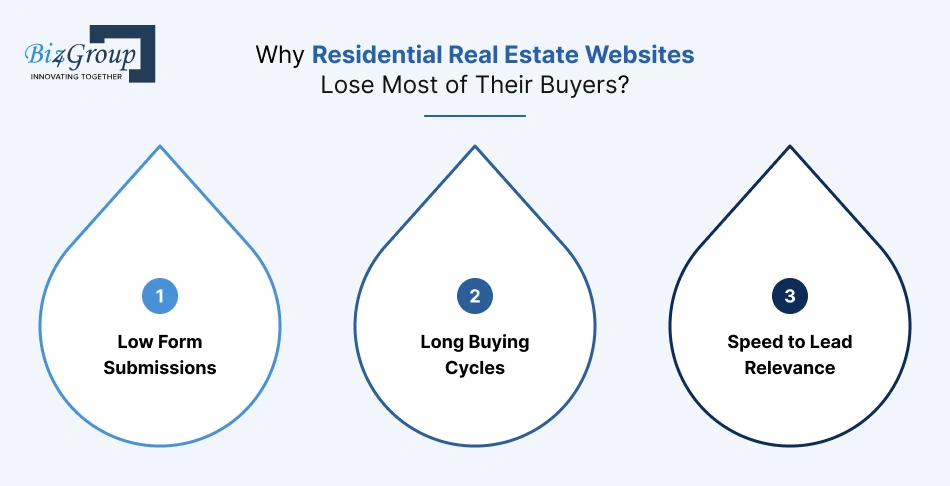
Residential real estate websites lose most of their buyers because they only notice the people who fill out a lead capture form, while the much larger group researching quietly leaves without a trace. Buying a home takes weeks, and the site that follows up quickly with something relevant usually gets the conversation.
Why Most Anonymous Website Visitors Never Submit a Form
Most anonymous website visitors aren't ready to hand over their details, and a form asks for a commitment they haven't made yet. NAR's 2026 Generational Trends report shows it: only 3% of buyers first reached their agent through the agent's website, versus 26% by phone call and 23% in person.
So what are those visitors doing on your site?
- Researching, not buying. Someone comparing neighborhoods on a Sunday night doesn't want a call on Monday.
- Avoiding the trade. Name, phone, and email for "more info" rarely feels worth it in week one.
- Sticking with a person they know. Plenty of buyers ask a friend for an agent and use the website only to look at homes.
Serious buyers can still look like this. Biz4Group's real estate builds, including Facilitor with its MLS integration and buyer financial verification, point the same way: what a buyer does and can verify says more than what a buyer types. That's where buyer intent signals come in, covered in the signals section later in this guide.
Long Buying Cycles: Buyers Research for Weeks and Return Many Times
A home search is a weeks-long project, and the visitor who isn't ready today is often the one who buys next month. NAR puts the median search at 10 weeks overall, 12 for Gen Z and younger Boomers, and 8 for younger Millennials.
NAR doesn't track returns to a single site, so this is an illustration, not a measurement: early weeks of broad browsing, then repeat visits to a few saved listings, then price-range narrowing and mortgage math, then a call to one agent.
A site with no memory treats the visitor in week 8 exactly like the visitor in week 1. If a buyer has visited six times, does anything about the sixth visit look different from the first?
Speed to Lead and Relevance Decide Who Gets the Conversation
When a buyer finally raises a hand, speed to lead matters. Roof AI's secret-shopper test of the top 74 U.S. brokerages found 41% never responded and only about 9% replied within five minutes. Roof AI sells lead-response technology and doesn't state the audit year, so read it as directional. Still, with 74% of buyers interviewing just one agent (NAR), the first helpful voice has a real edge.
Fast is only half the job, though. What does the message actually say?
|
Generic follow-up |
Relevant follow-up |
|---|---|
|
"Just checking in. Let me know if you have questions." |
"You've looked at the three-bedroom on Maple four times. Want to see it this weekend?" |
|
Based on a form entry, if one exists |
Based on listing views, calculator use, saved searches |
Relevance needs behavior data, and behavior data needs a system watching before the form arrives. The rest of this guide covers how.
What are the Buyer Intent Signals That Matter on a Home Search Website?
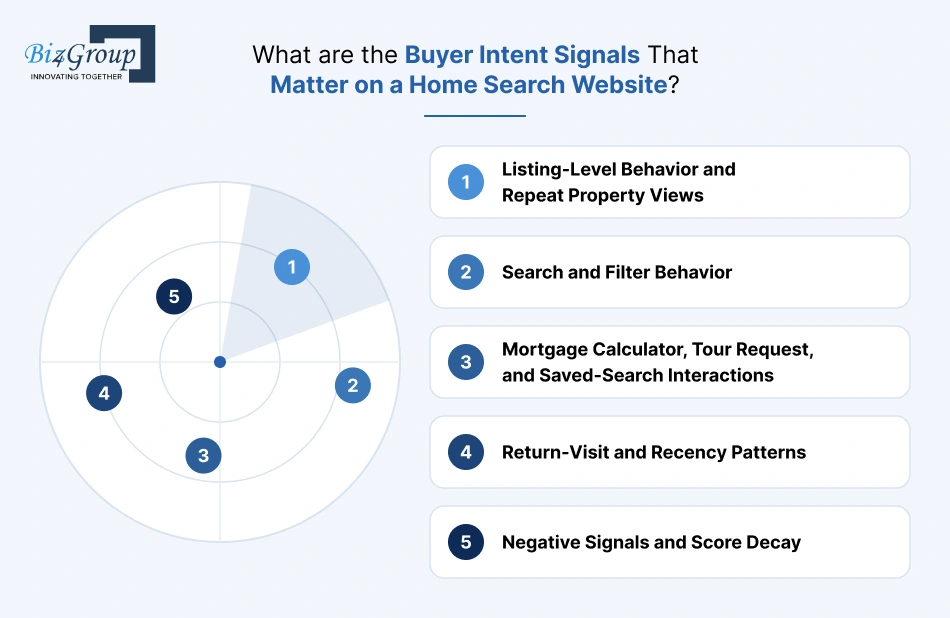
The buyer intent signals that matter most on a home search website are repeat views of the same listing, search filters that keep narrowing, actions like mortgage calculator use and tour requests, and recent, frequent return visits. Negative signals that cool a score matter just as much, because a score that only goes up soon fills the agent's list with people who stopped looking weeks ago.
No single signal is a verdict. Each one is a clue, and the weights should be tested against real closed deals, which is exactly where the scoring section picks up.
Listing-Level Behavior and Repeat Property Views
Looking at one listing once means almost nothing. Looking at it four times in a week means a lot. Repeat property views are usually the cleanest sign that a buyer has moved from browsing to comparing.
What to watch beyond the raw count:
- Depth of the visit. Photo gallery clicks, floor plan views, and time spent on the page say more than a quick open and close.
- Pattern across listings. Three similar homes viewed repeatedly suggests a shortlist. Fifty different homes viewed once suggests scrolling.
- Share and save actions. Sending a listing to a spouse or friend is a quiet but strong sign that a decision is being discussed.
Search and Filter Behavior
How someone searches reveals how ready they are. A buyer filtering "homes" in a whole metro is early. A buyer filtering three bedrooms, a tight price band, one school district, and a commute limit has done real thinking.
- Narrowing filters over time point toward a decision, while widening filters often mean a reset.
- Price-band tightening (for example, from $300K to $600K down to $425K to $475K) is one of the more telling patterns.
- Neighborhood focus, meaning repeated searches in one area, suggests the search is settling.
- Map and draw-on-map use shows location matters enough to define it by hand.
Mortgage Calculator, Tour Request, and Saved-Search Interactions
These are actions rather than views, so they usually carry more weight. They also differ in how strong they are.
|
Interaction |
What it suggests |
Strength |
|---|---|---|
|
Mortgage calculator use |
Testing affordability on a specific home |
Medium to strong |
|
Saved search created |
Planning to keep looking, and willing to be contacted |
Medium |
|
Tour request started but not finished |
Wanted to act, then hesitated |
Strong |
|
Tour request submitted |
Ready for a conversation |
Very strong |
The unfinished tour request is easy to miss. Someone who opened the form, picked a time, and left is far closer to ready than someone who never clicked it. Does your site even record that moment?
Calculator use also has a built-in weakness: it's self-reported. Anyone can type any income. That's why financial verification matters when a platform has it.
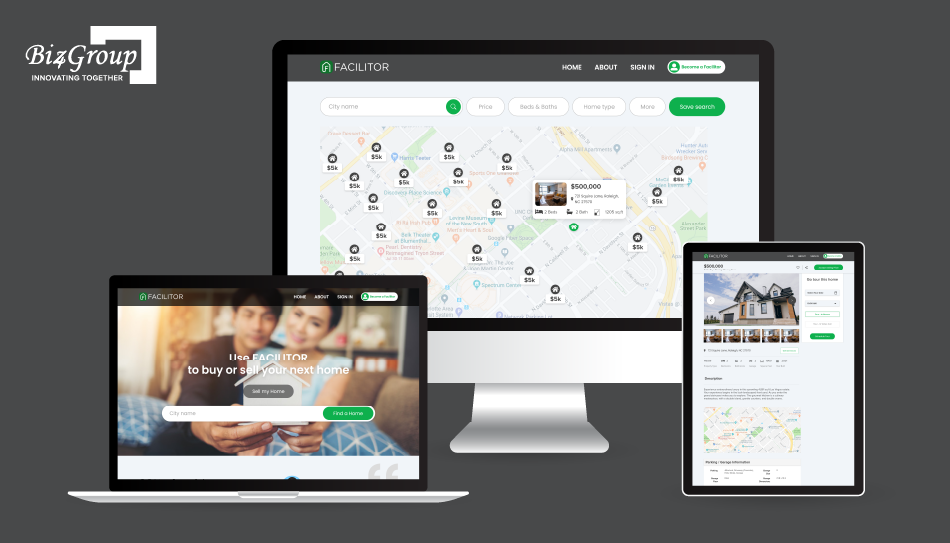
Facilitor, an AI-powered real estate platform built by Biz4Group, verifies a buyer's finances before showing properties and ties search to budget and location, so affordability there is confirmed, not guessed. Most home search websites won't have that data, and the calculator remains a useful soft signal. Where verified financial data does exist, though, it deserves a heavier weight than anything a visitor types into a box.
Return-Visit and Recency Patterns
When a visit happens matters nearly as much as what happens in it. Three visits in the last three days is a very different buyer from three visits spread across three months.
Two things to track: frequency (how often someone returns) and recency (how recently they last did). Rising frequency with fresh activity usually means momentum. A burst of activity followed by silence usually means the search paused or ended.
Device and session length add color too: a long desktop session with the calculator open looks more like homework than a quick phone scroll. Which of your visitors fits that picture right now?
Negative Signals and Score Decay
A good model has to forget. Without that, the platform confuses "was interested in March" with "is interested now."
Score decay lowers a score gradually when activity stops. A sensible approach is to let older actions count for less each week, so a buyer who goes quiet slides down the list without anyone removing them by hand.
Negative signals go further and push a score down on purpose:
- Unsubscribes or opt-outs, which should also stop all outreach.
- Bounced emails or dead phone numbers, meaning the lead can't be reached anyway.
- Signs the visitor is not a buyer, such as agents, competitors, or students browsing in bulk.
- Long silence after a burst, which often means they bought elsewhere or stopped looking.
Skip this step and agents learn quickly that the list can't be trusted, and then they stop reading it.
Biz4Group LLC treats every signal as a hypothesis until closed-deal outcomes prove it. Facilitor follows the same logic: search is tied to budget and location, and a buyer's finances are verified before properties are shown, so what a buyer can actually afford shapes what they see, not just what they click. On a typical home search website, that thinking plays out like this:
- Worth weighting first: repeat views of one listing, a narrowing price band, calculator use, and unfinished tour requests.
- Usually noise: raw page views, total time on site, and one-off visits from search or ads, unless something stronger comes with them.
- The quiet trap: bot and agent traffic, which inflates counts without ever signaling a buyer.
The habit that works: start with a few signals, compare scores against who actually booked tours and closed, and down-weight whatever doesn't separate the two.
How the AI Lead Scoring Engine Works
An AI lead scoring engine turns visitor behavior into a number and a stage, using weights for each signal and a decay that fades old activity. It usually starts with simple rules, graduates to machine learning once there are enough closed deals to learn from, and shows agents the reasons behind every score.
The Four-Stage Buyer Intent Model
A raw score alone doesn't tell an agent what to do. A buyer intent model that sorts visitors into stages does, because each stage calls for a different response.
|
Stage |
What it looks like |
What to do |
|---|---|---|
|
Browsing |
Broad searches, single listing views, no return |
Nothing personal yet. Keep the site relevant. |
|
Researching |
Saved searches, a few return visits, filters starting to narrow |
Light, useful nudges such as new listings that match |
|
Evaluating |
Repeat views of the same homes, calculator use, tight price band |
Agent task, relevant reminder, an invitation to talk |
|
Ready |
Tour request started or submitted, frequent recent activity |
Fast human follow-up, ideally within minutes |
Visitors move in both directions. Someone in "Evaluating" who goes quiet for a month should slide back, which is where the decay from the signals section earns its keep.
Starting With Weighted Rules, Then Moving to Machine Learning
Begin with rules. Machine learning needs examples of who actually bought, and a new platform doesn't have them yet.
A weighted rules model assigns points to behavior and adds them up. An illustration (the numbers are made up, and real weights come from testing):
- Repeat view of the same listing: +10
- Mortgage calculator used: +15
- Tour request started: +25
- No activity for two weeks: -10
Rules are easy to explain, quick to launch, and good enough to start sending agents useful alerts. They also expose how your own business reads buyers, which is worth knowing before a model is built on top.
When does machine learning take over? A few conditions usually point that way:
- Enough closed-deal outcomes exist to train on, linking behavior to who really bought.
- Scores and results keep disagreeing, with "hot" leads going nowhere and quiet ones closing.
- The rules have grown too tangled to adjust by hand.
- Different markets or price tiers behave differently, so one set of weights fits none of them well.
Then AI model development begins, and a model learns the weights from outcomes. Many teams keep the rules as a fallback and as a sanity check, running the model beside them before trusting it.
Making Lead Scores Explainable to Agents
Agents won't act on a score they can't understand. Telling someone "Lead score: 82" invites the question, "So what?"
The fix is to attach reasons, in plain words, to every score:
Maria S. is Evaluating (up from Researching). Viewed the Maple Street listing 4 times this week. Used the mortgage calculator twice. Started a tour request on Saturday.
Good explanations share a few traits:
- Top reasons only. Three or four, in order of weight, not a wall of data.
- Direction of travel. An arrow or a note showing whether the lead is heating up or cooling.
- A suggested next step. "Call today and offer a Saturday tour" beats a number every time.
- A way to disagree. If an agent marks a score as wrong, that feedback is useful training data later. Does your current system let agents say that?
Explainability also supports fairness, since a score built on listed behaviors can be checked and defended in a way a black box can't. The compliance section picks that up.
How to Turn Intent Scores Into Remarketing: Triggers, Channels, and Cadence
Intent scores become remarketing when each stage change is tied to one action on one channel, with limits on how often anyone is contacted. The scoring engine decides who is ready. The trigger map, channel rules, and frequency caps decide what happens next.
The Trigger-to-Action Map
Write down what each event should cause. A simple map keeps messages from piling up. The thresholds below are examples to test.
|
Trigger |
Channel |
Action |
|---|---|---|
|
Moves from Researching to Evaluating |
Agent task, on-site banner |
Agent reviews the lead; site shows saved homes |
|
Views the same listing 3+ times |
Paid audience |
Reminder ad for that listing or similar ones |
|
Starts a tour request, doesn't finish |
Email or text (if opted in) |
"Still want to see it?" with a booking link |
|
Price drops on a saved home |
Email, web push |
Short alert with the new price |
|
Quiet for 30 days |
Ads paused |
Queue for reactivation |
Retargeting Ads and Paid Audiences on Meta and Google
Retargeting ads bring back visitors who viewed specific homes. Scored visitors can be sent to Meta and Google as audiences through server-side connections such as Meta's Conversions API and Google's Customer Match, so targeting holds up when browser cookies fall short.
Evaluating and Ready visitors get listing-specific ads. Browsing visitors get a light brand reminder or nothing. Both platforms restrict housing ad targeting, including age, gender, ZIP, and lookalike options, so the Fair Housing section later treats this as a design requirement.
Email, SMS, and Web Push Remarketing
Each channel fits a different moment and carries its own permission rule.
- Email: Detail such as new matches and price changes. Needs an unsubscribe link and sender identity (CAN-SPAM).
- SMS: Time-sensitive nudges, like an open tour slot. Needs prior express written consent (TCPA).
- Web push: Returning visitors who allowed notifications. Short and current.
Ever received three messages about the same home in one day, on three channels? That happens when channels share no common suppression list.
On-Site Personalization and Agent Task Creation
A returning Evaluating visitor can see their saved homes up front, a "continue your search" card, or a tour prompt on the listing they keep revisiting.
For agents, the cleanest output is a task that says who, why, and what to do, placed where the agent already works.
Reactivating the Dormant Lead Database
Most brokerages hold thousands of cold leads. A scoring engine can wake the right ones one segment at a time:
- Score the old database from past inquiries, saved searches, and last-seen dates.
- Pick a segment, such as people who searched seriously in the past year.
- Wait for a trigger, like a return visit or a price drop on a saved home.
- Send one relevant message, then watch for a reply or visit.
Silent leads rest until behavior changes.
Frequency Caps and Suppression Rules
Without limits, remarketing turns into stalking. As starting points to test: a few ad impressions per week, one or two emails a week, and texts reserved for high-value moments.
Suppression rules stop messages that no longer make sense:
- Opt-outs leave every channel.
- Leads who booked a tour or signed with an agent stop receiving acquisition messages.
- Ads end once a listing sells.
Ad fatigue shows up as falling click-through, rising cost per lead, and climbing frequency. When that happens, rotate the creative, widen the gap between messages, or pause the segment.
Fair Housing-Compliant Retargeting: How to Build Compliance Into the Design?
Fair Housing-compliant retargeting happens when the rules live inside the platform from day one: blocked targeting options, logged consent, and scoring that never touches protected characteristics. Get the design right early and most problems never show up. Counsel should still review the final setup before launch, and everything here is general information.
Fair Housing Rules for Housing Ads
Here's the key thing to know: the Fair Housing Act covers online housing ads, and HUD's May 2024 guidance says that holds even when an algorithm does the targeting. Race, color, national origin, religion, sex, disability, and familial status are all protected. Guidance shifts over time, so have counsel confirm where things stand today.
The ad platforms have their own house rules, too:
- Meta: Housing ads go in the Special Ad Category. As of Jon Loomer's March 2025 update, that means fixed age and gender, no ZIP targeting, no lookalike audiences, and a 15-mile minimum radius.
- Google: Its housing policy FAQ bars age, gender, and parental status targeting and restricts full postal codes. Remarketing and Customer Match get restricted when the lists lean on demographic or ZIP signals.
A few guardrails worth baking in:
- A blocked-attribute list in the audience builder, so those options simply can't be picked for housing campaigns.
- Behavior-only audiences, built from things like listing views and saved searches.
- An audit log of every audience sent to an ad platform, with the rule that created it.
Picture a regulator asking how one audience got built. Could your team answer in five minutes? If it would take a week, the log is missing.
Consent, Opt-Outs, and State Privacy Laws
Think of consent as a simple record: the channel, the date, the page it happened on, the exact wording the person saw, and any opt-out. One opt-out should stop everything, on every channel.
Texting takes prior express written consent under the TCPA. The FCC's stricter one-to-one rule got vacated by the Eleventh Circuit in January 2025, so the earlier definition is the baseline. Email follows CAN-SPAM. State privacy laws, including California, Colorado, Texas, Virginia, and Connecticut, add rights to opt out of targeted ads and delete data, and some want browser signals like Global Privacy Control honored. Storing each contact's state lets the right rules kick in automatically.
Fair Scoring and MLS/IDX Data-Use Terms
Scores can create Fair Housing risk even with no ad involved, if they quietly steer better service toward some buyers. Two habits help:
- Behavior-based inputs only. No protected characteristics, and no stand-ins like names, photos, or neighborhood demographics.
- Regular score checks across areas, with a human review before any model change goes live.
Then there's the MLS side. NAR's IDX policy says participants may not use IDX-provided listings for any purpose other than IDX display. Local rules vary, so any platform that touches listing data, as Biz4Group's Facilitor does through its MLS integration, has to stay inside that MLS's terms. Check what the MLS allows for scoring and remarketing before building on its fields.
What do Architecture and Integrations for a Real Estate Intent Platform Look Like?
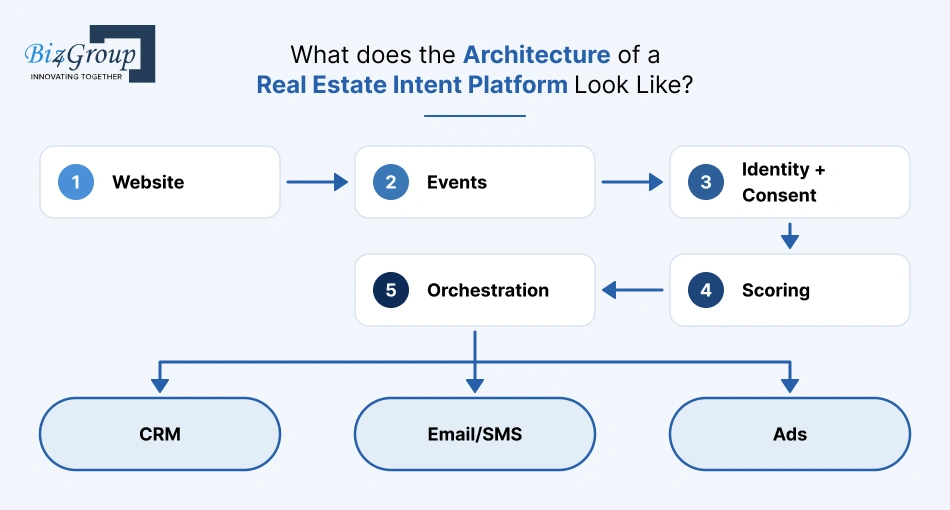
A real estate intent platform is built from a short chain of parts: event capture, identity and consent, scoring and orchestration, and connectors to the MLS, CRM, and ad platforms. Here's the whole thing on one line, and the rest of this section walks through each link.
Website → Events → Identity + Consent → Scoring → Orchestration → CRM, Email/SMS, Ads
Event Capture and First-Party Data Tracking
Everything starts with a clean record of what visitors do. A lightweight script on the site logs events such as listing views, searches, filter changes, calculator use, and tour-request steps, each with a timestamp and an anonymous visitor ID.
Two choices matter here:
- Set cookies from your own domain. First-party cookies last longer than third-party ones and hold up better against browser privacy settings.
- Send key events server-side too. Browser tracking gets blocked often. A server-side copy of important events (a tour request, say) keeps the data complete and feeds tools like Meta's Conversions API and Google's Enhanced Conversions.
A tidy event naming scheme, agreed early, saves months of cleanup later. Ever tried to analyze data where the same click has three different names?
Identity Resolution and Consent Management
Most visitors are anonymous until they do something that reveals who they are, like submitting a form, logging in, or clicking a link in an email. Identity resolution connects that moment back to the earlier anonymous activity, so one person's history sits in one profile.
Consent travels with the identity. Every profile carries flags for what the person agreed to by channel, and the platform checks those flags before anything goes out. The consent record described in the compliance section lives here, and one opt-out updates every channel at once.
Keep matching rules conservative. Link on a confirmed email, because a wrong merge sends the wrong message to the wrong buyer.
Scoring and Remarketing Orchestration Services
Once events and identities are in place, two services do the thinking:
- The scoring service reads each profile's recent behavior, applies the weights or model, and writes back a score, a stage, and the reasons behind it.
- The orchestration service watches for score and stage changes, matches them against the trigger map, and decides on the action and channel.
Before any message leaves, orchestration checks consent, frequency caps, and suppression lists. Keeping that step in one place means every channel follows the same rules, and AI automation services can connect this layer to the CRM, email, and ad tools a team already uses.
Splitting scoring and orchestration also pays off later. The scoring model can be swapped from rules to machine learning without touching the sending logic.
Connecting MLS/IDX Feeds, CRMs, and Ad Platforms
The platform needs three kinds of connections:
|
Connection |
What flows |
Typical route |
|---|---|---|
|
MLS/IDX feed |
Listing details, status, price changes |
RESO Web API or the MLS's data feed |
|
CRM |
Scores, reasons, and tasks out; lead status back |
CRM API, for example Follow Up Boss, kvCORE, or Sierra Interactive |
|
Ad platforms |
Behavior-based audiences and conversion events |
Meta Conversions API, Google Customer Match |
Listing data lets the platform know which home a visitor was looking at, along with its price and status, and it powers price-drop triggers. CRM sync puts scores where agents already work (where do yours look first each morning?), and sends outcomes such as booked tours and closed deals back, which gives the model something to learn from.
Biz4Group's Facilitor, is a handy example of connecting these pieces. It integrates MLS and GPS data, runs buyer financial verification, and ties property search to budget and location, with a stack that includes Python, FastAPI, and PostgreSQL. Intent platforms need the same kind of plumbing: listing data in, buyer context alongside it, and clean hand-offs to the systems that act.
Every MLS has its own data terms, so confirm what scoring and remarketing uses are allowed before building on a feed.
Build, Buy, or Hybrid: Custom Platform vs. Off-the-Shelf Suites
Buy an off-the-shelf suite when you need to be live quickly with a standard sales process, build a custom platform when your data, scoring, or systems are too specific for a suite to handle, and go hybrid when you want a suite for the basics plus custom pieces where it counts. Here's how the three compare side by side.
|
|
Off-the-shelf suite |
Custom platform |
Hybrid |
|---|---|---|---|
|
Examples |
Ylopo, Sierra Interactive, Luxury Presence |
Built around your own data and workflows |
Suite as the base, custom scoring or data layer on top |
|
Time to launch |
Days to weeks |
Months, in phases |
Weeks for the base, then add-ons over time |
|
Data ownership |
Often sits in the vendor's account |
Yours, in your own database |
Split, depending on the design |
|
Scoring |
Vendor's model and rules |
Your rules, then your own ML |
Custom score feeding the suite |
|
Integrations |
What the vendor supports |
Anything with an API |
Suite's list, plus custom connectors |
|
Upfront cost |
Low |
Highest |
Moderate |
|
Ongoing effort |
Vendor handles upkeep |
Your team or a partner maintains it |
Shared |
|
Best for |
Solo agents, small teams, standard funnels |
Large brokerages, multi-brand groups, proptech products |
Teams that outgrew a suite but can't wait for a full build |
Plenty of teams start with a suite, learn what it can't do, and then add custom pieces around it. That path costs less than building everything on day one, and it shows exactly where custom work earns its keep. So which column sounds like your business today, and which one sounds like where it's heading?
Development Roadmap, Team, and Cost Drivers
A custom AI buyer intent platform gets built in phases: a data-readiness review, tracking and data foundation, rules-based scoring, remarketing, and measurement, with machine learning arriving last. The team mixes product, engineering, data, and compliance skills, and the cost mostly follows scope, AI integration services, and data quality.
Phases From Data-Readiness Review to ML Scoring
Here's the order that tends to work best, and why each step waits on the one before it:
- Data-readiness review. Check what the site tracks today, what the CRM holds, and how many closed deals exist with usable history. This decides how ambitious the first release can be.
- Tracking and data foundation. Event capture, identity, and consent records go in first, because every later step depends on them.
- Rules-based scoring and agent view. Weighted rules, stages, and plain-language reasons give agents something useful early.
- Remarketing orchestration. Trigger maps, channel connections, caps, and suppression rules come next, starting with one or two channels.
- Measurement. Holdout groups and dashboards show what is working before more gets added.
- ML scoring. A model trains on real outcomes once enough closed deals have piled up, and runs beside the rules before replacing them.
Skipping straight to step 6 is a common temptation. Without outcome data, a model has nothing to learn from.
Team Roles and What the Client Supplies
|
Role |
What they do |
What the client supplies |
|---|---|---|
|
Product lead |
Defines scope, stages, and triggers |
Sales process, definition of a hot lead |
|
Backend and data engineers |
Build tracking, identity, scoring, and orchestration |
Access to site, CRM, and MLS/IDX feeds |
|
AI/ML engineer |
Designs scoring and, later, the model |
Historical leads and closed-deal outcomes |
|
Frontend developer |
Agent views and on-site personalization |
Brand guidelines, agent feedback |
|
QA and DevOps |
Testing, deployment, monitoring |
Hosting preferences and security requirements |
|
Compliance reviewer |
Checks ad, consent, and scoring design |
Legal counsel to sign off |
Teams without in-house engineers can hire AI developers to cover the backend, data, and ML roles above. The client’s most valuable contribution is a few agents willing to say what they would actually act on. Who on your team would that be?
What Drives the Cost of Custom AI Development
No two builds cost the same, because a handful of choices move the number:
- Scope of channels. Email only is smaller than email, SMS, push, and paid audiences together.
- Number of integrations. Each MLS, CRM, and ad platform adds mapping, testing, and upkeep.
- Data quality. Messy or missing history means cleanup before scoring can work.
- Rules or ML. A rules engine costs less to start than a trained and monitored model.
- Compliance depth. Consent management, audit logs, and fairness testing take real effort.
- Traffic volume and reporting. More events and more dashboards mean more infrastructure.
- After launch. Hosting, monitoring, and model retraining continue past delivery.
Costs also change depending on whether a suite handles part of the stack, which is where the hybrid option can save money.
Realistic Timelines
With AI-assisted development, a working first version no longer needs a long runway. A rules-based release with tracking, scoring, and an agent view can come together in days, and later phases can follow in quick steps. How soon do your agents need a first version they can actually use?
A few things set the pace after that. Clean data and a clear definition of a hot lead speed up everything. Each added integration, channel, and market adds testing time, and compliance review needs room. ML scoring depends on closed-deal data, so it follows the data, not the calendar.
Exact timing depends on scope, so a short discovery call gives a far better answer than any generic estimate.
How to Measure ROI and Conversion Lift?
The ROI of an AI buyer intent platform shows up as extra leads, tours, and closings at a similar or lower cost, and the only trustworthy way to prove it is to compare against a holdout group that never got the remarketing. Track a handful of KPIs from the start, then test lift so the numbers hold up when someone asks where they came from.
The KPIs That Matter, From Conversion Rate to Cost per Lead
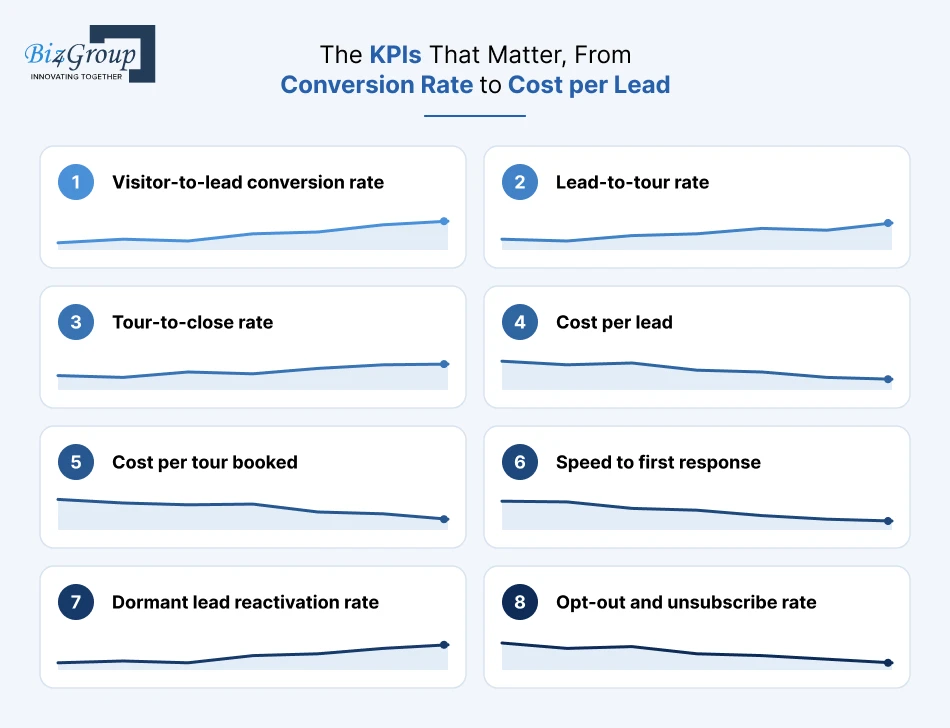
Keep the list short. These eight tell the story from first visit to closing, and the real question is which ones your team tracks today:
|
KPI |
What it tells you |
|---|---|
|
Visitor-to-lead conversion rate |
How many visitors raise a hand |
|
Lead-to-tour rate |
Whether leads are the serious kind |
|
Tour-to-close rate |
How well follow-up turns tours into deals |
|
Cost per lead |
Ad and platform spend divided by leads |
|
Cost per tour booked |
Closer to real buyer interest than cost per lead |
|
Speed to first response |
How fast an agent reaches a hot lead |
|
Dormant lead reactivation rate |
How many old leads come back to life |
|
Opt-out and unsubscribe rate |
An early warning that messaging is too heavy |
If only one number gets watched, make it cost per tour booked, since it sits close to revenue. Which of these do you already see in a report?
A Worked ROI Example
Here's an illustrative example with made-up numbers, so swap in your own. Say a site gets 20,000 visitors a month and converts 2%, which sits at the low end of the typical 2% to 4% range mentioned earlier. The platform lifts that conversion rate to 2.6%.
|
|
Before |
After |
|---|---|---|
|
Visitors |
20,000 |
20,000 |
|
Conversion rate |
2.0% |
2.6% |
|
Leads |
400 |
520 |
|
Lead-to-close rate (assumed) |
1.5% |
1.5% |
|
Closed deals |
6 |
7.8 |
|
Revenue at $9,000 per deal |
$54,000 |
$70,200 |
That's $16,200 in extra revenue. Assume the platform costs $5,000 a month to run. The return works out to ($16,200 − $5,000) ÷ $5,000, or about 224%.
Two honest notes. Deals take time to close, so revenue lags leads. And the 30% lift is an assumption, so the next step is to measure the real one.
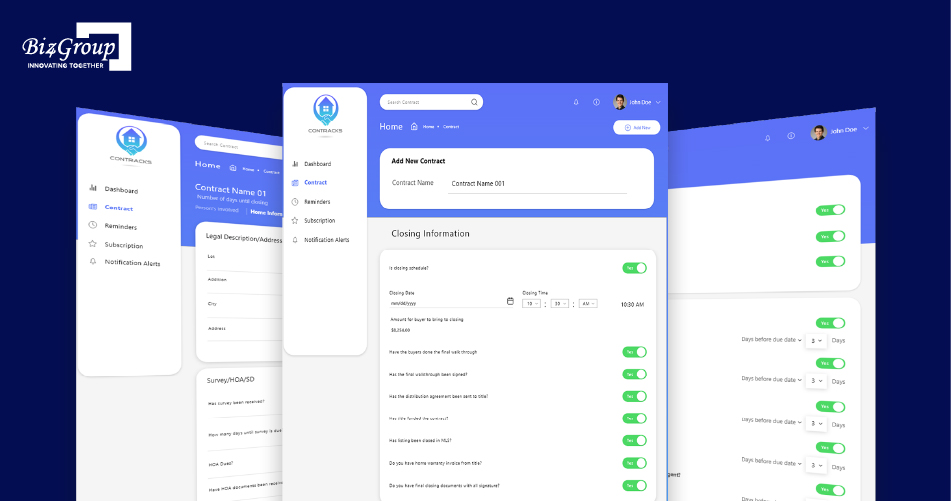
Agent time counts toward ROI too. Biz4Group's Contracks, for example, helps agents save up to 50% of their time on contract paperwork. The same logic applies when a ranked, explained lead list replaces manual lead hunting, so track hours saved alongside deals.
Proving Lift With Holdout Groups
Before-and-after comparisons mislead, because season, rates, and listings all shift on their own. A holdout group fixes that. Randomly keep a slice of eligible visitors, say 10%, out of all remarketing. Everyone else gets the full treatment. Compare the two groups over the same dates.
If the treated group converts at 2.6% and the holdout at 2.0%, the lift is 30%. A few habits keep the test honest:
- Randomize, so the groups match.
- Hold the split steady for the whole test.
- Wait for enough volume before calling a winner. Small groups swing wildly.
- Count the same outcome in both groups, such as tours booked.
Would your current tools let you answer "what would have happened without the remarketing?" Without a holdout, that question has no real answer.
Common Pitfalls in AI Lead Scoring and Remarketing Projects
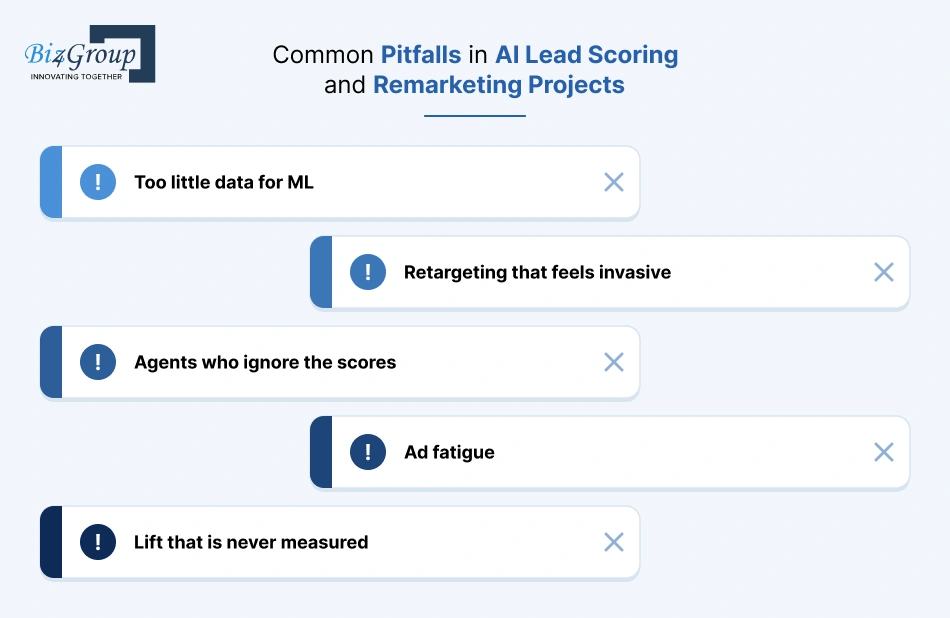
Most AI lead scoring and remarketing projects stumble on the same five things: starting machine learning too early, remarketing that feels creepy, agents who ignore the scores, ad fatigue, and results nobody measures. Each one is easy to avoid once you know to look for it.
|
Pitfall |
What goes wrong |
The fix |
|---|---|---|
|
Too little data for ML |
With only a handful of closed deals, a model learns noise and gives confident, wrong scores |
Start with weighted rules, collect outcomes, add ML once the data supports it |
|
Retargeting that feels invasive |
An ad that follows a buyer around with the exact home they viewed at midnight feels like surveillance |
Keep messages useful, cap frequency, honor opt-outs fast |
|
Agents who ignore the scores |
Lists that are hard to understand, or were wrong before, get tuned out |
Show plain-language reasons, put tasks in tools agents already use, let them flag bad scores |
|
Ad fatigue |
The same ad on repeat wears out the audience, so click-through falls and cost per lead rises |
Rotate creative, set frequency caps, stop ads once a listing sells |
|
Lift that is never measured |
Leads go up and the platform gets the credit, even when season or ad spend did the work |
Keep a holdout group from day one |
One habit catches most of these early. Before any campaign goes live, ask whether it would feel useful or creepy landing on your own phone. And ask your agents a second question: would they trust a list that was wrong last week? If either answer is shaky, fix that first.
From Quiet Browsers to Booked Tours: Where to Go From Here
Most people who visit a residential real estate website never fill out a form, yet plenty of them are serious. A custom AI buyer intent and remarketing platform gives those visitors a second chance: it reads their behavior, works out who is getting ready, and brings them back through ads, email, text, or a task for an agent, all inside Fair Housing, consent, and privacy rules. A good first version stays small, with rules-based scoring, one or two channels, and a holdout group to prove the lift.
If you're weighing a build, a suite, or a mix of both, a scoping conversation with Biz4Group's team is an easy next step. Bring your traffic, your CRM, and your goals, and the conversation can map out what a first version would look like.
Which part of your website traffic would you most like to hear from again? Schedule a call to know how we can help!
FAQs About AI Buyer Intent and Remarketing Platform Development
1. Can the Platform Be Added to My Existing IDX Website Without a Rebuild?
Usually yes, much like how teams integrate AI into an app they already run. Tracking goes in through a tag manager or a small script.
2. Can It Score Seller Intent as Well as Buyer Intent?
Yes, using separate signals such as valuation tool use, recent-sales checks near an address, and selling guide visits. Sellers get their own score and follow-up.
3. How Does the Platform Work Across Multiple MLSs and States?
Each MLS connects into one common listing format. Data-use, display, and consent rules for each market live in per-market settings.
4. Is It Safe to Use Generative AI to Write Remarketing Messages?
Yes, with guardrails. Messages written with generative AI use only approved listing facts, avoid hints about who lives in an area, get human approval at first, and are logged for review.
5. Will AI Remarketing Replace Our ISAs or Agent Follow-Up?
No. It sends ISAs and agents to the buyers worth calling and handles routine reminders. Teams that implement generative AI in real estate follow the same pattern: the tools draft and remind, and people handle the conversations.
6. What Maintenance and Model Retraining Does It Need After Launch?
Retrain the model on new closed-deal outcomes regularly, audit tracking after website changes, update MLS and CRM connections when they change, and revisit ad platform rules.
