 Location :
Orlando, FL, USA
 +1 (407) 714-1616
 info@biz4group.com


- AI App Ideas in 2026 will focus heavily on automation, personalization, predictive intelligence, and industry-specific problem solving, creating massive opportunities for startups and enterprises.
- Businesses can capitalize on the most promising AI Application Ideas by identifying real user pain points and building solutions powered by NLP, machine learning, and advanced analytics.
- The top AI Mobile App Ideas for 2026 include AI copilots, content generation tools, healthcare diagnostics, personal finance assistants, and smart retail applications, offering strong long-term growth potential.
- Entrepreneurs looking for innovative AI App Development Ideas should consider niche AI solutions that deliver measurable ROI, scalable features, and user-centric experiences.
- Partnering with an experienced development team is essential for turning complex AI concepts into functional, market-ready products.
- 2026 presents a unique opportunity for innovators to launch next-generation AI apps that redefine digital experiences and transform industries.
Artificial Intelligence has made building software easier than ever, but choosing the right AI app idea has become significantly harder. Every day, new AI startups launch across healthcare, finance, retail, education, logistics, and dozens of other industries, making it increasingly difficult to identify opportunities that are both commercially viable and capable of standing out in a crowded market.
The reality is that not every AI app idea is worth pursuing. Some categories are already saturated, while others continue to present untapped opportunities for founders who solve real business problems instead of chasing the latest AI trend. Whether you're building your first AI startup, expanding an existing business, or exploring investment opportunities, success starts with choosing an idea that offers genuine market demand, a clear competitive advantage, and long-term growth potential.
That's exactly what this guide is designed to help you do. Instead of presenting another generic list of AI app ideas, we've curated 100+ AI app ideas for 2026 across high-growth industries, covering opportunities for startups, enterprises, and entrepreneurs looking to build AI-powered products. You'll also discover practical insights to help evaluate which ideas are scalable, commercially promising, and worth investing in.
If you've been asking questions like:
- Which AI app ideas still have room for new competitors?
- What AI app should I build in 2026?
- Which AI startup ideas have the highest revenue potential?
- Which AI apps are attracting enterprise demand?
- How do I choose an AI app idea that users will actually pay for?
...you're in the right place. Let's explore the AI app ideas that have the potential to become tomorrow's successful businesses.
Why AI Business App Ideas are Booming in 2026?
Interest in AI app ideas is growing quickly as AI tools become easier to use and integrate into software. In the past, building AI-powered products required large teams and heavy infrastructure. Today, developers can use AI model development, APIs, and cloud platforms to build intelligent applications much faster.
Because of this shift, many founders are exploring AI app ideas for startups that solve real problems and automate everyday tasks. Businesses are also investing more in AI because it helps reduce manual work, improve efficiency, and make better use of data.
Several simple trends are driving this growth:
1. AI Tools Are Easier to Access
Developers no longer need to build AI systems from scratch. Many AI capabilities are now available through APIs and ready frameworks. This means teams can:
- build AI features faster
- launch new products with smaller teams
- experiment with ideas at lower cost
As a result, more startups and companies can embrace best artificial intelligence app ideas for business opportunities.
2. Businesses Want Automation
Companies are looking for ways to reduce repetitive work and save time. AI can help automate tasks that normally require manual effort. This includes areas like:
- data analysis
- content creation
- workflow automation
- decision support
Because of this demand, many founders are looking for AI solutions that can improve business operations.
3. Users Expect Smarter Software
Modern users expect applications to be more helpful and intelligent. Instead of just performing basic tasks, people want software that can assist them and save time. AI allows applications to:
- understand user requests
- suggest actions
- personalize results
- speed up routine tasks
This shift is pushing companies to add AI capabilities to their products.
4. AI Is Becoming Part of Everyday Software
AI is no longer only used in standalone tools. It is now being added directly into business platforms, productivity tools, and digital products.
This makes software more helpful during everyday work and improves overall efficiency.
Because of these changes, entrepreneurs and companies are exploring the best AI app ideas for businesses that can deliver real value. As AI technology continues to improve, the opportunities to build useful and scalable AI applications will keep growing.
What are AI App Ideas?
AI app ideas refer to innovative concepts for mobile or web applications that leverage artificial intelligence to solve problems, enhance user experiences, or automate tasks. These ideas are the foundation for creating smart, scalable, and often highly personalized apps that can serve a wide range of industries like healthcare and education to retail and entertainment.
As AI technology becomes more accessible through APIs, open-source models, and cloud platforms, it's now easier than ever to start a business using AI or bring new AI startup ideas to life. Whether it's a chatbot for customer service, a fitness app with personalized coaching, or a language learning assistant, AI can add intelligence and adaptability that traditional apps simply can't match.
Key Areas Where AI App Ideas Are Thriving:
- Health & Wellness: AI-powered symptom checkers, mental health chatbots, fitness trackers with adaptive plans.
- Education: Personalized tutoring apps, AI quiz generators, language learning with speech recognition.
- Business & Productivity: Smart meeting assistants, AI writing tools, resume builders with ATS optimization.
- Finance: Expense tracking apps, AI investment advisors, fraud detection systems.
- Retail & E-commerce: Virtual stylists, recommendation engines, smart inventory forecasting.
- Human Resources (HR): AI interview screeners, talent matching apps, and employee engagement analytics.
- Insurance: Claims automation tools, fraud detection systems, and AI-driven policy recommendations.
- Sports & Fitness: AI coaches for training feedback, performance analytics, and injury prevention insights.
- Real Estate: Property value estimators, virtual staging apps, and AI assistants for lead qualification.
- Legal Tech: Contract analysis tools, AI legal research assistants, and compliance monitoring apps.
- Travel & Hospitality: Smart itinerary planners, AI-powered concierge services, and dynamic pricing engines.
- Entertainment & Media: AI video editors, music composition tools, and content personalization engines.
- Customer Service: AI chatbots, sentiment analysis apps, and support ticket prioritization tools.
- Logistics & Supply Chain: Route optimization apps, demand forecasting, and inventory automation.
- Agriculture: Crop monitoring tools, AI-powered pest detection, and yield prediction systems.
Whether you're an entrepreneur looking for AI business ideas, understanding the scope of AI app ideas is a crucial step toward building something impactful and competitive in today’s market.
Why AI is the Future of App Development?
Artificial Intelligence (AI) is revolutionizing app development, enabling businesses to create cutting-edge solutions that cater to evolving market demands. From addressing complex challenges to delivering personalized experiences and automating workflows, top AI powered app ideas for entrepreneurs are redefining the way we develop and use technology.
AI Solves Complex Problems Across Industries
AI’s ability to tackle intricate challenges makes it essential in app development. In healthcare, AI-powered apps diagnose diseases and predict outcomes. In finance, they detect fraud and optimize investments. These features enable businesses to create apps that surpass traditional problem-solving methods.
AI Enhances Personalization
Modern users expect tailored experiences, and AI delivers by analyzing user behavior. Apps like Spotify and Netflix recommend personalized content, while eCommerce platforms enhance shopping journeys through data-driven suggestions. This personalization fosters user loyalty and improves app success.
AI Automates with Precision
AI automation services streamline workflows and reduces manual tasks. Robotic Process Automation (RPA) simplifies repetitive operations, and scheduling apps boost efficiency. By integrating automation, businesses can save time, cut costs, and improve productivity.

Growing AI Trends in App Development
Emerging AI app ideas for startups in the USA are reshaping business perspectives. Here’s the answer to everyone asking ‘what are trending AI app ideas right now?'.
- Conversational AI: Powers chatbots and virtual assistants like Alexa and Siri, offering human-like interactions.
- Generative AI: Enables content creation, app design, and coding, expanding possibilities for creative and business apps.
- AI Automation: Drives intelligent process automation, especially in logistics, HR, and supply chain management.
As the demand for innovative solutions rises, artificial intelligence app ideas will play a critical role in driving the future of app development and solving real-world challenges.
Market Insights: Why Now Is the Time to Invest in AI Apps
AI-powered mobile apps are revolutionizing industries, from healthcare to finance, offering smarter automation and personalized user experiences. The AI app market is projected to grow exponentially, making now the perfect time to invest in innovative AI mobile app ideas. Entrepreneurs and investors are increasingly exploring AI business ideas to tap into this booming market and gain a competitive edge.
If you are also an entrepreneur looking for an idea to develop an AI-based mobile app, the following market insights and statistics will help you make an informed decision and capitalize on this transformative technology.
- The market size in the Artificial Intelligence market is projected to reach US$243.70bn in 2025. (Source)
- The market size is expected to show an annual growth rate (CAGR 2025-2030) of 27.67%, resulting in a market volume of US$826.70bn by 2030. (Source)
- In global comparison, the largest market size will be in the United States (US$66.21bn in 2025). (Source)

How to Evaluate a Good AI App Idea?
Coming up with an AI app idea is exciting, but turning that idea into a successful business requires thoughtful evaluation. Not every concept is practical, profitable, or even necessary. To build an app that truly solves a problem and stands out in the market, you need to assess it through a strategic lens.
Below are four key criteria to evaluate the strength and viability of any AI business idea or AI startup concept:
1. Market Demand and User Pain Points
Before anything else, ask: Does this idea solve a real problem?
- A good AI app should address a specific pain point or unmet need in the market.
- Research your target audience: What are their daily challenges, inefficiencies, or frustrations?
- Look for proof of demand—search trends, forum discussions, existing app reviews, or competitor gaps.
Example: An AI mental health chatbot works because there’s a rising demand for affordable, 24/7 mental health support.
2. AI Feasibility and Available Technologies
Not every idea can or should use AI. Evaluate whether AI adds genuine value and whether the technology exists to support it.
- Is AI the best solution, or is a simple algorithm enough?
- Can current tools (like GPT, computer vision, or speech recognition) be used to build it?
- Consider development resources: Do you need data training, an ML team, or pre-built APIs?
Tip: Use platforms like OpenAI, Hugging Face, or Google Vertex AI to prototype quickly without starting from scratch.
3. Monetization Model
Even the smartest app won’t survive without a solid path to revenue.
- Ask yourself: How will this app make money? Subscription, freemium, ads, or enterprise licensing?
- Does the user segment have buying power or a willingness to pay for the solution?
- Analyze how similar AI apps monetize and identify opportunities to improve or differentiate.
Example: Resume optimization apps often use a freemium model—free scan, paid detailed reports.
4. Regulatory or Ethical Considerations
AI apps can easily cross into sensitive territory, especially when dealing with user data, predictions, or automation.
- Ensure your app complies with data privacy laws (like GDPR, HIPAA, or CCPA).
- Watch out for algorithmic bias, unfair treatment, or opaque decision-making.
- Ethical AI is becoming a standard expectation—transparency and explainability matter.
Example: An AI hiring tool must be transparent and bias-tested to avoid legal and reputational risks.
A good AI app idea balances innovation with practicality—it solves a real problem, is
technically achievable, can generate revenue, and operates ethically. Taking time to evaluate
your idea through these four lenses significantly increases your chances of building a scalable
and successful AI business.
Quick Framework to Evaluate an AI App Idea
|
Evaluation Factor |
What to Ask |
Why It Matters |
Example |
|---|---|---|---|
|
Market Demand & User Pain |
Does this idea solve a real and frequent problem? |
AI apps succeed when they remove friction, save time, or automate tasks users struggle with. |
An AI mental health chatbot addresses the growing demand for accessible, 24/7 support. |
|
AI Feasibility |
Does the solution genuinely require AI? Can existing AI tools build it? |
AI should provide clear value. Using existing technologies like NLP, computer vision, or speech recognition can make development faster and more practical. |
Tools like OpenAI, Hugging Face, or Google Vertex AI allow quick prototyping. |
|
Monetization Potential |
How will the app generate revenue? |
A sustainable AI product needs a clear revenue model such as subscription, freemium, or enterprise licensing. |
Resume optimization apps often use a freemium model with paid detailed reports. |
|
Regulatory & Ethical Considerations |
Does the app comply with data privacy and fairness standards? |
AI apps must handle data responsibly and avoid bias, especially in areas like hiring, healthcare, or finance. |
AI hiring tools must be bias-tested and transparent to avoid legal risks. |
100+ AI App Ideas Across Categories
Artificial Intelligence (AI) is unlocking new opportunities for app development, catering to diverse industries and user needs. From health and wellness to business productivity, AI app ideas are driving innovation and creating smarter solutions for users. Let’s explore 100 AI app ideas for entrepreneurs and startups in 2026, starting with health and wellness, that you can develop to address critical challenges and tap into lucrative markets.
Here’s a list of what AI products can a startup build to stay ahead in the technology landscape:
Top Healthcare and Wellness AI App Ideas
1. AI-powered Fitness Coaching App

With AI fitness app development, create an app that acts as a personal trainer, offering tailored workout plans, tracking progress, and providing real-time feedback using data from wearables. Popular apps like Fitbit and Freeletics highlight the demand for fitness coaching tools. The fitness industry’s shift toward digital solutions and personalized experiences makes this an attractive investment opportunity. The growing emphasis on health and convenience ensures that an AI-powered fitness app will have a strong user base and revenue potential.
Target Audience: Fitness enthusiasts, remote workers, busy professionals, Gen Z users
Business Stage Fit: Startup-Friendly, Bootstrap-Friendly
Suggested Tech Stack:
- Frontend: React Native
- Backend: js
- AI Frameworks/APIs: TensorFlow, Apple HealthKit API, OpenAI (for virtual coaching)
Investment Potential:
- Projected Revenue: $2M – $10M annually
- Estimated Development Cost: $30,000 – $120,000
- Revenue Streams: Subscription-based, freemium tier, in-app purchases (custom plans), fitness brand partnerships
Portfolio Spotlight
Biz4Group developed an AI-powered workout platform that uses computer vision and intelligent analysis to track posture and recommend personalized exercises. The system analyzes movement in real time and adjusts routines based on user performance, demonstrating how modern AI startup ideas for building scalable products can transform fitness coaching.
2. AI-based Baby Cry Translator App
This app leverages AI to analyze baby cries, identifying needs like hunger, discomfort, or sleepiness. ChatterBaby is a well-known app that has proven the viability of this idea. With an increasing number of busy parents seeking smarter parenting aids, this app addresses a unique niche. Investing in AI-powered parenting solutions caters to a growing demographic of tech-savvy parents, offering a meaningful and profitable opportunity.
Target Audience: New parents, caregivers, pediatricians, health-conscious families
Business Stage Fit: Startup-Friendly, Bootstrap-Friendly
Suggested Tech Stack:
- Frontend: Flutter
- Backend: Django or Firebase
- AI Frameworks/APIs: Python + TensorFlow (sound recognition), OpenAI Whisper (speech-to-text), Firebase ML
Investment Potential:
- Projected Revenue: $1M – $5M annually
- Estimated Development Cost: $25,000 – $90,000
- Revenue Streams: Subscription plans, in-app purchases (premium features), partnerships with baby product brands, white-label licensing to hospitals
3. AI-powered Pet Care Monitoring App
An AI-driven pet care app monitors a pet’s activity, health, and behavior via wearables or cameras. Apps like Whistle and PawTrack demonstrate the popularity of such tools. With global pet ownership on the rise, this app provides a solution for modern pet parents who want to ensure their pets' well-being. Investing in AI in pet care taps into an emotional yet practical market, ensuring long-term growth potential.
Target Audience: Pet owners, veterinarians, pet service providers
Business Stage Fit: Startup-Friendly, Bootstrap-Friendly
Suggested Tech Stack:
- Frontend: React Native
- Backend: js
- AI Frameworks/APIs: TensorFlow (activity recognition), AWS Rekognition (video/pet monitoring), Google Cloud AI
Investment Potential:
- Projected Revenue: $1.5M – $6M annually
- Estimated Development Cost: $30,000 – $100,000
- Revenue Streams: Subscription plans, data monetization (health tracking), device integrations (wearables), affiliate partnerships with pet brands or clinics
4. AI-driven Elderly Care Monitoring App
This app combines real-time health tracking and medication reminders with caregiver notifications. Apps like CarePredict are already proving the demand for AI-powered elderly care solutions. With an aging global population, the need for independent living support is growing rapidly. Investing in AI for elderly care addresses a critical societal need while capitalizing on a high-growth market driven by healthcare trends.
Target Audience: Seniors living independently, caregivers, healthcare providers, assisted living facilities
Business Stage Fit: Startup-Friendly, Investor-Backed Growth
Suggested Tech Stack:
- Frontend: Flutter
- Backend: js or Firebase
- AI Frameworks/APIs: TensorFlow (health trend prediction), OpenAI (caregiver chatbot), Google Cloud IoT (device integration)
Investment Potential:
- Projected Revenue: $3M – $8M annually
- Estimated Development Cost: $40,000 – $150,000
- Revenue Streams: Subscription plans, licensing to care centers, API integration for smart home systems, B2B partnerships with health insurers
5. AI-based Sleep Monitoring App
An AI-powered sleep monitoring app tracks users' sleep patterns, detects disorders like insomnia, and offers personalized suggestions to improve rest quality. Apps like Sleep Cycle and Pillow show the high demand for such tools. With increasing awareness about the importance of sleep for overall health, investing in AI-driven sleep monitoring solutions is a profitable opportunity. This app appeals to health-conscious individuals and integrates well with wearable technology for precise data tracking.
Target Audience: Health-conscious individuals, fitness enthusiasts, individuals with sleep disorders
Business Stage Fit: Startup-Friendly, Bootstrap-Friendly
Suggested Tech Stack:
- Frontend: Flutter
- Backend: js
- AI Frameworks/APIs: TensorFlow Lite (sleep pattern detection), Apple HealthKit, Google Fit API
Investment Potential:
- Projected Revenue: $2M – $7M annually
- Estimated Development Cost: $30,000 – $120,000
- Revenue Streams: Subscriptions, freemium tier, integrations with smart wearables, B2B licensing for health clinics or wellness apps
6. AI-driven Mental Health App

With AI mental health app technology, develop a platform that offers virtual therapy, mindfulness exercises, and stress management tools. Popular apps like Woebot and Wysa showcase the potential of AI in mental health support. As mental health awareness grows globally, this app addresses a critical need for accessible and affordable therapy. By investing in AI-driven mental health solutions, businesses can make a positive societal impact while entering a rapidly expanding market.
Target Audience: Young adults, remote workers, therapy seekers, HR departments in corporate wellness programs
Business Stage Fit: Startup-Friendly, Investor-Backed Growth
Suggested Tech Stack:
- Frontend: React Native
- Backend: Django or Node.js
- AI Frameworks/APIs: OpenAI (therapeutic chatbot), Google Dialogflow, TensorFlow (mood tracking and prediction)
Investment Potential:
- Projected Revenue: $3M – $10M annually
- Estimated Development Cost: $40,000 – $150,000
- Revenue Streams: Subscription-based, pay-per-session therapy models, enterprise wellness partnerships, in-app purchases (journals, mood tracking add-ons)
Portfolio Spotlight
CogniHelp is a healthcare-focused mobile application designed to support dementia patients through cognitive exercises, reminders, and monitoring tools. Built with a patient-centric approach, it shows how healthcare-focused AI startup app ideas can improve quality of life by helping users maintain mental engagement and independence during early and mid stages of cognitive decline.
7. AI-powered Nutrition Tracking App
An AI nutrition tracking app analyzes eating habits, calculates calorie intake, and provides meal plan recommendations tailored to health goals. Apps like MyFitnessPal have shown the effectiveness of AI in promoting healthier lifestyles. As fitness and nutrition trends rise, investing in AI-powered health and fitness apps offers businesses a chance to attract a health-conscious audience and build recurring revenue through subscriptions.
Target Audience: Health-conscious individuals, fitness app users, dietitians, wellness coaches
Business Stage Fit: Startup-Friendly, Bootstrap-Friendly
Suggested Tech Stack:
- Frontend: Flutter
- Backend: js or Firebase
- AI Frameworks/APIs: TensorFlow (nutrient tracking and pattern detection), Spoonacular API, OpenAI (chat-based diet coaching)
Investment Potential:
- Projected Revenue: $2M – $8M annually
- Estimated Development Cost: $30,000 – $100,000
- Revenue Streams: Subscription model, freemium features, partnerships with diet brands and gyms, in-app product promotions
8. AI-driven Health Diagnosis Assistant
This app evaluates user symptoms and provides potential diagnoses, leveraging extensive medical databases. Apps like Ada Health have proven the feasibility of this idea. By investing in AI-based diagnostic tools, businesses can revolutionize how users manage their health. The app reduces the need for immediate doctor visits and helps users make informed decisions about seeking medical care, appealing to individuals seeking proactive healthcare solutions.
Target Audience: Expecting mothers, OB-GYN clinics, prenatal health coaches, maternity hospitals
Business Stage Fit: Startup-Friendly, Bootstrap-Friendly
Suggested Tech Stack:
- Frontend: Flutter
- Backend: Firebase or Node.js
- AI Frameworks/APIs: TensorFlow (pregnancy tracking algorithms), MedlinePlus API, OpenAI (personalized pregnancy chatbot)
Investment Potential:
- Projected Revenue: $2M – $7M annually
- Estimated Development Cost: $30,000 – $100,000
- Revenue Streams: Subscription plans, premium content modules (diet, exercises), B2B healthcare partnerships, affiliate links for maternity products
9. AI-based Pregnancy Monitoring App
This app helps expectant mothers track fetal development, receive personalized tips, and manage prenatal appointments. Apps like What to Expect demonstrate the popularity of pregnancy-focused tools. By combining AI with healthcare, this app can offer advanced features like contraction tracking and nutritional advice. Investing in AI-powered pregnancy solutions targets a specific yet consistent market, ensuring stable growth while addressing a meaningful segment of healthcare.
Target Audience: Expecting mothers, OB-GYN clinics, prenatal health coaches, maternity hospitals
Business Stage Fit: Startup-Friendly, Bootstrap-Friendly
Suggested Tech Stack:
- Frontend: Flutter
- Backend: Firebase or Node.js
- AI Frameworks/APIs: TensorFlow (pregnancy tracking algorithms), MedlinePlus API, OpenAI (personalized pregnancy chatbot)
Investment Potential:
- Projected Revenue: $2M – $7M annually
- Estimated Development Cost: $30,000 – $100,000
Revenue Streams: Subscription plans, premium content modules (diet, exercises), B2B healthcare partnerships, affiliate links for maternity products
10. AI-based Stress Management App
An AI-based stress management app offers personalized tools like guided meditation, breathing exercises, and stress-level trackers. This AI app idea adapts to user needs by analyzing behavior patterns and offering effective relaxation techniques. Apps like Calm and Headspace prove the demand for mental wellness solutions. With rising awareness around mental health, this can be considered among the best AI startup ideas for the US market.
Target Audience: Mental health-conscious users, corporate wellness programs, college students
Business Stage Fit: Startup-Friendly
Suggested Tech Stack:
- Frontend: React Native
- Backend: Firebase
- AI: OpenAI (chat-based therapy), Google Cloud Natural Language API (stress detection)
Investment Potential:
- Projected Revenue: $2M – $6M annually
- Development Cost: $30,000 – $100,000
- Revenue Streams: Subscription-based, affiliate partnerships, B2B wellness licensing
11. AI-driven Medical Record Organizer
This AI app idea simplifies healthcare management by organizing medical records, tracking appointments, and reminding users about medications. AI ensures accuracy and accessibility of data for users and caregivers. Apps like MyChart demonstrate the demand for such tools. With the healthcare industry’s shift toward digital solutions, this app idea is a valuable addition to the list of innovative AI app ideas for entrepreneurs transforming patient care in 2026.
Target Audience: Patients, caregivers, hospitals, insurance providers
Business Stage Fit: Investor-Backed Growth
Suggested Tech Stack:
- Frontend: Angular
- Backend: js
- AI: Google Cloud Document AI, AWS Comprehend Medical
Investment Potential:
- Projected Revenue: $2M – $8M annually
- Development Cost: $40,000 – $120,000
- Revenue Streams: SaaS licensing, API access, enterprise subscriptions
12. AI-enabled Chronic Disease Management App
Managing chronic conditions like diabetes or hypertension becomes easier with this AI app idea. It tracks vital signs, sends personalized alerts, and offers lifestyle recommendations using real-time health data. Apps like Livongo highlight the success of such concepts. By collaborating with an iOS app development company, businesses can create scalable platforms for long-term healthcare solutions. With chronic illnesses on the rise, this idea addresses a pressing need while offering significant market potential.
Target Audience: Patients with chronic illnesses, doctors, wellness coaches
Business Stage Fit: Startup-Friendly
Suggested Tech Stack:
- Frontend: React Native
- Backend: Django
- AI: TensorFlow, Google Fit API, iOS HealthKit
Investment Potential:
- Projected Revenue: $3M – $10M annually
- Development Cost: $50,000 – $150,000
- Revenue Streams: Subscription-based, hospital licensing, insurer partnerships
13. AI-powered Yoga Posture Corrector

For those trying to figure out ' what AI app business can I start in 2026?’ This one focuses on analyzing yoga poses using AI-powered computer vision, providing corrective feedback to improve alignment and prevent injuries. Users can access customized routines and track their progress. Inspired by apps like YogaGlo, this idea targets the rapidly growing wellness market. As fitness and mindfulness gain popularity globally, this app idea provides an excellent opportunity for businesses to tap into a lucrative market while addressing user health needs.
Target Audience: Yoga practitioners, fitness coaches, wellness centers
Business Stage Fit: Startup-Friendly
Suggested Tech Stack:
- Frontend: Flutter
- Backend: js
- AI: OpenCV (pose detection), TensorFlow Lite (correction feedback)
Investment Potential:
- Projected Revenue: $1.5M – $6M annually
- Development Cost: $30,000 – $100,000
- Revenue Streams: One-time purchase, in-app upgrades, fitness platform integrations
14. AI-based Telemedicine Consultation App
This app connects patients with doctors through virtual consultations, using AI to gather health data, analyze symptoms, and assist with accurate diagnoses. Truman platform highlights the demand for telemedicine. This AI app idea addresses accessibility issues and enhances remote healthcare delivery. With the rise of healthcare enterprise AI solutions and digital transformation in medicine, this app is ideal for businesses looking to invest in a high-impact, scalable solution for 2026.
Target Audience: Remote patients, telehealth providers, rural clinics
Business Stage Fit: Investor-Backed Growth
Suggested Tech Stack:
- Frontend: React Native
- Backend: Django
- AI: OpenAI (symptom triage chatbot), Google Health API
Investment Potential:
- Projected Revenue: $5M – $12M annually
- Development Cost: $50,000 – $150,000
- Revenue Streams: Pay-per-consultation, insurance partnerships, SaaS licensing
15. AI-driven Personalized Meditation App
An AI-powered meditation app tailors sessions to users’ stress levels, moods, and preferences. It adapts recommendations using AI insights to ensure optimal relaxation. Inspired by apps like Cultiv8, this idea is perfect for the growing mental health tech industry. With wellness becoming a priority, this artificial intelligence app idea offers businesses a way to create innovative, impactful solutions for stress management while targeting the expanding mindfulness app market.
Target Audience: Meditation beginners, working professionals, therapy centers
Business Stage Fit: Startup-Friendly
Suggested Tech Stack:
- Frontend: Flutter
- Backend: Firebase
- AI: OpenAI (guided meditation scripts), TensorFlow (mood detection)
Investment Potential:
- Projected Revenue: $2M – $7M annually
- Development Cost: $30,000 – $100,000
- Revenue Streams: Subscription, in-app courses, B2B wellness partnerships
16. AI-powered Allergy Management App
So, what are the most profitable AI apps to build? Well, AI-powered allergy management app is one of them. This app identifies allergens, sends real-time alerts for environmental triggers, and offers dietary suggestions. Leveraging wearable sensors and AI, it ensures safety and convenience. Apps like Allergy Amulet validate the potential of this concept. As allergy awareness grows, this AI health app idea meets the needs of a sensitive, health-conscious audience. With increasing interest in AI-powered health apps, this app represents a unique and profitable niche for businesses to explore.
Target Audience: Allergy-prone individuals, clinics, health insurers
Business Stage Fit: Bootstrap-Friendly
Suggested Tech Stack:
- Frontend: React Native
- Backend:js
- AI: TensorFlow (symptom pattern detection), wearable APIs
Investment Potential:
- Projected Revenue: $1.5M – $5M annually
- Development Cost: $30,000 – $90,000
- Revenue Streams: Subscription, sensor integrations, pharmacy partnerships
Portfolio Spotlight
Select Balance is an AI-powered chatbot designed to help users discover personalized health supplements through conversational interaction and guided questionnaires. The platform demonstrates how top AI app ideas for businesses in the USA can simplify product discovery by combining natural language interaction with recommendation algorithms tailored to individual health needs.
17. AI-based Hydration Reminder App
This app tracks water consumption and uses AI to recommend personalized hydration goals based on activity, health metrics, and environmental factors. Inspired by apps like Plant Nanny, this idea aligns with the global digital health app trends of self-care and wellness. With features like daily progress tracking and customizable alerts, this AI-powered wellness app provides a practical, engaging tool for maintaining hydration, making it a solid investment opportunity.
Target Audience: Fitness users, office workers, chronic condition patients
Business Stage Fit: Startup-Friendly
Suggested Tech Stack:
- Frontend: Flutter
- Backend: Firebase
- AI: Google Fit API, TensorFlow (activity-based hydration estimation)
Investment Potential:
- Projected Revenue: $1M – $4M annually
- Development Cost: $20,000 – $70,000
- Revenue Streams: Freemium model, in-app coaching plans, wearables integrations
18. AI-driven Posture Correction App
An AI posture app uses cameras or sensors to monitor alignment, providing real-time corrective feedback. It includes personalized exercises to improve posture and prevent back pain. Apps like Upright Go highlight the success of such concepts. With remote work on the rise, this AI app idea targets ergonomic challenges faced by desk workers and fitness enthusiasts. Investing in AI-driven fitness app development ensures you tap into the growing demand for physical health solutions.
Target Audience: Desk workers, physiotherapy clinics, health-conscious individuals
Business Stage Fit: Startup-Friendly
Suggested Tech Stack:
- Frontend: React Native
- Backend:js
- AI: OpenCV (camera-based tracking), TensorFlow (alignment correction)
Investment Potential:
- Projected Revenue: $2M – $6M annually
- Development Cost: $30,000 – $100,000
- Revenue Streams: Subscriptions, ergonomic gear affiliate sales, fitness brand licensing
19. AI-driven Wellness App

This app combines fitness, nutrition, mindfulness, and mental health into one platform, providing a comprehensive solution for users. It delivers personalized plans; tracks progress and integrates AI analytics for smarter health insights. Apps like MyFitnessPal show the profitability of such holistic tools. By focusing on AI wellness app development, businesses can cater to an audience seeking all-in-one wellness solutions. This idea is a standout among AI app ideas for 2026, aligning with trends in holistic health and digital well-being.
Target Audience: Fitness users, lifestyle coaches, wellness platforms
Business Stage Fit: Startup-Friendly, Investor-Ready
Suggested Tech Stack:
- Frontend: Flutter
- Backend:js
- AI: TensorFlow (activity analytics), OpenAI (personalized wellness tips), HealthKit API
Investment Potential:
- Projected Revenue: $3M – $9M annually
- Development Cost: $40,000 – $120,000
- Revenue Streams: Subscription, corporate wellness integration, premium health tracking modules
Portfolio Spotlight
Semuto is an AI-driven healthcare recommendation platform that guides users toward personalized wellness solutions based on individual health needs. By combining user inputs with intelligent recommendation systems, the platform highlights how AI app ideas for modern businesses can deliver personalized healthcare discovery experiences through smart matching and data-driven insights.
20. AI-Powered Psychotherapy Training App
This AI-powered psychotherapy training app is an innovative Artificial Intelligence App Idea. This application utilizes AI to simulate real-life therapy sessions, providing trainees with interactive scenarios to enhance their counseling skills. By integrating AI Agent Development, the app offers personalized feedback, adapting to the user's responses to improve their therapeutic techniques. This tool is invaluable for educational institutions and professional development, ensuring therapists are well-prepared for diverse client interactions.
Target Audience: Psychology students, therapy training institutions, medical colleges
Business Stage Fit: Series A / Academic Partnerships
Suggested Tech Stack:
- Frontend: React
- Backend: Django + PostgreSQL
- AI: GPT-4 (case simulations), ML (dialogue scoring), voice analysis
Investment Potential:
- Projected Revenue: $4M – $10M annually
- Development Cost: $50,000 – $120,000
- Revenue Streams: Licensing to universities, certification modules, therapist training programs
21. AI-Based Personalized Nutrition App
A health-focused platform is among the best artificial intelligence startup app ideas for 2026, this application offers users personalized meal plans and dietary advice based on their health goals, preferences, and restrictions. Leveraging Generative AI, the app adapts recommendations as users' needs evolve, promoting healthier lifestyles.
Target Audience: Health-conscious users, dietitians, wellness platforms
Business Stage Fit: Startup to Growth-Stage Health Tech
Suggested Tech Stack:
- Frontend: React Native
- Backend:js + Firebase
- AI: ML (macro tracking), GPT-4 (meal planning), wearable integration
Investment Potential:
- Projected Revenue: $3M – $10M annually
- Development Cost: $40,000 – $100,000
Revenue Streams: Premium meal plans, fitness partnerships, personalized diet coaching
22. AI-Driven Mental Health Support App
A compassionate Artificial Intelligence App Idea, this application provides users with mental health resources, mood tracking, and coping strategies. Integrating AI Consulting Companies in USA, the app offers personalized support and connects users with professional help when necessary, promoting mental well-being.
Target Audience: Individuals, therapists, HR wellness programs
Business Stage Fit: Series A Wellness Startups
Suggested Tech Stack:
- Frontend: Flutter
- Backend: Python (Django) + AWS
- AI: Sentiment analysis, GPT-4 (CBT therapy simulations), ML (mood pattern tracking)
Investment Potential:
- Projected Revenue: $5M – $15M annually
- Development Cost: $50,000 – $130,000
- Revenue Streams: Subscriptions, therapy partnerships, employer wellness licensing
23. AI-Powered Employee Wellness App
A forward-thinking AI App Idea 2026, this application focuses on enhancing employee well-being by providing personalized fitness, nutrition, and mental health programs. Through AI Agent Development, the app adapts recommendations based on user inputs and progress, promoting a healthier and more productive workforce.
Target Audience: Enterprises, HR departments, wellness platforms
Business Stage Fit: Series A and Corporate Wellness Startups
Suggested Tech Stack:
- Frontend: Flutter
- Backend:js+ AWS
- AI: GPT-4 (personalized guidance), ML (activity trend analysis), wearable integrations
Investment Potential:
- Projected Revenue: $6M – $14M annually
- Development Cost: $60,000 – $130,000
Revenue Streams: Enterprise wellness packages, per-employee licensing,
productivity improvement incentives
Top Lifestyle and Personal AI App
Ideas
24. AI-Based Language Translation App
An essential AI Web App Idea, this application provides real-time translation services, facilitating seamless communication across different languages. By employing Generative AI, the app ensures contextually accurate translations, enhancing global connectivity and understanding.
Target Audience: Global travelers, language learners, businesses
Business Stage Fit: Mid-scale SaaS or Localization Startups
Suggested Tech Stack:
- Frontend: Flutter
- Backend: Python (Flask) + PostgreSQL
- AI: NLP (real-time translation), TTS (voice output), GPT-4 (contextual accuracy)
Investment Potential:
- Projected Revenue: $4M – $10M annually
- Development Cost: $50,000 – $120,000
- Revenue Streams: Subscription tiers, business licenses, voice translation packages
25. AI-powered Habit-building App
This AI app idea focuses on helping users build positive habits through AI-powered analysis of routines, personalized reminders, and motivational feedback. By tracking progress and adjusting goals, it keeps users engaged and committed. Popular apps like Quantum Fit highlight the success of habit-building tools. With the growing focus on productivity and self-improvement, this idea caters to a wide audience seeking efficient ways to achieve their personal growth goals in 2026.
Target Audience: Self-improvement enthusiasts, productivity seekers, students, professionals
Business Stage Fit: Startup-Friendly, Bootstrap-Friendly
Suggested Tech Stack:
- Frontend: Flutter
- Backend:js
- AI: TensorFlow (behavioral tracking), OpenAI (habit coaching assistant)
Investment Potential:
- Projected Revenue: $1.5M – $5M annually
- Development Cost: $25,000 – $90,000
- Revenue Streams: Freemium model, in-app purchases, productivity tool integrations
26. AI-powered Dating App

This app enhances matchmaking by analyzing user preferences, behaviors, and profiles to identify compatibility. Apps like Sensations and Amour are adopting AI to enhance user experiences. By leveraging AI to offer real-time recommendations and compatibility analysis, this idea aligns with modern dating trends. As the demand for smarter dating solutions grows, businesses can invest in AI-powered dating app development to create innovative platforms for meaningful connections.
Target Audience: Singles, dating platforms, matchmaking services
Business Stage Fit: Startup-Friendly
Suggested Tech Stack:
- Frontend: React Native
- Backend: Firebase
- AI: OpenAI (compatibility matching), Google Cloud Vision API (profile validation)
Investment Potential:
- Projected Revenue: $4M – $10M annually
- Development Cost: $50,000 – $150,000
- Revenue Streams: Premium subscriptions, match guarantees, in-app gifts
27. AI-driven Virtual Friend App

This app provides users with an interactive virtual companion that engages in conversations, plays games, and offers emotional support. Apps like Replika showcase the growing demand for AI virtual friend app, addressing issues like loneliness and mental health. As user interest in companionship tools grows, investing in this concept offers significant societal and commercial value. With AI driving emotional intelligence features, this app is both impactful and profitable.
Target Audience: Teens, solo dwellers, mental health users
Business Stage Fit: Startup-Friendly
Suggested Tech Stack:
- Frontend: Flutter
- Backend:js
- AI: OpenAI (chatbot personality engine), Emotion AI (sentiment analysis)
Investment Potential:
- Projected Revenue: $2M – $7M annually
- Development Cost: $30,000 – $110,000
Revenue Streams: Freemium chat features, in-app microtransactions, premium personas
28. AI-powered Virtual Pet App
This app offers users a lifelike virtual pet experience powered by AI. It learns user interactions to adapt its behavior, mimicking real pets. Features like voice recognition, health tracking, and emotional responses make it highly engaging. Inspired by games like Tamagotchi, this idea appeals to users seeking companionship or entertainment. With the popularity of interactive apps, an AI-powered virtual pet app caters to gamers, families, and individuals who want fun yet meaningful digital experiences.
Target Audience: Children, casual gamers, pet lovers
Business Stage Fit: Startup-Friendly
Suggested Tech Stack:
- Frontend: Flutter
- Backend: Firebase
- AI: OpenAI (dialogue simulation), Unity ML (behavior modeling), Vision AI (gesture interaction)
Investment Potential:
- Projected Revenue: $2M – $6M annually
- Development Cost: $25,000 – $90,000
- Revenue Streams: In-app purchases, freemium access, seasonal content packs
29. AI-based Personalized Horoscope App

This app uses AI to generate daily, weekly, and monthly horoscopes based on birth charts and user preferences. Advanced algorithms offer hyper-personalized insights into astrology, relationships, and career. Apps like Co-Star highlight the popularity of astrology-based tools. With a growing audience for personalized content, this idea appeals to users seeking deeper astrological insights and is a great domain to tap into for those wondering which AI apps have the biggest market opportunity.
Target Audience: Astrology enthusiasts, lifestyle app users, wellness influencers
Business Stage Fit: Startup-Friendly
Suggested Tech Stack:
- Frontend: Flutter
- Backend:js
- AI: OpenAI (narrative generation), TensorFlow (pattern prediction), Astro APIs
Investment Potential:
- Projected Revenue: $2M – $6M annually
- Development Cost: $30,000 – $100,000
- Revenue Streams: In-app purchases, subscription tiers, affiliate sales (gemstones, reports)
30. AI-powered Fashion Advisor App
This app offers personalized outfit suggestions based on users’ preferences, body measurements, and wardrobe inventory. It also recommends trending styles and integrates with eCommerce platforms for seamless shopping. Apps like Stylebook and Combyne highlight the demand for virtual styling solutions. As fashion meets technology, investing in AI-based fashion apps caters to style-conscious users while tapping into the lucrative online retail market. This app idea aligns with the digital-first approach in modern fashion.
Target Audience: Fashion-conscious consumers, personal stylists, eCommerce shoppers
Business Stage Fit: Startup-Friendly
Suggested Tech Stack:
- Frontend: React Native
- Backend:js
- AI: TensorFlow (style recognition), OpenCV (fit visualization), MLKit
Investment Potential:
- Projected Revenue: $2M – $7M annually
- Development Cost: $35,000 – $100,000
- Revenue Streams: Brand partnerships, in-app purchases, fashion affiliate links
31. AI-driven Meal Planning App
An AI-powered meal-planning app generates customized menus based on dietary needs, health goals, and available ingredients. It integrates with grocery delivery services, saving users time and effort. Apps like Eat This Much have proven the success of meal optimization tools. This AI app idea targets health-conscious users, providing a profitable opportunity in the wellness industry. As consumers prioritize convenience and personalization, this app concept addresses key market trends effectively.
Target Audience: Health-conscious individuals, dieticians, wellness coaches
Business Stage Fit: Bootstrap-Friendly
Suggested Tech Stack:
- Frontend: Flutter
- Backend: Firebase
- AI: OpenAI (meal suggestions), Nutritionix API, TensorFlow (diet adaptation)
Investment Potential:
- Projected Revenue: $2M – $6M annually
- Development Cost: $30,000 – $90,000
Revenue Streams: Subscriptions, diet upgrade packs, grocery API integrations
32. AI-driven Hobby Learning Assistant
This app uses AI to help users master hobbies like painting, cooking, or photography by analyzing their progress and providing step-by-step guidance. Features include personalized tutorials, goal tracking, and AI-powered feedback. Inspired by platforms like Skillshare, this app caters to individuals looking to explore new skills. With the rising demand for self-improvement tools, this concept taps into the lucrative market of e-learning, creating a strong opportunity for businesses targeting lifelong learners.
Target Audience: Hobbyists, creatives, skill development platforms
Business Stage Fit: Startup-Friendly
Suggested Tech Stack:
- Frontend: Flutter
- Backend:js
- AI: TensorFlow (progress tracking), OpenAI (custom lesson suggestions)
Investment Potential:
- Projected Revenue: $2M – $6M annually
- Development Cost: $30,000 – $100,000
- Revenue Streams: Course subscriptions, digital goods, affiliate tools
33. AI-based Virtual Gardening Advisor
This app uses AI to assist gardening enthusiasts by analyzing soil quality, plant health, and environmental conditions. It provides real-time suggestions for watering, fertilization, and pest control. Apps like PlantSnap demonstrate the success of AI in plant identification and care. With the increasing popularity of sustainable living and home gardening, this app appeals to eco-conscious users. By investing in this concept, businesses can tap into the growing trend of green tech and smart gardening solutions.
Target Audience: Home gardeners, landscaping businesses, plant lovers
Business Stage Fit: Bootstrap-Friendly
Suggested Tech Stack:
- Frontend: React Native
- Backend:js
- AI: OpenCV (plant recognition), TensorFlow (growth tracking), IoT integrations
Investment Potential:
- Projected Revenue: $1.5M – $4M annually
- Development Cost: $25,000 – $80,000
- Revenue Streams: Smart device integration, premium plant care guides, eCommerce for gardening tools
34. AI-Based Messaging Enhancement App
An engaging AI App Idea, this application enhances messaging platforms by allowing users to send creatively designed messages using multimedia elements, including photos, stickers, GIFs, and drawings. By employing AI Agent Development, the app offers interactive features that resonate with younger audiences seeking personalized communication.
Target Audience: Messaging app users, Gen Z & Millennials, social media platforms
Business Stage Fit: Startup & Creative Tech Ventures
Suggested Tech Stack:
- Frontend: React Native
- Backend: js + Firebase
- AI: GPT-4 (message suggestions), ML (user personalization), media generation APIs
Investment Potential:
- Projected Revenue: $2M – $6M annually
- Development Cost: $30,000 – $90,000
- Revenue Streams: In-app purchases, emoji/sticker packs, premium effects subscription
35. AI-Powered Personal Shopping Assistant
A convenient AI App Idea, this application curates personalized shopping recommendations by analyzing user preferences, purchase history, and current trends. Through AI Development, the app enhances the shopping experience by suggesting products that align with the user's style and needs.
Target Audience: Online shoppers, eCommerce platforms, fashion brands
Business Stage Fit: Startup to eCommerce Integrators
Suggested Tech Stack:
- Frontend: React Native
- Backend: js + MongoDB
- AI: GPT-4 (style suggestions), ML (purchase history analysis), recommendation engine
Investment Potential:
- Projected Revenue: $4M – $12M annually
- Development Cost: $50,000 – $110,000
- Revenue Streams: Affiliate links, brand collaborations, premium personalization features
36. AI-based Women Safety App
This app ensures safety by offering features like location tracking, emergency alerts, and AI-driven risk detection. Apps like bSafe have shown the importance of such tools. As women’s safety gains global attention, investing in AI-powered safety apps is both impactful and commercially promising. Businesses can align with social responsibility while tapping into a substantial user base looking for advanced security solutions.
Target Audience: Women travelers, students, working professionals, safety-conscious families
Business Stage Fit: Startup-Friendly, Bootstrap-Friendly
Suggested Tech Stack:
- Frontend: React Native
- Backend: Firebase or Node.js
- AI Frameworks/APIs: OpenAI (emergency chat response), Google Maps API (location tracking), TensorFlow Lite (suspicious behavior detection)
Investment Potential:
- Projected Revenue: $1.5M – $6M annually
- Estimated Development Cost: $25,000 – $100,000
- Revenue Streams: Freemium model, premium emergency services, affiliate partnerships (local law enforcement, security brands), white-label licensing for schools and organizations
Top Entertainment and Media AI App Ideas
37. AI-powered Storytelling App
This app uses AI to craft personalized stories based on themes, moods, or user inputs. Ideal for children and creative writers, it adapts narratives dynamically. Platforms like Plot Generator highlight the growing interest in storytelling tools. This artificial intelligence app idea offers businesses a chance to tap into the entertainment and educational market, where interactive and customizable content continues to gain popularity.
Target Audience: Parents, educators, creative writers
Business Stage Fit: Startup-Friendly
Suggested Tech Stack:
- Frontend: React Native
- Backend: Firebase
- AI: OpenAI (story generation), Google TTS (narration), ML Kit
Investment Potential:
- Projected Revenue: $1.5M – $5M annually
- Development Cost: $25,000 – $90,000
- Revenue Streams: Subscriptions, story pack purchases, educational partnerships
38. AI-based Movie Recommendation App
This app recommends movies and shows by analyzing user preferences, ratings, and watching habits. By offering hyper-personalized suggestions, it enhances user satisfaction. Streaming platforms like Netflix utilize similar AI-powered features. With the entertainment industry leaning heavily on customization, this app is an excellent opportunity for businesses to target niche audiences or partner with existing streaming services for enhanced personalization.
Target Audience: Movie enthusiasts, streaming platforms, OTT providers
Business Stage Fit: Startup-Friendly, B2B Licensing
Suggested Tech Stack:
- Frontend: React Native
- Backend:js
- AI: Collaborative filtering models, TensorFlow (behavioral analysis), OpenAI (mood-based suggestions)
Investment Potential:
- Projected Revenue: $3M – $8M annually
- Development Cost: $30,000 – $100,000
- Revenue Streams: API licensing, white-label for OTT, subscription model
AI-driven Photography Enhancement App
An AI-powered photography app enhances photos with advanced features like noise reduction, object removal, and automatic retouching. It uses AI to understand user preferences and apply edits accordingly. Inspired by apps like Lightroom, this concept targets photography enthusiasts and professionals. As demand for quick and high-quality photo editing grows, investing in this app offers significant market potential, combining user convenience with powerful AI-driven editing tools.
Target Audience: Mobile photographers, influencers, creatives
Business Stage Fit: Startup-Friendly
Suggested Tech Stack:
- Frontend: React Native
- Backend:js
- AI: OpenCV (image detection), TensorFlow (enhancement filters), GANs for style transfer
Investment Potential:
- Projected Revenue: $2M – $6M annually
- Development Cost: $30,000 – $110,000
- Revenue Streams: One-time purchases, editing toolkits, cloud storage upsells
40. AI-driven Video Generator App

This app automates video creation using AI to craft professional-grade content for marketing, tutorials, and presentations. Inspired by platforms like Synthesia, it uses AI to generate videos based on scripts or templates. With the increasing need for video content in marketing and education, businesses investing in apps like Synthesia can capitalize on this growing trend. The concept is ideal for empowering creators and brands seeking efficient, high-quality video production.
Target Audience: Marketers, educators, YouTubers, content creators
Business Stage Fit: Investor-Backed Growth
Suggested Tech Stack:
- Frontend: React
- Backend: Python/Django
- AI: Generative AI (e.g., OpenAI, Synthesia-like models), Deepfake APIs
Investment Potential:
- Projected Revenue: $4M – $12M annually
- Development Cost: $80,000 – $150,000
- Revenue Streams: Pay-per-video, B2B licensing, premium export options
41. AI-based Interactive Game Story Creator
This app enables users to design immersive game stories by selecting plot elements, characters, and themes. AI generates dynamic narratives that evolve based on user choices, enhancing creativity. Platforms like Twine illustrate the popularity of interactive storytelling tools. This AI App Idea 2026 appeals to gamers and writers seeking innovative outlets for expression. With gaming and creativity merging, this app offers significant investment potential for businesses targeting the entertainment sector.
Target Audience: Indie game developers, creative writers, gamers
Business Stage Fit: Startup-Friendly
Suggested Tech Stack:
- Frontend: React
- Backend:js
- AI: OpenAI (narrative generation), GPT APIs, Unity for game engine integration
Investment Potential:
- Projected Revenue: $1.5M – $5M annually
- Development Cost: $30,000 – $90,000
- Revenue Streams: Subscription model, template packs, B2B licensing for game studios
42. AI-driven Nightlife Discovery App

This app helps users find events, bars, and clubs by analyzing their location, preferences, and social media activity. Features like real-time updates, reservations, and friend invites enhance the user experience. Inspired by Discotech, this concept is ideal for businesses exploring nightlife app development to cater to urban millennials. With social engagement and local discovery becoming essential, this app leverages AI in entertainment apps to create a unique and engaging nightlife platform.
Target Audience: Urban millennials, partygoers, event planners
Business Stage Fit: Startup-Friendly
Suggested Tech Stack:
- Frontend: Flutter
- Backend:js
- AI: TensorFlow (user preference analysis), OpenAI (event description generation), Google Maps API
Investment Potential:
- Projected Revenue: $2M – $6M annually
- Development Cost: $30,000 – $90,000
- Revenue Streams: Venue listings, ticketing commissions, premium event placements
43. AI-powered Book Recommendation App
This app analyzes users’ reading habits, preferences, and reviews to offer tailored book recommendations. It also includes social features like reviews and book clubs to enhance engagement. Apps like Goodreads showcase the demand for personalized book discovery tools. This concept taps into AI-powered personalization technology to help users find their next favorite read. As reading apps grow in popularity, this idea addresses niche audiences with precise suggestions, making it a valuable investment.
Target Audience: Book lovers, students, online bookstores
Business Stage Fit: Bootstrap-Friendly
Suggested Tech Stack:
- Frontend: React Native
- Backend: Firebase
- AI: Recommendation engines (collaborative filtering), OpenAI (summary generation)
Investment Potential:
- Projected Revenue: $1.5M – $5M annually
- Development Cost: $25,000 – $80,000
- Revenue Streams: Affiliate links, book sales commissions, premium reading clubs
44. AI-based Music Recommendation App

This app analyzes user preferences, listening habits, and mood to recommend personalized playlists and tracks. It can also integrate features for generating custom music based on user input. Inspired by platforms like Spotify, this concept expands on personalization by including features of an AI music creation app for budding musicians. With AI reshaping the music industry, this app addresses both casual listeners and creators, making it an exciting opportunity for businesses in the entertainment sector.
Target Audience: Music lovers, streaming platforms, independent artists
Business Stage Fit: Startup-Friendly
Suggested Tech Stack:
- Frontend: Flutter
- Backend:js
- AI: Recommendation engines (user behavior), TensorFlow (mood mapping), Spotify API
Investment Potential:
- Projected Revenue: $3M – $8M annually
- Development Cost: $40,000 – $100,000
- Revenue Streams: Subscription, artist promotions, licensing
45. AI-Driven Virtual Influencer Platform
An innovative Artificial Intelligence App Idea, this platform utilizes AI to create and manage virtual influencers for marketing and entertainment purposes. By leveraging Generative AI, the app designs lifelike digital personas capable of engaging audiences across social media platforms, offering businesses a novel approach to brand promotion.
Target Audience: Brands, digital marketers, content creators
Business Stage Fit: Creator Economy Startups & Agencies
Suggested Tech Stack:
- Frontend: React
- Backend: js + Firebase
- AI: Generative AI (avatar design), ML (engagement prediction), GPT-4 (content creation)
Investment Potential:
- Projected Revenue: $5M – $15M annually
- Development Cost: $60,000 – $130,000
- Revenue Streams: Brand partnerships, avatar licensing, campaign monetization tools
Top Travel, Events, and Home AI App Ideas
46. AI-enabled Home Decor Suggestion App
This app helps users design their spaces by analyzing preferences, dimensions, and existing decor. AI-powered AR features allow users to visualize items in their homes before purchasing. Apps like Houzz demonstrate the demand for intuitive design tools. With the increasing focus on DIY home improvement, this concept offers significant investment potential by combining personalization and practicality in interior design.
Target Audience: Homeowners, interior designers, eCommerce furniture stores
Business Stage Fit: Bootstrap-Friendly
Suggested Tech Stack:
- Frontend: Flutter
- Backend: js
- AI: ARKit (room visualization), TensorFlow (style prediction), OpenCV
Investment Potential:
- Projected Revenue: $2M – $6M annually
- Development Cost: $30,000 – $100,000
- Revenue Streams: Product affiliate sales, eCommerce integrations, white-label licensing
47. AI-based Travel Planner App

This app uses AI to create customized itineraries based on user preferences, budget, and travel dates. It offers suggestions for accommodations, attractions, and transportation. By including real-time updates and local insights, it enhances travel experiences. With increasing demand for automated planning tools, investing in this concept is lucrative. Understanding the cost to develop a trip planner app ensures businesses can create a competitive solution with high user retention. Apps like TripIt demonstrate the potential of AI in transforming travel planning, making this concept a valuable addition to the tourism industry.
Target Audience: Frequent travelers, travel agencies, digital nomads
Business Stage Fit: Investor-Backed Growth
Suggested Tech Stack:
- Frontend: React Native
- Backend: js/Python
- AI: Google Maps API, TensorFlow (travel behavior analysis), OpenAI (itinerary generation)
Investment Potential:
- Projected Revenue: $3M – $10M annually
- Development Cost: $50,000 – $150,000
- Revenue Streams: Affiliate commissions, trip booking APIs, premium itinerary plans
48. AI-based Event Planning Assistant
This app simplifies event planning by using AI to manage guest lists, suggest venues, coordinate schedules, and track budgets. By automating complex tasks, it reduces stress for users. Apps like Venue Verse, Redeemed Events and Party Bands have proven the value of tech-driven event tools. With corporate events, weddings, and parties in constant demand, this app is a perfect solution for individuals and businesses seeking efficient planning tools tailored to specific needs.
Target Audience: Event organizers, couples, corporate planners
Business Stage Fit: Bootstrap-Friendly
Suggested Tech Stack:
- Frontend: Flutter
- Backend: Firebase
- AI: OpenAI (schedule optimization), TensorFlow (budget prediction), Google Calendar API
Investment Potential:
- Projected Revenue: $2M – $7M annually
- Development Cost: $30,000 – $100,000
- Revenue Streams: Premium templates, affiliate integrations, vendor partnerships
49. AI-Powered Virtual Interior Designer
An innovative AI Mobile App Idea, this application assists users in visualizing and planning interior design projects. By leveraging Generative AI, the app creates virtual room layouts, suggests color schemes, and recommends furniture placements, enabling users to experiment with different designs before implementation.
Target Audience: Homeowners, real estate firms, interior designers
Business Stage Fit: Startup to Design-Tech Scaleup
Suggested Tech Stack:
- Frontend: React + ARKit
- Backend: js + Firebase
- AI: Computer Vision (room detection), GPT-4 (design suggestions), AR integration
Investment Potential:
- Projected Revenue: $3M – $9M annually
- Development Cost: $45,000 – $110,000
- Revenue Streams: Design packages, affiliate links, in-app AR furniture sales
50. AI Smart Parking App
An essential AI Mobile App Idea, this AI smart parking app addresses urban parking challenges by providing real-time data on available parking spaces. Through AI Development, the app predicts parking availability based on historical and current data, guiding users to optimal parking spots. This not only saves time but also reduces traffic congestion and environmental impact.
Target Audience: Urban drivers, city administrations, smart city developers
Business Stage Fit: MVP to Enterprise
Suggested Tech Stack:
- Frontend: React Native
- Backend: js + MongoDB
- AI: Computer Vision (space detection), ML (availability prediction), Google Maps API
Investment Potential:
- Projected Revenue: $5M – $12M annually
- Development Cost: $50,000 – $130,000
- Revenue Streams: Municipality contracts, in-app parking reservations, driver subscriptions
Top Productivity and Personal Assistant AI App Ideas
51. AI-based Calendar App

This app uses AI to manage schedules, suggest optimal meeting times, and send automated reminders. It integrates with email and task management tools for seamless organization. Apps like Google Calendar AI assistant showcase the potential of such tools. By investing in an AI calendar app, businesses can target productivity-focused users looking for smarter ways to organize their time, offering a high-demand solution in the workplace and personal productivity market.
Target Audience: Busy professionals, corporate teams, students
Business Stage Fit: Bootstrap-Friendly
Suggested Tech Stack:
- Frontend: Flutter
- Backend: js
- AI: TensorFlow (time optimization), OpenAI (task prediction), Google Calendar API
Investment Potential:
- Projected Revenue: $2M – $6M annually
- Development Cost: $30,000 – $90,000
Revenue Streams: Freemium model, productivity integrations, premium features
52. AI-driven Meeting Transcription App
This app uses AI to transcribe meetings in real-time, generating accurate and shareable minutes. Features like voice recognition, multi-language support, and action item tracking make it an essential tool for professionals. Apps like Otter.ai showcase the growing demand for such solutions. By investing in AI meeting transcription app, businesses can target organizations and remote teams seeking ways to improve communication and documentation, offering a highly valuable productivity tool.
Target Audience: Remote teams, business professionals, educators
Business Stage Fit: Bootstrap-Friendly
Suggested Tech Stack:
- Frontend: React
- Backend: js
- AI: Whisper (speech-to-text), OpenAI (summary generation), Google Speech API
Investment Potential:
- Projected Revenue: $2M – $6M annually
- Development Cost: $30,000 – $90,000
- Revenue Streams: Subscription model, enterprise licensing, transcription credits
53. AI-driven Task Prioritization App
This app uses AI to analyze deadlines, dependencies, and workloads to prioritize tasks effectively. It provides dynamic updates and personalized suggestions to optimize productivity. With tools like Todoist incorporating similar features, this idea addresses the needs of professionals seeking smarter task management. As businesses increasingly rely on productivity solutions, AI task prioritization app offers a compelling opportunity to enhance efficiency and time management for users.
Target Audience: Productivity enthusiasts, busy professionals, project managers
Business Stage Fit: Bootstrap-Friendly
Suggested Tech Stack:
- Frontend: Flutter
- Backend: Firebase
- AI: TensorFlow (task prediction), OpenAI (priority suggestions), Notion API
Investment Potential:
- Projected Revenue: $1.5M – $5M annually
- Development Cost: $25,000 – $80,000
- Revenue Streams: Freemium with upgrades, workspace integrations, productivity bundles

54. AI-based Project Management Assistant
This app integrates AI in project management to automate planning, resource allocation, and progress tracking. It analyzes project data to predict bottlenecks and suggest corrective actions. Inspired by platforms like Asana, this idea is perfect for businesses exploring AI-based solutions for team collaboration. By addressing the complexities of modern workflows, this app provides significant ROI potential for businesses and professionals alike.
Target Audience: Agile teams, startups, large enterprises
Business Stage Fit: Investor-Backed Growth
Suggested Tech Stack:
- Frontend: React
- Backend: js + MongoDB
- AI: OpenAI (task breakdown), TensorFlow (progress analysis), Slack/MS Teams API
Investment Potential:
- Projected Revenue: $4M – $10M annually
- Development Cost: $50,000 – $120,000
- Revenue Streams: SaaS model, enterprise onboarding fees, integration charges
55. AI-powered Team Collaboration App
This app uses AI to enhance team collaboration by integrating features like task tracking, communication tools, and smart scheduling. It provides insights into team performance and suggests workflow improvements. Apps like Slack with AI integrations highlight the demand for such solutions. By investing in this concept, businesses can cater to remote and hybrid work models, where seamless collaboration tools are critical for productivity and engagement.
Target Audience: Remote teams, startups, project-based firms
Business Stage Fit: Bootstrap & Series A
Suggested Tech Stack:
- Frontend: js + TailwindCSS
- Backend: js + Firebase
- AI: NLP (task interpretation), TensorFlow (team performance analytics), ChatGPT (team suggestions)
Investment Potential:
- Projected Revenue: $4M – $10M annually
- Development Cost: $50,000 – $120,000
- Revenue Streams: Team plans, storage add-ons, API integrations
56. AI-based Time Tracking and Analytics App
An AI-driven time tracking app analyzes user activity, categorizes tasks, and provides productivity insights. It helps users optimize their schedules and identify inefficiencies. Inspired by platforms like Clockify, this app idea caters to freelancers, businesses, and professionals seeking better time management. With the rise of remote work, this app is an excellent opportunity to meet the increasing demand for AI-powered productivity tools.
Target Audience: Freelancers, agencies, HR departments
Business Stage Fit: Bootstrap-Friendly
Suggested Tech Stack:
- Frontend: React Native
- Backend: Django + PostgreSQL
- AI: ML for time prediction, OpenAI (summarizing work logs), browser tracking APIs
Investment Potential:
- Projected Revenue: $1.5M – $5M annually
- Development Cost: $30,000 – $80,000
- Revenue Streams: Freemium model, pro plans, integration sales
57. AI-enabled Document Summarization Tool
This app uses AI to condense lengthy documents, emails, and reports into concise summaries. It saves time and ensures users grasp key points without reading extensive content. Apps like SMMRY showcase the utility of such tools. This idea appeals to professionals handling high volumes of information, offering a productivity boost. By investing in this app, businesses can target knowledge workers and enterprises seeking efficient content management solutions.
Target Audience: Corporate professionals, researchers, lawyers, students
Business Stage Fit: Bootstrap-Friendly
Suggested Tech Stack:
- Frontend: React
- Backend: js
- AI: OpenAI (GPT for summary), NLP libraries (SpaCy, NLTK), BERT
Investment Potential:
- Projected Revenue: $2M – $6M annually
- Development Cost: $30,000 – $100,000
- Revenue Streams: Pay-per-summary, SaaS plans, B2B integrations
Portfolio Spotlight
PDF Consultant is an AI-powered document assistant that simplifies long-form reading by summarizing and analyzing complex PDF content. Designed for professionals and students, the platform demonstrates how it can be one of those AI app ideas that can become SaaS products, helping users quickly extract insights from lengthy reports and research materials.
58. AI-powered Invoice Management App
An AI-powered app automates invoice processing by extracting data, detecting discrepancies, and organizing records. It reduces manual errors and ensures timely payments. Inspired by apps like QuickBooks, this solution caters to businesses managing high volumes of transactions. As the demand for financial automation grows, this app idea provides a scalable opportunity for companies to simplify accounting processes and reduce operational costs.
Target Audience: SMBs, freelancers, finance departments
Business Stage Fit: Startup-Friendly
Suggested Tech Stack:
- Frontend: Angular
- Backend: js + PostgreSQL
- AI: OpenCV (data extraction), TensorFlow (fraud detection), OpenAI (invoice classification)
Investment Potential:
- Projected Revenue: $3M – $8M annually
- Development Cost: $40,000 – $100,000
- Revenue Streams: Tiered SaaS plans, API access fees, white-label solutions
Top Business, Marketing, and Sales AI App Ideas
59. AI-driven eCommerce Mobile App
This app leverages AI to analyze user preferences, recommend products, and optimize the shopping experience. Features like personalized discounts and chatbots enhance engagement. Inspired by platforms like Keep Watching, Subsciety, this idea addresses growing consumer expectations for tailored eCommerce experiences. Businesses exploring eCommerce mobile app development cost will find this concept aligns with market trends, offering substantial potential for driving sales and customer satisfaction.
Target Audience: Retailers, D2C brands, online shoppers
Business Stage Fit: Investor-Backed
Suggested Tech Stack:
- Frontend: React Native
- Backend: js + MongoDB
- AI: TensorFlow (recommendation engine), OpenCV (product detection), Chatbot integration
Investment Potential:
- Projected Revenue: $4M – $12M annually
- Development Cost: $50,000 – $150,000
Revenue Streams: Product upsells, subscription boxes, sponsored listings
60. AI-powered Invoice Management App
An AI-powered app automates invoice processing by extracting data, detecting discrepancies, and organizing records. It reduces manual errors and ensures timely payments. Inspired by apps like QuickBooks, this solution caters to businesses managing high volumes of transactions. As the demand for financial automation grows, this app idea provides a scalable opportunity for companies to simplify accounting processes and reduce operational costs.
Target Audience: SMBs, freelancers, finance departments
Business Stage Fit: Startup-Friendly
Suggested Tech Stack:
- Frontend: Angular
- Backend: js + PostgreSQL
- AI: OpenCV (data extraction), TensorFlow (fraud detection), OpenAI (invoice classification)
Investment Potential:
- Projected Revenue: $3M – $8M annually
- Development Cost: $40,000 – $100,000
- Revenue Streams: Tiered SaaS plans, API access fees, white-label solutions
61. AI-powered Sales Forecasting Tool
An AI sales forecasting app analyzes historical data, market trends, and customer behavior to predict revenue and sales outcomes. It provides actionable insights for better decision-making. Inspired by platforms like Aviso AI, this app helps sales teams improve accuracy and optimize strategies. By targeting businesses focused on growth and revenue optimization, this app idea offers substantial ROI potential in the sales and analytics domain.
Target Audience: Sales teams, finance heads, revenue ops
Business Stage Fit: Investor-Backed Growth
Suggested Tech Stack:
- Frontend: React
- Backend: Django + PostgreSQL
- AI: Time series forecasting (Prophet), OpenAI (insight generation), ML models
Investment Potential:
- Projected Revenue: $3M – $9M annually
- Development Cost: $50,000 – $130,000
- Revenue Streams: Enterprise SaaS, API access, advanced analytics modules
62. AI-driven Competitive Analysis Tool
This app monitors competitors’ pricing, marketing strategies, and product performance using AI. It provides businesses with real-time insights into market trends and opportunities. Platforms like Crayon illustrate the demand for competitive intelligence tools. With companies needing a strategic edge in dynamic markets, this app idea offers a robust opportunity to deliver value by leveraging AI-powered analytics for business growth.
Target Audience: Marketers, product managers, founders
Business Stage Fit: Startup-Friendly
Suggested Tech Stack:
- Frontend: js
- Backend: js
- AI: Web scraping tools, OpenAI (summary/insight), ML models (competitor prediction)
Investment Potential:
- Projected Revenue: $2M – $7M annually
- Development Cost: $40,000 – $120,000
Revenue Streams: Subscription, market reports, insights dashboard licensing
63. AI-based Marketing Campaign Assistant
This app automates marketing campaigns by analyzing audience behavior, optimizing ad placements, and providing performance insights. Inspired by tools like HubSpot AI, it ensures businesses achieve maximum ROI from their campaigns. With the increasing reliance on AI-powered tools in marketing, this idea appeals to companies looking to scale their advertising efforts effectively while enhancing audience targeting capabilities.
Target Audience: Marketing agencies, digital marketers, solopreneurs
Business Stage Fit: Startup-Friendly
Suggested Tech Stack:
- Frontend: React Native
- Backend: js
- AI: OpenAI (ad copy), DALL·E (ad visuals), analytics APIs (Google Ads, Meta)
Investment Potential:
- Projected Revenue: $3M – $10M annually
- Development Cost: $40,000 – $100,000
- Revenue Streams: Ad credit revenue share, creative template sales, campaign automation fees

64. AI-driven Startup Pitch Generator App
This app helps startups craft compelling pitches by analyzing industry data, financial projections, and investor preferences. It provides templates, feedback, and AI-generated suggestions for improvement. With the growing entrepreneurial ecosystem, this app idea caters to startups seeking to attract funding and stand out in competitive markets. By combining AI insights with intuitive design, this concept offers a valuable solution for aspiring business leaders.
Target Audience: Startup founders, incubators, pitch coaches
Business Stage Fit: Pre-seed & Seed Stage
Suggested Tech Stack:
- Frontend: React
- Backend:js + MongoDB
- AI: OpenAI (pitch deck generation), GPT-4 (investor persona targeting), Grammarly API
Investment Potential:
- Projected Revenue: $2M – $5M annually
- Development Cost: $30,000 – $90,000
Revenue Streams: Pitch template packs, one-time pitch generation fees, SaaS model for incubators
65. AI-Powered Content Creation Tool
An essential AI Web App Idea, this tool assists content creators by generating ideas, drafting articles, and optimizing content for SEO. Employing Generative AI, the app enhances productivity and ensures content aligns with current trends and audience preferences. At the moment, it’s considered one of the AI app ideas with high demand in the market.
Target Audience: Digital marketers, bloggers, social media managers
Business Stage Fit: Bootstrap to Growth-Stage SaaS
Suggested Tech Stack:
- Frontend: js
- Backend: js + Firebase
- AI: GPT-4 (content generation), NLP (tone control), ML (trend analysis)
Investment Potential:
- Projected Revenue: $5M – $14M annually
- Development Cost: $50,000 – $120,000
- Revenue Streams: Monthly subscriptions, SEO add-ons, agency packages
Top Customer Support and Communication AI App Ideas
66. AI-based Customer Support Automation App

This app automates customer interactions with AI-driven chatbots and voice assistants, handling queries, complaints, and feedback seamlessly. Apps like Zendesk AI demonstrate how AI in customer service reduces costs and enhances user satisfaction. By leveraging machine learning, the app provides accurate responses and learns over time. This concept is ideal for companies aiming to improve support operations while delivering faster and more personalized customer experiences.
Target Audience: E-commerce brands, SaaS companies, large enterprises
Business Stage Fit: Enterprise-Ready
Suggested Tech Stack:
- Frontend: Angular
- Backend: js + Redis
- AI: ChatGPT API, Dialogflow, TensorFlow (response prediction)
Investment Potential:
- Projected Revenue: $5M – $15M annually
- Development Cost: $60,000 – $150,000
- Revenue Streams: Usage-based pricing, enterprise onboarding, chatbot-as-a-service
Also Read: Comparative Analysis: Traditional vs. AI-Powered Customer Service Automation Software
67. AI-based Personal Avatar Chatbot

This app creates a customizable AI avatar chatbot that interacts with users for customer support, personal productivity, or entertainment. By mimicking human-like interactions, it enhances user engagement. Apps like Replika highlight the popularity of personalized chatbot solutions. This idea taps into the demand for AI-driven virtual assistants, making it a strong investment opportunity for businesses seeking to create innovative, interactive experiences for their users.
Target Audience: Gen Z users, solo entrepreneurs, social influencers
Business Stage Fit: Startup-Friendly
Suggested Tech Stack:
- Frontend: React Native
- Backend: Firebase + WebSockets
- AI: OpenAI (natural conversation), D-ID or Synthesia (avatar animation), GPT-4 API
Investment Potential:
- Projected Revenue: $3M – $7M annually
- Development Cost: $40,000 – $100,000
- Revenue Streams: In-app purchases, avatar templates, subscription tiers
Portfolio Spotlight
AI Wizard is an avatar-based AI companion that communicates through voice and video interactions to provide emotional support and conversational engagement. The system highlights how trending AI app ideas are moving toward more human-like digital companions that combine conversational AI, avatars, and real-time interaction to deliver immersive user experiences.
68. AI-based Text-to-speech App
This app converts written text into lifelike audio using advanced AI. It caters to users with reading disabilities, audiobook listeners, or multitaskers. Apps like Speechify have proven the demand for such solutions. By developing an AI-based text-to-speech app, businesses can tap into accessibility-focused markets and offer value to a wide range of users, from students to professionals. With AI advancements in natural language processing, this idea ensures a promising return on investment.
Target Audience: Audiobook listeners, visually impaired users, multitaskers
Business Stage Fit: Startup-Friendly
Suggested Tech Stack:
- Frontend: Flutter
- Backend: Firebase
- AI: Google TTS API, OpenAI (reading style adaptation), NLP models
Investment Potential:
- Projected Revenue: $2M – $7M annually
- Development Cost: $30,000 – $100,000
- Revenue Streams: Freemium, language pack upgrades, API licensing
Top FinTech AI App Ideas
69. AI-powered Fintech App

This app uses AI to provide personalized financial advice, manage budgets, and detect fraudulent transactions. Inspired by apps like Mint, it empowers users to make smarter financial decisions. Businesses looking into the cost of fintech application development can find opportunities in creating AI-powered fintech platforms that cater to modern banking and investment needs. As fintech adoption grows, this concept offers high market relevance and scalability.
Target Audience: Personal finance users, investors, fintech firms
Business Stage Fit: Investor-Backed Growth
Suggested Tech Stack:
- Frontend: React Native
- Backend: Python (Django), PostgreSQL
- AI: TensorFlow (fraud detection), OpenAI (financial advisory), FinTech APIs
Investment Potential:
- Projected Revenue: $5M – $15M annually
- Development Cost: $60,000 – $150,000
Revenue Streams: Premium insights, robo-advisory fees, bank partnerships
70. AI-Driven Personal Finance Manager
A forward-thinking Artificial Intelligence App Idea, this application assists users in managing their finances by analyzing spending patterns, predicting future expenses, and offering budgeting advice. By integrating AI Consulting Companies in USA, the app provides personalized financial planning, helping users achieve their financial goals efficiently.
Target Audience: Individuals, fintech platforms, personal advisors
Business Stage Fit: Startup to Growth
Suggested Tech Stack:
- Frontend: Flutter
- Backend: js + AWS
- AI: GPT-4 (financial advice), ML (spending trend detection), bank API integration
Investment Potential:
- Projected Revenue: $6M – $18M annually
- Development Cost: $60,000 – $140,000
- Revenue Streams: Freemium model, premium financial tools, API access for fintech partners
Portfolio Spotlight
Worth Advisors is a financial
planning platform that streamlines advisor-client collaboration through digital questionnaires,
automated reports, and integrated financial tools. The platform represents how AI business app
ideas can improve financial advisory services by enabling smarter data analysis and better
client management workflows.
Top HR and Recruitment AI App Ideas
71. AI-driven HR Recruitment Assistant

This app automates recruitment by screening resumes, matching candidates to job descriptions, and scheduling interviews. It uses machine learning to identify top talent and reduce hiring timelines. Platforms like DRHR showcase how AI simplifies hiring processes. Businesses exploring how to automate recruitment processes can leverage this app to save costs and improve hiring quality, making it a must-have tool in talent acquisition.
Target Audience: HR teams, recruiters, talent acquisition firms
Business Stage Fit: Enterprise & Series A
Suggested Tech Stack:
- Frontend: Angular
- Backend: js + Redis
- AI: Resume screening ML models, GPT-4 (job match logic), Calendly API
Investment Potential:
- Projected Revenue: $5M – $15M annually
- Development Cost: $60,000 – $150,000
- Revenue Streams: Hiring credits, enterprise onboarding, white-label solutions
72. AI-Enhanced Recruitment Platform
A strategic Artificial Intelligence App Idea, this platform streamlines the hiring process by matching candidates with job openings based on skills, experience, and cultural fit. By integrating AI Consulting Companies in USA, the app reduces hiring time and improves employee retention rates.
Target Audience: HR departments, recruitment agencies, startups
Business Stage Fit: Series A & Enterprise SaaS
Suggested Tech Stack:
- Frontend: React
- Backend: js + PostgreSQL
- AI: Resume parsing, ML-based candidate matching, GPT-4 (automated communication)
Investment Potential:
- Projected Revenue: $6M – $18M annually
- Development Cost: $60,000 – $140,000
Revenue Streams: SaaS recruitment tools, premium employer subscriptions,
placement commission
Top Legal and Compliance AI App Ideas
73. AI-powered Contract Analysis Tool
This app automates contract review by extracting key clauses, identifying risks, and suggesting improvements. AI ensures accuracy and efficiency, reducing the need for manual legal work. Platforms like Evisort demonstrate the success of AI-based contract management tools. With increasing focus on legal tech, this app appeals to businesses looking for smarter ways to handle contract analysis, offering both cost savings and reduced risks.
Target Audience: Legal departments, law firms, compliance officers
Business Stage Fit: Growth & Enterprise
Suggested Tech Stack:
- Frontend: React
- Backend: Flask + MongoDB
- AI: NLP (clause recognition), GPT-4 (legal simplification), SpaCy (entity detection)
Investment Potential:
- Projected Revenue: $6M – $20M annually
- Development Cost: $70,000 – $150,000
- Revenue Streams: Usage-based pricing, law firm licensing, audit plug-ins
Portfolio Spotlight
Contracks is a digital platform designed to simplify real estate contract management with automated alerts, document tracking, and progress monitoring. The solution demonstrates how AI product ideas for startups can improve operational efficiency in industries like real estate by reducing manual paperwork and improving contract visibility for all stakeholders.
74. AI-Powered Legal Research Assistant
An innovative Artificial Intelligence App Idea, this application aids legal professionals by analyzing case laws, statutes, and legal documents to provide relevant information quickly. By integrating AI Consulting Companies in USA, the app enhances legal research efficiency and accuracy.
Target Audience: Law firms, legal researchers, in-house legal teams
Business Stage Fit: Series A to Enterprise SaaS
Suggested Tech Stack:
- Frontend: React
- Backend: Django + PostgreSQL
- AI: NLP (case law search), GPT-4 (legal summarization), ML (relevance ranking)
Investment Potential:
- Projected Revenue: $6M – $15M annually
- Development Cost: $60,000 – $140,000
- Revenue Streams: Subscription tiers, API for legal software, law school licensing
Portfolio Spotlight
TrialProofer is a legal workflow automation platform that helps law firms manage deadlines, case files, and communication digitally. It showcases how profitable AI app ideas for entrepreneurs can modernize legal services by automating administrative tasks and enabling clients to interact with legal teams through secure digital workflows.
75. AI-Based Legal Document Analyzer
An essential AI Web App Idea, this tool assists legal professionals by analyzing contracts and legal documents to identify potential risks and ensure compliance. Employing AI Development, the app enhances efficiency and accuracy in legal practices, reducing the time spent on document review.
Target Audience: Law firms, paralegals, corporate legal teams
Business Stage Fit: Growth-Stage LegalTech Solutions
Suggested Tech Stack:
- Frontend: React
- Backend: Django + PostgreSQL
- AI: NLP (clause detection), ML (risk classification), GPT-4 (document summaries)
Investment Potential:
- Projected Revenue: $5M – $13M annually
- Development Cost: $55,000 – $120,000
- Revenue Streams: Subscription-based access, integration with legal CRMs,
document analytics services
Top Logistics, Operations, and Supply Chain AI App Ideas
76. AI-based Logistics App
This app optimizes supply chain and fleet management by analyzing delivery routes, monitoring vehicle performance, and reducing operational costs. Apps like Onfleet highlight the demand for such solutions. Businesses exploring logistics app development cost will find this idea aligns with the increasing need for efficiency in transportation and delivery. With AI’s ability to streamline operations, this app offers a profitable opportunity in the logistics industry.
Target Audience: Supply chain operators, delivery services, fleet managers
Business Stage Fit: Enterprise-Ready
Suggested Tech Stack:
- Frontend: Angular + Ionic
- Backend: js + AWS
- AI: Route optimization algorithms, TensorFlow (predictive analytics), Google Maps API
Investment Potential:
- Projected Revenue: $6M – $20M annually
- Development Cost: $70,000 – $150,000
- Revenue Streams: SaaS model, fleet licensing, usage-based pricing
77. AI-based Supply Chain Optimization App
This app leverages AI to optimize supply chain processes by analyzing demand forecasts, managing inventory, and improving logistics efficiency. It provides real-time insights and actionable recommendations for cost savings. Inspired by tools like Blue Yonder, this idea targets businesses seeking operational excellence. With global supply chains becoming more complex, this app offers significant potential to streamline operations and ensure resilience in dynamic markets.
Target Audience: Manufacturers, logistics firms, enterprise supply chain teams
Business Stage Fit: Enterprise-Ready
Suggested Tech Stack:
- Frontend: Angular
- Backend: js + AWS
- AI: TensorFlow (demand forecasting), ML models (route efficiency), OpenAI (inventory reports)
Investment Potential:
- Projected Revenue: $8M – $25M annually
- Development Cost: $80,000 – $150,000
- Revenue Streams: SaaS model, B2B integrations, data analytics services
78. AI-Driven Supply Chain Management App
A crucial AI App Idea, this application optimizes supply chain operations by predicting demand, managing inventory, and identifying potential disruptions. Through AI Development, businesses can enhance efficiency, reduce costs, and improve customer satisfaction.
Target Audience: Manufacturing firms, logistics companies, retailers
Business Stage Fit: Mid-size to Enterprise
Suggested Tech Stack:
- Frontend: Angular
- Backend: Java + AWS
- AI: Forecasting models, ML for demand planning, real-time analytics dashboards
Investment Potential:
- Projected Revenue: $10M – $30M annually
- Development Cost: $90,000 – $150,000
Revenue Streams: Enterprise licensing, data analytics modules, logistics
performance tools
Top Education and Learning AI App Ideas

79. AI-powered Virtual Tutor
One of the most promising AI App Ideas 2026, AI-powered virtual tutors are revolutionizing education by offering 24/7 personalized learning experiences. Leveraging Generative AI in Education, these tutors analyze student performance, create customized study plans, and provide real-time AI-driven feedback. With AI in eLearning, virtual tutors deliver interactive lessons, AI-curated quizzes, and AI-powered explanations, improving retention and engagement.
Platforms like Socratic by Google and TutorAI demonstrate how Education Software Development is making self-paced, AI-driven learning more effective.
Target Audience: K-12 students, college students, test prep providers
Business Stage Fit: Startup-Friendly
Suggested Tech Stack:
- Frontend: React Native
- Backend: Firebase + Node.js
- AI: GPT-4 (explanations), Hugging Face models (content adaptation), Twilio API (chat integration)
Investment Potential:
- Projected Revenue: $3M – $8M annually
- Development Cost: $40,000 – $100,000
- Revenue Streams: Subscription-based access, white-label to schools, premium subject packs
80. AI-based Homework Assistant

Among the most practical Artificial Intelligence App Ideas, AI-based homework assistants help students complete assignments efficiently with AI-generated explanations. These solutions utilize AI in eLearning to break down complex problems, analyze questions, and suggest AI-driven solutions in real time. Integrating elearning app development services, they enhance student learning while reducing reliance on external tutoring.
Platforms like Photomath and Brainly enable students to scan problems, receive step-by-step AI-powered assistance, and practice AI-curated exercises.
Target Audience: Students (middle school to university), parents, tutors
Business Stage Fit: Bootstrap-Friendly
Suggested Tech Stack:
- Frontend: Flutter
- Backend: Firebase
- AI: NLP (problem recognition), GPT-4 (step-by-step solutions), OCR (image-to-text)
Investment Potential:
- Projected Revenue: $2M – $6M annually
- Development Cost: $30,000 – $80,000
- Revenue Streams: Freemium model, per-solution credits, API access for EdTech firms
81. AI-powered Language Learning Coach
A key trend in AI App Ideas, AI-powered language learning coaches provide real-time pronunciation correction, grammar feedback, and adaptive learning paths. Utilizing Chatbot in Education, these apps help users refine speaking skills with AI-powered speech analysis, personalized language courses, and fluency-building exercises.
Target Audience: Language learners, schools, training institutions
Business Stage Fit: Bootstrap & Series A
Suggested Tech Stack:
- Frontend: React Native
- Backend:js + MongoDB
- AI: Speech recognition APIs, GPT-4 (grammar correction), TensorFlow (adaptive lesson planning)
Investment Potential:
- Projected Revenue: $4M – $12M annually
- Development Cost: $50,000 – $120,000
- Revenue Streams: Language packs, live tutor integration, school licensing
82. AI-driven Adaptive Learning Platform
A major advancement in AI App Ideas 2025, AI-driven adaptive learning platforms personalize education by analyzing student progress and dynamically adjusting content difficulty. Leveraging Generative AI and the Future of Education, these platforms generate AI-curated quizzes, recommend study materials, and provide instant performance feedback.
Target Audience: EdTech platforms, K-12 institutions, corporate training providers
Business Stage Fit: Enterprise-Ready
Suggested Tech Stack:
- Frontend: Angular + SCSS
- Backend: Django + PostgreSQL
- AI: ML (skill gap detection), GPT (content simplification), TensorFlow (progress predictions)
Investment Potential:
- Projected Revenue: $7M – $18M annually
- Development Cost: $70,000 – $150,000
- Revenue Streams: School SaaS plans, enterprise learning contracts, adaptive course subscriptions
83. AI-powered Career Guidance App
One of the most valuable AI App Ideas, AI-powered career guidance apps help students and professionals explore career options, identify skill gaps, and receive AI-driven job recommendations. Using Generative AI Opportunity, these solutions analyze user skills, suggest career paths, and provide AI-powered job matching based on real-time industry trends.
Platforms like PathMatch and CareerExplorer leverage AI in eLearning to provide AI-assisted career counseling and job-readiness insights.
Target Audience: High school & college students, career coaches, educational platforms
Business Stage Fit: Startup-Friendly
Suggested Tech Stack:
- Frontend: React
- Backend:js + MongoDB
- AI: GPT-4 (career path analysis), ML (aptitude scoring), OpenAI (resume feedback)
Investment Potential:
- Projected Revenue: $3M – $9M annually
- Development Cost: $40,000 – $100,000
- Revenue Streams: Student subscriptions, institution partnerships, premium mentorship
84. AI-driven Research Paper Summarizer

A must-have in Artificial Intelligence App Ideas, AI-driven research paper summarizers extract key insights from academic papers using AI-powered content analysis. These apps use AI in eLearning to generate summaries, highlight key points, and auto-generate citations for academic use.
Popular among AI App Ideas 2026, tools like Scholarcy and Semantic Scholar allow users to quickly digest complex research papers and generate AI-assisted citations.
Target Audience: Researchers, students, academic publishers
Business Stage Fit: Bootstrap-Friendly
Suggested Tech Stack:
- Frontend: js
- Backend: Flask + PostgreSQL
- AI: NLP (abstract extraction), GPT-4 (summary generation), BERT (keyword detection)
Investment Potential:
- Projected Revenue: $1.5M – $5M annually
- Development Cost: $30,000 – $90,000
- Revenue Streams: SaaS plans, citation tools integration, API access for publishers
85. AI-powered Scholarship Finder
A leading concept in AI App Ideas 2026, AI-powered scholarship finders simplify the process of matching students with the best financial aid options. By utilizing Education Software Development, these apps scan thousands of scholarships and grants, providing AI-powered recommendations based on eligibility.
Platforms like Scholly and Fastweb integrate Generative AI in Education to automate searches, track application deadlines, and optimize funding opportunities.
Target Audience: High school & college students, educational counselors, scholarship providers
Business Stage Fit: Bootstrap-Friendly
Suggested Tech Stack:
- Frontend: React Native
- Backend: Firebase
- AI: ML (eligibility matching), OpenAI (essay suggestion), Web scraping (opportunity discovery)
Investment Potential:
- Projected Revenue: $2M – $6M annually
- Development Cost: $30,000 – $80,000
- Revenue Streams: Affiliate commissions, counseling services, lead generation
86. AI-driven Exam Preparation Assistant
A high-value AI App Idea, AI-driven exam preparation assistants create personalized study plans, generate AI-powered quizzes, and track student performance. These solutions leverage elearning app development services to analyze student weaknesses and recommend adaptive learning strategies.
Platforms like Quizlet and PrepAI optimize AI-driven test preparation with AI-generated mock tests and real-time performance tracking.
Target Audience: Test prep centers, students preparing for standardized exams (SAT, GRE, etc.)
Business Stage Fit: Startup-Friendly
Suggested Tech Stack:
- Frontend: Flutter
- Backend:js + Redis
- AI: GPT-4 (mock test generation), ML (score prediction), OCR (scan & solve feature)
Investment Potential:
- Projected Revenue: $4M – $10M annually
- Development Cost: $40,000 – $120,000
Revenue Streams: Course bundles, test pack purchases, coaching partnerships
87. AI-powered Study Plan Generator
A trending AI App Idea, AI-powered study plan generators optimize study schedules and prioritize subjects based on AI-driven learning analytics. Using Generative AI Opportunity, these tools adjust learning plans dynamically based on user progress and upcoming deadlines.
Target Audience: Students, remote learners, corporate trainees
Business Stage Fit: Bootstrap-Friendly
Suggested Tech Stack:
- Frontend: React
- Backend:js
- AI: ML (study pattern recognition), GPT-4 (plan generation), Calendar API integration
Investment Potential:
- Projected Revenue: $1.5M – $4M annually
- Development Cost: $25,000 – $75,000
- Revenue Streams: Premium features, integrations, subscription plans
88. AI-based Virtual Science Lab

A revolutionary Artificial Intelligence App Idea, AI-based virtual science labs enable students to conduct experiments digitally through AI-driven simulations. Leveraging Generative AI in Education, these platforms offer real-time physics, chemistry, and biology experiment simulations.
Platforms like Labster and PraxiLabs integrate AI into apps to provide AI-powered interactive lab experiences.
Target Audience: Schools, universities, EdTech platforms
Business Stage Fit: Enterprise & Government Educational Initiatives
Suggested Tech Stack:
- Frontend: Angular + WebGL
- Backend: Django + PostgreSQL
- AI: ML for lab behavior modeling, OpenAI (concept explanations), AR/VR integration
Investment Potential:
- Projected Revenue: $6M – $20M annually
- Development Cost: $80,000 – $150,000
- Revenue Streams: School licensing, B2B SaaS, curriculum integration
89. AI-powered Public Speaking Coach
A unique AI App Idea 2026, AI-powered public speaking coaches enhance communication skills with AI-powered speech analysis and pronunciation training. Utilizing Generative AI in Education, these tools provide real-time feedback on tone, clarity, and presentation style.
Platforms like Orai and Yoodli show how Chatbot in Education can simulate public speaking exercises and AI-driven speech refinement.
Target Audience: Students, professionals, soft-skill training platforms
Business Stage Fit: Bootstrap & Seed Stage
Suggested Tech Stack:
- Frontend: React Native
- Backend: js + Firebase
- AI: Speech-to-text APIs, GPT-4 (feedback), ML for tone & pacing analysis
Investment Potential:
- Projected Revenue: $2M – $6M annually
- Development Cost: $35,000 – $85,000
Revenue Streams: Course upselling, personal coaching modules, freemium plans
90. AI-driven Handwriting Recognition App
A useful AI App Idea, AI-driven handwriting recognition apps convert handwritten text into digital formats with high accuracy. These solutions integrate AI in eLearning to enable real-time handwriting analysis and AI-powered note organization.
Target Audience: Students, researchers, documentation-heavy industries
Business Stage Fit: Bootstrap-Friendly
Suggested Tech Stack:
- Frontend: Flutter
- Backend: Python + Firebase
- AI: OCR (Google Vision), GPT (text refinement), handwriting ML models
Investment Potential:
- Projected Revenue: $1.5M – $5M annually
- Development Cost: $30,000 – $80,000
- Revenue Streams: SaaS subscriptions, education licensing, cloud storage upgrades
91. AI-powered Text-to-Speech for Education
One of the most innovative AI App Ideas, AI-powered text-to-speech applications convert textbooks and documents into AI-generated speech, enhancing accessibility. Using Education Software Development, these apps support AI-powered voice synthesis and adaptive speech learning.
Biz4Group is counted among top Chatbot Development Companies in USA that has developed AI solutions for clients in the eLearning industry.
Target Audience: Students with learning disabilities, eLearning platforms
Business Stage Fit: Series A & EdTech Integrators
Suggested Tech Stack:
- Frontend: React
- Backend: js
- AI: TTS (Google/WaveNet), NLP (tone detection), GPT-4 (voice narration logic)
Investment Potential:
- Projected Revenue: $3M – $8M annually
- Development Cost: $40,000 – $100,000
- Revenue Streams: Voice packs, accessibility modules, school API licensing
92. AI-driven Classroom Engagement Analyzer

A game-changing AI App Idea 2026, AI-driven classroom engagement analyzers help educators monitor student participation, track attention levels, and optimize teaching strategies. These AI-powered tools leverage Generative AI in Education to provide real-time insights into student engagement using facial recognition, behavioral tracking, and sentiment analysis.
Platforms like GoGuardian and Merlyn Mind integrate AI in eLearning to offer automated classroom engagement reports and AI-driven teaching improvements.
Target Audience: Schools, universities, digital classroom providers
Business Stage Fit: Enterprise & GovTech
Suggested Tech Stack:
- Frontend: Angular
- Backend: Flask + Redis
- AI: Computer vision (facial engagement), sentiment analysis, real-time feedback APIs
Investment Potential:
- Projected Revenue: $7M – $15M annually
- Development Cost: $70,000 – $150,000
- Revenue Streams: School-wide licensing, analytics dashboard subscriptions, hardware bundles
Portfolio Spotlight
Classroom Sync is an AI-powered classroom platform designed to enhance learning through data-driven insights and digital classroom management tools. The platform illustrates how innovative AI app ideas for SaaS companies can transform education by helping teachers monitor engagement, track student progress, and deliver more personalized learning experiences.
93. AI-powered Interactive Learning Games
Among the most engaging AI App Ideas, AI-powered interactive learning games use gamification and adaptive AI models to create personalized educational experiences. These solutions integrate Generative AI in Education to adjust game difficulty based on student performance, track progress, and enhance engagement.
Target Audience: EdTech companies, K-12 schools, language and skill learners
Business Stage Fit: Startup to Growth Stage
Suggested Tech Stack:
- Frontend: Unity or React Native
- Backend: js + MongoDB
- AI: Reinforcement Learning, GPT-4 (dynamic content), ML (adaptive learning curve)
Investment Potential:
- Projected Revenue: $5M – $12M annually
- Development Cost: $50,000 – $120,000
- Revenue Streams: In-app purchases, learning licenses, subscriptions for schools
94. AI-based Teacher’s Grading Assistant
An essential Artificial Intelligence App Idea, AI-based grading assistants automate assignment evaluations, provide AI-driven feedback, and improve grading accuracy. These AI-powered tools use Generative AI Opportunity to analyze written responses, detect errors, and ensure unbiased assessments.
Target Audience: Teachers, schools, education boards
Business Stage Fit: Bootstrap to Mid-scale EdTech
Suggested Tech Stack:
- Frontend: js
- Backend: Python (Flask) + PostgreSQL
- AI: NLP (essay scoring), ML (rubric matching), GPT-4 (automated feedback)
Investment Potential:
- Projected Revenue: $2.5M – $6M annually
- Development Cost: $35,000 – $90,000
Revenue Streams: School licenses, API to LMS platforms, SaaS grading engine
95. AI-powered Personalized Reading Assistant
A must-have AI App Idea, AI-powered reading assistants help students improve comprehension, pronunciation, and fluency using AI-driven speech analysis. Leveraging AI for Special Education Teachers, these solutions offer interactive reading support, AI-generated comprehension quizzes, and vocabulary-building exercises.
Target Audience: Special education learners, ESL students, early-grade students
Business Stage Fit: Bootstrap & Seed Stage
Suggested Tech Stack:
- Frontend: React Native
- Backend: Firebase + Node.js
- AI: Speech Recognition, GPT-4 (vocabulary explanations), NLP (reading fluency scoring)
Investment Potential:
- Projected Revenue: $2M – $5M annually
- Development Cost: $30,000 – $85,000
- Revenue Streams: Licensing to districts, subscription model, family packages
96. AI-driven Concept Visualization Tool

An advanced AI App Idea 2026, AI-driven concept visualization tools help students grasp complex subjects through AI-generated interactive diagrams and 3D models. These solutions leverage Generative AI in Education to convert abstract concepts into visually engaging content for deeper understanding.
Target Audience: STEM learners, teachers, EdTech platforms
Business Stage Fit: Growth & Enterprise
Suggested Tech Stack:
- Frontend: Angular + D3.js or Three.js
- Backend: js + Firebase
- AI: Computer Vision, GPT-4 (explanations), ML (topic-to-visual mapping)
Investment Potential:
- Projected Revenue: $4M – $10M annually
- Development Cost: $60,000 – $130,000
- Revenue Streams: EdTech platform integration, SaaS models, school-level licensing
97. AI-powered Debate & Argumentation Trainer
A futuristic AI App Idea, AI-powered debate trainers help students develop critical thinking, reasoning, and persuasive communication skills. Using Generative AI Opportunity, these solutions evaluate arguments, provide structured feedback, and refine debate techniques.
Target Audience: Students, law schools, public speaking coaches
Business Stage Fit: Bootstrap & Series A
Suggested Tech Stack:
- Frontend: React
- Backend: Flask + MongoDB
- AI: NLP (argument scoring), Speech Recognition (voice debates), GPT-4 (counterargument suggestions)
Investment Potential:
- Projected Revenue: $2M – $7M annually
- Development Cost: $40,000 – $100,000
- Revenue Streams: Premium access, team plans, school curriculum inclusion
Transform Your Business with AI
Leverage AI-powered automation and analytics to scale your business. Our experts will bring your AI vision to life with cutting-edge solutions.Get a Free AI Consultation
Transform Your Business with AI
Leverage AI-powered automation and analytics to scale your business. Our experts will bring your AI vision to life with cutting-edge solutions.
Get a Free AI Consultation98. AI-powered Parent-Teacher Communication Assistant
A practical Artificial Intelligence App Idea, AI-powered parent-teacher assistants streamline communication by providing automated academic updates, progress reports, and real-time alerts. These solutions integrate Education Software Development to send reminders, schedule meetings, and generate personalized student performance insights.
Target Audience: Schools, parents, EdTech platforms
Business Stage Fit: Bootstrap-Friendly to Enterprise
Suggested Tech Stack:
- Frontend: React Native
- Backend: js + Firebase
- AI: NLP (message interpretation), GPT-4 (automated feedback), ML (alert prioritization)
Investment Potential:
- Projected Revenue: $3M – $7M annually
- Development Cost: $35,000 – $90,000
- Revenue Streams: Subscription-based school plans, SMS/email integrations, white-label solutions
99. AI-Enhanced E-Learning Platform
A pivotal AI App Idea 2026, this platform personalizes the learning experience by adapting course materials to individual learning styles and paces. Through AI Agent Development, the app provides interactive tutorials, assessments, and feedback, enhancing educational outcomes.
Target Audience: Schools, corporates, independent learners
Business Stage Fit: Growth-Stage EdTech
Suggested Tech Stack:
- Frontend: Angular
- Backend: Django + MySQL
- AI: GPT-4 (lesson creation), ML (adaptive learning), AI agents (personal tutors)
Investment Potential:
- Projected Revenue: $10M – $25M annually
- Development Cost: $80,000 – $150,000
- Revenue Streams: Course licensing, SaaS subscriptions, institution
partnerships
Top Smart Infrastructure and Sustainability AI App Ideas
100. AI-Based Disaster Prediction and Management App
A life-saving AI App Idea 2026, this application predicts natural disasters such as earthquakes, floods, and hurricanes by analyzing geological and meteorological data. Leveraging AI Development Companies in USA, the app provides early warnings and safety guidelines, helping communities prepare and respond effectively.
Target Audience: Government bodies, emergency responders, NGOs
Business Stage Fit: GovTech and Enterprise-Scale Platforms
Suggested Tech Stack:
- Frontend: Angular
- Backend: Django + PostgreSQL
- AI: Predictive analytics, geospatial ML models, real-time satellite data processing
Investment Potential:
- Projected Revenue: $8M – $20M annually
- Development Cost: $90,000 – $150,000
- Revenue Streams: Government contracts, licensing for emergency services, API access
101. AI-Driven Agricultural Advisory App
An innovative Artificial Intelligence App Idea, this application provides personalized farming advice to rural farmers by analyzing local climate conditions, soil health, and crop patterns. Leveraging Generative AI, the app offers real-time recommendations to optimize yield and sustainability.
Target Audience: Farmers, agribusinesses, agricultural NGOs
Business Stage Fit: Seed to Growth in AgriTech
Suggested Tech Stack:
- Frontend: Flutter
- Backend: js + MongoDB
- AI: ML (crop yield prediction), Computer Vision (pest detection), NLP (advice delivery)
Investment Potential:
- Projected Revenue: $4M – $12M annually
- Development Cost: $50,000 – $110,000
- Revenue Streams: subsidies, farming co-op licensing, premium crop advisory
Have an AI App Idea? Let’s Build It!
Turn your AI app idea into reality with our expert development team. From concept to deployment, we’ve got you covered.
Discuss Your AI App Idea102. AI-Powered Environmental Monitoring App
An eco-conscious Artificial Intelligence App Idea, this application monitors environmental parameters such as air quality, water purity, and noise levels. By integrating AI App Development Companies in USA, the app provides real-time data and alerts, promoting environmental awareness and public health.
Target Audience: Governments, NGOs, climate researchers, urban developers
Business Stage Fit: Enterprise & GovTech Solutions
Suggested Tech Stack:
- Frontend: Angular
- Backend: Python (Flask) + AWS
- AI: Real-time sensors, ML (pollution trend prediction), IoT integration
Investment Potential:
- Projected Revenue: $7M – $18M annually
- Development Cost: $70,000 – $150,000
- Revenue Streams: Government partnerships, ESG dashboards, data analytics
licensing
Top Sports and Gaming AI App Ideas
103. AI Sports Betting App
A cutting-edge AI App Idea 2026, this AI sports betting app leverages AI to analyze vast datasets, including team statistics, player performance, and historical outcomes, to provide users with data-driven betting recommendations. By employing Generative AI, apps like Sportsmex can simulate various game scenarios, offering users insights into potential outcomes. This enhances the betting experience by making it more informed and strategic.
Target Audience: Sports enthusiasts, online betting platforms, analytics firms
Business Stage Fit: Scale-Up Stage
Suggested Tech Stack:
- Frontend: Flutter
- Backend: js + Redis
- AI: Predictive ML (match analysis), GPT-4 (betting tips), real-time data feeds
Investment Potential:
- Projected Revenue: $6M – $15M annually
- Development Cost: $60,000 – $150,000
- Revenue Streams: Commission on bets, premium prediction packs, partner revenue share
Portfolio Spotlight
Handshake is a digital sports betting platform built for sports enthusiasts who want to participate in prediction-based competitions. The project highlights how profitable AI app ideas in the gaming and sports industry can leverage analytics, real-time data, and user engagement features to create interactive sports experiences.
With more than 100 best AI app ideas for building a billion dollar startup to choose
from, there’s hardly any reason left for you to build a profitable business. So go on! Pick an
idea that you find the most interesting, and watch the revenue multifold in the years to come.
What is the Cost to Build an AI App?
The cost of building an AI application can vary depending on its features and complexity. In most cases, the development cost falls between $20,000 and $150,000+, though this is only a ballpark estimate. A simple AI product with basic features costs less, while a more advanced application with custom AI models, integrations, and scalable infrastructure costs more. When evaluating AI app ideas, it is helpful to understand how different levels of complexity affect the overall budget.
|
App Type |
What It Includes |
Estimated Cost |
|---|---|---|
|
Basic AI App |
Basic AI features, simple interfaces, and limited automation. Often built as an MVP to test an idea. |
$20,000 – $40,000 |
|
Advanced-Level AI App |
More advanced features, better UI, integrations with APIs, and larger datasets. |
$40,000 – $90,000 |
|
Enterprise-grade AI Platform |
Complex AI models, real-time data processing, and multiple integrations are common in enterprise-level AI SaaS app ideas. |
$90,000 – $150,000+ |
Unlock AI-Driven Growth
Discover AI solutions tailored to your business. Our experts will help you integrate AI for automation, efficiency, and innovation.
Book a Free AI Strategy CallThe final cost to develop an AI app depends on factors such as the type of AI technology used, the amount of data required, and the number of integrations needed. Many founders exploring AI app ideas for entrepreneurs start with a smaller MVP first. This approach helps test the idea, understand user demand, and improve the product before investing in a larger AI platform.
Key Cost Factors
Several key factors influence the cost of developing an AI app for businesses.
a. App Features and Functionality:
- Simple AI models like basic chatbots are cheaper than complex predictive analytics tools.
- Advanced features like natural language processing (NLP), voice recognition, or real-time recommendations increase costs, depending on the AI developers hired.
b. Industry Requirements:
- Healthcare, finance, and logistics require compliance with strict regulations (e.g., HIPAA, GDPR), raising development costs.
- Apps for simpler domains like eCommerce are relatively cost-effective.
c. Development Time and Team:
- Development time ranges from 3 months for basic apps to over a year for complex apps.
- Team composition (AI engineers, designers, QA specialists) directly impacts the cost.
d. UI/UX Design:
- Hire a UI/UX design agency to get a user-friendly interface with engaging design. It can add $5,000 to $25,000 to the cost, depending on complexity.
e. Post-launch Maintenance:
- Ongoing updates, bug fixes, and scaling features can cost 10-20% of the initial development budget annually.
Also Read: AI for UX Design
How to Validate an AI Startup App Idea?
Many founders come up with interesting AI app ideas, but not every idea turns into a successful product. Before building the full app, it is important to validate the concept. Validation helps you understand whether the problem is real, whether people want the solution, and whether the technology can support the idea.
|
Validation Step |
What to Do |
Why It Matters |
|---|---|---|
|
Understand the Problem |
Talk to potential users and study the problems they face in their daily work or activities. |
A strong AI app solves a clear and frequent problem for a specific group of users. |
|
Check Market Demand |
Research similar products, industry trends, and startup funding activity to understand which AI app are investors funding. |
If investors and companies are already focusing on similar solutions, it usually signals growing market demand. |
|
Build a Simple Prototype |
Create a basic version of the app with core features and test it with early users. |
A small prototype helps you understand if people actually use and benefit from the idea. |
|
Confirm Technical Feasibility |
Check whether existing AI models, APIs, and datasets can support the solution you want to build. |
Understanding technical requirements early helps avoid delays and unexpected development challenges. |
|
Collect User Feedback |
Ask early users for feedback and measure their interest in using or paying for the product. |
Real user feedback is one of the best ways to learn how to find a profitable AI app idea. |
Validating an idea early helps reduce risk and improve the chances of success. By studying user problems, testing prototypes, and collecting feedback, founders can refine their concept and focus on building how to find a profitable AI app idea that solves real problems and has strong market potential.
Real Success Stories of AI Apps In 2026
The global AI revolution is being led by a handful of powerful and innovative applications that have transformed industries, reshaped user behavior, and set new benchmarks for digital success. These apps serve as perfect inspiration for entrepreneurs searching for AI App Ideas, Budget Friendly AI App Ideas, or scalable AI Application Ideas that can turn into profitable ventures.
Below are the top five AI apps that have made a massive impact - and insights on how new business owners can build similar AI app startup ideas in 2026.
1. ChatGPT – The AI Conversation Powerhouse
Industry: Productivity, Customer Support, Education
ChatGPT by OpenAI has become one of the most widely adopted AI apps in history. Its ability to understand natural language, generate human-like responses, and provide instant assistance has transformed how people work, learn, and communicate.
Why it succeeded:
- Advanced language models
- Wide range of real-world applications
- Easy-to-use interface
- Multi-industry relevance
For new entrepreneurs:
You can build niche versions of conversational AI
tools such as:
- AI tutor apps
- AI medical chat support
- AI HR interview bots
Cost-effective API development make this one of the best Budget Friendly AI App Ideas for startups.
2. Midjourney – The AI Art and Creativity Revolution
Industry: Design, Marketing, Entertainment
Midjourney introduced a new world of creativity by converting text prompts into high-quality images. It empowered designers, marketers, and creators with rapid visual generation capabilities.
Why it succeeded:
- Stunning artistic output
- Strong community-driven growth
- Appeal to creative professionals
For new entrepreneurs:
You can develop ai mobile app ideas like:
- AI logo generators
- AI ad banner creators
- AI fashion design preview apps
These are in high demand and perfect for niche markets.
3. Replika – The Emotional AI Companion
Industry: Mental Health, Lifestyle
Replika gained popularity by offering an AI companion capable of emotional conversations, mood tracking, and mental support. It targets users seeking personalized engagement and stress relief.
Why it succeeded:
- Emotional connection with users
- Personalization through learning algorithms
- Multi-purpose: journaling, companionship, well-being
For new entrepreneurs:
You can build AI wellness tools such as:
- AI therapy-assistant apps
- Personalized meditation AI coaches
- AI mood and cognitive behavior trackers
Perfect for entrepreneurs seeking impactful AI App Ideas in the mental wellness space.
4. Grammarly – The AI Writing Assistant
Industry: Writing, Business, Education
Grammarly sets the standard for AI-powered writing correction. It helps millions of users with grammar, tone, clarity, and professional communication.
Why it succeeded:
- Immediate practical value
- Smooth integration across devices
- Appeals to students, professionals, and businesses
For new entrepreneurs:
You can launch AI writing tools like:
- AI resume-building apps
- AI email drafting assistants
- AI SEO content editors
A strong category for scalable AI app startup ideas.
5. Spotify AI DJ – Personalized Music Intelligence
Industry: Entertainment, Music
Spotify’s AI DJ uses machine learning to analyze user tastes and create curated playlists with voice-based commentary.
Why it succeeded:
- Hyper-personalization
- Real-time recommendation systems
- Seamless integration with existing user data
For new entrepreneurs:
You can create entertainment-focused AI
Application Ideas like:
- AI workout music generator
- AI podcast recommendation app
- AI mood-based playlist creator
Great for entering the booming entertainment-tech market.
Final Takeaway for New Business Owners
Whether you want to build an app like ChatGPT, Midjourney, or Grammarly, the core principles remain the same:
- Identify a high-demand niche
- Use AI to solve a targeted problem
- Start with an MVP version to stay budget-friendly
- Scale features as your audience grows
These success stories show that with the right AI App Ideas and market strategy, even small startups can disrupt entire industries.
Tips for Starting a Business Using AI
Starting a business using AI is no longer limited to tech giants. With the right tools, talent, and direction, entrepreneurs and startups can build powerful solutions that compete in almost any industry. However, success depends on how well you align your AI application idea with real-world needs, solid execution, and ethical practices.
Here are key tips to help you launch a smart, scalable, and sustainable AI business:
1. Define a Real User Problem
Every great startup begins by solving a clear problem—not just using cool technology.
- Focus on real user pain points in your chosen industry—whether it's slow hiring processes, manual data entry, or generic product recommendations.
- Your AI solution should offer meaningful improvements over existing non-AI alternatives.
- Validate your idea early through market research, user interviews, or surveys.
Pro Tip: Many successful AI application ideas started by deeply understanding niche user problems (e.g., AI resume scanners for job seekers, or AI tutors for students with learning gaps).
2. Start with an MVP
Before investing heavily, build a Minimum Viable Product (MVP)—a simplified version of your AI app with just the core features.
- Focus on solving one key user problem with just enough AI to prove value.
- Partner with an experienced MVP development company to accelerate prototyping, avoid technical pitfalls, and reduce costs.
- Launch early, test fast, and iterate based on real user feedback.
Why it works: MVP development helps validate demand and prevents wasting resources on unnecessary features or overly complex AI that users may not need.
Also Read: Top MVP Development Companies in USA
3. Use AI Where It Adds Real Value (Not as a Gimmick)
Just because you can use AI doesn’t mean you should—it must serve a purpose.
- Ask yourself: Does AI make the experience smarter, faster, more personalized, or more efficient?
- Avoid bloated features or “AI-powered” labels that don't actually improve outcomes.
- Use pre-built AI tools and APIs (e.g., OpenAI, Google Cloud, or Hugging Face) to speed up development.
Example: A travel app using AI to create personalized itineraries based on user preferences adds real value—unlike a generic chatbot that doesn't improve user experience.
4. Prioritize Ethical AI and Data Privacy
Trust is a currency in today’s digital economy—especially when you're using AI.
- Be transparent about how your AI works, what data it collects, and how decisions are made.
- Ensure compliance with regulations like GDPR, HIPAA, and CCPA depending on your audience and industry.
- Build fairness and inclusivity into your AI models to avoid bias or discrimination.
Tip: Ethical AI practices not only protect your users but also future-proof your business as regulations tighten.
Launching a business using AI is full of opportunity—but it requires discipline, focus, and responsibility. By choosing the right AI application idea, building a focused MVP, ensuring real impact, and respecting user trust, you're setting the foundation for long-term success.
Common Mistakes to Avoid When Choosing AI App Ideas
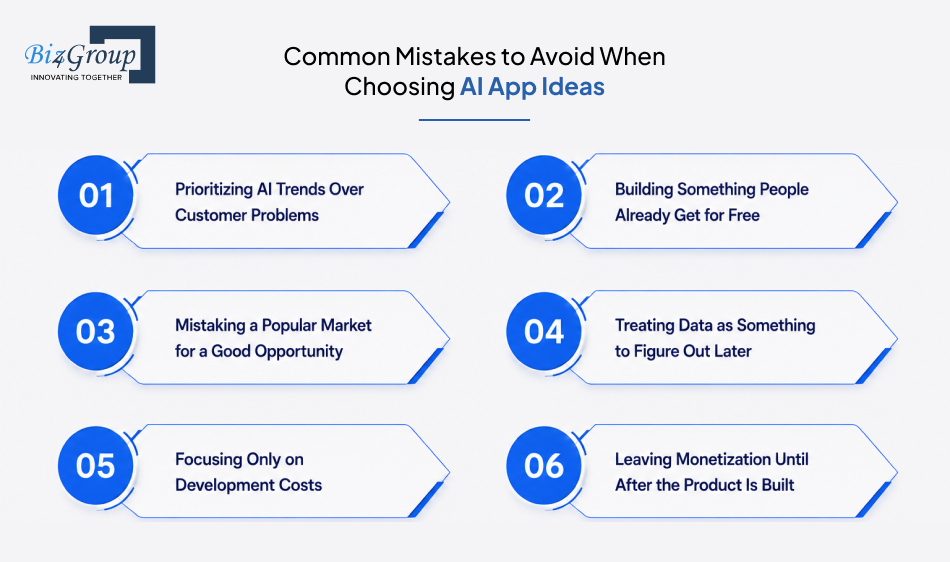
The success of an AI app often depends on the decisions you make before development begins. From chasing trends to overlooking commercial viability, a few early mistakes can turn even promising AI app ideas into expensive learning experiences. If you're evaluating AI app ideas for your next startup, avoid these pitfalls before investing your time and budget.
1. Prioritizing AI Trends Over Customer Problems
Generative AI, AI agents, and multimodal AI dominate today's conversations, but popularity alone isn't a reason to build a product around them. Ask yourself whether customers are actively looking for a solution or whether you're trying to find a problem for the technology you've already chosen. The strongest AI app ideas begin with a business problem that AI can solve better than existing alternatives.
2. Building Something People Already Get for Free
If your AI app delivers the same experience as ChatGPT or Gemini with a different interface, why would anyone switch? Founders often underestimate how quickly users compare new AI apps with the tools they already use every day. Unless your product offers industry-specific workflows, proprietary data, or seamless integrations, standing out becomes an uphill battle.
3. Mistaking a Popular Market for a Good Opportunity
A growing market doesn't automatically create room for another competitor. Many founders see dozens of successful AI-powered apps in a category and assume there's still plenty of opportunity left. A better question is whether customers are still struggling with an unsolved problem, or whether existing products already meet their expectations.
4. Treating Data as Something to Figure Out Later
Every AI app relies on data, yet many founders think about it only after the product idea is finalized. Where will your training data come from? Can you legally access it? Will it remain reliable as your product scales? These questions are often harder to answer than choosing the AI model itself, making data strategy one of the earliest decisions to validate.
5. Focusing Only on Development Costs
Launching the first version is only one milestone in the product journey. AI apps continue to incur costs through model usage, infrastructure, monitoring, updates, and performance improvements long after release. If the economics don't work as your user base grows, even a technically successful AI app can become difficult to sustain.
6. Leaving Monetization Until After the Product Is Built
Many founders assume they'll figure out pricing once users arrive, but that's rarely how successful AI products are built. Before choosing an AI app idea, consider who will pay for it, what outcome they're paying for, and whether that value justifies recurring AI costs. If those answers aren't clear from the beginning, the idea probably needs more refinement.
Avoiding these mistakes won't guarantee success, but it will help you eliminate weak AI app ideas before they consume valuable time and resources. The best opportunities usually come from solving real business problems with a clear competitive advantage, not from chasing the latest AI trend.
7 Questions Investors Will Ask Before Funding Your AI Startup
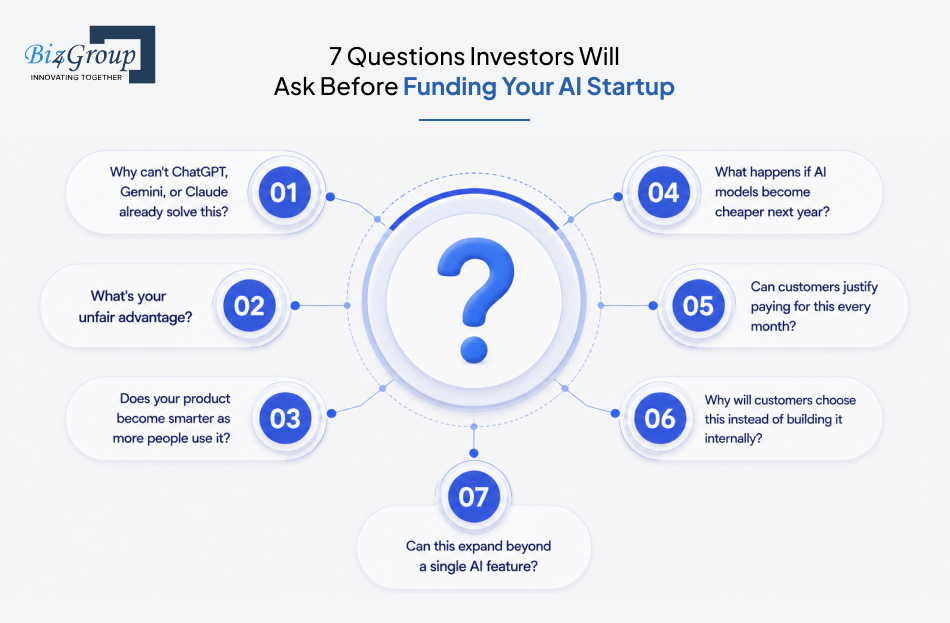
An AI app idea might impress users, but investors evaluate it through a different lens. Their goal isn't to find the smartest AI product, it's to identify businesses that can survive as AI technology becomes cheaper and more accessible. If your idea can't answer the questions below, it will be difficult to stand out during fundraising.
|
Investor Question |
What They're Really Trying to Understand |
|---|---|
|
Why can't ChatGPT, Gemini, or Claude already solve this? |
Whether your AI app delivers value beyond general-purpose AI assistants. |
|
What's your unfair advantage? |
Whether you have proprietary data, deep domain expertise, exclusive partnerships, or unique workflows competitors can't easily replicate. |
|
Does your product become smarter as more people use it? |
Whether your AI app creates a defensible data or network advantage over time. |
|
What happens if AI models become cheaper next year? |
Whether your business relies on the model itself or on the value built around it. |
|
Can customers justify paying for this every month? |
Whether your AI app solves a recurring business problem instead of being a one-time novelty. |
|
Why will customers choose this instead of building it internally? |
Whether your product saves enough time, expertise, or operational effort to outperform an in-house solution. |
|
Can this expand beyond a single AI feature? |
Whether the idea has the potential to grow into a broader AI platform or product ecosystem. |
Investors rarely fund AI app ideas simply because they're powered by the latest models. They invest in products with a clear competitive advantage, a sustainable business model, and a reason to exist even as AI capabilities continue to evolve.
Platforms like AppsInsight help businesses discover and evaluate the best AI app development companies for their project requirements.
Key Challenges in AI App Development
AI app development has immense potential, but it also comes with significant challenges that businesses must navigate. Addressing these hurdles is critical to ensuring the success of AI-powered applications.
a. Data Privacy and Security
- Challenge: AI apps rely on sensitive user data, making them vulnerable to breaches and non-compliance with regulations like GDPR and HIPAA.
- Solution: Implement end-to-end encryption, secure authentication, and regular security audits. Partnering with compliance experts and embedding privacy-by-design principles ensures robust data protection and regulatory adherence.
b. Algorithm Bias
- Challenge: Bias in training data can lead to unfair or inaccurate outcomes, alienating certain user groups.
- Solution: Use diverse and representative datasets during training. Conduct bias audits and regularly retrain models using updated data. Involve ethical AI experts in the development process to maintain fairness and transparency.
c. Scalability Challenges
- Challenge: Scaling AI applications for a growing user base demands high computational resources, potentially leading to performance bottlenecks.
- Solution: Opt for cloud-based infrastructure like AWS or Azure to scale dynamically. Optimize algorithms and use edge computing to distribute workload efficiently, reducing server dependency.
d. Development Costs
- Challenge: Developing AI apps involves high initial costs for data acquisition, model training, and infrastructure.
- Solution: Utilize open-source AI tools like TensorFlow or PyTorch to minimize costs. Leverage pre-trained models and frameworks to reduce development time and collaborate with experienced AI app developers for cost-effective solutions.
By proactively addressing these challenges, businesses exploring AI app ideas can enhance app reliability, scalability, and user trust. Implementing these solutions ensures smoother development processes and positions AI-powered applications for long-term success.

Why Choose Biz4Group LLC for Turning Your AI App Idea into Reality?
Choosing the right AI app development company in USA is the foundation of building a successful, ROI-driven digital product. When it comes to turning your AI app idea into a powerful, market-ready solution, Biz4Group stands out as a trusted technology partner with deep expertise in next-generation innovation.
Whether you're exploring Top AI App Ideas, evaluating AI Application Ideas to launch, or planning full-scale AI app development for 2026, Biz4Group delivers the experience, technology, and reliability your business needs.
a. Expertise in Advanced AI Technologies
Biz4Group has a proven legacy of building intelligent solutions powered by NLP, machine learning, predictive analytics, computer vision, and automation. Their team of certified experts understands how to convert an AI app development idea into a feature-rich application that solves real business challenges. Our portfolio showcases cutting-edge examples of how we helped business across the globe turn their AI app idea into reality.
b. End-to-End AI App Development Services
From idea validation and UX design to development, testing, deployment, and post-launch optimization, Biz4Group is an AI development company provides complete 360° development support. This holistic approach ensures your AI app is built efficiently, with high precision and seamless execution at every stage.
c. Custom AI Solutions Designed for Your Business
Every industry requires a unique AI strategy. Biz4Group excels at building customized, scalable applications tailored to business-specific goals—whether in healthcare, fintech, eCommerce, logistics, retail, manufacturing, or enterprise solutions. Their ability to turn even a simple AI app idea into a powerful business tool sets them apart.
d. Commitment to Quality, Innovation, and Timely Delivery
Biz4Group emphasizes performance, innovation, and reliability. Their client-centric methodology ensures transparency, smooth communication, and timely delivery—qualities essential for anyone launching Top AI App Ideas or next-gen AI startups.
e. Cost-Effective & Scalable Development Options
Biz4Group offers budget-friendly solutions without compromising quality. Their scalable architectures ensure your AI product grows with market demand, making it future-ready for 2026 and beyond.
Your Trusted Partner for AI Success in 2026
By choosing Biz4Group, you gain a strategic partner capable of transforming your AI app development idea into a high-impact, revenue-driven application. With unmatched expertise, proven experience, and a strong focus on innovation, Biz4Group is the go-to AI App Development Company in USA for entrepreneurs and enterprises planning to launch the most promising AI Application Ideas in 2026.
Conclusion
By now, you must’ve probably realized one thing: there isn't a single "best" AI app idea.
The best opportunity is the one that solves a real business problem and aligns with your industry expertise. A founder who understands healthcare workflows is more likely to build a successful healthcare AI app than someone chasing the latest AI trend. The same holds true across fintech, logistics, retail, manufacturing, education, and every other sector covered in this guide.
As you narrow down your shortlist, don't stop at asking, "Is this a good AI app idea?" Go a step further.
- Will businesses or consumers pay for it?
- Can it solve a recurring problem?
- What makes it better than a general-purpose AI tool?
- Can it evolve as AI technologies continue to advance?
The answers to these questions often determine whether an AI app becomes a sustainable business or just another product launch.
That's where experienced AI consulting services can make a meaningful difference. Validating the idea, defining the right AI capabilities, and planning a practical MVP before development begins often saves months of rework and helps you focus on building what the market actually needs. As your product matures, reliable AI integration services ensure your application connects seamlessly with existing business systems, third-party platforms, and enterprise workflows, making it easier to scale without compromising user experience.
If one of the AI app ideas in this guide aligns with your vision, now is the time to validate it, refine it, and turn it into a product that delivers lasting value. The next successful AI app won't be built by following trends. It'll be built by solving a problem that people genuinely want solved.

FAQ
1. What are AI App Ideas, and How Can They Transform Industries?
AI app ideas are concepts for applications that leverage artificial intelligence to automate tasks, deliver personalized experiences, and solve complex problems. These ideas are transforming industries like healthcare, finance, and logistics by improving efficiency and enhancing decision-making.
2. What are the top AI app ideas for 2026?
The innovative AI app ideas for 2026 include AI-driven virtual influencer platforms, AI-powered employee wellness apps, AI-based legal document analyzers, AI-enhanced recruitment platforms, and AI-powered content creation tools.
3. How will AI reshape mobile apps in the next five years?
AI is set to transform mobile apps through no-code AI development, real-time personalization, AI-powered UX automation, and the integration of intelligent AI agents, leading to more accessible, personalized, and user-friendly applications.
4. What is no-code AI development?
No-code AI development refers to platforms that allow users to create AI applications without extensive programming knowledge, using intuitive interfaces and drag-and-drop functionalities.
5. How does AI enable real-time personalization in mobile apps?
AI analyzes user behavior and preferences in real-time, allowing apps to adapt content, recommendations, and interfaces dynamically to enhance user engagement and satisfaction.
6. What are AI agents in mobile applications?
AI agents are autonomous programs integrated into mobile apps that perform tasks such as scheduling, information retrieval, and customer support, providing users with seamless assistance.
7. How can businesses benefit from AI app development?
Businesses can enhance efficiency, personalization, and user engagement by integrating AI into their applications, leading to improved customer satisfaction and competitive advantage.
8. How do AI development companies in the USA contribute to AI app innovation?
AI development companies in the USA play a crucial role in AI innovation by providing cutting-edge AI App Development services, including machine learning integration, AI-driven automation, and AI-powered analytics. These companies leverage advanced AI consulting services to help businesses implement AI solutions tailored to their industry needs. With expertise in AI Agent Development, they develop intelligent virtual assistants, predictive analytics tools, and AI-powered automation systems, enabling businesses to stay ahead in the digital landscape.
9. How Can AI-powered Apps Improve Customer Service?
AI-powered apps like chatbots can handle queries, provide instant support, and resolve complaints efficiently. Opting for enterprise AI chatbot development services allows businesses to offer 24/7 support while reducing operational costs.
10. How Can I Ensure My AI App is Scalable and Future-proof?
To ensure scalability, use cloud-based infrastructure, modular architecture, and regularly update your app with new features. Working with an experienced provider of enterprise AI solutions ensures future AI app ideas for technology companies remain competitive and adaptable to market demands.
11. Are AI-powered Apps Secure for Handling Sensitive Data?
Yes, AI-powered apps can be secure when proper measures like encryption, secure authentication, and regular audits are implemented. Collaborating with reliable enterprise AI solutions providers ensures compliance with industry standards like GDPR and HIPAA.
12. How Can I Monetize My AI app?
AI apps can be monetized through subscription models, in-app purchases, advertisements, or licensing. Enterprise solutions may charge based on SaaS models, offering customized pricing for B2B clients.
13. What are the Future Trends of AI Apps?
Future trends of AI apps involve advancements in generative AI, real-time personalization, and ethical AI practices, alongside growing adoption in industries like healthcare, education, and finance. Enhanced automation and human-AI collaboration will also shape the future landscape.
