Location :
Orlando, FL, USA
Location :
Orlando, FL, USA +1 (407) 714-1616
 info@biz4group.com


















Imagine a digital system that doesn’t wait for instructions but instead, understands your business goals, learns from real-time feedback, and takes independent actions to get the job done.
Read More
Can you still build a successful music streaming platform when Spotify has hundreds of millions of users and Apple Music dominates the premium market?
The short answer is yes.
In fact, some of the most promising opportunities in music streaming app development today aren't coming from companies trying to compete directly with Spotify. They're coming from businesses building streaming platforms for independent artists, regional music catalogs, niche genres, faith-based communities, educational audio, and other underserved audiences.
If you're wondering how to build a music streaming app, you're probably asking questions like:
You're not alone. We hear these questions from founders, startups, media companies, and independent music labels almost every week.
Many are looking beyond traditional streaming services to create a music streaming application that serves a specific audience with unique content, personalized experiences, or exclusive features.
The opportunity is substantial. According to the latest industry data, the global music streaming market generated approximately $63.6 billion in revenue in 2025 and continues to grow as consumers increasingly prefer subscription-based and on-demand audio experiences.
At the same time, Spotify reported 751 million monthly active users and 290 million premium subscribers by the end of 2025, proving that demand for digital music experiences remains stronger than ever.
But here's what many articles won't tell you:
You don't need millions of users to build a profitable streaming business.
We've seen founders successfully create a music streaming app around a specific audience, exclusive content library, or regional market where larger platforms have limited reach. The challenge isn't demand. The challenge is understanding the technology, licensing requirements, monetization strategy, and development process before you invest.
Before we break down the technology, costs, licensing, and monetization models, let's answer a more fundamental question: why are businesses continuing to invest in music streaming app development in the first place?
If Spotify, Apple Music, and YouTube Music already dominate the market, is there still room for new streaming platforms?
It's a fair question. In fact, it's one we hear often from founders, media companies, independent music labels, and entrepreneurs exploring music streaming app development.
Many of them ask: "Is it still possible to build a profitable streaming platform for a niche audience, regional market, or independent artist community when the biggest players already control so much of the market?"
The short answer is yes.
Over the years, we've seen businesses find success by focusing on audiences and content categories that larger streaming platforms often overlook. Whether it's regional music libraries, genre-specific communities, exclusive artist content, or direct-to-fan experiences, there are still opportunities to build products that listeners genuinely want.
Here are some of the biggest reasons companies continue to invest in streaming products in 2026.
Music streaming is no longer an occasional activity. It has become part of everyday life, whether people are commuting, exercising, working, or relaxing at home. According to IFPI's latest Engaging with Music report, the average listener spends 20.7 hours per week listening to music. For businesses investing in music streaming app development, this level of engagement creates more opportunities to increase subscriptions, ad revenue, and long-term user retention.
One of the biggest misconceptions about how to build a music streaming app is that you must compete directly with Spotify. In reality, many successful platforms focus on specific genres, regions, languages, or artist communities. Audiomack is a great example. By prioritizing emerging artists and genres such as Afrobeats, hip-hop, and reggae, it built a strong global user base without trying to replicate Spotify's model.
Businesses continue to build a music streaming app because subscription models generate recurring revenue rather than relying on one-time purchases. This creates greater revenue predictability and stronger customer lifetime value. The opportunity remains significant, according to a report paid music streaming subscriptions exceeded 750 million users globally, while streaming continues to account for the majority of music industry revenue.
Artists today want direct access to their audiences instead of depending entirely on third-party platforms and algorithms. This creates opportunities for companies looking to create a music streaming application that supports exclusive content, memberships, fan communities, merchandise sales, and direct artist engagement. The continued growth of artist-first platforms demonstrates that both creators and listeners are actively seeking alternatives.
Example: Bandcamp's direct-to-fan model has become a preferred choice for many independent musicians because it allows artists to retain more control over distribution and revenue.
A few years ago, recommendation engines and personalized listening experiences were advantages reserved for major technology companies. Today, AI tools make it easier for startups and enterprises to incorporate personalized playlists, smart search, listening recommendations, and user behavior analysis into their products. This lowers the barrier to entry for businesses pursuing music app development while improving the overall user experience.
Many entrepreneurs ask, "Isn't the streaming market already saturated?"
The numbers tell a different story. According to a report, global recorded music revenues reached $31.7 billion in 2025, marking the industry's 11th consecutive year of growth. Streaming remained the primary growth driver, generating more than $22 billion in revenue, while the number of paid streaming subscribers worldwide climbed to 837 million. For businesses exploring music streaming app development, this signals that consumer demand is still growing, particularly in niche, regional, and underserved markets.
The opportunity is clearly there. The next challenge is figuring out what type of streaming platform aligns with your business goals, audience expectations, and revenue model. So, what type of music streaming app should you build in 2026?
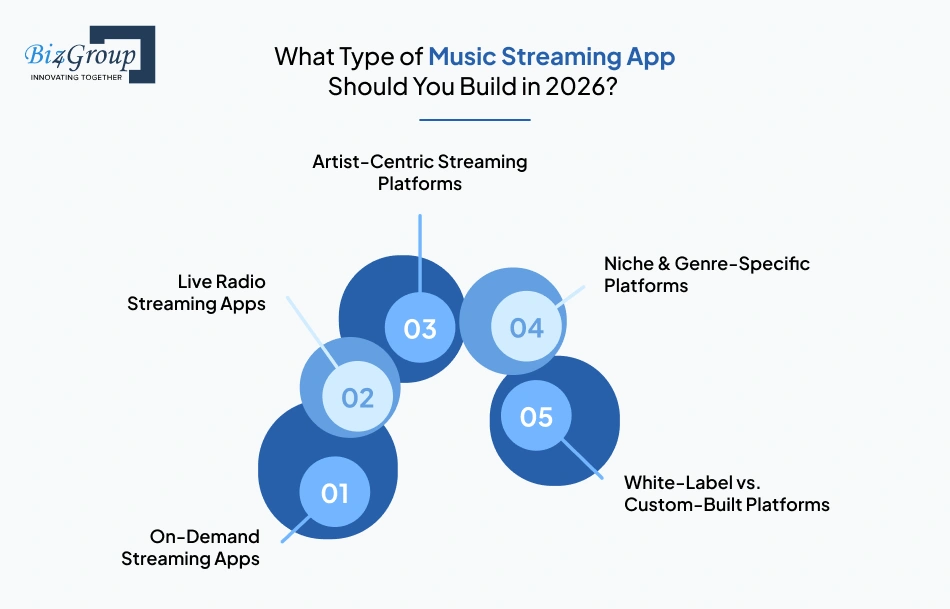
Before investing in music streaming app development, it's important to decide what kind of platform you're actually building. The right choice depends on your audience, content strategy, monetization goals, and budget. We've seen businesses succeed with everything from niche genre platforms to artist-focused ecosystems. The key is choosing a model that solves a specific problem rather than trying to replicate Spotify from day one.
These are the most popular types of music streaming platforms, allowing users to search, stream, and curate songs or playlists at any time. Leading services like Spotify and Apple Music have set high standards by offering features such as personalized recommendations, offline playback, lyrics integration, and podcast support.
From a development perspective, on-demand application development for music streaming requires robust content licensing, scalable cloud infrastructure, and advanced algorithms to support real-time playback, user preferences, and dynamic content delivery. Building such apps involves both a deep understanding of media streaming technologies and a focus on seamless user experience.
Best For: Startups, media companies, and entrepreneurs looking to build a large-scale consumer music platform.
Live radio apps simulate the traditional radio experience in a digital format. Platforms like iHeartRadio and Pandora allow users to tune into curated radio stations, genre-based channels, and live DJ sessions without actively selecting individual tracks. These apps often include limited skip functionality and ad-supported listening in the free version.
They're generally easier to build and license compared to full on-demand models, making them a cost-effective entry point for music streaming app development.
Best For: Radio broadcasters, media networks, local stations, and businesses looking for a faster market entry.
Artist-centric platforms are designed to help musicians build direct relationships with their audiences while maintaining greater control over content distribution and monetization. Unlike traditional streaming services, these platforms focus on fan engagement, exclusive releases, memberships, live sessions, merchandise sales, and creator-driven communities.
Real-world examples such as Bandcamp, Audiomack, and SoundCloud have demonstrated that artists and listeners are actively looking for alternatives that offer a more direct and meaningful connection. For businesses exploring how to create a music streaming app, this model presents an opportunity to build a loyal user base without competing solely on catalog size.
Best For: Independent music labels, artist collectives, creator platforms, and businesses focused on direct-to-fan experiences.
These apps focus on specific music genres or highly targeted audiences, such as classical music enthusiasts, Lo-Fi beats fans, or listeners of regional and local language content. By catering to a well-defined niche, these platforms deliver curated libraries, specialized playlists, and community-driven experiences that mainstream apps often overlook.
Niche streaming platforms are ideal for entrepreneurs exploring how to build a music streaming app that wins through focus and differentiation, rather than competing directly with large-scale players.
We've seen niche streaming platforms gain traction by serving audiences that larger services often struggle to personalize effectively. This approach can reduce customer acquisition challenges while creating stronger user loyalty and engagement.
Best For: Entrepreneurs targeting regional audiences, specific genres, cultural communities, or specialized listener groups.
You can either build your app from scratch or use a white-label solution. Custom-built music streaming apps offer complete control over design, features, and backend architecture but require higher investment and longer development time. White-label music platforms, on the other hand, allow you to launch faster and at a lower cost, with limited customization.
This is often a great choice for startups or local radio stations entering the streaming space.
If you're evaluating how to build a music streaming platform, this decision often comes down to your long-term growth plans. White-label solutions can accelerate launch timelines, while custom development provides the flexibility needed to introduce unique features, advanced monetization models, and scalable infrastructure as your user base grows.
Best For: Startups validating an idea, businesses seeking rapid deployment, and companies planning a fully customized streaming ecosystem.
Choosing the right type of music streaming app is the foundation of your development strategy. Whether you're targeting a mass-market audience or a niche segment, understanding these models will help you prioritize features, manage licensing, and plan a successful launch.
Once you've identified the right streaming model, the focus shifts to sustainability. After all, even the best product idea needs a clear path to revenue. So how do music streaming apps actually make money in 2026?
Turn your idea into a full-featured music streaming platform with expert guidance.
Start Your Project TodayOne of the biggest concerns we hear from founders exploring music streaming app development is whether the business model can work without millions of users.
The good news is that subscriptions are no longer the only path to profitability. Today's streaming platforms generate revenue through a mix of memberships, advertising, artist services, merchandise, and licensing opportunities. The key is choosing a monetization strategy that aligns with your audience and content model.
Subscription-based revenue continues to be the foundation of most successful streaming businesses. If you're planning to build a music streaming app, premium memberships can provide predictable recurring income while giving users access to ad-free listening, offline downloads, higher audio quality, and exclusive content. This model works particularly well for businesses looking to build long-term customer relationships rather than relying solely on one-time transactions.
Why it works:
Not every listener is ready to pay for a subscription. That's why many businesses exploring music streaming app development choose to offer free access supported by audio ads, display ads, sponsored playlists, and branded content. This approach helps platforms generate revenue while building a larger audience that can later be converted into paying subscribers.
Why it works:
Examples: Spotify Free, Pandora
Many founders exploring how to create a music streaming app assume subscriptions are the only way to make money. In reality, artist memberships, exclusive releases, fan communities, tipping, and premium content can generate meaningful revenue while strengthening user engagement. This model is particularly effective for niche platforms and independent artist ecosystems.
Why it works:
Examples: Bandcamp, Patreon-style memberships, Audiomack creator programs
If you're looking to build a music streaming platform around a specific community or artist network, merchandise and events can become valuable revenue drivers. Many successful platforms now integrate artist merchandise, concert tickets, VIP experiences, and exclusive event access directly into the user experience.
Why it works:
Examples: Artist merchandise stores, concert ticket integrations, exclusive live events
Businesses working with a music streaming app development company often focus exclusively on consumer revenue. However, licensing technology, content libraries, playlists, or recommendation engines to third parties can create a powerful B2B revenue channel. This strategy is especially valuable for platforms with unique content or proprietary technology.
Why it works:
One of the most common questions we hear is: "I am building a niche music streaming app for a specific genre community and I want to understand what monetization models actually work beyond a standard subscription because my target audience is small and I need to make the unit economics work without millions of users on day one."
The reality is that most successful platforms don't rely on a single revenue source. Businesses that develop music streaming apps for mobile and web often combine subscriptions, advertising, fan memberships, merchandise sales, and strategic partnerships to create a more sustainable revenue model.
Why it works:
Examples: Spotify combines subscriptions, advertising, audiobooks, and creator services, while Bandcamp generates revenue through music sales, merchandise, and fan support.
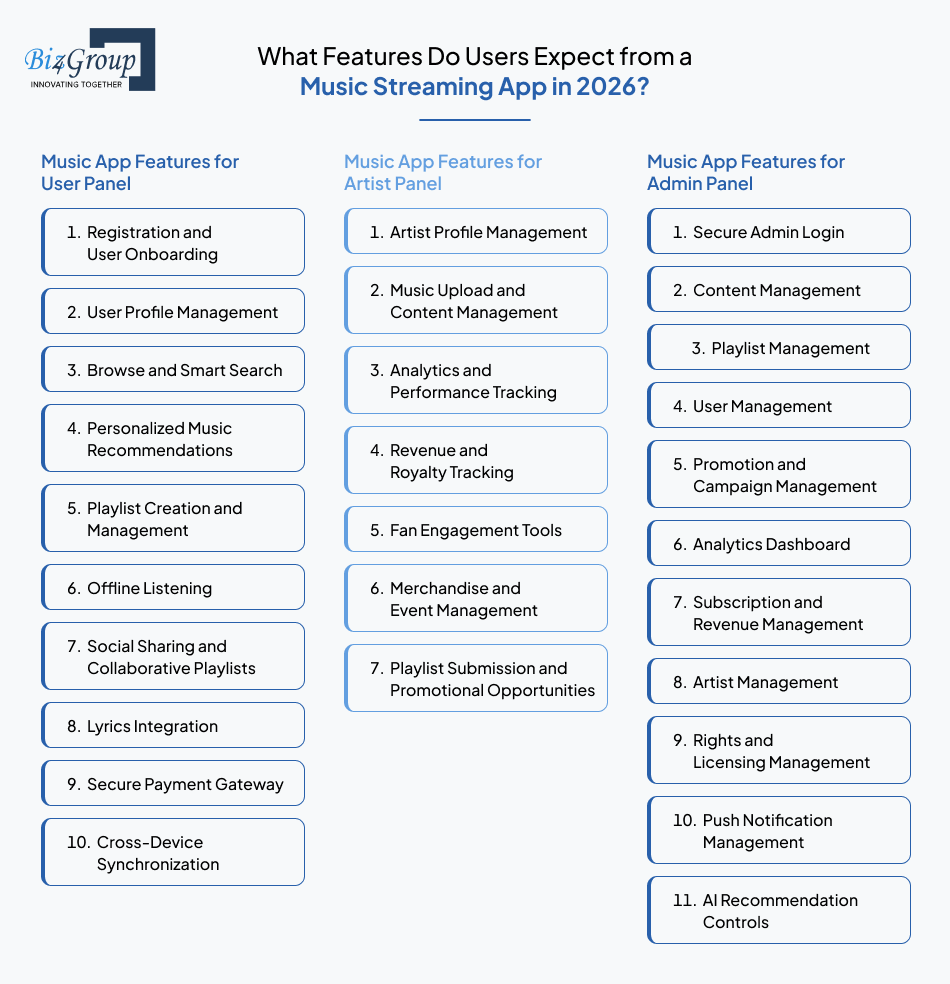
If you're planning to build a music streaming app or researching how to make a music streaming app, choosing the right feature set can have a direct impact on user acquisition, retention, and monetization. While core capabilities such as search, playlists, and offline listening remain essential, today's users expect personalized recommendations, seamless experiences across devices, and deeper engagement with artists and communities.
We've found that businesses exploring music streaming app development often make the mistake of focusing on dozens of features at launch. In reality, the goal should be to prioritize features that improve discovery, listening experience, and long-term user engagement.
The user panel is where listeners interact with your platform every day. Whether you're looking to create a music streaming app for a niche audience or create a music streaming application for a global audience, these features help deliver the experience users expect.
Additional User Features
If you're planning to build a music streaming platform, it's important to consider artist-focused features during the music app development process. An artist panel can become a major competitive advantage by giving creators greater control over content, audience engagement, and monetization.
Book a consultation with our experts to refine your MVP and strategy.
Schedule a Free ConsultationThe admin panel acts as the operational backbone of your platform. Whether you're building in-house or partnering with an experienced music app development company, this dashboard is essential for managing users, content, subscriptions, licensing, and platform performance.
Many founders know the features they want but struggle to understand what comes next. If you're wondering how to build a music streaming app, the next step is understanding the development journey from idea validation and licensing to design, development, testing, and launch.
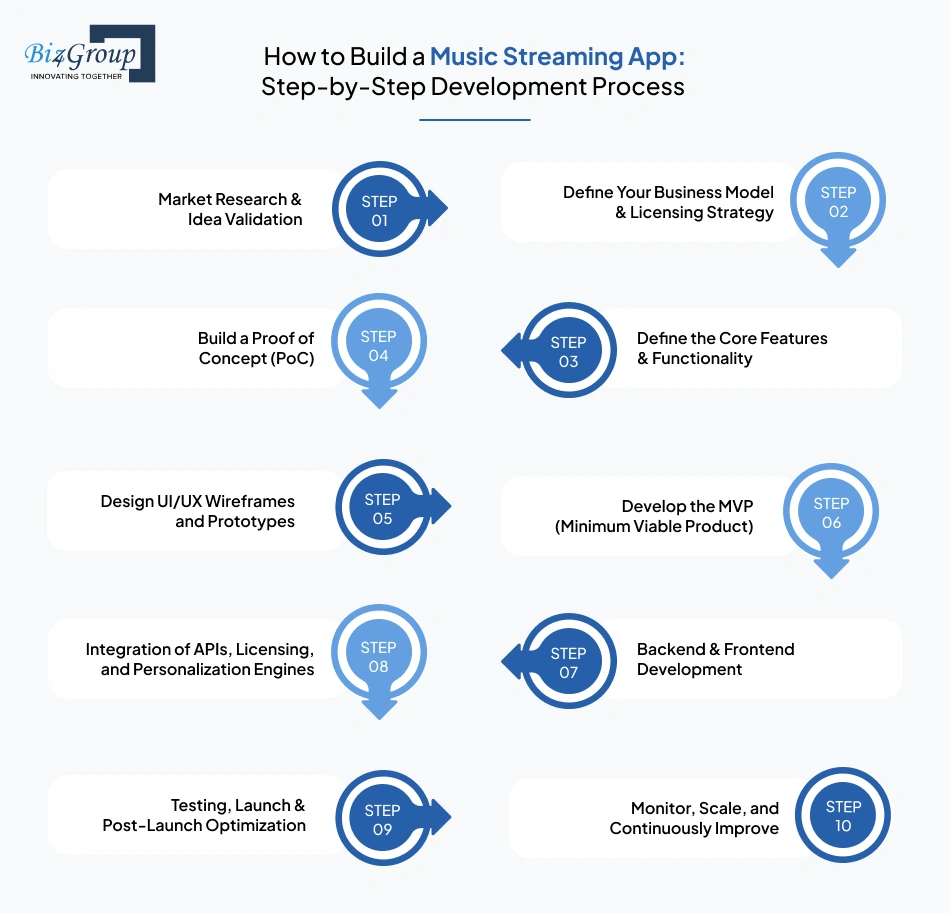
The successful development of a music streaming app involves more than just coding. It requires thoughtful planning, user-focused design, and scalable technology choices. Whether you're aiming to launch an MVP or a full-featured platform, understanding the entire workflow is key to effectively building a music streaming app that resonates with users and performs reliably in the real world.
One of the most common questions we hear from founders is: "I am running an independent music label and I want to build a music streaming app for my artists but I have no idea how much it actually costs to develop one end to end including licensing, backend infrastructure, and mobile app development across iOS and Android."
The reality is that successful music streaming app development requires careful planning across product strategy, licensing, infrastructure, user experience, and scalability. Whether you're looking to create a music streaming app for a niche audience or build a music streaming platform that serves millions of users, following a structured development process can help reduce risk, optimize costs, and accelerate time to market.
Here’s a step-by-step guide to create a music streaming app from concept to launch:
Before you create a music streaming app, you need to understand your audience and competitors. Research popular platforms like Spotify, Apple Music, or niche players to identify what works and where the gaps lie. Validate your idea through user surveys, interviews, or early landing pages. This step ensures you solve a real problem and avoid building features nobody wants.
Goal: Define your audience, value proposition, and competitive edge.
Before deciding on features or development timelines, determine how your platform will generate revenue and acquire content legally. Will you operate on subscriptions, advertising, artist memberships, or a hybrid model? Will you license music from labels, distributors, or independent artists?
Many startups underestimate the complexity of music licensing. Understanding content ownership, royalty structures, mechanical rights, performance rights, and licensing requirements early can help avoid costly legal and operational challenges later in the project.
Goal: Establish a sustainable business model and content acquisition strategy before development begins.
Based on your research, create a detailed list of essential features for both the MVP and the full-scale version. Prioritize core streaming capabilities like search, playback, and playlists while mapping out advanced functions like AI-based recommendations, podcast integration, and social sharing.
Goal: Align product scope with user needs, business goals, and development budget.
A PoC is a technical prototype used to validate your concept’s feasibility. It helps answer critical questions like: Can the app stream music efficiently? Will it scale with thousands of users? Can it integrate with music APIs and deliver smooth playback? Building a PoC early reduces the risk of technical surprises later in development.
Goal: De-risk your project by validating core technology decisions upfront.
Also Read: Top PoC Software Development Companies in USA
This is where your app takes visual form. Collaborate with an experienced UI/UX design company to create wireframes that map out every screen, user interaction, and design element. Use tools like Figma or Adobe XD to build interactive prototypes that simulate real user journeys. Strong UI/UX can significantly increase user retention and satisfaction, especially in content-heavy apps like music platforms.
Goal: Create a visually appealing, intuitive, and device-responsive user interface.
Also Read: Top UI/UX Design Companies in USA
MVP development is the most critical phase in the early stage of music streaming app development. Focus on building just enough functionality to test the core value proposition with real users. Include essential features like sign-up/login, music playback, basic search, and playlist creation. By launching early and iterating fast, you can save costs and make data-driven improvements.
Goal: Validate your product in the market with minimal investment and faster time-to-market.
Also Read: Top MVP Development Companies in USA
At this stage, your development team builds the app's infrastructure. The backend handles music databases, user accounts, streaming logic, and licensing controls. The frontend covers all user-facing features across iOS, Android, and web platforms. Use a scalable tech stack (e.g., Node.js, MongoDB, React Native) to ensure the app performs well under load and can easily integrate third-party APIs or AI engines.
For businesses developing music streaming apps for mobile and web, this phase also involves setting up cloud storage, content delivery networks (CDNs), audio transcoding pipelines, caching layers, and streaming optimization mechanisms. These components ensure uninterrupted playback and support future growth as your user base expands.
Goal: Create a secure, scalable, and efficient music streaming architecture.
Music apps require legally acquired content or licensed APIs from platforms like Spotify, Apple Music, or custom music labels. If building your own CMS, ensure copyright compliance and royalty tracking. Implement AI/ML engines for personalized music recommendations, dynamic playlists, and context-aware features (e.g., mood, time of day, user activity). Before launching your platform, make sure you understand content rights, royalty obligations, and distribution agreements to ensure compliance and avoid future disputes.
Goal: Enhance user satisfaction with personalized and legally compliant content.
Conduct comprehensive testing across devices, operating systems, and network conditions. Run functional, performance, and security tests. Once stable, launch the MVP to a closed beta or live market. Post-launch, use analytics tools to monitor engagement, feature usage, and drop-off points. Continue to refine and scale your app based on user feedback.
Goal: Deliver a high-quality, bug-free app and evolve it with real-world insights.
Launching your platform is only the beginning. Once users start interacting with the app, you should continuously monitor user behavior, retention rates, subscription performance, content engagement, and streaming quality metrics. Analytics insights can help identify opportunities to improve recommendations, optimize onboarding, and increase revenue.
As your audience grows, scaling infrastructure, expanding content partnerships, enhancing personalization engines, and introducing new monetization opportunities become essential for long-term success.
Goal: Continuously improve platform performance, user satisfaction, and business growth.
Following a structured development plan, from idea to MVP to full-scale product development, is essential when you create a music streaming app in today’s competitive market. With the right research, design, licensing, and development phases in place, your app can deliver a seamless listening experience while achieving long-term business success.
One of the most common questions founders ask is, "What technology stack should I use to build a music streaming app?" The answer depends on your business goals, expected user base, feature requirements, and scalability needs. Choosing the right technologies is crucial for delivering a secure, high-performing platform that can grow with your business.
Below is a recommended technology stack for music streaming app development to help you build a music streaming platform that delivers a seamless experience across mobile and web.
|
Component |
Tools/Technologies |
Purpose |
|---|---|---|
|
Frontend (Mobile/Web) |
React Native, Flutter, Swift (iOS), Kotlin (Android) |
To build a responsive and cross-platform user interface for seamless user interaction. |
|
Backend Framework |
Powers the core app logic, APIs, user handling, and integrates with databases and storage. |
|
|
Database |
MongoDB, PostgreSQL, MySQL |
Stores user data, playlists, music metadata, and history securely. |
|
Cloud & Storage |
AWS S3, Google Cloud Storage, Azure Blob Storage |
Hosts audio files and static assets with high availability and reliability. |
|
Streaming Protocol |
HLS (HTTP Live Streaming), RTMP, WebRTC |
Ensures smooth real-time audio streaming with adaptive quality. |
|
Content Delivery Network (CDN) |
Cloudflare, AWS CloudFront, Akamai |
Distributes audio content globally with low latency and faster load times. |
|
Music Licensing API / CMS |
Spotify SDK, Apple MusicKit, Custom CMS |
Integrates licensed music catalogs or manages your own uploaded content. |
|
Authentication |
Firebase Auth, OAuth 2.0, Auth0 |
Secures user accounts and enables social or email logins. |
|
AI/Recommendation Engine |
TensorFlow, Amazon Personalize, Scikit-learn |
Powers smart music suggestions and personalized playlists based on user behavior. |
|
AI Frameworks |
PyTorch, TensorFlow, Hugging Face Transformers |
Enables custom AI models for natural language processing, mood detection, and generative music suggestions. |
|
Analytics |
Google Analytics, Firebase Analytics, Mixpanel |
Tracks user behavior, feature engagement, and app performance metrics. |
|
Push Notifications |
Firebase Cloud Messaging, OneSignal |
Sends real-time alerts for updates, releases, and personalized content. |
|
Payments & Subscriptions |
Stripe, Razorpay, PayPal, RevenueCat |
Manages in-app purchases, subscription plans, and recurring payments. |
|
Admin Panel Framework |
React.js (Web), Angular |
Allows admin to manage users, content, analytics, and platform settings. |
|
DevOps & Hosting |
Docker, Kubernetes, AWS EC2, Heroku |
Handles app deployment, server orchestration, and scalability. |
|
Security Tools |
SSL, JWT, OAuth 2.0, OWASP best practices |
Ensures encrypted data transfer, user privacy, and secure authentication. |
There isn't a single technology stack that's right for every streaming platform. The best choice depends on your business requirements, expected traffic, and long-term goals. Prioritizing scalable, secure, and future-ready technologies is essential for successful music streaming app development and helps build a music streaming platform that delivers consistent performance while adapting to evolving user expectations.
Before you create a music streaming app, securing proper licensing is vital to ensure legal compliance and a rich music catalog.
In fact, one of the most common questions we hear from founders exploring music streaming app development is: "We are a startup trying to launch a music streaming platform and we are stuck on music licensing because we do not understand how to legally stream copyrighted songs, what the difference between mechanical and performance royalties is, and how platforms like Spotify actually get their music deals done."
The reality is that licensing is one of the most important aspects of music streaming app development. Without the appropriate rights and agreements in place, even the most technically advanced streaming platform can face legal challenges, content restrictions, and revenue limitations.
There are two primary types of licenses to consider:
These are necessary for streaming music to the public. Acquiring these rights typically involves negotiations with music rights organizations (like BMI, ASCAP, or SESAC in the USA) that represent songwriters, composers, and music publishers.
Public performance rights ensure that songwriters, composers, and publishers are compensated whenever their music is streamed. If you're planning to build a music streaming app, securing these rights is essential to legally deliver copyrighted content to listeners.
These are required for reproducing and distributing musical compositions. They are usually obtained from music publishers or through agencies like the Harry Fox Agency in the USA.
Mechanical licenses become especially important when your platform stores, reproduces, or delivers copyrighted musical compositions. Businesses researching how to build a music streaming app often underestimate the role these licenses play in maintaining compliance and avoiding legal risks.
In addition to these, synchronization licenses might be required if you plan to pair music with visual media. Also, consider direct agreements with record labels, especially for popular tracks, which can be more expensive but essential for a competitive music catalog.
Many streaming services also secure content directly from record labels, distributors, publishers, and independent artists. For founders looking to create a music streaming application with exclusive releases, regional catalogs, or premium content, direct licensing agreements can become a major competitive advantage.
Licensing gives your platform the legal right to stream music. Royalties determine how artists, labels, publishers, and rights holders get paid when that music is consumed.
The most common royalty categories include:
For businesses investing in music streaming app development, royalty obligations directly impact pricing models, profitability, and long-term scalability.
One common misconception is that platforms like Spotify own the majority of the music available on their services. In reality, they license content from record labels, publishers, distributors, and rights holders. Every stream generates royalty obligations that must be tracked, calculated, and distributed according to licensing agreements.
This is one reason why licensing often becomes one of the largest ongoing operational expenses associated with running a music streaming platform.
Licensing costs vary based on the music's popularity, the artist, and the type of license. Budget accordingly, as these costs can be significant.
Many businesses exploring music app development focus primarily on development costs and infrastructure expenses. However, licensing can become one of the largest investments required to launch and operate a streaming platform successfully. The size of your catalog, geographic reach, and licensing agreements will all influence ongoing costs.
Ensure compliance with international copyright laws, especially if your app serves a global audience. This may involve obtaining licenses from multiple countries.
If you're developing a music streaming app for mobile and web audiences across multiple countries, licensing becomes even more complex. Music rights are often granted on a territory-by-territory basis, meaning content available in one region may require separate agreements before it can be legally streamed elsewhere.
This is why many global streaming services rely on geo-restrictions and territory-specific licensing agreements to remain compliant with regional copyright regulations.
Collaborating with established music licensing companies can simplify the process and provide access to a broader music library.
Strategic partnerships can also accelerate time-to-market. Many startups work with licensing agencies, distributors, aggregators, and rights management providers that already have established relationships within the music industry.
For businesses learning how to build a music streaming app, partnering with an experienced music streaming app development company and licensing specialists can significantly reduce complexity while improving access to content, rights management expertise, and royalty administration support.
At this point, many entrepreneurs start asking the question that ultimately shapes every product decision: "How much does it actually cost to build a music streaming app?" The answer depends on factors such as features, licensing, platform coverage, infrastructure requirements, and long-term scalability. Let's break down the numbers.
One of the first questions founders ask when planning music streaming app development is: "How much does it actually cost to build a music streaming app?"
The answer depends on several factors, including feature complexity, platform coverage, licensing requirements, infrastructure needs, and scalability goals. A basic MVP with core streaming functionality will naturally cost less than a full-scale platform with AI recommendations, artist management tools, and multi-platform support.
As a general estimate, the cost to build a music streaming app can range from $20,000 to $150,000+. The final investment will vary depending on your product vision, development approach, and long-term business objectives.
|
Feature |
Estimated Cost Range |
Description |
|---|---|---|
|
User Registration & Authentication |
$2,000 - $5,000 |
Email, social login, profile setup, security controls |
|
Music Search & Discovery |
$3,000 - $8,000 |
Search filters, categories, content browsing |
|
Audio Streaming Engine |
$5,000 - $15,000 |
Real-time playback, buffering, streaming optimization |
|
Playlist Management |
$2,000 - $6,000 |
Create, edit, share, and organize playlists |
|
Offline Listening |
$4,000 - $10,000 |
Download and offline playback functionality |
|
AI-Powered Recommendations |
$8,000 - $20,000 |
Personalized suggestions and content discovery |
|
Lyrics Integration |
$2,000 - $5,000 |
Synchronized lyrics and song information |
|
Social Sharing Features |
$2,000 - $6,000 |
Playlist sharing and social engagement tools |
|
Artist Dashboard |
$5,000 - $15,000 |
Content uploads, analytics, and artist management |
|
Subscription & Payment Gateway |
$3,000 - $8,000 |
Membership plans, billing, payment processing |
|
Admin Dashboard |
$5,000 - $12,000 |
User management, content moderation, reporting |
|
Analytics & Reporting |
$3,000 - $10,000 |
User behavior, engagement, and revenue tracking |
Note: These estimates represent approximate development costs and may vary depending on project scope, technology stack, third-party integrations, geographic location of the development team, and customization requirements.
The cost of creating a music streaming application can vary significantly from one project to another. Some of the biggest cost drivers include:
Many founders focus only on development expenses and overlook operational costs that appear after launch.
Some of the most commonly overlooked costs include:
For businesses exploring how to build a music streaming app, these operational costs can become just as important as the initial development budget.
Keeping costs under control doesn't always mean removing features. In many cases, it means making smarter product decisions.
Some proven cost optimization strategies include:
One of the most important decisions during music app development is whether to build a custom platform or use an existing white-label solution.
|
Criteria |
White-Label Platform |
Custom Music Streaming App Development |
|---|---|---|
|
Initial Cost |
Lower |
Higher |
|
Time to Market |
Faster |
Longer |
|
Customization |
Limited |
Complete Control |
|
Scalability |
Depends on Vendor |
Fully Customizable |
|
Ownership |
Vendor Dependent |
Full Ownership |
|
Competitive Differentiation |
Limited |
High |
|
Integration Flexibility |
Moderate |
Extensive |
|
Long-Term Cost Efficiency |
Variable |
Often Better for Growth |
|
Best For |
Startups Validating Ideas |
Businesses Building Long-Term Platforms |
If your goal is to launch quickly and validate market demand, a white-label platform may be sufficient. However, businesses planning to build a scalable music streaming platform with unique features, advanced monetization models, and long-term growth ambitions often benefit from custom development.
Even with the right budget in place, building a successful streaming platform isn't without obstacles. From music licensing and royalty management to scalability, content discovery, and user retention, several challenges can influence the success of your product. Let's explore the most common music streaming app development challenges and how to overcome them.
Get a detailed estimate based on your features, timeline, and tech stack.
Request a Free QuoteBuilding a music streaming app is rarely straightforward. Beyond development, businesses must navigate licensing requirements, infrastructure costs, user retention, content discovery, scalability concerns, and evolving user expectations. Addressing these challenges early can help reduce risk, control costs, and improve the chances of long-term success.
|
Challenge |
Why It's a Problem |
Recommended Solution |
|---|---|---|
|
Music Licensing & Copyright Compliance |
Obtaining legal rights to stream copyrighted music can be complex, time-consuming, and expensive. Without proper licensing, businesses investing in music streaming app development may face legal and financial risks. |
Partner with licensing agencies, distributors, aggregators, or rights holders early in the planning stage. Implement royalty tracking and rights management systems from the beginning. We've seen licensing delays become one of the biggest reasons streaming projects miss their planned launch dates. |
|
High Infrastructure & Streaming Costs |
Streaming high-quality audio requires cloud storage, bandwidth, servers, and content delivery networks, all of which become more expensive as the user base grows. This is often one of the biggest operational challenges in music app development. |
Use scalable cloud platforms such as AWS or Google Cloud, implement CDN-based delivery, and optimize storage and bandwidth usage through adaptive streaming. Many successful streaming platforms start with cloud-native infrastructure to avoid large upfront investments. |
|
Content Personalization & Recommendation Accuracy |
Poor recommendations make content discovery difficult and can reduce listening time. Modern users expect personalized experiences similar to Spotify and Apple Music. |
Use AI and machine learning models to analyze listening behavior, create dynamic playlists, and continuously improve recommendation accuracy based on user interactions. Personalization is often what separates platforms users occasionally visit from platforms they use daily. |
|
Standing Out in a Competitive Market |
One of the biggest concerns we hear from founders looking to build a music streaming app is how to compete with established platforms such as Spotify and Apple Music. |
Focus on underserved audiences, regional content, niche genres, artist-first experiences, or community-driven engagement rather than competing directly with mainstream platforms. Many of today's fastest-growing streaming platforms succeeded by serving specific audiences rather than trying to become the next Spotify. |
|
Scaling the Platform as User Growth Increases |
A platform that performs well with a few thousand users may struggle when supporting hundreds of thousands of listeners. This becomes a major concern when businesses build a music streaming platform for long-term growth. |
Design for scalability from the start using cloud-native architecture, auto-scaling infrastructure, load balancing, microservices, and distributed databases. Retrofitting scalability after launch is typically far more expensive than planning for growth during the architecture stage. |
Whether you're planning to create a music streaming app for a niche audience or partner with a music streaming app development company to launch a large-scale platform, addressing these challenges early can significantly improve your chances of success. In our experience, the most successful streaming products are not necessarily the ones with the most features. They are the ones that solve licensing, scalability, content discovery, and user engagement challenges before they become growth barriers.
The music streaming industry continues to evolve as advances in artificial intelligence, immersive audio, and connected technologies reshape how users discover and experience music. Businesses investing in music streaming app development should understand these trends to build scalable, future-ready platforms. Whether you're exploring how to make a music streaming app or planning to build a music streaming platform, these innovations will influence the next generation of streaming services.
Artificial intelligence is making music recommendations more accurate by analyzing listening habits, preferences, and contextual data. Modern platforms can generate personalized playlists, improve music discovery, and enhance user engagement. For businesses learning how to build a music streaming app, AI-powered recommendations have become an essential feature for increasing user retention and satisfaction.
Users increasingly expect premium audio quality, with technologies like Dolby Atmos, Spatial Audio, and lossless streaming becoming more common. These features create a richer and more immersive listening experience on compatible devices. Including advanced audio support can help a music streaming app development project stand out in a competitive market.
Music streaming is becoming more interactive through collaborative playlists, shared listening sessions, and social sharing features. These community-driven experiences encourage users to spend more time on the platform while discovering new music. Businesses planning to create a music streaming application should consider adding social features to improve engagement and retention.
Voice assistants, smart speakers, wearables, and connected cars are changing how users access music throughout the day. Modern streaming platforms should offer seamless synchronization across devices while supporting hands-free controls. This is an important consideration when developing a music streaming app for mobile and web.
Generative AI is introducing new possibilities for artists through AI-assisted songwriting, remixing, and music production tools. Although the technology is still evolving, creator-focused AI features are expected to become increasingly valuable. Businesses looking to build a music streaming app can differentiate their platform by supporting both listeners and content creators.
Streaming platforms are expanding beyond subscriptions by offering exclusive content, fan memberships, virtual events, and digital merchandise. These monetization options help artists build stronger relationships with their audiences while creating additional revenue streams. This trend is becoming an important consideration in modern music app development.
Blockchain technology has the potential to improve royalty transparency, digital ownership, and payment distribution for artists. While decentralized music streaming is still an emerging concept, the technology continues to gain attention across the industry. Businesses working with a music streaming app development company should monitor these innovations as they mature and become more practical.
While not every trend will become an industry standard, AI-powered personalization, immersive audio, cross-device experiences, and creator-focused monetization are already influencing the direction of music streaming. Businesses investing in music streaming app development should prioritize scalable features that address current user expectations while remaining adaptable to future innovations.
Building a successful streaming platform requires much more than writing code. From licensing considerations and audio delivery infrastructure to user engagement, monetization, and scalability, every decision impacts the long-term success of the product.
In fact, many founders approach us with questions like: "I want to find a vendor to build a scalable music streaming app for mobile and web with monetization options."
That's where experience becomes critical.
With 20+ years of experience, 1,000+ successful project deliveries, and a 4.9/5 Clutch rating, Biz4Group has helped startups, enterprises, and entrepreneurs transform innovative ideas into scalable digital products. Our team brings deep expertise in music streaming app development, helping businesses navigate the technical and business challenges involved in launching modern streaming platforms.
What makes Biz4Group different is our ability to combine product strategy, user-centric design, cloud architecture, AI capabilities, and streaming technology expertise under one roof. Whether you're looking to build a music streaming app for independent artists, launch a niche streaming platform, or create a large-scale music ecosystem, we focus on building solutions that are scalable, engaging, and aligned with your business goals.
As a trusted mobile app development company, we understand what it takes to develop high-performance streaming applications that deliver seamless listening experiences across iOS, Android, and web platforms. Our expertise spans real-time audio streaming, AI-powered recommendations, subscription management, cloud infrastructure, analytics, and platform scalability.
From MVP development and architecture planning to full-scale deployment and ongoing optimization, we work as a long-term technology partner rather than just a development vendor.
If you're looking for a reliable music streaming app development company to bring your vision to life, Biz4Group offers the technical expertise, industry knowledge, and proven delivery experience needed to turn your idea into a successful streaming platform.
Future-Proof Your Music Streaming App
Talk to an Innovation ExpertThe success of a streaming platform isn't determined by how closely it resembles Spotify or Apple Music. More often, it comes down to understanding a specific audience, delivering a great listening experience, and building a product that solves real user needs.
As you've seen throughout this guide, music streaming app development involves much more than feature planning. Licensing, monetization, scalability, infrastructure, and user engagement all play a critical role in long-term success.
Whether you're launching a platform for independent artists, a niche music community, or a regional audience, the right strategy can help you build a music streaming app that stands out in an increasingly competitive market. Businesses that create a music streaming application with a clear value proposition and scalable foundation are often better positioned for long-term growth.
At Biz4Group, we help businesses transform ideas into scalable digital products. As an experienced music streaming app development company, we can help you validate your concept, define the right roadmap, and accelerate your journey from idea to launch.
The cost of music streaming app development typically ranges from $20,000 to $150,000+, depending on factors such as feature complexity, platform selection, licensing requirements, AI-powered recommendations, infrastructure needs, and scalability goals. An MVP with core streaming features will cost significantly less than an enterprise-grade platform with advanced personalization and multi-platform support.
The timeline for developing a music streaming app for mobile and web depends on the scope of the project. A basic MVP can often be developed within 3 to 6 months, while a feature-rich streaming platform with AI recommendations, offline listening, artist dashboards, and custom integrations may take 6 to 12 months or longer.
Absolutely. Many successful streaming businesses focus on niche genres, regional music libraries, independent artists, faith-based content, educational audio, or creator-led communities. If you're planning to build a music streaming platform, differentiation is often more important than trying to replicate Spotify's business model.
To legally create a music streaming application, you'll typically need public performance rights, mechanical licenses, and agreements covering the sound recordings you plan to stream. Depending on your business model, additional licensing agreements may be required with record labels, publishers, distributors, or independent artists.
The most successful platforms rarely rely on a single revenue stream. Businesses exploring how to create a music streaming app often combine subscriptions, advertising, artist memberships, merchandise sales, event promotions, and premium content offerings. The right model depends on your audience, content strategy, and growth objectives.
Most modern streaming platforms use technologies such as React Native, Flutter, Swift, Kotlin, Node.js, Python, AWS, Google Cloud, and CDN-based streaming infrastructure. The ideal stack depends on factors such as performance requirements, expected traffic, platform coverage, and future scalability. Businesses investing in music streaming app development should prioritize technologies that support low-latency streaming and long-term growth.
When selecting a music streaming app development company, evaluate their experience with streaming platforms, scalability, cloud infrastructure, monetization, and post-launch support. Companies like Biz4Group bring expertise in building scalable web and mobile streaming solutions, helping businesses move from idea validation to successful product launch.

with Biz4Group today!
Our website require some cookies to function properly. Read our privacy policy to know more.