 Location :
Orlando, FL, USA
 +1 (407) 714-1616
 info@biz4group.com


 AI Summary Powered by Biz4AI
- Skip the ranked lists: they compare marketing, not evidence, and often reflect whoever wrote them. Score every partner on the same sheet instead.
- Eight criteria: HOA domain understanding, proof on your own data, security and data handling, AI controls and human approval, integration, ownership and exit terms, delivery and references, and support after launch.
- Weight proof highest: a pilot or replay on your own closed months is the best predictor of what you’ll actually get.
- Check the security evidence: ask for a SOC 2 Type 2 report, its scope and period, and whether your data trains their models.
- Set automatic dealbreakers: no pilot on your data, no human approval for legal or financial actions, no data export or deletion terms.
- Compare quotes by scope: price the same defined first phase from every partner, not hourly rates or headline totals.
The best AI HOA management app development company for you is the one that can show its work on your data, not the one sitting highest on a “top companies” list. Every HOA platform development company says it has AI, domain expertise, and scalable architecture. The difference shows up when you ask for proof.
This blog replaces the usual ranked list of AI HOA management app development companies in the USA with a scorecard you can use on any partner, including Biz4Group. You’ll get eight criteria, suggested weights, the questions that reveal real answers, and a worked example. It’s written for US management companies and PropTech teams choosing a development partner for a custom AI HOA management platform.
Why Do “Top AI HOA Management App Development Companies” Lists Fall Short?
Ranked lists fall short because they compare marketing, not evidence. The order usually reflects who wrote the list, who paid for a placement, or who has the loudest website.
Lists also can’t tell you the things that decide a project:
- Whether the partner understands fund accounting and state notice rules
- How it tests AI before trusting it
- What happens to your data and your code if you part ways
- Who answers the phone after launch
A scorecard fixes that. It makes you decide what matters first, then score each AI HOA platform partner against the same standard. That includes this blog’s publisher. Biz4Group LLC builds AI products, so you can score it with the same sheet.
How Does the AI HOA Partner Scorecard Work?
The scorecard works by rating each HOA software development company from 0 to 5 on eight criteria, then weighting each criterion by how much it matters to you. Here’s the starting point.
|
# |
Criterion |
Suggested weight |
|---|---|---|
|
1 |
HOA domain understanding |
15 |
|
2 |
Proof on your own data (pilot) |
20 |
|
3 |
Security and data handling |
15 |
|
4 |
AI controls and human approval |
15 |
|
5 |
Integration with your systems |
10 |
|
6 |
Ownership and exit terms |
10 |
|
7 |
Delivery process and references |
10 |
|
8 |
Support after launch |
5 |
|
Total |
100 |
The weights are a starting suggestion, not an industry standard. Change them to fit your situation. A company with strict security requirements might weight criterion 3 higher, for example.
To score a partner, multiply each 0 to 5 rating by its weight, add the results, and divide by 5. The answer is a score out of 100.
Scoring guide for each criterion:
- 0: no answer, or the partner refused to answer
- 1 to 2: a claim with no evidence
- 3: evidence shown, but not on your data or not recent
- 4: evidence on a close match to your situation
- 5: evidence on your own data, with documents you can keep
Put Biz4Group on the Scorecard
Walk through your workflows, your systems, and what a first phase should cover.
Book a Free ConsultationWhat Should You Ask a Custom AI HOA Platform Partner Under Each Criterion?
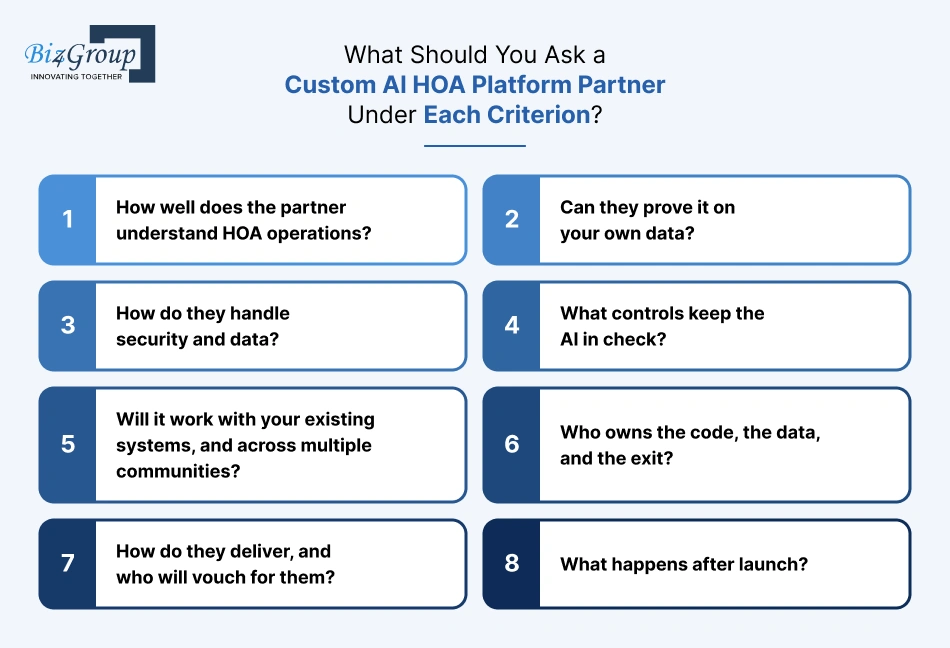
Each criterion needs a short list of questions that a strong partner can answer with evidence, not adjectives. Here are the questions and what a good answer looks like.
1. How well does the partner understand HOA operations?
Ask them to walk through a delinquent account, from the first missed payment to a lien decision. A partner who understands HOAs will mention fund accounting, state-specific notice rules, and who has to approve each step. See AI-assisted HOA dues collection for what those legal lines look like.
Good signs:
- Talks about operating versus reserve funds without prompting
- Knows that notice requirements differ by state
- Asks who signs what before proposing automation
Weak signs: a general “property management” pitch that never gets specific about HOAs.
2. Can they prove it on your own data?
This carries the highest weight because it’s the best predictor of what you’ll actually get. Ask for a pilot or a replay: run the proposed approach on a few of your closed months or past cases and compare it with what actually happened.
The testing method in AI HOA accounting and reporting works as a model. It uses past periods with known answers, plants a few errors on purpose, and reviews every miss, not just the average. A partner who won’t test on your data is asking you to trust a demo.
3. How do they handle security and data?
Ask what security evidence they can show, and read it. A SOC 2 report covers controls around areas like security, availability, processing integrity, confidentiality, and privacy. One CPA-industry overview explains that a Type 1 report looks at whether controls are suitably designed, while a Type 2 report also covers whether they operated effectively over a period.
A vendor due-diligence guide suggests asking for a Type II report rather than Type I, and checking its scope and report period. That guide is a consulting firm’s own marketing, so treat it as a checklist idea rather than an authority.
Also ask how they build AI platforms in general. NIST’s Secure App Development Framework describes itself as a set of fundamental, sound, and secure software development practices, and says producers and acquirers can use it as a shared vocabulary. Asking a partner how their process maps to it is a fair question.
Then ask the AI-specific ones:
- Is customer data ever used to train or fine-tune a model?
- Where are prompts, outputs, and documents stored, and for how long?
- Which third parties (subprocessors) touch your data?
4. What controls keep the AI in check?
Ask how the platform stops AI from taking actions it shouldn’t. For HOA work, that means human approval before anything with legal or financial weight, a complete log of what the AI suggested and who approved it, and a way to pause automation on a disputed account.
NIST’s AI Risk Management Framework is a useful lens. NIST describes it as guidance for voluntary use by organizations designing, developing, deploying or using AI systems, built around four functions: govern, map, measure, and manage. A partner doesn’t have to cite it. They should be able to explain how they’d govern and measure the AI they build. The question of who owns the rules as automation grows is covered in AI governance for HOA management.
5. Will it work with your existing systems, and across multiple communities?
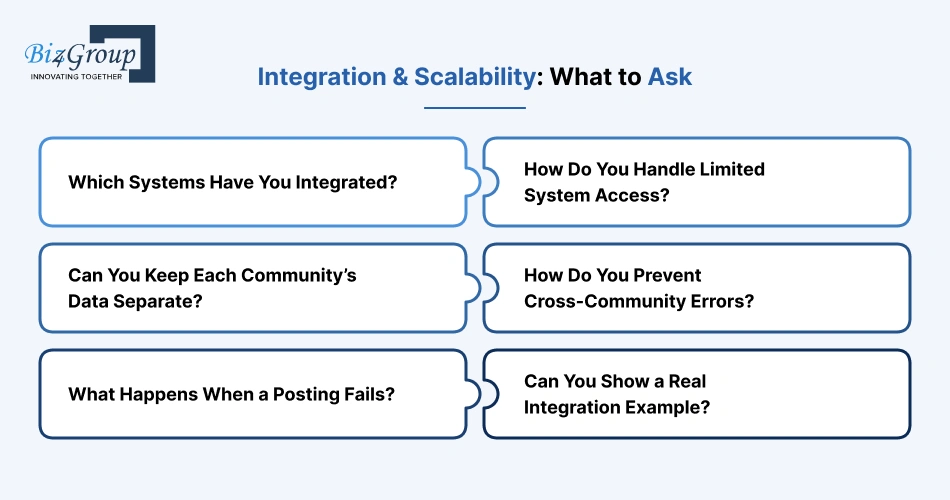
Ask which accounting system, bank feeds, and portals they’ve connected to before, and what happened when a system had limited access. Older systems are usually where the real difficulty hides. If you manage many associations, ask how the platform keeps each community’s funds, documents, and permissions separate as it scales.
Good signs: they ask for your system list before quoting, and they can describe a read/write plan, including what happens when a posting fails.
6. Who owns the code, the data, and the exit?
Get this in writing before work starts. Ask who owns the source code, the trained configurations, and the data. Ask what you receive if the relationship ends: an export in a usable format, documentation, and a handover period.
The due-diligence guide above gives a sample clause on deletion: customer data deleted within 30 days of termination unless retention is required by law. It notes that export and transition help are separate terms you’d need to add. Have counsel review the contract.
7. How do they deliver, and who will vouch for them?
Ask how they phase the work. A strong answer starts small, with a pilot on one community, and expands after results. Ask for references from clients with similar workflows and talk to them. Ask how often you’ll see working AI app, not slide decks.
8. What happens after launch?
Ask for support terms in measurable language. Response times, escalation paths, and who monitors AI quality over time all matter. Models drift as rules, vendors, and charts of accounts change, and someone has to watch for it.
How Do You Score Two HOA App Development Companies? A Worked Example
Say you’re comparing two partners. This example uses made-up scores to show the math.
|
Criterion |
Weight |
Partner A (0-5) |
A points |
Partner B (0-5) |
B points |
|---|---|---|---|---|---|
|
HOA domain understanding |
15 |
4 |
12 |
5 |
15 |
|
Proof on your own data |
20 |
5 |
20 |
2 |
8 |
|
Security and data handling |
15 |
3 |
9 |
4 |
12 |
|
AI controls and approval |
15 |
4 |
12 |
3 |
9 |
|
Integration |
10 |
4 |
8 |
3 |
6 |
|
Ownership and exit |
10 |
3 |
6 |
4 |
8 |
|
Delivery and references |
10 |
4 |
8 |
3 |
6 |
|
Support after launch |
5 |
3 |
3 |
5 |
5 |
|
Total |
100 |
78 |
69 |
Partner B knows HOAs best and has the stronger security story, but won’t test on your data. Partner A scores lower on security and exit terms, which are fixable in contract talks, and wins on proof. Those are the trade-offs the scorecard surfaces.
Which Answers Should Be Automatic Dealbreakers?
Some answers should end the conversation no matter what the total score says. Treat any of these as an automatic fail:
- No pilot or replay on your data. Without that, the rest is unverified.
- No human approval for legal or financial actions. Liens, fees, and referrals shouldn’t fire on their own.
- No data export or deletion terms. You need a way out.
- Refusal to share security evidence, or to say whether your data trains their models.
- No written ownership terms for code and data.
What Red Flags Show Up in Partner Pitches?
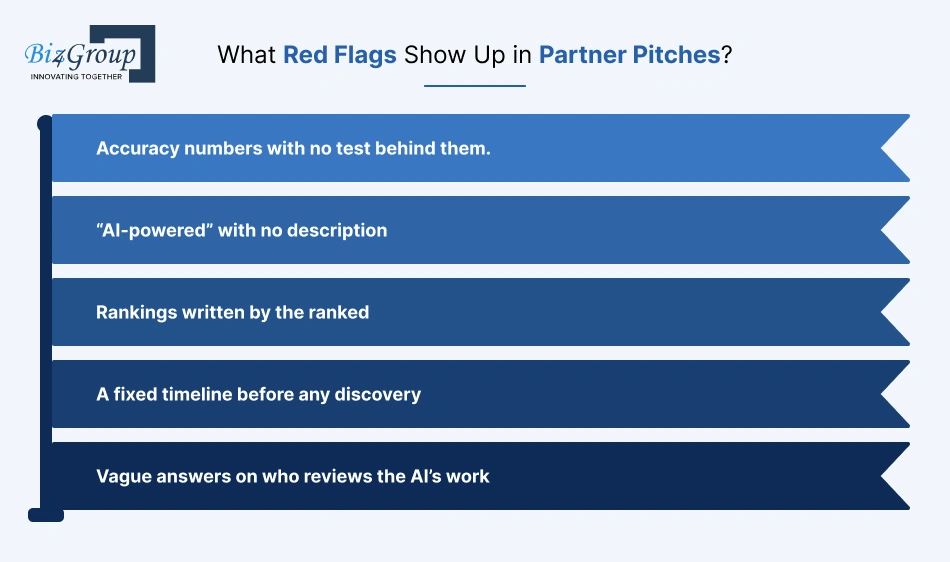
Pitches have patterns worth recognizing. A few to watch for:
- Accuracy numbers with no test behind them. A percentage that doesn’t say whose data it was measured on.
- “AI-powered” with no description of what the AI actually does.
- Rankings written by the ranked. Be wary of any “best companies” list published by a company that ranks itself.
- A fixed timeline before any discovery, especially for integrations with older systems.
- Vague answers on who reviews the AI’s work once it’s live.
If you’d rather buy an existing AI HOA app vendor’s product than build, the questions change. That path is covered in custom AI HOA platform development vs. off-the-shelf solutions and in the vendor comparison of the major HOA software platforms.
How Should You Compare Pricing Across PropTech Development Partners?
Compare pricing by scope, not by hourly rate or headline total. Two quotes can look far apart because one includes integrations, testing, and support and the other doesn’t.
Ask each partner to price the same defined first phase, with the same modules and the same pilot, and list what’s excluded. How scope drives price is laid out in the cost to develop an AI HOA management platform.
What Should the Selection Process Look Like, Start to Finish?
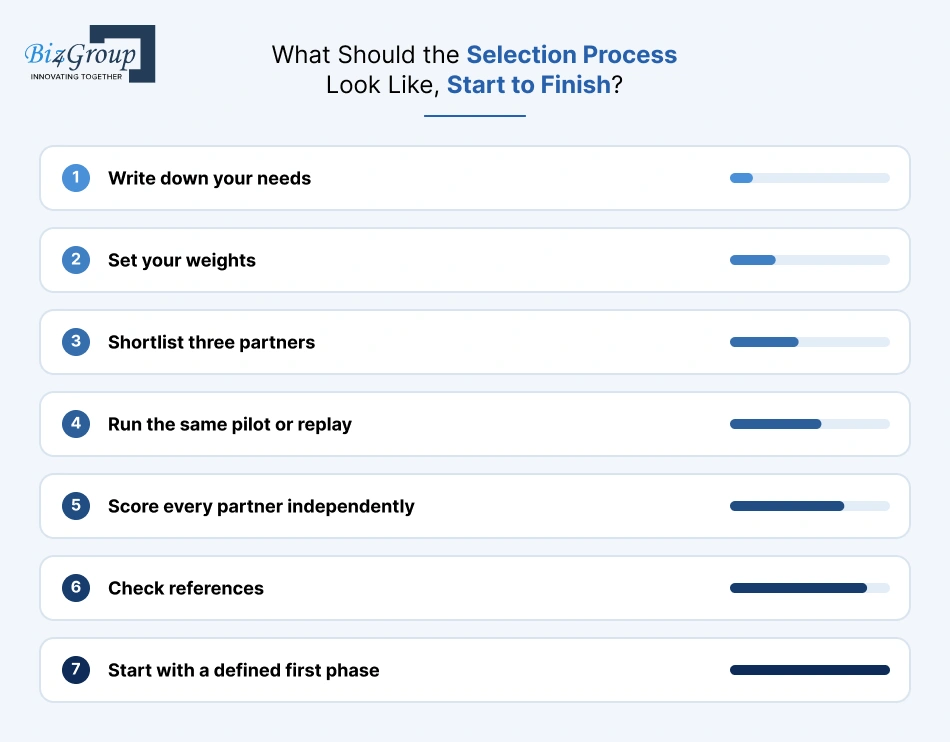
A sound selection process takes a few weeks, not a few days. A realistic shape:
- Write down your needs. Which workflows, which systems, which communities, which states.
- Set your weights and your dealbreakers before talking to anyone.
- Shortlist three partners and send each the same brief.
- Run the same pilot or replay with each shortlisted partner on a small set of your own cases.
- Score every partner independently, ideally with two people from your team, then compare notes.
- Check references and have counsel review ownership, data, and exit terms.
- Start with a defined first phase, not the whole platform.
Score Your Shortlist on the Same Sheet
Set your weights and dealbreakers before the pitches start, so the evidence decides.
Talk to Our AI ExpertsPick an AI HOA Platform Partner on Evidence, Not Rankings
Choosing an AI HOA management software development company goes better when you decide what matters before you see a pitch, score everyone against the same sheet, and give the most weight to proof on your own data.
Set your weights, write your dealbreakers, and ask every partner for the same pilot. The scorecard does the rest.
If you’d like Biz4Group’s AI experts to take a turn on that scorecard, reach out. They can walk through your workflows, your systems, and what a first phase should cover.
FAQs
1. How do you choose an AI HOA management app development company?
Define your workflows and systems first, then score each candidate on the same criteria: HOA domain understanding, proof on your own data, security, AI controls, integration, ownership and exit terms, delivery and references, and support. Give the most weight to a pilot on your own data.
2. What should you look for in an HOA app development company?
Look for people who understand fund accounting and state-specific notice rules, who test AI on past cases before trusting it, who require human approval for legal or financial actions, and who put ownership and exit terms in writing.
3. Is a SOC 2 report enough to trust a development partner?
It’s a useful sign, not a guarantee. Check whether it’s Type 1 or Type 2, what it covers, and the period it spans. Also ask how your data is used, where it’s stored, and which third parties touch it.
4. Should an AI HOA platform partner pilot on my own data?
Yes. A pilot or replay on your closed months or past cases is the best way to see how a partner’s approach holds up, and a partner who won’t do one is asking you to rely on a demo.
5. Who should own the code and data in a custom AI HOA platform project?
That’s for your contract to say, and it should be settled before work starts. Ask who owns the source code, configurations, and data, and what you receive if the relationship ends. Have counsel review the terms.
6. Why use a scorecard instead of a ranked list of AI HOA software development companies?
A scorecard makes you decide what matters first and compares every partner on the same evidence. A ranked list reflects whoever wrote it, which is often one of the companies on it.
