 Location :
Orlando, FL, USA
 +1 (407) 714-1616
 info@biz4group.com


 AI Summary Powered by Biz4AI
- What it is: AI handles the routine dues work: posting payments, flagging accounts that are slipping, drafting reminders, and tracking deadlines. People decide on fees, plans, liens, and referrals.
- Start earlier, not tougher: spotting a drifting account in week two is easier than managing a lien in month four.
- Reminders: keep them short and friendly, from pre-approved templates, with opt-outs and fixed send windows.
- The law varies: federal debt collection rules may apply depending on who is collecting, and state notice rules differ. Florida, Texas, and California are covered as examples.
- Let AI keep the clock: it can count waiting periods and block early sends. It shouldn’t decide an account has reached the lien step.
- Test before trusting: replay past delinquency cases, plant traps like a disputed charge, and pilot on one community with a manager approving every message.
AI-assisted HOA dues collection means letting platform do the routine work of getting assessments paid. It posts payments, spots accounts that are slipping, drafts reminders, and keeps track of deadlines.
People still make every call that carries legal weight. A manager or the board decides who gets a payment plan, who gets a notice, and who gets referred.
That split matters more here than almost anywhere else in HOA operations. A technical slip on dues isn’t just annoying. It can put a late fee, a lien, or a collection referral on a neighbor’s account, and the rules for when that’s allowed are different in every US state.
This blog walks through the whole dues cycle:
- what AI can safely take over
- where federal and state rules draw the lines (with Florida, Texas, and California as examples)
- how to test a collections workflow before it touches a real account
It’s one piece of the bigger AI HOA management platform picture. Dues are the cash that keeps everything else running.
Why Are HOA Dues So Hard to Collect Consistently?
HOA dues are hard to collect consistently because the work is manual, it runs community by community, and the stakes rise at every step.
Picture a manager handling a dozen associations. Each one has its own ledger, its own governing documents, and its own board with its own view on how firm to be. Reminders go out late, or not at all. An account that a friendly nudge in week two would have fixed becomes a lien conversation by month four.
The money involved is big. The CAI Foundation’s statistical review reports $124.2 billion in assessments collected from homeowners.
The tough end of the cycle is getting busier, too. Property-record data compiled by Benutech pointed to higher dues, special assessments, and rising housing costs as overlapping factors.
Lien counts aren’t a delinquency rate. They do show that more accounts are reaching the hardest step.
So the goal isn’t tougher collection. It’s catching problems earlier, treating every owner the same way, and never skipping a required step.
What Can AI Do Across the Dues Cycle?
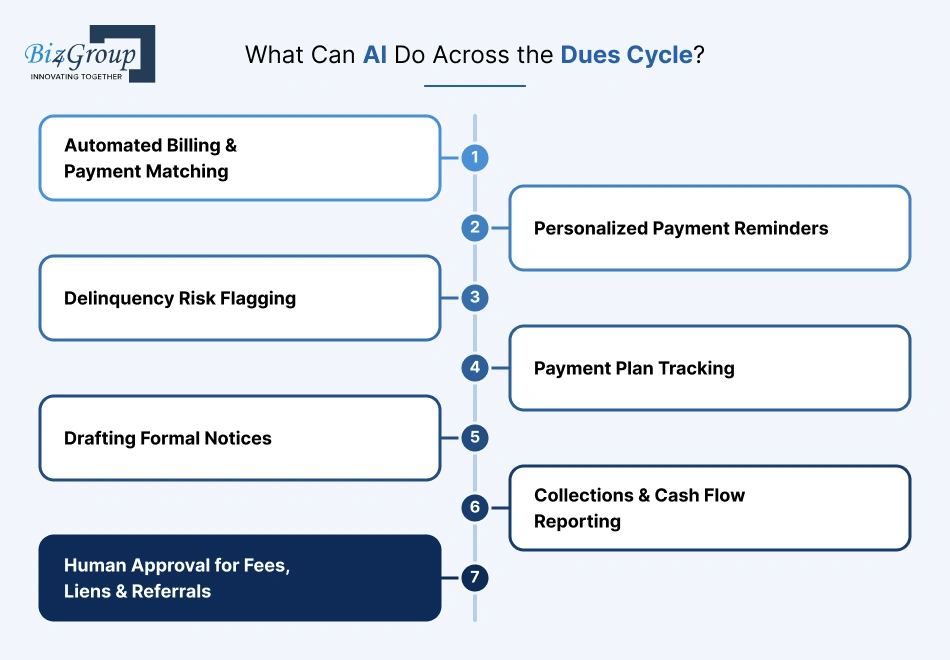
AI can take over the repetitive work at every stage, as long as anything with legal or personal consequences stays with a person. Here’s the split.
|
Stage |
What the AI can do |
What a person owns |
|---|---|---|
|
Billing and posting |
Generates statements, matches payments to the right owner and fund, flags mismatches |
Fixes disputed or misapplied payments |
|
Early reminders |
Drafts and schedules friendly nudges before and just after the due date |
Approves the tone and schedule for each community |
|
Risk flagging |
Surfaces accounts whose payment pattern is slipping |
Decides what, if anything, to do about it |
|
Payment plans |
Shows the options the documents and board policy allow, and tracks plan payments |
Offers, approves, and signs off on any plan |
|
Formal notices |
Tracks deadlines, builds drafts from attorney-approved templates, keeps proof of delivery |
Reviews and sends; decides on liens and referrals |
|
Reporting |
Summarizes aging, collections, and cash forecasts |
Presents and explains to the board |
Look at what’s missing from the AI column: deciding to charge a fee, file a lien, or hand an account to a collector. That’s not a gap to engineer around. It’s the design. In case you don't feel sure enough about it, you can always opt for AI consulting services that Biz4Group LLC provides for its clients in the USA.
How Does AI Flag Accounts Before They Go Delinquent?
AI flags at-risk accounts by watching payment behavior over time and surfacing the ones that are drifting, so someone can reach out before a balance becomes a problem.
The signals are simple, and they come straight from the ledger:
- An owner who always paid on the 1st is now paying on the 20th
- A partial payment
- A returned ACH
- A balance that has quietly grown across two cycles
The flag should start a conversation, not apply a penalty. A good setup shows the manager the reason, like “three late payments in the last four months, last payment short by the late fee.” Then a person decides whether it needs a friendly call, a payment-plan offer, or nothing at all.
A few guardrails keep this fair:
- Use payment behavior only. Build flags on what’s in the ledger, not on personal traits of the owner.
- Show the reason. A flag with no explanation is hard to defend if someone asks why an account was singled out.
- Treat flags as prompts. Nothing should happen to an account automatically just because it was flagged.
- Look for patterns. If one community or one type of owner keeps getting flagged, a person should check why.
How Should AI Reminders Be Set Up?
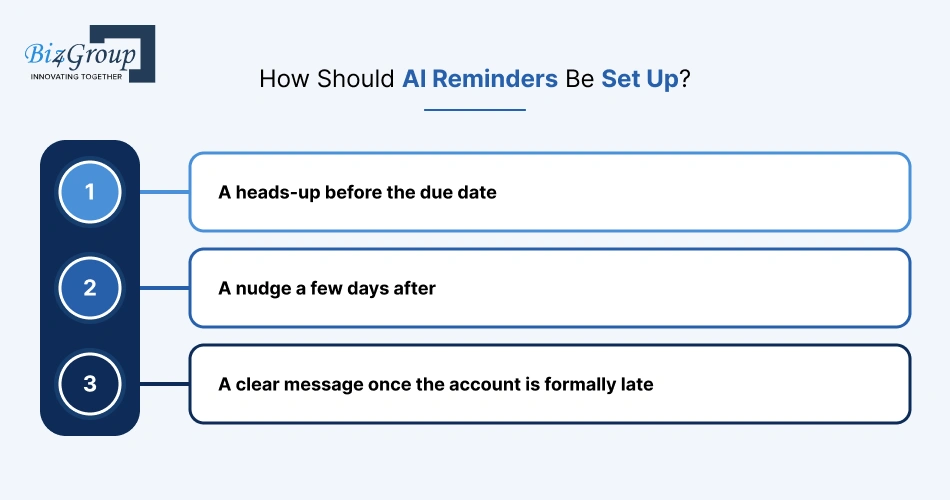
AI reminders work best as a short, friendly sequence that matches the community’s own policy. Every message should be easy to act on and easy to opt out of. A payment link in the first message does more than a stern paragraph.
A reasonable shape looks like this:
- A heads-up before the due date
- A nudge a few days after
- A clear message once the account is formally late
Each one should show the same figure the owner sees in the portal, say what it covers, and offer a way to ask questions or request a payment plan. It should also use the channel the owner chose, and stop the moment a payment or a dispute comes in.
According to Biz4Group LLC, The easiest way to keep this safe is to give the AI a menu, not a blank page. Pre-approved templates, set wording for each stage, and fixed send windows mean the AI decides when to send, not what to say. Anything off the menu goes to a person.
Does Federal Debt Collection Law Apply to HOA Dues?
Sometimes. Whether US federal debt collection law applies depends on who is doing the collecting, and that’s the kind of question a technical team shouldn’t guess at.
The Fair Debt Collection Practices Act targets debt collectors. One HOA-focused legal summary describes them as an individual or business that regularly attempts to collect debts owed by consumers to third parties. Whether a company counts is decided case by case, based on its principal purpose:
- A firm that mostly collects unpaid assessments and enforces liens is likelier to count.
- A management company that mostly handles facilities and administration, with collection as a small part, may not.
This matters because if the rules apply, they cover how an AI contacts people. The CFPB’s Regulation F sets a presumption on phone calls. A collector is presumed to comply if it doesn’t call a person about a particular debt more than seven times in seven consecutive days, or within seven days after talking with them about it.
Moreover, there are two additional points. Collectors must give people a way to opt out of texts and emails (for example, “Reply STOP”), and voicemails have to be limited-content messages.
State law can reach further. Florida’s consumer collection statute covers creditors, not just third-party collectors. A Florida appeals court held in 2019 that condominium association assessments are consumer debts under that statute. The same write-up notes that an earlier Florida decision went the other way on homeowner association maintenance assessments, so the courts haven’t been uniform.
The learning: build contact limits, opt-out handling, and send windows in from the start, and let the company’s counsel decide which rules apply. Being careful on day one costs little. Retrofitting later costs a lot.
What Do State Laws Require Before an HOA Escalates a Delinquent Account?
Most states require specific written notices, with set content and waiting periods, before an HOA can add collection fees, record a lien, or start foreclosure. The details vary a lot, so any AI that tracks deadlines has to be set up per state and per community. Three examples show how different the rules can be.
|
State |
What the statute or a reliable summary describes |
What it means for the workflow |
|---|---|---|
|
Florida |
HOAs fall under Chapter 720. One law firm’s summary of section 720.3085(3)(b) says the association must send a notice once an account is delinquent, before a lien or attorney fees can attach, giving the owner 30 days to pay. A separate 45-day notice of intent to lien follows, and a foreclosure suit needs another 45-day notice. |
Three timed notices in a row. A missed or mis-dated one can reset the clock. |
|
Texas |
Under Property Code section 209.0064(b), an association can’t hold an owner liable for a collection agent’s fees unless it first sends written notice by certified mail. The notice must list each delinquent amount and the total needed to make the account current, describe payment-plan options where required, and give the owner at least 45 days to cure. |
One notice with required content, a certified-mail trail, and a 45-day wait. |
|
California |
Civil Code section 5660 requires written notice by certified mail at least 30 days before recording a lien. It must include the collection procedures, an itemized statement of what’s owed, the owner’s right to request a board meeting, the right to dispute through “meet and confer,” and the right to alternative dispute resolution. It also needs a required capitalized foreclosure warning. |
A long content checklist, plus rights that must be offered before the lien. |
The Florida row comes from a Florida law firm’s explanation of the HOA lien process. The Texas row paraphrases Property Code section 209.0064, and the California row paraphrases Civil Code section 5660.
These are summaries for illustration. Statutes get amended, and the details of delivery, content, and timing matter. Have counsel confirm the current text before anything is configured.
This is where AI helps without adding risk. It can:
- store every date and count the days
- check that the right template is attached
- record how and when each notice went out
- block the “send” button until the clock has run
What it shouldn’t do is decide that an account has reached the lien step.
Keep Every Notice On the Clock
Track deadlines, templates, and proof of delivery in one place, with a person approving every legal step.
Talk to Our AI TeamWhere Should AI Stop in Collections?
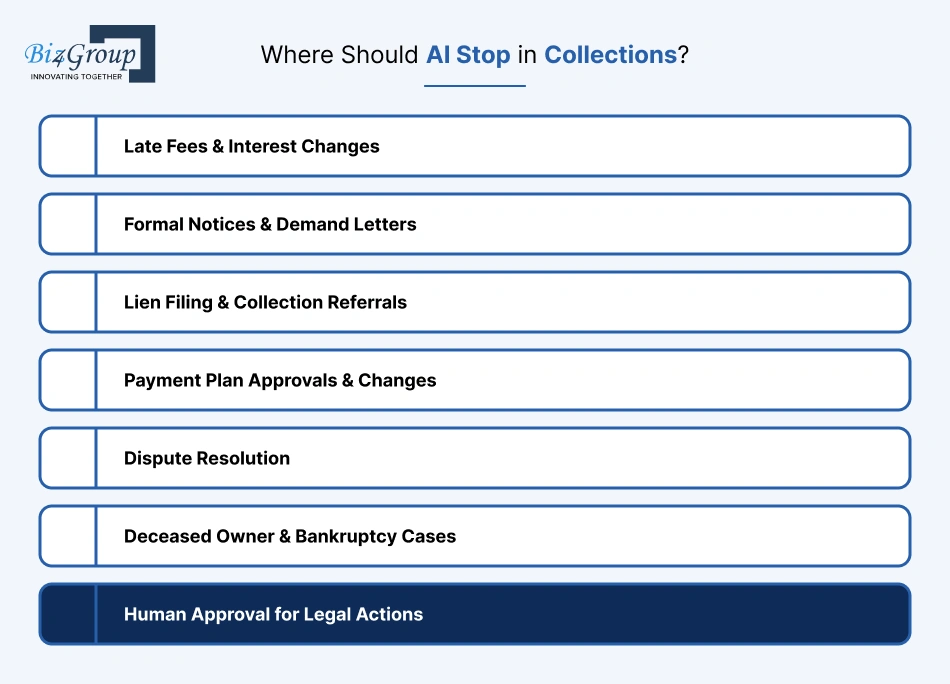
AI should stop before any step that creates a legal consequence for an owner, and each of those steps should need a named person’s approval.
- Charging a late fee or interest beyond what the governing documents and board policy already set.
- Sending a formal pre-lien or demand notice. The AI can prepare it. A person reviews and sends it.
- Recording a lien or referring an account to an attorney or collection agency.
- Agreeing to, changing, or cancelling a payment plan.
- Resolving a dispute. Disputes should pause automated messages until a person reviews the account.
- Unusual situations, like an owner who has died, filed bankruptcy, or is deployed. These go to counsel or the manager, not a template.
A good tool also keeps an audit trail for every one of these: what the AI suggested, who approved it, and when. If a board member or an attorney asks why a notice went out, the answer should be one click away.
How Do Payment Plans, Disputes, and Hardship Fit In?
Payment plans, disputes, and hardship requests are the human side of collections. The best use of AI here is making sure none of them slip through.
Some states require the association to offer a plan, or at least describe the option in the notice:
- Texas: the required notice has to describe payment-plan options where the association is subject to the plan statute or its documents require one.
- California: the required notice includes the owner’s right to a board meeting and to dispute the debt through “meet and confer.”
AI helps in three practical ways:
- Finding the options. It surfaces the plans the governing documents and board policy allow, so the manager isn’t digging through bylaws.
- Tracking installments. It flags a missed plan payment right away, not three weeks later.
- Catching disputes. When an owner writes in to dispute a charge or ask for help, it pauses the reminders on that account and hands it to a person with the message attached.
That last one matters. An owner who says “I already paid that” and keeps getting robotic reminders is how a small problem becomes a board complaint.
How Does Dues Collection Connect to Accounting and the Resident Portal?
Dues collection works best when it shares one source of truth with the books and with the owner’s own view of their account. If the reminder says $412, the portal says $380, and the ledger shows $412 less a pending payment, nobody trusts any of them.
On the accounting side, every payment should land in the right fund and flow straight into the monthly close. That’s where AI HOA accounting and reporting picks up, with reconciliation, receivables summaries, and the board packet. The delinquency numbers in the packet should come from the same ledger the reminders use.
On the resident side, the AI resident portal and assistant is where owners see their balance, pay, request a plan, or ask a question. A reminder that links straight to that page, showing the same figure, cuts a lot of back-and-forth.
Paying the association’s own bills is the other direction of the money. That’s the separate world of AI invoice processing for HOA management companies, where the same fund-accounting care applies.
When an owner sells, the question shifts from collecting to certifying: what exactly is owed at closing? That has its own rules and paperwork, covered in automating HOA resale document retrieval.
What Should a Dues-Collection Workflow Measure?
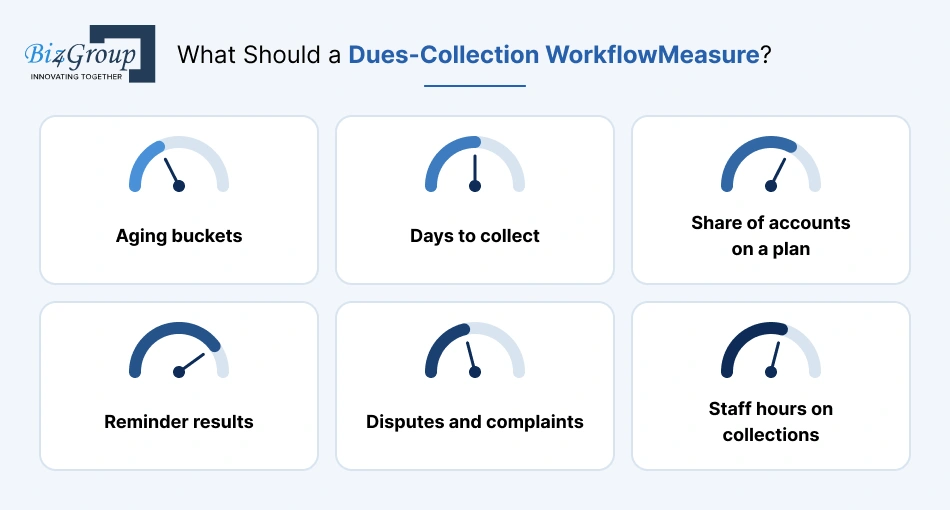
Measure a dues-collection workflow against a baseline taken before any AI is switched on. Otherwise “collections improved” is just a feeling. The numbers worth tracking are simple:
- Aging buckets: how much sits at 1 to 30, 31 to 60, 61 to 90, and over 90 days past due.
- Days to collect: the average time from due date to payment.
- Share of accounts on a plan, and how many of those plans get completed.
- Reminder results: how many payments follow each message, and how many owners opt out.
- Disputes and complaints: how many, and how fast they’re resolved.
- Staff hours on collections, per community, per month.
The two-week time study in the cost of manual HOA management vs AI automation works here too. Log the hours, the rework, and the days to resolve before changing anything.
How Do You Test an AI Collections Workflow Before It Touches a Real Account?
The safest test is the replay idea from accounting: run the workflow on past accounts where the right answer is already known, and see what it would have done.
Pull a set of closed delinquency cases, including a messy one. Feed in the original ledger data without the outcome. Then compare what the AI would have flagged, sent, and queued with what actually happened and what the rules allowed.
Then plant a few traps on purpose:
- A payment that was made on time but posted late, to see whether the AI still sends a reminder.
- A partial payment, to check it’s applied correctly and the balance stays accurate.
- An owner who disputed the charge, to confirm automation pauses.
- A notice one day short of its waiting period, to confirm the send is blocked.
- An address change or returned mail, to check the notice trail stays accurate.
- An unusual situation, like a bankruptcy or a deceased owner, to confirm it goes to a person.
Review every miss, not just the average. Then pilot on one community, with the manager approving every outbound message.
The scorecard approach from the accounting post, with thresholds set before the test, fits here too. The replay-test scorecard for AI accounting is built for this kind of before-you-trust-it check, and its seeded-error and miss-log tabs adapt easily to collections cases.
What Should a Custom Dues-Collection Build Include?
A custom dues-collection build needs rules that can be set per state and per community, a human approval step for anything with legal weight, and a full audit trail. The short checklist:
- A rules layer that stores each community’s due dates, grace periods, late-fee policy, and required notices, instead of hard-coding them.
- A deadline engine that counts waiting periods and blocks early sends.
- Attorney-approved templates, locked from casual edits, with changes logged.
- Contact controls: opt-out handling, send windows, and frequency limits for each account.
- A dispute and hardship pause that stops automation the moment an owner raises a problem.
- Proof of delivery, stored with every notice.
- Role-based access and an audit trail covering every AI suggestion and every human approval.
- Two-way sync with the accounting system and the resident portal.
Whether to build that or buy it is its own decision, covered in custom AI HOA platform development vs. off-the-shelf solutions. What it costs depends on scope, which our guide on cost to develop an AI HOA management platform breaks down.
Build Dues Collection Around Your Communities and Your States
Configurable rules, human approval where it counts, and a clear audit trail for every notice.
Scope My Dues Collection BuildConclusion: Earlier Nudges, Fewer Surprises, Every Step Accounted For
AI HOA dues collection software works when the AI in it handles the cycle (posting, pattern-spotting, reminders, and the clock) and people handle the decisions that affect a neighbor’s account.
Done well, that means friendlier nudges sooner, no skipped notices, and fewer accounts reaching the point where a lien is the only option.
The rules vary by state, and some may apply to whoever is doing the collecting. So the legal settings belong with counsel, not with the code. Test on past accounts, pilot on one community with a manager approving every message, and expand only when the results hold up.
Planning on creating an AI HOA dues collection platform for your real estate business? Reach out to real estate AI experts at Biz4Group today!
FAQs
1. What is AI HOA dues collection software?
It’s an AI platform for posting payments, flagging accounts that are slipping, drafting and scheduling reminders, tracking notice deadlines, and reporting on collections. People still decide on fees, payment plans, liens, and referrals.
2. Can AI send late notices to homeowners automatically?
Routine reminders, yes, from pre-approved templates and schedules. Formal notices that start legal clocks, like pre-lien notices, should be prepared by the AI but reviewed and sent by a person. Their content and timing are set by state law and the association’s documents.
3. Does the Fair Debt Collection Practices Act apply to HOA dues?
It can, depending on who is collecting. The law targets debt collectors, and whether a management company or attorney counts is decided case by case. State laws, like Florida’s consumer collection statute, can also reach creditors. The company’s counsel should decide which rules apply.
4. What notices does an HOA have to send before filing a lien?
It depends on the state. Texas requires certified-mail notice with at least 45 days to cure before collection-agent fees can be passed to an owner. California requires certified-mail notice at least 30 days before a lien is recorded. Florida describes a sequence of timed notices. Check the current statute and the association’s documents.
5. Can AI offer homeowners payment plans?
It can show which options the governing documents and board policy allow, and track installments once a plan exists. A person should approve any plan, because some states require plans to be offered or described in notices.
6. How do you test an AI collections workflow safely?
Replay past delinquency cases, plant known traps like a disputed charge or a notice one day too early, review every miss, and pilot on one community with a manager approving each outbound message.
