Location :
Orlando, FL, USA
Location :
Orlando, FL, USA +1 (407) 714-1616
 info@biz4group.com









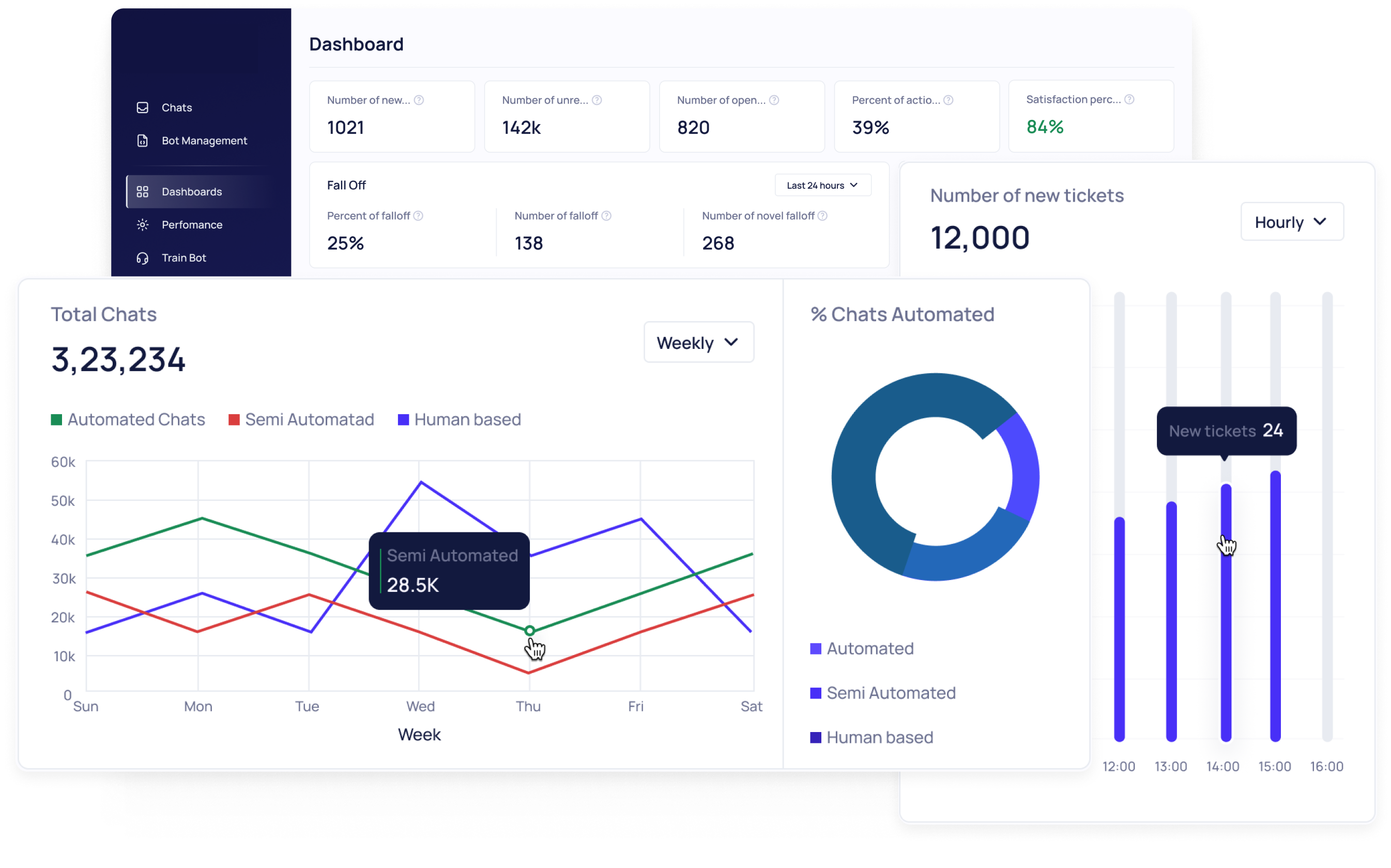









Imagine a digital system that doesn’t wait for instructions but instead, understands your business goals, learns from real-time feedback, and takes independent actions to get the job done.
Read More

 AI Summary Powered by Biz4AI
What if the biggest risk to your AI initiative isn't the technology, but the problem it's trying to solve?
Many organizations assume that once an AI solution achieves high accuracy then business value will naturally start following. Yet leaders continue to face a frustrating reality, projects that look successful on paper fail to deliver meaningful outcomes. This growing challenge has made AI business context validation a critical consideration for organizations investing in AI-driven initiatives.
This gap between technical success and business value is more common than many organizations realize. According to McKinsey's Global Survey on AI, while 64% of organizations report that AI is enabling innovation, only 39% have achieved measurable EBIT impact from their initiatives.
So, what's holding businesses back? In many cases, the issue isn't the technology itself. It's context.
Organizations spend months improving AI model performance only to discover that the system is optimizing metrics with little impact on the outcomes leadership actually cares about. The AI may be working exactly as intended, but the business problem remains unsolved.
Most AI systems don't know which customers deserve exceptions, which deals are strategically important, or which policies should take precedence when rules conflict. They can process vast amounts of data and generate intelligent outputs, but they lack the business understanding that experienced employees use to make sound decisions every day.
This is why two organizations can deploy similar AI solutions and achieve completely different results. One creates measurable business value. The other creates another dashboard full of impressive metrics. And the difference isn't necessarily the model. It's the context behind it.
As the importance of AI organizational context continues to grow, organizations must move beyond evaluating technical performance alone. They need to validate whether their AI solutions are supporting the right objectives, driving the right outcomes, and creating measurable business value.
The question isn't whether your AI works. The question is whether it's making decisions that make sense for your business.
AI business context validation is the process of ensuring that an AI system understands and operates within the specific business environment it is designed to support. It goes beyond evaluating technical performance and focuses on verifying whether the AI aligns with an organization's goals, policies, workflows, regulations, and decision-making processes.
An AI model is capable of generating accurate predictions, automate tasks efficiently, and produce high-quality outputs. However, if it lacks awareness of the organization's unique requirements, then it may end up delivering recommendations that conflict with business objectives, compliance standards, customer expectations, or operational realities.
For example, an AI-powered customer support system might accurately identify a customer's issue and suggest a resolution. But if it doesn't understand company refund policies, service agreements, or customer retention strategies, its recommendation could be technically correct while still being inappropriate for the business.
This is why organizations must validate more than just AI model accuracy. They must also verify that the system incorporates AI organizational context, leverages AI business-specific context, and demonstrates strong AI context understanding when making decisions. Effective AI contextual organizational insight validation and AI contextual organizational knowledge validation helps in ensuring that AI systems apply business rules, institutional knowledge, and strategic priorities consistently across real-world scenarios. A great example of this competitive advantage in action is Worth Advisors, developed by Biz4Group.
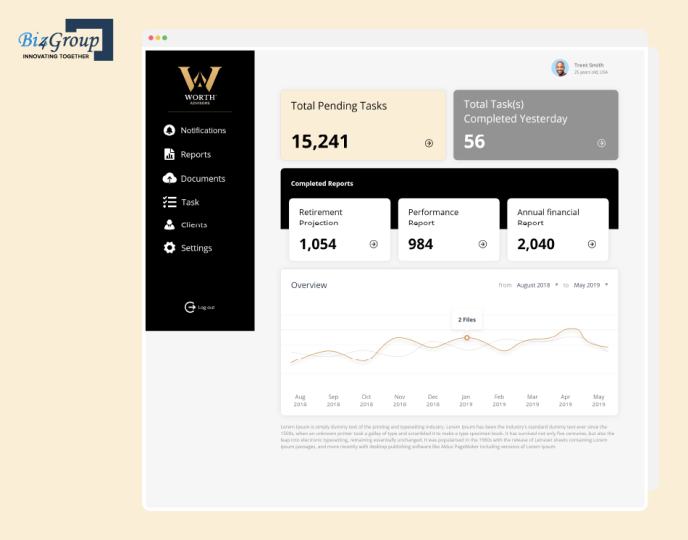
Worth Advisors is a financial planning platform that streamlines data collection through structured questionnaires and secure document uploads, that enables advisors to gain a complete understanding of each client's financial situation and deliver personalized planning reports.
Challenges
Earlier, Worth Advisors had limited capabilities for collecting client information and generating detailed financial planning reports. Advisors often worked with incomplete data and spent considerable time gathering, validating, and organizing information manually.
After analyzing the platform, we identified these gaps and recommended enhancements that would provide advisors with deeper client insights and a more efficient planning process.
Business Context Advantage
We transformed Worth Advisors into a centralized financial planning platform that brings together client information, financial data, and planning requirements in one place. By implementing 14 structured questionnaires, secure document uploads, and automated data integrations, we enabled advisors to access complete and reliable client context from the start. We also introduced five customizable report types and 37 modular report components, empowering advisors to create more personalized financial plans, make informed recommendations, and deliver a superior client experience.
Impact
By introducing a Smart Questionnaire Engine, Modular Report Engine, and Redtail & Intelliflo integrations, we helped:
Ultimately, AI business context validation serves as the bridge between technical capability and business value. It ensures that AI systems not only perform well but also support the outcomes that matter most to the organization. Next, we will learn what factors lead to the failure of AI contextual organizational knowledge validation.
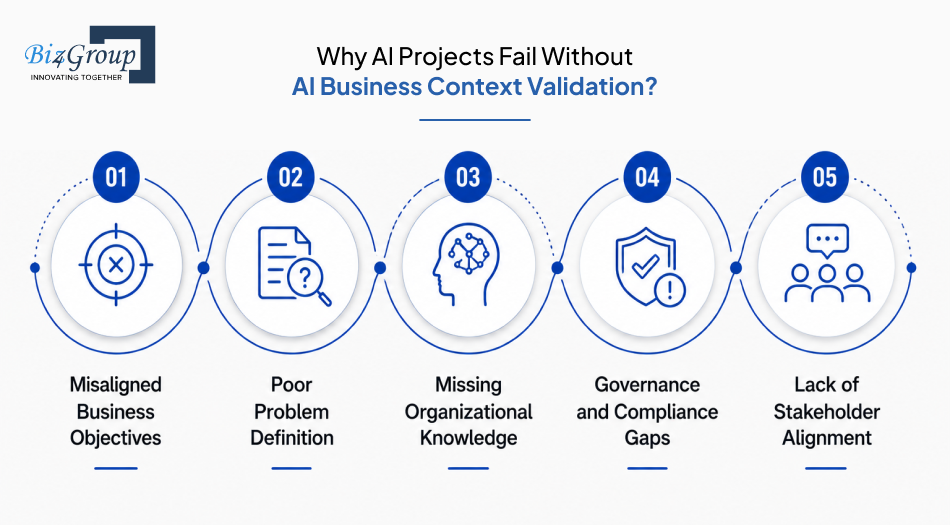
Recent research highlights a clear disconnect, that many organizations assume that better AI models automatically lead to better outcomes. However, some of the most expensive AI failures happen when the technology works exactly as intended. The challenge isn't deploying AI. It's ensuring that AI creates real business value.
The problem is that technical success and business success are not the same thing.
An AI system can deliver highly accurate predictions, automate workflows, and generate intelligent recommendations. However, if those outputs don't align with business goals, operational realities, or organizational policies, the project will struggle to produce meaningful results.
Some of the most common reasons AI projects fail despite strong technical performance include:
Many AI initiatives are built around “what the technology can do” rather than “what the business needs to achieve”. This often led teams to optimize for model performance rather than business outcomes.
Organizations often jump to AI before validating the problem itself. If the wrong problem is being solved, even the most sophisticated solution will fail to deliver value.
AI systems frequently lack institutional knowledge, business rules, and operational nuances that guide real-world decision-making. Without this context, technically correct outputs can lead to poor business decisions.
An AI model may perform accurately, but if its outputs conflict with regulatory requirements, company policies, or risk management standards, the project can quickly become a liability.
When executives, business teams, and end users have different expectations, AI projects struggle with adoption, trust, and long-term success.
Most AI failures aren't caused by inadequate technology. They're caused by a lack of AI business-specific context and insufficient AI context understanding.
Organizations that prioritize AI business context validation ensure that AI systems are aligned with business goals, workflows, and decision-making processes. That's what transforms AI from a technical achievement into a business success. Further, we will look at the real-world examples of AI business context validation.
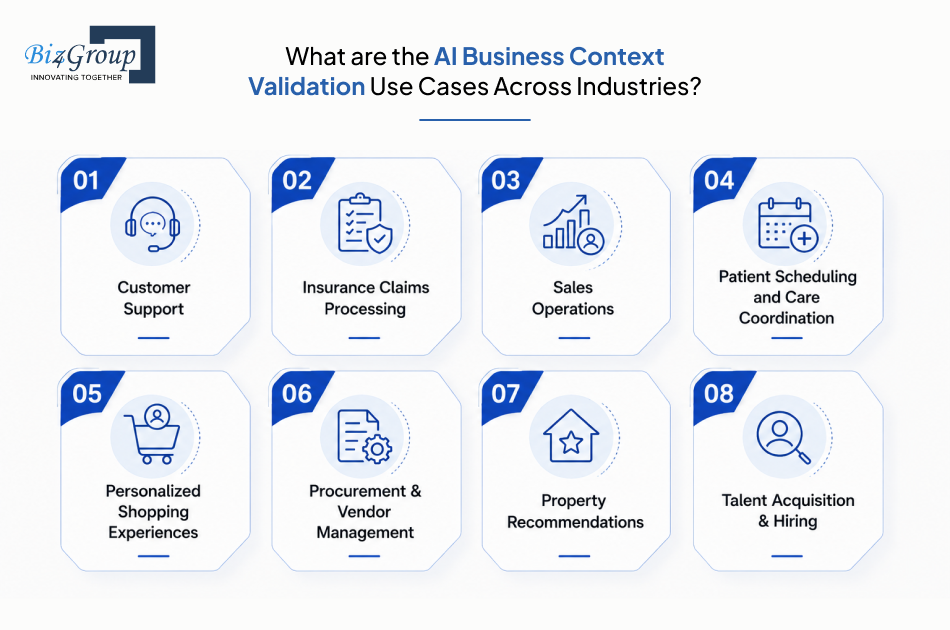
An AI system can appear highly successful on paper. It may improve efficiency, increase accuracy, and automate repetitive tasks. But if it doesn't understand the business context behind its decisions, that may never translate into real business value.
Here are three examples that demonstrate why AI business context validation matters.
Challenge: Reduce response times and support costs.
A company deployed an AI chatbot to handle routine customer inquiries. While response times improved significantly, customer satisfaction continued to decline. The system could answer questions quickly, but it lacked awareness of customer history, loyalty status, and escalation policies.
Key Lesson: Speed improves efficiency. Context improves customer experience.
Challenge: Accelerate claims reviews.
An insurer implemented AI to automate claim assessments and reduce processing delays. Although claims moved faster through the pipeline, the system struggled with policy exceptions and unique cases that required human judgment.
Key Lesson: Faster decisions must still account for fairness, compliance, and customer trust.
Challenge: Increase lead conversions.
A sales organization used AI to identify prospects most likely to convert. Conversion rates improved, but revenue growth remained stagnant because the system prioritized easy-to-close opportunities instead of high-value accounts.
Key Lesson: Business value matters more than isolated performance metrics.
Challenge: Improving patient throughput without increasing staff workload.
A healthcare provider uses AI to maximize appointment utilization and reduce scheduling inefficiencies. While operational metrics improved, the system ignored treatment complexity, provider specialization, and care for continuity requirements.
Key Lesson: Operational efficiency must support clinical outcomes, not compete with them.
Challenge: Increasing average order value and customer retention.
An e-commerce company used AI to personalize product recommendations for shoppers. While engagement rates improved, the system frequently promoted low-margin products and missed opportunities for cross-selling and upselling.
Key Lesson: More clicks don't always mean more revenue.
Challenge: Reducing procurement costs.
A company used AI to identify the lowest-cost suppliers. While purchasing costs decreased, the system overlooked supplier reliability, contract obligations, delivery performance, and strategic partnerships.
Key Lesson: The cheapest vendor isn't always the best business decision.
Challenge: Matching buyers with the right properties.
A real estate company deployed AI to recommend properties based on budget and location preferences. While engagement increased, the system often overlooked lifestyle needs, future growth plans, and buyer priorities.
Key Lesson: Customer preferences matter as much as customer data.
Challenge: Improving hiring quality while reducing time-to-hire.
An organization used AI to screen resumes and identify top candidates. While the system accelerated recruitment, it prioritized keyword matches and historical hiring patterns over team fit, role-specific requirements, and long-term potential.
Key Lesson: The best candidate isn't always the best-matching resume.
In every case, the AI performed well from a technical standpoint. The challenge wasn't technology. It was the lack of business context guiding its decisions. That's why AI business context validation is essential. Building on this, we will explore step by step AI business context validation process.
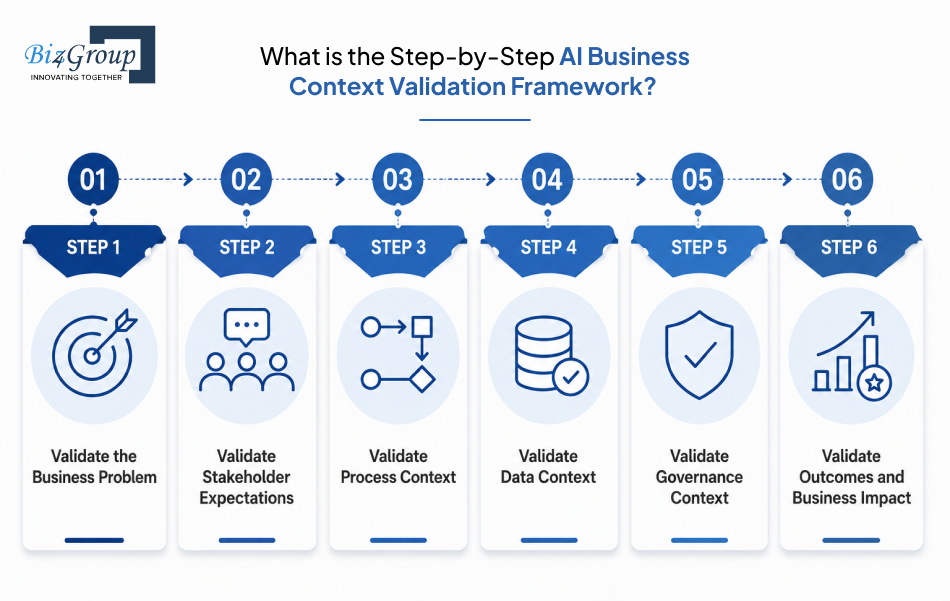
The further step in AI business context validation is ensuring that AI initiative is built around the right business problem from the start.
That's where a structured AI business context validation framework becomes essential. Rather than evaluating AI solely on technical performance, organizations must validate whether the solution aligns with business goals, operational realities, stakeholder expectations, and long-term strategic objectives.
The following six-step framework helps organizations identify context gaps early, reduce implementation risks, and ensure AI systems deliver measurable business value.
Every successful AI initiative begins with a clearly defined business problem. Before discussing models, data, or automation, organizations must determine whether AI is the right solution and whether the problem is worth solving.
Ask:
If the problem is poorly defined, even a technically successful AI project is unlikely to deliver value.
AI projects often involve executives, business leaders, operations teams, compliance specialists, and end users. Each group may have different expectations regarding outcomes, risks, and success metrics.
Ensure alignment by identifying:
When stakeholders aren't aligned, AI solutions frequently face adoption challenges and disappointing ROI.
AI does not operate in isolation. It functions within existing workflows, business processes, and operational procedures.
Organizations should evaluate:
Understanding process context ensures the AI supports how the business actually operates rather than disrupting critical functions.
Data quality alone is not enough. Organizations must ensure that the AI understands the business's meaning behind the data it uses.
Key questions include:
Strong AI business-specific context depends on more than clean data. It requires meaningful, business-relevant data.
AI systems must operate within organizational, legal, and regulatory boundaries. Without proper governance, even accurate AI outputs can create compliance, security, or reputational risks.
Organizations should validate:
This step ensures AI decisions remain aligned with both business objectives and governance expectations.
The final step is determining whether the AI delivers measurable value after deployment. Technical metrics such as accuracy and response time are important, but they don't tell the complete story.
Evaluate:
Ongoing outcome validation helps organizations maintain strong AI context understanding and ensure that AI continues to support business goals as conditions evolve.
The most successful AI initiatives don't start with technology. They start with context. By validating the business problem, stakeholders, processes, data, governance requirements, and outcomes, organizations can build AI systems that align with real-world business needs and generate sustainable value.
AI business context validation helps ensure that organizations aren't just building AI correctly but building the right AI solution in the first place. Moving forward, we’ll look at how to detect AI business context drift, so it doesn’t occur after deployment.
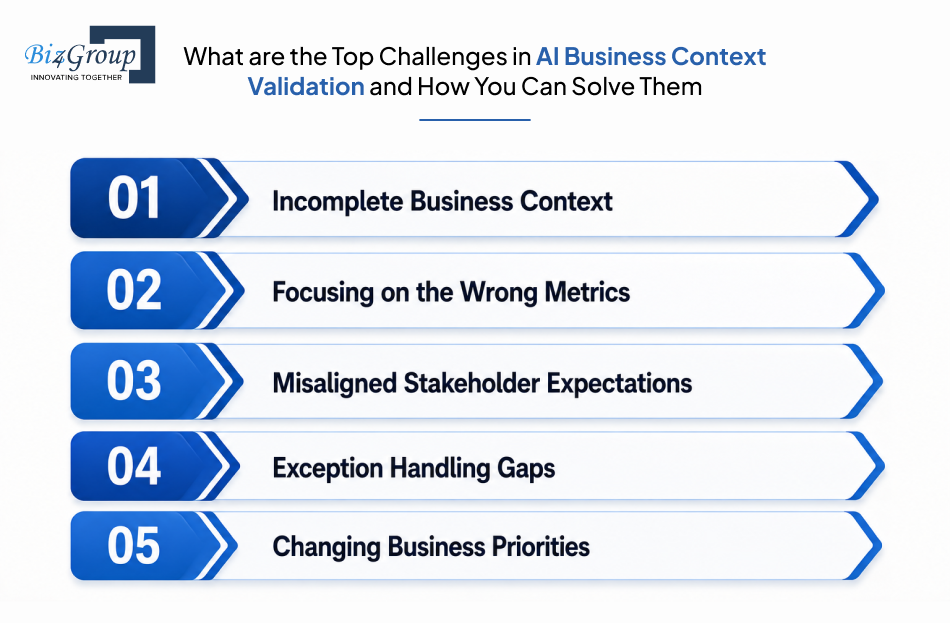
Getting AI to work is one challenge. Getting it to work for your business is another thing. Even well-designed AI systems can fall short when they lack the context needed to support real business decisions.
Here are some of the most common challenges organizations face:
|
Challenge |
Why It Happens |
How to Address It |
|---|---|---|
|
Incomplete Business Context |
AI has access to data but lacks business rules, policies, and operational knowledge. |
Integrate organizational knowledge, workflows, and decision-making criteria into the system. |
|
Focusing on the Wrong Metrics |
Success is measured by accuracy or efficiency instead of business outcomes. |
Align AI performance with KPIs such as revenue, customer satisfaction, cost savings, or risk reduction. |
|
Misaligned Stakeholder Expectations |
Business teams, users, and technical teams have different goals and success criteria. |
Establish stakeholder alignment before development begins. |
|
Exception Handling Gaps |
AI performs well in standard scenarios but struggles with edge cases and special situations. |
Identify exceptions early and create clear escalation paths for human review. |
|
Changing Business Priorities |
Business goals, regulations, and customer expectations evolve over time. |
Regularly review and revalidate AI systems against current business requirements. |
Most AI failures aren't technology failures. They're context failures. These challenges can be addressed with a structured validation process. That's exactly what we'll cover next.
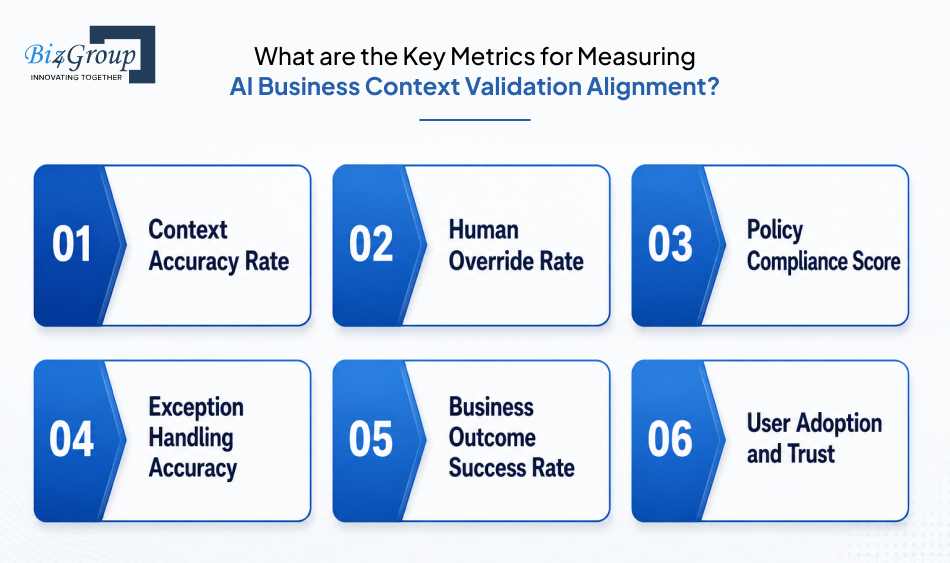
Organizations measure AI success using technical metrics like accuracy, precision, latency, or response quality. These indicators are important, but they don't reveal whether the AI is operating in alignment with business objectives.
That’s why organizations need metrics that measure how well AI decisions reflect business rules, stakeholder expectations, and organizational goals, to evaluate the effectiveness of AI business context validation.
The following metrics can help assess whether an AI system is delivering meaningful business value rather than simply producing technically correct outputs.
This metric measures how often AI-generated outputs align with established business rules, policies, and operational requirements.
For example, if an AI-powered customer service assistant correctly applies refund policies, escalation procedures, and customer-specific exceptions, it explains a high level of context accuracy.
A declining context accuracy rate may indicate that the system's understanding of the business environment is becoming outdated.
Human override rate tracks how often employees modify, reject, or replace AI-generated recommendations.
Besides occasional overrides, a consistently high override rate may suggest that the AI lacks sufficient AI business-specific context, or it is failing to account for important business considerations.
Tracking this metric helps organizations spot contextual gaps early, before they begin to impact business performance.
AI systems operating in regulated industries must consistently follow organizational policies and compliance requirements.
A policy compliance score measures how often AI outputs adhere to internal guidelines, regulatory standards, and governance frameworks.
This metric is particularly valuable for organizations using AI in areas such as finance, healthcare, insurance, and legal services.
Business decisions often involve exceptions that fall outside standard rules or workflows. Exception of handling accuracy evaluates how effectively an AI system manages these complex scenarios.
Examples include:
Strong performance in exception handling is often a sign of mature AI context understanding and effective contextual validation.
Ultimately, AI should be measured by its impact on business outcomes.
Depending on the use case, this may include:
This metric helps determine whether the AI is contributing to organizational objectives rather than simply performing well from a technical perspective.
Even highly accurate AI systems fail if employees do not trust or use them.
Organizations should monitor:
Low adoption often signals a disconnect between AI outputs and how users expect decisions to be made within the business context.
By tracking metrics organizations can continuously evaluate whether their AI systems remain aligned with evolving business needs.
The goal of AI business context validation is not just to build smarter AI. It is to build AI that consistently supports business objectives, adapts to organizational realities, and delivers measurable value over time. Next, we’ll explore a checklist to evaluate AI business context validation.
Make sure your AI understands the business, not just the data.
Connect With UsMost AI projects don't fail because of poor models or inadequate technology. They fail because the AI is solving a problem differently than the business expects, or worse, solving the wrong problem altogether.
Biz4Group, a leading AI development company. We help organizations build AI solutions that align with business goals, workflows, compliance requirements, and operational realities. Our team combines AI expertise with a business-first approach to ensure your solution delivers measurable outcomes, not just technical performance. We've seen the value of business context firsthand through solutions like Worth Advisors, developed to support smarter financial decision-making.
By prioritizing AI business context validation, we help businesses reduce implementation risks, accelerate adoption, improve ROI, and build AI solutions that solve the right problems from day one.
With Biz4Group, you're not just implementing AI. You're building AI that understands your business.
With acceleration in AI adoption around the sectors, success is not being determined by model performance alone. Organizations that achieve the greatest value from AI are those that ensure their systems understand the business context behind every decision, recommendation, and action.
That's why AI business context validation is essential. It helps organizations align AI with business goals, operational workflows, compliance requirements, and stakeholder expectations. It is reducing the risk of costly failures and increasing the likelihood of measurable ROI.
At Biz4Group LLC, we help businesses move beyond experimentation and build AI solutions that solve the right problems from the start. From use case validation and strategy development to implementation and ongoing optimization, our team ensures your AI initiatives remain aligned with your business objectives at every stage.
Ready to build AI that truly understands your business? Connect with Biz4Group today to discuss your AI goals and discover how our experts can help you develop context-aware AI solutions that drive real business results.
AI business context validation is the process of ensuring that an AI system understands and aligns with an organization's goals, workflows, policies, compliance requirements, and decision-making processes to deliver meaningful business outcomes.
It helps organizations ensure that AI solutions solve the right business problem, reduce implementation risks, improve adoption, and generate measurable ROI.
Model accuracy measures technical performance, while business context measures whether AI decisions align with organizational objectives, business rules, and operational realities.
Common causes include poorly defined business problems, misaligned objectives, missing organizational knowledge, governance gaps, and a lack of business context.
Business context drift occurs when an AI system remains technically accurate but becomes misaligned with changing business goals, policies, regulations, or operational requirements.
Warning signs include increased human overrides, declining user trust, customer complaints, policy violations, and reduced business performance despite stable model accuracy.
Key components include business problem validation, stakeholder alignment, process validation, data validation, governance validation, and outcome validation.
Context engineering is the practice of designing and managing the business information, rules, knowledge, and constraints that AI systems need to make context-aware decisions.
Industries such as healthcare, finance, insurance, retail, manufacturing, logistics, and customer service benefit significantly because they rely on complex workflows, regulations, and business rules.
Biz4Group helps businesses validate AI use cases, align AI with organizational goals, incorporate business knowledge into AI systems, ensure compliance readiness, and optimize AI performance for long-term success.

with Biz4Group today!
Our website require some cookies to function properly. Read our privacy policy to know more.