Location :
Orlando, FL, USA
Location :
Orlando, FL, USA +1 (407) 714-1616
 info@biz4group.com

















Imagine a digital system that doesn’t wait for instructions but instead, understands your business goals, learns from real-time feedback, and takes independent actions to get the job done.
Read More

 AI Summary Powered by Biz4AI
"Our finance and revenue cycle management (RCM) teams want better visibility into how much revenue is being lost through denials and underpayments. How can an AI revenue recovery platform help us measure and recover that revenue?"
AI healthcare revenue recovery helps you turn claim and payment data into identifiable recovery opportunities. Instead of depending on spreadsheets and manual reviews, your team can find denied claims, detect payment discrepancies, and determine which accounts may still have recoverable revenue.
U.S. healthcare organizations handle nearly 9 billion claims annually, while commercial insurers deny or reject approximately 15-20% at the initial submission stage, often because of coding inaccuracies, insufficient documentation, or discrepancies in patient eligibility. This is one of the biggest reasons that the use of AI in healthcare revenue recovery is increasing.
The global AI in RCM market is projected to grow from USD 28.1 billion in 2026 to USD 70.1 billion by 2030, at a CAGR of 24.2%.
But how AI help recover lost healthcare revenue from denied claims? How can AI identify underpaid healthcare claims? And how much time could your RCM team save with automated healthcare revenue recovery?
Finding healthcare revenue leakage is only the starting point. You still need to determine which claims deserve attention, understand why revenue was lost, gather supporting evidence, and move each opportunity toward recovery.
At Biz4Group, we build AI products that help healthcare teams tackle revenue loss from denied and underpaid claims. Bill Matters focuses on the claims side of this problem, helping finance and RCM teams spot recovery opportunities and stay focused on claims that may still have revenue to recover.
The real value lies in understanding how the process of AI revenue recovery for healthcare works from claim identification to revenue recovery. But before that you need to understand what it is?
Find the claims worth pursuing and give your team time back.
See How It WorksAI healthcare revenue recovery uses AI to find claims and payment issues that may be costing your organization revenue. It brings claim details, payment information, denial data, and recovery activity into a more structured workflow.
For an RCM team, the purpose is practical. You want fewer hours spent searching through records and more time spent on claims with a reasonable recovery opportunity.
How can this approach change the way your team handles AI revenue recovery for healthcare? The answer becomes clearer when you look at how the process works.
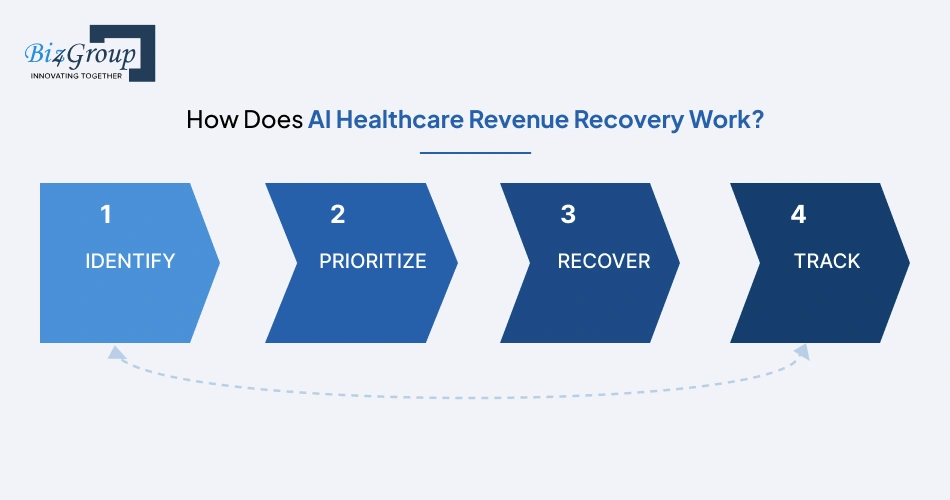
A practical AI healthcare revenue recovery workflow moves claims through four stages: identify, prioritize, recover, and track. Each stage has a specific purpose, helping your team move from finding lost revenue to measuring what comes back.
AI reviews claim and payment information to surface denied, underpaid, and potentially recoverable claims.
AI revenue recovery for healthcare helps rank opportunities based on factors such as recovery value, urgency, and the effort required to pursue them.
AI organizes the claim details and supporting information needed to determine the right recovery action, whether that involves correcting an issue, gathering documentation, or preparing an appeal.
Recovery does not end with an appeal. Teams track payer responses, claim outcomes, and recovered dollars to understand what actually came back.
Together, these four stages turn healthcare revenue recovery with AI into a repeatable process. You can find potential leakage, focus resources where they matter, act on selected claims, and measure the financial outcome.
"We know our healthcare organization is losing revenue from denied and underpaid claims, but our team cannot manually review everything."
This problem gets harder as claim volumes grow. Manual healthcare revenue recovery for hospitals often depends on spreadsheets, individual claim reviews, and staff remembering which cases need follow-up. A few missed deadlines or overlooked payment differences can leave recoverable revenue behind. Understand it here:
|
Where Manual Recovery Struggles |
What Happens in Practice |
Impact on Your Revenue Team |
|---|---|---|
|
Large claim volumes |
Staff work through large denial queues and decide which claims deserve attention first. |
High-value claims usually get attention first, while smaller recoverable claims may sit untouched. Over time, these smaller amounts can add up to significant lost revenue. |
|
Underpayment review |
Staff compare EOBs and payment records against expected reimbursement to find discrepancies. |
A paid claim can easily appear complete even when money is missing. Manual comparison makes it harder to consistently catch these gaps across thousands of claims. |
|
Evidence gathering |
Staff search through claim records, documents, payer information, and previous correspondence before preparing an appeal. |
A single appeal may consume substantial staff time before it is even submitted. That reduces the number of claims your team can work through each day. |
|
Appeal follow-up |
Submitted appeals require status checks, payer follow-ups, and outcome tracking. |
Cases can remain unresolved when follow-ups get buried under new denials. Missed responses or deadlines can turn a recoverable claim into a permanent write-off. |
|
Older claims |
Teams review aging claims to determine whether they are still worth pursuing. |
Valuable opportunities may become less recoverable as deadlines approach. Without a consistent review process, older claims are easier to overlook. |
The problem is not that your team lacks effort. The volume and complexity of recovery work make it difficult to give every claim the attention it deserves.
This is where automated healthcare revenue recovery becomes useful. AI takes on the heavy review and organization work, while your RCM team focuses its time on the claims that need human judgment and action.
But before deciding which claims deserve attention, you first need to know where the lost revenue is hiding and how AI identify it?
Before looking at specific detection methods, consider the challenge many healthcare organizations face:
"Our healthcare organization is losing revenue from denied and underpaid claims, but our team cannot manually review everything. How can AI help us identify the highest-value recovery opportunities?"
AI revenue leakage detection helps your team examine claim and payment information at scale, so potential losses do not depend on someone noticing them manually.
The goal is not to label every unusual claim as a recovery opportunity. Instead, AI healthcare revenue recovery connects claim details with payment outcomes and highlights records that deserve closer attention.
A denial does not automatically mean the revenue is lost. The reason behind the denial determines whether further action may be worthwhile. AI can analyze denial information and identify patterns across claims, payers, and recurring issues.
For your RCM team, this creates a clearer starting point for denied claim recovery. Instead of searching through a broad denial queue, staff can focus their review on claims with signs of recoverability.
Underpayments create a different problem because the claim has already produced a payment. Without comparing the expected reimbursement with the actual amount received, the discrepancy can remain hidden.
Underpaid claim detection helps uncover these gaps by examining payment information and identifying amounts that may not match expected reimbursement. This makes AI underpayment recovery an important part of broader revenue recovery, rather than treating every payment as a completed financial outcome.
A claim rarely tells the complete financial story by itself. You may need payment details, denial information, claim history, and related records to understand why the expected revenue was not received.
AI can bring these data points together for claim payment analysis. That broader view helps your team distinguish between an ordinary claim outcome and a potential recovery opportunity.
Once these opportunities are visible, the next question becomes more practical: which claims should your team work on first?
Healthcare professionals regularly ask, "our billing team has a large backlog of denied claims and limited RCM staff to work on appeals. How can AI help us prioritize which claims should be addressed first?"
AI revenue recovery for RCM teams organize claim opportunities using financial value, recovery potential, urgency, and workload. It gives your team a practical way to decide which recovery opportunities deserve resources first.
For example, one has a $40,000 balance but weak recovery prospects. Another has a $15,000 balance with strong supporting documentation. The third has a $9,000 balance with an appeal deadline approaching. If your team ranks claims only by balance, the $40,000 claim comes first. A stronger AI revenue recovery for RCM teams approach looks like this:
The $40,000 claim has the highest balance, so it naturally attracts attention. However, its weak recovery prospects may make it less valuable than the $15,000 claim. AI claims recovery solutions can assess the financial value of each opportunity while considering other signals that affect its recovery potential.
This helps your team look beyond the claim balance and focus on opportunities with a more realistic financial return.
Now consider the $15,000 claim. It has strong supporting documentation, which may give your team a clearer path toward recovery. The $40,000 claim may require substantial investigation with no clear indication that an appeal will succeed.
An AI revenue recovery platform evaluates factors such as denial reason, available documentation, payer patterns, and previous outcomes. This helps distinguish a large claim from a claim that is actually worth pursuing.
The $9,000 claim introduces another factor: timing. If its appeal deadline is approaching, delaying it could eliminate the recovery opportunity altogether. At the same time, a claim requiring extensive manual research may deliver less return for the effort involved.
A practical prioritization model considers both urgency and workload. Your team can then avoid losing recoverable revenue simply because the claim was buried behind older or larger accounts.
The three claims now have different priorities for different reasons. The $15,000 claim may rank highly because recovery looks achievable. The $9,000 claim may move up because its deadline is close. The $40,000 claim may require further review before staff commit significant resources.
This is how AI healthcare revenue recovery solutions can become a practical decision-support layer. Instead of manually sorting spreadsheets, your team gets a clearer basis for deciding what to work on first and why. Once AI identifies a high-priority denied claim, how can it help your team move that claim toward recovery?
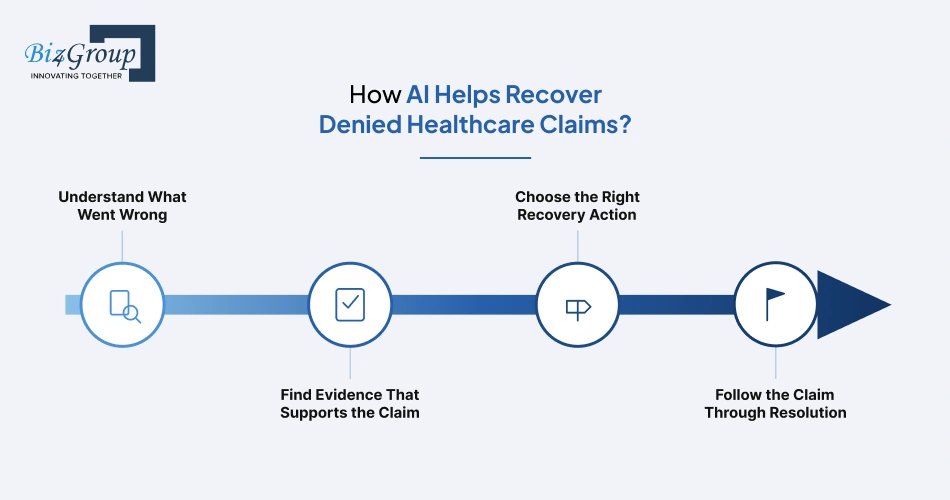
Your team has identified a high-priority denied claim. Now comes the important question: what should you do to recover it?
AI denial recovery for healthcare organize the claim history, denial details, and supporting information so your staff can move from investigation to action with less manual effort.
Imagine the $15,000 claim denied because the payer says prior authorization was missing. Instead of searching across multiple records, your team can follow a focused recovery path.
The first step is confirming why the payer rejected the claim. AI can connect the denial reason with relevant claim information, helping your team determine whether the denial appears valid or worth challenging.
Useful signals may include:
Once the denial is understood, your team needs evidence that directly addresses the payer's concern. AI can help surface relevant information without requiring staff to manually search through every available record.
For example, the recovery team may need:
Not every denial requires the same response. Depending on the issue, your team may correct the claim, provide missing information, request reconsideration, or prepare an appeal.
Healthcare claim recovery automation can help organize the information needed for that decision while keeping the final action with your staff.
The appropriate response may involve:
Submitting an appeal is not the finish line. Your team still needs to know whether the payer responded, what amount was recovered, and whether additional action is necessary.
A complete recovery record can show:
This turns denied claim recovery into a measurable process rather than a series of disconnected follow-ups.
But what happens when a claim is paid and the reimbursement is still lower than it should be?
AI underpayment recovery focuses on finding the payment gaps and giving your team the information needed to pursue them.
Consider a $10,000 claim where the expected reimbursement is $8,000, but the payer sends only $6,800. The claim is technically paid, yet $1,200 remains unaccounted for. At scale, these small differences become a significant source of healthcare revenue leakage.
Here is how AI healthcare payment recovery supports the process:
|
Recovery Stage |
How AI Helps |
What Your Team Gets |
|---|---|---|
|
Compare payments |
AI compares expected reimbursement with the amount actually received, bringing payment differences into view. |
Your team gets a clearer starting point for underpaid claim detection instead of relying on manual payment reviews. |
|
Detect discrepancies |
AI analyzes payment patterns across claims, payers, and services to identify recurring reimbursement differences. |
RCM teams gain visibility into payer reimbursement discrepancies that may otherwise remain hidden among successfully paid claims. |
|
Validate the opportunity |
AI brings claim details, payment information, and relevant reimbursement data together for a closer review. |
Staff have the context needed to determine whether the payment difference represents a genuine recovery opportunity. |
|
Pursue and track recovery |
AI organizes relevant claim information for the appropriate recovery action and keeps the outcome connected to the original discrepancy. |
Your team gets better visibility into outstanding amounts, recovered revenue, and recurring underpayment issues. |
Claim payment analysis gives your team a way to examine whether the payment actually matches the expected reimbursement and where further recovery deserves attention.
For finance and RCM leaders, that distinction matters. A paid claim should represent an appropriate payment, not simply a closed transaction.
When these discrepancies are identified consistently, AI revenue recovery for healthcare gives your organization a more structured way to pursue revenue that has already been earned but not fully reimbursed.
Finding and recovering these opportunities is only part of the equation. Now you need to know how to choose an AI revenue recovery platform for your organization?
Choosing an AI revenue recovery platform is not just about finding AI tool that spots denied claims. You need something that helps your team find worthwhile opportunities, understand what happened, and move those claims toward recovery without creating another manual workload.
Before choosing a platform, ask yourself: Will it help us find more leakage, focus on the right claims, and show what we actually recovered? Here is a comprehensive explanation how you should choose one:
Denials are only one part of the revenue problem. A claim may be marked paid while the reimbursement is still lower than what your organization should have received.
That makes healthcare revenue leakage harder to spot. Look for a platform that reviews both denied and paid claims and helps uncover reimbursement discrepancies that deserve a closer look.
Finding thousands of claims does not help if your team still has to sort through them manually. Good AI healthcare revenue recovery solutions should help your staff understand which opportunities deserve attention first.
The platform should consider potential recovery value, urgency, recovery prospects, and the effort involved. That gives your RCM team a focused queue instead of another long list of claims.
Identifying an opportunity is only the beginning. Your staff still needs to understand the issue, find supporting information, and decide what to do next.
A strong healthcare revenue recovery platform should bring relevant claim, payment, and supporting information together around the recovery case. The less time your team spends hunting through records, the more time they have for actual recovery work.
You probably already rely on electronic health records (EHRs), billing system, payer data, and established RCM processes. Replacing all of that just to improve recovery is rarely practical.
Instead, look for an AI revenue recovery platform that fits around your existing workflow. Data access, user permissions, security, and how easily your team can adopt the new process all matter when evaluating a solution.
A platform may process thousands of claims and still have little financial impact. What matters to finance and RCM leaders is what happens to the money.
Your AI healthcare revenue recovery solution should help you see how much revenue was identified, how much was actually recovered, and where recovery opportunities remain. That gives you a much clearer way to judge whether the technology is improving your bottom line.
The right platform should ultimately connect AI revenue recovery activity to financial results your leadership team can evaluate.
A good healthcare revenue recovery platform should do more than find lost revenue. It should also fit into the systems and processes your team already depends on. So, how do you bring AI into your recovery workflow without replacing the RCM infrastructure you already have?
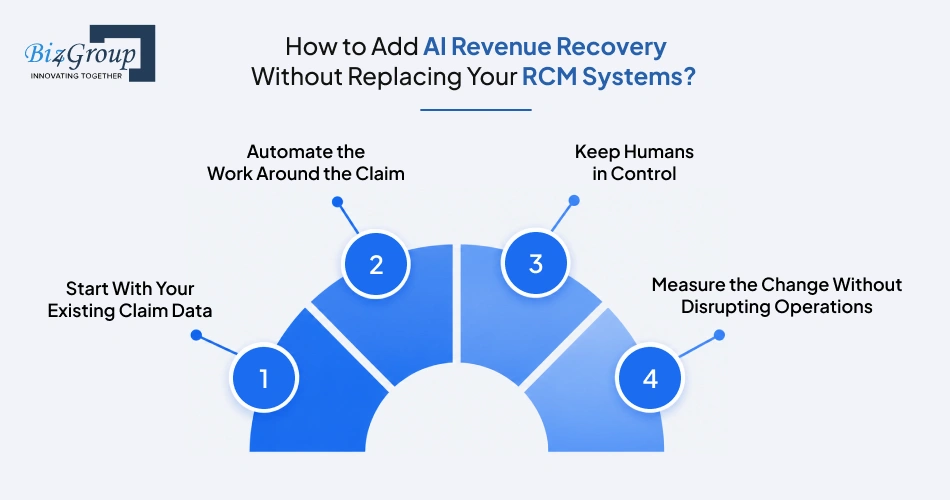
Healthcare teams often ask, "we already use an EHR and existing RCM systems, but revenue recovery still involves spreadsheets and manual follow-ups. How can we introduce AI without replacing our existing workflows?"
You don't need to rebuild your entire revenue cycle to improve recovery. AI revenue recovery for healthcare works best as a focused layer around the systems your team already uses. The goal is to reduce the manual work between finding a claim and recovering the money, without disrupting your core billing operations.
Your EHR, billing system, and payer records already contain much of the information needed for AI healthcare revenue recovery. The first step is using that information to find recovery opportunities instead of creating another manual data-gathering process.
A practical setup should:
The biggest opportunity is usually not replacing your RCM staff. It is reducing the repetitive work that happens between claim identification and recovery action.
With healthcare claim recovery automation, AI can take on tasks such as:
AI should support recovery decisions, not make every decision on behalf of your team. Your RCM staff still need to review important cases, determine the appropriate action, and approve sensitive communications with payers.
A strong AI revenue recovery platform should therefore:
You don't need to transform your entire RCM operation on day one. Start with a defined recovery workflow, measure the results, and expand based on what your team learns.
Early measurements should include:
This approach makes automated healthcare revenue recovery an addition to your existing process rather than another system your team has to work around.
Adding AI does not have to mean changing everything your team already uses. The bigger opportunity is to make the recovery work happening around those systems faster and more consistent. That is the approach Bill Matters takes by focusing specifically on denied claims and the work required to get them paid.
Add AI to your recovery process without rebuilding your RCM setup.
See What AI Can DoBill Matters, built by Biz4Group, is an AI-powered denial management and appeals platform designed to help US healthcare providers and medical billing companies recover rejected claims.
So, what happens when a denial reaches Bill Matters?
The platform reads the denial, original claim, EOB, payment details, and relevant payer rules to understand what went wrong. It then works through the case to find what is missing, build the supporting evidence, and prepare an appeal for your team to review.
Every denial has a reason, but finding that reason and figuring out what to do about it takes time. Bill Matters reads the denial code and related claim information to understand the issue instead of treating every rejected claim the same way.
Its AI contract intelligence checks the claim against relevant payer rules, while the AI claim denial decoder turns complex CARC and RARC codes into plain-language explanations. The AI billing evidence finder then identifies the documentation needed to strengthen the case.
This gives your team a clearer picture of why the claim was denied and what is needed to fight it.
Once the case is understood, Bill Matters uses the available claim details, supporting evidence, and applicable rules to build an evidence-backed appeal. The appeal is built around the actual denial rather than a generic template.
Your team still has the final say. An authorized reviewer can read the appeal, make changes, and approve it before anything goes to the payer. AI appeal generation handles the time-consuming preparation, while your team stays in control of the submission.
Bill Matters is designed for workflows involving sensitive healthcare claim information. Its architecture uses role-based access, encryption at rest and in transit, minimum-necessary PHI access, and audit trails to help protect the data moving through the recovery process.
For healthcare organizations evaluating AI healthcare revenue recovery solutions, these controls matter because recovery efficiency should not come at the expense of data protection.
An appeal sitting in a sent folder does not mean the money has been recovered. Bill Matters tracks the case through the payer's response and keeps the recovery activity tied to the original claim.
Your team can see whether the appeal was approved, denied, or still needs attention. That makes it easier to follow the case through to the actual payment and understand the results of your healthcare claim recovery automation efforts.
For organizations looking for a focused way to manage denied claims, Bill Matters brings the key recovery steps into one claims-focused workflow.
Once you start recovering these claims, how do you measure whether the effort is actually paying off?
Denied and underpaid claims don't always mean you've lost the money for good. The real challenge is finding those claims and giving your team enough time to do something about them.
That's where AI healthcare revenue recovery helps your team spot payment issues, decide which claims deserve attention, gather the right information, and keep recovery work moving.
The goal is simple: find more recoverable revenue without adding more work to your RCM team.
That's the problem Bill Matters is built around. It reads the denial, looks at the claim and payer rules, finds what is needed to support the case, and prepares the appeal for your team's review.
You keep your existing billing and RCM systems. Bill Matters focuses on the part that often gets left behind: getting rejected claims paid.
AI processes claim and payment information at scale, helping RCM teams review large volumes without manually opening every record. This makes automated healthcare revenue recovery more practical when denial backlogs become difficult to manage.
Yes. Older claims may still represent denied claim recovery opportunities when they remain within applicable payer and appeal requirements. AI helps surface these claims so your team can determine whether pursuing them is still worthwhile.
AI reviews requirements relevant to the specific payer and claim instead of applying one generic recovery approach. This is important for AI claims recovery solutions, since documentation, reimbursement rules, and appeal requirements vary across payers.
Yes. Not every claim justifies the same recovery effort. AI-assisted prioritization helps your team assess potential recovery value, urgency, and recovery likelihood before investing significant staff time.
AI performs claim payment analysis by comparing payment information with expected reimbursement and identifying meaningful differences. This helps uncover AI underpayment recovery opportunities that may otherwise look like successfully paid claims.
No. AI revenue recovery for RCM teams is designed to handle data-heavy review and preparation while staff retain control over important recovery decisions. Human oversight remains particularly important when deciding how a claim should be handled with the payer.
The timeline depends on claim volume, payer response times, and the recovery opportunities available. Organizations with large denial backlogs may have opportunities to address immediately, while longer-term results become clearer as more claims move through the revenue cycle recovery process.
The requirements depend on the recovery task. Claim details, EOBs or ERAs, payment records, denial information, payer requirements, and supporting documentation provide the context needed for effective AI healthcare revenue recovery.
Yes. AI healthcare revenue recovery solutions should account for differences in services, documentation, coding, and payer requirements across specialties. This is particularly important when recovery workflows need to reflect specialty-specific billing practices.

Our website require some cookies to function properly. Read our privacy policy to know more.