 Location :
Orlando, FL, USA
Location :
Orlando, FL, USA +1 (407) 714-1616
 info@biz4group.com

 AI Summary Powered by Biz4AI
- A reliable MLS data layer, fast search, integrations, compliance, and AI form the foundation of an effective MLS product.
- Teams can choose between off-the-shelf platforms, custom builds, licensed MLS infrastructure, or a hybrid approach based on their requirements.
- For differentiated real estate products, AI real estate MLS software development enables custom search, recommendations, enrichment, and workflow capabilities.
- The right MLS software development services partner should also handle scalability, data-quality issues, feed changes, testing, and post-launch improvements.
- Biz4Group LLC has delivered real estate AI products including Homer AI and Contracks. Development costs typically range from $40,000 to $300,000+, depending on scope.
- A focused MVP can start with one MLS and a limited AI scope, then expand as the product gains users and data.
An MLS platform can have millions of listings and still deliver a poor user experience if the underlying data is inconsistent, search is too rigid, or AI is bolted on without understanding how the platform actually works.
That is the central challenge in AI real estate MLS software development. AI can make property discovery more natural, surface relevant listings, enrich property data, prioritize leads, and assist agents. But those capabilities depend on something less flashy: reliable MLS data, well-designed search logic, clear system boundaries, and integrations that can handle the rules and variations of real estate data.
A useful way to think about an AI MLS platform is not as "an MLS with a chatbot." It is a product where structured MLS data remains the foundation and AI operates on top of that foundation where it has a clear job to do.
For example, an AI system can understand that a buyer wants "a three-bedroom home under $800K with a short commute and a large backyard." But turning that request into accurate results requires more than an LLM. The platform needs structured property attributes, deterministic filters, location data, retrieval logic, and safeguards against unsupported AI assumptions.
That distinction is what separates an AI feature from a dependable AI product.
For teams planning to build real estate AI software, getting that foundation right early can determine whether the product remains manageable as listings, users, MLS sources, and AI workloads grow.
What Does an AI MLS Platform Actually Need to Do?
An AI MLS platform needs four core capabilities: reliable listing data management, fast property search, useful AI functionality, and integration with the systems real estate teams already use. Each capability has a distinct role in making the platform reliable and useful in production.
The MLS Data Layer
This layer brings listing data into the platform and keeps it accurate and current. It handles feed connections, field mapping, normalization, validation, deduplication, and updates. It also accounts for differences between MLS sources, since standardized specifications do not guarantee identical data.
The Core Listing and Search Layer
This is where multiple listing service software becomes a usable property experience. It manages listings, property details, filters, accounts, saved searches, and results. Structured criteria such as price, bedrooms, location, and property type should be handled reliably here, including when an AI-powered search sits on top.
The AI Capability Layer
The AI layer adds capabilities that traditional MLS software handles less effectively. It can interpret natural-language searches, enrich listing data, generate descriptions, personalize recommendations, or assist agents with repetitive tasks. AI integration services are most valuable when they connect a specific AI capability to a clear product outcome.
The Integration and User Workflow Layer
An MLS platform usually connects with other business systems. These can include CRMs, brokerage systems, mapping services, communication tools, transaction platforms, and real estate APIs. This layer supports MLS integration with existing systems, allowing data and actions to move between connected systems as part of a single workflow.
A well-designed platform gives each layer a clear responsibility. Structured systems manage information that requires precision. AI handles tasks where interpretation, prediction, or automation can improve the user experience or business workflow.
Why MLS Data Is Harder to Work With Than Most Teams Expect
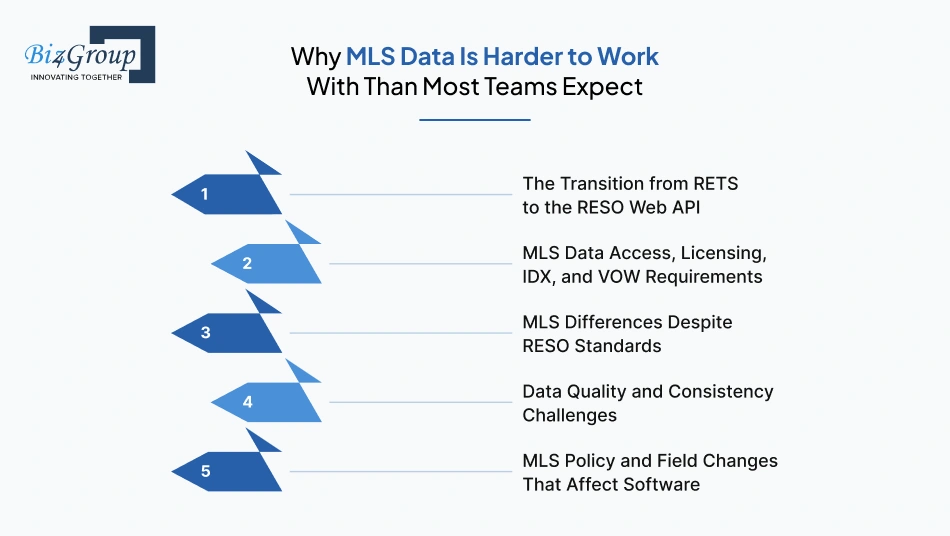
MLS data involves more than connecting an API and displaying listings. MLS technology has to account for data standards, access rights, MLS-specific implementations, data quality, and policy changes. Each can affect how a platform stores, searches, displays, and uses listing information.
The Transition from RETS to the RESO Web API
RETS, or Real Estate Transaction Standard, was an older method for exchanging MLS data. It has been replaced by the RESO Web API, a modern web-based standard that uses REST, JSON, and OAuth. Some legacy MLS connections may still use RETS.
- Practical example: A new MLS platform would generally use the RESO Web API rather than create a new RETS dependency.
MLS Data Access, Licensing, IDX, and VOW Requirements
MLS data comes with rules covering who can access it and how it can be used. IDX, or Internet Data Exchange, supports approved public listing displays, while VOW, or Virtual Office Website, provides listing information to users with an established broker relationship.
- Practical example: A public property search and a broker-controlled VOW may require different permissions and display rules.
MLS Differences Despite RESO Standards
RESO establishes common standards for real estate data exchange, yet MLS implementations can still vary. Available fields and the way attributes are represented may differ between sources.
- Practical example: A multi-MLS platform may need separate mapping rules when one MLS provides an attribute that another does not.
Data Quality and Consistency Challenges
MLS data often needs processing before it can reliably support search, analytics, or AI. Missing values, inconsistent formats, duplicate records, and stale information can affect results. This matters in AI in real estate development, where poor source data can reduce AI reliability.
- Practical example: An AI search for "homes with a large backyard" can struggle when lot-size and property-description data are incomplete or inconsistently structured.
MLS Policy and Field Changes That Affect Software
MLS software must account for policy changes alongside technical changes. NAR policies and individual MLS rules can affect data fields and workflows, including compensation-related information following the NAR settlement.
- Practical example: A compensation-related field may need to be removed or redesigned when applicable MLS rules change.
MLS integrations should be designed for change. Maintainable mappings, validation rules, permissions, and workflows make future updates easier to manage.
How Does an AI MLS Platform Process and Organize Real Estate Listing Data?
An AI MLS platform typically moves listing data through five stages: collecting it from MLS sources, making it consistent, checking it for errors and duplicates, adding useful context, and keeping it up to date. This gives the platform a reliable data foundation for search, analytics, and AI features.
A common question from real estate businesses dealing with this challenge is: "We are a real estate business using multiple data sources, and our listing information is often inconsistent. How can an AI MLS platform help standardize and manage the data?"
The answer lies in combining a structured data pipeline with AI where it adds value. The platform can normalize incoming records, identify inconsistencies and duplicates, enrich unstructured information, and continuously synchronize changes from the source systems.
|
Stage |
What Happens |
Why It Matters |
|---|---|---|
|
MLS Data Ingestion |
Pull listing data from MLS sources. |
Gets listings into the platform. |
|
Data Normalization |
Put data into a common format. |
Keeps listings consistent. |
|
Data Validation and Deduplication |
Check for errors and duplicate listings. |
Keeps results accurate. |
|
Listing Enrichment and Metadata Management |
Add useful details from approved data sources. |
Gives AI and search more context. |
|
Data Freshness and Synchronization |
Update listings when source data changes. |
Keeps information current. |
A clean data pipeline also makes AI easier to control. When the system knows what each field means, where the data came from, and when it was last updated, AI features have a stronger foundation for producing useful and reliable results.
What Features Should an AI Real Estate MLS Platform Include?
An AI real estate MLS platform needs the core tools for listing management and property discovery, along with features that improve agent workflows, personalization, analytics, and automation. The final feature set should match the product's users and business goals.
Basic MLS Features
Listing management, property search, filters, property details, user accounts, saved searches, favorites, alerts, and listing-status updates cover the essential workflow expected from multiple listing services software for real estate.
Advanced MLS Features
Map-based search, personalized recommendations, advanced filters, market insights, and richer property profiles can make the platform more useful as its data and user base grow.
AI-Powered Features
Natural-language search, listing enrichment, image analysis, recommendations, valuation assistance, and lead scoring are common AI opportunities. AI model development may be needed for highly specialized requirements.
Agent and Brokerage Features
Agents can use lead management, client preference tracking, recommendations, communication tools, and activity history. Brokerages may also need team management, permissions, and performance dashboards.
Administration, Analytics, and Reporting
Administrative tools manage users, permissions, listings, data sources, and platform settings. Analytics can track searches, engagement, leads, and feature usage.
MVP Feature Prioritization
An MVP should establish the core workflow first. Reliable MLS data, essential search, user management, and the primary AI capability are usually stronger starting points than a large feature set.
The best MVP is rarely the one with the most features. It is the one that proves the product's central value with the least unnecessary complexity.
Where Does AI Actually Add Value in MLS Software?
AI adds real value in MLS software when it helps people find properties faster, understand listing data better, make informed decisions, or reduce repetitive work. MLS AI is most useful when it improves a specific workflow enough to justify the added complexity and cost.
Benefits of AI for Property Discovery
Most property searches still depend heavily on filters and exact matches. AI can understand what a user means and connect that intent with structured MLS data, making property discovery more flexible.
- Understands natural-language property requests
- Matches related concepts and preferences
- Improves recommendations as user preferences become clearer
What happens when a buyer's request does not fit neatly into standard filters? AI can interpret the request and translate relevant parts into searchable property criteria.
Benefits of AI for Listing Enrichment
Listing descriptions, photos, and other unstructured content can contain useful details that standard fields miss. AI can extract this information and turn it into searchable attributes.
- Extracts features from listing descriptions
- Identifies useful details from property images
- Adds structured metadata to listing records
Benefits of AI for Valuation and Prediction
AI can examine property characteristics, comparable sales, market data, and historical patterns to support valuation and forecasting. These systems work best as decision-support tools because data quality and market conditions can change their results.
- Supports automated valuation models (AVMs)
- Finds patterns across large property datasets
- Helps estimate price ranges and potential market outcomes
Can an AI valuation model tell you exactly what a property is worth? No. Its output is an estimate, and its reliability depends on the data, model, location, and market conditions.
Benefits of AI for Lead Qualification and Prioritization
AI can look at permitted signals such as property views, saved listings, search activity, and engagement. AI for real estate agents can turn these signals into useful follow-up priorities.
- Identifies stronger signs of buying or selling intent
- Scores and prioritizes leads
- Reduces manual review of lead activity
AI Capabilities That May Not Justify Their Cost
Not every AI feature deserves a place in an MLS product. A capability can be technically impressive and still deliver little value when usage is low, data is weak, or operating costs are high.
- Custom models when existing models are sufficient
- Automation for low-volume workflows
- Features with unclear business outcomes
- AI outputs that still require extensive manual review
Does adding AI automatically make an MLS product better? No. The feature needs a clear user problem, suitable data, and a measurable reason to exist.
A strong AI MLS platform development strategy starts with the workflows where AI can make a visible difference. Product usage and results can then guide what gets added next.
How Do You Build an AI-Powered Multiple Listing Service for Real Estate?
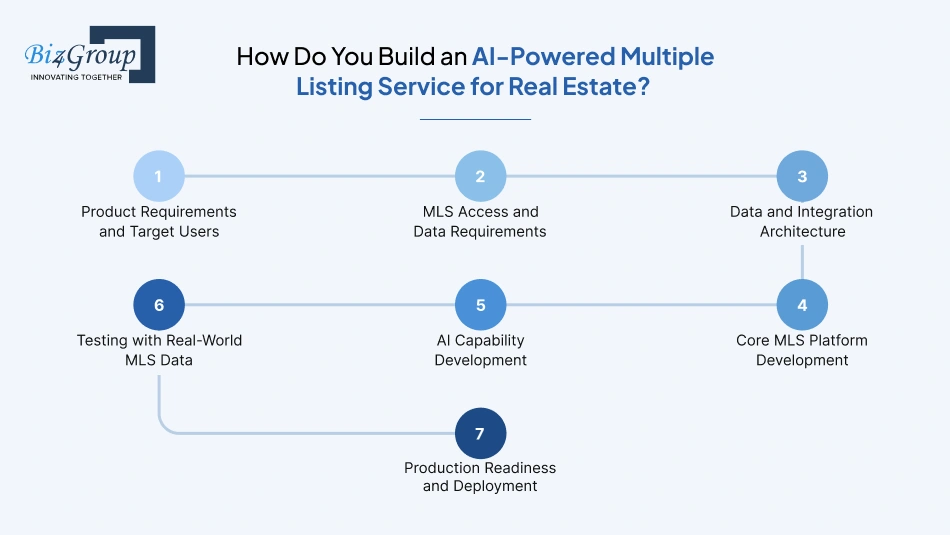
Building an AI-powered MLS platform is best approached in stages. First, define the product and users, then sort out MLS access and data, build the core platform and integrations, add the right AI capabilities, and test everything with realistic data before going live.
Product Requirements and Target Users
Start with the people who will actually use the product. A buyer-facing platform, an agent tool, and a brokerage system can have very different needs, so the main workflows should be clear before features are finalized.
- Map the key user journeys before creating the feature list.
A useful starting question is: "I am running a real estate brokerage and our current MLS platform does not provide enough automation. Can you suggest how we could build a custom AI MLS platform?"
The answer depends on where the current platform falls short. The development scope could include automated listing workflows, AI-powered search, lead qualification, recommendations, or integrations with brokerage systems.
Tip: Ask who is the platform really being built for? That answer should shape the product more than a long list of possible features.
MLS Access and Data Requirements
Before development gets too far, establish which MLS sources the platform will use, what data they provide, how that data can be used, and which access and display rules apply.
- Confirm feed availability and usage rights before building around specific fields.
Data and Integration Architecture
Decide how listing data will move from the MLS feed through storage, search, AI, and connected systems. The architecture should also leave room for normalization, synchronization, security, and additional MLS sources.
- Give every listing a clear path from ingestion to the user-facing search experience.
Now, what if the product needs another MLS six months after launch? The architecture should make adding it an integration task rather than a major rebuild.
Core MLS Platform Development
This is where the main product takes shape: listing management, property search, filters, accounts, saved searches, alerts, and other core workflows. UI/UX development also belongs here because the way users move through these workflows can directly affect product adoption.
- Keep precise search criteria such as price, location, property type, and bedrooms easy to find and use.
AI Capability Development
AI should be added around a specific product need, such as natural-language search, recommendations, listing enrichment, image analysis, valuation support, or lead prioritization. AI automation services can also help reduce repetitive work when the workflow has a clear business benefit.
- Define how each AI feature will be measured before choosing a model or API.
Does the most advanced AI model automatically make the product better? No. A simpler model can be the better choice when it is faster, cheaper, easier to control, and accurate enough for the task.
Testing with Real-World MLS Data
Software testing needs to go beyond checking whether individual features work. The platform should be tested with realistic listing data, incomplete fields, duplicates, stale records, changing values, real search behavior, AI outputs, integrations, and expected traffic.
- Test how the system behaves when the incoming MLS data is messy or incomplete.
Production Readiness and Deployment
Before launch, the product needs monitoring, security controls, error handling, backups, recovery processes, and a clear way to manage ongoing updates. For an early-stage product, MVP development services can help validate the core workflow before the team commits to a much larger production scope.
- Set alerts for feed failures, data-quality problems, system errors, and unusual AI behavior.
So, when should the team ideally think about scaling? Before the first production release. Data storage, search, integrations, and AI workloads become harder to change after the platform has accumulated users and data.
|
Development Stage |
Main Focus |
Key Outcome |
|---|---|---|
|
Product Planning |
Users, workflows, MVP scope |
Clear product direction |
|
MLS & Data Setup |
MLS access, data, permissions |
Reliable data foundation |
|
Platform Development |
Core features, UI/UX, integrations |
Working MLS product |
|
AI Development |
Search, recommendations, automation |
Useful AI capabilities |
|
Testing |
Real MLS data, workflows, performance |
Production-ready product |
|
Deployment |
Security, monitoring, scaling |
Stable live platform |
A good development process leaves room to learn. The first release should prove the core product, while real usage can guide what gets built next.
Ready for a Thousand More Listings?
Design an AI MLS platform built to handle growing inventory, multiple data sources, faster search, and expanding AI workloads.
Build for Scale With AI Real Estate MLS Software DevelopmentWhat Tech Stack Is Used for AI Real Estate MLS Software Development?
There is no single tech stack that fits every AI MLS product. The right combination depends on the product's search needs, MLS integrations, AI workload, expected traffic, and deployment requirements. For example, Biz4Group's Homer AI used FastAPI for backend APIs and Next.js for the web application, along with Three.js for 3D property visualization.
|
Layer |
Common Technology Choices |
What It Handles |
|---|---|---|
|
Frontend Technologies |
React, Next.js |
Web interface and user experience |
|
Backend Technologies |
Python, FastAPI, Node.js |
APIs, business logic, and integrations |
|
Databases and Search Infrastructure |
PostgreSQL, Elasticsearch, vector databases |
Listings, structured data, and search |
|
AI and Machine Learning Technologies |
LLMs, ML models, computer vision |
Search, recommendations, enrichment, and prediction |
|
APIs and Integration Technologies |
REST APIs, OAuth, webhooks |
MLS and third-party connections |
|
Cloud Infrastructure and DevOps |
AWS, Azure, GCP, Docker, CI/CD |
Deployment, scaling, monitoring, and reliability |
How to Choose the Stack Based on Product Requirements
Start with the product's actual workload rather than choosing technologies because they are popular. Python development and NodeJS development can support different backend needs, while ReactJS development and NextJS development can suit different frontend requirements.
- High listing volume: prioritize indexing, caching, and efficient database queries.
- Complex property search: plan for structured filters alongside semantic search.
- Multiple MLS integrations: keep feed-specific logic separate from the core application.
- Heavy AI workloads: isolate AI services so model processing does not slow down core MLS functions.
- Early-stage MVP: keep the infrastructure lean until actual usage justifies additional complexity.
The key is to choose technologies around the product's expected workload, integrations, and growth path, rather than treating the tech stack as a fixed checklist.
Why Search Architecture Matters More Than the LLM
In an AI MLS platform, search architecture often matters more than the choice of LLM. The LLM can understand a user's request, but the search system determines which properties are actually retrieved. If that foundation is weak, even a strong model can return incomplete, irrelevant, or inaccurate results.
|
Search Approach |
Best Used For |
Main Limitation |
|---|---|---|
|
Structured Property Search |
Price, location, beds, baths, property type |
Struggles with natural-language intent |
|
Semantic Property Search |
Preferences, descriptions, contextual queries |
Can miss exact property constraints |
|
Pure Vector Search |
Finding conceptually similar listings |
May return properties that violate hard requirements |
|
Hybrid Search |
Combining meaning with precise filters |
More complex to design and maintain |
|
Deterministic Constraints |
Price limits, bedrooms, location, listing status |
Cannot understand vague user intent |
|
Retrieval and AI Response Grounding |
Generating answers from retrieved MLS data |
Depends on retrieval quality and data freshness |
A strong search experience comes from giving each layer a clear job. The LLM handles language and reasoning, while the search architecture controls what information the AI is actually allowed to work with.
What Integrations Are Required When Developing a Custom MLS Platform for Real Estate?
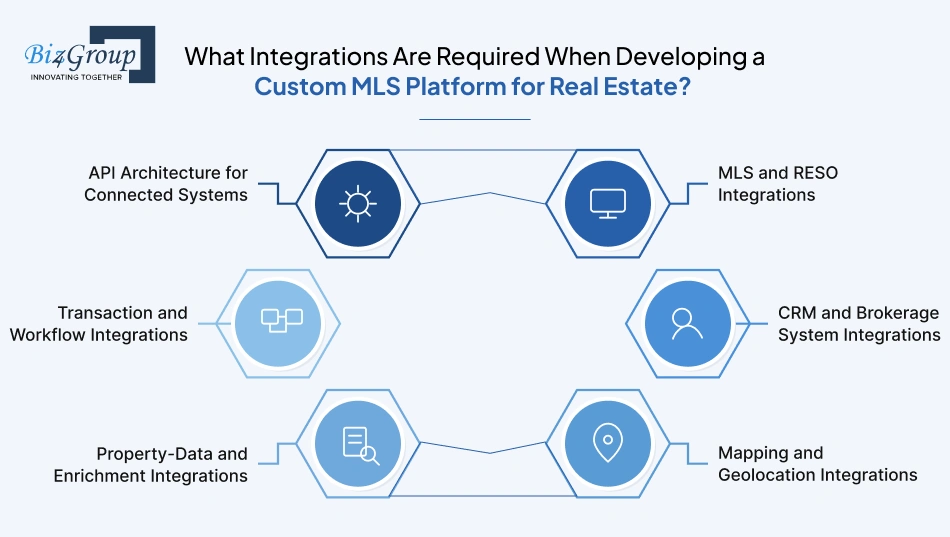
A custom MLS platform usually needs several integrations working together. MLS and RESO connections bring in listing data, while CRM, mapping, property-data, transaction, and other APIs connect that data to the workflows users already rely on.
A common query sounds like this: "I am building a real estate technology platform and need MLS integration with our existing systems. What should I consider when developing a custom solution?"
Start by mapping every system the MLS platform needs to exchange data with, what information needs to move between them, which system should remain the source of truth, and how often that information needs to be synchronized.
MLS and RESO Integrations
MLS integrations provide access to listing data, while RESO standards help structure how that data is exchanged. The implementation still needs to account for each MLS's available fields, access rules, and technical requirements. Real estate MLS integration is therefore shaped by both technical and MLS-specific requirements.
CRM and Brokerage System Integrations
CRM and brokerage integrations connect listings with leads, agents, clients, and business workflows. This keeps the MLS product connected to the systems teams already use instead of creating another isolated workflow.
Mapping and Geolocation Integrations
Mapping services add capabilities such as map-based search, property coordinates, nearby places, boundaries, and distance calculations. These services can also support location-aware property discovery.
Property-Data and Enrichment Integrations
External property-data services can add information that may not be available in the primary MLS feed. Depending on the product, this can include additional property attributes, geographic information, or other enrichment signals.
Transaction and Workflow Integrations
A product that supports workflows beyond property discovery may need connections to transaction management, document handling, scheduling, communication, or other business systems. AI automation services can then be applied where repetitive steps within those workflows are worth automating.
API Architecture for Connected Systems
The API layer should give each connected system a clear and controlled way to exchange data. MLS integration with existing systems also becomes easier when authentication, permissions, error handling, and API versioning are planned into the architecture from the start.
The goal is not to connect every available service. Each integration should have a clear role in the product and a defined reason for exchanging data.
How Do You Develop an MLS Platform That Can Manage Large Volumes of Real Estate Listings?
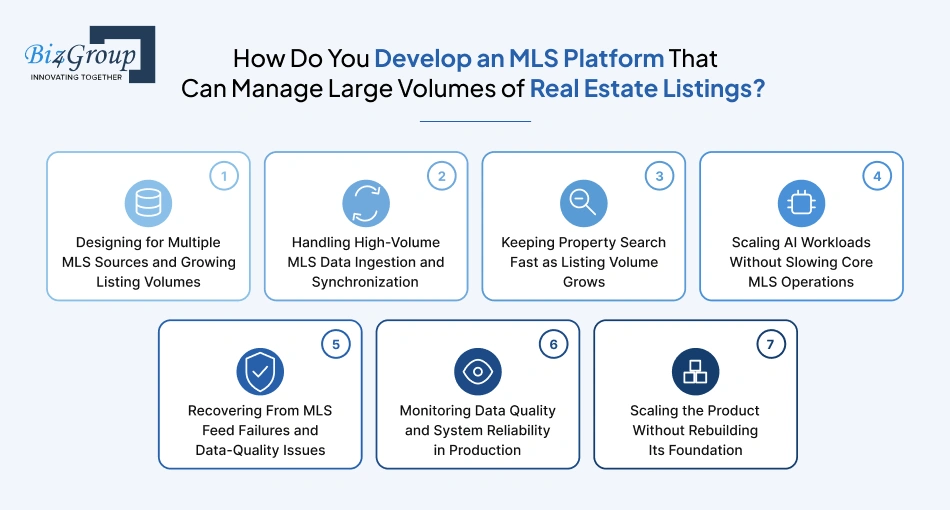
A high-volume MLS platform has to keep working smoothly as listings, MLS sources, users, searches, and AI workloads increase. That means planning for scale in the data layer, search, integrations, and AI services from the start rather than trying to fix bottlenecks after they appear.
Designing for Multiple MLS Sources and Growing Listing Volumes
Adding another MLS can bring new fields, formats, update patterns, and rules into the system. A good real estate MLS platform development approach keeps those differences contained so one MLS does not create problems for the others.
- Use a common internal listing structure while maintaining separate mappings for each MLS source.
Handling High-Volume MLS Data Ingestion and Synchronization
When thousands of listing changes arrive, processing everything one update at a time can quickly become a bottleneck. The system should handle updates in the background and spread the workload across multiple processes.
- Separate new listings, updates, removals, and reconciliation jobs so they can run independently.
For example, a brokerage managing thousands of properties may ask, "Can AI MLS software help us automate this process?" It can support parts of the workflow, such as identifying incomplete records, detecting anomalies, enriching listing information, and flagging records that need attention. The underlying data pipeline still needs reliable synchronization and validation.
Keeping Property Search Fast as Listing Volume Grows
A search that feels instant with 50,000 listings can become frustrating with millions. Search infrastructure should be designed around the fields users query most often, with indexing and caching used where they provide a real performance benefit.
- Optimize common searches around price, location, property type, bedrooms, and listing status.
Scaling AI Workloads Without Slowing Core MLS Operations
AI tasks such as image processing, recommendations, or natural-language search can consume significant computing resources. Enterprise AI solutions often separate these workloads from core application services so a spike in AI activity does not slow basic MLS operations.
- Scale AI services independently when demand increases instead of scaling the entire application.
Recovering From MLS Feed Failures and Data-Quality Issues
MLS feeds can go down, deliver delayed updates, or contain unexpected values. The platform needs ways to detect these problems, retry failed processes, and reconcile missed changes once the feed is working again.
- Keep reconciliation jobs that can identify and recover listings missed during a feed interruption.
Monitoring Data Quality and System Reliability in Production
Once an MLS product is live, teams need to watch more than server health. Listing freshness, failed ingestion, missing fields, search latency, and AI performance can all signal problems before users start reporting them.
- Track stale listings, failed feed jobs, unusual field changes, and sudden increases in search response time.
Scaling the Product Without Rebuilding Its Foundation
Growth becomes easier when major parts of the system can scale separately. Build AI software with clear boundaries between data processing, search, core application services, and AI workloads so new MLS sources and features do not require a redesign of the entire product.
- Keep major services loosely connected so each can grow or change without disrupting the others.
A scalable MLS product should make growth predictable. When one part gets busier, the rest of the platform should still have enough room to keep running normally.
Build vs. Buy: Which MLS Development Approach Makes Sense?
There are three practical routes for an MLS product: Use an off-the-shelf platform, build from scratch, or combine licensed MLS infrastructure with a custom product and AI layer.
The right choice depends on how much control you need, how quickly you want to launch, and where the product needs to stand out. AI real estate MLS software development makes more sense when custom AI, workflows, or product experiences are central to that differentiation.
|
Approach |
Best Fit |
Main Advantage |
Main Trade-Off |
|---|---|---|---|
|
Off-the-Shelf MLS Platform |
Standard MLS needs and faster launches |
Faster to market |
Less control |
|
Custom MLS Software Development |
Unique workflows and differentiated products |
Full control |
More development effort |
|
Custom AI Layer on Licensed MLS Infrastructure |
AI-led products |
Custom AI without rebuilding MLS infrastructure |
Depends on the underlying platform |
|
Hybrid Development Approach |
Products needing speed and customization |
Balances both |
More integration work |
When evaluating MLS software development services, start with what actually makes the product different. Existing infrastructure may be enough for standard MLS functionality. Custom development becomes easier to justify when the product relies on unique workflows, AI capabilities, or a highly customized experience.
Choose the approach that gives you control where differentiation matters, without taking on infrastructure you do not need to own.
Build the Right MLS Product From Day One
Get help choosing the right architecture, AI capabilities, integrations, and development approach for your real estate product.
Talk to Our AI ExpertsHow Much Does It Cost to Develop an AI Real Estate MLS Platform?
An AI real estate MLS platform can cost roughly $40,000–$300,000 to develop. A smaller MVP with limited MLS connectivity and basic AI can sit near the lower end, while a multi-MLS, production-ready platform with advanced AI can move toward the upper end.
|
Cost Area |
Approx. Cost Range |
|---|---|
|
MLS Data and Integration |
$5,000–$40,000+ |
|
Core Platform Development |
$15,000–$100,000+ |
|
AI Development and Models |
$10,000–$80,000+ |
|
Infrastructure and Third-Party Services |
$3,000–$20,000+ |
|
MVP Development |
$40,000–$100,000 |
|
Production-Ready Development |
$100,000–$300,000+ |
MLS Data and Integration Costs
Expect roughly $5,000–$40,000+ for MLS-related integration work, depending on the number of sources, feed complexity, field mapping, normalization, and supporting APIs. MLS access or licensing fees may sit outside the development budget.
Core Platform Development Costs
The core MLS platform can account for around $15,000–$100,000+. This covers areas such as listing management, property search, user accounts, dashboards, administration, and custom workflows.
AI Development and Model Costs
AI capabilities can add roughly $10,000–$80,000+ depending on complexity. Basic AI search or recommendations may stay toward the lower end, while custom models, computer vision, valuation, or generative AI features require more development and testing.
Infrastructure and Third-Party Service Costs
Initial infrastructure setup can fall around $3,000–$20,000+, covering cloud services, databases, search infrastructure, maps, monitoring, and other APIs. Usage-based costs then continue after launch.
MVP Versus Production Development Costs
A focused MVP typically falls around $40,000–$100,000. A production-ready platform can reach $100,000–$300,000+ once broader MLS coverage, security, scalability, testing, monitoring, and advanced AI are included.
Ongoing Operating and Maintenance Costs
Post-launch costs can start around $1,000–$5,000+ per month for a smaller product and rise with usage. Major factors include cloud infrastructure, AI/API consumption, MLS changes, monitoring, maintenance, and ongoing development.
The final budget depends on how much of the $40,000–$300,000 range the product's actual scope requires. MLS coverage and AI complexity are two of the biggest variables to settle early.
Common Mistakes That Cause AI MLS Projects to Fail or Stall
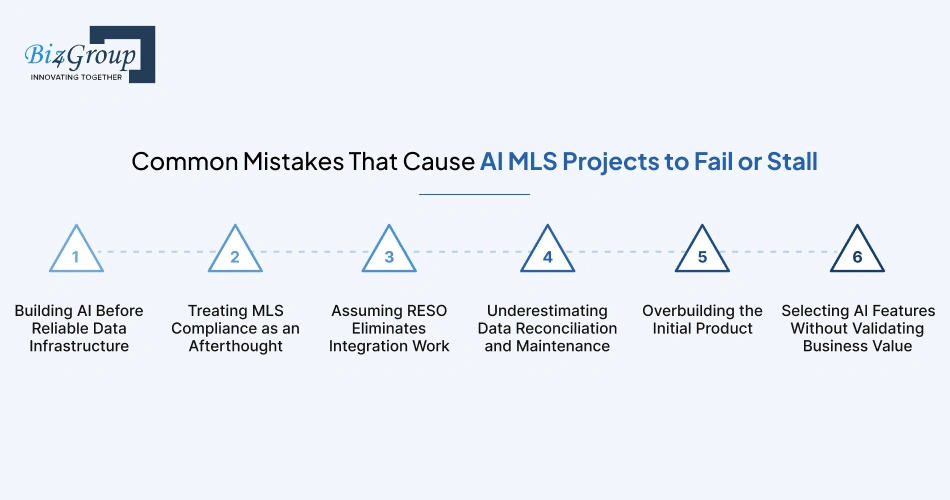
Most AI MLS projects run into trouble when teams get the order of priorities wrong. The biggest issues usually come from weak data foundations, overlooked MLS requirements, underestimated maintenance, or AI features that have not been tied to a real product need.
|
Common Mistakes |
What Goes Wrong |
Better Approach |
|---|---|---|
|
Building AI Before Reliable Data Infrastructure |
AI works with incomplete, inconsistent, or outdated listing data |
Stabilize ingestion, normalization, and validation first |
|
Treating MLS Compliance as an Afterthought |
Changes later can force expensive product rework |
Build MLS rules and data-use requirements into the product from the start |
|
Assuming RESO Eliminates Integration Work |
RESO standards do not remove MLS-specific mapping and implementation work |
Plan for source-specific data handling |
|
Underestimating Data Reconciliation and Maintenance |
Missed updates and data issues accumulate after launch |
Budget for ongoing monitoring and reconciliation |
|
Overbuilding the Initial Product |
Too many features increase cost and delay validation |
Start with a focused MVP |
|
Selecting AI Features Without Validating Business Value |
Impressive features add cost without improving the product |
Prioritize AI based on measurable user or business outcomes |
The strongest projects treat the MLS product as an evolving system. Start with the parts that need to be reliable, validate the product, then expand where the results justify it.
What Should You Evaluate Before Choosing an AI Product Development Company?
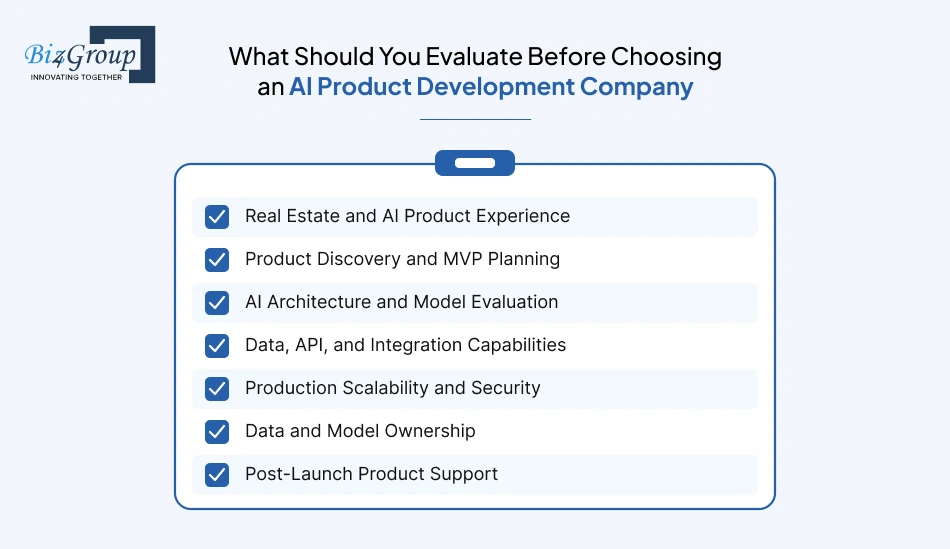
Look for a partner that can handle the full product journey, from understanding the real estate use case and shaping the MVP to building the AI, connecting existing systems, and supporting the product after launch. A strong portfolio should show real product delivery, not just isolated AI demos.
Real Estate and AI Product Experience
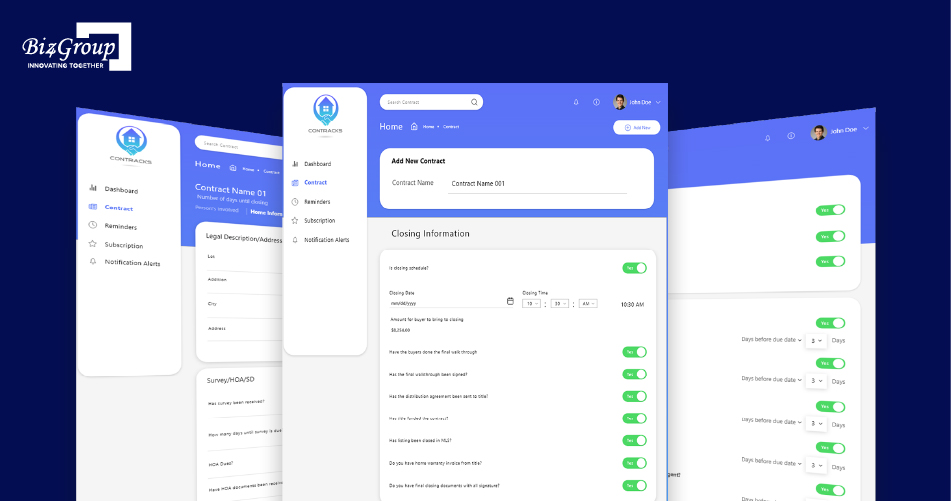
Look for experience where AI is used within real estate workflows and delivered as a usable product. Biz4Group LLC, for example, has delivered real estate AI projects such as MyContracks, which involved document and data processing, AI integration, and web and mobile product delivery.
Product Discovery and MVP Planning
A good development partner should help turn an idea into a practical first release. This includes identifying the core users, prioritizing features, defining the MVP, and deciding what can wait for later versions.
AI Architecture and Model Evaluation
The team should be able to choose AI approaches based on the actual product requirement. That means evaluating models, data needs, accuracy, cost, and how the AI will fit into the overall product architecture.
Data, API, and Integration Capabilities
AI products rarely work in isolation. Check whether the company can connect MLS data, APIs, business systems, and third-party services while keeping the product's data flow reliable and manageable.
Production Scalability and Security
Ask how the team handles real production workloads, especially when data and user volume increase. Production infrastructure, access controls, monitoring, performance, and secure data handling should be part of the development approach.
Data and Model Ownership
Clarify who owns the application, source code, data pipelines, models, prompts, and other product assets. This becomes especially important when custom generative AI capabilities are developed for the product.
Post-Launch Product Support
Product development does not end when the first version goes live. Look for a partner that can handle fixes, infrastructure changes, AI improvements, new integrations, and future product iterations as user needs become clearer.
The right partner should give you confidence in the product beyond the initial build. Their past work, technical approach, and willingness to stay involved after launch can tell you a lot about that fit.
Key Takeaways for Decision-Makers
If you're planning an AI MLS product, a few decisions will have the biggest impact on whether the product is reliable, useful, and ready to grow.
- Treat MLS data infrastructure as a core product investment. Data quality affects search, AI features, integrations, and the user experience, so the underlying data layer needs proper attention from the start.
- Build AI around real business workflows. Give AI a clear purpose, such as improving property discovery, reducing manual work, or helping agents make faster decisions.
- Choose the MLS development approach based on product requirements. Off-the-shelf, custom, and hybrid approaches each have their place. The right choice depends on the control, customization, differentiation, and launch speed you need.
- Design for scale, compliance, and ongoing data changes from the start. Listing volumes, MLS sources, schemas, policies, and user demands can change over time. The architecture should be ready to handle those changes without major rework.
- Evaluate AI product development partners beyond development cost. Look at their real estate experience, product thinking, AI capabilities, integration expertise, production experience, and ability to support the product after launch. This is especially important when you hire AI developers to build a product that needs to evolve beyond its initial release.
The goal is to make decisions that keep the product useful today and adaptable as the MLS ecosystem and AI capabilities evolve.
Conclusion
Building an AI MLS platform requires decisions that go beyond choosing AI models or development tools. The product needs a reliable MLS data foundation, relevant search, the right integrations, and AI capabilities that solve specific real estate workflows. Starting with a focused scope also gives the product room to evolve as user needs and listing volumes grow.
For companies turning a real estate idea into a working model, product development services should bring these pieces together from the initial concept through MVP development, AI implementation, testing, deployment, and product iteration. AI consulting services can support the early decisions around where AI fits, which capabilities are worth building, and what technical approach the product requires.
Whether the goal is a new MLS platform or a specialized AI product built around existing real estate systems, AI real estate MLS software development needs to be approached as a product-building exercise. The right MLS software development services partner should understand both the technical foundation and the real estate use case behind the product.
If you're planning on building a custom AI MLS platform for your business, discuss with our AI experts.
FAQ’s
1. We already have an MLS feed. Why would we need custom MLS software?
An MLS feed gives you access to listing data, but it does not give you the complete product around that data. If you need a custom property search experience, AI recommendations, brokerage workflows, proprietary dashboards, or integrations with your existing systems, custom software can provide those capabilities.
2. We want to launch in multiple markets. Do we need a separate integration for every MLS?
Potentially, yes. Each MLS can have different fields, rules, data coverage, and implementation details. A scalable platform should therefore be designed with a common data model and source-specific integration layer from the beginning.
3. Can we start with one MLS and add more later?
Yes, and this is often a sensible MVP strategy. The important part is designing the data architecture so additional MLS sources can be added without rebuilding the core listing, search, and AI systems.
4. We want users to search by phrases like "a quiet home near downtown." Can AI handle that?
Yes. AI can interpret conversational or descriptive intent and translate it into relevant search criteria. The platform can then combine that interpretation with structured MLS filters to return properties that actually match the available listing data.
5. What if the MLS data is incomplete or inconsistent? Will the AI still work?
AI cannot reliably compensate for poor underlying data. Missing fields, stale listings, duplicates, and inconsistent values can directly affect search, recommendations, enrichment, and other AI features, which is why data normalization and validation need to be part of the platform architecture.
6. Can we add our own business rules on top of MLS data?
Yes. A custom platform can combine MLS information with your own rules, workflows, proprietary data, and user preferences. This is particularly useful when the product needs to do more than provide a standard listing search experience.
7. We have an existing real estate app. Do we really need a new platform?
Not necessarily. If the existing application already handles your core workflows and MLS connectivity, it may be possible to add an AI layer or develop specific new capabilities around it. The right approach depends on what the current architecture can support and what you want the new product to accomplish.
8. How much of the $40,000-$300,000 development cost goes toward AI?
There is no fixed percentage because AI scope varies significantly. A focused AI search or recommendation feature may require a much smaller investment than custom valuation models, computer vision, multiple AI workflows, or a sophisticated conversational property assistant.
9. Can we build the MVP without advanced AI?
Yes. In many cases, starting with reliable MLS ingestion, property search, user workflows, and one high-value AI capability is more practical than launching with every possible AI feature. This also gives you real usage data to determine what should be developed next.
10. What happens if the MLS changes its API after we launch?
The integration needs to be maintained as the MLS changes its schema, API behavior, or data policies. A production product should include monitoring, testing, and a process for handling these changes rather than treating the initial integration as a one-time development task.
11. Can we own the AI product even if a development company builds it?
That depends on the agreement. Before development starts, clarify ownership of the source code, application architecture, data pipelines, AI components, prompts, models or model configurations, and other project assets.
12. We don't need a full MLS platform. Can a development company build just the AI part?
Yes. If your existing system already provides the listing data and core workflows, development can focus on a specific AI product capability such as conversational search, recommendations, listing enrichment, lead qualification, or document intelligence.
