 Location :
Orlando, FL, USA
Location :
Orlando, FL, USA +1 (407) 714-1616
 info@biz4group.com

 AI Summary Powered by Biz4AI
- AI visual search in e-commerce helps customers find products using images instead of keywords, improving product discovery and reducing search friction.
- Successful implementations rely on computer vision, image recognition, structured product data, and a well-prepared catalog rather than AI alone.
- Depending on business needs, implementation costs typically range from $25,000 to $150,000 for custom solutions, with SaaS and API-based options available for lower budgets.
- Businesses that start with a focused pilot and optimize continuously are more likely to achieve higher conversions, better AOV, and stronger ROI.
- Biz4Group helps businesses design, develop, and integrate scalable AI visual search solutions tailored to their ecommerce goals.
When's the last time you actually knew the exact name of something you wanted to buy?
Most shoppers don't begin with keywords anymore. They begin with an Instagram screenshot, a saved Pinterest board, a TikTok video, or a photo of something they spotted in a café, hotel, or a friend's home. They know exactly what they want the moment they see it. They just don't know what to type.
A customer eyeing a walnut fluted coffee table might try "modern wooden table," "round coffee table," or "living room table" none of which capture what's actually in the screenshot. A few dead-end searches later, they leave. Not because they lost interest, but because your store couldn't read theirs.
Product discovery has evolved into AI visual search in e-commerce, while many online stores still depend on text-based search experiences designed for a very different shopping behavior. The numbers reflect that shift. Google Lens now handles more than 20 billion visual searches every month, with approximately 4 billion related to shopping, showing that millions of purchase journeys now begin with an image rather than a keyword. Meanwhile, the average ecommerce conversion rate still hovers around 2.5% to 3%, leaving significant revenue on the table for retailers that struggle to connect shoppers with the right products.
This shift is exactly why AI visual search in e-commerce is moving from an emerging capability to a business priority. Instead of relying on keywords, shoppers can search the way they naturally discover products, through images.
At Biz4Group, we've seen the conversation evolve. Furniture brands want AI to match customer screenshots to their catalogs. Beauty companies want shoppers to find the right shade from a photo. Marketplace operators want to detect duplicate listings and counterfeit products at scale. The question is not whether AI can recognize products anymore. It's how quickly businesses can turn that capability into a better AI product discovery for e-commerce experience.
In the sections ahead, you'll learn how AI visual search in e-commerce works, how it fits into modern product discovery, what it takes to implement successfully, how much it costs, and how to prepare your catalog for the next generation of AI-driven shopping experiences.
What Is AI Visual Search in E-Commerce, and Why Is Everyone Talking About It?
AI visual search in e-commerce is an AI-powered product discovery technology that identifies products from images rather than text. It combines AI computer vision in e-commerce, AI image recognition for e-commerce, embeddings, and vector search to analyze an image, extract its visual characteristics, and retrieve the closest matching products from a retailer's catalog.
Traditional search relies on keywords for matching product metadata. But AI visual product search understands visual features such as shape, color, texture, pattern, and style to surface relevant products, even when customers don't know the right search terms.
Why Is AI Visual Search Becoming Essential?
AI visual search is not something only Amazon or Pinterest can afford to build anymore. Advances in computer vision and cloud AI have made it practical for mid-sized retailers, marketplaces, and growing ecommerce brands too.
More importantly, it solves a problem every online store faces, that is helping customers find the right product before they leave. Whether someone is shopping for a sofa, a lipstick shade, or a pair of sneakers, finding relevant products faster means fewer abandoned searches and more completed purchases.
For ecommerce businesses, that often leads to:
- Higher conversion rates because shoppers reach the right products faster.
- Higher average order value (AOV) through similar and complementary product suggestions.
- Lower bounce and search abandonment rates.
- Better product discovery across large catalogs.
And that's where the real value lies. AI visual search in e-commerce isn't just another search feature. It's becoming the starting point for better AI product discovery for e-commerce, helping retailers turn customer intent into purchases with far less friction.
Understanding the concept is one thing, but knowing what happens behind the scenes is where the real value begins.
Ready to make product discovery effortless?
Talk to our AI experts about integrating visual search into your online store.
Book a ConsultationHow Does AI Visual Search Actually Work Behind the Scenes?
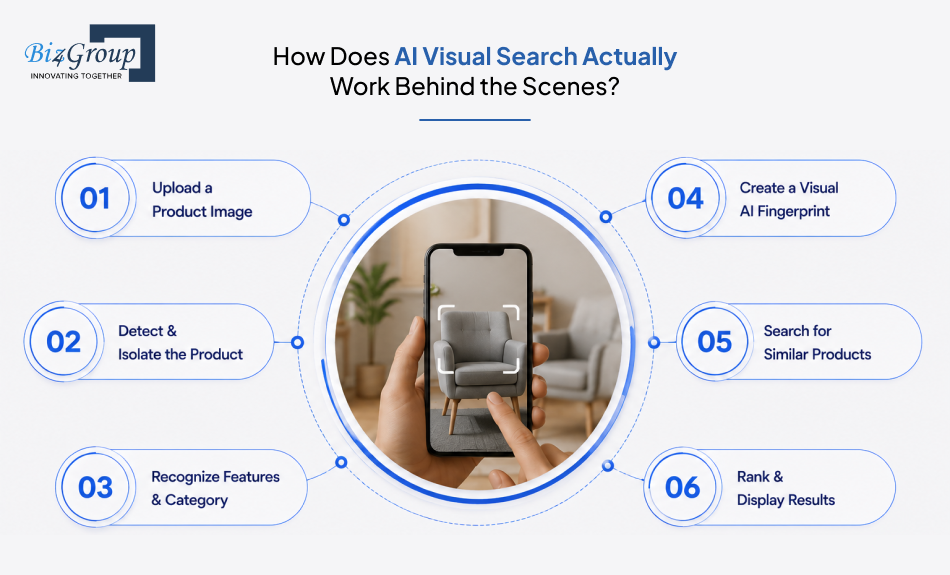
When a shopper uploads an image, AI visual search in e-commerce doesn't identify the product in a single step. It follows a sequence of AI technologies, where each one performs a specific task before passing the output to the next stage. Together, these technologies transform an image into a product search query and retrieve the closest matches from the catalog.
1. Computer Vision
Computer vision is a branch of AI that enables computers to interpret and analyze visual information from images. When a customer uploads an image, computer vision processes it by:
- Detecting the product within the image.
- Separating the product from the background.
- Identifying edges, contours, and boundaries.
- Extracting visual features such as color, texture, shape, and patterns.
- Creating a feature map that represents the product visually.
For example, if someone uploads a photo of a green velvet accent chair placed in a living room, computer vision isolates the chair from the surrounding furniture and captures its visual characteristics. Those extracted features are then passed to the next stage.
At Biz4Group, we have used computer vision to solve real business problems. Kalix QC is one example, where AI is used to automate quality assessment and pricing.
Kalix QC is an AI-powered platform that uses computer vision to evaluate cannabis flower quality from images. Instead of relying on manual inspections, it analyzes visual characteristics to deliver consistent quality scores and pricing insights.

The platform can:
- Evaluate cannabis flowers across seven visual quality parameters, including color, density, structure, trichome coverage, trim quality, and freshness.
- Generate a standardized Kalix Score for objective quality assessment.
- Estimate a Kalix Price Range (KPR) based on visual quality.
- Analyze both images and videos for faster evaluations.
- Deliver results through a mobile-first interface for on-site inspections.
While Kalix QC serves a different industry, the underlying computer vision workflow is the same as AI visual search in e-commerce. AI analyzes visual features, extracts meaningful patterns, compares them against reference data, and returns a reliable match or classification, demonstrating how computer vision can automate visual decision-making across different business domains.
2. AI Image Recognition
AI image recognition identifies the object in an image and classifies it into a meaningful product category. It uses the visual features extracted by computer vision to:
- Classifies the object into a product category.
- Detects product attributes such as material, color, pattern, and style.
- Recognizes logos or brand identifiers, when visible.
- Distinguishes between products that belong to the same category.
- Generates descriptive labels for the product.
Instead of recognizing only a chair, the system may identify it as a green velvet accent chair with wooden legs. These attributes make product matching much more accurate.
Biz4Group has implemented AI image recognition in systems that require real-time monitoring and automated responses. One example is an IoT-based heat cable management system that uses visual data to detect conditions and trigger actions.
The IoT-Based Heat Cable Management System combines AI image recognition with IoT to monitor roof conditions and automatically manage heating cables. Instead of relying on manual inspections or fixed schedules, the system analyzes visual inputs and activates heating only when it's needed.

The platform can:
- Detect snow and ice accumulation using AI-enabled smart cameras.
- Automatically control heat cables based on real-time visual conditions.
- Reduce unnecessary energy consumption through intelligent automation.
- Send alerts and notifications when user attention is required.
- Support remote monitoring and control through a connected IoT platform.
- Help prevent roof damage while reducing operational costs.
Although the use case is different from ecommerce, the underlying technology is the same. AI image recognition analyzes visual inputs, identifies relevant patterns, and triggers the appropriate action. In AI visual search in e-commerce, that action is retrieving the most relevant product. In this system, it's activating heat cables only when environmental conditions require it.
3. Embeddings
Embeddings are numerical representations of images that capture their visual characteristics in a format computers can compare efficiently. During this stage, the system:
- Converts the extracted visual features into a numerical vector.
- Preserves the relationship between visually similar products.
- Compresses complex image information into searchable data.
- Generates a consistent representation for every product image.
Two products with similar embeddings are likely to share similar visual characteristics, even if their titles, descriptions, or brands are completely different.
4. Vector Search
Vector search is a search technique that compares embeddings instead of keywords. When a shopper uploads an image, the system:
- Compares the uploaded image's embedding with product embeddings stored in the catalog.
- Calculates similarity scores between vectors.
- Retrieves the nearest visual matches.
- Filters out unrelated products.
- Passes the closest matches to the ranking engine.
This enables image-based AI product search to retrieve visually similar products even when the uploaded image comes from social media, a camera, or another retailer's website.
5. Ranking Engine
The ranking engine determines the order in which retrieved products appear in the search results. Before displaying the results, it:
- Scores every retrieved product.
- Prioritizes products with the highest visual similarity.
- Removes weaker matches.
- Organizes the final results page.
The shopper sees the products that most closely resemble the uploaded image, making the search experience faster and more relevant.
By the time the shopper sees the results, the system has already analyzed the image, identified the product, converted it into searchable data, compared it against the entire catalog, and ranked the closest matches, all within a fraction of a second. This end-to-end pipeline is what powers modern AI visual search in e-commerce and enables retailers to deliver faster, more accurate product discovery.
Finding a product is just the beginning. Modern ecommerce uses AI far beyond visual search.
Why Is AI Visual Search Only One Part of Modern AI Product Discovery?
A shopper rarely buys the first product they find. They compare styles, refine preferences, check different colors, explore alternatives, and often return later before making a decision. Although AI visual search in e-commerce helps them start that journey with an image, but product discovery doesn't end there.
Modern ecommerce platforms use several AI capabilities together to help shoppers move from finding a product to choosing the right one. That's what AI product discovery for e-commerce is built for.
1. AI Product Discovery
AI visual search and AI product discovery aren't quite the same thing. AI visual search helps shoppers find products, whereas AI product discovery helps them choose the right one.
AI visual search is the entry point, it lets shoppers locate visually similar products from an image instead of a query. AI Product discovery picks up from there, using AI throughout the buying journey to help shoppers answer the questions that actually drive a purchase:
- Is there a better alternative?
- Does it come in another color or size?
- Which option fits my budget?
- What other products should I consider?
Instead of relying on a single search method, AI product discovery combines capabilities like AI visual product search, semantic search, recommendations, personalization, and intelligent ranking to guide shoppers toward the right purchase.
2. Multimodal AI
AI product discovery combines more than one way of searching because customers don't always search the same way. This is where multimodal AI comes in. It understands and processes different types of inputs together, such as images, text, and voice, instead of treating each one separately.
A shopper might:
- Upload a product image.
- Type "under $800".
- Add "available in walnut finish".
- Use voice to refine the search.
The AI combines all these inputs into a single search request, which makes product discovery more accurate than relying on images or keywords alone.
3. Recommendations and Personalization
A question we often hear is: "We are a growing home decor brand and want recommendations based on a room photo, not just an exact item match. Is that visual search or a separate recommendation engine?"
The answer is both. AI visual search identifies products that match the uploaded image, while AI recommendation and personalization build on those results by suggesting complementary or better-fitting products based on the customer's preferences, browsing behavior, and the visual context of the room.
Finding a product is one step. Helping customers choose the right one is the next. That's where AI recommendation engines and AI personalization create a more complete shopping experience.
They help shoppers by:
- Recommending similar products.
- Suggesting complementary items.
- Prioritizing products based on browsing and purchase behavior.
- Surfacing products that better match individual preferences.
Instead of showing the same results to every shopper, these capabilities adapt to the experience based on customer intent and behavior.
4. Intelligent Ranking
Not every relevant product deserves a top position. AI decides which ones should appear first. Intelligent ranking organizes search results, so shoppers see the products that best match their intent. To determine the order of results, AI evaluates signals such as:
- Visual similarity.
- Search context.
- Customer preferences.
- Product popularity.
- Business rules.
The goal isn't to display every possible match. It's to surface the products that are most likely to help the customer make a purchase.
AI Visual Search vs. AI Product Discovery
|
Aspect |
AI Visual Search |
AI Product Discovery |
|---|---|---|
|
Primary purpose |
Finds products from images |
Helps customers discover and choose the right products |
|
Input |
Images |
Images, text, voice, and customer signals |
|
Focus |
Product matching |
End-to-end product discovery |
|
Core capabilities |
Computer vision, image recognition, embeddings, vector search |
Visual search, multimodal AI, recommendations, personalization, and ranking |
|
Business outcome |
Better search experience |
Better shopping experience and higher conversions |
Together, these capabilities turn AI visual search in e-commerce into a complete AI product discovery for e-commerce experience, helping businesses connect shoppers with the right products and making every step of the buying journey more relevant. With technology in place, the next question is where it delivers the biggest business impact.
Want AI product discovery tailored to your catalog?
Let's design a solution that fits your business goals and shopper behavior.
Talk to Our AI ExpertsWhich E-Commerce Businesses Benefit the Most from AI Visual Search?
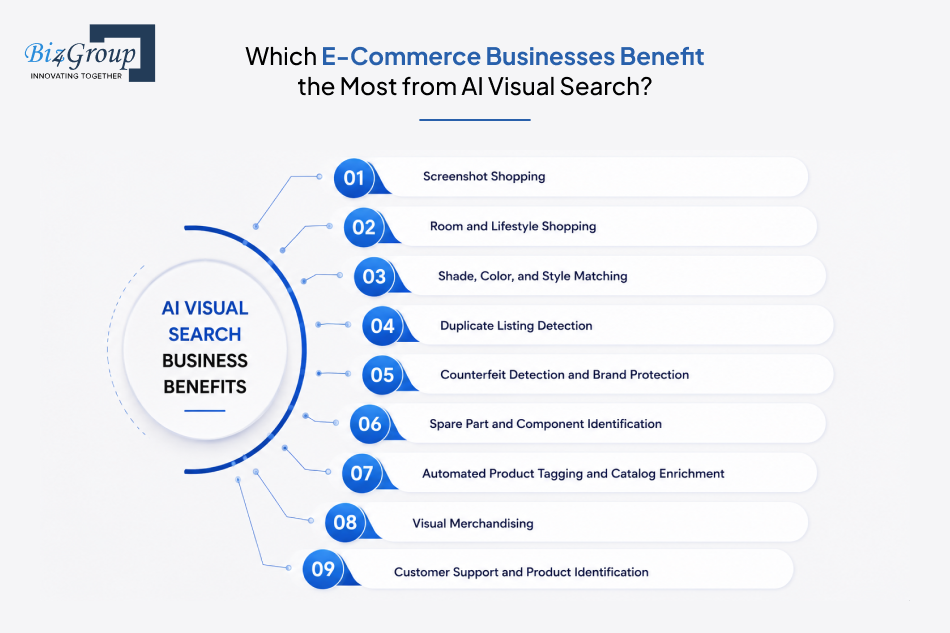
AI visual search in e-commerce delivers the most value when customers rely on what they see to make buying decisions. While fashion is often the first industry that comes to mind, the technology has expanded into furniture, beauty, marketplaces, automotive, B2B commerce, and many other industries.
Take a question we often hear from ecommerce leaders: "I am running a furniture business and customers screenshot items from Instagram asking if we carry something similar, how do I automate matching these requests with AI instead of doing it manually?"
The answer is AI visual search. It analyzes the uploaded image, extracts its visual features, and matches it with the closest products in your catalog within seconds, eliminating the need for manual product matching.
This is just one example. The bigger opportunity isn't choosing an industry. It's identifying the product discovery challenge you want to solve. Here are some of the most impactful ways businesses are using AI visual search today.
1. Screenshot Shopping
Many shopping journeys begin on social media, not on online stores. Screenshot shopping helps businesses convert that inspiration into a purchase. Customers upload screenshots from Instagram, Pinterest, TikTok, YouTube, or other websites. AI analyzes the image and retrieves visually similar products from the retailer's catalog.
Common use cases
- Fashion and apparel
- Footwear
- Home décor
- Furniture
- Consumer electronics
Business benefits
- Captures high-intent shoppers.
- Increases conversions from social traffic.
- Reduces search friction.
- Connects inspiration directly to purchase.
2. Room and Lifestyle Shopping
Customers often shop for an entire look instead of a single product. Visual search helps retailers recreate the style customers see in a room or lifestyle image. They upload a room or lifestyle photo. AI identifies products within the image and retrieves visually similar furniture, décor, or accessories from the catalog.
Common use cases
- Furniture
- Home décor
- Kitchen
- Office furniture
- Hospitality
Business benefits
- Encourages complete-room shopping.
- Increases basket size.
- Supports inspiration-led purchasing.
- Improves product discovery across collections.
3. Shade, Color, and Style Matching
Beauty and lifestyle brands often face a similar challenge. One question we frequently hear is: "We are a growing skincare brand and our biggest issue is customers can't describe shades or textures in words. Can AI visual search actually solve that, or is it more of a color-matching problem?"
The answer is yes, but it goes beyond color matching. AI visual search analyzes visual attributes such as shades, textures, finishes, patterns, and other design characteristics to find the closest matching products. This makes it easier for customers to discover products when they know how something looks but don't know how to describe it.
Common use cases
- Beauty and cosmetics
- Fashion
- Paint
- Flooring
- Interior design
Business benefits
- Reduces purchase uncertainty.
- Improves customer confidence.
- Lowers return rates.
- Improves conversion rates.
4. Duplicate Listing Detection
Large marketplaces receive thousands of new product listings every day, making manual moderation both time-consuming and expensive.
A common question from marketplace operators is: "I am running a multi-vendor marketplace and need to catch duplicate listings across thousands of sellers, can visual search handle that instead of manual moderation?"
Yes, AI visual search is capable of comparing seller-uploaded product images against existing listings, identifies visually similar or duplicate products, and flags them for review. This helps reduce duplicate listings, improve catalog quality, and create a better shopping experience for buyers.
Common use cases
- Multi-vendor marketplaces
- Classified platforms
- Resale marketplaces
Business benefits
- Reduces manual moderation.
- Improves catalog quality.
- Prevents duplicate listings.
- Saves operational time.
5. Counterfeit Detection and Brand Protection
Counterfeit products are a growing concern for marketplaces and premium brands. A question we often hear is: "I am building a resale app and need to flag counterfeit or trademark-infringing items from photos, is that visual search or a different category of AI tool?"
The answer is that it uses many of the same computer vision capabilities as AI visual search but serves a different purpose. Instead of helping customers find similar products, AI compares uploaded images with authentic product references to identify visual inconsistencies, duplicate listings, or potential trademark infringements. This allows marketplaces to flag suspicious listings for further review and strengthen brand protection at scale.
Common use cases
- Luxury fashion
- Watches
- Sneakers
- Electronics
- Premium consumer brands
Business benefits
- Protects brand reputation.
- Improves marketplace trust.
- Supports compliance teams.
- Speeds up manual investigations.
6. Spare Part and Component Identification
Customers rarely know the exact name or SKU of a replacement part. Visual search makes identification much easier using only an image. Customers upload a photo of a spare part or component. AI compares it against the product catalog and retrieves visually similar replacements.
Common use cases
- Automotive
- Manufacturing
- Industrial equipment
- Electronics
- B2B ecommerce
Business benefits
- Improves replacement accuracy.
- Reduces search time.
- Speeds up procurement.
- Reduces ordering errors.
7. Automated Product Tagging and Catalog Enrichment
Managing product information manually becomes difficult as catalogs grow. Visual AI helps enrich product data without relying entirely on manual tagging. AI analyzes product images and automatically identifies attributes such as product category, color, material, pattern, style, and other visual characteristics before adding them to the catalog.
Common use cases
- Fashion retailers
- Furniture stores
- Home décor brands
- Large ecommerce catalogs
- Marketplaces
Business benefits
- Reduces manual catalog management.
- Improves product consistency.
- Enhances search accuracy.
- Speeds up product onboarding.
8. Visual Merchandising
Creating visually consistent collections across thousands of products is difficult to do manually. AI helps merchandising teams organize products based on visual similarity. AI groups products with similar colors, styles, materials, and patterns, which makes it easier to build collections, category pages, and promotional campaigns.
Common use cases
- Fashion
- Furniture
- Beauty
- Lifestyle brands
Business benefits
- Saves merchandising time.
- Improves category presentation.
- Creates visually consistent collections.
- Helps customers discover related products.
9. Customer Support and Product Identification
Support teams often receive photos instead of product names. Visual search helps identify products quickly, even when customers can't describe them accurately. Customers upload a photo through chat, email, or a support portal. AI identifies the product and retrieves matching catalog information for support teams.
Common use cases
- Furniture
- Consumer electronics
- Appliances
- Automotive
- B2B equipment suppliers
Business benefits
- Reduces support resolution time.
- Improves product identification.
- Helps customers find replacements faster.
- Reduces manual effort for support teams.
Knowing where visual search fits is only half the equation. Your product catalog has to be ready to support it.
Is Your Product Catalog Ready for AI Visual Search?
Deploying AI visual search in e-commerce is only half the job. The other half is making sure your product catalog can support it.
AI can only retrieve products that it can clearly identify, compare, and understand. If product images are inconsistent, product information is incomplete, or catalog data is outdated, even the most advanced AI visual search solution for e-commerce will struggle to return accurate results. Before evaluating platforms or vendors, audit your catalog across these seven areas.
1. Product Images
AI can only match what it can clearly see. Product images are the foundation of AI visual product search. Every image is analyzed to identify visual details that distinguish one product from another. If those details are blurred, compressed, or hidden behind filters, the quality of the search results suffers.
Review whether your images have:
- High resolution with minimal compression.
- Consistent lighting across all products.
- Clean backgrounds that keep the focus on the product.
- Minimal filters, watermarks, or promotional overlays.
- Zoom support for capturing fine visual details.
For products with intricate textures, stitching, or finishes, those small details often make the difference between an accurate match and an irrelevant one.
2. Product Variants
Every variation should be searchable, not just the parent product. Many retailers upload one image for a parent product and use it across every color, material, or finish. That approach works for browsing, but it creates gaps for visual search.
Each variant should include:
- Its own product images.
- Color-specific photos.
- Material or finish variations.
- Pattern or design variations.
- Variant-level attributes.
If a shopper uploads a photo of a brown leather chair, returning the same chair in grey fabric isn't a great experience. Separate images for each variant to help AI identify and retrieve the closest visual match.
3. Product Attributes and Metadata
Images show what a product looks like, and product attributes explain what it is. Some products look almost identical but differ in ways customers care about. A dining chair made of oak, and another made of walnut may share the same design but belong to different buying decisions.
Every product should include consistent information such as:
- Product category.
- Brand.
- Material.
- Color.
- Dimensions.
- Style.
- Pattern.
- Finish.
These attributes provide additional context that helps refine search results and reduce mismatches between visually similar products.
4. Catalog Structure
A well-organized catalog helps AI retrieve the right products faster. Even with excellent images, inconsistent catalog structures can create duplicate or irrelevant results. Products placed in the wrong category, inconsistent naming conventions, or duplicate listings make it harder for AI to understand how products relate to one another.
Audit your catalog for:
- Duplicate products.
- Incorrect categories.
- Missing parent-child relationships.
- Inconsistent naming conventions.
- Broken product hierarchies.
A clean catalog improves both search quality and long-term catalog management.
5. Inventory and Pricing
Visual search should recommend products customers can actually buy. Nothing creates a poor shopping experience faster than discovering the perfect product only to find it's unavailable.
Keep your catalog synchronized by regularly reviewing:
- Inventory availability.
- Product status.
- Pricing accuracy.
- Active product listings.
- Discontinued products.
Keeping this information current helps ensure visual search surfaces products that are available and ready to purchase.
6. Image Coverage
One image rarely tells the complete story. A single front-facing image captures only part of a product. Details such as side profiles, textures, finishes, and craftsmanship often become visible only from additional angles.
Where possible, include:
- Front view.
- Side view.
- Back view.
- Close-up detail shots.
- Lifestyle images showing the product in use.
The more visual context AI receives, the better it can distinguish between products that appear similar at first glance.
7. Catalog Freshness
A product catalog should evolve as quickly as your inventory. New collections arrive, seasonal products change, and discontinued items disappear. If the catalog isn't updated regularly, visual search may continue retrieving products that are no longer relevant.
Build regular catalog reviews into your workflow to:
- Remove inactive products.
- Replace broken or outdated images.
- Update product attributes.
- Add new product variants.
- Refresh seasonal collections.
A well-maintained catalog gives AI access to the most accurate and up-to-date product information.
Why Do Structured Data and Schema Matter for AI Product Discovery?
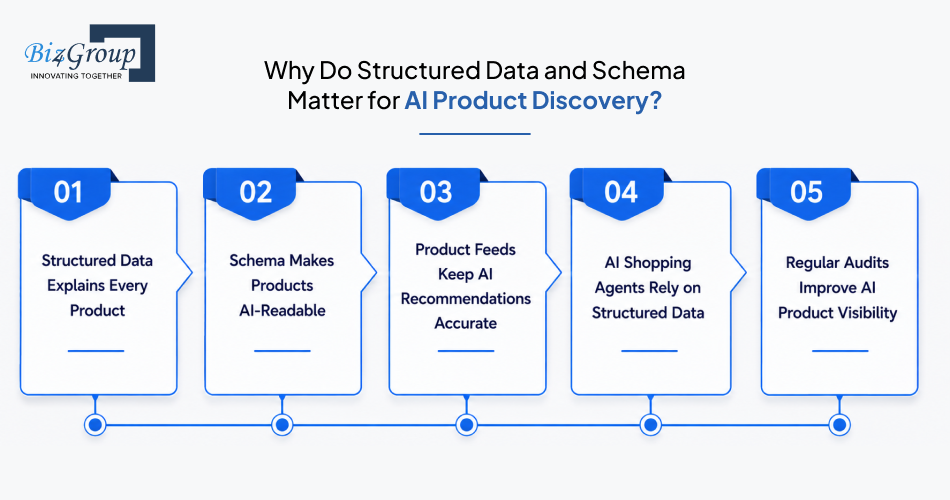
Images are the foundation of AI visual search in e-commerce, but they don't tell the whole story. An image can show what a product looks like, but it can't tell AI its price, availability, dimensions, brand, or whether it's currently in stock.
That's where structured product data comes in. It gives AI systems the context needed to identify, compare, rank, and recommend products more accurately. Whether it's a visual search engine, an AI shopping assistant, or a search engine, structured data helps machines understand what they're looking at instead of making assumptions.
1. Structured Data
Images show the product and structured data explain it. Structured data is product information organized in a standardized format that machines can read and process. While product images describe a product visually, structured data describes its characteristics and commercial details.
A well-structured product record typically includes:
- Product name
- Brand
- Category
- Price
- Availability
- Color
- Material
- Dimensions
- SKU or GTIN
Together, these attributes give AI the context it needs to distinguish between products that may look similar but differ in important ways.
2. Schema Markup
Schema markup gives search engines and AI systems a consistent way to interpret your product information. It is structured data added to a webpage using a standardized vocabulary. It helps search engines and AI-powered shopping platforms understand what information on the page represents.
For ecommerce stores, Product Schema usually includes properties such as:
- Product name
- Description
- Product images
- Brand
- Price
- Availability
- Product reviews
- Ratings
Without schema markup, product pages remain readable for people, but machines have to infer much of the information themselves.
3. Product Feeds
AI can only recommend products that reflect your current catalog. A product feed is a structured file that shares product information across shopping platforms and AI-powered discovery systems. It keeps product details synchronized as inventory, pricing, and availability change.
A healthy product feed should include:
- Current inventory
- Accurate pricing
- Product variants
- Product images
- Product identifiers
- Availability status
Keeping feeds updated helps ensure customers discover products they can actually purchase.
4. AI Shopping Agents
AI shopping agents rely on structured data to understand your products before recommending them. Whether a customer is searching through Google, ChatGPT, Perplexity, or another AI-powered shopping experience, these systems rely on structured product information to interpret and compare products.
Before recommending a product, AI looks for signals such as:
- Product details
- Pricing
- Availability
- Brand information
- Ratings and reviews
- Product variants
The clearer this information is, the easier it becomes for AI systems to surface the right products in the right context.
Also Read: How to Build AI Shopping Assistant App: A Complete Guide
5. Structured Data Audit
A quick audit can uncover gaps that limit how easily your products show up in AI-powered shopping experiences. Even small issues like missing attributes, outdated pricing, or incomplete schema can make it harder for AI to understand and recommend your products. Regularly reviewing your product pages and feeds helps catch these problems early and keeps your data consistent and discoverable across search engines, marketplaces, and AI-driven platforms.
Review a sample of your product pages and confirm that they consistently include:
- Product Schema
- Brand information
- Price
- Availability
- Product images
- Product identifiers (SKU or GTIN)
- Ratings and reviews
- Product variants
Small improvements to structured data often have a greater impact than businesses expect because they improve how machines interpret and retrieve product information.
A high-quality product catalog helps AI recognize products visually. High-quality structured data helps AI understand those products, making both layers equally important for delivering accurate AI visual commerce solutions. Once your data foundation is in place, the next question becomes, what does it take to implement AI visual search?
How Much Does AI Visual Search Cost to Build or Implement?
The cost of implementing AI visual search in e-commerce estimates from $25,000 to $500,000, because every business starts from a different point. Some retailers need an image search feature that plugs into an existing store, while others are building a complete AI visual product discovery platform across multiple channels and millions of SKUs.
Instead of asking "How much does it cost?", ask "What level of capability does my business actually need?" That's what determines the investment.
1. What Actually Determines the Cost?
The AI model is rarely the biggest expense. Most of the budget goes into preparing your business to use it effectively. The final investment depends on how much work is required before customers can use visual search. Businesses with clean catalogs and modern ecommerce platforms usually spend less than those needing custom development and complex integrations.
The biggest cost drivers include:
|
Cost Driver |
Why It Matters |
|---|---|
|
Product catalog |
More products require more indexing and storage. |
|
Image quality |
Poor images often need to be replaced or optimized. |
|
Platform integrations |
ERP, PIM, CMS, and ecommerce integrations add development effort. |
|
Custom features |
Camera search, recommendations, and custom workflows increase complexity. |
|
Search volume |
Higher usage increases infrastructure and API costs. |
|
Deployment model |
SaaS, APIs, and custom builds have different pricing structures. |
2. Build, Buy, or Partner: Which AI Visual Search in E-Commerce Approach Is Right for You?
"Should I build AI visual search in-house or buy a third-party solution, what's the real tradeoff for a mid-size store?"
The answer depends on your business goals, budget, internal engineering capabilities, and how central AI visual search is to your ecommerce strategy. Most implementations follow one of three approaches, each offering a different balance of cost, deployment speed, customization, and long-term scalability. For custom implementations, AI visual search development costs typically range from $25,000 to $150,000, depending on the project's complexity and scope.
|
Approach |
What It Means |
Typical Cost |
Best For |
Time to Launch |
|---|---|---|---|---|
|
Buy an Existing Solution |
Subscribe to a ready-made AI visual search platform and integrate it into your ecommerce store. |
$500-$5,000+/month |
Small to mid-sized retailers that need the fastest deployment with minimal customization. |
2-4 weeks |
|
Partner with an AI Development Company |
Work with an AI development partner to design and build a custom solution tailored to your business without creating an in-house AI team. |
$25,000-$150,000+ |
Growing ecommerce brands, retailers, and marketplaces that need custom features, integrations, and scalability. |
4-6 weeks |
|
Build In-House |
Develop, deploy, and maintain the entire AI visual search solution using your own engineering and AI teams. |
$150,000-$250,000+ (plus ongoing engineering and infrastructure costs) |
Large enterprises with dedicated AI teams requiring complete ownership and long-term control. |
2-4 months |
For most growing ecommerce businesses, partnering with an AI development company offers the best balance between cost, customization, and time to market. Businesses gain a solution tailored to their requirements without the cost and complexity of building an in-house AI team.
3. Where Does Your Budget Go?
Buying AI is only one part of the project. Getting it ready for production is where much of the investment happens. A typical implementation budget is spread across several activities.
|
Investment Area |
What's Included |
Typical Budget Allocation |
|---|---|---|
|
Discovery & Planning |
Requirements gathering, solution architecture, project planning |
5-10% |
|
Catalog Preparation |
Image improvements, attribute enrichment, catalog cleanup |
15-20% |
|
AI Development |
Search models, vector search, ranking, APIs |
25-35% |
|
Platform Integration |
Ecommerce platform, PIM, ERP, CMS, search engine |
20-25% |
|
Testing & Deployment |
QA, performance testing, production rollout |
10-15% |
|
Ongoing Operations |
Cloud infrastructure, monitoring, model improvements |
10-15% |
This is why two businesses with the same number of products can receive very different quotes. One may already have a well-maintained catalog, while the other needs significant preparation before AI can deliver reliable results.
For most businesses, a pilot covering one product category is the smartest first step. It validates the technology, measures business impact, and creates a clear roadmap before expanding across the entire catalog.
Not sure where your budget should go first?
Let's map a pilot that validates AI visual search for your catalog before you scale.
Plan My PilotWhy Do AI Visual Search Projects Fail, and How Can You Avoid It?
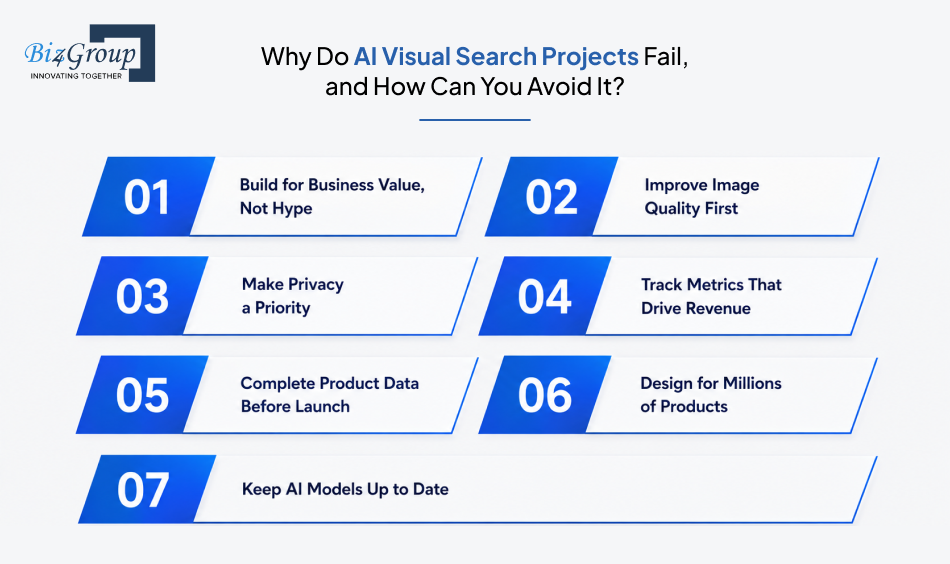
Most AI visual search in e-commerce projects don't fail because of the AI itself. They fail because businesses overlook the people, processes, and product decisions needed to make the technology successful. Many of these challenges are predictable and can be avoided with the right planning.
|
Challenge |
Why It Happens |
How to Solve It |
|---|---|---|
|
No clear business objective |
AI is implemented because it's trending instead of solving a measurable product discovery problem. |
Start with one defined use case, such as screenshot shopping, duplicate detection, or spare part identification, and establish success metrics before development begins. |
|
Low-quality visual data |
Blurry images, inconsistent product photography, or missing variant images reduce matching accuracy. |
Standardize product photography, capture every variant, and audit image quality before deployment. |
|
Privacy and compliance concerns |
Customers upload personal photos that may contain faces, homes, or other sensitive information. Regulations such as GDPR and CCPA require businesses to handle this data responsibly. |
Minimize image retention, obtain user consent where required, anonymize uploaded images when possible, and define clear data retention policies. |
|
Wrong success metrics |
Teams measure image uploads or search volume instead of business outcomes. |
Track conversion rate, search-to-purchase rate, revenue per search session, average order value, and search abandonment. |
|
Cold-start catalogs |
New products with limited images or incomplete product data are harder for AI to retrieve accurately. |
Publish multiple product images, complete product attributes, and enrich new listings before making them searchable. |
|
Scalability issues |
Search performance often declines as catalogs grow from thousands to millions of products without the right infrastructure. |
Use scalable vector databases, optimize indexing, and continuously monitor search latency and accuracy. |
|
Model drift |
Customer preferences, product catalogs, and fashion trends change over time, reducing search quality if the system isn't updated. |
Regularly refresh embeddings, reindex the catalog, and evaluate search performance against current customer behavior. |
The most successful retailers don't treat AI visual search as a feature they launch once. They treat it as a product capability they continuously improve based on customer behavior and business outcomes. Solving today's implementation challenges prepares your business for tomorrow's opportunities. Let's explore where AI visual search in e-commerce is heading next.
What Is the Future of AI Visual Search in E-Commerce?
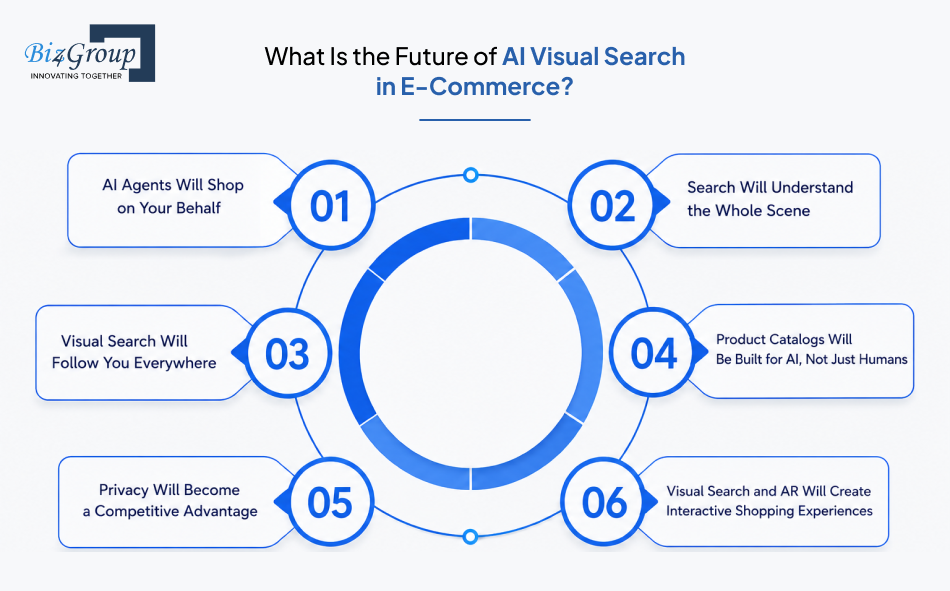
AI visual search is evolving from a search feature into a core commerce capability. The next wave isn't about recognizing products more accurately. It's about understanding customer intent, reducing shopping effort, and helping AI make better product decisions.
If you're planning your ecommerce strategy for the next few years, these are the shifts worth paying attention to.
1. AI Agents Will Shop on Your Behalf
Imagine a customer asking an AI assistant to buy a black running shoe under $150 from a preferred brand. Instead of returning a list of links, the AI compares products, checks availability, reviews specifications, and can even complete the purchase with the customer's approval.
That changes who you're optimizing for. Your product catalog won't just need to convince shoppers. It will also need to provide AI agents with accurate, structured, and up-to-date product information.
2. Search Will Understand the Whole Scene
Today's visual search usually focuses on identifying a product. The next generation will understand the entire context around it.
Upload a photo of a living room, and AI won't stop at finding a similar sofa. It will recognize the design style, color palette, available space, and complementary furniture to recommend products that work well together.
The question will shift from "What is this product?" to "What fits this space?"
3. Visual Search Will Follow You Everywhere
Think about how often you discover products outside an ecommerce website, on the street, in a café, at a friend's house, or while scrolling social media.
As smart glasses, wearable devices, and connected cameras become more common, almost any object could become the starting point of a shopping journey. Instead of opening an app and typing a search, customers will point a camera and instantly explore similar products.
4. Product Catalogs Will Be Built for AI, Not Just Humans
For years, retailers optimized product pages for search engines and shoppers. The next priority will be making catalogs easy for AI to interpret.
That means investing in:
- Rich product attributes
- High-quality images
- Structured product data
- Accurate inventory and pricing
Businesses that treat their product catalog as an AI-ready asset will be better positioned as AI becomes a bigger part of online shopping.
5. Privacy Will Become a Competitive Advantage
Would customers upload photos from their homes or wardrobes if they weren't confident those images would be handled responsibly?
As visual search becomes more personal, trust will matter as much as technology. Retailers that are transparent about how images are processed, stored, and protected will have an advantage as customer expectations and privacy regulations continue to evolve.
6. Visual Search and AR Will Create Interactive Shopping Experiences
Today's visual search helps customers find products. The next generation will help them experience those products before they buy.
Upload a photo of your living room, and AI won't just recommend a similar sofa. It will let you place that sofa in your space, see how it fits with your existing furniture, and explore different colors, sizes, or materials in real time. The experience will shift from "Will this product work for me?" to "I already know how it looks."
The future of AI visual search in e-commerce isn't about replacing the search bar. It's about making product discovery more natural, more contextual, and increasingly driven by AI that understands what customers want with less effort from them. Preparing for the future starts with making the right technology decisions today, and choosing the right AI development partner is one of them.
Why Is Biz4Group the Right AI Visual Search Development Partner?
Building AI visual search in ecommerce requires more than integrating computer vision models or APIs. It requires an understanding of product catalogs, ecommerce workflows, and the business goals the technology is meant to achieve.
With 20+ years of experience, 1,000+ successful projects, and 500+ global clients, Biz4Group, a leading e-commerce development company in USA, has helped businesses build AI solutions that solve real operational and customer challenges.
Our expertise extends beyond ecommerce. We've developed computer vision and AI image recognition solutions across industries, including Kalix QC, an AI-powered cannabis quality assessment platform, and an IoT-Based Heat Cable Management System that uses AI to automate real-time monitoring. These projects demonstrate our ability to build production-ready AI solutions that deliver measurable business outcomes.
Whether you're planning to implement AI visual search, modernize your ecommerce platform, or integrate AI into an existing workflow, our team can help you design, develop, and deploy a solution aligned with your business goals.
Final Thoughts
The next generation of ecommerce won't be won on catalog size, ad spend, or website traffic. It will be won on how little effort it takes a customer to go from "I want that" to "I bought that."
AI visual search closes that gap faster than any other technology available today. Not because it makes search smarter, but because it removes the need for customers to guess the right keywords. When a screenshot is enough to find the right product, the friction disappears, along with the sales lost to unsuccessful searches.
Getting started doesn't require rebuilding your ecommerce platform. A focused pilot, a well-prepared product catalog, and the right implementation strategy are enough to validate the business impact before scaling further.
If you're evaluating AI visual search in e-commerce, Biz4Group LLC can help you identify the right use cases, assess your existing ecommerce ecosystem, and build a solution that aligns with your business goals.
Ready to implement AI visual search in your online store? Talk to our AI experts and discover how a custom solution can improve product discovery, increase conversions, and support long-term ecommerce growth.
FAQ’s
1. Can AI visual search work with existing ecommerce platforms like Shopify, Magento, or WooCommerce?
Yes. Most AI visual search solutions can be integrated with popular ecommerce platforms through APIs or custom plugins, allowing businesses to add image-based product search without rebuilding their online store.
2. Does AI visual search require thousands of product images to work effectively?
No, but larger and well-structured product catalogs generally deliver better results. High-quality images from multiple angles and complete product attributes help improve search accuracy.
3. Can AI visual search identify counterfeit or duplicate products?
Yes. Computer vision can compare visual features across products to identify duplicate listings, detect similar products, and support counterfeit detection. Many marketplaces use this capability to improve catalog quality and streamline moderation.
4. How accurate is AI visual search?
Accuracy depends on several factors, including image quality, catalog size, product diversity, and the AI models used. With a well-prepared catalog, modern AI visual search systems can deliver highly relevant product matches.
5. Does AI visual search support video searches as well as images?
Yes. Many advanced solutions can analyze video frames, extract visual features, and identify products from recorded or live video, although image-based search remains the most common implementation.
6. Can AI visual search work for B2B ecommerce?
Absolutely. B2B businesses use AI visual search to identify industrial components, machinery parts, medical equipment, automotive components, and replacement parts where customers often have an image but not a product name or SKU.
7. Is AI visual search secure for customer-uploaded images?
It can be, provided businesses implement appropriate security measures, encryption, access controls, and privacy policies. Compliance with regulations such as GDPR and CCPA should also be considered when storing or processing uploaded images.
8. Can AI visual search recommend visually similar products instead of exact matches?
Yes. Most modern systems retrieve both exact and visually similar products by comparing colors, patterns, shapes, materials, and other visual characteristics, helping customers discover relevant alternatives.
9. What industries benefit from AI visual search besides ecommerce?
Beyond ecommerce, AI visual search and computer vision are widely used in healthcare, manufacturing, agriculture, logistics, real estate, automotive, quality inspection, retail analytics, and security applications.
10. How much does it cost to implement AI visual search in an ecommerce store?
The cost depends on how you choose to implement it. SaaS solutions typically start at $500-$5,000+ per month, while custom implementations with an AI development partner generally range from $25,000 to $150,000+. Building the solution in-house requires a significantly larger investment in engineering and infrastructure.
