 Location :
Orlando, FL, USA
Location :
Orlando, FL, USA +1 (407) 714-1616
 info@biz4group.com

 AI Summary Powered by Biz4AI
- Custom AI home buying platform development connects search, affordability guidance, mortgage workflows, transaction tasks, and closing support into one buyer journey.
- An AI powered property search and matching engine uses buyer preferences, property data, budget, and location to deliver relevant recommendations with clear reasoning.
- Strong AI home buying platform architecture separates LLM conversations from calculations, business rules, sensitive data, and external MLS, mortgage, title, and closing systems.
- Costs typically range from $60,000 to $250,000+, with an MVP taking around 2–4 weeks and an enterprise platform around 6–8 weeks, depending on scope and integrations.
- Biz4Group's work on Facilitor highlighted a practical lesson: useful AI recommendations depend on reliable property data, buyer context, financial verification, integrations, and the workflow surrounding the AI.
A first-time buyer tells the AI home buying platform, “I want a 3-bedroom home under $450,000, close to work, and I have not started pre-approval.” The platform turns that information into a buyer profile, finds relevant listings, explains affordability, starts the right mortgage workflow, schedules viewings, and keeps the buyer on track after an offer through closing.
That makes custom AI home buying platform development especially useful when a company wants its buyer experience to follow its own process. For example, the platform qualifies a buyer before showing properties, uses affordability inputs to narrow the search, trigger a mortgage handoff when the buyer is ready, and creates follow-ups for viewings, offers, documents, and closing. Those workflows are where a custom build earns its place.
So, where does AI actually fit into that journey? Bank of America’s 2026 Homebuyer Insights Report found that 20% of prospective buyers and current homeowners used AI tools or chatbots for homebuying research in the past year. Among those users, 57% used AI for affordability, mortgage payments, or closing-cost estimates, while 55% used AI for general homebuying education.
So, how much of the buyer journey belongs inside the platform? An AI home buying platform with mortgage integration needs to distinguish between tasks such as explaining a loan term, calculating an approved affordability figure, requesting a lender document, and making a lending decision.
Biz4Group LLC as an AI development company has built AI products for U.S. real estate businesses that bring together property search, buyer preferences, financial verification, MLS and GPS data, property visits, contracts, and transaction updates. Working across these workflows has given the team practical experience with a challenge at the heart of AI home buying platforms: making AI useful while keeping property data, transaction logic, and human decisions connected.
Ready to Turn Your Home Buying Journey into One Smarter Experience?
Bring search, AI guidance, mortgage workflows, and closing tasks together without making buyers play “Where did I save that document?”
Build Your AI Home Buying PlatformWhat Should a Custom AI Platform Actually Do for a First-Time Buyer from Search to Closing?
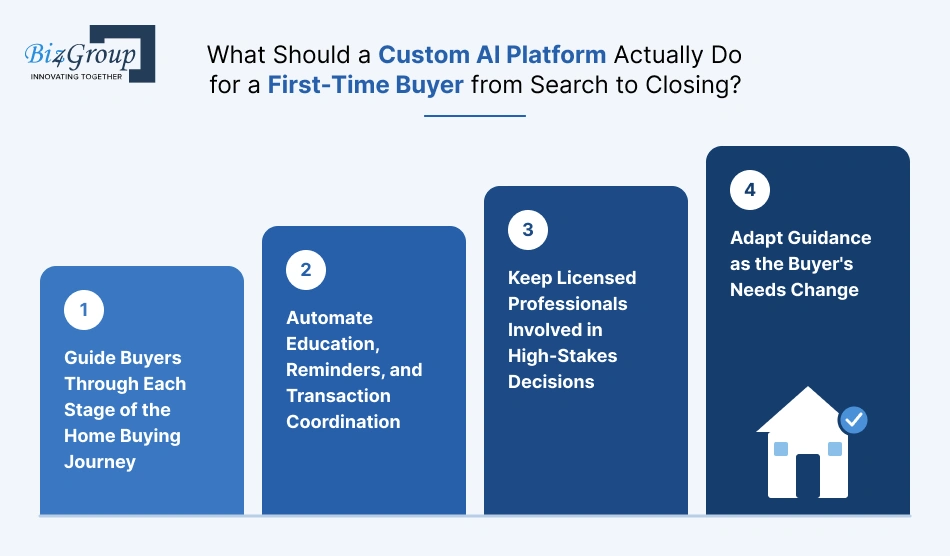
A first-time buyer needs more than a property search tool. An AI homebuyer engagement platform brings the search, affordability questions, lender steps, appointments, offers, paperwork, and closing deadlines into one guided experience. The buyer gets context at each step, while agents, lenders, and closing professionals take over when their expertise is required.
A common question among first-time buyer-focused real estate companies is this:
"I am running a real estate business focused on first-time buyers, and they keep getting stuck because they do not understand the process, so can you suggest how an AI platform could guide them from finding a home through financing, viewing, and closing."
An AI platform guides buyers from property search and recommendations to affordability, financing tasks, property viewings, document collection, and closing milestones. It keeps the next step visible, sends timely reminders, and brings agents or other professionals into the process when human input is required.
Guide Buyers Through Each Stage of the Home Buying Journey
Start with the buyer's first question: “What homes actually fit my situation?” From there, AI home buyer guidance platform supports the next decisions, such as which properties to view, what to prepare for a lender, when an offer needs attention, and which closing tasks remain. The experience follows the transaction rather than forcing buyers to piece it together themselves.
Automate Education, Reminders, and Transaction Coordination
A first-time buyer does not need an agent involved every time a basic question comes up. A home buyer journey automation platform handles routine explanations, reminders, document requests, appointment updates, and task tracking.
For example, after a buyer enters an offer, the system keeps the relevant deadlines visible and prompts the buyer about outstanding items.
Keep Licensed Professionals Involved in High-Stakes Decisions
The boundary matters. AI explains a mortgage term or tells a buyer that a lender document is missing. The lender decides whether the buyer qualifies and what loan terms apply. The same principle extends to property advice, contracts, title issues, and closing decisions. AI platform for first-time home buyer companies needs these handoffs built into the buyer journey rather than added later as a safety measure.
Adapt Guidance as the Buyer's Needs Change
The buyer's situation changes as the search progresses. A lower budget changes the property set. A new location changes the search area. A change in financing affects affordability and the next lender step. AI powered home buyer journey platform keeps those changes connected, so the guidance reflects what the buyer needs now rather than what they entered at the beginning.
How Does an AI Matching Engine Recommend Homes Based on Budget, Preferences, and Location?
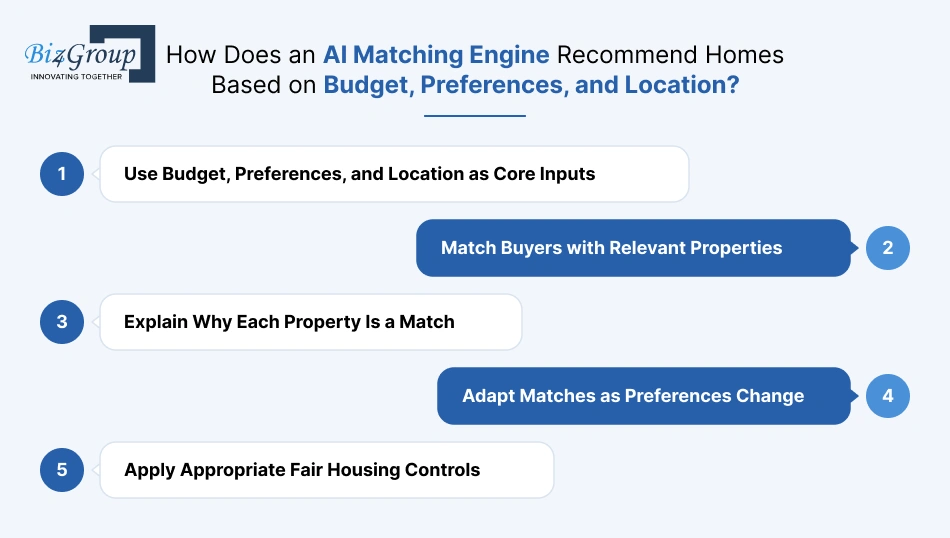
An AI powered property search and matching engine compares a buyer's budget, location, home requirements, and priorities against available listings, then ranks the properties that fit. The useful part is the reasoning behind each recommendation: buyers need to understand why a home appeared and what trade-offs come with it.
Use Budget, Preferences, and Location as Core Inputs
The matching process starts with the details that shape the search:
- Budget: target price, affordability range, and financing constraints
- Location: preferred neighborhoods, commute requirements, and geographic preferences
- Home requirements: bedrooms, bathrooms, property type, size, and must-have features
- Personal priorities: features the buyer values more, such as a garage, outdoor space, or proximity to transit
These inputs form the buyer profile used by the personalized home recommendation engine. The system also needs to distinguish between a hard requirement and preference. “3 bedrooms” has a different meaning from “3 bedrooms would be nice.”
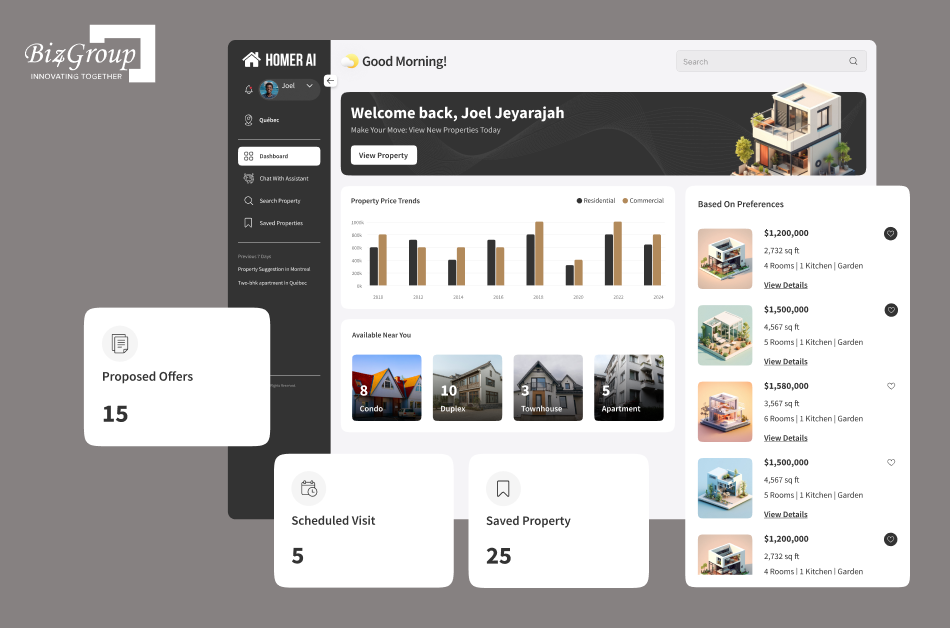
Biz4Group has worked through a similar problem in Homer AI, a conversational real estate platform built around buyer and seller interactions. The buyer-side experience used conversational questions to capture preferences such as budget and location, filter available properties, and surface relevant matches before moving toward a property visit.
Match Buyers with Relevant Properties
The engine compares the buyer profile with listing data and filters out homes that miss important requirements. It then ranks the remaining properties according to how closely they fit the buyer's priorities.
For example:
$425,000 | 3 bedrooms | 18-minute commute
Matches your budget, bedroom requirements, and preferred commute. The home sits outside your preferred neighborhood but remains within your wider search area.
That explanation gives the buyer something useful to react to instead of presenting another long list of listings.
Explain Why Each Property Is a Match
Each recommendation needs a clear reason. The system might highlight price, location, bedroom count, commute, property features, and meaningful compromises.
If a buyer says, “I care more about commute time than having a garage,” that preference becomes a new signal for future recommendations. The matching logic then reflects what the buyer actually values.
Adapt Matches as Preferences Change
Home searches rarely stay fixed. A buyer might raise the budget, add a bedroom, expand the search area, or decide that commute time matters more than a specific feature. The matching engine updates the property set as those priorities change, which is a core consideration in AI property matching platform development.
Apply Appropriate Fair Housing Controls
The matching logic needs firm boundaries around sensitive information and protected characteristics. The system needs defined rules for which inputs influence recommendations, which stay outside the matching process, and how recommendation behavior gets tested for unintended patterns.
How Can AI Guide Buyers Through Affordability, Pre-Approval, and Financing Without Giving Wrong Advice?
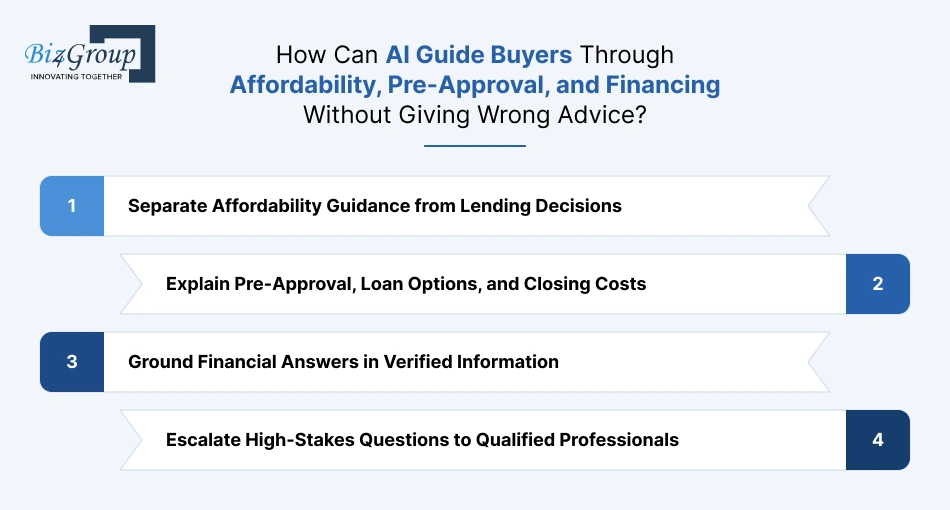
AI works best here as a guide, not as the lender. It explains what a buyer's numbers mean, walks them through pre-approval, answers basic mortgage questions, and keeps financing tasks moving. The lender still handles qualification, loan terms, underwriting, and approval.
Target audiences have queries like:
"We work exclusively with first-time home buyers who do not understand mortgage pre-approval, affordability, or the closing process, so we want to build a custom AI platform that can guide them step by step without them needing to constantly call an agent."
The platform explains pre-approval, affordability, loan terms, closing costs, and required documents in plain language. It also tracks financial tasks and deadlines while routing lending decisions and high-stakes questions to the appropriate professional.
Separate Affordability Guidance from Lending Decisions
A buyer might ask, “I make $90,000 a year, so what home price makes sense for me?” The AI explains the numbers and gives an affordability estimate based on the information provided. It does not tell the buyer that they qualify for a particular loan. That decision stays with the lender.
Explain Pre-Approval, Loan Options, and Closing Costs
Mortgage terms get confusing fast, especially for a first-time buyer. The AI explains things like pre-approval, down payment, interest rates, points, taxes, insurance, and closing costs in simple language. With an AI home buying platform with mortgage integration, the buyer also sees where they are in the mortgage process, which documents are missing, and what the lender needs next.
Ground Financial Answers in Verified Information
This is one area where guessing is a bad idea. Rates, lender requirements, fees, and closing costs need to come from trusted sources or connected lending systems. Calculations such as estimated monthly payments and affordability ranges also need fixed formulas rather than an LLM trying to work out the numbers in a conversation.
Escalate High-Stakes Questions to Qualified Professionals
Some questions need a lender. “Will my credit history affect approval?” or “Which loan should I choose?” are examples. The AI identifies those situations, passes the relevant information to the lender, and tells the buyer what happens next.
What Architecture Does a Custom AI Home Buying Platform Need?
A custom AI home buying platform architecture needs six main pieces: the buyer app, backend services, AI and property matching, business rules, data storage, and external integrations. Together, they connect home search, buyer guidance, mortgage steps, documents, and closing updates without putting every task inside the AI itself.
Architecture flow:
Buyer App → API & Backend → AI + Matching → Business Rules & Workflows → Data → External Systems
Connect the Buyer App, AI, Matching, and Workflow Layers
The buyer sees the simple part: search for homes, ask questions, book a viewing, upload documents, and check what happens next. Behind that, the architecture needs to integrate AI into an app without putting every workflow inside the AI itself.
Behind that, APIs move information between the AI assistant, property matching, CRM, mortgage services, and closing tools. This structure also supports the AI home buying platform features for real estate companies, because search, recommendations, financing tasks, and transaction updates each have a place in the system.
Use LLMs Where Conversation Adds Value
This is where an LLM earns its place. It handles questions, explanations, summaries, and next-step guidance.
A buyer asking, “Why did you show me this house?” gets an explanation based on their preferences and listing data. The AI works with approved information rather than having open access to every system in the business.
Keep Calculations and Rules Outside the LLM
Some jobs need predictable results. Affordability calculations, mortgage payment estimates, deadlines, eligibility checks, and document requirements belong in application logic.
For example:
Income + debts + other inputs → affordability service → calculated range → AI explains the result
The AI explains the number. The application calculates it.
Keep Buyer, Property, Mortgage, and Transaction Data Organized
The data layer keeps the information needed across the journey:
|
Data |
Examples |
|---|---|
|
Buyer |
Budget, preferences, search history |
|
Property |
Price, location, features, listing status |
|
Mortgage |
Application status, lender information, loan data |
|
Transaction |
Offers, documents, deadlines, closing status |
|
AI |
Conversation context, retrieved information, audit records |
PostgreSQL fits structured buyer and transaction data. pgvector adds semantic search when the AI needs to find relevant information across documents and knowledge sources.
Support the AI Real Estate Transaction Assistant
An AI powered real estate transaction assistant system needs access to the right information at the right point in the transaction. It might pull a listing detail during the search, explain a mortgage document later, or remind a buyer about a closing deadline.
That requires the AI layer, workflow services, and transaction data to work together rather than treating the chatbot as a standalone feature.
Pick a Tech Stack That Fits the Product
There is no reason to pick technologies simply because they are popular. The existing engineering team, integrations, expected traffic, security needs, and cloud environment all matter.
|
Layer |
Example Technology |
|---|---|
|
Web App |
React, Next.js |
|
Mobile App |
React Native, Flutter |
|
Backend & APIs |
Python/FastAPI, Node.js |
|
AI & LLM |
OpenAI API or another approved LLM provider |
|
Matching & Data Processing |
Python |
|
Database |
PostgreSQL |
|
Semantic Search |
pgvector |
|
Cloud |
AWS, Azure, Google Cloud |
|
Authentication |
Auth0, AWS Cognito |
|
Integrations |
REST APIs, webhooks, secure data feeds |
|
Monitoring |
CloudWatch, Datadog |
For a company already running Azure and .NET, sticking with that environment often makes more sense than replacing the backend simply to introduce a different stack.
Keep MLS, Mortgage, CRM, and Closing Connections Separate
The platform needs connections to MLS feeds, CRM systems, mortgage providers, document services, title companies, and closing systems. Each one has its own API, data format, and access rules.
Keeping those connections in a separate integration layer makes changes easier to manage. If a mortgage provider changes its API, the change stays within that connection instead of spreading through the buyer-facing application.
How Does the Platform Integrate With MLS, Mortgage, and Title or Closing Systems?
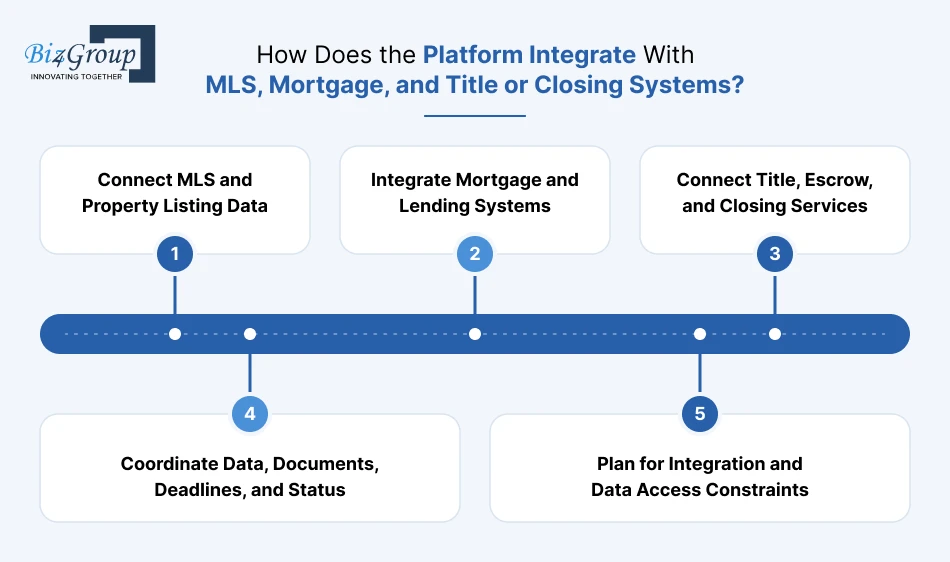
An AI home buying platform with MLS integration connects MLS, mortgage, title, escrow, and closing systems through APIs, data feeds, webhooks, and secure data exchanges.
An integration layer receives that information, validates and maps it into the platform's data structure, and passes the relevant updates to the database, workflows, AI assistant, and buyer app. This is where AI integration services help connect the AI layer with the systems already used across the buying journey.
A frequent concern among companies building AI:
"I want to build an AI platform that helps first-time buyers search for homes and stay guided all the way through financing, viewing, and closing, but I am concerned about it giving incorrect financial guidance or missing important steps in the transaction."
The platform should separate AI explanations from transaction rules and verified system data. MLS, mortgage, title, and closing updates feed the workflow engine, while financial decisions and critical transaction actions remain governed by deterministic rules and qualified professionals.
Connect MLS and Property Listing Data
The MLS connection keeps the property search tied to current listing information. The platform pulls available listing data into the search and matching experience, then uses those details alongside the buyer's preferences.
Key data includes:
- Property price and listing status
- Address and location details
- Bedrooms, bathrooms, and property type
- Available property features
- Listing updates and changes in status
Integrate Mortgage and Lending Systems
Once the buyer starts financing, the platform connects the mortgage workflow to the lender's system. This gives the buyer visibility into financing tasks without turning the AI into a substitute for the lender.
The integration typically handles:
- Pre-approval or application status
- Requests for additional documents
- Financing workflow updates
- Lender messages or action items
- Status changes that affect the buyer's next step
The AI explains these updates in simple language, while the lender remains responsible for qualification, loan terms, underwriting, and approval.
Connect Title, Escrow, and Closing Services
After an offer is accepted, the platform needs information from the services handling the transaction. Title, escrow, and closing connections bring those updates into the same transaction workflow the buyer has already been using.
Relevant information includes:
- Title search or title-related tasks
- Escrow activities
- Inspection-related deadlines
- Required transaction documents
- Closing appointment details
- Changes to important dates
This keeps closing tasks visible instead of forcing the buyer to track them across separate emails, portals, and documents.
This type of workflow thinking also appears in Contracks, a real estate contract management platform developed by Biz4Group. The product focused on keeping contract information, important dates, notifications, and outstanding formalities in one place. That experience is relevant to AI home buying platforms because closing support depends on more than answering questions; the system also needs to know what has happened, what is due next, and which tasks still need attention.
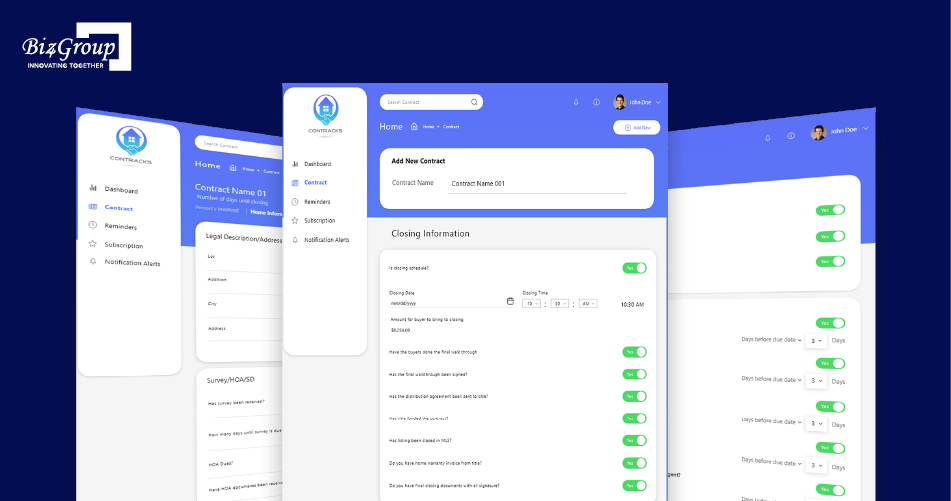
Coordinate Data, Documents, Deadlines, and Status
The integration layer becomes especially useful when information from one system triggers work somewhere else. Instead of treating each connection as a separate feature, the platform links related events to the same buyer and transaction.
For example:
- A lender requests a document → the platform creates a buyer task.
- A document is received → the financing workflow updates.
- A closing date changes → related reminders are updated.
- A transaction status changes → the AI explains what happens next.
- A deadline approaches → the buyer receives the appropriate prompt.
An AI powered real estate transaction assistant system sits on top of these workflows and turns verified transaction updates into useful guidance.
Plan for Integration and Data Access Constraints
Integration planning starts before development because access to real estate data depends on the provider, agreement, API, permissions, and technical format. The platform needs a consistent way to handle those differences without exposing them to the buyer.
The integration design needs to account for:
- API and data-feed availability
- Authentication and access permissions
- Different data fields and formats
- Update frequency and event handling
- Document and file-transfer requirements
- Provider-specific limitations and agreements
When a required piece of information is unavailable, the workflow needs a defined fallback, such as a manual update or professional handoff. That keeps the buyer experience useful without allowing the AI to invent missing information.
A well-designed integration layer also makes future connections easier to add because new providers do not require the entire buyer experience to be rebuilt.
How Does the Custom AI Home Buying Platform Development Handle Data Privacy, Security, and Compliance?
A custom AI home buying platform protects buyer data by controlling who can access it, where it is stored, how it moves between systems, and what the AI is allowed to do with it. Financial records, identity documents, property preferences, and transaction data need different access rules and AI permissions.
Protect Sensitive Buyer and Financial Information
The platform needs to separate everyday buyer data from sensitive financial and identity information. Access depends on the user's role and the task they are handling.
Practical example: A buyer uploads a bank statement for a lender. The document is stored in a restricted document service, linked to that buyer's mortgage workflow, and made available only to users with the required permission. The custom AI home buying platform receives the information needed for the specific task instead of unrestricted access to the entire document repository.
Address Fair Housing and Fair Lending Considerations
AI matching needs defined inputs tied to legitimate housing requirements. Protected characteristics and inappropriate proxies need to stay outside property recommendations and housing-related targeting. HUD has addressed these considerations for digital platforms using automated systems and AI.
Practical example: A buyer asks the platform to prioritize neighborhoods based on the racial or religious makeup of residents. The matching engine rejects that input and continues the search using legitimate criteria such as price, location, property type, commute, bedrooms, and selected home features.
Control What the AI Can Say and Do
The AI needs clear boundaries between explaining information and making consequential decisions. It handles guidance and summaries while lending, contractual, and other regulated decisions stay with the appropriate professional or system.
Practical example: A buyer asks, "Why was my mortgage application denied?" If the AI home buying platform is connected to a lender's decision workflow, the AI uses the lender's recorded reason rather than generating its own explanation. For credit decisions, Consumer Financial Protection Bureau guidance states that creditors using complex algorithms still need to provide specific and accurate reasons for adverse actions.
Maintain Human Oversight, Audit Trails, and AI Disclosures
Important AI and transaction activity needs to remain traceable. The platform records significant workflow changes, external data updates, AI-triggered actions, and human handoffs. Privacy disclosures also need to match actual data practices. The Federal Trade Comision has warned businesses against privacy promises that differ from how consumer data is actually used.
Practical example: An AI workflow tells a buyer that a lender document is missing. The audit record shows which lender update triggered the message, when the status changed, what information the AI received, and whether a human later corrected the task.
Privacy and compliance work best when these controls are part of the platform's workflows from the beginning, rather than added as a final compliance exercise.
How Do You Develop a Custom AI Home Buying Platform?
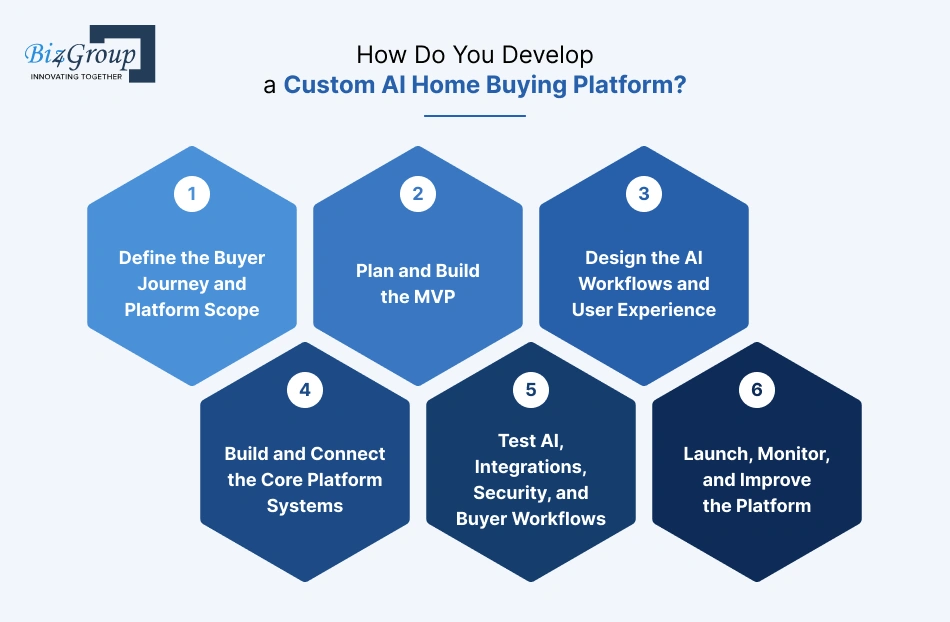
Building a custom AI home buying platform starts with the buyer journey and shows where AI in real estate development actually adds value, rather than adding AI to every part of the product.
The MVP establishes the first useful experience, while later releases add deeper AI capabilities, real estate integrations, and transaction automation as the product grows into broader enterprise AI solutions. The development approach also needs to define where the platform provides guidance and where agents, lenders, and closing professionals remain responsible.
Define the Buyer Journey and Platform Scope
Looking at the buyer's journey from the first search through closing is also the practical starting point for answering how to use AI for real estate in a way that solves actual workflow problems. A first-time buyer needs different support while comparing homes than when dealing with mortgage documents or closing deadlines. Those situations help define the platform's scope.
The scope usually covers areas such as:
- Buyer onboarding and preference capture
- Property search and recommendations
- Affordability guidance
- Viewing and appointment requests
- Offer and transaction tracking
- Document and deadline management
- Agent, lender, and closing-team handoffs
This stage also helps define the AI home buying platform features for real estate companies, separating the workflows that belong in the first release from those better suited to later phases.
Plan and Build the MVP
The MVP needs to give buyers a useful reason to return to the platform. A focused first release provides enough functionality to test the buyer experience without requiring every mortgage, title, and closing integration from day one.
A practical MVP might include:
- Buyer profile creation
- AI-assisted home search
- Personalized property recommendations
- Basic affordability guidance
- Property question answering
- Viewing requests
- Buyer tasks and reminders
- Agent handoff
Design the AI Workflows and User Experience
Generative AI needs a clear role throughout the journey.. That means designing how it answers property questions, explains recommendations, handles financing questions, and knows when a professional needs to take over.
The design might include:
- Conversational property search
- Follow-up questions based on buyer context
- Explanations behind property recommendations
- Mortgage and affordability guidance
- Document and task assistance
- Context-based reminders
- Escalation to agents, lenders, or closing professionals
The team also defines where an LLM provides conversation, where verified platform data supplies the answer, and where application rules handle calculations or sensitive decisions.
Build and Connect the Core Platform Systems
This is where the product's individual pieces start working as one system, which is essentially business app development using AI around real buyer workflows. The buyer interface communicates with the backend, AI services, matching engine, data layer, workflow services, and external real estate systems.
The technical build typically includes:
- Web or mobile buyer application
- AI assistant and retrieval layer
- Property matching and ranking engine
- Buyer, property, mortgage, and transaction data models
- Workflow and notification services
- MLS and mortgage connections
- CRM, title, escrow, and closing integrations
- Authentication, permissions, logging, and monitoring
This is where AI home buying platform development services need to account for real estate-specific data access, integration requirements, and transaction workflows.
Test AI, Integrations, Security, and Buyer Workflows
Testing needs to resemble an actual home purchase. A feature might work correctly on its own while the complete workflow fails when listing data, AI responses, mortgage updates, and buyer tasks interact.
Useful test cases include:
- A buyer enters incomplete financial information
- A recommended property changes to pending status
- A listing feed sends outdated information
- A lender requests an additional document
- A buyer asks the AI for a lending decision
- An external integration stops responding
- A user attempts to access another party's documents
- A closing deadline changes after a reminder is issued
Testing also needs to check whether the AI powered home buyer journey platform gives the buyer the right guidance at the right point, rather than simply checking whether individual screens and APIs work.
Launch, Monitor, and Improve the Platform
Once real buyers start using the product, development priorities become easier to identify. Analytics show where buyers stop progressing, while agent and lender feedback reveals which tasks still create unnecessary manual work.
Useful signals include:
- Buyer progression at each stage
- AI correction and escalation rates
- Property search and recommendation activity
- Integration errors and delays
- Agent and lender workload
- Security events
- Repeated buyer questions
- Features buyers actually use
Those findings guide subsequent releases. A company might discover that buyers need deeper mortgage guidance before investing in more sophisticated closing automation, for example.
A phased rollout gives the company room to expand from an initial buyer experience into a broader search-to-closing platform as real usage shows where additional automation is worth building.
How Much Does It Cost to Build a Custom AI Home Buying Platform?
A custom AI home buying platform typically costs $60,000 to $250,000+ to build. A focused MVP sits toward the lower end, while a production platform with AI workflows, MLS and mortgage integrations, transaction automation, security controls, and broader scalability moves toward the higher end.
One question leadership teams often ask:
"I am trying to convince my leadership team to invest in a custom AI home buying platform built specifically for first-time buyers, but I do not have clear numbers on cost or return, so can you break down the realistic development cost, timeline, and ROI?"
A focused MVP typically costs $60,000–$100,000 and takes 2–4 weeks, while a broader production platform reaches $100,000–$250,000+. ROI depends on factors such as reduced manual support, faster buyer response, higher engagement, and more efficient transaction workflows.
|
Development scope |
Typical cost range |
|---|---|
|
Focused MVP |
$60,000–$100,000 |
|
Production-ready platform |
$100,000–$175,000 |
|
Advanced search-to-closing platform |
$175,000–$250,000+ |
The actual AI home buying platform development cost depends more on scope and integration complexity than on the number of screens or AI features.
Hidden Costs You Should Care About
The initial development quote is only part of the budget. Data access, AI usage, infrastructure, security reviews, third-party services, and ongoing maintenance add costs after the core platform is built.
Common expenses include:
- MLS and property data access fees
- LLM and AI usage charges
- Cloud hosting and storage
- Mortgage and third-party API fees
- Security testing and compliance work
- Monitoring and analytics tools
- Ongoing maintenance and model updates
For example, a company might build the platform within its development budget and then discover that its MLS data agreement, high-volume AI usage, or additional mortgage integration creates a separate recurring expense.
Factors Affecting the Cost
The biggest cost difference comes from how much of the buyer journey the platform needs to handle. A property search assistant is considerably different from a system that follows a buyer through mortgage, offer, title, documents, and closing.
Key cost drivers include:
- MVP scope: More workflows and user roles increase development effort. MVP development services help establish a focused first release before larger investments.
- AI requirements: Using existing models is different from building custom retrieval, evaluation, fine-tuning, or workflows that train AI models for specific business needs.
- Integrations: MLS, mortgage, CRM, title, escrow, and closing connections add development and testing work.
- UI/UX: A simple buyer portal costs less to design than a guided experience covering search, financing, documents, tasks, and closing. A specialized UI/UX development company also adds design expertise and delivery cost.
- Security and compliance: Sensitive financial and transaction data requires stronger controls, testing, and monitoring.
- Scale: Supporting thousands of buyers, agents, and transactions requires more infrastructure and operational planning than a limited pilot.
For most first-time-buyer companies, the practical approach is to price the MVP separately, validate usage, and then budget the larger search-to-closing platform around proven workflows.
What Questions Should You Ask an AI Home Buying Platform Development Company?
Choosing an AI home buying platform development company requires more than comparing portfolios and development rates. The useful questions are about whether the vendor understands real estate integrations, AI boundaries, sensitive buyer data, long-term maintenance, and the assumptions behind its proposal.
If you plan to hire AI developers, ask how they handle real estate data, AI accuracy, integrations, security, and human handoffs before discussing price.
How Do You Verify the Vendor's Real Estate and Integration Experience?
Ask:
- Which MLS or property data systems have you integrated?
- Have you connected mortgage, lender, title, escrow, or closing systems?
- How do you handle different APIs, data formats, and access permissions?
- How do you manage failed or delayed data updates?
- Can you show a comparable real estate platform you have delivered?
A useful answer should include specific systems, integration challenges, and how those challenges were handled.
How Does the Vendor Handle AI Accuracy and Financial Guidance?
Ask:
- Which tasks use an LLM and which use application logic?
- How does the AI access current property and mortgage information?
- How are unsupported or inaccurate answers detected?
- What happens when a buyer needs a lender, agent, or other professional?
- How are AI responses tested before and after launch?
For example, affordability calculations belong in controlled application logic, while the AI explains the result to the buyer.
How Does the Vendor Handle Security, Compliance, and Data Ownership?
Ask:
- Who owns the source code and custom components?
- Who owns buyer and transaction data?
- Which AI, cloud, and third-party services receive your data?
- Where is sensitive information stored?
- How are permissions and audit records managed?
- What happens to your data when the vendor relationship ends?
These answers should appear in the contract rather than relying on verbal assurances.
What Post-Launch Support and Maintenance Does the Vendor Provide?
Clarify:
- How long is post-launch support included?
- How are critical production issues handled?
- Who monitors AI and integration failures?
- How are API and model changes managed?
- What maintenance is included?
- How are future enhancements estimated?
The goal is to understand what happens when something breaks at 9 AM on a Tuesday after the development team has handed over the product.
What Red Flags Should You Look for in Proposals and Estimates?
Watch for:
- A chatbot presented as the entire AI strategy
- No defined MVP
- Vague MLS or mortgage integration plans
- AI accuracy claims without a testing approach
- No clear source-code or data ownership terms
- One fixed price despite undefined integrations
- No post-launch support model
- No defined human handoff for high-stakes questions
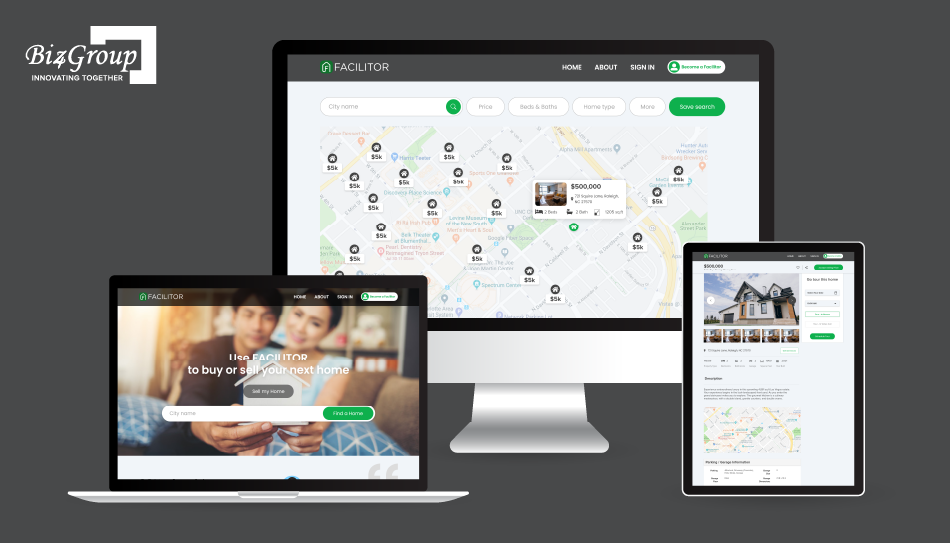
One lesson from developing Facilitor, a real estate buying platform built by Biz4Group, was that the recommendation layer becomes much more useful when it has reliable buyer and property context around it. The platform combined budget and location-based search, AI property recommendations, financial verification, MLS and GPS data, real-time communication, and guided property visits.
Wondering Where AI Actually Fits into Your Buyer Journey?
Find the workflows worth automating first, then turn the best ideas into an MVP buyers will actually use.
Talk to an AI ExpertFinal Thought!
Buying a home already comes with enough tabs, forms, calls, and “wait, what happens next?” moments. So why make buyers jump between five different systems to figure out one transaction? A custom AI home buying platform development approach brings the journey together, from finding a home and understanding affordability to tracking documents and closing tasks, while keeping agents, lenders, and other professionals in the loop where they matter.
Biz4Group, providing AI consulting services in USA, understands that the AI recommendation itself is only one piece of the puzzle. Buyer preferences, property data, financial verification, MLS connections, and property visits all have to work together for the experience to make sense. Where should you start? Start with the buyer's biggest friction point, then build outward. Talk to Biz4Group's experts and turn that starting point into a practical MVP and a roadmap for what comes next.
FAQs
1. Can You Build an AI Platform for Home Search to Closing Without Replacing Real Estate Agents?
Yes. A Build an AI platform for home search to closing approach works well when AI handles repetitive guidance, search assistance, reminders, and transaction coordination while agents remain involved in negotiations, property advice, contracts, and other professional decisions. The platform becomes an additional layer of support rather than an attempt to remove the agent from the process.
2. What Does an AI Home Closing Assistant Actually Handle?
An AI home closing assistant development company typically builds workflows around the tasks that become harder to track near closing. These include explaining document requests, surfacing upcoming deadlines, organizing transaction updates, and helping buyers understand what needs attention. The assistant works from verified transaction information and routes questions requiring professional judgment to the appropriate person.
3. How Does an AI Home Buying Assistant Learn a Buyer's Preferences Over Time?
When you develop an AI home buying assistant platform, the system can use explicit feedback and search behavior to refine the buyer profile. A buyer who repeatedly rejects homes because of long commutes, for example, gives the system a stronger signal that commute time matters. The platform needs controls around which signals influence recommendations so that personalization does not become opaque or inappropriate.
4. What Data Does an AI Home Buying Platform Need to Personalize the Buyer Experience?
A useful AI powered home buyer journey platform needs more than listing data. Depending on the workflow, relevant information includes buyer preferences, search behavior, property interactions, affordability inputs, appointment activity, transaction status, and task history. The platform should collect only the information needed for the experience and give users appropriate control over sensitive data.
5. Can an AI Home Buying Platform Support Multiple Real Estate Brands or Markets?
Yes. A multi-brand platform needs configurable workflows, branding, user roles, market-specific property sources, and business rules rather than a separate application for every market. This approach is particularly relevant for companies planning to build an AI home buying platform for first-time buyers across different regions or business units.
6. What Is the Difference Between an AI Home Buying Platform and a Real Estate Chatbot?
An AI conversation app mainly answers questions through conversation, while an AI home buying platform connects that conversation to actual buyer workflows, property data, search, appointments, financing tasks, and transaction records. The difference becomes obvious when a buyer says, “Show me homes like this one and remind me what I need to do next.” A platform acts on the broader workflow; a chatbot mainly responds.
7. When Does It Make Sense to Choose a Best AI Home Buying Platform Development Company Over an Off-the-Shelf Tool?
The phrase best AI home buying platform development company should not be reduced to a generic vendor ranking. The better question is whether the development partner fits the project's integration requirements, real estate workflows, AI use cases, security needs, and long-term product plans. Custom development becomes more relevant when an off-the-shelf tool cannot accommodate the company's buyer journey or required connections.
8. How Long Does It Take to Develop an AI Home Buying Platform?
The development timeline depends on the scope and integration requirements. A focused MVP typically takes 2–4 weeks, while an enterprise-grade platform typically takes 6–8 weeks when the required workflows, integrations, and technical requirements are clearly defined.
9. How Much Does It Cost to Develop an AI Home Buying Platform?
The Cost to build an AI home buying platform typically falls between $60,000 and $250,000+, depending on the product scope, AI requirements, integrations, security needs, and level of transaction automation. A focused MVP sits toward the lower end, while a broader search-to-closing platform moves toward the higher end.
