 Location :
Orlando, FL, USA
Location :
Orlando, FL, USA +1 (407) 714-1616
 info@biz4group.com

 AI Summary Powered by Biz4AI
- A commercial real estate (CRE) investment platform links each asset's original underwriting assumptions to its actual performance, so variances are easy to find, explain, and act on.
- The core loop is underwriting → actuals → variance → cause → revised forecast → investment action.
- The original underwriting stays frozen. Forecasts, budgets, and scenarios are stored separately.
- Reliable data, versioned assumptions, data lineage, and governance should come before advanced AI.
- Once the data is trusted, AI can explain variances, spot patterns across properties, answer investment questions, and test scenarios.
- A development partner with experience across AI, real estate workflows, data integrations, and custom product development, such as Biz4Group, can help turn this investment workflow into a purpose-built platform.
What happens when the property is performing differently from the deal you originally underwrote? You need more than another dashboard.
You need to know: What changed? Why did it change? And what should we do next?
A commercial real estate investment platform should help your team answer those questions by tracing the change from the original underwriting assumption to the latest property actual, identifying the variance, understanding what caused it, and turning that insight into a decision.
And this becomes even more useful when portfolios are being actively repositioned.
Deloitte's 2027 CRE Outlook, based on a 2026 survey of 950 CRE executives and their direct reports, found that nearly 80% expect to update or reposition existing assets over the next 12 to 18 months. Simultaneously, more than 90% plan to increase spending on data and technology in 2027.
Put those two findings together, and the need is pretty clear, teams don't just need more data. They need technology that helps them turn changing property performance into better investment decisions. That's where a connected commercial real estate investment analytics layer comes in.
Think of it as bringing the whole story into one place, acquisition assumptions, property actuals, rent rolls, leasing, accounting, financing, market data, and revised forecasts. Instead of jumping between systems to piece together what happened, your team can follow the story from "this is what we expected" to "this is what's happening" to "here's what we should do next."
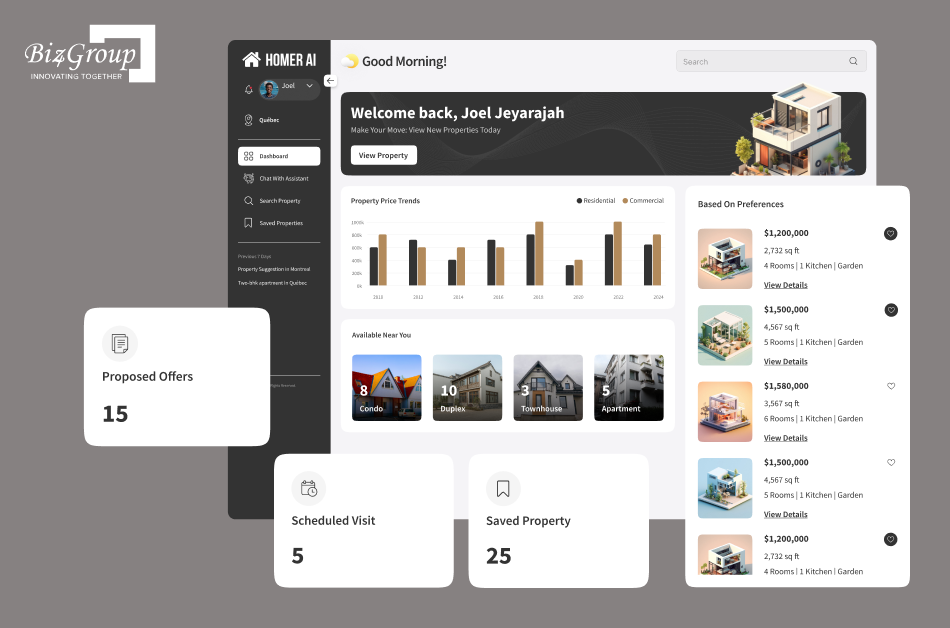
There's a useful product lesson in Biz4Group's Homer AI work, too. The platform connects conversational AI with structured property data, filtering, dashboards, and APIs. For CRE investment system, that same principle matters, the data model and the decision workflow need to be designed together. Otherwise, the platform risks becoming another place to look for information.
The real opportunity is to build a place where teams can understand what changed, why it changed, and make the next decision.
Let's unpack what that could look like.
Why Do CRE Teams Lose Track of Underwriting Assumptions After Acquisition?
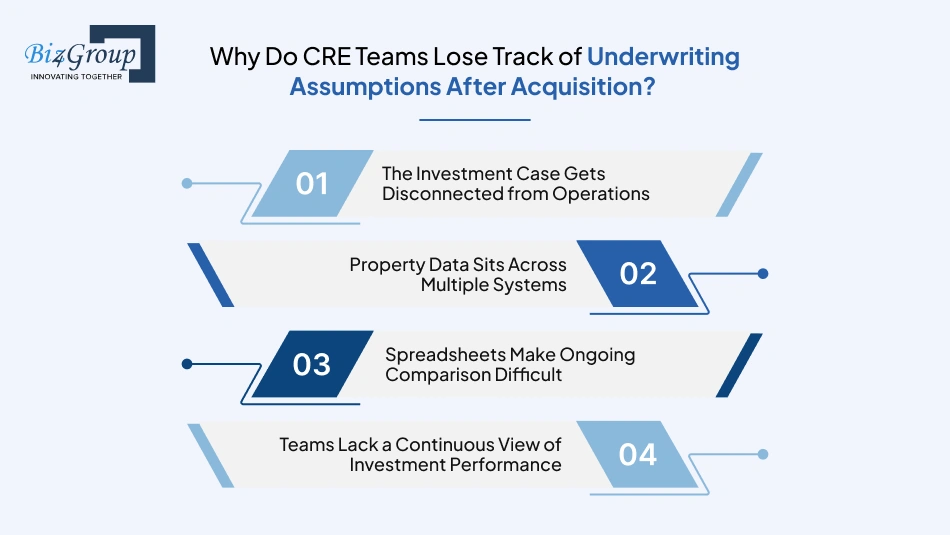
CRE teams lose track of underwriting assumptions when the acquisition case and property operations live in separate workflows. The original CRE underwriting may remain in an acquisition model while rents, occupancy, expenses, leasing, and capital spending are tracked elsewhere. A connected commercial real estate investment platform keeps the original case visible alongside actual performance, variances, forecasts, and decisions.
1. The Investment Case Gets Disconnected from Operations
After closing, the question changes from "Should we buy this property?" to "Is it performing as expected?"
An acquisition model may assume 95% occupancy, 4% rent growth, a target expense ratio, and $5M NOI. Six months later, the asset manager is working from rent rolls, T-12s, leasing reports, and monthly financials. These sources show what happened, but not necessarily how it compares with the acquisition case.
The platform should therefore keep three things distinct: what was assumed, what happened, and what is now expected.
2. Property Data Sits Across Multiple Systems
The challenge is not a lack of data. It is that commercial real estate property performance data is spread across systems built for different purposes.
A typical CRE environment may include:
- ARGUS Enterprise for underwriting and valuation
- Yardi, MRI, or RealPage for property and financial data
- Rent rolls and leasing systems for tenant information
- Accounting systems for actual income and expenses
- CoStar for market and comparable-property data
- Debt systems and spreadsheets for financing and investment analysis
The hard part is making these sources comparable. Property IDs, reporting periods, account categories, and metric definitions may differ. For example, underwriting may forecast annual rent at the property level while the property system records monthly tenant charges. A useful integration must map both to the same economic concept.
Also Read: AI for Residential Real Estate: How to Build an AI Property Management System
3. Spreadsheets Make Ongoing Comparison Difficult
Spreadsheets are useful for underwriting and scenarios, but they become difficult to control when they are the permanent link between acquisition assumptions and property results.
Forecast overrides, new rent rolls, committee versions, and analyst adjustments can create competing files. Revised assumptions can also overwrite the original case.
For CRE investment management, version history matters. A property can outperform the latest forecast while still underperforming the original underwriting.
4. Teams Lack a Continuous View of Investment Performance
The real gap is not seeing that NOI is below budget. It is understanding what changed in the investment case and what to do about it.
|
Original Assumption |
Current Actual |
Decision Question |
|---|---|---|
|
95% stabilized occupancy |
91% |
Temporary gap or structural issue? |
|
4% annual rent growth |
2.1% |
Market pressure or lease-specific issue? |
|
32% expense ratio |
36% |
Which costs changed, and will they persist? |
|
$5M annual NOI |
$4.4M |
What caused the shortfall and what is the valuation impact? |
This is where commercial real estate portfolio analytics becomes more useful when connected to actual vs projected real estate performance. The goal is not another red variance. It is enough context to determine whether an assumption still holds and whether the response should be operational, financial, or strategic.
That is the role of commercial real estate performance monitoring: connect the original investment case to actual results and the decision that follows.
How Does a CRE Investment Platform Connect Underwriting with Actual Performance?
A commercial real estate investment platform connects underwriting to actual performance through four controlled views: original underwriting, actual performance, current forecast, and scenarios. It maps equivalent metrics, identifies material variances, and feeds validated changes back into the investment outlook without altering the original case.
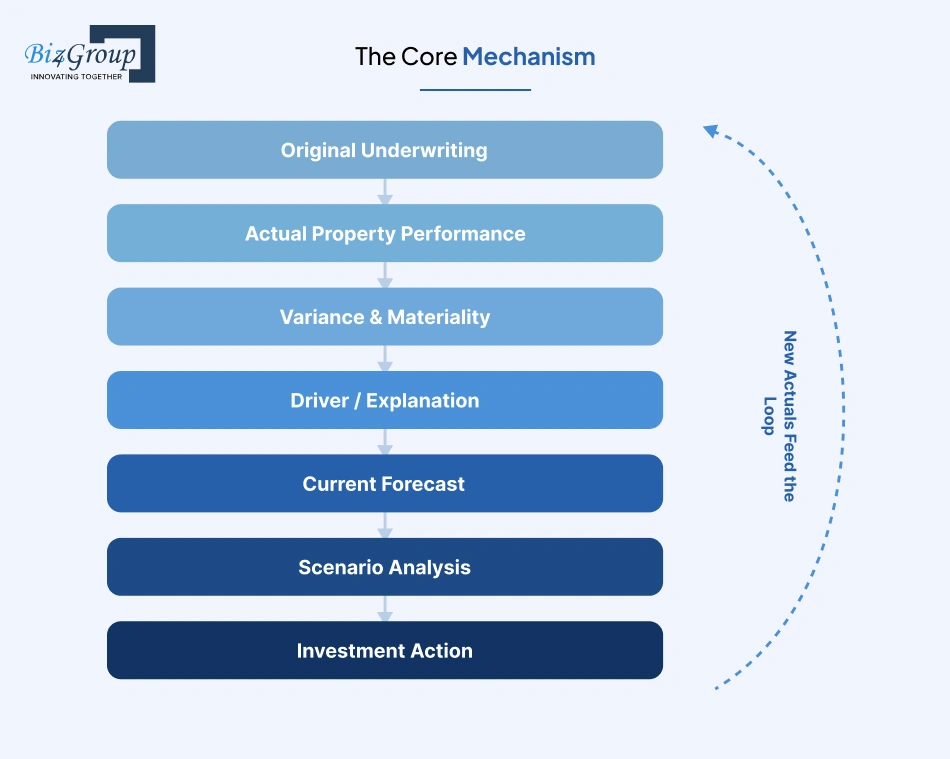
The Core Mechanism
Original underwriting → Actual property performance → Variance & materiality → Driver / explanation → Current forecast → Scenario analysis → Investment action → New actuals feed the loop
1. Four Views Keep the Investment Case Intact
|
View |
What It Answers |
Example |
|---|---|---|
|
Original underwriting |
What did we assume when we invested? |
95% occupancy, $5M NOI |
|
Actual performance |
What is happening now? |
91% occupancy, $4.4M NOI |
|
Current forecast |
What do we expect going forward? |
92% occupancy, $4.7M NOI |
|
Scenario |
What happens if assumptions change? |
90% vs 94% occupancy |
The original underwriting should remain unchanged. A commercial real estate underwriting platform can preserve the acquisition assumptions, model version, period, and source while allowing authorized teams to update forecasts and scenarios.
2. Mapping And Materiality Turn Differences into Decisions
|
Step |
What the Platform Does |
Example |
|---|---|---|
|
Map |
Matches equivalent measures across systems |
Economic occupancy → economic occupancy |
|
Compare |
Calculates the difference |
95% vs 91% = -4 pts |
|
Assess |
Determines whether the variance matters |
NOI impact, duration, valuation effect |
|
Explain |
Connects the variance to its driver |
Lower renewals caused higher vacancy |
|
Update |
Changes the forward outlook without changing the baseline |
Forecast occupancy moves to 92% |
|
Act |
Links the revised outlook to the investment workflow |
Leasing plan or business-plan change |
This is where commercial real estate investment analytics becomes useful. Not every variance deserves attention. A temporary $300K capex overrun is different from recurring expense growth that reduces NOI and valuation.
The result is a controlled loop: preserve the case, map actuals, assess materiality, explain the change, update the forecast, and act. That is the core mechanism behind connecting actual vs underwriting assumptions without losing the investment history.
Still Comparing Underwriting to Actuals in Spreadsheets?
Your properties have moved on. Your investment model shouldn't be stuck in the past. Let's connect your underwriting assumptions to what's actually happening.
Talk to Biz4GroupWhat Performance Data and Integrations Does a CRE Investment Platform Need?
A commercial real estate investment platform should connect the performance metrics that affect the investment case with the systems that produce them. The goal is to compare underwriting with actuals across revenue, occupancy, expenses, leasing, capex, financing, valuation, and returns without creating another disconnected data source.
|
Performance Area |
What to Compare |
Primary Data Sources |
Investment Impact |
|---|---|---|---|
|
Revenue, rents, and occupancy |
Rent growth, physical/economic occupancy, concessions, other income |
Rent rolls, leasing systems, property systems |
Revenue and stabilization |
|
Expenses and NOI |
Taxes, insurance, repairs, utilities, management costs, NOI |
Accounting and property systems |
Cash flow and valuation |
|
Leasing and renewals |
Lease rollover, renewal rates, downtime, new lease rents, TI and concessions |
Rent rolls, leasing systems |
Occupancy and future revenue |
|
Capex and financing |
Planned vs actual capex, debt balance, interest, maturity, DSCR, LTV |
Accounting, debt systems, lender data |
Cash flow and financing risk |
|
Valuation and returns |
NOI, cap rate, valuation, IRR, equity multiple |
Underwriting, market data, valuation models |
Investment performance |
How The Data Connects
Underwriting models → Property + accounting systems → Rent rolls + leasing data → Market + debt data → Common property, period, and metric structure → Actual vs underwriting comparison → Variance analysis → forecast → investment decision
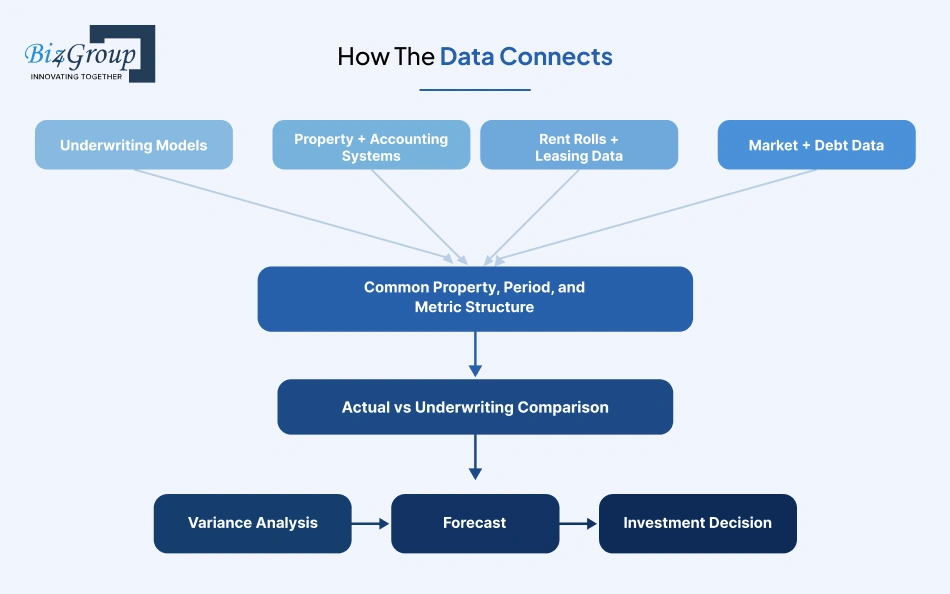
Systems such as ARGUS Enterprise, Yardi, MRI, RealPage, and CoStar can remain part of the existing technology stack. The investment layer connects their outputs rather than forcing every system into one platform.
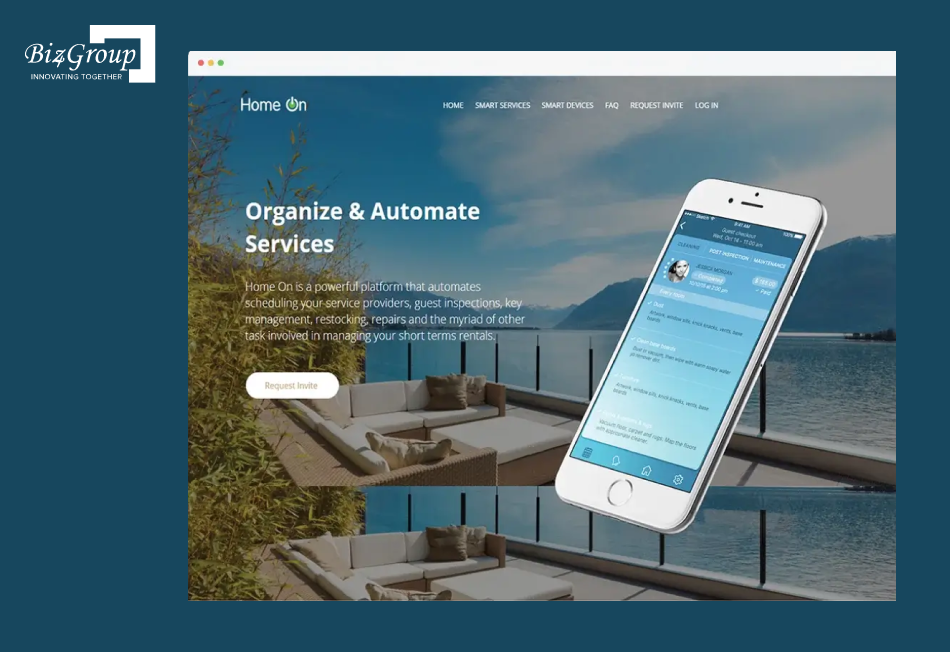
For example, HomeOn, developed by Biz4group brings inspections, maintenance, scheduling, and property tasks into one operational view. For a CRE investment team, the takeaway is practical, when property activity is already structured and accessible, it becomes easier to connect those operating events with financial results, underwriting assumptions, and the decisions that follow.
The critical requirement is consistent data structure. Property IDs, reporting periods, occupancy definitions, revenue categories, and NOI calculations need common rules so the platform compares equivalent measures.
For commercial real estate portfolio analytics, this creates a single analytical chain from source data to investment decision instead of separate reports for each system.
Also Read: AI Real Estate Lease Management Software Development
How Can AI Improve CRE Underwriting Variance Analysis?
AI can turn a variance from a number into an explanation by connecting property, leasing, financial, market, and underwriting data. Instead of simply showing that NOI is below plan, it can identify the likely drivers, assess whether the change is recurring, and show how it could affect the investment outlook.
1. It Traces the Drivers Behind Major Variances
AI can follow relationships across the investment data:
NOI ↓ 8% → rental revenue ↓ 5% → occupancy ↓ 3 pts → delayed renewals → higher vacancy
The same logic can connect higher expenses to repairs, insurance, taxes, utilities, or other recurring costs.
2. It Separates One-time Events from Recurring Changes
An 8% expense increase does not always require a forecast revision. AI can examine historical data and supporting records to distinguish a one-time roof replacement from recurring insurance increases or maintenance costs.
3. It Connects Operating Changes to Investment Outcomes
AI can trace how an operating change affects the broader investment case:
Lower renewals → higher vacancy → lower revenue → lower NOI → lower valuation → weaker projected returns
This makes commercial real estate investment analytics more useful for asset managers and investment committees.
4. It Answers Investment Questions in Context
Instead of asking teams to search multiple reports, AI can answer questions such as:
- Why is NOI below underwriting?
- Which assets have recurring expense variances?
- Which lease renewals are affecting the forecast?
- What changed since the acquisition case?
- How would 2% lower rent growth affect projected returns?
AI should explain and surface evidence, not silently change investment assumptions. Every explanation should link back to its source data, show the relevant calculation or driver, and allow authorized users to review or override the conclusion.
The key principle is simple: AI should sit on top of trusted CRE data and investment logic, not compensate for weak data foundations.
For leasing-related analysis, AI can also examine tenant behavior and renewal signals. A separate example of this application is tenant retention AI agents for CRE, where AI is applied to tenant-related signals rather than treating leasing activity as an isolated report.
How Can a CRE Investment Platform Turn Variance into Action?
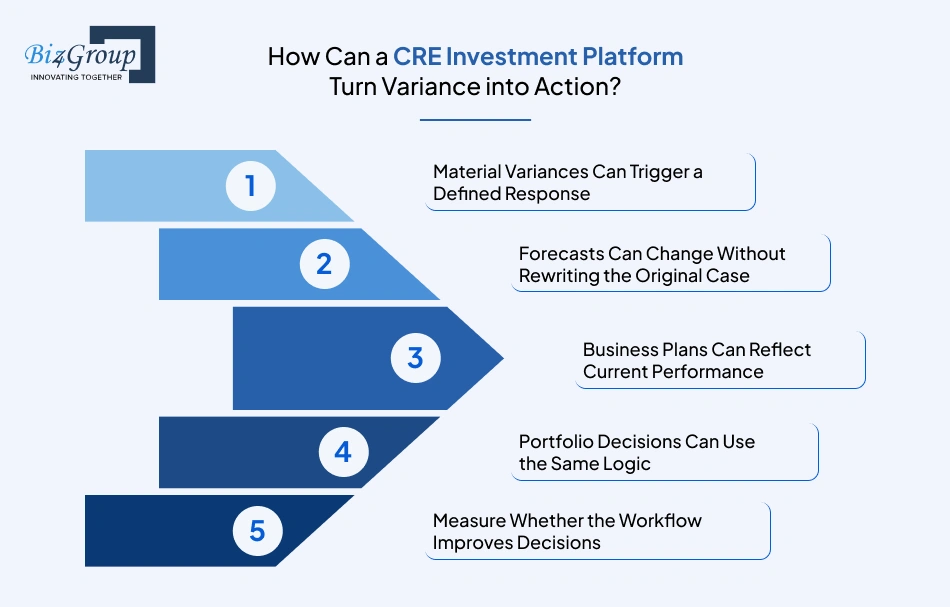
A commercial real estate investment platform turns performance variance into action by linking material changes to forecasts, management reviews, business plans, and portfolio decisions. The goal is to shorten the path from "something changed" to "here is what we should do next."
1. Material Variances Can Trigger a Defined Response
For example:
NOI 9% below underwriting → occupancy is 3 points lower → two renewals delayed → $350K forecast impact → asset-manager review
The platform can route the variance to the right owner, attach the supporting data, and track the resulting action.
2. Forecasts Can Change Without Rewriting the Original Case
If rent growth, occupancy, expenses, or capex assumptions no longer hold, the team can update the forward forecast while preserving the acquisition baseline.
This makes actual vs projected real estate performance useful for planning rather than just reporting.
3. Business Plans Can Reflect Current Performance
A persistent variance may require a leasing strategy change, revised operating budget, additional capex, refinancing review, or updated exit assumptions. The platform should connect the revised forecast to the relevant business-plan action.
4. Portfolio Decisions Can Use the Same Logic
At portfolio level, teams can distinguish between temporary issues and structural changes across assets. One property may need a leasing response, another may require expense control, while a third may warrant a broader investment review.
5. Measure Whether the Workflow Improves Decisions
Useful KPIs include:
- Time from variance detection to review
- Time to investigate material variances
- Forecast update cycle time
- Manual reconciliation hours
- Percentage of material variances with documented drivers
- Percentage of assets with current forecasts
- Forecast accuracy over time
The real outcome is not more alerts. It is a shorter, more traceable path from actual performance → explanation → revised outlook → investment action.
How Does a CRE Investment Platform Support CRE Investment Management Teams?
A commercial real estate investment platform gives acquisitions, asset management, portfolio management, and investment committees a shared investment view, while letting each team focus on the decisions specific to its role.
|
Team |
What They Need |
How the Platform Helps |
|---|---|---|
|
Acquisitions |
Original deal assumptions and post-acquisition performance |
Preserves the investment case and creates feedback for future underwriting |
|
Asset management |
Drivers behind operational and financial variances |
Connects performance changes to leasing, expenses, capex, and business-plan actions |
|
Portfolio management |
Consistent asset-level comparisons |
Standardizes KPIs and identifies patterns across properties and strategies |
|
Investment committee |
Current performance and investment implications |
Shows original assumptions, actuals, forecast changes, and material risks in one view |
The benefit is continuity. Each team works from the same underlying data and investment history instead of rebuilding the analysis for its own reporting needs.
Also Read: Building an AI Enabled Asset Data Management Automation Platform for Modern Real Estate Company
What Should Be Core and Advance Features in CRE Investment Platform Development?
A custom CRE investment platform should establish a reliable investment foundation before adding advanced AI. Core capabilities make underwriting, actuals, variance analysis, forecasting, integrations, and governance dependable. Advanced capabilities can then automate deeper analysis and improve decision speed.
|
Capability |
Core |
Advanced |
|---|---|---|
|
Underwriting |
Original assumptions, versioning, business plans |
AI-assisted assumption analysis |
|
Performance |
Revenue, rent, occupancy, expenses, NOI, capex |
Predictive signals and anomaly detection |
|
Variance analysis |
Actual vs underwriting, thresholds, drivers |
AI-generated explanations and pattern detection |
|
Forecasting |
Current and scenario forecasts |
Automated sensitivity analysis |
|
Portfolio analytics |
Consistent property and portfolio KPIs |
Cross-property predictive insights |
|
Investment queries |
Dashboards and drill-downs |
Natural-language questions |
|
Governance |
Permissions, approvals, version history, audit trails |
AI output traceability and confidence controls |
|
Data foundation |
Integrations, definitions, source tracking, lineage |
Automated data-quality monitoring |
A Practical Delivery Path
- Phase 1: Foundation — Data model → integrations → underwriting baseline → actuals → permissions and lineage.
- Phase 2: Investment workflow — Variance analysis → materiality rules → driver analysis → forecasting → scenario management.
- Phase 3: Intelligence — AI variance explanations → natural-language queries → predictive signals → automated scenario analysis.
The principle is simple: build the trusted investment workflow first, then add intelligence to it. This reduces implementation risk and gives the team a usable platform before advanced capabilities are introduced.
What Should You Look for in a Commercial Real Estate Investment Platform?
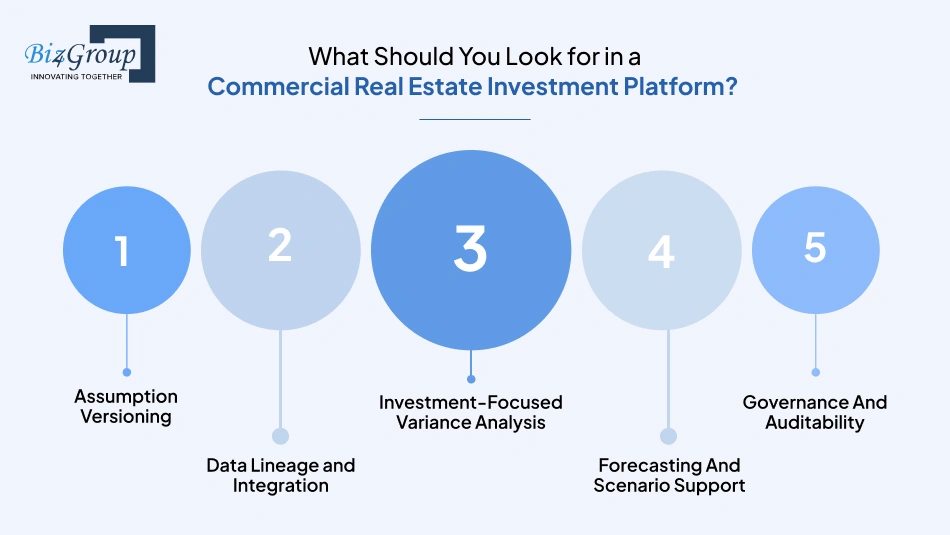
A commercial real estate investment platform should be evaluated on whether it can preserve investment history, connect trusted data, explain variances, support changing forecasts, and fit your governance model. The right platform should improve the investment workflow, not simply add another reporting layer.
1. Assumption Versioning
The platform should preserve the original acquisition case alongside business plans, current forecasts, and scenarios. Teams should be able to see what changed, when it changed, and why.
2. Data Lineage and Integration
Every important figure should be traceable to its source, reporting period, and transformation. The platform should also integrate with the property, accounting, leasing, underwriting, market, and debt systems already in use.
3. Investment-Focused Variance Analysis
Look for variance workflows that go beyond red and green indicators. The platform should identify material changes, show their drivers, and connect them to NOI, valuation, cash flow, and return implications.
4. Forecasting And Scenario Support
Teams should be able to update forward assumptions without changing the original underwriting. Base, upside, and downside scenarios should show how changes in occupancy, rents, expenses, capex, financing, or exit assumptions affect the investment outlook.
5. Governance And Auditability
Role-based access, approvals, version history, and audit trails should be built into the workflow. AI-generated analysis should also remain traceable and reviewable before it influences investment decisions.
How Much Does a Custom CRE Investment Platform Cost?
A custom commercial real estate investment platform can range from roughly $75,000 to $150,000+ for a production platform with multiple users, integrations, dashboards, workflows, and data processing. Enterprise implementations with extensive integrations, AI, security, data migration, and portfolio scale can reach $150K–$250K+. These are planning ranges, not fixed quotes, because scope and architecture have a major impact on cost.
|
Platform Scope |
Planning Range |
Typical Scope |
|---|---|---|
|
Focused MVP |
$25K–$75K |
Core underwriting, actuals, variance workflow, basic dashboards |
|
Multi-role platform |
$75K–$150K |
Multiple teams, integrations, forecasting, permissions, reporting |
|
Enterprise platform |
$150K–$250K+ |
Complex integrations, AI, advanced analytics, security, scale, data migration |
What Drives the Cost?
The main cost drivers are data integrations, migration, investment logic, AI capabilities, security, portfolio scale, and workflow complexity. Connecting Yardi, ARGUS, leasing, accounting, market, and debt data requires more work than building a standalone analytics interface.
The initial build is only part of the budget. Teams should also account for:
- Data cleanup and historical migration
- API or third-party integration fees
- Cloud infrastructure and data storage
- AI model and API usage
- Security testing and compliance requirements
- User training and rollout
- Ongoing maintenance and support
- Changes to workflows after initial deployment
How To Optimize Development Cost?
Start with the investment workflow that delivers the most value: underwriting baseline → actuals → variance → forecast → action. Build reliable integrations and governance first, then add advanced AI, predictive analytics, and automation in later phases.
A phased approach reduces unnecessary upfront development while keeping the architecture ready for future capabilities. The goal is not to build fewer features. It is to build the right capabilities in the right order.
Your CRE Systems Already Have the Data. They Just Don't Talk Investment.
No need to replace everything. Build the missing connection. Let's map your current systems into one investment workflow.
Connect With Biz4GroupShould You Build, Buy, or Partner for a CRE Investment Platform?
The right approach depends on how closely your investment workflow fits existing tools and how much control you need over data, AI integrations, AI, and investment logic. Buy when standard capabilities are enough, build when the workflow is highly proprietary, and partner when you need custom capabilities without building the entire product team internally.
|
Approach |
Best Fit |
What to Consider |
|---|---|---|
|
Buy |
Standard CRE workflows and established requirements |
Faster deployment, but customization and proprietary logic may be limited |
|
Build |
Large teams with strong internal product and engineering capabilities |
Maximum control, but requires ongoing technical resources and ownership |
|
Partner |
Teams that need a tailored platform without building everything internally |
Balances customization with access to specialized development expertise |
When Each Approach Makes Sense
Buy when:
- Existing platforms cover most of your underwriting and portfolio workflows.
- Required integrations are already available.
- Standard reporting and forecasting meet your needs.
Build when:
- Your underwriting methodology is highly proprietary.
- You have an established internal product and engineering team.
- The platform will become a core part of your long-term technology strategy.
Partner when:
- Existing tools leave important workflow gaps.
- You need custom integrations, AI, or investment logic.
- You want control over the product without building the entire technical team internally.
If you choose the partner route, look for a team that understands both real estate workflows and AI product development. Your team defines the investment logic and business requirements. The partner handles architecture, integrations, AI capabilities, and delivery. Biz4Group builds AI-driven real estate applications, data workflows, integrations, and custom platforms.
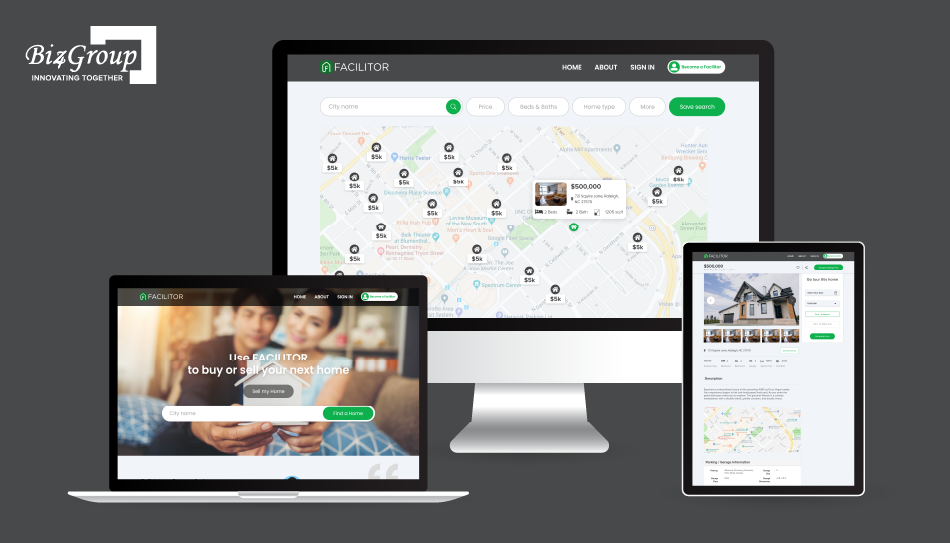
Biz4Group's Facilitor shows this approach in practice. It brings property search, AI recommendations, financial verification, location data, and communication together around a single real estate decision. A CRE investment platform needs the same design: data and workflows built around the decision, not another dashboard.
The decision comes down to one question: which approach gives your team the right balance of control, flexibility, development effort, and time to value?
Final Thoughts
A commercial real estate investment platform does not need to replace the CRE systems your team already uses. Its job is to connect them around the investment question that matters after acquisition: What did we underwrite, what actually happened, what changed, and what should we do next?
That requires more than a dashboard. The platform needs a reliable data structure, preserved underwriting versions, actual-to-underwriting mapping, materiality rules, forecasting, lineage, and governance. AI can then sit on top of that foundation to explain variances, surface patterns, answer investment questions, and test scenarios.
The build decision comes down to fit. Buy when existing tools cover the workflow. Build when the process is highly proprietary and you have the internal capability. Partner when you need a tailored platform, integrations, and AI without building the entire technical function yourself.
For teams taking the partner route, Biz4Group LLC brings experience across AI, real estate applications, integrations, and custom product development, including products such as Homer AI, HomeOn, and Facilitor.
If your team still needs spreadsheets to connect underwriting with actual property performance, it may be time to build the missing investment layer. Talk to Biz4Group about your CRE workflow, integrations, and platform roadmap.
FAQ’s
1. How long does it take to build a custom CRE investment platform?
The timeline depends on portfolio complexity, integrations, user roles, data migration, and AI requirements. A focused MVP can be developed first around underwriting, actual performance, variance analysis, and forecasting, with advanced capabilities added in later phases.
2. How much does a custom CRE investment platform cost?
A custom CRE investment platform can start around $25,000–$75,000 for a focused MVP, while a multi-role platform typically falls around $75,000–$250,000. Enterprise platforms with complex integrations, AI, security, data migration, and larger portfolio requirements can reach $250,000–$1M+. The final cost depends on scope, integrations, workflows, data complexity, and AI requirements.
3. Can a CRE investment platform integrate with Yardi, MRI, ARGUS, or other existing systems?
Yes. A custom platform can connect with property management, accounting, underwriting, leasing, market data, and debt systems through available APIs, data exports, or other integration methods. The important part is mapping data consistently so the same property, metric, and reporting period are interpreted correctly across systems.
4. Can existing underwriting models be migrated into a new CRE investment platform?
Yes. Existing models can be assessed and mapped into a standardized investment data structure. The migration should preserve key assumptions, model versions, historical forecasts, and relevant calculation logic rather than simply importing spreadsheet values.
5. How can AI be used in CRE investment analysis without replacing investment managers?
AI can handle analysis that is repetitive or difficult to perform across large datasets, such as explaining material variances, identifying relationships, detecting unusual changes, and testing scenarios. Investment managers can retain control over assumptions, approvals, forecasts, and final decisions.
6. What data security controls should a CRE investment platform have?
At minimum, the platform should support role-based access, permissions by portfolio or asset, secure integrations, audit trails, version history, approval workflows, and controlled access to sensitive financial information. The required controls should reflect the firm's investment governance and compliance requirements.
7. Can a CRE investment platform support multiple investment strategies?
Yes. The data model and workflows can be structured to support different asset types, markets, funds, investment strategies, underwriting methodologies, and reporting requirements while maintaining consistent portfolio-level metrics.
8. Can a custom CRE investment platform replace our existing CRE systems?
It does not necessarily need to. In many cases, the better approach is to keep established underwriting, property, accounting, leasing, and market systems in place and add an investment layer that connects their data to the firm's decision-making workflow.
9. What should we prepare before starting CRE investment platform development?
Start with the investment workflow rather than a feature list. Document the underwriting inputs, property data sources, key performance metrics, variance rules, forecast process, user roles, approval requirements, existing integrations, and the decisions the platform needs to support.
10. How do I choose a development partner for a custom CRE investment platform?
Choose a partner with experience in CRE investment platform development, data integrations, AI, security, and real estate workflows. Evaluate relevant projects, technical capabilities, and their ability to build around your investment process. Biz4Group is one example to consider for AI-driven real estate product development.
