 Location :
Orlando, FL, USA
Location :
Orlando, FL, USA +1 (407) 714-1616
 info@biz4group.com

 AI Summary Powered by Biz4AI
- Commercial tenant retention improves when businesses identify tenant dissatisfaction early instead of waiting until lease renewal conversations begin.
- Tenant retention AI agent development connects operational data, detects changing tenant behaviour, prioritizes at-risk tenants, and supports timely retention decisions.
- Successful implementations rely on high-quality data, balanced human oversight, continuous model refinement, and clear governance rather than automation alone.
- The right implementation approach includes phased deployment, seamless integration with existing property systems, measurable KPIs, and ongoing optimization for long-term value.
- Tenant retention AI agent development typically costs $30,000–$250,000+, with investment depending on portfolio size, integrations, AI capabilities, and business complexity.
- Biz4Group LLC helps commercial real estate businesses design, develop, and scale enterprise AI solutions with practical implementation expertise and long-term operational support.
How many commercial tenants show signs of leaving months before lease renewal conversations begin, yet remain completely invisible to property teams?
For many commercial property managers, tenant churn is not caused by a lack of effort. The challenge is recognizing dissatisfaction early enough to act on it. Maintenance complaints, changing space needs, declining engagement, and payment issues often emerge gradually across different systems, making it difficult to see the full picture until a renewal decision is already taking shape.
This is where tenant retention AI agents development is gaining attention across commercial real estate. Instead of waiting for annual reviews or lease renewal discussions, AI agents can continuously monitor tenant-related signals, identify emerging risks, and help property teams intervene while there is still time to influence the outcome.
Wondering why are we seeking this as the solution to your problem?
Commercial tenant turnover costs property owners an average of $31,927 per departing tenant, indicating that replacement costs can be 3× higher than retention costs. When every renewal directly impacts occupancy and revenue stability, earlier visibility into tenant risk becomes a business priority rather than an operational preference.
A proactive retention strategy can help property teams:
- Detect early warning signs before dissatisfaction escalates.
- Prioritize outreach efforts based on tenant risk levels.
- Reduce preventable churn across commercial portfolios.
- Create more consistent renewal and retention processes.
Organizations that strengthen tenant intelligence with AI-driven data practices have seen commercial tenant retention rates improve from 72% to 87%, highlighting the value of acting before problems become visible on the surface.
If what we just laid down seems like a solution, then this guide is built for you. We will walk you through the data, decision-making frameworks, business considerations, and the practical steps required to develop AI agents for tenant retention in commercial properties.
Why Traditional Commercial Tenant Retention Strategies Fail to Detect Churn Early
Most commercial property management teams are not operating with a shortage of tenant data. Lease information exists in one system, maintenance records live in another, and payment history is tracked elsewhere. Not only this, even tenant communications are often scattered across emails, calls, and service platforms. The challenge is that these signals rarely come together in a way that reveals emerging retention risks.
As a result, retention efforts often begin after dissatisfaction has already developed. Property managers may only become aware of a problem when a lease renewal conversation starts; a relocation discussion surfaces, or a tenant formally expresses concerns. By that stage, opportunities for meaningful intervention can be limited.
The issue is not a lack of data.
The issue is a lack of connected intelligence.
According to a report published by ResearchGate in January 2026 found that a 1-point increase in tenant satisfaction was associated with an 8.6% greater willingness to renew a lease and a 23.1% lower probability of moving out of a property. This highlights how closely tenant experience is tied to retention outcomes. Yet many property teams still rely on periodic reviews, isolated feedback channels, and manual monitoring methods that make it difficult to recognize changes in tenant sentiment before they influence renewal decisions.
Many traditional retention approaches can identify obvious problems. What they often miss are the gradual patterns that emerge across multiple touchpoints and accumulate over time.
Commercial Tenant Retention Visibility Gap Framework
|
Retention Method |
Why It Fails |
|---|---|
|
Annual tenant satisfaction reviews |
Feedback is collected long after dissatisfaction begins to develop. |
|
Manual portfolio reviews |
Monitoring depends on individual observations and limited review cycles. |
|
Complaint-driven retention efforts |
Action is triggered only after tenants raise visible concerns. |
|
Lease renewal discussions |
Potential churn risks may remain hidden until renewal decisions are already being considered. |
|
Disconnected operational reporting |
Important signals remain spread across multiple systems without a unified view. |
When viewed individually, a maintenance request, a delayed payment, or a change in communication frequency may not appear significant. The real challenge lies in recognizing how these seemingly unrelated events connect to form a broader picture of tenant satisfaction and retention risk before a tenant begins evaluating alternative options.
What Are Commercial Tenant Retention AI agents and How Do They Work?
Commercial tenant retention AI agents are intelligent systems designed to help property management teams identify emerging tenant retention risks before they turn into lease non-renewals. Rather than relying on periodic reviews or isolated observations, these agents continuously evaluate tenant-related activity across the property ecosystem and surface situations that may require attention.
At a high level, these AI agents for commercial tenant retention act as an intelligence layer between operational data and retention decisions. Their role is not to replace property managers but to help them recognize patterns, prioritize actions, and respond to potential concerns earlier in the tenant lifecycle.
Commercial Tenant Risk Intelligence Model
The workflow behind a tenant retention AI agent can be understood through a five-layer intelligence model that transforms scattered tenant activity into actionable retention insights.
Layer 1: Data Collection
- Information is gathered from the systems property teams already use to manage leases, maintenance requests, payments, communications, and tenant interactions.
- The objective is to create a unified view of tenant activity instead of relying on disconnected records.
- This layer ensures that relevant information is continuously available for evaluation.
Layer 2: Signal Analysis
- The agent reviews incoming activity and looks for patterns that may indicate changes in tenant behavior or experience.
- Events that appear insignificant on their own are analyzed within a broader operational context.
- This helps establish visibility into trends that are difficult to identify through manual monitoring.
Layer 3: Risk Detection
- The system evaluates emerging patterns and determines whether a situation requires additional attention.
- Potential retention concerns are surfaced before they become visible through traditional review processes.
- Property teams gain earlier awareness of developing tenant issues.
Layer 4: Retention Recommendations
- Once a potential concern is identified, the AI agent determines the most appropriate next steps based on the situation.
- Recommendations are designed to help property teams respond consistently and proactively.
- Suggested actions focus on improving visibility and supporting retention efforts.
Layer 5: Human Action
- Property managers review insights and decide how to engage with tenants.
- Human judgment remains central to relationship management, negotiations, and retention decisions.
- The agent supports decision-making while property teams maintain control over tenant interactions.
How Do Commercial Tenant Retention AI Agents Work?
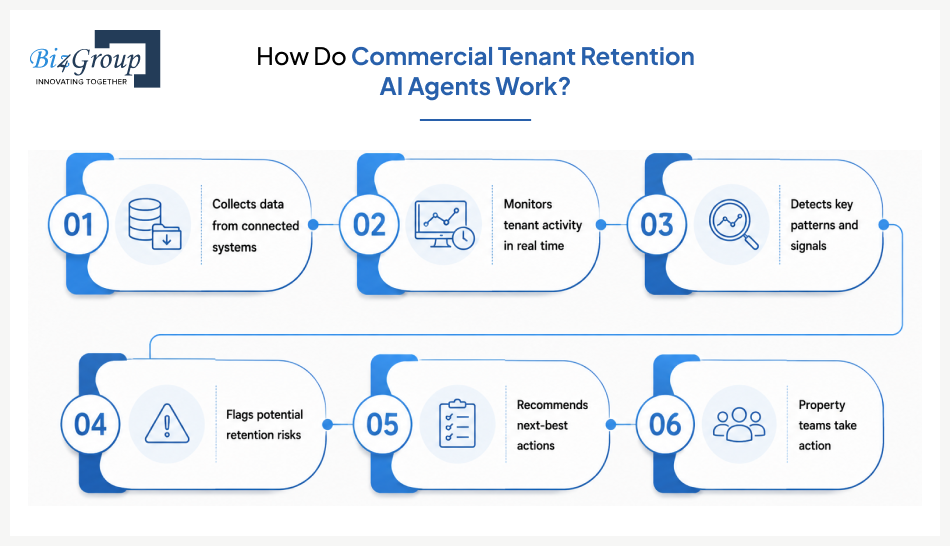
- Information enters the system from multiple operational sources.
- The agent continuously monitors activity as new events occur.
- Relevant patterns are identified and evaluated in context.
- Potential concerns are surfaced for review.
- Recommendations are generated to support retention efforts.
- Property teams determine and execute the appropriate response.
This intelligence cycle enables property managers to move from isolated observations to a more connected understanding of tenant relationships, creating greater visibility into retention risks before critical renewal decisions take shape.
Real-World Use Cases: How AI Agents Are Reducing Churn in Commercial Real Estate
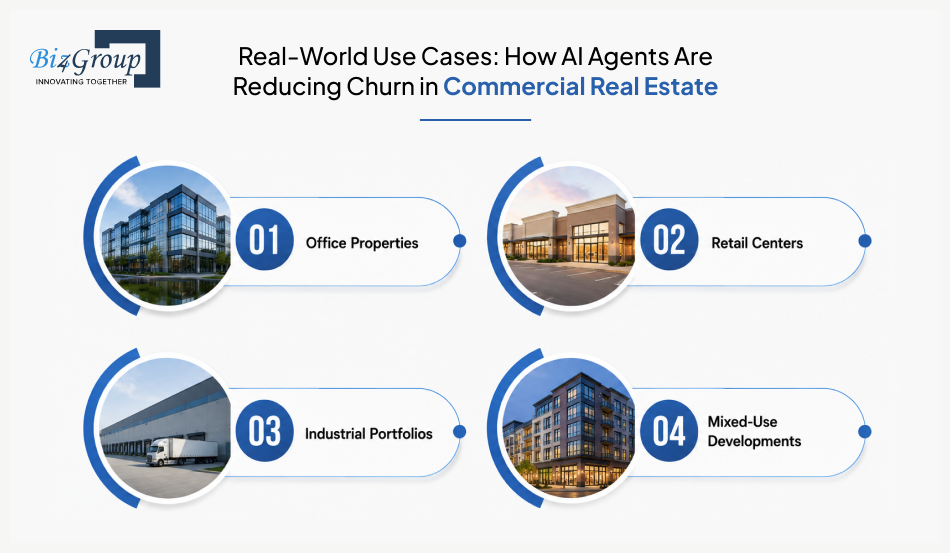
Tenant retention challenges rarely look the same across commercial properties. In some cases, dissatisfaction appears through unresolved service issues. In others, it surfaces through changing space requirements or declining engagement. I
If this sounds familiar, “I am running a commercial property management business, and we only find out a tenant is unhappy after they have already decided not to renew their lease. I want to know how an AI agent could actually flag at risk tenants early enough for us to intervene.”
Then, the following examples show how commercial property operators are identifying retention risks earlier and creating opportunities to intervene before tenants reach that stage.
1. Office Properties: Identifying Workplace Experience Issues Before Renewal Discussions
In office buildings, tenant dissatisfaction often develops gradually. A tenant may never submit a formal complaint, yet recurring maintenance requests, delayed resolutions, and reduced engagement with property management can signal growing frustration.
- Problem: Tenant experience declines without obvious warning signs.
- Signal: Repeated unresolved maintenance requests and reduced communication activity.
- AI Agent's Action: Detects a pattern of service-related dissatisfaction and prioritizes the account for immediate review.
- Business Outcome: Maintenance concerns are addressed before they become major objections during renewal conversations.
This allows property teams to focus on tenant experience issues while there is still time to rebuild confidence.
2. Retail Centers: Detecting Occupancy Risks Linked to Changing Business Conditions
Retail tenants often experience changing customer traffic patterns, staffing pressures, and operational challenges throughout their lease term. These factors can influence renewal decisions long before lease expiration approaches.
- Problem: Retail tenants quietly reassess whether the location continues to support business goals.
- Signal: Increased service requests, changing operating patterns, and declining engagement.
- AI Agent's Action: Identifies tenants showing signs of reduced property satisfaction and flags them for proactive outreach.
- Business Outcome: Leasing teams can engage tenants earlier to understand concerns and discuss occupancy plans.
Earlier engagement helps prevent important business concerns from remaining unnoticed until renewal season.
3. Industrial Portfolios: Recognizing Space and Operational Concerns Early
Industrial tenants regularly adapt their operations as demand, inventory requirements, and workflows evolve. When facilities no longer support those needs effectively, relocation discussions can begin long before property owners become aware of them.
- Problem: Operational growth creates friction between tenant requirements and facility capabilities.
- Signal: Frequent requests related to expansion, facility modifications, or workflow challenges.
- AI Agent's Action: Connects recurring operational requests and highlights tenants whose space requirements are changing.
- Business Outcome: Property managers gain an opportunity to address expansion needs before tenants begin evaluating alternative facilities.
This helps transform potential relocation discussions into retention opportunities.
4. Mixed-Use Developments: Connecting Signals Across Different Tenant Types
Mixed-use properties bring together office tenants, retailers, restaurants, and service businesses, each with different expectations and operational priorities. This makes retention challenges more difficult to identify through manual monitoring alone.
- Problem: Retention risks emerge across multiple tenant categories at different times.
- Signal: Service complaints, engagement changes, and operational concerns occurring across various tenant groups.
- AI Agent's Action: Brings together signals from different tenant types to create a unified view of emerging risks across the property.
- Business Outcome: Property managers gain portfolio-wide visibility into tenant health and can prioritize retention efforts more effectively.
A broader view of tenant sentiment helps ensure that smaller warning signs are not overlooked simply because they appear across different tenant groups.
Looking across these examples, one pattern becomes clear: tenant churn is rarely triggered by a single event. It typically develops through a series of signals that appear across day-to-day interactions. Identifying those signals early gives property managers more time to engage tenants, address concerns, and improve the chances of renewal.
Detect Tenant Churn Before It Impacts Renewals
Build a commercial tenant retention AI agent that uncovers hidden risk signals and helps property teams act before dissatisfaction turns into vacancy.
Assess My AI StrategyWhat Data Signals Should AI Agents Monitor to Identify At-Risk Commercial Tenants?
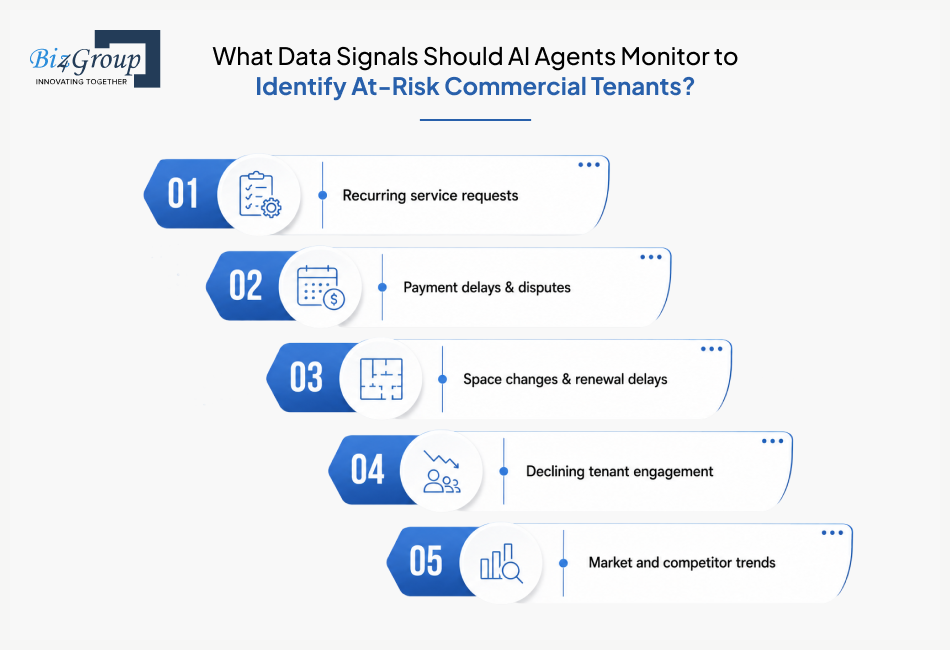
Identifying retention risks depends less on the amount of data available and more on knowing which tenant behaviors deserve attention. This is where many property leaders encounter a common challenge: "I am leading operations at a commercial property management company, and I want to build an AI agent for tenant retention. But I do not know what actual data signals are reliable predictors of a tenant planning to leave."
Well, the starting point is understanding which patterns consistently reveal changing tenant sentiment.
Commercial Tenant Risk Signal Library
|
Signal Category |
Example Indicators |
Why It Matters |
|---|---|---|
|
Maintenance Signals |
Repeated service requests, unresolved work orders, increasing complaint frequency |
Often reflects declining tenant experience and operational frustration |
|
Financial Signals |
Late payments, payment disputes, concession requests |
May indicate financial pressure or changing business priorities |
|
Lease Signals |
Space modification requests, downsizing discussions, renewal delays |
Can reveal changing occupancy requirements and commitment levels |
|
Communication Signals |
Reduced responsiveness, negative feedback, declining engagement |
Often signals weakening tenant relationships |
|
Market Signals |
Competitor property activity, local vacancy trends, rental market changes |
External factors can influence tenant retention decisions |
The following categories deserve close attention because they tend to reveal patterns that are difficult to identify through isolated reviews.
1. Maintenance Signals
Maintenance-related activity often provides one of the earliest indications of tenant dissatisfaction. A single service request is rarely a concern. However, recurring issues, unresolved work orders, or increasing complaint frequency can suggest that tenant expectations are not being met. What makes these signals valuable is their consistency over time rather than the severity of any individual incident.
2. Financial Signals
Financial activity can reveal changing business conditions that influence future occupancy decisions. Patterns such as recurring late payments, payment disputes, or requests for financial accommodations may indicate operational challenges within the tenant's business. While financial signals do not automatically suggest churn risk, sustained changes in payment behavior often warrant closer attention.
3. Lease Signals
Lease-related interactions frequently provide insight into how tenants view their future within a property. Requests involving space adjustments, discussions around occupancy needs, or delays in renewal-related conversations can indicate evolving requirements. These signals become particularly meaningful when they reflect a shift from previous leasing behavior.
4. Communication Signals
Changes in communication patterns can reveal shifts in tenant engagement. Reduced responsiveness, declining participation in property initiatives, or increasingly negative interactions may indicate growing dissatisfaction. These signals are valuable because they often capture sentiment that does not appear in operational or financial records.
5. Market Signals
Tenant decisions are not influenced solely by internal experiences. Market conditions also play an important role. Rising vacancy rates, new competing properties, and changing rental conditions can affect how tenants evaluate their options. Monitoring these external factors helps provide additional context around tenant behavior and expectations.
Taken individually, these signals may seem routine. Their value comes from understanding how they evolve over time and how they relate to one another. Organizations looking to develop AI tenant retention platform for commercial real estate often find that meaningful retention insights begin with identifying the right data signals before attempting to analyze anything else.
How AI Agents Calculate Tenant Health Scores and Churn Risk Levels
Monitoring tenant signals is only the first step. The real value lies in understanding how those individual signals are evaluated together to determine whether tenant sentiment is changing. This decision logic sits at the core of commercial tenant retention AI agent development, turning day-to-day operational data into meaningful retention intelligence before property teams review the information.
Tenant Health Score Framework
A tenant health score is calculated by assigning different levels of importance to the major categories of tenant activity. Rather than treating every signal equally, the AI agent evaluates how strongly each category reflects long-term tenant satisfaction and occupancy stability.
|
Signal Category |
Suggested Weight |
Why It Receives This Weight |
|---|---|---|
|
Maintenance Signals |
30% |
Service quality directly influences day-to-day tenant experience. |
|
Lease Signals |
25% |
Changes in lease activity often reflect evolving occupancy intentions. |
|
Financial Signals |
20% |
Consistent payment behaviour provides insight into business stability. |
|
Communication Signals |
15% |
Engagement patterns help reveal shifts in tenant sentiment. |
|
Market Signals |
10% |
External market conditions provide supporting context rather than primary evidence. |
The exact weighting can vary based on property type, tenant mix, and business priorities. What remains consistent is the principle of evaluating multiple categories together instead of relying on any single indicator.
How Different Signals Work Together
A maintenance complaint on its own rarely indicates that a tenant is preparing to leave. The same applies to a delayed payment or a postponed renewal discussion. Greater confidence comes from identifying several related changes occurring over a period of time. Looking at behavioural patterns instead of isolated events helps produce a more reliable assessment of tenant health.
Risk Classification Model
Once the combined tenant health score is calculated, it is grouped into broad risk categories that help organize tenant portfolios for ongoing review.
|
Tenant Health Score |
Risk Level |
|---|---|
|
81–100 |
Low Risk |
|
61–80 |
Moderate Risk |
|
41–60 |
High Risk |
|
0–40 |
Critical Risk |
These ranges provide a structured way to interpret tenant health scores while keeping the evaluation process consistent across different commercial properties.
A well-designed scoring framework gives meaning to the signals collected throughout the tenant lifecycle. Organizations looking to develop AI tenant retention platform for commercial real estate solutions often discover that accurate tenant health assessment depends less on the volume of data collected and more on how consistently that data is evaluated.
What Features Should a Commercial Tenant Retention AI Agent Include?
Understanding how an AI agent identifies tenant risk naturally leads to the next question: what capabilities should you actually look for? When evaluating the process to build proactive AI agents for tenant retention in commercial real estate, every feature should solve a specific operational challenge rather than simply expand a product checklist.
1. Core Tenant Intelligence
Strong tenant retention starts with complete visibility into each tenant relationship. These capabilities reduce the need to piece together information manually and help property teams understand tenant conditions from a single, reliable view.
|
Feature |
Business Value |
|---|---|
|
Tenant Health Score Engine |
Eliminates the need to manually review multiple tenant records before understanding overall tenant health. |
|
Unified Tenant Profile |
Brings operational, financial, lease, and communication data into one view, reducing fragmented decision-making. |
|
Tenant Activity Timeline |
Gives property managers historical context instead of relying only on recent interactions. |
|
Portfolio Health Overview |
Helps leadership quickly identify properties where tenant conditions require closer attention. |
2. Monitoring and Early Visibility
Retention opportunities often disappear because warning signs remain unnoticed. These capabilities focus on helping property teams recognize meaningful changes before tenant concerns become difficult to address.
|
Feature |
Business Value |
|---|---|
|
Early Warning Alert System |
Prevents important behavioural changes from remaining unnoticed until renewal discussions begin. |
|
Multi-Signal Monitoring |
Reduces the risk of overlooking tenant dissatisfaction by evaluating multiple operational patterns together. |
|
Tenant Trend Monitoring |
Helps distinguish temporary issues from consistent changes in tenant behaviour. |
|
Portfolio Heatmap |
Enables teams to identify properties showing higher concentrations of emerging tenant concerns. |
3. Decision Support
Collecting information alone does not improve retention. Property teams also need capabilities that simplify decision-making and help prioritize limited time and resources where they can have the greatest impact.
|
Feature |
Business Value |
|---|---|
|
Tenant Prioritization Queue |
Ensures high-priority tenant relationships receive attention before lower-impact accounts. |
|
Retention Recommendation Engine |
Reduces inconsistent decision-making by presenting standardized next-step recommendations for review. |
|
Explainable Risk Insights |
Helps property managers understand why a tenant requires attention, improving confidence in operational decisions. |
|
Historical Tenant Comparison |
Places current tenant behaviour in context by comparing it with previous engagement patterns. |
4. Portfolio Management and Executive Visibility
Commercial portfolios require decisions at both the tenant and portfolio level. These capabilities help leadership identify recurring retention trends and allocate resources more effectively across multiple properties.
|
Feature |
Business Value |
|---|---|
|
Portfolio Performance Dashboard |
Gives executives a consolidated view of tenant health across all managed properties. |
|
Property Comparison Dashboard |
Helps identify locations experiencing recurring tenant satisfaction challenges. |
|
Retention Performance Reporting |
Measures how tenant conditions change across different properties over time. |
|
Executive Portfolio Summary |
Supports strategic planning with a high-level view of portfolio-wide tenant health and retention trends. |
A valuable tenant retention AI agent is defined less by the number of capabilities it offers and more by whether each feature addresses a real operational challenge. Keeping business value at the center of every evaluation leads to stronger technology decisions and better outcomes when organizations build proactive tenant retention AI agents.
How Much Autonomy Should a Tenant Retention AI agent Have and When Should Humans Stay in the Loop?
Identifying tenant risks is only one part of the equation. The next decision is determining how much authority the AI should actually have. As organizations move toward building AI tenant retention software for reducing churn in commercial real estate, the objective should be to automate operational intelligence while keeping business accountability where it belongs with property teams.
Tenant Retention AI Autonomy Matrix
|
Activity |
AI Agent Leads |
Human Reviews |
Human Leads |
|---|---|---|---|
|
Monitor tenant activity across connected systems |
✓ |
|
|
|
Detect behavioural changes and emerging patterns |
✓ |
|
|
|
Organize tenant information into a unified view |
✓ |
|
|
|
Prioritize tenants requiring attention |
|
✓ |
|
|
Recommend retention strategies |
|
✓ |
|
|
Draft tenant communication for review |
|
✓ |
|
|
Approve tenant outreach |
|
✓ |
|
|
Conduct tenant meetings and discussions |
|
|
✓ |
|
Negotiate lease renewals or commercial terms |
|
|
✓ |
|
Approve financial concessions or incentives |
|
|
✓ |
|
Make final tenant retention decisions |
|
|
✓ |
Now let’s look at what you should do and why?
1. Automate Repetitive Analysis, Not Business Judgment
Reviewing thousands of tenant interactions, maintenance updates, lease activities, and communication records is repetitive work that benefits from AI automation tools. AI agents can evaluate these activities continuously and consistently, helping property teams avoid spending valuable time searching for emerging concerns across disconnected information sources.
Also Read: AI Business Process Automation for Modern Enterprises
2. Keep Relationship Decisions Under Human Ownership
Commercial tenant retention extends beyond operational data. Renewal discussions often involve business priorities, financial negotiations, long-term partnerships, and unique tenant circumstances that cannot be fully understood through historical records alone. These conversations require context, negotiation skills, and professional judgment that remain the responsibility of property managers.
3. Use AI Recommendations as Decision Support, Not Final Decisions
Recommendations become significantly more valuable when they support decision-making rather than replace it. AI agent can organize information, identify potential retention concerns, and present consistent recommendations, but every important tenant action should be validated by the people responsible for maintaining the relationship. This approach strengthens governance while reducing the risk of inappropriate or poorly timed decisions.
The strongest governance model is not measured by how many responsibilities can be automated. It is measured by how clearly decision ownership is defined. Organizations investing in tenant retention AI agent development achieve more reliable outcomes when AI accelerates analysis while property teams retain authority over every business-critical decision.
Increase Commercial Tenant Retention by Up to 15%
Turn disconnected maintenance, lease, and communication data into actionable insights with tenant retention AI agent development built for commercial real estate.
Estimate Your ROICustom Tenant Retention AI Agent vs PropTech Retention Platform: Which Is the Better Investment?
Once you've identified what an AI agent should do and where human oversight belongs, another question that we stumbled upon from our audience was, “I am running a commercial real estate portfolio and I am trying to decide whether to build a custom AI tenant retention agent or buy an existing PropTech platform with retention features built in and I want a clear comparison of cost and flexibility for each option.”
Well, the right choice depends on how your portfolio operates today and how you expect it to evolve over time, and we surely can help you solve that confusion. Taka a Look:
1. When a PropTech Retention Platform Makes More Business Sense
When every property follows the same leasing process, similar tenant engagement practices, and consistent renewal workflows, introducing a fully customized AI solution often creates more complexity than business value. In these situations, a mature PropTech platform can deliver meaningful retention improvements without requiring extensive operational change.
A PropTech retention platform usually makes better business sense when you want to:
- Keep technology costs predictable through a subscription-based investment.
- Introduce retention capabilities without redesigning existing operational workflows.
- Depend on vendor-managed upgrades instead of maintaining custom software internally.
- Work with standardized integrations that already support your daily property operations.
- Improve operational efficiency without investing in extensive customization.
2. When a Custom Tenant Retention AI Agent Becomes the Better Investment
As portfolios expand, operational consistency becomes harder to maintain. Office buildings, retail centers, industrial facilities, and mixed-use developments rarely follow identical tenant journeys. Once retention strategies begin varying across properties, standardized software often requires the business to adapt its processes instead of supporting them.
A custom tenant retention AI agent becomes the stronger investment when you need to:
- Shape retention workflows around business objectives instead of software limitations.
- Retain ownership of the decision logic that determines how tenant risk is evaluated over time.
- You can connect multiple internal systems through tailored AI integration services, allowing tenant intelligence to reflect how your organization actually operates.
- Expand into new markets or property types without rebuilding retention processes from the ground up.
- Continuously refine retention strategies through specialized AI automation services as business priorities evolve.
Also Read: Top 10 AI Automation Companies in USA
3. When a Hybrid Approach Delivers the Best of Both
Treating this as a build-or-buy decision can be limiting. Many commercial real estate organizations achieve better results by keeping their existing PropTech platform responsible for property operations while introducing a custom AI layer focused entirely on tenant retention intelligence. This approach protects previous technology investments while adding capabilities that standard platforms often cannot provide.
A hybrid strategy is worth considering when you want to:
- Preserve existing property management workflows instead of replacing familiar systems.
- Introduce AI capabilities without disrupting day-to-day leasing and maintenance operations.
- Add intelligent retention decision support while continuing to use your current PropTech platform as the operational backbone.
- Expand AI capabilities gradually as portfolio requirements become more sophisticated.
- Reduce implementation risk by modernizing one business function at a time.
There is rarely a universally better investment. The stronger decision is the one that reduces operational friction instead of introducing it. Start with how your portfolio operates today, then choose the approach that can continue supporting your business as it grows. That mindset creates a stronger foundation for developing AI solutions for commercial tenant retention that deliver value well beyond the initial implementation.
What is the Recommended Technology Stack to Build Proactive Commercial Tenant Retention AI Agent
A well-designed AI architecture is less about selecting popular technologies and more about assigning every layer a clear responsibility. Organizations building scalable AI tenant retention platform for multi-property commercial portfolios benefit most when tenant information moves through a structured architecture where each layer supports the next instead of performing overlapping functions.
|
Architecture Layer |
Recommended Technologies |
Purpose |
|---|---|---|
|
Enterprise Data Sources |
Property Management System (Yardi, MRI Software, AppFolio), CRM, Lease Management, Maintenance Systems, ERP |
Acts as the starting point by supplying tenant, lease, financial, maintenance, and operational information from the systems your teams already use. |
|
Data Integration Layer |
REST APIs, GraphQL, Webhooks, ETL Pipelines |
Reliable API development ensures information flows securely between business systems without requiring organizations to replace their existing software. |
|
Central Data Storage Layer |
PostgreSQL, MongoDB, Snowflake |
Consolidates structured and unstructured tenant information into a single repository that supports portfolio-wide analysis. |
|
AI Intelligence Layer |
OpenAI, Anthropic Claude, Llama, Python |
Models developed through Python development evaluate tenant behaviour, identify emerging patterns, and generate contextual retention insights. |
|
Knowledge & Memory Layer |
Pinecone, Weaviate, ChromaDB |
Stores historical conversations, previous recommendations, and business knowledge so AI agents can make decisions with greater context instead of relying only on recent activity. |
|
Agent Orchestration Layer |
LangGraph, CrewAI, Temporal |
Coordinates multiple AI agents, manages task sequencing, and ensures different business activities work together as a unified retention process. |
|
Workflow Automation Layer |
Node.js, FastAPI, n8n |
Business services supported by NodeJS development translate AI insights into operational workflows, approvals, and task management across departments. |
|
Communication Layer |
Microsoft Outlook, Gmail, Microsoft Teams, Slack, Twilio |
Delivers notifications, internal collaboration, and tenant communication through the channels property teams already use. |
|
Dashboard & User Experience Layer |
React.js, Next.js |
Interfaces built through ReactJS development and NextJS development present tenant health, portfolio insights, and operational dashboards in an intuitive format for day-to-day decision-making. |
|
Security & Access Management Layer |
OAuth 2.0, Azure Active Directory, Okta |
Protects tenant information through authentication, role-based access, and secure user management across the platform. |
|
Monitoring & Observability Layer |
Prometheus, Grafana, ELK Stack |
Tracks system health, AI performance, workflow execution, and operational reliability to support continuous improvement. |
|
Cloud Infrastructure Layer |
Microsoft Azure, AWS, Google Cloud Platform, Docker, Kubernetes |
Provides scalable infrastructure capable of supporting enterprise workloads, high availability, and future portfolio expansion without redesigning the application. |
Enterprise AI agents deliver reliable results when each architectural layer performs one clearly defined responsibility. Data is collected, organized, analyzed, coordinated, and presented through independent layers that can evolve without disrupting the rest of the platform. That modular approach creates a stronger foundation for creating AI agents to improve tenant satisfaction and retention, while experienced full stack development services ensure every layer works together as a unified enterprise solution.
Also Read: Why to Choose the Full Stack Development for Modern Business
How to Develop Commercial Tenant Retention AI Agents To Improve Property Occupancy: Step-by-Step Implementation Framework
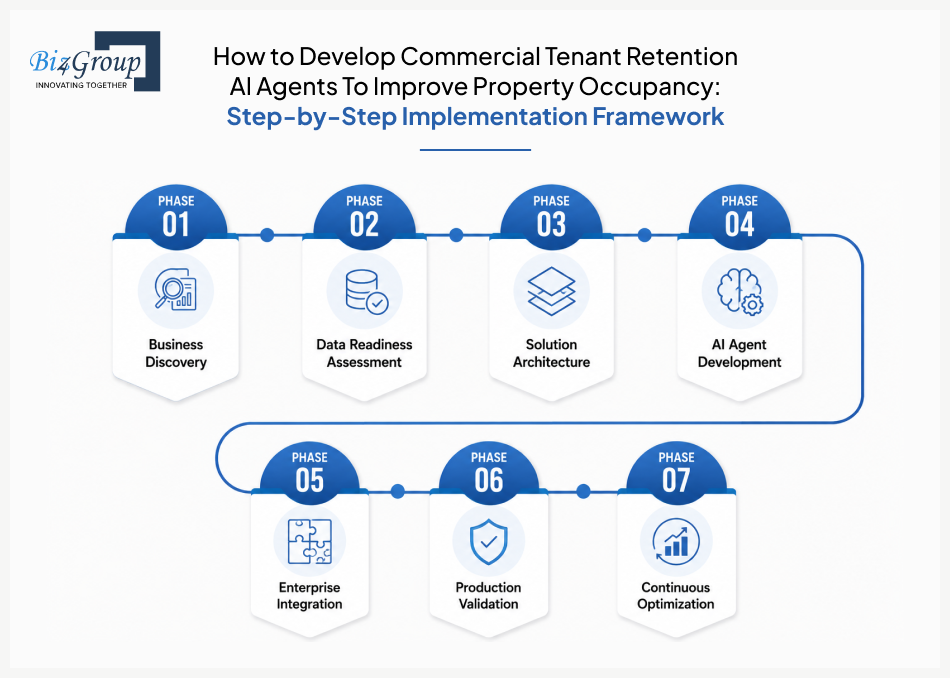
A successful AI implementation is determined less by development speed and more by implementation sequence. Organizations planning to build AI-powered agents for tenant engagement and retention achieve stronger business outcomes when every phase delivers a validated business asset before the next phase begins.
Phase 1: Business Discovery
Every implementation begins with one critical deliverable, a business blueprint. This document defines how tenant retention operates today, where operational gaps exist, what business outcomes the AI agent is expected to achieve, and which decisions should always remain under human ownership. Every technical activity completed later in the project should trace back to this blueprint.
By the end of this phase, your project should have:
- A documented tenant lifecycle covering onboarding, service requests, lease management, renewal planning, and tenant exit.
- A workflow gap analysis identifying where retention opportunities are currently missed.
- Clearly defined business objectives, measurable KPIs, and project success criteria.
- An approval framework establishing where AI recommendations end and human decisions begin.
- A prioritized implementation roadmap identifying the business processes to be automated during the first release.
Phase 2: Data Readiness Assessment
Reliable AI depends on reliable operational data. This phase confirms whether existing business systems contain enough connected, consistent, and trustworthy information to support accurate tenant retention decisions before development begins. Addressing data quality at this stage is considerably less expensive than redesigning AI workflows after implementation has started.
By the end of this phase, your project should have:
- A complete inventory of tenant, lease, maintenance, financial, communication, and occupancy data available across existing systems.
- A data quality assessment highlighting missing, duplicated, inconsistent, or outdated operational records.
- A data mapping document showing how information will move between connected business applications.
- A governance framework defining ownership, validation standards, access permissions, and ongoing data management responsibilities.
- A formal readiness assessment confirming the available information can support future AI reasoning and operational decision-making.
Also Read: AI Readiness Assessment for Startups and Small Businesses
Phase 3: Solution Architecture
The next deliverable is a production-ready solution blueprint that defines how every component of the AI platform works together before development begins. It establishes how operational data moves across the system, where AI agents make recommendations, how users interact with those recommendations, and how existing business applications remain connected throughout the workflow.
By the end of this phase, your project should have:
- A complete solution architecture showing how every platform component exchanges information.
- User journey blueprints designed with an experienced UI/UX design company to simplify decision-making for leasing teams, property managers, and portfolio leaders.
- AI workflow diagrams defining recommendation logic, approval paths, escalation points, and operational handoffs.
- An integration blueprint documenting how the AI agent exchanges information with existing enterprise systems.
- Security architecture covering authentication, user permissions, audit logging, and governance requirements.
Also Read: Top UI/UX Design Companies in USA
Phase 4: AI Agent Development
This phase transforms the approved architecture into a working AI solution capable of supporting day-to-day tenant retention decisions. Development should focus on delivering the highest-priority business capabilities identified during discovery instead of attempting to automate every workflow in the first release.
By the end of this phase, your project should have:
- A production-ready tenant retention AI agent created through structured AI model development using approved business rules and operational objectives.
- Intelligent workflows that monitor tenant activity, evaluate behavioural patterns, and generate contextual retention recommendations.
- Operational dashboards that present AI insights in a format aligned with different business roles.
- Approval workflows ensuring recommendations follow the governance model established during business discovery.
- A validated first release delivered through phased MVP development services, allowing operational teams to evaluate business value before expanding platform capabilities.
Also Read: Top MVP Development Companies in USA
Phase 5: Enterprise Integration
The AI agent becomes operational only after it exchanges information with the business systems employees already depend on. This phase connects every approved integration, validates information flow, and confirms that AI recommendations become part of existing operational processes instead of creating new ones.
By the end of this phase, your project should have:
- Secure integration with property management, lease administration, CRM, maintenance, financial, and communication platforms.
- Automated synchronization that maintains a consistent tenant record across connected systems.
- Verified data exchange confirming that AI agent’s recommendations are generated from current operational information.
- User access controls aligned with organizational roles and governance policies.
- End-to-end workflow validation demonstrating that business users can act on AI agent’s recommendations without leaving their existing operational environment.
Phase 6: Production Validation
Production deployment should begin only after the AI agent demonstrates reliable performance under real operating conditions. This phase confirms that recommendations support business decisions consistently, operational workflows function as intended, and property teams are confident using the platform before organization-wide rollout.
By the end of this phase, your project should have:
- A controlled production deployment across selected commercial properties representing different tenant and operational scenarios.
- AI recommendations validated against decisions made by experienced property managers and leasing teams.
- Performance benchmarks measuring recommendation accuracy, operational efficiency, user adoption, and business impact.
- Refined business rules based on feedback collected during production use.
- Formal rollout approval supported by validated business outcomes and governance reviews.
Phase 7: Continuous Optimization
Long-term business value depends on continuously improving the AI agent as commercial portfolios, tenant expectations, and operational priorities evolve. This phase ensures the platform remains aligned with changing business requirements while expanding its capabilities through controlled enhancements rather than large-scale redevelopment.
By the end of this phase, your project should have:
- Performance reviews comparing AI recommendations against the business objectives established during the discovery phase.
- Updated decision logic reflecting changes in leasing strategies, tenant engagement processes, and retention policies.
- Additional AI capabilities introduced after existing workflows consistently achieve expected business outcomes.
- Continuous monitoring that identifies opportunities to improve recommendation quality, operational efficiency, and user adoption.
- An expansion roadmap supporting new properties, regions, and business units without redesigning the existing platform.
A structured implementation roadmap reduces rework, strengthens adoption, and delivers measurable business outcomes because every phase establishes a validated foundation before the next begins. Following this sequence helps organizations make AI tenant retention agents for property management that continue improving as business needs evolve, supported by experienced full stack development services.
Planning a Commercial Tenant Retention AI Agent?
Our experts help commercial real estate businesses design, build, and deploy tenant retention AI agents tailored to their portfolios and operational workflows.
Schedule a Call with Our AI ExpertsHow Much Does It Cost to Develop Tenant Retention AI Agents for Real Estate?
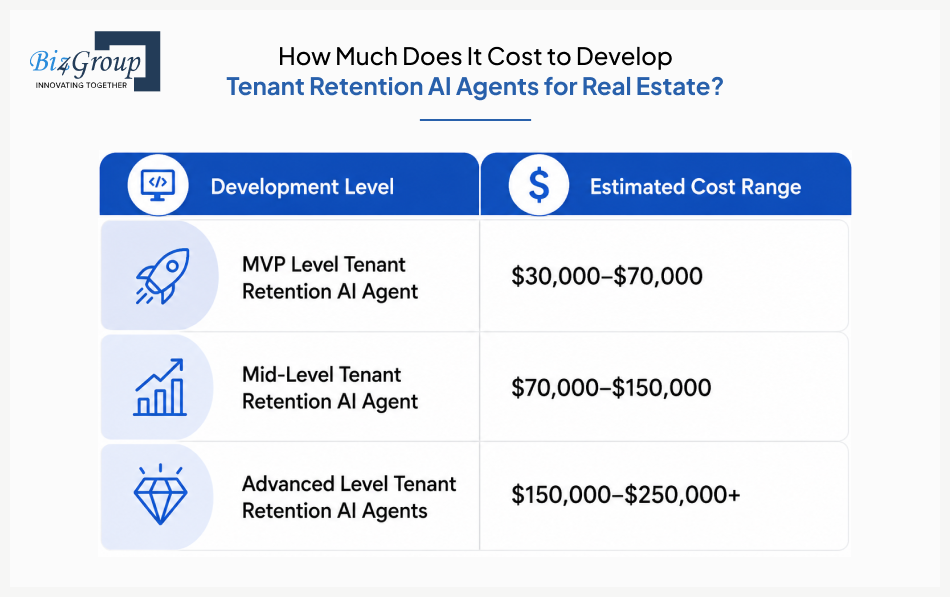
Budget planning usually starts with one question: how much should you realistically invest? For most organizations, tenant retention AI Agents development typically falls between $30,000 and $250,000+, depending on business objectives, implementation scope, integration requirements, and the level of operational intelligence expected from the platform. The breakdown below provides a practical starting point for estimating project investment.
|
Development Level |
Estimated Cost Range |
Typical Scope |
|---|---|---|
|
MVP Level Tenant Retention AI Agent |
$30,000–$70,000 |
Covers core tenant monitoring, basic risk detection, essential dashboards, limited workflows, and a pilot-ready deployment for validating business value. |
|
Mid-Level Tenant Retention AI Agent |
$70,000–$150,000 |
Expands the platform with multiple AI workflows, broader business automation, enterprise dashboards, advanced reporting, larger data volumes, and higher AI integration costs across existing property management systems. |
|
Advanced Level Tenant Retention AI Agents |
$150,000–$250,000+ |
Supports enterprise-scale portfolios with multiple AI agents, advanced decision intelligence, governance controls, multi-property management, custom integrations, high availability, and continuous optimization. |
The final investment depends less on the number of software screens and more on the operational complexity the AI agent must support. Expanding from a single commercial property to a multi-property portfolio, increasing business workflows, or integrating additional enterprise systems will naturally increase development effort and overall project cost.
Rather than estimating the budget around software features alone, define the business outcomes you expect during the first release, then expand the platform in controlled phases as operational requirements grow. This approach produces a more predictable AI agent development cost while allowing organizations to validate business value before making larger investments.
What Business Results Can Property Managers Expect from Tenant Retention AI Agents?
Business value should be measured through operational performance rather than software adoption. Why? Because the number of automations running in the background is not what you need. It's the business metrics that start moving in the right direction. These KPIs provide a practical way to measure whether your tenant retention strategy is delivering meaningful results.
|
Business KPI |
Expected Operational Impact |
|---|---|
|
Renewal Rate |
More lease renewals completed because tenant concerns are identified early enough to act before renewal decisions are finalized. |
|
Tenant Churn Rate |
Fewer avoidable tenant departures as property teams intervene before dissatisfaction leads to non-renewal. |
|
Portfolio Occupancy |
Stronger occupancy levels supported by higher tenant retention and fewer unexpected vacancies. |
|
Vacancy Duration |
Shorter vacancy periods by reducing the number of units returning to the leasing cycle. |
|
Property Manager Productivity |
More time spent resolving high-priority tenant issues instead of manually reviewing tenant activity across multiple systems. |
|
Retention Response Time |
Faster intervention after early risk signals appear, allowing property teams to engage tenants before problems escalate. |
|
Revenue Stability |
More predictable rental income through improved lease renewals and reduced turnover. |
|
Portfolio Performance Visibility |
Clearer prioritization of properties and tenants requiring immediate attention, helping managers allocate resources more effectively. |
The objective is not improving one KPI in isolation. Sustainable business value comes from improving renewal performance, protecting occupancy, reducing churn, and increasing operational efficiency simultaneously. Thus, monitoring these KPIs provides a practical way to measure long-term ROI after deployment.
What to Watch Out for When Implementing a Tenant Retention AI Agent (and How to Get It Right)
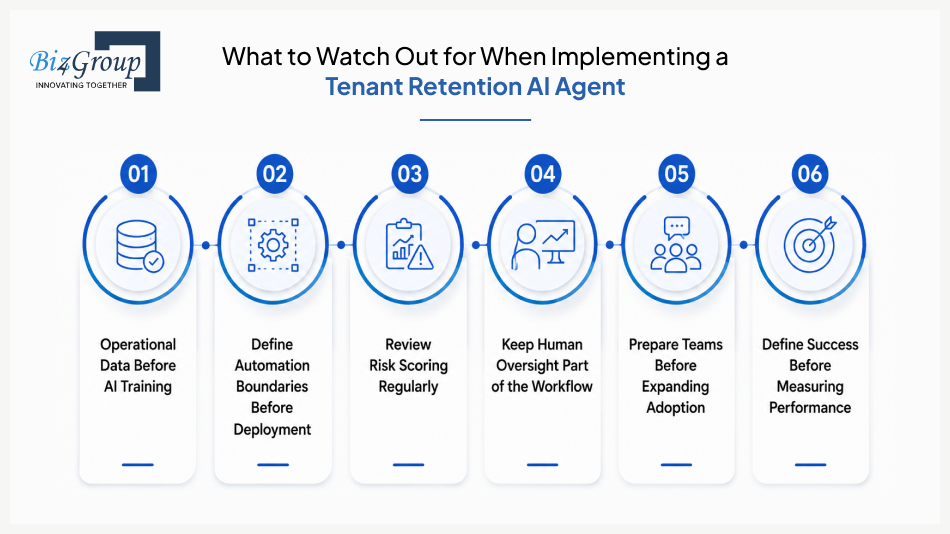
Even well-planned tenant retention AI Agents development projects can lose business value because of implementation decisions that seem minor at first. Paying attention to the following areas helps reduce unnecessary setbacks and gives your AI initiative a stronger foundation from the beginning.
1. Operational Data Before AI Training
Incomplete lease records, inconsistent maintenance histories, duplicate tenant profiles, or missing communication logs reduce the quality of AI recommendations. When operational data is unreliable, property teams quickly lose confidence in the platform.
How to get it right: Validate historical tenant data before model training begins. Standardize records across business systems, remove duplicate information, and establish data governance from day one. Work with an experienced AI development company that can help you evaluate data readiness before recommending AI training or automation.
Also Read: Top 29+ AI Development Companies in USA
2. Define Automation Boundaries Before Deployment
Giving the AI complete authority to communicate with tenants, negotiate renewals, or trigger major retention actions without review can create unnecessary operational and relationship risks.
How to get it right: Allow the AI to identify risks, prioritize opportunities, and recommend next steps while keeping lease negotiations, retention incentives, and high-value tenant decisions under human approval.
3. Review Risk Scoring Regularly
Tenant behaviour changes as occupancy trends, leasing strategies, and market conditions evolve. Risk models that are never reviewed gradually become less reliable, reducing confidence in future recommendations.
How to get it right: Measure predicted outcomes against actual renewal decisions at regular intervals. Update scoring logic whenever business patterns change instead of relying on fixed rules established during the initial deployment.
4. Keep Human Oversight Part of the Workflow
Operational data does not capture every business situation. Strategic tenants, unique lease negotiations, or exceptional circumstances still require human judgement beyond what the AI can evaluate.
How to get it right: Define governance before rollout begins. Clearly document which decisions the AI can support, which require approval, and which should always remain human-led. When you hire AI developers, ensure those governance rules are built directly into the platform rather than added after deployment.
5. Prepare Teams Before Expanding Adoption
Low user adoption is often caused by unclear workflows instead of poor technology. When property managers do not understand how recommendations are generated, they are less likely to use them consistently.
How to get it right: Train operational teams using real business scenarios instead of product demonstrations. Help users understand when to trust AI recommendations, when additional review is needed, and how those recommendations fit naturally into existing retention workflows.
6. Define Success Before Measuring Performance
Many organizations judge implementation success by platform activity instead of business results. Frequent AI recommendations or high login numbers do not necessarily indicate better tenant retention.
How to get it right: Measure outcomes against the objectives established at the beginning of the project. Renewal rates, tenant churn, occupancy, response time, and portfolio performance provide a much clearer picture of implementation success than software usage alone.
Every implementation decision you make today shapes the business value your AI agent delivers tomorrow. Taking the time to address these risks early puts you in a much stronger position to create AI-powered commercial tenant retention system initiatives that scale with confidence.
How Can We Help?
Commercial tenant retention AI initiatives succeed when technology aligns with real leasing operations, not the other way around. Over the past 20+ years, Biz4Group LLC has helped businesses solve complex operational challenges by building enterprise software that fits the way teams actually work. As an AI agent development company in USA, we approach every project with equal focus on business workflows, governance, adoption, and long-term scalability.
- Align AI decisions with commercial leasing and property management workflows instead of isolated automation with reliable AI consulting services.
- Design enterprise AI around measurable business outcomes, operational adoption, and continuous optimization.
- Deliver scalable enterprise AI solutions that support long-term portfolio growth rather than short-term technology implementation.
Conclusion
Every tenant interaction leaves behind signals that tell a story long before a renewal decision is made. The real opportunity lies in connecting those signals, understanding what they mean, and acting while there is still time to influence the outcome. That is where tenant retention AI Agents development creates lasting business value not by replacing property managers, but by helping them make better decisions with greater confidence and better timing.
Whether you manage a single commercial property or a large real estate portfolio, the goal remains the same: identify risk early, prioritize the right tenants, and intervene before dissatisfaction turns into churn. When that process becomes part of everyday operations, retention becomes a proactive business strategy instead of a last-minute response.
When you're ready to turn that strategy into a practical solution, partnering with a team experienced in AI product development services can help you move from planning to implementation with confidence.
FAQ’s
1. Can a commercial tenant retention AI agent work across multiple properties with different tenant types?
Yes, provided the platform is designed to support portfolio-level operations. A well-designed AI agent can evaluate office buildings, retail centers, industrial facilities, and mixed-use properties independently while applying property-specific retention rules, lease structures, and operational workflows. This allows organizations to maintain a centralized retention strategy without forcing every property to follow the same process.
2. How long does tenant retention AI agent development usually take from planning to deployment?
For most commercial real estate organizations, tenant retention AI agent development typically takes 3 to 15 weeks, depending on project scope, portfolio size, data readiness, system integrations, and deployment complexity. An MVP can often be delivered in 3–5 weeks, while enterprise implementations supporting multiple properties and advanced workflows generally require additional implementation and validation time.
3. How much does it typically cost to develop a commercial tenant retention AI agent?
The overall investment generally ranges from $30,000 to $250,000+. Smaller MVP projects focus on validating business value with core AI capabilities, while enterprise platforms supporting multiple commercial properties, advanced workflows, governance controls, and extensive integrations require larger investments. The final budget depends primarily on implementation scope rather than the number of software screens.
4. How can property managers measure whether a tenant retention AI agent is actually delivering ROI?
The most reliable approach is to compare business performance before and after implementation. Metrics such as lease renewal rates, tenant churn, occupancy levels, vacancy duration, response time to at-risk tenants, and portfolio revenue stability provide a much clearer picture of ROI than software usage or automation activity alone.
5. Can a tenant retention AI agent continue improving after deployment without rebuilding the platform
Yes. Modern AI platforms are designed for continuous improvement. As more operational data becomes available, organizations can refine decision models, update business rules, introduce additional retention workflows, and expand the platform across new commercial properties without replacing the existing solution.
6. What should commercial real estate companies evaluate before selecting a partner for tenant retention AI agent development?
Look beyond technical capabilities. Evaluate whether the team understands commercial leasing workflows, enterprise system integrations, AI governance, data quality, change management, and long-term platform scalability. A partner with experience delivering enterprise AI solutions is more likely to design a platform that supports real operational decisions rather than simply automating isolated tasks.
