Location :
Orlando, FL, USA
Location :
Orlando, FL, USA +1 (407) 714-1616
 info@biz4group.com


















Imagine a digital system that doesn’t wait for instructions but instead, understands your business goals, learns from real-time feedback, and takes independent actions to get the job done.
Read More

Ever felt buried under spreadsheets and property reports when a simple question about your portfolio should take minutes to answer? You are not alone.
Many real estate leaders wrestle with disjointed data from multiple systems. That slows decisions, frustrates teams, and leaves valuable insights out of reach. Real estate companies that want clarity and speed are asking themselves how to break free.
Data shows this shift is already happening in the market. Nearly 80% of real estate agents now use AI-based tools to handle tasks from scheduling to lead scoring and customer support, freeing human teams to focus on strategy and growth.
This reality makes AI asset data management automation platform development a priority for modern real estate businesses. Tools that centralize and automate asset data help companies:
Forward thinkers realize that if they want to lead, they must evolve how they collect, manage, and act on data. At the heart of this evolution lies the need to build AI powered asset data management platform solutions that unify property records, financials, and insights in one place.
This blog explores how to develop AI asset data management automation system the right way. By the end, you will understand why a tailored platform changes the game, what it must include, and how industry leaders are using these systems to stay ahead.
Before diving into features, costs, or technology, it helps to clearly understand what an AI enabled asset data management automation platform actually means in a real estate context.
Many platforms claim intelligence. Few solve the real problem. The real issue lies in how asset data is collected, organized, updated, and made useful for everyday business decisions.
This section breaks that foundation down in simple terms.
An AI asset data management automation platform is a centralized system that captures, organizes, and maintains real estate asset information with minimal manual effort. It acts as a single source of truth for property related data across residential and commercial portfolios.
Unlike traditional databases or static dashboards, this platform continuously improves how data flows and how it stays accurate. It learns from patterns. It flags inconsistencies. It supports faster decision making by keeping asset data clean, structured, and accessible.
At a practical level, such a platform manages data related to:
The goal is clarity. Leaders should not have to chase data across spreadsheets, emails, or disconnected tools to understand asset performance.
The platform works through a layered approach that keeps complexity behind the scenes while delivering clarity upfront.
Here is a simplified view of how it functions:
This approach removes friction from everyday operations while preparing the data foundation for deeper automation later.
The strength of this platform lies in its foundation. These components focus purely on data structure and flow, not on advanced features or technology stacks that will be covered later.
Below is an overview of the essential building blocks.
| Core Component | Purpose | Business Value |
|---|---|---|
|
Centralized Asset Repository |
Stores all asset data in one place |
Eliminates silos and duplication |
|
Data Classification Logic |
Organizes data into consistent categories |
Improves accuracy and reporting |
|
Automated Validation Rules |
Detects missing or incorrect data |
Reduces operational risk |
|
Portfolio Structuring Engine |
Groups assets logically by type or ownership |
Enhances portfolio visibility |
|
Audit Friendly Data Trails |
Tracks data changes over time |
Supports compliance and reviews |
Each component plays a specific role. Together, they create a stable and scalable data environment.
When you develop AI asset data management automation system capabilities correctly, the platform becomes a decision support backbone for modern real estate businesses. This foundation prepares companies to unlock deeper automation, intelligent insights, and long-term value.
Most firms collect asset data but never act on it. Automation turns dormant data into decisions that move portfolios forward.
Build Smart with Biz4GroupReal estate is changing fast. Old ways of recording information and manually managing data no longer work at scale. Both residential and commercial operators are feeling the pressure to modernize.
The global AI in real estate market is projected to grow to USD 41.5 billion by 2033. This represents strong appetite for automation and intelligent data solutions across real estate operations.
AI is not experimental anymore. Tools that can automate up to 37% of routine tasks create significant headroom for growth and efficiency within property management, leasing, administrative support, and risk functions.
And this shift is broad. Over 75% of U.S. brokerages and a similar share of agents have already adopted AI tools to enhance efficiency and consistency in marketing, content creation, and client engagement.
With these changes in motion, it is no longer a question of if real estate leaders should act but when they act to transform data operations.
Below is a snapshot of core pain points that real estate teams encounter before adopting advanced automation:
Key Operational Challenges
Let us look at how building an AI powered asset data management platform changes the game in practical terms.
| Pain Point Before Automation | What Automation Delivers | Business Benefit |
|---|---|---|
|
Data scattered in silos |
Centralized data repository |
Better visibility and alignment |
|
High manual workload |
Automated workflows |
Time savings and reduced errors |
|
Slow reporting |
Real time dashboards |
Faster decision cycles |
|
Fragmented insights |
Unified analytics |
Strategic clarity |
|
Inconsistent outputs |
Standard data governance |
Trustworthy results |
The table above simplifies how AI automation directly addresses the key challenges facing real estate teams today.
Here is a quick list of benefits that executives, operations leaders, and investors care about when they consider developing AI based solutions:
Here is the truth. AI adoption is rising. Siloed data is becoming a liability. Competitors are already leveraging smart systems. That means leaders who move faster gain advantage. Those who hesitate risk being left behind.
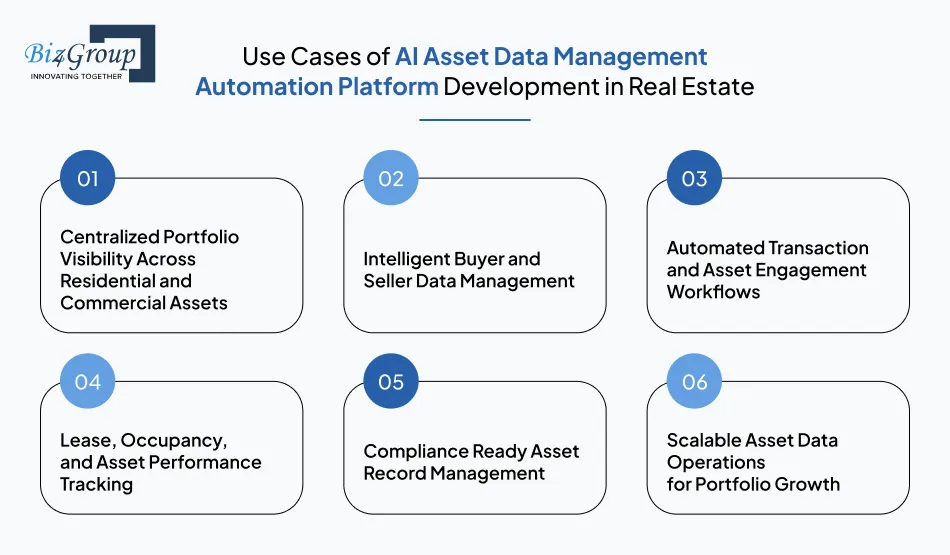
Every real estate organization interacts with asset data differently. The value of an automation platform becomes clear when viewed through real operational scenarios.
Below are the most relevant and high impact use cases where companies choose to develop AI asset data management automation system capabilities.
Large portfolios often suffer from fragmented visibility. Asset data lives in multiple systems, owned by different teams, and updated at different times.
An AI powered platform consolidates asset records into a single environment. It ensures that updates made in one area reflect everywhere else. Decision makers gain clarity on asset distribution, performance history, and portfolio structure without manual reconciliation.
Also read: Real estate ERP software development with AI guide
Real estate transactions generate massive volumes of asset related data tied to buyers, sellers, listings, and preferences. Managing this information manually leads to missed opportunities and slow response times.
By choosing to build AI powered asset data management platform solutions, companies can organize buyer and seller interactions as structured asset intelligence. Preference data, property attributes, and engagement history stay aligned with asset records, improving responsiveness and conversion outcomes.
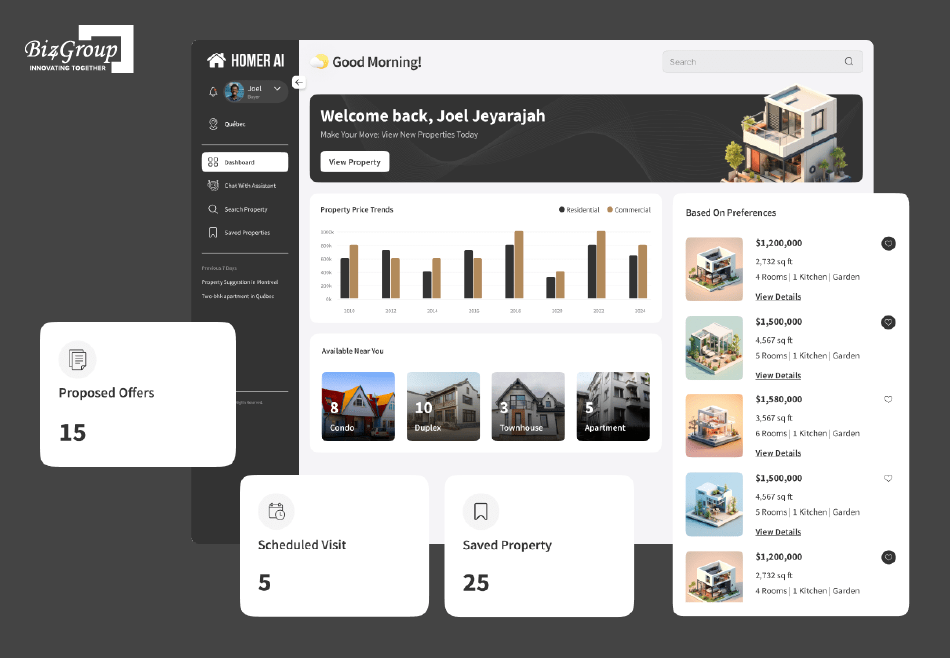
Biz4Group developed Homer AI, an AI based property management platform that demonstrates how intelligent data handling transforms buyer and seller engagement.
Homer AI supports this use case by:
This project shows how AI asset data automation solutions for real estate can improve engagement while maintaining accurate asset data across the platform.
Also read: Automate sales, inventory & customer service with retail AI agent development
Managing asset data during transactions involves financial verification, scheduling, communication, and documentation. Manual handling slows momentum and increases error risk.
An automated platform enables real-time asset engagement while keeping transaction data structured and reliable. Buyers, sellers, and facilitators interact through a unified system that maintains asset context at every step.
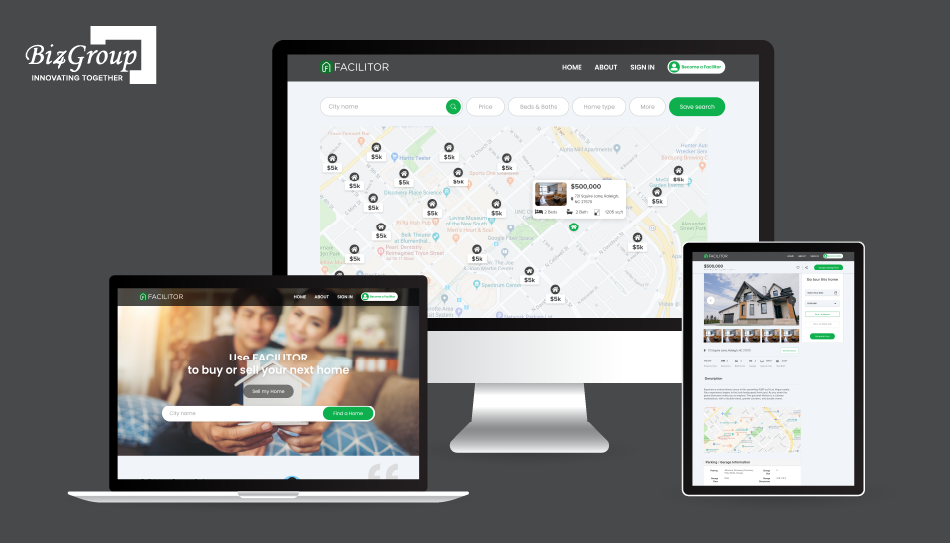
This real estate AI platform, developed by Biz4Group, reflects this use case through intelligent transaction enablement.
The platform supports asset data automation by:
This project demonstrates how AI powered asset data management systems for real estate companies can reduce friction and improve transaction confidence.
Also read: How to build an AI property recommendation app?
Tracking leases and occupancy across multiple properties requires consistent and reliable data. Manual tracking often leads to outdated records and reporting delays.
An AI enabled platform keeps lease data synchronized with asset records, making lease management hassle-free. Occupancy changes, historical performance, and timeline tracking remain accurate across portfolios. Asset managers gain a clearer picture of utilization and revenue trends.
Real estate firms face increasing regulatory scrutiny. Asset records must be complete, auditable, and up to date.
An AI powered real estate compliance software maintains structured audit trails and historical data continuity. It reduces compliance risks by ensuring asset changes are tracked consistently over time. Teams can respond faster to audits and internal reviews.
Growth introduces complexity. New properties, new regions, and new stakeholders strain traditional systems.
By choosing to develop intelligent asset data management system for real estate growth, companies ensure that asset data processes scale without adding operational overhead. Automation absorbs complexity while keeping data consistent and reliable.
Also read: How to create a scalable AI real estate SaaS product?
These use cases highlight how AI asset data management automation platform development adapts to real operational needs. In the next section, we will break down the important features required to support these use cases effectively and sustainably.
When asset data flows without friction, decisions happen quicker and opportunities do not slip away.
Tap Here for a Quick Chat with Biz4GroupA strong foundation determines whether an automation platform delivers long term value or becomes another tool teams avoid. The features below are the core capabilities every company must include when they create automated asset data management platform for real estate.
| Must Have Feature | What It Enables | Why It Matters for Real Estate |
|---|---|---|
|
Centralized Asset Data Repository |
Stores all asset related data in one unified system |
Eliminates data silos across departments and properties |
|
Asset Data Standardization |
Converts inconsistent data into a common structure |
Ensures reliable reporting across residential and commercial assets |
|
Automated Data Validation |
Detects missing, outdated, or conflicting records |
Reduces compliance risks and costly human errors |
|
Portfolio Level Asset Mapping |
Organizes assets by ownership, location, or category |
Improves portfolio visibility and strategic planning |
|
Role Based Data Access |
Controls who can view or edit asset information |
Protects sensitive data and supports governance |
|
Real Time Data Updates |
Reflects changes instantly across the system |
Keeps decisions aligned with current asset status |
|
Audit Ready Data History |
Maintains historical records of asset changes |
Supports regulatory reviews and internal audits |
|
Scalable Data Architecture |
Supports growth in assets and users |
Prevents performance bottlenecks as portfolios expand |
Each feature plays a clear role in operational stability. Together, they ensure that asset data remains accurate, accessible, and trustworthy as the organization grows.
Once these fundamentals are in place, companies can confidently move toward advanced capabilities that unlock deeper automation and intelligence across real estate operations.
Also read: AI property asset management software development guide
Once the foundational features are in place, advanced capabilities determine how far a platform can scale and how much strategic value it delivers. These capabilities focus on intelligence, foresight, and automation depth.
Asset data often arrives incomplete or inconsistent. Advanced platforms enrich asset records automatically by identifying gaps and improving data depth over time. This capability strengthens asset profiles and improves confidence in reports and analysis.
Historical data holds patterns that manual reviews often miss. Advanced platforms analyze trends to forecast asset performance. Predictive analytics helps asset managers anticipate risks, identify opportunities, and prioritize investments more effectively.
Contracts are a critical source of asset data. Advanced platforms extract, summarize, and organize contract information automatically, making contract management seem like a walk in the park.
This helps in document management by reducing review time and improving accuracy across lease and transaction records.
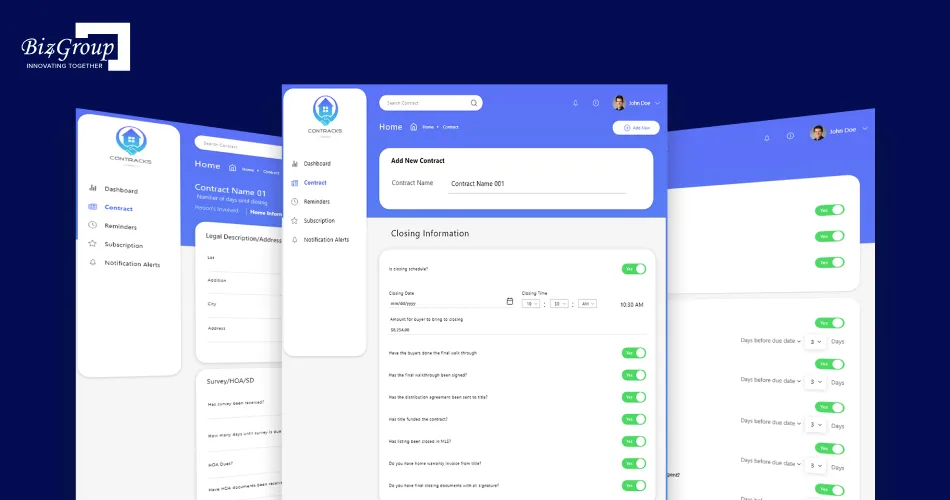
Biz4Group developed a real estate contract management platform that showcases intelligent document automation.
The project enables this advanced capability by:
This project demonstrates how AI powered asset data automation platform development improves document heavy workflows while preserving compliance.
Not all asset risks come from market performance. Tenant behavior and landlord credibility also influence outcomes. Advanced platforms incorporate trust intelligence into asset data to support better decisions.
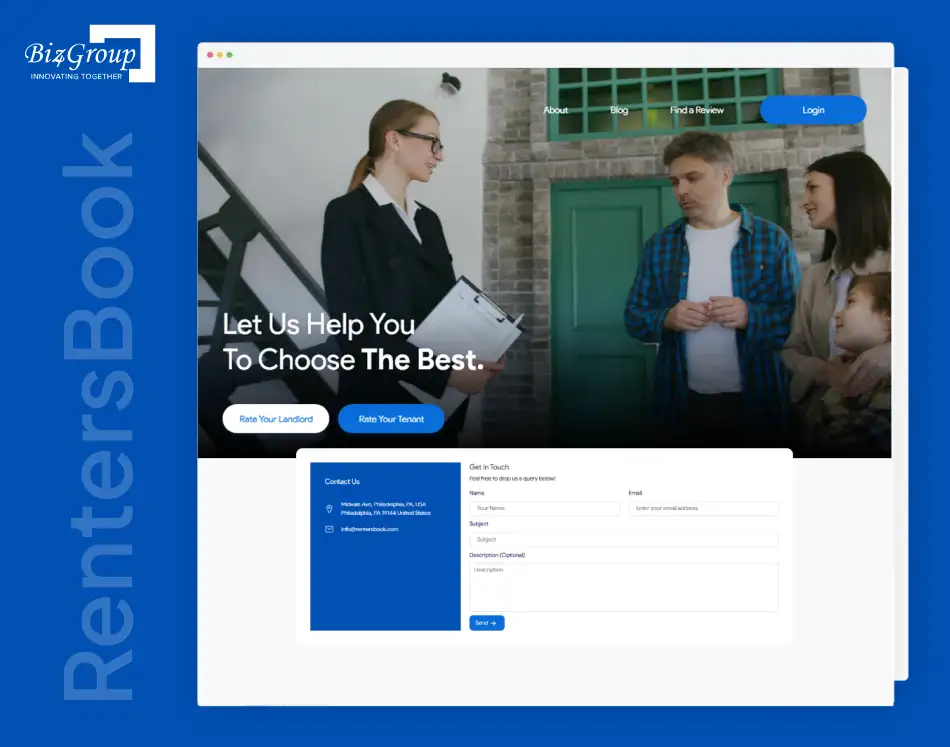
Developed by Biz4Group, this review and ratings platform for rental agreements highlights how trust data can strengthen asset intelligence.
The platform supports this feature through:
This capability helps companies create AI-driven asset data automation solutions for property portfolios that balance opportunity with risk awareness.
Also read: AI property rental calculation tool development guide
As portfolios grow, anomalies become harder to spot. Advanced systems monitor asset data continuously and flag unusual changes. This enables faster intervention before small issues turn into costly problems.
Also read: How to build an AI real estate fraud detection system?
Advanced platforms improve over time. They adapt to new data patterns and refine how asset information is organized and interpreted. This ensures that the system remains relevant as portfolios, regulations, and market dynamics evolve.
These advanced capabilities transform an automation platform into a strategic asset. They help organizations move beyond operational efficiency and unlock deeper insight, resilience, and growth.
Next, we will explore the recommended tech stack required to support these capabilities reliably and at scale.
Basic tools organize data. Advanced features prevent costly mistakes before they impact revenue or compliance.
Book a Strategy Call TodayChoosing the right technology stack plays a critical role in how scalable, secure, and adaptable the platform becomes over time. The goal here is not to chase trends, but to select proven tools that support reliability, flexibility, and long term growth.
The table below outlines a recommended tech stack aligned with real estate focused AI asset data management automation platform development.
| Platform Layer | Tools and Frameworks | Why This Layer Matters |
|---|---|---|
|
Frontend Interface |
React, Next.js, Angular |
Enables responsive dashboards and intuitive asset views for different user roles |
|
Backend Services |
Node.js, Python, FastAPI |
Handles business logic, data orchestration, and secure API communication |
|
Data Storage |
PostgreSQL, MongoDB, Amazon RDS |
Supports structured and semi structured asset data at scale |
|
AI and Data Processing |
Python, TensorFlow, PyTorch, Scikit learn |
Powers data classification, validation, and intelligent enrichment |
|
Workflow Automation |
Apache Airflow, Temporal |
Manages automated data pipelines and scheduled processes |
|
Cloud Infrastructure |
AWS, Microsoft Azure, Google Cloud |
Ensures scalability, high availability, and global access |
|
Integration Layer |
REST APIs, GraphQL |
Connects existing real estate systems and third-party services |
|
Monitoring and Logging |
Prometheus, ELK Stack |
Tracks system health, performance, and operational stability |
|
Security Foundation |
OAuth 2.0, JWT, IAM |
Protects asset data through authentication and access control |
A well-chosen tech stack reduces technical debt, shortens development cycles, and improves future adaptability. With this foundation in place, the next step is understanding how to bring the platform to life through a structured development process.
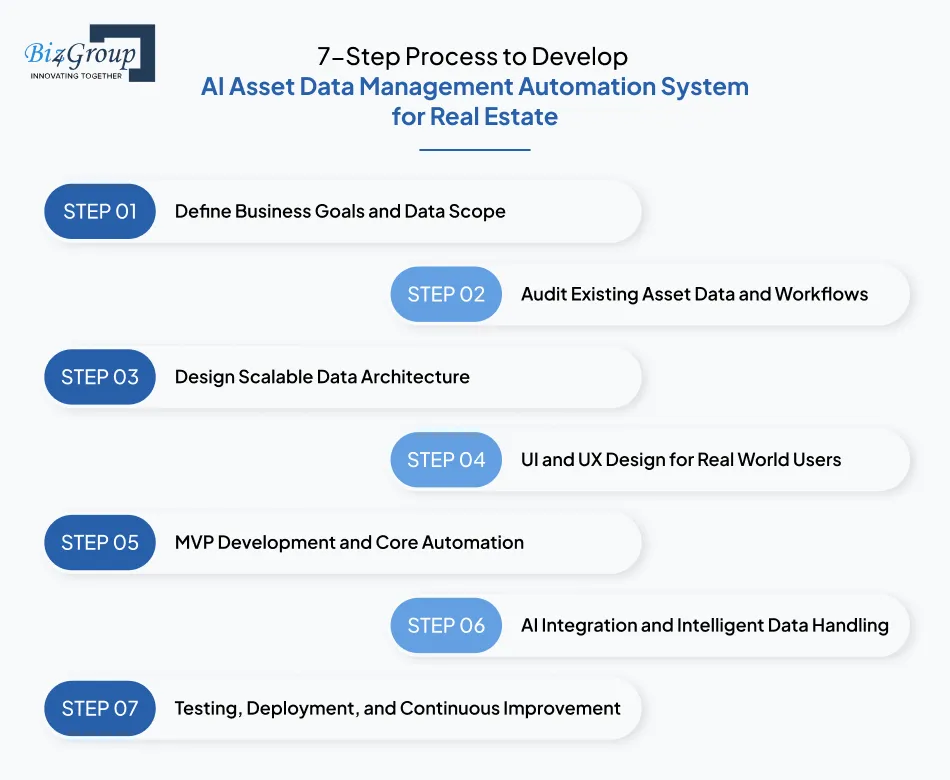
Building an intelligent asset data platform works best when approached with clarity and structure. Each step builds momentum, reduces risk, and keeps business goals in focus. Below is a proven seven step process that real estate companies follow to move from idea to impact.
Every successful platform starts with clarity. Teams must align on what problems the platform should solve and which asset data truly matters.
This step involves identifying key asset types, portfolio size, compliance needs, and decision makers. Clear goals prevent scope creep later and keep development grounded in business value.
Before automation begins, it helps to understand the current reality. This step reviews where asset data lives today and how it flows across teams.
Gaps, redundancies, and manual bottlenecks surface quickly. These insights guide smarter automation decisions and avoid rebuilding broken processes digitally.
Once gaps are visible, teams can plan how data should move in the future. This step focuses on structuring asset data for consistency and growth.
The goal is to create a flexible foundation that supports expansion without rework. Good architecture today saves cost and frustration tomorrow.
Even the smartest platform fails if people avoid using it. Strong UI and UX design ensures the platform feels intuitive and purposeful.
Working with an experienced UI/UX design company helps translate complex asset data into clear views. Well-designed interfaces reduce training time and boost adoption across teams.
Also read: Top 15 UI/UX design companies in USA
This is where ideas turn into something tangible. MVP development focuses on building the most valuable workflows first, not everything at once.
By launching a focused version early, teams can test assumptions, gather feedback, and validate ROI before scaling further.
Also read: Top 12+ MVP development companies in USA
With the core platform in place, intelligence enters the picture. AI integration enables data classification, validation, and enrichment to happen automatically.
This step improves accuracy while reducing manual intervention. Over time, the system becomes smarter and more reliable with real usage.
Before full rollout, the platform undergoes rigorous testing to ensure reliability and performance. Once deployed, monitoring begins immediately.
Feedback loops and performance metrics guide continuous improvement. The platform evolves alongside portfolio growth and changing business needs.
Following this step-by-step process helps real estate companies reduce risk, control costs, and deliver value faster. Each phase builds confidence while keeping the platform aligned with long term goals.
Next, we will explore security, regulatory compliance, and data governance, which are critical for protecting asset data and maintaining trust at scale.
Most delays happen before development even starts. A defined process keeps timelines predictable and costs under control.
Get Your Functional MVP in 3 WeeksWhen real estate companies centralize asset data, security and governance become non-negotiable. A platform that handles property records, contracts, and operational data must protect information at every level.
This section outlines the core areas leaders must address to maintain trust and compliance.
Modern real estate assets increasingly include connected devices. Smart buildings generate continuous data streams that must be protected and governed carefully.
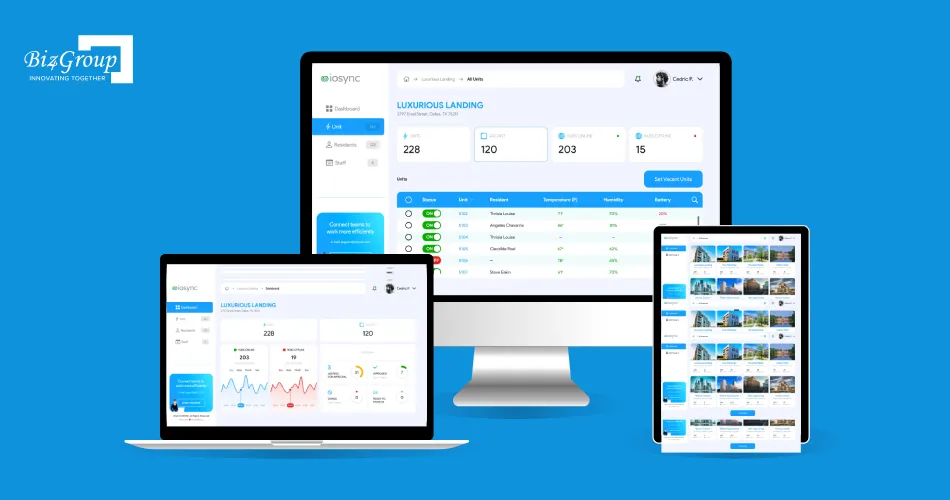
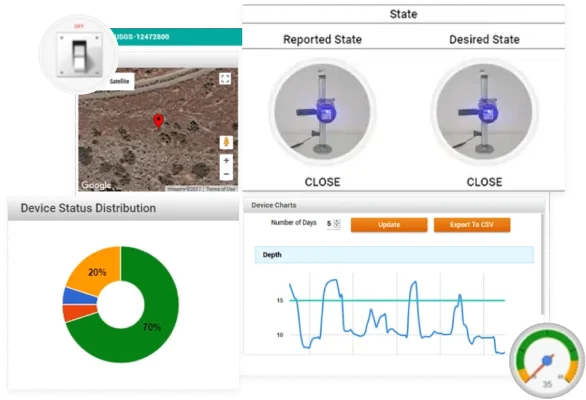
Biz4Group developed a smart home management platform for a leading smart device manufacturer. This project highlights how secure data governance extends beyond traditional asset records. Here’s how:
This solution shows how AI asset data management automation development must account for both digital records and live asset data generated by smart environments.
With security and governance in place, the next critical consideration is cost. In the following section, we will break down the cost of building an AI asset data management automation platform, including hidden factors leaders often overlook.
Before budgets get approved and timelines get locked, one question always comes up. How much does it actually cost?
On average, companies spend anywhere between $30,000-$150,000+ to build an AI powered asset data management platform, depending on scope, complexity, and long-term goals.
Some start small. Others build for scale from day one. Both approaches work when planned correctly.
To set expectations early, here is a quick view of cost ranges from MVP to enterprise scale.
| Platform Stage | What It Covers | Typical Cost Range |
|---|---|---|
|
MVP |
Core asset data automation, workflows, limited users |
$30,000-$50,000 |
|
Advanced Level |
Expanded automation, analytics, integrations |
$60,000-$100,000 |
|
Enterprise Scale |
Large portfolios, compliance heavy workflows, scalability |
$120,000-$150,000+ |
These ranges offer a starting point. The real cost depends on what drives complexity under the hood.
Every platform has unique cost drivers. Understanding them early helps avoid surprises later.
| Cost Driver | What Influences Cost | Typical Impact |
|---|---|---|
|
Data Volume and Complexity |
Number of assets, data sources, formats |
$5,000-$25,000 |
|
Automation Scope |
Depth of workflows and validation rules |
$10,000-$30,000 |
|
AI Model Customization |
Training, tuning, and refinement |
$8,000-$25,000 |
|
Integrations |
External systems and data sources |
$5,000-$20,000 |
|
Compliance Requirements |
Audit trails, security controls |
$5,000-$15,000 |
|
Scalability Planning |
Future growth readiness |
$7,000-$20,000 |
Each of these drivers compounds as portfolios grow. Planning for scale early often reduces long-term spend.
Even the best plans miss a few line items. These costs usually appear after launch if they are not anticipated.
These costs are not bad news. They simply need to be planned for realistically.
Spending wisely matters more than spending less. A few strategic choices can protect budgets while preserving quality.
These approaches often reduce total spend by 15%-25% over the platform lifecycle.
The cost of building an AI asset data management automation platform should be viewed alongside the cost of doing nothing. When built thoughtfully, the platform pays for itself through efficiency, accuracy, and faster decisions.
Up next, we will look at KPIs and success metrics that help measure whether the investment is delivering real business impact.
Also read: AI property management software development cost guide
Reporting delays, data errors, and rework silently drain budgets. Automation replaces recurring loss with long term value.
Let's Talk NumbersMeasuring success keeps the platform aligned with business goals. The right KPIs help leaders understand performance, adoption, and ROI without digging into technical details.
| KPI Category | Metric | What It Indicates |
|---|---|---|
|
Data Accuracy |
Error reduction rate |
Improvement in asset data reliability |
|
Operational Efficiency |
Time saved on reporting |
Reduction in manual workload |
|
Automation Impact |
Percentage of automated workflows |
Level of process automation achieved |
|
Platform Adoption |
Active users per month |
User engagement and acceptance |
|
Decision Speed |
Reporting turnaround time |
Faster access to insights |
|
Compliance Readiness |
Audit issue reduction |
Strength of governance controls |
|
Scalability |
Asset growth handled without performance drop |
Platform readiness for expansion |
|
Financial ROI |
Cost savings vs baseline |
Return on platform investment |
Tracking these metrics regularly ensures the platform continues to deliver value as portfolios evolve. Next, we will explore challenges, risks, and common mistakes, along with practical ways to mitigate them during development and rollout.
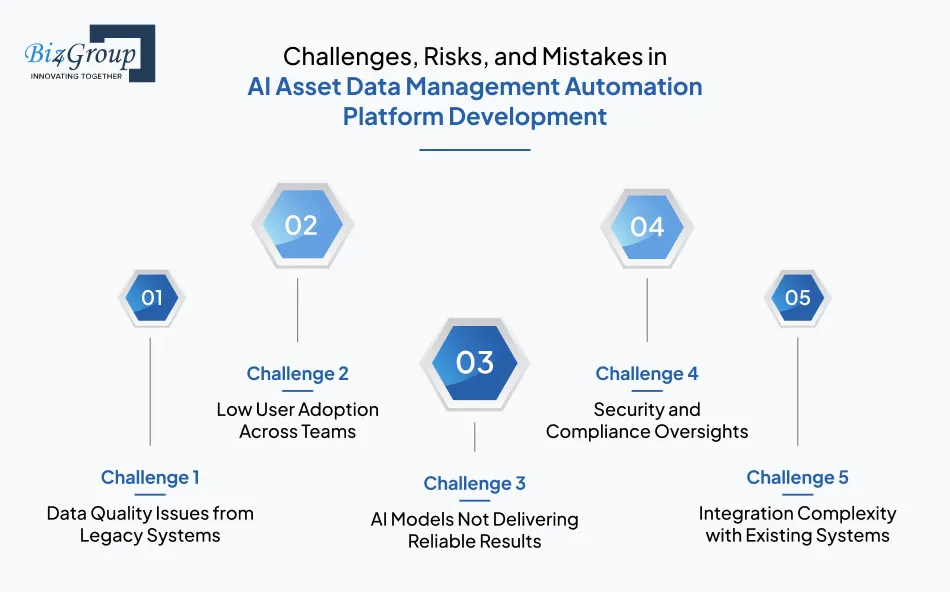
Every ambitious platform faces obstacles. The difference between success and frustration lies in anticipating them early and responding with the right strategy.
Below are the most common challenges real estate companies encounter and how to address them effectively.
Legacy systems often contain incomplete, duplicated, or inconsistent asset data. When automation relies on poor data, outcomes suffer.
How to mitigate this challenge:
Even well-built platforms fail when users resist change. Poor adoption usually stems from complex interfaces or unclear value.
How to mitigate this challenge:
AI outcomes depend on how AI models are trained and maintained. Poor tuning leads to inconsistent insights and erodes trust.
How to mitigate this challenge:
Real estate platforms handle sensitive financial and personal data. Weak security can result in regulatory and reputational damage.
How to mitigate this challenge:
Asset data often lives across ERPs, CRMs, and third-party tools. Poor integration planning causes delays and broken workflows.
How to mitigate this challenge:
Addressing these challenges early reduces risk and increases the likelihood of long-term success. The right strategy, tools, and partners turn complexity into competitive advantage.
Next, we will look ahead at future trends shaping AI asset data management automation for real estate companies.
Most failures come from poor planning, not poor ideas. Knowing the risks early saves time, money, and credibility.
Talk to Biz4Group's Experts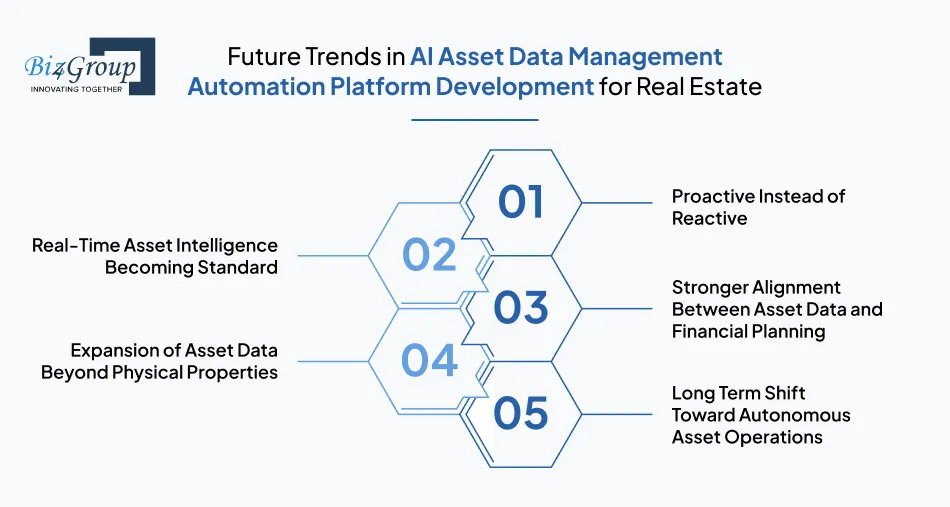
The real estate industry rarely changes overnight. It evolves in layers. AI asset data platforms are following the same path. Below are the most important trends shaping what these platforms will look like in the coming years.
Today, platforms organize and validate data. Tomorrow, they will actively suggest actions.
Systems will highlight underperforming assets early. They will recommend adjustments before issues show up in reports. Decision making will shift from response driven to foresight led.
Static reports will fade. Real-time data views will become the default expectation.
Asset managers will rely on continuously updated dashboards rather than scheduled reports. This shift will support faster operational adjustments across portfolios.
Asset data platforms will connect more closely with financial forecasting.
Budget planning, cash flow analysis, and capital allocation decisions will increasingly rely on unified asset data rather than separate financial tools. This alignment will improve confidence in long-term strategies.
Asset data will go beyond buildings and leases.
Platforms will manage digital twins, operational benchmarks, and performance indicators tied to assets. This expanded view will support smarter evaluations and comparisons across portfolios.
Over time, automation will handle more operational decisions.
Routine approvals, validations, and updates will require minimal human input. Teams will focus on strategy while platforms handle execution behind the scenes.
These trends point toward a future where asset data platforms act as intelligent partners rather than passive systems. Companies that prepare early will adapt faster and compete stronger.
Biz4Group LLC is a technology partner known for building complex digital platforms that solve real business problems. As a seasoned US-based software development company, we help real estate businesses modernize operations through intelligent automation and data centric platforms.
Our expertise extends deeply into AI development. We build platforms that apply intelligence where it matters most. From asset data automation to predictive insights, we understand how to align AI with business objectives. Every platform we develop reflects a balance between innovation and practicality.
Our real estate focused experience sets us apart. Through our work in real estate AI software development, we understand industry specific challenges such as compliance, portfolio complexity, and multi stakeholder workflows. That domain knowledge helps us build platforms that feel intuitive while remaining robust under scale.
When businesses partner with Biz4Group, they gain a technology ally that understands where they are today and where they want to go tomorrow. If you are ready to build an AI asset data management automation platform that delivers clarity and control, we’re here to help you.
We've done it before, and we’ll do it all again (and more) for you.
An AI enabled asset data management automation platform brings structure, accuracy, and clarity to complex portfolios. It centralizes information, reduces manual effort, and supports smarter decisions across residential and commercial assets. For real estate leaders, this shift creates stronger visibility, faster insights, and more confidence in every strategic move.
As portfolios grow and markets become more competitive, automation becomes less of an option and more of a necessity. Companies that invest in intelligent asset data systems position themselves to scale without chaos. They spend less time fixing data and more time using it. The result is better operational control, improved compliance readiness, and long term business resilience.
This is where Biz4Group stands out. As a software development company, Biz4Group brings proven experience in building AI powered platforms tailored for real estate businesses. From strategy to execution, our teams understand how to translate complex requirements into reliable, scalable solutions that deliver real impact.
If you are ready to take control of your asset data and build a platform that supports growth, clarity, and competitive advantage, now is the moment.
Connect with Biz4Group and let’s build something that moves your real estate business forward.
Most platforms take several months to reach a usable stage due to custom development and integrations. Biz4Group can deliver a functional MVP in 2-3 weeks by using reusable components and real estate focused frameworks. This approach cuts both development time and overall cost while enabling faster validation and scale.
Yes. A well-designed platform can support mixed portfolios by using flexible data structures that adapt to different asset types, ownership models, and operational requirements.
Customization depends on how the platform is designed. Many real estate companies choose tailored workflows, dashboards, and access rules to align with their internal processes and reporting needs.
Yes. AI asset data management systems are especially useful during expansion. They help consolidate new asset data quickly while maintaining consistency and visibility across the entire portfolio.
Modern platforms are built to adapt. Data models and governance rules can be updated without rebuilding the system, making it easier to stay compliant as regulations evolve.

with Biz4Group today!
Our website require some cookies to function properly. Read our privacy policy to know more.