Location :
Orlando, FL, USA
Location :
Orlando, FL, USA +1 (407) 714-1616
 info@biz4group.com

 AI Summary Powered by Biz4AI
- Live betting vs. pre-match betting requires a sportsbook architecture that shares core services while giving live betting its own real-time processing capabilities.
- Custom sportsbook platform development should centralize accounts, wallets, payments, administration, reporting, and betting while separating time-sensitive live workflows.
- Sports data and odds feed integration is critical for accurate event updates, market availability, odds changes, and consistent data across pre-match and live betting.
- Sportsbook security and compliance should cover KYC, AML, geolocation, responsible gambling, payment security, access controls, and jurisdiction-specific requirements.
- Custom sportsbook development cost can range from $30,000 to $500,000+, with the final budget shaped by live betting depth, integrations, data feeds, risk tools, infrastructure, and compliance requirements.
- Biz4Group LLC brings relevant sports betting experience, covering real-time odds, sports data, synchronization, scalable infrastructure, and high-volume betting activity.
What happens when a sportsbook has to keep up with the game while the game is still happening?
That is where live betting vs. pre-match betting becomes much more than a comparison between two betting formats.
Pre-match markets have time on their side. Live markets do not.
A soccer goal can change several markets within seconds. A red card can force a completely different pricing scenario. A tennis break can turn a calm betting screen into a very busy one.
For businesses planning custom sportsbook development, supporting both formats means building a platform that can handle two very different operating environments without turning the product into two disconnected systems.
The market itself is moving at scale. The American Gaming Association reported $16.96 billion in US sports betting revenue in 2025, generated from $166.94 billion in handle.
So, how do you build a sportsbook that supports pre-match and live betting?
This guide looks at the architecture, data feeds, risk controls, security, development roadmap, and budget behind a complete platform. It also covers pre-match betting platform development, live betting sportsbook development, and the practical technology choices that sit between the two.
The short version is simple.
Build one strong platform foundation. Give live betting its own real-time processing capabilities. Do not force every betting function into the same workflow.
That distinction can save plenty of headaches later.
What Is the Difference Between Pre-Match Betting and Live Betting?
Pre-match betting takes place before an event starts, while live betting takes place during the event and requires the platform to react to changing conditions in real time.
That sounds straightforward. The development difference is not.
Pre-match wagering gives operators more time to prepare fixtures, markets, odds, limits, and event information. Live betting works with a moving target.
A match starts. The score changes. A player is substituted. A market is suspended. New odds arrive. The platform has to keep pace.
Pre-Match Betting Works Around Prepared Markets
Pre-match betting is built around events that have not started yet.
The sportsbook can load fixtures in advance and prepare the relevant markets. Traders can configure prices, limits, and availability before the event begins.
Typical pre-match requirements include:
- Fixture management
- Event scheduling
- Market creation
- Pre-match odds feeds
- Team and player information
- Market limits
- Bet acceptance rules
- Pre-event risk controls
- Scheduled settlement workflows
The user experience is also more predictable.
A bettor can browse a soccer league, select a fixture, compare markets, and add a selection to the bet slip without watching the clock tick toward a new price every few seconds.
Live Betting Runs on Changing Event Data
Live betting, also called in-play betting, starts when the event starts.
The sportsbook now needs a constant flow of information.
A football touchdown can change several markets. A basketball foul can affect player props. A tennis break can shift game, set, and match prices.
The platform needs to know what happened, when it happened, which markets were affected, and what should happen next. That creates additional requirements for in-play betting platform development.
The Difference at a Glance
|
Area |
Pre-Match Betting |
Live Betting |
|---|---|---|
|
Timing |
Before the event |
During the event |
|
Data behavior |
More predictable |
Continuously changing |
|
Odds updates |
Scheduled or event-based |
Frequent and event-driven |
|
Market state |
Usually stable |
Can change quickly |
|
Bet acceptance |
Based on current pre-event conditions |
Requires current market validation |
|
Infrastructure |
More predictable demand |
Demand can spike during events |
|
User experience |
Browse and select |
Monitor, react, confirm |
|
Testing |
Functional and integration focused |
Functional, integration, event and load focused |
|
Risk conditions |
Pre-event exposure |
Exposure can change during play |
The important point is not that one format needs more features. It needs a different technical rhythm. That rhythm should influence architecture, data processing, testing, and infrastructure decisions later in the build.
What Should a Custom Sportsbook Share Between Pre-Match and Live Betting?
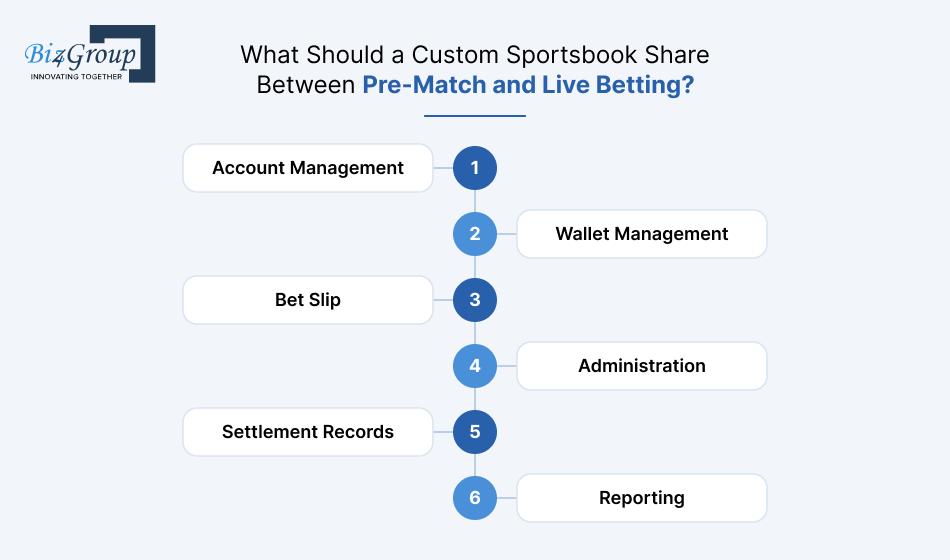
A complete custom sportsbook should share account, wallet, betting, administration, reporting, and core data services while keeping live event processing specialized.
This is where smart architecture saves a lot of duplicate work.
The platform does not need one account system for pre-match betting and another for live betting. That would be a strange way to spend a development budget.
The same principle applies to wallets, authentication, payment records, transaction history, and administration.
The Shared Platform Foundation
A custom sportsbook platform can use a common foundation for:
- Account Management — Registration, authentication, account preferences, responsible gambling settings, and account restrictions can serve both betting modes.
- Wallet Management — Deposits, withdrawals, balances, transaction records, and wallet reconciliation should remain centralized.
- Bet Slip — The same bet slip can support both formats. The difference lies in how quickly selections can change and how the platform validates them before acceptance.
- Administration — Operators need one back office for users, events, markets, transactions, reports, and configuration.
- Settlement Records — The transaction layer can maintain a consistent record of accepted wagers and settlement outcomes.
- Reporting — Operator reporting can use shared account and transaction data while separating live and pre-match activity for analysis.
What Needs to Stay Specialized?
Live betting needs specialized processing for:
- Event updates
- Rapid odds changes
- Market state changes
- Live event status
- Time-sensitive bet validation
- Data interruptions
- In-play market availability
The trick is to share the foundation without flattening every workflow into one generic process.
That is also why operators should define their platform boundaries early.
A strong sports betting app development company understands the business model, sports coverage, target jurisdictions, data providers, and live market depth before locking the architecture. That early planning can prevent expensive changes halfway through development.
How Should the Architecture Handle Both Betting Modes?
A sportsbook platform architecture should use shared core services with separate processing paths for pre-match and live market activity.
Picture the platform as a busy airport. The terminal is shared. The flight paths are not.
The account system, wallet, administration, reporting, and core betting services form the shared foundation. Live and pre-match workflows then use the services they need.
A Practical Sportsbook Architecture
|
Layer |
Main Responsibility |
|---|---|
|
Frontend |
Events, markets, odds, bet slip, account and live updates |
|
API layer |
Connects user interfaces with platform services |
|
Betting engine |
Validates and processes wagers |
|
Market service |
Manages market availability and configuration |
|
Odds service |
Receives and distributes odds |
|
Event processor |
Processes sporting events and status changes |
|
Risk service |
Monitors exposure, limits and acceptance rules |
|
Wallet service |
Manages balances and transactions |
|
Account service |
Handles users and authentication |
|
Data layer |
Stores events, bets, accounts and settlements |
|
Admin layer |
Gives operators control over platform activity |
|
Monitoring |
Tracks service health and platform events |
Where Does Live Betting Need More Muscle?
The live path needs an event processing layer that can handle incoming sporting events and trigger the appropriate downstream actions.
Imagine a soccer match.
A provider reports a goal.
The event processor identifies the fixture and event. The relevant market service receives the change. Affected markets may change state. New odds can be processed. The frontend receives the update.
The services do not all need to become live-specific. The important part is keeping the live processing path responsive.
What Does Pre-Match Use?
Pre-match markets can use the same event, market, odds, risk, and betting foundations. The major difference is the operating window.
Fixtures can be loaded ahead of time. Markets can be prepared before the event. Odds can be updated according to the provider's schedule.
This structure makes sportsbook platform architecture easier to extend.
New sports can be added without rebuilding the wallet. New market types can be added without redesigning authentication. New data feeds can be introduced without replacing the entire frontend.
That is what modular architecture should accomplish. It should make change less painful.
What Changes in Development When You Add Live Betting?
Adding live betting increases the need for real-time processing, dynamic interfaces, event-driven testing, monitoring, and stronger failure handling. This is where a project estimate can suddenly grow legs.
A pre-match sportsbook has plenty of moving parts. Live betting adds another clock to the room.
The Data Layer Becomes Continuous
A live sportsbook cannot rely on occasional data refreshes. It needs a steady stream of event information and a mechanism for distributing relevant changes.
That means the development team has to think about persistent connections, message handling, event ordering, normalization, and service recovery.
The Bet Slip Needs More Care
A live selection can change while the user is looking at it. The platform therefore needs to verify that the market and price are still valid when the wager reaches the betting engine.
The user should also understand when a selection has changed. That is where good product design earns its keep.
Testing Gets More Interesting
Live betting creates test scenarios that do not exist in the same way for pre-match markets.
A QA team should test:
- Rapid score changes
- Multiple events arriving together
- Delayed provider data
- Market suspension
- Odds changes during bet submission
- Interrupted matches
- Provider outages
- Duplicate event messages
- High-volume live sessions
- Recovery after service failure
These tests need realistic event sequences.
A simple click-through test will not tell you what happens when three important events arrive within a second.
The Interface Needs to Stay Calm
The backend may be doing gymnastics. The user should not feel like they are watching the control room.
A clean UI/UX design can help organize changing odds, market status, score updates, and bet confirmation without turning the screen into a wall of flashing information.
The design goal is clarity. Fast does not have to mean frantic.
How Do Sports Data and Odds Feeds Work for Pre-Match and Live Betting?
Sportsbook odds feed integration connects external sports data providers with the platform's event, market, odds, and betting services.
The sportsbook needs more than scores. Depending on the product, data can include:
- Fixtures
- Team information
- Player information
- Historical statistics
- Scores
- Game periods
- Cards
- Substitutions
- Player events
- Market data
- Odds
- Settlement information
Why Does Data Normalization Matter?
Different providers can structure their information differently. One provider may use one event identifier. Another may use a different one. Team names can also vary.
The sportsbook needs a normalization layer that maps incoming data into a consistent internal model. A typical flow can look like this.
Sports data provider → ingestion service → normalization → event processing → market and odds services → betting engine → frontend
That structure can support both pre-match and live betting. The difference comes from how frequently the data changes and what the platform does with each update.
Quick Start Bets and Real-Time Odds
Quick Start Bets is a strong example of this problem in practice.
The NHL-focused platform combines real-time odds with player and team statistics, historical data, bet tracking, and a centralized dashboard. Its implementation uses WebSockets for persistent data connections and a normalization layer for information coming from different sources.
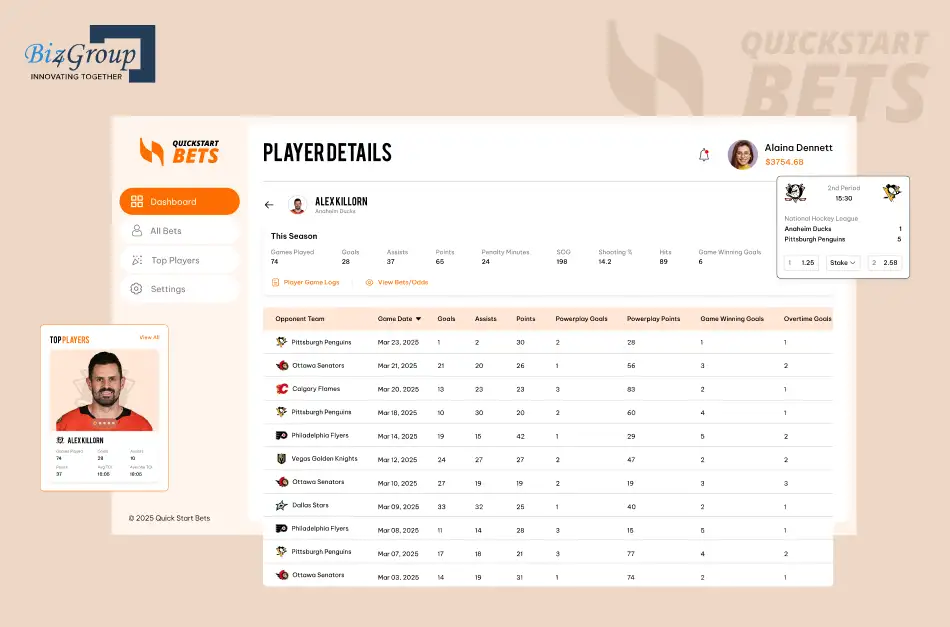
Quick Start Bets and the Data Problem
The interesting part is not the list of features. It is the data plumbing underneath them.
The project needed to keep NHL odds current while also combining statistics and other information from different providers. WebSockets helped maintain persistent connections. A normalization layer helped standardize incoming information.
That is the sort of detail operators should ask about when evaluating sportsbook API integration.
Do not ask only if a vendor can connect an API. Ask how the data is mapped, validated, monitored, cached, and recovered when something goes sideways.
Should a Sportsbook Use Multiple Data Providers?
Sometimes.
A multi-provider strategy can help operators broaden sports coverage or create redundancy. It can also introduce more integration work.
The provider contracts matter too.
Operators should confirm data rights, coverage, update expectations, storage rules, and commercial terms before development begins.
Also read: Why top US betting apps rely on multiple sports data providers?
Your Odds Feed Shouldn’t Be the Weak Link
$166.94B was wagered through US sports betting in 2025. Is your data stack ready for the pressure?
Talk To a Sportsbook ExpertHow Should Risk Management Work Across Pre-Match and Live Betting?
Sportsbook risk management should use shared exposure controls while applying additional validation to markets affected by live events.
Risk is not something to bolt onto the platform after the betting engine is finished. It belongs in the core design.
What Does the Risk Layer Watch?
|
Risk Area |
What It Monitors |
|---|---|
|
User exposure |
Account-level liability |
|
Market exposure |
Total liability within a market |
|
Stake limits |
Maximum permitted wager |
|
Odds state |
Current accepted price |
|
Market state |
Open, suspended, closed or settled |
|
Event state |
Scheduled, active, interrupted or completed |
|
Account activity |
Betting patterns and restrictions |
|
Settlement |
Outcome and settlement status |
Pre-match markets can use configured limits and exposure rules based on the event and market. Live markets need those controls to work alongside current event information.
What Happens When Data Becomes Uncertain?
The platform needs a clear response.
Suppose a live feed stops updating during an important phase of a match. The sportsbook should not keep treating stale information as current information. Depending on the operator's rules, affected markets may be suspended until reliable information returns.
This is where market state becomes important.
A market needs a defined status. Open means bets can be considered under the platform's rules. Suspended means acceptance is temporarily restricted. Closed means the market is no longer accepting bets. Settled means the outcome has been processed.
The exact rules depend on the market and jurisdiction.
What About Interrupted Events?
The platform should have predefined handling for:
- Postponed events
- Suspended events
- Abandoned events
- Rescheduled events
- Incomplete events
- Events with disputed or unavailable data
The development team should translate approved operator rules into testable workflows.
This is also where challenges in modern sports betting app development can become expensive if discovered late. Clear event-state rules reduce that risk during implementation.
How Can a Custom Sportsbook Scale for Live and Pre-Match Traffic?
A scalable sportsbook should separate workloads so that browsing, data ingestion, betting transactions, analytics, and administrative activity can scale according to demand.
A major sporting event can change the traffic pattern in minutes. The platform might see more logins, more event views, more odds requests, more bet submissions, and more live updates at the same time.
That is a very different workload from a quiet weekday afternoon.
What Should Scale Independently?
Useful approaches include:
- Stateless application services
- Load balancing
- Horizontal scaling
- Caching
- Queue-based background processing
- Database read replicas
- Independent data ingestion services
- Service-level monitoring
- Cloud-based infrastructure
- Failover planning
The goal is separation.
Analytics should not compete with bet acceptance for the same resources. A reporting query should not become the reason a live market update arrives late.
All Chalk and High-Volume Activity
All Chalk offers a useful example from the sports prediction space.
The platform covers NFL, NBA, NCAAFB, and MLB. It includes real-time synchronization, schedules, leaderboards, reminders, and cross-platform access.
The project uses PostgreSQL and AWS for scalable infrastructure. Its development also addressed traffic increases around major sports events and the need to support large volumes of simultaneous betting-related transactions.

All Chalk and the Scaling Lesson
The important takeaway is workload planning. The platform needed real-time synchronization, data storage, security, cross-platform delivery, and high-volume transaction handling.
Those requirements were not treated as one giant infrastructure problem. They were broken into manageable technical pieces.
That is a useful approach for a complete scalable sportsbook platform development project too.
What Should Load Testing Cover?
Do not test only the average traffic level. Test the ugly days.
A realistic load plan can include:
- Major championship events
- Multiple simultaneous matches
- Large login spikes
- Rapid odds updates
- High bet submission volume
- Database pressure
- Data provider failure
- Service restarts
- Increased API traffic
The sportsbook should know what happens before a peak event arrives. Not discover it during the second quarter.
Peak Traffic Shouldn’t Peak Your Costs
Plan the right architecture now and put more of your budget where it can actually drive sportsbook ROI.
Calculate My Sportsbook ROIWhat Security and Compliance Requirements Apply to a Complete Sportsbook?
A complete sportsbook needs security and compliance controls across identity, payments, account access, geolocation, responsible gambling, data protection, and transaction monitoring.
The exact requirements depend on the jurisdiction. That part matters.
A sportsbook targeting several US states may face different requirements across those markets. An international operator can face another set of licensing and reporting obligations.
Core Security and Compliance Areas
A sportsbook may need:
- KYC verification
- Age verification
- AML controls
- Geolocation
- Responsible gambling controls
- Account restrictions
- Payment security
- Data encryption
- Access controls
- Audit logs
- Fraud monitoring
- Session management
- Security monitoring
Why Does Geolocation Matter?
Real-money sports betting can depend on where a user is physically located. The platform may therefore need location verification before allowing certain betting activity.
That means geolocation is part of the user journey. It is not a small checkbox buried in administration. Operators can review geofencing in sports betting apps when mapping this requirement into the platform.
Compliance Needs to Be Designed Early
A common mistake is leaving compliance until the final development sprint. That can be painful.
KYC affects account flows. Geolocation affects access control. AML affects transactions and monitoring. Responsible gambling affects limits and user controls. Reporting requirements affect data structures.
The target jurisdictions should therefore be identified before the architecture is finalized.
For US operators, sports betting regulations across US states can help teams understand why a single compliance assumption may not work across every market.
What Are the Steps to Develop a Dual-Mode Sportsbook?
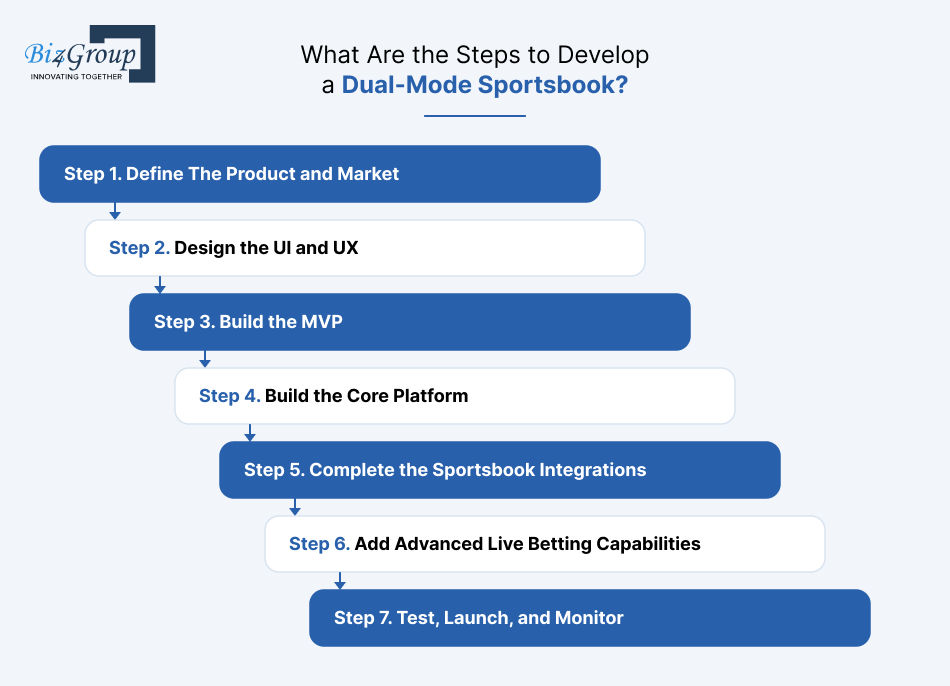
The development roadmap should move from product requirements to UX, MVP scope, architecture, integrations, full development, and testing before launch.
A seven-step approach keeps the project moving without turning the roadmap into another architecture lesson.
Step 1. Define The Product and Market
Start with the business model.
Document:
- Target jurisdictions
- Sports and leagues
- Pre-match markets
- Live markets
- User types
- Revenue model
- Payment methods
- Data providers
- Compliance requirements
- Expected traffic
This gives the team a real project boundary.
Step 2. Design the UI and UX
Map the complete betting journey before development begins.
Onboard a reliable UI/UX design company for the event lobby, market screens, bet slip, account area, wallet, live betting interface, transaction history, and operator dashboard.
Live screens deserve extra attention. Odds can change. Markets can suspend. Events can move quickly.
The interface needs to communicate those changes without making users hunt for information.
Also read: Top 15 UI/UX design companies in USA
Step 3. Build the MVP
The MVP should contain the minimum set of functions needed to validate the sportsbook concept.
A practical sports betting app MVP can include:
- User registration
- Account management
- Selected sports
- Selected pre-match markets
- Core live markets
- Bet slip
- Wallet
- Payment integration
- Basic risk controls
- Administration
- Selected sports data integration
The point is scope control.
A first release does not need every sport, every market, every dashboard, and every clever idea that appeared during the first product meeting. MVP development services can help structure this phase around the core user journey.
Also read: Top 12+ MVP development companies in USA
Step 4. Build the Core Platform
Now develop the main services. This includes the betting engine, market management, account services, wallet, administration, reporting, and data layer.
The shared foundation comes first. Specialized live processing can then connect into it.
Step 5. Complete the Sportsbook Integrations
This stage connects the platform to its external dependencies.
Typical integrations include:
- Sports data providers
- Odds feeds
- Payment gateways
- KYC providers
- AML services
- Geolocation services
- Identity verification
- Analytics
- Notifications
The integration plan should also account for provider failures. An API that works perfectly during development is not a disaster plan.
Step 6. Add Advanced Live Betting Capabilities
Once the core platform is stable, expand live market depth. This can include additional sports, more market types, enhanced event processing, trading controls, and more advanced monitoring.
The expansion should follow actual business priorities. More markets mean more data, more rules, more testing, and more operational work.
Step 7. Test, Launch, and Monitor
The final stage covers:
- Functional testing
- Integration testing
- Security testing
- Load testing
- Live event testing
- Payment testing
- Compliance validation
- Data accuracy checks
- Failure recovery
- Production monitoring
Then comes launch. And then comes the part nobody gets to skip. Monitoring.
A sportsbook needs ongoing maintenance because data providers change, regulations evolve, markets expand, and traffic patterns shift.
Got A Sportsbook Idea? Let’s Talk Numbers
Your live betting concept could be closer to launch than you think. One quick call can clarify the scope, timeline, and budget.
Call Our Sportsbook TeamHow Much Does a Custom Sportsbook with Live and Pre-Match Betting Cost?
A custom sportsbook with both pre-match and live betting can cost about $30,000 for a focused MVP and reach $500,000 or more for an enterprise-grade platform with broad sports coverage, deep live markets, advanced risk tools, multiple integrations, and multi-jurisdiction support.
The final number depends heavily on scope.
For planning purposes, a useful three-tier model looks like this.
Custom Sportsbook Cost by Product Tier
|
Platform Tier |
Estimated Development Cost |
Typical Scope |
|---|---|---|
|
MVP |
$30,000 to $100,000+ |
Selected sports, core pre-match markets, limited live markets, basic wallet, payments, admin |
|
Advanced |
$120,000 to $250,000+ |
Multiple sports, deeper live markets, risk controls, several integrations, stronger analytics |
|
Enterprise |
$300,000 to $500,000+ |
Multi-market platform, advanced live betting, extensive integrations, custom trading tools, high-scale infrastructure |
These figures describe technology development.
Licensing fees, legal work, sports data contracts, payment processing, taxes, marketing, and working capital can sit outside the development estimate.
That distinction matters when preparing the real launch budget.
What Drives Custom Sportsbook Development Cost?
Several cost drivers can move the project from one tier to another.
|
Cost Driver |
Typical Budget Impact |
|---|---|
|
UI and UX design |
$5,000 to $25,000 |
|
Frontend development |
$15,000 to $60,000 |
|
Backend development |
$25,000 to $100,000 |
|
Betting engine |
$30,000 to $100,000+ |
|
Live betting functionality |
15% to 30% of development budget |
|
Sports data and odds integrations |
$10,000 to $50,000+ |
|
Payment integrations |
$5,000 to $20,000 |
|
KYC and AML integrations |
$5,000 to $25,000 |
|
Risk and trading tools |
$15,000 to $60,000+ |
|
Admin and reporting |
$10,000 to $35,000 |
|
QA and security testing |
10% to 20% of development budget |
|
DevOps and cloud setup |
$5,000 to $25,000 |
These are planning ranges, not vendor quotes.
What Hidden Costs Should Operators Plan For?
The development quote is not the entire bill. Several costs can appear after the initial build.
|
Hidden Cost |
Planning Range |
|---|---|
|
Sports data subscriptions |
$2,000 to $20,000+ per month |
|
Cloud infrastructure |
$1,000 to $15,000+ per month |
|
Monitoring and observability |
$500 to $5,000+ per month |
|
Security monitoring |
$1,000 to $10,000+ per month |
|
Platform maintenance |
15% to 25% of annual development cost |
|
Compliance updates |
5% to 15% of annual development cost |
|
Additional jurisdiction support |
$20,000 to $100,000+ per jurisdiction |
|
New payment integrations |
$3,000 to $15,000 each |
|
Additional sports data integration |
$5,000 to $25,000 each |
|
Major feature expansion |
10% to 30% of original build cost |
Sports data deserves special attention. The integration fee may be a relatively small part of the initial build. The provider subscription can become a recurring operating expense.
The same goes for cloud infrastructure. A low-traffic MVP may be inexpensive to host. A sportsbook handling major live events needs a different infrastructure budget.
How Can Operators Keep the Budget Under Control?
Start with the market and the betting journey. Pick the sports that matter most. Choose a manageable live market set. Integrate the providers required for the first release. Keep the MVP focused. Then expand based on actual usage and business priorities.
A sports betting app development cost breakdown can also help teams identify where feature scope tends to push the budget upward.
The goal is not to make the cheapest sportsbook possible. It is to avoid spending heavily on features that do not belong in the first release.
How Should Operators Evaluate a Custom Sportsbook Development Partner?
Operators should evaluate a custom sportsbook development partner through relevant project experience, real-time data capabilities, integration depth, scalability planning, security practices, and clarity around ownership and post-launch support.
A polished sales deck can look impressive. A technical review is harder to fake.
Ask for evidence.
Questions Worth Asking a Vendor
|
Question |
What a Strong Answer Should Cover |
|---|---|
|
Have you built live betting platforms? |
Real-time data, market processing and live workflows |
|
Which sports data providers have you integrated? |
APIs, sockets, normalization and monitoring |
|
How does your betting engine validate wagers? |
Market state, odds and account rules |
|
How do you handle provider outages? |
Fallback and recovery procedures |
|
How do you test live betting? |
Event simulation and load testing |
|
How does the platform scale? |
Independent services and cloud infrastructure |
|
How is compliance handled? |
Jurisdiction-specific controls |
|
Who owns the source code? |
Clear IP terms |
|
What happens after launch? |
Maintenance and support |
|
Can you show relevant projects? |
Specific evidence from comparable products |
PredictEX and Real-Time Sports Betting
PredictEX is particularly relevant for this type of project.
Biz4Group LLC built PredictEX around real-time sports data for US leagues. The project uses real-time connections for official sports data and combines several technologies across the frontend, backend, data processing, and cloud infrastructure. The platform was designed to synchronize real-time information across users while handling high-volume activity.
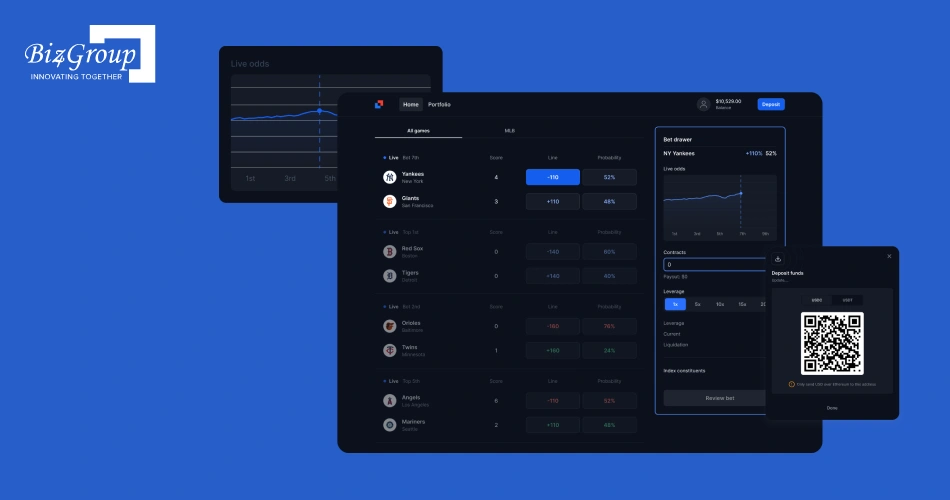
PredictEX and the Real-Time Question
The interesting part is the system around the data. Real-time sports information has to reach the right users. It also needs to stay synchronized across the platform.
That requires more than connecting an API and calling the job finished. It requires careful event handling, data processing, frontend updates, infrastructure planning, and testing.
That is the kind of experience worth asking a vendor to demonstrate.
What Else Should a Partner Bring to the Table?
A strong development partner should understand the product as a whole.
That includes:
- Sportsbook architecture
- Betting engine development
- Live data integrations
- Payment workflows
- Risk controls
- Compliance requirements
- Cloud infrastructure
- QA
- Security
- Post-launch support
Biz4Group's sports betting portfolio covers real-time analytics, sports prediction, mobile betting experiences, data synchronization, and scalable infrastructure. That mix is useful when the project needs more than a standard betting interface.
The company also works across AI integration services, which can be relevant when operators later introduce analytics, personalization, fraud monitoring, or other intelligent features.
The key is timing. Those additions should follow the core sportsbook requirements, not distract from them.
To Summarize...
Building a sportsbook that handles both pre-match and live betting is a balancing act. Pre-match markets reward preparation. Live markets reward responsiveness.
The platform needs shared foundations for accounts, wallets, payments, betting, administration, and reporting. Live betting then needs specialized handling for event updates, changing markets, real-time data, and time-sensitive validation.
The development roadmap should reflect that difference from day one.
Biz4Group brings relevant experience across real-time sports data, betting interfaces, scalable infrastructure, and sports-focused digital products. Quick Start Bets demonstrates real-time odds and data normalization. All Chalk addresses synchronized sports activity and high-volume traffic. PredictEX adds experience with real-time sports data and high-volume user synchronization.
If you are planning a complete sportsbook, the next useful step is to map your sports, markets, target jurisdictions, data providers, live betting depth, and expected traffic into a technical scope.
Talk to Biz4Group about turning that scope into a practical sportsbook development roadmap.
FAQ’s
1. Can pre-match and live betting run on the same sportsbook platform?
Yes. A single platform can support both modes when the shared services and specialized live processing paths are designed correctly.
2. Does Live Betting Need A Separate Betting Engine?
Not necessarily. A common betting engine can process both formats, provided it can handle different market states, validation rules, timing conditions, and event-driven updates.
3. What is the most important integration for live betting?
The sports data and odds feed is one of the most important dependencies because live markets rely on timely event information. The platform also needs payment, identity, KYC, AML, and geolocation integrations depending on the market.
4. How do sportsbooks handle outdated live odds?
The platform can use market and odds validation before accepting a wager. If data becomes stale or unreliable, affected markets may be suspended according to the operator's rules.
5. What happens if a sports data provider goes offline?
The sportsbook should have defined failure-handling procedures. Depending on the architecture, that can include fallback providers, cached information for non-critical functions, market suspension, alerts, and service recovery workflows.
6. How many sports should a new custom sportsbook launch with?
There is no universal number. The decision should depend on the target market, available data coverage, licensing conditions, trading resources, and expected user demand. A focused initial sports catalog can simplify testing and operations.
7. Can a sportsbook add live betting after launch?
Yes, but the initial architecture should account for it if live betting is part of the product roadmap. Adding live markets later becomes more complicated when the original platform was designed around static pre-match workflows.
8. How do multiple sports data feeds work together?
The platform can receive information from multiple providers and use a normalization layer to map different formats into a common internal data model. This can simplify downstream processing and support broader coverage or redundancy.