 Location :
Orlando, FL, USA
Location :
Orlando, FL, USA +1 (407) 714-1616
 info@biz4group.com

- Sports data providers for betting apps are the backbone of accurate, real-time betting experiences, especially in high-traffic US markets.
- Relying on a single source creates risks such as latency spikes, data inconsistencies, and operational downtime during live events.
- Multiple sports data providers for betting apps improve validation, uptime, and scalability while protecting revenue during peak games.
- Live sports data feeds for betting applications power in-play betting, fantasy scoring, analytics dashboards, and personalized user engagement.
- Strong sports data aggregation for betting apps strengthens long-term performance, reliability, and growth readiness.
- Biz4Group LLC helps betting platforms design, integrate, and scale reliable sports data providers for betting apps with secure, high-performance architecture built for real world demands.
The sports data providers for betting apps topic gets talked about so much in tech and betting circles lately. And guess what turns out to be the silent hero behind record betting growth in the US? Data quality.
Quick fact: Americans wagered between USD 160 billion and USD 170 billion legally on sports betting in 2025 across 38 regulated states and Washington DC, a figure that reflects rapid adoption of online platforms and mobile betting trends.
That tells you how big the opportunity really is for any betting platform live today.
But with this explosion comes real pressure. A large chunk of that revenue now comes from in-play and live betting, which accounted for more than 62% of the online betting market share in 2025.
That trend demands systems that deliver instant updates accurately from kick off to final whistle.
Here’s where multiple sports data providers for betting apps matter more than ever.
Here’s what keeps millions of users glued to an app during peak game moments.
Here’s why data accuracy matters more than flashy UI.
In this blog, we will walk through why top platforms invest heavily in sports data integration for betting apps and how this could be a game changer for your business performance.
So, without further ado, let’s begin with the basics.
Why Read Theories When You Can Talk to the People Building It?
Over 70% of US betting platforms struggle with data reliability in their first 18 months. Want to avoid learning that the hard way?
Talk to Biz4Group's Betting App ExpertsUnderstanding Sports Data Providers for Betting Apps and How They Work
Every betting app lives and breathes on data. Without a steady stream of accurate updates, even the most polished interface feels unreliable. So how do sports data providers for betting apps actually work behind the scenes?
At a high level, these providers collect, process, and distribute sports information from live matches across leagues. This includes scores, player stats, match events, odds movements, and even micro events like fouls or substitutions. The data then travels through secure pipelines to betting platforms in near real-time.
But the process is far more layered than it sounds.
How Sports Data Moves from the Field to Your Betting App
Let us break this down into simple steps.
- Data is captured directly from stadiums using sensors, official scorers, and tracking systems
- Raw data is validated and standardized by the provider
- Information is delivered through sports data APIs for betting apps
- Betting platforms consume this data to update odds, markets, and live visuals
Each step introduces potential delay or error. That is why the quality of the provider matters.
Core Components Behind Sports Data Integration for Betting Apps
Now comes the part many founders and product teams underestimate. Data does not magically stay accurate and fast on its own. Behind every smooth betting experience sits a carefully designed data stack.
The table below outlines the core components involved in sports data integration for betting apps and why each one matters.
|
Core Component |
What It Does |
Why It Matters for Betting Apps |
|---|---|---|
|
Live data ingestion |
Pulls real-time updates from multiple sources |
Ensures users see current scores and odds |
|
API gateway |
Manages incoming and outgoing data requests |
Controls traffic and prevents overload |
|
Data normalization |
Aligns different data formats into one structure |
Avoids mismatched stats and errors |
|
Latency monitoring |
Tracks speed of incoming feeds |
Helps prioritize faster data sources |
|
Validation rules |
Cross checks data accuracy |
Protects betting app data accuracy solutions |
|
Delivery layer |
Pushes updates to frontend and odds engines |
Keeps in-play betting smooth and responsive |
This setup may look straightforward on paper, but in reality, it demands constant tuning and oversight.
Why Real-Time Accuracy Remains Hard to Maintain
Live betting runs on seconds. Sometimes milliseconds.
A delay of even two seconds can result in incorrect odds, unfair bets, or regulatory complaints. This is why real-time sports data providers for betting apps invest heavily in infrastructure, redundancy, and monitoring.
And yet, even the most reliable setups face occasional feed issues during peak events.
Which leads to an important question worth asking early. Can a single data provider truly support your platform at scale?
That question naturally leads us into the next section, where we explore the hidden risks of relying on only one data source and how that decision can quietly limit growth, trust, and revenue.
Risks of Relying on a Single Sports Data Provider for Betting Apps
At first glance, working with one provider feels simpler.
One contract. One integration. One bill. But simplicity often hides risk.
When betting platforms depend on a single source, cracks start to show under real world pressure.
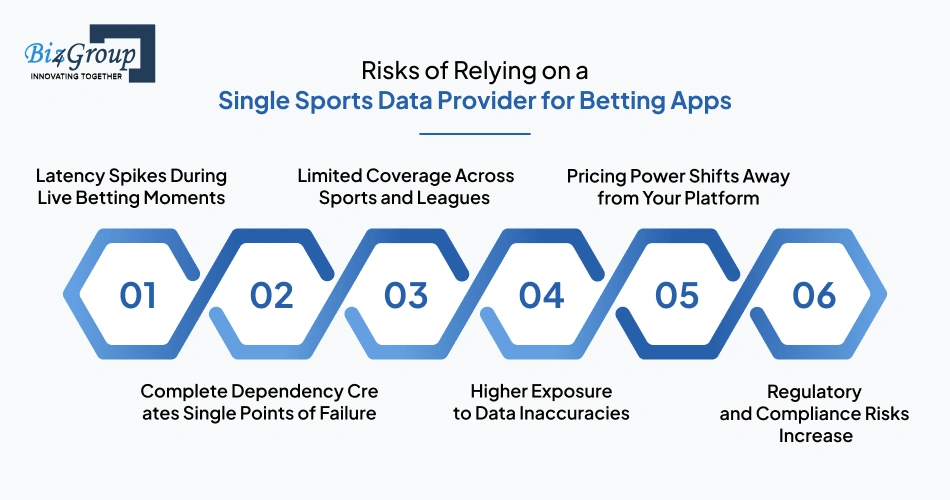
Here are the most common risks founders and operators face.
1. Latency Spikes During Live Betting Moments
Live betting thrives on speed. A single delayed update can throw off odds, freeze markets, or frustrate users. When all live sports data feeds for betting applications come from one source, you have no fallback when delays occur.
What happens during the final minutes of a playoff game when traffic surges? With no secondary feed, your platform absorbs the full impact.
2. Complete Dependency Creates Single Points of Failure
APIs go down. Servers fail. Maintenance windows overlap with live games.
Relying on one provider means every outage becomes your outage. This dependency puts betting app uptime and revenue at risk, especially during high stakes events.
This is where many platforms realize that reliable sports data sources for betting apps require redundancy.
3. Limited Coverage Across Sports and Leagues
No provider excels at everything. Some focus on major US leagues. Others specialize in niche or international sports. Using one provider often means compromising on coverage, which limits market expansion and user engagement.
Multiple sports data providers for betting apps allow platforms to scale into new leagues without rebuilding infrastructure.
4. Higher Exposure to Data Inaccuracies
Errors happen. A missed foul. An incorrect score update. A delayed stat correction.
With a single feed, there is no way to validate data in real-time. That increases the risk of settlement disputes and damages trust. Strong betting app data accuracy solutions depend on cross verification.
5. Pricing Power Shifts Away from Your Platform
When one vendor controls your entire data pipeline, negotiating leverage drops. Cost increases, usage caps, and contract restrictions become harder to challenge.
Sports data management for betting platforms works best when operators retain flexibility.
6. Regulatory and Compliance Risks Increase
US betting regulations demand accuracy, transparency, and auditability. A single provider failure can lead to compliance breaches, even when the issue lies outside your control.
Redundant data strategies help protect platforms during audits and disputes.
These risks often stay invisible until a major event exposes them. By then, the cost of recovery is far higher than the cost of prevention.
Also read: Why most betting apps fail at real-time match accuracy (and how top apps fix it)?
One Data Outage Can Cost More Than 20% of Daily Revenue!
Live betting traffic peaks do not come with warnings. If your only data provider fails during a major game, how much revenue and trust can you afford to lose?
Contact Biz4Group TodayBenefits of Using Multiple Sports Data Providers in Betting Apps
Once betting platforms recognize the risks of relying on a single source, the next logical step is diversification. But this shift is not only about avoiding downtime. It is about gaining a competitive edge.
Why do leading platforms invest in multiple sports data providers for betting apps even when one provider appears sufficient? Because performance, trust, and scalability depend on it.
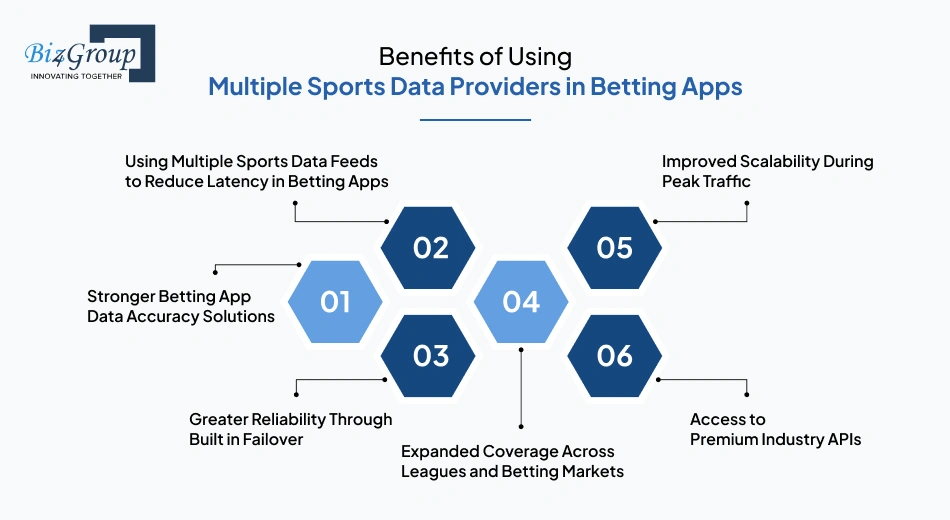
Below are the core advantages that separate market leaders from average platforms.
1. Stronger Betting App Data Accuracy Solutions
Accuracy is the backbone of real-time wagering. With multiple feeds in place, platforms can:
- Cross verify scores and match events instantly
- Detect discrepancies before users notice
- Reduce settlement disputes and refund cases
This approach directly strengthens sports data providers for real-time betting app accuracy. If one source reports a delayed goal update, another can confirm the correct outcome within seconds.
That level of validation builds long term user confidence.
2. Using Multiple Sports Data Feeds to Reduce Latency in Betting Apps
Live betting is highly sensitive to speed. Even slight delays impact user experience and risk management.
With diversified live sports data feeds for betting applications, platforms can:
- Prioritize the fastest responding provider
- Automatically reroute traffic during latency spikes
- Maintain seamless in-play betting
Instead of waiting for one provider to recover, the system dynamically shifts load. This keeps markets stable during peak moments.
And during events like NFL playoffs or March Madness, that flexibility becomes invaluable.
3. Greater Reliability Through Built in Failover
Every provider experiences maintenance cycles or unexpected outages. By integrating multiple sports data providers for betting apps, operators gain:
- Automatic failover mechanisms
- Continuous uptime during disruptions
- Protection against revenue loss during high traffic games
This redundancy creates a resilient sports data management strategy for betting platforms.
The result is fewer interruptions and stronger brand credibility.
4. Expanded Coverage Across Leagues and Betting Markets
Different providers specialize in different areas. Some focus on official US league partnerships. Others deliver broader international coverage or niche sports.
By comparing sports data providers for betting applications and combining strengths, platforms can:
- Launch new sports faster
- Enter emerging betting markets
- Offer deeper statistical insights
This flexibility supports long-term growth and market diversification.
5. Improved Scalability During Peak Traffic
Betting traffic does not grow evenly. It spikes dramatically during major games.
Multiple high frequency sports data providers for apps allow platforms to:
- Distribute API calls efficiently
- Prevent bottlenecks
- Maintain performance during user surges
Scalability is not an afterthought. It is an architectural decision.
6. Access to Premium Industry APIs
Many top tier betting platforms integrate trusted data ecosystems such as:
- Sportradar, known for official league partnerships and integrity monitoring
- Genius Sports, widely recognized for high frequency official data feeds
- API-Sports, offering flexible APIs across global leagues
Instead of relying on one ecosystem, leading apps strategically combine reliable sports data sources for betting apps to optimize performance and coverage.
The pattern becomes clear. Multiple providers do more than reduce risk. They enhance speed, expand coverage, and strengthen user trust at scale.
Sports Data Aggregation for Betting Apps and Multi Provider Architecture
If multiple providers improve reliability, the next logical question becomes clear. How do you actually manage them without creating chaos?
Integrating two or three feeds without structure can create more problems than it solves. That is why serious platforms invest in a well-planned sports data aggregation for betting apps strategy.
Multi Provider Data Architecture Overview
|
Architecture Layer |
Purpose in Multi Provider Setup |
Business Impact |
|---|---|---|
|
Provider orchestration engine |
Decides which provider has priority for specific leagues or markets |
Ensures optimal speed and coverage |
|
Real-time comparison engine |
Matches incoming data across providers to detect mismatches |
Improves betting app data accuracy solutions |
|
Intelligent routing logic |
Automatically switches to backup provider during disruptions |
Prevents live market downtime |
|
Latency scoring system |
Continuously ranks providers based on speed performance |
Supports using multiple sports data feeds to reduce latency in betting apps |
|
Data reconciliation module |
Resolves score or stat conflicts before settlement |
Reduces disputes and compliance risks |
|
Monitoring and alert dashboards |
Tracks provider health and anomalies |
Enables proactive issue resolution |
Notice something important here. This architecture is not about collecting data. It is about controlling it.
Without orchestration, multiple sports data providers for betting apps can create inconsistent odds, duplicate updates, or settlement confusion. With the right aggregation layer, they become a strategic advantage.
Project Spotlight: Real-Time Sports Betting Platform
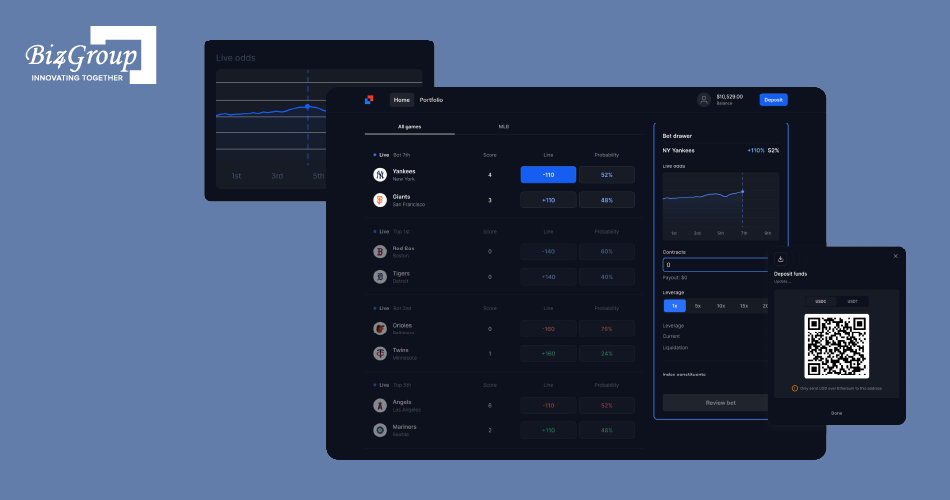
When Biz4Group developed this real-time sports betting platform, the goal was clear. Deliver real-time betting across MLB, CFB, and NFL while handling high traffic and instant updates without performance drops.
To support that vision, we implemented a structured sports data aggregation for betting apps approach designed for reliability and scale.
- Real-time socket-based integration for continuous game updates
- Layered backend architecture built with Node.js, Go, C#, and Python
- Global state management to synchronize live updates across users
- Dynamic pricing adjustments based on incoming market data
- Administrative controls for backend monitoring and data governance
Instead of relying on one stream of live sports data feeds for betting applications, the platform was designed to manage high frequency updates efficiently and maintain consistency during peak usage.
Why does that matter?
During high profile league games, thousands of users interact with the platform simultaneously. Any delay or mismatch can impact wagers, analytics, and trust. A structured aggregation strategy ensures that performance remains stable even under pressure.
And that is the difference between adding multiple providers and truly mastering sports data management for betting platforms.
In the next section, we shift from architecture to application. Let us explore practical use cases of sports data integration for betting apps and see how this strategy translates into measurable business outcomes.
Also read: How to develop a sports betting app like Stake in 2026?
Scalable Betting Apps Are Built 3 Times Faster with the Right Architecture!
A strong sports data architecture decides whether your app scales smoothly or breaks under pressure. Want to see what a future ready setup looks like?
Book a Strategy Call NowUse Cases of Live Sports Data Feeds for Betting Applications
Once multiple sports data providers for betting apps are in place, their real value appears in everyday user interactions. This is where strategy turns into experience.
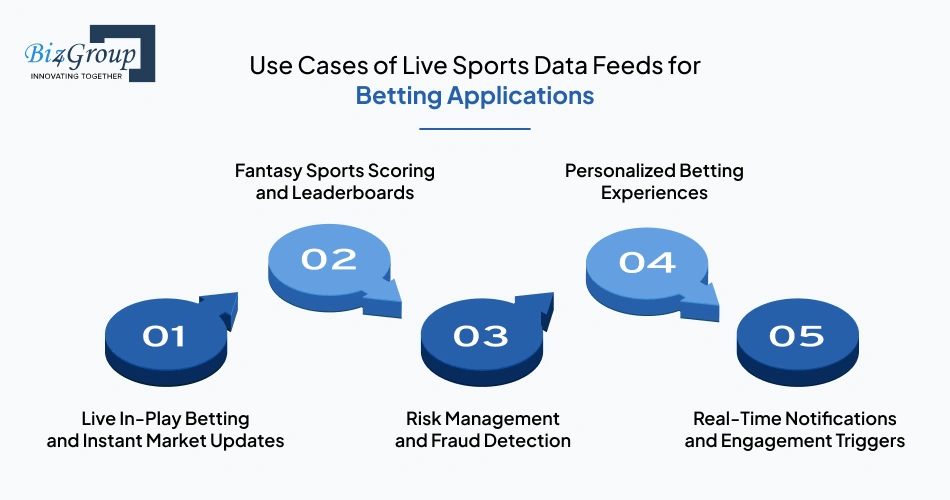
Below are the most impactful use cases seen across successful platforms today.
1. Live In-Play Betting and Instant Market Updates
In-play betting depends on speed and accuracy.
With real-time sports data providers for betting apps, platforms can refresh odds, pause markets, and reopen bets within seconds of a game event. This responsiveness keeps users engaged while reducing exposure to unfair wagers.
It also supports smoother cash out experiences during critical moments.
2. Fantasy Sports Scoring and Leaderboards
Fantasy platforms rely on continuous player level updates.
Using live sports data feeds for betting applications allows fantasy apps to update points instantly, reflect substitutions, and maintain fair rankings across thousands of concurrent users.
When data lags, user trust drops. Consistency keeps engagement high.
3. Risk Management and Fraud Detection
Data plays a central role in protecting betting platforms.
By integrating multiple sports data feeds, operators can monitor unusual betting patterns, detect inconsistencies, and flag suspicious activity faster. This strengthens betting app data accuracy solutions and supports fair play policies.
4. Personalized Betting Experiences
Sports data integration for betting apps enables platforms to tailor experiences based on user behavior.
Historical stats, live performance trends, and player data combine to deliver personalized recommendations. Users feel understood, not overwhelmed. This often translates into higher retention.
5. Real-Time Notifications and Engagement Triggers
Timely alerts drive action.
Accurate live data powers push notifications for score changes, odds shifts, and betting opportunities. When users receive updates at the right moment, engagement increases naturally.
Portfolio Spotlight: Ingenious Betting App for Sports Enthusiasts
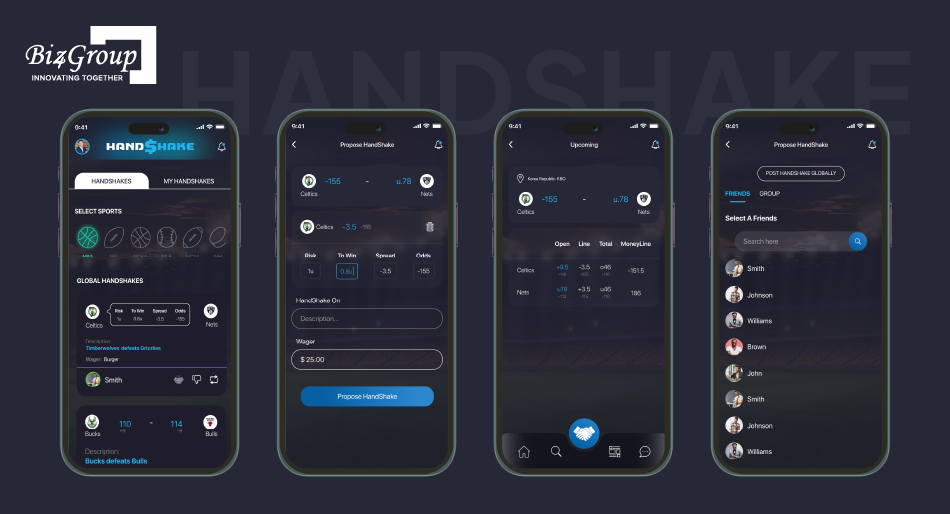
This ingenious betting app was designed to bring social interaction into sports betting. The challenge was keeping live data flowing smoothly across conversations, bets, and notifications.
Here is how sports data integration shaped the experience.
- Real-time live game scores across NFL, NBA, NHL, MLB, and more
- Instant betting alerts and schedule updates
- AI-recommended betting suggestions based on current match data
- One-on-one and group betting interactions synced with live events
- Push notifications triggered by score and market changes
By combining reliable sports data sources for betting apps with a social layer, this app created a dynamic and engaging betting environment where timing mattered.
That balance between speed, accuracy, and interaction is what modern users expect.
Next, we move into a critical evaluation step. Let us explore the key features to consider when choosing sports data providers for betting apps and how to compare them effectively.
Also read: Top 15 sports betting website development companies in USA (2026)
Key Features to Consider When Choosing Sports Data Providers for Betting Apps
Once platforms move toward multiple sports data providers for betting apps, the next challenge is selection. Not every provider fits every use case. Choosing poorly can increase costs, complicate architecture, and slow down delivery.
The table below highlights what decision makers should examine before signing long-term agreements.
|
Feature |
What to Evaluate |
Why It Matters for Betting Apps |
|---|---|---|
|
Data update frequency |
How often data refreshes during live events |
Impacts in-play betting experience |
|
Historical data depth |
Availability of past match and player records |
Supports analytics and predictions |
|
Sport specific expertise |
Strength in certain leagues or sports |
Improves niche market coverage |
|
API flexibility |
Ease of customization and filtering |
Reduces development overhead |
|
Documentation quality |
Clarity of technical guides and references |
Speeds up integration timelines |
|
Data consistency |
Stability of data formats across seasons |
Prevents rework during updates |
|
Support responsiveness |
Availability of technical assistance |
Minimizes downtime during issues |
|
Commercial transparency |
Clear pricing and usage policies |
Helps manage long term costs |
Choosing sports data providers for betting apps is not about picking the biggest name. It is about alignment with your product roadmap, target audience, and growth strategy.
This evaluation stage often separates scalable platforms from those forced into costly migrations later.
With feature selection clear, the next concern naturally shifts toward protection and governance. In the following section, we take a focused look at security and regulatory compliance for sports data management for betting platforms, especially within the US market.
Also read: How do AI sports betting apps like FanDuel make money?
Choosing the Wrong Data Provider Costs More Than Choosing Early!
Most platforms switch providers within two years due to poor fit. What if you could get it right the first time?
Choose Smart with Biz4GroupSecurity and Regulatory Compliance for Sports Data Providers for Betting Apps
Security and compliance are non-negotiable in the US betting ecosystem. Even a minor lapse can trigger penalties, platform suspension, or long-term reputational damage. That is why sports data providers for betting apps must meet strict technical and regulatory expectations.
Below are the core areas platforms need to address.
- State Level Regulatory Alignment
US sports betting laws vary by state. Data used for odds, settlements, and reporting must align with local regulatory frameworks. Reliable sports data sources for betting apps support jurisdiction specific requirements. - Data Integrity and Audit Readiness
Regulators expect transparent records. Platforms must maintain verifiable data trails that show how odds were generated and how outcomes were settled. This protects operators during audits and disputes. - Secure API Access Controls
Sports data APIs for betting apps should enforce token-based authentication, access limits, and role-based permissions. This reduces exposure to misuse or unauthorized access. - Encryption of Data in Transit and At Rest
Live sports data feeds for betting applications must be encrypted while moving across systems and when stored. This safeguards sensitive operational data from interception. - Incident Response and Monitoring
Continuous monitoring helps detect anomalies early. Whether it is a data spike or a feed interruption, proactive alerts support faster resolution and regulatory reporting. - Third-Party Accountability
When using multiple sports data providers for betting apps, operators remain responsible for compliance. Providers must meet security benchmarks and contractual obligations consistently.
Security and compliance often work quietly in the background.
When done right, users never notice. When done wrong, everyone does.
With governance covered, it is time to address reality on the ground. In the next section, we look at common challenges, risks, and mistakes teams make when working with multiple sports data providers and how to mitigate them effectively.
Challenges, Risks, and Mistakes When Using Multiple Sports Data Providers for Betting Apps
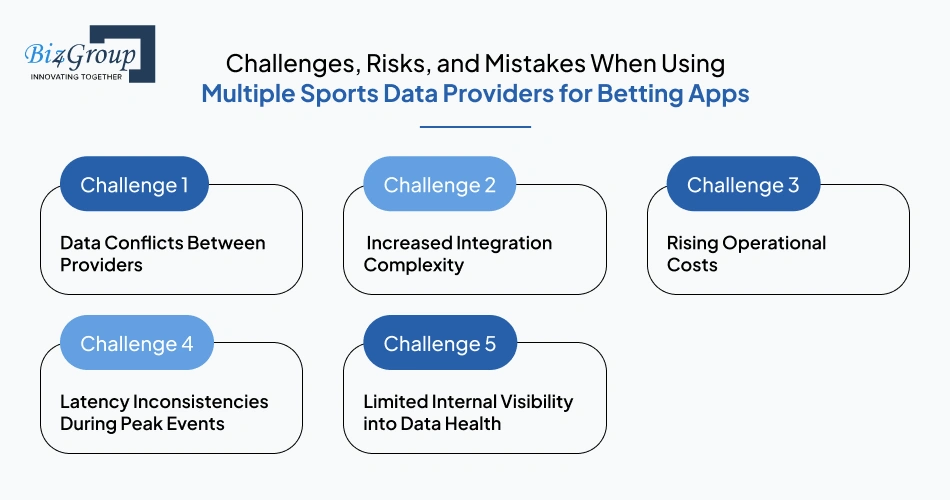
Using multiple sports data providers for betting apps brings clear benefits. It also introduces operational challenges when not handled carefully. Many platforms face issues not because of the providers themselves, but due to how integration and governance are approached.
Below are the most common challenges, along with practical mitigation strategies.
Challenge 1: Data Conflicts Between Providers
Different providers may report the same event at slightly different times or with variations in formatting. This can create confusion during live betting or settlement.
How to mitigate
- Establish a primary and secondary provider hierarchy
- Apply validation rules before publishing updates
- Delay settlement until cross verification completes
Challenge 2: Increased Integration Complexity
Managing several sports data APIs for betting apps can strain development teams. Poor planning often leads to fragile systems.
How to mitigate
- Centralize integration through an aggregation layer
- Standardize data models across providers
- Use clear interface contracts for each feed
Challenge 3: Rising Operational Costs
Multiple providers can increase licensing and infrastructure expenses if usage is not monitored.
How to mitigate
- Track API usage and optimize call frequency
- Assign providers based on sport or league specialization
- Review contracts regularly for cost alignment
Challenge 4: Latency Inconsistencies During Peak Events
Not all providers perform equally under heavy load. Sudden traffic spikes can slow critical updates.
How to mitigate
- Continuously score providers based on real-time performance
- Route high priority events through the fastest feed
- Maintain standby capacity for peak matches
Challenge 5: Limited Internal Visibility into Data Health
Without proper monitoring, issues may go unnoticed until users complain.
How to mitigate
- Implement real-time dashboards for feed health
- Set automated alerts for anomalies
- Schedule routine audits of data quality
These challenges are manageable with the right planning and partners. When ignored, they quietly erode trust and performance.
Looking ahead, betting platforms are evolving quickly. In the next section, we explore future trends shaping sports data providers for betting apps and how forward-thinking teams are preparing for what comes next.
Also read: Challenges in modern sports betting app development
Every Betting Platform Hits Data Challenges. Smart Ones Prepare for Them!
The difference between downtime and dominance often comes down to planning. Are your systems ready for peak traffic and edge cases?
Future Proof Betting Platform with Biz4GroupEmerging Trends in Sports Data Integration for Betting Apps
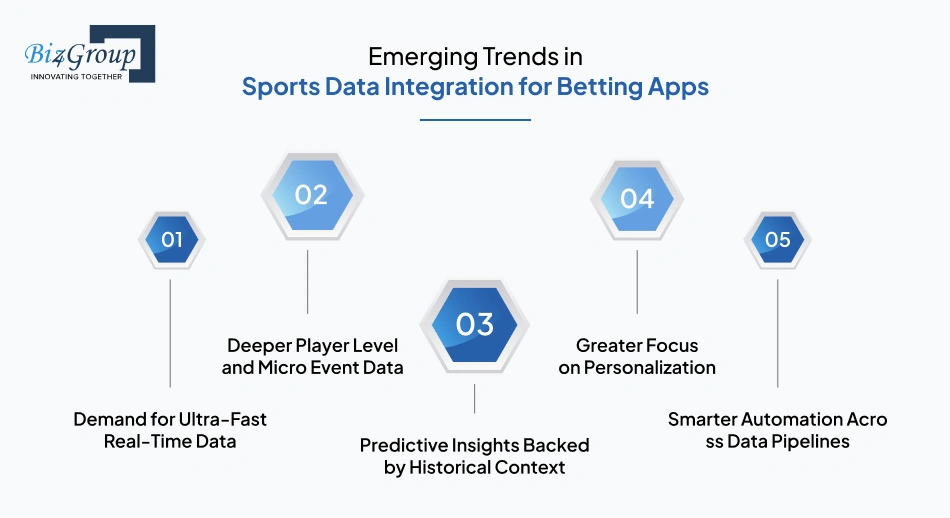
The sports betting landscape keeps evolving. Data expectations grow faster than features. Platforms that plan ahead gain an edge while others struggle to keep up.
Below are the key trends influencing how sports data providers for betting apps operate today and where the market is heading.
1. Demand for Ultra-Fast Real-Time Data
As in-play markets expand, platforms expect near instant updates with minimal lag. This drives demand for high frequency sports data providers for apps that can handle dense event streams without performance drops.
Speed is becoming a baseline requirement, not a differentiator.
2. Deeper Player Level and Micro Event Data
Users want more than final scores. Future focused platforms rely on granular stats like player movement, possession shifts, and situational performance. These insights fuel smarter odds, richer analytics, and more engaging experiences.
This shift pushes sports data integration for betting apps toward depth, not volume alone.
3. Predictive Insights Backed by Historical Context
Historical data is no longer passive.
Platforms increasingly combine past performance with live trends to offer smarter recommendations and predictive analytics. This approach strengthens sports data management for betting platforms by connecting past and present in real-time.
4. Greater Focus on Personalization
Generic betting feeds feel outdated. Data-driven personalization allows platforms to tailor markets, alerts, and insights to individual users. This improves engagement while reducing decision fatigue.
Personalized experiences rely heavily on reliable sports data sources for betting apps.
5. Smarter Automation Across Data Pipelines
Manual oversight does not scale. Intelligent automation now supports anomaly detection, provider prioritization, and performance optimization. Platforms that adopt this early reduce operational friction and improve consistency.
Now let us look at how these trends translate into a real product.
Project Spotlight: Quick Start Bets
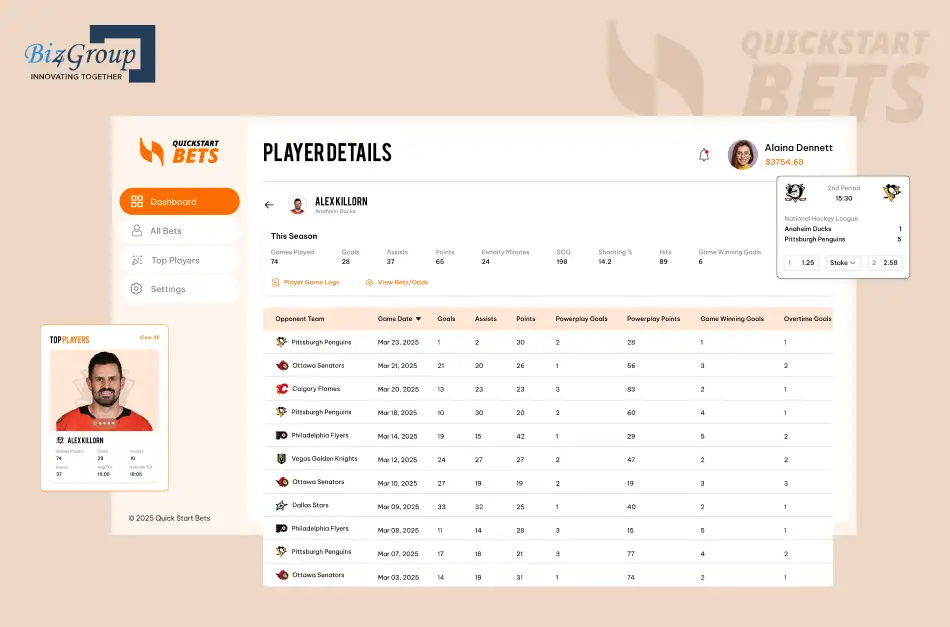
Quick Start Bets was built to support fast paced NHL games where timing defines user experience. The focus was clear. Deliver clarity, speed, and insight without overwhelming the user.
Here is how future ready data strategies shaped the platform.
- Real-time odds updates tailored for NHL games
- Detailed player and team statistics with historical context
- Centralized dashboard for bet tracking and performance insights
- Low latency updates designed for high-speed game events
- Simplified analytics presentation for faster decision making
By combining reliable sports data integration for betting apps with thoughtful UI/UX design, Quick Start Bets demonstrates how data trends translate into real engagement.
Looking ahead is important. Acting on those insights matters more.
Here is who believes in acting on those insights...
Biz4Group LLC and Its Experience with Sports Data Providers for Betting Apps
Biz4Group LLC is a USA-based software development company known for building complex, performance-driven platforms for regulated and data intensive industries. Sports betting is one of them. And it is not an easy space to get right.
Betting platforms demand accuracy under pressure, stability during traffic spikes, and speed when every second matters. Over the years, Biz4Group has helped founders, operators, and enterprises design and scale betting ecosystems that rely on dependable sports data providers for betting apps.
Our strength lies in understanding both sides of the equation. The business side that focuses on growth, user trust, and compliance. And the technical side that demands resilient architecture, clean intelligent integrations, and long-term scalability.
Our portfolio reflects this mindset. Each platform was designed to handle real-time data flows, high frequency updates, and evolving user expectations without compromising stability or experience.
Why Businesses Across the Globe Choose Biz4Group LLC
- Proven experience building real-time betting and sports analytics platforms
- Deep expertise in multi provider sports data integration and aggregation
- Strong understanding of US betting regulations and platform requirements
- Custom architecture designed for performance, scale, and accuracy
- Transparent communication and long-term technology partnership mindset
- Dedicated teams that think beyond launch and focus on growth readiness
Clients choose Biz4Group because they want more than code. They want clarity, accountability, and a partner who understands what happens when thousands of users place bets at the same moment.
At the core, our work is about trust.
Trust in data.
Trust in systems.
Trust in the people building them.
If you are planning to launch, scale, or modernize a betting platform in the USA, the right data strategy can define your success. And the right technology partner can make that strategy work in the real world.
We are that technology partner for you. Build something amazing with us. Let’s talk.
Final Thoughts
Building a successful betting platform today comes down to one critical factor. Trust in data. From live odds to final settlements, users expect accuracy, speed, and consistency at every moment. That is why leading platforms rely on multiple sports data providers for betting apps. It reduces risk, improves reliability, and keeps performance steady during high traffic events. More importantly, it creates a betting experience users feel confident returning to.
As competition grows and regulations tighten, betting platforms can no longer afford fragile data pipelines. Smart sports data integration for betting apps, backed by aggregation and redundancy, supports fair play, smoother operations, and long-term scalability. Platforms that invest in reliable sports data sources for betting apps position themselves to grow faster and respond better to market demands.
This is where Biz4Group LLC steps in. With deep experience in building real-time betting and sports analytics platforms, Biz4Group helps businesses design data architectures that work under pressure. From selecting the right providers to implementing scalable integration strategies, we help transform complex data challenges into dependable systems that support growth.
If you are planning to launch or scale a betting platform, now is the time to get the data foundation right. Connect with Biz4Group LLC and build a betting experience your users trust, your teams rely on, and your business can confidently grow with.
FAQs
1. How many sports data providers should a betting app use at minimum?
There is no fixed number, but most scalable betting platforms start with two providers and add more based on sports coverage and traffic volume. The goal is flexibility, not excess. Each additional provider should solve a specific business or performance need.
2. Can smaller betting startups afford multiple sports data providers?
Yes, if planned correctly. Startups often begin with a phased approach where secondary providers are activated only for high traffic sports or peak events. This keeps early costs controlled while leaving room to scale.
3. Does using multiple sports data providers slow down app performance?
When implemented correctly, the opposite happens. A well-designed aggregation layer improves performance by routing requests to the fastest available source. Performance issues usually arise from poor orchestration, not from having multiple providers.
4. Are official league data sources mandatory for US betting apps?
Not always mandatory, but often recommended depending on the state and sport. Some regulators and leagues strongly prefer official data sources for settlement accuracy and dispute resolution. This is an important consideration during provider selection.
5. What happens if two sports data providers report different outcomes?
Discrepancies are resolved using predefined validation rules and provider priority logic. Many platforms also delay final settlements until conflicts are resolved, protecting both users and operators from incorrect payouts.
6. Do fantasy sports apps need the same data strategy as betting apps?
Fantasy platforms often require deeper player level and historical data but may not need the same real-time settlement precision as betting apps. That said, multi provider strategies still help improve accuracy and coverage for fantasy use cases.
