 Location :
Orlando, FL, USA
Location :
Orlando, FL, USA +1 (407) 714-1616
 info@biz4group.com

 AI Summary Powered by Biz4AI
- A New York sports betting license is not available through an open application window as of October 8, 2026. The state's limited-license model licensed eight platform providers and nine operators in 2021, for up to 10 years.
- For companies researching how to enter the New York sports betting market, access runs through a license transfer (PENN paid $25 million for Wynn's licensed entity), a licensed partner, or supplying technology to one. Bill A6013 would expand the market but remains in committee.
- New York sports betting market size: $25.38 billion wagered in 2025 and about $1.3 billion in state tax revenue in SFY 2026, with basketball driving 36% of wagers.
- New York sportsbook operators: eight are active after Resorts World Bet's June 2025 exit and ESPN BET's rebrand to theScore Bet. FanDuel and DraftKings held about 75% of 2024 handle.
- The New York sports betting tax rate is 51% of gross gaming revenue, not handle. In June 2026, handle rose 36.6% while gross gaming revenue fell 43.5%.
- Biz4Group LLC helps businesses build the technology layer, from geolocation and KYC to real-time odds and responsible gaming, with cost and ROI planning.
Regulatory note: This article is for business and technology planning only and is not legal advice. New York licensing, vendor, transfer and ownership requirements change and apply differently depending on the business model. Consult a qualified New York gaming attorney before committing capital, signing contracts or launching a product.
Sources used (information last verified October 8, 2026):
- New York State Gaming Commission (NYSGC) & Office of Addiction Services and Supports (OASAS), 2025 Mobile Sports Wagering Impact Report (gaming.ny.gov/system/files/documents/2026/09/2025mswimpactreport_final.pdf)
- New York State Comptroller, Sports Wagering in New York (September 2026) (osc.ny.gov/files/reports/pdf/sports-wagering-in-new-york.pdf) and the accompanying press release (osc.ny.gov/press/releases/2026/09/dinapoli-new-york-sees-surge-mobile-sports-betting-and-jump-problem-gambling-calls)
- NYSGC, Mobile Sports Wagering Request for Applications (RFA) materials, 2021 (gaming.ny.gov/mobile-sports-wagering-rfa-materials)
- New York Racing, Pari-Mutuel Wagering and Breeding Law §1367-a, mobile sports wagering (newyork.public.law/laws/n.y._racing,_pari-mutuel_wagering_and_breeding_law_section_1367-a)
- New York State Assembly Bill A6013, 2025–26 session (nysenate.gov/legislation/bills/2025/A6013)
- PENN Entertainment, Agreement with Wynn Interactive Holdings to Acquire Mobile Sports Wagering Licenses for New York Market Access (February 13, 2024) (investors.pennentertainment.com/news-releases/news-release-details/penn-entertainment-announces-agreement-wynn-interactive-holdings) and theScore Bet Now Live In 21 U.S. Jurisdictions (December 1, 2025) (investors.pennentertainment.com/news-releases/news-release-details/thescore-bet-now-live-21-us-jurisdictions)
- New York State Gaming Commission, 2024 Annual Report (gaming.ny.gov/system/files/documents/2025/09/annualreport_2024_final.pdf)
Technology cost ranges, per-account economics and market-concentration percentages in this article are Biz4Group estimates or calculations based on official data, not official figures.
Imagine spending months planning a sportsbook launch, mapping out odds, payments, KYC, responsible gaming, and customer acquisition, only to discover that New York does not have a normal “apply here” licensing queue waiting for you.
That is the reality behind the New York sports betting license market in 2026.
As of October 8, 2026, a new company cannot enter New York through a conventional open sportsbook application process. The state operates a tightly controlled mobile sports wagering structure built around licensed platform providers and operators. However, the market is not formally closed forever. New York law and Commission materials allow for additional licenses in circumstances that serve the state's interests, while existing license positions can also create acquisition or market-access opportunities. (Sources: NY Racing, Pari-Mutuel Wagering and Breeding Law §1367-a; NYSGC 2021 RFA materials.)
That distinction matters if you are an operator, investor, sportsbook founder, technology provider, or company evaluating how to enter the New York sports betting market.
How Does the New York Sports Betting License Model Work?
New York launched statewide mobile sports wagering on January 8, 2022, after the New York State Gaming Commission conducted a competitive bidding process.
The original structure resulted in eight platform providers supporting nine licensed operators, with the awards carrying terms of up to 10 years and a 51% tax rate on mobile sports wagering gross gaming revenue. The state also requires the wagering server or acceptance equipment to be physically located at a licensed commercial casino gaming facility. (Sources: NYSGC/OASAS 2025 Impact Report; NYSGC 2021 RFA materials; NY Racing, Pari-Mutuel Wagering and Breeding Law §1367-a.)
The eight platform providers selected in 2021 were FanDuel, Bally's, BetMGM, DraftKings, Kambi, Caesars, WynnBET and PointsBet. Two of those positions have since changed hands: Wynn's licensed entity was acquired by PENN, and PointsBet's license was taken over by Fanatics. (Sources: NYSGC 2021 award materials; NYSGC 2024 Annual Report.)
That last requirement makes New York structurally different from markets where a sportsbook can build its digital operation around a conventional remote infrastructure model.
Together, the capped number of licenses and the casino-server requirement make New York a limited-license model rather than an open-application market.
What Is the Difference Between a Platform Provider and a Sportsbook Operator?
This distinction is critical when evaluating a New York sports betting license.
|
Role |
What It Does |
NY Licensing Position |
|---|---|---|
|
Platform provider |
Supplies the regulated mobile wagering platform and associated infrastructure |
Licensed role |
|
Mobile sports wagering operator |
Runs the sportsbook brand and accepts wagers through a licensed platform |
Separately licensed role |
|
Technology vendor |
Supplies specific technology or services to a licensed entity |
May fall under separate vendor licensing or registration requirements depending on its activities |
The New York Gaming Commission's 2021 RFA explicitly states that platform providers and operators are licensed under standards equivalent to a Casino Vendor Enterprise. It also says entities providing goods and services directly related to gaming activity can be subject to licensing requirements. (Source: NYSGC 2021 RFA materials.)
So calling an ordinary sportsbook development company a “New York platform provider” is misleading.
A technology company building KYC workflows, betting interfaces, APIs, compliance layers, or other components for a licensed operator should instead evaluate its vendor licensing and regulatory obligations with New York gaming counsel.
Can a New Company Get a New York Sports Betting License in 2026?
Not through a normal open application window.
The original 2021 licensing process produced the state's current mobile sportsbook structure, and there is no general 2026 application round that allows an unrelated startup to submit a fresh application and launch a new standalone sportsbook tomorrow. (Sources: NY Racing, Pari-Mutuel Wagering and Breeding Law §1367-a; NYSGC 2021 RFA materials.)
There is an important legal nuance, though.
The Commission's original RFA allowed it to recommend additional platform providers and operators when doing so was in the best interests of New York State. The Commission's 2021 evaluation also included an additional-license review, and applicants such as bet365 did not receive a license. (Source: NYSGC 2021 RFA materials, including the Evaluation Committee Report.)
So the market is restricted, not permanently sealed.
No "Apply Here" Button? We Know Where the Door Is.
Five routes on the map, one that fits your budget and timeline. Which is yours?
Call an Expert NowWhat Happened to New York's Expansion Proposal?
Assembly Bill A6013 is one of the clearest signals of how policymakers have considered expanding the market.
The bill proposes a much larger operator pool, with:
- 14 mobile sports wagering operators by January 31, 2026
- 16 by January 31, 2027
- A tax rate ranging from 64% with 4–5 operators to 25% with 15 or more
- A proposed $25 million platform-provider fee
- A proposed $50 million operator fee (Source: NY Assembly Bill A6013, 2025–26 session.)
Its proposed tax table is worth looking at because it shows how dramatically the economics could change if New York expanded the operator pool.
|
Number of Operators |
Proposed Tax Rate Under A6013 |
|---|---|
|
4–5 |
64% |
|
6 |
62% |
|
7 |
60% |
|
8 |
58% |
|
9 |
51% |
|
10–12 |
50% |
|
13–14 |
35% |
|
15+ |
25% |
These are proposed rates under A6013, not current New York law. (Source: NY Assembly Bill A6013.)
But there is a catch that matters in October 2026.
The January 31, 2026 deadline in A6013 has already passed, and the bill remains in Assembly committee. It should therefore be treated as a legislative proposal, not an upcoming licensing round. (Source: NY Assembly Bill A6013, bill status page.)
How Can You Enter the New York Sports Betting Market?
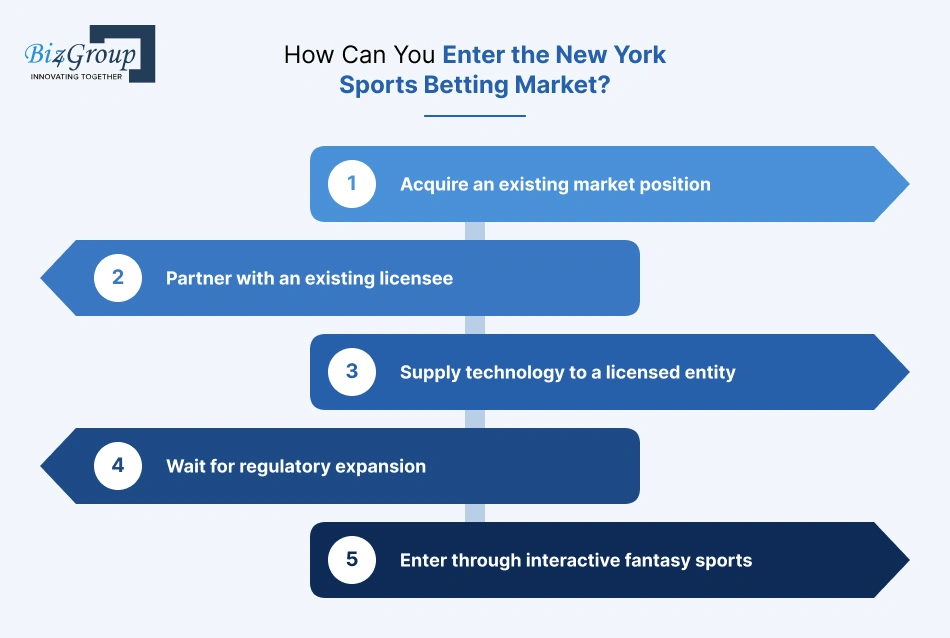
For a company asking how to enter the New York sports betting market, the practical routes look different from those available in an open-license state.
|
Entry Route |
What It Involves |
Practical Outlook |
|---|---|---|
|
Acquire an existing market position |
Purchase or restructure an entity holding NY market access, subject to regulatory approval |
Potentially viable |
|
Partner with an existing licensee |
Enter through a commercial, brand, technology, or operating relationship |
Viable depending on structure |
|
Supply technology to a licensed entity |
Build or provide components under an appropriate vendor relationship |
Most relevant route for technology companies |
|
Wait for regulatory expansion |
Monitor Commission action or future legislation |
Possible, but timing uncertain |
|
Enter through interactive fantasy sports |
Build a regulated fantasy product instead of a sportsbook |
Lower-barrier adjacent route |
Can You Acquire a New York Sportsbook License?
Existing transactions demonstrate that market access can have a real acquisition value, and that a license transfer can be approved by the Commission.
In February 2024, PENN Entertainment announced its agreement to acquire WSI US, the entity holding Wynn's New York mobile sports wagering licenses, for $25 million. The transaction gave PENN access to the New York market and eventually supported the ESPN BET launch. (Source: PENN Entertainment announcement, February 2024.)
PENN later rebranded its U.S. sportsbook to theScore Bet on December 1, 2025. (Source: PENN Entertainment announcement, December 2025.)
That $25 million transaction is an important benchmark, but it should not be interpreted as a fixed “New York sportsbook license price.” It was the transaction price for acquiring an entity holding existing NY licenses and related market access.
Is There a Vacant New York Sportsbook License?
There is an inactive license position associated with Resorts World Bet, but it is more precise to describe it as an inactive market position than to call it a confirmed vacant license available for purchase.
Resorts World Bet ceased offering mobile sports wagering in New York in June 2025. The 2025 Gaming Commission/OASAS report records its exit from mobile sports wagering. (Source: NYSGC/OASAS 2025 Impact Report.)
As of October 8, 2026, no public confirmation of a completed transfer of that license position had been identified. Any transfer, restructuring, or future use would remain subject to New York Gaming Commission review and approval.
That makes the inactive position worth monitoring for investors and potential market entrants, but it should not be presented as an automatically available license.
How Many New York Sportsbook Operators Are Active?
The original market had nine licensed operators. After Resorts World Bet's 2025 exit, the live roster is best described as 8 active operators and 1 licensee inactive as of October 2026.
|
Status |
New York Sportsbook Operator |
|---|---|
|
Active |
Bally Bet |
|
Active |
BetMGM |
|
Active |
Caesars Sportsbook |
|
Active |
DraftKings |
|
Active |
Fanatics Sportsbook |
|
Active |
FanDuel |
|
Active |
BetRivers / Rush Street Interactive |
|
Active |
theScore Bet |
|
Inactive |
Resorts World Bet |
This roster reflects Resorts World Bet's June 2025 exit (NYSGC/OASAS 2025 Impact Report) and the rebranding of ESPN BET to theScore Bet (PENN Entertainment announcement, December 2025).
Can a Technology Company Enter New York Without Owning a Sportsbook?
A development company can potentially supply technology to a licensed operator or platform provider, subject to the specific services, regulatory classification, contracts, and New York licensing requirements involved.
The Commission's own RFA says that platform providers, mobile sports wagering operators, and entities providing goods and services directly related to gaming activity can be subject to Casino Vendor Enterprise licensing standards. (Source: NYSGC 2021 RFA materials.)
That means the commercial opportunity is less about getting a New York sportsbook license for your development company and more about becoming a technically capable supplier inside the regulated ecosystem.
For companies evaluating this route, a compliance-first sports betting app development company, like Biz4Group, can help scope the KYC, geolocation, payments, audit, betting, and reporting layers before a regulated entity takes the product through its own approval process.
Regulatory note: Vendor classification and licensing obligations should be confirmed with New York gaming counsel before development or contracting begins. The Commission's RFA and Q&A materials provide useful direction around vendor registration and Casino Vendor Enterprise standards, but the current rule text and the specific services being supplied should be reviewed by counsel. This article does not constitute legal advice.
How Big Is the New York Sports Betting Market in 2026?
The market is enormous. The economics are where the plot gets interesting.
According to the latest Gaming Commission and OASAS report, New Yorkers wagered $25.38 billion in 2025, up 12.4% from 2024. Licensee gross gaming revenue increased 8% to $2.22 billion. The state recorded approximately 7.2 million unique mobile sports wagering accounts, with an average of $3,500 wagered per account and $42 per wager. (Source: NYSGC/OASAS 2025 Impact Report.)
The Comptroller's September 2026 report provides an even broader view. Since mobile sports betting launched in January 2022, New Yorkers had placed more than $91.2 billion in wagers, generating approximately $8.3 billion in gross gaming revenue through the end of SFY 2026. The state collected about $1.3 billion in mobile sports betting taxes during SFY 2026. (Source: NY State Comptroller, September 2026 report.)
What Sports Drive the New York Sports Betting Market?
Basketball dominates.
In 2025, basketball represented 36% of all mobile sports wagering, with approximately $9.13 billion wagered. Football accounted for 20%, baseball 17%, tennis 12%, and soccer 7%. (Source: NYSGC/OASAS 2025 Impact Report.)
That concentration matters when designing a New York sportsbook platform.
The product needs strong coverage for the sports that actually drive handle, but it also needs architecture capable of handling sharp changes in demand around major events.
And 2026 delivered a particularly good lesson in why handle alone cannot tell the whole story.
What Is the New York Sports Betting Tax Rate, and Why Does It Matter?
The New York sports betting tax rate is 51%, and it applies to mobile sports wagering gross gaming revenue, not the total amount customers wager.
That distinction is crucial.
If a sportsbook generates $100 million in taxable GGR, approximately $51 million goes to the state, leaving $49 million before other expenses such as platform costs, data, payments, marketing, staffing, risk management, compliance, customer support, and infrastructure.
The latest state data shows why operators need to model this carefully. In SFY 2026, New York collected approximately $1.3 billion in taxes from mobile sports betting. (Source: NY State Comptroller, September 2026 report.)
What Does 51% Taxation Mean Per New York Sports Betting Account?
The account-level economics make the tax burden easier to understand.
Using the Gaming Commission's 2025 figures, $2.22 billion in GGR across approximately 7.2 million unique accounts works out to roughly $309 in GGR per account.
After the 51% state tax, approximately $151 per account remains before other operating costs.
These are our calculations based on the Commission's reported 2025 GGR and account figures, so they should be treated as an illustrative average rather than a measure of individual player profitability. (Source: NYSGC/OASAS 2025 Impact Report, with Biz4Group calculations.)
The $2.22 billion is licensee-reported revenue, and one bettor with accounts at several sportsbooks may be counted more than once, so the figure does not reconcile exactly with state tax collections.
That single calculation explains why New York's huge handle does not automatically translate into easy sportsbook economics.
Handle Can Make a New York Sportsbook Look Healthier Than It Is
June 2026 offered a spectacular example.
Mobile sports betting activity increased by 36.6% year over year, adding more than $604 million in handle. Yet GGR fell 43.5%, dropping nearly $90 million. During the first two weeks of June, more than $1 billion was wagered, but sportsbooks collectively recorded a $14.4 million net GGR loss as winning wagers exceeded wagers received. (Source: NY State Comptroller, September 2026 report.)
The culprit was not mysterious.
The New York Knicks won the 2026 NBA Championship as underdogs, producing unusually large payouts. (Source: NY State Comptroller, September 2026 report.)
That is why a serious New York sportsbook business plan should model hold, GGR, tax, promotional exposure, volatility, and player acquisition costs instead of presenting handle as revenue.
$100M GGR In, $51M to Albany. What's Left for You?
Handle wows investors. Margins pay the bills. Is your New York model post-tax proof?
Model My Post-Tax ROIHow Much Does It Cost to Build a New York Sportsbook Platform?
A practical planning range is approximately $20,000 to $350,000+.
The lower end can cover a lean MVP with a limited feature set and fewer integrations. The upper end is reserved for highly bespoke, integration-heavy builds involving sophisticated real-time infrastructure, extensive compliance requirements, advanced trading and risk functionality, and high-volume architecture.
However, the New York sports betting license cost and the technology development cost are two completely different numbers.
A technology build can range widely depending on how much of the sportsbook is being developed, which third-party services are integrated, and how much regulatory infrastructure must be engineered.
|
Development Level |
Approx. Technology Budget |
Typical Scope |
|---|---|---|
|
Lean MVP |
$20K–$50K+ |
Core UX, registration, basic betting flows, admin tools, limited integrations |
|
Growth sportsbook |
$50K–$120K+ |
More betting markets, payments, KYC, geolocation, odds feeds, stronger admin and reporting |
|
Enterprise platform |
$100K–$150K+ |
Multiple integrations, real-time betting, advanced risk controls, analytics, stronger infrastructure |
|
Highly bespoke enterprise build |
$150K–$350K+ |
Extensive integrations, high concurrency, sophisticated compliance architecture, advanced trading, complex reporting and multi-state readiness |
These figures are development planning ranges, not New York licensing fees.
The $100K–$150K+ enterprise range represents a more typical planning estimate for an enterprise sportsbook build, while the $350K+ ceiling applies to exceptionally complex, highly customized implementations. They also exclude market-access acquisition, regulatory counsel, licensing fees, data contracts, payment processing costs, geolocation vendor charges, marketing, staffing, and operating capital. (Biz4Group planning estimates.)
For comparison, Biz4Group's current sportsbook cost analysis places multi-state platforms at roughly $60,000–$110,000 and enterprise platforms at $100,000–$150,000+, illustrating how scope and jurisdictional complexity can move development budgets substantially.
The key takeaway is simple: a basic MVP can cost far less than a heavily integrated sportsbook designed for high traffic, multiple jurisdictions, real-time markets, and extensive compliance workflows.
Also read: Sports betting app development cost
What Is the Actual New York Sports Betting License Cost?
There are three different numbers worth separating.
First, the current statutory licensing structure. The original 2021 RFA required each platform provider selected through the competitive process to pay a $25 million one-time platform-provider fee. That is the most important historical benchmark for understanding the original New York entry structure. (Source: NYSGC 2021 RFA materials; NY Racing, Pari-Mutuel Wagering and Breeding Law §1367-a.)
Second, A6013's proposed future fees. The bill proposes a $25 million platform-provider fee and $50 million operator fee as part of a potential expanded licensing structure. These amounts are proposed legislation and are not current licensing fees. (Source: NY Assembly Bill A6013.)
Third, the PENN–Wynn market-access benchmark. PENN agreed to pay $25 million to acquire the entity holding Wynn's New York mobile sports wagering licenses. That was an acquisition transaction, not a government-set license fee. (Source: PENN Entertainment announcement, February 2024.)
So, if someone searches “New York sportsbook license cost,” the answer is not simply “$25 million.”
The $25 million figure can represent a historical platform-provider fee or a specific market-access transaction. A6013's $25 million/$50 million structure is only proposed. A new entrant should therefore separate state licensing fees, acquisition consideration, technology development, and regulatory expenses when calculating the actual capital requirement.
What Does a New York Sports Betting Platform Need for Regulatory Readiness?
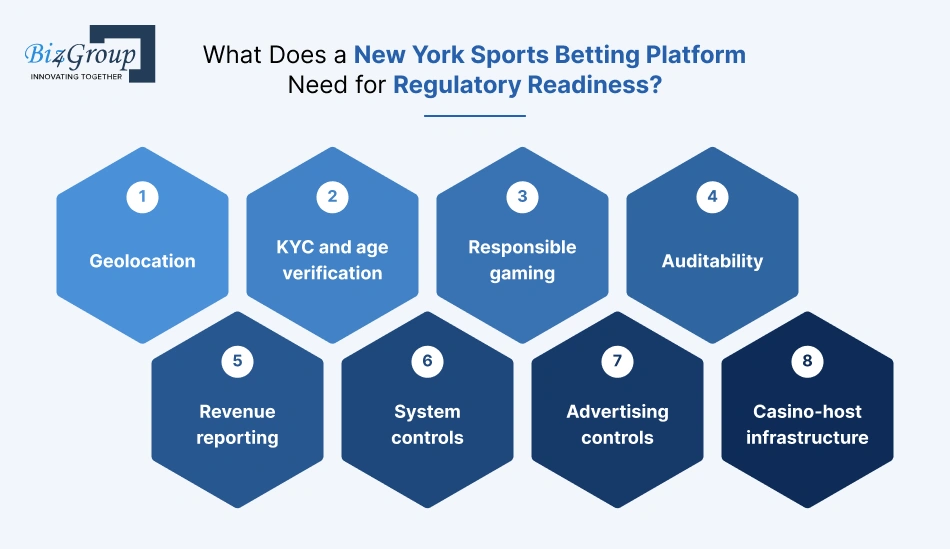
A compliant New York sports betting platform has to account for regulatory controls at the architecture level.
|
Requirement |
What the Platform Needs to Support |
|---|---|
|
Geolocation |
Confirm the bettor is physically within New York |
|
KYC and age verification |
Prevent unauthorized or underage wagering |
|
Responsible gaming |
Limits, self-exclusion, problem-gambling controls |
|
Auditability |
Traceable records of wagers and relevant account activity |
|
Revenue reporting |
Accurate GGR calculations and tax reporting |
|
System controls |
Controlled changes, testing, and regulatory validation |
|
Advertising controls |
Rules for responsible gaming messages and prohibited marketing |
|
Casino-host infrastructure |
Wager acceptance equipment must comply with NY's physical-location requirements |
New York requires Commission-approved geolocation services to verify that wagering activity takes place within the state. The state also requires responsible gaming controls, including account-level limits and information around deposits, wagers, time, and losses. (Source: NYSGC/OASAS 2025 Impact Report, citing 9 NYCRR Part 5330.)
Advertising is another technical and operational concern. New York prohibits misleading sportsbook advertising, requires responsible gambling messaging, restricts marketing aimed at underage audiences, and places specific limits on advertising around colleges and universities. (Source: NYSGC/OASAS 2025 Impact Report, marketing and advertising regulations section.)
Teams planning a compliance-first build can also review Biz4Group's sports betting compliance architecture guide, which covers geolocation, KYC, AML, audit logging, testing, and state-aware architecture.
What Should You Know About New York Sports Betting Prediction Markets?
Prediction markets have become one of the biggest new questions surrounding the New York sports betting market.
Platforms such as Kalshi and Polymarket allow users to trade contracts connected to real-world outcomes, including sporting events. The New York Comptroller reported that global trading volume on these platforms reached tens of billions of dollars in 2025 and noted that sports represented a substantial share of that activity. (Source: NY State Comptroller, September 2026 report.)
New York has taken an aggressive regulatory position.
In October 2025, the Gaming Commission sent Kalshi a cease-and-desist letter alleging that its sports-related activity constituted unlicensed mobile sports wagering. In July 2026, New York sued Kalshi, seeking to stop what the state described as illegal gambling activity and recover alleged gains. (Source: NY State Comptroller, September 2026 report.)
That creates an important warning for founders.
Prediction markets should not be treated as a simple workaround for New York's sportsbook licensing structure.
The legal position is still developing, and companies entering this area should obtain specialist gaming counsel before treating an event-contract model as an alternative sportsbook route.
What Other New York Gaming Entry Routes Exist?
New York also recognizes interactive fantasy sports, and the Comptroller identifies it as one of the state's statutorily authorized gaming categories alongside mobile and retail sports betting, casinos, lottery, VLTs, and horse racing. (Source: NY State Comptroller, September 2026 report.)
That creates a potentially useful adjacent path for companies whose product does not require a sportsbook license.
Interactive fantasy sports also has a different regulatory structure and tax treatment from mobile sports wagering, making it worth evaluating separately instead of assuming every sports-gaming concept needs the same licensing pathway.
The same applies to retail gaming. Three downstate commercial casino licenses were awarded in December 2025, creating additional physical casino infrastructure that could influence New York's broader gaming ecosystem. (Source: NY State Comptroller, September 2026 report.)
Online casino expansion, however, should not be treated as an immediate 2026 opportunity. The state's broader iGaming debate remains a separate legislative question.
What Should You Do Before Entering the New York Sports Betting Market?
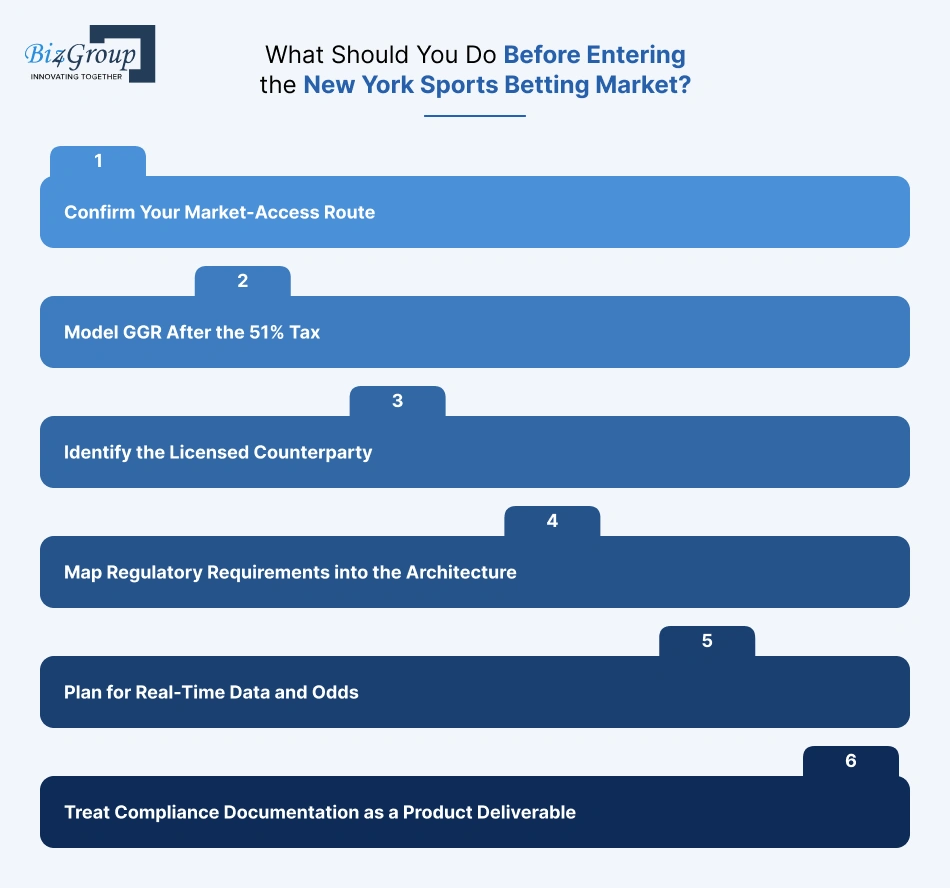
If New York is on your expansion map, start with the route, not the app.
1. Confirm Your Market-Access Route
Determine whether the business depends on a new license, an acquisition, a partnership, or a technology-supply relationship.
2. Model GGR After the 51% Tax
Run scenarios for hold, promotions, player acquisition, payment costs, data costs, operating expenses, and tax.
3. Identify the Licensed Counterparty
If your company is not itself a license holder, establish exactly which licensed operator or platform provider will sit between your technology and the regulated wagering activity.
4. Map Regulatory Requirements into the Architecture
Build geolocation, KYC, responsible gaming, auditability, reporting, and change-control requirements into the product plan.
A state-aware architecture becomes particularly important if New York is one market in a larger U.S. rollout. The broader state-wise sports betting regulations guide can help compare how licensing models differ across jurisdictions.
5. Plan for Real-Time Data and Odds
Odds feeds, market updates, latency, failover, and high-volume event traffic need their own architecture decisions.
A detailed real-time odds engine architecture guide covers the ingestion, normalization, distribution, and scalability considerations behind production sportsbook infrastructure.
6. Treat Compliance Documentation as a Product Deliverable
Regulated-market development is not complete when the application works.
System diagrams, workflows, logs, testing evidence, security controls, and regulatory documentation should be planned alongside development.
Found a Licensed Partner? Now Pass the Tech Test.
8 compliance layers, 1 casino-server rule, zero "we'll fix it later" tickets.
Book a Readiness ReviewQuick Start Bets and Real-Time Sports Data Platform Development
Biz4Group's Quick Start Bets is a relevant technology reference for teams planning the data layer behind a regulated sports product. The platform combines real-time odds, player analytics, historical statistics, centralized dashboards and low-latency infrastructure.
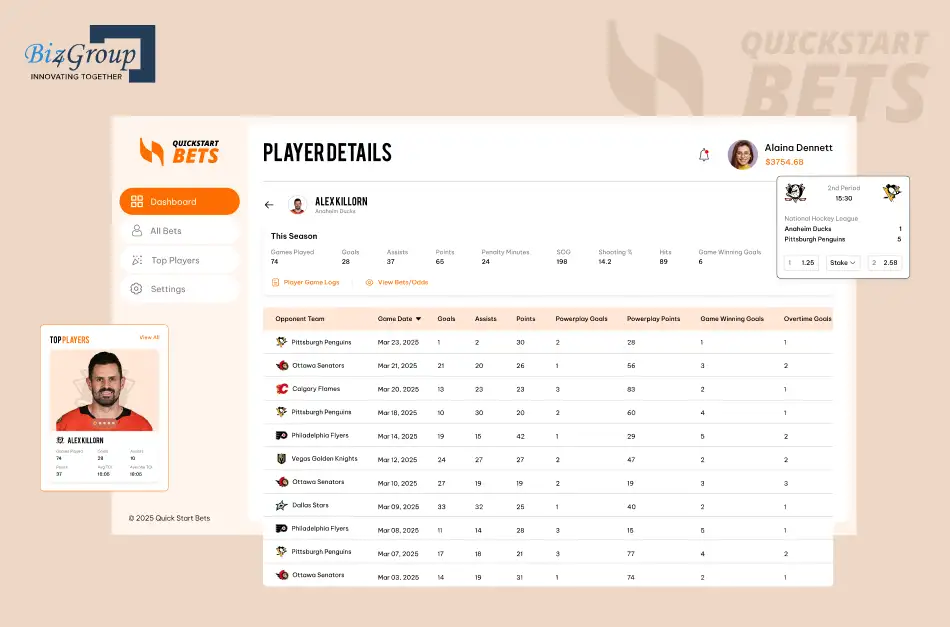
Importantly, Quick Start Bets should be viewed as a technology-development reference, not as evidence of New York sportsbook licensure or approval. Regulatory status depends on the specific product, business model, licensed entities, and jurisdiction.
That distinction matters in a market where technology architecture and gaming authorization are closely connected but are not the same thing.
Is New York Still Worth Entering in 2026?
The answer depends heavily on how you plan to enter.
Why the New York Sports Betting Market Is Attractive
- More than $25.3 billion was wagered in 2025. (NYSGC/OASAS 2025 Impact Report)
- The state generated approximately $1.3 billion in mobile sports betting tax revenue in SFY 2026. (NY State Comptroller, September 2026 report)
- More than 7.2 million unique mobile wagering accounts were recorded in 2025. (NYSGC/OASAS 2025 Impact Report)
- Basketball alone generated more than $9.1 billion in 2025 handle. (NYSGC/OASAS 2025 Impact Report)
- Existing license transactions demonstrate that New York market access has tangible commercial value. (PENN Entertainment announcement, February 2024)
Why New York Is Difficult
- The mobile sportsbook market has a highly restricted licensing structure. (NY Racing, Pari-Mutuel Wagering and Breeding Law §1367-a; NYSGC 2021 RFA materials)
- The mobile sports wagering tax rate is 51% of GGR. (NYSGC/OASAS 2025 Impact Report)
- Customer acquisition and sportsbook economics must withstand significant tax and payout pressure.
- A June 2026 event demonstrated how quickly high handle can coexist with negative GGR. (NY State Comptroller, September 2026 report)
- Prediction-market regulation is creating another layer of uncertainty around sports-related event contracts. (NY State Comptroller, September 2026 report)
So, is New York closed?
Not exactly.
It is better described as a high-barrier, tightly controlled market where market access matters more than building a sportsbook and waiting for a license application window.
For an operator, the first question should be how to secure regulated market access.
For an investor, the question is what an existing license position is worth and what economics remain after the 51% tax.
For a technology company, the opportunity is to become a capable technology supplier to a properly licensed entity, with New York gaming counsel determining the applicable licensing or registration requirements.
For businesses planning that technology layer, Biz4Group LLC's sports betting app development services can support product architecture, integrations, KYC, geolocation, payments, compliance workflows, and sportsbook-specific development requirements.
FAQs
1. Can an out-of-state sportsbook apply for New York market access?
Being licensed in another state does not automatically create a New York market right. A company must satisfy New York's own licensing and regulatory framework or establish an appropriate relationship with an existing New York license holder.
2. How long are New York mobile sportsbook licenses valid?
The original mobile sports wagering awards were structured for 10-year terms. (Source: NYSGC/OASAS 2025 Impact Report.) That means the original award cycle creates an important structural window around the early 2030s, although the exact expiry and renewal position for a specific license should be confirmed against its licensing documents and current law.
3. What is the legal betting age in New York?
The minimum age for mobile sports wagering in New York is 21. The Gaming Commission's 2025 report documents measures intended to prevent individuals under 21 from participating in mobile sports wagering. (Sources: NYSGC/OASAS 2025 Impact Report; NY State Comptroller, September 2026 report.)
4. Can tribal casinos offer sports betting in New York?
Yes. New York recognizes both commercial and tribal casinos as part of its gaming framework, and retail sports betting operates at authorized casino properties. Mobile sports wagering, however, follows the separate statewide licensing structure established under Section 1367-a. (Sources: NY State Comptroller, September 2026 report; NY Racing, Pari-Mutuel Wagering and Breeding Law §1367-a.)
5. Can a sportsbook development company get a New York platform-provider license?
A development company should not assume that building sportsbook technology makes it a licensed platform provider. New York treats platform providers as a regulated role and also has licensing standards for entities providing goods and services directly related to gaming activity. The precise classification depends on the company's activities and relationship with the licensed entity. (Source: NYSGC 2021 RFA materials.)
6. Is New York a good state for a sportsbook MVP?
It can be an attractive market to study because of its enormous wagering volume, but it is a difficult place to validate a new sportsbook concept through a standalone launch. Founders without existing market access may find an adjacent fantasy product, technology partnership, or another state more practical for initial validation.
7. Why is it difficult for a new sportsbook to enter New York?
Four barriers stack up. New York runs a limited-license model with no open application window, so a new entrant needs a license transfer, a licensed partner or a technology-supplier role. The 51% tax on gross gaming revenue leaves thin margins before data, payments, compliance and marketing costs. Wagers must be accepted through equipment at a licensed casino facility. And the market is concentrated: FanDuel and DraftKings together accounted for about 75% of 2024 handle and about 81% of gross gaming revenue. (Sources: NY Racing, Pari-Mutuel Wagering and Breeding Law §1367-a; NYSGC 2024 Annual Report, with Biz4Group calculations.)
8. Can a sportsbook license be transferred in New York?
Yes, with Commission review. PENN Entertainment agreed in February 2024 to acquire WSI US, LLC, the entity holding Wynn's New York mobile sports wagering licenses, for $25 million, and Fanatics took over PointsBet's operations in February 2024. Any transfer requires New York State Gaming Commission approval, so buyers should treat it as a regulated transaction, not a simple asset purchase. (Sources: PENN Entertainment announcement, February 2024; NYSGC 2024 Annual Report.)
9. Why does New York have a 51% sports betting tax rate?
The rate came out of the 2021 competitive bidding process, not from a flat statutory number. Bidders proposed tax rates tied to the number of operators the Commission would license, and the rate that applied to the nine-operator outcome the Commission selected was 51% of mobile sports wagering gross gaming revenue. (Sources: NYSGC 2021 RFA materials; NY Racing, Pari-Mutuel Wagering and Breeding Law §1367-a.)
