Location :
Orlando, FL, USA
Location :
Orlando, FL, USA +1 (407) 714-1616
 info@biz4group.com

 AI Summary Powered by Biz4AI
- To develop real-time odds engine architecture for AI sports betting platform solutions, sportsbooks need a carefully designed stack that balances low latency, scalability, reliability, and compliance across every layer of the system.
- Teams looking to build AI sports betting odds engine infrastructure should begin with the right sports data providers because feed quality directly impacts market accuracy, user trust, and operational performance.
- Successful operators develop real-time sportsbook backend architecture with dedicated ingestion, validation, and normalization layers that standardize incoming data before it enters production workflows.
- Companies aiming to develop high-concurrency sports betting system environments must prepare for 50,000+ concurrent users through scalable connection management, capacity planning, and operational resilience.
- Biz4Group LLC helps businesses develop scalable sportsbook backend with AI, integrate real-time odds engines, implement sports data APIs, and build production-ready betting platforms designed for long-term growth.
Have you ever wondered what happens when 50,000 bettors hit the same sportsbook at kickoff, odds begin moving every few seconds, and millions of dollars are riding on data that cannot afford to be late?
In 2025 alone, Americans legally wagered nearly $167 billion on sports, according to the American Gaming Association, pushing sportsbook infrastructure into territory that looks far more like high-frequency trading than traditional web applications. For engineering leaders tasked with handling that scale, the challenge is how to develop real-time odds engine architecture for AI sports betting platform environments where latency, uptime, and reliability directly impact revenue.
Many sportsbook teams discover the problem only when traffic spikes. A platform that performs flawlessly at 3,000 concurrent users can begin to crack under Super Bowl traffic. Database writes queue up, API requests multiply, and stale odds start creating liability exposure. That is why organizations looking to build AI sports betting odds engine infrastructure are shifting toward event-driven architectures, real-time streaming protocols, and distributed processing layers designed for constant market movement.
The stakes become even higher when live betting enters the picture. Odds updates must travel from provider feeds to bettors' screens in milliseconds while remaining accurate, synchronized, and compliant. To develop real-time sportsbook backend architecture capable of supporting modern sportsbooks, engineering teams must rethink every layer of the stack, from ingestion and normalization to distribution and failover.
This guide breaks down exactly how to develop a real-time odds engine architecture for AI sports betting platforms handling high concurrency, including provider selection, Redis Pub/Sub design, WebSocket delivery, market suspension logic, disaster recovery planning, and the AI-powered infrastructure patterns that separate production-grade sportsbooks from platforms that fail under pressure.
What Does It Take to Develop Real-Time Odds Engine Architecture for an AI Sports Betting Platform Handling $160 Billion in Annual US Wagers?
Ask ten engineers how sportsbooks work and most will point to the betting interface, payment systems, or mobile experience. In reality, the odds engine sits at the center of everything. It is the component responsible for receiving live market data, processing changes, distributing updated prices, and ensuring bettors always interact with current information.
For teams looking to develop real-time odds engine architecture for AI sports betting platform environments, the challenge is building a system that remains reliable when traffic spikes, odds fluctuate every few seconds, and thousands of users request updates simultaneously.
One question frequently appears during architecture evaluations: “We are a sportsbook startup planning to develop a real-time odds engine for an AI sports betting platform and want guidance on technical stack, live odds delivery, and API integration.”
The answer starts with understanding the complete stack before selecting technologies.
The Core Responsibilities of a Real-Time Odds Engine
A production-grade odds engine performs five critical functions simultaneously.
|
Function |
Purpose |
|---|---|
|
Data Ingestion |
Receives live odds and event feeds from external providers |
|
Normalization |
Converts provider-specific formats into a standardized internal structure |
|
Distribution |
Delivers odds updates across thousands of active sessions |
|
Client Delivery |
Pushes updates to web and mobile applications in real time |
|
Bet Safety Controls |
Ensures bets are accepted only against valid and current market data |
Each layer must operate independently while remaining tightly synchronized with the rest of the platform.
The Modern Odds Engine Architecture Stack
Most successful sportsbook operators follow an event-driven architecture rather than relying on traditional request-response workflows.
A typical production flow looks like this:
Sports Data Providers
↓
Feed Ingestion Layer
↓
Normalization Engine
↓
Odds Processing Layer
↓
Distribution Layer
↓
Live Client Delivery
↓
Bet Acceptance Layer
At first glance, the workflow appears straightforward.
The complexity emerges when the platform must support:
- Tens of thousands of simultaneous users
- Constant odds movement
- Multiple data providers
- Live betting markets
- Regulatory compliance requirements
- Multi-state operations
That is why many operators move away from generic sportsbook software and begin evaluating whether to build vs. buy a sportsbook platform as they scale.
What Changes at Production Scale?
An odds engine supporting 1,000 users behaves very differently from one supporting 50,000.
The table below highlights the difference.
|
Metric |
Small Sportsbook |
Production Sportsbook |
|---|---|---|
|
Concurrent Connections |
1,000 to 5,000 |
50,000+ |
|
Odds Updates per Minute |
Hundreds |
Hundreds of Thousands |
|
Supported Markets |
Limited |
Thousands |
|
Latency Target |
Under 1 second |
Under 300ms p99 |
|
Infrastructure Design |
Monolithic |
Distributed |
|
Fault Tolerance |
Basic |
Multi-layered |
This transition is where many platforms encounter the same technical roadblocks documented in discussions around challenges in modern sports betting app development.
Where Does AI Fit Into the Architecture?
Many operators today want to create AI-powered sports betting odds systems to improve pricing intelligence and user engagement.
However, AI should be viewed as an enhancement layer rather than the foundation.
A well-architected platform typically combines:
- Real-time odds infrastructure
- Market intelligence systems
- Behavioral analytics
- Prediction models
- Personalized betting experiences
Real-World Example From Biz4Group
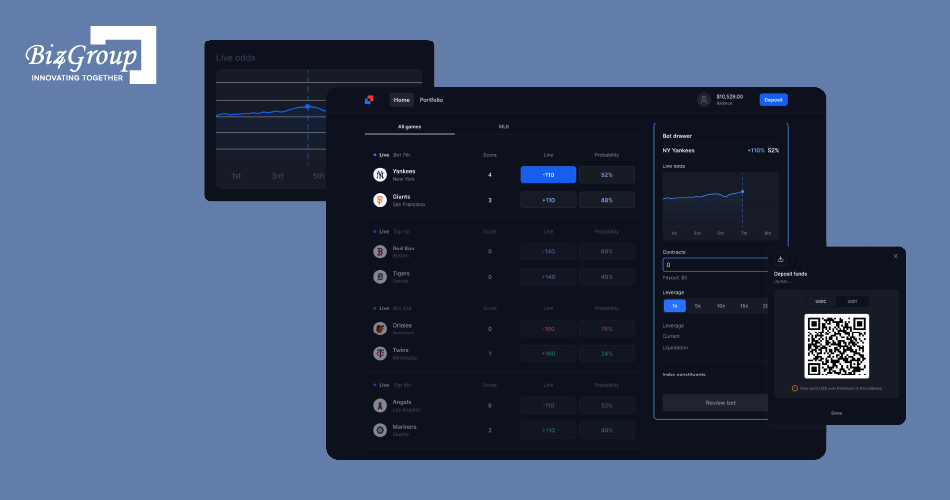
A practical example comes from a real-time sports betting platform developed by Biz4Group for MLB, NFL, and CFB betting markets.
The platform required:
- Live socket-based data ingestion
- Continuous market updates
- High-traffic scalability
- Dynamic pricing mechanisms
- Multi-service backend coordination
To support these requirements, the system was architected with distributed backend services, optimized socket communication, load balancing, caching layers, and real-time synchronization mechanisms.
The result was a sportsbook environment capable of maintaining responsive betting experiences even during periods of heavy activity.
What Should Engineering Teams Focus on First?
Before selecting Redis, Kafka, WebSockets, or AI models, focus on these architectural decisions:
|
Priority |
Decision Area |
|---|---|
|
1 |
Sports data provider strategy |
|
2 |
Feed ingestion architecture |
|
3 |
Internal odds data model |
|
4 |
Distribution mechanism |
|
5 |
Live delivery protocol |
|
6 |
Market safety controls |
|
7 |
Disaster recovery planning |
|
8 |
AI integration approach |
Get these foundations right and the rest of the platform becomes easier to scale.
Get them wrong and every new feature compounds technical debt.
The next step is selecting the sports data providers that feed the entire ecosystem. That choice affects latency, reliability, coverage, licensing flexibility, and ultimately every architectural decision that follows.
Choosing Sports Data Providers to Build an AI Sports Betting Odds Engine That Delivers Accurate Live Markets
Every sportsbook operator eventually reaches the same realization... Your odds engine can only be as reliable as the data entering it.
Before engineering teams begin discussing Redis clusters, WebSocket scaling, or AI modeling, they need to answer a more fundamental question.
Which sports data provider should power the platform?
This question appears frequently during vendor evaluations, “We are planning to create a real-time AI sports betting engine and need guidance on market suspension logic and API provider selection.”
The reality is that provider selection influences market coverage, update frequency, data quality, licensing flexibility, and long-term operational costs. A poor provider choice can introduce inaccuracies that no amount of backend engineering can fully correct.
The Three Providers Most Commonly Used by US Sportsbooks
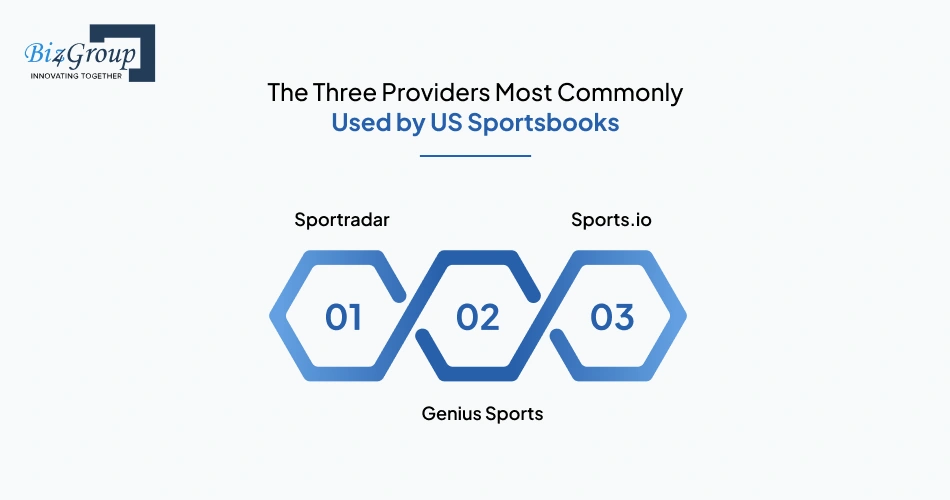
For operators looking to build AI sports betting odds engine platforms, three names consistently appear in architecture discussions:
Each serves a different business and technical need.
|
Evaluation Criteria |
Sportradar |
Genius Sports |
Sports.io |
|---|---|---|---|
|
US League Coverage |
Excellent |
Excellent |
Good |
|
NFL Data Access |
Strong |
Strong |
Moderate |
|
NBA Coverage |
Strong |
Strong |
Good |
|
MLB Coverage |
Strong |
Moderate |
Good |
|
Global Sports Coverage |
Excellent |
Good |
Excellent |
|
Historical Data Depth |
Excellent |
Good |
Good |
|
Enterprise Adoption |
Very High |
High |
Growing |
|
Startup Accessibility |
Moderate |
Moderate |
Strong |
For regulated US sportsbooks, Sportradar and Genius Sports often dominate conversations because of their league partnerships and extensive coverage.
What Actually Matters During Provider Evaluation?
Many teams compare providers solely on API documentation or pricing. That approach often leads to expensive mistakes.
Instead, evaluate providers across four practical dimensions.
1. Market Coverage
Start with the sports and betting markets you plan to support. A platform focused on NFL, NBA, MLB, NCAA Football will have different requirements than one offering:
- Soccer
- Tennis
- Cricket
- eSports
Provider strengths vary significantly across regions and sports.
2. Data Freshness
The best provider is often the one delivering updates consistently rather than simply delivering them first.
Questions worth asking include:
- How frequently are odds refreshed?
- How are corrections handled?
- How quickly are event changes propagated?
- What service-level commitments are available?
This becomes especially important for operators building live betting products, same-game parlays, player prop markets, and micro-betting experiences.
3. Historical Data Availability
Historical datasets fuel much more than reporting. They support:
- Trading models
- Simulation environments
- Risk analysis
- AI experimentation
Teams looking to use AI for sports betting often place significant weight on historical data accessibility.
4. Documentation Quality
An overlooked factor. Poor documentation increases:
- Development time
- Testing effort
- Integration complexity
- Maintenance costs
Many engineering teams discover that documentation quality directly impacts implementation velocity.
Official Data Rights Matter More Than Many Teams Realize
One misconception among startup operators is that all sports feeds are essentially interchangeable
They are not.
Official league relationships can influence:
|
Area |
Potential Impact |
|---|---|
|
Data Accuracy |
Faster corrections and updates |
|
Event Coverage |
More comprehensive datasets |
|
Market Availability |
Expanded betting opportunities |
|
Compliance Readiness |
Easier regulatory alignment |
|
Commercial Credibility |
Stronger operator positioning |
This is one reason many enterprise operators prioritize official data partnerships over feature checklists alone.
For a deeper understanding of this dynamic, many sportsbook founders examine why enterprise sports data APIs like Sportradar matter more than features when evaluating long-term platform strategy.
Should You Use One Provider or Multiple Providers?
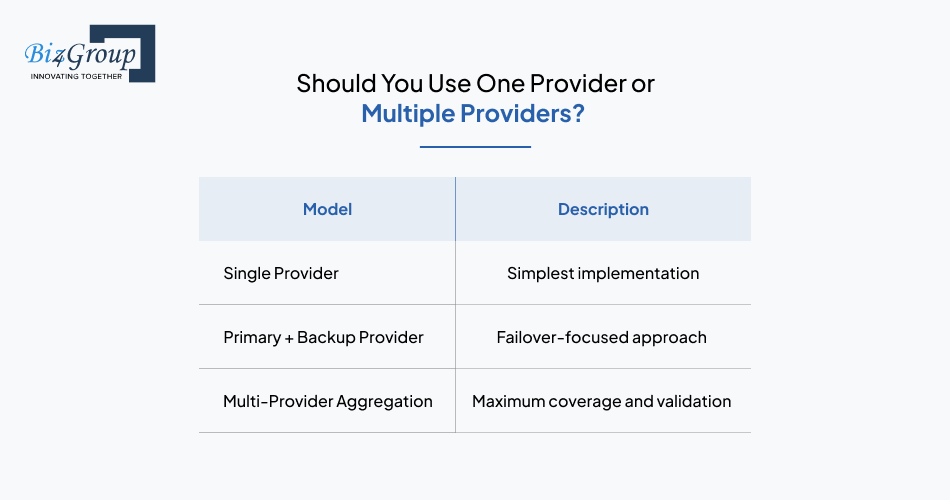
Many first-generation sportsbooks rely on a single provider. Larger operators often take a different approach.
A multi-provider strategy can offer advantages such as:
- Broader market coverage
- Cross-validation of data
- Vendor redundancy
- Reduced operational risk
Common architecture patterns include:
|
Model |
Description |
|---|---|
|
Single Provider |
Simplest implementation |
|
Primary + Backup Provider |
Failover-focused approach |
|
Multi-Provider Aggregation |
Maximum coverage and validation |
This explains why many successful operators rely on multiple sports data providers.
Matching Providers to Business Goals
Not every sportsbook has identical requirements. The right provider depends heavily on business objectives.
|
Business Goal |
Recommended Priority |
|---|---|
|
Enterprise Sportsbook |
Sportradar or Genius Sports |
|
Global Coverage Expansion |
Sports.io or Sportradar |
|
Fast Market Entry |
Sports.io |
|
AI Analytics Focus |
Strong historical datasets |
|
Multi-State US Operations |
Official league coverage |
|
High-Volume Live Betting |
Low-latency feeds and reliability |
Operators evaluating AI sportsbook platform architecture development should treat provider selection as a vital decision. The provider becomes the foundation upon which every subsequent infrastructure layer depends.
Choose wisely, because the next step involves designing the ingestion architecture that transforms raw provider feeds into a standardized odds format suitable for real-time processing.
One Bad Feed Can Cost More Than Your Entire Tech Stack
NFL, NBA, and MLB markets can generate thousands of odds changes per game. Are you confident your data provider strategy won't become your biggest operational risk?
Get a Sports Data Architecture ReviewHow to Develop Real-Time Sportsbook Backend Architecture for Ingestion, Validation, and Odds Normalization
Receiving sports data is only the beginning.
The real engineering challenge starts when multiple providers deliver different event IDs, team names, market structures, timestamps, and pricing formats. Without a structured ingestion and normalization layer, the platform quickly becomes a collection of inconsistent data streams that are difficult to trust and even harder to scale.
This is where teams looking to develop real-time sportsbook backend architecture move ahead.
A well-designed backend transforms raw provider feeds into a clean, validated, and standardized internal model that every downstream service can rely on.
One common question from engineering teams is, “We are a sports tech company evaluating backend architecture for AI sportsbook development and want to implement Redis pub/sub, WebSocket, and SSE for live odds.”
Before any distribution technology enters the conversation, the platform needs a trusted source of normalized data.
Why Raw Provider Data Cannot Be Used Directly
Different providers describe the same sporting event differently. Consider a simple NFL matchup.
|
Provider |
Team Name Format |
|---|---|
|
Provider A |
Kansas City Chiefs |
|
Provider B |
KC Chiefs |
|
Provider C |
Kansas City |
To a human, these represent the same team.
To software, they are three separate entities.
The same problem appears with:
- Market identifiers
- Event timestamps
- Odds formats
- Player names
- League naming conventions
Without normalization, duplicate markets, reporting errors, and pricing inconsistencies become inevitable.
The Four-Layer Processing Pipeline
Most operators building AI sports betting infrastructure development projects separate ingestion into four distinct layers.
Layer 1. Feed Reception
The objective here is simple. Receive and store incoming messages exactly as delivered.
Key responsibilities include:
- Connection management
- Message capture
- Sequence tracking
- Source attribution
- Timestamp recording
No transformations occur at this stage. Raw data remains untouched.
Layer 2. Validation
Every incoming payload should pass through validation before entering the platform.
Validation checks typically include:
|
Validation Type |
Purpose |
|---|---|
|
Schema Validation |
Ensures required fields exist |
|
Timestamp Validation |
Detects outdated messages |
|
Data Type Validation |
Prevents malformed values |
|
Duplicate Detection |
Removes repeated updates |
|
Integrity Validation |
Verifies event consistency |
A surprising number of sportsbook incidents originate from invalid upstream data entering production environments unchecked.
What Should Be Validated First?
Engineering teams often focus on market data. In practice, event integrity deserves equal attention.
A strong validation sequence usually follows this order:
- Event existence
- League verification
- Team mapping
- Market structure validation
- Odds validation
- Metadata verification
By validating entities before prices, platforms reduce the risk of downstream reconciliation issues.
Layer 3. Normalization
Normalization converts every provider's format into a unified internal model.
For example:
|
Incoming Format |
Internal Format |
|---|---|
|
American Odds |
Standardized Price Object |
|
Decimal Odds |
Standardized Price Object |
|
Fractional Odds |
Standardized Price Object |
This approach creates consistency across:
- Sports
- Markets
- Providers
- Frontend applications
- Reporting systems
Many organizations migrating from white label to custom sports betting software development discover that normalization becomes one of the most important architectural upgrades because it decouples internal systems from external providers.
Layer 4. Enrichment
After normalization, additional business context can be attached.
Examples include:
- Internal event identifiers
- League classifications
- Market categories
- Risk metadata
- Geographic restrictions
This enriched data becomes significantly easier for other platform services to consume.
Common Normalization Mistakes
Many teams underestimate the complexity of standardizing sports data. The most frequent mistakes include:
|
Mistake |
Consequence |
|---|---|
|
Hardcoded Team Mapping |
Difficult maintenance |
|
Provider-Specific Logic Everywhere |
Vendor lock-in |
|
Missing Version Control |
Breaking changes |
|
No Audit Trail |
Troubleshooting difficulties |
|
Manual Data Corrections |
Operational overhead |
The goal is to create a provider-agnostic architecture that remains stable even as vendors change.
Real-World Example From Biz4Group
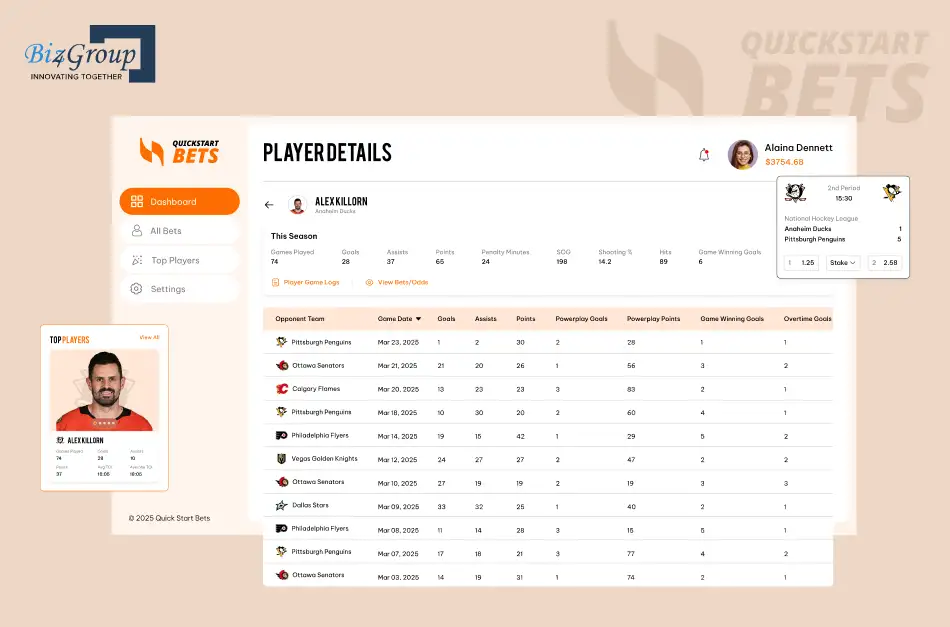
During development of Quick Start Bets, Biz4Group faced a challenge common to many sportsbooks.
The platform needed to combine:
- NHL odds feeds
- Player statistics
- Team performance data
- Historical game information
Each source used different structures and naming conventions.
To solve this, our engineering team implemented a normalization layer that standardized incoming data before it reached user-facing systems. Combined with strategic caching mechanisms, this ensured users always viewed synchronized and consistent information regardless of the original source format.
This architecture significantly reduced integration complexity while improving platform reliability.
What Should the Internal Odds Model Contain?
Teams looking to develop scalable sportsbook backend with AI capabilities should design internal models that remain independent of external providers.
A typical internal odds object contains:
|
Field |
Purpose |
|---|---|
|
Event ID |
Internal event reference |
|
Market ID |
Internal market reference |
|
Selection ID |
Outcome identifier |
|
Price |
Standardized odds value |
|
Provider Source |
Data origin |
|
Update Timestamp |
Freshness tracking |
|
Version Number |
Change management |
Keeping the internal model consistent allows future integrations, analytics systems, and AI workloads to operate against a single trusted structure.
This principle applies whether the organization is building a sportsbook, an AI pari-mutuel betting software, or a specialized AI sports betting exchange ecosystem.
The Outcome of Strong Ingestion Architecture
When designed correctly, the ingestion and normalization layer delivers three critical benefits:
- Cleaner market data
- Faster downstream development
- Reduced operational risk
Most importantly, it creates a reliable foundation for the next architectural challenge... Ensuring sportsbook operations continue uninterrupted when the underlying data provider becomes unavailable.
Building Feed Redundancy and Failover Into AI Sports Betting Infrastructure Development
Imagine an NFL game entering the fourth quarter.
Betting volume surges.
Markets are moving rapidly.
Then your primary data provider suddenly stops sending updates.
What happens next determines whether your sportsbook remains operational or becomes an expensive lesson in infrastructure planning.
This is why mature operators treat feed redundancy as a core requirement of AI sports betting infrastructure development, not an optional enhancement.
A common concern among sportsbook founders sounds like, “We are building an AI sports betting platform and need to develop a scalable real-time odds engine that handles high concurrency and disaster recovery.”
The first step toward that goal is ensuring your platform can survive provider-side failures.
Why Single-Provider Architectures Create Risk
Many startups launch with a single feed provider because it reduces initial complexity. The downside becomes obvious during live operations.
If that provider experiences:
- service degradation
- connectivity issues
- delayed event updates
- maintenance outages
- regional network disruptions
your sportsbook immediately becomes dependent on external recovery timelines. The operator loses control.
What Feed Redundancy Actually Means
Feed redundancy does not mean connecting to two providers and hoping for the best. It means creating a structured decision framework that determines:
- Which provider acts as primary
- Which provider acts as secondary
- When traffic should switch
- How data quality should be evaluated
- How conflicting information should be handled
The architecture must make these decisions automatically.
Common Redundancy Models
Different sportsbooks adopt different redundancy strategies based on scale and budget.
|
Model |
Description |
Best For |
|---|---|---|
|
Active-Passive |
Secondary feed remains on standby |
Emerging operators |
|
Active-Active |
Both providers remain live simultaneously |
Enterprise sportsbooks |
|
Market-Based Routing |
Different providers serve different sports |
Multi-sport platforms |
|
Aggregated Feed Layer |
Multiple providers merged into one internal stream |
Advanced operators |
For organizations building developing scalable sports betting backend systems with AI odds calculation and live updates, active-active architectures typically provide the highest resilience.
The Signals That Trigger Feed Failover
A common mistake is waiting for a complete provider outage. Most production systems switch providers long before total failure occurs.
Typical failover triggers include:
1. Data Delay Thresholds
If incoming updates arrive significantly later than expected, the feed may no longer be trustworthy.
Examples include:
- Missing score updates
- Delayed market changes
- Outdated event status information
2. Message Loss Rates
A sudden increase in missing events often indicates upstream instability.
Monitoring systems track:
- Expected messages
- Received messages
- Missing sequence counts
3. Connection Health Degradation
Key indicators include:
|
Metric |
Warning Signal |
|---|---|
|
Packet Loss |
Sustained increase |
|
Disconnect Frequency |
Repeated reconnect cycles |
|
Response Time |
Significant deviation from baseline |
|
Throughput |
Unexpected drops |
4. Data Consistency Failures
When multiple providers are available, platforms can compare incoming event data. Major discrepancies may indicate feed corruption or provider-side issues.
How Feed Health Monitoring Works
Leading sportsbooks establish a dedicated monitoring layer between providers and internal systems.
The layer continuously evaluates:
|
Monitoring Area |
Purpose |
|---|---|
|
Feed Availability |
Detect outages |
|
Data Completeness |
Detect missing markets |
|
Update Frequency |
Detect slow feeds |
|
Event Accuracy |
Detect inconsistencies |
|
Provider SLA Performance |
Track vendor reliability |
This monitoring service often becomes one of the most valuable operational tools within a sportsbook platform. The same principle contributes heavily to why most betting apps fail at real-time match accuracy and how top apps fix it.
Should Startups Invest in Redundancy Early?
The answer depends on market positioning.
For example:
|
Platform Type |
Recommended Approach |
|---|---|
|
MVP Validation |
Primary provider only |
|
Regional Sportsbook |
Active-passive redundancy |
|
Multi-State Sportsbook |
Active-active redundancy |
|
Enterprise Operator |
Multi-provider aggregation |
This is one reason teams often start with a focused MVP development services before investing in enterprise-grade failover infrastructure.
Also read: Top 12+ MVP development companies in USA
Provider Diversity Matters
Many operators unintentionally create hidden risks by sourcing multiple feeds from vendors that depend on the same upstream data source.
True redundancy requires:
- Independent provider infrastructure
- Independent delivery networks
- Independent data pipelines
Otherwise, a single upstream issue can affect every feed simultaneously.
Building for Future Expansion
Feed redundancy becomes even more important when expanding into:
- New jurisdictions
- Additional sports
- International markets
- Franchise sportsbook operations
For example, operators pursuing a multi-tenant AI sports betting platform often need tenant-specific feed configurations and independent redundancy policies.
The Goal of Feed Redundancy
Feed failover should achieve one simple outcome... Users should never know it happened.
A properly designed redundancy layer quietly detects issues, evaluates provider health, switches traffic when required, and maintains uninterrupted market visibility. Once that resilience layer exists, attention can shift toward another challenge that emerges at scale.
What happens when thousands of odds updates must be distributed simultaneously across an entire sportsbook ecosystem during peak event traffic.
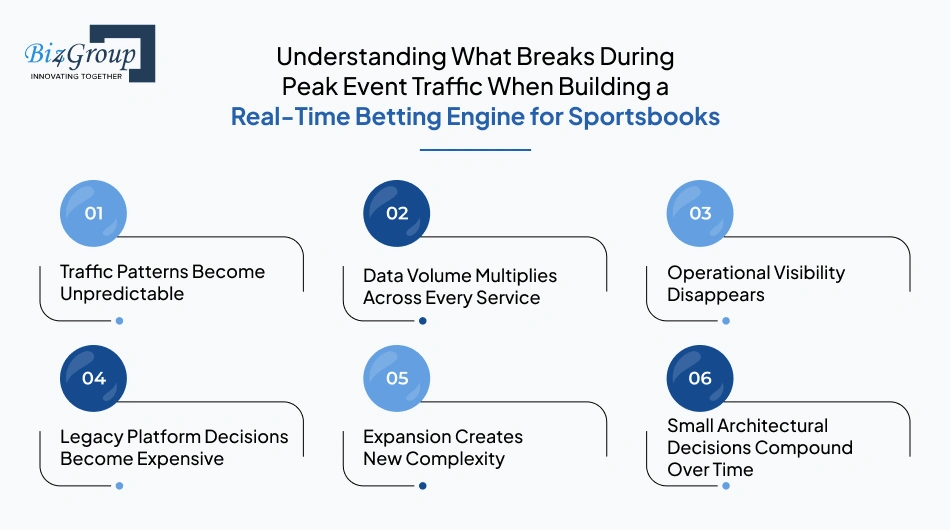
Understanding What Breaks During Peak Event Traffic When Building a Real-Time Betting Engine for Sportsbooks
Most sportsbook outages do not happen on a quiet Tuesday afternoon.
They happen during playoff games, championship weekends, and moments when user activity increases faster than infrastructure can adapt.
For teams looking to develop high-concurrency sports betting systems, understanding these failure points early can prevent costly redesigns later.
One question often asked during architecture reviews is: “We are upgrading our sportsbook platform and want to develop a real-time odds engine with high reliability, low latency, and compliance for multi-state US markets.”
The answer starts with understanding what typically breaks first.
1. Traffic Patterns Become Unpredictable
Peak events rarely generate steady traffic. Users tend to arrive in waves triggered by kickoff, major scoring plays, injury news, and last-minute betting opportunities.
Infrastructure designed around average traffic often struggles when thousands of users arrive within seconds.
2. Data Volume Multiplies Across Every Service
A single odds update may trigger:
- Market recalculations
- Analytics events
- User notifications
- Dashboard updates
- Reporting workflows
This creates amplification effects that many teams underestimate when building real-time betting engines for sportsbooks.
3. Operational Visibility Disappears
During major traffic spikes, identifying the source of a performance issue becomes increasingly difficult.
Without comprehensive observability, engineering teams can spend valuable minutes diagnosing symptoms instead of resolving root causes.
4. Legacy Platform Decisions Become Expensive
Many operators launching from a white-label sports betting platform eventually discover architectural limitations that were not visible during early growth stages.
Peak traffic often exposes those limitations quickly.
5. Expansion Creates New Complexity
A platform serving one sport behaves differently from a platform supporting:
- Live betting
- Fantasy contests
- Multiple leagues
- Multiple jurisdictions
This becomes particularly relevant for businesses expanding into areas such as AI fantasy sports app or broader sportsbook ecosystems.
6. Small Architectural Decisions Compound Over Time
The systems that survive major sporting events are rarely the ones with the biggest budgets. They are the ones that planned for growth from the beginning.
Whether evaluating sports betting app development cost or assessing long-term infrastructure investments, scalability decisions made early often determine how well a sportsbook performs under pressure.
The next challenge is deciding how those odds updates should be distributed across the platform once traffic reaches production scale.
Will Your Sportsbook Survive Kickoff?
Most sportsbooks fail during the 15 minutes when traffic spikes, users flood in, and every system is under pressure. Better to find the bottleneck before your users do.
Talk to Biz4Group’s ExpertsRedis Pub/Sub vs. Kafka for Developing Scalable Sports Betting Backend Systems With AI Odds Calculation and Live Updates
Once normalized odds data enters the platform, it needs a mechanism for distributing updates across internal services efficiently.
This raises a common architecture question. “We are a sports tech company evaluating backend architecture for AI sportsbook development and want to implement Redis pub/sub, WebSocket, and SSE for live odds.”
For teams focused on developing scalable sports betting backend systems with AI odds calculation and live updates, the decision often comes down to Redis Pub/Sub versus Kafka.
The right answer depends on the workload.
|
Evaluation Area |
Redis Pub/Sub |
Kafka |
|---|---|---|
|
Primary Strength |
Ultra-fast message distribution |
Durable event streaming |
|
Typical Latency |
Sub-millisecond to low milliseconds |
~20-50ms higher than Redis |
|
Message Persistence |
No |
Yes |
|
Replay Capability |
No |
Yes |
|
Consumer Recovery |
Limited |
Excellent |
|
Event Retention |
Not designed for retention |
Built for retention |
|
Infrastructure Complexity |
Lower |
Higher |
|
Real-Time Odds Distribution |
Excellent |
Good |
|
Historical Event Auditing |
Limited |
Excellent |
|
Analytics Pipeline Support |
Moderate |
Excellent |
|
Operational Overhead |
Lower |
Higher |
Quick Decision Framework
|
Use Case |
Recommended Choice |
|---|---|
|
Live Odds Distribution |
Redis Pub/Sub |
|
Trading Dashboards |
Redis Pub/Sub |
|
Real-Time Notifications |
Redis Pub/Sub |
|
Regulatory Audit Trails |
Kafka |
|
Historical Event Replay |
Kafka |
|
Data Warehousing Pipelines |
Kafka |
|
AI Model Training Pipelines |
Kafka |
|
Hybrid Enterprise Architecture |
Redis + Kafka |
For most sportsbooks, Redis handles real-time distribution while Kafka feeds downstream analytics, reporting, and machine learning systems.
In Summary...
- If your primary goal is building real-time odds engine for sportsbooks with high reliability and low latency, Redis Pub/Sub should sit closest to the odds delivery path.
- If your platform also requires long-term event retention, AI training datasets, business intelligence, or compliance reporting, Kafka becomes an important secondary layer.
Many mature sportsbook architectures ultimately use both technologies because they solve different problems exceptionally well. The next architectural decision is determining how those updates should travel from backend services to thousands of connected users in real time.
WebSocket vs. SSE vs. HTTP/2 for Developing Scalable AI Sportsbook Systems With Live Odds Delivery
Once odds updates are ready for distribution, engineering teams must decide how those updates reach user devices.
A common question during architecture planning is: “We are a sports tech company evaluating backend architecture for AI sportsbook development and want to implement Redis pub/sub, WebSocket, and SSE for live odds.”
For organizations developing scalable AI sportsbook systems with WebSocket or SSE for live odds delivery, the protocol decision directly impacts user experience, infrastructure efficiency, and future scalability.
|
Evaluation Criteria |
WebSocket |
SSE (Server-Sent Events) |
HTTP/2 Server Push |
|---|---|---|---|
|
Communication Type |
Bidirectional |
Server to Client Only |
Server Initiated |
|
Live Odds Updates |
Excellent |
Good |
Limited |
|
Browser Support |
Excellent |
Excellent |
Declining |
|
Mobile Compatibility |
Excellent |
Good |
Limited |
|
Reconnection Handling |
Application Controlled |
Built-In |
Varies |
|
Message Frequency Handling |
Excellent |
Moderate |
Moderate |
|
Interactive Features |
Excellent |
Limited |
Limited |
|
Implementation Complexity |
Moderate |
Low |
High |
|
Long-Term Industry Adoption |
Strong |
Strong |
Weak |
|
Sportsbook Suitability |
Excellent |
Good |
Poor |
Quick Selection Guide
|
Scenario |
Recommended Protocol |
|---|---|
|
Live Betting Platform |
WebSocket |
|
Interactive Betting Experience |
WebSocket |
|
High-Frequency Market Updates |
WebSocket |
|
Read-Only Market Feeds |
SSE |
|
Internal Monitoring Dashboards |
SSE |
|
New Sportsbook Development |
WebSocket |
|
Modern Enterprise Sportsbooks |
WebSocket |
Basically...
- For teams looking to developing scalable AI sportsbook systems with WebSocket or SSE for live odds delivery, WebSocket remains the preferred choice because it supports continuous two-way communication and adapts well to highly interactive sportsbook environments.
- SSE remains a reasonable option for lightweight applications that primarily require one-directional updates.
- HTTP/2 Server Push has largely fallen out of favor for modern sportsbook implementations and is rarely selected for new platform development.
This is one reason most modern turnkey sports betting solutions and enterprise sportsbook platforms standardize on WebSocket-based delivery models.
The next challenge is arguably the most sportsbook-specific component in the entire architecture... Determining when markets should automatically pause to protect both operators and bettors from inaccurate wagering conditions.
Market Suspension Logic: The Core Reliability Layer in AI Sportsbook Platform Architecture Development
A sportsbook does not fail when odds move. It fails when bettors are allowed to wager on markets that should have been paused.
That is why market suspension logic sits at the center of modern AI sportsbook platform architecture development. It acts as a safety mechanism that temporarily removes a market from betting whenever the platform detects conditions that could compromise pricing accuracy.
A common question from operators is: “We are planning to create a real-time AI sports betting engine and need guidance on market suspension logic and API provider selection.”
The answer starts with defining clear suspension triggers.
Common Market Suspension Triggers
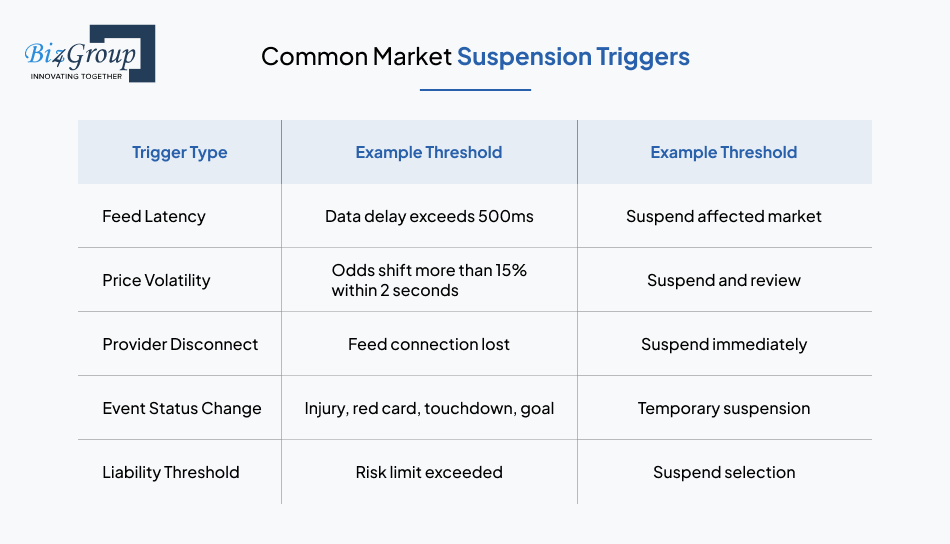
|
Trigger Type |
Example Threshold |
Typical Action |
|---|---|---|
|
Feed Latency |
Data delay exceeds 500ms |
Suspend affected market |
|
Price Volatility |
Odds shift more than 15% within 2 seconds |
Suspend and review |
|
Provider Disconnect |
Feed connection lost |
Suspend immediately |
|
Event Status Change |
Injury, red card, touchdown, goal |
Temporary suspension |
|
Liability Threshold |
Risk limit exceeded |
Suspend selection |
The exact values vary by operator, sport, and risk appetite.
A Typical Market State Flow
Most sportsbooks operate with four market states:
- Active
- Suspended
- Reopened
- Settled
When a trigger condition occurs, the market transitions from Active to Suspended.
Once the triggering condition clears and validation checks pass, the market can safely move back to Reopened status.
What Happens to Bets During Suspension?
The safest approach is straightforward.
- New wagers are rejected.
- Existing accepted bets remain valid.
- Pending bet requests enter review workflows.
- Settlement logic continues operating normally.
This prevents disputes while maintaining platform integrity.
Why This Matters Beyond Operations
Market suspension is not solely a technical safeguard. In regulated environments, it also supports compliance requirements discussed across various sports betting regulations across US states.
Operators that fail to implement adequate controls expose themselves to financial, operational, and regulatory risk.
The Practical Goal
The best market suspension systems are rarely noticed by users. They activate quickly, protect the platform from bad pricing exposure, and restore betting availability as soon as conditions return to normal.
The next challenge is determining how sportsbooks verify that the odds being presented to bettors remain fresh enough to accept wagers in the first place.
How Expensive Is One Stale Bet?
A missed suspension trigger can expose operators to thousands in liability within seconds. If your market controls haven't been audited recently, now is a good time.
Call an Odds Engine ExpertHow to Create an AI-Powered Sports Betting Odds System That Prevents Stale Odds and Liability Exposure
A market can be active, the feed can be healthy, and the infrastructure can be running normally.
Yet a sportsbook may still accept a wager based on outdated pricing.
That is where stale odds protection becomes essential.
For organizations looking to create AI-powered sports betting odds systems, preventing stale bets is one of the most important safeguards between a valid wager and a costly liability event.
A common question from operators sounds like, “I want to build a sportsbook backend with AI-powered odds calculation, live updates, and disaster recovery but need guidance on architecture and technical stack.”
One of the first architectural controls to implement is odds freshness validation.
What Are Stale Odds?
Stale odds are prices that remain available after their acceptable validity window has expired.
This does not necessarily mean the odds are incorrect.
It means the sportsbook can no longer guarantee they represent the most current market conditions.
Defining Freshness Windows
Different market types require different freshness thresholds.
|
Market Type |
Typical Freshness Window |
|---|---|
|
Pre-Match Markets |
Several seconds |
|
Player Props |
A few seconds |
|
In-Play Markets |
Sub-second validation |
|
Micro-Betting Markets |
Millisecond-level validation |
The faster the market moves, the shorter the allowable freshness window becomes.
The Odds Freshness Validation Process
Before accepting a wager, the platform performs a simple validation check.
|
Validation Step |
Purpose |
|---|---|
|
Retrieve Current Odds Timestamp |
Identify update age |
|
Compare Against Freshness Policy |
Determine validity |
|
Check Market Status |
Confirm wagering eligibility |
|
Verify Selection Availability |
Confirm active outcome |
|
Approve or Reject Bet |
Execute decision |
If the odds exceed the defined freshness threshold, the wager is rejected or repriced.
Why Freshness Validation Matters
Liability exposure typically occurs when:
- A market moves rapidly.
- A bettor submits a wager.
- The sportsbook accepts pricing that is no longer current.
This creates an asymmetric risk scenario where the operator absorbs unnecessary exposure.
For operators evaluating how AI sports betting apps like FanDuel make money, protecting margins through accurate pricing controls is just as important as attracting betting volume.
Where AI Can Help
While freshness validation should remain deterministic, AI can support surrounding workflows such as:
- Detecting unusual pricing behavior
- Identifying abnormal market movements
- Flagging suspicious betting patterns
- Forecasting elevated risk conditions
These supporting capabilities are often delivered through broader AI automation services layered around sportsbook operations.
The Business Impact
Preventing stale odds protects more than revenue. It improves:
- Risk management
- Trading efficiency
- Bettor trust
- Operational consistency
As sportsbooks scale, freshness validation becomes a foundational control that protects every wager entering the platform.
The next challenge is ensuring the infrastructure can continue delivering those validated odds reliably when tens of thousands of users remain connected simultaneously.
How to Develop a High-Concurrency Sports Betting System Supporting 50,000+ Concurrent Connections
Traffic growth rarely arrives gradually in sports betting. A platform may serve a few thousand active users during regular games and then experience a tenfold increase during the Super Bowl, March Madness, or a major UFC event.
That is why engineering teams planning to develop high-concurrency sports betting systems must design for connection scale long before those users actually arrive.
A common question from operators is “I need a company that can develop a high-concurrency AI sports betting platform with Redis pub/sub and live odds updates.”
The answer depends less on individual technologies and more on how connection management is architected across the platform.
What Changes When User Counts Reach 50,000+?
At lower traffic levels, connection management is relatively straightforward. At large scale, several new challenges emerge:
- Session tracking
- User presence management
- Connection routing
- Resource allocation
- Rolling deployment continuity
These challenges have very little to do with odds generation and everything to do with maintaining stable user connectivity.
Core Components of a High-Concurrency Architecture
|
Component |
Primary Responsibility |
|---|---|
|
Load Balancer |
Distributes incoming traffic |
|
Connection Gateway |
Manages active client sessions |
|
Session Store |
Tracks connection state |
|
Auto Scaling Layer |
Adds capacity during demand spikes |
|
Monitoring Layer |
Tracks connection health metrics |
Each layer serves a different purpose and helps prevent bottlenecks from forming as user counts increase.
Why Connection State Matters
Many sportsbooks focus heavily on application logic while overlooking connection state management.
At scale, maintaining awareness of:
- connected users
- active devices
- session ownership
- authentication status
becomes critical for platform stability. Without centralized session visibility, scaling decisions become significantly more difficult.
Capacity Planning Should Be Data-Driven
Engineering teams should define capacity targets before launch. Typical planning metrics include:
|
Metric |
Example Planning Target |
|---|---|
|
Concurrent Users |
50,000+ |
|
Peak Session Duration |
Event-dependent |
|
Geographic Regions |
Single or Multi-Region |
|
Device Types |
Mobile and Web |
|
Traffic Growth Buffer |
2x to 5x expected demand |
Platforms that establish measurable scaling objectives early typically avoid expensive re-architecture efforts later.
Real-World Example From Biz4Group
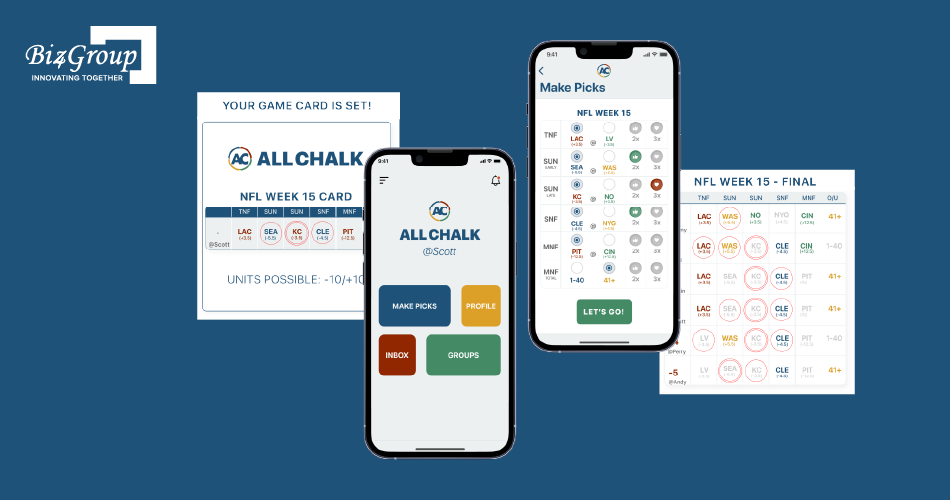
A good example comes from All Chalk, where Biz4Group needed to support large volumes of simultaneous users interacting with live leaderboards, game schedules, reminders, and synchronized platform activity.
To support growth, the architecture incorporated:
- Real-time synchronization mechanisms
- Scalable cloud infrastructure
- Efficient backend processing
- Cross-platform consistency
This approach helped maintain a responsive experience even during periods of elevated user participation.
Scalability Is Also a Business Decision
Infrastructure planning directly affects:
- User retention
- Expansion opportunities
- Platform valuation
- Operational costs
This is one reason investors evaluating sportsbook products often pay close attention to how enterprise-grade sports APIs power $10M+ betting app valuations and the underlying technology stack.
So, a sportsbook should not require architectural redesign every time traffic doubles. The objective is to create a platform that can absorb growth predictably while maintaining consistent performance as user counts rise.
The next step is ensuring the platform can recover quickly when infrastructure failures occur, even during live sporting events with active betting markets.
Can Your Backend Handle 5x More Users Tomorrow?
Growth sounds exciting until your infrastructure becomes the reason users leave.
Scale Better with Biz4GroupDisaster Recovery Strategies for Building Real-Time Odds Engines for Sportsbooks With High Reliability and Low Latency
Most engineering teams prepare for traffic spikes.
Far fewer prepare for infrastructure failures during traffic spikes.
For sportsbooks, that distinction matters.
An outage during a live NFL game has a very different impact than an outage during routine business hours. Every minute of downtime affects user trust, operational continuity, and revenue generation.
A common question from operators is: “We are building an AI sports betting platform and need to develop a scalable real-time odds engine that handles high concurrency and disaster recovery.”
The answer begins with defining recovery objectives before choosing technologies.
The Two Metrics That Matter Most
|
Metric |
Purpose |
|---|---|
|
RTO (Recovery Time Objective) |
How quickly systems must be restored |
|
RPO (Recovery Point Objective) |
How much data loss is acceptable |
For most production sportsbooks:
- RTO is measured in seconds, not hours.
- RPO is close to zero for active wagering systems.
Active-Passive vs Active-Active Recovery Models
|
Recovery Model |
Characteristics |
Best For |
|---|---|---|
|
Active-Passive |
Secondary environment remains on standby |
Growing sportsbooks |
|
Active-Active |
Multiple environments serve traffic simultaneously |
Enterprise sportsbooks |
Active-passive offers lower operational costs.
Active-active offers faster recovery and greater resilience.
Recovery Priority Order
Not every component should be restored at the same time.
A practical recovery sequence looks like this:
- Authentication services
- Core betting services
- Odds engine services
- User-facing applications
- Reporting and analytics systems
This prioritization helps restore wagering operations as quickly as possible.
What Should Be Tested Regularly?
Many disaster recovery plans fail because they exist only on paper.
Teams should regularly test:
- Regional failover procedures
- Database restoration processes
- Infrastructure provisioning workflows
- Dependency recovery sequences
- Incident communication procedures
A recovery plan that has never been tested should not be considered production-ready.
Real-World Example From Biz4Group
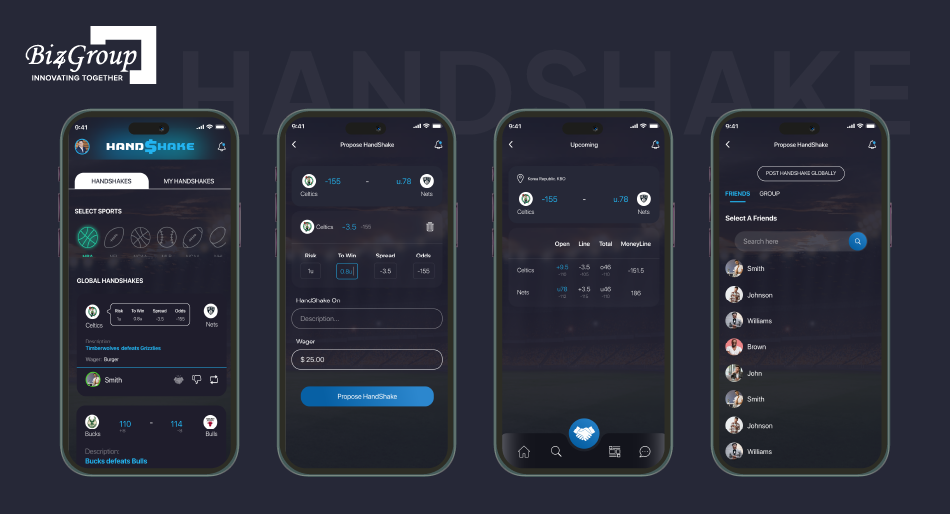
When building the sports betting platform for sports enthusiasts, one of the key architectural requirements involved maintaining access to live game information, betting activity, user communications, and AI-assisted recommendations during periods of elevated demand.
To support platform reliability, the architecture emphasized service separation, operational resilience, and recovery planning across critical platform components. This reduced the likelihood of a single failure affecting the entire user experience.
Disaster Recovery Takes You A Step Ahead
Many operators view disaster recovery as an infrastructure expense. In reality, it becomes a differentiator.
Reliable platforms attract:
- Higher user retention
- Stronger partner confidence
- Easier regulatory approvals
- Better long-term scalability
This is one reason businesses evaluating how to choose the right AI sports betting software development company increasingly assess operational resilience alongside feature development capabilities.
Also read: Top 15 sports betting website development companies in USA
Disaster recovery should not focus on preventing failures. Failures will happen.
The objective is to recover quickly, minimize business impact, and continue serving users with as little disruption as possible.
Once resilience is established, the next question becomes where artificial intelligence should actually fit within the sportsbook architecture without compromising performance or reliability.
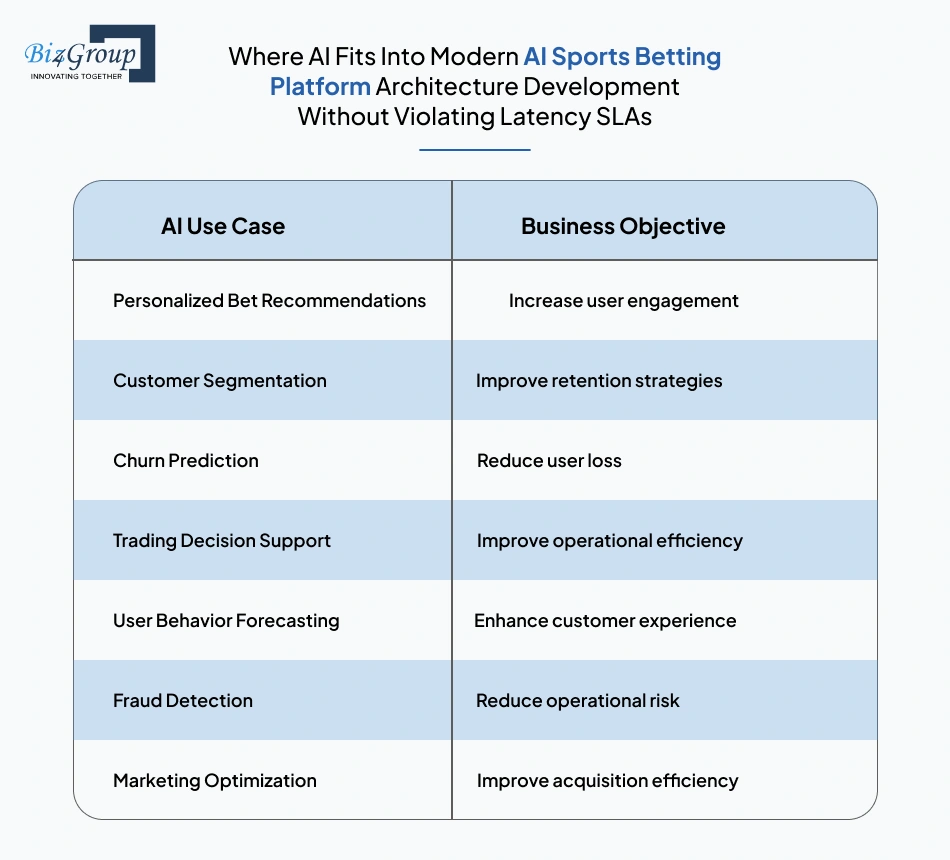
Where AI Fits Into Modern AI Sports Betting Platform Architecture Development Without Violating Latency SLAs
One of the biggest misconceptions in sportsbook engineering is that AI should sit at the center of the odds engine.
In practice, the most successful operators separate AI workloads from core transaction workflows.
This allows teams to benefit from machine learning without introducing unnecessary latency into wagering operations.
A common question from founders and platform owners is: “We want end-to-end AI sports betting platform development services with real-time odds engine and full technical stack implementation.”
The answer starts with understanding where AI creates value.
The Best Places to Apply AI
Not every sportsbook function benefits equally from machine learning. The highest-impact applications typically include:
|
AI Use Case |
Business Objective |
|---|---|
|
Personalized Bet Recommendations |
Increase user engagement |
|
Customer Segmentation |
Improve retention strategies |
|
Churn Prediction |
Reduce user loss |
|
Trading Decision Support |
Improve operational efficiency |
|
User Behavior Forecasting |
Enhance customer experience |
|
Fraud Detection |
Reduce operational risk |
|
Marketing Optimization |
Improve acquisition efficiency |
These systems help operators make better decisions without interfering with live wagering workflows.
AI Workloads Typically Run Asynchronously
Most production sportsbooks use asynchronous AI architectures.
The process usually follows this pattern:
- Collect user and market data.
- Process data through AI models.
- Generate recommendations or predictions.
- Deliver outputs to dashboards, trading tools, or customer-facing applications.
This separation allows AI systems to scale independently from sportsbook infrastructure.
AI Models Often Consume More Than Betting Data
Many organizations pursuing AI sportsbook platform architecture development focus exclusively on odds and wagers. In reality, modern models frequently analyze:
- User interaction patterns
- Session duration
- Deposit activity
- Promotional engagement
- Historical betting behavior
- Customer support interactions
This broader context often produces more valuable insights than betting activity alone.
Choosing the Right AI Strategy
|
Business Stage |
Recommended AI Focus |
|---|---|
|
MVP Launch |
User analytics |
|
Growth Phase |
Personalization |
|
Expansion Phase |
Predictive automation |
|
Enterprise Scale |
Multi-model AI ecosystems |
For teams beginning their journey, a focused MVP often produces stronger results than deploying multiple AI initiatives simultaneously. This is why many operators start with a sports betting app MVP before expanding into advanced machine learning programs.
Building an AI Layer That Evolves
AI requirements change rapidly. A sportsbook architecture should allow teams to:
- Add new models
- Replace existing models
- Test alternative approaches
- Scale inference environments independently
Organizations frequently achieve this through modular AI integration services and broader enterprise AI solutions that evolve alongside business requirements.
The Bottom Line
AI works best when it augments sportsbook operations rather than controlling them.
The strongest architectures treat machine learning as a specialized intelligence layer that improves decision-making, personalization, and efficiency while allowing the core betting platform to remain predictable, scalable, and performant.
The final technical step is validating that the entire architecture can withstand real-world production conditions before it reaches bettors.
AI Is Impressive. ROI Is Better.
Many sportsbooks invest heavily in AI and struggle to measure business impact. The real question is how quickly it can increase retention, engagement, and revenue.
Calculate My AI Betting ROILoad Testing and Production Readiness for Real-Time Odds Delivery Systems for Sportsbooks
A sportsbook should never discover its limitations on game day.
Before launch, engineering teams need evidence that the platform can handle expected traffic, user activity, and operational workloads under realistic conditions.
A common question from operators is: “We are building an AI sports betting platform and need to develop a scalable real-time odds engine that handles high concurrency and disaster recovery.”
The answer requires more than architecture diagrams. It requires testing.
Common Load Testing Tools
|
Tool |
Primary Use Case |
|---|---|
|
k6 |
API and performance testing |
|
Locust |
User behavior simulation |
|
Gatling |
Large-scale traffic testing |
|
JMeter |
Protocol and workload testing |
The best choice depends on the systems being validated.
What Should Be Tested?
Many teams test average traffic. Production readiness requires testing extreme scenarios.
Examples include:
- Championship game traffic spikes
- Simultaneous user login surges
- High-volume wager submission periods
- Rapid market update bursts
- Regional traffic concentration
The goal is to understand system behavior before users do.
Production Readiness Checklist
Before launch, every real-time odds delivery system for sportsbooks should be able to answer the following questions:
|
Validation Area |
Pass/Fail Question |
|---|---|
|
Scalability |
Can the platform handle expected peak traffic? |
|
Reliability |
Can critical services remain available during stress conditions? |
|
Monitoring |
Are operational alerts configured correctly? |
|
Security |
Have penetration and vulnerability tests been completed? |
|
Compliance |
Are audit and reporting requirements satisfied? |
|
Recovery |
Have recovery procedures been validated? |
Why Testing Should Be Continuous
User behavior changes.
Sports calendars change.
Infrastructure changes.
A test that passed six months ago may no longer represent current production conditions.
Organizations investing in real-time odds delivery systems for sportsbooks typically incorporate recurring performance testing into their release process rather than treating it as a one-time activity.
Final Verification Before Launch
The most successful sportsbook launches are rarely the fastest. They are the most prepared. Production readiness testing remains one of the highest-return investments a team can make.
After all, a platform that performs well in staging still needs to prove it can perform under real-world pressure.
How Biz4Group LLC Helps Businesses in USA Develop Scalable Sportsbook Backend Architectures With AI and Real-Time Odds Engines
By this point, one thing should be clear.... Developing a real-time odds engine requires expertise across sports data integrations, backend engineering, AI implementation, risk controls, and production infrastructure.
Very few technology partners bring all of those capabilities under one roof.
Biz4Group LLC does.
We are a US-based sports betting app development company that helps startups, sportsbooks, sports-tech companies, and enterprises build custom betting platforms powered by modern AI and real-time technologies.
If you’re saying, “We are looking for companies that can develop a real-time AI sports betting odds engine with scalable backend and API integration”, our team can help turn those requirements into production-ready systems.
What sets us apart is practical experience.
We've built sports betting platforms, prediction applications, real-time analytics systems, and sports engagement products that process live data, support active user communities, and deliver seamless experiences across web and mobile devices.
As an established AI development company, we help clients with:
- Real-time odds engine architecture
- Custom sportsbook development
- AI-powered betting features
- Multi-provider feed integrations
- Trading and analytics systems
- Performance optimization
- Platform modernization
We also provide specialized sports betting API integration services for businesses that need reliable access to live sports data and betting markets.
Looking for a Development Partner?
If you're planning to build, upgrade, or scale a sportsbook platform, Biz4Group can help you evaluate the architecture, identify technical risks early, and create a roadmap that supports long-term growth.
Let's discuss your sportsbook vision and build a platform ready for real-world betting volume. Let’s talk.
Final Thoughts
To develop real-time odds engine architecture for AI sports betting platform environments that can handle modern wagering volumes, sportsbooks need far more than live odds feeds and betting interfaces. Success depends on making the right architectural decisions at every layer, including provider selection, data normalization, distribution systems, market protection controls, scalability planning, disaster recovery, and AI integration.
For teams asking, “We are evaluating vendors for AI sportsbook backend architecture and want pricing and technical guidance for real-time odds engine development”, the answer often comes down to building infrastructure that remains reliable when traffic spikes, markets move rapidly, and thousands of users interact with the platform simultaneously.
As a trusted USA-based software development company, Biz4Group helps businesses transform sportsbook concepts into high-performance platforms built for long-term growth.
If you're exploring a new sportsbook idea, upgrading an existing platform, or assessing the technical feasibility of an AI-powered betting product, our team can help you identify the right architecture, technology stack, and development roadmap before costly mistakes reach production.
Frequently Asked Questions
1. Can a sportsbook build its own odds engine instead of relying on third-party odds providers?
Yes, but building an in-house odds engine requires dedicated trading teams, large historical datasets, quantitative modeling expertise, and continuous market monitoring. Many sportsbooks begin with external odds feeds and gradually develop proprietary pricing capabilities as their betting volume and operational maturity increase.
2. What programming languages are commonly used for sportsbook backend development?
Most modern sportsbooks use a combination of technologies rather than a single language. Go, Node.js, Java, C#, and Python are among the most common choices because they support scalable backend services, data processing workloads, and AI integrations while maintaining strong ecosystem support.
3. What is the biggest mistake sportsbook startups make when building their backend?
Many startups prioritize user-facing features while underestimating backend complexity. Challenges related to scalability, data consistency, compliance readiness, and operational monitoring often emerge after launch. Addressing these areas early usually reduces future redevelopment costs and operational risk.
4. Can AI generate sportsbook odds automatically?
AI can assist with forecasting, market analysis, player projections, and risk modeling. However, most sportsbooks still rely on structured pricing models, trading expertise, and market data inputs when creating betting lines. AI is typically used to enhance decision-making rather than fully replace sportsbook trading operations.
5. What compliance considerations should be included when designing a sportsbook backend?
Compliance requirements vary by jurisdiction but commonly include audit logging, data retention policies, user verification workflows, responsible gambling controls, reporting capabilities, and transaction traceability. These requirements should be considered during architecture planning rather than added later.
6. How do sportsbooks prepare for future technologies such as AI agents and autonomous betting assistants?
The most effective approach is building modular architectures that allow new services to be integrated without disrupting existing operations. This enables sportsbooks to adopt emerging technologies such as AI agents, advanced recommendation systems, predictive analytics platforms, and automated trading tools as business requirements evolve.