Location :
Orlando, FL, USA
Location :
Orlando, FL, USA +1 (407) 714-1616
 info@biz4group.com

 AI Summary Powered by Biz4AI
- Create a sports betting app by following a structured development process that covers product planning, UI/UX design, MVP validation, integrations, testing, and continuous improvements after launch.
- Sports betting app development succeeds when you combine secure architecture, live odds, reliable payment systems, compliance, and user-focused features that keep bettors engaged.
- Sports betting app development costs typically range from $20,000 to $150,000+, depending on the platform's complexity, custom features, third-party integrations, and scalability requirements.
- Sports betting software development should balance performance, compliance, and user engagement to improve retention and support long-term business growth.
- Biz4Group LLC helps startups, sportsbook operators, and enterprises build secure, scalable, and high-performance betting platforms backed by proven industry experience and end-to-end development expertise.
What does it really take to create a sports betting app that users trust, regulators approve, and competitors struggle to match?
Many businesses enter this market with a great idea but quickly realize that building a sportsbook is far more complex than developing another mobile application. Licensing requirements change across jurisdictions. Live odds have to update instantly. Payment flows need to be secure. A poor product decision made early can become an expensive problem after launch. If your goal is to create a sports betting app, planning matters as much as development.
The timing, however, has never been better. According to American Gaming Association, Americans legally wagered $166.94 billion on sports in 2025, setting another industry record and proving that demand for regulated digital sportsbooks continues to grow.
Business owners often ask us, how do you create a sports betting app that can support real users, scale during major sporting events, and remain compliant as regulations evolve? The answer starts with the right strategy, not the first line of code.
This guide breaks down every stage of online sports betting app development in practical terms. You'll learn how to build a sports betting app from scratch, understand the technology behind modern sportsbooks, estimate realistic development costs, and evaluate the sports betting app development services required to launch a secure platform with confidence.
Why Is Sports Betting App Development Growing So Fast in 2026?
Sports betting app development is growing rapidly because user demand, favorable regulations in many markets, and modern technologies have made launching and scaling a sportsbook more practical than ever before. Businesses that focus on performance, compliance, and user experience still have significant opportunities to enter the market.
Mobile betting now accounts for the majority of sports wagers, while live betting continues to raise user expectations for speed and reliability. At the same time, cloud infrastructure and third-party integrations have made development more accessible than it was a few years ago.
Here are the key factors driving this growth in 2026.
1. Changing User Betting Behavior
Today's users are not placing a single bet and logging off.
- Live and in-play betting has become the norm
- Users expect instant odds updates and real-time bet settlement
- Engagement now happens during matches, not just before kickoff
This shift creates strong demand for teams that can create real time sports betting apps with reliable performance.
2. Operator Demand for Flexible Platforms
Operators are rethinking their technology stacks.
- Legacy systems slow down feature releases
- Rigid platforms limit personalization and risk control
- Operators want modular systems that evolve with market trends
That is why many companies are choosing to develop sports betting software solutions that give them long-term control.
3. Lower Barriers to Entry Through Modern Tech
Building a betting platform is no longer restricted to enterprise budgets.
- Cloud infrastructure supports rapid scaling
- Real-time data APIs reduce engineering complexity
- Modular architectures allow phased launches
This makes it easier than ever to build a sports betting app platform that grows alongside your business.
4. Expansion Into Broader Gaming Ecosystems
Sports betting rarely exists on its own anymore.
- Many platforms expand into casino and esports offerings
- Cross-product engagement increases lifetime value
- Unified wallets and accounts improve retention
As a result, many businesses are investing in a broader iGaming platform strategy to stay competitive.
The takeaway is clear. The opportunity in 2026 is not about launching quickly. It is about launching smart. Teams that invest in scalable sports betting application development are better positioned to attract users, meet compliance standards, and grow sustainably.
Thinking About Creating a Sports Betting App but Not Sure Where to Start?
You don't need all the answers upfront. You just need the right roadmap and the right partner to validate your idea before you invest heavily.
Talk to Our Betting App ExpertsWhat Are the Real Business Benefits of Creating a Sports Betting App?
Creating a sports betting app gives you complete control over your product, users, revenue, and future growth. Unlike third-party platforms, owning your sportsbook allows you to introduce new features faster, strengthen your brand, and build a business that grows with changing market demands.
Here are the benefits that matter most before you invest in development.
1. Full Ownership of Users and Data
Relying on third-party platforms limits how much you can learn about your users. When you own the app, you control user data, betting behavior, and engagement patterns. This insight helps you personalize experiences, optimize odds, and improve retention over time. More importantly, these insights help you make better product, marketing, and retention decisions as your platform grows.
2. Scalable Revenue with Multiple Income Streams
A betting app is not restricted to a single revenue model. You can earn through betting commissions, premium features, subscriptions, and targeted promotions. This flexibility makes sports betting application development appealing because revenue grows alongside usage without increasing costs at the same rate. It also gives you room to test and refine monetization strategies as the market evolves.
3. Stronger Brand Control and Market Positioning
Your app defines how users perceive your brand. From onboarding to payouts, every interaction builds trust or breaks it. With custom sports betting app development, you control design, messaging, and feature prioritization. This allows you to differentiate your platform instead of blending into a sea of similar-looking sportsbooks.
4. Faster Expansion Into New Betting Products
Once your core platform is live, adding new offerings becomes much easier. Many companies expand into fantasy sports, live betting, or esports to increase engagement across seasons. A flexible architecture lets you introduce new products without rebuilding your entire system, which keeps users active and improves lifetime value.
5. Better Compliance and Risk Management
Regulatory requirements are strict and constantly changing across US states. Owning your platform gives you full control over KYC, responsible gaming tools, geolocation checks, and reporting workflows. This flexibility is essential when you build secure sports betting applications with compliance as a core requirement, not an afterthought.
6. Long-Term Cost Efficiency
While initial development requires investment, ownership reduces long-term expenses. You avoid ongoing platform licensing fees and vendor limitations. Over time, sports betting app product development becomes more cost-effective than relying on third-party solutions, especially as your user base and transaction volume grow.
What Types of Sports Betting Apps Can You Build in 2026?
The right type of sports betting app depends on your business goals, target audience, budget, and launch strategy. Some businesses prioritize speed to market, while others focus on long-term product ownership and scalability. Understanding these options will help you choose an approach that supports your growth plans.
1. Traditional Sportsbook Apps
These are the most widely used betting platforms and are often the first choice when businesses create online sports betting apps. Users place wagers on real-world sports such as football, basketball, baseball, and soccer. Core features include pre-match betting, live odds, multiple betting markets, secure payments, and real-time match statistics.
Example: Platforms like FanDuel Sportsbook or Bet365 offer full-scale sportsbook experiences across multiple regions. This type is ideal if your goal is to build a sports betting app platform that mirrors the experience of a physical bookmaker while delivering mobile-first convenience.
2. Live and In-Play Sports Betting Apps
Live betting apps allow users to place bets while a match is already in progress. Odds update dynamically based on what is happening on the field, making speed and accuracy critical. This type of app keeps users engaged throughout the game instead of just before kickoff.
Example: Apps that focus heavily on in-play markets, such as in-match goal or point predictions, rely on advanced data feeds. If your objective is to create real time sports betting apps, this model offers higher engagement but requires strong backend performance and reliable odds providers.
3. Fantasy Sports Betting Apps
Fantasy sports apps let users create virtual teams using real players and earn points based on actual performance. Instead of betting directly on match outcomes, users compete against others in leagues or contests. This model is especially popular in the US and often has a simpler regulatory path.
Example: Platforms like FanDuel Fantasy have built massive user bases by focusing on short contests and social competition. Many founders use fantasy apps as a stepping stone before expanding into full sports betting application development.
4. Peer-to-Peer and Social Betting Apps
In peer-to-peer betting apps, users place bets against each other rather than against a bookmaker. The platform facilitates the wager, manages escrow, and earns through service fees or commissions. Social features like leaderboards, chat, and friend challenges play a major role here.
Example: Social betting platforms often attract casual users who enjoy competition and community. This model works well if you want to develop sports betting app solutions for operators focused on engagement rather than complex odds management.
5. Esports and Skill-Based Betting Apps
Esports betting apps focus on competitive gaming events such as tournaments and leagues. These platforms appeal to younger, digital-native users who may not follow traditional sports. Many apps combine esports betting with predictive analytics and automation.
Example: Products inspired by AI Esports app models use data-driven insights to enhance user engagement. This option is ideal if you want to diversify beyond traditional sports betting.
6. White-Label vs Custom Sports Betting Platforms
Some businesses choose a white-label sports betting platform to launch quickly with pre-built functionality. Others invest in custom sports betting app development to gain full control over features, integrations, and scalability. White-label platforms reduce time to market, while custom sports betting app development offers greater flexibility, ownership, and room for future expansion. The right choice depends on your business priorities.
Example: A startup validating its idea may go white-label, while an established operator often prefers to develop a sports betting application tailored to its brand and market strategy.
Choosing the right type of app ensures your product aligns with your audience, regulatory environment, and growth goals. Once this decision is clear, you can move forward with confidence.
How Do Sports Betting Apps Make Money and Which Monetization Model Works Best?
Sports betting apps make money through multiple revenue streams, not a single monetization model. The right approach depends on your target audience, betting products, and business goals. Building a profitable platform starts with selecting revenue models that can grow alongside your business.
Here are all the proven ways to generate revenue when you build a sports betting app platform in 2026.
1. Commission on Bets Placed
Most sportsbooks generate a significant share of their revenue through commissions on bets placed by users. The platform earns a small percentage from each wager placed by users. The more active your users are, the stronger this model performs.
- Percentage-based commission per bet
- Scales naturally with betting volume
- Works across all major sports and markets
2. Odds Margin and Spread Management
Instead of charging visible fees, platforms earn through calculated margins built into odds. This model requires advanced risk control and accurate data feeds to remain profitable.
- Revenue embedded directly in odds
- No friction for users
- Common in high-volume sportsbook apps
3. Subscription and Premium Betting Access
Many platforms offer premium tools for experienced bettors who want deeper insights. This model is increasingly popular when companies develop sports betting software solutions focused on analytics and predictions.
- Monthly or annual subscriptions
- Access to advanced stats and betting tools
- Predictable recurring revenue
4. In-App Purchases and Paid Enhancements
Paid features allow users to upgrade their experience without forcing subscriptions. These features are optional but appealing to high-intent bettors.
- Odds boosts and custom bet builders
- Faster withdrawals or exclusive markets
- Upsell opportunities inside live betting flows
5. Advertising and Affiliate Revenue
As your app gains traction, third parties want access to your audience. This model works best for apps with strong engagement and retention.
- Sponsored betting events
- Affiliate partnerships with casinos or sportsbooks
- Performance-based revenue streams
6. Data Insights and Market Intelligence
At scale, betting platforms generate valuable behavioral data. When handled responsibly, this data can support additional revenue streams.
- Aggregated betting trend reports
- Market demand insights
- Requires strict compliance and privacy controls
7. AI-Powered Personalization and Smart Monetization
AI plays a growing role in how platforms maximize revenue. Personalized offers, dynamic odds, and tailored promotions increase engagement and conversion. Many teams also apply broader strategies used to monetize AI app models across betting platforms.
- Personalized promotions and bet suggestions
- Dynamic pricing based on behavior
- Higher lifetime value per user
The most successful teams do not rely on one revenue source. They combine multiple models based on user behavior, geography, and maturity. When done right, sports betting app product development becomes a scalable business engine rather than a one-dimensional betting tool.
Also Read: How Do AI Sports Betting Apps like FanDuel Make Money?
Wondering Which Monetization Model Will Actually Work for Your App?
We help you choose revenue strategies that fit your audience, market, and long-term growth goals, not guesswork.
Discuss Monetization StrategyWhat Core Features Are Required to Build a Competitive Sports Betting App?
A competitive sports betting app combines security, speed, compliance, and an intuitive user experience. Missing even one core feature can affect user trust, retention, and revenue. The features below form the foundation of a sportsbook that is ready to scale.
1. User Registration, KYC, and Account Verification
Every sports betting application development project starts with onboarding. Users expect quick sign-up, but regulations demand strict identity verification. A streamlined KYC flow ensures age verification, fraud prevention, and regulatory compliance without slowing users down. Getting this right is essential when you build secure sports betting applications with compliance across multiple US states.
2. Sports Selection and Betting Markets
Your app must offer a wide range of sports, leagues, and betting markets to stay competitive. From football and basketball to niche sports, users want variety with clear navigation. Well-structured markets improve engagement and directly support sports betting app product development goals by increasing bet frequency and session time.
3. Odds Management and Betting Slip Experience
Accurate odds and a responsive betting slip are critical to user trust. Odds must update instantly, and users should be able to place, edit, or cancel bets without friction. This feature heavily depends on reliable data feeds and real-time processing, which is why many teams invest in robust sports betting API integration as part of their platform strategy.
4. Secure Wallet and Payment Processing
Payments are where users decide if your platform feels professional. Supporting multiple deposit and withdrawal methods with fast processing builds confidence and retention. Strong encryption, audit trails, and regulatory alignment are essential, especially in sports betting mobile app development for US audiences where financial compliance is strict.
5. Live Betting and Real-Time Match Updates
Modern bettors expect to wager while games are in progress. Live scores, instant odds changes, and fast bet settlement keep users engaged throughout events. This feature is central if you want to create real time sports betting apps that compete with top sportsbooks and drive higher engagement per user.
6. User Dashboard and Betting History
A clear dashboard helps users track open bets, past wagers, wins, and losses in one place. Transparency here builds trust and supports responsible gaming initiatives. This feature also helps operators analyze behavior patterns as part of sports betting app product development and optimization.
7. Notifications and User Engagement Tools
Smart notifications remind users about upcoming matches, odds changes, and bet outcomes without feeling intrusive. Personalized alerts improve retention and re-engagement. This is a subtle but powerful component when you develop scalable sports betting apps for startups aiming to grow active users.
8. Customer Support and Dispute Resolution
Issues around payouts or odds disputes can quickly damage credibility. In-app support through chat or ticket systems reassures users that help is available when needed. Reliable support is a must when you develop sports betting app solutions for operators handling real money and regulated users.
These core features create a stable, compliant foundation. Once they are in place, you can focus on advanced capabilities that truly differentiate your platform.
Which Advanced and AI Features Help Create Real-Time Sports Betting Apps That Stand Out in 2026?
The features that set modern sportsbooks apart include AI-powered odds prediction, real-time risk management, personalized betting recommendations, fraud detection, smart cash-out, and advanced analytics. Each one solves a different business challenge, from improving user engagement to reducing operational risk.
Below is a breakdown of the most important advanced features and how they add real business value.
|
Advanced Feature |
What It Does |
Why It Matters for Your Business |
|---|---|---|
|
AI-Based Odds Prediction |
Uses historical data, live feeds, and player statistics to generate dynamic odds and predictions. |
Improves pricing accuracy, reduces risk exposure, and helps you develop sports betting software solutions that scale reliably. Many platforms follow models similar to an AI sports betting predictions app. |
|
Real-Time Risk Management Engine |
Monitors betting activity continuously and adjusts limits or odds based on risk levels. |
Protects margins while supporting high-volume betting, especially critical when you build a sports betting app platform for live markets. |
|
Personalized Betting Recommendations |
Suggests bets based on user behavior, preferences, and past activity using machine learning. |
Increases engagement and average bet value. This is a practical way to use AI for sports betting personalization. |
|
Automated Fraud Detection |
Identifies unusual betting patterns, bonus abuse, or account misuse in real time. |
Reduces financial losses and supports compliance when you build secure sports betting applications with compliance in regulated markets. |
|
Smart Cash-Out and Bet Editing |
Allows users to cash out or modify bets dynamically based on live conditions. |
Improves user control and satisfaction, which directly impacts retention and trust. |
|
AI-Powered Player Segmentation |
Groups users based on betting habits, risk tolerance, and engagement levels. |
Enables targeted promotions and smarter monetization strategies during sports betting app product development. |
|
Predictive Engagement and Churn Prevention |
Detects when users are likely to disengage and triggers timely offers or notifications. |
Helps you retain users longer and develop scalable sports betting apps for startups competing with large operators. |
|
Voice and Smart Assistant Betting |
Enables users to place bets or check odds using voice commands. |
Enhances accessibility and positions your app as forward-looking in sports betting mobile app development. |
|
Advanced Analytics Dashboard for Operators |
Provides real-time insights into revenue, risk, user behavior, and performance. |
Empowers operators to make data-driven decisions when they develop sports betting app solutions for operators. |
Advanced features are not just technical upgrades. They directly impact revenue, retention, and regulatory readiness. When planned correctly, they transform your app from a betting tool into a smart betting ecosystem.
How Do You Create a Sports Betting App Step by Step?
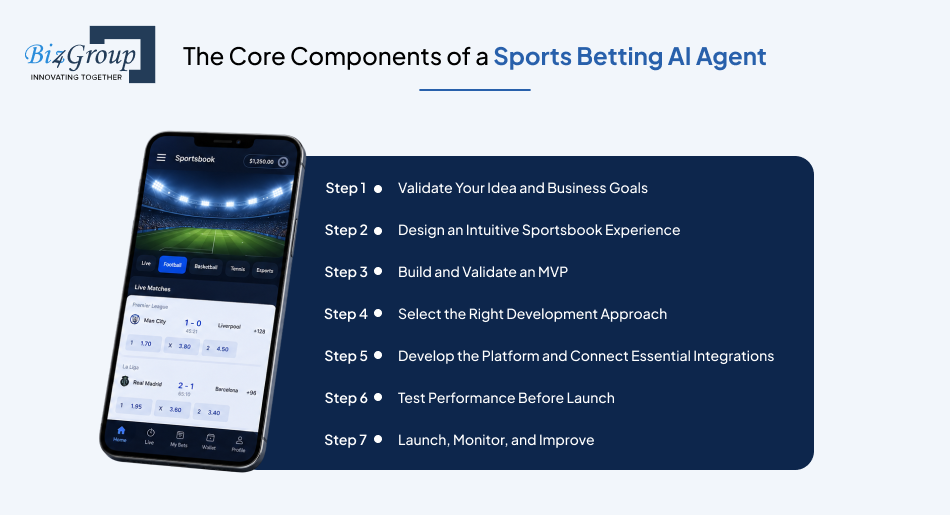
Creating a sports betting app starts with a clear business plan, followed by thoughtful product design, phased development, and continuous improvements after launch. Following a structured process helps reduce development risks, control costs, and build a sportsbook that can grow with your business.
Here is a practical seven-step roadmap used for successful sportsbook projects.
Step 1. Validate Your Idea and Business Goals
Every successful sportsbook begins with a well-defined business strategy. Before development starts, identify your target audience, preferred betting markets, revenue model, and unique value proposition. Spend time studying established sportsbooks to understand user expectations while identifying opportunities to deliver a better experience.
Early validation helps you make informed product decisions and reduces costly changes later in the development process.
Step 2. Design an Intuitive Sportsbook Experience
A sportsbook should feel simple, even though the technology behind it is complex. Users should be able to browse betting markets, compare odds, and place wagers without confusion or unnecessary steps.
Working with an experienced UI/UX design company helps create intuitive navigation, faster betting journeys, and a consistent experience across mobile and web platforms. Strong design decisions made at this stage often improve user retention after launch.
Also read: Top 15 UI/UX design companies in USA
Step 3. Build and Validate an MVP
Instead of building every feature at once, launch a focused version of your sportsbook with the features needed to validate your business idea. An MVP helps you gather user feedback, measure engagement, and identify improvements before making larger investments.
Many startups choose MVP development services to shorten time to market while reducing development risk. Once the product has gained traction, additional features can be introduced based on real user behavior instead of assumptions.
Also read: Top 12+ MVP development companies in USA
Step 4. Select the Right Development Approach
Your next decision is how you want to build the platform.
A white-label sports betting platform is often the preferred choice for businesses that want to launch quickly with proven functionality. Custom development offers greater flexibility, stronger branding, and complete ownership of the platform.
Many operators begin with a white-label solution and later focus on migrating from white label to custom sports betting software development as their business expands and product requirements become more advanced.
|
If your priority is... |
Recommended approach |
|---|---|
|
Faster launch |
White-label platform |
|
Lower initial investment |
White-label platform |
|
Complete product ownership |
Custom development |
|
Long-term scalability |
Custom development |
Step 5. Develop the Platform and Connect Essential Integrations
Once the product scope is finalized, development begins in phases. Building the platform incrementally makes testing easier and reduces the risk of large-scale issues later in the project.
At this stage, integrate essential services such as live odds providers, payment gateways, user authentication, notifications, and analytics. Strong AI integration services help in delivering a smooth betting experience, especially during high-traffic sporting events.
Step 6. Test Performance Before Launch
Thorough testing helps identify issues before they affect real users. Review betting workflows, payment processing, live odds updates, account management, and platform performance under different traffic conditions.
Beta testing with a controlled group of users also provides valuable feedback that can improve usability before the public launch.
Step 7. Launch, Monitor, and Improve
Launching your sportsbook is the beginning of an ongoing product journey. Monitor user behavior, measure engagement, and release regular improvements based on analytics and customer feedback.
The most successful sportsbook platforms continue evolving after launch because user expectations, betting trends, and market demands never remain static.
Once your development roadmap is in place, the next decision is selecting a technology stack that supports performance, scalability, and long-term product growth.
What Is the Best Technology Stack for Sports Betting App Development?
The best technology stack for sports betting app development depends on your business goals, expected user traffic, platform requirements, and future scalability plans. Selecting proven technologies helps deliver faster performance, seamless real-time betting experiences, and secure transactions while making future upgrades easier.
The table below highlights the technologies commonly used to build modern sportsbook platforms.
|
Technology Layer |
Recommended Technologies |
Why It Matters |
|---|---|---|
|
Backend |
Node.js, Python (Django/Flask), Ruby on Rails |
Powers betting logic, manages transactions, and supports high volumes of real-time requests. |
|
Mobile App Development |
Flutter, React Native |
Enables faster cross-platform development for Android and iOS with a consistent user experience. |
|
Web Development |
React.js, Next.js |
Builds responsive sportsbook websites and operator dashboards with excellent performance. |
|
Database |
PostgreSQL, MongoDB, Redis |
Stores betting records, user information, and improves response times through efficient data management. |
|
Odds & Sports Data APIs |
Sportradar, BetRadar |
Delivers live odds, match statistics, and real-time betting data. |
|
Payment Gateways |
Stripe, PayPal, Crypto Payment Gateways |
Supports secure deposits, withdrawals, and transaction processing. |
|
Authentication & Identity |
OAuth 2.0, Firebase Authentication |
Protects user accounts through secure login and identity verification. |
|
Cloud Infrastructure |
AWS, Microsoft Azure, Google Cloud |
Ensures reliable performance and automatically scales during high-traffic sporting events. |
|
Security |
SSL/TLS Encryption, AI-powered Fraud Detection |
Protects sensitive user data, detects suspicious activity, and strengthens platform security. |
No single technology stack fits every sportsbook project. A startup launching an MVP may prioritize rapid development, while an established operator may need an architecture designed for millions of transactions and continuous feature releases.
Businesses investing in sports betting software development should choose technologies that support current requirements while allowing future expansion without unnecessary redevelopment.
The right technology stack creates the foundation for a reliable sportsbook that performs well today and continues to support business growth in the years ahead.
How Do You Build a Secure and Compliant Sports Betting App?
A secure and compliant sports betting app combines identity verification, payment security, responsible gaming measures, and regulatory controls from the very beginning of development. Building these requirements into the platform early helps reduce operational risks, protects user data, and simplifies expansion into regulated markets.
The following checklist highlights the essential compliance and security requirements every sportsbook should address before launch.
|
Requirement |
Why It Matters |
|---|---|
|
Know Your Customer (KYC) |
Verifies user identity and age to prevent underage gambling and support regulatory compliance. |
|
Geolocation Verification |
Confirms users place bets only from jurisdictions where sports betting is legally permitted. |
|
Anti-Money Laundering (AML) |
Monitors suspicious transactions and helps prevent financial crimes through automated risk checks. |
|
Secure Payment Processing |
Protects deposits and withdrawals using trusted payment gateways and encrypted transaction workflows. |
|
Licensing & Jurisdiction Management |
Helps operators comply with state-specific betting laws before entering new markets. |
|
Responsible Gaming Controls |
Supports deposit limits, betting limits, cooling-off periods, and self-exclusion to promote responsible gambling. |
|
Audit Logs and Reporting |
Maintains detailed activity records that simplify regulatory reporting and operational transparency. |
Meeting compliance requirements is only one part of building a successful sportsbook. The platform should also be designed to adapt as regulations evolve across different jurisdictions. A flexible architecture makes it easier to introduce new compliance measures, payment providers, or verification workflows without rebuilding the entire application.
For businesses planning sports betting website development or mobile sportsbook platforms, security should never be treated as a post-launch enhancement. Investing in compliance from the start builds user trust, reduces legal risks, and creates a stronger foundation for long-term growth.
How Much Does It Cost to Develop a Sports Betting App in 2026?
The cost to develop a sports betting app typically ranges from $20,000 to $150,000+, depending on your product scope, feature requirements, and development approach. A basic MVP costs significantly less than a custom sportsbook platform with live betting, advanced integrations, and enterprise-grade scalability.
If you're wondering how much it costs to create a sports betting app, the final budget depends on factors such as platform complexity, custom features, third-party integrations, and the level of personalization your business requires.
|
Platform Type |
Estimated Development Cost (USD) |
|---|---|
|
Basic Sports Betting MVP |
$20,000 to $35,000+ |
|
Mid-Scale Custom Sportsbook Platform |
$40,000 to $80,000+ |
|
Advanced Scalable Sports Betting Platform |
$80,000 to $150,000+ |
These estimates provide a starting point for budgeting, but every sportsbook project has unique technical and business requirements. If you're evaluating sports betting app development services, a detailed cost assessment will provide a far more accurate estimate based on your goals.
For a complete breakdown of development costs, pricing factors, timelines, and budgeting tips, read our sports betting app development cost guide before planning your investment.
Want a Realistic Cost Estimate for Your Sports Betting App?
Get clarity on features, compliance scope, and timelines before you commit your budget.
Get a Cost BreakdownWhat Are the Biggest Challenges in Sports Betting App Development and How Can You Solve Them?
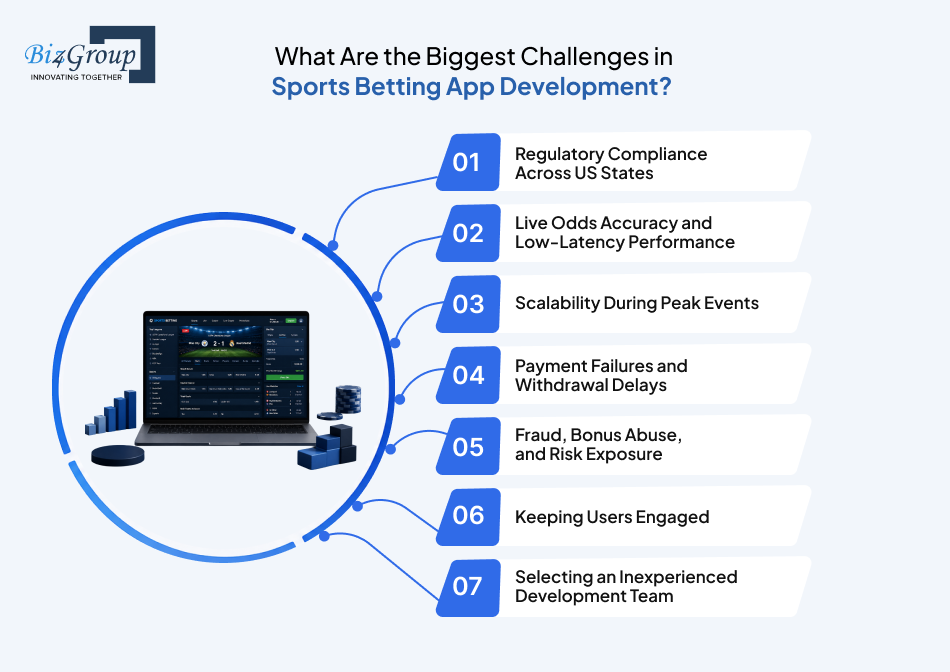
The biggest challenges in sports betting app development include regulatory compliance, real-time data accuracy, platform scalability, payment reliability, fraud prevention, and long-term user retention. Addressing these challenges early helps reduce development risks, improve user trust, and create a platform that can grow with your business.
Below are the most common challenges teams face in 2026 and how successful platforms solve them.
|
Challenge |
Why This Is a Problem |
How to Solve It Effectively |
|---|---|---|
|
Regulatory Compliance Across US States |
Each US state has different rules for licensing, payments, and user verification. Missing a requirement can delay launch or lead to penalties. |
Design compliance into your architecture from day one with modular KYC, geolocation, and reporting systems. Many of these issues are explained in detail in challenges in modern sports betting app development. |
|
Live Odds Accuracy and Low-Latency Performance |
Live betting depends on instant and accurate match data. Even small delays can cause incorrect odds, disputes, or user mistrust. |
Use reliable data providers, event-driven architectures, and continuous monitoring. This is critical if you want to create real time sports betting apps, as highlighted in why most betting apps fail at real-time match accuracy. |
|
Scalability During Peak Events |
Traffic spikes during major games can overwhelm systems and cause downtime. Poor performance leads to lost bets and frustrated users. |
Build on cloud infrastructure with auto-scaling and load balancing. This approach supports developing scalable sports betting apps for startups and growing operators. |
|
Payment Failures and Withdrawal Delays |
Users lose trust quickly if deposits fail or withdrawals are slow. Payments are often the most sensitive touchpoint. |
Integrate compliant payment gateways, automate reconciliation, and provide clear transaction tracking as part of sports betting mobile app development. |
|
Fraud, Bonus Abuse, and Risk Exposure |
Betting platforms attract bad actors attempting to exploit promotions or system gaps. This directly impacts margins. |
Implement AI-driven fraud detection, betting limits, and behavioral monitoring to develop sports betting software solutions that protect revenue. |
|
Keeping Users Engaged |
With many apps available, users switch easily if engagement drops. Acquisition costs keep rising. |
Focus on personalization, real-time engagement, and loyalty features during sports betting app product development to keep users active. |
|
Selecting an Inexperienced Development Team |
Inexperienced teams underestimate compliance, performance, and scalability requirements. This leads to delays and rewrites. |
Work with a proven sports betting app development company USA that understands regulations, real-time systems, and long-term scaling needs. |
Challenges are part of the journey, but they do not have to slow you down. With the right planning, architecture, and expertise, you can avoid the mistakes that cause most betting apps to fail and build a platform ready for long-term growth.
How Can Biz4Group LLC Be the Right Choice for You to Develop a Sports Betting App?
Choosing the right sports betting app development partner can influence everything from product quality and launch timelines to long-term scalability. Beyond technical expertise, you need a team that understands live sportsbook operations, real-time data, secure payment systems, user experience, and the demands of regulated betting platforms.
At Biz4Group, we have delivered multiple sports-focused digital products that demonstrate our ability to build scalable, engaging, and high-performance platforms. Here are a few projects that showcase our expertise.
1. Quick Start Bets
Quick Start Bets is a real-time sports analytics and betting reference platform built for hockey fans. The platform delivers live odds updates, detailed player and team statistics, and a centralized dashboard that helps users stay informed throughout every game.
Key highlights
- Real-time odds updates with low-latency performance for NHL games
- Comprehensive player and team statistics for data-backed betting decisions
- Unified dashboard for upcoming matches, bet tracking, and performance insights
- Optimized for real-time engagement and sports analytics
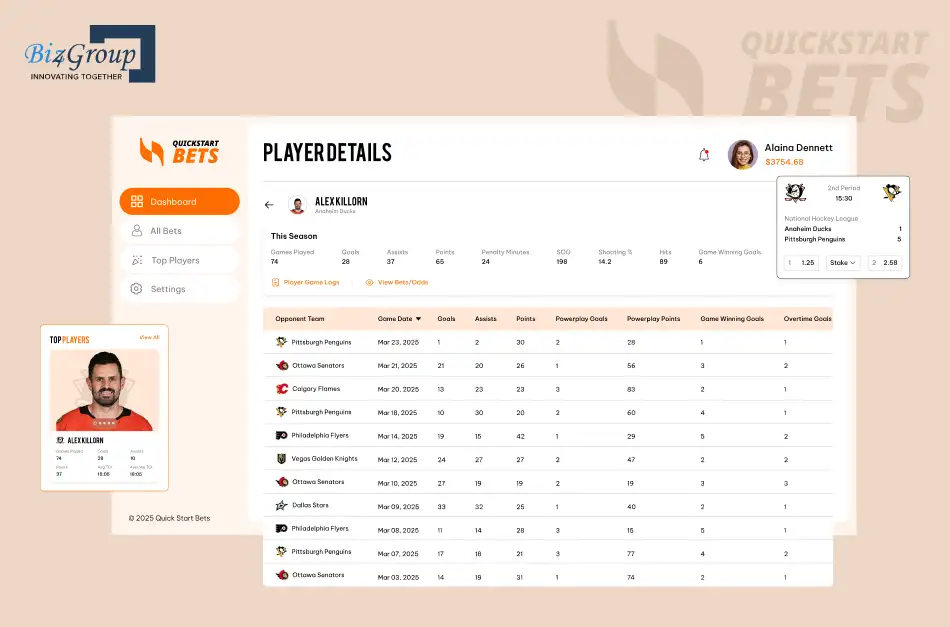
The project reflects our experience in building platforms that process continuous live data while delivering a fast and reliable user experience.
2. All Chalk
All Chalk is a mobile application designed for sports betting enthusiasts seeking betting opportunities alongside predictive insights. The platform combines intuitive navigation, real-time odds, and multiple betting markets to create a streamlined betting experience.
What we delivered
- Support for multiple sports and betting markets
- User-focused interface that simplifies navigation and bet placement
- Predictive insights that help users analyze trends and betting opportunities
- Optimized performance for real-time betting activities
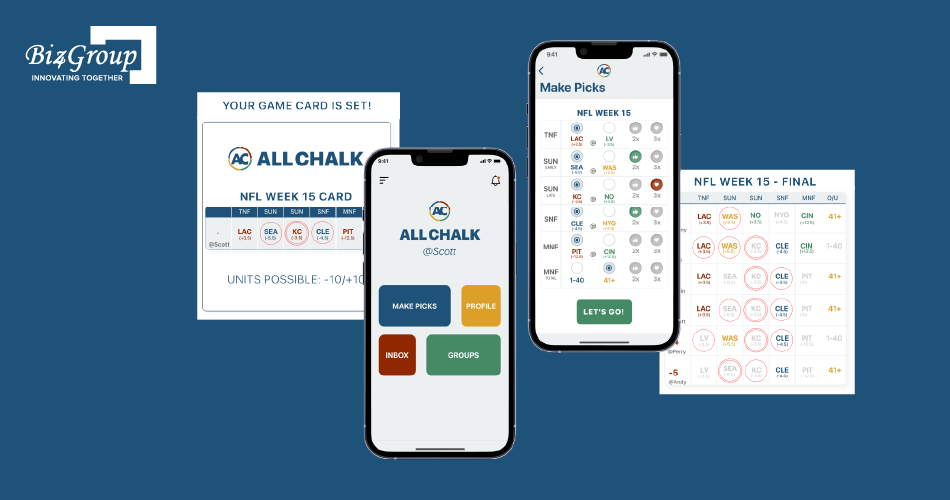
This project demonstrates our ability to create online sports betting apps that balance usability, performance, and user engagement.
3. Handshake
Handshake is a sports engagement platform that brings users together through real-time interactions during live sporting events. The project highlights our ability to build community-driven experiences that encourage continuous user participation.
Notable capabilities
- Real-time event updates and interactive user engagement
- Community-focused features that encourage social participation
- Integrated notifications for live sports moments
- User experience designed to support ongoing engagement
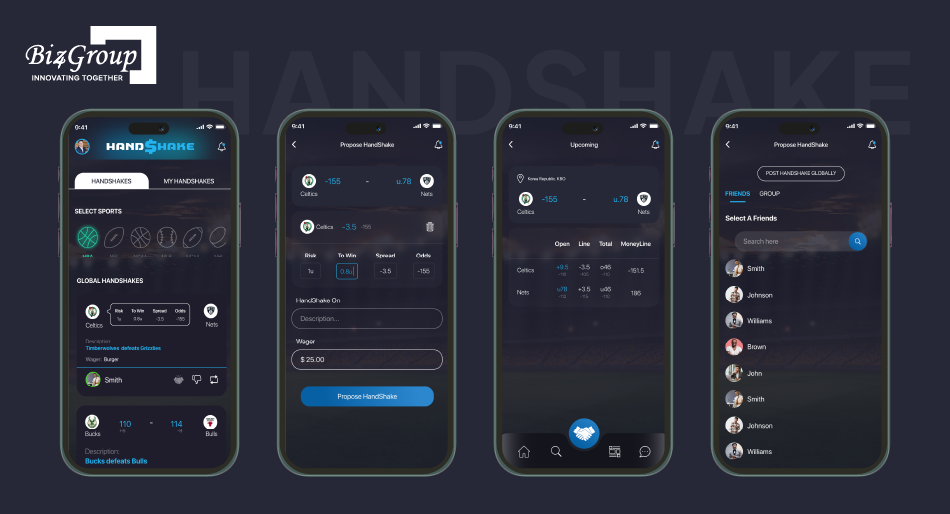
The platform showcases our expertise in developing sports experiences that keep users connected before, during, and after live events.
Every sportsbook project has unique business goals, feature requirements, and growth plans. As a sports betting app development company businesses trust, Biz4Group helps startups, operators, and enterprises build secure, scalable, and user-centric sportsbook platforms designed for long-term success.
Planning to create a sports betting app? Let's discuss your vision and build a sportsbook that is ready for today's market and tomorrow's opportunities.
Wrapping Up!
Building a successful betting product today takes more than speed to market. Sports betting app development demands real-time performance, strong compliance, secure payments, and a user experience that keeps bettors coming back.
To build a sports betting app from idea to launch, you need a partner who understands the technical and regulatory realities of the US market. As a trusted sports betting app development company, Biz4Group brings proven experience through projects like Quick Start Bets, All Chalk, and Handshake, showcasing deep expertise in real-time systems, user engagement, and scalable sports platforms.
When evaluating options among the top sports betting app development companies in the USA, experience with real-world betting products and regulated markets makes a measurable difference.
With the right strategy and the right team, your betting app can compete, grow, and scale with confidence.
So, without further ado, connect with Biz4Group. Let's build a secure, high-performing sports betting app that is ready for the future.
FAQs
1. What APIs are required for sports betting app development?
Most sportsbook platforms rely on multiple APIs to deliver a seamless betting experience. Common integrations include live sports data and odds providers, payment gateways, identity verification services, geolocation tools, notifications, and analytics platforms. Selecting reliable APIs improves performance, accuracy, and long-term scalability.
2. Can I launch a sports betting app for both iOS and Android?
Yes. Most businesses choose cross-platform development to launch on both iOS and Android while reducing development time and maintenance costs. This approach provides a consistent user experience across devices without maintaining separate codebases.
3. How long does it take to develop a sports betting app?
Most sports betting platforms take four to eight months to design, develop, test, and launch, depending on their complexity. At Biz4Group, we can deliver a functional MVP in 2 to 4 weeks by using reusable components and proven development frameworks that reduce both development time and overall project costs.
4. Can an existing sportsbook be upgraded instead of building a new app?
Yes. Many businesses modernize legacy sportsbook platforms instead of replacing them completely. Existing systems can often be upgraded with modern user interfaces, faster performance, new integrations, improved security, and additional betting features while preserving core business operations.
5. What should I look for in a sports betting app development company?
Look for a partner with experience building real-time applications, integrating sportsbook APIs, developing secure payment workflows, and delivering scalable platforms. Reviewing relevant case studies and understanding the team's experience with sportsbook products can also help you make an informed decision.