 Location :
Orlando, FL, USA
 +1 (407) 714-1616
 info@biz4group.com


 AI Summary Powered by Biz4AI
- A multi-agent AI system splits marketplace work among specialist agents, such as matching, moderation and support, with an orchestrator that routes tasks between them.
- Start with one agent on one task and add agents only when a single one cannot hold the job.
- People stay in charge of sensitive steps. NIST's AI Risk Management Framework calls for documented human-oversight processes and for monitoring after launch.
- Pricing, contract and valuation outputs can be wrong, so show them as drafts with a plain warning and a human check.
- Fair housing rules reach any agent that matches, ranks or screens, and the AI spoke covers them in full.
A multi-agent AI system for real estate is a set of specialist AI agents, each with one job, that work together to run a marketplace's daily operations: matching buyers to homes, checking listings and answering support questions. Instead of one large assistant trying to do everything, each agent gets a narrow task, its own tools and clear limits.
This guide covers which agents a marketplace needs, how they hand work to each other, where people stay in charge and how to handle the cases where an agent is wrong. If you are still choosing between a portal, a marketplace or an app, that choice decides how much of this operational work you will have.
What does a multi-agent AI system for real estate do inside a marketplace?
It divides the marketplace's repeating work among specialist agents and coordinates them with an orchestrator. The table shows a typical split and where a person steps in.
|
AI Agent |
Its job |
Hands off to |
Where a person steps in |
|---|---|---|---|
|
Matching agent |
Pairs a buyer's stated needs with listings and agents |
Orchestrator, then the buyer |
Reviewing how matches are ranked |
|
Lead routing agent |
Sends each inquiry to the right agent with the listing attached |
Support agent if no agent is free |
Resolving disputed routing |
|
Moderation agent |
Checks new listings, photos and reviews against the rules |
A review queue |
Deciding on removals and bans |
|
Support agent |
Answers questions from listing data and help content |
A person, when unsure |
Taking over escalated chats |
|
Orchestrator |
Routes tasks, tracks their status and decides when to stop and ask |
All of the above |
Setting the rules for when to stop |
Every row has a handoff and a checkpoint, which is what separates a system you can trust from a set of bots acting on their own.
Why use AI agents for real estate operations instead of one big agent?
A real estate multi-agent AI platform makes each job smaller, easier to test and easier to restrict. A moderation agent never needs access to billing, and a support agent never needs permission to remove a listing. The trade-off is more handoffs, and each handoff is another place for something to go wrong.
That is why one agent on one task is the right start. Add a second agent only when the first cannot hold its job, and building a single real estate AI agent comes before building a team of them.
How does a matching agent work in a real estate multi-agent AI platform?
A matching agent takes what a buyer says they want, queries the listing data through a tool and returns ranked homes with a short reason for each. The reason matters, because a buyer who sees why a home was suggested can correct the agent when it guessed wrong. The same pairing shows up in Facilitor, one of Biz4Group's projects: budget- and location-based search alongside AI-powered property suggestions.
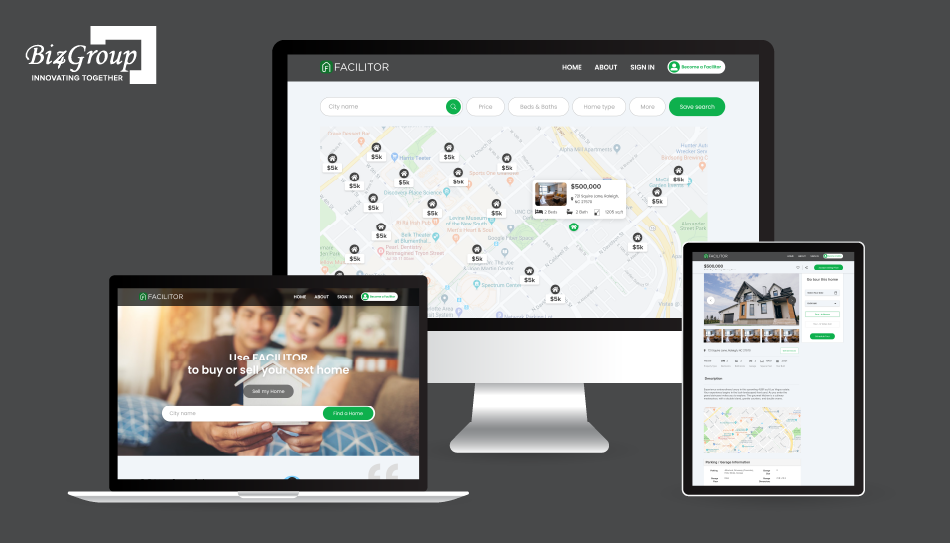
Because a matching agent ranks housing, fair housing rules reach it. They are covered in full in the fair housing section of the AI feature guide, and the short version is to keep protected characteristics and close proxies out of the inputs and to review the outcomes.
Put AI Agents to Work on Your Marketplace's Routine
Biz4Group designs and builds matching, moderation and support agents with human checkpoints built in.
Plan My AgentsHow does a moderation agent protect listings and reviews in a marketplace?
A moderation agent screens new content against your rules and sends anything doubtful to a person. It checks for duplicate listings, missing details, suspicious prices, off-platform payment requests and reviews that break the rules, using the same checks a human moderator would apply. The listing quality and review rules for a marketplace are the rule book it works from.
Let the agent flag and hold. Let a person decide on removals and bans, since those affect an agent's income and a mistake is hard to undo.
How does a support agent use retrieval and escalation to answer users?
A support agent answers questions by looking up your listing data and help content, and it hands the conversation to a person when it is not sure. Retrieval from a knowledge base keeps its answers tied to your own content instead of its general knowledge. Homer AI, from the Biz4Group's portfolio, puts a chatbot in this seat: it asks buyers for location and budget, shows matching properties and guides sellers through listing a property.
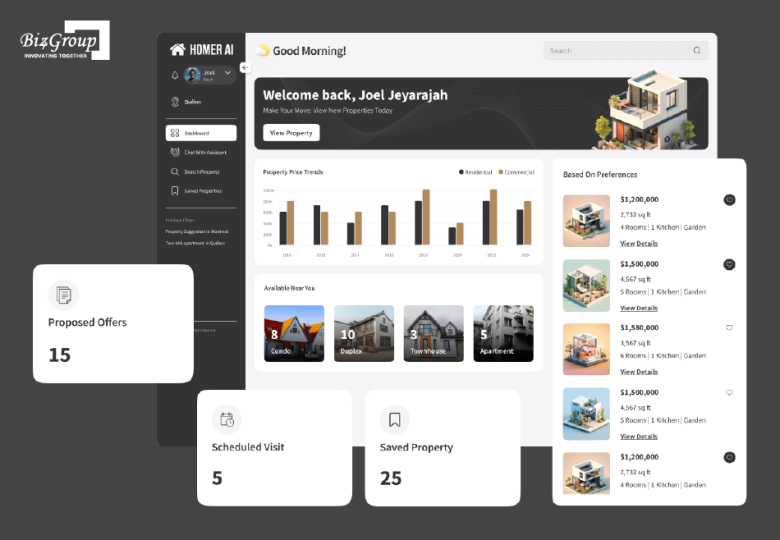
The handoff rule is the part to design carefully. Decide in advance which topics always go to a person, such as complaints, legal questions and anything about money.
How does orchestration hand work from one agent to another?
Agents hand work through an orchestrator, which decides who acts next, tracks the task's status and stops the process when a rule says to ask a person. A buyer's inquiry shows the flow:
- The buyer sends a question about a listing.
- The orchestrator classifies it as a general question or a request to reach an agent.
- The support agent answers general questions from listing data, or passes the inquiry on.
- The lead routing agent assigns it to the right agent with the listing attached.
- The orchestrator logs every step, so any outcome can be traced afterward.
The log is not optional. It is how you find out why an agent did something, and it is the first thing a reviewer or an attorney will ask to see. Multi-agent AI for real estate marketplaces also needs clear limits on which agent may call which tool, so a support agent cannot reach moderation controls by accident.
The workflow around the agents, such as notifications, scheduled checks and queue handling, is ordinary automation, and AI automation services can wire it to the rest of your platform.
Where should human-in-the-loop oversight sit in a multi agent AI system for real estate?
People should stay in charge of anything sensitive, irreversible or financial, and the oversight should be written down. NIST's AI Risk Management Framework says processes for human oversight should be defined, assessed and documented, that roles and responsibilities should be clear and that systems should be tested before deployment and regularly while in operation. It also calls for post-deployment monitoring plans.
For AI agents for real estate operations, that translates into approval gates:
- Removing a listing or banning a user, since either affects someone's income.
- Anything involving money, such as refunds, billing changes or lead pricing.
- Legal or compliance questions, which should always reach a person.
- Messages sent to many users at once, where one mistake is multiplied.
Name an owner for each gate. An approval step with no owner is just a delay.
What happens when an agent is wrong, and how do guardrails and an audit log help?
Agents will sometimes be wrong, so design for it and say so plainly where the stakes are higher. Pricing suggestions, valuation estimates and contract summaries are the outputs most likely to be relied on, which makes them the ones that need the clearest handling:
- Label the output as AI-generated, next to the output and not buried in the terms.
- Show it as a draft or an estimate, never as a decision.
- Link back to the source, such as the clause a contract summary came from or the sales an estimate used.
- Give a one-click way to reach a person.
- Never let an agent commit a price, a contract term or an offer on its own.
A summary tool like the one in Contracks, which condenses long contract documents for agents and brokers, is only as useful as the reader's ability to check it against the original.
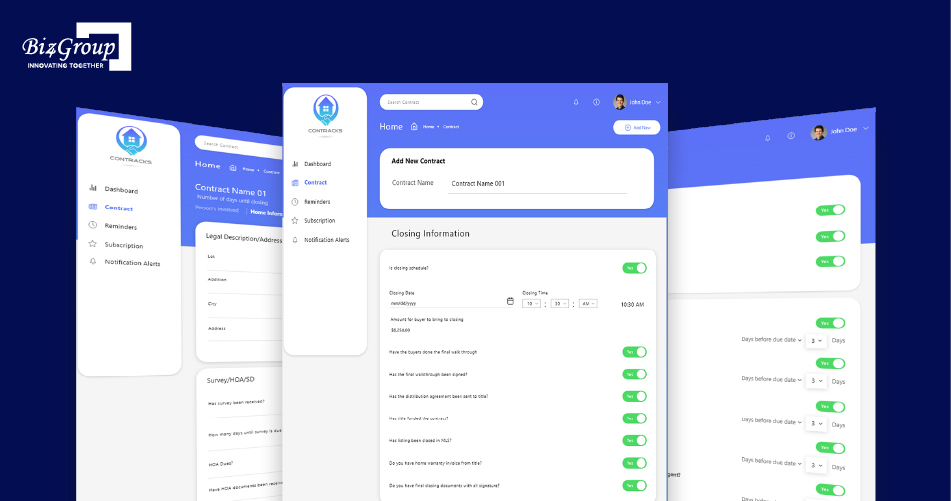
How does fair housing apply to multi-agent AI for real estate marketplaces?
Fair housing applies to any agent that matches, ranks, screens or targets housing, and HUD has said the Fair Housing Act covers those tasks when AI performs them. The risk differs by agent:
- Matching agent: keep protected characteristics and close proxies out of its inputs, and review who is shown what.
- Lead routing agent: route by availability and fit, not by traits of the buyer.
- Moderation agent: apply the same rules to every user and track who gets flagged.
- Support agent: keep its answers consistent regardless of who is asking.
Have counsel review the design. This section is information, not legal advice.
In what order should you build a multi-agent AI system for real estate?
Build one agent first, wrap it in oversight and logging, and add agents one at a time. A sensible order has seven steps:
- Pick one task and define what success looks like.
- Build a single agent with the tools and limits that task needs.
- Add logging and a handoff to a person before anything else.
- Test with real cases, including the awkward ones and the ones it should refuse.
- Add a second agent and the orchestrator once the first is stable.
- Monitor after launch, watching for model drift as listings and policies change.
- Add further agents only when a single one cannot hold its job.
What does multi-agent AI system development add to a marketplace's cost?
Multi-agent AI system development adds orchestration, testing and monitoring on top of each agent's own build, so it is best quoted as its own line. This guide gives no figure, because it depends on how many agents you build and how much oversight each needs. The full cost breakdown shows how hours and team rates add up to a figure for your own scope.
Not Sure Where Agents Should Start?
Share your marketplace's busiest task and get a recommendation on the first agent to build.
Talk to Our TeamThe balance a multi-agent system has to strike
A multi-agent system works when each agent has a narrow job, every handoff is logged and a person owns every sensitive decision. The agents save time on routine matching, screening and answers, and the oversight keeps one bad output from turning into a bad outcome. If you want a team to design and test the agents with you, reach out to Biz4Group.
Frequently asked questions
1. Do you need your own data to start?
You need listing data and your help content, and little else at first. Matching, moderation and support agents all work from those. Your own history of inquiries and moderation decisions becomes valuable later, when you want to test and tune the agents against real cases.
2. Can the agents work with an existing CRM?
Yes, if the CRM has an API the agents can call. Give each agent only the access its job needs, test the connection with sample records before real ones and log every call the agents make to it.
3. How is a multi-agent system different from a chatbot?
A chatbot answers questions in a conversation. A multi-agent system also takes actions across your tools, such as routing a lead or holding a listing for review, and passes work between specialists. That ability to act is why it needs approval gates and logs that a chatbot does not.
4. Will agents close deals faster?
They can shorten the routine steps, such as replying to an inquiry or screening a new listing, but whether deals close faster depends on much more. Measure what the agents directly affect: reply time, the share of questions resolved without a person and how long a flagged listing waits for review.
5. When should you add another agent?
Add one when a single agent's job has grown so broad that you can no longer test it reliably, or when you need to give different tasks different permissions. If neither is true, keep the agent you have.
6. How do you test agents before launch?
Run scenario tests with real cases, including ones the agent should refuse, and test each handoff to a person. Read the logs from those runs, fix what they show and repeat. Keep the same test set so you can see whether a change made things better or worse.
