 Location :
Orlando, FL, USA
Location :
Orlando, FL, USA +1 (407) 714-1616
 info@biz4group.com

 AI Summary Powered by Biz4AI
- 1031 exchange technology helps organize documents, deadlines, transaction data, communication, and exchange records, while QIs and tax professionals retain decision-making responsibility.
- AI is most useful for document extraction, summaries, classification, search, alerts, and workflow automation, not for independently determining tax eligibility.
- The 2026 market spans QI platforms, exchange technology providers, tax technology, property tax tools, financial platforms, and custom AI development.
- Choosing between adopting, integrating, or building depends on workflow complexity, required integrations, security, scalability, and control over proprietary data.
- For custom platforms, experienced real estate AI developers such as Biz4Group can connect property data, documents, transactions, AI workflows, integrations, and human review into one solution.
1031 exchanges have a funny way of turning a tax strategy into an admin marathon. A property sells, replacement options need tracking, documents move between people, and the clock keeps moving. That's where 1031 exchange technology gets interesting.
In a March 2026 survey of 407 investors and real estate professionals, 74% of investors who completed their first 1031 exchange became repeat exchangers. Meanwhile, NAREIM's 2026 survey found institutional real estate firms rated their AI maturity at 5.7/10, even though 91% had deployed Microsoft Copilot.
We've seen this shift across the real estate platforms we've built over more than 20 years. And we figured that the hard part isn't getting AI to read a document or make a recommendation. It's making that output useful inside the workflow.
That's what shaped our work on Contracks, where contract management, document summaries, deadlines, reminders, transaction details, and financial responsibilities come together in one workflow. The takeaway is that the AI works best when it reduces manual effort without removing the professionals from the process.
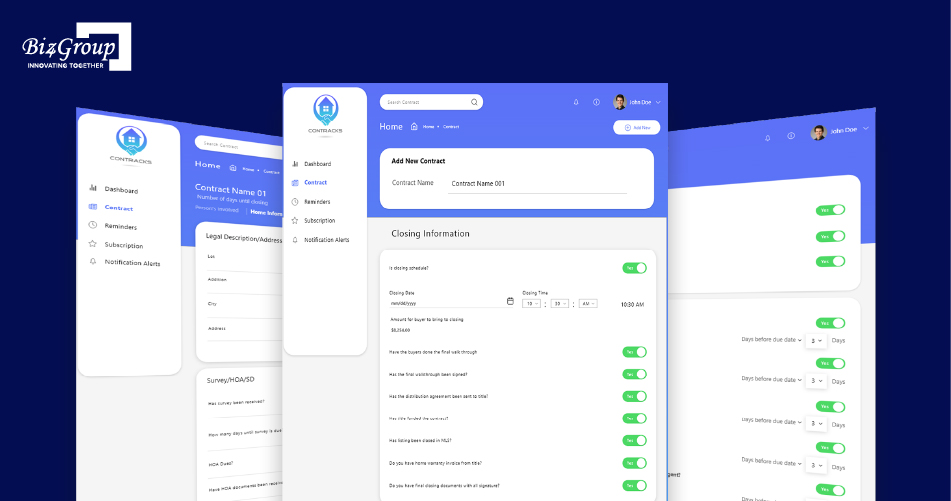
That matters in 1031 exchanges, where deadlines, documents, transaction records, and tax workflows all need to stay aligned. AI can help surface and organize the information. The judgment stays with the experts.
So, which companies are actually putting that idea into practice? Let's find out.
What Is 1031 Exchange Technology, and Where Does a Qualified Intermediary Fit?
A 1031 exchange lets investors defer certain capital gains when exchanging qualifying real property held for business or investment, subject to IRS rules. 1031 exchange technology supports the workflow around an exchange. A Qualified Intermediary (QI) performs the intermediary function itself. One is a technology layer, and the other is a participant in the exchange structure.
1. What Does a Qualified Intermediary Do?
A QI facilitates a deferred exchange under a written exchange agreement. Under IRS rules, the QI can acquire and transfer the relinquished property, acquire and transfer the replacement property, and handle the exchange proceeds within the required arrangement.
In practice, the roles are different:
- QI: facilitates the exchange and handles the responsibilities defined by the exchange agreement.
- 1031 exchange technology: manages information, documents, tasks, deadlines, and communication around that exchange.
2. What Does 1031 Exchange Technology Handle?
The technology layer can centralize the administrative work that otherwise gets scattered across email, spreadsheets, shared drives, and portals.
Common capabilities include:
- Document collection and organization
- Deadline and task tracking
- Exchange status updates
- Notifications and communication
- User access and permissions
- Connections to accounting, CRM, tax, or transaction systems
These capabilities can reduce manual data entry and document searching while giving QIs, advisors, and investors a clearer view of what needs to happen before the exchange moves forward.
3. Where Do Technology-Powered QIs Fit?
A technology-powered QI combines both sides, the provider performs the QI function and gives users a digital platform for managing the exchange.
A separate QI technology provider may supply the infrastructure a QI uses without performing the QI role.
That makes one question essential when reviewing vendors: “Are they QI, the technology provider, or both?”
4. How Does Real Estate Tax Technology Go Beyond 1031?
Real estate tax technology covers tax and financial workflows beyond the exchange itself. Depending on the provider, that may include:
- Depreciation
- Cost segregation
- Property tax management
- Tax reporting
- Accounting records
- Investment and transaction data
This broader category matters because exchange data does not disappear when the transaction ends. The same property and transaction information may later feed accounting, depreciation, reporting, and investment workflows.
How Did We Pick These 10 Companies for 1031 Exchange Technology?
We screened companies using four basic requirements. They needed clear U.S. relevance, a documented connection to 1031 exchanges, real estate tax, or related workflows, technology as a meaningful part of the offering, and enough public information to verify their capabilities.
Once they passed that screen, we compared them across six practical areas:
|
Factor |
What we looked at |
|---|---|
|
1031 Exchange Coverage |
Deferred, reverse, improvement, or related exchange workflows |
|
AI Evidence |
Documented AI capabilities rather than generic automation or AI labels |
|
Tax Technology Depth |
Cost segregation, depreciation, property tax, reporting, and related workflows |
|
Workflow & Integrations |
CRM, accounting, tax, transaction, MLS, and other system connections |
|
Users & Access |
Investors, QIs, CPAs, advisors, enterprises, or multiple user groups |
|
Pricing Transparency |
Published fees, subscriptions, or custom-quote models |
The list covers QI platforms, 1031 technology providers, real estate tax technology, investment platforms, and custom AI development because these categories address different parts of the same broader workflow.
We also separate vendor information by evidence level. Documented means supported by credible source material, company claim means stated by the provider, and estimate means our interpretation based on available information. This is especially important for AI, where OCR, automation, chatbots, and generative AI should not be treated as interchangeable.
The result is a practical comparison based on fit, capabilities, users, integrations, and pricing, rather than a popularity contest.
Where Does AI Fit in the 1031 Exchange Workflow, and Where Does It Stop?
AI fits best where a 1031 exchange gets information-heavy. Automation handles the predictable stuff, like sending a deadline reminder, routing a document, or updating a task after a signature. AI steps in when the information needs some interpretation, such as pulling details from documents, summarizing agreements, finding records across connected systems, or flagging something that looks incomplete.
A practical AI for 1031 exchanges workflow comes down to a simple chain,
AI capability → data → workflow → output → human review.
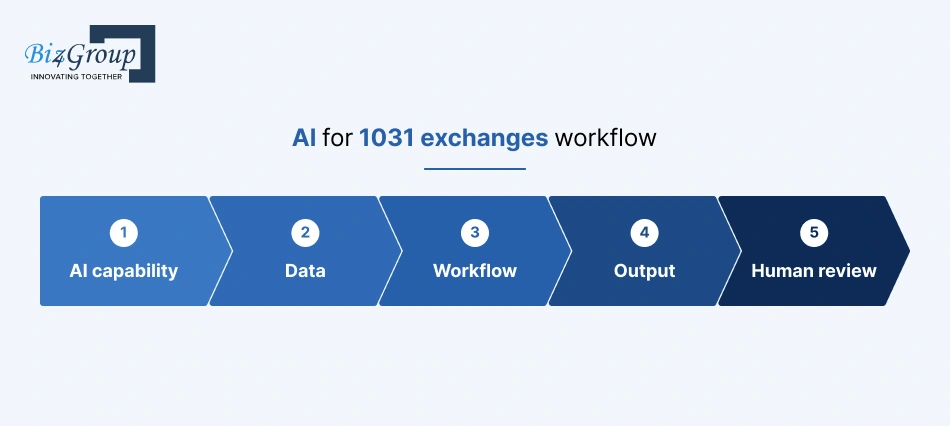
The goal is to take some of the manual digging off the team’s plate while keeping tax treatment, exchange eligibility, and other judgment calls with the right professionals.
1. Before the Exchange: Planning, QI Engagement, and Documentation
Before the transfer, AI can help organize the information needed to prepare the exchange.
- Extract property and transaction details from documents
- Identify missing or inconsistent information
- Organize contracts and supporting records
- Create task lists and surface upcoming actions
- Prepare information for QI, CPA, attorney, or investor review
These capabilities can reduce manual data entry and document searching.
They do not make the AI responsible for determining whether a transaction qualifies for Section 1031 treatment. The IRS rules generally apply to qualifying real property held for business or investment, with specific exclusions.
2. During the Exchange: Proceeds, the 45-Day Identification Period, and the 180-Day Exchange Period
This is where 1031 exchange technology can provide the most visible workflow support.
For a deferred exchange, replacement property generally must be identified within 45 days after the relinquished property is transferred. The replacement property must generally be received by the earlier of 180 days after the transfer or the applicable tax-return due date, including extensions.
Technology can:
- Track the 45-day and 180-day deadlines
- Send reminders and task alerts
- Organize identification documents
- Extract transaction information
- Show exchange status
- Maintain communication and document records
The QI remains responsible for the exchange arrangement and proceeds. AI can support the workflow, but it should not be treated as the authority on whether an identification is valid or a tax requirement has been met.
3. After the Exchange: Records, Depreciation, Cost Segregation, and Tax Reporting
The data generated during an exchange can continue into broader real estate tax technology workflows.
That may include:
- Depreciation records
- Cost segregation
- Asset and property records
- Accounting reconciliation
- Tax reporting
- Investment and portfolio reporting
AI can extract, organize, and connect information across systems, but professionals still need to validate the records and apply the relevant tax rules. AI supports the workflow; professional judgment and responsibility remain with the experts.
Ready to Take Some of the Busywork Off Your Plate?
If your 1031 workflow still involves spreadsheets, inbox archaeology, and sticky-note deadline reminders, AI can do better.
Talk to the AI ExpertsSo Who Actually Made the Cut? 10 AI 1031 Exchange and Real Estate Tax Technology Companies
The 10 companies below approach 1031 exchange and real estate tax technology from very different angles. Some combine QI services with digital exchange tools, some build technology specifically for QI firms, while others focus on tax workflows, property finance, or custom real estate platforms.
The table puts those differences side by side, covering 1031 support, AI capabilities, tax functionality, users, access, pricing, and what sets each provider apart. It gives you a quick way to see which companies are closest to your use case before digging into the details.
|
Company |
Category |
1031 Support |
AI & Evidence Level |
Tax Technology |
Primary Users & Access |
Pricing Model |
Differentiator |
|---|---|---|---|---|---|---|---|
|
Deferred |
QI + technology platform |
Direct: forward, reverse, improvement |
Company claim: AI-powered exchange platform; specific AI workflows not fully disclosed |
Exchange administration, fund handling |
Investors; online access |
$0 standard forward exchange; reverse from $7,000; improvement from $7,500 |
Digital-first QI experience with published forward-exchange pricing |
|
QI + technology platform |
Direct: forward exchange workflow |
Company-described AI: Clera AI assistant for milestones, transaction data, and 1031-related questions |
Exchange records, deadlines, trust-account visibility |
Investors, advisors, QI teams |
$500 admin exchange fee + $22-$144/member/month plans |
AI assistant built into QI workflow |
|
|
1031 exchange technology provider |
Technology support: QI administration workflows |
Company-described AI: Ally AI for questions, updates, and deadline flags |
Exchange documents, identification rules, portals |
QIs, RIAs, attorneys, wealth managers |
$2,499-$5,998/month; custom tier |
QI-focused workflow with CRM integrations and white-label options |
|
|
QI + technology platform |
Direct: forward, reverse, improvement, specialty |
Not publicly substantiated: automation documented |
Exchange management, reporting, e-signatures |
Investors and QI firms |
Custom quote |
Established QI infrastructure plus Exchange Manager Pro |
|
|
Real estate tax technology |
No direct 1031 service |
Documented company claim: AI-assisted parsing, aggregation, and classification with expert review |
Cost segregation |
Investors, tax professionals |
Property-specific quote |
AI-assisted cost segregation with human technical review |
|
|
Real estate tax technology |
No direct 1031 service |
Documented: AI-assisted property-data collection |
Cost segregation, 481(a) schedules, audit support |
Property owners, investors, tax preparers |
Starts at $495 for published residential pricing |
Self-guided cost segregation backed by a specialty tax firm |
|
|
Property tax technology |
No direct 1031 service |
AI not publicly substantiated: technology and automated data processing documented |
Property tax appeals |
Property owners and investors |
25%-35% of savings; no upfront fee under stated model |
Contingency-based property tax appeal service |
|
|
Real estate financial/tax technology |
No direct 1031 service |
Documented: AI and rules-based transaction categorization |
Bookkeeping, property tracking, tax packages, cost segregation |
Rental-property owners and investors |
$0 Core; $20/month Smart |
Property-level financial data and tax workflow |
|
|
Custom real estate AI development |
Custom build: 1031 workflows can be developed to requirements |
Documented project experience: property recommendations, document analysis, workflow AI |
Custom real estate tax and transaction workflows |
QIs, investors, advisors, enterprises; project-based access |
$25,000+ minimum; $50-$99/hour listed on Clutch |
Builds around proprietary workflows, data, integrations, and user roles |
|
|
Real estate investment platform |
No direct 1031 service |
Documented: JunieAI agents for fund and investor workflows |
Fund accounting, reporting, compliance, investor operations |
Institutional GPs and private-market firms |
Custom quote |
Deep fund-operations data model with AI and API capabilities |
Pricing reflects current public figures reviewed for this article. The pricing models vary by service and are not directly comparable.
1. Deferred
Deferred is a Qualified Intermediary with a digital 1031 exchange platform. It supports forward, reverse, and improvement exchanges. Its workflow brings exchange administration, documents, deadlines, and funds into an online experience.
- AI evidence: Deferred describes its platform as AI-powered and says it uses AI and automation to simplify exchanges and reduce manual work. Specific AI tasks and underlying data are not publicly detailed, so this remains a company claim.
- Pricing: Standard forward exchanges are advertised at $0, with a stated 2.00% APY based on rates as of September 19, 2026. Reverse exchanges start at $7,000 and improvement exchanges at $7,500.
- Founded and location: Founded in 2024, the company is headquartered in Dover, Delaware
- Best suited for: Investors looking for a QI with online exchange management, transparent forward-exchange pricing, and technology-led administration.
2. i1031
i1031 combines Qualified Intermediary services with 1031 exchange technology. It covers deadline tracking, property identification, trust-account visibility, digital records, messaging, and compliance checkpoints. Its Clera assistant adds an AI layer to the exchange workflow.
- AI evidence: Clera is described as a contextual AI co-pilot and compliance monitor that works with transaction milestones, escrow and fund status, replacement-property data, and IRC 1031 logic. The underlying model details are not publicly disclosed.
- Pricing: The public plans start at $22 per member/month, with higher tiers at $46, $124, and $144 per member/month, plus a $500 administrative exchange fee per relinquished property.
- Founded and location: Founded in 2008, based in La Jolla, California.
- Best suited for: Investors, advisors, and exchange teams wanting a digital QI workflow with AI-assisted transaction visibility.
3. DeferAlly
DeferAlly is a 1031 exchange technology provider for QIs, wealth managers, attorneys, and RIAs. Its platform combines exchange documents, e-signatures, escrow tracking, identification rules, deadline management, client portals, and CRM connectivity.
- AI evidence: Ally AI can draft client updates, answer 1031 questions, and flag deadlines. The company does not publicly specify the model or full source-data architecture.
- Integrations: It supports two-way Salesforce and HubSpot sync, CSV imports, APIs, white-label portals, and multi-entity management.
- Pricing: Professional is $2,499/month and Elite is $5,998/month. A Custom tier uses tailored pricing and includes enterprise features.
- Founded and location: Founded in 2023 and is based in Atlanta, United States.
- Best suited for: QI firms handling multiple exchanges and looking for centralized, scalable 1031 exchange technology.
4. Accruit
Accruit provides Qualified Intermediary services and 1031 workflow technology through Exchange Manager Pro. The platform supports exchange records, documents, agreements, notifications, signatures, and standardized case workflows.
- AI evidence: Its public materials document workflow automation and real-time transaction management, but do not clearly identify a dedicated AI feature. Based on the available evidence, it is more accurate to classify the offering as advanced automation rather than AI-first technology.
- Integrations: Exchange Manager Pro is licensed to other QIs and organizations, with secure cloud hosting and configurable workflows.
- Pricing: Pricing is not public; platform and QI fees require a quote.
- Founded and location: Founded in 2000 is headquartered in Denver, Colorado.
- Best suited for: Complex exchange operations and QI firms that need established 1031 workflow technology.
5. Segtax
Segtax provides AI-enabled cost segregation studies. It combines automated data processing with cost segregation specialists. The workflow can use property details, closing documents, payment applications, drawings, and photos to structure the information needed for a study.
- AI evidence: Its platform extracts and structures property and document data, while specialists handle classifications, methodology decisions, review, and final sign-off.
- Pricing: Segtax uses a fixed-fee proposal based on the property and engagement rather than publishing one universal price.
- Founded and location: Founded in 2024 is headquartered in Richmond, Virginia.
- Best suited for: Real estate investors and tax professionals seeking AI-assisted cost segregation with human technical review.
6. KBKG / CostSegregation.com
KBKG provides specialty tax services, while CostSegregation.com offers a self-guided AI-powered cost segregation platform for residential and commercial properties.
- AI evidence: Users enter a property address, and AI finds public property information before users complete the remaining details. The platform also provides audit support, report corrections, and a 481(a) schedule.
- Pricing: Residential reports start at $495 for a $750,000 tax basis. That is a stated pricing point, not a universal price for every property.
- Founded and location: KBKG was established in 1999 and is headquartered in Pasadena, California.
- Best suited for: Property investors and tax preparers looking for a self-guided cost segregation workflow backed by a specialty tax firm.
7. Ownwell
Ownwell focuses on property tax technology and appeal services. It combines property data, technology, and local tax professionals to help owners challenge assessments. It serves homeowners, commercial owners, and real estate investors rather than 1031 exchanges.
- AI evidence: Ownwell documents technology and automated data processing, but its current public material does not establish a specific AI model or AI decision-making workflow.
- Integrations and access: Customers submit property details online, receive appeal updates, and work with local tax consultants who handle hearings and negotiations.
- Pricing: There is no upfront fee. Ownwell charges 25% to 35% of actual property tax savings, depending on the state.
- Founded and location: Founded in 2020, is based in Austin, Texas.
- Best suited for: Property owners and investors seeking technology-assisted property tax appeals.
8. Baselane
Baselane brings banking, bookkeeping, rent collection, and tax reporting together for rental property investors. Its connection to real estate tax technology comes from property-level financial records rather than direct 1031 administration.
- AI evidence: Baselane uses AI and custom rules to categorize transactions by entity, property, and tax category, then supports receipt matching and tax-package preparation.
- Integrations: It supports QuickBooks synchronization and property-level financial tracking.
- Pricing: Baselane Core is free; Smart is listed at $20/month and adds AI auto-tagging, receipt matching, and other automation.
- Founded and location: Based in New York, New York, was founded in 2020.
- Best suited for: Rental-property investors who need bookkeeping, transaction categorization, and tax-ready financial records.
9. Biz4Group
Biz4Group can custom-build AI 1031 exchange platforms around property data, transaction workflows, document management, deadline tracking, and professional review. Its real estate AI development work provides a foundation for tailoring 1031 exchange technology to a company's existing processes.
- AI evidence: Projects such as Homer AI and Contracks demonstrate AI-driven property recommendations and document workflows. Its 2026 1031 exchange guidance also covers document processing, property comparison, deadline support, and human oversight.
- Integrations: Custom builds can connect MLS, CRM, APIs, property data, and internal business systems depending on requirements.
- Pricing and reviews: Clutch lists a $25,000+ minimum project size, $50-$99/hour, and a 4.9/5 rating from 28 reviews.
- Founded and location: Founded in 2003, is headquartered in Orlando, Florida.
- Best suited for: QIs, real estate companies, investors, and enterprises that need a custom AI-enabled real estate tax platform built around their data and workflows.
10. Juniper Square
Juniper Square provides fund operations and investor management infrastructure for private-market firms, including real estate investment managers. Its platform connects fundraising, investor onboarding, fund accounting, treasury, compliance, investor reporting, and distributions.
- AI evidence: JunieAI agents support investor relations and fund operations using connected fund data, permissions, and audit trails. Juniper Square states that AI suggestions do not independently make fund lifecycle decisions and require human review.
- Integrations: Its developer API and Headless GPX connect with systems and AI clients, with integrations including HubSpot, Preqin, Outlook, DocuSign, and Yardi.
- Pricing: Custom pricing is available through sales; public pricing information was not found.
- Founded and location: Founded in 2014; based in San Francisco, California, with Austin also listed as a company location.
- Best suited for: Institutional real estate fund managers and private-market GPs that need connected fund, investor, and operational data.
The result is a practical cross-section of the market. It is covering exchange administration, tax workflows, investment operations, and custom AI. So instead of one “best” option, you can see which approach fits your actual need.
What Security, Governance, and Compliance Controls Should These Providers Have?
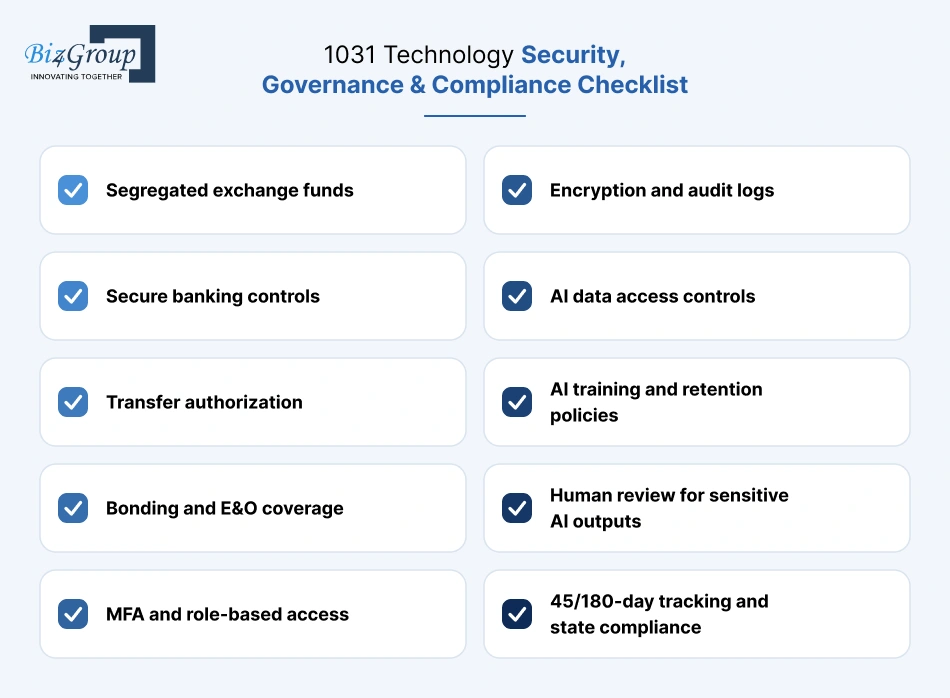
With 1031 exchange technology, the focus should stay on four areas that directly affect trust and usability. Fund protection, data security, AI governance, and clear compliance boundaries all matter, and the right controls will vary depending on whether the provider is the QI, supports a QI, or handles related tax and investment workflows.
1. Fund Protection: Segregated Accounts, Bonding, Insurance, and Banking
Exchange proceeds require tighter controls than ordinary transaction data. Treasury regulations recognize specific escrow and trust arrangements within the 1031 safe-harbor framework.
|
Control |
What to verify |
|---|---|
|
Fund segregation |
Exchange proceeds are separated from operating funds and other client assets |
|
Banking structure |
Where funds are held and which institution provides the accounts? |
|
Authorization |
Who can approve transfers or disbursements? |
|
Bonding and insurance |
Fidelity bond and E&O coverage, limits, exclusions, and policy dates |
|
Audit records |
Deposit, transfer, approval, and disbursement history |
These protections are not one-size-fits-all federal requirements. State laws can impose additional requirements on exchange facilitators, including financial assurance, bonding, or insurance. Buyers should therefore check the rules applicable to the provider's operating states.
2. Data Security: Access Controls, Audit Trails, and SOC 2
A provider may hold taxpayer information, exchange documents, bank details, property records, and transaction history. Core security controls should include:
- Multi-factor authentication
- Role-based or least-privilege access
- Encryption in transit and at rest
- Detailed audit trails
- Backup and disaster recovery
- Vendor and third-party risk controls
- Incident response procedures
- Data retention and secure deletion policies
For covered financial institutions, the FTC Safeguards Rule requires an information-security program and addresses controls such as access management, encryption, MFA, application security, and secure disposal. Applicability depends on the entity and its activities.
One terminology point matters, SOC 2 is an attestation report, not a certification. The AICPA Trust Services Criteria cover security, availability, processing integrity, confidentiality, and privacy. Ask for the report scope and audit period rather than treating a SOC 2 claim as a blanket security guarantee.
3. AI Governance: Know What Data Goes into the Model
For AI for 1031 exchanges, the key questions are what the AI can access, what it produces, and who reviews the result.
|
AI control |
Buyer question |
|---|---|
|
Data access |
Can the model access exchange documents, taxpayer data, property records, or financial information? |
|
Third-party models |
Is customer data sent to an external AI provider? |
|
AI Training use |
Is customer data used to train or improve AI models? |
|
Retention |
How long are prompts, documents, and outputs stored? |
|
Human review |
Which outputs require QI, CPA, attorney, or other professional review? |
|
Accuracy testing |
How are extraction errors, hallucinations, and incorrect outputs tested? |
|
Auditability |
Can users trace an AI output back to the source data? |
The NIST AI Risk Management Framework emphasizes AI characteristics including validity and reliability, security, privacy, transparency, explainability, and accountability.
For a tax-sensitive workflow, that means AI can extract, summarize, classify, search, and flag information, while decisions affecting exchange eligibility or tax treatment remain subject to appropriate professional review.
4. Compliance Boundaries: Technology Is Not Tax Advice
A good 1031 exchange technology platform should clearly separate workflow automation from professional judgment.
|
Technology can support |
Professional responsibility |
|---|---|
|
Track 45-day and 180-day deadlines |
Determine whether an exchange qualifies |
|
Organize identification documents |
Evaluate identification and tax treatment |
|
Extract transaction information |
Review whether extracted data is correct |
|
Summarize agreements |
Interpret legal or tax consequences |
|
Flag missing information |
Decide what action the transaction requires |
The IRS states that replacement property generally must be identified within 45 days and received within 180 days or the applicable tax-return due date, including extensions, whichever is earlier. A platform can track those deadlines, but it cannot extend them or determine that a missed requirement is harmless.
The same principle applies to real estate tax technology. A platform can organize records and surface information, but it should not blur the line between technology output and tax advice. State requirements can also differ for QIs and exchange facilitators, so compliance should be evaluated by jurisdiction rather than assumed to be uniform nationwide.
Before choosing a provider, verify four things: where exchange funds are held, who can access sensitive data, what the AI can process, and where professional review is required.
What Does 1031 Exchange and Real Estate Tax Technology Cost?
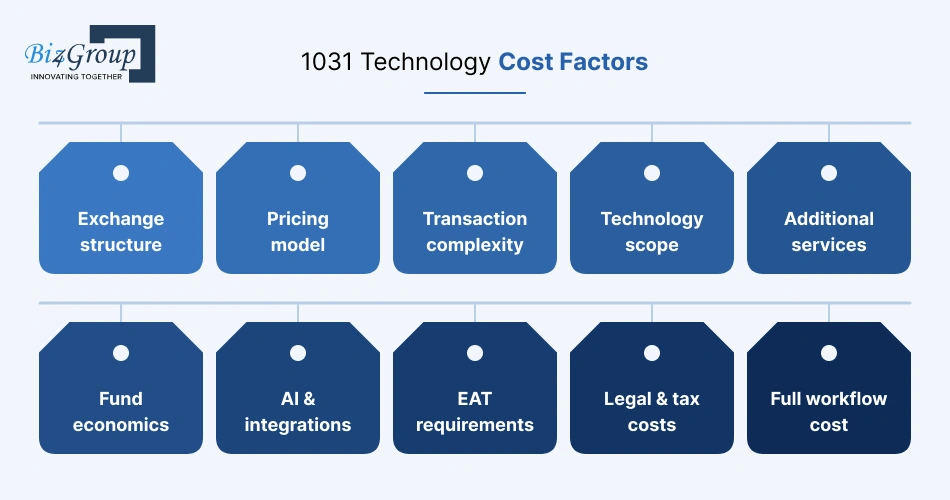
A standard 1031 exchange usually adds around $750-$1,500 in QI fees. Reverse exchanges can run $5,000-$15,000+, while improvement exchanges may reach $7,500-$15,000+, before you factor in legal, financing, title, and tax-advisor costs.
On the technology side, pricing can range from about $20/month for investor tools to nearly $6,000/month for QI platforms. And when you need a custom AI platform, development can start around $25,000 and go well beyond $250,000, depending on how much you need it to do and integrate.
1. How Pricing Works: Per-Exchange Fees, No-Fee Models, Subscriptions, and Contingency Fees
Providers use different pricing models, so comparing the headline fee alone can be misleading.
|
Pricing model |
What you pay |
|---|---|
|
Per-exchange fee |
$750 for a standard forward exchange |
|
No-fee model |
$0 for its standard forward exchange |
|
QI technology subscription |
$2,499-$5,998/month |
|
Investor financial platform |
$0/month Core; $20/month Smart |
|
Contingency fee |
25%-35% of property-tax savings, depending on state |
|
Cost segregation study |
$495 residential; $1,295 commercial at published example tax bases |
|
Custom AI development |
$25,000-$250,000+ as a practical planning range |
2. Reverse and Improvement Exchanges Cost More
The exchange structure is one of the biggest pricing variables.
|
Exchange type |
Typical 2026 range |
What usually affects the cost |
|---|---|---|
|
Standard forward |
$750-$1,500 |
Number of properties, transaction complexity, and additional administrative services |
|
Reverse |
$5,000-$15,000+ |
EAT structure, property holding period, financing requirements, and transaction complexity |
|
Improvement / construction |
$7,500-$15,000+ |
Construction scope, fund disbursements, EAT involvement, documentation, and project complexity |
Reverse exchanges typically cost more because they may require an Exchange Accommodation Titleholder (EAT) to temporarily hold title. Improvement exchanges can add construction administration, financing, documentation, and additional property controls.
The range can also vary by transaction size and structure. For example, Atlas 1031 lists forward exchange fees of $900 for transactions below $800,000 and $1,200 above $800,000, while reverse and construction exchanges start at $5,125. Additional EAT and transaction-related charges may apply.
3. How Providers Make Money, Including Interest on Exchange Funds?
A no-fee 1031 exchange does not necessarily mean the provider has no revenue from the transaction. Exchange proceeds may remain with the intermediary while the transaction is completed, and the treatment of interest or other earnings depends on the agreement.
IRS guidance specifically recognizes interest or growth factors in deferred exchanges and provides rules for how exchange funds held by facilitators are treated.
The difference can be substantial when large balances are held for months.
For example, at a purely illustrative 2.00% annual rate:
|
Exchange funds |
Approx. interest over 180 days* |
|---|---|
|
$500,000 |
~$4,932 |
|
$1 million |
~$9,863 |
|
$5 million |
~$49,315 |
|
$10 million |
~$98,630 |
A simple 2.00% annualized rate on $1 million held for 180 days works out to roughly $9,863 in interest, before compounding, taxes, or contractual adjustments.
4. Hidden Costs to Ask About
The QI fee is not necessarily the full exchange budget. Ask about:
- Additional relinquished or replacement properties
- Wire or transfer fees
- Reverse-exchange EAT and title costs
- Improvement or construction administration
- Legal review
- Financing or lender-related costs
- CPA and tax-return preparation
- Cancellation or termination fees
- How interest on exchange funds is handled
Atlas 1031 lists $400 for each additional property, with reverse exchanges potentially adding EAT and transfer-related fees.
For planning, one current 2026 cost guide estimates $2,000-$5,000 for a straightforward exchange and $8,000-$26,000 for a reverse exchange, including QI, legal, and tax-advisory costs. These are planning ranges, so get an itemized quote for the actual transaction.
5. What Real Estate Tax Technology Costs?
The broader real estate tax technology market uses several pricing models:
- Cost segregation: Usually priced per study, with entry-level studies starting around $495. Complex properties can cost more.
- Property tax appeals: Commonly charged at 25%-35% of actual savings, often with $0 upfront.
- Rental-property technology: Basic plans can start at $0/month, with paid plans around $20/month for added automation and tax features.
- 1031 QI technology: Individual plans can start around $22/member/month, while firm-level platforms can run roughly $2,500-$6,000/month.
- Custom AI development: A tailored AI-enabled real estate tax platform or 1031 system can range from $25,000-$250,000+, depending on integrations, security, AI functionality, and workflow complexity.
For a standard exchange, budget roughly $750-$1,500 for QI fees, with reverse or improvement exchanges, tax services, additional properties, and custom technology increasing the total.
Should You Adopt, Integrate, or Build 1031 Exchange Technology?
The right choice depends on how closely your workflow matches existing products. Adopt when standard exchange capabilities are enough, integrate when your systems need to work together, and build when your processes, data, or client experience are unique.
|
Approach |
Best fit |
Main advantage |
Main limitation |
|---|---|---|---|
|
Adopt |
Standard exchange workflows |
Faster deployment |
Limited customization |
|
Integrate |
Firms with established systems |
Connects existing data and workflows |
Integration complexity |
|
Build |
Proprietary or complex workflows |
Full control over product and AI |
Greater planning and implementation effort |
1. Adopt an Existing Platform or Work With a Technology-Powered QI
Adoption makes sense when your workflow is close to what the market already supports. Existing 1031 exchange technology can cover document collection, deadline tracking, client communication, signatures, exchange records, and related administration.
Choose this route when:
- Your exchange process is mostly standard
- You need to launch quickly
- You do not need extensive customization
- A QI platform already covers your required controls
2. Integrate With Your CRM, Accounting, Tax, and Settlement Systems
Integration is the middle ground when replacing your existing systems does not make sense. Instead of creating another isolated application, connect exchange data with the tools your teams already use.
|
System |
What integration can support |
|---|---|
|
CRM |
Client details, tasks, exchange status |
|
Accounting |
Transaction and financial records |
|
Tax systems |
Property and transaction information |
|
Settlement/title |
Closing details and documents |
|
Document systems |
Agreements, records, signatures |
|
APIs |
Data exchange across applications |
3. Build Custom When Your Workflows Are Proprietary
Custom development makes sense when a standard platform does not fit your 1031 exchange workflow. Before choosing a development partner, ask:
- Can you map our current process first? The team should understand how QIs, investors, CPAs, and operations staff handle each step.
- What should AI automate? Look for a clear division between AI tasks such as document extraction and summaries, and fixed logic for deadlines, validations, and calculations.
- What data will AI use? Ask how exchange documents, property records, transaction data, and approved sources will be connected and protected.
- Can it connect to our existing stack? Look for APIs and integrations with CRM, accounting, tax, settlement, document, or banking systems.
- Where does human review remain? Critical outputs should have clear approval or verification points.
A company such as Biz4Group can bring those requirements together through custom AI architecture, AI integrations, and workflow design. Its work on Homer AI and Contracks demonstrates experience with property recommendations, document analysis, contract tracking, alerts, and transaction workflows, while its AI 1031 exchange approach applies those capabilities specifically to exchange workflows.
For the end user, that could mean:
- QIs: exchange status, deadline alerts, missing documents, and approvals
- Investors: properties, transactions, and documents in one view
- CPAs and advisors: source records and AI-generated summaries for review
- Operations teams: automated routing, follow-ups, and notifications with an audit trail
The right partner should fit the technology to your workflow, automate the right tasks, and keep tax-sensitive decisions under professional control.
Your Workflow Is Unique. Your Platform Can Be Too.
When off-the-shelf tools make your team work around the system, it may be time to build around how you actually work.
Build Your Custom AI PlatformHow Do You Shortlist the Right 1031 Exchange Technology Provider?
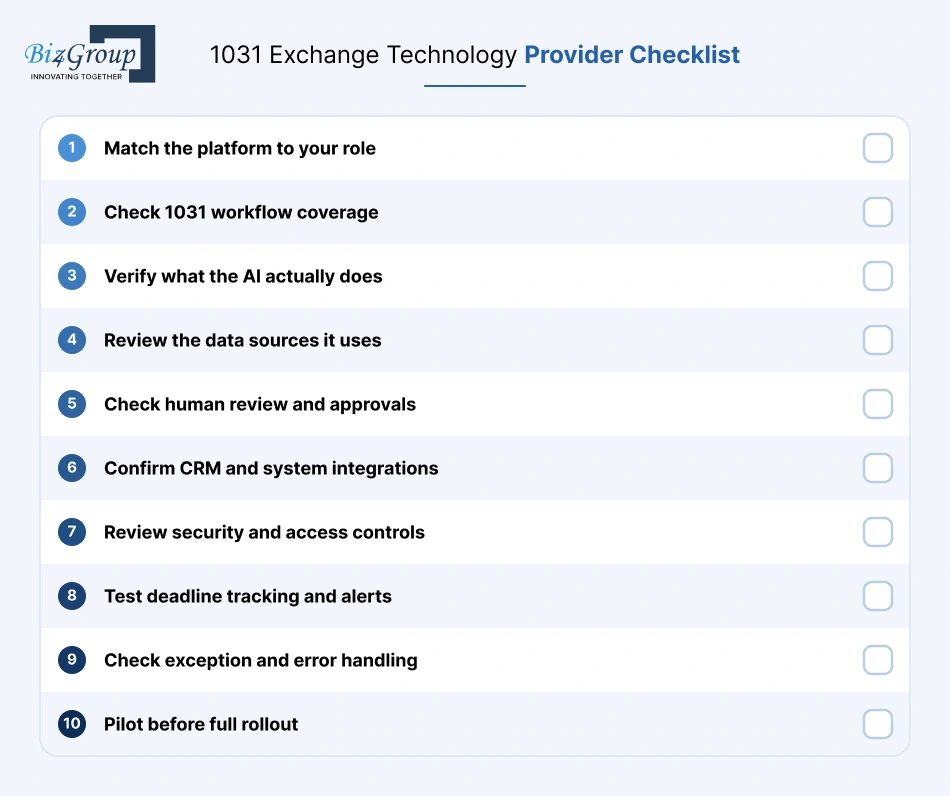
The right 1031 exchange technology provider depends on your role and workflow. Investors may need simple tracking and alerts, while QIs, CPAs, advisors, and enterprises often need deeper controls, integrations, and reporting.
|
Role |
Priorities |
|---|---|
|
Investor |
Documents, deadlines, communication, ease of use |
|
QI |
Exchange workflows, approvals, portals, audit trails |
|
CPA / Advisor |
Source records, data accuracy, review controls |
|
Enterprise |
APIs, security, permissions, scalability |
1. Match the Provider to Your Role
Start with the problem the provider needs to solve, not the size of its feature list.
- Investors: Check document access, deadline tracking, alerts, and communication.
- QIs: Look for exchange administration, identification tracking, approvals, portals, and reporting.
- CPAs and advisors: Prioritize source documents, transaction records, exports, and review controls.
- Enterprises: Add APIs, system integrations, role-based access, audit trails, security, and scalability.
2. Questions to Ask Before the Demo
Ask for specific, verifiable answers:
- What does the AI actually do? Extraction, classification, summaries, search, or rule-based automation?
- What data does it use? Exchange documents, transaction records, property data, or third-party sources?
- How are outputs reviewed? Where can users verify, correct, or approve results?
- Can it integrate with our stack? Ask about CRM, accounting, tax, settlement, document, banking, and API connections.
- How does it handle 1031 deadlines? The platform should track required timelines without implying it can change them.
- What security evidence is available? Ask about SOC 2, encryption, access controls, audit logs, and data retention.
- What happens when the system is uncertain or wrong? Look for exception handling and human escalation.
3. From Pilot to Production
Test the platform on one real workflow before expanding it across the business.
Pilot → Validate → Integrate → Roll Out
Start with document processing, deadline alerts, data matching, AI summaries, permissions, and exception handling. Measure accuracy, time saved, manual steps removed, integration reliability, and user adoption.
Once the results are consistent, connect the remaining systems, train users, and expand the rollout. This gives you evidence that the real estate tax technology or 1031 platform works in your actual workflow before making it business-critical.
Final Takeaway
The right 1031 exchange technology should make the workflow easier, not the decisions riskier. Look for platforms that connect documents, property data, deadlines, communication, and reporting while keeping QIs, CPAs, and advisors in control of tax-sensitive decisions.
As NAR's Sharon Love-Bates puts it, “We need to use AI for the heavy lifting, but apply human judgment.”
That is a useful rule for evaluating both AI for 1031 exchanges and broader real estate tax technology:
- Automate repetitive information work
- Keep source data and audit trails visible
- Integrate with the systems your team already uses
- Require human review where judgment matters
The real decision comes down to how much control, flexibility, and integration your workflow needs. Start with the level of complexity your team can realistically support, then choose the technology approach that matches it.
The goal isn’t to choose the platform with the most AI. It’s to choose the one that removes manual work, improves visibility, and keeps professional judgment where it matters most.
Ready to explore a custom 1031 or real estate tax platform? Talk to Biz4Group about your workflow and technical requirements.
Frequently Asked Questions
1. Can existing exchange records from spreadsheets and email be moved into a new platform?
Yes, usually through CSV imports, document migration, APIs, or a structured data-migration process. The important question is whether the provider can preserve historical documents, transaction records, user permissions, and audit history rather than moving only basic client data.
2. Can a 1031 platform support multiple QI offices or business entities?
Many enterprise platforms can be structured for multiple entities, branches, teams, and user roles. Before choosing one, check whether data can be isolated by entity while administrators still have the reporting and oversight they need.
3. Can investors and advisors access the same exchange from different accounts?
Yes. A well-designed platform can give investors, QIs, CPAs, attorneys, and administrators different views and permissions within the same exchange. This can reduce email back-and-forth while limiting access to sensitive information.
4. What happens when a CRM or accounting integration fails?
The platform should have error handling rather than silently dropping the data. Look for sync status, failed-transaction alerts, retry mechanisms, activity logs, and manual reconciliation tools so the team can identify and correct missing information.
5. Can an AI system answer questions using only our company's approved documents?
Yes, with a controlled retrieval-based architecture. The AI can search approved internal records and return answers linked to source documents rather than relying only on its general model knowledge. This is especially useful for internal procedures, exchange records, and client-specific information.
6. Can the platform be white-labeled for clients?
Some provider platforms support white-label portals, custom branding, domains, and client-facing workflows. This can matter for QIs and advisory firms that want technology to operate under their own brand.
7. How can we test whether an AI feature is accurate before giving it real client data?
Use a controlled pilot with historical or de-identified records and measure extraction accuracy, missed information, incorrect answers, response consistency, and escalation behavior. Test difficult documents and exceptions, not just clean examples.
8. Can a 1031 exchange platform work with mobile devices?
A responsive web platform can generally support phones and tablets, while a dedicated mobile application can provide features such as push notifications, camera-based document capture, and mobile approvals. The right option depends on how frequently users work away from a desktop.
9. Can the technology continue to work if the business changes its QI, CRM, or accounting provider?
It should, provided the platform uses APIs, exportable data, documented integrations, and a clear data-ownership policy. Ask about data portability before signing a long-term contract.
10. What should a technical team ask for during a vendor demo?
Ask to see the actual workflow rather than a feature presentation. A useful demo should show a document entering the system, data being extracted, a deadline being created, users receiving the right permissions, an AI result being reviewed, and the final activity appearing in the audit trail.
